





Connect with us
DAPA Banner
DAPA Coin
DAPA
COIN PAYMENT ASSET
PRIVACY · BLOCKDAG · HOMOMORPHIC ENCRYPTION · RUST
ElGamal Encrypted MINE DAPA
🚫 GENESIS SOLD OUT
DAPAPAY COMING

Tech

Quantum ‘Jamming’ Could Help Unlock the Mysteries of Causality

Published

on

The original version of this story appeared in Quanta Magazine.

For the past few decades, researchers have understood that quantum computers should eventually be able to crack the widely used codes that secure much of the digital world. To protect against this fate, they’ve spent years developing new codes that appear to be safe from future safecrackers armed with quantum computers.

At the same time, they’ve also devised ingenious ways to use the rules of quantum mechanics to keep communications secure. But quantum mechanics, just like the “classical” mechanics that preceded it, is just a theory of nature. What if it eventually gets superseded by a fuller theory, just as quantum mechanics supplanted Newtonian physics a century ago? Will these quantum communication techniques still be secure in a world where there’s an even more fundamental set of rules?

“In terms of these cryptographic protocols, it’s good to be paranoid,” said Ravishankar Ramanathan, a quantum information theorist at the University of Hong Kong who works on quantum cryptography. “Let’s try to minimize the assumptions behind the protocol. Let’s suppose that at some future date people realize that quantum mechanics is not the ultimate theory of nature.”

Advertisement

It’s a possibility worth considering. The difficulty of outstanding problems—like reconciling quantum mechanics and gravity—suggests that a post-quantum theory of nature might involve something quite unexpected.

To guard against the possibility that their protocols are based on faulty assumptions, some quantum cryptographers search for even more basic principles to build upon. Instead of starting from quantum mechanics, they dig deeper, down to the very concept of causality.

A Subtle Sabotage

One way to understand developments in this area is to consider quantum key distribution, which involves taking advantage of the rules of quantum mechanics to pass along a key—something that can be used to decode a secret message—in a way that cannot be covertly tampered with. Quantum key distribution makes use of quantum entanglement, which locks two particles together through one of their properties, like spin. Quantum entanglement contains something of a trip wire. If anyone tries to mess with the entanglement—as they would if they tried to steal the key—the intrusion will destroy the entanglement, revealing the sabotage. This is because of a fundamental quantum mechanical principle called the “monogamy of entanglement.”

But what if this principle no longer held? In such a case, if the people passing the message did not have complete control of their devices, an outsider could potentially subtly change the particles’ entanglement, disrupting the communication without leaving a trace.

Advertisement

This process is called quantum jamming, and efforts to understand it have surged in recent years.

For many scientists, jamming is appealing because it can help them better understand both quantum mechanics and the nature of cause and effect. They wonder: Are there deep principles that forbid jamming, that make it impossible? Or, if no principle forbids it, could jamming occur in the real world?

Jim the Jammer

Michał Eckstein, a theoretical physicist at the Jagiellonian University in Krakow, Poland, likes to illustrate jamming with a story. Its protagonists are the classic characters from explanations of quantum mechanics, Alice and Bob.

“Suppose you have Alice and Bob, and they meet a magician, Jim the Jammer,” Eckstein said. “The magician says, ‘I have two balls; one is white, and one is black.’”

Advertisement

The balls stand in for a pair of entangled particles. If two particles are entangled, they have a property that is linked in some way—if you measure the first particle and find that its spin is up, for example, the other particle’s spin will inevitably be down, and vice versa. This holds true even if the other particle is halfway across the universe. Here the balls are linked such that if one is white, the other will always be black.

Source link

Continue Reading
Click to comment

You must be logged in to post a comment Login

Leave a Reply

Tech

The US Air Force Just Paused Its Entire T-38 Fleet

Published

on


The usual next step following an aircraft mishap is to pull that unit aside for inspection. Very rarely does it result in the entire fleet getting grounded. That only happens when the Air Force suspects a problem on one airframe might be present on every other one.

However, that’s exactly what’s happened with the T-38 Talon, the USAF’s primary trainer aircraft for fighter and bomber pilots. On May 12, one of these jets went down during a routine training mission in rural Alabama. Specifically, it was assigned to the 14th Flying Training Wing at Columbus Air Force Base in Mississippi. Both pilots ejected and survived, though one of them, a Japanese aviator trainee with the Japan Air Self-Defense Force, suffered a broken leg.

Advertisement

Weirdly, around the same time as this incident, a second T-38C was reportedly broadcasting 7700 on its transponder – the code pilots use to signal a general in-flight emergency. While the Air Force hasn’t confirmed whether the two aircraft were flying together, two separate incidents on the same day raise eyebrows.

As a result, a week later on May 19, the Air Force put the brakes on every single T-38 Talon in its fleet with a fleetwide operational pause. An Air Force press release noted that the pause “allows an ongoing Safety Board to locate and assess evidence” from the wreckage. As of writing, nobody knows how long the grounding will last. But as these aircraft clear inspections, they should individually trickle back into service. In the meantime, crews will have to stick with simulators to keep their hours up.

Advertisement

Why the T-38 is crucial

The T-38 Talon has been giving student pilots their first taste of supersonic flight since 1961, meaning it’s actually older than most of the people flying it. Northrop built more than 1,100 of them , and over 450 are still serving the USAF today. Even though it’s not designed to engage with enemies, it’s still crucial to the service since it’s the only advanced jet trainer in the Air Force’s inventory. Anyone destined for an F-22 Raptor, one of the most expensive jets ever built, or even the B-2 Spirit flies one of these first.

The latest variant of the jet is from 2001 and is called the T-38C. Even though it has a glass cockpit and updated engine components to increase available takeoff thrust, the underlying airframe is the same as the original. Inside, two General Electric J85 turbojets push the plane past Mach 1. The jet can also climb above 55,000 feet, so student aviators can learn the ropes.

Advertisement

Replacements are underway

Despite its workhorse status, this is still a pretty old jet. The Air Force is obviously aware of that and is already working on replacing it. The earliest retirements are set to kick off in 2027, with a full fleet phase-out targeted for the 2030s. As a replacement, the Boeing and Saab T-7A Red Hawk is supposed to take over by 2028 even though production of those jets only recently got greenlit in April 2026.

It’s fair to say, the T-38 is being used to its limits, and that’s exactly why the jet keeps showing up in incident reports like these. Its J85 engine alone is a huge headache to maintain. By 2020, the Air Force’s internal depot system was struggling so badly with overhaul backlogs that pilot training output was actually at risk. At the time, Lt. Gen. Brian Robinson, Air Education and Training Command boss told the Air Force Times, “It’s an old engine…There’s a lot of moving parts” The Air Force then awarded a $237 million contract to a company called StandardAero to fix things. Today, until the T-7A Red Hawk arrives in numbers, the Talon is stuck doing the heavy lifting.

Advertisement


Source link

Advertisement
Continue Reading

Tech

A VPN built for criminals just got shut down by Europol and Eurojust

Published

on


Earlier this week, European authorities carried out a continent-wide operation targeting a crime-focused VPN service known as “First VPN.” Europol said the illicit service had been promoted for years on Russian-language underground forums, where it was marketed as a “trusted” platform for cybercriminals seeking a safehaven for their malicious online…
Read Entire Article
Source link

Continue Reading

Tech

How to watch French Open 2026: Free Live Streams & TV Channels for Roland-Garros

Published

on

  • French Open 2026: Sunday, May 24 to Sunday, June 7
  • Daily start time: 5am ET / 10am BST / 7pm AEST
  • Best FREE stream: 9Now (AUS)
  • Access your usual streaming services with NordVPN

Watch French Open 2026 live streams, as tennis’ second grand slam of the season returns to the clay courts at Roland-Garros in Paris. With defending men’s champion Carlos Alcaraz absent through injury, Jannik Sinner will be seeking a first title in the French capital, while a wide open women’s event features Coco Gauff defending her crown.

Sinner doesn’t exactly have history on his side. Given 14-time champion Rafael Nadal’s domination at Roland-Garros, followed by Alcaraz’s three victories, there have only been five non-Spanish tournament winners since 2004. But the Italian world number one has five wins on tour this year, including the recent Italian Open to complete a career Golden Masters of all nine 1000 events.

Source link

Advertisement
Continue Reading

Tech

Cosmic Voids May Contain the Universe’s Best Secrets

Published

on

Nature abhors a vacuum, so the saying goes, but nobody told the universe. Space is filled with cosmic voids—vast regions mostly free of matter that have opened between dense threads of material that make up a cosmic web.

Far from being vacant backwaters with little to study, these voids may hold solutions to some of the most persistent cosmic mysteries, such as the behavior of gravity, the nature of dark energy, and the so-called Hubble tension, an observational mismatch in the expansion rate of the universe that has caused astronomers’ headaches for years.

“With voids, we have the power to tackle most of the interesting cosmological riddles,” says Alice Pisani, a research professor in cosmology working at the Centre for Particle Physics in Marseille (CPPM) of the French National Centre for Scientific Research. She adds that because there’s less interference from matter, there’s a “high signal-to-noise” ratio in terms of what researchers can observe.

The advent of new telescopes and advanced simulations has supercharged this field, inspiring a growing community of scientists worldwide to specialize in voids as unique cosmological laboratories. Some experts argue we may even live inside a colossal void, a position that may alter our view of the universe in consequential ways.

Advertisement

For places defined by sparseness, voids are becoming cosmological heavyweights, where the laws of physics can be observed with unusual clarity.

“From a cosmology perspective, it is a very exciting time,” Pisani says.

What Are Cosmic Voids?

Following the Big Bang, the universe was a uniform soup of subatomic particles. But over millions of years, as matter cooled and stabilized into atoms, the faint outlines of the cosmic web began to emerge.

Over billions of years, the web gravitationally pulled gas clouds, galaxy clusters, and other cosmic objects toward its scaffolding. As more matter is drawn into the web, gaps have widened between its filaments, forming voids.

Advertisement

Small “subvoids” can open between galaxy clusters, where they might be only 10 or 20 million light years across. But voids can get bigger. Much bigger. The Boötes Void, also known as the “Great Nothing,” stretches across more than 300 million light years.

Calling them cosmic voids can be “misleading,” Pisani says, “because we end up thinking that a void means empty. But as a matter of fact, the voids that we look at are never empty. There are very tiny low-mass galaxies inside those under-dense regions.” The Boötes Void, for example, contains a few dozen galaxies— though that’s still far less than the thousands that would be expected in a similarly sized area.

Because they are comparatively bereft of material, cosmic voids remained out of observational view until the late 1970s. Until that point, the positions of galaxies had been mapped as 2D points on the sky, but the development of 3D maps of galaxy distribution revealed the contours of the cosmic web for the first time, exposing the presence of voids.

In recent years, a host of new telescope surveys have kicked off an explosion of new void discoveries, such as the Dark Energy Survey Instrument (DESI) in Arizona, and the European Euclid space telescope. These instruments are expected to map more than 100,000 voids in space, offering an unprecedented glimpse of these structures. Yet these surveys will still only capture a fraction of the many millions of voids that are estimated to exist in the observable universe.

Advertisement

“Just in the last 10 years, the field really evolved significantly with new technologies,” says Nico Schuster, a cosmologist and cosmic void expert at CPPM. “All of that really enables us to observe plenty more galaxies than we could before, and that really allows us to probe, finally, the cosmic web at a much deeper depth, and find more voids and resolve them better.”

Source link

Continue Reading

Tech

Canada is imposing a 15% tax on streaming services to support local content

Published

on


The Canadian Radio-television and Telecommunications Commission recently introduced a significant update to the Online Streaming Act. The legislation, enacted in 2023, requires major streaming platforms such as Netflix to contribute funding toward Canadian content. The CRTC now says that these financial obligations are being further expanded for companies generating significant…
Read Entire Article
Source link

Continue Reading

Tech

These special phone and app features can help protect you from spyware

Published

on

Spyware attacks on journalists, human rights defenders, and political dissidents are no longer rare or exotic. In early 2025, WhatsApp notified roughly 90 users — many of them journalists and civil society members across Europe — that they had been targeted by Israeli spyware company Paragon Solutions. Months later, Apple sent threat notifications to a new group of iOS users; forensic analysis confirmed two of them, both journalists, had been hit with Paragon’s Graphite spyware using a zero-click attack, meaning they didn’t even have to tap a link to be compromised. These aren’t isolated incidents. They’re the norm.

For the last 15 years, security researchers have documented countless cases where government hackers have targeted and successfully compromised journalists, human rights defenders, critics, and political opponents. 

These attacks rely on expensive, sophisticated, and stealthy tools that allow their operators to hack into and install spyware on computers, but especially smartphones, which hold virtually all of the data about a person’s daily life. 

Spyware gives its operators virtually full access to the target’s device and data. Government spies can record phone calls, steal chat messages, access photos, and switch on the device’s camera and microphone to record ambient sound and record nearby conversations. Spyware also typically tracks a person’s real-time location.

Advertisement

In response to these attacks, tech giants now provide their users with better defenses. In particular, Apple, Google, and Meta offer opt-in features specifically designed to counter targeted spyware attacks. 

Generally speaking, these features add extra protection, sometimes by turning off or limiting some regular features. It’s a tradeoff, but having used these myself for a long time, I have never found them to be too onerous or annoying to use. 

Tech companies, security researchers who have studied spyware for years, and we at TechCrunch, recommend that you use these features if you suspect you may be a target of government surveillance because of who you are or what you do. Even if you’re not, these security features will keep your data better protected from entering the wrong hands. 

No security measure is perfect, and it’s a constant effort to keep security flaws at bay. Spyware makers find new ways to hack into phones and services, then software makers learn from those attacks and respond. Rinse and repeat. 

Advertisement

But that doesn’t mean these features are not worth using. On the contrary; these features have been proven effective. 

“These features are free, easy to enable, and the best defense we have today against sophisticated spyware,” said Runa Sandvik, a security researcher who has worked to protect journalists and other at-risk communities for more than a decade. “If the features get in the way of something you need to do, you can easily turn them off again — meaning it costs very little to turn them on and try them out.”

Here’s a recap of these features, and how to switch them on. 

Image Credits:TechCrunch / Screenshot /

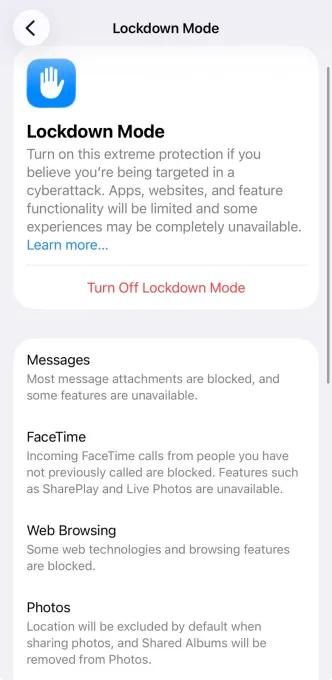
Apple’s Lockdown Mode

Apple’s Lockdown Mode is available on all Apple devices, including iPhones. Apple says that when Lockdown Mode is enabled, “your device won’t function like it typically does.” In exchange for this inconvenience, your device will be more secure. 

There is evidence that Lockdown Mode has helped in the past. Citizen Lab found that Lockdown Mode stopped one spyware attack carried out with NSO Group’s Pegasus software. As recently as March, Apple said it has never detected a successful attack on an Apple device with Lockdown Mode enabled.

Advertisement

This is what Lockdown Mode changes on your device when you turn it on:

  • Attachments received on iMessage other than some images, video, and audio are blocked by default.
  • Links and previews in iMessage are blocked and appear as non-linked web addresses. (You can copy and paste the links into Safari or another browser if you want.)
  • Fonts, some images, and some web technologies are blocked when browsing in Safari.
  • Incoming FaceTime calls are blocked if you haven’t contacted that person before or in the last 30 days. 
  • Screen sharing, content sharing over SharePlay, and Live Photos are unavailable.
  • Incoming invitations for Apple services are blocked unless you have previously invited that person.
  • The Focus feature “and any related status will not work as expected.”
  • Game Center is disabled.
  • Location information is stripped when you share photos. 
  • “Shared albums are removed from the Photos app, and new Shared Album invitations are blocked.”
  • You need to unlock your device to connect it to an accessory or a computer. When connecting a Mac with Apple-made processors to an accessory, the computer needs to be unlocked and you have to approve the connection with your passcode.
  • You can’t connect automatically to open or public Wi-Fi networks, and you will be disconnected from any non-secure Wi-Fi networks that you previously connected to before enabling Lockdown Mode. 
  • Your phone won’t be able to connect to 2G or 3G cellular networks.
  • You can’t install configuration profiles or enroll the device in a Mobile Device Management program.

To switch on Lockdown Mode, go to Settings, then Privacy & Security, and scroll down to Lockdown Mode. Once you enable the feature, your Apple device will restart. 

I have used Lockdown Mode for years. While I noticed some websites being a bit wonky at the beginning, I haven’t noticed that in a while. Also, you can selectively switch off Lockdown Mode for specific websites and apps, without disabling the feature entirely. There are some quirks, but I have gotten used to them, too.

Image Credits:TechCrunch /

Google’s Advanced Protection Program

Google launched its Advanced Protection Program in 2017. This feature is designed to make your Google account more resilient against malicious hackers of all kinds. 

Advanced Protection Program includes the following features:

  • Restricts some third-party services and apps from accessing your Google account, and only with your permission.
  • Enables “Deep Gmail Scans,” which scan your incoming emails for phishing attacks and malicious content.
  • Enables Google Safe Browsing in Chrome, which warns users navigating to dangerous sites or downloading dangerous files. 
  • On Android, you can only install apps and games from legitimate app stores.
  • If someone tries to log into your account, Google takes extra steps to verify it’s really you.

To turn on Advanced Protection, go to its official page and click “Get Started.” This will prompt you to log into your Google account. Follow the instructions there. 

First, you will need to add a physical security key (or a software passkey) as an additional verification factor apart from your passwords. You will also need to add a recovery phone and a recovery email to your account, or use a backup passkey or security key. 

Advertisement
Image Credits:EFF /

Android’s Advanced Protection Mode

Introduced last year and likely inspired by Apple’s Lockdown Mode, Android’s Advanced Protection Mode brings similar defenses to Google’s mobile operating system.

Android’s Advanced Protection Mode provides the following security features:

  • Enables Google Play Protect, which guards against malware and unwanted apps, and checks all apps for “harmful behavior.”
  • Apps from unknown sources cannot be installed, and updates from previously installed apps from unknown sources will be blocked from running.
  • Enables Memory Tagging Extension (MTE) on supported devices. MTE is a hardware-enforced feature that protects against certain types of vulnerabilities. 
  • The device locks automatically if it detects suspicious activity “indicative of theft,” such as sudden and fast movement. This is based on data from the device’s motion sensors, Wi-Fi, and Bluetooth. 
  • The device locks automatically if it goes offline for a prolonged period. 
  • The device automatically reboots if the phone has been locked for 72 hours, making it harder to extract data using law enforcement tools designed to unlock phones, such as devices made by Cellebrite.
  • When the device is locked, USB connections are blocked.
  • Google scans for “unwanted and potentially harmful messages.”
  • Links sent via the Messages app from unknown users will be flagged. 
  • Connection to 2G networks is blocked.
  • Google will identify spam callers. 
  • You will be able to screen incoming calls and decline spam calls automatically. (Available only in certain regions.)
  • Enables Android Safe Browsing, which protects against malicious websites.
  • Chrome will automatically enforce HTTPS encryption for all sites.
  • Some JavaScript functions are turned off, reducing the browser’s attack surface for potential weaknesses.
  • You can also enable Intrusion Logging, an optional feature that helps researchers investigate spyware attacks

To enable Advanced Protection Mode on your Android device, go to Settings, then Security and Privacy, and under Other Settings, tap Advanced Protection, then tap Device Protection. 

Image Credits:TechCrunch / Screenshot /

WhatsApp’s Strict Account Settings

WhatsApp is used by more than 3 billion people, including those in the crosshairs of resourceful government agencies. 

The demand for hacking tools that target WhatsApp is so high demand that exploits can cost millions of dollars — and they work. In 2019, WhatsApp caught a hacking campaign by NSO Group that targeted around 1,200 users. Early last year, WhatsApp caught another spy operation that ensnared around 90 users in Europe. 

In response, earlier this year, WhatsApp launched Strict Account Settings, an opt-in feature that switches on some privacy and security controls depending on the operating system.

On Android and iOS, Strict Account Settings turns on the following features:

Advertisement
  • Two-step verification.
  • Security notifications, which alert users when a contact has changed their phone or reinstalled WhatsApp, or if an attacker takes control of their account. 
  • Blocks attachments and media (pictures and videos) from unknown senders by default.
  • Link previews are turned off.
  • Calls from unknown numbers are silenced.
  • Your IP address is hidden in calls.
  • Your profile information and activity, such as when you were last seen online, your profile photo, and About information, are hidden from people who are not your contacts or members of a pre-established group. 
  • Only contacts or members of a pre-established group can add you to a group chat.

To switch the feature on, use your primary device and go to Settings, then Privacy, then scroll down to Advanced and turn it on. 

When you purchase through links in our articles, we may earn a small commission. This doesn’t affect our editorial independence.

Source link

Continue Reading

Tech

Google Beam Brings Life-Size AI Agents Straight Into the Meeting Room

Published

on

Google Beam Life-Sized AI Agent 2026
Google recently opened its labs to show off an experimental AI agent that appears full-size on the Beam telepresence device. Reporters who stepped in for a close look described the figure as strikingly realistic, smiling and moving in ways that made the conversation feel natural.


Beam started as a way to make remote participants appear to be sitting right there with you, accurate to scale and depth. The Dimension, a collaboration with HP, combines six cameras and a powerful server configuration to create a believable 3D presence. Instead of flat video, you get a person on the other end who appears to have just sat down in the same room with you, owing to spatial audio, which places speech exactly where the speakers are onscreen.

Sale


Insta360 Link 2 Pro – 4K PTZ Webcam for PC/Mac, 1/1.3” Sensor, Low-Light, AI Tracking, HDR…
  • Flagship Image Quality: Capture sharp, detailed 4K with a large 1/1.3” sensor that delivers cleaner video and excellent low-light performance. Great…
  • Professional Audio with Directional Pickup:A redesigned dual-mic system with beamforming directional pickup delivers clearer voice isolation and…
  • Natural Bokeh:Get a professional look by replicating a DSLR-like depth of field. Provides a realistic and natural bokeh effect, straight from Link’s…

The latest trial expands on that by including an AI agent. For the time being, she goes by the name Sophie, and she is a basic yet effective presence. She wears a dark turtleneck top, speaks clearly, and is fluent in several languages. She can even notice her surroundings through the cameras and read writing, look up the weather or a map, and answer basic questions. She even utilizes motions, albeit they can be a little out of rhythm because the system binds them to the music.

Advertisement


Group meetings are now possible with Beam, since remote colleagues coming in from computers or phones via Google Meet appear in full size on the large screen. The system does its best to keep everyone on the same scale and employs positional sound to indicate who is speaking from where. Google has also been looking into possible partnerships with Zoom to provide users with more options. The goal is to make these hybrid meetings feel more balanced and connected, especially when some participants are present in a room while others are dialing in from afar.

The engineers built the agent on cloud servers rather than on a local workstation. So the Beam unit simply catches the environment and sends information back up to the cloud, while the AI responds in real-time. In the current samples, the agent only appears in 2D on the screen, but this still creates a far greater sensation of shared presence than normal video calls. Specifically because of accurate eye contact, natural head tracking, and awareness of physical space.

Some companies have already had early access to the hardware in their workplaces. For the time being, the life-size AI trial is only taking place at Google Labs, with the Mountain View location serving as the primary testing area. That’s where the developers are putting it through its paces, doing extended durability testing and fine-tuning the accuracy of the head tracking. It’s a bit of a guessing game, but the same agent may end up being utilized for a variety of other things, including information desks, guest greeting systems, and any case where consistent availability is required. It may also be used at hotels or theme parks to answer inquiries and guide visitors around without the need for a human service member to be there at all times.
[Source]

Advertisement

Source link

Continue Reading

Tech

The Best Smart Sprinklers and Irrigation Systems: In-Ground Sprinklers, Hose Timers (2026)

Published

on

Planting a garden or laying down sod for your yard is the easy part. Keeping that foliage appropriately hydrated, that’s the real challenge—and it’s one that just keeps going and going, only getting more complicated as the seasons change.

In recent years, interior smart home technology has spilled outside, and you’ll now find dozens of wireless watering systems on the market that can take some of the confusion and complexity out of irrigating your plants. Whether you have a sophisticated in-ground sprinkler or drip irrigation system or you rely on an old-fashioned hose, multiple smart watering solutions are readily available. The good news: We’ve got you covered no matter what type of outdoor environment you have.

Be sure to check out our other guides to backyard tech, including the Best Smart Bird Feeders, Best Grills and Smart Grills, Best Flat-Top Grills and Griddles, Best Coolers, and Best Pool Cleaning Robots.

What Can Smart Irrigation Systems Do?

Advertisement

Across the board, smart watering solutions are fundamentally designed around scheduling. While you can always initiate a manual watering run with one of these systems, their real value is in setting up a recurring schedule so you can basically forget about them. The best systems offer sophisticated scheduling tools that let you water on your chosen days of the week or month, along with the time of watering and the amount of water you want to deliver.

Best of all, the more sophisticated solutions include what’s now commonly known as “weather intelligence,” a fancy way of saying they will check the internet for local weather conditions and adjust watering based on whether it’s going to rain or freeze. Many systems will also work with wireless soil monitors to give you even finer control over ground moisture levels—and help you conserve as much water as possible.

What if I Have an Existing Irrigation System?

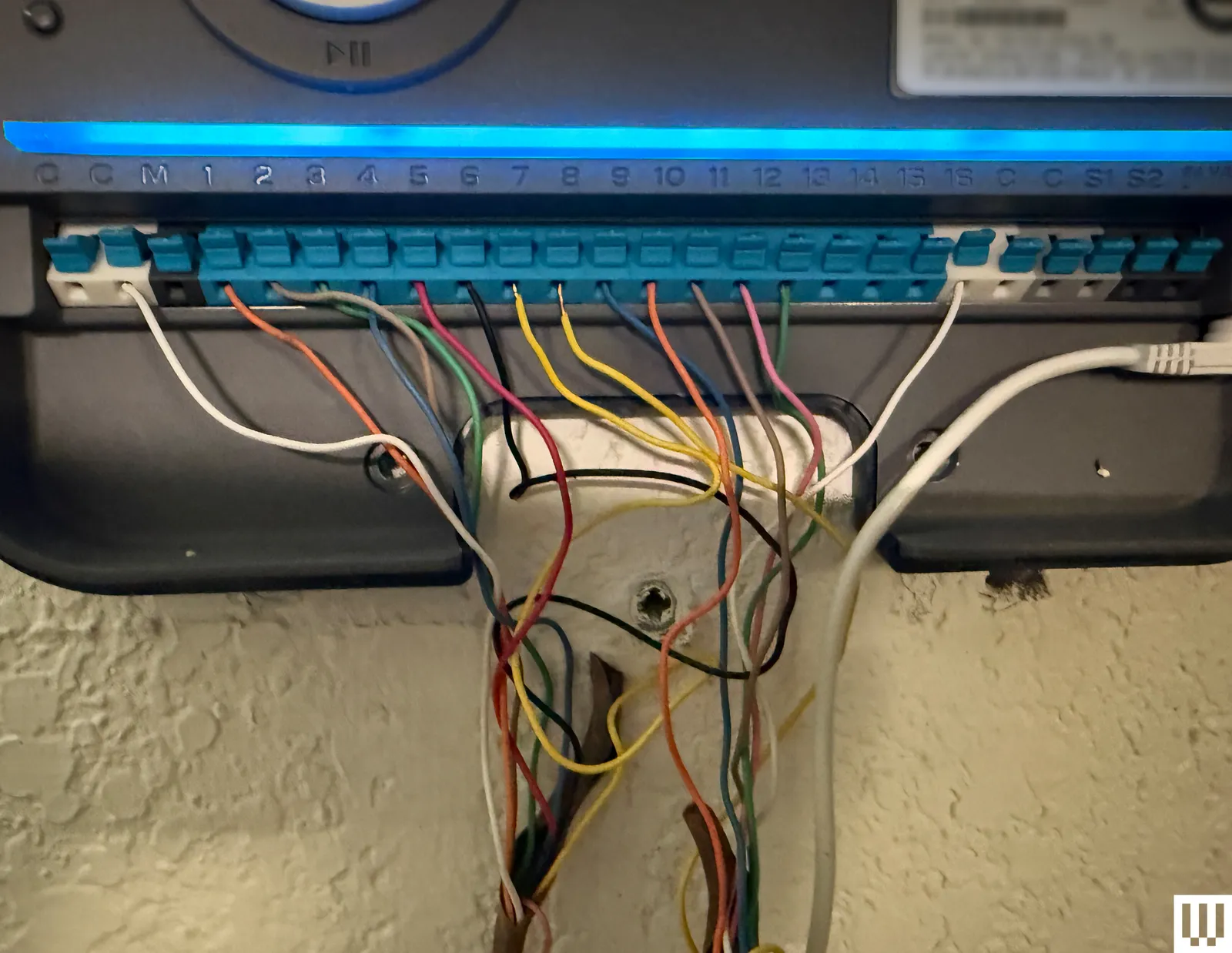
If you already have an in-ground watering system with a traditional timer attached, upgrading to a smart irrigation system is pretty simple. You simply remove your old controller and replace it with the smart one, connecting the zone wiring leads to the terminal posts inside the smart controller, just as they were in the old controller, leaving the remaining infrastructure in place. (Make sure the controller you purchase has enough zones to handle your infrastructure; controllers typically support either 8 or 16 zones.)

Advertisement
Back of a device with lots of wires coming out

Photograph: Chris Null

From there, you’ll use an app to configure your zones based on plant type, shade conditions, and soil type. Most apps will recommend watering durations for each zone based on this information, and you can fine-tune these durations as you go, zone by zone. For setups involving a garden hose, configuration is even easier. Smart sprinklers attach to the terminus of any standard hose and can be placed anywhere in your yard. Alternately, smart hose timers attach to the spigot; you then connect your own sprinkler (or, in some cases, drip irrigation) to the timer. Mobile app features will of course vary, but many are just as sophisticated as permanent smart sprinkler systems.

How I Test Smart Irrigation Systems

I’ve been testing smart irrigation products since 2017 in yards as large as 1.3 acres in both California and Texas. My current sprinkler system is a permanently plumbed solution that spans 11 zones and includes both in-ground sprinklers and drip irrigation. For hose-based solutions, I test by connecting to a standard hose spigot, typically in both lawn and flower bed environments.

Jump to Section

Advertisement

Best Smart Controller for In-Ground Sprinkler Systems

White rectangular box attached to interior wall

Rachio

3 Smart Sprinkler Controller

I’ve tested over a dozen smart sprinkler controllers with my underground irrigation systems, and this Rachio controller is the one I use every day. To be sure, there’s nothing remarkable about the hardware, though it’s easy to connect zone wiring thanks to spring-loaded clips instead of screws, and the onboard controls cover just the basics.

The real magic is in Rachio’s app. Here, you define your zones based on vegetation type, nozzle/drip type, soil type, sun exposure level, and slope. If you want to get really wild, advanced options let you set everything from root depth to the amount of water depletion you wish to allow. Assign each zone a name and a photo, and they’re all presented in an intuitive grid, which you can use as a point-and-click interface for manual watering operations as needed.

Advertisement

Rachio’s scheduling can be fixed based on day or date, or dynamic, with adjustments automatically applied based on rolling weather conditions. The app’s logging system is copious, detailing every run’s timing and duration—for each zone and each day. It’s also easy to share access with my professional irrigation team, so they can periodically test zones for leaks or other problems without needing physical access to my garage, where the controller lives.

Other Solid Smart Controller Picks

Image may contain IrriGreen smart irrigation system

Irrigreen 3.0

Photograph: Christopher Null

Irrigreen 3.0 Starting at $2,089: Irrigreen isn’t just a controller. It’s a pricey, complete irrigation solution that requires fresh plumbing and an upgrade of all your sprinkler heads to Irrigreen’s conservationist “water painting” system. I wouldn’t rip out an existing system for it, but if you’re installing sprinklers from scratch, it’s worth a strong look.

Advertisement

Source link

Continue Reading

Tech

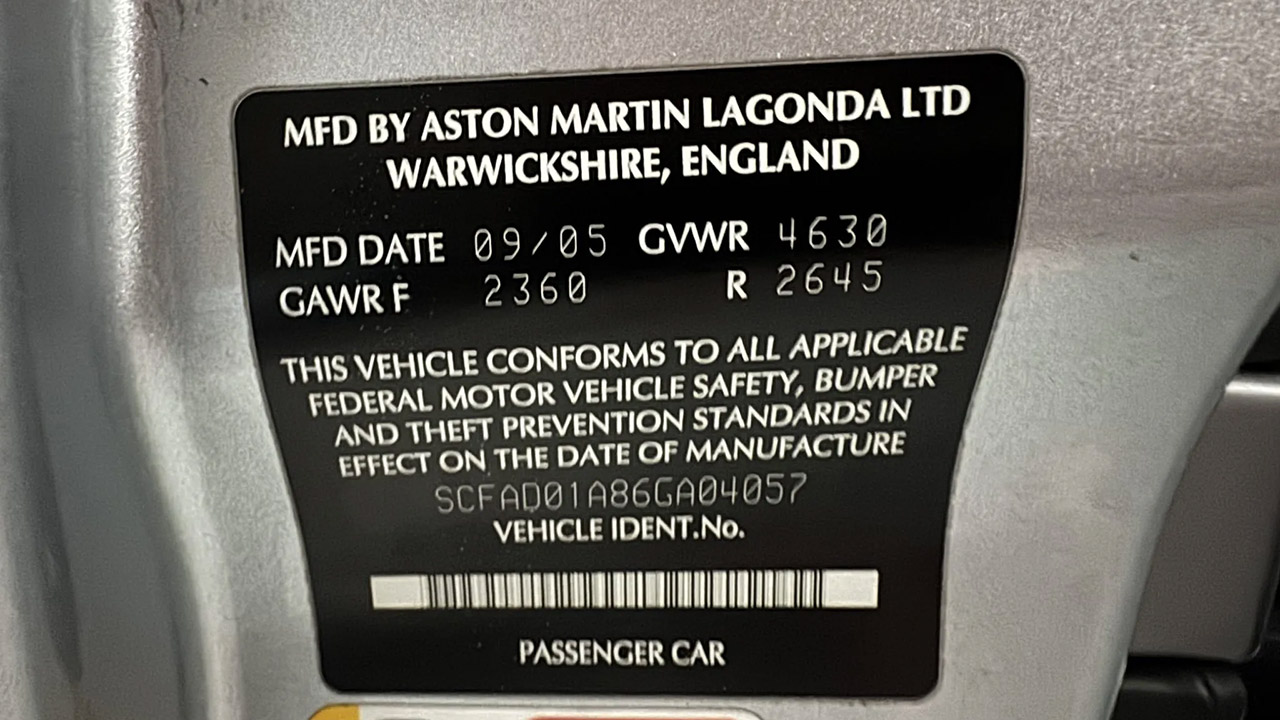
This 2006 Aston Martin DB9 Delivers James Bond Thrills With Flames and Corvette Power

Published

on

Aston Martin DB9 Corvette Swap Flame Thrower
Silver paint catches every ray of sunlight across the smooth curves of this 2006 Aston Martin DB9. A linear actuator tilts the front fascia forward on hinged brackets. Twin assemblies shaped like miniguns slide into view right behind the grille. Propane and oxygen tanks stored in the trunk feed these devices so they shoot real flames when activated. Smoke canisters mounted on the rear subframe release thick clouds for equally dramatic exits. These effects turn the car into a rolling tribute to James Bond without any actual weapons involved.


Power comes from a 6.2-liter LS3 V8 that used to power a Corvette, as creating this car required removing the standard V12 and installing some aftermarket goodies such as a mild camshaft, bespoke air intake, and long tube headers. The electronics are handled by a Holley Terminator X Max system, giving the entire setup a professional appearance. And it all goes to the rear wheels via a 4L65E four-speed automatic transaxle sourced from a Corvette and still connected to the existing subframe. All of this results in smooth, powerful acceleration and the distinct growl of a genuine American V8.

Sale


LEGO Technic Aston Martin Valkyrie Toy Car – Kids Model Kit Toy for Boys and Girls, Ages 9+ – Vehicle…
  • BUILD A BRITISH SUPERCAR – Young auto enthusiasts 9 years old and up can build the legendary Aston Martin Valkyrie, a stylish speed machine favored…
  • REALISTIC ENGINEERING COMPONENTS – Kids can discover real automotive principles as they build and operate mechanical features including functional…
  • AUTHENTIC FEATURES & DETAILS – This aerodynamic sports car toy features a striking teal color scheme and signature design elements that make it an…


Inside the cabin, black Alcantara has been utilized to cover the seats, center console, and door panels, adding a stylish touch. The instrument cluster features bespoke digital gauges and a Bond-themed design. A specialized control panel is crammed into the center stack, and the push-button gear selector is hidden in the console. You can connect your music over Bluetooth to a modern digital receiver, and because some people prefer that sort of thing, a manual toggle has been installed for the air conditioning compressor, which is very reasonable. The windshield wipers are still locked in neutral, which isn’t a bad thing, and the horn has been moved to the dashboard for better access. To avoid potential problems, fuel is added slowly to the tank.

Advertisement

Aston Martin DB9 Corvette Swap Flame Thrower
Conquer Custom in Tampa, Florida completely rebuilt this DB9. They purchased it in 2021, after a prior accident had declared it a total write-off. After then, salvage titles began to oppose it, but they were eventually able to get it re-titled as a rebuilt one. They wanted to highlight the Holley engine management system and make it a true eye-catcher worthy of the big screen. The final automobile had its public debut at the 2025 LS Fest in Bowling Green, Kentucky. Since the work was completed, the automobile has accumulated around 4,500 miles.

Aston Martin DB9 Corvette Swap Flame Thrower
However, the unusual DB9 is still available through a live Bring a Trailer auction, so fans of the series with a large budget will still have a chance at it when the sale closes on May 24th. The price is steadily creeping beyond $40,000 at the moment.
[Source]

Source link

Continue Reading

Tech

Why Chargebacks are Just One Piece of the Fraud Puzzle

Published

on

Chargeback header

For most teams, fraud performance is still summed up in a single metric: chargeback rate. It is visible, painful, and tied directly to card network thresholds, so it naturally becomes the north star for fraud programs.

The new VP of Fraud Strategy at IPQS, Alexander Hall, recently sat down with Jordan Harris of The Fraud Boxer to unpack a growing issue many teams are underestimating: the true impact of fraud beyond chargebacks.  

These hidden impacts rarely show up in chargeback metrics but significantly affect revenue, operations, and brand trust, making it critical for organizations to broaden how they measure fraud. 

The problem is that chargebacks capture only a narrow slice of fraud losses, and focusing on them alone can hide bigger issues affecting growth, customer experience, and long term profitability. 

Advertisement

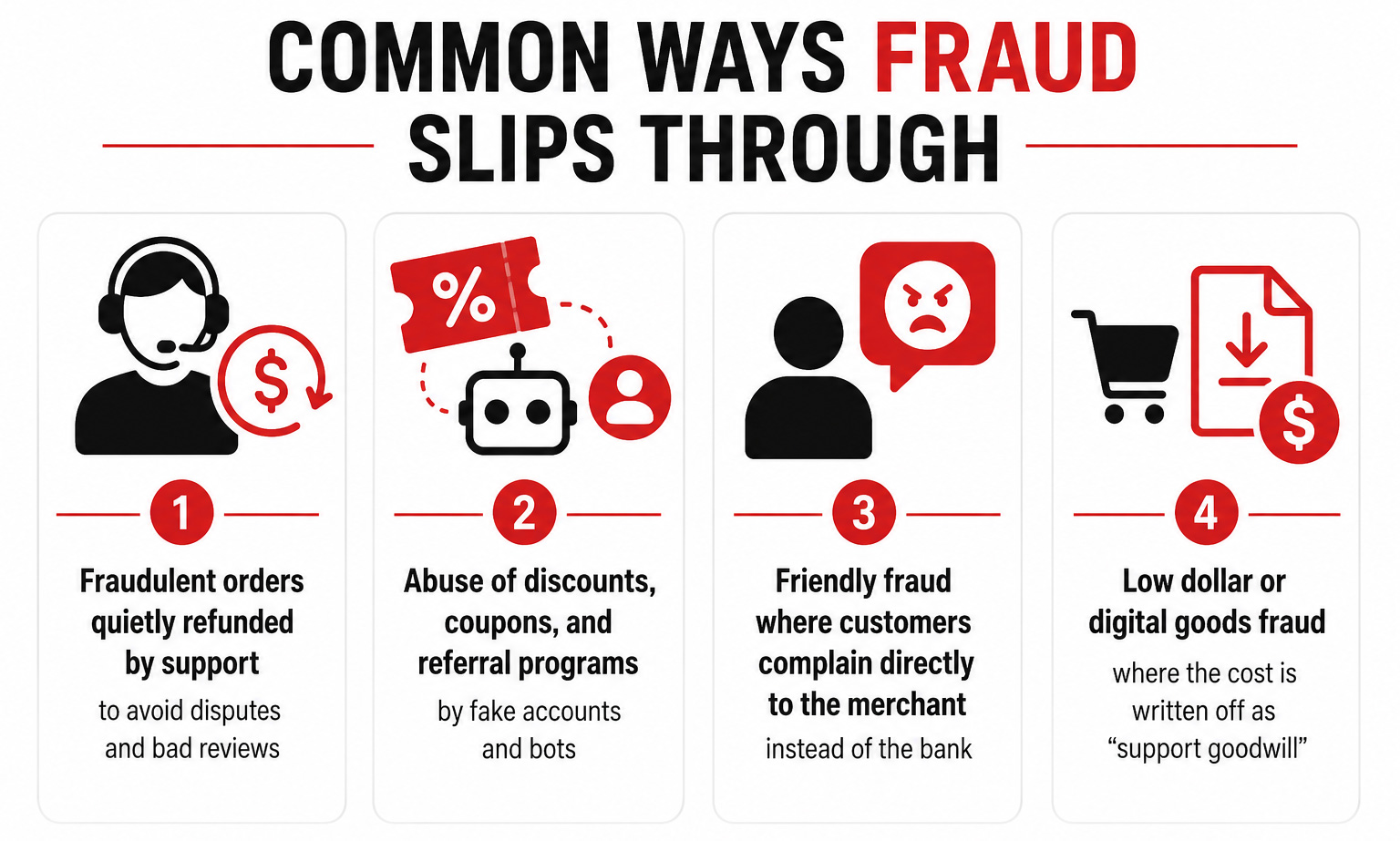
These cases eat into margins just as much as disputes, but they are rarely tagged as fraud in internal reporting, so they do not inform future risk decisions.

Common ways fraud slips through

As an example, ecommerce and airlines are experiencing a troubling rise in account takeovers (ATOs).

While teams work hard to create seamless user experiences, successful ATOs quickly undo that effort, driving customer churn, increasing acquisition costs through negative word of mouth, and enabling off-platform identity theft through stolen PII. They also lead to direct losses like reimbursing stolen stored value, including loyalty points. 

Similar patterns are emerging across industries, with iGaming platforms seeing fraudulent withdrawals after account changes, banking facing a surge in synthetic identity fraud, and money movement platforms dealing with identity theft used to create and operate fraudulent businesses.

Advertisement

Learn how to apply the right fraud checks at the right time without slowing users down.

Sign up for a free trial today to explore IPQS easy API solutions for your business.

SIGN UP TODAY

Opportunity Cost: Good Customers You Never See

The other side of fraud is the revenue you never earn. When rules or tools are too strict, good customers are declined or forced into slow manual reviews.

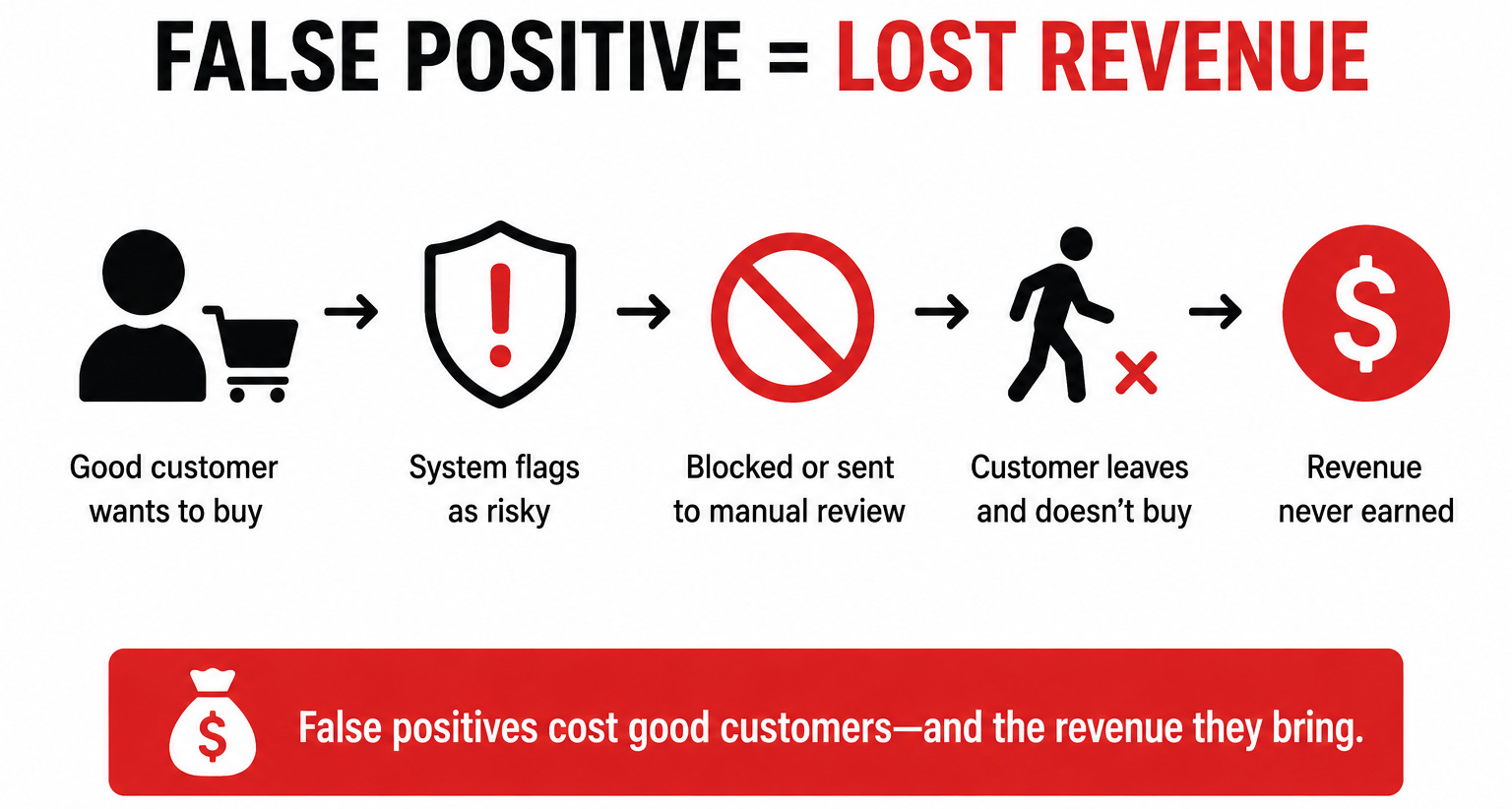
False positives are one of the largest and least visible costs of fraud prevention. A legitimate customer who gets blocked because their IP, device, or email “looks risky” may abandon the purchase and never return.

Advertisement

From IPQS’ vantage point, this is where accurate risk scoring and tuning matter as much as catching fraud itself.

False Positive = Lost Revenue

Operational Drag: Manual Reviews, Support Tickets, and Rework

Every suspicious order that goes to manual review adds labor cost, slows fulfillment, and creates friction for customers waiting on decisions.

Fraud related tickets also pile up in support queues, from refund requests and account lockouts to disputes over promotional abuse. Over time, the operational drag of managing fraud can rival direct loss, especially for high volume merchants and platforms.

Brand and Customer Experience Risk

Fraud is ultimately a trust problem. When accounts are taken over or fake accounts abuse a platform, legitimate users start to question whether their data and money are safe.

Advertisement

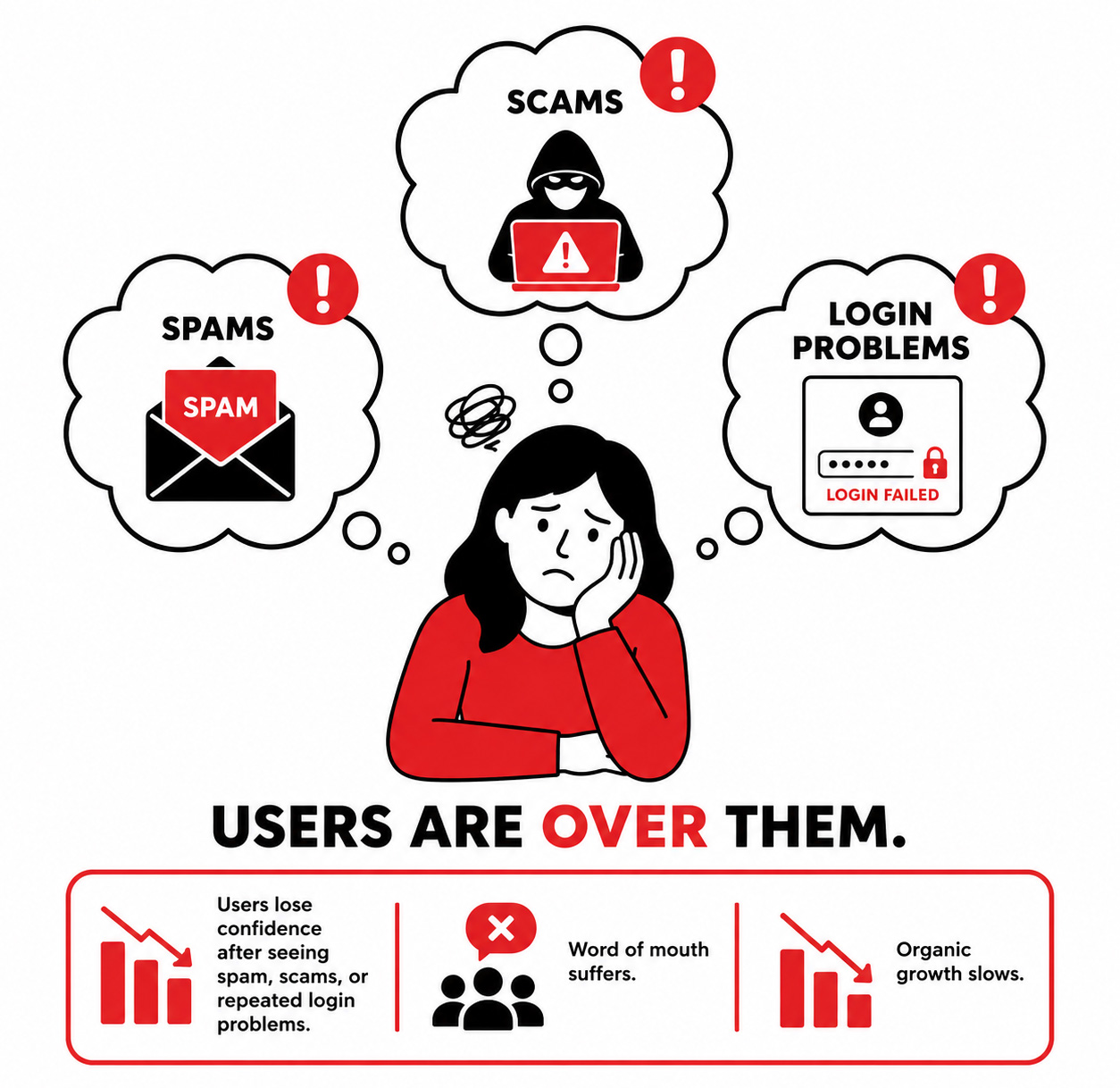
Users are over them

IPQS frequently works with companies where fraud has become a brand issue, not just a risk issue: users lose confidence after seeing spam, scams, or repeated login problems, and organic growth slows because word of mouth suffers.

Looking Beyond Chargebacks: Key Metrics to Track

From an IPQS perspective, a mature fraud program treats chargebacks as one outcome among many, not the whole picture. Useful additional metrics include:

  • Approval rate for good customers

  • False positive rate or “good customer decline” rate

  • Advertisement
  • Manual review rate and average decision time

  • Volume and value of fraud related refunds or credits

  • Abuse rates for promotions, referrals, and loyalty programs

  • Account takeover incidents and new account abuse volume

Tracking these metrics side by side with chargebacks gives a much clearer view of whether your fraud controls are truly supporting growth.

Advertisement

How IPQS Thinks About Measuring Fraud Impact

As a fraud and risk data provider, IPQS is designed to plug visibility gaps rather than just block obvious bad payments. Our scoring looks at the user and their behavior across signals like IP reputation, device intelligence, email history, and past abuse patterns, not just the payment details in front of you.

The goal is to help teams:

  • Catch more fraud before it becomes a chargeback

  • Reduce friction and false positives for legitimate customers

  • Advertisement
  • Identify patterns of abuse in accounts, promotions, and traffic sources

  • Feed more accurate data back into internal reporting and decisioning

When risk scores and signals align with your own outcomes data, your fraud metrics evolve from “chargebacks this month” to “total impact on revenue, costs, and growth.”

Questions to Ask Inside Your Organization

If you are looking to measure fraud impact beyond chargebacks, a few internal questions can help start the conversation:

  • Where are we writing off loss that is not labeled as fraud today

  • Advertisement
  • How many legitimate orders are delayed or declined by current controls

  • Which marketing or growth programs see the highest rate of abuse

  • How often do fraud cases create support tickets or manual work for other teams

  • Do we have a shared view of fraud impact across risk, product, finance, and marketing

Aligning on these questions helps teams move from reactive dispute handling to proactive fraud strategy.

Advertisement

Turning Broader Insight into Better Decisions

Once you recognize that chargebacks are only one symptom, you can redesign your fraud program around a wider set of outcomes.

From the IPQS perspective, the strongest programs are not just “stopping fraud” but actively protecting customer experience, enabling marketing to scale safely, and giving leadership confidence that risk controls support long term growth rather than restrict it.

Sign up for IPQS free trial today and see the difference when you prevent fraud before it starts.

Sponsored and written by IPQS.

Advertisement

Source link

Continue Reading

Trending

Copyright © 2025