













Connect with us
DAPA Banner

Tech

Rogbid Fusion Combines Smartwatch and Smart Ring Into a Single Device

Published

on

Rogbid Fusion Smartwatch Smart Ring
The Rogbid Fusion arrives as a no-frills answer to a very real wearable tech problem: why choose between a smartwatch and a smart ring when you can have both? Rogbid designed this wearable around a compact metal core that measures only 20.6 x 21 by 8.2 millimeters and weighs about 14 grams, a sizable amount of technology in a very small package.


Its 0.49-inch OLED screen packs a punch, displaying the time, steps, heart rate, blood oxygen levels, and basic sleep statistics at a glance. You can use the screen to navigate menus, but let’s be honest, the majority of the work is done via Bluetooth using the associated app on an Android or iOS phone.

The wearable comes with two straps that allow you to change how the Fusion sits on your body: a Milanese-style band that fits any finger size and turns the thing into a sleek little ring that rests on your knuckle with the display peeking out the front, or the included nylon wrist strap, which transforms it into a super minimalist watch to wear on your arm. The transition takes seconds and allows you to choose how noticeable you want it to be, whether low profile for a night out or more prominent for the gym.

Rogbid Fusion Smartwatch Smart Ring
Inside the Fusion, a host of sensors do the heavy lifting for you. The optical heart rate monitor records your pulse all day or on demand, while blood oxygen levels are taken from the same location on the back. An accelerometer records all of your movements, crunching the information for step counting, distance, and sports modes. It supports over 100 different activities, but for real-time feedback, it sticks to the basics: heart rate, steps, and distance.

Sleep tracking is also included, giving you a rough idea of your sleep patterns overnight, and if you’re into that sort of thing, you can even use the app for prayer time reminders or a couple-focused mode that allows you and your partner to share special dates and go for walks together; yeah, it’s a little strange.

Rogbid Fusion Smartwatch Smart Ring
The battery life is fairly good, lasting roughly 5 days with daily use and up to 8 days in standby mode. It takes less than an hour to charge from dead to 100%. It can withstand temperatures ranging from -20 to 60 degrees Celsius and is water resistant up to 5ATM.

For $49.99, the Fusion remains grounded and humble. Don’t expect it to make Bluetooth phone calls or provide precise medical readings, as its health data is only a rough guide. However, the price point means that anyone interested in finger-based monitoring or a tiny wrist display doesn’t have to spend a fortune on a specialized ring or full-fledged watch.
[Source]

Advertisement

Source link

Continue Reading
Click to comment

You must be logged in to post a comment Login

Leave a Reply

Tech

Jury rules against Meta and YouTube in social media addiction case

Published

on

A jury in Los Angeles has found that Meta and YouTube were negligent in a closely-watched trial over social media addiction. The companies were ordered to pay $6 million in damages to the woman who said she was harmed by their addictive features as a child.

The case was brought by a 20-year-old woman, named in court documents as “K.G.M,” who sued Meta, YouTube, TikTok and Snap, saying that she had been harmed by the platforms as a child due to addictive features. TikTok and Snap reached a settlement ahead of the trial.

According to NBC News, Meta was ordered to pay 70 percent of the $3 million in compensatory damages with YouTube taking on the remaining portion. The jury awarded an additional $3 million in punitive damages. “We respectfully disagree with the verdict and are evaluating our legal options,” a Meta spokesperson said in a statement. “We disagree with the verdict and plan to appeal.,” Google spokesperson José Castañeda said in a statement. “This case misunderstands YouTube, which is a responsibly built streaming platform, not a social media site.”

The weeks-long trial has been closely watched because it’s the first of many court cases in which plaintiffs have argued that social media platforms harmed minors due to how they were designed. Meta’s lawyers and executives have disputed the idea that social media should be considered an “addiction.” CEO Mark Zuckerberg testified that the company wants Instagram to be “useful,” and repeatedly accused the plaintiff’s lawyer of “mischaracterizing” his past statements.

Advertisement

“This is the first time in history a jury has heard testimony by executives and seen internal documents that we believe prove these companies chose profits over children,” Joseph VanZandt, one of K.G.M.’s lawyers, said in a statement to The New York Times,

For Meta, it’s the second legal setback in as many days. The verdict comes one day after a jury in New Mexico ruled against Meta in a trial over child safety issues. The company was ordered to pay $375 million in penalties; the company said it would appeal.

Update, March 25, 2026, 11:22AM PT: Added a statement from Google.

Update. March 25, 2026, 2:05PM PT: Added details about punitive damages.

Advertisement

Source link

Continue Reading

Tech

Amazon Spring Sale Deal: The Typhur Dome 2 Air Fryer Is 30% Off

Published

on

I was a late convert to air fryers, in part because I worried about versatility: Just how many wings and nuggets and fries does anyone need? (Don’t answer. The answer will incriminate you.)

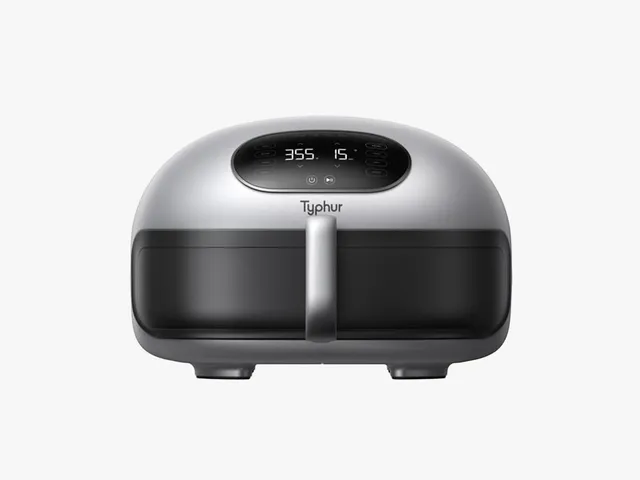
The Typhur Dome 2 is the air fryer that obliterated this worry, by adding pizza, browned meats, grilled asparagus, and toasted bread to this list—not to mention perfect crispy bacon. It’s an innovative device that takes over most of the functions of a classic auxiliary oven, but with far more powerful convection.

After testing more than 30 air fryers over the past year, the Dome 2 is the one I far and away recommend as the most powerful, versatile, accurate, and fast air fryer I know. I’ve evangelized for this thing ever since I first tried it last year. But the one big caveat is always the price: It’s listed at $500 and rarely dips much below $400.

So imagine my surprise when I saw the Dome 2 dip to $340 for Amazon’s Spring Sale, the lowest I’ve seen it since Black Friday. If you’ve been hunting for an upgrade to your old basket air fryer, this is probably a good time. The sale lasts until March 31.

Advertisement
  • Photograph: Matthew Korfhage

  • Photograph: Matthew Korfhage

  • Photograph: Matthew Korfhage

Fast, Versatile, App-Controlled Cooks

So why’s the Dome 2 my favorite air fryer? Typhur, a tech-forward company based in San Francisco but with engineering and manufacturing ties to China, reimagined the shape and function of the classic basket fryer by creating a broader and shallower basket, with individually controllable dual heating elements.

This means the Dome 2 has room for a freezer pizza, and can apply direct heat from the bottom to add actual char-speckle and crispness to the crust, kind of like a combination grill-oven. The Dome’s shallow basket also lets you spread out ingredients in a single layer for excellent airflow, while heating from both sides. I can crisp two dozen wings in just 14 minutes (or 17 minutes if I fry hard). The Dome also toasts bread evenly, and crisps bacon without smelling up the house—in part because it has a helpful self-clean function.

Temp accuracy is within 5 or 10 degrees of target, and the fan can adjust its speed depending on the cooking mode. And the smart app is actually useful, with about 50 recipes ranging from asparagus to eclair to a flank steak London broil that can be synced with a button-press. But note that some functions, such as baking, need the app to work, and the device is more of a counter hog than taller basket fryers.

Typhur’s Probe-Assisted Oven Also on Sale

The Dome 2’s basket is a bit shallow for a whole bird or a large roast, however. If you want a convection device for larger meats, I often recommend the Breville Smart Oven Air Fryer Pro, which is among my favorite convection toaster ovens. This is a (very) smart oven and air fryer that doesn’t crisp up wings and fries quite as well as basket fryers, but is more versatile for roasting big proteins like a whole chicken. The Breville is also on a nice sale right now, dropping by 20 percent.

Advertisement
Breville Smart Oven Air Fryer Pro

Breville

the Smart Oven Air Fryer Pro

Source link

Continue Reading

Tech

How to use Playlist Playground to build Apple Music playlists in seconds

Published

on

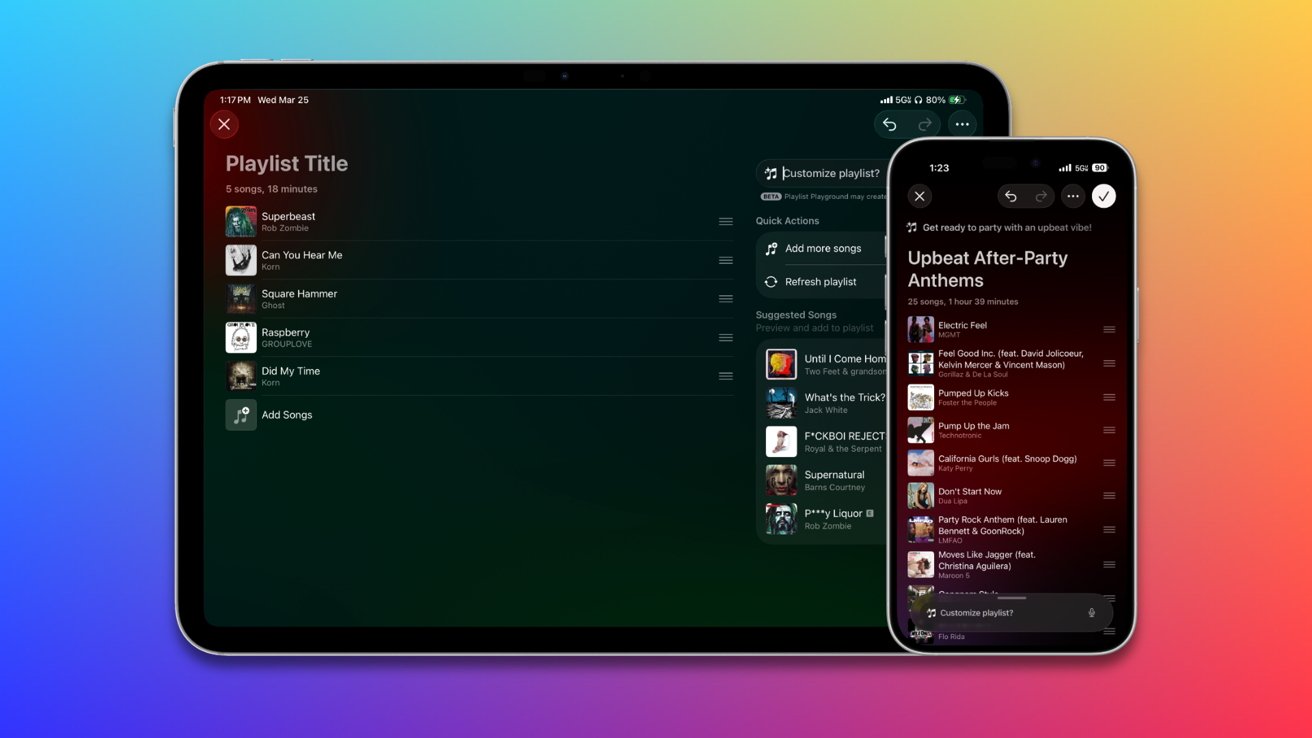
Apple Music’s new Playlist Playground feature is a prompt-driven playlist builder that’s fast and surprisingly useful, even if it won’t replace a carefully curated mix. Here’s how to start playing, and how well it works.

Tablet and smartphone displaying a dark-themed music app with playlists and song lists, set against a colorful gradient background transitioning from blue to pink, orange, and green
Apple Music’s new Playlist Playground

Apple added Playlist Playground to Apple Music on March 24 with iOS 26.4 and iPadOS 26.4. It lets users build playlists by describing what they want instead of adding songs one by one.
Building playlists in Apple Music takes time, especially when you’re chasing a specific mood. Playlist Playground cuts that down to a few seconds, making it useful as a starting point.
Continue Reading on AppleInsider | Discuss on our Forums

Source link

Continue Reading

Tech

Bubble AI app builder abused to steal Microsoft account credentials

Published

on

Bubble AI app builder abused to steal Microsoft account credentials

Threat actors are evading phishing detection in campaigns targeting Microsoft accounts by abusing the no-code app-building platform Bubble to generate and host malicious web apps.

Because the web app is hosted on a legitimate platform, email security solutions do not flag the link as a potential threat, allowing users to access the page.

Security researchers at Kaspersky say that threat actors are using the new method to redirect users to the actual phishing page, which is often mimicking a Microsoft login portal that is sometimes hidden behind a Cloudflare check.

Any credentials entered on these fake web pages are siphoned to the phishing actor, who may then use them to access email, calendar, and other sensitive data associated with Microsoft 365 accounts.

Advertisement
The phishing page
The Microsoft-themed phishing page
Source: Kaspersky

Bubble is a no-code AI-powered platform where users describe the app they want to build and then the platform automatically generates the backend logic and frontend.

The resulting apps are hosted on Bubble’s infrastructure under *.bubble.io, which is a trusted domain unlikely to trigger security warnings from email security solutions.

Phishing actors take advantage of this by creating Bubble apps that consist of large, complex JavaScript bundles and Shadow DOM-heavy structures, which are not flagged as redirection scripts or classified as malicious by static and automated analysis tools.

“The code generated by this no-code platform is a massive jumble of JavaScript and isolated Shadow DOM (Document Object Model) structures,” explains Kaspersky.

“Even for an expert, it’s difficult to grasp what’s happening at first glance; you really have to dig through it to understand how it all works and what the purpose is.”

Advertisement

“Automated web-code analysis algorithms are even more likely to get tripped up, frequently reaching the verdict that this is just a functional, useful site.”

Code fragment of a Bubble app
Source: Kaspersky

The researchers warn that the tactic of abusing AI-powered app builders for evasion in phishing campaigns is very likely to be adopted by phishing-as-a-service (PhaaS) platforms and integrated into phishing kits that are widely used by lower-tier cybercriminals.

These platforms already provide session cookie theft, adversary-in-the-middle (AiTM) layers that bypass two-factor authentication (2FA), geo-fencing, anti-analysis tricks, and AI-generated email content, so the abuse of legitimate platforms will only increase the stealth of these attacks.

BleepingComputer has contacted Bubble for a comment about Kaspersky’s findings and any plans to strengthen anti-abuse protections, but we have not received a response by publishing time.

Malware is getting smarter. The Red Report 2026 reveals how new threats use math to detect sandboxes and hide in plain sight.

Download our analysis of 1.1 million malicious samples to uncover the top 10 techniques and see if your security stack is blinded.

Advertisement

Source link

Continue Reading

Tech

T-Mobile customers have a week to sign up for a free year of MLB.TV

Published

on

Today marks the start of the 2026 baseball season and in what has sort of become an annual tradition, T-Mobile is once again offering a free subscription to MLB.TV.

In order to take advantage of the deal, T-Mobile customers simply need to log into the T Life app, navigate to the Benefits tab and then hit Redeem after clicking the banner for a free season of MLB.TV. From there, you just need to download the latest version of the MLB app to your mobile device and sign in or create an account. That said, this is a time-limited offer, so if you want the ability to stream regular season baseball for free, you’ll need claim the deal prior to March 31 at 4:59 AM ET. For anyone on a different carrier, this may be enough time to switch providers and still get in on the savings.

Unfortunately, MLB.TV is subject to blackouts and market restrictions, so depending on where you live and where your favorite team is playing that day, you may not be able to catch every game. Sadly, this includes tonight’s 8:05 PM ET matchup between the New York Yankees and the San Francisco Giants, which is streaming exclusively on Netflix. Even so, with a one-year subscription to MLB.TV currently going for $150, this is one of the best perks available from any of the big cellular carriers.

In addition to full season of games, an MLB.TV subscription also includes access to a collection of baseball documentaries, game streams from previous years, World Series films, highlights, news and more. And with over 1.25 million customers having redeemed last year’s offer, this is potentially one of T-Mobile’s biggest offers of the year, with the company claiming to have delivered more than $1 billion in savings since it first started running the promotion 10 years ago in 2016.

Advertisement

Source link

Continue Reading

Tech

Today’s NYT Mini Crossword Answers for March 26

Published

on

Looking for the most recent Mini Crossword answer? Click here for today’s Mini Crossword hints, as well as our daily answers and hints for The New York Times Wordle, Strands, Connections and Connections: Sports Edition puzzles.


Baseball is back! You’ll see baseball images patterned throughout today’s Mini Crossword grid, and when you solve the puzzle, they’ll spell out a certain word. Play ball! Er, read on for all the answers. And if you could use some hints and guidance for daily solving, check out our Mini Crossword tips.

If you’re looking for today’s Wordle, Connections, Connections: Sports Edition and Strands answers, you can visit CNET’s NYT puzzle hints page.

Advertisement

Read more: Tips and Tricks for Solving The New York Times Mini Crossword

Let’s get to those Mini Crossword clues and answers.

completed-nyt-mini-crossword-puzzle-for-march-26-2026.png

The completed NYT Mini Crossword puzzle for March 26, 2026.

Advertisement

NYT/Screenshot by CNET

Mini across clues and answers

1A clue: Degrees for boardroom execs
Answer: MBAS

5A clue: “___ want for Christmas …”
Answer: ALLI

6A clue: What Hamlet holds while giving his “Alas, poor Yorick!” speech
Answer: SKULL

Advertisement

7A clue: Wild, as an animal
Answer: FERAL

8A clue: Sphere
Answer: ORB

Mini down clues and answers

1D clue: Word after “match” or “mischief”
Answer: MAKER

2D clue: Bit of writing on a book jacket
Answer: BLURB

Advertisement

3D clue: Penne ___ vodka
Answer: ALLA

4D clue: Window ledge
Answer: SILL

6D clue: Bay Area airport, for short
Answer: SFO

Advertisement

Source link

Continue Reading

Tech

Version 1 opens new Dublin HQ, adds 250 local jobs

Published

on

Version 1 says it has chosen its new Dublin HQ for its ‘state-of-the-art AI Studio’ and will add 250 roles locally.

The new HQ at Four Park Place in Dublin will see it become neighbours to Apple when they officially open their new Dublin offices later this year, and sees the Irish technology provider reach a headcount of some 3,700 globally.

The Dublin jobs news follows an announcement earlier this month at the UK-Ireland Summit that it would create 1,000 jobs across the UK and Northern Ireland, as part of its plans to invest £40m into the UK market over the next few years.

Version 1 was founded in Dublin in 1996 and offers a range of technology services to global organisations. It has other key hubs in London, Edinburgh and Belfast, but has chosen Dublin for its AI studio as it focuses in on AI. At the summit, it said the majority of the 1,000 UK roles would also be AI-focused, and around 400 of the roles would be in Northern Ireland.

Advertisement

“This is more than an office opening. It is a statement of intent,” said Roop Singh, CEO of Version 1. “30 years ago, Version 1 was founded in Dublin with a commitment to making technology deliver extraordinary business outcomes and citizen welfare. That commitment has not changed, but the scale and ambition have.

“Our principal belief is that AI enhances human capability, it does not replace it. This studio is where we will prove that, working alongside our customers and communities to build AI solutions that are practical, governed and grounded in real business outcomes.”

“Version 1’s continued growth and investment in Ireland is a powerful example of an Irish company winning on the global stage,” said Kevin Sherry, executive director at Enterprise Ireland, which has worked closely with Version 1 to support international growth. “The opening of this AI Studio positions Ireland as a serious centre for AI innovation and reinforces our ability to develop and retain world-class technology talent.

“Ambitious companies like Version 1 embody Enterprise Ireland’s mission that Irish-owned, globally-focused companies will be the primary driver of our economy,” he added.

Advertisement

Version 1 says the AI Studio has been designed as a space to “harness the power of technology by co-creating solutions to complex problems alongside customers from all sectors”, and added that it will be available to schools, universities and community groups in an effort to “democratise” technology. Version 1 says AI must “carry a social licence and be developed responsibly”.

The opening was attended by Minister for Enterprise, Tourism and Employment Peter Burke, TD who described Version 1 as “a blueprint for how Ireland creates, retains and scales world-class technology companies”.

“This new headquarters represents significant inward investment in Ireland’s economy and talent base and cements our position as a premier hub for AI and business transformation services at a time when nations are competing for AI leadership,” he said.

Minister of State for Trade Promotion, Artificial Intelligence and Digital Transformation Niamh Smyth, TD also attended the launch and said it was Ireland’s ambition to be “at the forefront of responsible AI adoption”.

Advertisement

“Version 1’s new AI Studio demonstrates what is possible when Irish enterprise combines deep technical expertise with a genuine commitment to community partnership and skills development,” she said.

Don’t miss out on the knowledge you need to succeed. Sign up for the Daily Brief, Silicon Republic’s digest of need-to-know sci-tech news.

Source link

Advertisement
Continue Reading

Tech

It’s here! NASA reveals full livestream schedule for crewed moon mission

Published

on

The excitement is building with NASA now just a few days away from sending four astronauts on a voyage around the moon.

On Wednesday, the space agency shared its schedule for coverage of the final buildup and main event, including a Q&A with the astronauts this Friday, blast off on Wednesday, April 1, and regular updates as the crew make their way to the moon.

Americans Reid Wiseman, Victor Glover, and Christina Koch, together with Canadian Jeremy Hansen, will leave the launchpad aboard an Orion spacecraft carried skyward by NASA’s massive Space Launch System (SLS) rocket.

They’ll spend several days in Earth orbit checking the spacecraft’s systems before heading toward the moon. They won’t land on the lunar surface, but instead fly around it on a journey that will take humans farther from Earth than at any time since the Apollo era more than five decades ago.

Advertisement

Below is a summary of the events linked to the upcoming Artemis II mission. All times are Eastern Time (ET):

Friday, March 27

2:30 p.m.: The Artemis II crew will arrive at the Kennedy Space Center for a Q&A session with the press. NASA chief Jared Isaacman will also be in attendance, along with CSA (Canadian Space Agency) president Lisa Campbell.

Sunday, March 29

Advertisement

9:30 a.m.: The Artemis II crew will spend some time answering additional media questions, but this time virtually, from their quarantine facility.

2 p.m.: NASA officials linked to the mission will hold a status update on preparations for the Artemis II launch.

Monday, March 30

5 p.m.: Following a key mission meeting, NASA will host a news conference to provide a status update on preparations for launch.

Advertisement

Tuesday, March 31

1 p.m.: The space agency will hold a prelaunch news conference on the countdown status.

Wednesday, April 1

7:45 a.m.: Coverage begins on NASA+ of the tanking operations to load propellant into the SLS rocket. The livestream will include various views of the rocket and commentator analysis.

Advertisement

12:50 p.m.: NASA+ begins the official livestream for the much-anticipated launch, which is targeted for no earlier than 6:24 p.m. Following liftoff, coverage will continue on YouTube after Orion’s solar array wings deploy in space.

Around two-and-a-half hours after launch, and after the SLS rocket’s upper stage has performed a burn to send Orion and its crew to high-Earth orbit, NASA will hold a news conference to offer an update on the mission. The start time could change, depending on the precise liftoff time. In fact, the entire schedule could change, according to how the final preparations proceed. NASA will post any developments on its X account.

For information on the timing of daily updates during the mission, including live link-ups with the crew, check out NASA’s full schedule.

Advertisement

Source link

Continue Reading

Tech

The least surprising chapter of the Manus story is what’s happening right now

Published

on

Okay, so the U.S. and China are locked in an all-out race to build the most powerful AI on the planet. Beijing is throwing billions at homegrown models, tightening its grip on the tech sector, and watching nervously as its best AI talent gravitates to U.S. companies. A Carnegie Endowment study published late last year found that 87 of the 100 top Chinese AI researchers at U.S. institutions in 2019 are still there.

Yet Manus — one of China’s most buzzed-about AI startups — quietly relocated to Singapore and sold itself to Meta for $2 billion. Did anyone think there would not be a reckoning over this tie-up?

As industry watchers know, Manus burst onto the scene in the spring of last year with a demo video showing an AI agent screening job candidates, planning vacations, and analyzing stock portfolios, and it cheekily claimed it outperformed OpenAI’s Deep Research. Within weeks, Benchmark — the consummate Silicon Valley venture firm — led a $75 million funding round at a $500 million valuation. That was surprising. (Senator John Cornyn had thoughts, tweeting at the time, “Who thinks it is a good idea for American investors to subsidize our biggest adversary in AI, only to have the CCP use that technology to challenge us economically and militarily? Not me.”)

By December, Manus had millions of users and was pulling in over $100 million in annual recurring revenue. Then Meta came calling, and Mark Zuckerberg, who has staked the company’s future on AI, snapped it up for $2 billion.

Advertisement

It’s worth noting that Manus didn’t just sell itself to an American buyer; it spent the better part of last year actively trying to operate outside China’s orbit. The company relocated its headquarters and core team from Beijing to Singapore, restructured its ownership, and after the Meta deal was announced, Meta pledged to cut all ties with Manus’s Chinese investors and shut down its operations in China entirely. By every measure, Manus was trying to make itself a Singapore company.

But if that string of events raised eyebrows in Washington, you can only imagine that in Beijing, they were apoplectic.

China has a phrase for all of this: “selling young crops” — homegrown AI companies that move abroad and sell themselves to foreign buyers before they’ve fully matured, taking their intellectual property and talent with them.

Techcrunch event

Advertisement

San Francisco, CA
|
October 13-15, 2026

Beijing hates it and has spent years establishing that no company operates outside its reach. Surely, we all remember that time Jack Ma gave a speech in 2020, mildly criticizing Chinese regulators, after which he disappeared from public life for months, Ant Group’s blockbuster IPO was killed overnight, and Alibaba was handed a $2.8 billion fine. China then spent the next two years methodically dismantling its own booming tech sector, wiping out hundreds of billions in market value. Chinese leaders are many things, but subtle is not one of them.

Advertisement

Which is why it wasn’t entirely surprising when, on Tuesday, the Financial Times reported that Manus co-founders Xiao Hong and Ji Yichao were summoned to a meeting this month with China’s National Development and Reform Commission and told that they wouldn’t be leaving the country for a while. No formal charges have been filed — just an inquiry into whether the Meta deal violated Beijing’s foreign investment rules.

Beijing is calling it a routine regulatory review.

At some point, someone at Manus probably thought they’d gotten away with it, and maybe they still will. But given the stakes of the AI race, that was always a big gamble. Now Beijing wants answers; Manus’s founders are apparently not going anywhere until it gets them.

Source link

Advertisement
Continue Reading

Tech

GitHub adds AI-powered bug detection to expand security coverage

Published

on

GitHub adds AI-powered bug detection to expand security coverage

GitHub is adopting AI-based scanning for its Code Security tool to expand vulnerability detections beyond the CodeQL static analysis and cover more languages and frameworks.

The developer collaboration platform says that the move is meant to uncover security issues “in areas that are difficult to support with traditional static analysis alone.”

CodeQL will continue to provide deep semantic analysis for supported languages, while AI detections will provide broader coverage for Shell/Bash, Dockerfiles, Terraform, PHP, and other ecosystems.

The new hybrid model is expected to enter public preview in early Q2 2026, possibly as soon as next month.

Advertisement

Finding bugs before they bite

GitHub Code Security is a set of application security tools integrated directly into GitHub repositories and workflows.

It is available for free (with limitations) for all public repositories. However, paying users can access the full set of features for private/internal repositories as part of the GitHub Advanced Security (GHAS) add-on suite.

It offers code scanning for known vulnerabilities, dependency scanning to pinpoint vulnerable open-source libraries, secrets scanning to uncover leaked credentials on public assets, and provides security alerts with Copilot-powered remediation suggestions.

The security tools operate at the pull request level, with the platform selecting the appropriate tool (CodeQL or AI) for each case, so any issues are caught before merging the potentially problematic code.

Advertisement

If any issues, such as weak cryptography, misconfigurations, or insecure SQL, are detected, those are presented directly in the pull request.

GitHub’s internal testing showed that the system processed over 170,000 findings over 30 days, resulting in 80% positive developer feedback, and indicating that the flagged issues were valid.

These results showed “strong coverage” of the target ecosystems that had not been sufficiently scrutinized before.

GitHub also highlights the importance of Copilot Autofix, which suggests solutions for the problems detected through GitHub Code Security.

Advertisement

Stats from 2025 comprising over 460,000 security alerts handled by Autofix show that resolution was reached in 0.66 hours on average, compared to 1.29 hours when Autofix wasn’t used.

GitHub’s adoption of AI-powered vulnerability detection marks a broader shift where security is becoming AI-augmented and also natively embedded within the development workflow itself.

Malware is getting smarter. The Red Report 2026 reveals how new threats use math to detect sandboxes and hide in plain sight.

Download our analysis of 1.1 million malicious samples to uncover the top 10 techniques and see if your security stack is blinded.

Source link

Advertisement
Continue Reading

Trending

Copyright © 2025