
TL;DR
Berlin’s Peec AI hit $10M ARR six months after a $21M Series A at $4M. It helps brands optimise for AI search results.



Tannoy is marking its 100th anniversary with a major loudspeaker announcement at HIGH END Vienna 2026, where the legendary British speaker maker will unveil exclusive limited-edition models and signal the return of several iconic designs. The anniversary lineup begins with special versions of the Westminster Royal GR and Canterbury GR, both based on the Prestige Gold Reference Series and produced in extremely limited numbers that nod directly to Tannoy’s 1926 founding in South London.
Tannoy’s first 100th anniversary Limited Editions will be produced in extremely small numbers: 19 pairs of the flagship Westminster Royal GR and 26 pairs of the Canterbury GR. The production figures are intentional, combining to reference 1926, the year Tannoy was founded in South London. Anniversary upgrades are said to, “incorporate significant performance upgrades, including enhanced crossovers and improved internal cabling.” Additional anniversary models are expected to be added to the range in the coming months.
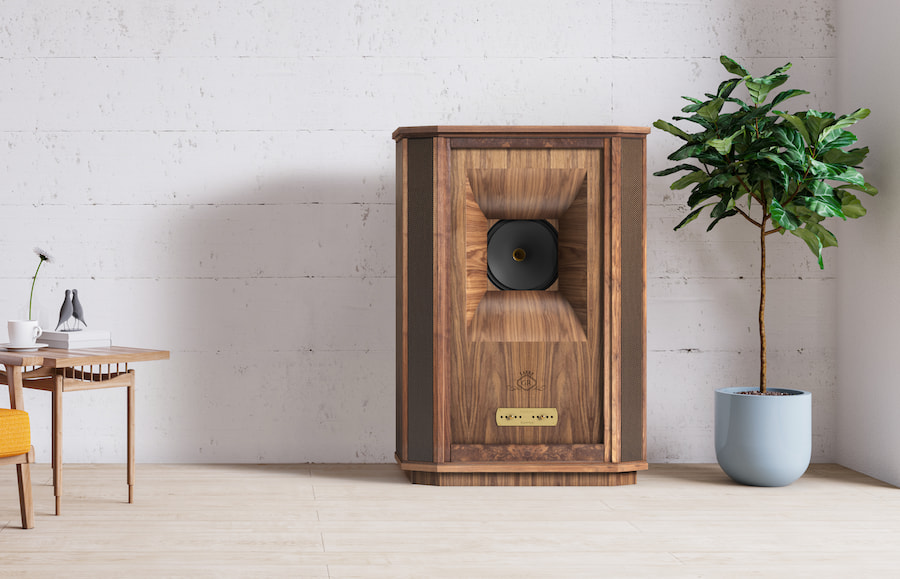
At HIGH END 2026 in Vienna, Tannoy will give attendees a rare chance to hear the Westminster Royal GR, the brand’s flagship Prestige loudspeaker and one of the most recognizable large-format designs in British hi-fi.
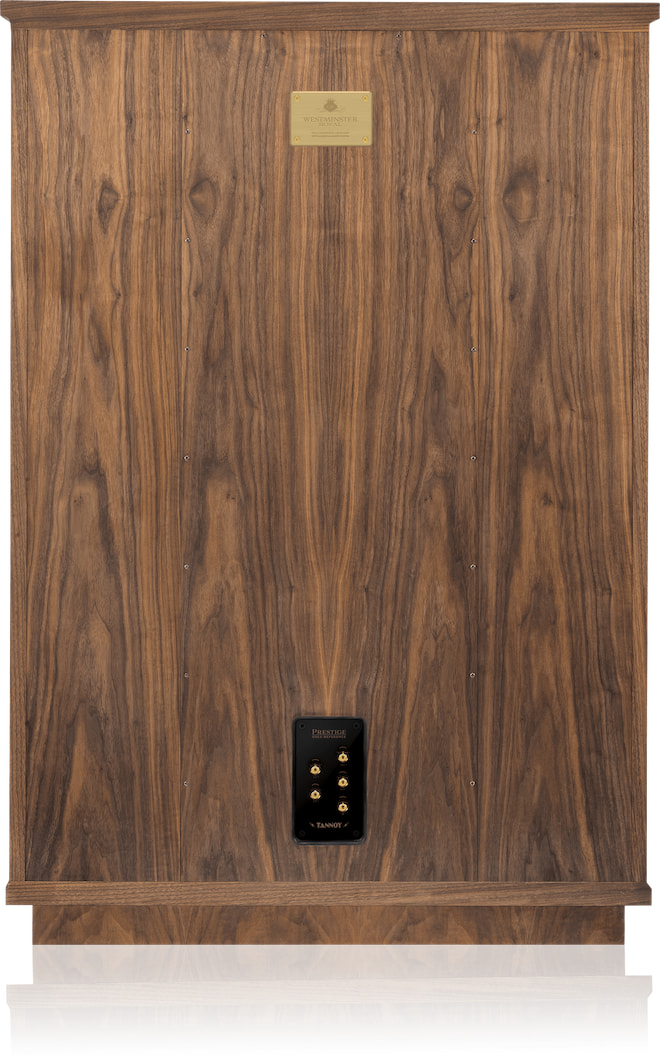
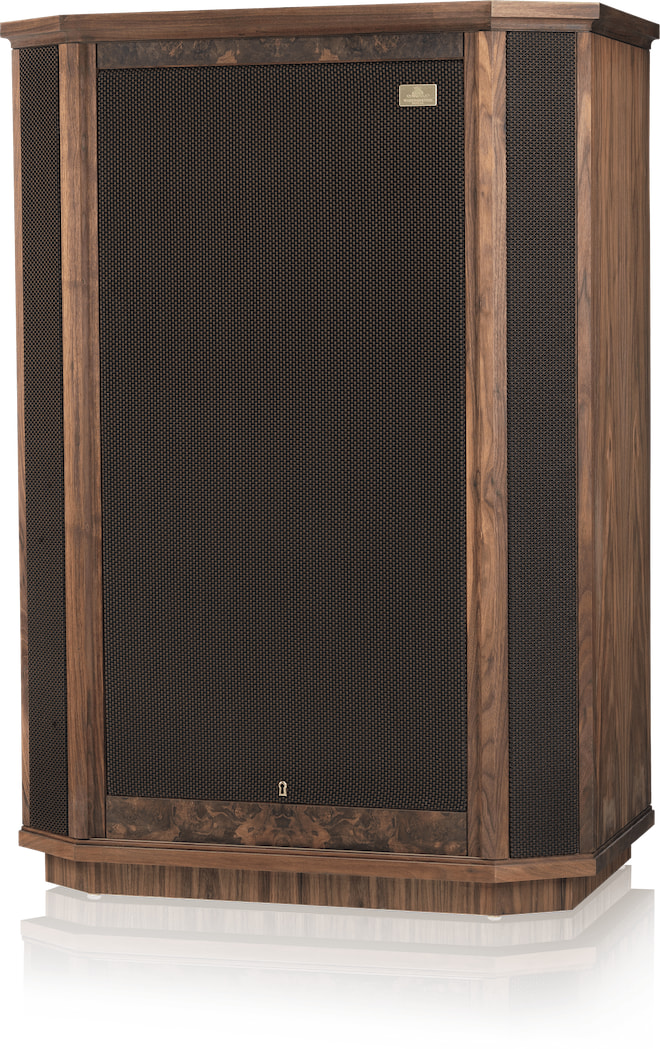
The Westminster Royal GR is a two-way, horn-loaded loudspeaker built around a 15-inch Tannoy Dual Concentric driver, a driver architecture first introduced by the company in 1947. This is not a compact lifestyle box pretending to be heritage audio. At 140 cm tall, 55 inches, and weighing 140 kg, 309 pounds, the Westminster Royal GR is closer to furniture with a passport and a solicitor.
Key acoustic technologies include Tannoy’s PepperPot WaveGuide, Alnico magnets, and aluminium-magnesium alloy diaphragm compression drivers with Mylar surrounds. The massive 530-litre birch ply cabinet uses extensive internal bracing and Tannoy’s Differential Materials Technology, which couples the drive unit to the cabinet using materials of varying density to help control resonance, improve damping, and reduce unwanted vibration.
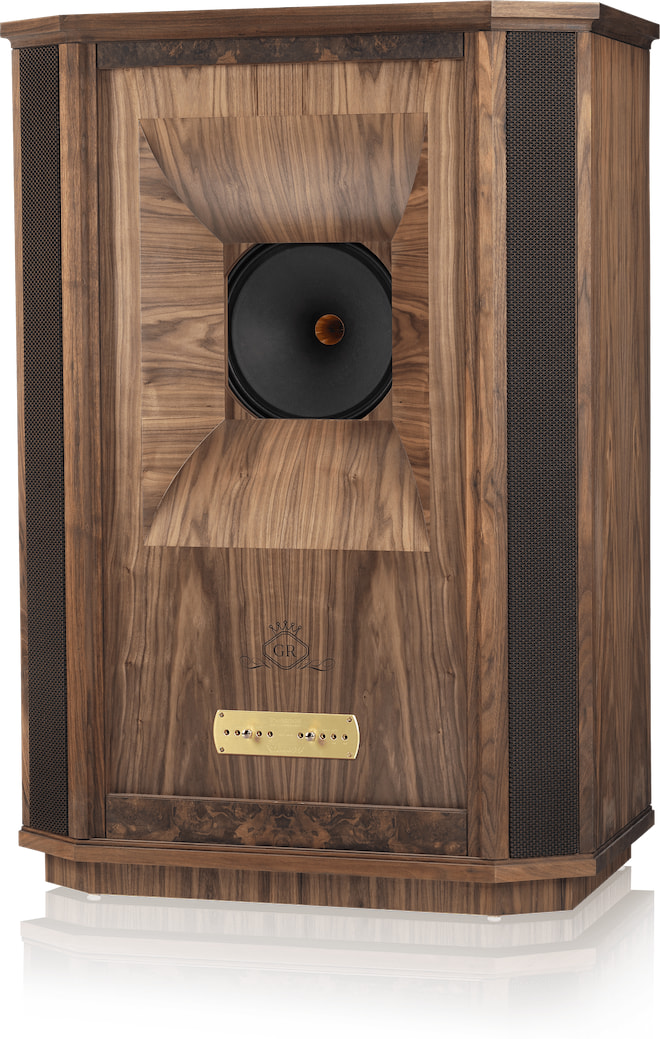
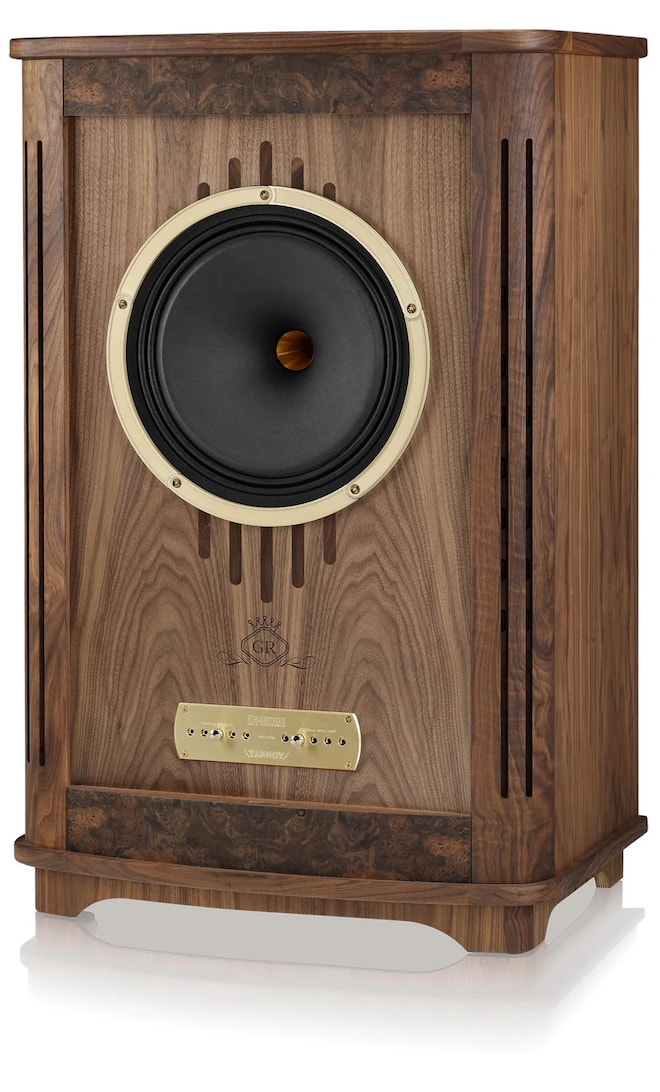
The cabinet is finished in oiled walnut veneer with hand-selected burr walnut inlays, because when a loudspeaker weighs more than some motorcycles, it may as well look like it belongs in a country estate.
The Westminster Royal GR has a sensitivity rating of 99 dB. This contributes to better compatibility with amplifiers from high-powered transistors to low-powered tube amplifiers, while bass extension reaches down to 18 Hz for full-bandwidth reproduction.
At HIGH END Vienna 2026, the Tannoy Westminster Royal GR will be demonstrated with high-performance electronics from Esoteric and cabling from Montaudio, giving attendees a properly configured listen to one of Tannoy’s most ambitious loudspeaker designs. Not exactly the kind of speaker you casually wedge between a media console and a ficus.
Tannoy says full specifications, pricing, and imagery for the wider range of special edition models will be released when the lineup formally launches later this year. Until then, the Vienna showing is effectively the preview: limited information, very large cabinets, and enough British hi-fi gravitas to make the carpet nervous.
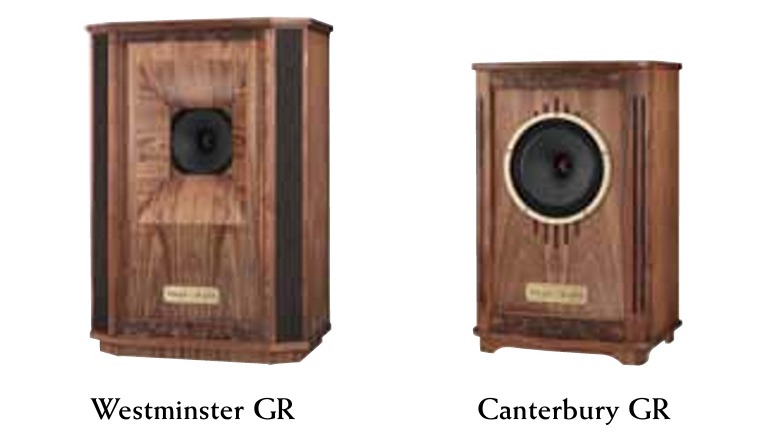
| Tannoy Non-Anniversary Model | Westminster GR | Canterbury GR |
| Product Type | Floor Standing Speaker | Floor Standing Speaker |
| MSRP (pair) | $60,000 | $30,000 |
| Recommended Amplifier Power | 20 to 350 watts per channel | 20 to 300 watts per channel |
| Continuous power handling | 175 watt RMS | 150 watt RMS |
| Peak power handling | 700 watt | 600 watt |
| Sensitivity (2.83 volt @ 1 m) | 99 dB | 96 dB |
| Nominal Impedance | 8 ohm | 8 ohm |
| Minimum Impedance | 5 ohm | 5 ohm |
| Frequency Response | 18 Hz – 27 kHz (-6 dB) | 28 Hz – 27 kHz (-6 dB) |
| Dispersion | 90 degrees conical | 90 degrees conical |
| Dual Concentric Drive Unit | 380 mm (15”) with paper pulp cone and twin roll impregnated fabric surround.
52 mm (2”) round wire voice coil 52 mm (2”) aluminium/magnesium alloy dome with round wire voice coil |
380 mm (15”) with paper pulp cone and twin roll impregnated fabric surround.
52 mm (2”) round wire voice coil 52 mm (2”) aluminium/magnesium alloy dome with round wire voice coil |
| Crossover Type | Bi-wired, hard-wired, passive, low loss.
Time compensated. 2nd order low pass. 2nd order high pass. |
Bi-wired, hard-wired, passive, low loss.
Time compensated. 2nd order low pass. 2nd order high pass. |
| Crossover Frequency | 200 Hz acoustical, 1.0 kHz electrical |
1.1 kHz |
| Adjustments | +/-3 dB over 1.0 kHz to 27 kHz shelving
+ 2 dB to -6 dB per octave over 5 kHz to 27 kHz slope |
+/-3 dB over 1.1 kHz to 27 kHz shelving
+ 2 dB to -6 dB per octave over 5 kHz to 27 kHz slope |
| Enclosure Type | Compound horn | Dual variable distributed port |
| Volume | 530 litres (18.72 cu. ft) | 235 litres (3.71 cu. ft) |
| Dimensions (HWD) | 1395 x 980 x 560 mm
54.92 x 38.58 x 22.05” |
1100 x 680 x 480 mm
43.31 x 26.77 x 18.90” |
| Construction | High-density birch ply, walnut veneered, with solid walnut trim and edging | High-density birch ply, walnut veneered, with solid walnut trim, 25mm (1”) thick front baffle. Internally cross-braced and heavily damped |
Tannoy’s 100th anniversary lineup is shaping up to be more than a commemorative badge and a nicer veneer. The limited-edition Westminster Royal GR and Canterbury GR lean into real heritage, serious engineering, and deliberately tiny production numbers tied to 1926, the year Tannoy was founded.
Who buys these? Tannoy loyalists, collectors, and serious audiophiles with the room, budget, and structural flooring to handle them. The Westminster Royal GR is not for casual listening in a condo. It is for someone who wants one of British hi-fi’s most iconic loudspeakers and is willing to build a system, and possibly a room, around it.
The bigger story is still coming at HIGH END Vienna 2026. For now, Tannoy has shown the tip of the iceberg, and it appears to be wearing oiled walnut.
The Tannoy UK team will be available at HIGH END Vienna to discuss the anniversary models in Hall X2, E06, as well as at the nearby Tech Gate demonstration area.
We don’t have final pricing or availability on the Anniversary models, but the regular versions of the each model are priced from $28K to $60K at upscaleaudio.com.


AI + ML
Limping Llama model needs a crutch made of surveillance tools
Meta CEO Mark Zuckerberg appears so determined to win the AI race that he is willing to sacrifice some employee privacy to make it happen.
In a leaked audio recording published by the worker advocacy group More Perfect Union, Zuckerberg purportedly answered an employee’s question about “device monitoring” with a six-minute monologue in which he said Meta employees are very smart and to win the most competitive technology race in history, he would need to collect their keystrokes, mouse clicks, and screenshots to make its own AI measure up to its rivals.
“We are using this to feed a very large amount of content into the AI model, so that way it can learn how smart people use computers to accomplish tasks. I think that this is going to be a very big advantage if we can do it,” Zuckerberg purportedly said during an April 30 meeting in which an employee asked about the “top of mind” issue.
Meta did not reply to an email from The Register seeking comment and has not confirmed the authenticity of the audio clip, but a company spokesperson confirmed in April that Meta would monitor employees to train AI. Meta’s tracking tool is called Model Capability Initiative, according to reports.
The audio was posted the same day Meta announced 8,000 job cuts. It captured Zuckerberg’s thoughts on the news, first reported by Reuters, that Meta planned to install software on employees’ computers to monitor activity for AI training. More Perfect Union did not reply to an email from The Register seeking comment.
“So if we’re trying to teach the models coding, for example, then having people internally build tools that or solve tasks that help teach the model how to code, we think, is going to dramatically increase our models’ coding ability faster than what others in the industry have the capability to do, who don’t have thousands and thousands of extremely strong engineers at their company,” he purportedly said in the audio.
“So that’s one example. Another thing that our system needs to be very good at is using computers, so the way that you get a system to be good at using computers is by having it watch really smart people use computers. So that’s basically the essence of what we are trying to do here.”
In one part of the audio, Zuckerberg said the software would not be used to surveil employees’ actions on the job, though he stopped short of saying the data would be anonymized. Rather, he said the purpose was narrowly focused on making its AI work better than competitors.
“The content is sort of, you know, stripped out in like as much as is possible,” he purportedly said in the leaked audio. “It’s like none of the data has been used for like looking at what people are doing, or surveillance, or performance tracking, or anything like that.”
That aligns with what a Meta spokesperson told Reuters: that MCI data would not be used for performance assessments. European employees are reportedly exempt from the program because the EU’s General Data Protection Regulation likely prohibits this type of monitoring without explicit consent, according to multiple reports.
Meta is not the only major technology company turning to its own workforce for AI training data. The Information reported this week that Microsoft and xAI are also leveraging internal employees to generate and refine training datasets. In a similar vein to what Zuckerberg purportedly said, Microsoft, which employs thousands of software engineers, reportedly views its workforce as a competitive advantage for improving GitHub Copilot.
In the recording, Zuckerberg purportedly said Meta settled on using its own employees over contractors because they were smarter.
“One basic insight and hypothesis that we have is that a lot of data generation across the field is done by these like contract companies,” Zuckerberg purportedly said. “(B)ut in general, the average intelligence of the people who are at this company is significantly higher than the average set of people that you can get to do tasks if you’re working through these contractors.”
However, the contractor pipeline is also being watched.
In January 2026, Wired reported that OpenAI’s data vendor, Handshake AI, began asking freelance contractors to upload real work products from past and current jobs, including contracts, financial models, presentations, and code repositories. OpenAI provided a tool to help contractors strip confidential information before uploading, but intellectual property lawyers warned the approach carries significant legal risk.
Zuckerberg said this sort of surveillance and the difficult conversations around it are the cost of competing at the frontier of AI.
“How do we navigate running the company through what is just this incredibly dynamic period?” he said. “There’s lots of things that people would like more certainty on than we have.” ®

The AI-generated version of ‘Moonrise, Hernandez, New Mexico’ was on display at AIPAD’s The Photography show.

The Ansel Adams Publishing Rights Trust released a statement this weekend condemning the unauthorized use of the photographer’s name and work for the creation of an “AI-generated color version” of Adams’ “Moonrise, Hernandez, New Mexico.” According to the trust, the piece was up for sale last month at the Association of International Photography Art Dealers’ (AIPAD) The Photography Show. The exhibit by Danziger Gallery “exploited Ansel’s name, reputation, and his most iconic image, while failing to identify any human artist responsible for its creation,” the statement says.
Interestingly, the trust didn’t take issue with the involvement of AI, noting that Adams “was remarkably prescient about—and excited by—the potential of computers to transform photography.” The issue is that the exhibitor allegedly just straight up ripped off the artist’s work to make money off of it.
“The Trust was not consulted or notified before the work appeared,” the Ansel Adams Publishing Rights Trust said. “Once alerted, we reached out to James Danziger in real time, notifying him of the Trust’s rights, and asking for the work to be removed. Correspondence shared with the Trust shows that, despite our formal notice, Mr. Danziger subsequently leveraged Ansel’s name, ‘Moonrise,’ and the AIPAD presentation while pursuing a proposed commercial AI colorization venture involving other artists’ estates.” The statement goes on to denounce the nonconsensual use of an artist’s name and work for commercial purposes, calling the incident “a gross failure of ethical and professional judgment.”


Infinity Ward studio heads Mark Grigsby and Jack O’Hara shared brief statements this week about the developer’s next game, indicating that they plan to unveil the next Call of Duty title soon. The highly anticipated first-person shooter might debut during Sony’s hour-long June 2 State of Play presentation or the…
Read Entire Article
Source link

At first glance, it looks like a regular USB cable. But a new Kickstarter project called Hacknect is trying to turn something as ordinary as a charging cable into a surprisingly powerful hacking and automation device. The product is being pitched toward ethical hackers, cybersecurity researchers, developers, and automation enthusiasts. Hidden inside the cable is a tiny Wi-Fi-enabled computer powered by an ESP32-S3 chip, allowing it to do far more than simply charge a phone or transfer files.
According to the Kickstarter campaign, Hacknect can remotely execute scripts, automate tasks, emulate keyboard inputs, and even store hidden files through a built-in microSD card slot. Users can reportedly control the cable wirelessly through a browser dashboard or smartphone.
In simple terms, once plugged into a computer, the cable can pretend to be a keyboard and automatically type commands or launch scripts. That’s why many people are comparing it to tools like the USB Rubber Ducky and O.MG Cable, which are already popular in cybersecurity circles for penetration testing and security training.
The interesting part is not just what Hacknect can do – it’s how invisible it looks while doing it.
Cybersecurity tools used to look like developer hardware or bulky gadgets. Now, they’re increasingly being disguised as everyday objects. A charging cable that secretly contains a wireless hacking platform feels like something out of a spy movie, which is exactly why projects like this grab attention so quickly online.

For professionals, there are legitimate uses. Security teams often use devices like these to test whether employees can detect malicious USB devices or to simulate real-world cyberattacks during training exercises. Automation enthusiasts can also use them for repetitive workflows, scripting, or remote device management.
But there’s also an uncomfortable side to this conversation.
Because the cable looks completely normal, critics argue that the same features could potentially be abused if used irresponsibly. A device capable of remotely injecting commands into a computer naturally raises concerns about unauthorized access and physical cybersecurity threats.
What makes devices like Hacknect dangerous is how easily they blend into everyday life. Most people would never suspect that a normal-looking charging cable could secretly execute commands, inject keystrokes, or remotely communicate over Wi-Fi. That creates a major trust problem around physical device security.
In the wrong hands, tools like this could potentially be used to steal data, install malicious software, or gain unauthorized access to systems without immediately raising suspicion. Since the cable appears completely ordinary, victims may plug it into personal laptops, office systems, or shared computers without thinking twice. Cybersecurity experts have long warned that physical hardware attacks are becoming harder to detect – and products like this show why.
Hacknect also reflects a larger shift happening in cybersecurity right now. As software defenses become stronger, researchers and attackers alike are paying more attention to hardware-based attack methods.
At the same time, Western companies are increasingly paying attention to the hardware innovation happening in smaller developer communities and independent tech projects. Crowdfunding platforms like Kickstarter have become a launchpad for niche cybersecurity gadgets that might once have stayed hidden inside underground forums or specialist circles.

That said, products like this still sit in a gray area. The creators heavily market Hacknect as an ethical hacking and educational tool, but like most cybersecurity hardware, the intent behind how it’s used matters far more than the gadget itself.
And while it may look like an ordinary cable sitting on a desk, Hacknect is a reminder that modern cybersecurity threats are starting to hide in plain sight.

SolarSquare, an Indian rooftop solar startup that helps households and housing societies adopt solar power, is in advanced talks to raise fresh capital after securing India’s largest solar venture investment in December 2024, TechCrunch has learned.
B Capital and Lightspeed Venture Partners are set to co-lead the Series C round, which could value SolarSquare at between $450 million and $500 million and bring in $55 million to $60 million in new investment, according to multiple people familiar with the matter. That would represent more than a doubling of SolarSquare’s valuation in roughly 18 months — a sign of how rapidly investor conviction is building around India’s residential solar market.
Lightspeed Venture Partners previously led SolarSquare’s $40 million Series B round at around a $200 million post-money valuation in December 2024. This time, according to a source, it’s investing through its growth fund, which has backed names such as Razorpay — India’s leading digital payments platform — and Zepto, the fast-delivery startup.
Existing investor Elevation Capital is also expected to participate in the deal, which is currently in advanced stages and is expected to close next month. The terms could still change as the financing has not yet been finalized. SolarSquare has raised $61.1 million in equity financing to date, per the startup data platform Tracxn.
India has set a target of achieving 500 gigawatts of renewable energy capacity by 2030, with solar expected to contribute more than half of that total. The country became the world’s third-largest solar power producer in 2025, trailing only China and the U.S. Its cumulative installed solar capacity has surged from about 3 GW in 2014 to more than 150 GW in 2026, aided partly by government incentives and subsidy schemes aimed at accelerating rooftop solar adoption.
Mumbai-headquartered SolarSquare, founded in 2015, is positioning itself as a full-stack residential solar platform in a market that remains highly fragmented, dominated by small local installers and dealer networks tied to component manufacturers such as Tata Power, Waaree Energies, Luminous Power Technologies, and Exide Industries. The startup designs, installs, and maintains rooftop solar systems for homes, housing societies (the apartment complexes and gated communities common across urban India), and enterprises, and has installed more than 150 megawatts of solar capacity with a presence across 29 cities in nine states, per its website.
SolarSquare has powered nearly 50,000 homes and around 400 housing societies, according to a source. The startup has also deployed rooftop solar systems for large enterprises including Swiggy, Zepto, and iD Fresh Food.
Residential customers and housing societies now account for a majority of SolarSquare’s business, according to people familiar with the startup’s operations, as the startup has increasingly scaled back lower-margin industrial rooftop solar projects in recent years.
The startup has crossed an annualized revenue run rate of more than ₹10 billion (around $104 million) across homes and housing societies combined, according to a source familiar with the matter. It also aims to reach 200 megawatts in its residential solar portfolio this year, the source added.
SolarSquare declined to comment. B Capital, Lightspeed Venture Partners, and Elevation Capital did not respond to requests for comment.
When you purchase through links in our articles, we may earn a small commission. This doesn’t affect our editorial independence.


A massive compilation of historic OSes and the emulators to run them
The Virtual OS Museum is an epic collection of historically
significant operating systems, representing more than 600 OSes across upwards of 250
platforms. It’s all local, so you’ll need a good few gigs of space.
The Virtual OS Museum is a
giant mixtape for enthusiasts of the history of OS evolution. As an
indication of its breadth of coverage, it reaches all the way back to
the Manchester
Baby – from 1948. Multics, the Xerox Alto, NeXTstep, PowerPC Mac OS
X, early versions of Windows NT and Android, and more.
It is one hefty layer-cake of code. The project offers two versions to
download. The Full edition is a whopping 121 GB download,
which unpacks to 174 GB, but includes everything ready for offline use.
If that’s a little indigestible, there’s also a “Lite” edition which
includes the various emulators, but not the all the disk and tape images
of actual vintage OSes: those are downloaded and run on first use. This
is a mere 14 GB download, which expands to 21 GB of space.
The download contains an x86 Linux VM, and inside that are the
various emulators, which are listed on the Credits page. The VM
should run on most things: the README has instructions
for launching it on Linux, and on both macOS and Windows on both x86-64
and Arm64. On Linux and Windows it runs inside VirtualBox, and on macOS
inside QEMU. Either way, the package will install and configure the
hypervisor for you if needed – including adding itself to an existing
copy, if you already have it installed.
There’s a lot in here: the homepage has a section with 45
screenshots and there’s a second page with over 100
more.
This means that its licensing is a little complicated. The
launcher and its configuration is distributed under the MAME
license, which keeps source code available but prohibits commercial
use. The metadata of the various OSes is distributed under the CC-BY-NC-SA license.
As for the many OSes themselves, the license page merely says:
Everything else retains its original license. Any commercial software
in this collection is included for purposes of historical research and
preservation only
Everything else retains its original license. Any commercial software in this collection is included for purposes of historical research and preservation only
This is followed by a note that nothing in the compilation is still
available for retail sale anywhere, and a request for copyright holders to contact
the author if they want anything removed.
That author is Canadian developer Andrew
Warkentin, who also has a blog called Andrew’s OS Lab, plus a Gitlab instance, holding the
project’s scripts, config
and website, and for his unfinished RTOS UX/RT.
It’s an impressive assembly. Although this vulture suspects that he’s
already tried quite a few of the contents, this is a vastly larger
collection than we’ve ever assembled. Part of the value here is that it
contains snapshots of various important steps in the evolution of modern
computers – including things outside of the main sequence. So many such
emulators exist because somebody somewhere got curious and went looking
for some relics of code gone by and built tools to run it – but to do
that, you need to know that it existed.
If you don’t already know, then this browsable catalog of OSes running via emulation is your illustrated and interactive
guide. It’s way more interesting to play with these old systems than
just watch videos, and at least for us, it’s more interesting to run it
on your own computer than inside an web page.
We’ve also personally
failed fairly hard at getting some ancient mainframe OSes running,
because the meager available documentation assumes that if you’re
interested enough to want to try something, that means that you already
know about it. When it comes to very early mainframes, for example, the
Reg FOSS desk definitely doesn’t – even though our knowledge
reaches back to the early 1980s. On that note, we also like Warkentin’s mention
that if you break the emulated system, then there is a button to restore
to a working snapshot.
In his introductory video, he says that it’s a
work-in-progress and he has enough additional candidates yet to add to
push the collection to over 2,000 different entries. An updater is
included, so you won’t have to re-download the whole thing. He also,
slightly disarmingly, does admit that not every single one has been
tested yet, and that he’s publishing it partly in the hopes of finding
employment.
We wish him luck. ®
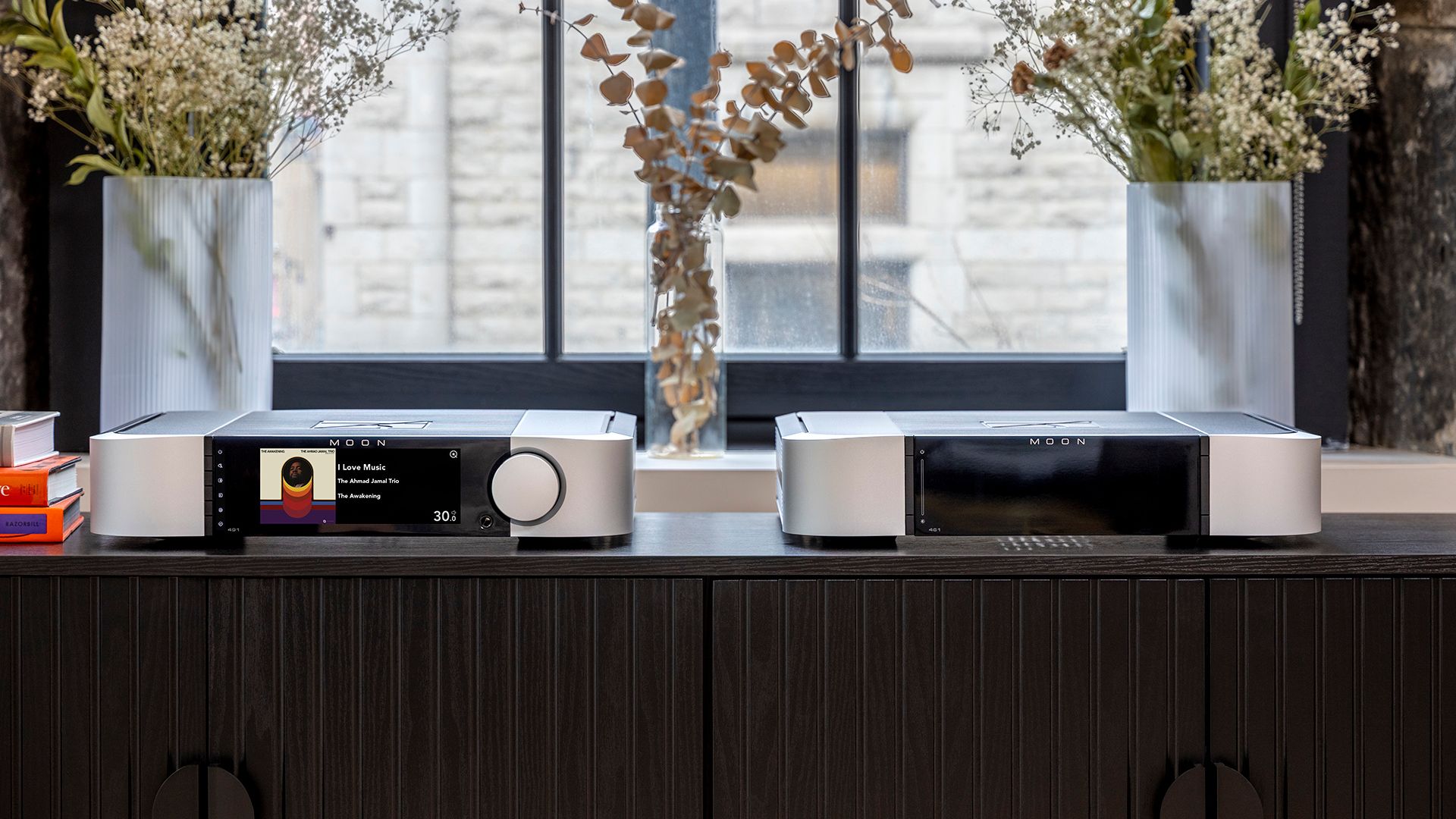
Moon’s Compass Collection has swollen with the addition of two new models in the 491 network player and 461 power amp.
Here’s the lowdown on specs and features for both.
The Moon 491 is a “fully featured network player, preamplifier, DAC, phono stage and headphone amplifier”, so suffice to say it’s a talented bit of kit that’s been built to serve as the hub “of a high-performance audio system”.
Combining digital and analogue connectivity, the 491 has been devised to deliver low-noise performance all the while maintaining the clarity, refinement and musicality that Moon’s products have become know for.
As usual the MiND 2 streaming platform serves at the core of its streaming performance, incorporating support for Roon Ready, UPnP streaming, AirPlay 2 and Bluetooth. Virtually every major streaming service under the sun is supported, a list that includes Qobuz, Tidal, Deezer and Spotify, available through the Moon MiND Controller app (iOS and Android). The ‘Connect’ versions of Qobuz, Tidal and Spotify are also supported for connecting straight to hi-fi kit.
The phono stage supports both MM and MC cartridges, and can be adjusted to allow precise cartridge matching for “optimised vinyl playback”.
The proprietary Moon Hybrid power (MHP) supply is said to improve channel separation, reduce crosstalk and enhance current delivery, in particular with low-impedance loudspeakers.
The Moon 461 power amplifier can act as a partner for the 491 network player, with its “substantual output capability” that amounts to 150W per channel, low distortion and stable performance across a “wide range” of loudspeaker loads, Moon says this is able to preserve signal integrity “with transparency, dynamic expression and composure”.
Serving as the 461’s heart is Moon’s proprietary MDCA (Moon Distortion-Cancelling Amplifier) architecture that was initially developed for its North Collection. It can significantly reduce distortion and imrpove linearity, which Moon says results in “faithful reproduction and exceptional clarirty and precision”.
Available in the UK from July onwards, the Moon 491 is priced at £5950 and the Moon 461 at £4550.
Berlin’s Peec AI hit $10M ARR six months after a $21M Series A at $4M. It helps brands optimise for AI search results.
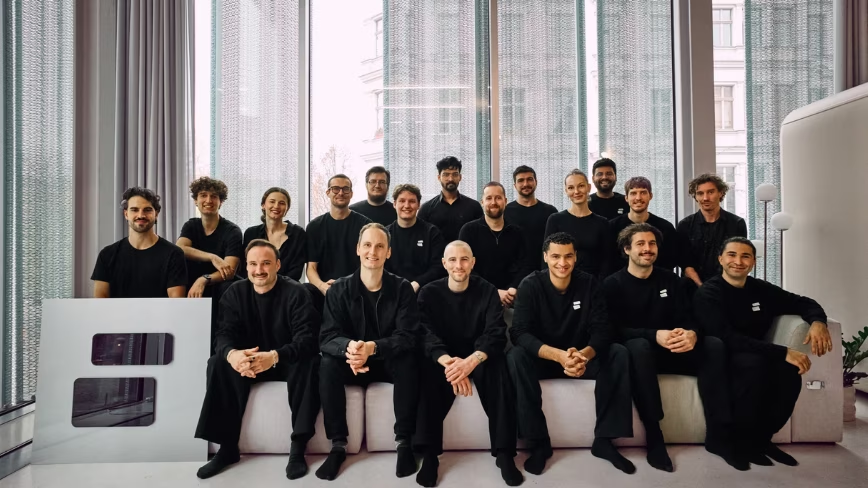
Peec AI, a Berlin-based startup that helps brands track and improve their visibility in AI-generated search results, has crossed $10 million in annualised revenue, according to internal dashboard data seen and verified by TechCrunch. The milestone comes six months after the company raised a $21 million Series A at a valuation above $100 million, when it was running at just over $4 million ARR. Revenue has more than doubled, and the pace of growth has accelerated.
The product occupies a category that barely existed 18 months ago: generative engine optimisation, or GEO. Where traditional SEO dashboards track a brand’s ranking on Google, Peec’s platform visualises whether a brand appears when users type a given set of prompts into ChatGPT, Claude, Gemini, Perplexity, or any other AI chatbot that is increasingly replacing the search bar. As consumers shift from clicking links to asking questions, the brands that show up in conversational AI responses capture attention that search engine results pages once monopolised. Peec gives marketers a dashboard to monitor, measure, and influence that visibility.
CEO Marius Meiners, a former professional esports athlete who once ranked among the top 100 League of Legends players globally, has built the company’s internal culture around competitive transparency. Peec’s revenue tracker is visible to all employees, a practice Meiners attributes to his background in competitive gaming: everyone on the team sees the score, in real time, at all times.
Antler partner Christoph Klink, whose portfolio includes both Peec and vibe-coding platform Lovable, described the company as one of the most successful investments in his fund. Speaking to TechCrunch at an event in Berlin, Klink framed Peec’s trajectory as evidence of a structural shift in the European startup ecosystem. “Founders these days track revenue much more closely,” he said. After the 2021 valuation bubble and its painful correction, success in European venture is now defined by growth, not valuation. Revenue cannot be an afterthought, and startups that treat ARR as a live metric rather than a quarterly reporting exercise are outperforming those that do not.
Peec has taken an unusual approach to talent acquisition for a European startup. Like Bay Area companies but very few Berlin firms, it invested in physical billboards to recruit engineers and sell to prospects simultaneously. The billboards were, according to Klink, “more often than not strategically placed in front of other tech companies across the city.” The tactic is part of a broader positioning effort to make Peec feel like a company worth leaving a comfortable job for, a signalling strategy that matters particularly in the current AI cycle, where the window to build a category-defining product is narrow and the competition for engineers is intense.
The GEO category is growing in parallel with the shift in consumer behaviour it serves. Canva’s State of Marketing and AI Report, published this week, found that 97% of marketing leaders now use AI daily. Google’s own data shows that AI Overviews now appear on roughly 60% of US search queries, fundamentally changing which brands get seen and which disappear. For any company whose customer acquisition depends on being found online, the transition from SEO to GEO is not optional. Peec is building the measurement layer for that transition.
The competitive landscape includes HubSpot’s recently launched AI search analytics tools, Semrush’s GEO features, and a growing number of point solutions from startups in the US and Israel. Peec’s advantage, according to Meiners, is that it was built for GEO from the ground up rather than bolted onto an existing SEO platform. The company recently opened an office in New York to serve US enterprise clients, a move that reflects where the largest marketing budgets are and where the GEO adoption curve is steepest.
The revenue trajectory places Peec in a small cohort of European AI startups that are growing at a pace previously associated only with US companies. Lovable, also in Klink’s portfolio, added $100 million in revenue in a single month in March with just 146 employees. Mistral, the Paris-based foundation model company, reached $300 million ARR earlier this year. The pattern suggests that the gap between European and American AI startups, long defined by slower growth and smaller rounds, is narrowing for the companies that are building products in categories where demand is genuinely new rather than incremental.
Klink’s explanation for why companies like Peec and Lovable publicly disclose revenue milestones despite having no obligation to do so is simple: “That’s a way to show it’s working. It also shows a focus on growth that sets the culture.” In a market where investors have been burned by companies that optimised for valuation over substance, a $10 million ARR number verified by a journalist carries more weight than a press release about a funding round. As AI chatbots begin monetising through advertising, the question of who controls brand visibility inside those conversations will only become more commercially significant. Peec is betting that the answer is: whoever can measure it.


Photograph: Michael Calore
The walls of the bag are tough enough, made from 1,200-denier polyester, which is heavy-duty and water-resistant, not to mention so rugged that it’s nearly indestructible. I’ve checked it as luggage on a dozen or so flights, and it doesn’t show any scuffs or tears. The zipper at the top isn’t sealed, but it’s heavier than it needs to be and works just fine in the rain. What truly sets the bag apart, though, is its lining. The whole interior of the tote is coated with a thin layer of thermoplastic, further increasing its imperviousness to moisture.

Photograph: Michael Calore

Photograph: Michael Calore
Now, of course, the purpose of this kind of lining is to keep the contents dry when you use the bag in a wet environment, like on a canoe trip, on a rainy bike ride, or on a duck hunt in the Maine wilderness. And surely, I have used the bag in a canoe and on many a rainy bike ride (I’ve never been on a duck hunt), and the goods inside have indeed always remained intact. I even trust the bag enough to carry electronics and musical equipment to the office or studio on drizzly mornings. But for me, the utility the bag provides is more so the opposite: it’s an excellent place to cleanly transport items that are, themselves, muddy, wet, or slimy.
For example, I’ve taken the bag car camping several times. Once, I used it to pack my tent, ground cloth, boots, and rain shell. On the last day of the trip, it poured outside, and upon it being time to head home, my rain jacket and tent were soaked, the ground cloth was dotted with wet pine needles and flecks of bark, and my boots had a thick layer of Mendocino, California, muck in the tread. I crammed all of those items in the Hunter’s Tote, zipped it up, and tossed it into the back seat of my rental car. The interior lining kept the mess inside, saving the rental car’s tuck-and-roll upholstery. Back home, I emptied the tote, flipped it inside out, and blasted out all the forest flooring with a hose.
There are two heavy plastic tabs on the edges of the tote, one at each end of the zipper. This is where the shoulder strap clips in. I’ve never really used the strap (honestly, it just gets in the way), but those tabs are great for hanging the tote to dry after rinsing it out.
The Hunter’s Tote comes in three sizes. I have the largest, the XL, which has a capacity of 53 liters. (That’s huge for a tote bag.) I prefer the larger size because when you set the reinforced bottom on a flat surface and prop the mouth of the bag open, you have a generous flat bottom inside of 10 by 19 inches. All that room really makes the bag more versatile, so my recommendation is to go large.
Also, just know there are no frills here: no exterior pockets, no padding, no laptop sleeve. Just a rugged carrier that’s ready for your dirtiest work. Whether you’re carrying twelvers of La Croix or bagging Buffleheads, it’s indispensable.
Power up with unlimited access to WIRED. Get best-in-class reporting and exclusive subscriber content that’s too important to ignore. Subscribe Today.

Anthropic’s Glasswing project found 10,000+ critical flaws across 1,000 open-source projects in a month. Only 97 have been patched.
Anthropic disclosed on Friday that Project Glasswing, its restricted cybersecurity initiative, has uncovered more than 10,000 high- or critical-severity vulnerability candidates across some of the most systemically important software in the world since the programme went live one month ago. Of those, 1,726 have been validated as true positives. 1,094 are confirmed high- or critical-severity flaws. Only 97 have been patched.
The gap between those numbers is the story. Anthropic’s Claude Mythos Preview, a frontier model with specialised capabilities for finding vulnerabilities in source code, can identify flaws at a pace that the open-source ecosystem cannot absorb. The 6,202 high- or critical-severity candidates affect more than 1,000 open-source projects. Eighty-eight advisories have been issued. The rate of discovery is orders of magnitude faster than the rate of remediation.
“The relative ease of finding vulnerabilities compared with the difficulty of fixing them amounts to a major challenge for cybersecurity,” Anthropic acknowledged. The company is urging software developers to shorten patch cycles and make security fixes available as quickly as possible. Oracle has already shifted from quarterly to monthly patch releases to address the acceleration. Microsoft has warned that the number of monthly patches it expects to release will “continue trending larger for some time.”

The 💜 of EU tech
The latest rumblings from the EU tech scene, a story from our wise ol’ founder Boris, and some questionable AI art. It’s free, every week, in your inbox. Sign up now!
The most notable finding so far is a critical flaw in WolfSSL (CVE-2026-5194, CVSS score 9.1), a widely used embedded TLS library, that could allow an attacker to forge certificates and impersonate a legitimate service. WolfSSL is deployed across IoT devices, automotive systems, and industrial control environments where a certificate forgery vulnerability carries consequences well beyond conventional web security.
Glasswing operates through a restricted partnership model. Approximately 50 organisations, described by Anthropic as the most systemically important cyber defenders, have access to Claude Mythos Preview. The model has not been released to the general public. XBOW, an autonomous offensive security platform, described Mythos Preview as “a major advance” that is “substantially better than prior models at finding vulnerability candidates” and “adept at analysing source code with a security mindset.” Cloudflare’s analysis found the model excels at turning individual vulnerabilities into end-to-end attack chains, a capability that is as useful for defenders building threat models as it is dangerous in the wrong hands.
The defensive applications extend beyond vulnerability discovery. In one case, a Glasswing partner bank used Claude Mythos to detect and prevent a fraudulent $1.5 million wire transfer after an attacker breached a customer’s email account and made spoof phone calls. The model identified the fraud pattern before the transfer was executed. The use case illustrates Anthropic’s argument that frontier AI models can provide asymmetric advantages to defenders, but only if access is restricted to organisations with the maturity to use them responsibly.
The timing aligns with a broader acceleration in AI-related security disclosures. Cyera’s Claw Chain vulnerabilities in OpenClaw, disclosed earlier this month, demonstrated how attackers can weaponise an AI agent’s own sandbox privileges. Koi Security’s audit of ClawHub found 341 malicious entries among 2,857 available AI agent skills. The pattern is consistent: AI is simultaneously creating new attack surfaces and providing more powerful tools to find flaws in existing ones. The question is which side of the equation moves faster.
Anthropic has launched a Cyber Verification Program that allows vetted security professionals to use Claude without guardrails for legitimate purposes including vulnerability research, penetration testing, and red teaming. OpenAI has introduced a parallel programme called Daybreak, which provides similar access to GPT-5.5-Cyber. Neither Mythos Preview nor GPT-5.5-Cyber has been released to the general public due to concerns that adequate safeguards to prevent large-scale misuse do not yet exist.
The competitive dynamic between Anthropic and OpenAI in the cybersecurity space is intensifying. Both companies are positioning their frontier models as essential infrastructure for national and corporate cyber defence, while simultaneously restricting access to prevent the same capabilities from being used offensively. The dual-use nature of the technology creates a policy challenge that neither company has fully resolved: if models with Mythos-level capabilities become broadly available, as Anthropic itself acknowledges is likely in the near future, the current model of restricting access to 50 trusted partners will not hold.
Anthropic’s publicly available Claude models are already among the most capable coding assistants on the market. The gap between what Mythos can do and what the public-facing Claude can do is narrowing with each release. Anthropic is urging organisations to prepare for a world in which these capabilities are widely accessible by hardening network configurations, enforcing multi-factor authentication, and maintaining comprehensive logs for detection and response.
Ten thousand vulnerability candidates in one month from 50 partners using one model. The software ecosystem now has a tool that can find flaws faster than developers can fix them. That is both the promise and the problem. Anthropic calls Glasswing an asymmetric advantage for defenders. It is. But asymmetric advantages tend to be temporary, and the clock on this one is already running.




Blockchain.com files with SEC for U.S. IPO


Holiday Weekend Open Thread – Corporette.com


Intesa Sanpaolo’s crypto holdings jump to $235M as XRP enters


Dell Technologies DELL Stock Surges 15% on AI Server Momentum and Analyst Upgrades in 2026


Space X IPO Is ‘Bad News’ for Tech Stocks: But What About Bitcoin?


Robinhood crypto COO Tanya Denisova exits


Makerfield: a tale of two social-media histories


AI infrastructure race heats up as IREN pitches full-stack strategy, WhiteFiber lands $160M deal

A 0.12% parameter add-on gives AI agents the working memory RAG can’t


WhatsApp ads could make Irish debut after discussions with DPC


Bitcoin Accumulation Weakens as BTC Realized Losses Hit $600M


You Can Now Add ChatGPT To PowerPoint

Revolut Launches Dogecoin Debit Card Across UK and EU


Off Campus Easter Eggs Explained: Characters, Stories, More


2026 CJ Cup Byron Nelson leaderboard: Brooks Koepka finds putting stroke in Round 1

Charity run by Reform leader Malcolm Offord accused of ‘law breaking’ over Scottish registration


Trump Media’s Bitcoin Stash Shrinks Again as 2,650 BTC Lands on Crypto.com


Trump Invests $1M-$5M in Kura Sushi USA Chain With 27 California Locations
Goldman Sachs reinstates Ageas stock coverage with neutral rating
Australia defends property tax changes designed to fix ‘broken’ housing


You must be logged in to post a comment Login