

Stepping into VR is about more than strapping on a headset and loading a game. The best VR headsets today are gateways to fully realized experiences, whether that’s gaming, fitness, creative work or simply spending time inside a richly rendered virtual world. As the hardware has improved, so has the sense of presence, with sharper displays, wider fields of view and tracking systems that make movement feel more natural and responsive. The result is VR that feels less like a novelty and more like a platform you can actually spend time in.
That said, not every headset is built for the same function. Some prioritize ease of use and standalone play, while others demand a powerful PC in exchange for higher fidelity. Compatibility also matters more than ever, especially as VR begins to overlap with mixed reality and early smart glasses experiments. Whether you want a simple way to explore virtual spaces or a high-end rig that pushes immersion as far as possible, this guide breaks down the best VR headsets you can buy in 2026 and explains who each one is really for.
Storage capacity: 128GB | Battery life: 2.2 hours | Field of view: 110 degrees (horizontal), 96 degrees (vertical) | Max refresh rate: 120Hz
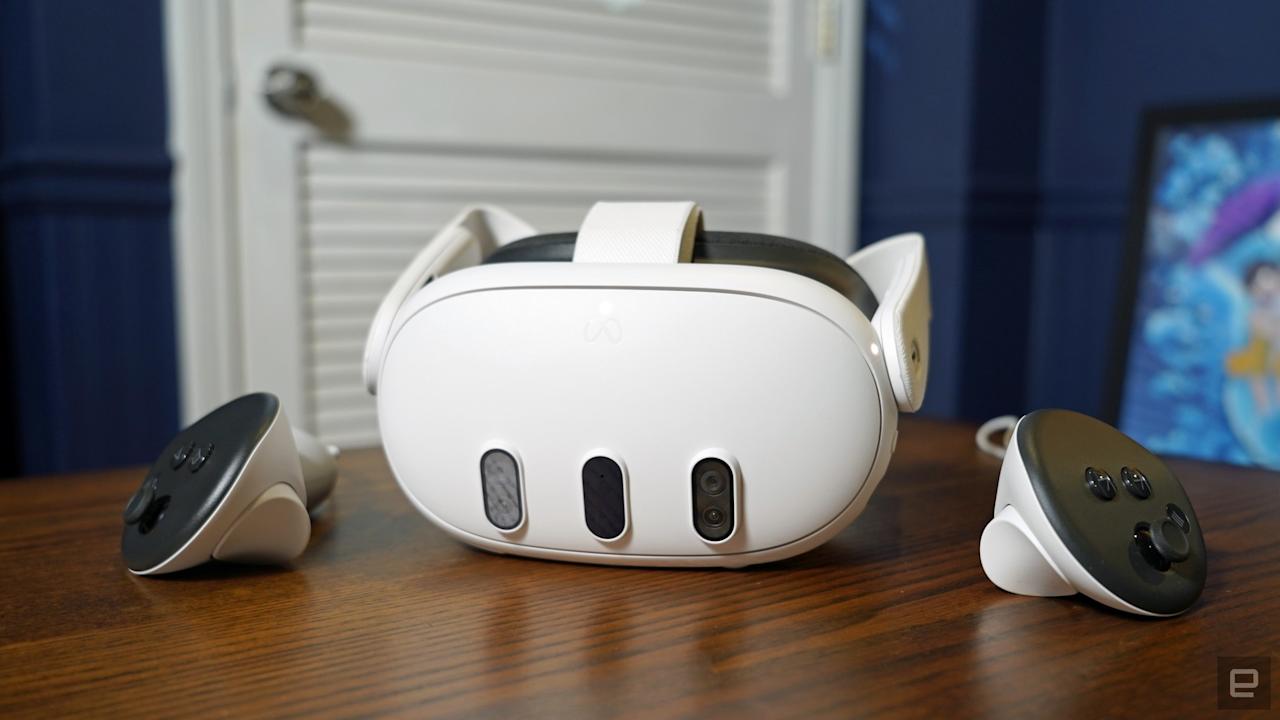
The long-awaited follow-up to the Quest 2 is an upgrade in every respect: It’s more comfortable to wear, it has higher quality screens and it has full-color mixed reality cameras, allowing you to see the real world alongside virtual elements. While it’s more expensive at $500, it’s also a far more capable headset than the Quest 2 and the new Quest 3S, with hardware and optics that will keep you happily immersed in VR for years.
The Quest 3 is powered by Qualcomm’s Snapdragon XR2 Gen 2 chip, which Meta says has double the graphics power of the Quest 2. That additional power is noticeable in games like Red Matter 2, which feature updated textures that deliver an experience closer to PC VR. The Quest 3’s new displays run at 2,064 by 2,208 pixels per eye, offering an even better experience than the PlayStation VR2. Its mixed reality cameras also let you easily see the real world, in case you need to quickly answer a text or Slack message. And they enable games that can be built around your room.
What makes the Quest 3 interesting is that it offers more than just solid VR: It also gives you a glimpse at what a mixed reality future could be, blurring the line between the real world and a virtual world. While it’s not as sharp or capable as Apple’s Vision Pro, that’s understandable. And just like previous Quest headsets, you can also plug it into a gaming PC for higher quality VR experiences, expanding its compatibility beyond standalone use.
Advertisement
Pros
Sharp new screens and lenses
Faster performance
Mixed reality cameras make it easier to see the real world
Storage capacity: Up to 1TB | Battery life: 2.5 hours | Field of view: 100 degrees | Max refresh rate: 120Hz
Apple’s first update for the Vision Pro is basically just a spec bump, but it’s at least a sign that the company hasn’t forgotten about its whole spatial computing endeavour. It’s faster and more power efficient, thanks to the M5 chip, and it also ships with a more comfortable Dual Knit Band that does a better job of balancing such a heavy headset.
With its additional power, the M5 Vision Pro can render 10 percent more pixels than the original model, and it can reach up to a faster 120Hz refresh rate for smoother scrolling. I couldn’t see a major difference in our testing, but I can confirm its Micro OLED screens still look phenomenal. They’re crisp enough for reading text on websites and a mirrored Mac, plus can also scale to extreme heights for stunning Immersive Video content.
Given its high $3,500 price and limited content, though, the Vision Pro is still clearly not meant for typical consumers, with its primary function leaning more toward development and experimentation than everyday VR use. Instead, like the original, it’s basically just a highly polished developer kit for people interested in building visionOS apps. Apple diehards will likely get a kick out of it too, but practically most people interested in AR and VR are better off buying a Meta Quest 3 alongside a gaming PC, especially as lighter smart glasses concepts continue to evolve separately from full headsets.
Storage capacity: 128GB, 256GB | Battery life: 2-3 hours | Field of view: 96 degrees | Max refresh rate: 120Hz
The Quest 3S is Meta’s latest entry-level VR headset, but don’t let its reasonable $300 price fool you: It’s also a remarkable achievement for the company. It sports the same Qualcomm Snapdragon XR2 Gen 2 chip as the Quest 3, as well as a healthy 8GB of RAM, allowing it to power the same experiences as its pricier sibling. It also features Meta’s excellent Touch Plus controllers, which deliver solid motion controls, as well as responsive joysticks and buttons.
The only major downside is that the Quest 3S isn’t nearly as sharp as the Quest 3. It features the same 1,830 by 1,920 pixel per eye screen from the Quest 2, while the Quest 3’s screen offers 30 percent more pixels (2,264 by 2,208 pixels per eye), to deliver a sharper and more realistic image.
VR newbies probably won’t notice the difference much though, and that’s what really matters. The Quest 3S is just as comfortable as the Quest 3 to wear, and it can easily access the same apps and games on the Meta Quest Store. There’s no headphone jack either, but its built-in speakers deliver solid enveloping audio for games like Maestro, and you could also plug in a USB-C to 3.5mm adapter, or just pair wireless headphones.
Advertisement
The Quest 3S can connect to gaming PCs over USB-C or wirelessly to play more intense VR experiences, giving it strong compatibility with both standalone and PC-based setups. It can also wirelessly stream your gameplay to Chromecast devices, or to AirPlay devices by mirroring the Quest app from an iPhone. If you’re still holding onto the Quest 2, or an original Quest, the Quest 3S is precisely the inexpensive upgrade you’ve been waiting for.
Storage capacity: 128GB, 256GB | Battery life: 3 hours | Field of view: 110 degrees | Max refresh rate: 120Hz
The PS VR2 is one of the best headset we’ve tested. It offers dual 2K OLED HDR screens, effectively giving you 4K quality. It’s one of the most comfortable headsets around. And it has some genuinely refreshing new features, like eye tracking and headset haptics. (Yes, it can literally rock your noggin.) Best of all, the PS VR2 delivers high-quality virtual reality without the need for a $1,000+ gaming PC – all you need is a PlayStation 5, making its core function tightly focused on console gaming.
Now, our recommendation comes with a few caveats. At $550, the PS VR2 is more expensive than the PS5 itself. And it’s unclear how quickly its game library will fill up. The initial run has only a few exclusives, like Horizon VR and Gran Turismo 7, and we haven’t seen many new titles since then. But it’s still the easiest way to experience high-end VR, and it’s a major upgrade over the original PS VR.
Storage capacity: N/A | Battery life: 7 hours | Field of view: 108 degrees | Max refresh rate: 120Hz
Valve’s Index kit remains one of the best high-end solutions on the market that provides a truly immersive VR experience. For $999 you get the Index headset, Valve’s finger tracking controllers and two SteamVR base stations. While we’ve seen higher-resolution headsets arrive in the last two years, it’s still a very solid option, with a 1,440 by 1,600 pixel resolution, an eye-watering 144Hz refresh rate and a massive 130-degree field of view. I’d gladly lose a few pixels for the Index’s smoother and more expansive screen, which are still far beyond most other consumer headsets.
As a SteamVR product, the Index requires installing two sensors at opposite corners of your room, which limits its compatibility but enables extremely precise tracking. And of course, it’s wired to your PC. But that clunkiness is worth it for the higher refresh rate and more accurate tracking, especially if you want the deepest possible sense of immersion in a virtual world. Sure, it’s not as easy to use as the Quest 3S, but at this price range, we assume you’ll suffer a bit of inconvenience to get a truly high-quality VR experience.
Valve’s finger tracking controllers are fantastic as well, with a convenient strap that locks them onto your hands. They make playing Half-Life: Alyx feel like a dream. It’s unfortunate that other VR games haven’t fully taken advantage of the finger tracking though.
Advertisement
Pros
144Hz refresh rate with a 130-degree field of view
Storage capacity: N/A | Battery life: 2 hours | Field of view: 102 degrees | Max refresh rate: 90Hz
Essentially an upgrade for the Index, the Beyond is a unique spin on a VR headset from Bigscreen, with a function that prioritizes comfort and visual fidelity over convenience, the developer of a popular app for watching video in VR. It looks more like an oversized pair of goggles than a massive VR headset. The $999 Beyond is the lightest VR option we’ve ever seen (it weighs a tad more than a deck of playing cards), and its Micro-OLED screens are sharp and offer near-perfect contrast. Unlike LCD screens, black can look genuinely black with the Beyond.
The downside, though, is that the Bigscreen Beyond is expensive. It’s $999 on its own if you’re just upgrading a Valve Index setup. If you’re starting from scratch, though, you’ll also need to buy two Steam VR base stations and a pair of Index controllers. That adds up to a whopping $1,578.
The Bigscreen Beyond also requires a custom face cushion, which is built from a 3D facescan when you place your order. Unfortunately, that makes it harder to share than other headsets. There’s also no room for glasses, since it’s so slim. You can buy prescription lens inserts from Bigscreen for an additional fee. And of course, you’ll have to live with a cable tethered to your PC, there’s none of the freedom of the cordless Meta Quest headsets.
Advertisement
For all of its complexity, though, the Bigscreen Beyond delivers the most immersive PC VR experience I’ve ever seen. Since it’s so light, you can easily wear it for hours. Together with its glorious screens, it’s the best option for VR enthusiasts who don’t mind dealing with cost and complexity for true immersion.
Pros
Incredibly light and comfortable
Sharp and bright Micro-OLED screens
Works alongside existing Valve Index accessories
Cons
Expensive
No built-in audio
Still exhibits artifacting like other VR headsets
How we test VR headsets
I tend to judge candidates for the best VR headset on a few basic criteria: Ergonomics, immersion and controls. It’s not that hard to shove a mobile display into a plastic headset and strap some cheap elastic headbands onto it. But it takes real design skill to craft something that’s well balanced, includes a supportive headstrap, and doesn’t feel uncomfortable after 30 minutes.
My test for ergonomics is fairly simple: How long can I wear a headset until I start to feel discomfort? For the most ergonomic devices, like the Quest 3, that could easily be an hour or two. But heavier PC hardware often feels cumbersome after just 15 minutes — you won’t find those kinds of devices in our list of the best VR headsets.
Advertisement
Immersion, meanwhile, comes from having high resolution screens with fast refresh rates, like a 120Hz refresh rate, helping users feel fully present inside a virtual world. Field of view is also a major element, as it describes how well VR screens can cover what you see. A narrow FOV makes it feel like you’re peering through a pair of binoculars, which limits your sense of “presence.” The best VR headsets aim for a wider field of view, helping virtual environments feel more natural and fully surround you.
A wide field of view, on the other hand, can make it seem like you’re actually flying over the globe in Google Earth. We look at a few popular video games, like Superhot, Beat Saber and Pistol Whip, on every headset to judge how immersed we feel and how enjoyable the gaming experience is overall.
The best controllers fit naturally in your hands and offer accurate tracking. The industry has basically adopted the design of Meta’s excellent touch controllers, but we’re also seeing intriguing leaps forward like Valve’s finger tracking gamepads. We judge controllers based on how easy they are to hold, how they hold up to sweaty gameplay sessions and how easily headsets can track their position in space.
However, it’s important to look at a virtual reality headset’s specs as a whole, including compatibility with your existing hardware and the kind of experiences you plan to use it for. Depending on what you’re looking for in yourVR headset, you’ll want to consider factors like your PC’s CPU and graphics card if you plan to use the headset to play the best VR games. You might not need a super powerful PC, but you should check the minimum requirements for the headset you’re looking to purchase. If you’re not looking to invest in a VR headset solely for gaming, features like head tracking allow you to explore your environment just by simply moving your head in the simulator. This often results in a more immersive and realistic experience.
Advertisement
Other VR headsets we’ve tested
HTC Vive Focus Vision
The Vive Focus Vision is a sleek premium standalone VR headset that can also deliver solid PC VR. But it’s also running aging hardware, it’s riddled with software issues and it’s expensive compared to the Meta Quest 3.
Meta Quest Pro
As great as the Meta Quest 3 is, the Quest 2 is still a very good entry-level VR headset, and it’s worth considering if it’s on sale below its current $250 list price. The Meta Quest Pro, on the the hand, is an expensive boondoggle best ignored.
HTC Vive Pro 2
Outside of Meta’s hardware, the HTC Vive Pro 2 remains a fantastic PC headset, but it’s far more expensive than the Valve Index, which is more comfortable and offers better audio.
VR headset FAQs
How do VR headsets work?
At the most basic level, a VR headset is simply a high quality screen that you’re holding up to your face. For a wired headset, the actual work of rendering a game is done on either a PC or game console. For completely wireless devices, like the Meta Quest 3, that work is handled right on the headset. They rely on either external sensors, or sensors built into the headsets, to map your physical space. While you can use a traditional gamepad or keyboard and mouse in VR, they typically use motion tracking controllers to immerse you in their 3D environments.
Advertisement
What VR headset is best for full body tracking?
While we’re still waiting for a truly great haptic VR bodysuit to arrive, you can still achieve accurate body tracking with most Steam VR-compatible PC headsets. The Valve Index and HTC Vive Pro 2 both rely on room-tracking sensors that can map your body more effectively than the built-in sensors on competitors. You can also add HTC Vive Trackers to wrist and leg straps, as well as belts, for even better coverage. The Meta Quest 3 doesn’t have any easy body tracking solutions, but you can add Vive trackers when it’s plugged into your PC to mimic a Steam VR headset.
Only a few experiences, like VRChat, take advantage of full body tracking at the moment. Currently there aren’t any body tracking solutions for the PlayStation VR and VR2, but we’re intrigued by the company’s Mocopi body trackers, which were really announced in Japan.
What VR headsets are better than Oculus?
Oculus is the previous name for Meta’s VR hardware. Currently, Meta only supports the Quest 3, Quest 3S and Quest Pro, all of which are wireless headsets. As we explain above, PC VR headsets can generally achieve better quality virtual reality, since they rely on more powerful graphics hardware.
What VR headsets work with Xbox?
Currently, Microsoft’s Xbox consoles don’t support any VR headsets.
Advertisement
Recent updates
November 2025: Updated to include the Apple Vision Pro M5.
April 2025: Updated to include review scores for our top picks, where applicable.
November 2024: Added the HTC Vive Focus Vision to the “others we tested” section.
October 2024: Updated our “best cheap VR headset” top pick to be the Meta Quest 3S.
The Shark EveryMess 3-in-1 can vacuum wet and dry spills, and act like a spot cleaner
It’s impressively compact and comes with a range of attachments
Available to buy now for $149.99 / £199
Shark has expanded its spot cleaner lineup with a multitalented new machine. The Shark EveryMess can vacuum liquid and solid messes, or work as a spot cleaner on upholstery. I saw one in action at Shark’s HQ, where it sucked up a Coke spill from a cream carpet with not so much as a trace of sticky soda left behind.
This 3-in-1 combination is pretty unusual — in this corner of the market, you typically get wet-and-dry vacuums or spot cleaners, but it’s rare for an appliance to do both. It’s available to buy now from $149.99 in the US, and £199.99 in the UK (scroll down to check out the best prices at a range of retailers).
What’s more, it’s impressively compact. The US and UK versions have slightly different proportions, but either would fit into an average-sized kitchen/utility room cupboard. (The US version is 10.5 x 16.5 x 13.5in / 26.7 x 41.9 x 34.3cm L x W x H. The UK version is 22.7 x 36.9 x 36.4cm / 8.9 x 14.5 x 14.3in.)
(Image credit: Shark)
There are multiple compatible attachments for tackling different kinds of messes: an extending Crevice tool for tight corners, a wider Squeegee tool for covering larger spaces, and a dedicated Stain Eliminator attachment for tough, set-in stains.
Advertisement
Although it’s marketed as a 3-in-1, this doesn’t look like a sensible replacement for a full-sized wet floor cleaner, because none of the attachments are especially big. However, for smaller, trickier cleanups of any kind, it seems ideal — Shark lists broken glass and permanent marker as examples of awkward cleanups this appliance can happily tackle.
Another obvious market for such multipurpose cleaners is pet owners. Not only is the EveryMess suitable for cleaning everything from muddy pawprints on your soft furnishings to the occasional toilet-training accident, but Shark says it’s especially good at picking up pet hair at the same time.
(Image credit: Shark)
Shark boasts about a ‘Rinse & Ready’ self-clean function, but it’s a little more rudimentary than it sounds: to rinse out the tubing, you can simply vacuum up a pitcher of fresh water. For especially disgusting messes, Shark recommends lining the main bin with a 15-50L plastic bag so you don’t need to get your hands dirty when it comes to disposal.
Advertisement
Sign up for breaking news, reviews, opinion, top tech deals, and more.
The EveryMess is designed for use with Shark’s ‘StainForce’ two-part cleaning solution, and the brand suggests you’ll only get that kind of extreme, stain-busting performance with that specific formula. The spray nozzle part clips straight onto the cleaner cartridges, replacements of which can be purchased separately at a cost of $24.99 / £24.99 for two, or $14.99 / £14.99 for one.
And of course, you can also follow TechRadar on YouTube and TikTok for news, reviews, unboxings in video form, and get regular updates from us on WhatsApp too.
The Durobo Krono strips the e-reader down to its pocketable essentials, but a lack of polish and questionable features keep it from challenging more refined rivals.
Durobo Krono e-ink e-reader
Reading on the go is always kind of a pain. Either you’re doing it on a smartphone, which isn’t great for your eyes, or you might try to lug around an iPad or a larger e-paper reader like a Kindle. That’s why there’s a surprisingly large fanbase for pocket-sized e-eaders. I even consider myself a part of that fanbase, considering how much I’ve enjoyed using one myself. Continue Reading on AppleInsider | Discuss on our Forums
The front lobby of Kumo, an Amazon office building at 1915 Terry Ave. in Seattle. (GeekWire Photo / Taylor Soper)
Amazon plans to exit an office building near its Seattle headquarters, 12 years after taking over the space during the height of its growth in the city.
Amazon is not renewing its lease at 1915 Terry Ave. in the Denny Triangle area of downtown Seattle, the company confirmed to GeekWire on Tuesday. The tech giant, which has occupied the seven-story, 251,000-square-foot space owned by Seattle Children’s since 2014, will move out at the end of May and relocate employees to other offices.
The Puget Sound Business Journal first reported on the planned move.
The seven-story building in the Denny Triangle neighborhood is owned by Seattle Children’s. (GeekWire Photo / Taylor Soper)
Kumo, as Amazon calls it, is a 1950s-era building located just a few blocks from Amazon’s main office towers and the Spheres. Amazon did not say how many employees work from the building.
The company employs approximately 50,000 corporate and tech employees in Seattle. More than 1,400 workers in Seattle were impacted by company-wide layoffs of 16,000 people announced at the end of January.
PSBJ reported that since 2020, Amazon has given up more than 1 million square feet of office space in Seattle, most of it in the Denny Triangle.
Advertisement
The company has been growing its footprint across Lake Washington in Bellevue, where it has opened new office buildings and said it plans to employ 25,000 people as part of its regional HQ.
The United States installed a record 57 gigawatt hours of new battery storage on its electric grids in 2025, a nearly 30% increase over the prior year that arrived even as the Trump administration cut tax credits for wind and solar in last summer’s One Big Beautiful Bill.
The figures come from a Solar Energy Industries Association report published Monday, which also projects the market will grow another 21% this year by adding 70 gigawatt hours in 2026 alone. Battery tax credits themselves survived the legislation largely intact, and the majority of last year’s new installations were stand-alone systems not tied to specific solar projects.
In Texas, solar met more than 15% of electricity demand throughout the summer and beat out coal for the first time, and the SEIA report predicts the state will overtake California this year in total deployed storage. Supply chain restrictions reinforced by the bill and project cancellations could slow the pipeline this year, the report cautions.
Tap Space’s founder started with just S$50 to kickstart his business
From keychains bearing the names of MRT stations to miniature bus models, transport merchandise is taking off in Singapore.
One business riding this wave is TapSpace, founded by 29-year-old Danial Sim—he started with just S$50, and now, he can sell thousands of items in a single day.
We spoke with Danial to find out more about how a holiday inspiration grew into a full-fledged business, with a store that regularly sees queues and can sell over a thousand products in a single day.
The idea for Tap Space struck him during a holiday in Korea
(Left): Danial Sim in South Korea; (Right): Seoul’s transport keychains inspired by real-life stations./ Image Credit: Danial Sim/ KAvenyou via Facebook
The idea for TapSpace struck Danial during a holiday in Korea in August 2023. There, he noticed a vibrant public transport culture and a genuine appreciation for transit systems through collectible trinkets—something he realised was largely missing back home in Singapore.
At the time, Danial was working in engineering and laboratory roles, hardly the typical background for someone launching a creative merchandise business. Though the idea of making transport-themed collectibles had lingered in the back of his mind, he had put it on hold due to the demands of his job.
Advertisement
Yet his love for public transport—and the nostalgia it evoked, from the sights and smells to the interiors—stuck with him throughout his daily travels around Singapore. Hence, a year later, in Aug 2024, he finally decided to give it a shot, starting with a S$50 investment to test the market.
That modest investment went towards sourcing local manufacturers for small-batch items like keychains. Danial’s breakthrough came when he found a Singapore supplier willing to work without minimum order quantities, a rare opportunity that let him test the market without a massive upfront commitment.
Starting from ground zero
Image Credit: Kevin Chng via Google Reviews, Tap Space
Tap Space’s first merchandise line launched with just four MRT station keychain designs: Changi, Orchard, Punggol, and Sengkang, each priced at S$9.90.
To market his products, Danial started from scratch, launching a TikTok account with zero followers. Every single night, after dinner, Danial would religiously start a TikTok livestream to show what he’s come up with and engage with potential customers.
Beyond TikTok Shop, Danial expanded to Shopee after noticing that many Singaporeans prefer it for online purchases. Tap Space also regularly held pop-ups at hobby fairs to reach an even wider audience.
Advertisement
Danial’s hard work paid off eventually. Every day, he would gain “a few hundred followers” on social media, which proved to him that there was an appetite for transport trinkets in Singapore.
Gradually, customers also began requesting additional stations—Choa Chu Kang, Jurong East, Woodlands—laying the foundation for new product lines. Danial continued expanding, and today he has over 250 MRT and LRT-inspired key chain designs.
Tap Space broke even in one year
Every brand has its watershed moment. For TapSpace, it arrived in Aug 2025 at Takashimaya during a two-week invitational pop-up event coinciding with Singapore’s SG60 National Day celebrations.
Image Credit: Tap Space
The event marked a milestone for the business—it broke even, selling 1,500 pieces on the first day and completely selling out by day three.
It also showed Danial that Tap Space could grow beyond a hobby. After the pop-up, he took the leap from full-time employment into full-time entrepreneurship, recognising that the growing demand for his products required his full attention.
Advertisement
Shortly afterwards, he even opened a physical retail space at Burlington Square, giving customers a place to browse his collectibles in person.
Expanding Tap Space’s product range
Tap Space’s store at Burlington Square./ Image Credit: Tap Space
Beyond MRT stations, Tap Space also offers other iconic transport symbols as keychains, such as the ‘May I have a seat’ and priority seating icons. The shop even sells MRT handles as keychains—initially sourced from local scrap yards, though Danial has since located the original supplier for these authentic pieces.
People thought the transport handles were 3D printed, like a fake thing. However, when they realised that it’s the actual thing, they buy them for funny uses, not just as keychains, but for the gym, or to walk their dogs.
Danial Sim
Tap Space turns transport handles and transport symbols commonly seen on Singapore’s public transport into functional merchandise./ Image Credit: Tap Space
Apart from keychains, Tap Space has expanded into stickers, miniature models of buses, trains and taxis from different eras, figurines, and desk mats. Some of these products are even sold in blind boxes.
To balance local support with efficiency, Danial works with local manufacturers for small-batch restocking, while larger production is handled by specialised suppliers across Asia—China, Malaysia, and Thailand—for faster turnaround times.
Ambitions to go beyond merchandise & expanding overseas
Today, Tap Space’s store sees steady demand. According to the founder, it requires restocking two to three times weekly, a frequency backed by the “daily” queues it sees every day.
Advertisement
People just see public transport as something that you take; they don’t really think of it as a memory. When you turn it into something memorable and collectible, people be like, ‘Oh, I didn’t know that this can have so much memories in this one keychain or in this one design.’ That’s where it starts off.
Danial Sim
Miniature trains and buses are also part of the key offerings at Tap Space./ Image Credit: Tap Space
The shop attracts a wide range of customers, from parents with children to groups of overseas tourists seeking authentic souvenirs beyond the usual Merlion keychains. Many visitors come just to browse the carefully curated, cosy space, which, according to Danial, has been described as a ‘museum for mini Singapore transport.’
The founder has also managed to secure consignment placements in major retailers, including Popular bookstores and Toys “R” Us.
Looking ahead, Tap Space’s ambitions go beyond merchandise into technology. Danial is exploring NFC-enabled keychains that link to LTA wayfinding and EZ-Link systems, aiming to merge physical collectibles with digital utility.
As part of his efforts of “expanding thoughtfully,” Danial is also in the midst of coming up with bilingual versions of station designs, such as Japanese and English, which may appeal better to international visitors.
Advertisement
International expansion is also not off the table. Danial recently hosted a successful pop-up in Kuala Lumpur showcasing products inspired by Malaysian public transport, though he has not shared concrete plans for further expansion.
The transformation of mundane infrastructure—train handles, station signs, bus liveries—into coveted collectibles demonstrates that business opportunities often hide in plain sight, waiting for someone willing to see the extraordinary in the ordinary.
You don’t have to start with a lot of money. Can be like me: start with S$50. Use the money you have. You shouldn’t go all out; you should just try the small market first. If you go for small pop-ups around Singapore and there is interest, then why not?
Way back in the ancient days of the year 2020, the world went through this pandemic thing called COVID-19. For those of you not old enough to remember such ancient history, it was a fairly significant health issue that caused a few disruptions throughout the world, including in these here United States. Trump was president at the time of the wild spread of the pandemic. There were shutdowns. There was a supply chain shitstorm. People argued over masks and school closures while staring at shelves where toilet paper used to be available so we could wipe ourselves. The government displayed such an impressive failure of leadership that I myself questioned why we should have a government at all if this is how it was going to behave.
But, to be fair, there were also some impressive things from government to come out of the pandemic. Trump’s administration initiated Operation Warp Speed to develop and distribute COVID vaccines so we could all get back to our lives. While the first Trump administration didn’t do so great at the distribution part of the plan, and managed to coat the world in incredible amounts of misinformation around the pandemic and these vaccines, it was still an impressive feat to bring these vaccines to market in record time. One of the government agencies that powered Operation Warp Speed was the National Institute of Allergy and Infectious Disease (NIAID), which was responsible for collating research on previous pathogens similar to COVID-19 and for building out the trials for the vaccines that would eventually come to market. If it weren’t for NIAID, it’s unlikely the government’s response to the pandemic would have been as rapid, or successful.
And if you think I’m wrong about that, there’s a chance that the next pandemic will provide us with an answer. That’s because this second Trump administration is actively choosing to remove exactly this sort of pandemic work from NIAID’s proactive efforts.
NIH director Jay Bhattacharya explained the restructure at an event with other top agency officials on 30 January. “It’s a complete transformation of [the NIAID] away from this old model” that has historically prioritized research on HIV, biodefence and pandemic preparedness, he said. The institute will focus more on basic immunology and other infectious diseases currently affecting people in the United States, he added, rather than on predicting future diseases.
Nahid Bhadelia, director of Boston University’s Center on Emerging Infectious Diseases in Massachusetts, says the decision to deprioritize these areas will leave people in the United States more vulnerable to pathogens that are constantly evolving in wildlife around the world and spilling into human populations, sometimes sparking outbreaks. “Just because we say we’re going to stop caring about these issues doesn’t make the issues go away — it just makes us less prepared,” she says.
Advertisement
This is one of the things I’ve found about Trump’s second term most perplexing. His reelection efforts were arguably chiefly torpedoed by the pandemic. There’s an old saying in parenting that even a child can learn a lesson from pain. If a child touches a hot stove, they will get burned and will not touch it again. By installing the likes of RFK Jr. and his cadre of conspiracy theorists to manage the health of Americans, and by keeping the very agency that allowed for his rapid response to COVID from doing likewise in the future, it appears Trump wants to keep touching the hot stove. I don’t get it.
And it’s not like we don’t have outbreaks of infectious disease happening right now. We absolutely do. The measles infection count that has gone on for 14 months in this country is insane. There’s no reason COVID can’t mutate and come right back into our lives as a major health issue. Or there could be another novel pathogen that grinds all of our lives back to a halt once more. For a man so concerned with building walls, he’s tearing down the virtual protection that is proactive research and knowledge.
“NIAID’s work clearly neither prevented the pandemic nor prevented Americans from experiencing among the highest levels of all-cause excess mortality in the developed world during that time,” [Bhattacharya and subordinates] wrote. “Given the increasing prevalence of allergic and autoimmune disorders and the burden of common infections in the population over the past few decades, the NIAID must focus research on these conditions with a greater sense of urgency.”
This is a wild fictionalization of what occurred at NIAID. The agency doesn’t make healthcare policy. It advises the Executive Branch on what is needed to prepare for new and existing diseases, performs research into detecting those diseases before they become pandemics, and provides research and planning into how to respond to them. When Anthony Fauci led NIAID in 2017, he warned the administration of all of this and asked for funding to prepare for it. Not only did he not get his funding, but the administration also made staff and budget cuts impacting our pandemic preparations.
“We do need a public-health emergency fund. It’s tough to get it … but we need it,” Fauci said. “Because what we had to go through for Zika — it was very, very painful when the president asked for the $1.9 billion in February and we didn’t get it until September.”
But the Trump administration did not create such a fund, and instead cut spending for federal agencies responsible for detecting and preparing for outbreaks. In May 2018, Trump’s national security advisor disbanded the National Security Council’s pandemic response team, while in October 2019, the administration declined to renew funding for a pandemic early warning system.
Advertisement
This administration is doing it again, except worse. This time, it’s not removing some funding and some staff that were used to prepare us for the next pandemic. Instead, he’s just removing the mission of pandemic preparedness from NIAID entirely. And there are future plans to remove funding for research on novel pathogens, as well.
The instructions to agency staff members to rebrand the institute’s language are only the first step towards implementing this new vision, according to the NIAID employees. NIH principal deputy director Matthew Memoli has ordered more changes, including the review of the portfolio of grants funding biodefence and pandemic preparedness, in the coming weeks and months, they say.
This is crazy. It’s as though we’re all in the back seat of the family minivan, while mom and dad drive us somewhere… except we have no GPS, no maps, the steering wheel moves on its own, and the windshield is made of lead.
The stove is still hot. And, unfortunately, as Trump makes another attempt to touch it, it won’t be his fingers that are singed, but our own.
Apple’s plan to add touchscreens to its premium MacBook Pros is coming into focus. Bloomberg reports that when the new laptops launch this fall, they’ll feature a Dynamic Island, not unlike Apple’s iPhones, and an interface that changes depending on where you touch your Macbook’s screen.
This “dynamic interface” is reportedly designed to make the transition between mouse input and touch input smoother on Apple’s new laptops. Bloomberg says that if users touch an onscreen button, the version of macOS running on these new MacBook Pros will be able to pull up a contextual menu “that provides more relevant options for touch commands.” Parts of the interface, like macOS’ menu bar, will also be able to enlarge to make menu items easier to select with a finger. Those tweaks are on top of the expected features from touchscreen Apple products, like smooth scrolling and the ability to pinch and zoom into and out of images, files and web pages. The only thing missing from these increasingly iPad-like laptops, per Bloomberg, will be a touchscreen keyboard, because they’ll already have a more comfortable physical keyboard attached.
To make these new laptops extra enticing, both the 14-inch and 16-inch touchscreen MacBook Pros will feature OLED screens for the first time, likely the reason Apple will be able to include a Dynamic Island-style webcam in the first place. Up until now, the company has offered OLED screens on its iPhones, Apple Watches and more recently the iPad Pro, but it hasn’t brought the display technology to laptops. That could reportedly change with these new MacBook Pros.
Plenty of Windows laptops include touchscreens, and Microsoft and its partners have incorporated dynamic interface elements in the past to make these touchscreens more natural to use with Windows. Apple is late to the party in this respect, but it’s also potentially set up to succeed. Much of modern macOS already looks touch-friendly, and Apple’s has expended significant effort making it possible to port touch-based iPad apps to macOS and develop applications across platforms. That, paired with the right interface, could make the experience of using a touchscreen MacBook nicer out of the box, even if it doesn’t get rid of the awkwardness of reaching over your keyboard to touch a screen.

MatX, a chip startup founded by two former Google hardware engineers, has raised a $500 million Series B led by Jane Street and Situational Awareness, an investment fund formed by former OpenAI researcher Leopold Aschenbrenner.
The company’s goal is to make its processors 10 times better at training LLMs and delivering results than Nvidia’s GPUs.
Other investors in the round include Marvell Technology, NFDG, Spark Capital, and Stripe co-founders Patrick Collison and John Collison, the startup’s founder and CEO Reiner Pope announced Tuesday in a post on LinkedIn.
Although the company didn’t release its latest valuation, Etched, MatX’s closest competitor, raised a $500 million round at a $5 billion valuation, Bloomberg reported last month. Etched didn’t immediately respond to a request for comment.
Advertisement
MatX’s latest round comes more than a year after its Series A of about $100 million, which was led by Spark Capital. TechCrunch earlier reported that the 2024 round valued the startup at more than $300 million.
Before co-founding MatX in 2023, Pope led AI software development for Google’s TPUs, the tech giant’s proprietary AI chips. His co-founder, Mike Gunter, was a lead designer of the TPU hardware before leaving to launch the startup.
The new funding will help MatX produce its chips with TSMC, with plans to start shipping them in 2027.
Kojima Productions has officially revealed the PC system requirements for Death Stranding 2: On the Beach, and the good news is that they are far more approachable than many recent big-budget releases. According to Sony’s PlayStation Blog, the PC version launches March 19 and includes a wide range of graphics presets designed to scale from budget systems all the way to high-end rigs.
Kojima Productions
At the entry level, the game targets 1080p at 30 frames per second with hardware that many gamers already own. A GTX 1660 or Radeon RX 5500 XT paired with an Intel Core i3-10100 or Ryzen 3 3100 and 16GB of RAM is enough to get started. That alone makes the game feel refreshingly accessible in a landscape where minimum specs often demand much newer GPUs.
Sony
Moving up the preset scales is a predictable process. Medium settings aim for 1080p at 60fps with an RTX 3060 or RX 6600, while the recommended tier targets 1440p at 60fps with an RTX 3070 or RX 6800. The very high preset pushes into 4K at 60fps territory with an RTX 4080 or RX 9070 XT. Every preset requires 16GB of RAM and a 150GB SSD install, which is becoming standard for modern AAA titles.
Handheld gaming and modern upscaling take center stage
One of the most interesting additions is a dedicated Portable preset designed specifically for handheld gaming PCs. This mode targets devices such as the Steam Deck and ROG Ally, with full support for modern upscaling and frame-generation technologies, including NVIDIA DLSS 4, AMD FSR 4, and Intel XeSS 2. These tools allow players to push higher resolutions and frame rates without requiring top-tier hardware.
Sony
On top of that, the game includes Guerrilla’s in-house Pico upscaling technology from the Decima engine, which can be used alongside frame generation and works across different graphics cards. Ultrawide support is also included, with cutscenes designed for 21:9 displays and gameplay extending to 32:9 aspect ratios.
With the PC launch arriving on March 19, these requirements suggest that many players may already have the hardware needed to jump in on day one. If anything, this release feels like a reminder that not every blockbuster needs extreme specs to deliver a next-gen experience.
Across industries, retail, food and lifestyle brands are rethinking how space functions—not just to sell, but to shape how they are experienced.
Advertisement
From individual brands like Louis Vuitton x Takashi Murakami’s pop-up, where potential customers can pamper themselves with a cinema, cafe and carestation to creative precincts like New Bahru that feature retail brands in a design-led and cultural environment, physical environments are becoming strategic branding tools.
Now, the automotive industry is catching up. BYD by 1826, which claims to be Singapore’s first integrated automotive lifestyle brand, wants to lead the way in enhancing how car showrooms can appeal to customers.
BYD is transforming the car-buying experience
BYD by 1826’s IMM hub features locally roasted specialty coffee in a tranquil setting./ Image Credit: BYD by 1826
While lifestyle-first spaces are common in fashion, food, and retail, automotive retail spaces have largely remained transactional. Traditional showrooms can feel intimidating or high-pressure, especially for first-time buyers.
This is evident from how two-thirds of people globally expect the places and spaces where they live, work and play to provide more enjoyment, diverse activities, and add value to the time they spend there.
Advertisement
As such, BYD has been experimenting with spaces that blend automotive retail with lifestyle experiences. Over the years, it has launched several of these spaces, including the first BYD-themed restaurant, BYD by 1826, which opened at Boat Quay in 2023.
These outlets have helped the brand understand how Singaporeans interact with cars in relaxed, everyday settings and refine its automotive-lifestyle retail model.
Michelle Ho, Chief Brand Officer & Chief Culinary Officer, shared: “Each outlet sharpened our understanding of how different communities engage with us.”
BYD by 1826 Zhongshan Park./ Image Credit: BYD by 1826
For instance, while BYD by 1826’s Zhongshan Park outlet demonstrated the strength of inclusive, pet-friendly environments that encourage longer stays, the Suntec and Tanjong Pagar outlets reinforced the need for accessibility and seamless integration into the routines of professionals.
On the other hand, BYD by 1826 at Waterway Point highlighted the power of neighbourhood familiarity and repeat visits driven by coffee culture.
Advertisement
Armed with these insights, its latest IMM outlet, located in the West, draws inspiration from local identity and daily routines. The outlet combines electric vehicles, a café, design elements, and community-focused activities.
Alongside its accessible EVs, BYD by 1826 at IMM also includes DENZA, a premium electric‑vehicle brand owned by the Chinese automaker.
BYD by 1826’s IMM hub represents the evolution of the concept from hybrid showroom to experiential hub… [it] signals a deeper commitment to embedding BYD within the social fabric of the neighbourhood.
Michelle Ho, Chief Brand Officer & Chief Culinary Officer of BYD by 1826
What you can expect at BYD by 1826’s IMM hub
BYD by 1826’s IMM outlet is pet-friendly and serves Singapore fusion dishes./ Image Credit: BYD by 1826
At the BYD by 1826 IMM hub, visitors can enjoy speciality coffee and Singaporean fusion fare, from Chilli Crab Shiok-shuka to Tiger Prawn Risotto Pao Fan, in a pet-friendly, family-oriented space designed for lingering.
While they enjoy the ambience and food, they can also browse cars from BYD and DENZA.
Advertisement
Together, these elements form a “café-first” environment where food, conversation, and community unfold alongside automobiles, according to the brand.
This reinforces BYD by 1826’s vision of automotive-lifestyle integration, where they aim to position cars as part of a place of familiarity and belonging.
(Left): The cafe at BYD by 1826’s IMM hub; (Right): The space also hosts curated cultural programmes, spotlighting local musicians, creatives and small businesses./ Image Credit: BYD by 1826
The brand has noticed that because customers are not in a sales-driven environment, they feel comfortable asking questions at their own pace, which piques their curiosity.
In several cases, repeat visits have led to spontaneous test drives and eventually to serious purchase considerations.
When people experience the brand in a relaxed, lifestyle setting, trust builds organically. That sustained engagement has proven far more impactful than a single transactional interaction.
Advertisement
“Each location we open is not just about showcasing cars—it’s about creating experiences that belong to Singaporeans,” said Davin Ongsono, CEO of BYD by 1826.
The future of automotive spaces
Image Credit: BYD by 1826
In Singapore, it’s clear that retail spaces are no longer just about transactions—they’re evolving into experience-driven destinations.
BYD has embraced this trend by creating spaces that combine cars, cafés, and community activities, offering a more relaxed and engaging way for people to explore automotive options.
It’s a notable disruption in the automotive industry, which has long relied on traditional, transactional showrooms.
From the West to the East, the brand wants Singaporeans to experience what the future of automotive spaces can look like. You can check out BYD by 1826 at IMM here, and discover its other lifestyle spaces across the city-state here.