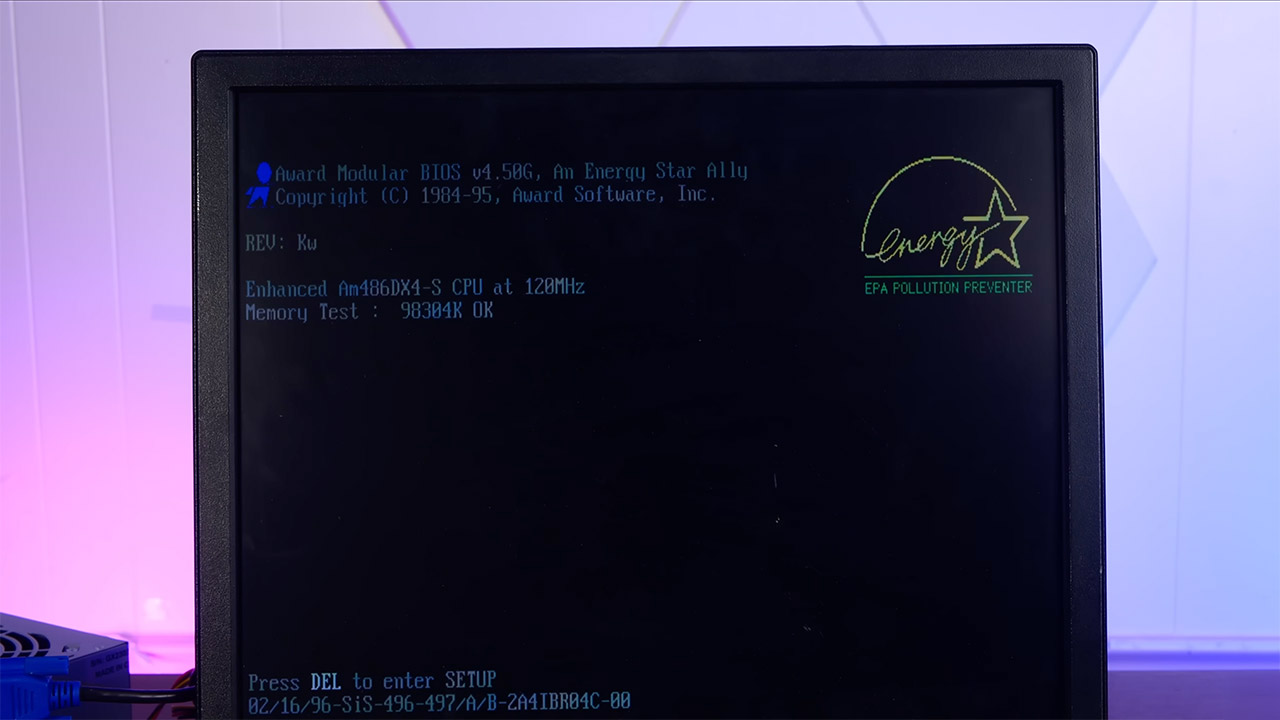
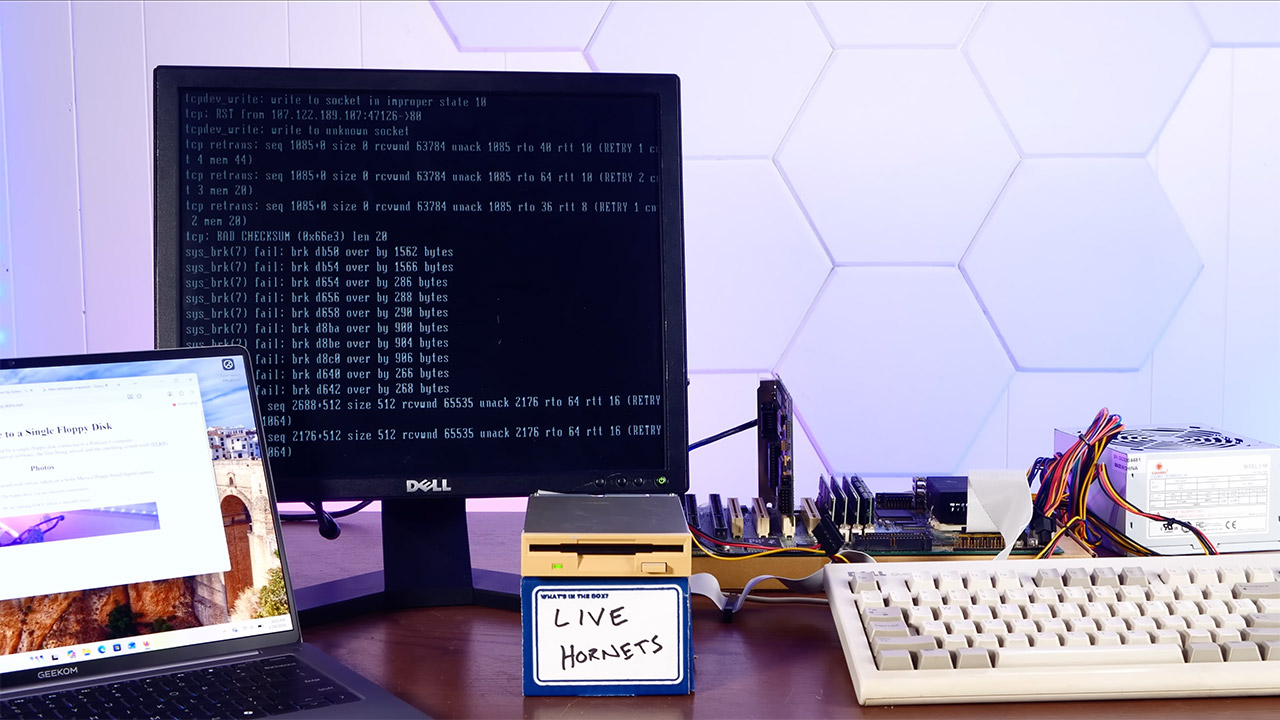
Today, a single 1.44MB floppy disk is sufficient to run an entire operating system and a functional web server. Despite the fact that hardware costs are soaring, this demonstrates that you don’t need the latest and greatest to support a server; just a little old-fashioned efficiency.
Action Retro, a retro computing enthusiast, accomplished this by booting ELKS (which stands for Embeddable Linux Kernel Subset) directly from a floppy disk. ELKS is a lightweight operating system that is only a quarter of the size of a standard operating system, yet it still has a full kernel, TCP/IP networking, device drivers, shell, and other features.
【AMD Ryzen 4300U Processor】KAMRUI Pinova P2 Mini PC is equipped with AMD Ryzen 4300U (4-core/4-thread, up to 3.7GHz), Based on the advanced Zen…
【Large Storage Capacity, Easy Expansion】KAMRUI Pinova P2 mini computers is equipped with 16GB DDR4 for faster multitasking and smooth application…
【4K Triple Display】KAMRUI Pinova P2 4300U mini desktop computers is equipped with HDMI2.0 ×1 +DP1.4 ×1+USB3.2 Gen2 Type-C ×1 interfaces for…
ELKS is a lightweight version of Linux that was originally designed to run on some very old 16-bit machines, so old that it only goes up to the 286 era, but it still has a lot of life in it, as it runs well on 256KB of RAM, and in some cases as little as 128KB, whereas regular images require about 512KB. Of course, the secret to ELKS’ small weight is that it is fully bloat-free, with no new and fancy software or features to get in the way, just a lean, mean, and efficient machine that gets the job done.
Advertisement
Action Retro made the disk by getting a bootable ELKS floppy image from the project’s GitHub source code repository. He then used his Mac’s dd tool to transfer the image on a regular 3.5-inch floppy disk. He chose a Socket 3 motherboard with a 120MHz AMD 486DX4 CPU to support the ELKS operating system, which he linked to a 3Com EtherLink III Ethernet adapter that happened to include ELKS drivers. The only accessories required are a keyboard, a visual card, and a floppy disk drive. A hard drive is not required because this is a simple system.
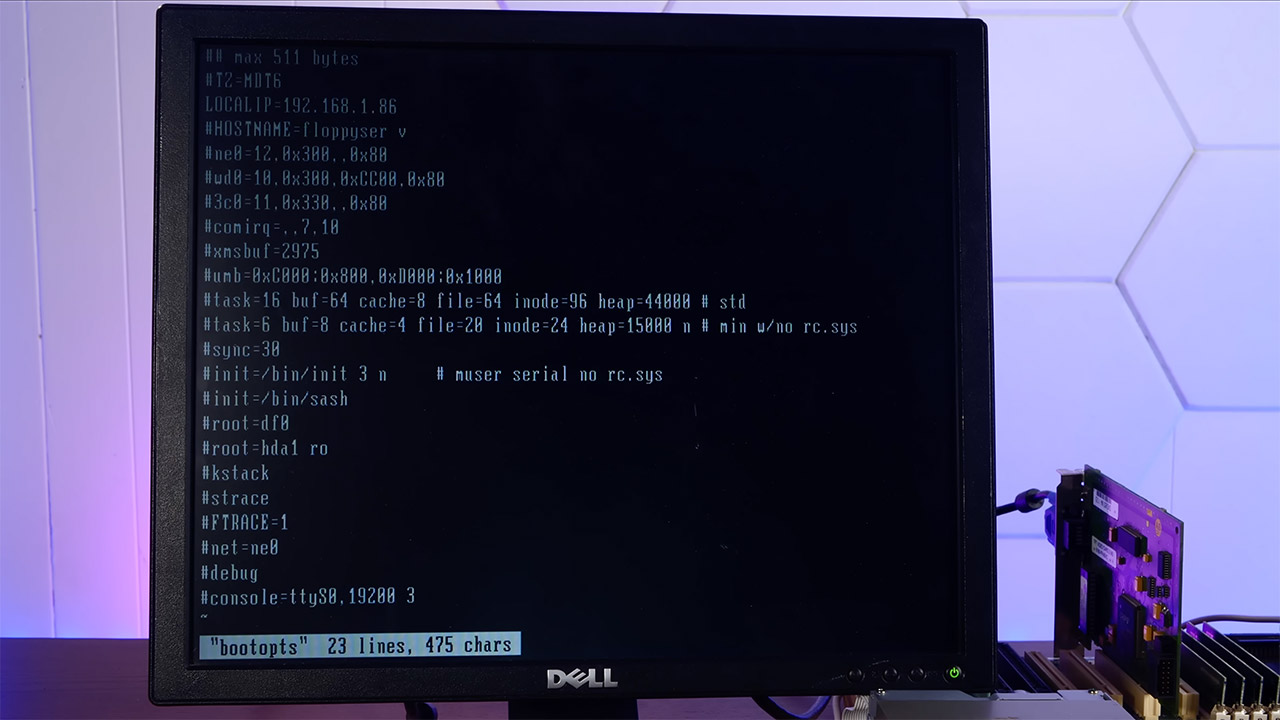
Booting is quick, as you are immediately sent to a command line. The network setup is a little more involved; you must manually update a few configuration files. In boot.opts, you specify a local IP address, hostname, and gateway. In net.config, you load the Ethernet driver and configure the netmask. At startup, the TCP/IP stack and its associated daemons are automatically launched.
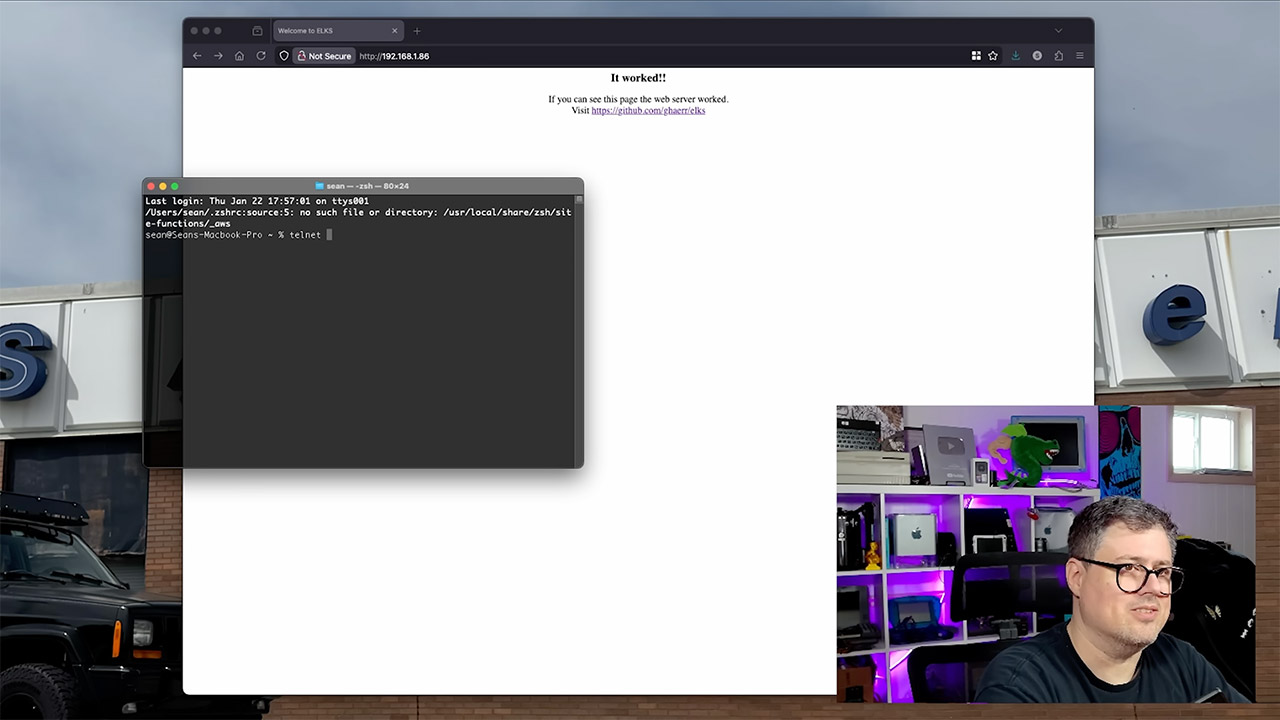
Once up and running, the HTTP server uses the floppy drive to offer rudimentary web pages. Action Retro even used FTP to upload a basic HTML file and a few JPEG photos from another PC. He used vi to edit the page on the ELKS system to ensure its perfection. Because this gadget is running on a floppy disk, the web pages are locally accessible; simply visit the associated IP address and you’ll be ready to go.
If you have an ancient PC, a working floppy drive, and the ELKS image, you can basically replicate this setup. Just go to the GitHub page, download the image, write it to a floppy drive, setup the networking, and boot; it’s truly that simple. The end product is a nice reminder that sometimes little is more; an outdated floppy disk can still produce a functional server with plenty of space to spare. [Source]
University of Surrey researchers discovered a compound known as nanostructured sodium vanadate hydrate (NVOH) – a layered sodium-based material that naturally contains water within its crystalline structure. Traditionally, researchers treat such compounds with heat to evaporate that water, assuming it weakens the material’s stability. The Surrey team tested that assumption… Read Entire Article Source link
Lockheed Martin’s F-35 combat aircraft is a supersonic stealth “strike fighter.” But this week the military news site TWZ reports that the fighter’s “computer brain,” including “its cloud-based components, could be cracked to accept third-party software updates, just like ‘jailbreaking’ a cellphone, according to the Dutch State Secretary for Defense.”
TWZ notes that the Dutch defense secretary made the remarks during an episode of BNR Nieuwsradio’s “Boekestijn en de Wijk” podcast, according to a machine translation:
Gijs Tuinman, who has been State Secretary for Defense in the Netherlands since 2024, does not appear to have offered any further details about what the jailbreaking process might entail. What, if any, cyber vulnerabilities this might indicate is also unclear. It is possible that he may have been speaking more notionally or figuratively about action that could be taken in the future, if necessary…
The ALIS/ODIN network is designed to handle much more than just software updates and logistical data. It is also the port used to upload mission data packages containing highly sensitive planning information, including details about enemy air defenses and other intelligence, onto F-35s before missions and to download intelligence and other data after a sortie. To date, Israel is the only country known to have successfully negotiated a deal giving it the right to install domestically-developed software onto its F-35Is, as well as otherwise operate its jets outside of the ALIS/ODIN network.
The comments “underscore larger issues surrounding the F-35 program, especially for foreign operators,” the article points out. But at the same time F-35’s have a sophisticated mission-planning data package. “So while jailbreaking F-35’s onboard computers, as well as other aspects of the ALIS/ODIN network, may technically be feasible, there are immediate questions about the ability to independently recreate the critical mission planning and other support it provides. This is also just one aspect of what is necessary to keep the jets flying, let alone operationally relevant.”
“TWZ previously explored many of these same issues in detail last year, amid a flurry of reports about the possibility that F-35s have some type of discreet ‘kill switch’ built in that U.S. authorities could use to remotely disable the jets. Rumors of this capability are not new and remain completely unsubstantiated.”
Advertisement
At that time, we stressed that a ‘kill switch’ would not even be necessary to hobble F-35s in foreign service. At present, the jets are heavily dependent on U.S.-centric maintenance and logistics chains that are subject to American export controls and agreements with manufacturer Lockheed Martin. Just reliably sourcing spare parts has been a huge challenge for the U.S. military itself… F-35s would be quickly grounded without this sustainment support. [A cutoff in spare parts and support”would leave jailbroken jets quickly bricked on the ground,” the article notes later.] Altogether, any kind of jailbreaking of the F-35’s systems would come with a serious risk of legal action by Lockheed Martin and additional friction with the U.S. government.
Thanks to long-time Slashdot reader Koreantoast for sharing the article.
Programmer/entrepreneur Paul Ford is the co-founder of AI-driven business software platform Aboard. This week he wrote a guest essay for the New York Times titled “The AI Disruption Has Arrived, and It Sure Is Fun,” arguing that Anthropic’s Claude Code “was always a helpful coding assistant, but in November it suddenly got much better, and ever since I’ve been knocking off side projects that had sat in folders for a decade or longer… [W]hen the stars align and my prompts work out, I can do hundreds of thousands of dollars worth of work for fun (fun for me) over weekends and evenings, for the price of the Claude $200-a-month.”
I’m deeply convinced that it’s possible to accelerate software development with AI coding — not deprofessionalize it entirely, or simplify it so that everything is prompts, but make it into a more accessible craft. Things which not long ago cost hundreds of thousands of dollars to pull off might come for hundreds of dollars, and be doable by you, or your cousin. This is a remarkable accelerant, dumped into the public square at a bad moment, with no guidance or manual — and the reaction of many people who could gain the most power from these tools is rejection and anxiety. But as I wrote….
I believe there are millions, maybe billions, of software products that don’t exist but should: Dashboards, reports, apps, project trackers and countless others. People want these things to do their jobs, or to help others, but they can’t find the budget. They make do with spreadsheets and to-do lists.
Advertisement
I don’t expect to change any minds; that’s not how minds work. I just wanted to make sure that I used the platform offered by the Times to say, in as cheerful a way as possible: Hey, this new power is real, and it should be in as many hands as possible. I believe everyone should have good software, and that it’s more possible now than it was a few years ago. From his guest essay:
Is the software I’m making for myself on my phone as good as handcrafted, bespoke code? No. But it’s immediate and cheap. And the quantities, measured in lines of text, are large. It might fail a company’s quality test, but it would meet every deadline. That is what makes A.I. coding such a shock to the system… What if software suddenly wanted to ship? What if all of that immense bureaucracy, the endless processes, the mind-boggling range of costs that you need to make the computer compute, just goes?
That doesn’t mean that the software will be good. But most software today is not good. It simply means that products could go to market very quickly. And for lots of users, that’s going to be fine. People don’t judge A.I. code the same way they judge slop articles or glazed videos. They’re not looking for the human connection of art. They’re looking to achieve a goal. Code just has to work… In about six months you could do a lot of things that took me 20 years to learn. I’m writing all kinds of code I never could before — but you can, too. If we can’t stop the freight train, we can at least hop on for a ride.
The simple truth is that I am less valuable than I used to be. It stings to be made obsolete, but it’s fun to code on the train, too. And if this technology keeps improving, then all of the people who tell me how hard it is to make a report, place an order, upgrade an app or update a record — they could get the software they deserve, too. That might be a good trade, long term.
Apple’s satellite features were originally designed for emergencies, allowing iPhone users to contact emergency services when cellular and Wi-Fi coverage is unavailable. With recent versions of iOS, Apple has expanded those capabilities to include sending and receiving messages via satellite. This makes it possible to stay in touch with friends and family from remote locations where traditional networks do not reach, such as hiking trails, rural areas or offshore locations.
Messaging via satellite is built directly into the iPhone and works automatically when no cellular or Wi-Fi signal is available. While it is not intended to replace regular messaging, it can be a useful backup when coverage drops.
How to send a message via satellite
Before you can get started, you’ll need to turn on iMessage before you’re off the grid. It’s also important to set up an emergency contact as well as members of your Family Sharing group prior to your departure. This will enable them to message you via SMS without the need to message them first. To send a message via satellite, open the Messages app when no cellular or Wi-Fi signal is available. If the feature is supported in the current location, the app will display a prompt indicating that satellite messaging is available.
Selecting the option to connect via satellite launches a guided connection screen. Your iPhone will provide real-time instructions to help maintain alignment with the satellite. Once connected, a text message can be typed and sent, although delivery may take longer than usual.
Advertisement
The iPhone will notify you when the message has been sent successfully. Replies from the recipient will also be delivered via satellite, as long as the connection remains active.
What you need before you can send satellite messages
Sending messages via satellite requires a compatible iPhone model and the correct software version. The feature is supported on iPhone models with satellite hardware, beginning with iPhone 14 and later. The device must be running a version of iOS (iOS 18 or higher) that supports satellite messaging, which Apple has continued to refine through recent iOS updates.
The feature also depends on location and availability. Satellite messaging is currently supported in select regions, including the United States and parts of Canada, with expanded support rolling out gradually. The iPhone must be outdoors with a clear view of the sky, as trees, buildings and terrain can interfere with the satellite connection.
Satellite messaging is not designed for continuous conversations. Messages are compressed and sent at a slower pace than standard texts, and delivery times can vary depending on conditions and satellite positioning.
Advertisement
How satellite messaging works on iPhone
When an iPhone loses access to cellular and Wi-Fi networks, the system automatically detects that only satellite connectivity is available. Instead of failing to send, the Messages app prompts the user to connect to a satellite.
On-screen instructions guide the user to position the phone correctly. This typically involves holding the device up and following directional prompts to align it with an overhead satellite. The phone uses built-in sensors to help maintain the connection while the message is being sent.
Messages sent via satellite are text-only and use a reduced data format to ensure they can be transmitted reliably. Images, videos, audio messages and large attachments are not supported.
Who can receive satellite messages?
Satellite messages can be sent to contacts using iMessage or standard SMS, depending on the recipient’s device and settings. If the recipient is using an Apple device with iMessage enabled, the message will be delivered through Apple’s messaging system. If not, the message will be sent as a standard text.
Advertisement
Recipients do not need a satellite-capable device to receive messages. From their perspective, the message appears similar to a regular text, though delivery times may be longer.
Tips for getting a reliable connection
A clear view of the sky is essential for satellite messaging to work properly. Open areas with minimal obstructions offer the best results. Movement, heavy foliage and nearby structures can interrupt the connection.
Because satellite bandwidth is limited, keeping messages short improves reliability and delivery speed. The iPhone may prompt the user to edit longer messages to fit within satellite constraints.
Battery life is also a consideration. Maintaining a satellite connection uses more power than standard messaging, so it helps to conserve battery when relying on satellite features for extended periods.
Advertisement
Limitations to keep in mind
Satellite messaging is designed for occasional use when other networks are unavailable. It does not support group messages, media attachments or read receipts in the same way as standard messaging.
Delivery times can range from under a minute to several minutes, depending on environmental conditions and satellite availability. The feature should not be relied upon for time-sensitive communication unless no other option is available.
Apple has also noted that satellite features may be offered free for a limited period, with potential pricing or subscription requirements introduced in the future depending on region and carrier arrangements.
When satellite messaging can be useful
Messaging via satellite can be helpful for travelers, hikers and anyone spending time in remote areas where coverage is unreliable. It offers a way to check in, share basic updates or request non-emergency assistance when traditional networks are unavailable.
Advertisement
While it is not a replacement for emergency services, it complements Apple’s existing emergency satellite features by providing an additional communication option when users are off the grid.
As Apple continues to expand satellite support, messaging via satellite is likely to become a more familiar part of the iPhone experience, particularly for users who regularly venture beyond the reach of cellular networks.
Before heading on a trip to Tahoe last weekend, GM offered me the use of the company’s 9,000-pound monument to excess – the new 2026 electric Escalade IQL (starting at $130,405) – for a week to test-drive. Before you continue, note that I’m not a professional car reviewer. TechCrunch has excellent transportation writers; I am not one of them. I do, however, drive an electric car.
I was immediately game. I’d first glimpsed one last summer at a car show, where some regional car dealers had stationed themselves at the end of a long field dotted with exquisite vintage automobiles. My immediate reaction was “Jesus, that’s enormous,” followed by a surprising admiration for its design, which, despite its enormous scale, shows restraint. For lack of a better word, I’m going to say it’s “strapping.” Its proportions just work.
My excitement waned pretty quickly when the car was dropped off at my house a day before our departure time. This thing is a monstrosity — at 228.5 inches long and 94.1 inches wide, it made our own cars look like toys. My first apartment in San Francisco was smaller. Trying to drive it up my driveway was a little harrowing, too; it’s so big, and its hood is so high, that if you’re ascending a road at a certain slope – we live midway down a hill; our mailbox is at the top of it – you can’t see whatever is directly in front of the car.
I thought about just leaving it in the driveway for the duration of the trip. The other alternative was doing what I could to grow more comfortable with the prospect of driving it 200 miles to Tahoe City, so I tooled around in it that night and the next day, picking up dinner, heading to an exercise class — just basic stuff around town. When I ran into a friend on the street, I volunteered as quickly as possible that this was not my new car, that I was going to possibly review it, and wasn’t its size ridiculous? It felt like a tank. I thought: other than hotels that use SUVs like the Escalade to ferry guests around, what kind of monster chooses a car like this?
Advertisement
Five days later, it turns out that I am that kind of monster.
Image Credits:Connie Loizos
Look, I don’t know how or when I fell for this car. If I’d written this review after two days, it would read very differently. Even now, I’m not so blind that I don’t see its shortcomings.
It was the Escalade’s performance in a terrible snowstorm that really won my heart, but let me walk you through the steps between “Ugh, this car is a tank” and “Yes! This car is a tank.”
Techcrunch event
Boston, MA | June 9, 2026
Advertisement
Just getting into it requires a little more exertion than would seem to make sense. I’m fairly athletic and I still found myself wondering if this thing shouldn’t come with an automated step stool.
Inside is where digital maximalism does its work. The dashboard opens with a 55-inch curved LED screen with 8K resolution that reads less like a car display and more like a situation room. Front passengers get their own screens. Second-row passengers also get 12.6-inch personal screens along with stowable tray tables, dual wireless chargers, and — with the most lavish version of the car — massage seats that will make them forget they’re in a vehicle at all. Google Maps handles navigation. And the polarized screen technology deserves its own praise: while one of my kids binge-watched Hulu in the front seat, not a frame of it leaked into my sightline from behind the wheel.
Advertisement
The cabin itself is built around the premise that no one inside should feel crowded, and it delivers. Front legroom stretches to 45.2 inches; the second row offers 41.3; even the third row manages 32.3 inches. Seven adults could share this machine for a long while without fraying each other’s nerves. Heated and ventilated leather seats with 14-way power adjustment come standard in the first two rows, and the whole operation runs on 5G Wi-Fi.
The car also comes standard with Super Cruise, GM’s hands-free driving system, which I’m not sure I quite figured out. True car reviewers seem to love it; when I tried it, the car felt like it was drifting to an alarming degree between the outer boundaries of the highway lane, and when that happens, it unleashes an escalating sequence of warnings. First, a red steering wheel icon materializes on-screen. Then your seat pulses haptic warnings against your rump. Ignore those and a chime — both reminder and reproach — fills the cabin. GM calls this impolite series a “driver takeover request.”
Did I mention the 38-speaker AKG Studio sound system? So good.
As for the exterior — this is a handsome giant, but it takes some getting used to. At first, I found the grille, which is just for show, almost comically imposing. This is definitely a car for people who are the boss, or want to be the boss, or want to look like the boss while privately dealing with existential crises. Pulling up to a glass-lined restaurant one night, I’m pretty sure I blinded half the patrons as I swung into a parking spot perpendicular to the building, the Escalade’s headlights flooding through the windows.

Advertisement
Then there is the light show the car launches whenever it detects you approaching via the key or the MyCadillac app. It’s as if it’s saying, “Hey, chief, where we headed?” before you’ve so much as touched a door handle. (In the vernacular of Cadillac, this is thanks to its “advanced, all-LED exterior lighting system,” highlighted by a “crystal shield” illuminated grille and crest, along with vertical LED headlamps and “choreography-capable tail lamps.”)
It is, objectively, a bit much. I loved it immediately.
Image Credits:Connie Loizos
Despite its size, the Escalade IQL is unexpectedly nimble. Not “sports car darting through traffic” nimble, but “I can’t quite believe something this colossal doesn’t handle like a battleship” nimble.
Now we arrive at the frustrations. The front trunk — or “frunk” in the lexicon of EV devotees — operates in mysterious and frustrating ways. Opening requires holding the button until completion. Release prematurely and it halts mid-ascent, frozen in automotive purgatory, forcing you to restart the entire sequence. Closing demands the same sustained pressure. The rear trunk, conversely, requires two distinct taps followed by immediate button abandonment. Hold too long and nothing happens.

Relatedly, twice, the vehicle refused to power down after I’d finished driving. The car simply sat there, running, even when shifted to park and opened the door (which tells the car to turn off). One clunky solution: open the frunk, close the frunk, shift into drive, then park, then exit entirely.
Advertisement
As for the software, it’s absolutely fine unless you’ve owned a Tesla, in which case, prepare for disappointment. This seems to be true across the board — everyone I know who owns both a Tesla and another EV, no matter how high end, says the same thing. Once you’ve internalized how effortlessly Tesla’s software dissolves barriers between intention and execution, every other automaker’s software feels like a compromise.
Which brings us to the nadir of the trip: charging in Tahoe during winter. For all its virtues, the Escalade IQL is, by any measure, a thirsty machine. The battery is a 205 kWh pack — enormous, and it needs to be, because the car burns through roughly 45 kWh per 100 miles, which is considerably more than comparable electric SUVs. Cadillac estimates 460 miles of range on a full charge, and in ideal conditions that holds up. Tahoe in winter, however, is not ideal conditions. We’d also arrived with less charge than we should have. A series of side trips on the way up, including an emergency detour to find shirts for a family member who had packed none, had eaten into the battery more than expected. By the time we needed to charge, we genuinely needed to charge.
We approached a Tesla Supercharger in Tahoe City that appeared on the MyCadillac app, but when we plugged in to the designated stall, nothing happened. We searched for answers, discovering that even Tesla stations that accept non-Tesla vehicles throttle energy to 6 kilowatts per hour anyway, but it was a frustrating experience. A nearby EVGo had shuttered a month prior. ChargePoint’s two units at the Tahoe City Public Utility lot were, respectively, broken and willing to connect but not to actually charge anything. We briefly contemplated a 35-mile drive to Incline Village, did the math on what stranded would actually look like, and decided against it. Then I discovered an Electrify America station 12 miles away. We drove through gathering snow, arrived shortly before 11 p.m., and it worked. We sat there for an hour fighting exhaustion before driving home.
The following morning revealed another issue via an app alert: tire pressure had dropped to 53 and 56 PSI in the front (recommended: 61) and 62 PSI in the rear (recommended: 68). I have no idea whether the car had been delivered that way or whether something else was going on — either way, it meant someone standing at a gas station filling tires while being pelted directly in the face with ice. (That someone was my husband.) The tires held steady after that, even as the week kept doing its worst. For a family trip, it was going great.
Advertisement
At this point, in fact, I would have told you that the Escalade IQL is unquestionably luxurious and ideal for families of four or more who value space and technology. I would tell you it came burdened by real tradeoffs: forward visibility obstructed by its commanding hood, parking challenges inherent to its dimensions, limited charging infrastructure for a machine this ravenous, and tires tasked with supporting 9,000 pounds. It’s a beautiful car, I would have said, but it’s not for me.
But the snow that had started to fall kept falling. Within two days, eight feet had accumulated, making it impossible to ski — the entire point of the trip — and terrifying to drive. Except I found that I wasn’t terrified because we had the Escalade, which, because of its weight, felt like driving a tank through the snow. What could have been harrowing felt serene. It was quiet, it was strong, it was taking charge in a bad situation.
I also adjusted to the size. By the end of this past week I had stopped mouthing “I’m sorry” to whoever who was waiting for me to figure out where to park it. I had stopped caring what it said about me that I was driving a car whose entire design philosophy is: the owner of this vehicle is not waiting in line. Eight feet of snow had fallen, we needed groceries, and I was the one with the tank, suckers! I could sense my husband falling for the car, too.
Image Credits:Connie Loizos
Then, as tends to happen in Tahoe, the snow stopped all at once and the sun came out, and the Escalade was just a very dirty car sitting in the driveway (sorry, GM!). It was in this moment that I realized: I still like it, and it’s not because of the emergency alone. I love riding high, with the speaker system flooding the car with a favorite soundtrack. That light show still gets me. The car’s long, curved LED screen is a marvel, among other features.
The frunk is still unhinged. I won’t soon forget the panic of not being able to charge the car where I thought I could. Parking this thing is truly an exercise in patience. I have strong opinions about unnecessary consumption. None of that has changed.
Advertisement
I just also, somehow, want this car, so when the GM middleman comes to collect it, I may hide it under a tarp — a very large tarp — and tell him he has the wrong address.
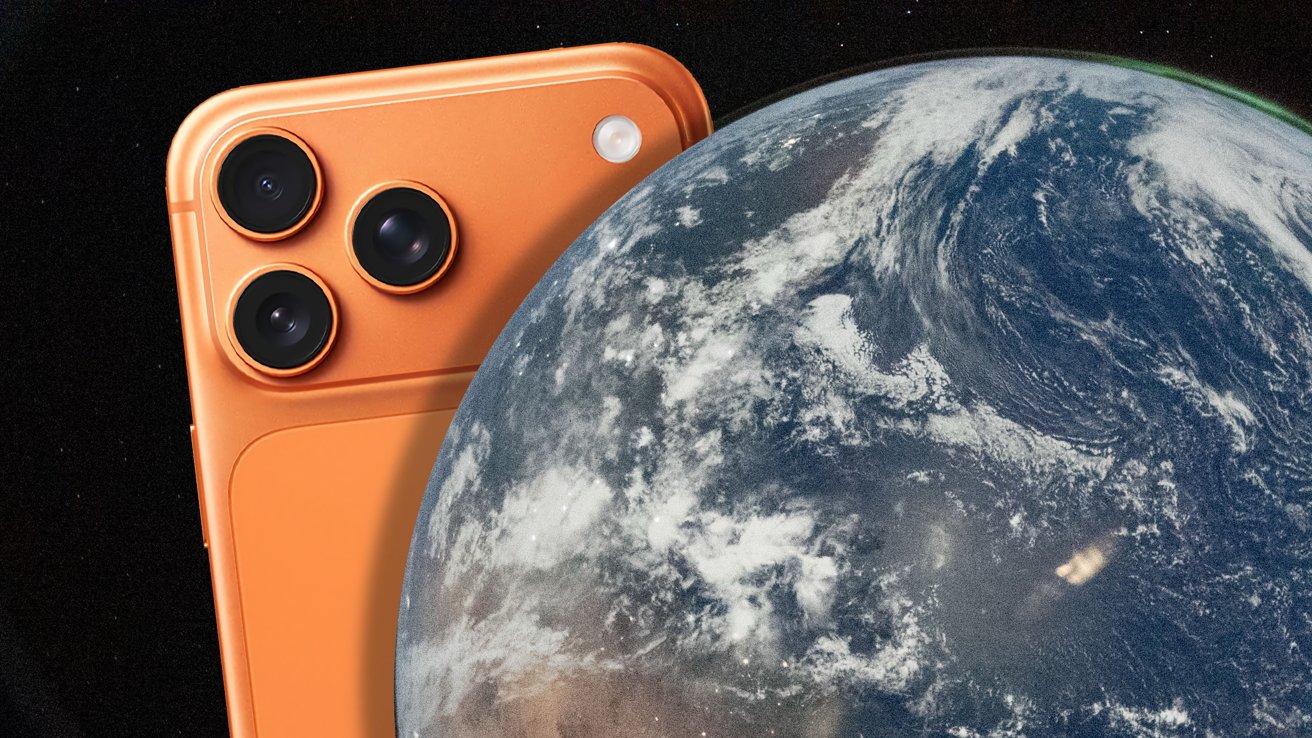
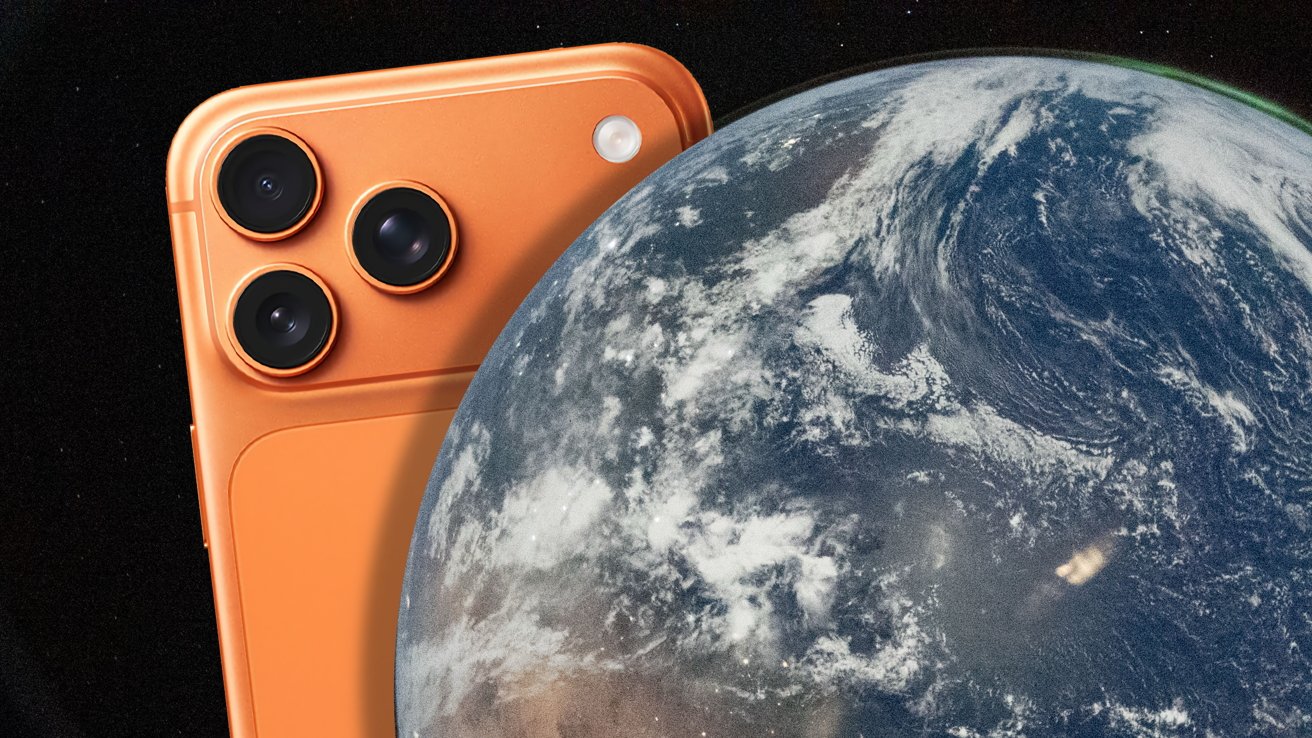
Apple has usually played it safe with the color options on its flagship iPhones. Aside from the usual silver, white, gold, and black, the company barely ever goes bold. That changed with the iPhone 18 Pro, which landed in an eye-catching Cosmic Orange color, and it proved to be quite popular. Apple is looking to replicate that success with the iPhone 18 Pro later this year, according to Bloomberg, and its next bet could be a shade of red.
What’s the big shift?
“Given the success of orange, I wouldn’t be surprised if the company keeps that option around and just adds the red as an additional choice,” reports the outlet, adding that “as of now, red is the new flagship color in testing for the next iPhone Pros.” Now, deep red is just one of the colors that Apple is eyeing for the iPhone 18 Pro, and it’s plausible that the company might ultimately decide on other colors. It’s also worth noting that Apple experiments with multiple colors years in advance, so there’s a possibility that we might ultimately see a red iPhone in a few years from now.
It was recently reported that Apple tried bold color options for the M2 MacBook Air, but eventually ditched the idea. Those colors are finally rumored to appear on the low-cost MacBook that is set to arrive in March, packing an A-series smartphone chip and a display smaller than 13 inches. It would be interesting to see if Apple also tries something new with the surface finish on the deep red shade of iPhone 18 Pro. Multiple iPhone 17 Pro users have reported the orange paint easily getting scratched and discolored.
A return to Red
Apple is no stranger to red iPhones. In fact, the company has a long history of releasing iPhones in a bright red shade, which the company markets as (PRODUCT)RED iPhone. The company has released iPhones donning this signature red shade, which is a reflection of a partnership with Red to raise awareness about HIV and rally support for the cause. Apple has predominantly released (PRODUCT)RED variants of iPhones and iPods, and as per the company, the initiative has raised $250 million to support HIV/AIDS programs.
As for the iPhone 18 Pro, it’s unclear whether the deep red shade will be a continuation of the partnership, or if it’s just the signature color for the Fall 2026 slate of iPhones. Other rumors suggest that chocolate brown and purple are also under consideration at Apple. As far as upgrades go, the iPhone 18 Pro is expected to feature a slimmer Dynamic Island, a camera with variable aperture, a next-gen modem with enhanced satellite connectivity, and a faster chip.
If you’re the kind of person who gets nervous or squeamish at the doctor’s office, you might find that collecting your own samples doesn’t freak you out as much as someone in a white coat doing it.
Depending on where you live and your transportation situation, at-home STD tests might be more accessible than visiting a clinic or making a doctor’s appointment. And you can pay for them out of pocket, which might be a better option based on your health insurance.
Finally, and unfortunately, sexually transmitted infections have a stigma attached to them. You shouldn’t feel ashamed of checking up on your sexual health—far from it, in fact—but at-home tests might be a better option if you’re concerned about what others may think.
The Cons of At-Home STI Tests
Advertisement
At-home STI tests are expensive. Depending on your specific health care situation, they might be more affordable, and many of them are FSA- and HSA-eligible or may be covered by insurance. But if you live in an area where there’s free testing through your city or state health departments, or a third-party clinic like Planned Parenthood, those options are likely going to be much cheaper than testing at home.
There’s also the risk of you collecting your samples incorrectly, which can lead to false negatives. Depending on the test you choose, if you do get positive results for a sexually transmitted infection, you might still end up having to go visit a doctor in person to get it treated. While many tests are reputable, it’s still important to ensure that the lab analyzing your results is well-regulated (and that the test itself comes from a reputable company). “It’s important to follow the kit instructions exactly and collect the sample properly while avoiding contamination. You should also follow the warnings and avoid factors that can interfere with results, including incorrect kit storage or use of certain products in the last 48 hours,” says Dr. Gary Schoolnik, Chief Medical Officer at Visby Medical.
Your individual health and timing can impact the accuracy of at-home tests, too. For example, if you’re on your period or have recently used antibiotics, those variables might affect the quality of the samples you can collect. A health care provider can take these things into account and adjust your testing protocol accordingly.
If the situation is urgent—for example, if you’re experiencing physical symptoms that raised concerns, or you’re immunocompromised, or you’re pregnant, or you know you were exposed to an STI—it’s important to actually visit a health care provider rather than trying to treat your condition at home. “I still recommend people who’re having symptoms or know they’ve been with someone that has an STI to seek professional sexual health care to be completely sure, as a false result from a do-it-at-home-kit can make you think you’re okay and therefore dismiss or overlook symptoms,” says Roos.
Advertisement
If privacy is a concern, it might actually be more beneficial for you to go to a routine doctor’s appointment rather than having the packaging for an STD test in the trash. And if you think you might test positive for something, it might be beneficial for you to hear that news from a health care provider rather than finding out while opening the mail in your kitchen. It’s something that’s important to think through before you decide to go with testing at home.
Blue Jay lasted less than six months despite rapid development speed
Prototype status was not clearly communicated during Blue Jay’s initial press announcements
Blue Jay employees are reassigned to programs leveraging core robotic innovations
Amazon has been steadily developing warehouse robotics since acquiring Kiva Systems in 2012, creating the foundation for automated fulfillment centers.
By July 2025, the company had deployed more than 1 million robots in its warehouses, showing a strong commitment to robotics while also highlighting the operational complexity involved.
Despite this scale, not every internal robotics initiative succeeds, and the company’s latest experiment, Blue Jay, illustrates the challenges of rapid innovation.
The rise and fall of Blue Jay
Unveiled in October 2025, Blue Jay was designed as a multi-armed robot capable of sorting and moving packages in same-day delivery facilities.
Testing began at a facility in South Carolina, with Amazon noting that the development cycle was unusually fast — approximately one year — compared with other warehouse robots, a speed attributed to advances in AI.
Despite its rapid development, the project lasted less than six months before being halted, showing that speed alone does not guarantee operational success.
Advertisement
Amazon confirmed that Blue Jay was introduced as a prototype, which it did not clearly state in earlier press announcements.
Sign up to the TechRadar Pro newsletter to get all the top news, opinion, features and guidance your business needs to succeed!
Employees who worked on the project are being reassigned to other robotics programs that use the core Blue Jay technology.
Terrence Clark, an Amazon spokesperson, said the company intends to accelerate the use of underlying Blue Jay innovations in future warehouse robotics, maintaining continuity while shifting focus to more sustainable applications.
Advertisement
While Blue Jay is no longer active, Amazon continues to develop other warehouse robots, including Vulcan.
Vulcan features two robotic arms — one dedicated to rearranging and moving items within storage compartments, while the other uses a camera and suction cups to pick and place individual goods with precision.
Its sensors allow it to detect the weight, shape, and orientation of packages, enabling it to handle items without causing damage.
Advertisement
The robot’s software continuously adapts to variations in package size and density, allowing it to optimize picking sequences and reduce delays in order fulfillment.
Vulcan operates within Amazon’s same-day delivery and high-density fulfillment centers, where space constraints require precise navigation and coordination with existing conveyor systems.
The robot’s dual-arm configuration allows it to handle multiple items at the same time, increasing throughput in storage compartments without requiring human intervention for repetitive lifting tasks.
Its vision and tactile sensors feed continuous data to onboard processing units, enabling real-time adjustments to grip force and movement paths.
Advertisement
Integration with warehouse management software allows Vulcan to receive task priorities.
It dynamically plans routes and communicates with other robotic units to prevent collisions or bottlenecks, supporting a more efficient automated workflow.
Its final outlet at VivoCity will close down on Feb 22
Fashion retailer Pull&Bear is set to close down its last remaining outlet in Singapore at VivoCity on Sunday (Feb 22).
In a notice on their website, the brand said: “Our stores will close on Feb 22. Returns for purchases made both online and in stores can still be made at Zara VivoCity. If you have any questions, please contact our customer service team via contact.sg@pullandbear.com.”
Screen shot by Vulcan Post
Pull&Bear is a Spanish brand, part of the Inditex Group, which is widely regarded as the world’s largest fashion retailer. The group also owns brands such as Zara, Bershka, Massimo Dutti and Stradivarius.
According to its website, Pull&Bear first entered Singapore in 2006 as part of its broader expansion into Asia. The brand operated four stores here at its peak, including at Bugis+, ION Orchard, and Ngee Ann City.
Its former Bugis+ outlet has since been taken over by the first Singapore outlet of Chick-fil-A, which opened in Dec 2025.
Advertisement
Reasons for Pull&Bear’s closure in Singapore remain unknown. However, it comes amid global store closures by Inditex Group. According to a Dec 2025 report cited by CNA, the group has shuttered more than 100 stores year-to-date as part of efforts to strengthen its financial position.
Moreover, in 2020, amid the COVID-19 pandemic, Inditex Group announced that it would close as many as 1,200 stores to boost online sales.
Its brands have also scaled back in Singapore previously, including Bershka. The label once operated physical stores at Bugis+, ION Orchard and VivoCity; however, it no longer has any outlets in the country today, though shoppers can still purchase its products via its Singapore website.
Pull&Bear Singapore’s website is currently unavailable for online purchases. Whether the brand will maintain an e-commerce presence in Singapore remains unclear.
Advertisement
Vulcan Post has reached out to Pull&Bear and Inditex Group for comments.
Read other articles we’ve written on Singaporean businesses here.