
Tech
TNW Moves Its Flagship Conference to London



The Next Web (TNW) is making a bold move: its flagship conference is relocating to London, placing TNW’s main annual event at the centre of one of the world’s most powerful technology and investment ecosystems. The move marks a significant moment for TNW and signals a broader evolution of the brand’s global events strategy. A new concept: TNW Gathering Alongside the move to London, TNW is introducing a new global event concept: TNW Gathering. Designed as an intimate, invite-only format, TNW Gathering is created for members of the TNW Council and a carefully selected group of founders, operators, and investors.…
This story continues at The Next Web

If you hang out in DIY, automotive, mechanical, or hobby spaces long enough, you’re likely to encounter a few niche tools designed for rare, specific jobs. They might be nice to have, but they’ll collect dust while you return to your screwdrivers, wrenches, and other unsung heroes that solve everyday problems.
If you’ve got limited space, a modest budget, or if you’re just getting started with a hobby or handy work, these 12 products solve common problems and might be a good addition to your tool collection. They cover a wide range of tasks, from cutting and fastening to measuring, layout, and troubleshooting issues.
Atomic 20V Max brushless cordless oscillating multi-tool
Instead of a spinning or reciprocating blade with sharpened teeth, an oscillating multi-tool uses small back-and-forth oscillations to cut, scrape, sand, and more. When an oscillating saw blade encounters a rigid material like metal or wood, it cuts into that material with relative ease. The same thing doesn’t happen when an oscillating blade encounters softer materials like carpet or skin. Doctors use an oscillating saw to remove plaster casts from broken bones for precisely that reason.
As the name suggests, multi-tools have multiple applications depending on what blade attachment you’re using. DeWalt’s Atomic 20V Max multi-tool comes with a general-purpose bi-metal blade, a fast wood-cutting HCS blade, and a universal accessory adapter to make it work with most non-DeWalt attachments. You’ll also get a 4Ah battery, charger, and a tool bag. A multi-tool becomes more useful and more versatile the more attachments you collect, so it doesn’t just solve one common problem. With a little practice and a few multi-tool tips and tricks, it can solve lots of problems.
20V MAX XR brushless drywall cut-out tool
If you think of the wooden frame as the skeleton of a building, then drywall is like the skin, withholding insulation and protecting pipes or wires circulating through the walls. Putting up new drywall panels is fairly simple if there’s nothing in the way, but if you have to account for pipe fittings, electrical outlets, light switches, or other protrusions, things can get a little more complicated. Instead of measuring the precise position of those protrusions and cutting them out of the drywall in advance, a cut-out tool lets you do it while hanging the drywall.
To use it, you put up your panel and drive a couple of screws to hold it in place. The drywall will hang crooked because a protrusion is in the way, but that’s what you want. Push the cutter into the drywall inside the electrical box or pipe, find the outer edge, trace around the box, and the drywall should drop neatly into place.
DeWalt’s cordless drywall cut-out tool spins up to 26,000 RPM and features a tool-free bit exchange so you can swap bits out without needing a chuck key. A guard ring controls the depth of your cuts so you can trim the drywall without accidentally slicing up wires or anything else inside the walls. You can adjust the ring’s depth or remove it entirely if you want to freehand your cuts.
70 amp rolling charger, jumpstarter, and maintainer
This rolling power station from DeWalt is a charger, car jumpstarter, and a battery maintainer. You can use it to recharge a dead battery or keep your car battery in a working state over a long period. If, for instance, you’re going on vacation and your car’s going to be sitting for a while, a battery maintainer makes sure it stays healthy and ready to start your car when you come back.
DeWalt’s rolling charger, jumpstarter, and maintainer connects to your car’s battery with the attached alligator clamps, monitors the voltage, and kicks on a trickle charge when it falls too low, to prevent the slow discharge that usually happens over time. In addition to jumpstarting or maintaining a car battery, this gadget has two USB charging ports and one 120V AC outlet for powering your other devices. If you need power on the go, this power station could be your solution.
The charger delivers a 210 amp starting charge and 70 amp continuous charge. It’s got a built-in alternator check function and a reverse polarity alarm to let you know if you’ve accidentally hooked up the alligator clips backward. A telescoping handle expands when you need to cart your power source to a new location and tucks away when in storage. There’s also built-in storage for the clamps and cables.
USB rechargeable green line laser
DeWalt’s USB rechargeable 3×360-degree green line laser helps you level objects or align materials, whether you’re hanging family photos or laying out a new construction project.
It only takes half an hour to charge, and it can operate for up to nine hours on a charge, or you can use it continuously when plugged into a power adapter (not included). It remains accurate to within an eighth of an inch at a distance of 33 feet and has a visibility range of up to 150 feet, depending on environmental conditions. It can be picked up from more than twice that distance using DeWalt’s green laser line detector, sold separately.
You can mount the green line laser in multiple ways, using the built-in tripod threads or the integrated rare earth magnets. It’s designed to stand up to harsh workshop conditions with an IP54 rating to protect it from water and dust. It also has overmolded housing to reduce wear and tear.
200-foot lithium-ion laser distance measurer
Measuring large areas with a tape measure is monotonous and challenging. Depending on the size of the space you’re measuring and the length of your tape measure, you might have to make several measurements and add them together. This isn’t the easiest nor the most accurate. Fortunately, light can do the heavy lifting for you.
You might remember from physics class that speed can be calculated by dividing the distance by duration. Likewise, if you know the speed and the duration, you can calculate the distance traveled. Because the speed of light through a medium is constant, you can bounce a laser off something and count the time between its departure and return to measure the exact distance.
DeWalt’s laser-based distance measurer has a range of 200 feet and can measure distance, area, and volume with an accuracy of plus or minus a sixteenth of an inch at 32 feet. A blacklit display helps you see the readings indoors and outside, and it also features haptic feedback for working in noisy environments. A laser distance measurer is often more accurate and more convenient than conventional low-tech measuring techniques, delivering measurements literally at the speed of light.
3/4-inch stud finder
If you’re hanging a picture, television, or anything else, you usually want to find a wooden or metal stud. That’s especially true if you’re planning to hang or mount something weighty. Of course, it’s hard to find a beam behind drywall.
One strategy is to use a strong magnet to hunt for screws in the studs. Another is to knock on the walls, listening for changes in tone. Or you could just use a stud finder. When used properly, stud finders measure changes in capacitance to detect different densities beneath the drywall. When it detects a change in subsurface density, the stud finder alerts you with a light and sound.
Most stud finders alert you when they detect the edges of a stud, but DeWalt’s 3/4-inch stud finder shows you the center, and it helps you find the stud using directional LED arrows. It detects wood or metal at a depth of 3/4 of an inch. In addition to detecting studs, it also has AC and live wire detection to help prevent you from accidentally drilling into electrical wiring. Once you’ve found the stud, a center channel lets you leave pencil markings for later drilling or fastening.
12V MAX imaging thermometer
Thermal vision is not only a cool superpower, it’s also a useful way of identifying problem areas. Light comes in several different flavors. We’re most familiar with visible light but that’s only a very small portion of all light, constrained to a narrow band of frequencies and wavelengths. In addition to visible light there’s also radio waves, microwaves, infrared light, UV light, X-rays, and gamma rays.
While we can’t see those other frequencies of light outside the narrow visible range, it’s possible to physically detect some of them in other ways. In fact, you detect infrared light all the time, in the form of heat. Imaging thermometers can also detect infrared radiation and translate their readings into visible images. The warmest temperatures are typically seen in the brightest colors and the coldest temperatures show up as dark spots.
DeWalt’s 12V MAX imaging thermometer measures temperatures between 14 degrees and 480 degrees Fahrenheit, and displays both thermal and visual images. It could be used for thermographic inspections, measuring the surface temperature of parts of your home and other objects. Cold spots in your walls might point to gaps in your home’s insulation while hot spots in your engine could suggest an automotive problem, and there are plenty of other ways to use a thermal camera. The thermometer comes with a battery, fast charger, storage box, download link for report writing software, and an SD card for saving captured images.
12V MAX 9mm inspection camera
An inspection camera, also known as a borescope, has a camera on one end and a display on the other, connected by a length of semi-flexible camera cable. They are essentially endoscopes used for seeing into hard to reach or inaccessible spaces.
While doctors use them to look inside a patient’s body, we can use inspection cameras to see inside pipes to find clogs or leaks, look inside heating and cooling vents, see inside walls or behind heavy appliances, to get a better view of a car’s engine, and more. You could even use it for pure exploration, by sending it into underground cavities, the hollows of trees, or into sewer grates.
DeWalt’s 12V MAX 9mm inspection camera has a removable 3.5-inch wireless screen, it can magnify images up to three times, and features a micro SD slot for saving photos and videos. It comes with a battery, fast charger, three-foot camera cable, and storage box, along with hook, magnet, and mirror accessories.
DeWalt aluminum chalk reel kit
Also known as a chalk line, a chalk reel kit can be used to mark straight lines across materials and surfaces for design or construction purposes. If you need to make a clean cut, paint straight lines, put up wallpaper, or anything else that needs precise lines over a long distance, a chalk reel is a low-tech but reliable solution.
DeWalt’s aluminum chalk reel has a closed spool design to help prevent tangles and protect the reel from debris. There’s a small door through which you can pour crushed chalk, which coats a thread with high-visibility powdered pigment. To use the reel, lay the string horizontally across your desired surface and pull it tight. It should hover just above what you want to mark. Pinch the string between your fingers, pull it upward slightly, and release. When the string bounces back and hits the surface, it deposits chalk in a straight line.
In addition to marking flat surfaces, you can also use a chalk reel to mark a straight line across multiple objects on the same plane. For example, while framing a house, you could mark a line across several wooden studs all at the same time, even though they aren’t touching. You can even create vertical lines by hanging the chalk reel like a plumb bob. This reel has a durable aluminum housing and comes with a 4-ounce bottle of powdered red chalk.
46-inch fiberglass handle post hole digger
Ordinary shovels are good for digging general-purpose holes, but if you want to install a mailbox or fence posts, you want a hole that’s a specific size and shape. That’s where a post hole digger, also known as a clam-shell digger or post hole piner, can be pretty useful.
A post hole digger is essentially two narrow shovels bolted together, with one point of articulation. Holding the handles together keeps the blades parallel and in the open position. Rounded edges help the blades pierce grass, dirt, clay, and more. Then, pulling the handles apart closes the blades and grabs onto the dirt for removal.
DeWalt’s 46-inch fiberglass handle post hole digger has hardened carbon steel blades and is designed to dig holes with just the right dimensions to hold a post in place. It could also be used to dig small, uniform holes for planting saplings and other small plants. Overmolded end grips are intended to improve the user’s comfort, so you can dig more holes without blisters.
Heavy duty work stand
When you’re working in your garage at home or in a professional setting, you probably have the benefit of convenient work surfaces, but that’s not necessarily the case when you’re working on the go.
DeWalt’s heavy-duty work stand provides a pair of table legs, but no connecting surface. You could turn the stand into a workable table by throwing a piece of plywood or another piece of flat, sturdy material on top.
The stands are essentially a couple of metal sawhorses with a weight capacity of 1,000 pounds apiece. They’re made of lightweight aluminum, weighing in at just 15.4 pounds combined, and the pieces collapse down into a compact package. There’s even a transport latch on the sides that connects both stands so they can be transported and stored together between usage.
Atomic 20V MAX brushless cordless 1/4-inch extended reach ratchet
A wrench gives the user extra leverage for fastening and unfastening nuts and bolts, and an extended reach ratchet gives you even more leverage. DeWalt’s 1/4-inch extended reach ratchet is handheld, battery powered, and has a compact construction that allows a user to work in narrow spaces where other drivers might not fit.
Controls include a variable speed trigger and a forward/reverse switch that’s easy to access and manipulate, so you can control the ratchet even with greasy or gloved hands. The wrench delivers up to 45 foot-pounds of maximum torque. The ratchet mechanism means it turns in one direction but not the other, and you don’t have to lift the tool after each turn.
A trigger lock prevents the ratchet from activating accidentally, and a built-in work light helps to illuminate your workspace. DeWalt’s battery-powered extended reach ratchet is powered by the company’s 20V MAX battery platform, which is sold separately.


Amid widespread blowback against the spread of data centers, Microsoft on Wednesday announced it is abandoning its practice of secrecy with local governments when deploying new facilities.
“[W]e’ve made the decision that being transparent with the communities where we operate or seek to operate is paramount. This shift is about strengthening public trust, enabling better dialogue, and ensuring that our growth is matched by meaningful engagement,” the company said in a blog post.
The Redmond, Wash., tech giant said it uses non-disclosure agreements (NDAs) in early stages of development to protect commercial information, address security needs and navigate regulatory and permitting processes. That will no longer be the “default mechanism,” said Rima Alaily, Microsoft’s infrastructure legal affairs team lead, on LinkedIn.
“We will continue to use NDAs in connection with private transactions when acquiring land, and we will continue to rigorously protect our trade secrets and datacenter design information,” Alaily added.
The company is terminating any existing, active NDAs worldwide.
Microsoft in January launched a “community first” initiative in response to growing opposition from people across the country worried about data center impacts on higher electricity bills and dwindling water supplies.
The plan pledges to pay the company’s full power costs, reject local property tax breaks, replenish more water than it uses, train local workers, and invest in AI education and community programs.
While the company is internally taking action to address community concerns, it was a key player in defeating Washington state legislation mandating data center transparency and restrictions on environmental impacts. Microsoft, which has roughly 30 data centers in its home state, publicly opposed the bill shortly before the end of Washington’s legislative session.
Microsoft last fall abandoned plans to build a data center campus in a rural community in Caledonia, Wisc., after the community raised stiff opposition. Residents cited concerns about the project’s secrecy and its potential impacts on electric bills and quality-of-life issues.
Other companies have likewise faced resistance to the tech center deployments. From May 2024 to March 2025, $64 billion in U.S. data center projects were blocked or delayed due to local opposition, according to a report by Data Center Watch.

Viwoods wants you to embrace artificial intelligence with its AiPaper e-reader — but I think it’s actually banking on the wrong features.

Viwoods AiPaper
The e-book reader market is growing, with plenty of companies offering their own takes on the genre.
Some, like most of Boox’s lineup, offer an option that lies somewhere between a Kindle and an iPad. Others, like Durobo’s Krono, want you to focus on portability over all else.
Continue Reading on AppleInsider | Discuss on our Forums

When high school students step into a cybersecurity internship, they enter a field where the stakes are real. The tools, threats and responsibilities extend well beyond the classroom. In rural communities, such opportunities can be transformative — for both learners and the regions working to build a future-ready workforce.
In eastern Alabama, cybersecurity pathways are creating new opportunities for collaboration between educators and employers, reflecting a broader lesson: Workforce development is more impactful when industry helps shape learning early. As cybersecurity threats grow more complex, many employers say preparing future talent does not begin at the point of hiring — it starts earlier, through partnerships connecting classrooms, credentials and real-world experience.
For district leaders and career and technical education (CTE) directors designing career-connected learning, these partnerships can help align instruction with workforce realities while expanding students’ access to high-demand careers.
Industry as a Co-Designer
Cybersecurity is a field that depends on industry insights. The tools and threats defining the work often evolve faster than traditional curriculum cycles, and employers see firsthand how quickly skill requirements change.
Scott Ross, director of information technology at HudsonAlpha Institute for Biotechnology, has seen how quickly the field changes throughout his career. While professional credentials such as Certified Information Systems Security Professional (CISSP) can signal readiness, Ross points to internships and applied experience as equally critical.
“Credentials matter, but they only tell part of the story,” Ross said. “What really prepares students for cybersecurity work is exposure — seeing how systems operate in the real world and understanding the responsibility that comes with protecting them.”
That perspective shapes HudsonAlpha’s engagement with regional education partners. As cybersecurity roles expand across sectors, from defense and healthcare to biotechnology and agriculture, employers are increasingly invested in helping students understand the range of opportunities available and the expectations that come with them.
A Regional Effort Takes Shape
In eastern Alabama, those connections are coordinated through the East Alabama Regional Cybersecurity Alliance (EARCA), a collaboration among K-12 districts, postsecondary institutions and industry partners focused on growing local cybersecurity talent. Rather than operating in isolation, schools and employers are aligning around shared goals: relevant curriculum, meaningful credentials and work-based learning opportunities tied to workforce needs.
Ross sees this regional approach as essential. “Cybersecurity isn’t limited to one industry,” he said. “When education and employers collaborate across sectors, students gain a clearer picture of where these skills apply, and regions build stronger, more adaptable talent pipelines.”
With thousands of unfilled cybersecurity roles in the state, that alignment helps keep learning connected to opportunity.
How Industry Partnerships Shape Learning
For educators, industry engagement can change what is possible inside schools. Tanner Gamble, the computer science and cybersecurity teacher at Childersburg High School in Talladega County, has seen how employer involvement reshapes student motivation and confidence.
“When students know their learning connects directly to real jobs, it changes how they approach the work,” Gamble said. “They’re not just completing assignments; they’re preparing for environments they know they’ll encounter.”
Preparing teachers for industry-aligned instruction is also central to the effort, said Ira Lacy, who trains educators and connects them with employers to support cybersecurity pathways across Alabama.
“When you train teachers using industry practices and give students access to authentic experiences, you start building a pipeline that lasts,” Lacy said. “We’ve seen graduates in North Alabama come back to mentor younger students and invest in their hometowns, and now we’re applying the same approach in eastern Alabama.”
Internships and industry-aligned credentials help validate pathways at the school level by demonstrating clear connections between classroom instruction and real workforce needs.
“Internships and credentials act as the ‘proof of work’ for school cybersecurity programs,” said Hillary Rogers, principal of Childersburg High School. “They bridge the gap between theory and real-world practice, ensuring students aren’t just learning about the digital front lines — they’re equipped to operate in them.”

Learning That Changes Trajectories
That impact is evident in Gavin’s experience, a junior at Childersburg High School who participated in a summer internship with the IT department at Heritage South Credit Union. During the internship, Gavin worked alongside IT staff, troubleshooting real systems, building and maintaining network infrastructure, and learning how access and risk are managed in real-world settings.
The experience opened the door to continued applied learning. Gavin now supports the IT department at Childersburg High School and earned his CompTIA Tech+ certification, an early milestone in a pathway focused on technical skill development and professional responsibility.
“The internship allowed me to start dreaming for myself and what I want my future to look like,” Gavin said. “I’ve always been interested in space, and now I can see different paths, like working in aerospace or eventually leading an IT department near Huntsville.”
For employers and educators, helping students see concrete future pathways is a powerful outcome of early work-based learning.
Why Employers Invest
While not every employer is positioned to host interns, those who engage early gain clearer insight into student readiness and stronger workforce alignment. Early exposure helps employers identify motivated learners and reduce uncertainty in later hiring decisions.
“If we wait until graduation to connect with talent, we’ve missed an opportunity,” Ross said. “Early exposure helps students prepare, and it helps employers build a workforce that understands their needs.”
At a regional level, these investments can contribute to rural economic stability by increasing the likelihood that students will pursue and remain in local careers.
A Blueprint for Other Regions
EARCA is part of broader efforts led by Digital Promise’s Center for Learner Pathway Innovations to develop statewide cybersecurity pathways that connect education and workforce systems. Pathways are strongest when learning, work and community are connected early. For students like Gavin, that collaboration opens doors. For employers, it helps ensure the next generation is ready to meet that demand.

Carl Pei, co-founder and CEO of Nothing, is imagining a future beyond the iPhone — and it’s a device powered by AI agents, not running apps.
“In terms of AI in software, I think people should understand that apps are going to disappear,” said Pei, whose consumer electronics brand makes unique smartphones and other accessories. “So, if you’re a founder or a startup and your app is like where the core value lies, that will be disrupted whether you like it or not.”
Pei made these comments during an interview at the SXSW conference in Austin on Wednesday.
The founder has talked about an AI-first device before, as this vision helped the company close its $200 million Series C funding round last year. At the time, Nothing was pitching the idea of a new kind of smartphone using AI and personalization technology that’s accurate enough for its users to not feel they had to go behind the AI and double-check its output.
At SXSW, Pei expanded on his vision for the AI-first device and the steps needed to get there.
The initial step, which is being tested by some companies today, is an AI feature that can execute a command on the users’ behalf, like booking flights or hotels. Pei, however, dismissed this step as being “super boring.”
The next step is where things could get more interesting, as the AI begins to learn a user’s intentions long-term. For instance, if you wanted to be healthier, the device could give you nudges to help you accomplish your goals.
“I think it gets even more powerful when it starts surfacing suggestions for you; you don’t have to manually come up with an idea…when the system knows us so well, it will come up with things that we don’t even [know] we wanted,” Pei explained, comparing this concept to something like ChatGPT’s memory feature.
In describing how he pictured an AI-first smartphone, Pei said it would be a device that would do things for you without needing to be commanded to.
“The current way we use phones is very old-school. It’s pre-iPhone…there used to be Palm Pilots and PDAs back in the day. And if you think about the user experience, it’s still very similar,” Pei said. “You have lock screens, home screens, apps. You browse different apps. Each app is like a full-screen thing. There’s some kind of app store that allows you to download more apps. So it hasn’t really changed for like, 20 years.”
This frustrated him because the technology consumers are using has evolved quite a bit, but the products we use have not. Even simple tasks have us jumping through multiple steps, he explained.
“It’s very hard to get things done on a phone,” Pei said. “Let’s say we want to grab coffee. That’s an intention. But to execute that intention, we have to go through so many different steps and so many different apps. It’s probably like four apps to grab coffee with somebody — some messaging app, some kind of maps, Uber, calendar.”
He continued: “I think the future of smartphones or operating systems should just be: ‘I know you very well, and if I know your intention, I just do it for you,’ instead of having to go through all the apps manually.”
“It should just do it through AI,” he said.
This also means devices would have an interface that’s not focused on apps for humans to navigate, but would instead feature an interface designed for the AI agent to use.
That doesn’t mean apps are going away in the near-term, Pei cautioned. Nothing’s own operating system even allows users to vibe code their own mini apps today. But eventually, the AI will need to be able to use the “app” in a frictionless way, not trying to mimic human touch on the smartphones by moving through menus and tapping options.
“That’s not the future. The future is not the agent using a human interface. You need to create an interface for the agent to use. I think that’s the more future-proof way of doing it,” Pei said.

If you need a cathartic release from the news that Amazon laid off 16,000 workers, Block chopped nearly half its workforce, Atlassian pared back 10% of staffers, and Meta is reportedly considering another massive round of layoffs, all in the name of AI, then we invite you to browse the responses to a recent Sam Altman post on X.
Altman, the CEO of OpenAI, shared this on Tuesday:
“I have so much gratitude to people who wrote extremely complex software character-by-character. It already feels difficult to remember how much effort it really took. Thank you for getting us to this point.”
The problem with that sweet sentiment is that Altman’s company ushered in the AI now being used as an excuse for developer layoffs and fewer junior developer jobs. And it did so by training on massive volumes of code written the old-fashioned way — by the very people he’s now thanking.
His post implies that developers’ genuinely difficult-to-master craft is now like a rotary telephone: outdated and unnecessary.
Naturally, Altman’s comments attracted memes and responses richer than his post. While some were straight-up angry, (“You’re welcome. Nice to know that our reward is our jobs being taken away”), much of the internet did what it always does: cracked jokes.
There are thousands of comments. Some of our favorites:
Techcrunch event
San Francisco, CA
|
October 13-15, 2026
“Sam’s eulogy for software engineers”
“It’s times like this when I really miss the Sam Altman parody account”
“Dear devs You will lose your jobs forever and be forced to work in the coal mines But you can rest easy knowing sam Altman is grateful. ❤️ 🙏”
“Billion dollar app idea: AI that reads billionaire tweets before they post them and says ‘this is going to make you sound incredibly out of touch, are you sure?’”
“I have gratitude to OpenAI for doing all the AI work so I can have free Chinese open source AI models to use 🙏”
“This reads like something the Mayans would say right before the ceremony starts.”
And finally, another reason to trot out this meme:
Tech
Xiaomi stuns with new MiMo-V2-Pro LLM nearing GPT-5.2, Opus 4.6 performance at a fraction of the cost
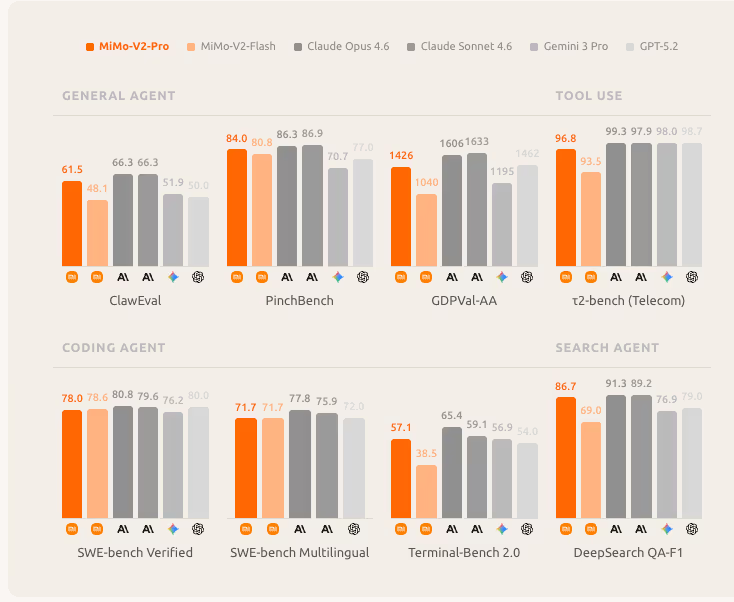
Chinese electronics and car manufacturer Xiaomi surprised the global AI community today with the release of MiMo-V2-Pro, a new 1-trillion parameter foundation model with benchmarks approaching those of U.S. AI giants OpenAI and Anthropic, but at around a seventh or sixth the cost when accessed over proprietary API — and importantly, sending less than 256,000 tokens-worth of information back and forth.
Led by Fuli Luo, a veteran of the disruptive DeepSeek R1 project, the release represents what Luo characterizes as a “quiet ambush” on the global frontier. Furthermore, Luo stated in an X post that the company does plan to open source a model variant from this latest release, ” when the models are stable enough to deserve it.”
By focusing on the “action space” of intelligence—moving from code generation to the autonomous operation of digital “claws”—Xiaomi is attempting to leapfrog the conversational paradigm entirely.
Prior to this foray into frontier AI, Beijing-based Xiaomi established itself as a titan of “The Internet of Things” and consumer hardware.
Globally recognized as the world’s third-largest smartphone manufacturer, Xiaomi spent the early 2020s executing a high-stakes entry into the automotive sector. Its electric vehicles (EVs), such as the SU7 and the recently launched YU7 SUV, have turned the company into a vertically integrated powerhouse capable of merging hardware, software, and now, advanced reasoning.
This pedigree in physical-world engineering informs MiMo-V2-Pro’s architecture; it is built to be the “brain” of complex systems, whether those systems are managing global supply chains or navigating the intricate scaffolds of an autonomous coding agent.
Technology: The architecture of agency
The central challenge of the “Agent Era” is maintaining high-fidelity reasoning over massive spans of data without incurring a prohibitive “intelligence tax” in latency or cost. MiMo-V2-Pro addresses this through a sparse architecture: while it houses 1T total parameters, only 42B are active during any single forward pass, making it roughly three times the size of its predecessor, MiMo-V2-Flash.
The model’s efficiency is rooted in an evolved Hybrid Attention mechanism. Standard transformers typically face a quadratic increase in compute requirements as context grows; MiMo-V2-Pro utilizes a 7:1 hybrid ratio (increased from 5:1 in the Flash version) to manage its massive 1M-token context window. This architectural choice allows the model to maintain a deep “memory” of long-running tasks without the performance degradation usually seen in frontier models.
The analogy: Think of the model not as a student reading a book page-by-page, but as an expert researcher in a vast library. The 7:1 ratio allows the model to “skim” 85% of the data for context while applying high-density attention to the 15% most relevant to the task at hand.
This is paired with a lightweight Multi-Token Prediction (MTP) layer, which allows the model to anticipate and generate multiple tokens simultaneously, drastically reducing the latency required for the “thinking” phases of agentic workflows. According to Luo, these structural decisions were made months in advance, specifically to provide a “structural advantage” for the unexpected speed at which the industry shifted toward agents.
Product and benchmarking: A third-party reality check

Xiaomi’s internal data paints a picture of a model that excels in “real-world” tasks over synthetic benchmarks. On GDPval-AA, a benchmark measuring performance on agentic real-world work tasks, MiMo-V2-Pro achieved an Elo of 1426, placing it ahead of major Chinese peers like GLM-5 (1406) and Kimi K2.5 (1283).
While it still trails Western “max effort” models like Claude Sonnet 4.6 (1633) in raw Elo, it represents the highest recorded performance for a Chinese-origin model in this category.
The third-party benchmarking organization Artificial Analysis verified these claims, placing MiMo-V2-Pro at #10 on its global Intelligence Index with a score of 49. This places it in the same tier as GPT-5.2 Codex and ahead of Grok 4.20 Beta. These results suggest that Xiaomi has successfully built a model capable of the high-level reasoning required for engineering and production tasks.

Key metrics from Artificial Analysis highlight a significant leap over the previous open-weights version, MiMo-V2-Flash (which scored 41):
-
Hallucination rate: The Pro model reduced hallucination rates to 30%, a sharp improvement over the Flash model’s 48%.
-
Omniscience index: It scored a +5, placing it ahead of GLM-5 (+2) and Kimi K2.5 (-8).
-
Token efficiency: To run the entire Intelligence Index, MiMo-V2-Pro required only 77M output tokens, significantly less than GLM-5 (109M) or Kimi K2.5 (89M), indicating a more concise and efficient reasoning process.
Xiaomi’s own charts further emphasize its “General Agent” and “Coding Agent” capabilities. On ClawEval, a benchmark for agentic scaffolds, the model scored 61.5, approaching the performance of Claude Opus 4.6 (66.3) and significantly outpacing GPT-5.2 (50.0). In coding-specific environments like Terminal-Bench 2.0, it achieved an 86.7, suggesting high reliability when executing commands in a live terminal environment.
How enterprises should evaluate MiMo-V2-Pro for usage
For the personas outlined in contemporary AI organizations—from Infrastructure to Security—MiMo-V2-Pro represents a paradigm shift in the “Price-Quality” curve.
Infrastructure decision-makers will find MiMo-V2-Pro a compelling candidate for the Pareto frontier of intelligence vs. cost. Artificial Analysis reported that running their index cost only $348 for MiMo-V2-Pro, compared to $2,304 for GPT-5.2 and $2,486 for Claude Opus 4.6.
For organizations managing GPU clusters or procurement, the ability to access top-10 global intelligence at roughly 1/7th the cost of Western incumbents is a powerful incentive for production-scale testing.
Data decision-makers can leverage the 1M context window for RAG-ready architectures, allowing them to feed entire enterprise codebases or documentation sets into a single prompt without the fragmentation required by smaller context models.
A systems/orchestration decision-maker should evaluate MiMo-V2-Pro as a primary “brain” for multi-agent coordination. Because the model is optimized for OpenClaw and Claude Code, it can handle long-horizon planning and precise tool use without the constant human intervention that plagues earlier models.
Its high ranking in GDPval-AA suggests it is particularly well-suited for the workflow and orchestration layer needed to scale AI across the enterprise. It allows for the creation of systems that can move beyond simple automation into complex, multi-step problem solving.
However, security decision-makers must exercise caution. The very “agentic” nature that makes the model powerful—its ability to use terminals and manipulate files—increases the surface area for prompt injection and unauthorized model access.
While its low hallucination rate (30%) is a defensive boon, the lack of public weights (unlike the Flash version) means internal security teams cannot perform the deep “model-level” audits sometimes required for highly sensitive deployments. Any enterprise implementation must be accompanied by robust monitoring and auditability protocols.
Pricing, availability, and the path forward
Xiaomi has priced MiMo-V2-Pro to dominate the developer market. The pricing is tiered based on context usage, with competitive rates for caching to support high-frequency reasoning tasks.
-
MiMo-V2-Pro (up to 256K): $1 per 1M input tokens and $3 per 1M output tokens
-
MiMo-V2-Pro (256K-1M): $2 per 1M input tokens and $6 per 1M output tokens
-
Cache read: $0.20 per 1M tokens for the lower tier and $0.40 for the higher tier
-
Cache write: Temporarily free ($0)
Here’s how it stacks up to other leading frontier models around the world:
This aggressive positioning is designed to encourage the high-intensity application flows that define the next generation of software. The model is currently available via Xiaomi’s first-party API only, with no current support for image or multimodal input—a notable omission in an era of “Omni” models, though Xiaomi has teased a separate MiMo-V2-Omni for those needs.
The “Hunter Alpha” period on OpenRouter proved that the market has a high appetite for this specific blend of efficiency and reasoning. Fuli Luo’s philosophy—that research velocity is fueled by a “genuine love for the world you’re building for”—has resulted in a model that ranks 2nd in China and 8th worldwide on established intelligence indices.
Whether it remains a “quiet” ambush or becomes the foundation for a global realignment of AI power depends on how quickly developers adopt the “action space” over the “chat window”. For now, Xiaomi has moved the goalposts: the question is no longer just “can it talk?” but “can it act?”

If you’re hunting for a new vacuum, Dyson has surely come up in one way or another. The brand is famous for its powerful vacuum cleaners, but its air power also extends to other parts of the home, including hair care and air purification. It’s a dream household staple; I lugged around an old Dyson vacuum for years until I could upgrade to one of the newer stick models rather than buying something that wouldn’t be as powerful or last as long.
But the cost can make it a hard investment to make, even if it’s worth it. If you’re shopping for one of Dyson’s long-lasting gadgets but have a limited budget, fear not: we’ve got coupon codes to make it a better buy, plus tips on how to get discounts on Dyson’s website. Read on to get all of our Dyson promo codes and coupons, and learn the best ways to shop for a Dyson.
Get a 15% Off Dyson Promo Code When You Register
Usually, you need to be a new customer to get a great discount, but Dyson actually rewards you for being a repeat customer. You can get 15% off your next order by registering your current Dyson product’s serial number.
Sign Up to Unlock a 10% Off Dyson Coupon Code
You can also get 10 percent off your next Dyson purchase without needing a device to register. You’ll want to sign up your mobile number using a pop-up on Dyson’s homepage. That will get you a text, and you’ll have to reply with “Y” to officially register. After you reply, you’ll get a message with a link that will reveal a single-use code for 10 percent off your next purchase at Dyson.
You can also sign up for texts or Dyson’s email newsletters (like this hair care newsletter) to get access to exclusive Dyson sale events, more coupon codes, and new product releases (and several new vacuums are due out this year).
Save up to $600 With This Week’s Dyson Coupons
Dyson always has sales going on its website at the Dyson Deals Hub. The discounts rotate weekly, and there’s always different active coupons in different categories of Dyson products. You might find a nice discount on the V12 vacuum, for instance, or the Dyson Airstrait.
Save 30% When You Shop the Dyson Outlet
Looking for a bigger discount? Try Dyson’s outlet of refurbished vacuums, hair tools, and air purifiers. Youl’l find discounts of up to 30 percent off the original price, and each one is inspected, restored to like-new condition, and backed by Dyson’s official warranty. It’s a good way to get a great discount on products like the Supersonic hair dryers, which you can find for under $200 when refurbished, and Dyson’s multi-stylers can be found for under $300. These do have a shorter warranty period than new products, though; it’ll only be six months to a year rather than two to five years.
Dyson Discount: 20% Off
During the Dyson owner savings event, Dyson owners get rewarded by getting 20% off Dyson technology purchases. When you choose one of the qualifying floorcare or air purifiers, you’ll add your one-time-use code at the payment section when you checkout online at Dyson. Or if you’d rather, you can simply log in and your Dyson discount will automatically be applied at checkout. Plus, if you’d rather, you can also shop at your nearest Dyson Demo Store or make a purchase over the phone. And if you don’t have a Dyson discount code automatically, you can register your machine by calling 1-866-693-9766 to speak to a Dyson expert about Owner Rewards.

Google and cybersecurity companies Lookout and iVerify have detailed a new hacking technique that potentially puts a significant portion of iPhone users in danger, just by visiting the wrong web page. The hack is called “DarkSword” and since it specifically targets several different versions of iOS 18, it could affect “close to a quarter of iPhones,” Wired writes.
DarkSword is a “fileless” hack that leverages a collection of exploits to access sensitive data when an iPhone visits an infected website. Rather than install spyware that hangs around on a user’s phone after messages and other private information are stolen, fileless hacks like DarkSword take control of “the legitimate processes in an iPhone’s operating system to steal data,” according to Wired. Even more troubling, DarkSword deletes any evidence it was running on an iPhone after it finishes stealing your information.
The hack starts as soon as an iOS device encounters an “malicious iframe embedded in a web page,” after which it works its way through your iPhone, gathering sensitive information like passwords before deleting itself. DarkSword can abscond with things like messages and iCloud content, but it’s also specifically designed to access crypto currency wallets, Lookout says, which could indicate who was using DarkSword before it became widely available.
DarkSword has reportedly been used in Ukraine, Saudi Arabia, Malaysia, Turkey and Russia, and its origins could be tied to a different hacking toolkit called Coruna that TechCrunch reports may have been created for the US government by a company called Trenchant. Regardless of where DarkSword came from, the tool didn’t become widely available until its Russian users left DarkSword’s source code on a website for anyone to access, “complete with explanatory comments in English that describe each component and include the ‘DarkSword’ name for the tool,” Wired writes.
Apple patched the exploits that DarkSword and Coruna used in recent updates to iOS 26, the yearly software release from 2025 that followed iOS 18. The problem is that not everyone is using Apple’s latest update. DarkSword targets iOS 18 releases between iOS 18.4 and iOS 18.6.2, and according to Apple’s latest iOS usage stats for developers, around 24 percent of iOS devices are still on iOS 18. Without more detail, it’s hard to know how many people that leaves exposed, but as a rule of thumb, if your iOS device can update to a newer software release, you should do so as soon as possible to stay secure.

With today’s latest Stitch updates, Google is trying to make “vibe design” happen, reports The Verge’s Jay Peters. The AI-native design platform encourages users to describe goals, feelings, or inspiration in “natural language,” rather than starting with traditional blueprints.
In a blog post, Google Labs Product Manager Rustin Banks says that Stitch can turn those inputs into interactive prototypes, automatically map user flows, and support real-time iteration. It introduces voice capabilities that allow users to “speak directly to [the] canvas” for feedback or changes. Tools like DESIGN.md also help users create reusable design systems across various projects.

Rory McIlroy explains how Augusta will be different for him as Masters champion
Swissquote Group reports 2026 guidance below consensus on growth investments

China Gold Reserves Hit Record 2,309 Tonnes as PBOC Marks 16 Straight Months of Buying


-
 Crypto World5 days ago
HYPE Token Enters Net Deflation as HyperCore Buybacks Outpace Staking Rewards
-

 Tech3 days ago
Your Legally Registered ‘Motorcycle’ Might Not Count Under Proposed US Law
-

 Fashion6 days ago
Weekend Open Thread: Addict Lip Glow
-
 Tech2 days ago
Are Split Spacebars the Next Big Gaming Keyboard Trend?
-
Sports5 days ago
Why Duke and Michigan Are Dead Even Entering Selection Sunday
-

 Business4 days ago
Search for Savannah Guthrie’s Mother Enters Seventh Week with No Arrests
-

 Business5 days ago
US Airports Launch Donation Drives for Unpaid TSA Workers as Partial Government Shutdown Enters Fifth Week
-
Crypto World5 days ago
Coinbase and Bybit in Investment Talks: Could Bybit Finally Enter the US Crypto Market?
-

 Business3 days ago
Australian shares drop as Iran war enters third week
-

 Business5 days ago
Country star Brantley Gilbert enters growing non-alcoholic beer market
-

 Crypto World3 days ago
Crypto Lender BlockFills Enters Chapter 11 with Up to $500M in Liabilities
-

 Sports6 days ago
College Basketball Best Bets: Conference Tournament Semifinal Picks
-

 Politics23 hours ago
The House | The new register to protect children from their abusers shows Parliament at its best
-

 Business6 days ago
Trump demands Powell cut rates as Iran conflict raises energy prices
-

 Fashion3 days ago
25 Celebrities with Curly Hair That Are Naturally Beautiful
-

 News Videos15 hours ago
RBA board divided on rate cut, unusually buoyant share market | Finance Report | ABC NEWS
-

 Crypto World6 days ago
Senate Votes to Include CBDC Ban in Bipartisan Housing Bill
-

 NewsBeat6 days ago
Deane Road crash near Bolton colleges and university
-

 News Videos6 days ago
Tom Lee: The 100x Opportunity EVEN Bigger Than Bitcoin (New Ethereum Prediction 2026)
-

 Crypto World15 hours ago
Canada’s FINTRAC revokes registrations of 23 crypto MSBs in AML crackdown


You must be logged in to post a comment Login