Connect with us
DAPA Banner

Tech

USPS 8% Surcharge Could Hit Small Businesses and Shoppers Alike

Published

on

It’s about to cost more to ship packages through the United States Postal Service. The USPS said Wednesday that it will implement a temporary 8% surcharge beginning in April “to better align its costs of transportation with the market.” Like everyone, the post office is facing higher fuel costs driven by ongoing turmoil in the Middle East.

The proposed increase will affect Priority Mail Express, Priority Mail, USPS Ground Advantage and Parcel Select, but not first-class stamps and other products and services.

If the Postal Regulatory Commission approves the measure, the price change will begin on April 26 at midnight Central Time and expire on Jan. 17, 2027, at midnight Central Time. At that time, the USPS will assess if the surcharge will continue.

Advertisement

Last week, Postmaster General David Steiner told Congress that the USPS will run out of money by next February. He requested that Congress lift regulatory restrictions so that the postal service can raise prices on products and services. 

The Postal Service has been financially underwater for nearly two decades. The Government Accountability Office added the agency to its High Risk List in 2009. Since 2007, it has incurred over $100 billion in financial losses. 

Much of the reason for these losses is the company’s mandate to deliver to over 170 million addresses during a six-day work week. According to The Wall Street Journal, which originally broke this story, that mandate has led to “71% of delivery routes being financially underwater.” That math roughly translates to three in five post offices being unable to cover their operating costs. 

Shipping competitors, such as FedEx and United Parcel Service, have had fuel surcharges in place for years. Due to the ongoing oil crisis and rise in gas prices, they have increased these fees in recent weeks.

Advertisement

Source link

Continue Reading
Click to comment

You must be logged in to post a comment Login

Leave a Reply

Tech

OnePlus may close operations in the US and Europe as early as April

Published

on


On Tuesday, tipster Yogesh Brar reiterated earlier rumors that OnePlus will soon shut down in the US, the UK, the EU, and most other global markets while continuing to operate in a handful of Asian countries, including China and India. Although the post has since been deleted, 9to5Google reports that…
Read Entire Article
Source link

Continue Reading

Tech

Meta & YouTube found liable in landmark social media addiction trial

Published

on

A Los Angeles jury has found Meta and Google liable for intentionally building addictive social media platforms that harmed a young woman’s mental health, awarding her $3 million in compensatory damages in what is the first trial verdict of its kind in the United States. The decision, delivered on Wednesday after a five-week trial, found Meta responsible for 70 per cent of the plaintiff’s harm and YouTube for the remaining 30 per cent. Punitive damages, which could reach $30 million under California law, are still to be determined.

The plaintiff, identified as Kaley, is now 20 years old. She testified that she began using YouTube at age six and Instagram at age nine, encountering no age verification barriers on either platform. She described spending entire days on social media as a child, withdrawing from her family, and developing anxiety, depression, and body dysmorphia, a condition in which a person becomes obsessively preoccupied with perceived flaws in their appearance. She said she began using Instagram filters that altered her facial features almost as soon as she started using the platform.

The verdict landed one day after a separate jury in New Mexico ordered Meta to pay $375 million for violating state consumer protection law by failing to protect children from sexual predators on its platforms. Together, the back-to-back rulings represent the first time juries have held social media companies financially liable for the harms their products cause to young users.

What the jury decided

Kaley’s lawyers argued that features such as infinite scroll, autoplay, and algorithmically curated content feeds were deliberately designed to maximise engagement and that Meta’s internal growth targets explicitly sought to acquire young users because they were more likely to remain on the platform for longer periods. They presented testimony from former Meta executives and internal company research showing that Meta knew children under 13 were using its platforms and that its products were linked to negative mental health outcomes in teenagers.

Advertisement

When Mark Zuckerberg testified before the jury in February, he acknowledged the issue but said he “always wished” the company had made faster progress on identifying underage users. He maintained that Meta had reached “the right place over time.” Adam Mosseri, the head of Instagram, was presented with data showing Kaley’s longest single-day session on the platform lasted 16 hours. He declined to call it addiction, describing it instead as “problematic.”

Lawyers for Meta argued that while Kaley had experienced genuine mental health struggles, her use of Instagram did not cause or meaningfully contribute to them. Meta said it “respectfully disagrees with the verdict” and is evaluating its legal options. Google called the case a mischaracterisation of YouTube, describing it as “a responsibly built streaming platform, not a social media site,” and said it plans to appeal.

The cases behind this one

Kaley’s was the first of more than 1,500 similar cases consolidated in federal multidistrict litigation against Meta, Google, Snap, and TikTok. Both Snap and TikTok reached undisclosed settlements with Kaley before the trial began, leaving Meta and Google as the two defendants that chose to fight the case in court.

The New Mexico verdict, though legally separate, reinforced the same underlying claim: that Meta knew its platforms endangered children and chose not to act. That case originated from a 2023 undercover operation by New Mexico Attorney General Raúl Torrez, who created a fake profile of a 13-year-old girl and found it was quickly inundated with sexually explicit material and contact from predators. The jury found Meta liable on all counts, including for willfully engaging in unfair, deceptive, and unconscionable trade practices.

Advertisement

Another federal trial is scheduled for June in California, and hundreds of additional cases brought by school districts and state attorneys general are queued behind it. Legal commentators have compared the litigation wave to the tobacco industry lawsuits of the 1990s, which ultimately resulted in a $206 billion settlement and fundamentally reshaped how cigarettes were marketed and regulated in the United States.

What changes and what does not

The immediate financial impact on Meta and Google is minimal. A $3 million compensatory award, even if punitive damages push it toward $30 million, is trivial for companies with a combined market capitalisation exceeding $3 trillion. The $375 million New Mexico verdict is larger but still represents a fraction of a single quarter’s revenue for Meta.

The significance is precedential, not financial. The Los Angeles verdict establishes that a jury of ordinary citizens, presented with internal documents, expert testimony, and the companies’ own research, concluded that social media platforms were intentionally designed to be addictive and that this design caused measurable harm to a specific individual. That finding will be cited in every one of the 1,500 pending cases. It shifts the burden: Meta and Google now enter each subsequent trial not as defendants facing novel claims but as companies a jury has already found liable.

Mike Proulx, a research director at Forrester, described the verdicts as a “breaking point” between social media companies and the public. Whether they also mark a breaking point in how these platforms are built remains to be seen. The features Kaley’s lawyers identified as harmful, infinite scroll, autoplay, algorithmic feeds, and engagement-maximising recommendation systems, are not incidental design choices. They are the business model. Removing them would require Meta and Google to become fundamentally different companies, which is something no jury verdict, however large, can compel.

Advertisement

Source link

Continue Reading

Tech

Google’s TurboQuant compresses AI memory by 6x, rattles chip stocks

Published

on

Google published a research blog post on Tuesday about a new compression algorithm for AI models. Within hours, memory stocks were falling. Micron dropped 3 per cent, Western Digital lost 4.7 per cent, and SanDisk fell 5.7 per cent, as investors recalculated how much physical memory the AI industry might actually need.

The algorithm is called TurboQuant, and it addresses one of the most expensive bottlenecks in running large language models: the key-value cache, a high-speed data store that holds context information so the model does not have to recompute it with every new token it generates. As models process longer inputs, the cache grows rapidly, consuming GPU memory that could otherwise be used to serve more users or run larger models. TurboQuant compresses the cache to just 3 bits per value, down from the standard 16, reducing its memory footprint by at least six times without, according to Google’s benchmarks, any measurable loss in accuracy.

The paper, which will be presented at ICLR 2026, was authored by Amir Zandieh, a research scientist at Google, and Vahab Mirrokni, a vice president and Google Fellow, along with collaborators at Google DeepMind, KAIST, and New York University. It builds on two earlier papers from the same group: QJL, published at AAAI 2025, and PolarQuant, which will appear at AISTATS 2026.

How it works

TurboQuant’s core innovation is eliminating the overhead that makes most compression techniques less effective than their headline numbers suggest. Traditional quantization methods reduce the size of data vectors but must store additional constants, normalization values that the system needs in order to decompress the data accurately. These constants typically add one or two extra bits per number, partially undoing the compression.

Advertisement

The 💜 of EU tech

The latest rumblings from the EU tech scene, a story from our wise ol’ founder Boris, and some questionable AI art. It’s free, every week, in your inbox. Sign up now!

TurboQuant avoids this through a two-stage process. The first stage, called PolarQuant, converts data vectors from standard Cartesian coordinates into polar coordinates, separating each vector into a magnitude and a set of angles. Because the angular distributions follow predictable, concentrated patterns, the system can skip the expensive per-block normalization step entirely. The second stage applies QJL, a technique based on the Johnson-Lindenstrauss transform, which reduces the small residual error from the first stage to a single sign bit per dimension. The combined result is a representation that uses most of its compression budget on capturing the original data’s meaning and a minimal residual budget on error correction, with no overhead wasted on normalization constants.

Google tested TurboQuant across five standard benchmarks for long-context language models, including LongBench, Needle in a Haystack, and ZeroSCROLLS, using open-source models from the Gemma, Mistral, and Llama families. At 3 bits, TurboQuant matched or outperformed KIVI, the current standard baseline for key-value cache quantization, which was published at ICML 2024. On needle-in-a-haystack retrieval tasks, which test whether a model can locate a single piece of information buried in a long passage, TurboQuant achieved perfect scores while compressing the cache by a factor of six. At 4-bit precision, the algorithm delivered up to an eight-times speedup in computing attention on Nvidia H100 GPUs compared to the uncompressed 32-bit baseline.

Advertisement

What the market heard

The stock reaction was swift and, in the view of several analysts, disproportionate. Wells Fargo analyst Andrew Rocha noted that TurboQuant directly attacks the cost curve for memory in AI systems. If adopted broadly, he said, it quickly raises the question of how much memory capacity the industry actually needs. But Rocha and others also cautioned that the demand picture for AI memory remains strong, and that compression algorithms have existed for years without fundamentally altering procurement volumes.

The concern is not unfounded, however. AI infrastructure spending is growing at extraordinary rates, with Meta alone committing up to $27 billion in a recent deal with Nebius for dedicated compute capacity, and Google, Microsoft, and Amazon collectively planning hundreds of billions in capital expenditure on data centres through 2026. A technology that reduces memory requirements by six times does not reduce spending by six times, because memory is only one component of a data centre’s cost. But it changes the ratio, and in an industry spending at this scale, even marginal efficiency gains compound quickly.

The efficiency question

TurboQuant arrives at a moment when the AI industry is being forced to confront the economics of inference. Training a model is a one-time cost, however enormous. Running it, serving millions of queries per day with acceptable latency and accuracy, is the recurring expense that determines whether AI products are financially viable at scale. The key-value cache is central to this calculation: it is the bottleneck that limits how many concurrent users a single GPU can serve and how long a context window a model can practically support.

Compression techniques like TurboQuant are part of a broader push toward making inference cheaper, alongside hardware improvements such as Nvidia’s Vera Rubin architecture and Google’s own Ironwood TPUs. The question is whether these efficiency gains will reduce the total amount of hardware the industry buys, or whether they will simply enable more ambitious deployments at roughly the same cost. The history of computing suggests the latter: when storage gets cheaper, people store more; when bandwidth increases, applications consume it.

Advertisement

For Google, TurboQuant also has a direct commercial application beyond language models. The blog post notes that the algorithm improves vector search, the technology that powers semantic similarity lookups across billions of items. Google tested it against existing methods on the GloVe benchmark dataset and found it achieved superior recall ratios without requiring the large codebooks or dataset-specific tuning that competing approaches demand. This matters because vector search underpins everything from Google Search to YouTube recommendations to advertising targeting, which is to say, it underpins Google’s revenue.

The paper’s contribution is real: a training-free compression method that achieves measurably better results than the existing state of the art, with strong theoretical foundations and practical implementation on production hardware. Whether it reshapes the economics of AI infrastructure or simply becomes one more optimisation absorbed into the industry’s insatiable appetite for compute is a question the market will answer over months, not hours.

Source link

Advertisement
Continue Reading

Tech

Testing Severely Neglected VHS Tapes And CDs

Published

on

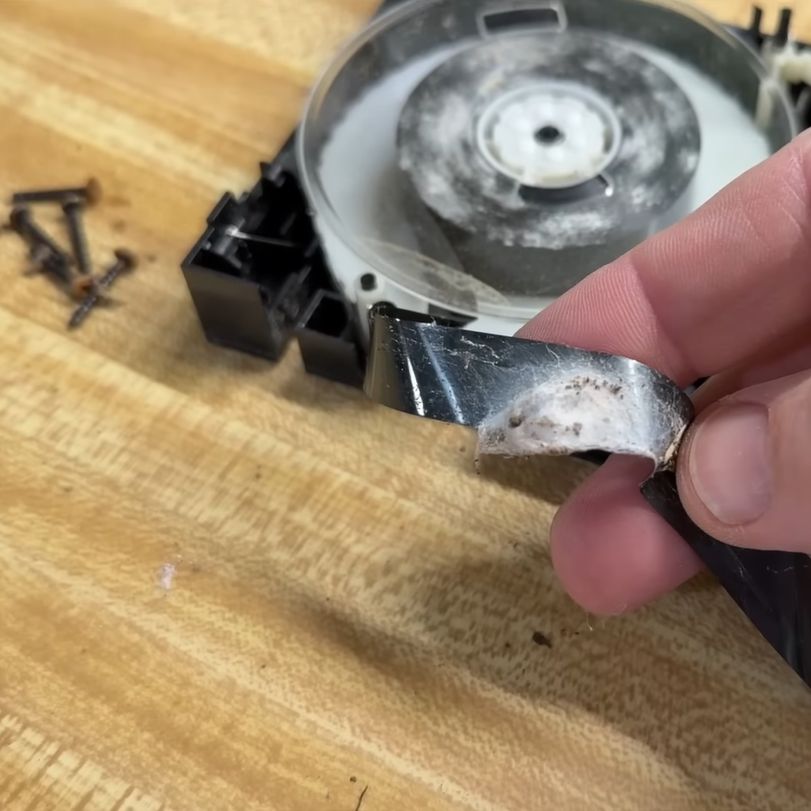
Check your tape for spider nests before rewinding. (Credit: Brady Brandwood, YouTube)

Physical media has a certain amount of durability associated with it, a quality which is naturally determined by the way that they’re stored. Generally this does not involve being abandoned on the porch of a delipidated, abandoned house where the elements and any passing critter can have their way with it.

Exactly how playable would these VHS tapes and CDs still be? Whether it was out of a sense of burning curiosity, or for a similar reason that [Brady Brandwood] has a habit of adopting former seafood critters like lobsters as adorable pets, these items got recently collected and put to the test.

Normally VHS tapes are kept safely in a little sleeve or box in a dry, cool place, similar to CDs and DVDs. These particular items had however been left for at least a decade out in the open amidst the ransacked remains of abandoned homes. This meant that the VHS tapes were full of dirt and debris, and at least in one case with a spider nest that jammed up the thrift-store VHS/DVD combo player.

The CDs were cleaned and tried in a G5 iMac, with the obvious results there being that as long as the shiny layer with the data was intact, they worked fine. While a damaged disc tried to play somewhat, even the amazing audio CD error-correcting algorithms can not compensate for see-through gashes.

Perhaps the real surprise came from the VHS tapes, none of which had any protection from the elements other than the little plastic flap that keeps human paws from touching the tape directly. Although one tape looked somewhat moldy, after evicting a spider nest and some general clean-up, it played mostly fine.

Advertisement

One tape apparently it had a copy of The Land Before Time movie on it, while others contained various recordings, including of a concert with [Jerry Lee Lewis] and a recording of a Cartoon Network episode. Although the VCR’s head needed to be cleaned once during this whole test to remove some black gunk, none of the tapes seemed to show any signs of sticking, delaminating or any other issue commonly associated with degraded tapes.

This difference in physical durability between CDs and VHS tapes ought to not come as a surprise to anyone who has ever dropped a CD and saw the Scratch of Death™ on its shiny surface, yet the fact that the tapes survived what must have been years of Appalachian seasons is definitely somewhat impressive.

Advertisement

Source link

Continue Reading

Tech

This Harbor Freight Drill Kit Is Under $30 And Actually Worth Buying

Published

on


We may receive a commission on purchases made from links.

There are a lot of amazing cordless drills from premier brands on the market that offer performance superior to just about anything you’re likely to find for under $100. That said, not everyone is a professional in the trades or has their own workshop that needs to be filled with outrageously expensive tools. Some people just want a basic drill that they can use to perform a few basic repairs or home improvement projects.

Advertisement

Those looking to save some money on hardware might consider checking out Harbor Freight, which is widely known as a purveyor of discount tools. The retailer owns a majority of the brands that are sold inside its stores, cutting out the middlemen between production and distribution and allowing it to keep both costs and prices to a minimum. While Harbor Freight has premier lines, like Hercules, that are designed to target the more performance-oriented markets, the company also has some power tool brands that are very affordable.

A lot of people might disregard these budget brands without giving them much consideration, but there are some surprisingly decent tools tucked away within their product lines. For example, there is a Warrior brand cordless drill kit for just $29.99 that hits well above its weight class in terms of performance and has gotten some surprisingly confidence-inspiring reviews from users. It never hurts to retain a healthy dose of skepticism, but there are a few reasons why budget-minded buyers might want to give the Warrior 18V Cordless ⅜-inch Drill Kit a closer look.

Advertisement

Decent specs for a household drill

Let’s start by mitigating our expectations a bit. No one is saying that a $30 drill from Harbor Freight is going to be competing with anything from Milwaukee or Makita, but that doesn’t mean it doesn’t have its own niche to fill, starting with its value proposition. 

This drill is significantly cheaper than the $53.87 Hart 20V ⅜-inch Drill Driver Kit (5154054383). The Hart drill has a bit more torque, but otherwise fairly comparable specs. Hart is a Techtronic Industries-owned brand that is primarily offered through Walmart and is generally considered to be a budget store-affiliated brand, similar to Warrior, so the dip in price for the Harbor Freight tool is fairly significant.

As you probably surmised from the name, the Warrior drill has a ⅜-inch keyless chuck and is powered by the brand’s proprietary 18V battery system. The motor is able to generate speeds up to 900 RPM and up to 199 in-lbs of torque. It has a 20-gear clutch, a variable speed trigger, a reverse function, an electric brake, and a built-in LED on the face to illuminate your workspace. Those specs won’t impress many pros, but they cover all the basics for what one might need in a household drill. It’s also very lightweight, at just 2.68 pounds. This makes it easy to use for light-duty tasks in a way that most of the heavier pro drills might not be.

Advertisement

On top of the tool itself, the kit also includes a 1.3 Ah 18V Lithium-Ion battery, which is compatible with any other cordless Warrior tools you might decide to purchase, and a charger. Harbor Freight sells these together for $19.99 without the drill, so the drill kit is a pretty impressive bargain, all things considered.

Advertisement

What do users think of the drill?

Of course, you don’t need to just take Harbor Freight’s word for it that the drill is a competent tool. It’s always good to consider what previous buyers have had to say about it as well. The Warrior 18V Cordless ⅜-inch Drill Kit has received over 3,800 reviews on the Harbor Freight website, giving it an aggregate score of 4.6 out of 5. A full 96% of customers who reviewed the tool claimed that they would recommend it to other buyers.

Nearly every review that the Warrior drill has received explicitly mentions its value. “Great at the normal price, but I got it on sale,” one reviewer said. “Does drilling and screw driving with plenty of torque. Covers what I need.” These comments paint the drill as a very basic tool that is good for most household DIY tasks, which is a fair assessment, but that only appears to be half the picture.

There are also several reviews from people who were surprised by the amount of power this ‘cheap’ drill had to offer. “I use this tool more often than any other drill in my shop. I bought it on sale for the low price but found that the drill is lightweight and handy to use so I use it often,” another reviewer claimed. “I have other more expensive drills, including the Bauer, which is heavier duty, but I use this drill more often.”

That said, there are also reports of the drill dying prematurely, with some saying it only lasted them a few months. It’s unclear if it’s the drill or the battery that died in these instances, but you should be aware that Harbor Freight only covers the tool in its warranty for the first 90 days.

Advertisement


Source link

Advertisement
Continue Reading

Tech

Jury rules against Meta and YouTube in social media addiction case

Published

on

A jury in Los Angeles has found that Meta and YouTube were negligent in a closely-watched trial over social media addiction. The companies were ordered to pay $6 million in damages to the woman who said she was harmed by their addictive features as a child.

The case was brought by a 20-year-old woman, named in court documents as “K.G.M,” who sued Meta, YouTube, TikTok and Snap, saying that she had been harmed by the platforms as a child due to addictive features. TikTok and Snap reached a settlement ahead of the trial.

According to NBC News, Meta was ordered to pay 70 percent of the $3 million in compensatory damages with YouTube taking on the remaining portion. The jury awarded an additional $3 million in punitive damages. “We respectfully disagree with the verdict and are evaluating our legal options,” a Meta spokesperson said in a statement. “We disagree with the verdict and plan to appeal.,” Google spokesperson José Castañeda said in a statement. “This case misunderstands YouTube, which is a responsibly built streaming platform, not a social media site.”

The weeks-long trial has been closely watched because it’s the first of many court cases in which plaintiffs have argued that social media platforms harmed minors due to how they were designed. Meta’s lawyers and executives have disputed the idea that social media should be considered an “addiction.” CEO Mark Zuckerberg testified that the company wants Instagram to be “useful,” and repeatedly accused the plaintiff’s lawyer of “mischaracterizing” his past statements.

Advertisement

“This is the first time in history a jury has heard testimony by executives and seen internal documents that we believe prove these companies chose profits over children,” Joseph VanZandt, one of K.G.M.’s lawyers, said in a statement to The New York Times,

For Meta, it’s the second legal setback in as many days. The verdict comes one day after a jury in New Mexico ruled against Meta in a trial over child safety issues. The company was ordered to pay $375 million in penalties; the company said it would appeal.

Update, March 25, 2026, 11:22AM PT: Added a statement from Google.

Update. March 25, 2026, 2:05PM PT: Added details about punitive damages.

Advertisement

Source link

Continue Reading

Tech

Amazon Spring Sale Deal: The Typhur Dome 2 Air Fryer Is 30% Off

Published

on

I was a late convert to air fryers, in part because I worried about versatility: Just how many wings and nuggets and fries does anyone need? (Don’t answer. The answer will incriminate you.)

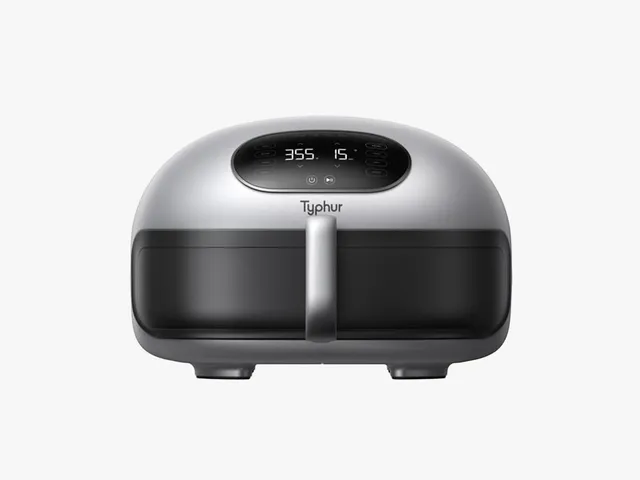
The Typhur Dome 2 is the air fryer that obliterated this worry, by adding pizza, browned meats, grilled asparagus, and toasted bread to this list—not to mention perfect crispy bacon. It’s an innovative device that takes over most of the functions of a classic auxiliary oven, but with far more powerful convection.

After testing more than 30 air fryers over the past year, the Dome 2 is the one I far and away recommend as the most powerful, versatile, accurate, and fast air fryer I know. I’ve evangelized for this thing ever since I first tried it last year. But the one big caveat is always the price: It’s listed at $500 and rarely dips much below $400.

So imagine my surprise when I saw the Dome 2 dip to $340 for Amazon’s Spring Sale, the lowest I’ve seen it since Black Friday. If you’ve been hunting for an upgrade to your old basket air fryer, this is probably a good time. The sale lasts until March 31.

Advertisement
  • Photograph: Matthew Korfhage

  • Photograph: Matthew Korfhage

  • Photograph: Matthew Korfhage

Fast, Versatile, App-Controlled Cooks

So why’s the Dome 2 my favorite air fryer? Typhur, a tech-forward company based in San Francisco but with engineering and manufacturing ties to China, reimagined the shape and function of the classic basket fryer by creating a broader and shallower basket, with individually controllable dual heating elements.

This means the Dome 2 has room for a freezer pizza, and can apply direct heat from the bottom to add actual char-speckle and crispness to the crust, kind of like a combination grill-oven. The Dome’s shallow basket also lets you spread out ingredients in a single layer for excellent airflow, while heating from both sides. I can crisp two dozen wings in just 14 minutes (or 17 minutes if I fry hard). The Dome also toasts bread evenly, and crisps bacon without smelling up the house—in part because it has a helpful self-clean function.

Temp accuracy is within 5 or 10 degrees of target, and the fan can adjust its speed depending on the cooking mode. And the smart app is actually useful, with about 50 recipes ranging from asparagus to eclair to a flank steak London broil that can be synced with a button-press. But note that some functions, such as baking, need the app to work, and the device is more of a counter hog than taller basket fryers.

Typhur’s Probe-Assisted Oven Also on Sale

The Dome 2’s basket is a bit shallow for a whole bird or a large roast, however. If you want a convection device for larger meats, I often recommend the Breville Smart Oven Air Fryer Pro, which is among my favorite convection toaster ovens. This is a (very) smart oven and air fryer that doesn’t crisp up wings and fries quite as well as basket fryers, but is more versatile for roasting big proteins like a whole chicken. The Breville is also on a nice sale right now, dropping by 20 percent.

Advertisement
Breville Smart Oven Air Fryer Pro

Breville

the Smart Oven Air Fryer Pro

Source link

Continue Reading

Tech

How to use Playlist Playground to build Apple Music playlists in seconds

Published

on

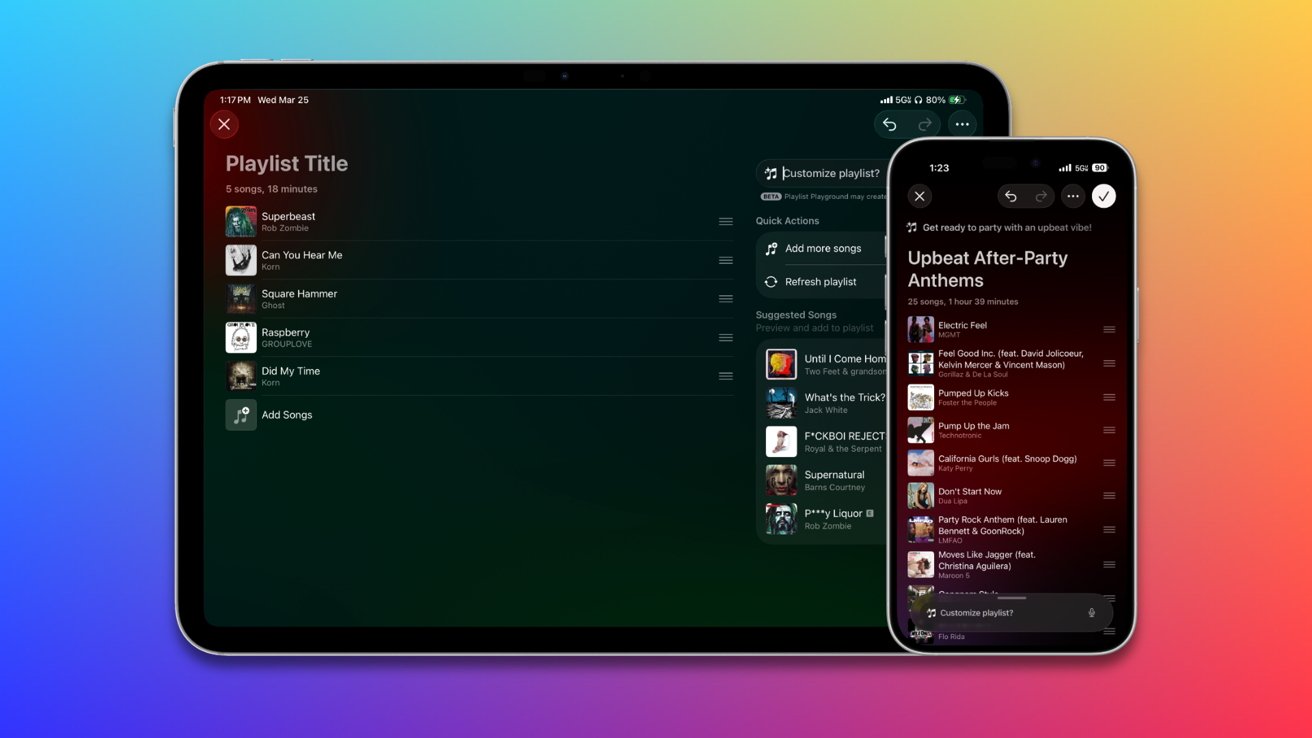
Apple Music’s new Playlist Playground feature is a prompt-driven playlist builder that’s fast and surprisingly useful, even if it won’t replace a carefully curated mix. Here’s how to start playing, and how well it works.

Tablet and smartphone displaying a dark-themed music app with playlists and song lists, set against a colorful gradient background transitioning from blue to pink, orange, and green
Apple Music’s new Playlist Playground

Apple added Playlist Playground to Apple Music on March 24 with iOS 26.4 and iPadOS 26.4. It lets users build playlists by describing what they want instead of adding songs one by one.
Building playlists in Apple Music takes time, especially when you’re chasing a specific mood. Playlist Playground cuts that down to a few seconds, making it useful as a starting point.
Continue Reading on AppleInsider | Discuss on our Forums

Source link

Continue Reading

Tech

Bubble AI app builder abused to steal Microsoft account credentials

Published

on

Bubble AI app builder abused to steal Microsoft account credentials

Threat actors are evading phishing detection in campaigns targeting Microsoft accounts by abusing the no-code app-building platform Bubble to generate and host malicious web apps.

Because the web app is hosted on a legitimate platform, email security solutions do not flag the link as a potential threat, allowing users to access the page.

Security researchers at Kaspersky say that threat actors are using the new method to redirect users to the actual phishing page, which is often mimicking a Microsoft login portal that is sometimes hidden behind a Cloudflare check.

Any credentials entered on these fake web pages are siphoned to the phishing actor, who may then use them to access email, calendar, and other sensitive data associated with Microsoft 365 accounts.

Advertisement
The phishing page
The Microsoft-themed phishing page
Source: Kaspersky

Bubble is a no-code AI-powered platform where users describe the app they want to build and then the platform automatically generates the backend logic and frontend.

The resulting apps are hosted on Bubble’s infrastructure under *.bubble.io, which is a trusted domain unlikely to trigger security warnings from email security solutions.

Phishing actors take advantage of this by creating Bubble apps that consist of large, complex JavaScript bundles and Shadow DOM-heavy structures, which are not flagged as redirection scripts or classified as malicious by static and automated analysis tools.

“The code generated by this no-code platform is a massive jumble of JavaScript and isolated Shadow DOM (Document Object Model) structures,” explains Kaspersky.

“Even for an expert, it’s difficult to grasp what’s happening at first glance; you really have to dig through it to understand how it all works and what the purpose is.”

Advertisement

“Automated web-code analysis algorithms are even more likely to get tripped up, frequently reaching the verdict that this is just a functional, useful site.”

Code fragment of a Bubble app
Source: Kaspersky

The researchers warn that the tactic of abusing AI-powered app builders for evasion in phishing campaigns is very likely to be adopted by phishing-as-a-service (PhaaS) platforms and integrated into phishing kits that are widely used by lower-tier cybercriminals.

These platforms already provide session cookie theft, adversary-in-the-middle (AiTM) layers that bypass two-factor authentication (2FA), geo-fencing, anti-analysis tricks, and AI-generated email content, so the abuse of legitimate platforms will only increase the stealth of these attacks.

BleepingComputer has contacted Bubble for a comment about Kaspersky’s findings and any plans to strengthen anti-abuse protections, but we have not received a response by publishing time.

Malware is getting smarter. The Red Report 2026 reveals how new threats use math to detect sandboxes and hide in plain sight.

Download our analysis of 1.1 million malicious samples to uncover the top 10 techniques and see if your security stack is blinded.

Advertisement

Source link

Continue Reading

Tech

T-Mobile customers have a week to sign up for a free year of MLB.TV

Published

on

Today marks the start of the 2026 baseball season and in what has sort of become an annual tradition, T-Mobile is once again offering a free subscription to MLB.TV.

In order to take advantage of the deal, T-Mobile customers simply need to log into the T Life app, navigate to the Benefits tab and then hit Redeem after clicking the banner for a free season of MLB.TV. From there, you just need to download the latest version of the MLB app to your mobile device and sign in or create an account. That said, this is a time-limited offer, so if you want the ability to stream regular season baseball for free, you’ll need claim the deal prior to March 31 at 4:59 AM ET. For anyone on a different carrier, this may be enough time to switch providers and still get in on the savings.

Unfortunately, MLB.TV is subject to blackouts and market restrictions, so depending on where you live and where your favorite team is playing that day, you may not be able to catch every game. Sadly, this includes tonight’s 8:05 PM ET matchup between the New York Yankees and the San Francisco Giants, which is streaming exclusively on Netflix. Even so, with a one-year subscription to MLB.TV currently going for $150, this is one of the best perks available from any of the big cellular carriers.

In addition to full season of games, an MLB.TV subscription also includes access to a collection of baseball documentaries, game streams from previous years, World Series films, highlights, news and more. And with over 1.25 million customers having redeemed last year’s offer, this is potentially one of T-Mobile’s biggest offers of the year, with the company claiming to have delivered more than $1 billion in savings since it first started running the promotion 10 years ago in 2016.

Advertisement

Source link

Continue Reading

Trending

Copyright © 2025