Connect with us

Tech

Why balance is needed when using AI in the creator economy

Published

on

CreationDose’s Alessandro La Rosa discusses AI and the creator economy, and why a balance between automation and humanity is needed to preserve authenticity.

The rise of social media and influencers into the mainstream – and the subsequent monetisation that eventually emerged out of the field – has made the ‘creator economy’ an extremely buoyant market in the last decade.

In fact, a Goldman Sachs report from 2023 predicted that the creator economy could be worth as much as $480bn by 2027.

As the creator economy continues to grow, one company is working on using artificial intelligence (AI) to help content creators and brands manage collaboration strategies and campaigns.

Advertisement

CreationDose, a media-tech company based in Sicily, Italy, has developed an AI-powered platform called Vidoser, which aims to help manage the collaboration life cycle between influencers and brands, assisting in tasks such as content production and marketing campaigns.

“I’ve always had a deep passion for communication and for the ways people express themselves through the media,” says founder and CEO Alessandro La Rosa. “When I realised that creators were redefining the language of brands, I decided to build a platform that put them at the centre.

“That’s how Vidoser was born – with the mission to unite technology, creativity and new generations.”

Risk and trust

‘Make sure your ambition is always greater than your fears.’

Advertisement

According to La Rosa, this is the best piece of career advice he has ever received, as it pushed him to “never stop in front of risk, to believe in my projects and to build something concrete even when conditions seemed impossible”.

La Rosa held this advice to heart when founding CreationDose in 2018 and launching Vidoser in 2019, which he describes as the biggest risks he has ever taken, as at the time, talking about the creator economy “still sounded almost utopian”.

“We started with a small team and a big vision in an environment where the start-up ecosystem was still underdeveloped,” he says. “Today, I can say it was the biggest – and most rewarding – risk of my life.”

As CreationDose’s CEO, La Rosa leads the company’s strategic direction, overseeing product development, revenue growth and partnerships, with his main focus being defining the company’s long-term trajectory, ensuring technological innovation remains at the core of its culture, and aligning all business units toward common objectives.

Advertisement

As a business leader, La Rosa says he believes in giving trust and responsibility to his team.

“I try to build an environment where people feel part of the vision and can express themselves freely. I focus more on results than on hours worked, promoting a culture of listening and continuous growth. When people understand that their contribution has real impact, they give their best.”

Balanced automation

The advent of advanced AI technology has sparked concern in multiple industries – especially creative industries such as art and entertainment.

In the aftermath of the rise of generative AI, kicked off by OpenAI’s ChatGPT, professionals from creative industries – ranging from film, TV and literature to music and video games – have voiced worry about the technology encroaching on their sectors and work without restraint.

Advertisement

La Rosa recognises the concern that creatives may have about the technology, and emphasises that a balance is needed between automation and the human in the process.

“It’s natural that people feel apprehensive about AI, especially in creative fields where personal identity carries great value,” he says.

“AI should be used as a creative partner, not a replacement. It can help improve quality, analyse creator performance, suggest optimisations, review content or speed up editing – but the final decisions should always remain in human hands.

“Transparency in the use of AI, data protection and respect for the intellectual property of creators are essential principles.”

Advertisement

La Rosa says that the speed at which the creator economy is evolving means that one of the biggest challenges is maintaining that balance between automation and humanity.

“On one hand, artificial intelligence allows us to scale and optimise content production; on the other, it’s essential to preserve the authenticity of creators and support the people behind this industry,” he says.

“The main advantages are the ability to analyse millions of data points, predict trends and optimise campaigns in real time. The downside is the risk of losing authenticity if everything becomes too automated.”

La Rosa believes that the right balance comes from combining AI with human sensitivity. “Data can guide decisions, but the relationship between brand and creator must remain deeply human.

Advertisement

“I believe AI represents an extraordinary opportunity to free up time, enhance productivity and make tools accessible that were once available only to a few,” he says. “The difference will always depend on how it’s used: as a lever to elevate human ingenuity, not to replace it.”

Don’t miss out on the knowledge you need to succeed. Sign up for the Daily Brief, Silicon Republic’s digest of need-to-know sci-tech news.

Source link

Advertisement
Continue Reading
Click to comment

Leave a Reply

Your email address will not be published. Required fields are marked *

Tech

Phil Spencer Retiring After 38 Years At Microsoft

Published

on

Xbox chief and Microsoft Gaming CEO Phil Spencer is leaving Microsoft after nearly 40 years at the company. “Meanwhile, Xbox President Sarah Bond, “long thought by many both inside and outside of Microsoft to be Spencer’s heir apparent, has resigned,” reports IGN. From the report: The new CEO of Microsoft Gaming will be Asha Sharma, currently the President of Microsoft’s CoreAI product. Finally, Xbox Game Studios head Matt Booty is being promoted to Chief Content Officer and will work closely with Sharma. “I want to thank Phil for his extraordinary leadership and partnership,” Microsoft CEO Satya Nadella said in an email sent to Microsoft staff. “Over 38 years at Microsoft, including 12 years leading Gaming, Phil helped transform what we do and how we do it.” […]

Spencer was named Head of Xbox in March of 2014, when he was tasked with righting a ship that had made a number of product choices and policy decisions that rubbed core gamers the wrong way in the run-up to the launch of the Xbox One in Fall 2013. Long hailed by gamers as being one of their own, Spencer could frequently be found on Xbox Live, playing games regularly with fellow Xbox gamers and racking up a healthy Gamerscore. His first major move when put in charge was decoupling the Kinect 2.0 peripheral from the Xbox One package, thus immediately reducing the new console’s price by $100 to $399, matching the day-one price of Sony’s PlayStation 4. He spearheaded the much-heralded backwards compatibility movement within Xbox, the Xbox Game Pass service was born under his watch, and accessibility made major advances during his tenure in both hardware and software. Xbox Play Anywhere, which sought to let gamers play their Xbox games on any device, be it a PC, console, or handheld, isn’t new but has been a big recent focal point.

Spencer’s time running Xbox will perhaps be most remembered for Microsoft’s $69 billion acquisition of Activision-Blizzard-King in 2022, which took almost two years to achieve regulatory approval from various agencies around the world. But Spencer began trying to solve for Xbox’s dearth of first-party games in 2018, when the first wave of studio acquisitions occurred. Prior to the Activision deal, Spencer’s biggest move came with the $7.5 billion acquisition of ZeniMax, parent company of Bethesda, in 2020. The deal gave Xbox total ownership of Bethesda Game Studios and its Fallout and Elder Scrolls franchises along with id Software and its Doom and Quake IPs, among many others. Questions arose from there about whether or not that meant all of Xbox’s new studios would produce games exclusively for Xbox consoles, and while some games were kept off of PlayStation platforms temporarily, many weren’t and most now seem to come to PS5 eventually, if not on day one.

Source link

Advertisement
Continue Reading

Tech

Xbox head Phil Spencer is leaving Microsoft

Published

on

Phil Spencer, CEO of Microsoft Gaming, is retiring, Satya Nadella has announced. Asha Sharma, the President of Microsoft’s CoreAI division is taking over Spencer’s role, while Sarah Bond, the current President of Xbox, is resigning.

“I am long on gaming and its role at the center of our consumer ambition, and as we look ahead, I’m excited to share that Asha Sharma will become Executive Vice President and CEO, Microsoft Gaming, reporting to me,” Nadella says. “Over the last two years at Microsoft, and previously as Chief Operating Officer at Instacart and a Vice President at Meta, Asha has helped build and scale services that reach billions of people and support thriving consumer and developer ecosystems. She brings deep experience building and growing platforms, aligning business models to long-term value, and operating at global scale, which will be critical in leading our gaming business into its next era of growth.”

In a thread on X, Spencer shared his thoughts on Sharma’s new position. “I’m excited for [Asha Sharma] as she steps into the CEO role,” Spencer wrote. “She’s joining an incredible group of people; teams full of talent, heart, and a deep commitment to the players they serve. Watching her lean in with curiosity and a real desire to strengthen the foundation we’ve built gives me confidence that our Xbox communities will be well supported in the years ahead.”

Alongside Sharma, Matt Booty, the current head of Xbox Game Studios, is getting promoted to Chief Content Officer, and will report to Sharma. Sarah Bond, who like Spencer served as a public face for the Xbox brand and was assumed to be his successor, is leaving Microsoft to “begin a new chapter.” Bond has yet to make a public statement about her resignation.

Advertisement

Spencer joined Microsoft in 1988, and has worked on Xbox since at least 2001. He assumed responsibility for Microsoft’s gaming brand and its various studios and associated subscription products in 2013, before becoming an Executive VP of Gaming in 2017 and later CEO of Microsoft Gaming in 2022. Spencer’s biggest impact on Xbox will likely be remembered as the creation of Game Pass, Microsoft’s “Netflix for Games” and the wave of studio acquisitions Microsoft completed from 2018 to 2022, which included smaller studios like Double Fine and the massive $68.7 billion purchase of Activision Blizzard King.

While Microsoft has plenty of developers and IP to fall back on, it’s struggled to compete with the likes of Sony and Nintendo during the current console generation. Microsoft’s gaming division has gone through widespread layoffs, its revenue continued to fall throughout 2025 and it raised the prices of both its consoles and Game Pass Ultimate, which likely won’t help things going forward. Sharma is in many ways inheriting a broken-down car.

As far as her plans go, Sharma’s email to staff that was included in Nadella’s announcement is light on details. Sharma says she plans to continue developing “great games,” wants to “recommit” to core Xbox fans and “invent new business models and new ways to play.” Whether that’s enough to turn Xbox’s fortunes around remains to be seen.

Update, February 20, 4:52PM ET: Added statement from Phil Spencer shared on X.

Advertisement

Source link

Continue Reading

Tech

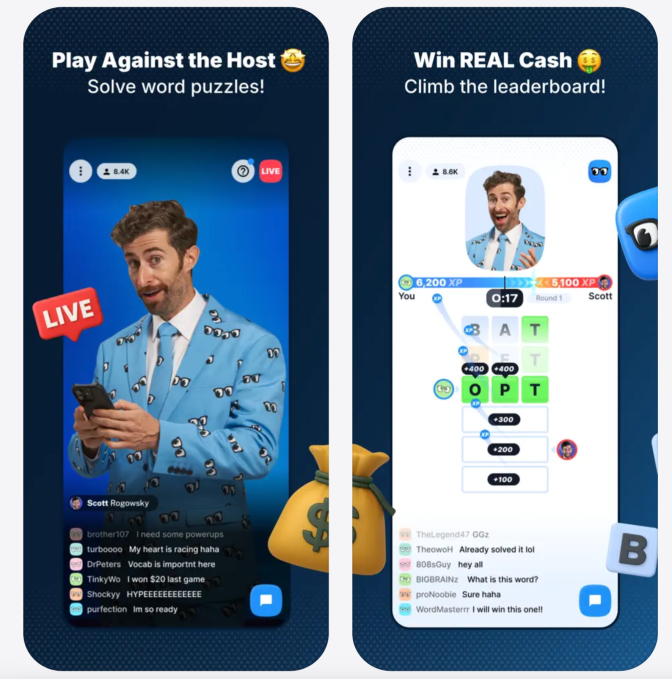
Remember HQ? ‘Quiz Daddy’ Scott Rogowsky is back with TextSavvy, a daily mobile game show

Published

on

Scott Rogowsky is a comedian – he knows how to make fun of himself. That’s how he ended up roaming New York City Comic Con with his own photo printed out like a “Wanted” poster, filming himself asking strangers, “Have you seen this man?”

These passersby showed a flicker of recognition, looking at the tall, bearded man like someone they had known in a past life, but couldn’t quite place.

“You look familiar! Where do I know you from?” someone asks, as though Rogowsky could be a friend of a friend they had met at a party.

“I know your face,” another person says, staring thoughtfully at the 41-one-year-old.

Advertisement

A cosplayer dressed as a Ghostbuster finally figures it out.

“Did you used to do that game show online?” he asks. “Like, every night?”

Rogowsky was just poking fun at himself, embracing the persona of a washed-up internet sensation. “I know my place,” he tells TechCrunch. “I’m not walking around like everybody’s supposed to know who I am.” 

Techcrunch event

Advertisement

Boston, MA
|
June 9, 2026

But seven years ago, everyone did. 

Advertisement

Rogowsky was once the face of HQ Trivia, an app that exploded into popular culture, then faded out of the public consciousness almost as fast. Between 2017 and 2019, Rogowsky hosted the live mobile game show twice a day. At its peak, it drew more than 2.4 million daily viewers each night. It garnered 20 million lifetime downloads.

Now thecomedian is back with an app of his own called Savvy, which shares a lot of the DNA of HQ. Savvy’s first game, TextSavvy, is a daily live game show where players can earn cash — only this time, viewers are competing against Rogowsky in a word puzzle game that’s something like a hybrid of The New York Times’ Wordle and Connections, rather than trivia. 

“I believe this is my calling in a weird way,” Rogowsky says. “I get up there in front of that camera, there’s thousands of people watching at home – millions, back in the HQ days – and it just flows.”

Advertisement

HQ Trivia was founded by the creators of Vine — the short-video platform that predated TikTok — and became a genuine cultural sensation. National news channels ran stories about office workers dropping everything in the middle of the day to play HQ at 3 p.m. It was groundbreaking – appointment entertainment in a new format for the streaming era – until the company imploded in a barrage of unfortunate circumstances. 

One founder, Colin Kroll, died of a drug overdose; the other founder, Rus Yusupov, was a divisive leader who clashed with his staff. He once threatened a journalist that he would fire Rogowsky if she published an interview with Rogowsky where he mentioned liking Sweetgreen salads (Yusupov apparently didn’t want to give the fast-food chain free publicity). Most of all, HQ Trivia fell victim to the same trap that dooms so many startups. The company had raised a $15 million funding round at a $100 million valuation, but it was – quite literally – giving away money, and it never developed a meaningful plan to monetize or build a sustainable business model. The company ultimately filed for bankruptcy in February 2020, with its demise later becoming fodder for dramatic documentaries and true-crime-adjacent podcasts dissecting how such a promising app failed so spectacularly.

This was, understandably, a real blow for Rogowsky. But more bad luck followed. A baseball superfan, Rogowsky had left HQ Trivia in 2019 for a job hosting a daily MLB Network show. He felt like he finally made it – he still lights up recalling running into Hall of Fame pitcher Pedro Martinez in the bathroom. But his show was cancelled when the pandemic shut down baseball. He tried a handful of times over the years to recreate a company like HQ, but it was a journey of false starts.

“Crazy s–t happened that I had no control over, and I felt like I was being tossed and turned on this raft in the ocean, just getting battered by things I can’t control, and that was sort of my attitude about life in general,” he says.

Advertisement

He considered himself retired from show business and opened a vintage store in California. But he missed comedy.

“I went through this very meaningful personal transformation in the last couple of years,” he said. That process culminated in a seven-day mountain retreat called “the Hoffman Process,” a program that he describes as a digital detox combining lessons in psychology and neuroscience that helped him “take control of [his] life again.”

“It gave me a lot of clarity to say, you know what, I have more to do here,” Rogowsky says. “I got out of that retreat and I was like, ‘I have something to say. People find me funny and entertaining. I find myself funny and entertaining.’”

People tuned into HQ Trivia for the prospect of winning a cash prize, but the odds of winning were slim. Millions of viewers came back each night because of Rogowsky’s quick wit and charm, which earned him a cult following of fans who still call him “Quiz Daddy.” 

Advertisement

“From the psychological, emotional side, I couldn’t really process what was going on,” Rogowsky says, reflecting on his viral fame. “And in the seven humbling years since, I have a vastly new perspective… I have my fanbase, I have my core followers right here. They’re on board with me, and it’s a matter of getting the word out.”

Image Credits:Savvy

Rogowsky received a lot of messages over the years from people who wanted to help him build the next HQ. But last year, a direct message on X from European game designer Johan de Jager grabbed his attention. 

“The idea was the host plays against the audience, so it’s like a two-way interaction,” Rogowsky says. “Imagine HQ if I wasn’t just asking the questions but also answering [them]… That adds another layer to it that no one had thought of before.”

But in the age of AI, where players can easily look up answers, Rogowsky was skeptical that a trivia game could work fairly, so Savvy embraced word puzzles instead.

The most that Savvy has paid out in a single game is around $400 — small compared to HQ’s occasional six-figure prize pools. That’s because Rogowsky and his co-founders are funding the company themselves.

Advertisement

“Look, I know this isn’t the thousands of dollars that you saw on HQ, the hundreds of thousands that we eventually got to,” Rogowsky said on one recent TextSavvy broadcast. “But the difference is HQ was funded by venture capital. They had $8 million in the bank to start. They got another $15 million from other venture capitalists. We don’t got that… This is a low-budge operashe because I’m paying for it!”

Rogwosky says he has spoken with investors about Savvy and even gotten some enticing offers. But venture backing often comes with pressure on founders to maximize returns as fast as they can, a model that can set a business up to fail, as HQ demonstrated. 

“People want to 10x and 100x [their investment]… I’d be very happy to get to a point of profitability, to where we can just keep growing the company, keep hiring more people, keep making more games,” Rogowsky says. “I’m not looking for some type of eight-figure, nine-figure exit. This is what I want to do. I’m going to do this as long as I continue to wake up every morning and say, ‘Goddamn, I’m excited to get up there in front of that camera and have fun.’”

TextSavvy is currently running a “Season 0,” a soft launch that allows the team to work through technical kinks before formally launching on March 1. So far, without much promotion, TextSavvy has peaked at about 4,000 viewers in one night. 

Advertisement

That’s not much compared to the HQ days. Then again, when TechCrunch first wrote about HQ, the app only had about 3,300 concurrent viewers. Who’s to say Savvy can’t do it again?

“We’re not going anywhere this time,” Rogowsky said. “There’s no one to fire me. There’s no drama, there’s no tension. There’s not going to be a documentary about Savvy the way there was about HQ.”

Source link

Advertisement
Continue Reading

Tech

Horizon Europe Action Plan to boost Irish SME participation

Published

on

The Government strategy has a renewed focus on improving Ireland’s SME involvement in Europe’s €95bn research and innovation programme.

Ireland’s Government has launched a “strengthened” version of the Horizon Europe Action Plan, Ireland’s gateway to a €95.5bn EU funding programme focused on research, innovation and investment to address global challenges for the years 2025 to 2027. 

The Action Plan, announced by the Minister for Further and Higher Education, Research, Innovation and Science James Lawless, TD, will set out measures designed to build on Ireland’s performance in Horizon Europe. In September 2025, Ireland reached a milestone of €1bn in secured funding. 

Noting that Ireland’s higher educational institutions have performed strongly in Horizon Europe, Lawless is of the opinion that this success, which demonstrates scale of opportunity, can be replicated by the country’s small and medium sized enterprises (SMEs). 

Advertisement

Commenting on the announcement, Lawless said it is important that “Ireland’s enterprise base, especially small and medium businesses, have the awareness, support and clear pathways to fully benefit from Horizon Europe”.

Core pillars

Looking ahead, the plan – which was developed with key research and innovation partners in the Horizon Europe focus group, including national support network members and higher education representatives – will focus on four core priorities.

The first of these is the further development of higher education institution engagement via tailored institutional supports, stronger post-award assistance efforts and enhanced alignment with research priorities.

The second is the enhancement of SME participation and performance through targeted engagement, improved visibility of financial support, and stronger links between SMEs, higher education institutions and research centres. 

Advertisement

The third priority is to encourage more Irish-led coordination roles, reducing administrative burdens, expanding mentoring and training, and strengthening incentives. 

Lastly is the aim of attracting and supporting newcomers, including early-career researchers and first-time applicants, through mentorship, developing networks and improving career sustainability supports.

Lawless said: “Ireland has already secured €1bn in Horizon Europe funding, with two years still remaining in the programme. This Action Plan will support both our higher education institutions and our small and medium‑sized enterprises to strengthen their participation, enhance performance and maximise the impact of EU research and innovation funding.

“The next phase of our national effort must see SME participation grow significantly. It is essential that Ireland’s enterprise base, particularly small and medium businesses, have the awareness, support and clear pathways to fully benefit from Horizon Europe. 

Advertisement

“Equally, our higher education institutions play a vital role in driving excellence, collaboration and innovation. This Action Plan commits to strengthening both, ensuring that Ireland’s research and enterprise communities succeed together.”

Earlier this month, it was discovered that, for the first time since 2018, annual venture capital funding into Irish technology SMEs fell, according to the Irish Venture Capital Association Venture Pulse report. 

The report, published in partnership with Irish law firm William Fry, indicated that funding in 2025 fell by 23pc to €1.1bn – a decline from 2024’s record €1.48bn. A total of 186 deals were completed in 2025, down from 217 in 2024 – a drop of 14pc.

Don’t miss out on the knowledge you need to succeed. Sign up for the Daily Brief, Silicon Republic’s digest of need-to-know sci-tech news.

Advertisement

Source link

Continue Reading

Tech

The latest iPhone update lets you chat to ChatGPT and Gemini in your car

Published

on

Apple’s latest iOS 26.4 public beta includes a cool new feature: the ability to chat with third-party AI like ChatGPT, Gemini, and Claude right through CarPlay.

This is the first time Apple has opened up CarPlay to conversational AI, offering a neat way for drivers to get info and help on the go.

The update brings a new voice control screen to CarPlay, so these AI assistants can give you both spoken and visual answers. Basically, you can launch ChatGPT or Gemini, ask your question, and see the response on your dashboard. It’s a significant upgrade for CarPlay, though it does have a few caveats.

Siri still holds the default voice assistant spot for now. These third-party bots won’t be able to control your car or iPhone settings, and you’ll have to tap to launch them; there are no wake words yet. Developers also need to update their apps to support CarPlay, so while the groundwork is laid, it might be a little bit before ChatGPT, Gemini, and Claude are fully operational in your ride.

Advertisement

Advertisement

It’s interesting timing, even if Apple hasn’t given a formal explanation. Siri is already hooked up with ChatGPT, and Gemini-powered Siri is on the way later this year. Opening CarPlay to other AI assistants isn’t just about giving users more choice; it also helps Apple show it’s open to alternative platforms, which is something EU regulators have been keen on.

The rumoured improved, Gemini-powered Siri is now expected to arrive with iOS 27 in September, not iOS 26.4. Meanwhile, iOS 26.4 does bring other improvements, including updates to Apple Music and Camera.

The public version of iOS 26.4 should be out in a matter of weeks. Once developers do their part, you’ll be able to chat with ChatGPT, Gemini, and Claude while driving. For Apple users, this is a clear look at a future where CarPlay transforms from just a dashboard display into an AI-powered conversational hub.

Advertisement

Source link

Continue Reading

Tech

Meta’s Pivot From VR Is Happening. Too Bad Glasses Aren’t Ready for This Moment

Published

on

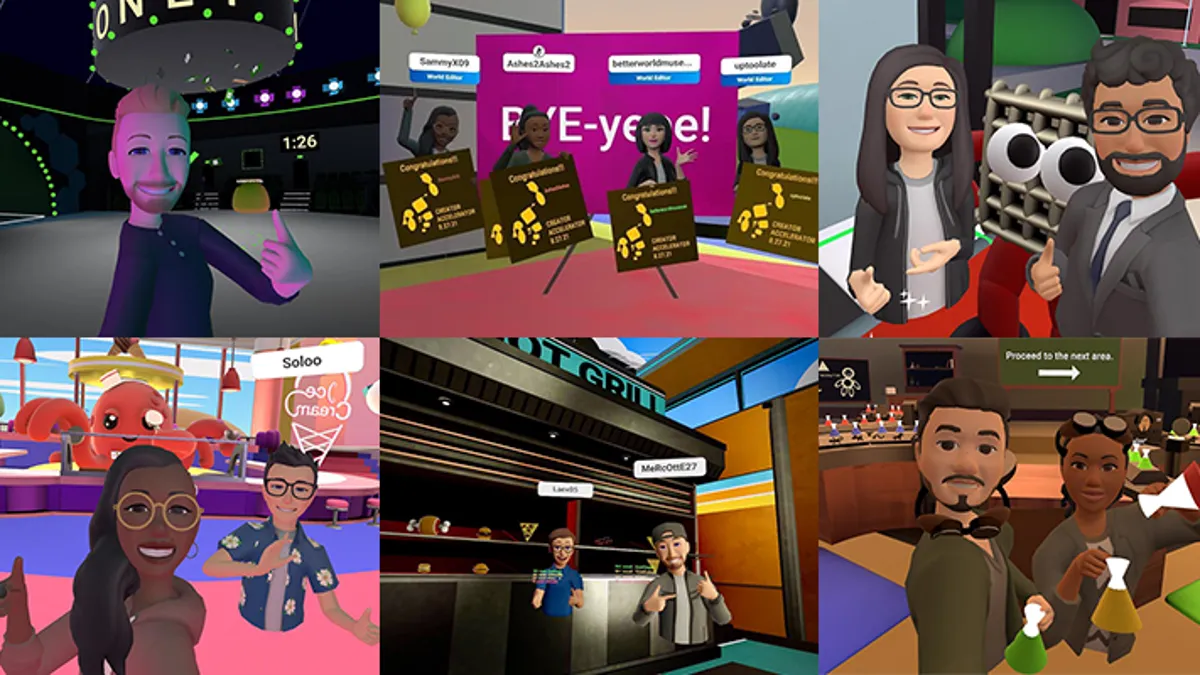
I never loved Horizon Worlds, Meta’s best attempt at creating a social universe for its VR headsets. In fact, I’ve completely avoided it. So I’m not at all surprised that Meta now says it’ll be refocusing Horizon Worlds on Roblox-like phone games. 

Is the metaverse dead? No, because the metaverse isn’t just Meta: It just co-opted the philosophical term. But the company’s biggest investment in virtual worlds has turned out to be a failure. And it’s just the “tip of the iceberg pivot” that Meta’s doing right now, as it tries to turn its VR efforts into a win with future AR glasses.

I’ve been somewhat stunned by Meta’s series of seemingly give-up-on-VR moves over the last few months, which included shutting down its best VR game studio acquisitions, killing off the best and most innovative VR fitness platform (also an acquisition), and ending attempts to make its VR ecosystem into a work software tool.

Advertisement

Meta’s new head of Reality Labs content, Samantha Kelly, admitted in a new blog post that VR hasn’t been the big seller Meta expected, echoing recent statements from Meta CTO Andrew Bosworth. Though VR headsets will still exist going forward, according to Meta, the company will lean on third-party apps and games to sell the headset instead. 

And now it’ll be moving away from trying to make Horizon Worlds happen as the centerpiece of Quest VR.

The Meta Quest 3S VR headset and controllers with a pink and green background

Meta’s Quest headsets have always been geared toward gaming and low-priced fun, but Meta’s pulling back on the other pieces of the puzzle in favor of advancing glasses.

Advertisement

Scott Stein/CNET

That’s a bit of a cosmic joke to me, considering that until now, Meta had wasted no effort in trying to bury game developers’ apps by spamming its OS with links to Horizon Worlds. Meta’s Quest app on phones became Horizon-branded and tried to hide app content in favor of weird Horizon Worlds social experiences, too.

While the Quest 3 and 3S are still the best-for-the-money VR headsets, I have no idea what the future holds for these systems. At every turn, I see Mark Zuckerberg and Meta declaring a full-on push to AI and smart glasses. Meanwhile, AI has barely surfaced inside Quest headsets in any meaningful way. 

Meta always had its VR ambitions split between everyday work and kid-focused gaming. It got the latter, not the former. It became a kid’s console, even though Meta tried to keep kids away. As a result, I don’t think anyone ever took the Quest seriously as anything you’d use for anything else other than games. Neither does Meta anymore, apparently.

Advertisement
CNET's Scott Stein wearing the new Meta Ray-Ban Display smart glasses and neural wristband.

Meta’s current Ray-Ban Displays have only one display, and the apps on them are much more basic than those on any VR headset.

Scott Stein/CNET

So now what, Meta?

Meta’s next steps look like they’ll still be focused on VR a bit, but I think it’ll be as a bridge to glasses. A smaller headset expected sometime in the next year could be more of an attempt to focus on portability and higher-resolution video to compete with display glassesApple’s Vision headset and the Samsung Galaxy XR (or even Valve’s upcoming Steam Frame). 

However, this shift might signal the end of subsidized gaming hardware, leading to higher prices. It could also mean Meta’s VR pivots toward showcasing immersive films and games rather than building an entire computing universe — or at least one requiring such extensive custom software.

As Meta keeps trying to make advanced AR glasses happen at some point down the road, its glasses are slowly adding displays and apps, but the software on Ray-Ban Displays is embryonic and primitive. It’s nothing like VR, and I have no idea when AR glasses will even get close. 

Advertisement

Meta’s moonshot, the AR glasses prototype Orion, needed a separate processing puck to work. That’s basically a similar idea to Xreal and Google’s upcoming Project Aura set of glasses, which also uses a puck. But the difference between Google and Meta is that Google plans to eventually put the processing on next-gen phones to run these AR glasses. Meta has no ability to do that, because it’s bottlenecked by Google and Apple.

Three parts of an AR headset kit by Meta called Orion: computer, glasses and wristband

Meta’s concept for next-gen AR glasses, Orion, demoed in 2024, relies on a processor puck. 

Meta

And then what? Unlike Apple, Google and Samsung, Meta doesn’t have its own phone platform. Glasses are going to work with phones. That’s going to be Meta’s bottleneck, no matter how many times it tries to reshuffle its metaverse and device vision. VR headsets may have been a way to try to get around phones, but when it comes to glasses, it’s unavoidable. 

Advertisement

I don’t see how Horizon Worlds will ever be popular as another phone gaming app in a world dripping in Roblox-alikes. And as I said about Meta’s decision to destroy the fitness app Supernatural, what pieces does Meta have for its glasses push that are going to really be ready to compete with what Google, and likely Apple, are going to bring — fitness, app hook-ins, media, mapping, future car integrations and everything else? 

As Meta seems ever more ready to abandon so much of what it tried to build in VR, I wonder if it will realize that glasses just aren’t ready yet, app-wise, to pick up the journey on the other side. Even if the goal is to lean heavily on AI to do it.

Source link

Advertisement
Continue Reading

Tech

Amazon Prime Members: You Can Play These Games for Free

Published

on

Did you know that your Amazon Prime membership comes not only with delivery perks and Prime Video, but also free games? Amazon’s recently relaunched streaming gaming service, Luna, has added new titles for you to play this month.

With a Prime membership, you get a Luna Standard subscription for free. That includes games such as Hogwarts Legacy and Indiana Jones and the Great Circle. You’ll need a compatible device and either a controller or a mouse and keyboard to play. You can also use your phone as a controller with a stack of multiplayer GameNight games.

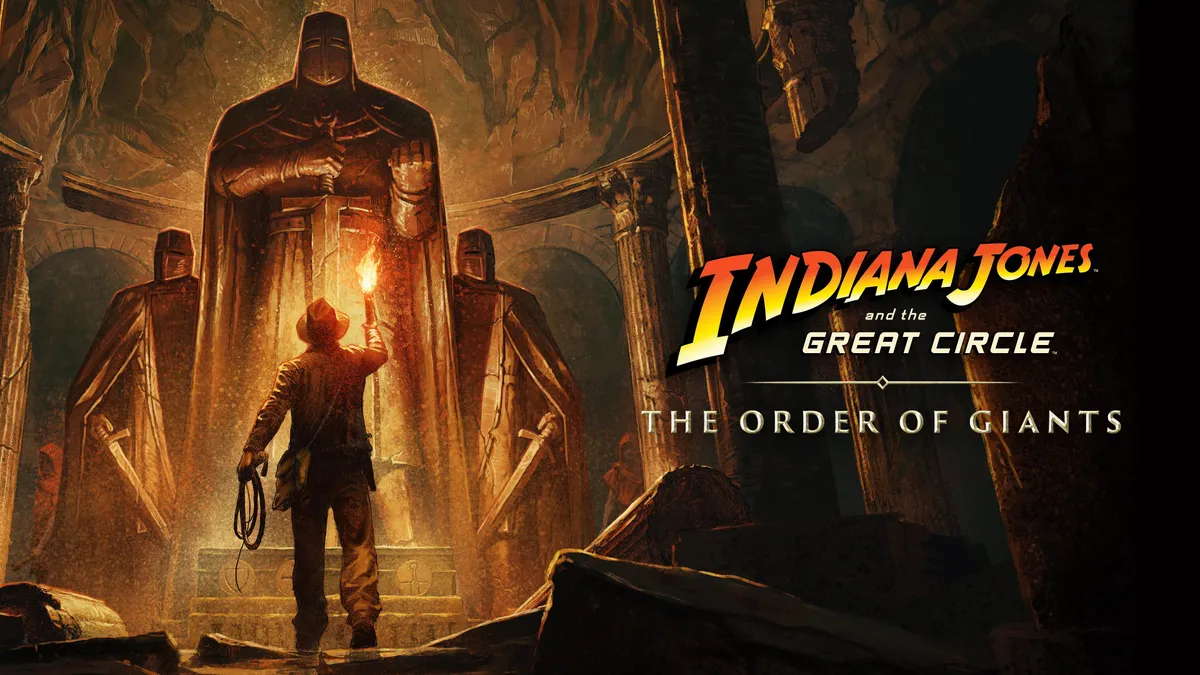
New games added to Luna in February include Indiana Jones and the Great Circle: The Order of Giants, the survivor horror game Alan Wake 2 and the music-based GameNight game Just Shapes & Beats. 

Advertisement

You’ll also find Disney Universe, RiMS Racing, Time on Frog Island, Valfaris, Worms Crazy Golf, Yooka-Laylee and the Impossible Lair, Disney Planes and Endzone: A World Apart.

Luna Standard is free with a Prime membership, which costs $15 per month or $139 per year. For a larger game library, you can also upgrade to a Luna Premium subscription for an extra $10 per month.

Advertisement

Source link

Continue Reading

Tech

Bondi Bragged About Forcing Facebook To Censor Speech. Now FIRE Is Suing.

Published

on

from the every-accusation-is-a-confession-tweeted-out dept

I seem to recall a years-long freakout among MAGA folks about the Biden administration pressuring social media companies to remove content. You may have heard about it.

Anyway. In unrelated news FIRE (the Foundation for Individual Rights and Expression), has filed suit against Attorney General Pam Bondi and DHS Secretary Kristi Noem on behalf of Kassandra Rosado, who ran a 100,000-member Facebook group called “ICE Sightings – Chicagoland,” and Mark Hodges, who created the Eyes Up app for documenting and archiving videos of ICE enforcement activity.

The suit alleges that Bondi and Noem coerced Facebook into disabling the group and coerced Apple into pulling the app from its App Store, in direct violation of the First Amendment. Because, you know, government officials calling social media companies and demanding they remove content is… bad.

The legal theory is straightforward, the evidence is overwhelming, and perhaps most remarkably, the government handed FIRE much of its case on a silver platter. In other words, for all the talk of “censorship” during the Biden admin, which went nowhere due to the lack of any actual evidence, here there not only is evidence, it was eagerly and readily provided by Pam Bondi and Kristi Noem themselves. In public. Repeatedly. Proudly.

Advertisement

Let’s start with the basics of what actually happened, because the facts here are almost embarrassingly damning. Kassandra Rosado created her Facebook group in January 2025, initially as a small community resource for Chicago-area small business owners trying to understand how ICE raids were affecting foot traffic and community events. The group grew to nearly 100,000 members by October as ICE enforcement escalated under what the agency publicly branded “Operation Midway Blitz.” According to the complaint, Facebook’s own moderators reviewed thousands of posts and found exactly five that violated its guidelines. Just five. Which Facebook removed, telling Rosado that participants acting badly don’t impact the group themselves (a good policy!).

Out of thousands of posts and tens of thousands of comments that members of the Chicagoland group created through October 2025, Facebook’s own moderators found and removed only five purportedly violating its guidelines.

Even as to these five posts, Facebook advised Rosado that they were “participant violations” that “don’t hurt your group.” Facebook further explained: “Groups aren’t penalized when members or visitors break the rules without admin approval.”

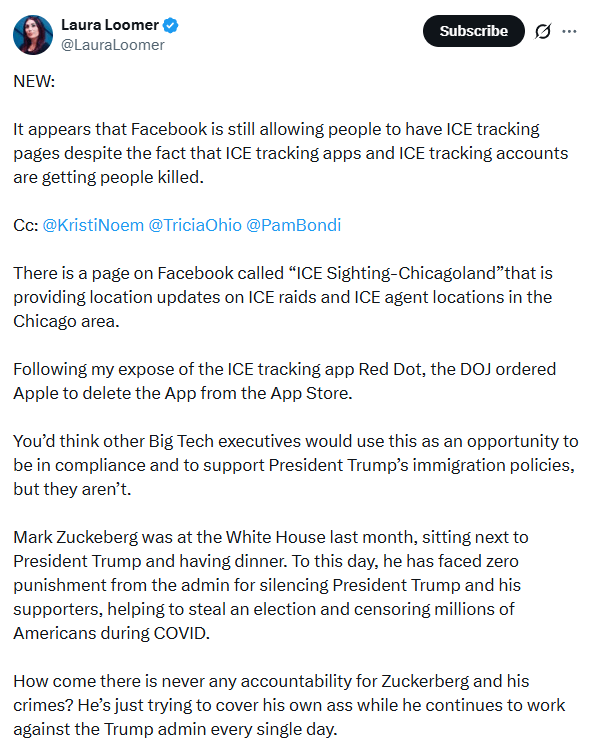
Then, on October 12, 2025, Laura Loomer tagged Noem and Bondi in a social media post flagging the group. Loomer’s role here deserves a moment of appreciation. This is a person who sued Facebook, claiming it was literally RICO to moderate her posts. Who sued all the major tech companies, arguing that content moderation violated her First Amendment rights. Her entire public identity has been built on the premise that private platforms moderating her speech is unconstitutional censorship.

And here she is, tagging federal officials to demand they force Facebook to suppress other people’s speech. The First Amendment, which constrains government action, apparently only matters when Loomer is the one being moderated. When she wants someone else silenced, she calls in the actual state.

Advertisement

The next day, a DOJ source confirmed to Loomer that DOJ had contacted Facebook to demand removal.

That same day, Facebook disabled the entire group. Then Bondi posted on social media claiming credit:

That’s the AG admitting to a pretty clear First Amendment violation. Not in a leaked email discovered through litigation. Not in a deposition. On X, taking credit. Proudly.

Today following outreach from @thejusticedept, Facebook removed a large group page that was being used to dox and target @ICEgov agents in Chicago.

…. The Department of Justice will continue engaging tech companies to eliminate platforms where radicals can incite imminent violence against federal law enforcement.

Noem piled on with her own post, crediting the DOJ for the takedown.

That’s the Secretary of Homeland Security saying:

Anti-ICE radicals are using social media apps to dox, threaten, and terrorize the brave men and women of ICE and their families.

Today, thanks to @POTUS Trump’s @TheJusticeDept under the leadership of @AGPamBondi, Facebook removed a large page being used to dox and threaten our ICE agents in Chicago.

These officers risk their lives every day arresting murderers, rapists, and gang members to protect our homeland. Platforms like Facebook must be PROACTIVE in stopping the doxxing of our @ICEgov law enforcement.

Advertisement

We will prosecute those who dox our agents to the fullest extent of the law.

The Eyes Up situation is even more instructive. Mark Hodges built Eyes Up specifically as a documentation and archiving tool for videos of ICE enforcement activity. The app uses manual moderation—meaning Hodges or other moderators personally review every video before it becomes publicly accessible.

The complaint specifically notes that:

Eyes Up is not useful for tracking ICE location or movement in real time. Because Hodges or other moderators manually review each video before it becomes publicly available, any ICE officers would be long gone by the time a video is posted.

Apple had independently reviewed and approved Eyes Up for the App Store in August 2025, raising no concerns about the content. On October 3, Apple removed it anyway—citing “information provided by law enforcement” that the app violated its guidelines on “Defamatory, discriminatory, or mean-spirited content.”

Advertisement

Bondi again made no effort to be subtle about DOJ’s role, gleefully telling Fox News:

“We reached out to Apple today demanding they remove the ICEBlock app from their App Store—and Apple did so.”

She later boasted at a roundtable that:

“We had Apple and Google take down the ICEBlock apps.”

For years, MAGA world has treated Murthy v. Missouri as a foundational text of government overreach—proof that the Biden administration ran a sophisticated censorship operation by pressuring social media companies to remove content. Jim Jordan convened hearings. The case went all the way to the Supreme Court, though MAGA folks love to ignore or downplay what the Supreme Court decision actually said about the case. The argument, reduced to its essence, was that White House officials sending emails asking platforms to review posts against their existing policies constituted unconstitutional “jawboning.”

The Supreme Court threw the case out because the plaintiffs couldn’t prove that the government’s communications actually caused the platforms to take action. The majority opinion by Justice Amy Coney Barrett found that the platforms were making their own independent decisions, often rejecting the government’s requests, and that the plaintiffs couldn’t trace any specific content removal directly to government coercion. The evidence, the Court concluded, just wasn’t there. Barrett’s opinion uses the phrase “no evidence” five times. And the little evidence plaintiffs did offer? She called it out as “unfortunately appear[ing] to be clearly erroneous.”

Advertisement

Bondi and Noem have now done something remarkable: they have provided, entirely on their own initiative and through public statements made to friendly media outlets, every single piece of evidence that was missing in Murthy.

Traceability? Bondi literally said “We reached out to Apple today demanding they remove the ICEBlock app—and Apple did so.” Coercion versus mere persuasion? The complaint details how Noem announced she was “working with the Department of Justice to see if we can prosecute” app developers, how Bondi told Fox News that ICEBlock’s creator “better watch out” because the speech was “not protected,” and how these explicit criminal threats preceded the removals.

The NRA v. Vullo standard, which the Supreme Court articulated just before the Murthy ruling (on a case they heard the same day as Murthy), holds clearly that a government official cannot use “the power of the State to punish or suppress disfavored expression” through third-party intermediaries. The complaint quotes this directly. There is no ambiguity here about what happened or who caused it.

In Murthy, investigators spent years poring over internal communications trying to find proof that the government’s requests had actually caused the platforms to act. And found nothing concrete. Here, the government’s own press releases and Fox News appearances serve that function. You don’t need subpoenas or discovery depositions when the Attorney General is posting on X to take credit.

Advertisement

The complaint captures the legal significance:

Attorney General Pamela Bondi and Homeland Security Secretary Kristi Noem want to control what the public can see, hear, or say about ICE operations. Wielding the power of federal criminal law, they coerced Facebook to disable Rosado’s Facebook group and coerced Apple to remove Kreisau Group’s Eyes Up app from its App Store. That’s unconstitutional. The First Amendment prohibits the government from coercing companies to censor protected speech. NRA v. Vullo, 602 U.S. 175, 190–91 (2024) (“[A] government official cannot do indirectly what she is barred from doing directly.”). Without this Court’s intervention, this unconstitutional coercion will continue.

That last line is important as well, because a key piece of Murthy was that to get an injunction, the plaintiffs had to show that these suppression efforts were likely to continue. That wasn’t there in Murthy. But here, we (again) have Noem and Bondi screaming to the heavens that they’re going to keep doing this.

The “officer safety” justification doesn’t survive contact with the actual facts. An app that archives manually reviewed videos of past ICE activity cannot be used to track officers in real time. The complaint notes that Apple had previously approved the app with full knowledge of what it did, then reversed course only after receiving “information from law enforcement”—which appears to mean a phone call from Bondi’s DOJ:

Apple cited its app review guideline 1.1.1, which prohibits “Defamatory, discriminatory, or mean-spirited content, including references or commentary about religion, race, sexual orientation, gender, national/ethnic origin, or other targeted groups.”

Apple had never previously stated that Eyes Up purportedly violated guideline 1.1.1 or included “Defamatory, discriminatory, or mean-spirited content.”

Advertisement

In fact, when Apple had independently reviewed Kreisau Group’s application to include Eyes Up in the App Store in August 2025, Apple did not conclude that Eyes Up violated guideline 1.1.1. During that review, Eyes Up was already available on its website, and Apple had full knowledge of the purpose of Eyes Up, of actual videos available on it, and of how it worked (including its location features). Apple flagged some unrelated issues, which Kreisau Group resolved before Apple approved the app. Apple raised no concern that Eyes Up contained “Defamatory, discriminatory, or mean-spirited” content in violation of guideline 1.1.1.

This appears to be the exact opposite of the situation in Murthy, where tech companies frequently rejected government requests if they didn’t violate policies. Here, it appears that, under pressure from Bondi, Apple changed its interpretation of the policies in a weak pretext to justify the government-led censorship.

And it was so clearly pretext:

Apple’s transparency reports show that from 2022 to 2024, it almost never removed apps for “Defamatory, discriminatory, or mean-spirited” content under guideline 1.1.1. Apple removed only three apps by US-based creators under guideline 1.1.1 in 2022, four apps in 2023, and none in 2024.

Eyes Up was not tracking anyone. It was creating an archive of documented government behavior in public spaces, exactly the kind of activity the First Amendment—and the Seventh Circuit’s precedent in ACLU v. Alvarez—exists to protect.

Advertisement

The viewpoint discrimination point in the complaint is also notable. The government targeted speech that was critical of ICE operations, while ICE itself actively posts on social media about its own enforcement activities, including specific locations and neighborhoods:

Bondi and Noem are not suppressing laudatory speech about ICE’s operations. ICE’s own social media accounts, for example, frequently share videos and photos of ICE arrests and other information indicating where enforcement operations occurred. Bondi and Noem only target such speech, like with Rosado’s Facebook group, that shares information about ICE operations in ways that are critical of those operations or that defendants perceive as such.

The same footage, in the government’s hands, becomes a success story, which make it textbook viewpoint discrimination.

Which brings us back to the political context that makes this so extraordinary to watch.

The people who spent years insisting that Biden’s White House committed the gravest sin against free speech in living memory by asking Twitter to look at some posts about COVID vaccines are, by and large, completely untroubled by Pam Bondi going on Fox News to brag about forcing Apple to remove an app.

Advertisement

The people who elevated Murthy v. Missouri into a constitutional crisis, who convened hearings and issued subpoenas and demanded that the “censorship industrial complex” be dismantled, have found absolutely nothing to say about a case where the Attorney General of the United States explicitly announced that she demanded a tech company remove an application and the company complied within hours.

Their position was, of course, never really about the principle. It was always about which direction the government’s thumb was pressing. When the Biden administration asked platforms to review COVID misinformation posts against their own existing policies—and platforms rejected the vast majority of those requests—that was tyranny.

When Bondi demands Apple remove an app and Apple does it the same day, that’s apparently just law enforcement doing its job.

The lawsuit asks for declaratory relief and injunctions preventing Bondi and Noem from continuing to coerce Apple and Facebook into suppressing this speech.

Advertisement

These irreparable harms will continue absent declaratory and prospective injunctive relief.

At no point have Bondi or Noem backtracked from their position that any involvement in ICE-tracking speech exposes an individual or business to criminal prosecution, nor from their demands that Apple and Facebook suppress such speech.

Accordingly, Bondi and Noem’s threats continue to hang over Apple and Facebook, who would risk adverse government action were they to reinstate Kreisau Group’s app or Rosado’s Facebook group

FIRE’s complaint frames the stakes with appropriate directness:

Our First Amendment right to speak “to oppose or challenge police action without thereby risking arrest is one of the principal characteristics by which we distinguish a free nation from a police state.” City of Houston v. Hill, 482 U.S. 451, 462–63 (1987). Plaintiffs bring this case to preserve our country’s fundamental character as a free nation, asking this Court to protect the basic First Amendment right to share information about our government and its activities.

The MAGA world spent four years constructing an elaborate theory of shadow-government censorship—one that required stretching reality to its breaking point, cherry-picked emails, and ultimately couldn’t survive Supreme Court scrutiny—when the actual government censorship they always claimed to fear was apparently just one phone call from the AG’s office away. They finally got the “coercive jawboning” they warned everyone about. Bondi and Noem are doing it out in the open, on television, and bragging about it in official social media posts.

Advertisement

And the free speech warriors have nothing to say.

Which tells you everything you need to know about what they actually believed all along. The principle was never “the government shouldn’t pressure platforms to remove speech.” The principle was “the government shouldn’t pressure platforms to remove our speech.” Now that the thumb is pressing in the direction they like, the constitutional crisis has mysteriously resolved itself.

Filed Under: 1st amendment, censorship, eyes up, free speech, ice sightings, iceblock, jawboning, kasandra rosado, kristi noem, laura loomer, mark hodges, pam bondi

Companies: apple, facebook, fire, meta

Advertisement

Source link

Continue Reading

Tech

Trump fights back, replaces struck-down reciprocal tariffs with 10% global import tax

Published

on

Hours after the Supreme Court struck down broad “reciprocal” tariffs as unlawful, President Donald Trump lashed out at justices, and said he will impose a 10% global tariff under a different trade law with more restrictions and a timetable.

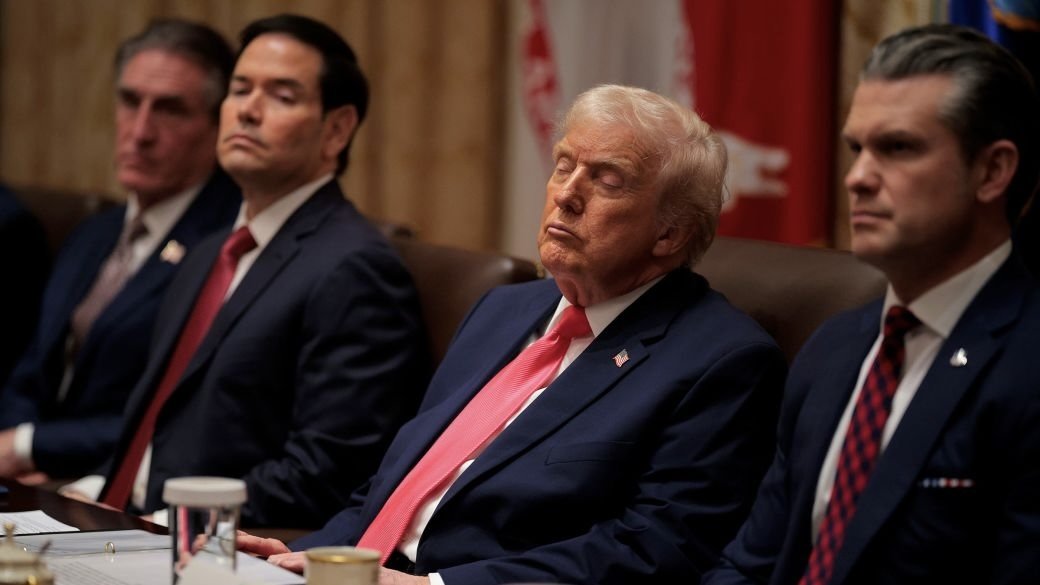
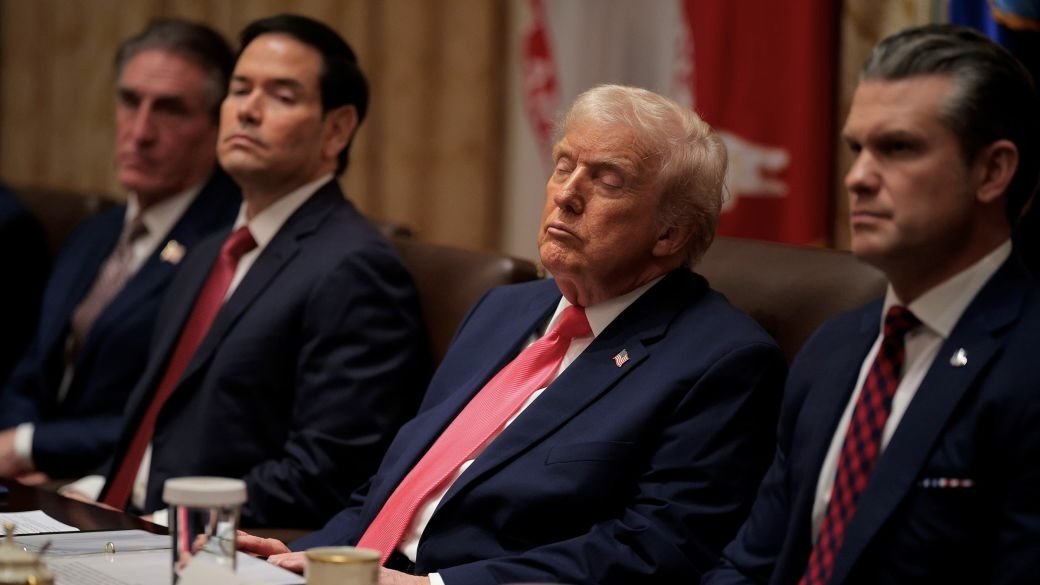
Four suited men sit at a conference table; the central man with blond hair and red tie has eyes closed, appearing contemplative, while others look forward in a formal meeting setting
President Trump introduces a global import tax. Image credit: Chip Somodevilla/Getty Images

The announcement follows a 6-3 ruling that the earlier tariffs, imposed under the International Emergency Economic Powers Act, exceeded presidential authority and required congressional approval. The now-invalidated tariffs have cost Apple about $2 billion.
Section 122 provides a narrower legal pathway, but it doesn’t soften the economic impact. The statute permits temporary tariffs of up to 15% total for 150 days unless Congress votes to extend them.
Continue Reading on AppleInsider | Discuss on our Forums

Source link

Continue Reading

Tech

Final expands its gaming headphones line with the A2000 and VR3000

Published

on

Final has introduced a new wired in-ear monitor, the A2000, expanding its headphone line-up with a focus on affordable performance.

At the core of the A2000 is Final’s in-house 6mm “f-Core DU” dynamic driver, developed entirely by the company — from diaphragm and voice coil to magnet assembly.

Final says the result is a sound signature built around “exceptional clarity” paired with tight, energetic bass. Sensitivity is rated at 99 dB/mW, with 19Ω impedance. This makes it relatively easy to drive from everyday devices.

The A2000 is also the first model in its class to benefit from Final’s revised sound evaluation process, originally developed for its flagship A10000.

Advertisement

Instead of relying purely on lab-based sound pressure testing, the company evaluated performance across real-world listening scenarios. This included varied volumes and recording quality. The goal, according to Final, is more natural and controlled playback in everyday use.

Advertisement

Build details are equally considered. A brass front housing is used to reduce magnetic interference, while an ultra-fine 30μm CCAW voice coil is designed to improve transient response. Each diaphragm is pressed in small batches to ensure consistent performance and lower distortion.

Comfort remains a priority. Borrowing from the brand’s B Series design philosophy, the A2000 uses a three-point support fit across the ear pocket, eartip and tragus to reduce pressure while maintaining stability. The housing features a two-tone black-and-blue finish with Final’s textured “shibo” coating to resist fingerprints.

Advertisement

The earphones connect via a 0.78mm 2-pin connector, paired with a 1.2m black OFC cable designed to minimise microphonics. Five sizes of dual-hardness silicone eartips (SS to LL) are included to help achieve a secure seal.

While the A2000 leads this latest expansion, Final continues to offer models like the VR3000, aimed specifically at gamers seeking accurate positional audio.

Priced at $79.99 / £79.99 / €74.99, the A2000 is available to buy globally right now. It aims to deliver high-end tuning without the flagship price tag and, just as importantly, without straying from its audiophile roots.

Advertisement

Advertisement

Source link

Continue Reading

Trending

Copyright © 2025