
Business
India and EU announce FTA amid Trump tariff tensions


 EPA/Shutterstock
The European Union and India have announced a landmark trade deal after nearly two decades of on-off talks, as both sides aim to deepen ties amid tensions with the US.
“Europe and India are making history today. We have concluded the mother of all deals,” European Commission President Ursula von der Leyen posted on X.
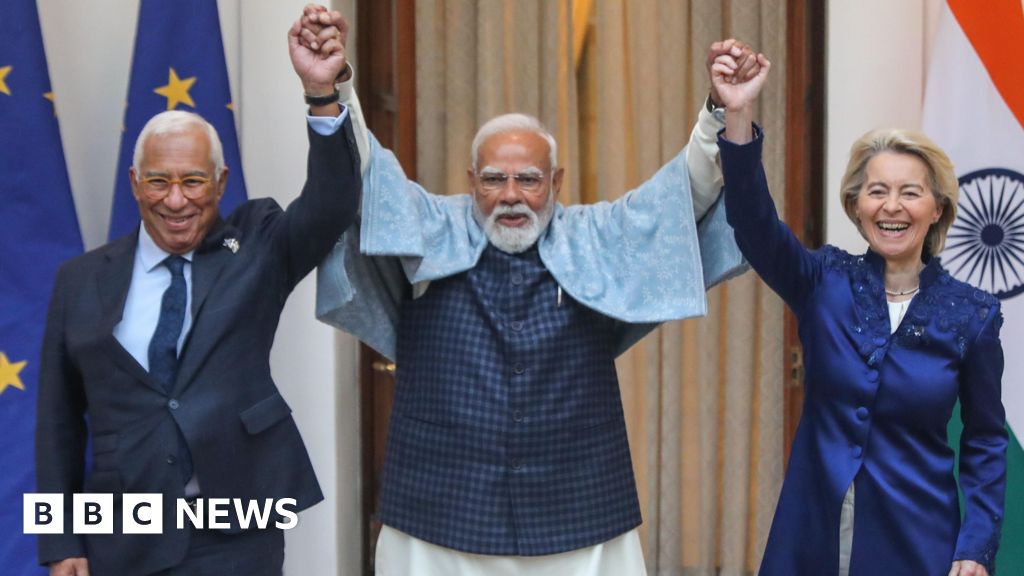
Von der Leyen and European Council President António Costa are in Delhi, where they met Indian Prime Minister Narendra Modi at a bilateral summit.
Both India and the EU are seeking to strengthen strategic and trade ties with the rest of the world as they contend with economic and geopolitical pressure from the US.
Delhi is grappling with 50% tariffs imposed by President Donald Trump last year amid talks aimed at securing a trade deal between India and the US that are still dragging on.
Last week, Trump threatened to escalate his trade war with European allies for opposing a US takeover of Greenland before backing off.
That larger geopolitical context was evident in recent statements made by leaders.
On Tuesday, von der Leyen wrote: “We have created a free trade zone of two billion people, with both sides set to benefit. This is only the beginning. We will grow our strategic relationship to be even stronger.”
A day before that, Costa had said, without naming the US, that the trade deal would send an “important political message to the world that India and the EU believe more in trade agreements than in tariffs” at a time when protectionism is on the rise and “some countries have decided to increase tariffs”.
More details about the deal are expected to be announced soon, during a media briefing.
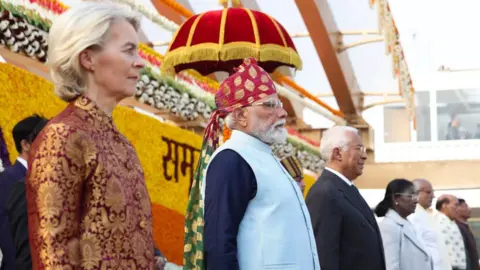
Von der Leyen and Costa arrived in Delhi over the weekend and were the chief guests at India’s colourful Republic Day celebrations on Monday.
On Tuesday, the leaders posed for photos with Modi, with the bonhomie between them evident.
The formal signing is likely to take place only later this year, after the agreement is approved by the European Parliament and the European Council.
 Narendra Modi/X
The deal will expand market access for Indian exports to Europe while easing entry for European investments and goods, such as cars and beverages, into Asia’s third-largest economy.
“This is a perfect example of a partnership between two major economies of the world… This agreement represents 25% of the global GDP and one-third of global trade,” Modi said while inaugurating the India Energy Week conference on Tuesday.
The EU is India’s largest trading partner in goods, with bilateral merchandise trade reaching $136bn (£99.4bn) in 2024-25, nearly doubling over a decade.
Talks for a deal between India and the EU started in 2007 but stalled in 2013 over roadblocks in market access and regulatory demands. Discussions were formally restarted in July 2022.
The main sticking points were access to India’s automobile market, agriculture goods and carbon-linked tariffs – and analysts will be reading the fine print to see what the final agreement says on these issues.
Officials from both sides worked hard over the past few days to finalise outstanding chapters of the agreement, aiming to wrap it up before the EU leaders’ visit.
The agreement comes as pressure grows on Delhi and Brussels to secure alternative markets for exporters.
In the past seven months, India signed major trade agreements with the UK, Oman and New Zealand, and a 2024 pact signed with the four-nation European Free Trade Association bloc of Switzerland, Norway, Iceland and Liechtenstein has come into effect.
The EU, meanwhile, signed a trade deal with South Asian trade bloc Mercosur earlier this month after 25 years of negotiation.
Follow BBC News India on Instagram, YouTube, Twitter and Facebook.



