DaBaby doesn’t play about his babies! Over the weekend, a video surfaced of the rapper approaching a Dallas nightclub during his ‘Be More Grateful’ tour. He stopped to glance at a portrait of his daughters, then walked away without accepting it or acknowledging the artist, Bruce White Jr. (@bwhitecreations). That moment sparked so much conversation that the rapper ultimately addressed it, saying he’s not impressed with “grown men” doing anything related to his daughters. Then, Baby circled to the artist’s comment section to drop STRONG warnings about continuing to promote the portrait. Here’s everything that happened leading up to and after that point!
DaBaby Explains Why He Rejected Painting Of His Daughters, Sends “Father First” Warnings
After the internet flooded DaBaby with mentions of the fan’s painting, he hopped on video to share his energy behind the rejection. He said the topic was starting to work his nerves, and explained the type of father he is and isn’t.
“…I’m not into grown a*s men discussing my daughters, painting pictures of my daughters, taking pictures of my kids. I don’t play like that. If you play like that, to each its own. Send that n***a a picture of your daughters, let that n***a paint them and then show him some appreciation.”
Additionally, Baby clarified that he wouldn’t accept a painting of his kids outside a nightclub. Furthermore, he said if anyone is bothered by how he protects his kids, that’s not his concern.
DaBaby’s video appears to be a direct response to Bruce’s POV video, which is no longer on his Instagram page. However, the POV clip (swipe below to see) shows Bruce with the painting in his house, saying he doesn’t understand what was “wrong” with it.
Advertisement
After DaBaby’s first response, it appears Bruce didn’t remove the POV video and/or other videos featuring the painting of the rapper’s daughters. According to a screenshot shared by The Shade Room, Baby stopped by the @bwhitecreations’ comment section with some direct warnings. He reminded the artist that he’s a father first and rapper second!
“You still got my daughters on yo page as a grown ma after I made it clear I ain’t comfortable with that. Steady playing for this online attention. So when God put me back in front of you ima show you how serious I am about my daughters,” DaBaby wrote. “Best advice I can give you, get my children off yo page & keep doing what you gifted at doing. Using my kids ain’t the route to go if you wanna go viral, that’s the route to go if you wanna get hurt. This a father talking, not a rapper.”
Artist Sets The Record Straight, Rapper Reacts
Sometime on Sunday (April 5), the content featuring DaBaby’s daughters was removed from @bwhitecreations’ IG page. Also, Bruce (B. White) shared a video clearing the air, sharing his perspective of the portrait. He explained that he moved to Dallas about three years ago to pursue art. One of his industry peers recommended he feature celebs’ loved ones in his artwork to be more attention-grabbing. That’s been his style for the last two years or so, Bruce explained.
A few hours after Bruce shared his message, DaBaby hopped in the comment section. He ultimately thanked him for complying with his removal request. However, he also clarified his energy and shared his disagreement with some of the video.
“I see the picture finally down that’s all I wanted my boy, it’s all good. I know first hand how judgement can get clouded when that attention come pouring in, so I appreciate you for straightening that shit out. I just wanted my babies off the page & detached from anything negative. Everything else niggas talking bout for the birds! I ain’t think you meant no harm in painting the picture, I just ain’t like how the viral moment led you to believe it was cool to double back and post them on your page feeding into the situation after I reached out privately to the nigga that walked you over to me and I commented and told you how I felt & asked you to take it down & you didn’t. I ain’t got no ill will for ya bruh I’m just serious bout my lil girls and I’d give you & any other parent the same respect with no hesitation. Ion like a lot of lil shit you said in this video but I understand you defending your character as you should, cause as you can see this internet don’t got no picks and chooses. So I’m responding with grace and understanding my n***a. Keep doing what you doing!”
Us Weekly has affiliate partnerships. We receive compensation when you click on a link and make a purchase. Learn more!
Summer dressing sounds easy until you’re stuck choosing between stiff, structured pieces that feel restrictive and flowy dresses that lack shape. As a shopping editor, I’m always looking for that sweet spot: styles that define your silhouette without sacrificing comfort. That’s exactly where soft, structured dresses come in. They give you polish, ease and breathability all at once.
These 15 soft-structured summer dresses on Amazon strike the perfect balance. Think lightweight fabrics with smocking, tailored seams, cinched waists and subtle shaping details that do the work for you. From casual daytime options to elevated picks you can wear out to dinner, these dresses are equal parts flattering and wearable.
Advertisement
15 Soft, Structured Dresses for Summer From Amazon
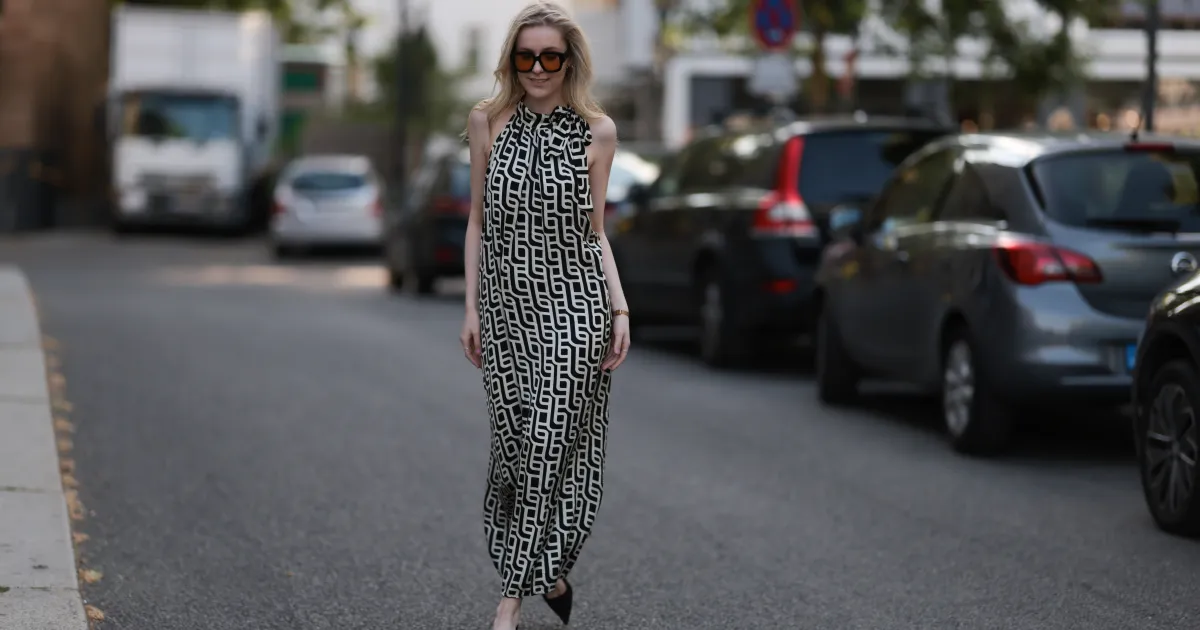
1. Top Pick: This floral smocked midi dress hugs through the bodice and flows effortlessly through the skirt for a naturally flattering shape. I love that it gives you definition without feeling tight because it’s basically built-in tailoring with zero effort.
2. Runner-up: A square-neck dress with a fitted top and A-line skirt creates that classic hourglass illusion instantly. The breathable, stretchy blend keeps it feeling light even on the hottest days.
3. So Chic: A ribbed knit midi dress is one thing, but a three-pack for $32? I’m sold. This style channels that off-duty model look while subtly contouring your shape. It’s stretchy, smoothing and polished enough to wear from brunch to dinner.
4. Designer-Looking: A linen-blend wrap dress with a tie waist gives you full control over the fit while keeping things airy. It looks like something you’d find at a boutique, but it feels way more wearable.
Advertisement
5. Everyday Essential: A T-shirt dress is basically my summer uniform, and this one features a slit at the leg waist and fun patterns that elevate it beyond basic. I throw it on when I want to look put-together in under 30 seconds.
6. Comfy-Chic: A tiered midi with a fitted bodice balances volume and structure beautifully. The soft fabric moves with you, while the top half keeps everything feeling secure and shaped.
7. Work-to-Weekend: This sleeveless sheath dress skims your body without clinging, thanks to its thicker, stretchy fabric. It’s polished enough for the office but comfortable enough for all-day wear.
8. Effortless Staple: A button-front shirt dress gives you that tailored look without stiffness. I love how you can adjust the fit depending on how relaxed or defined you want it.
Advertisement
9. Polished Pick: If there’s one thing about a dress with pockets, it’s that I’m going to buy it. This flowy, cap sleeve pick combines a cinched waist with a flowy skirt for the perfect contrast. It creates movement while still keeping your silhouette clean and refined.
10. Travel Hero: This wrinkle-resistant knit dress is basically a giant T-shirt begging you to wear it on travel days. For as comfortable as it is, this one holds its shape all day, so you look fresh even after hours on the go.
11. Trend-Forward: This puff-sleeve mini dress adds volume up top while cinching at the waist for balance. It’s playful but still gives you that structured, put-together feel.
12. Minimalist Must-Have: A sleek tank dress with strategic rouching subtly shapes your figure without extra bulk. It’s the kind of piece you can dress up or down endlessly.
Advertisement
13. Curve-Enhancing: This ruched midi dress uses gathered fabric to sculpt and flatter in all the right places. It’s comfortable, forgiving and surprisingly supportive.
14. Lightweight Luxe: A chiffon midi with a smocked waist gives you softness and structure in one. It feels airy and elegant, but still defines your shape beautifully.
15. Throw-On-and-Go: This elastic-waist maxi dress delivers instant polish with zero effort. I reach for it when I want something easy that still looks intentionally styled.
For the week ahead, we’re planning on testing your wits with television spin-offs, series that changed networks mid-run, famous episodes of shows that featured baseball, and the off-beat phenomenon, Atlanta.
For today’s TV challenge, we’re heading to Albuquerque and checking in with our favorite teacher-turned-dealer, Walter White, in order to grill you on the Breaking Bad universe. Scroll down for the cold open!
News of an anime adaptation of the popular manga Witch Hat Atelier made headlines in 2022. Initially scheduled for a 2025 premiere, the show was delayed to ensure “an even higher quality,” making fans more excited but also more anxious. Witch Hat Atelier has been one of the most highly anticipated Crunchyroll titles for a while, considering its production process and the name recognition of its source material.
However, the series not only meets the sky-high expectations set for it but also exceeds them in a few key ways. Fantasy anime is almost always a surefire bet, but there’s something special about Witch Hat Atelier, a sense of warmth and melancholy that makes it the perfect watch for any and every lover of the genre and the medium.
Advertisement
What Is ‘Witch Hat Atelier’ About?
Witch Hat Atelier tells the story of Coco (Rena Motomura), a young girl who lives with her dressmaker mother in a secluded home. Enthusiastic and hopeful, Coco is fascinated with magic and dreams of one day becoming a witch, but knows it’s impossible since only those with innate magic can perform it. She also has a mysterious book full of drawings and a wand given to her by a witch when she was a child.
Coco’s fate changes when she meets Master Qifrey (Natsuki Hanae), a witch who visits her home, leading to Coco discovering how he uses magic: by drawing signs using special ink. Realizing her book’s drawings are actually spells, and the wand is actually a pen, Coco begins replicating the drawings, accidentally petrifying her mother. Intrigued by the book’s contents, Qifrey agrees to take Coco as a student.
The show also stars the voice talents of Hibiku Yamamura, Kurumi Haruki, and Hika Tsukishiru as Agott, Tetia, and Richeh, three fellow students at Qifrey’s atelier. Witch Hat Atelier is based on the manga by Kamome Shirahama, with Ayumu Watanabe acting as director, Hiroshi Seko in charge of the script, Kairi Unabara as character designer, and Satoshi Nakano as chief animator.
Advertisement
‘Witch Hat Atelier’ Features Some of the Best Visuals in Anime
The Witch Hat Atelier manga earned considerable acclaim for its beautiful art style, and the anime adaptation lives up to its high standard. Indeed, this anime features some of the most striking and detailed visuals on television, joining the likes of Frieren: Beyond Journey’s End among the shows that are currently elevating the medium to new, impressive heights. Many of Witch Hat Atelier‘s panoramic sequences are genuinely breathtaking, creating an immersive world that feels alive and full of magic.
From the jump, Witch Hat Atelier establishes itself as a visual marvel with a truly jaw-dropping sequence where Coco stands on the rooftop and the camera follows a pegasus carriage as it circles her humble home; everything, from the mountains to the tree tops and even the clouds to the winged horses, feels vibrant and almost tactile. A few scenes, like memories and some of the exposition, are presented in the style of a pop-up book, and the result is striking, both gorgeous and somewhat haunting. There’s a level of attention and care to the show that makes it all the more impressive, with shots that fans should be allowed to experience on the big screen.
The character animation flows naturally, whether it’s the lively, restless personality of Coco or the quiet, stoic approach of Agott. What truly amazes is the level of care in the characters’ movements — a sequence as simple as Coco tracing measurements in a piece of cloth becomes an outright ASMR session. There’s not a hint of stiffness here; every movement just glides across the screen, like butter sliding down a piece of warm toast. It all combines to create a true sense of coziness, the type of warmth that many crave in their anime but very few shows successfully offer.
Perhaps most impressively is how effectively Witch Hat Atelier builds its world from the ground up. Early in the premiere, Coco establishes her philosophy: magic is everywhere if we know where to look for it, and the show takes it as gospel. It effectively shows us everything from Coco’s perspective, and we discover the marvels of magic alongside her. Every scene drips with a sense of wonder, the innocence of a child just discovering the world and all its possibilities. In that way, Witch Hat Atelier echoes the spirit of Studio Ghibli movies, which convey a sense of awe and charm in every frame. Like the studio’s biggest masterpieces, Witch Hat Atelier reminds us that there is magic in being alive, even if we can’t use special ink to conjure spells.
Advertisement
‘Witch Hat Atelier’ Has the Perfect Protagonist
Coco from Witch Hat AtelierImage via Crunchyroll
A story is only as good as its protagonist, and fortunately, Witch Hat Atelier features a perfect one. Coco is the ideal lead: she’s fallible, and her curiosity leads her to make serious mistakes, most notably petrifying her mother. As Qifrey’s student, she’s eager to please and learn but prone to overreactions, leading to the type of overblown visuals one would expect from an anime. Yet, Coco remains endearing, a classic hero on a journey of self-discovery. Crucially, she’s relatable, frustrating but never annoying, and it’s a breeze to be on this magic journey with her.
It’s wonderful that Coco is such a likable protagonist, because Witch Hat Atelier uses her to introduce many of its detailed worldbuilding blocks, and it can get somewhat tedious. Such an intricate world was always going to need considerable exposition to establish its boundaries, but the show should’ve taken a more subtle approach, especially when explaining how the magic system works. Instead, it opts for a dynamic where Qifrey has Coco repeat all the rules under the guise of teaching. It’s an effective but rather blunt ploy, and while it’s harmless for a few episodes, hopefully, we don’t have much more of that in the future. After all, many fantasy stories have been crushed under the weight of their own worldbuilding, and it’d be a shame to see that happen to Witch Hat Atelier.
Overall, Witch Hat Atelier is a perfect fantasy anime that hits the ground running. The visuals are among the best in current television, creating a sensory experience that will easily transport you into its world of charm, magic, and unforeseen dangers. For all its more obvious qualities, the real strength of Witch Hat Atelier lies in its message about self-discovery and perseverance, and the feelings it’s bound to evoke in its audience. There’s a warmth to it that recalls the comfort shows that are in short supply in this era of prestige TV. It’s the perfect mix of nostalgia and solace, pure hopecore in service of a riveting fantasy tale. Indeed, Witch Hat Atelier is a triumph of feeling, and it’s exactly that quality that makes it a must-watch anime for every fan.
Advertisement
Witch Hat Atelier premieres with its first two episodes April 6 on Crunchyroll.
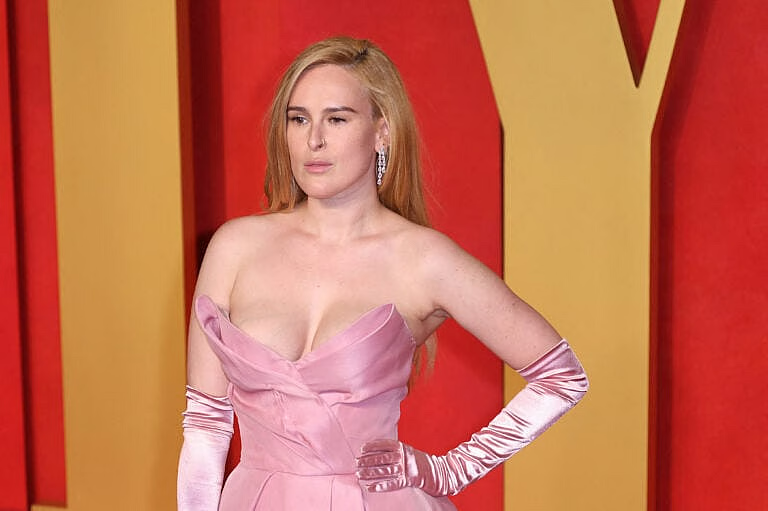
Rumer Willis is once again at the center of an online debate after sharing a deeply personal parenting moment that quickly divided opinion.
The actress, who has been open about her motherhood journey since welcoming daughter Louetta in April 2023, posted a clip of herself breastfeeding, only to be met with both praise and sharp criticism.
As the conversation escalated, Willis didn’t hold back, defending her choices while also shedding light on her life as a single mother navigating public scrutiny.
Advertisement
Rumer Willis Fires Back At Parenting Critics With Bold Response
CraSH/imageSPACE / MEGA
Rumer Willis made it clear she wasn’t interested in staying quiet after facing repeated criticism over her parenting.
Sharing a video of herself breastfeeding her daughter on Instagram, she addressed the backlash directly with a pointed message.
Overlaying the clip, she wrote, “When someone starts judging my parenting,” before cutting to a viral TikTok clip of a woman encouraging people to mind their business.
The TikTok clip featured the woman drawing two circles on a whiteboard and saying, “This is my business,” pointing to one circle, “And this is yours,” while pointing to another circle.
“I am here,” she continued, referring to the first circle. “The problem is, you are also here,” she added, pointing to the same circle before drawing a line to the second circle. “When you need to be here,” the woman concluded.
Advertisement
Willis reinforced her stance in the caption with a blunt “Sorry not sorry,” signaling she had no intention of backing down.
Willis Faces Backlash Over Breastfeeding A Toddler
MEGA
Despite her confident stance, Rumer Willis’ post drew sharp criticism from many who questioned her decision to continue breastfeeding as her daughter approaches three years old.
Several commenters argued that once a child can ask for breastfeeding, it may be time to stop.
One person wrote, “Once a baby has teeth, it’s time to stop nursing. One woman lost her nip when lightening & thunder hit and scared the child.”
Another added, “3 is way too old to keep breastfed. Sorry honey!!” while others suggested transitioning to alternatives like pumping or using a cup, calling it a more typical milestone.
Advertisement
“This is just insane. Just pump and let her drink from a cup,” one person shared.
Some critics went further, claiming the practice was no longer about the child’s needs. A comment reading, “It’s more for you at this point. Not sorry.” captured that sentiment.
Others framed their concerns around milestones and discipline, suggesting that parents should guide children away from habits like breastfeeding as they grow older.
Rumer Willis Gets Support From Fans Who Share Similar Experiences
ZUMAPRESS.com / MEGA
While backlash was loud, Willis also received strong support from followers who related to her experience.
Many mothers shared their own stories of extended breastfeeding, pushing back against the criticism and encouraging her to ignore the negativity.
Advertisement
Some supporters emphasized that nursing beyond toddler years is both natural and beneficial.
One wrote, “I breastfed my daughter until she was three; no regrets,” while another commented, “I think it’s a beautiful thing. My cousin breastfed her son until he was 5. It’s your business F others and their opinion.”
Some described breastfeeding as something that fosters comfort, bonding, and long-term emotional security.
Others applauded Willis for being open about a topic they feel is often unfairly judged.
Advertisement
“Good job, mama!!! You are normalizing normal, healthy parenting. Carry on — you are on the right path!!!” one fan commented.
Willis Accused Of Inviting Judgment By Posting Private Moment
Jeffrey Mayer/JTMPhotos, Int’l. / MEGA
A major portion of the criticism wasn’t just about breastfeeding, but about Rumer Willis choosing to share the moment publicly.
Many argued that by posting such personal content online, she was inevitably opening herself up to scrutiny.
One commenter wrote, “No one is judging your parenting, just posting breast feeding…..which you’ve now made public and everyone’s business.”
Another shared, “What a ridiculous post. If you don’t want people in your business then keep it private,” while a third commented, “Why put yourself out there to be judged? Why have to show everyone what you’re doing with your child? Some things should just be private and that’s okay too.”
Advertisement
Some critics even suggested the post was intentional, labeling it “rage bait” and questioning her motives.
Others expressed concern about Louetta’s future, wondering how she might feel seeing these moments shared online.
Rumer Willis Defends Her Choices And Opens Up About Motherhood
Jeffrey Mayer/JTMPhotos, Int’l. / MEGA
Willis has faced similar backlash before and has consistently defended her choices.
During World Breast Feeding Week in August 2024, she described breastfeeding as “one of the most joyful and bonding experiences of my life,” adding that she and her daughter would figure out together when to stop.
She also highlighted its benefits, noting per the Daily Mail, “Breast milk is a miraculous living substance, rich in antibodies, essential nutrients, and enzymes that bolster a baby’s immune system and promote healthy development,” framing it as more than just nourishment.
Advertisement
Addressing criticism about sharing such moments, Willis previously said, “I didn’t grow up in a house where we had shame about being naked, ever,” making it clear that her perspective is shaped by her upbringing.
She also pushed back against the sexualization of breastfeeding, stating, “I’m feeding my kid. It’s not sexual unless you’re making it that way.”
Beyond the controversy, Willis has been candid about her personal life. She revealed she is raising her daughter independently, saying, “I am single momming it and co-parenting. I’m so grateful for Lou,” and calling her “the best thing in my life.”
Chile! The internet is in tears after Rod Wave was caught fully in his feelings while singing along at Ye’s, formerly known as Kanye West, latest concert.
Ye Brings Out Major Guest For Second L.A. Comeback Show
On Friday, Ye held his second comeback show in Los Angeles at SoFi Stadium. The performance followed his first return show earlier in the week on Wednesday, April 1.
Ye ran through a mix of new and old fan-favorite hits from his catalog. Night two also came with a few surprises, including a special appearance from Lauryn Hill. She joined Ye onstage for a live performance of ‘All Falls Down’ before transitioning into one of her own records.
The show continued to deliver star power, with Travis Scott and CeeLo Green also hitting the stage. Meanwhile, 12-year-old North West returned for another performance alongside her dad after appearing during the first show.
Advertisement
Rod Wave Goes Viral While Singing ‘All Falls Down’
While the stage was packed with major guests, the crowd also had its own viral moments. Celebrities in attendance were seen singing along throughout the night and sharing their view. One artist in particular, Rod Wave, definitely stole the show online.
The Florida artist shared clips from the concert on his Instagram Story, including one standout moment during “All Falls Down.” As Lauryn Hill and Ye performed, Rod could be heard loudly singing along, passionately trying to hit every note.
The clip quickly made its rounds on social media, with fans joking that his raw vocals sounded just like how they belt out his songs at his own concerts.
Social Media Is Crying Laughing
Social media users wasted no time chiming in, flooding comment sections with jokes and relatable reactions.
Advertisement
Instagram user @heydimpless wrote, “He sound just like his songs just without the instrument 😂😂😂😂”
Another Instagram user @banksbig4 wrote, “Tb sum “NAH FORREAL” 😭”
While Instagram user @_mickishaaa wrote, “Exactly how I be at his concert 😭😭”
Instagram user @s.for.shametria wrote, “he sound funny bra 😂😂😂😂”
Advertisement
Another Instagram user @mariiipyt wrote, “Just hootin and hollerin 😂😂😂😂😂”
While Instagram user @nasia.lavay_ wrote, “having the time of his life 😂😂😂😂😂”
Instagram user @iiamroyaltybaby wrote, “he sounds like me 😂😂😂😂 a hot mess”
Another Instagram user @onlyycharm wrote, “this canning be the same Rodarius Green who sings”
Advertisement
While Instagram user @jadorekiss_monae wrote, “😭😭😭😭 He sang that with his chest too 🫶🏽”
“Born and raised Mormon (LDS) and I’ll always have love and respect towards it. I’ll even continue to go with my family at times … with that being said, it’s time to detach myself from it,” the Secret Lives of Mormon Wives star shared in a Sunday, April 5, Instagram Story.
Taylor, 31, continued, “I strongly believe in Christ, God, the bible, the divine. I believe we are loved whether we are praying in [a] church building or from a bathroom floor at home. I’ve also experienced grace and love from amazing people that aren’t sure what they believe if at all and that’s okay too.”
“Point being there is more out there to learn. And I’m writing this out as a release,” she concluded.
Taylor Frankie Paul exploded onto the internet when she started sharing social media videos with a group of other Mormon moms during the coronavirus pandemic. Paul, who is a member of the Church of Jesus Christ of Latter-Day Saints, often teamed up with Whitney Leavitt, Miranda McWhorter, Demi Engemann, Mayci Neeley, Mikayla Matthews, Layla Taylor […]
Taylor first gained fame in 2022 when she went public about a swinging scandal involving members of Utah’s Mormon church. Taylor revealed via TikTok that she and her husband at the time, Tate Paul, had engaged in “soft swinging” with other couples, including her Mormon Wives costar Miranda Hope McWhorter and Miranda’s ex, Chase McWhorter.
Advertisement
The swinging scandal and Taylor’s life in the Mormon church have both been central to Hulu’s hit reality show, which premiered in September 2024.
Courtesy of Taylor Frankie Paul/Instagram
Taylor recently hit headlines after ABC pulled season 22 of The Bachelorette amid domestic violence allegations involving the reality star and her ex-boyfriend, Dakota Mortensen.
Taylor shares son Ever, 2, with Dakota, 33, as well as daughter Indy, 8, and son Ocean, 5, with ex-husband Tate.
Taylor Frankie Paul dropped several teases about her journey on The Bachelorette ahead of ABC deciding to cancel the season. News broke in March that Taylor and on-again, off-again ex Dakota Mortensen were involved in a domestic incident, which led to The Secret Lives of Mormon Wives halting production on season 5. A spokesperson for […]
Earlier on Sunday, the influencer opened up about experiencing “hell on earth” over the last month.
Thank You!
You have successfully subscribed.
Advertisement
“The last 40 days felt like hell on earth,” she wrote alongside an Instagram video featuring candid moments from her life. “Through every panic attack I prayed for strength as I could feel my body breaking down and out from the distress of it all.”
“And HE sent just that in various ways along with so many undeniable signs saying ‘I am with you’ which I can’t wait to share that part,” she continued. “I’ve prayed since I was young and never strayed away because I believe he wants us to ask for help especially during our lowest points. However, instead of just asking I switched over to thanking him at the end of each day no matter how low I felt.”
ABC announced it was canceling Taylor’s season of The Bachelorette on March 19 after video footage emerged of her and Dakota involved in a 2023 domestic dispute. Utah’s Draper City Police Department and West Jordan Police Department later confirmed they were looking into separate allegations of domestic violence involving the pair, including one as recently as February.
When it comes to discussing the all-time greatest movies in American cinema, two names will always come up: The Godfather and The Godfather Part II. Francis Ford Coppola‘s timeless tale of family tragedy, legacy, and the deterioration of the human spirit has become synonymous with American cinema, a celebrated duology that is often used as the standard to compare all subsequent crime and drama movies. Sure, the third part, 1990’s infamous The Godfather Part III, isn’t as great as its predecessors, but it remains a riveting and poignant conclusion to the tragedy of Michael Corleone (Al Pacino). Together, they form one of the greatest film trilogies in the medium’s history, and their standing keeps improving with each passing year.
With such high praises, it’s easy to understand why these three movies are often considered among cinema’s indisputed masterpieces — yes, even Part III, despite its numerous and well-known shortcomings. Thus, the question arises: which of these three silver screen triumphs is the best one, the cream of the crop, the ultimate triumph among a group of undeniable masterworks? Chances are, you know which of the three isn’t the best one, but the other two are neck-and-neck. You might have another opinion, and many will surely have a lot to say about the one they believe is the best. However, there’s no denying that one of the Godfather movies is so good that it’s almost impossible to believe it’s real.
Advertisement
Collider Exclusive · Middle-earth Quiz Which Lord of the Rings Character Are You? One Quiz · Ten Questions · Your Fate Revealed
Advertisement
The road goes ever on. From the green hills of the Shire to the fires of Mount Doom, every soul in Middle-earth carries a destiny. Ten questions stand between you and the truth of who you are. Answer honestly — the One Ring has a way of revealing what we most want to hide.
💍Frodo
🌿Samwise
👑Aragorn
🔥Gandalf
Advertisement
🏹Legolas
⚒️Gimli
👁️Sauron
🪨Gollum
Advertisement
01
Advertisement
You are handed a responsibility that could destroy you. What do you do? The weight of the world falls on unlikely shoulders.
02
Advertisement
Your closest companion is heading into terrible danger. You: True loyalty is revealed not in comfort, but in crisis.
03
Advertisement
Enormous power is within your reach. Your instinct is: Power corrupts — but only those who reach for it.
04
Advertisement
What does “home” mean to you? Where we long to return reveals who we truly are.
05
Advertisement
When a battle is upon you, your approach is: War reveals what we are made of — whether we like it or not.
06
Advertisement
Someone comes to you for advice in their darkest hour. You: Wisdom is not knowing all the answers — it’s knowing which questions to ask.
07
Advertisement
How do you see yourself, honestly? Self-knowledge is the most dangerous kind.
08
Advertisement
Which of these best describes your relationship with the natural world? Middle-earth speaks to those who know how to listen.
09
Advertisement
You encounter a wretched, pitiable creature who has done terrible things. You: How we treat the fallen reveals the height of our character.
10
Advertisement
When the quest is over and the songs are sung, what do you hope they say about you? In the end, we are all just stories.
The Fellowship Has Spoken Your Place in Middle-earth
Advertisement
The scores below reveal your true character. Your highest number is your match. Even a tie tells a story — the Fellowship was never made of simple people.
💍 Frodo
🌿 Samwise
Advertisement
👑 Aragorn
🔥 Gandalf
🏹 Legolas
⚒️ Gimli
Advertisement
👁️ Sauron
🪨 Gollum
You carry something heavy — and you carry it alone, even when you don’t have to. You were not born for greatness, and that is precisely why greatness chose you. Your courage is not the roaring, sword-swinging kind; it is quiet, stubborn, and terrifying in its refusal to quit. The Ring weighs on you more than anyone can see, and still you walk toward the fire. That is not weakness. That is the rarest kind of strength there is.
Advertisement
You are, without question, the best of them. Not the most powerful, not the most celebrated — but the most essential. Your loyalty is not a trait; it is a force of nature. You would carry the person you love up the slopes of Mount Doom if it came to that, and we both know you’d do it without being asked. The world needs more people like you, and the world is lucky it has even one.
You were born to lead, and you have spent years running from it. The crown is yours by right, but you know better than anyone that right means nothing without the will and the worthiness to back it up. You are tempered by loss, shaped by long roads, and defined by a code of honour you hold to even when no one is watching. When you finally step forward, the world shifts. Because it was always waiting for you.
Advertisement
You have seen more than you let on, and you say less than you know — which is exactly as it should be. You are a catalyst: you do not fight the battles yourself, you ignite the people who can. Your wisdom comes not from books but from an age of watching what happens when it is ignored. You arrive precisely when you mean to, and your presence alone changes what is possible. A wizard is never late.
Graceful, perceptive, and almost preternaturally calm under pressure — you see things others miss and act before others react. You do not need to make a scene to be remarkable; your presence speaks for itself. You are loyal to those you choose to stand beside, and that choice is not made lightly. You have lived long enough to know that the most beautiful things in this world are also the most fragile, and that is why you fight to protect them.
Advertisement
You are loud, proud, and absolutely formidable — and beneath all of that is one of the most fiercely loyal hearts in Middle-earth. You don’t do anything by half measures. Your friendships are forged like iron, your grudges run as deep as mines, and your courage in battle is the kind that makes legends. You came into this fellowship suspicious of everyone and ended it willing to die for an elf. That is not a small thing. That is everything.
You think in centuries and act in absolutes. Order, dominion, control — not because you are cruel by nature, but because you have decided that the world left to itself always falls apart, and you are the only one with the vision and the will to hold it together. You were not always this. Something was lost, or taken, or betrayed, and the version of you that stands now is the answer to that wound. The tragedy is that you’re not entirely wrong — just entirely too far gone to course-correct.
Advertisement
You are a study in contradiction — pitiable and dangerous, cunning and broken, capable of both cruelty and something that once resembled love. You are defined by loss: of innocence, of self, of the one thing that gave your existence meaning. Two voices war inside you constantly, and the tragedy is that the better one sometimes wins, just not often enough, and never at the right moment. You are a warning, yes — but also a mirror. We are all a little Gollum, given the right ring and enough time.
Advertisement
‘The Godfather Part III’ (1990)
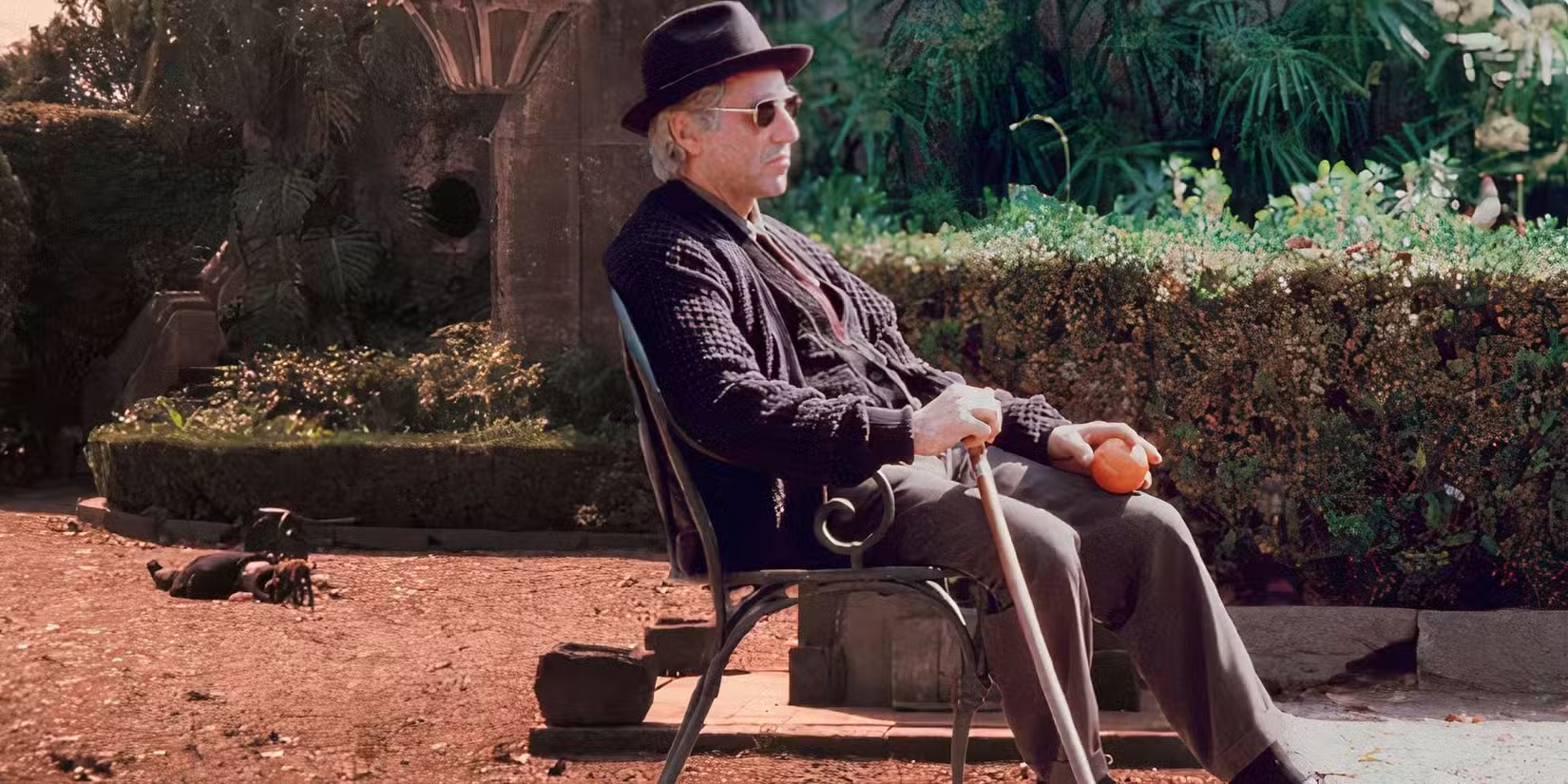
Al Pacino as Michael Corleone sitting in a chair outside alone in The Godfather Part III (1990)Image via Paramount Pictures
Advertisement
As I said, you probably know which movie is not the best in the Godfather trilogy, and that’s The Godfather Part III. Arriving sixteen years after Part II, this coda to the story of Michael Corleone might be the most uneven of the three, but it remains a satisfying payoff to this decades-spanning tragedy. Set in the late ’70s and early ’80s, with an epilogue set in the mid-’90s, the film tells the final portion of Michael’s story, particularly his efforts to legitimize his family business, much to the chagrin of the other mafia dons. Meanwhile, Michael’s illegitimate nephew, Vincent (Andy Garcia), throws the family into chaos with his arrival and eventual romance with Michael’s daughter, Mary (Sofia Coppola).
For years, Part III has been unfairly maligned as the black sheep of the Godfather trilogy. Now, to be fair, much of the criticism is fair: in their review, Variety called it “two hours of exposition and 40 minutes of payoff,” and you know what? They’re spot on. Yet, there’s some real gold in those two hours of exposition, and the 40-minute payoff packs a strong punch, albeit far less impactful than the first two movies. Pacino is brilliant as the weary and nearly broken Michael, finally bearing the weight of decades of violence, ruthlessness, and moral compromise: his spirit is deteriorated, and his body is barely hanging on. For his part, Garcia is a welcome addition to the cast, making Vincent equal parts charming and reckless. Alas, we can’t discuss Part III without mentioning Sofia Coppola, whose performance has been widely panned for years now. It’s fair to say she was woefully miscast, but it’s also fair to say there is a certain ugliness in the way the film’s shortcomings are often solely placed at her feet. In the end, Part III is convoluted and uneven, but it remains a somber and melancholic culmination to a larger-than-life tale that redefined American cinema.
‘The Godfather’ (1972)
In 1972, Francis Ford Coppola revolutionized the industry with The Godfather, an adaptation of Mario Puzo‘s 1969 pulpy crime novel of the same name. The plot centers on Vito Corleone (Marlon Brando), the aging don of the Corleone crime family, and his efforts to shape his youngest son, Michael, into a worthy heir. Although initially unwilling to commit himself to a life of crime, Michael soon surrenders to his family’s influence, going from a reluctant outsider to a ruthless mafia boss who will stop at nothing to protect his empire. James Caan and John Cazale co-star as Vito’s oldest and middle sons, Sonny and Fredo.
Advertisement
The first Godfather marked a distinct before-and-after in mainstream filmmaking. Arriving in the early years of New Hollywood, it was a formative entry in the movement, challenging notions and reshaping what audiences expected from their crime sagas. There is a pervasive sense of dread looming over the film, an inescapable and nearly suffocating notion that everything can change from one scene to the next. Here, Coppola presents the erosion of the soul with such assuredness that one can’t help but feel empty after it ends. Yet, Michael’s deterioration is so compelling, so brutal yet so operatic that it becomes almost irresistible; you’re watching the very destruction of the human spirit, and there’s an eerie beauty to eat. It’s well known that The Godfather influenced how the real mafia behaved, making it one of the few films that actually changed history. Its legacy is nearly indescribable: much has been written about this film, and much will follow still. The Godfather is among those movies that are as good as everyone says, a true masterpiece that you must simply watch at least once before kicking the bucket.
‘The Godfather Part II’ (1974)
Robert De Niro as a younger Vito Corleone in The Godfather Part II (1974)Image via Paramount Pictures
Two years after Coppola wowed the world with The Godfather, he did it all over again. The Godfather Part II presents two stories: the first is the rise of young Vito Corleone (Robert De Niro) at the turn of the century, chronicling how he went from a lowly Italian refugee in New York City into the head of one of the most powerful mafia families. The second continues Michael’s rise in power as the new don of the Corleone family, focusing on his efforts to protect the business and ensure his place following an attempt on his life.
Advertisement
The question of whether The Godfather or The Godfather Part II is better has been going on for decades now. You could make a convincing argument for both, but this time, we have to give it to the sequel. Part II is monumental in scope, brilliant in construction, tragic in storytelling, and outright masterful in execution. The choice to juxtapose Michael’s further descent into darkness with Vito’s rise in the criminal world is a stroke of genius, allowing the parallel stories to build towards the same conclusion. Part II is more operatic, more detailed in its exploration of Vito and Michael’s psyche, and therefore far more tragic. There is a solemnity and melancholic inevitability to the story, the sense that ambition will always come first for the Corleones: they will get everything, only to lose it all because, in a world of absolute power, there can never be absolute trust. Here, commitment becomes imprisonment, and family is a life sentence. In the end, The Godfather Part II surpasses its predecessor in every possible way, presenting a heartbreaking tale of power, a beautiful calamity that is, quite possibly, the greatest achievement in American cinema.


:max_bytes(150000):strip_icc():format(jpeg)/Bad-Bunny-2026-Grammys-020126-1-e69797988be24c3cac217d311cb72346.jpg)







:max_bytes(150000):strip_icc():format(jpeg)/kelly-ripa-mark-consuelos-2024-Time100-Gala-071525-31cb2d32e01543a880a7f71586ec9668.jpg)







:max_bytes(150000):strip_icc():format(jpeg)/the-girlfriend-adolescence-black-rabbit-022526-a82614090ef6417d9d15b694bbdd4a42.jpg)




































You must be logged in to post a comment Login