

Crypto World
Dems press CFTC, ethics board on prediction-market insider trades


A bipartisan push in Congress is pressing federal regulators to curb insider trading risks tied to prediction markets. In a letter addressed to the Commodity Futures Trading Commission (CFTC) Chair Mike Selig and the Office of Government Ethics (OGE), at least 42 Democratic lawmakers urged executive-branch guidance that would require federal employees to refrain from using nonpublic information to trade on prediction-market contracts. The move comes amid heightened scrutiny of platforms like Kalshi and Polymarket, which have faced questions about how their markets could be leveraged for insider information.
The letter, prompted by “multiple incidents” that have sparked speculation about possible insider trading by federal employees in prediction markets, asks the CFTC and OGE to circulate guidance that applies across the entire federal workforce. The request, highlighted in a press release from Senator Elizabeth Warren’s office, emphasizes the need for clear rules to prevent government workers from exploiting inside information in these markets. Warren’s release notes the concern that such activity could undermine public trust and risk regulatory violations.
Among the incidents cited by the lawmakers are reported trades connected to geopolitical events and political developments, including bets on the capture of Nicolás Maduro and wagers tied to the length of a White House press briefing. The letter also references later reports of suspicious trades related to the invasion of Iran and the death of Ayatollah Khamenei, drawing national-security implications into the debate over how prediction markets operate within federal oversight. The lawmakers describe these events as signaling the need for stronger guardrails and enforcement mechanisms. Related coverage provides context on the broader growth and scrutiny of prediction-market activity.
In their request, the lawmakers ask for a briefing and written responses by April 13, including whether the CFTC has investigated or received reports of federal employees engaging in insider trading on prediction markets and what steps the agency is taking to detect and deter such activity. The push explicitly seeks to understand how regulators plan to monitor and enforce the line between legal participation in markets and improper use of inside information.
Key takeaways
- Executive guidance urged to curb insider trading by federal workers: A broad call for a formal, government-wide warning against using confidential information to trade in prediction markets.
- Incidents cited as catalysts for renewed oversight: Examples range from bets on Maduro’s capture to the length of a White House briefing, with later reports alleging suspicious trades tied to geopolitical events and public personnel decisions.
- Legal framework invoked: STOCK Act and derivatives status: The lawmakers argue the STOCK Act applies to prediction-market activity, given the CFTC’s view that event contracts are derivatives with potential financial consequences.
- Clear deadline and asks for transparency: The group seeks a briefing and written answers by April 13, including any investigations or measures underway to prevent insider trading by federal employees.
Regulatory framework and the broader implications
The lawmakers’ letter leans on the idea that prediction markets, which trade contracts based on future events, sit at the intersection of financial markets and public governance. They point to the Commodity Exchange Act (CEA) framework and the CFTC’s characterization of event contracts as derivatives—an interpretation that would bring such activity under the STOCK Act’s prohibitions on insider trading by government officials. The STOCK Act, originally signed into law by President Barack Obama in 2012, was designed to clarify that government officials cannot use material, nonpublic information for personal gain. The letter argues that the CFTC’s position effectively extends insider-trading prohibitions to prediction-market activity, in line with the spirit of the STOCK Act.
“Thus, the CEA’s prohibition on government officials engaging in insider trading also applies to such activity in prediction markets.”
This framing matters because it ties the governance of prediction markets to a long-standing public-integrity regime. If regulators and lawmakers treat event contracts as derivatives under the STOCK Act, federal employees would be barred from participating in these markets when they possess material nonpublic information—regardless of the market’s private platform semantics. That reinterpretation could tighten compliance obligations for agencies that use or monitor prediction-market data, while also shaping how future reforms are drafted.
Platform responses and what to watch next
Industry players have responded to rising scrutiny with efforts to reinforce guardrails. Kalshi and Polymarket, two of the largest prediction-market platforms, have announced steps to curb potential insider-trading exploits by tightening participant restrictions and introducing new safeguards. These moves come amid broader industry discussions about how to separate legitimate trading activity from signals that could reveal sensitive information or enable manipulation. For context, prior reporting has highlighted ongoing debates about insider-trading allegations and the regulatory pathway for prediction markets, including proposals for tighter controls and user bans. Platform guardrails reflect a pragmatic early response to a problem regulators say warrants formal clarification.
The letter’s examples underscore why such guardrails are not merely theoretical: incidents involving geopolitical bets, public-safety events, and personnel decisions highlight how quickly prediction markets can become channels for signaling or leakage of sensitive information. Regulators face the challenge of balancing the innovative potential of prediction markets—what they can reveal about collective expectations and risk—with the need to prevent improper disclosures and manipulation. The April 13 deadline for regulator responses will help determine whether more formal guidance, rulemaking, or legislative proposals follow, potentially shaping how these markets operate inside federal ecosystems and beyond.
What this means for investors, users, and builders
For market participants, there is an evolving risk calculus around prediction-market participation, particularly for individuals connected to or employed by the government. If regulators codify stricter guidance or broaden the STOCK Act’s application to prediction markets, investors and traders might see tighter eligibility criteria, more stringent compliance checks, and clearer disclosure expectations. For builders and platform operators, the development signals a growing imperative to implement robust user-verification processes, enhanced surveillance for unusual trading patterns, and transparent communications about governance and risk controls. The growing regulatory clarity could also help align prediction-market ecosystems with traditional derivatives markets, potentially unlocking broader institutional participation while reducing the risk of misuse.
In the near term, market watchers should monitor how the CFTC, the OGE, and lawmakers articulate expectations for insider-trading prevention. The April 13 briefing deadline will likely set the tone for whether regulatory momentum translates into concrete guidance, targeted rulemaking, or even new legislative proposals that further define the boundaries of prediction-market activity for federal actors and private participants alike.
As prediction markets continue to grow in adoption and scale, the tension between rapid experimentation and robust governance remains a defining theme. The coming weeks will reveal whether regulators favor a cautious, clearly defined framework or a more expansive approach that aggressively constrains insider-information dynamics in these markets.
Readers should watch for formal regulator communications and any legislative initiatives that spell out the exact scope of protections for nonpublic information, as well as how platforms implement the guardrails described by lawmakers. The alignment (or misalignment) between enforcement expectations and market incentives will shape how investment and participation in prediction markets evolve in 2026 and beyond.
This article was originally published as Dems press CFTC, ethics board on prediction-market insider trades on Crypto Breaking News – your trusted source for crypto news, Bitcoin news, and blockchain updates.

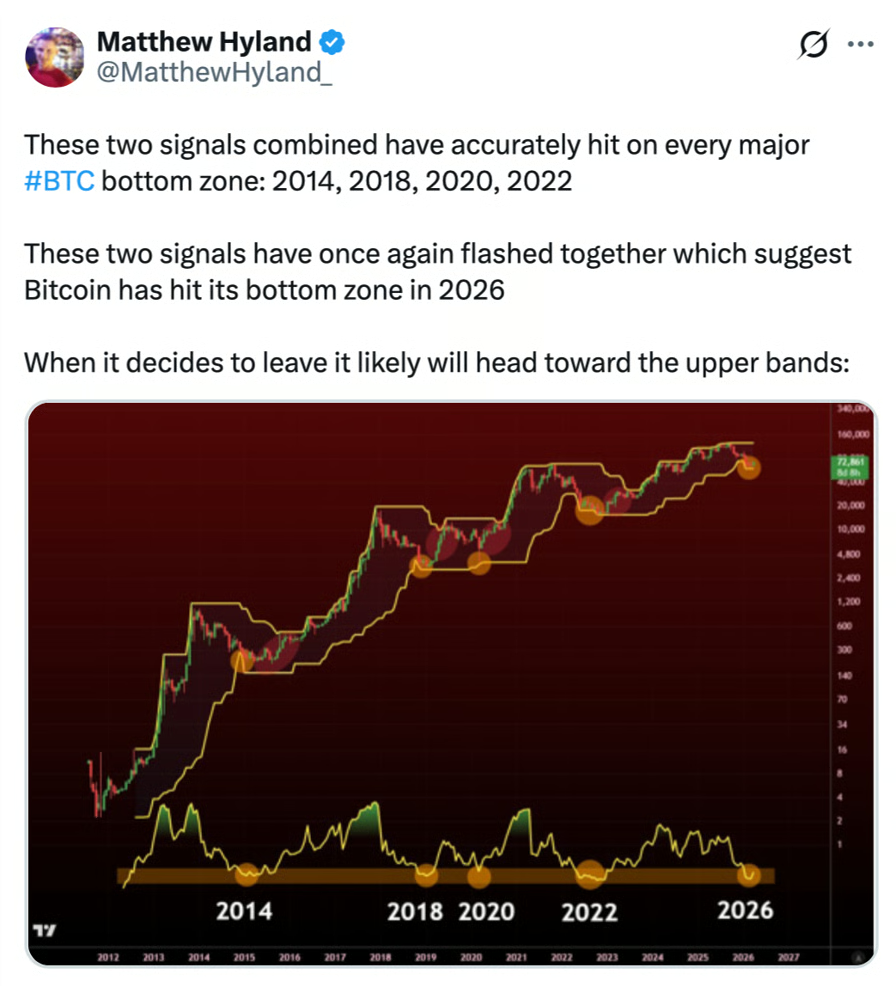
Bitcoin may have already bottomed in early February at around $60,000 and is unlikely to go lower this year, according to a crypto analyst, despite expectations of another downturn.
“The dozens of bottom signals only flashed in synchrony at the bottoms. They were not flashing in the middle. Yet they all flashed in Q1 2026 at 60k,” Matthew Hyland said in an X post on Friday.
“To compare the current price action to mid bear market price action has major visible flaws because you did not have bottom signals flashing in the middle; they flashed at the bottoms,” Hyland said, pointing to chart movements in prior cycles.

Source: Matthew Hyland
Analysts are divided over whether $60,000 was the bottom
Bitcoin (BTC) analysts have recently been divided over whether the asset already bottomed in February or if it still has further downside in this cycle.
Veteran trader Peter Brandt said in March that $60,000 may not be the lowest level for 2026, forecasting that Bitcoin could retest or even move “slightly lower” in September or October this year.
Bitcoin analyst Willy Woo said in an X post on March 17 that, from a liquidity perspective, Bitcoin is about one-third of the way “through the bear market.”
More recently, in an X post on Friday, MN Trading Capital founder Michael van de Poppe pointed to a forming pattern on Bitcoin’s short-to-long-term realized value ratio chart to argue that Bitcoin is nearing the end of the bear phase.
“The levels are hit again, which shows that we’re at the end of the bear market, and not at the start,” van de Poppe said.

Source: Michael van de Poppe
Bitcoin recently reached its highest price in three months
Bitcoin reached $82,499 on Wednesday, its highest price since Jan. 31. At the time of publication, Bitcoin is trading at $79,646, approximately 32.74% higher than the $60,000 level it reached in February, according to CoinMarketCap.
Related: Bitcoin bulls target $115K by December: Does data back the expectation?
Bitcoin analyst Kyle Chasse pointed out the price increase in an X post on Thursday, saying he expects further upside in the near term.
“$82,000 this week. Up 5% in five days. Crypto legislation is moving through Congress. Iran peace talks reducing risk-off pressure,” Chasse said.
“The technicals are clean. Bull-stacked moving averages. Shorts getting squeezed,” Chasse said, adding that the “next wall” is $85,000.
“Above that, the path to $100k opens back up,” Chasse said.
Magazine: XRP ‘probably going to $12,’ Bitcoin ETFs add $1B: Market Moves
Pacific Investment Management Company (PIMCO), a leading US bond manager, has warned that the Federal Reserve may need to raise rates rather than cut them.
This comes as the US-Iran war drives inflation higher and undermines the central bank’s 2% target.
Wall Street Heavyweights Warn Against Fed Easing Path
CIO Dan Ivascyn said Iran’s closure of the Strait of Hormuz has compounded long-standing challenges for US policymakers who have struggled to bring inflation down to target.
“US is further away from that, but you are going to see more tightening as it looks today in Europe, the UK and maybe even Japan, and I wouldn’t take it completely off the table for the US either,” he said
Ivascyn warned that cutting borrowing costs now could backfire.
“He added that any reduction in US borrowing costs ‘would be counter-productive . . . given the inflation dynamic and the uncertainty around inflation, the uncertainty around inflation expectations’, noting that any such move ‘very well could lead to higher intermediate long-term rates,” the FT reported.
Franklin Templeton Chief Executive Jenny Johnson also said inflation will be difficult to contain.
“It’s going to be difficult for the Fed to cut,” she warned.
Meanwhile, Goldman Sachs pushed back its forecast for the next two Fed cuts to December 2026 and March 2027. The bank expects energy cost passthrough to keep core PCE near 3% through 2026.
Follow us on X to get the latest news as it happens
Sticky Inflation Tightens Liquidity for Crypto
The Fed has held its benchmark rate at 3.50% to 3.75% since January 2026, pausing after three reductions delivered through 2025. March consumer prices climbed 0.9% on the month, pushing annual inflation to 3.3%.
Personal Consumption Expenditures (PCE), the Fed’s preferred gauge, rose to 3.5%, the highest level in nearly three years.
A higher-for-longer rate path compresses valuations for risk assets, including Bitcoin (BTC) and Ethereum (ETH). Historically, a stronger dollar tied to that outlook weighs on broader crypto markets, with altcoins absorbing the bulk of the selling.
Bitcoin reclaimed $80,000 in early May after the Trump administration moved to ease tensions with Iran, but a hawkish Fed pivot at the June FOMC meeting could cap further upside.
Subscribe to our YouTube channel to watch leaders and journalists provide expert insights
The post Rate Hike Back on the Table? Pimco Sounds Alarm Over Iran War Inflation appeared first on BeInCrypto.
Digital Asset Holdings, the enterprise blockchain company behind the Canton Network, a permissioned blockchain network for financial institutions with privacy features, is reportedly raising fresh capital at a $2 billion valuation.
The $300 million round is being led by venture capital firm a16z crypto, and is expected to close in several weeks, according to Bloomberg, which cited unidentified people with knowledge of the deal.
The report comes less than a year after Digital Asset announced it had raised $135 million in a strategic funding round led by DRW Venture Capital and Tradeweb Markets. A company spokesman on Sunday declined to comment in response to an email query from Cointelegraph.
In December, Digital Asset, the Canton Network and Depository Trust & Clearing Corporation (DTCC) announced a partnership to enable the tokenization of DTCC-custodied assets on the Canton Network.

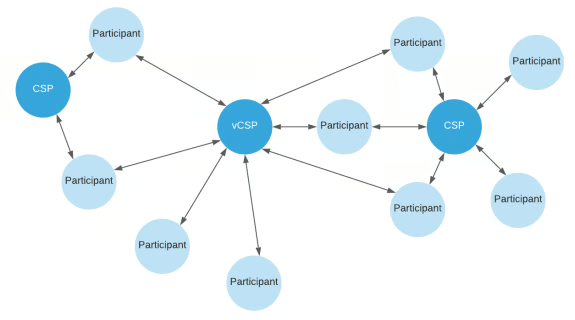
Canton Network topology. Source: Canton Network Whitepaper
Last week, DTCC announced plans to pilot trading of tokenized versions of some of the $114 trillion in liquid assets that it custodies beginning in July with a goal of a full service launch in October.
Related: Canton, ZKsync clash over how blockchains enforce rules
Financial institutions are onboarding or experimenting with Canton Network
While the Canton Network has drawn mixed reactions from the crypto community over its role in the blockchain ecosystem and its level of decentralization, it continues to onboard global financial institutions, banks and government entities.
In March, financial rating agency Moody’s deployed its ratings data on the network, allowing financial institutions to use the data directly within blockchain workflows, making it the first credit ratings firm to publish its data onchain, according to an announcement from the firm.
In April, Japan Securities Clearing Corporation (JSCC), a financial clearinghouse and settlement service for equities, commodities and derivatives, announced it was testing onchain government bonds on the Network.
More specifically, JSCC is testing whether ownership of Japan’s government bonds can be transferred onchain and used as digital collateral.

The Canton Coin’s price action since December 2025. Source: CoinMarketCap
Earlier this month, Swiss crypto bank Amina, announced custody and trading support for Canton Coin, the utility token of the Canton Network.
Amina is the first bank regulated by the Swiss Financial Market Supervisory Authority (FINMA) to announce support for the Canton token, according to an announcement from the crypto bank.
Magazine: One metric shows crypto is now in a bear market: Carl Moon
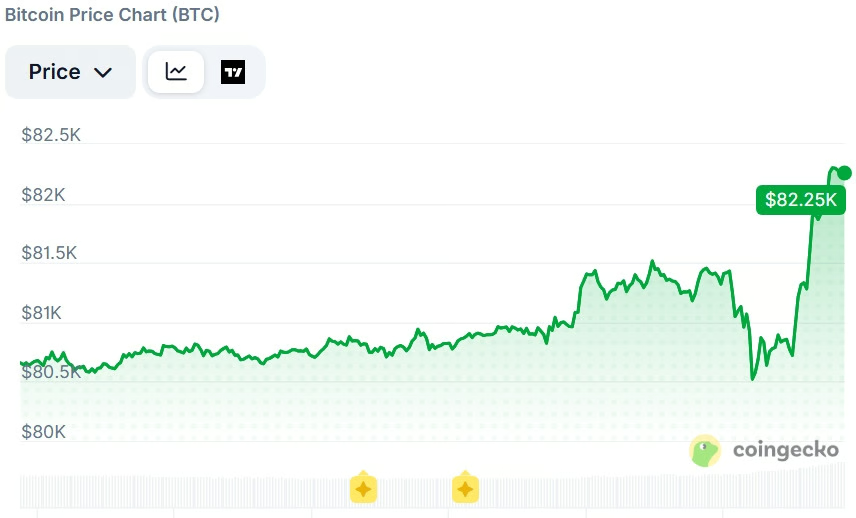
Bitcoin briefly dipped before surging over $82,000 on Sunday as US President Donald Trump rejected Iran’s counteroffer to a peace deal, which could prolong tension in the Middle East.
“I don’t like it — TOTALLY UNACCEPTABLE, Trump said in a post to Truth Social on Sunday after reading Iran’s proposal to end the war. Iran has previously requested that the US pay for war reparations and unfreeze blocked Iranian financial assets.
Bitcoin (BTC) fell from $81,430 to $80,520 within 45 minutes of Trump’s post before whipsawing nearly 2.3% to $82,347 less than three hours later, according to CoinGecko data. Bitcoin’s rise also resulted in nearly $64 million worth of short positions being wiped out over the last four hours, according to Coinglass data.

Bitcoin’s change in price over the last 24 hours. Source: CoinGecko
The US-Iran war and dispute over control of the Strait of Hormuz — which handles one-fifth of oil trade — has caused significant disruption in the financial markets over the past ten weeks, particularly in oil markets, which rose another 4.6% to $98.7 per barrel on Trump’s latest comments.
The S&P 500 futures index has risen 0.13% since the market opened about two hours after Trump’s post.
Trump’s refusal to accept Iran’s counteroffer dashes hopes of an imminent end to the war on Wednesday. Israeli Prime Minister Benjamin Netanyahu also said the war won’t be over until Iran’s uranium sites are dismantled.

Source: Rapid Response 47
Bitcoin could see more regulatory momentum in US this week
Bitcoin’s strength at the $80,000 level could be supported by two favorable decisions in the US Senate this week, 10x Research CEO Markus Thielen told Cointelegraph.
“Two catalysts stand out this week,” a Senate vote on Monday for Kevin Warsh’s confirmation as Federal Reserve chair and the Senate Banking Committee’s markup on the CLARITY Act on Thursday, Thielen said.
Related: Bitcoin price may dip toward $70K as Fed estimates hotter inflation print
Thielen noted that while “Warsh is widely regarded as more hawkish on inflation” than the current Fed Chair, Jerome Powell, his confirmation would remove “uncertainty overhang.”
Thielen described the CLARITY Act as the “most significant piece of crypto legislation in years,” adding that it could be a “turning point for regulatory certainty across digital assets.”
“Both events lean bullish for Bitcoin: regulatory clarity reduces institutional friction, and a smooth Fed leadership transition avoids the policy uncertainty that typically pressures risk assets.”
Bitcoin up 29.7% since the US-Iran war began
Despite the US-Iran conflict, Bitcoin has now risen 29.7% since the US-Iran conflict started on Feb. 28, when a US airstrike killed Iran’s Supreme Leader Ayatollah Ali Khamenei.
Bitcoin has outperformed the S&P 500 and gold since the US-Iran war started, clawing back some lost ground from October when Bitcoin hit a high of $126,080.
Magazine: Adam Back says current demand is ‘almost’ enough to send Bitcoin to $1M


A bitcoin whale came back to life Sunday, moving coins worth $40 billion to a new address after more than a decade of inactivity.
The transfer took place at around 19:16 UTC, according to blockchain tracking service Whale Alert. The coins were moved from address “1KAA8GGhVjjUjVTz1HKAjCyGNzAKQd882j” to “bc1qm6m6d33d02edr0k8yj9jgt027zl6dvx6thjrxy.”
The wallet had remained inactive since November 2013, when BTC was originally acquired and subsequently held untouched for more than a decade.
The reason behind the latest transfer remains unclear. Large holders often move coins between wallets for address management or security purposes, though such activity can also precede sales or transfers to exchanges. In this case, the destination address does not appear to be linked to a known exchange wallet.
Dormant bitcoin wallets have increasingly resurfaced since BTC first crossed the $100,000 mark in late 2024. Several early investors and miners have moved long-held coins over the past year, with some ultimately taking profits after bitcoin’s massive rally.
The trend was most intense in July last year, when blockchain analytics firms flagged eight Satoshi-era wallets, each holding 10,000 BTC, moving their coins for the first time in 14 years. Those transfers came as bitcoin traded above $100,000 and hovered near all-time highs.
As of writing, bitcoin changed hands near $80,700, down over 1% since midnight UTC, according to CoinDesk’s market data.

Strategy, the Bitcoin treasury vehicle co-founded by Michael Saylor, signaled it would resume BTC purchases this week after its first-quarter earnings call, during which executives floated selling portions of its Bitcoin reserve to fund dividends on its corporate credit facilities. Saylor, who has historically marked new buys with an X post, sent a Sunday message: “Back to work, BTC.” The cadence has often preceded fresh accumulation.
The last known buy occurred on April 27, when Strategy purchased 3,273 BTC for roughly $255 million, lifting total holdings to 818,334 BTC. Strategy’s own purchases page at the time valued the stash at about $61.8 billion. The company had paused its BTC buying streak for one week ahead of the Q1 2026 earnings call, where management indicated it could periodically sell portions of BTC to fund dividends on its debt instruments.
Key takeaways
- Strategy plans to resume BTC purchases this week after pausing ahead of its Q1 2026 earnings call, continuing a pattern that has accompanied prior buying waves.
- During the earnings call, executives flagged the possibility of selling portions of its Bitcoin to fund dividends on corporate credit instruments, marking a shift from an earlier stance against selling.
- Strategy’s BTC stake stands at about 818,334 BTC, roughly 4% of the total supply, with the group asserting purchases and sales should not meaningfully move Bitcoin’s price.
- Reaction within the crypto community has been mixed: some view periodic sales as a way to finance future buys, while others warn of potential price pressure or a “doom loop” for the spot market.
- The firm cited an estimated $1.5 billion per year in dividend-equivalent payments, arguing Bitcoin’s high daily liquidity—over $60 billion on average—could absorb such demand without destabilizing prices.
Strategy restarts BTC purchases as a revised treasury playbook
On the earnings call, Strategy executives indicated that the company could periodically liquidate portions of its Bitcoin holdings to fund dividends on its corporate credit products. In a direct nod to this approach, Saylor told the call that the firm would “probably sell some Bitcoin to fund a dividend, just to inoculate the market, just to send the message that we did it.” The remark underscored a strategic pivot toward treasury management that blends accumulation with targeted selling for yield support.
The move drew a spectrum of responses from investors and observers. Some supporters argued that measured sales could provide a predictable mechanism to nurture future BTC purchases, effectively broadening Strategy’s financing toolkit. Others cautioned that even small, regular sales could add selling pressure to a market already sensitive to large holders’ actions.
Industry voices highlighted differing interpretations of the plan. Samson Mow, a prominent Bitcoin advocate, argued that Strategy’s sales would grant the firm additional optionality in the financial landscape. Critics, meanwhile, raised concerns about potential market implications and referred to the risk of reinforcing negative sentiment if sales appeared episodic or unpredictable. Strategy’s leadership tried to temper these concerns, with CEO Phong Le stressing that any sales would occur in specific, defensible circumstances—such as dividend distributions or tax deferral—while insisting that neither the company’s actions nor their timing should materially move Bitcoin’s price.
Le also framed the size of the operation in context: Strategy owns about 4% of the total BTC supply, and he pointed to Bitcoin’s substantial daily trading volume as a cushion. In an interview with CNBC, Le noted that the market’s liquidity could readily absorb the targeted cash flow associated with annual dividend payments—roughly $1.5 billion—without creating outsized price volatility. He reinforced the message that the firm does not intend to manipulate prices and that its buying and occasional selling are not expected to move the market significantly.
Market context, risks, and what to watch next
Strategy’s approach sits at the intersection of treasury policy and market dynamics. By expanding the toolbox beyond passive holding to include strategic liquidations, the firm aims to sustain its BTC holdings while delivering yields to creditors. Yet the decision to monetize a portion of the reserve raises questions about long-term price discovery for Bitcoin and the potential signaling effect for other large holders contemplating similar moves.
Analysts and traders will be watching several factors: the cadence and size of any future BTC sales, how the dividends on Strategy’s credit instruments are structured, and whether other institutions with sizable BTC treasuries adjust their strategies in response. The company’s reported scale—standing around 4% of the total supply—ensures that even modest shifts can become meaningful talking points for market participants. At the same time, observers point to Bitcoin’s liquidity as a mitigating factor; with daily volumes well north of $60 billion, the market could theoretically absorb substantial on-chain activity tied to dividends without a wholesale price revaluation in the near term.
Beyond market mechanics, regulatory and macro considerations loom. If Strategy proceeds with a measurable program of sales, nearby observers will scrutinize tax treatment, dividend timing, and the broader implications for corporate treasury strategies in the crypto space. As always with Bitcoin’s largest treasury holders, the balance between long-term accumulation and opportunistic monetization will shape both the price narrative and the strategic calculus of other institutions contemplating similar moves.
For now, the sequence is clear: Strategy intends to resume BTC purchases this week, while leaving open the possibility of measured sales to support its credit instrument dividends. The coming weeks will reveal how the market prices this nuanced treasury playbook and whether Strategy’s approach becomes a blueprint for a new era of corporate crypto treasury management.

Three of DeFi’s relatively young applications — Hyperliquid, EdgeX and Pump.fun — collectively returned $96.3 million to token holders over the last 30 days, according to data compiled by DefiLlama. The results underscore a shift in the sector’s focus from pure on-chain activity to actual earnings that can be distributed to holders.
Hyperliquid led the pack, distributing $50.95 million in revenue to token holders for the period, with zero incentives spent, DefiLlama’s figures show. Pump.fun ranked second, returning $22.09 million to holders from $38.81 million in total revenue. EdgeX distributed $23.26 million to holders from $8.26 million in protocol revenue, a pattern that suggests the project is leveraging reserves or alternative income streams to reward its holders.
On an annualized basis, the momentum is even more pronounced: Hyperliquid has generated $945.87 million in revenue over the past year, all returned to holders; Pump.fun sits at $481.15 million; and EdgeX at $236.42 million.
Across the broader DeFi landscape, other major protocols reported distributions as well: Chainlink returned $4.63 million to holders, Aerodrome $3.53 million and Uniswap $3.29 million, spread across 44 chains. PancakeSwap generated $3.94 million in revenue, but returned $2.48 million to holders while spending $905,260 on incentives.
Related: DeFi can freeze stolen funds, but not everyone agrees it should
Crypto community now focuses on revenue
The data comes as revenue is becoming the metric that matters most in crypto, with token holders pushing protocols to justify their valuations through actual earnings rather than transaction volumes or network growth figures.
“Nobody cares that your chain does 10x the TPS anymore,” wrote Robbie Klages, co-founder of The Rollup, in a widely cited post on X. “The market is ‘show me the money right now.’ Treat it like a business, not a network-growth thesis.”
Another commentator on X framed the shift as potentially permanent: the move from a narrative-driven backdrop to a transparency of earnings could reprice projects that fail to demonstrate real revenue, especially in a rising-rate environment where capital becomes more expensive for speculative assets.
Top DeFi protocols by Holders Revenue. Source: DefiLlama
DeFi is becoming backend for onchain economy
Andre Cronje, founder of Yearn.Finance, described a future where DeFi resembles essential financial infrastructure rather than a speculative playground. In his view, stablecoins have grown into a $320 billion market led by Tether and Circle, decentralized exchanges are processing over $160 billion in monthly spot volume, and perpetuals are handling roughly $540 billion in monthly volume. Lending protocols like Aave, Morpho and Maple Finance collectively support around $28 billion in active loans, while real-world assets increasingly appear as on-chain collateral. “DeFi is no longer just competing for APY. It is becoming the backend for the onchain economy,” Cronje wrote on X.
The broader context is shaping how market participants assess risk and opportunity in the sector. As traditional finance channels scrutinize on-chain revenue and the sustainability of distributed earnings, observers are watching whether more protocols will translate engagement into verifiable cash flows that can be shared with holders.
For readers seeking deeper context on DeFi’s evolving role, Cointelegraph’s coverage on related topics remains a useful resource, including discussions around recovery plans and real-world asset integration within DeFi ecosystems.
Magazine: Guide to the top and emerging global crypto hubs — Mid-2026
Notes: This article relies on data from DefiLlama for revenue distributions and is intended to reflect observed patterns in the DeFi sector. Citations include public posts and prior reporting from industry figures and outlets referenced above.
What to watch next: as more protocols publish holder distributions and audited revenue figures, investors will increasingly evaluate projects on earnings quality and sustainability rather than growth narratives. The next several quarters could reveal whether the current revenue-centric approach endures, or if broader market dynamics reintroduce balance between on-chain activity and real-world cash flows.

Digital Asset Holdings, the firm behind the Canton Network, is reportedly raising about $300 million at a roughly $2 billion valuation, according toBloomberg, which cited people familiar with the matter. The round is said to be led by a16z crypto and could close in the coming weeks, signaling continued investor appetite for enterprise-grade, privacy-forward blockchain rails designed for regulated finance.
The potential financing would come less than a year after Digital Asset disclosed a $135 million strategic round led by DRW Venture Capital and Tradeweb Markets to accelerate Canton Network adoption. The fresh capital would help scale Canton Network’s ecosystem as financial institutions explore on-chain workflows that preserve privacy and governance controls while enabling asset-tokenization use cases.
In December, Digital Asset, the Canton Network, and the Depository Trust & Clearing Corporation (DTCC) announced a collaboration to tokenize DTCC-custodied assets on Canton Network, underscoring a concrete path to moving regulated instruments onto a private, interoperable ledger.
DTCC’s latest push adds to a broader momentum around on-chain asset handling. The clearinghouse said it would pilot trading of tokenized versions of a portion of the $114 trillion in assets it custody, with activity slated to begin in July and a full-service launch planned for October, according to reports linked to the initiative.
Meanwhile, Moody’s announced in March that it had deployed its ratings data on the Canton Network, enabling financial institutions to use independent credit analysis directly within blockchain workflows. The move marked Moody’s as the first credit ratings agency to publish data on-chain for use in a financial-infrastructure context.
In April, the Japan Securities Clearing Corporation (JSCC) announced that it would test the use of on-chain government bonds on Canton Network, evaluating whether ownership of Japan’s sovereign bonds can be transferred on-chain and used as digital collateral.
Swiss crypto bank Amina disclosed custody and trading support for Canton Coin, the network’s utility token, becoming the first FINMA-regulated bank to back the token, according to an announcement from Amina.
As the Canton Network pushes deeper into regulated rails, it has drawn mixed reactions within the broader crypto community regarding its approach to decentralization and governance. Yet institutional actors—from clearinghouses to credit-rating agencies—continue to experiment with Canton as a bridge between traditional assets and on-chain processes.
Key takeaways
- Fresh funding at a $2 billion valuation signals ongoing investor confidence in Canton Network’s enterprise-use case and privacy-oriented design for regulated finance.
- The ecosystem is expanding beyond pilots to tangible tokenization workflows, with DTCC’s collaboration, Moody’s on-chain data, and JSCC’s government-bond testing illustrating a broadening operational agenda.
- Regulated adoption is advancing alongside the Canton Coin ecosystem, highlighted by Amina’s custody and trading support as a FINMA-regulated bank.
- The funding cycle comes amid persistent debates about decentralization versus controlled, permissioned rails in the traditional-finance layer of the crypto stack.
- Investors will watch how the upcoming DTCC tokenization pilots and related on-chain implementations perform in real markets and how regulators respond to tokenized assets and on-chain collateralization.
Enterprise rails in motion: what’s changing for investors and users
The reported $300 million round, if completed, would place Digital Asset in a clearer position to accelerate Canton Network’s commercial ambitions. By drawing capital into a permissioned, privacy-preserving ledger tailored for banks, asset managers, and other financial institutions, the project aims to reduce counterparty risk and operational friction traditionally associated with moving complex assets onto public blockchains. The leadership by a16z crypto—an investor with a broad portfolio in infrastructure and selective, enterprise-grade blockchain bets—underscores a continuing tilt toward assets and workflows that require regulatory-grade controls.
Meanwhile, the DTCC collaboration and its tokenization agenda are particularly noteworthy. Tokenizing DTCC-custodied assets on Canton could serve as a proving ground for how institutional-grade custody, settlement, and risk management operate when assets exist as tokenized representations on a private, auditable ledger. The announced July pilot and October full rollout set clear milestones for market participants watching for scalable, on-chain settlement and collateral frameworks.
Moody’s on-chain data integration adds a complementary dimension: credit analytics flowing into blockchain workflows could streamline risk assessment and due diligence across tokenized instruments. The once-dominant silos between credit ratings and settlement infrastructure may gradually blur as data becomes clickable within tokenized processes. The on-chain access to independent credit analysis signals a maturation of the use cases anchored in Canton’s network design.
The on-chain government-bond experiments by JSCC push further the notion that sovereign debt can function as digital collateral within a regulated, interoperable environment. If successful, such tests could influence how central-bank-like operations or cross-border collateral agreements evolve in a hybrid of traditional and digital finance.
Finally, Amina’s Canton Coin custody and trading support marks a visible step for regulated banks toward integrating native network tokens into their custody and liquidity frameworks. As the first FINMA-regulated bank to back Canton Coin, Amina’s move may serve as a reference point for other regulated banks considering similar digital-asset rails, while also inviting regulatory scrutiny and clarity about tokenization standards and custody risk.
Taken together, these developments illustrate a broader shift: institutional finance is quietly exploring controlled, auditable, and privacy-conscious blockchain networks as the backbone for on-chain asset tokenization, while investors seek clarity on governance and long-term decentralization dynamics.
As the Canton Network ecosystem pursues live deployments and scale, readers should watch how regulatory signals unfold around on-chain assets and collateral, how tokenized workflows perform in real-market conditions, and which traditional institutions partner most aggressively to harness private-ledger innovation.
Crypto World
Quantum-Proof Wallets: Crypto Firms Race to Secure Digital Assets Ahead of Protocol Upgrades

TLDR:
- Crypto firms are upgrading wallets to post-quantum MPC signatures before blockchain protocols make the same shift.
- NIST-approved algorithms like ML-DSA are being evaluated for distributed signing compatibility across wallet systems.
- Institutions with existing MPC infrastructure can migrate to quantum-resistant wallets through a simple code upgrade.
- Wallet-level upgrades alone cannot fully protect users if underlying blockchain networks do not follow with protocol changes.
Quantum-proof wallets are becoming a priority for crypto companies as the threat of quantum computing draws closer. Firms are now upgrading their wallet infrastructure faster than blockchain networks can update their core protocols.
The concern stems from estimates suggesting a “Q-Day” scenario could arrive as early as 2030. One recent report by Project Eleven warns that quantum computers could break the cryptographic foundations securing trillions in digital assets within four to seven years.
Wallet-Level Upgrades Lead the Charge
Crypto infrastructure firms are not waiting for blockchain-level changes to roll out quantum-resistant protections. Silence Laboratories recently added support for distributed multi-party computation (MPC) signatures using ML-DSA.
This is a cryptographic algorithm selected by the National Institute of Standards and Technology (NIST). The company spent six months evaluating three NIST-approved algorithms: SPHINCS+, Falcon, and CRYSTALS-Dilithium.
Not every algorithm suits every use case, however. Silence Laboratories CEO Jay Prakash addressed this directly, stating: “Not all of SPHINCS+, Falcon, and CRYSTALS-Dilithium will meet the criteria of MPC friendliness — whether they support efficient distributed transaction signing.”
He added that fragmentation across chains is also a factor, as each network is optimizing for different criteria. This complexity makes a one-size-fits-all approach difficult to achieve.
The approach used by Silence Laboratories generates private key shares across isolated nodes. A signature is then produced jointly without ever reconstructing the full key.
This method protects against quantum attacks while staying compatible with existing MPC infrastructure. Prakash noted that institutions have already embraced this model: “Whether it’s a partner like BitGo or a bank building a digital asset practice, they all understand that keys can’t sit in one place.”
Prakash confirmed that the transition would be seamless for end users. Whether using MetaMask or another wallet interface, users would not notice any change. The upgrade happens entirely at the infrastructure level.
As he explained: “Any bank or custodian with existing MPC infrastructure can now migrate to a post-quantum MPC-based wallet, without changing their infrastructure. It’s a code upgrade.”
Alternative Approaches and Remaining Gaps
Other developers are exploring protocol-adjacent solutions rather than pure wallet-level fixes. Developers behind Postquant Labs are building quantum-resistant signatures on top of Bitcoin using a separate smart contract layer.
This avoids changes to the Bitcoin base protocol entirely. StarkWare researcher Avihu Mordechai Levy has proposed replacing Bitcoin’s elliptic-curve cryptography with hash-based signatures that operate within the existing network rules.
That proposal, however, is described as a last-resort option rather than a scalable solution. It could also prove costly to implement at scale.
Meanwhile, a researcher recently cracked a 15-bit elliptic curve cryptography key using a quantum computer and a variant of Shor’s algorithm. Project Eleven awarded its 1 Bitcoin “Q-Day Prize” to the researcher for this demonstration.
Coordination between wallet providers and blockchain networks remains a key challenge. Prakash was direct about the limits of a wallet-only fix: “If wallets are upgraded to post-quantum and chains are not upgrading, it won’t work.”
The timeline pressure is pushing firms to act now, even as true quantum threats have not fully materialized. User behavior and coordination across the ecosystem remain the weakest links in the rollout.

TLDR:
- Hyperliquid channels trading fees into buybacks, linking perpetual volume directly to token demand
- Pump.fun monetizes memecoin launches, turning speculative cycles into recurring protocol revenue
- EdgeX shows a payout-revenue mismatch, raising questions over the sustainability of the distribution model
- Revenue-sharing tokens now prioritize fee generation over inflation-based incentive structures
DeFi $96.3M token holder payouts reflect a growing shift toward fee-backed distribution models across leading decentralized protocols.
Hyperliquid, EdgeX, and Pump. fun now channel real trading and launch revenue directly to users, reshaping how token economics is evaluated in 2026 markets.
Hyperliquid and Pump.Fun Drive Fee-Based Market Cycles
Hyperliquid continues to anchor the largest share of distributions through derivatives trading activity across decentralized markets. Its fee structure converts perpetual futures volume into direct token buybacks, linking usage with holder returns.
Pump.fun operates differently by monetizing memecoin launches, where each token creation contributes to platform revenue streams. Both models demonstrate how trading behavior and viral engagement now serve as direct revenue engines in crypto.
Together, they contribute a major portion of the recent market-wide distribution tracked across decentralized finance ecosystems.
Market participants’ revenue generation is at the center of valuation models across leading decentralized applications.
Liquidity depth and fee consistency now carry more weight than short-term token sentiment across trading platforms. As a result, protocols are increasingly evaluated based on how effectively they convert activity into revenue.
Hyperliquid’s dominance reflects deeper liquidity participation from perpetual traders across global markets. Pump.fun sustains relevance through continuous launch activity, even as broader memecoin cycles fluctuate sharply.
Together, these mechanisms form a fee-driven loop that supports recurring token holder distributions. Structure continues shaping how decentralized exchanges and launchpads compete for sustainable on-chain revenue.
EdgeX Distribution Gaps and the Rise of Revenue-Backed Tokens
EdgeX contributes to the overall distribution but shows a mismatch between revenue and token payouts. Reported figures indicate higher holder distributions compared to organic revenue generation from platform activity.
This gap introduces scrutiny around funding sources and the long-term sustainability of payout structures. Market observers note that such models may rely on reserves or incentive-driven liquidity programs. Despite this, EdgeX remains part of the broader trend toward fee-linked token economics.
Protocols across decentralized finance increasingly adopt buyback mechanisms tied to trading or launch activity. This structure reduces reliance on inflation-based rewards and shifts focus toward measurable cash flows.
Investors now compare revenue coverage ratios when evaluating token models across competing ecosystems. Buybacks funded through fees are increasingly treated as a benchmark for protocol maturity.
However, volatility in trading cycles means revenue-linked payouts remain sensitive to market conditions. The combined $96.3M distribution demonstrates how far token economics has shifted in recent cycles.
Across protocols, fee generation now competes directly with traditional valuation narratives in crypto markets. This environment places a stronger emphasis on real transaction activity rather than speculative token growth stories
EdgeX remains under observation as analysts evaluate its ability to sustain payouts without external support. Revenue-backed models continue to reshape expectations across decentralized trading infrastructure.

Swiggy shares plunge 7% after Q4 results. What are Nomura, Citi and others saying?

HBO Max’s 90% Rotten Tomatoes Classic Is the Most Realistic War Movie You’ve Never Seen

Unemployment Ticked Up in America’s IT Sector

Manchester United reach agreement with Casemiro over contract clause amid transfer speculation

US brings back mandatory military draft registration

Steven Gerrard disagrees with Gary Neville over ‘shock’ Chelsea and Arsenal claim | Football


-
 Crypto World3 days ago
HarrisX Poll Found 52% of Registered Voters Support the CLARITY Act
-

 Crypto World4 days ago
Upbit adds B3 Korean won pair as Base token gains Korea access
-

 Fashion2 days ago
Weekend Open Thread: Marianne Dress
-

 Tech6 days ago
Image AI models now drive app growth, beating chatbot upgrades
-
 NewsBeat4 days ago
NCP car park operator enters administration putting 340 UK sites at risk of closure
-
 Business2 days ago
Ignore market noise, India’s long-term story intact, say D-Street bulls Ramesh Damani and Sunil Singhania
-

 Politics2 days ago
Politics Home Article | Starmer Enters The Danger Zone
-

 Sports7 days ago
Inter Milan Win Serie A Title After Victory Over Parma
-
 Sports7 days ago
2026 NHL playoff picks: Second-round predictions, series odds, Stanley Cup bracket
-

 Crypto World6 days ago
UAE Free Zone Deploys Blockchain IDs to Verify Registered Firms
-
 Sports7 days ago
Every word of Arne Slot’s heated rant after Manchester United win vs Liverpool
-

 Crypto World5 days ago
BlackRock CEO Larry Fink Discusses a New Asset Class
-

 Crypto World4 days ago
Robinhood says Wall Street is building onchain
-

 Tech5 days ago
Apple and Samsung are dominating smartphone sales so thoroughly that only one other company makes the top 10
-
Entertainment6 days ago
Serena Williams hits Met Gala in metallic dress after GLP-1 reveal
-

 Fashion4 days ago
The Best Work Pants for Women in 2026
-

 Tech5 days ago
I tested the Xiaomi 17 Ultra’s camera and I don’t think I’ll ever go back to an iPhone
-
 Sports7 days ago
Hearts v Rangers LIVE: Prediction, team news and line-ups as Scottish Premiership title rivals meet at Tynecastle
-

 Entertainment7 days ago
Skai Jackson Responds To AI Baklash After Viral Snapchat Photos
-

 Politics6 days ago
Met Gala 2026: Madonna’s Dramatic Red Carpet Look Steals The Show
You must be logged in to post a comment Login