

Crypto World
Nio (NIO) Stock Climbs on Robust Q4 Earnings and Wave of Positive Analyst Revisions


TLDR
- Nomura initiated a Buy rating on NIO with a $6.60 price objective, suggesting approximately 34% potential gains from current trading levels
- Macquarie increased its price objective to $6.50 while maintaining an Outperform stance following fourth-quarter 2025 earnings
- Fourth-quarter revenue climbed 76% annually and 59% sequentially to reach RMB34.7 billion
- Vehicle gross margin expanded to 18.1% during Q4, compared to 13.1% in the prior-year period
- NIO projected Q1 2026 vehicle deliveries between 80,000 and 83,000 units, with revenue expectations exceeding analyst estimates
The Chinese electric vehicle manufacturer Nio has experienced an eventful week. Following the release of impressive fourth-quarter 2025 financial results, the company secured multiple analyst upgrades and elevated price objectives from prominent Wall Street firms.
The standout metric proved difficult to overlook. Fourth-quarter total revenue reached RMB34.7 billion, representing a 76% increase compared to the same quarter last year and a 59% jump from the previous quarter. Such robust expansion typically captures market attention.
Nomura made the boldest move, elevating NIO from a Neutral stance to Buy. The investment bank established a $6.60 price objective, reduced from its earlier $8.40 forecast, yet still suggesting roughly 34% upside potential from the stock’s recent trading level around $4.94.
The brokerage highlighted two consecutive quarters of operational improvements, emphasizing increased vehicle deliveries and enhanced expense management as catalysts for stronger profitability. Nomura now anticipates NIO will achieve non-GAAP operating profit breakeven during 2026.
Despite reducing delivery projections for 2026 and 2027 — acknowledging intensified competition within the EV sector — Nomura still forecasts vehicle deliveries will expand at approximately 25% compounded annual growth between 2025 and 2028. Revenue expansion is anticipated at roughly 21% during the identical timeframe.
Gross margin projections for 2026 and 2027 received upward revisions, while operating margin estimates were boosted by over 3 percentage points for both fiscal years. This represents a substantial reassessment of the company’s cost efficiency.
Enhanced Profitability Fuels Positive Analyst Sentiment
Macquarie similarly elevated its price objective, advancing to $6.50 from $6.10, while preserving its Outperform recommendation. The firm identified vehicle margin expansion as the primary narrative.
Vehicle margin reached 18.1% during Q4 2025, climbing significantly from 13.1% during the comparable quarter one year prior. The recently launched ES8 model received credit for contributing substantially to that improvement. Additional sales margin widened to 11.9% from merely 1.1% in Q4 2024.
NIO also reduced R&D expenditures through workforce optimization and intends to maintain quarterly R&D costs within the RMB2.0 billion to RMB2.5 billion range. The manufacturer generated positive operating cash flow during the quarter, which Macquarie noted reduces future capital-raising requirements.
Macquarie did reduce its fiscal 2026 volume projection by 8%, acknowledging subdued near-term demand and escalating competition within the EV SUV category from rivals including Li Auto, XPeng, Xiaomi, and Seres. However, it narrowed its 2026 net loss forecast to RMB1.8 billion from RMB4.5 billion, reflecting decreased operating costs and an improved product portfolio.
Additional Financial Institutions Provide Analysis
BofA Securities increased its price objective to $6.70 while maintaining a Neutral recommendation, observing that Q4 performance largely aligned with projections. Morgan Stanley reaffirmed its Overweight rating with a $7.00 price target following optimistic delivery growth commentary from NIO’s founder.
For Q1 2026, NIO provided delivery guidance of 80,000 to 83,000 vehicles. The midpoint sits approximately 8% below Bloomberg consensus figures but 2% above Macquarie’s projection. Revenue guidance ranging from RMB24.5 billion to RMB25.2 billion exceeded both Macquarie’s estimate and broader consensus expectations.
NIO has three additional mid- to large-size SUV models under development, with two variants scheduled to debut during Q2 2026.
The stock had appreciated 17.77% during the preceding week through Wednesday’s trading session, with a market capitalization standing at $14.41 billion.



Editor’s note: Concrete’s integration with Binance Wallet signals a shift in DeFi yield access. By embedding risk-adjusted USDT strategies directly into a widely used wallet, the collaboration aims to simplify entry for institutions and retail investors alike, while reducing interface fragmentation that has long hindered on-chain yield infrastructure. This milestone highlights a broader push toward robust, audited yield capabilities that prioritize risk management and transparency, rather than chasing short-term gains.
Key points
- Concrete vaults are accessible inside Binance Wallet for USDT yield strategies.
- Modular architecture separates custody, strategy execution, and accounting to lower friction.
- Promotional rewards up to $200,000 for eligible participants staking 100 USDT via Binance Wallet.
- Focus on risk-adjusted, institutional-grade strategies over short-term yield chasing.
Why this matters
Bringing Concrete into a major wallet ecosystem reduces fragmentation and broadens access to disciplined DeFi yield infrastructure, with emphasis on risk management and transparent evaluation of strategy parameters.
What to watch next
- Real-time APY will adjust dynamically based on participation and market conditions.
- Uptake of the rewards program and staking in the Concrete USDT Vault via Binance Wallet.
- Expansion of access as Concrete vaults become native inside Binance Wallet ecosystem.
Disclosure: The content below is a press release provided by the company/PR representative. It is published for informational purposes.
Concrete Integrates with Binance Wallet to Enable Access to Institutional-Grade USDT Yield
As demand for stablecoin yield grows, Concrete’s vault technology brings institutional strategy execution directly into one of the world’s largest wallet ecosystems.
NEW YORK, March 12, 2026 – Blueprint Finance, a multi-chain DeFi infrastructure company, today announced that its Ethereum-based institutional-grade vault infrastructure, Concrete, has integrated with the Binance Wallet ecosystem. This milestone enables Binance Wallet users to access sophisticated, risk-adjusted USDT yield strategies directly through their native wallet interface.
Concrete is purpose-built to address fundamental challenges in DeFi by providing infrastructure that prioritizes risk-adjusted yield strategies over short-term yield maximization.
“Integrating Concrete directly into Binance Wallet is a major step toward making sophisticated on-chain yield infrastructure accessible at a global scale,” said Nic Roberts-Huntley, CEO and co-founder of Blueprint Finance. “For too long, sophisticated on-chain yield strategies have been siloed behind fragmented interfaces and operational complexity. By embedding Concrete Vaults natively within one of the world’s most widely used wallet ecosystems, we’re bringing disciplined, risk-adjusted USDT yield strategies[1] to a global audience. This integration reflects the signal that DeFi is headed away from unsustainable yield chasing and toward infrastructure that institutions and retail users alike can rely on.”
Institutional-grade vault strategies are available natively inside one of the most widely used wallet ecosystems in the world. With tens of millions of users globally, Binance has become the gateway through which retail participants, power users, and institutions alike access decentralized finance. This integration also removes the fragmentation that has historically kept advanced on-chain strategies out of mainstream reach.
Concrete’s vault engine utilizes modular smart contract architecture and quantitative modeling frameworks originally developed for institutional environments. It separates custody, strategy execution, and accounting into enforceable layers, while automation reduces operational friction. Concrete Vaults seek to provide risk-adjusted, institutional-grade strategies, where each strategy is evaluated using quantitative models that account for volatility, downside probability, liquidity depth, and execution costs.[2]
To celebrate the integration, Concrete is launching a promotional rewards campaign of up to $200,000 in total rewards for eligible participants. Eligible users who stake at least 100 USDT in the Concrete USDT Vault via Binance Wallet may participate in the rewards program, alongside the vault’s ongoing yield generation. Reward structure and form are subject to change. Real-time APY will adjust dynamically based on participation and market conditions.
Visit concrete.xyz for more information.
About Concrete
Concrete is an Ethereum-based protocol that provides institutional-grade tooling for on-chain yield generation. With a proven track record of executing billions in structured flow volume, Concrete offers sophisticated vault architecture and strategy layering to enable secure and transparent yield generation in the DeFi ecosystem. Concrete is part of the Blueprint ecosystem.
About Blueprint Finance
Blueprint Finance is a multi-chain DeFi infrastructure company and the core developer of both the Ethereum-based Concrete and Solana-based Glow Finance. Concrete powers tokenized DeFi native vault infrastructure and the creation of new derivatives for any asset, while Glow powers yield, trading, and lending on Solana. The company’s quantitative framework transforms complex DeFi mechanisms into products that work reliably for both institutions and individuals alike. By eliminating traditional DeFi pain points, such as liquidation risk and capital fragmentation, Blueprint is building the technical foundation for broader institutional adoption of decentralized finance.
This press release is for informational purposes only and does not constitute an offer of securities, investment advice, or a solicitation of any kind. Yield is variable and not guaranteed. Past performance is not indicative of future results. Participation involves smart contract risk, market risk, and potential loss of principal. Users should review all applicable terms and conduct their own research before participating. Concrete vaults are not insured by any government agency.
[1] Risk-adjusted” refers to Concrete’s use of quantitative models to evaluate strategy parameters such as volatility, downside probability, liquidity depth, and execution costs. It does not imply elimination of risk or guarantee of returns. All strategies involve risk, including potential loss of principal.
[2] Strategy evaluation frameworks are subject to change and may not capture all relevant risk factors. Quantitative modeling does not guarantee performance or prevent losses.


- Hyperliquid price rose to its highest level in over a month as it touched $38.08.
- The HYPE is up amid increased trading activity as open interest jumps to over $1.56 billion.
- Technical indicators on the daily chart suggest a bullish continuation.
What’s driving the HYPE price up?
Bitcoin’s rally above $70,000 following Wednesday’s CPI data helped lift sentiment across the broader crypto market, even as geopolitical tensions continued to escalate.
Gains among major altcoins also provided momentum for smaller tokens such as Hyperliquid.
However, HYPE appears particularly well positioned for a potential breakout as trading activity in the energy sector intensifies amid the escalating U.S.–Israel conflict with Iran.
Data from Coinglass shows that Hyperliquid’s open interest rose from $1.18 billion to more than $1.56 billion, marking a 32% increase between March 6 and March 12, 2026.
Much of this activity has been driven by traders entering futures positions as oil prices surged. Crude briefly climbed toward $120 before pulling back.
Even after the retreat, prices remain above $100, as the Strait of Hormuz blockade continues to disrupt a key global shipping route, with Iranian leaders insisting the waterway should remain closed.
As Bloomberg recently reported, trading activity on Hyperliquid has surged under these conditions, with futures volume reaching about $2.2 billion in the past 24 hours.
At the same time, the platform’s stablecoin market capitalization increased nearly 3% to $4.76 billion.
Hyperliquid price: Is a new ATH next?
HYPE is currently trading at its highest level since February 3, 2026.
A similar price zone was last tested in November 2025, when bullish momentum weakened and the token failed to maintain support.
The latest retest raises the question of whether Hyperliquid could be setting up for a fresh push toward a new all-time high. If the current momentum continues, bulls may increasingly target that milestone in the near term.
Meanwhile, crypto investor Arthur Hayes has projected a much more aggressive outlook, suggesting that HYPE could climb to $150 by August 2026, driven by strong platform growth and token buyback dynamics.
HYPE price short-term technical outlook

From a technical standpoint, the first resistance lies in the $38–$42 range, followed by a stronger barrier around $48–$50.
A decisive close above $38 could open the door for a move toward these levels, with the all-time high above $59 emerging as a potential target if bullish momentum strengthens.
On the downside, if broader market weakness triggers a pullback, initial support is likely near $33.
A deeper correction could bring the 50-day SMA around $30 and the 100-day SMA near $28 into focus as key demand zones.
Crypto World
Ark Invest says quantum computing is a long-term risk for bitcoin, not an imminent threat
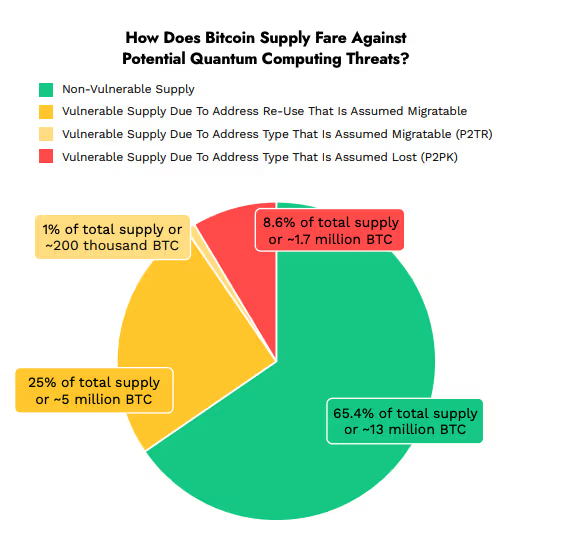
Asset manager Ark Invest says quantum computing is a long-term consideration for Bitcoin security but not an imminent threat.
In a Wednesday report co-authored with Unchained, the investment manager said today’s quantum computers are far below the capabilities needed to break Bitcoin’s cryptography, which relies on elliptic curve encryption to secure wallets.
“Today’s quantum systems lack the capabilities required to compromise Bitcoin,” wrote authors Dhruv Bansal, co-founder and CSO at Unchained; Tom Honzik, director of custody research at Unchained; and David Puell, research trading analyst and associate portfolio manager for digital assets at Ark Invest.
Even if quantum systems eventually reach that level, the risks will likely emerge gradually and at high cost to attackers, the report said.
One of the main reasons Bitcoin won’t face an immediate threat is because a major breakthrough in quantum computing would likely disrupt broader internet security first, prompting coordinated responses from governments, technology firms and financial institutions before reaching Bitcoin.
The report comes as long-term investors grapple with the possibility that advances in quantum computing could one day break the cryptography underpinning bitcoin, fueling speculation about a potential security crisis.
Earlier this year, a prominent portfolio strategist at Jefferies, Christopher Wood, said investors should drop 10% bitcoin allocation and add gold instead, due to a quantum threat. The move rattled investors and spooked the digital assets market.
35% of the supply in risk
While researchers broadly agree that such capabilities remain far off, the prospect that powerful quantum machines could eventually crack private keys or older wallet formats has raised concerns among investors about long-term risks to bitcoin and the broader digital asset ecosystem.

Ark’s report estimated that about 35% of bitcoin’s supply sits in address types theoretically exposed to future quantum attacks, including roughly 1.7 million BTC believed to be lost and about 5.2 million BTC that could be migrated to more secure wallets.
One of those wallets, roughly 1 million BTC, belongs to Satoshi Nakamoto, the creator of the Bitcoin network.
However, rather than a sudden “Q-day,” Ark Invest sees these progressions unfolding in several different stages over many years. Some investors fear the first attack could occur before 2030, while others suggest it could be “decades away,” the report noted.

The report argues that in either scenarios, it will likely give the Bitcoin community time to upgrade the network with quantum-resistant cryptography and encourage users to move coins to safer address formats.
“The good news is that we already know how to protect against quantum attacks,” the report said.
“The majority of Bitcoin’s supply is held in quantum-resistant addresses, and the remainder is held in quantum-vulnerable addresses that should not be at risk until Stage 3 of our timeline, when a CRQC exists that can break a 256-bit ECC key.”
The world’s largest cryptocurrency was trading around $70,000 at the time of publication.
Read more: Grayscale sees regulation, not quantum fears, shaping crypto markets in 2026


JPMorgan Chase has been sued by investors in Goliath Ventures, with a proposed class action lawsuit alleging the bank ignored “red flags” that the allegedly fraudulent crypto pool raised and helped enable what the complaint describes as a $328 million crypto Ponzi scheme that affected over 2,000 people.
Filed in federal court in the Northern District of California Wednesday, the complaint claims Chase “provided the essential banking infrastructure through which the Ponzi scheme operated,” processing investor deposits, facilitating transfers and enabling payments that allegedly “created the false appearance of legitimate profits.”
Florida resident Christopher Alexander Delgado was arrested last month by federal authorities on wire fraud and money laundering charges tied to his operation of Goliath. That criminal case is in its early stages.
“Numerous red flags made the fraudulent nature of the scheme obvious and known to Chase,” Wednesday’s proposed class action claims. “Despite those red flags, Chase turned a blind eye and continued servicing the accounts used to perpetrate the fraud, earning substantial fees from the hundreds of millions of dollars it washed through Goliath and Delgado’s banking activities at Chase.”
A JPMorgan spokesperson toldCoinDesk that the bank would “decline to comment.”
The complaint, filed by Robby Alan Steele through his lawyers at Shaw Lewenz and co-counsel, states that JPMorgan was the sole banking institution for Goliath. It further states that approximately $253 million was deposited into a Chase account linked to Goliath between January 2023 and June 2025. Roughly $123 million was transferred from that account to crypto exchange Coinbase, while about $50 million was sent to investors as purported returns.
The lawsuit, which does not state a specific damages figure, repeatedly argued the bank should have spotted the alleged fraud from the flow of funds alone.
“From a bank’s perspective, the fraudulent scheme was obvious,” the complaint said. “A fraudulent scheme of this magnitude cannot be run surreptitiously through one bank.”
The suit also mentions JPMorgan CEO Jamie Dimon’s public criticism of cryptocurrencies, adding it contradicts the bank’s alleged conduct.
“Despite Dimon’s long history of criticizing cryptocurrency,” the complaint said, Chase “knowingly permitted a bank customer—Goliath—to commingle investors’ money at Chase” and use funds from later investors to pay earlier ones “in a classic Ponzi scheme fashion.”
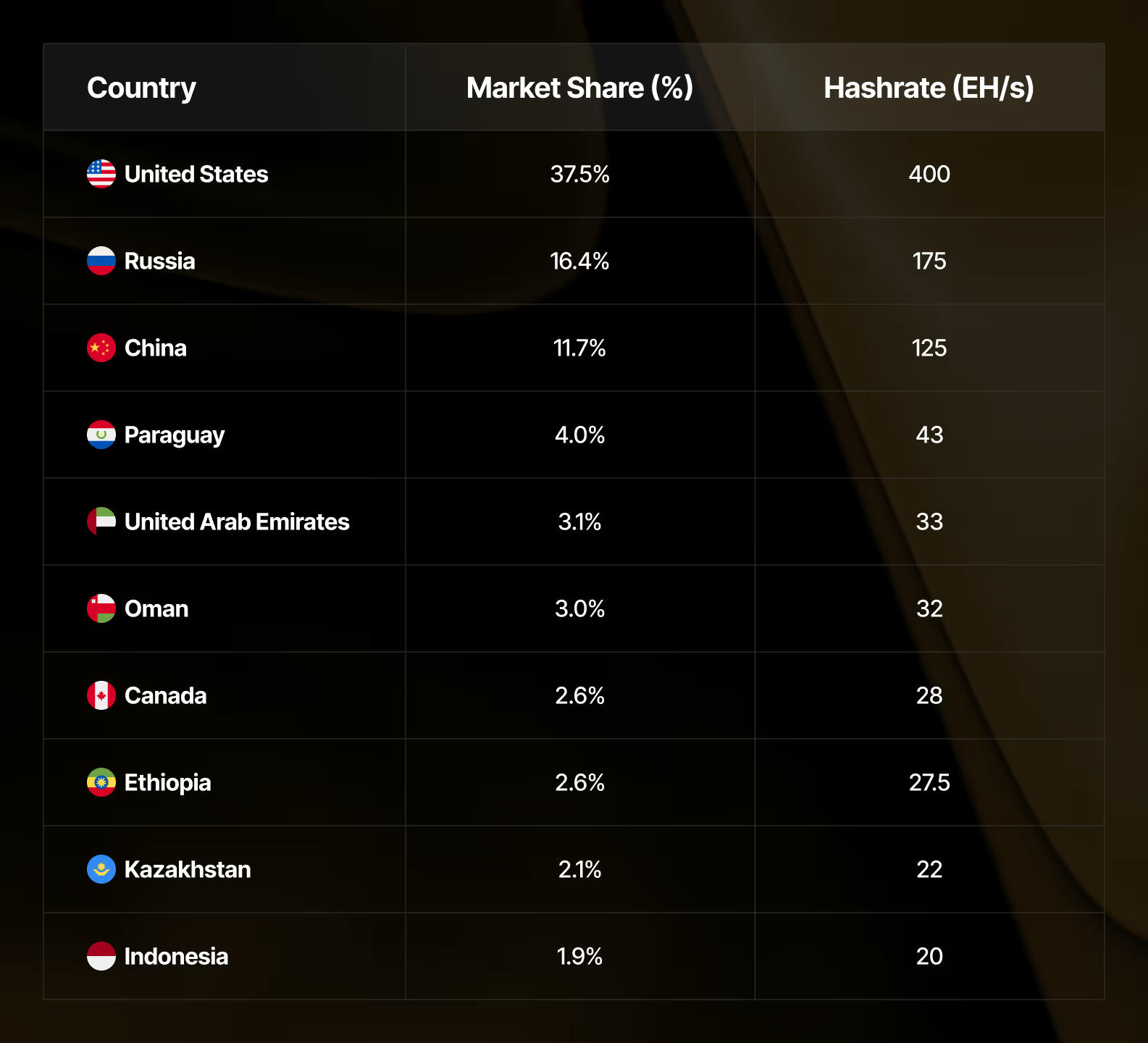
As oil surges past $100 amid escalating Middle East tensions, the question for the Bitcoin network and miners is not whether their power bills will rise, but whether Bitcoin’s price will fall.
According to research from bitcoin mining software and services company Luxor’s Hashrate Index, the direct effect of oil price shocks on mining costs is likely to be limited, but the broader macroeconomic consequences could weigh more heavily on the industry.
However, the impact of oil prices surging isn’t zero on the Bitcoin network.
Luxor estimates that about 8 to 10 percent of global bitcoin hashrate operates in electricity markets where power prices are closely linked to crude oil. These operations are primarily concentrated in Gulf states such as the United Arab Emirates and Oman, with smaller contributions from Iran, Kuwait, Qatar and Libya.
“The genuinely oil-exposed countries” are the Gulf states, Luxor wrote in its research note, adding that the UAE and Oman together account for roughly about 6% of the network’s computing power or hashrate.
“These grids run primarily on natural gas derived from oil production, with electricity pricing that does track crude more directly than in the US or Russia,” the report said.
Meanwhile, Iran is estimated to hold another 0.8%, and other smaller contributors like Kuwait, Qatar, and Libya bring the total crude-sensitive hashrate exposure to roughly 8–10% of the network.

The remaining roughly 90% of the network runs in regions where electricity prices are driven by natural gas, coal, hydro or nuclear energy, meaning crude oil price swings have little direct influence on mining costs.
Impact on mining
What does this mean for bitcoin miners, who run power-hungry machines to secure the network and validate the transactions?
Luxor argues that even if oil prices remain above $100 per barrel, the effect on mining economics from higher electricity costs would likely be limited to a small portion of the network. Electricity is the single largest input cost for mining bitcoin.
Instead, the bigger risk for miners lies in how geopolitical shocks affect bitcoin’s price. According to Luxor, periods of macro stress often trigger risk-off behavior in financial markets, which can pressure volatile assets such as Bitcoin.
Recent data cited by the firm shows hashprice, a measure of profitability for the miners, fell to an all-time low of $27.89 per petahash per second per day in February, driven largely by a 23.8% drop in bitcoin’s price during the same period.
For miners, Luxor concludes, profitability is far more sensitive to changes in bitcoin’s price than to shifts in electricity costs.
Read more: Bitcoin hashrate drops 12% in worst drawdown since China mining ban: CryptoQuant

Against this backdrop, Bitcoin 2026 — now expected to surpass 40,000 attendees — is the definitive gathering for anyone serious about the future of money. With 500+ speakers, multiple world-class stages, and programming spanning Bitcoin fundamentals, enterprise adoption, mining, energy, AI, policy, and culture, the conference brings every corner of the Bitcoin ecosystem together under one roof. The BFC Symposium anchors the institutional conversation at the center of that ecosystem.
Op Labs’ CEO said the move was not about finances, and that the firm has “years of runway.”
The development company behind Ethereum Layer 2 network Optimism has laid off 20 employees — what appears to be approximately 20% of its team. The news was announced by OP Labs CEO and Optimism co-founder Jing Wang in an X post today, March 12, and included a screenshot of an internal Slack message Wang had sent to staff earlier in the day.
“This decision reflects a narrowing of our focus, not our runway,” Wang wrote on X.
In a Slack message to what appears to be Op Labs’ 102 employees, Wang said that the decision is “not about finances” but rather about “doing fewer things well, making decisions faster, and reducing coordination overhead.”
Op Labs’ CEO also noted in the Slack messaged that OP Labs “is well capitalized with years of runway.”
The OP token fell slightly on the news, down 2.4% in the past 24 hours, per The Defiant’s price page, while the broader market is flat today.
Last month, Coinbase’s Base — which was reportedly contributing an estimated 97% of Superchain revenue — announced it was departing the OP Stack for a self-managed codebase, sending OP down 26% in a single day. Wang acknowledged the blow but said evolving the business model was overdue.
On the product side, Optimism launched OP Enterprise in January and also passed a governance vote to direct 50% of Superchain revenue toward OP token buybacks.
This article was written with the assistance of AI workflows. All our stories are curated, edited and fact-checked by a human.
Safe-haven asset?
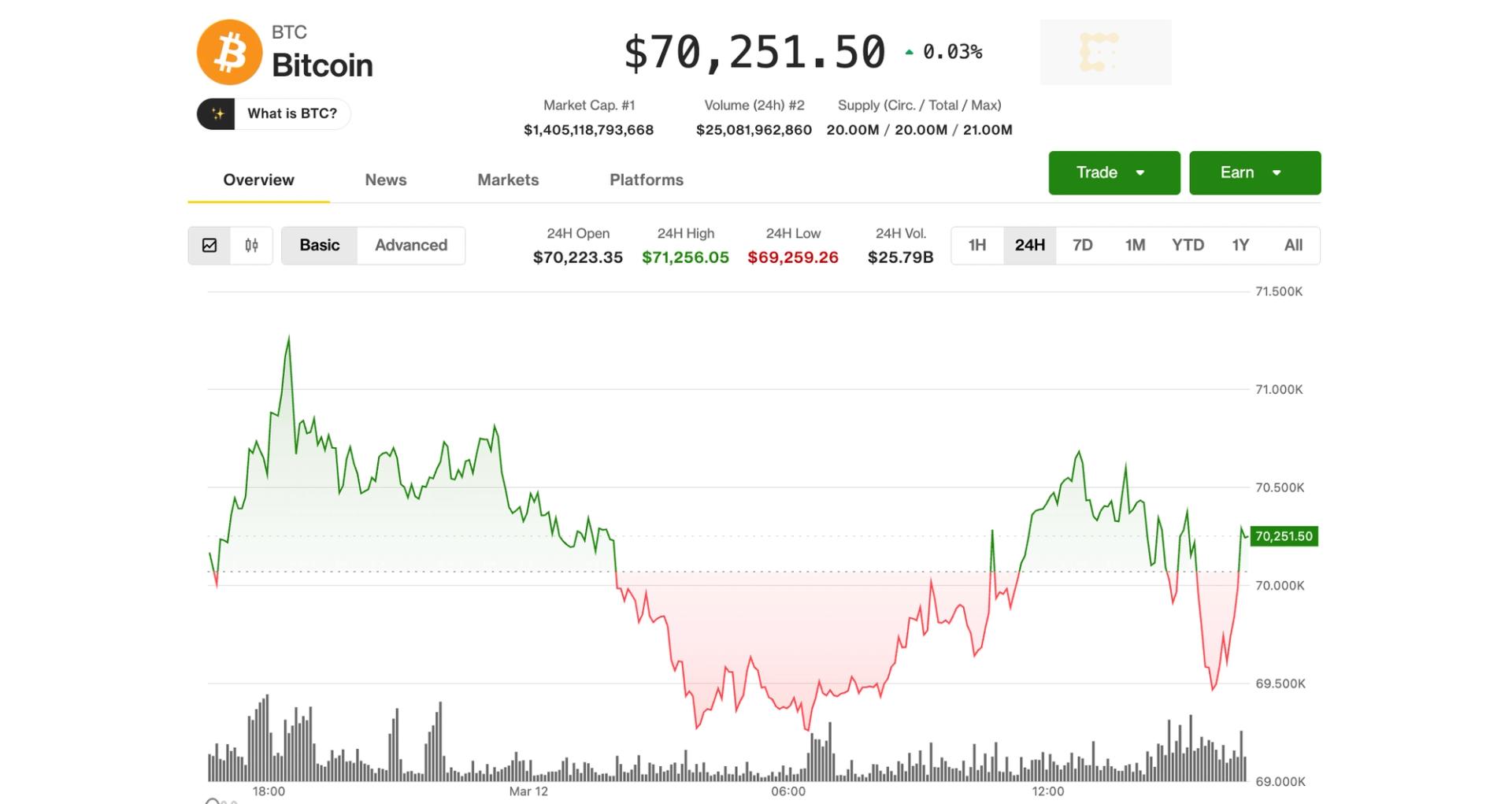
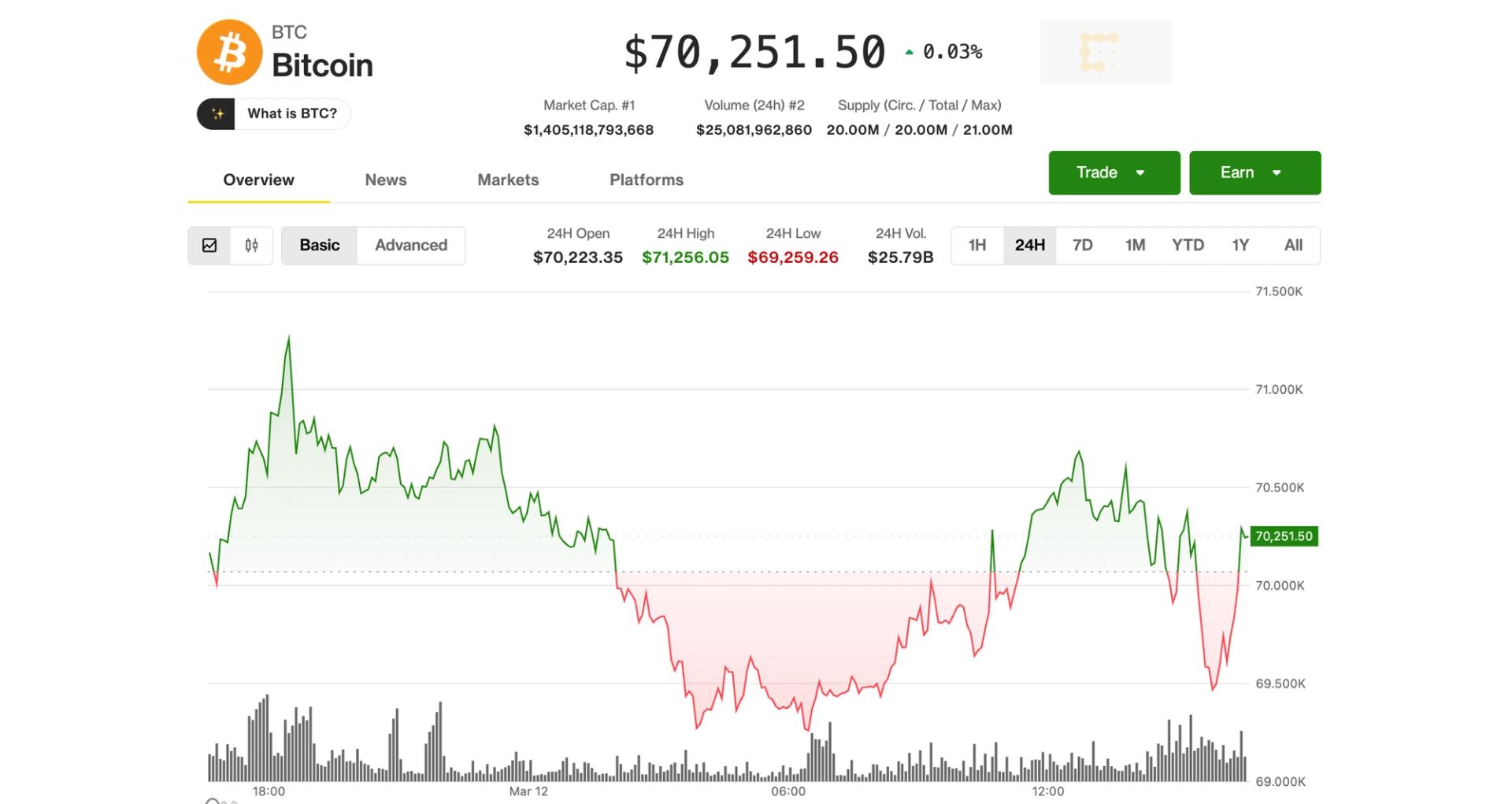
The action is volatile, but bitcoin for the moment is continuing to hold just above the $70,000 even as other risk assets sell off across the board.
Helping to send stocks lower, crude oil prices are up more than 10% and nearing $100 per barrel amid concerns about the Hormuz Strait — a key shipping route for oil tankers.
“Stopping Iran is of more concern to me than oil prices,” said President Trump on Thursday. Meanwhile, in his first public statement since being appointed Iran’s supreme leader, Mojtaba Khamenei said the Strait of Hormuz should remain closed.
“It’s becoming clear to everyone that the Strait is far from under control and potentially impossible to control without severe concessions to Iran, boots on the ground, or huge military risks,” said Quinn Thompson, founder of Lekker Capital. “Things get dicey from here and when backs are up against the wall, volatility increases.”
Nearing the noon hour on the east coast, the Nasdaq is near session lows, down 1.6% and S&P 500 is off 1.2%.
Wiped from the front pages thanks to Iran, but still of major concern are continuing worries about a collapse in private credit. Morgan Stanley (MS) was the latest in a growing series of financial giants to cap redemptions — this one at its $8 billion North Haven Private Income Fund. Shares of Morgan Stanley were down 4% on Thursday, leading declines in the financial sector. JPMorgan, Citigroup, and Wells Fargo were lower by closer to 3%.
In private equity, KKR, Apollo Global, and Ares Management were all sporting 3% to 4% declines.
Gold, meanwhile, was down 0.6% and the 10-year U.S. Treasury yield was higher by three basis points to 4.23%.
Oil drives markets
Oil has become the main driver of crypto prices, according to CoinShares’ head of research, James Butterfill. “The dominant variable in global asset pricing is no longer the labour market. It is oil — and the geopolitical crisis underpinning it,” he said in a note. He argued that the government’s most recent U.S. payroll report, which missed expectations, would’ve normally pushed markets to price in faster rate cuts by the Federal Reserve, but the reaction was muted as investors instead focused on rising energy costs tied to the conflict in the Middle East.
Despite the pullback on Thursday, bitcoin has remained relatively resilient despite rising geopolitical tensions and broader market uncertainty, holding near the $70,000 level even as investors reassess global risks.
The reason could be that large investors are increasingly seeking more than simple exposure to bitcoin’s price, according to Dom Harz, co-founder of layer-2 blockchain BOB. “Institutions want more than exposure to bitcoin and are increasingly looking for the infrastructure designed to unlock Bitcoin’s financial utility,” he wrote in a note, pointing to growing interest in bitcoin-based financial applications that could allow users to spend, save and earn using the network.


- Ethereum price hovered just above $2,000 as whales moved ETH off exchanges.
- Large holder activity sees Ethereum exchange balances fall by over 74,000 ETH this week.
- Bulls could eye $2,188 and potentially $2,600 amid a technical breakout.
Ethereum’s price is holding near the $2,000 level, with bulls eyeing fresh moves above what many analysts see as a crucial psychological level.
The top altcoin traded within a tight range on Thursday, as Bitcoin showed resilience near $70,000.
However, ETH could test recent highs above the level, with whales signaling fresh confidence through notable exchange withdrawals.
ETH whales move coins off exchanges
Details shared by the smartmoney on-chain platform Lookonchain on March 12 indicate that Ethereum whale activity is picking up new momentum.
The Lookonchain X account spotlighted two of these large holder moves, with a newly created wallet address withdrawing 11,629 ETH worth about $23.7 million from Binance.
This transfer is critical as fresh wallets signal new entrants positioning for long-term appreciation.
Notably, Lookonchain also spotted a 63,324 ETH transfer by the whale address 0x8E34. According to the details, this bullish move, worth about $131.2 million, was from the crypto exchange Kraken.
Whales are buying $ETH!
Someone created a new wallet (0xfDe8) and has withdrawn 11,629 $ETH($23.71M) from #Binance in the past 2 days.
Earlier, we also reported that whale 0x8E34 withdrew 63,324 $ETH($131.2M) from #Kraken in the past 2 days.https://t.co/c0fmBE42N6… pic.twitter.com/ro8ikqlk4l
— Lookonchain (@lookonchain) March 12, 2026
What does this mean?
Whale activity had recently subsided as bears threatened to annihilate bulls amid the Iran war.
However, with analysts projecting a likely scenario where crypto rallies in the coming months, exchange outflows are on the rise again.
The two whales have, for instance, moved over 74,950 ETH worth roughly $155 million from centralised exchanges.
Such large-scale shifts can reduce sell-side pressure as fewer coins are available on CEXs compared to historical averages. This relates to an indicator called the scarcity index, which, as the data shows, has shifted positively.
The upbeat outlook for the altcoin comes as Ethereum spot exchange-traded funds recorded a second consecutive day of net inflows with over $57 million on March 11, 2026.
Net inflows increased from $12.6 million on Tuesday, ending a three-day outflow streak.
US spot ETH ETFs are also on track for another week of positive flows, with ETH price holding near the $2,000 level through this period.
Ethereum price analysis
Bulls have struggled since losing the $3,000 mark earlier in the year, and at current levels, hover about 30% down year-to-date.
Macro and geopolitical headwinds have largely allowed bears to dominate. If BTC sinks amid the Iran war sentiment, Ethereum would likely plummet alongside it.
Yet, despite overall sentiment, prices have held within the $1,800-$2,100 range in recent weeks, and $2,000 has emerged as a key short-term pivot mark.
ETH presents a bullish outlook amid its consolidation around this level, with on-chain metrics such as stablecoin inflows, ETFs, and declining exchange reserves pointing to a potential uptick.
Meanwhile, technical indicators such as the Relative Strength Index (RSI) and Moving Average Convergence Divergence strengthen this perspective.
The daily chart shows the RSI hovers near 50, neutral but trending upward. The MACD boasts a bullish outlook with the histogram bars green and expanding.

If prices climb to the channel resistance, bulls may test the 50-day moving average at $2,188. The 100-day moving average provides a dynamic supply wall just above $2,600.
However, the moving averages are trending lower. A close below $1,950 might allow for a bearish retest of $1,800 and potentially YTD lows of $1,740.
ETH changed hands at around $2,057 at the time of writing.
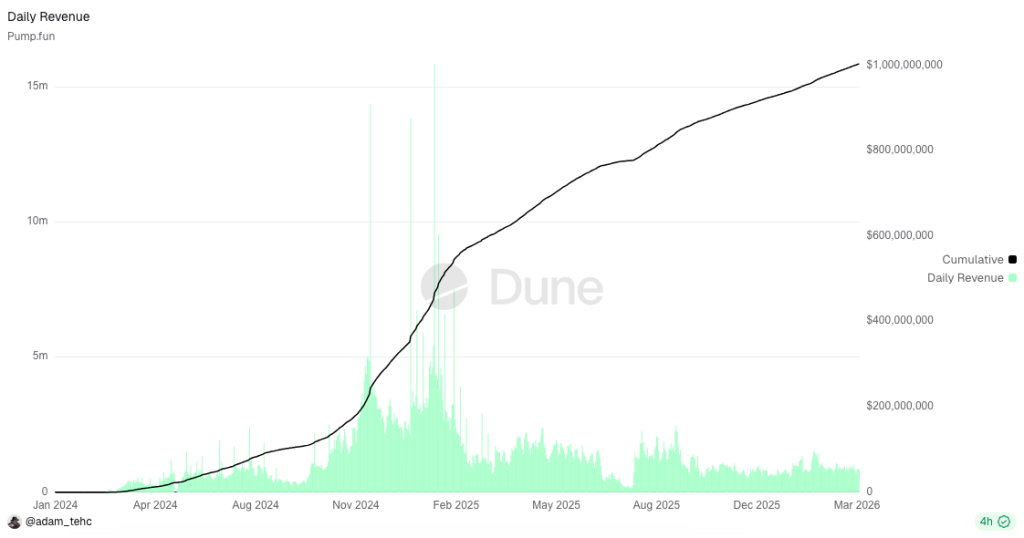
Pump.fun has officially generated over $1 billion in cumulative revenue, becoming the first application in Solana history to cross the ten-figure milestone.
The viral memecoin launchpad, which pioneered the bonding curve model to deter rug pulls, has now outpaced nearly every DeFi protocol in crypto by fee generation.
But the revenue record is already secondary to a potentially larger shift. Subdomain registrations for ethereum.pump.fun, base.pump.fun, and monad.pump.fun have been identified on-chain, signaling that an aggressive cross-chain expansion is imminent.
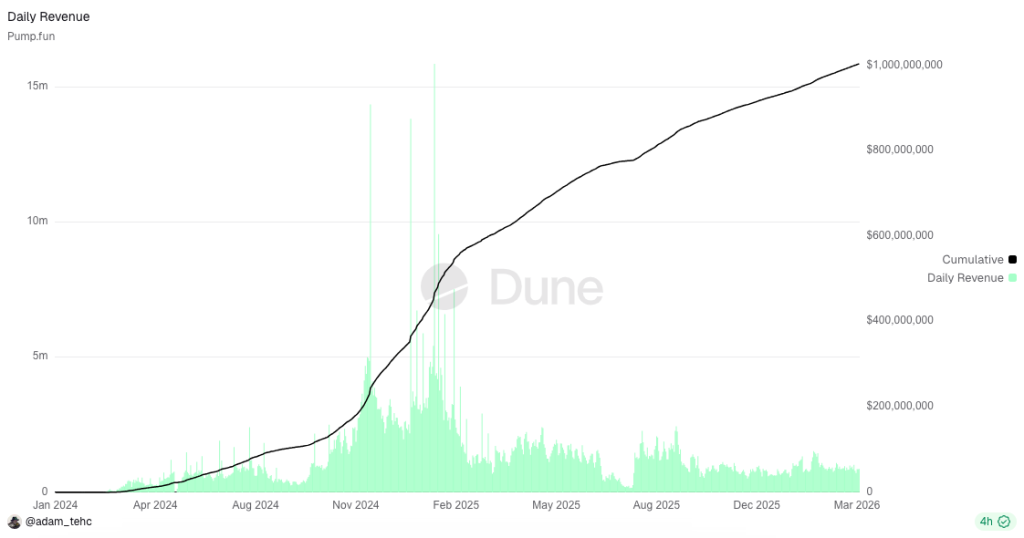
Since its launch on January 19, 2024, Pump.fun has facilitated the creation of around 12 million tokens. At the height of the memecoin frenzy in late 2024, the platform accounted for approximately 62% of all daily transactions on the Solana network.
The platform’s revenue engine is relentless. By April 2025, total fees hit 1.52 million SOL. Daily revenue consistently hovers around $1 million. This volume has made Pump.fun the de facto ‘Solana revenue’ driver, overshadowing legacy DeFi applications.
However, the metrics also reveal the extreme volatility of the product. Data suggests 98.5% of tokens launched on the platform fail to complete their bonding curve, effectively going to zero. Despite this, user retention remains high, with lifetime unique users exceeding 22 million.
Discover: The next crypto to explode
What the Subdomain Registrations Actually Reveal About Pump.fun’s Next Move
The discovery of formatted subdomains for Ethereum, Base, and Monad is not a definitive roadmap, but it is a strong signal of intent.
Expansion to the Base network represents the most logical immediate step. Base has cultivated a thriving retail user base similar to Solana’s, but currently lacks a single dominant launchpad with Pump.fun’s brand recognition.
A successful deployment here would unify the fractured memecoin liquidity currently spread across smaller forks.
The Ethereum subdomain points to a different strategy. While high gas fees historically deterred memecoin trading on mainnet, Wall Street is choosing Ethereum as the backbone of institutional DeFi, which could allow Pump.fun to tap into deeper capital markets.
How Pump.fun Expanding From Solana to Ethereum and Base Changes the Launchpad Wars
If Pump.fun successfully ports its UI and bonding curve mechanics to EVM chains, it instantly threatens native competitors.
On Base, protocols like Clanker have gained traction, but they lack the massive war chest, fueled by $1.3 billion in ICO and private funding, that Pump.fun now commands.
Security remains the primary wildcard in this expansion. The memecoin launchpad sector is notoriously fragile.
Recently, the Bonk.fun website was hijacked by a malicious actor, draining user wallets and highlighting the risks inherent in these high-velocity platforms. Expanding to new chains multiplies these attack vectors significantly.
If Pump.fun can maintain security while deploying on multiple chains, it effectively universalizes the ‘launchpad’ experience, turning it into a chain-agnostic utility rather than a feature exclusive to Solana.
Discover: The best crypto to buy now
The post Pump.fun Is Solana First $1B Revenue App: Expansion to Ethereum Incoming appeared first on Cryptonews.

The run-in: How race for Championship survival shapes up for Portsmouth, West Brom, Leicester City & Co

Saturn Oil & Gas Inc. (SOIL:CA) Q4 2025 Earnings Call Transcript

Concrete integrates with Binance Wallet to enable USDT yield


-
Business6 days ago
Form 8K Entergy Mississippi LLC For: 6 March
-

 News Videos3 days ago
10th Algebra | Financial Planning | Question Bank Solution | Board Exam 2026
-

 Fashion6 days ago
Weekend Open Thread: Ann Taylor
-

 Crypto World3 days ago
Paradigm, a16z, Winklevoss Capital, Balaji Srinivasan among investors in ZODL
-
 Tech1 day ago
A 1,300-Pound NASA Spacecraft To Re-Enter Earth’s Atmosphere
-
 Sports7 days ago
499 runs and 34 sixes later, India beat England to enter T20 World Cup final | Cricket News
-

 Politics6 days ago
Top Mamdani aide takes progressive project to the UK
-

 Tech2 days ago
ChatGPT will now generate interactive visuals to help you with math and science concepts
-

 Business2 days ago
ExxonMobil seeks to move corporate registration from New Jersey to Texas
-

 Sports5 days ago
Three share 2-shot lead entering final round in Hong Kong
-

 Sports4 days ago
Braveheart Lakshya downs Lai in epic battle to enter All England Open final | Other Sports News
-

 NewsBeat22 hours ago
Residents reaction as Shildon murder probe enters second day
-

 NewsBeat7 days ago
Piccadilly Circus just unveiled ‘London’s newest tourist attraction’ and it only costs 80p to enter
-

 Entertainment6 days ago
Hailey Bieber Poses For Sexy Selfies In New Luscious Lip Thirst Traps
-

 Business4 days ago
Search for Nancy Guthrie Enters 37th Day as FBI Probes Wi-Fi Jammer Theory
-

 Business1 day ago
Search Enters Sixth Week With New Leads in Tucson Abduction Case
-
 NewsBeat3 days ago
Pagazzi Lighting enters administration as 70 jobs lost and 11 stores close across Scotland
-

 Tech3 days ago
Despite challenges, Ireland sixth in EU for board gender diversity
-

 Business3 days ago
Search Enters 39th Day with FBI Tip Line Developments and No Major Breakthroughs
-

 NewsBeat1 day ago
I Entered The Manosphere. Nothing Could Prepare Me For What I Found.