

Crypto World
Avalanche’s business chief says crypto must grow up and solve real problems

What he’s saying: Nahas told Sam Ewen on CoinDesk’s Gen C that Avalanche is a business tool, not a crypto product. He said companies want tailored blockchain infrastructure that fits compliance, geography and operational needs.
Nahas compared Avalanche’s model to WordPress, arguing businesses should be able to “spin up” a blockchain the way they spin up websites.
He said Avalanche’s strategy has shifted from broad crypto narratives toward “built for business” and embedded finance.
The goal, according to Nahas, is to help companies either make new revenue through digitization or cut costs through more efficient digital rails.
Why it matters: The discussion shows how one major crypto network is trying to distance itself from speculative token mania and pitch itself as enterprise infrastructure.
Nahas said much of crypto has been “technology for technology’s sake,” with too few products solving concrete customer problems.
He argued that businesses do not want to force their operations onto a shared general-purpose chain if they need privacy, specific fee structures or regulatory controls.
That stance reflects a broader industry push to hide the underlying blockchain and sell outcomes instead: faster payments, tokenized assets and new customer experiences.
Closer look: Nahas said Avalanche’s former “subnets” model, now rebranded as Avalanche L1s, is designed to let businesses run sovereign blockchains with their own validators and rules.
He said Avalanche has more than 70 live L1s and is targeting roughly 200 by the end of the year.
He pointed to use cases including tokenized equities, FIFA digital products, deed records in Bergen County, New Jersey, and tokenized asset programs in Japan.
Nahas said Avalanche’s combined L1 activity is processing about 40 million daily transactions, though those transactions are spread across many chains rather than concentrated on one flagship network.
Reading between the lines: Nahas was blunt that crypto’s critics are not entirely wrong. He said too much of the industry has relied on speculation, weak business models and short-term headlines.
He said “the token was the product” for many projects, which in his view is not a durable business model.
Nahas argued the sector still has not produced enough true “killer apps” that only blockchain can enable, though he suggested stablecoins may be emerging as one of them.
He also said enterprise partners are already in crypto, but often do not like what they see when projects focus more on announcements than execution.
What comes next: Nahas said clearer rules could unlock more institutional activity, even if crypto’s more libertarian wing resists regulation.
He said many companies want to build with blockchain now but will not move until they know where the legal line is.
On AI, he said blockchain-based payment rails could become important for agentic systems and micropayments, pointing to Avalanche partner Kite AI as an example.
His broader argument: the winning crypto platforms will be the ones that act less like ideology and more like dependable business infrastructure.



Disclosure: This article does not represent investment advice. The content and materials featured on this page are for educational purposes only.
Playnance will launch G Coin on March 18 to power transactions across its blockchain gaming and prediction ecosystem.
Summary
- Playnance will launch G Coin on March 18 to power its gaming and prediction ecosystem.
- G Coin will run on PlayBlock, enabling fast, gas-free transactions across platforms.
- Playnance reports 200k token holders and 300k users ahead of the G Coin token generation event.
Playnance is launching G Coin on March 18, introducing the token that will support economic activity across its blockchain entertainment ecosystem.
The company says the token will power interactions across gaming platforms, sports prediction markets, and financial participation tools operating within the Playnance network.
According to Playnance, the token already has more than 200,000 holders prior to its official launch. Roughly 13 billion tokens were distributed during the presale phase. The project’s market capitalization is estimated to be around $38 million ahead of the Token Generation Event.
G Coin is designed to function as the economic infrastructure across the ecosystem. It will facilitate gameplay activity, predictions, rewards, and settlement transactions across Playnance platforms.
The token runs on PlayBlock, the company’s blockchain infrastructure designed to support fast and gas-free interactions while maintaining non-custodial ownership and full on-chain transparency.
Playnance reports that its ecosystem currently includes more than 300,000 registered users and partnerships with over 30 game studios. More than 10,000 blockchain-based games are available across the network.
Across these platforms, around 2 million on-chain transactions are processed daily. Users also interact with more than 2.5 million sports events annually.
Playnance CEO Pini Peter said that G Coin introduces a usage-driven token economy designed to grow alongside its expanding global community.
The company also reported that its “Be The Boss” program has exceeded $2 million in payouts to participants. Total revenue generated across the ecosystem has surpassed $5.3 million.
The token will follow a fixed supply model capped at 77 billion tokens. Circulating supply will be managed through a lock and release system. Tokens lost during gameplay will remain locked for 12 months before being reintroduced to circulation. Unsold tokens from the Token Generation Event will be subject to a 12-month cliff and a 24-month linear vesting schedule.
Disclosure: This content is provided by a third party. Neither crypto.news nor the author of this article endorses any product mentioned on this page. Users should conduct their own research before taking any action related to the company.


For more than a decade, the cryptocurrency industry has promised to reinvent money. Permissionless. Trustless. Borderless. Immune to the recurring failures of traditional finance.
Yet, commonly cited estimates of global ownership all languish below 10% — and the proportion actually using crypto for payments and other tangible uses is likely even less. After billions in venture funding, endless meme coins and nonstop media cycles, crypto remains a niche product held by a tiny fraction of the world’s population. The uncomfortable question is whether crypto has delivered anything indispensable to everyday people.
It hasn’t.
Built for speculators, not users
The largest smart-contract network in the world introduced programmable finance and launched an entire pseudo-decentralized ecosystem. But the onchain experience remains daunting. Users must manage private keys, navigate fragmented exchanges, parse multiple token standards, cross a variety of bridges, and absorb transaction fees that spike without warning. For developers, this is manageable. For everyday users, it’s prohibitive.
One high-speed blockchain marketed itself as the answer: faster, cheaper, higher throughput. Repeated network outages told a different story. Financial infrastructure that goes offline repeatedly cannot realistically serve as the backbone of global commerce. Meanwhile, the network’s enthusiastic embrace of memecoins left ordinary users holding worthless tokens while insiders quietly exited.
Another major project positioned itself as a bridge between crypto and banking institutions. Retail adoption for everyday spending remains nonexistent. Most market activity still centers on speculation rather than commerce, while insiders continue liquidating their personal holdings into the hands of true believers.
Across ecosystems, the pattern repeats: heavy trading volume, much of it wash trading, masking modest real-world usage. Founders unlock their holdings and dump on the people who believed in them most.
Permissionless in theory, custodial in practice
Crypto markets celebrate self-custody and decentralization. In practice, most users hold assets on centralized exchanges because self-custodial wallets remain incomprehensible to anyone outside the industry.
Those exchanges layer on leverage, derivatives and yield instruments that everyday people neither understand nor want. Deposits are frequently rehypothecated — reused as collateral elsewhere — creating synthetic exposure that echoes the very financial engineering crypto claimed to replace. When markets turn volatile, these structures amplify forced liquidations. Price swings cascade through leveraged positions, and true onchain price discovery becomes impossible to separate from derivatives-driven noise.
The result is a paradox: a technology designed to eliminate opaque balance sheets has spawned a new generation of them.
The adoption ceiling
If crypto were solving clear everyday problems, utilization would reflect it. But paying rent in crypto remains a fantasy. Small businesses won’t price goods in volatile native tokens and remain hesitant about stablecoins. Transaction fees are unpredictable. Wallet recovery intimidates new users. Interfaces are confusing and fragmented.
For most holders, crypto is something to buy and hope appreciates, not something to use. Many barely understand what the underlying technology does. A financial revolution that requires tutorials, Discord communities and gas fee calculators has not crossed into mainstream simplicity. People don’t want another tutorial. They want utility they can actually control.
The UX problem no one wants to admit
Most crypto products are built by engineers for engineers, with little consideration for users encountering the technology for the first time. Slippage tolerances, bridging risk, liquidity pools and yield strategies greet newcomers before they’ve completed a single transaction. A single mistake can permanently destroy funds. The onboarding experience is less like opening a bank account and more like configuring a server.
Simply put: The user experience is terrible.
Contrast this with modern consumer finance apps, where transfers are intuitive and costly errors are rare.
Mass adoption will not come from more chains or ever-more-complicated concepts that users must untangle. It will come from abstraction, from making the underlying complexity invisible, the way Apple and Microsoft once hid the command line behind the operating system. Crypto needs to be as easy as sending a text message. Until it is, it will stay in its niche.
The synthetic spiral
Perhaps the most underexamined problem in crypto markets is the dominance of offchain financialization. Perpetual futures routinely exceed spot volume. Leveraged tokens multiply exposure. Lending desks re-collateralize deposits. Wrapped assets circulate across chains. The same underlying token can support multiple layers of claims simultaneously.
The consequences are not theoretical. Bitcoin recently lost half its value, with billions in leveraged long positions liquidated in single-day cascades. Forced selling triggered more forced selling. Prices deviated violently from any reasonable measure of fundamental value, and retail participants, overwhelmingly positioned long, absorbed the damage. The crash was not driven by a change in Bitcoin’s utility or a collapse in adoption. It was driven by the very leverage and synthetic structures the market had layered on top of it.
This is the trap: In trying to escape traditional finance’s complexity, crypto rebuilt it, only faster, more automated and with fewer second chances.
What needs to change
Moving beyond minuscule crypto use requires an honest shift in priorities.
- Simplify the experience. Key management, gas abstraction and cross-chain interaction must become invisible. The technology should disappear behind the task.
- Prioritize real utility over token velocity. Products should enable payments, savings and transfers in ways that are tangibly better than existing systems, usable in daily life rather than merely speculative.
- Ensure transparent backing and verifiable supply. Onchain proof must replace opaque leverage structures. No exceptions.
- Deliver predictable costs. Fee volatility is incompatible with financial infrastructure. Everyday tools shouldn’t behave like auction houses.
- Design for humans, not developers. Consumer-grade UX is not cosmetic. It is existential.
A crossroads
Speculation built awareness. It funded infrastructure. It attracted talent. But speculation alone does not build permanence.
The next chapter of crypto will not be written in token prices or meme cycles. It will be written by projects that quietly integrate into daily life, enabling transactions that are simpler, cheaper and more transparent than the systems they aim to replace. That means tools ordinary people can actually use, seamlessly integrated into their daily lives. Yields that don’t require a Ph.D. to understand. Payment rails that feel as natural as the apps people already trust, backed by infrastructure that serious finance demands.
Until then, the promise of the financial revolution remains exactly that.
And the emperor, for all the code written in his name, still doesn’t have a wallet most people can use.


Tether’s investment arm has invested in Ark Labs, the developer of the programmable Bitcoin infrastructure Arkade, as part of a $5.2 million funding round to expand stablecoin capabilities on the Bitcoin network.
According to Thursday’s announcement from Ark Labs, the investment is intended to support infrastructure that enables stablecoins such as USDT (USDT) to be issued, transferred and settled more efficiently on Bitcoin (BTC).
The Lugano, Switzerland-based startup is developing an execution layer designed to support instant and programmable transactions on Bitcoin. The funding round brings the company’s total funding to $7.7 million.
Other investors in the seed round include Sats Ventures and Contribution Capital, with participation from Anchorage Digital. Specifics on the sizes of the various stakes were not disclosed.
Currently, Bitcoin does not appear among chains hosting stablecoins, as per data from DefiLlama, which shows about $161 billion in stablecoins on Ethereum (ETH) and about $86 billion on Tron (TRX) out of a total stablecoin market capitalization of around $315 billion.
Tether’s independent investment arm deploys capital from the company’s profits and reserves into companies building infrastructure around digital assets and related technologies. Its portfolio spans sectors including financial services, artificial intelligence, energy and digital media.
Arkade is intended to give developers and institutions the ability to build applications such as payments and financial services on Bitcoin by enabling more complex transaction logic than the base layer currently supports.
The investment comes about a week after Tether, the issuer of USDT, the largest stablecoin by market capitalization, led a $50 million investment round in sleep technology company Eight Sleep aimed at supporting the integration of artificial intelligence agents into its products.
Related: Bitcoin catching up to gold hints at an ‘opportunity within risk’
Companies expand financial infrastructure on Bitcoin
While Bitcoin is not traditionally known for supporting complex financial applications, a growing number of companies are building infrastructure aimed at expanding Bitcoin’s use beyond simple transfers into payments and financial applications.
In 2023, Bitcoin infrastructure company Lightning Labs released the mainnet alpha of Taproot Assets, a protocol designed to enable stablecoins and other assets to be issued on Bitcoin and transferred over the Lightning Network.
Other initiatives include Rootstock, a smart contract platform secured through merged mining with Bitcoin that supports decentralized finance (DeFi) applications tied to the network.
Institutional players have also begun integrating Bitcoin-based financial layers. In February, crypto custody provider Fireblocks said it would integrate the Stacks blockchain, a decentralized finance layer for Bitcoin, to give institutional clients access to lending and yield opportunities tied to Bitcoin-based DeFi.
In March, Bitcoin staking infrastructure developer Babylon Labs said it would work with Ledger, a hardware wallet maker, to enable users to lock Bitcoin into programmable vaults while maintaining self-custody of their assets.
Magazine: All 21 million Bitcoin is at risk from quantum computers

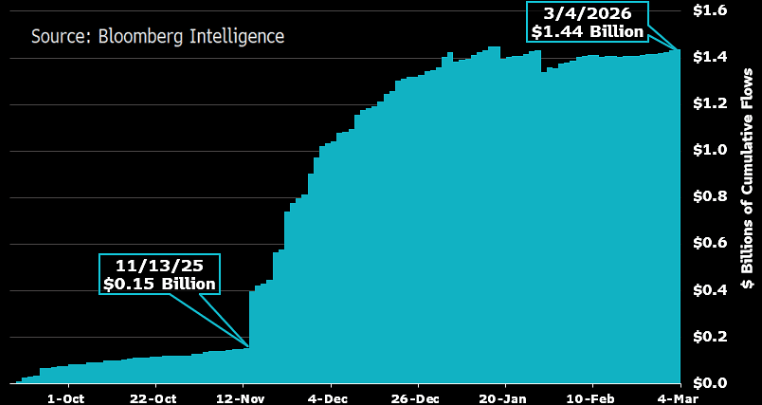
Exchange-traded funds (ETFs) tracking the cryptocurrency XRP have attracted approximately $1.4 billion in cumulative inflows since their launch, according to recent data from analysts at Bloomberg Intelligence. The figures suggest sustained investor interest in XRP-based investment products despite ongoing volatility across the broader digital asset market.
XRP ETFs Attract Investors Despite Market Volatility
According to data provided by analyst James Seyffart, capital has been slowly draining into XRP-oriented ETFs since their launch. This is due to the fact that the inflows have continued despite the variation in price on the altcoin, indicating a steady institutional demand.
According to market observers, the ETFs provide an institutional investor with a regulated way of gaining exposure to digital assets without having to hold the cryptocurrencies themselves. Consequently, asset managers and other large institutions have become more and more familiar with ETFs as a vehicle to gain exposure to crypto.
This milestone of $1.4 billion was reached at a time when the XRP had been experiencing price adjustments in the general cryptocurrency market. Generally, decline in the asset prices may lower the inflows of investors, but the XRP based ETFs have registered positive fund flows.
Analysts observe that the ETF structure is mostly appealing to long-term investors who can see price declines as possible buying points. Such strategies are widely used among asset managers and institutional investors who tend to consider short-term fluctuations as a longer investment period.
ETFs Expand Regulated Access to Cryptocurrency Investments
ETFs have emerged as one of the most visible financial products that enable investors to be exposed to cryptocurrencies in regulated financial markets. Through traditional investment brokerage accounts, investors are able to buy or sell crypto-linked investments without buying and holding digital tokens.
In the case of XRP, an increase in the number of ETF products may greatly increase market inclusion, especially among those investors who are more comfortable with traditional financial instruments, as opposed to managing actual crypto trading.
The long-term inflows into XRP-bound funds might indicate the increased trust of institutional investors in the cryptocurrency industry. Analysts often view ETF inflows as a long-term demand in new asset classes.
Should the trend persist, analysts believe that ETF demand will become one of the most important metrics to look at as far as future performance and institutional adoption of XRP are concerned.

Bitcoin’s long-run price relationship with gold is flashing a bullish signal after a retracement that mirrors levels seen in 2017, 2022, and 2023. The BTC–gold ratio has begun to show strength in tandem with a bullish divergence on the daily RSI, a setup that traders watch as a potential pivot from risk-off to risk-on sentiment. Analysts describe the moment as an “opportunity within risk,” where macro volatility intersects with a nascent shift in capital allocation. As liquidity shifts and institutional attention debates the next leg for bitcoin, the ratio’s behavior is drawing renewed interest from traders watching the macro backdrop and cross-asset dynamics.
Key takeaways
- The Bitcoin-to-gold ratio is signaling a bullish divergence on the daily RSI, suggesting fading selling pressure even as prices form lower lows.
- In February, the BTC/Gold ratio retraced toward a key support zone around 12–13, a level that has acted as resistance in 2017 and as support in 2022–2023, potentially marking a long-term bottom for the pair.
- Gold ETF flows showed a major outflow, with SPDR Gold Shares (GLD) shedding about $3 billion on March 6, highlighting risk-off repositioning in precious metals amid broader market volatility.
- Bitcoin ETF flows turned positive in March, with 30-day net inflows of $906 million by March 11, indicating a resurgence of institutional participation after prior outflows.
- Macro conditions are described by policymakers and researchers as creating a window of “opportunity within risk” for BTC, as bitcoin’s correlations with macro assets like oil and U.S. equities shift amid geopolitical tensions.
- Despite these signals, ETFs still account for a relatively small share of total BTC spot trading, implying substantial room for future institutional expansion.
Tickers mentioned: $BTC, $GLD
Sentiment: Bullish
Price impact: Positive. A confluence of improving ETF inflows for BTC and a rebound in the BTC/Gold ratio suggests upside potential, though macro risk remains a consideration for near-term moves.
Market context: A backdrop of macro volatility is shaping crypto liquidity and cross-asset flows, with rising institutional activity in BTC spot trading contrasted against ongoing gold ETF dynamics and geopolitical drivers that influence risk appetite.
Why it matters
The BTC–gold ratio has long served as a proxy for risk sentiment and cross-asset competition between non-sovereign stores of value. A bullish divergence on the RSI — when price forms lower lows while momentum indicators crest higher lows — points to waning selling pressure and the potential for a trend reversal. If the ratio can sustain a bottom near the 12–13 range seen in prior cycles, Bitcoin could embark on a multi-year re-pricing against gold, implying shifts in diversification strategies among investors who balance crypto exposure with traditional inflation hedges.
The flow dynamics underscore a broader transition in investor posture. The SPDR Gold Shares (GLD) outflow near $3 billion on March 6 suggests a tactical rotation away from gold, at least in the short term, while Bitcoin’s ETF balances and net flows have started to revert from net outflows to net inflows in early March. For background context, a notable observation from the Kobeissi Letter highlighted the scale of GLD’s outflow and compared it to activity seen over the last two years, underscoring how large-cap moves in the precious metals space can influence risk-on/risk-off cycles across assets.
On the BTC side, the institutional signal has begun to resume. The 30-day change in Bitcoin ETF balances turned positive, moving to 12,909 BTC after a prior period of heavy withdrawals, even as gold ETF holdings declined. This juxtaposition illustrates a shifting appetite for bitcoin among large market participants who historically favored traditional hedges during times of geopolitical stress. Binance Research has framed these dynamics within a wider macro context, noting that volatility can occasionally create an “opportunity within risk” for Bitcoin when macro assets move in a correlated fashion with energy and equities markets.
Against this backdrop, market participants are also watching the role of exchange-traded products in driving liquidity. Bitcoin’s share of US spot ETF trading volume has edged higher in recent weeks, signaling growing institutional participation, though it remains a minority share of total activity. If this trend continues, it could bolster BTC’s capacity to absorb shocks and sustain upside momentum when risk sentiment improves. The broader narrative—geopolitical tensions, inflation dynamics, and policy expectations—continues to influence price behavior in ways that can either exacerbate volatility or unlock durable moves when catalysts align.
As noted in prior coverage, historical patterns around midterm elections and macro shocks show BTC delivering varying returns, but the longer-run perspective remains constructive for BTC vs. gold when risk-on sentiment returns. It is at these points that the BTC–gold ratio might transition from a defensive stance to a more cyclical, growth-oriented trajectory, supported by increasing institutional flows and a measured reallocation of capital between crypto and traditional hedges.
What to watch next
- Monitor the BTC/Gold ratio’s ability to hold the 12–13 support area and whether momentum confirms a new uptrend on the weekly chart.
- Track SPDR Gold Shares (GLD) flows for signals of renewed risk-off rotations or renewed interest in gold as a hedge.
- Watch 30-day BTC ETF balance changes and overall ETF flow data for a sustained shift from selling to buying pressure.
- Observe the share of US spot trading volume attributed to BTC-related ETFs as institutional participation strengthens.
- Keep an eye on macro developments and geopolitical events that could reaccelerate cross-asset correlations, affecting both BTC and gold dynamics.
Sources & verification
- World Gold Council data on gold ETF flows and holdings to corroborate the GLD outflow narrative.
- Kobeissi Letter commentary on GLD flows and the scale of the recent outflow.
- Bold.report data showing the 30-day BTC ETF net inflows improving to approximately $906 million as of March 11.
- Binance Research weekly market commentary (March 11, 2026) discussing macro volatility and Bitcoin’s opportunity within risk.
- Cointelegraph coverage on Bitcoin versus gold ETF flows and related market dynamics, including references to BTC/Gold ratio behavior and RSI signals.
Bitcoin’s long-run tilt against gold signals a potential trend shift
Bitcoin (CRYPTO: BTC) is tracing a long-horizon pattern versus gold that could hint at a broader regime shift in capital allocation. The BTC–gold ratio has recharged after a dip that aligned with major macro events, and a bullish RSI divergence on the daily chart indicates a possible easing of downward price pressure. The retrace to a support zone around 12–13 on the BTCXAU scale echoes a critical juncture seen in 2017 before a multi-year acceleration, as well as the stabilization seen in 2022 and 2023. While the exact path remains uncertain, traders are watching whether this level holds as a foundation for a durable breakout from a bear-market phase in the ratio.
One pivotal factor is the flow dynamic between gold and bitcoin-related instruments. The SPDR Gold Shares (GLD) ETF experienced a sizable outflow around March 6, a signal that risk-off capital was rotating away from bullion at that moment. The Kobeissi Letter captured the magnitude of the move, noting that the outflow exceeded typical daily shifts by a wide margin. In contrast, Bitcoin-focused ETF activity began to show renewed interest, with 30-day BTC ETF balances flipping from negative territory to a positive drift. By March 11, net inflows reached roughly $906 million, suggesting a re-emergence of institutional participation in BTC markets after prior corrections.
The macro backdrop adds an additional layer of nuance. Binance Research described current volatility as creating a meaningful “opportunity within risk” for Bitcoin, pointing to how BTC’s price action has begun to mirror other macro assets amid regional tensions and shifting risk sentiment. In practical terms, this means that while geopolitical developments can drive immediate volatility, they can also create dispersion that benefits an asset with growing institutional interest and a robust macro narrative. The market’s liquidity dynamics—particularly the share of BTC trading volume emanating from spot ETFs—signal that institutions are cautiously increasing exposure, even as overall ETF penetration remains below highs observed in broader equity markets.
Looking ahead, the critical question is whether BTC can sustain a higher-low trajectory against gold and crack the resistance that defines the current phase. If the ratio remains supported and momentum continues to strengthen, Bitcoin could extend its outperformance relative to gold in the coming quarters. The market’s response to macro news, regulatory developments, and ETF flows will likely shape whether this divergence translates into a sustained trend or a temporary re-pricing within a broader range.


Bitcoin’s overheating indicators remain moderate compared with previous market cycle peaks.
Bitcoin’s LTH Realized Supply stood at 8.05 million BTC as of March 11, 2026, representing a decline of roughly 5.5% from the cycle peak of 8,529,671 BTC recorded on March 8, 2026, when the asset traded at $65,974, and the metric’s Z-score reached 3.20.
At the time of the latest reading, the Z-score had eased to 2.66.
Compressed Cycle
According to crypto analyst Axel Adler Jr., despite the recent pullback, the amount of Bitcoin held by long-term holders at this point in the cycle remains historically high. When compared with previous cycles at the same post-halving stage, day 691 after the halving, the current cycle shows significantly larger holdings.
In fact, the total volume of coins held by long-term holders was found to be about 1.52 times higher than during the 2020 cycle and roughly 3.4 times higher than in the 2016 cycle at equivalent points. Adler explained that the current Z-score of 2.66 is very similar to the 2016 cycle reading of 2.94 at the same stage. In the 2016 halving cycle, this period witnessed the early phase of the final redistribution period, which continued for approximately another 200 days before the metric reached its all-time high in December 2018.
On the other hand, the 2020 cycle displayed a very different structure at the same point in time. At day 691 following the halving in that cycle, the Z-score was only 1.08, reflecting the end of the bear market following the Terra/LUNA collapse, and the LTH Realized Supply had already been declining for eight months from its peak.
Adler also examined the MA365 ratio, which currently stands at 1.595 in the ongoing cycle. This level is lower than the equivalent ratio in the 2016 cycle, which was 2.523, and slightly higher than the 2020 cycle value of 1.502. According to the analyst, this means that the degree of overheating relative to the one-year moving average remains moderate.
In previous cycles, the final peaks of LTH Realized Supply occurred between days 880 and 912 after the halving, almost 190 to 220 days later than the current point in the cycle. In those cycles, the Z-score ultimately climbed to between 4.24 and 4.94 before the peak was reached. If the present cycle follows a similar timeline, Adler said the current peak could represent only an intermediate high rather than the final one.
You may also like:
Accumulation Loses Momentum
However, he also pointed out that the current cycle differs structurally from earlier ones because institutional inflows into Bitcoin ETFs have locked up large volumes of coins, thereby reducing the share of supply available for active circulation and potentially accelerating the accumulation process among long-term holders.
There has also been a slowdown in accumulation momentum, as the 30-day rate of change is currently at +7.6%, far below the levels seen in comparable phases of previous cycles, when the metric rose by as much as 87% in 2016 and 51.6% in 2020. According to the analyst, the declining growth rate suggests the market may be entering a stabilization phase following the strong accumulation seen in January and February 2026.
Binance Free $600 (CryptoPotato Exclusive): Use this link to register a new account and receive $600 exclusive welcome offer on Binance (full details).
LIMITED OFFER for CryptoPotato readers at Bybit: Use this link to register and open a $500 FREE position on any coin!

The SEC and CFTC have signed a formal memorandum of understanding to coordinate digital asset oversight, ending years of jurisdictional conflict that forced crypto firms to navigate competing regulatory demands simultaneously.
The agreement establishes six priority areas: shared crypto-asset taxonomy, coordinated enforcement decisions, joint regulatory examinations, policymaking alignment, a new harmonization website for simultaneous agency input on firm applications, and confidential supervisory data sharing between the two bodies.
— U.S. Securities and Exchange Commission (@SECGov) March 11, 2026
 TODAY: Alongside the @CFTC, we entered into an updated Memorandum of Understanding to guide future coordination between our two agencies.
This MOU will support lawful innovation, uphold market integrity, and promote investor and customer protection.
Link in the comments. pic.twitter.com/tAJbYrukvs
Both agencies also launched a Joint Harmonization Initiative to work through product classification, regulatory reporting, clearing and margin systems, and cross-market surveillance.
The practical upshot: firms regulated by both agencies no longer ping-pong between conflicting requirements.
Discover: The best new crypto!
What the SEC-CFTC MoU Actually Establishes
The memorandum sets binding procedures across policymaking, supervisory activities, enforcement, and regulatory examinations.
Critically, it commits both agencies to aligning certain regulatory definitions, targeting the classification gap that has left token issuers and exchanges uncertain whether they’re dealing with a security, a commodity, or both.
The Joint Harmonization Initiative covers joint examinations on product applications from dual-regulated firms, coordinated planning to reduce duplicative compliance burdens, and a dedicated harmonization website where firms can submit applications and receive simultaneous input from both agencies.
SEC Chairman Paul Atkins stated earlier this year: “For too long, market participants have been forced to navigate regulatory boundaries that are unclear… This event will build on our broader harmonization efforts to ensure that innovation takes root on American soil.”
What the SEC-CFTC Deal Means for Crypto Exchanges, Tokens, and Custody
For exchanges, the immediate benefit is jurisdictional clarity on token listings: the shared crypto-asset taxonomy means classification decisions carry weight at both agencies simultaneously.
Custody providers and dual-regulated firms gain a single supervisory pathway rather than sequential examinations that surfaced conflicting findings. Token issuers targeting U.S. markets now have a defined framework to engage rather than a guessing game between agencies.
The agreement also has direct implications for stablecoin issuers, whose products can fall under SEC or CFTC jurisdiction depending on classification, precisely the ambiguity the harmonization initiative targets.
The agreement advances independently of the CLARITY Act, the House bill that passed in July 2025 that would hand CFTC primary spot market authority, but remains stalled in the Senate over disputes between the banks and the industry around stablecoin yields and tokenized assets.
If the CLARITY Act clears the Senate, it codifies the MoU’s framework into law. If it stalls further, the MoU still delivers operational coordination, just without statutory backing.
Discover: The top crypto to diversify your portfolio with
Is US Regulation Here? The Next Steps…
The harmonization website launch is the first concrete milestone, it determines how quickly dual-regulated firms can access the new joint application pathway.
Watch also for the first coordinated enforcement action under the MoU, which will signal whether the agencies are genuinely aligning on classification or still operating in parallel.
The days of turf battles between the @CFTC and @SECgov are over. @SECPaulSAtkins and I are working together, and today’s Memorandum of Understanding solidifies our efforts to achieve our mutual goals of harmonization. — Mike Selig (@ChairmanSelig) March 11, 2026
Read the full MOU  https://t.co/MJhgT1iYTU pic.twitter.com/iggsTtoTfe
Democrats have already signaled continued pressure on crypto-adjacent markets, and the MoU’s prediction market and perpetual futures frameworks will face scrutiny in that context.
If the CLARITY Act advances through the Senate in 2026, the MoU becomes the operational layer beneath a full statutory framework, and the U.S. emerges with the most structured crypto regulatory environment globally.
The post SEC and CFTC End Regulatory Turf War With Joint Crypto Coordination Deal appeared first on Cryptonews.

Bitcoin (CRYPTO: BTC) faces a long-running security debate as researchers map the timeline over which quantum computing could undermine current cryptography. A white paper from Ark Invest, prepared with Unchained Capital’s insights, argues that a substantial portion of the BTC supply is not immediately exposed to such a threat, while a meaningful minority could require attention in the years ahead. The study estimates that roughly 65.4% of the circulating BTC is not vulnerable to a quantum-based breakthrough today, leaving about 34.6% at risk under certain assumptions about address behavior and key exposure. In concrete terms, the assessment breaks down the vulnerable pool into roughly 5 million BTC that could migrate due to address reuse, about 1.7 million BTC (around 8.6% of supply) possibly lost in legacy P2PK (Pay To Public Key) addresses, and roughly 200,000 BTC (about 1%) that could migrate because of newer P2TR (Pay To Taproot) formats. The authors contend that breaking Bitcoin’s elliptic-curve cryptography would require a quantum computer with thousands of qubits and a vast number of quantum gates, meaning a direct attack remains distant, even as prep work accelerates. Even so, their practical feasibility would require quantum systems to reach performance levels that our research suggests will take much time to achieve.
“Even so, their practical feasibility would require quantum systems to reach performance levels that our research suggests will take much time to achieve.”
The Ark Invest analysis sits alongside broader discussions about the pace of quantum development. It contrasts with a February CoinShares assessment, which estimated that only about 10,200 BTC—roughly 0.05% of the supply—present true market-relevant quantum risk, even though older P2PK addresses still carry theoretical exposure. Separately, progress in quantum hardware continues apace: a landmark facility capable of housing one million physical qubits, a scale that dwarfs typical data-crunching rigs, is slated for completion in 2027. Chicago-based PsiQuantum leads the project, backed in part by BlackRock-linked funds, underscoring institutional interest in quantum infrastructure as much as cryptographic risk.
Quantum breakthrough remains “long-term risk” for Bitcoin
The white paper frames quantum risk as a gradual, multi-stage development rather than an instantaneous vulnerability. It outlines five stages of quantum computing progress, with the most consequential impact—breaking ECC at a pace faster than Bitcoin’s block interval—occurring only in the final stage. In practical terms, Bitcoin’s exposure from migrating or reusing addresses would remain limited until stage 3, when a quantum computer could break the 256-bit ECC key. The authors point to a mid-2030s window for the first public-key break, a benchmark derived from assessments by major tech firms such as Google, IBM and Microsoft. The conclusion is not alarmist, but it signals that the network has time to study protections and plan upgrades without rushing a hard fork or governance overreach.
“Those who hold and transact Bitcoin should regard quantum risk as a long-run risk rather than an imminent threat,” the paper notes, framing it as a call to prepare rather than panic. The authors emphasize that awareness and foresight will be essential as the risk migrates through the network over time, potentially shaping how wallets, exchanges and custodians think about security architecture in the coming decade. The discussion also touches on governance frictions: unlike a single-fork upgrade, implementing post-quantum safeguards across Bitcoin’s decentralized consensus model will require broad alignment across nodes, miners and developers.
The Ark Invest report includes a figure on the multi-stage trajectory of quantum advancement but also flags a practical nuance: even at higher stages, the speed of a security breach would depend on the specific cryptographic primitives in use and how quickly the ecosystem migrates to post-quantum alternatives. In the meantime, researchers and builders are exploring how to harden the network with post-quantum cryptography (PQC) while preserving compatibility and performance. The authors also discuss candidate post-quantum schemes, such as ML-DSA (lattice-based) and SLH-DSA (hash-based), which are among the approaches considered for future resilience.
On the governance frontier, the paper notes that a wholesale, rapid shift to PQC would be challenging under Bitcoin’s consensus rules. A proposed path discussed in the literature is BIP-360, which contemplates a Pay-to-Merkle-Root type output designed to mitigate long-exposure quantum risk without immediately reworking the entire signature ecosystem. Yet, the authors caution that BIP-360 is not a cure-all; it does not itself embed post-quantum signatures, which the team regards as essential for durable protection against quantum attacks. Experts such as Chris Tam of BTQ Technologies have underscored this gap, arguing that effective post-quantum defense requires signatures, not just new address formats.
The broader takeaway is that quantum risk, while real, is a long-term concern that invites proactive planning rather than haste. The Ark Invest paper emphasizes that the transition to quantum-safe mechanisms will likely unfold in stages, with ongoing research, testing and governance conversations shaping the path forward. As the spotlight intensifies on quantum hardware, Bitcoin’s security posture will increasingly hinge on how the community negotiates practical upgrades within a decentralized framework that favors gradual, consensus-driven change.
In closing, Ark Invest’s analysis corroborates a cautious but constructive view: the threat remains distant enough to permit careful preparation, yet imminent enough in its trajectory to justify continued investment in quantum-ready cryptography and related upgrades. The dialogue around post-quantum protections—beyond mere address formats—reflects a mature understanding that long-horizon risk requires long-horizon solutions, coordinated across ecosystems from core developers to wallet providers and exchanges.
Why it matters
For individual holders, the report underscores that the security of today’s holdings relies on a combination of on-chain design and user behavior. A sizable portion of BTC may still be at risk only if quantum attackers gain the means to break elliptic-curve cryptography in a time window long enough for the network to implement upgrades. This matters not as a near-term crisis, but as a strategic reason to stay informed about post-quantum advances and to monitor consensus-driven proposals that could alter how keys and addresses are managed in the future.
For builders and wallet providers, the analysis highlights the importance of future-proofing infrastructure. The emergence of PQC standards and the potential need for quantum-safe address formats could influence wallet compatibility, key management, and transaction verification. The discussion around BIP-360 — and the broader push toward signatures resilient to quantum attacks — points to a practical roadmap where security upgrades are evaluated in stages rather than through abrupt protocol changes.
For the market at large, the study underscores that quantum readiness is increasingly a governance and investment narrative as much as a technical one. The prospect of a major quantum milestone, like a million-qubit facility, signals a broader shift toward quantum readiness across technology and finance, which could impact risk appetite, capital allocation and the pace at which institutions engage with crypto security initiatives.
What to watch next
- Progress on BIP-360 and any proposals to introduce post-quantum signatures or other PQC-based protections.
- Updates to Ark Invest’s research or new white papers that refine the share of vulnerable BTC as quantum hardware advances.
- Milestones in quantum hardware deployments, including PsiQuantum’s 1-million-qubit roadmap and related funding developments.
- Adoption timelines for post-quantum cryptography standards and their integration into Bitcoin’s consensus framework.
Sources & verification
- Ark Invest and Unchained’s white paper on Bitcoin and quantum computing, including address migration and exposure breakdown. https://www.ark-invest.com/Thank-You/bitcoin-and-quantum-computing?submissionGuid=0568c5c5-6004-4bb3-9c71-ad9f904c3cf6
- CoinShares analysis referenced in February detailing market-relevant quantum risk estimates. https://cointelegraph.com/news/only-10k-bitcoin-quantum-risk-coinshares
- Announcement of PsiQuantum’s one-million-qubit facility with BlackRock-linked funding. https://cointelegraph.com/news/construction-quantum-facility-1m-qubits-begins
- BIP-360 post-quantum discussion and related commentary, including the critique that it lacks post-quantum signatures. https://cointelegraph.com/news/bitcoin-quantum-resistant-bip-360-post-quantum-signatures-taproot
- Perspective on the potential timeline for post-quantum upgrades, including expert commentary from BTQ Technologies. https://cointelegraph.com/news/whale-9b-bitcoin-sale-not-quantum-concerns-galaxy-digital

Editor’s note: Concrete’s integration with Binance Wallet signals a shift in DeFi yield access. By embedding risk-adjusted USDT strategies directly into a widely used wallet, the collaboration aims to simplify entry for institutions and retail investors alike, while reducing interface fragmentation that has long hindered on-chain yield infrastructure. This milestone highlights a broader push toward robust, audited yield capabilities that prioritize risk management and transparency, rather than chasing short-term gains.
Key points
- Concrete vaults are accessible inside Binance Wallet for USDT yield strategies.
- Modular architecture separates custody, strategy execution, and accounting to lower friction.
- Promotional rewards up to $200,000 for eligible participants staking 100 USDT via Binance Wallet.
- Focus on risk-adjusted, institutional-grade strategies over short-term yield chasing.
Why this matters
Bringing Concrete into a major wallet ecosystem reduces fragmentation and broadens access to disciplined DeFi yield infrastructure, with emphasis on risk management and transparent evaluation of strategy parameters.
What to watch next
- Real-time APY will adjust dynamically based on participation and market conditions.
- Uptake of the rewards program and staking in the Concrete USDT Vault via Binance Wallet.
- Expansion of access as Concrete vaults become native inside Binance Wallet ecosystem.
Disclosure: The content below is a press release provided by the company/PR representative. It is published for informational purposes.
Concrete Integrates with Binance Wallet to Enable Access to Institutional-Grade USDT Yield
As demand for stablecoin yield grows, Concrete’s vault technology brings institutional strategy execution directly into one of the world’s largest wallet ecosystems.
NEW YORK, March 12, 2026 – Blueprint Finance, a multi-chain DeFi infrastructure company, today announced that its Ethereum-based institutional-grade vault infrastructure, Concrete, has integrated with the Binance Wallet ecosystem. This milestone enables Binance Wallet users to access sophisticated, risk-adjusted USDT yield strategies directly through their native wallet interface.
Concrete is purpose-built to address fundamental challenges in DeFi by providing infrastructure that prioritizes risk-adjusted yield strategies over short-term yield maximization.
“Integrating Concrete directly into Binance Wallet is a major step toward making sophisticated on-chain yield infrastructure accessible at a global scale,” said Nic Roberts-Huntley, CEO and co-founder of Blueprint Finance. “For too long, sophisticated on-chain yield strategies have been siloed behind fragmented interfaces and operational complexity. By embedding Concrete Vaults natively within one of the world’s most widely used wallet ecosystems, we’re bringing disciplined, risk-adjusted USDT yield strategies[1] to a global audience. This integration reflects the signal that DeFi is headed away from unsustainable yield chasing and toward infrastructure that institutions and retail users alike can rely on.”
Institutional-grade vault strategies are available natively inside one of the most widely used wallet ecosystems in the world. With tens of millions of users globally, Binance has become the gateway through which retail participants, power users, and institutions alike access decentralized finance. This integration also removes the fragmentation that has historically kept advanced on-chain strategies out of mainstream reach.
Concrete’s vault engine utilizes modular smart contract architecture and quantitative modeling frameworks originally developed for institutional environments. It separates custody, strategy execution, and accounting into enforceable layers, while automation reduces operational friction. Concrete Vaults seek to provide risk-adjusted, institutional-grade strategies, where each strategy is evaluated using quantitative models that account for volatility, downside probability, liquidity depth, and execution costs.[2]
To celebrate the integration, Concrete is launching a promotional rewards campaign of up to $200,000 in total rewards for eligible participants. Eligible users who stake at least 100 USDT in the Concrete USDT Vault via Binance Wallet may participate in the rewards program, alongside the vault’s ongoing yield generation. Reward structure and form are subject to change. Real-time APY will adjust dynamically based on participation and market conditions.
Visit concrete.xyz for more information.
About Concrete
Concrete is an Ethereum-based protocol that provides institutional-grade tooling for on-chain yield generation. With a proven track record of executing billions in structured flow volume, Concrete offers sophisticated vault architecture and strategy layering to enable secure and transparent yield generation in the DeFi ecosystem. Concrete is part of the Blueprint ecosystem.
About Blueprint Finance
Blueprint Finance is a multi-chain DeFi infrastructure company and the core developer of both the Ethereum-based Concrete and Solana-based Glow Finance. Concrete powers tokenized DeFi native vault infrastructure and the creation of new derivatives for any asset, while Glow powers yield, trading, and lending on Solana. The company’s quantitative framework transforms complex DeFi mechanisms into products that work reliably for both institutions and individuals alike. By eliminating traditional DeFi pain points, such as liquidation risk and capital fragmentation, Blueprint is building the technical foundation for broader institutional adoption of decentralized finance.
This press release is for informational purposes only and does not constitute an offer of securities, investment advice, or a solicitation of any kind. Yield is variable and not guaranteed. Past performance is not indicative of future results. Participation involves smart contract risk, market risk, and potential loss of principal. Users should review all applicable terms and conduct their own research before participating. Concrete vaults are not insured by any government agency.
[1] Risk-adjusted” refers to Concrete’s use of quantitative models to evaluate strategy parameters such as volatility, downside probability, liquidity depth, and execution costs. It does not imply elimination of risk or guarantee of returns. All strategies involve risk, including potential loss of principal.
[2] Strategy evaluation frameworks are subject to change and may not capture all relevant risk factors. Quantitative modeling does not guarantee performance or prevent losses.


- Hyperliquid price rose to its highest level in over a month as it touched $38.08.
- The HYPE is up amid increased trading activity as open interest jumps to over $1.56 billion.
- Technical indicators on the daily chart suggest a bullish continuation.
What’s driving the HYPE price up?
Bitcoin’s rally above $70,000 following Wednesday’s CPI data helped lift sentiment across the broader crypto market, even as geopolitical tensions continued to escalate.
Gains among major altcoins also provided momentum for smaller tokens such as Hyperliquid.
However, HYPE appears particularly well positioned for a potential breakout as trading activity in the energy sector intensifies amid the escalating U.S.–Israel conflict with Iran.
Data from Coinglass shows that Hyperliquid’s open interest rose from $1.18 billion to more than $1.56 billion, marking a 32% increase between March 6 and March 12, 2026.
Much of this activity has been driven by traders entering futures positions as oil prices surged. Crude briefly climbed toward $120 before pulling back.
Even after the retreat, prices remain above $100, as the Strait of Hormuz blockade continues to disrupt a key global shipping route, with Iranian leaders insisting the waterway should remain closed.
As Bloomberg recently reported, trading activity on Hyperliquid has surged under these conditions, with futures volume reaching about $2.2 billion in the past 24 hours.
At the same time, the platform’s stablecoin market capitalization increased nearly 3% to $4.76 billion.
Hyperliquid price: Is a new ATH next?
HYPE is currently trading at its highest level since February 3, 2026.
A similar price zone was last tested in November 2025, when bullish momentum weakened and the token failed to maintain support.
The latest retest raises the question of whether Hyperliquid could be setting up for a fresh push toward a new all-time high. If the current momentum continues, bulls may increasingly target that milestone in the near term.
Meanwhile, crypto investor Arthur Hayes has projected a much more aggressive outlook, suggesting that HYPE could climb to $150 by August 2026, driven by strong platform growth and token buyback dynamics.
HYPE price short-term technical outlook

From a technical standpoint, the first resistance lies in the $38–$42 range, followed by a stronger barrier around $48–$50.
A decisive close above $38 could open the door for a move toward these levels, with the all-time high above $59 emerging as a potential target if bullish momentum strengthens.
On the downside, if broader market weakness triggers a pullback, initial support is likely near $33.
A deeper correction could bring the 50-day SMA around $30 and the 100-day SMA near $28 into focus as key demand zones.

Playnance introduces G Coin as token economy for its blockchain gaming ecosystem

Celtics vs. Thunder prediction, odds, time: 2026 NBA picks for Thursday, March 12

Drug-driver knocked down and killed ex-council leader as he walked to church


-
Business6 days ago
Form 8K Entergy Mississippi LLC For: 6 March
-

 News Videos3 days ago
10th Algebra | Financial Planning | Question Bank Solution | Board Exam 2026
-

 Fashion6 days ago
Weekend Open Thread: Ann Taylor
-

 Crypto World3 days ago
Paradigm, a16z, Winklevoss Capital, Balaji Srinivasan among investors in ZODL
-
 Tech1 day ago
A 1,300-Pound NASA Spacecraft To Re-Enter Earth’s Atmosphere
-
 Sports7 days ago
499 runs and 34 sixes later, India beat England to enter T20 World Cup final | Cricket News
-

 Politics6 days ago
Top Mamdani aide takes progressive project to the UK
-

 Tech2 days ago
ChatGPT will now generate interactive visuals to help you with math and science concepts
-

 Business2 days ago
ExxonMobil seeks to move corporate registration from New Jersey to Texas
-

 Sports5 days ago
Three share 2-shot lead entering final round in Hong Kong
-

 Sports5 days ago
Braveheart Lakshya downs Lai in epic battle to enter All England Open final | Other Sports News
-

 NewsBeat23 hours ago
Residents reaction as Shildon murder probe enters second day
-

 Entertainment6 days ago
Hailey Bieber Poses For Sexy Selfies In New Luscious Lip Thirst Traps
-

 Business4 days ago
Search for Nancy Guthrie Enters 37th Day as FBI Probes Wi-Fi Jammer Theory
-

 Business1 day ago
Search Enters Sixth Week With New Leads in Tucson Abduction Case
-
 NewsBeat3 days ago
Pagazzi Lighting enters administration as 70 jobs lost and 11 stores close across Scotland
-

 Tech3 days ago
Despite challenges, Ireland sixth in EU for board gender diversity
-

 Business3 days ago
Search Enters 39th Day with FBI Tip Line Developments and No Major Breakthroughs
-

 NewsBeat1 day ago
I Entered The Manosphere. Nothing Could Prepare Me For What I Found.
-

 Business6 days ago
Iran war enters second week as Trump demands ’unconditional surrender’