Connect with us

Business

Zumiez Inc. (ZUMZ) Q4 2025 Earnings Call Transcript

Published

on

OneWater Marine Inc. (ONEW) Q1 2026 Earnings Call Transcript

Zumiez Inc. (ZUMZ) Q4 2025 Earnings Call March 12, 2026 5:00 PM EDT

Company Participants

Richard Brooks – CEO & Director
Christopher Work – Chief Financial Officer

Conference Call Participants

Advertisement

Mitchel Kummetz – Seaport Research Partners
Richard Magnusen – B. Riley Securities, Inc., Research Division
Marcus Belanger – William Blair & Company L.L.C., Research Division

Presentation

Operator

Advertisement

Good afternoon, ladies and gentlemen, and welcome to Zumiez Inc. Fourth Quarter Fiscal 2025 Earnings Conference Call. [Operator Instructions]

Before we begin, I’d like to remind everyone of the company’s safe harbor language. Today’s conference call includes comments concerning Zumiez Inc.’s business outlook and contains forward-looking statements. These forward-looking statements and all other statements that may be made on this call are not based on historical facts, are subject to risks and uncertainties. Actual results may differ materially. Additional information concerning a number of factors that could cause actual results to differ materially from the information that will be discussed is available in Zumiez’s filings with the SEC.

At this time, I would like to turn the call over to Rick Brooks, Chief Executive Officer. You may begin.

Advertisement

Richard Brooks
CEO & Director

Hello, and thank you, everyone, for joining us on today’s call. With me today is Chris Work, our Chief Financial Officer. I’ll begin with remarks about our fourth quarter performance and the successful holiday season we just completed before reflecting on our strong full year 2025 results and discussing our strategic priorities. Chris will then take you through the financials and our outlook for fiscal 2026. After that, we’ll open the call to your questions.

We’re pleased with our fourth quarter results, which capped off a second consecutive year of important progress for Zumiez. Q4 results were highlighted by robust full price selling in North America during the important holiday season, which fueled mid-single-digit

Advertisement
Continue Reading
Click to comment

Leave a Reply

Your email address will not be published. Required fields are marked *

Business

How to end awkward multilingual calls

Published

on

Zoom

Living in different countries often means families speak different languages during video calls. Technology can now remove that barrier and make conversations smoother for everyone.

For families who want one simple setup, real time video translation turns awkward multilingual calls into natural conversations.

When families live across borders, video calls keep everyone visible but not always connected. You can see faces, smiles, reactions, and emotion, but the conversation still stalls when people do not share the same language. Grandparents end up smiling politely. Children lose focus. Parents become full-time interpreters instead of participants.

This is exactly where modern translation tools create value. The goal is not to impress anyone with AI. The goal is to let families speak normally, hear each other clearly, and keep the emotional flow of the call intact.

The hidden cost of language barriers in family calls

Most families think language friction is a minor inconvenience. In reality, the cost compounds over years.

Advertisement

– Grandparents hear updates, but cannot ask follow-up questions.

– Children recognize faces, but miss stories, humour, and family history.

– Parents carry the cognitive load of translating every sentence.

– Important moments become summaries rather than real conversations.

Advertisement

Over time, this changes relationships. People talk less often because calls feel hard work. Family rituals become shorter. Birthdays and milestones are still celebrated, but with thinner communication and less depth.

The emotional impact is strongest in multigenerational families. Older relatives often prefer speaking over typing, and younger relatives move quickly between topics. Without live translation, both sides adapt by saying less.

What better calls look like in practice

Good translation does not need to feel technical. In strong setups, it fades into the background and lets conversation lead.

A practical family call should feel like this:

Advertisement

– Everyone speaks in their own language.

– Each person hears or reads the meaning quickly enough to respond naturally.

– Nobody has to copy text between apps.

– Nobody has to pause every 20 seconds to “translate the thread.”

Advertisement

When this works, calls become longer and more meaningful. Grandparents can share stories in detail. Teenagers can explain school, friends, and plans without losing momentum. Parents can stay present as family members, not interpreters.

Why this matters now

Digital communication is not occasional anymore. It is daily infrastructure for modern families.

The Ofcom media habits research shows how deeply video calling and digital communication are now embedded in daily life in the UK. For multilingual households, that trend makes language accessibility even more important. If calls are central to family life, then clear cross-language communication is no longer optional.

This also explains why real-time translation is shifting from a novelty feature to a core communication layer. Families are no longer experimenting once a month. They are trying to maintain close relationships every week, sometimes every day.

Advertisement

Three moments where translation creates immediate value

Step 1: Weekly check-ins with older relatives

Many families already have a recurring Sunday call. Translation helps these calls move past greetings and into real conversation. Instead of “How are you?” repeated three times, families can discuss health updates, school progress, travel plans, and personal concerns with clarity.

Step 2: Milestones and celebrations

Birthdays, graduations, new homes, and newborn introductions are emotional moments. Translation reduces the risk that key family members feel like observers. Everyone can participate in real time, not through delayed summaries.

Advertisement

Step 3: Daily practical support

Families often use calls for practical coordination: childcare timing, travel arrivals, medication reminders, and documents. Live translation lowers misunderstanding risk and improves confidence for everyone involved.

Choosing a setup that older relatives can actually use

A common failure is picking tools that work for the most technical person in the family, not the least technical.

A better approach:

Advertisement

– Keep onboarding minimal.

– Avoid multi-app workflows.

– Use familiar calling patterns.

– Prioritise clarity over extra features.

Advertisement

If a grandparent needs a five-step setup before every call, adoption will collapse. The strongest solutions remove friction and preserve routine. Families should be able to focus on talking, not troubleshooting.

Where Bridgecall fits

Bridgecall is most useful in one clear scenario: personal, live conversations across language barriers. The value is direct and practical: less confusion, faster understanding, and better emotional continuity in the same call.

For distributed families, this means fewer missed details and fewer “we will explain later” moments. It also helps reduce interpreter fatigue for parents who currently mediate every exchange.

In short, the product outcome is simple: better family conversations now, not eventually.

Advertisement

Final take

Multilingual families do not need perfect translation theory. They need calls that feel human again.

When translation works in real time, families recover rhythm, nuance, and spontaneity. Grandparents are heard. Children stay engaged. Parents can relax and participate.

That is why this category matters. It protects something concrete: ongoing relationships across generations and languages.

If your family already depends on video calls, improving language access is one of the highest-leverage upgrades you can make.

Advertisement

Continue Reading

Business

PwC says young recruits are 'hungry' for careers and plans to hire more graduates

Published

on

PwC says young recruits are 'hungry' for careers and plans to hire more graduates

Last year the consultancy cut its graduate intake, but UK boss Marco Amitrano says it is still worth getting a degree.

Continue Reading

Business

Clothing, Bags, and Accessories for a Better Future

Published

on

Zeel Clothing is a known brand of premium quality Ethnic Fashion Wear where every trend meets!

Sustainable fashion has quietly moved from the margins into the mainstream, and it’s not hard to see why.

What started as a niche concern among environmentally minded shoppers has become something much more significant – a genuine rethinking of how we produce, buy, and wear clothes. People aren’t just asking whether something looks good anymore. They’re asking where it came from, who made it, and what happens to it when they’re done with it.

The fashion industry has, for a long time, been pretty difficult to defend. Exploitative labour practices, mountains of waste, and a carbon footprint that rivals entire sectors of the global economy – it’s not a flattering picture. But consumer attitudes have shifted considerably, and brands are beginning to take notice. Nowhere is this more visible than in the rise of sustainable bags, which have quietly become one of the clearest symbols of a broader change in how people think about what they carry with them every day.

The Environmental Cost of Fast Fashion

The scale of the problem is genuinely hard to get your head around. According to the United Nations Environment Programme, the fashion industry accounts for roughly 10% of global carbon emissions. Every year, around 92 million tonnes of textile waste are generated – most of it ending up in landfill or being incinerated. That’s the direct consequence of a system built on cheap production, rapid turnover, and the relentless churn of new trends.

Much of fast fashion relies on synthetic materials – polyester, nylon – that don’t biodegrade and take centuries to break down. Their production is energy-intensive and water-hungry. And behind the low price tags is often a workforce paid poverty wages in unsafe conditions, largely hidden from the consumers who benefit from those low costs.

Advertisement

Awareness of all this has been growing for years, and it’s changing behaviour. More people are actively seeking out alternatives – clothing, bags, and accessories made with some regard for the environment and the people involved in making them. It’s not a perfect system yet, not by a long stretch, but the direction of travel is clear.

The Role of Sustainable Bags in Fashion

When most people think of sustainable fashion, they probably picture organic cotton T-shirts or hemp trousers. But the market for sustainable bags has expanded considerably, and it’s worth paying attention to. Tote bags, handbags, backpacks, purses – all of these are now available in forms that don’t carry the same environmental baggage as their conventional counterparts.

The materials being used are genuinely inventive. Recycled PET fabric, made from old plastic bottles, is now common – keeping plastic out of landfill and the ocean while producing something genuinely usable. Piñatex, derived from pineapple leaves, offers a credible alternative to leather. Hemp, which requires far less water and fewer pesticides than conventional cotton, produces strong, biodegradable fibre. These aren’t gimmicks; they’re real alternatives that are improving all the time.

What often surprises people is how good these bags actually look and feel. Sustainable bags tend to be built to last, with quality construction and designs that aren’t chasing whatever’s fashionable this season. That durability matters – not just aesthetically, but practically. A bag that lasts five years instead of one is doing a lot of quiet work in reducing waste.

Advertisement

The Benefits of Choosing Sustainable Bags

There are several compelling reasons to make the switch, and they go well beyond the environmental angle.

Environmental impact is the obvious one. Materials with a lower carbon footprint, less reliance on synthetic textiles, and reduced pressure on landfill all add up. Choosing brands that use recycled or renewable materials is a meaningful, if modest, contribution.

Durability is another factor that doesn’t always get enough credit. Sustainable bags are generally built with more care than their fast-fashion equivalents. They don’t fall apart after a season. Over time, buying one well-made bag instead of three disposable ones is both better for the planet and, often, cheaper.

Then there’s the question of who makes these things. Many sustainable bag brands are genuinely committed to ethical production – fair wages, decent working conditions, transparency about supply chains. That matters to a growing number of people, and rightly so.

Advertisement

Practicality shouldn’t be overlooked either. Sustainable bags come in a wide range of styles suited to different needs – whether you want something robust for daily commuting or something a bit smarter for an evening out. There’s no trade-off between function and conscience.

And perhaps less tangibly, but not unimportantly – these choices say something. The things we carry and wear are, whether we like it or not, a form of self-expression. Opting for a sustainable bag is a way of putting values into practice, not just holding them privately.

The Growth of Sustainable Fashion

All of this sits within a wider cultural shift. People are more sceptical of brands than they used to be, more likely to ask awkward questions about where things come from, and more willing to pay a bit more for something they feel good about. Conscious consumerism – for all its occasional self-congratulatory overtones – is genuinely changing what gets made and how.

Customisation is a big part of this shift too. There’s something that changes in how you feel about an object when you’ve had a hand in shaping it – a bag with your initials, a wallet in a colour you actually chose, a tote that doesn’t look like everyone else’s. It stops being just a purchase and starts being yours. That sense of ownership matters more than it might seem, because things you’re attached to don’t end up at the back of the wardrobe or in a charity shop bag after six months. You look after them. You keep them. And that’s really the point – personalisation quietly sidesteps the whole trend cycle, because something made to reflect you doesn’t go out of style in the same way a mass-produced piece does. It’s not about being flashy or exclusive either; it’s just about buying something with a bit more intention behind it. When you’ve thought carefully about what you want, you’re far less likely to regret it or replace it. In that sense, customisation and sustainability are pulling in exactly the same direction – towards fewer, better things that actually last.

Advertisement

The growth of sustainable bags reflects this. As people become more informed, they’re drawn towards accessories that are both well-designed and responsibly made. That combination – beautiful and sustainable – is quietly redefining what fashionable actually means. It’s less about novelty and more about considered, lasting value.

Every purchase, however small it might seem, sends a signal. A tote made from recycled materials, a handbag crafted from plant-based leather – these choices aggregate into something meaningful. As demand grows, so does innovation, and sustainable options are becoming more accessible and more varied all the time.

The Future of Sustainable Fashion

This isn’t going away. Sustainable fashion represents a fundamental shift in how we think about clothing, accessories, and consumption – not a trend that will be replaced by the next thing. As the industry evolves, sustainable bags will remain central to that story.

The next time you need a new bag, it’s worth pausing before defaulting to whatever is cheapest or most convenient. There are good options out there – options that are well-made, honestly produced, and kinder to the planet. It’s a small decision in isolation. But small decisions, made consistently and collectively, are how things actually change.

Advertisement

Continue Reading

Business

Anthropic’s Claude Can Now Whip Up Charts, Interactive Visuals for Step-by-Step Tutorials

Published

on

Instagram

Anthropic added a new feature to Claude that gives the chatbot the capability to create interactive visuals directly in the chat, featuring elements such as charts, diagrams, and more.

This latest tool focuses on giving users interactive visuals regarding different topics they ask for help with.

Anthropic Claude Can Now Create Charts, Visuals

Anthropic announced the latest feature now available on Claude, and it offers a new way to help users visualize explanations or answers that the chatbot would normally explain.

Instead of getting lines or paragraphs of text content explaining an answer or information, Claude will now whip up interactive charts, diagrams, and many other forms of visualizations.

Advertisement

According to Anthropic, the team previously previewed this tool last fall, calling it “Imagine with Claude,” and now, they are bringing this feature to the beta testing phase for more users to explore.

The visuals that Claude creates are interactive, and users may click on some parts of the chatbot’s generated content and see more information on each piece of data.

According to Anthropic, the chatbot creates these visuals “in real time, without any code.”

Step-by-Step Tutorials With Visuals From Claude

According to Anthropic, they added this new Claude tool to better aid users’ understanding amidst the discussion of the topic. When users ask for directions regarding certain activities, Claude will build these interactive visuals in line with the text with step-by-step tutorials.

Advertisement

The company said that the visuals are temporary, and these will change or disappear as the conversation continues.

In Anthropic’s example, users may ask about the periodic table, and Claude will generate an interactive table where users may click on each element to give them more information and content.

This will pair well with Claude’s memory feature that is now available on the Free tier, making it remember past conversations to get better context.

Advertisement

Originally published on Tech Times

Continue Reading

Business

US eases Russia oil sanctions as Iran war pushes up energy prices

Published

on

US eases Russia oil sanctions as Iran war pushes up energy prices

US Treasury Secretary Scott Bessent said it was a temporary measure that will last until 11 April.

Continue Reading

Business

Meta Tests Instagram Clickable Links on Caption for Verified Users, But There’s a Catch

Published

on

Instagram
Instagram

Meta is now testing a way on Instagram to share clickable links right on a post’s caption, which is available for subscribers of the platform’s verification program.

Meta Tests Instagram Links on Captions for Verified Users

Andrea Valeria, also known as @itstravelod, shared a new post on Threads detailing her latest discovery of a new Instagram feature that allows users to add clickable links to their posts’ captions.

Through the feature, users have the chance to choose which word gets the hyperlink to better highlight their messaging to followers and fans.

According to Meta (via Engadget), the company is indeed testing this feature on Instagram, and this widens the channels where users may add hyperlinks on the platform.

Meta further confirmed that this feature is limited to Meta Verified subscribers, particularly for those who have the blue checkmark verification.

Advertisement

Before this, users could only share links on Instagram via Reels, Stories, and profiles.

Instagram Clickable Links on Captions Have a Catch

The new Instagram feature opens up massive opportunities for content creators, influencers, and businesses to share direct links on their captions, but there is a catch.

According to Valeria, after adding the clickable links to her Instagram post, she got a message from the platform that eligible users may only use the new feature 10 times a month.

Meta did not comment regarding the limits to the feature. The company also did not share how many Verified users are part of the latest test and if it will be available to more subscribers in the future.

Advertisement

Originally published on Tech Times

Continue Reading

Business

Arlo Technologies CEO Mcrae sells $2.1 million in stock

Published

on


Arlo Technologies CEO Mcrae sells $2.1 million in stock

Continue Reading

Business

Income + Arbitrage FoFs gain ground in choppy market

Published

on

Income + Arbitrage FoFs gain ground in choppy market
Mumbai: A relatively new hybrid mutual fund product, being marketed as safe and tax-efficient, is gaining traction among investors disillusioned by the wobbly equity returns in recent months.

Income plus arbitrage fund of funds (FoF)-a category that allocates just under 65% to fixed income with the balance to equity arbitrage strategies-has seen its assets grow by 75% to nearly ‘23,500 in February from June last year, according to data from Value Research. With equity’s prospects turning hazier in the wake of the West Asia conflict, investment advisors expect the product to become more popular among investors.

“Investors are hesitant to allocate more to equity as the impact is unknown given the geopolitical tensions around the globe,” says S Shankar, certified financial planner, Credo Capital. “They are allocating new money to safe and tax-efficient strategies like the income plus arbitrage fund of funds.”

The category came into prominence in February last year after mutual funds repackaged some of their existing debt schemes as fund of funds (FoFs) – a product that invests in a collection of other funds- to take advantage of the tax benefits for this category announced in the 2025 budget. What were originally debt schemes were refurbished as fixed income plus arbitrage that reduced the tax outgo for investors.

Gains from Income plus arbitrage fund of funds are taxed at 12.5% if held for more than 24 months. In comparison, capital gains from plain vanilla debt schemes are taxed as per the tax slabs. Most fund houses run portfolios under this category with a yield to maturity (YTM) of around 6.9-7.1%.

Advertisement


After accounting for expenses, these schemes could fetch returns of 6.5 – 6.75% .
“We have maintained duration around 2.5 years as a strategy to generate capital gains when yields come down as well as earn high accruals,” says Shantanu Godambe, fund manager, DSP Mutual Fund. Some fund managers follow a core-and-satellite strategy, keeping a large portion of the portfolio in fixed income while using a smaller allocation for trading opportunities in bonds. “The core fixed income portfolio is positioned in line with the medium term view on bond yields, while some allocation could be based on the tactical view on the bond market,” says Dhawal Dalal, president & CIO-fixed income, Edelweiss Asset Management.

Add ET Logo as a Reliable and Trusted News Source

Continue Reading

Business

Food delivery, QSR stocks slip on LPG shortage fears

Published

on

Food delivery, QSR stocks slip on LPG shortage fears
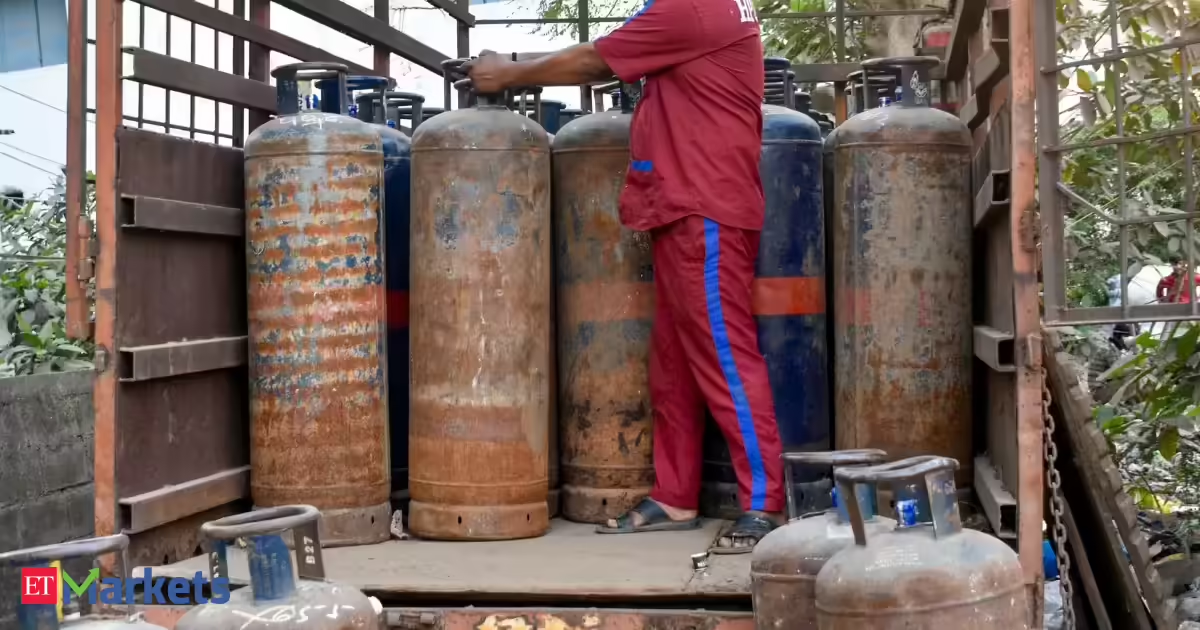
Mumbai: Shares of quick service restaurant operators and online delivery platforms weakened on Thursday as a shortage of commercial LPG cylinders disrupted operations and is feared to hit delivery volumes.

Among online delivery platforms, shares of Eternal (Zomato) and Swiggy each ended 1% lower after declining as much as 5%.

Food Delivery, QSR Stocks Slip on LPG Shortage FearsAgencies

War Begins to choke Supply disruptions have hit kitchen operations in some areas, though the impact on large QSR chains is limited so far

Westlife Foodworld, operator of McDonald’s restaurants in West and South India, slipped about 3%, Jubilant FoodWorks, a franchisee of Domino’s brand, fell nearly 2.4% and Speciality Restaurants, owner of multiple restaurant chains, ended 0.2% lower.

“The decline in food delivery and QSR stocks appears to be a knee-jerk reaction to concerns around a potential shortage of commercial LPG cylinders and the possible disruption it may cause to restaurant operations,” said Nirali Bhansali, equity fund manager at Samco Mutual Fund.

Advertisement

According to Sunny Agarwal, head of fundamental research at SBI Securities, feedback from restaurant owners suggests LPG supply disruptions have begun affecting kitchen operations in some places, although the impact on large listed QSR chains is likely to be limited.


“Many restaurant owners have indicated disruption in the supply of LPG and the likely impact on smooth operations,” Agarwal said, adding that organised QSR chains are relatively less dependent on commercial LPG cylinders as they often rely on electric ovens and other cooking equipment.
Technical indicators are flashing signs of a pullback in Eternal Ltd and Jubilant FoodWorks. “Technically, on the short-term time frame, Eternal is forming lower highs and is trading comfortably below short-term averages, which is largely negative,” said Amol Athawale, vice-president, technical research at Kotak Securities.

So far this month, Eternal Ltd shares have corrected more than 10%.

If the stock succeeds in trading above the 210-215 range, the pullback could extend towards 235-240. On the other hand, below 210 the sentiment could turn negative, in which case traders may prefer to exit long positions, Athawale said.

Jubilant FoodWorks slipped below its crucial support zone of 480, after which selling pressure intensified. “As long as the stock remains below ‘480, the weak formation is likely to continue on the downside, with potential retests of 450 and 440,” he said.

Advertisement
Continue Reading

Business

What Businesses Must Know in 2026

Published

on

What Businesses Must Know in 2026

Thailand is quietly engineering one of Southeast Asia’s most consequential regulatory shifts. As artificial intelligence becomes increasingly embedded in commerce, finance, and governance, the kingdom is developing a legal framework that will redefine how companies, both local and multinational, build, deploy, and govern AI systems within Thai territory.

Key takeaways

  • Thailand is building a comprehensive, risk-based national AI framework that will impose direct legal duties on both AI providers and deployers, with a dedicated AI Governance Center set to oversee enforcement.
  • Sector-specific AI regulations in judicial processes, consumer protection, and financial services are already in force, meaning legal exposure for businesses is current, not future.
  • Companies must act now by strengthening internal AI governance, updating external-facing documents, and maintaining clear documentation to stay ahead of tightening transparency and accountability requirements.

According to a legal update published on March 9, 2026, by Baker McKenzie, the country’s AI regulatory framework is no longer a distant ambition. It is a developing legal reality, and businesses that fail to prepare now risk being caught flat-footed when the full weight of legislation arrives.

A Framework in Motion, But Not Yet Law

At the heart of Thailand’s regulatory evolution is a comprehensive national AI framework currently in development, with enactment projected within the next few years. The framework is not a patchwork of ad-hoc rules. It is a structured, principles-driven architecture built on a risk-based model, one that classifies AI systems by the severity of harm they may cause and assigns corresponding legal obligations.

This is a design philosophy already proven in the European Union’s landmark AI Act, and Thailand’s adoption of a similar tiered approach signals that Bangkok is watching the global regulatory conversation carefully and choosing to align itself with emerging international standards rather than chart an isolated course.

Under the forthcoming framework, the obligations will be sharpest for those operating at the frontier. High-risk AI providers, those who develop and commercialise AI systems, and deployers, businesses that implement AI tools in their products and services, will face explicit legal duties. The specifics are still being shaped, but the direction is clear: accountability will be demanded at every link in the AI value chain.

Advertisement

Individual Rights at the Centre

Critically, the national framework does not only address industry compliance. It also establishes individual rights in relation to AI, a move that places human dignity and autonomy at the normative centre of Thailand’s AI governance model.

The inclusion of individual rights signals that Thai regulators understand AI regulation is not merely a business compliance exercise. It is, fundamentally, a question of how technology mediates the relationship between citizens, institutions, and power. These rights, when enacted, are expected to give Thai individuals recourse when AI systems affect decisions that touch their lives, from credit assessments and job applications to healthcare triage and judicial processes.

A New Regulator on the Horizon: The AI Governance Center

Oversight of this framework will fall to a newly created body: the AI Governance Center. While its full mandate, staffing, and enforcement powers are yet to be publicly detailed, its creation is the clearest institutional signal yet that Thailand is not merely passing laws. It is building the bureaucratic infrastructure to enforce them.

For businesses, the emergence of a dedicated AI regulator is a pivotal development. It means that, unlike today’s diffuse enforcement environment, there will soon be a single authoritative body empowered to investigate, sanction, and guide AI use across sectors.

Advertisement

Sector-Specific Rules Already in Force

Critically, businesses should not mistake the pending national framework for a regulatory vacuum. Multiple sector-specific rules are already in effect, covering domains as varied as judicial processes, governing the use of AI in legal and court proceedings, consumer protection, setting standards for AI-driven transactions and interactions, and financial services, addressing algorithmic decision-making, risk modelling, and customer-facing AI in banking and fintech. These rules carry immediate legal force. Non-compliance is not a future risk; it is a present one.

Soft Law Is Shaping Hard Expectations

Beyond binding regulations, Thailand has also cultivated a growing body of non-binding guidelines on ethical and responsible AI use. While these documents carry no direct legal penalty, their significance should not be underestimated.

In regulatory practice globally, soft law often precedes hard law. Guidelines shape how regulators interpret ambiguous situations, how courts assess reasonableness, and how enforcement priorities are set. Businesses that dismiss ethical AI guidelines as voluntary risk misunderstand how they function in practice as pre-competitive compliance benchmarks.

The AI and Privacy Nexus: A Draft Under Public Scrutiny

One of the most closely watched recent developments is the release of a draft regulation addressing the intersection of AI and privacy, which has been sent for public hearing. This reflects a recognition, increasingly common among regulators worldwide, that AI and data protection law are inseparable.

Advertisement

AI systems are, at their core, data-processing engines. They ingest personal information, learn from it, generate outputs that reflect it, and often make decisions that affect the people it belongs to. Treating AI governance and privacy regulation as distinct silos was never intellectually coherent, and Thailand’s move to address them together is a significant step toward regulatory coherence.

The Prescription for Businesses: Act Now, Not Later

Baker McKenzie’s Bangkok partners Pattaraphan Paiboon and Kritiyanee Buranatrevedhya, along with associates Aue-angkul Santirongyuth, Pimpisa Ardborirak, and Pirun Suttiprapha, are unambiguous in their guidance to businesses navigating this hybrid environment.

The advice is to act proactively, not reactively. Companies are advised to build internal AI governance frameworks before regulators demand it, documenting how AI is used internally, who is responsible for oversight, and what risk controls are in place. Businesses should also update external-facing documentation, including terms of service, privacy notices, and consumer disclosures, to reflect AI use, particularly as transparency obligations crystallise in law. Maintaining clear, defensible documentation is equally important, as the strength of a company’s position will depend heavily on its paper trail when regulators eventually scrutinise AI deployments. Finally, companies must mitigate legal exposure under existing law, since consumer protection, data privacy, financial services, and tort law already apply to AI-related harms, regardless of whether a dedicated AI law is yet in force.

The Bottom Line

Thailand’s AI regulatory moment has arrived, not with a bang, but with the steady, deliberate accumulation of frameworks, guidelines, sector rules, and now a dedicated oversight institution. The national framework will take time to enact, but the direction is set, and the pace is quickening.

Advertisement

For businesses operating in Thailand, the message from Baker McKenzie is both simple and urgent: the time to build AI governance infrastructure is now, not when the ink dries on legislation, but while there is still space to shape internal culture, update documentation, and get ahead of what will inevitably become mandatory.

Those who treat this moment as a preview rather than a warning will have a significant competitive and legal advantage when Thailand’s AI regulatory architecture reaches full force.

Advertisement
Continue Reading

Trending

Copyright © 2025