
Crypto World
Bitcoin Rebounds Above $76K, but Analysts See Cycle Bottom Much Lower



Doctor Profit revised Bitcoin’s projected cycle bottom lower, and now expects a final low between $54,000 and $44,000.
Crypto markets experienced another bout of forced selling over the past 24 hours, which pushed Bitcoin (BTC) briefly toward $74,000 before rebounding above $76,800. The asset is down 13% over the past week.
Market data cited by analysts now suggest a deeper bear market and a lower projected cycle bottom.
Deeper Cycle Lows
Prominent crypto analyst Doctor Profit has revised his expectations for Bitcoin’s cycle bottom, lowering his projected price range to between $54,000 and $44,000.
He explained that the recent decline coincided with a critical technical development. Doctor Profit found that Bitcoin lost the 100-week moving average (MA100 Weekly), which he describes as a crucial indicator that separates bull and bear market conditions. He points out that BTC’s break above this same moving average in October 2023 was the confirmation of the previous bull market. He argued that losing it again, two years later, and in line with the broader market cycle, points to a transition into a bear market.
Doctor Profit also cited the emergence of a death cross as further confirmation, and stated that this setup is very similar to the market structure seen during the 2021-2022 cycle peak and subsequent downturn. He even went on to add that the move below the MA100 Weekly was sharp and decisive, and that it also represents a confirmed breakdown from a bearish flag pattern he has referenced repeatedly over recent weeks.
Looking ahead, the analyst expects Bitcoin to close the coming week below the MA100 Weekly, enter another consolidation phase, and then continue lower toward a $70,000 target, which he believes is not the cycle bottom. While he previously projected a bottom in the $50,000-$60,000 range, an outlook he first shared when Bitcoin was trading between $115,000 and $125,000, he now said that updated models point to even lower levels.
Based on his recalculations, Doctor Profit placed the new bottom zone between $54,000 and $44,000, calling this range the most likely area for the true cycle low. He also flagged the asset’s drop below Strategy’s average entry price of around $76,000 as an additional source of risk, and argued that this development could intensify fear and panic in the market.
You may also like:
A significant portion of Strategy’s Bitcoin was acquired using leverage, and the firm’s stock, used as collateral, has been declining. This has made stabilization more difficult with BTC below the firm’s cost basis. Doctor Profit also added that Strategy’s overall Bitcoin position is now roughly flat on a profit-and-loss basis, while emphasizing that no profits were ever taken.
He even warned that additional fear could be driven by external narratives, including speculation linked to the release of Epstein-related files, which he says may fuel emotional selling regardless of their validity.
BTC May Need a New Narrative
Further adding to the bearish outlook, Matrixport’s recent market update shed light on weakening demand from traditional finance investors through spot Bitcoin ETFs. According to the firm, Bitcoin ETFs have recorded three consecutive months of net outflows, even as many US wealth managers have only recently enabled client access to these products.
It found that the last month of meaningful inflows occurred in July, and a brief resurgence in October, but overall momentum has deteriorated since the summer. This slowdown has continued despite a strong rally in gold and the continuation of the broader de-dollarization theme. As a result, Matrixport stated that BTC may need a new or refreshed narrative before a durable bottom forms and renewed interest from traditional investors emerges.
SECRET PARTNERSHIP BONUS for CryptoPotato readers: Use this link to register and unlock $1,500 in exclusive BingX Exchange rewards (limited time offer).

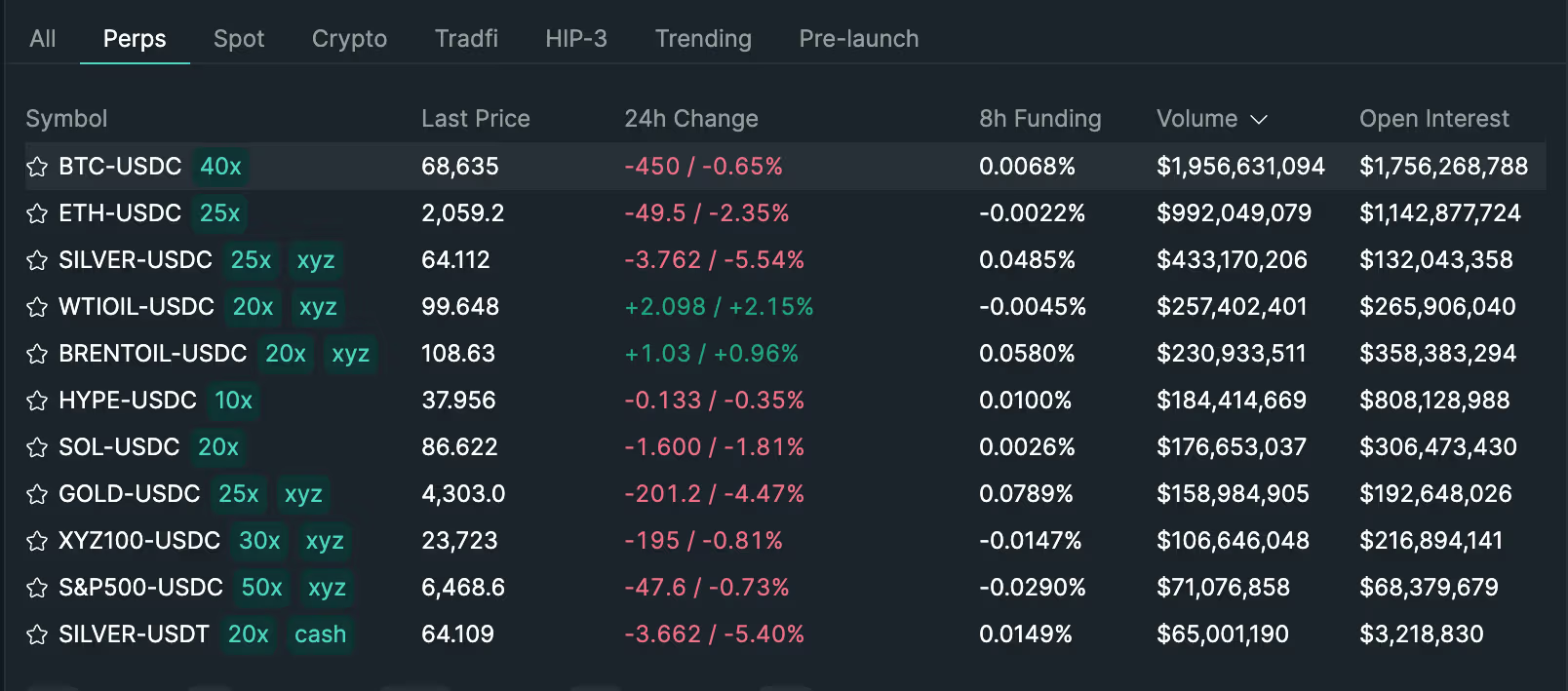
Traders on decentralized exchange Hyperliquid are favoring traditional commodities like oil and silver, trading them more aggressively than crypto tokens such as XRP (XRP) and solana (SOL).
Perpetual futures contracts tied to crude oil benchmarks WTI and Brent have recorded a combined trading volume of over $500 million in the past 24 hours. The silver contract alone accounted for more than $412 million in trades.
By trading activity, oil and silver contracts now far outpace SOL and XRP perps, which posted $176 million and $31 million in volume, respectively. For context, both XRP and SOL have multibillion-dollar market caps and rank among the world’s largest cryptocurrencies.
This trend comes as commodities have turned highly volatile amid the ongoing Iran conflict, which has disrupted crude supply through the strategic Strait of Hormuz — a critical chokepoint for roughly 20% of global oil shipments. It underscores Hyperliquid’s emergence as a go-to platform for price discovery in commodities, especially over weekends when traditional markets are closed.

Brent and WTI crude prices have surged more than 45% this month, the kind of returns typically seen in memecoins. The rally has pushed oil above $100 a barrel, sending inflationary shocks worldwide and drawing renewed attention to commodities as a sector of interest amid heightened geopolitical and market risks.
The uncertainty shows no signs of abating, suggesting Hyperliquid’s energy markets could continue to see heavy activity and potentially challenge bitcoin and ether’s dominance. Perpetual contracts tied to the two tokens still remain the most traded on the exchange, posting 24-hour volumes of $1.94 billion and $990 million, respectively.
Iran said early Monday that the Strait of Hormuz would be “completely closed” immediately if the U.S. follows up on President Donald Trump’s threat to attack its power plants.
The stark warning came after Trump said the U.s. would obliterate Iran’s power plans if Tehran fails to fully allow oil tankers to pass through the Strait within 48 hours.
In the meantime, analysts at investment banking giant Goldman Sachs have lifted their oil price forecasts amid the ongoing supply disruption.
They now see the Brent crude averaging $100 a barrel over March-April, up from a prior forecast of $98, and implying a roughly 62% premium to their full‑year 2025 outlook. The bank also revised its full‑year 2026 Brent average higher to $85 a barrel, while maintaining a robust $80 average for 2027.
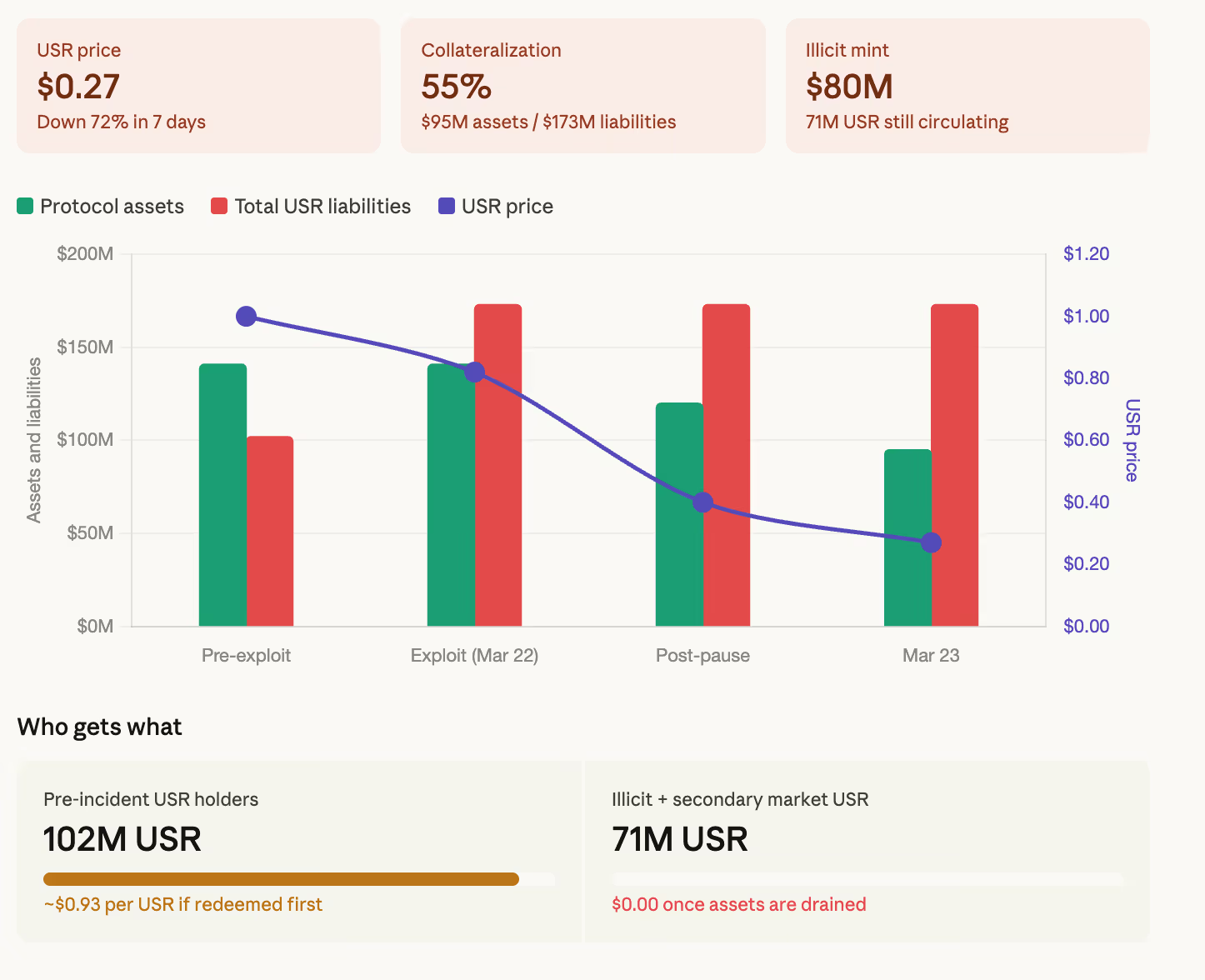
A stablecoin is supposed to be worth a dollar. Resolv’s USR is worth 27 cents and the math to fix it doesn’t work.
Resolv Labs confirmed over the weekend that a malicious actor gained unauthorized access to protocol infrastructure through a compromised private key and minted approximately $80 million in uncollateralized USR. The team paused smart contracts and burned roughly 9 million of the illicitly minted tokens, but the damage was already done.
Unlike smart contract bugs that can be patched, key compromises are infrastructure failures that no amount of code auditing can prevent.
This notice is issued on behalf of Resolv Digital Assets Ltd. in relation to the Resolv protocol.
Earlier today, a malicious actor gained unauthorized access to Resolv infrastructure through compromised private key, resulting in the minting of approximately $80M of…
— Resolv Labs (@ResolvLabs) March 22, 2026
Current USR supply consists of 102 million pre-incident tokens plus approximately 71 million illicitly minted tokens that are still circulating. The protocol holds roughly $95 million in assets as of Monday morning, down from $141 million cited in Resolv’s initial statement as redemptions drain what’s left.
Against total liabilities of approximately $173 million in outstanding USR, that’s a collateralization ratio of roughly 55%.

If pre-incident USR holders redeem first, which is what Resolv is facilitating through an allowlist process targeting March 23, the $95 million in assets gets absorbed by the 102 million in legitimate USR. That’s roughly 93 cents on the dollar for those who get through the door.
USR is trading at $0.27 on CoinGecko, down 72% over the past week and 61% in the past 24 hours alone. The 24-hour range stretched from $0.14 to $0.82, reflecting chaotic trading as the market tried to price in the exploit’s severity. Daily volume hit $8.4 million against a market cap of just $54 million, meaning a significant chunk of the remaining supply changed hands in a single day.
DeFiLlama data shows Resolv’s TVL peaked near $684 million in February 2025 before declining through the year to around $95 million pre-exploit. The protocol had raised $10 million in funding and was generating roughly $5.28 million in annualized fees. That revenue stream is now effectively dead.
Ledger CTO Charles Guillemet said in an X post that the exploit “will create bad debt on some lending markets, particularly in specific pools,” flagging that some Morpho pools using USR as collateral had already been exited.
Resolv Labs was exploited. $50M worth of USR was minted without collateral.
It lost its peg and is now trading around ~$0.5, with lows below $0.2.
This will create bad debt on some lending markets, particularly in specific pools.
Some Morpho pools using USR as collateral have… https://t.co/uo69WEd9IE— Charles Guillemet (@P3b7_) March 22, 2026
Resolv said the underlying collateral was not directly compromised and that the attack came through “unauthorized third-party actions, including a targeted infrastructure compromise and cyberattack.” The team said it was working with law enforcement and onchain analytics firms and would “pursue all available avenues to recover assets.”
The protocol strongly advised against trading USR or related Resolv tokens while recovery measures are being implemented, adding that “actions of users during post-exploit period may affect the recovery,” a line that suggests trading could complicate any future claims process.
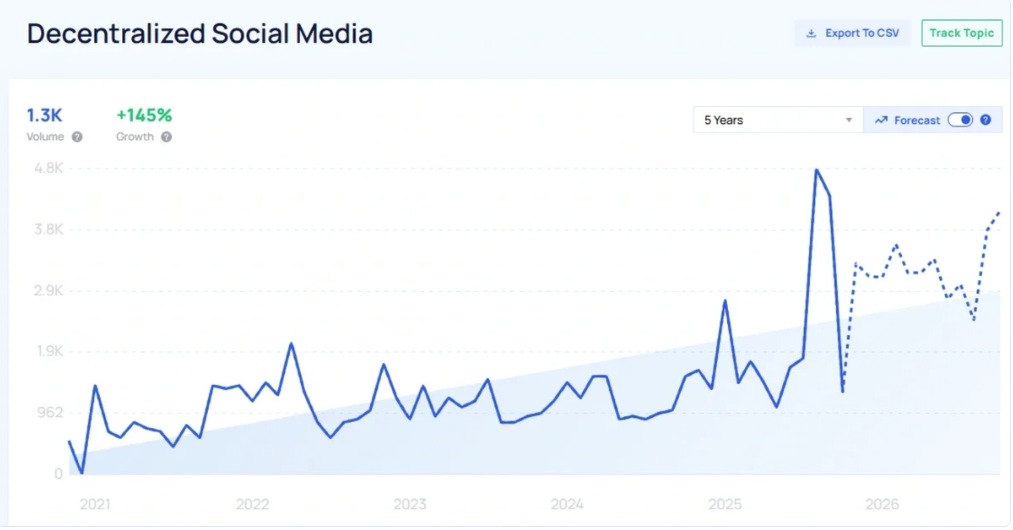
Decentralized, blockchain-based messaging and social media apps saw a surge of interest over the last year amid civil unrest and communication blackouts in the Middle East, Asia and Africa.
Search interest in decentralized social media has grown 145% over the last five years, according to Exploding Topics, while decentralized peer-to-peer messaging service Bitchat saw a spike in downloads during protests in Madagascar, Uganda, Nepal, Indonesia and Iran in recent months.

“I think people are starting to trust open protocols more than they trust closed companies,” Shane Mac, the CEO of XMTP Labs, told Cointelegraph in a recent interview.
XMTP Labs is a startup focused on building decentralized communication technology. Mac said that unrest around the world is pushing people to explore decentralized messaging options and think more about privacy.
WhatsApp, the messaging app owned by social media giant Meta, said in February that Russia had moved forward with its block on the app, making it inaccessible without a VPN or similar workaround.
“The last 15 years have been centralized, and the next 15 are going to decentralize. When you see an entire country shut down single apps, it tells you that there has to be a new foundation that we need to go build on,” added Mac.
“Open source is having a moment. Open protocols, open financial systems, open communication protocols, open identity standards. It’s going to be a really cool next era of the internet as decentralization and open standards come back.”
No single point of failure
Mac said decentralized networks can provide a safe harbor during turmoil as they’re typically harder to shut down without a single point of failure.
Decentralized platforms are generally hosted across networks spanning multiple countries, with servers managed by their participants.
In comparison, centralized options run on a single collection of servers controlled by one entity or company, which can be blocked and taken offline more easily.
He added that the technology is only getting better as developers and users push the boundaries.
“Someone took the open source Bitchat client and put the XMTP network inside of it, because they were getting their app shut down in their country. The connection of mesh networks and decentralized networks meant the app is no longer the single point of failure,” Mac said.
Decentralized messengers won’t replace the old guard
Market researcher 360 Research Reports predicted in a March 2 report that the blockchain messaging market will grow significantly over the next few years, with main drivers such as global demand for enhanced privacy and security in communication fueling the growth.
However, despite rising user interest, Mac said centralized platforms will likely remain popular and operate alongside decentralized alternatives. Developers will need to step up and keep innovating to sustain that momentum.
Exploding Topics found that social media users now spread their time across an average of 6.75 social media platforms per month.
Related: Telegram’s Durov: We’re ‘running out of time to save the free internet’
“I don’t think it will end up killing things; you built a new platform. SMS and email didn’t die to build encrypted messaging; I don’t know if they go away,” Mac said, referring to centralized messengers.
Magazine: Are DeFi devs liable for the illegal activity of others on their platforms?

Crypto and broader markets faced renewed volatility as tensions between the United States and Iran intensified, sending oil prices fluctuating and risk appetite shifting. The week’s escalation comes amid a backdrop of macro uncertainty and a fragile risk-off mood that has influenced how traders view Bitcoin and other digital assets.
President Donald Trump posted on Truth Social that the U.S. would “hit and obliterate” Iranian power plants if Tehran did not open the Strait of Hormuz within 48 hours, a warning that drew immediate responses from Iran about retaliation against U.S. and Israeli targets in the Gulf and potential closure of the strategic chokepoint. The standoff has kept investors on edge as markets weigh potential disruptions to energy flows and the global geopolitical risk premium.
Bitcoin slipped 1.8% over the past 24 hours to around $68,160 after earlier dipping below $67,600, with a notable surge in liquidations across the crypto space. Data from CoinGlass showed about $336.3 million in liquidations in the last day, driven in part by a large chunk of the activity—roughly $100 million—stemming from failed Bitcoin long bets. The move underscores how crypto markets are currently behaving in tandem with broader risk-off dynamics rather than acting as a pure safe haven.
Analysts have observed that crypto prices have been correlated with equities as geopolitical risk and macro cues influence investor behavior. “Crypto is trading in lockstep with equities right now, not as a haven, and sentiment is sitting at historic lows, with the Fear and Greed Index deep in ‘extreme fear’ territory at 8,” said Rachael Lucas, an analyst at the crypto exchange BTC Markets.
Key takeaways
- Bitcoin fell about 1.8% in 24 hours to roughly $68,160, with a low near $67,600, as risk assets reeled from intensifying US-Iran tensions.
- Crypto liquidations totaled $336.3 million in the last day, with roughly $100 million attributed to failed Bitcoin long bets, per CoinGlass.
- Oil markets reacted sharply: crude briefly topped $100, Brent crude surged to above $113, then settled under that level, while the Fed’s rate-hike expectations rose to around 12.4% probability in a week, signaling a macro repricing that crypto will track.
- Despite the near-term volatility, institutional interest remains evident, with about $1.43 billion in net inflows into Bitcoin ETFs observed this month, suggesting ongoing structural demand alongside a fragile sentiment backdrop.
- Key price levels to watch for Bitcoin: immediate support around $68,000, with $65,800 as the next line of defense if that gives way; a recovery narrative would gain traction if Bitcoin can reclaim around $71,500.
Geopolitics, macro signals, and the crypto response
Beyond the immediate price moves, the market backdrop is colored by a complex mix of geopolitical risk and macroeconomic signals. The Trump administration’s warning and Iran’s stated readiness to retaliate against U.S. and Israeli targets in the Gulf have kept the Strait of Hormuz—a vital oil artery—perceived as a potential flashpoint. While the oil reaction has been volatile, with futures briefly spiking above $100 per barrel before stabilizing, the broader implication is a potential acceleration of inflation expectations if energy costs remain elevated. In turn, investors have priced in higher probabilities of a Federal Reserve response, with futures indicating a non-negligible chance of a rate increase in the near term.
Lucas highlighted that Brent’s move is feeding inflation expectations and that the probability of a Fed rate hike has jumped in a short period, a dynamic that could ripple through crypto markets as investors reassess risk and liquidity. “That is a significant macro repricing that crypto will continue to reflect until there is clarity on both fronts,” she said.
Market structure and the recovery path
The latest price action adds another chapter to the ongoing debate about Bitcoin’s role in a world characterized by macro shocks and geopolitical risk. While the selloff underscores a current lack of broad risk appetite, it also spotlights robust institutional infrastructure. According to BTC Markets’ analyst, even with volatility, there remains substantial institutional exposure to Bitcoin through vehicles like ETFs, which have seen meaningful inflows this month.
For traders, the immediate technical watchpoints are crucial: Bitcoin’s near-term floor sits around $68,000, with a more meaningful support at about $65,800 if that zone yields. On the upside, reclaiming the $71,500 level would likely mark a transition back toward a recovery narrative, though timing remains uncertain as global risk factors evolve.
As the market awaits clearer signals on de-escalation in the Middle East and a more defined path for U.S. monetary policy, investors will be watching both macro prompts and on-chain behavior. The near-term linkage between oil swings, equity markets, and crypto suggests that any sustained improvement will likely require a combination of reduced geopolitical risk and a stable, gradual normalization in macro expectations.
The latest data also suggests sustaining traction from the institutional side could help underpin a more resilient price trajectory. With $1.43 billion of net inflows into Bitcoin ETFs observed this month, the groundwork for a more constructive environment remains in place even as volatility persists.
Oil and macro developments aside, the crypto market’s sensitivity to sentiment means traders should stay vigilant for abrupt shifts in risk appetite, liquidity conditions, and policy signals. The next few sessions could prove pivotal in determining whether Bitcoin can stabilize above key support levels or if fresh downside pressure emerges as investors weigh the evolving risk landscape.
Readers should watch for any signs of de-escalation in the US-Iran standoff and for upcoming macro updates from the Federal Reserve, which could further influence the path of Bitcoin and the broader crypto markets in the near term.
Crypto World
Stocks start catching up with bitcoin’s earlier meltdown to $60,000 as bond yields rise


Bitcoin began the year on a painful note, even as equity markets remained buoyant. But stock traders’ luck is now running out, as rising bond yields pressure valuations.
Prices for bitcoin plunged to nearly $60,000 from around $90,000 in the first five weeks of the year, according to CoinDesk data. The decline marked a sharp decoupling from the S&P 500 and Nasdaq, which were trading at or near record highs at the time.
Analysts wondered how long the divergence would last — whether bitcoin would quickly bounce back or stocks would eventually catch up with the weakness in bitcoin.
The latter appears to be happening. Since the Iran war began on Feb. 28, fears over inflation and fading Fed rate-cut expectations have pushed U.S. Treasury yields sharply higher, putting pressure on equities.
The stock market’s weakness, appearing weeks after BTC’s decline, underscores the cryptocurrency’s role as a leading indicator for traditional risk assets. Traders in conventional markets often watch BTC to gauge overall risk sentiment, particularly on weekends or during days when traditional exchanges are closed.
Yields rise, stocks drop
The yield on the 10-year U.S. Treasury note rose to 4.41% soon before press time, the highest since Aug. 1. The benchmark borrowing cost has risen by 48 basis points since the onset of the Iran war. The U.S. two-year yield has jumped 57 basis points to 3.94%.
Treasury yields are considered the benchmark for risk-free interest rates and borrowing costs in the economy, such as corporate bonds, mortgages, student loans, etc., are priced relative to Treasuries. So, when yields rise, lenders typically increase rates on loans to maintain their spreads, which pushes borrowing costs higher for businesses and consumers. This leads to risk aversion in equities, which we are beginning to see now.
Futures tied to Wall Street’s tech heavy index Nasdaq fell to 23,890 points early Monday, the lowest since Sept. 11. The S&P 500 e-mini futures fell to 6,505 points, also the lowest since September.
CoinDesk recently highlighted that the price patterns of major stock indices bear a striking resemblance to bitcoin’s price action leading up to its crash. This similarity has raised concerns among analysts, suggesting that stocks could be at risk of further declines if the pattern continues to play out.
“Bitcoin has been at the top of the risk-assets iceberg, and its collapsing price could be early days of a broader drawdown — particularly if surging commodity volatility trickles up to stocks,” Bloomberg’s Senior Commodity Strategist Mike McGlone said in a recent report.
Bitcoin steady
Having crashed early this year, BTC has held largely steady between $65,000 and $75,000 in recent weeks. As of writing, the cryptocurrency changed hands at $68,790.
Yet, pricing in options market shows peak fear, resulting in a record bias for put options, or derivative contracts offering protection from price slides in BTC.
Meta CEO and co-founder Mark Zuckerberg is reportedly building an AI agent to help handle his work in managing the company amid a company-wide push for employees to adopt agentic tech.
According to a report from The Wall Street Journal on Sunday, citing sources close to the matter, Zuckerberg’s AI agent is still in development but already being used to help the CEO speed up information retrieval.
Instead of going through multiple layers of people or teams to get the required information, the agent has been retrieving the information directly.
The move is part of a broader goal within the company to accelerate employee productivity and reduce layers of friction within its 78,000-strong employee base. The report adds that Meta is pushing to compete with AI-native startups that have much smaller teams.
Zuckerberg has previously alluded to this push, noting in an earnings call in late January that 2026 is going to be the year that “AI starts to dramatically change the way” Meta works, while also indicating there may be changes to the firm’s organizational structure moving forward.
“As we navigate this, our north star is building the best place for individuals to make a massive impact. So to do this, we’re investing in AI-native tooling so individuals at Meta can get more done, we’re elevating individual contributors, and flattening teams.”
The WSJ report highlights that Meta employees have been utilizing agentic tools such as MyClaw, which has been giving them access to work files and chat logs, while also enabling them to talk with colleagues or their AI agent counterparts.
Meta employees have also been said to be using Second Brain, another AI tool built on top of Anthropic’s Claude infrastructure to help speed up work on projects, which has been described internally as something akin to an “AI chief of staff,” according to the sources.
Meta could be eyeing mass layoffs
A recent report from Reuters claimed that the firm may be finalizing plans for another wave of layoffs to offset its expenditures and capitalize on AI efficiency gains.
In an article on March 14, Reuters cited three sources familiar with the matter who claimed that Meta could be planning layoffs that may impact up to 20% of the company.
The sources claimed that no date has been set yet and that the scale of the layoffs hasn’t been finalized.
Related: Meta to shutter Horizon Worlds metaverse on VR in favor of mobile
In a statement to Cointelegraph, Meta declined to comment on the WSJ article; however, a spokesperson responded to the Reuters reporting by saying that it was a “speculative report about theoretical approaches.”
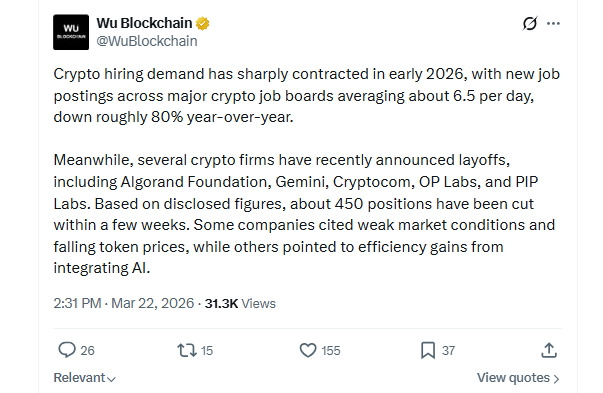
The crypto sector has been hit by a wave of layoffs in 2026, with several firms outlining a renewed focus on AI.
Last week, blockchain data provider Messari announced a shuffling of executives and employee layoffs to make way for the company’s “next phase” of becoming an AI-first company.
Meanwhile, exchange Crypto.com also announced a 12% reduction in its workforce amid its own AI push.

Magazine: Google flags crypto malware, retiree loses $840K in ‘expert’ scam: Hodler’s Digest, Mar. 15 – 21
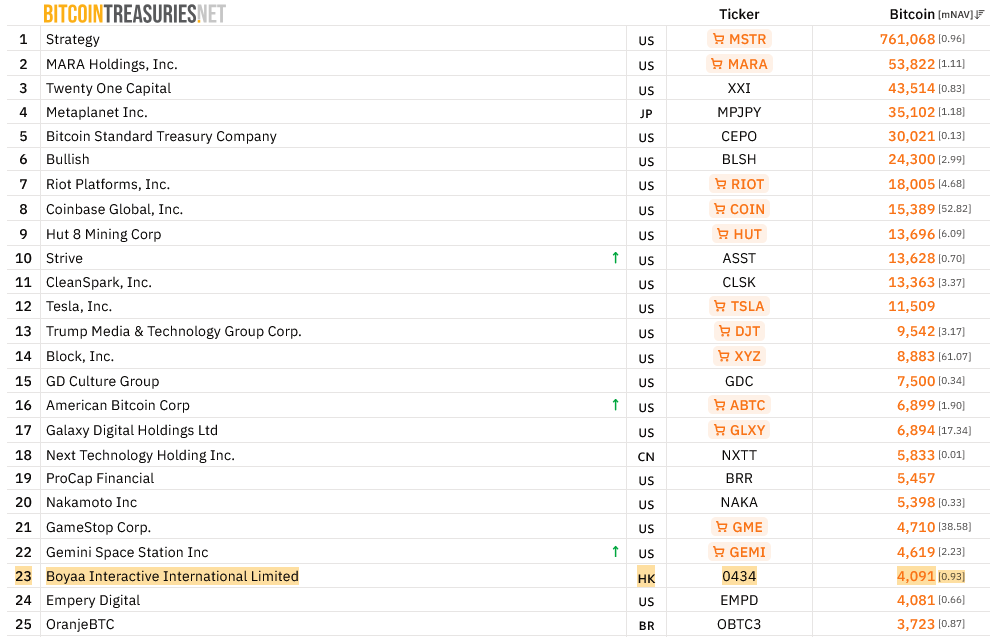
Boyaa Interactive International is the 23rd-largest Bitcoin treasury and the third-largest in Asia, behind Japan’s Metaplanet and China’s Next Technology Holding.
Hong Kong-based Web3 gaming firm Boyaa Interactive International said it is seeking shareholder approval to expand its crypto treasury, planning up to $70 million in purchases over the next year.
In a statement on Sunday, the Hong Kong-listed company said it is looking to use its “idle cash reserves during periods of weakness in the cryptocurrency market” to increase its existing positions and to support the research and development of Boyaa’s Web3 gaming business.
If approved by shareholders, Boyaa said it would invest in crypto tokens with “good market liquidity, large market value, wide recognition on the market and relatively long-term holding value.”
The $70 million would add to Boyaa’s nearly $3 billion treasury, which includes 4,091 Bitcoin (BTC) worth $2.8 billion and 302 Ether (ETH) worth $621,200.
Boyaa’s crypto treasury expansion plan comes as the crypto industry continues to grapple with a 45% market drawdown since October and growing doubt over the sustainability of crypto treasury strategies.
Few crypto treasury companies outside of Strategy and Bitmine Immersion Technologies have been buying crypto on a weekly basis over the last few months, while multiple Bitcoin miners have offloaded portions of their holdings.
Boyaa is a top-25 corporate Bitcoin treasury
Boyaa, which made $80.5 million worth of Bitcoin purchases between August and November, is currently the 23rd-largest corporate Bitcoin treasury and the third-largest in the Asia-Pacific region, trailing only Japan’s Metaplanet and China’s Next Technology Holding.

Related: Metaplanet forms new venture firm as it expands Bitcoin playbook
Boyaa expanded from online card and board games to Web3 gaming in late 2023, developing blockchain-based games and infrastructure, while making its first Bitcoin purchase in January 2024 to support that transition.
One of its offerings includes a Web3 version of a Texas Hold’em online poker platform it created in the early 2000s, offering Bitcoin rewards and crypto prizes.
Magazine: Bitcoin’s ‘narrative vacuum,’ Ethereum now inevitable: Trade Secrets
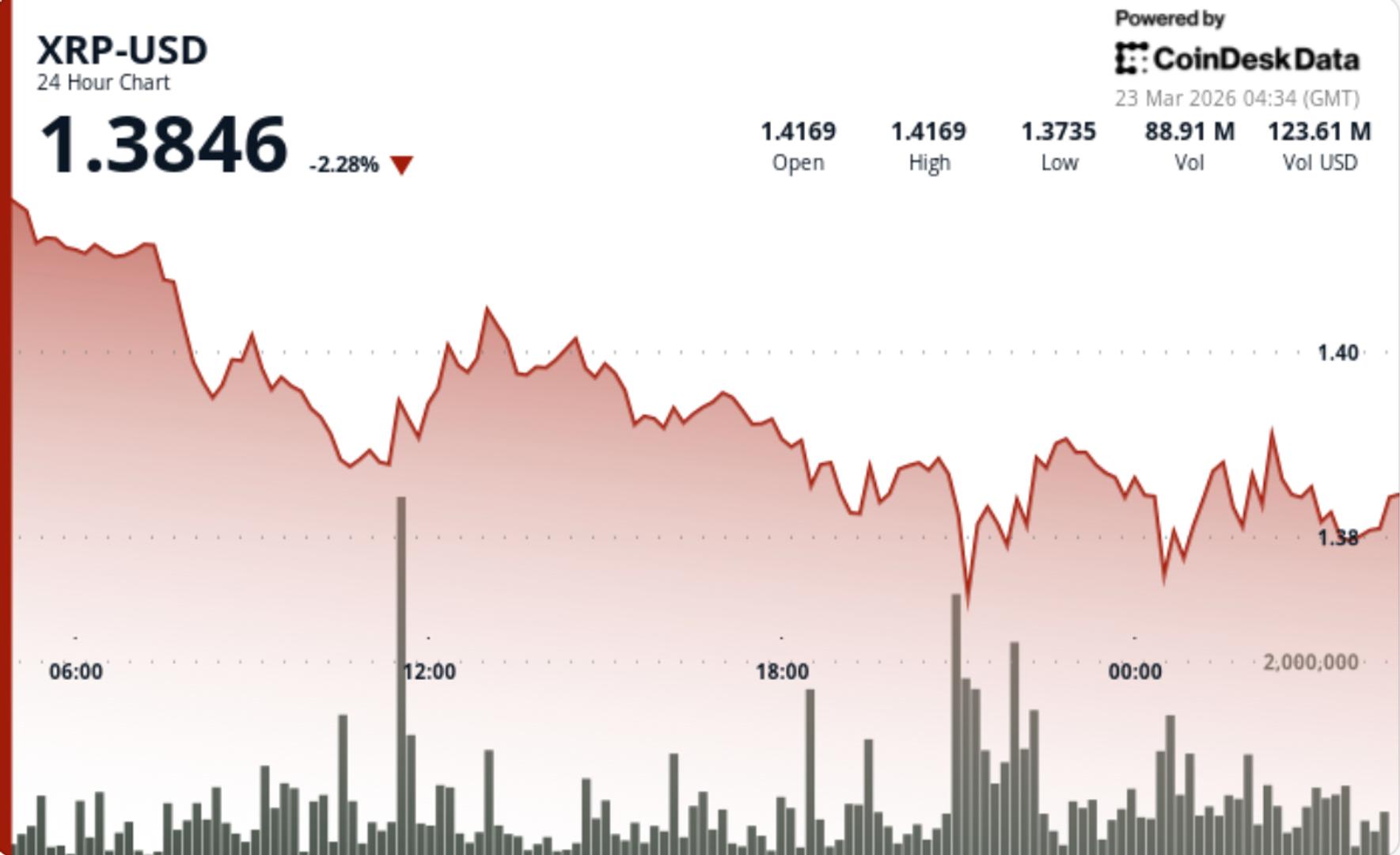
XRP dropped below the $1.40 level after a sharp wave of selling and is still struggling to recover, with buyers unable to push prices meaningfully higher. The weak bounce suggests selling pressure remains stronger than demand, keeping the token under pressure as traders look for signs of stabilization near current levels.
News Background
- XRP moved lower alongside broader crypto weakness, but the key driver was technical, with price losing the $1.40 level that had acted as near-term support.
- The token has struggled to sustain recovery attempts since mid-March, with rallies consistently fading below the $1.55–$1.60 area.
- Spot ETF flows showed limited improvement, with a modest $636K in weekly inflows — far below earlier demand, pointing to subdued institutional participation.
Price Action Summary
- XRP fell from $1.4404 to $1.3872, down roughly 3.7% over 24 hours.
- A high-volume move near 23:00 pushed price to $1.4018 before support gave way.
- Price then consolidated between $1.38 and $1.42, forming a descending intraday structure.
- A late bounce attempt toward $1.386 failed to hold, reinforcing near-term weakness.
Technical Analysis
- The break below $1.40 is the key development, confirming a loss of short-term structure and shifting momentum back toward sellers.
- Price is now trading in a descending channel between roughly $1.38 and $1.42, with lower highs forming on declining volume — a typical distribution pattern.
- Attempts to reclaim $1.40–$1.41 have been rejected, turning the level into immediate resistance.
- The broader trend remains bearish, with XRP still trading within a multi-month downtrend defined by lower highs since mid-2025.
What traders say is next?
- Traders are focused on whether the $1.38–$1.40 zone can hold as support.
- If this range stabilizes, XRP may consolidate before another attempt toward $1.41–$1.44, with a broader test near $1.55 needed to shift structure.
- A clean break below $1.38 would expose the $1.30–$1.32 zone, where support is thinner and downside could accelerate.
- For now, momentum favors sellers, with any bounce viewed as corrective until resistance levels are reclaimed.


Autonomous AI agent commerce could mean the end of online advertising as it is currently known today and shift the internet’s economic model, according to a16z Crypto.
Since the dawn of the internet, buying goods or services typically involves navigating to online stores (some through online advertisements). However, Merit Systems co-founder Sam Ragsdale argues this could change if AI agents do the shopping in the future.
From 1997 to 2024, the business model for the internet was “distraction,” said Ragsdale in an a16z blog post on Sunday.
“Humans reading a webpage can be distracted by an advert, monetizing their partial attention,” but LLMs and agents “do not get distracted,” he said.
The online advertising market size, which is dominated by search giant Google, was an estimated $291 billion in 2025, according to Mordor Intelligence.
“There is some beautiful irony in ads creating the free and open internet, which became the 10-trillion-token dataset that created LLMs, leading to the downfall of ads.”
Open protocols are the way forward
Ragsdale said the first step is already being seen, with AI platforms like ChatGPT and Gemini adding products like “Instant Checkout” for US users last year, allowing them to buy products directly within a conversation without needing to head to an external website.
Soon, hundreds of millions of consumers around the globe will “find better products, merchants will have improved conversion rates, and platforms will be able to take 5% to 10%,” he said.
However, these “checkout” services are just new “walled gardens,” Ragsdale explained, as merchants have to go through stringent approval processes to be included.
Related: AI agent payment volumes lower than reported, but adoption is growing: a16z
Instead, Ragsdale argued that the way forward will be AI agents with open protocols that allow them to discover products on their own.
“An agent that can only buy from pre-approved merchants is an employee with a corporate card restricted to three vendors. An agent with open protocols is an entrepreneur with a bank account,” he said.
Ragsdale concluded that a “clever hack” called advertising changed the internet forever, but in 2026, “that hack is dying,” arguing that open agentic commerce, powered by the x402 protocol developed by Coinbase or the Machine Payments Protocol (MPP) from Tempo and Stripe, is the future.
Magazine: Google flags crypto malware, retiree loses $840K in ‘expert’ scam: Hodler’s Digest
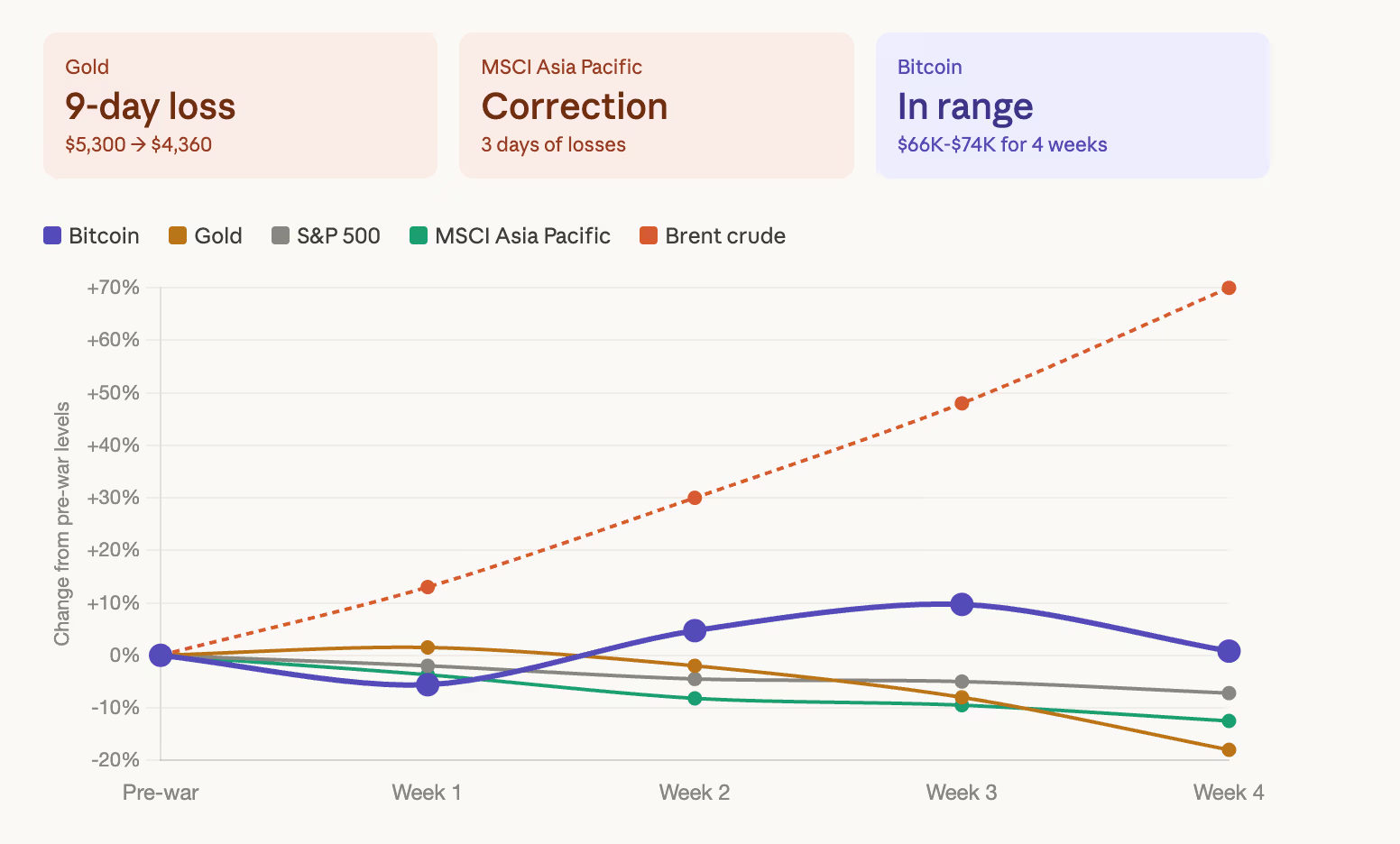
Everything is selling. Bitcoin is selling the least.
Gold dropped for a ninth straight day on Monday to around $4,360, its longest losing streak in years. Asian stocks fell for a third session and are set to enter correction territory.
Bond yields climbed as the prolonged war threatened to stoke inflation and push central banks toward rate hikes rather than cuts. S&P and European futures pointed to further losses. Brent crude edged up to $113 a barrel, now up more than 70% year-to-date.
Bitcoin was trading at $68,316 on Monday morning, up 1.5% over the past 24 hours and down 6% on the week. Ether rose 2.7% to $2,059. XRP gained 2% to $1.38. Tron climbed 0.3% to $0.309, the only major green on a weekly basis at 3.8%. BNB fell 1.2% to $627. Solana dropped 2.5% to $86.54. Dogecoin lost 1.7% to $0.09, down 7.4% on the week and the worst-performing major.
The weekly numbers are ugly across the board. Gold, the asset that’s supposed to outperform in geopolitical chaos, has lost roughly 18% from its recent highs. Asian equities are entering a correction. Bitcoin is down 6% on the week but still trading above the $66,000 floor that held through every war-driven sell-off since Feb. 28.

“The gold rally and the BTC collapse are more structural than market-based,” said Alexander Blume, CEO of Two Prime, an SEC-registered investment advisor. “China and others have been systematically buying gold as part of a broader effort to decouple from Western markets and the US dollar.” That buying has reversed as the conflict intensified and liquidity became the priority over safety.
Blume noted that both bitcoin’s price and derivatives markets “have held up decently well” given the macro backdrop, and said Two Prime is positioned for “an increase in funding and futures rates in the weeks and months to come,” effectively betting the contrarian view that an upside surprise is more likely than the market expects.
Trump’s 48-hour ultimatum on Saturday to “hit and obliterate” Iran’s power plants if the Strait of Hormuz isn’t reopened expires Monday evening. Iran responded that any such attack would trigger an indefinite closure of the waterway and retaliatory strikes on U.S. and Israeli energy infrastructure across the region.
Meanwhile, Goldman Sachs raised its full-year Brent forecast to $85 from $77 and WTI to $79 from $72, describing the Hormuz disruption as the “largest-ever supply shock for global crude markets.”

‘Thought Ravindra Jadeja Would Be The Captain Of Rajasthan Royals’: India Great’s Blunt View

Fosi Audio MD3 Review: Can a $149 MagSafe DAC/Amp Fix Your Phone’s Sound?

Growing Up With Rejection Sensitivity Dysphoria: Advice For Parents

Smart energy pays enters the US market, targeting scalable financial infrastructure

Why Israel is blocking foreign journalists from entering

Bitcoin: We’re Entering The Most Dangerous Phase

IT’S OFFICIAL: The $3.5 Trillion Financial Crisis Nobody Is Talking About.

CEO SALARY Compared To Regular Worker SALARY! #shorts #money #salary #career #mcdonalds

Crypto Trading LIVE: BTC Live Trading Bitcoin Analysis | 22 MAR #crypto #bitcoin #btc
-

 Fashion3 days ago
Weekend Open Thread: Adidas – Corporette.com
-

 Politics3 days ago
Jenni Murray, Long-Serving Woman’s Hour Presenter, Dies Aged 75
-
 Tech6 days ago
Are Split Spacebars the Next Big Gaming Keyboard Trend?
-
 Crypto World2 days ago
NIO (NIO) Stock Plunges 6.5% as Shelf Registration Sparks Dilution Worries
-

 Crypto World1 day ago
Best Crypto to Buy Now: Strategy Just Spent $1.57 Billion on Bitcoin During Fear While Early Investors Quietly Enter Pepeto for 150x Potential
-

 News Videos5 days ago
RBA board divided on rate cut, unusually buoyant share market | Finance Report | ABC NEWS
-

 Crypto World1 day ago
Bitcoin Price News: Bhutan Sells $72 Million in BTC Under Fiscal Pressure, but the Smart Money Entering Pepeto Sees What the Market Does Not
-

 Business7 days ago
Australian shares drop as Iran war enters third week
-

 Crypto World7 days ago
Crypto Lender BlockFills Enters Chapter 11 with Up to $500M in Liabilities
-

 Politics5 days ago
The House | The new register to protect children from their abusers shows Parliament at its best
-

 Fashion7 days ago
25 Celebrities with Curly Hair That Are Naturally Beautiful
-

 Tech3 days ago
inKONBINI Lets You Spend Summer Days Behind the Register
-
 Politics6 days ago
Real-time pollution monitoring calls after boy nearly dies
-

 Crypto World5 days ago
Canada’s FINTRAC revokes registrations of 23 crypto MSBs in AML crackdown
-
 NewsBeat4 days ago
Residents in North Lanarkshire reminded to register to vote in Scottish Parliament Election
-

 Business7 days ago
Meta planning major layoffs as AI spending and automation reshape workforce
-

 News Videos5 days ago
PARLIAMENT OF MALAWI – PAC MEETING WITH REGISTRAR OF FINANCIAL ON AMARYLLIS HOTEL – INQUIRY LIVE
-

 Business15 hours ago
No Winner in March 21 Drawing as Prize Rolls to $133 Million for Next
-

 Politics3 days ago
Gender equality discussions at UN face pushbacks and US resistance
-
Entertainment7 days ago
Oscars reunite Rob Reiner supergroup of 17 stars for emotional tribute: Here's who appeared on stage
You must be logged in to post a comment Login