Lord Ashcroft KCMG PC is an international businessman, philanthropist, author and pollster. For more information on his work, visit lordashcroft.com
The string of defections from the Conservatives to Reform has intensified both the schism on the right of politics and the debate over what to do about it.
Prosper UK, the new group launched by Sir Andy Street and Baroness Ruth Davidson, argue that the Tories should occupy the moderate centre ground. Others assert that the only way to dislodge Labour is to “unite the right” through some kind of accommodation with Reform.
Where should the Conservatives position themselves in the multiparty political landscape? Analysis of my recent polling points to some answers.
Advertisement
Published polling regularly shows the right’s combined vote share to be in the mid-40s – surely enough to oust Labour and install a Tory-Reform administration with a comfortable majority if only the two sets of supporters could be brought together. But even if the personalities could agree and the internal politics navigated (big enough ifs in themselves) would this hypothetical alliance be as big as the sum of its parts?
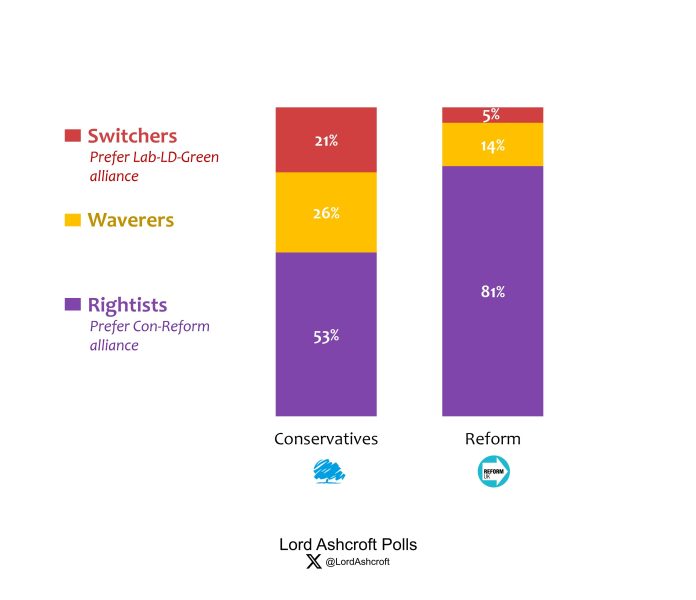
The chart below shows everyone currently intending to vote Conservative on the left and everyone currently intending to vote Reform on the right. Each party’s support is broken into three groups based upon their answers to two questions in my January poll. First, their preference between Keir Starmer and the other party’s leader (for Conservative voters, whether they would prefer Starmer or Nigel Farage as PM; for Reform voters, whether they would prefer Starmer or Kemi Badenoch). Second, the kind of government they would rather see in the event of a hung parliament at the next election – a Conservative-Reform coalition or a Labour-Lib Dem-Green coalition, or if they don’t know which they would prefer.
Within each party’s current backers, we can therefore identify three groups:
‘Rightists’ who prefer the other right-wing party’s leader to Starmer and prefer a coalition between Reform and the Conservatives
‘Switchers’ who prefer Starmer to the other right-wing party’s leader, and do not prefer a Reform-Conservative coalition in the event of a hung parliament (they either prefer a Labour-Lib Dem-Green coalition, or they don’t know)
‘Waverers’ who do not fall into either of the other two categories
We would expect Rightists to back a Conservative-Reform alliance at the general election, and that Switchers would not vote for such an alliance. Waverers might do either.
As we can see, the two sets of voters are far from symmetrical. While 81 per cent of current Reform voters are Rightists whom we would expect back a Tory-Reform alliance, the same is true of just 53 per cent of current Conservatives. Only 5 per cent of Reform voters would switch to back a Labour-led coalition rather than vote for an alliance with the Conservatives, but 21 per cent of current Tories would do so.
Advertisement
Being ahead in the polls, Reform supporters might expect to be the senior partner in such an alliance, making them more amenable to the idea. But while 91 per cent of current Reform supporters prefer Badenoch to Starmer in a forced choice, only 62 per cent of current Tories prefer Farage to Starmer.
Conservatives are much more hesitant about a pact led by their rival on the right.
If we estimate that all the Rightists, half of the Waverers and none of the Defectors would vote for a united Reform-Conservative ticket, then this ticket would achieve 36.4 per cent of the vote: 10 points lower than the current aggregate of Reform and Conservative votes. (If we were more generous and assumed that three-quarters of the waverers backed the joint ticket, this would amount to 38.7 per cent of the vote). More than two thirds of the “lost” voters – who would vote for one of the parties alone but not in an alliance with the other – would come from the Conservative side.
Of course, elections have been won with a vote share in the mid-30s: it did the trick for Tony Blair in 2005, David Cameron in 2015, and of course Starmer in 2024. Could the Reform-Conservative alliance also be elected with a share in this range? To answer this, we need to look deeper into voting intention – making use of the fact that we ask people to rate on a 0-100 scale how likely they are to back a given party. In September 2025, we asked people how likely they were to vote for each party separately, and then how they would vote if Reform and the Conservatives formed an alliance.
Advertisement
The chart below shows three categories of supporters and potential supporters for each party:
‘Core voters’ who intend to support this party at the next election and whose likelihood of doing so is very high (75+ out of 100)
‘Soft voters’ who expect to vote for this party at the next election, but whose likelihood of doing so is between 50 and 75
‘Potential voters’ who intend to support a different party, but are at least slightly open (25+ out of 100) to supporting this party
A party’s current voting intention is the sum of its core and soft vote. The sum of all three – Core, Soft and Potential voters – can be thought of as a party’s ceiling.
This reveals that Reform has a large and highly motivated Core vote, but on this measure currently has slightly less room for expansion than the Conservatives – even though the Tories have fewer committed supporters. But what happens if people are presented with a single combined Reform-Conservative option?
The results of this exercise reinforce the finding that a Tory-Reform alliance would shed about 10 points (in September 2025, the combined Reform and Conservative vote share was 47.6 per cent; the vote share of the hypothetical Reform-Conservative alliance was 34 per cent with a ceiling of 38.2 per cent). Crucially, it also pushes up the ceiling for Labour and the Lib Dems, suggesting that uniting the right in this way would boost tactical voting among left-of-centre voters. (Any analysis of a united right-wing vote must account for the psephological equivalent of Newton’s Third Law).
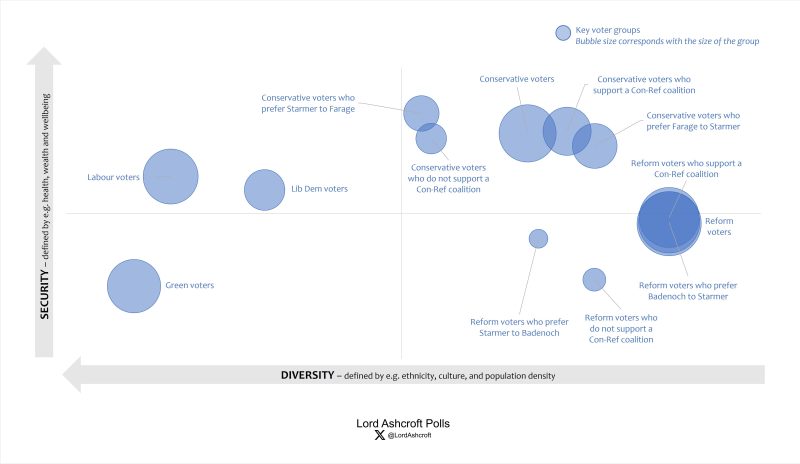
What is behind this? We can see where some of these key groups sit on our political map, which charts how views and voting behaviour varies between different parts of the electorate. The size of the group is proportional to the size of the bubble.
Advertisement
For a Conservative-Reform alliance to equal the sum of its parts, or come close to doing so, it would have to retain current Tories at the top and centre of the map who are closer to the Labour and Lib Dem voter bases than they are to Reform’s. At the same time, it would have to hold on to current Reform supporters around the “3 o’clock” position. In other words, it would have to bring together voters who have almost diametrically opposed views on many economic and social issues.
This is not impossible, as Boris Johnson proved in 2019. But he was helped by the unique confluence of Jeremy Corbyn and the Brexit deadlock, not to mention the Brexit Party standing down in hundreds of seats to clear the way for the Conservatives. While uniting the left has its own challenges, Labour and Lib Dem supporters occupy essentially the same space on the political map, making it much more likely that they will be willing to switch between the two. (Persuading Greens to vote Labour to stop Farage may be difficult, but if a Reform-Conservative alliance polls below 40 per cent, there is less imperative for Labour to squeeze the Greens).
Clearly, then, “uniting the right” isn’t as simple as taking the Conservative and Reform columns in current polls and adding them together. An alliance or pact between the two parties would, on current evidence, perform much worse than the sum of its parts. This would be to the disproportionate detriment of the Tories, who could potentially be destroyed as a party in the process.
What, then, should Badenoch and the Conservatives do instead? There has been no shortage of advice. Following the defections, many inside and outside the party have argued that it should not try to emulate Reform. The case has been forcefully put by Street and Davidson, who say that millions of potential Tory voters currently feel politically homeless – something I can certainly echo from my research as we listen to people up and down the country each month.
Advertisement
This problem would be exacerbated if the Tories were to become a watered-down version of Reform (and it would inevitably be watered down, since the insurgent party can always take the rhetoric one stage further). Voters attracted by Farage would not be tempted back, and we have seen above how embracing Reform and its agenda would hurt the Conservative party rather than consolidate overall support for the right. Many Tories are instinctively suspicious of Farage and his motives or doubt that his party could form a serious government. The fact that in 2024 the Tories lost 60 seats to the Lib Dems should also warn against a Reform-lite strategy.
But nor is the solution for the Conservatives simply to tack towards the centre ground. Some long to recreate the party of the early Cameron era – the heady (as they remember them) pre-Brexit, huskie-hugging days of the Big Society. But while the Tories cannot win without votes from centrist, liberal-minded voters, nor can it win with these votes alone. In terms of our political map, the Conservative coalition needs to begin at around the “12 o’clock” position (where we find current Tories who would rather see Starmer than Farage in No.10). But if the party moved further towards that point, it would lose ground to Reform at around “2 and 3 o’clock”, while being very unlikely to gain many compensating votes in Labour and Lib Dem territory on the left-hand side of the map. This would be especially damaging as it would leave Reform as the only party occupying the right of the political map which was once the Tories’ centre of gravity. In the battle for the right, this would amount to a Conservative retreat.
In fact, as the nostalgists should remember, this is something that Cameron himself well understood. His modernisation programme was a response to the politics of the time: the deficit and its roots in Brown-era profligacy, welfare dependency and other social problems resulting from state overreach, and an understanding of how the Conservatives were seen after their long years in office. His majority-winning electoral coalition of 2015, built on the “long-term economic plan” to restore the public finances, embraced wavering centrist voters sceptical of Labour, traditional Tories, and right-leaning Eurosceptics who were kept on board with the promise of an EU referendum.
What does this mean in practice today? Our evidence points to two pillars upon which a Conservative recovery can be built: leadership and the economy. In my January poll, in head-to-head contests where people are forced to choose without a “don’t know” option, Badenoch beat Starmer by four points, and Farage trailed Starmer by 16 points. Reform voters overwhelmingly prefer Badenoch to Starmer, but a sizeable minority of Conservatives would choose Starmer over Farage. At the same time, the Tories enjoyed a six-point lead over Labour on being trusted to manage the economy – a lead which has ticked up steadily from month to month. Taken together, these things suggest the Conservatives should pursue their focus on the economy, controlling public spending, and offering strength and stable leadership in contrast to a weak government with no sense of direction and no ability to get anything done.
Advertisement
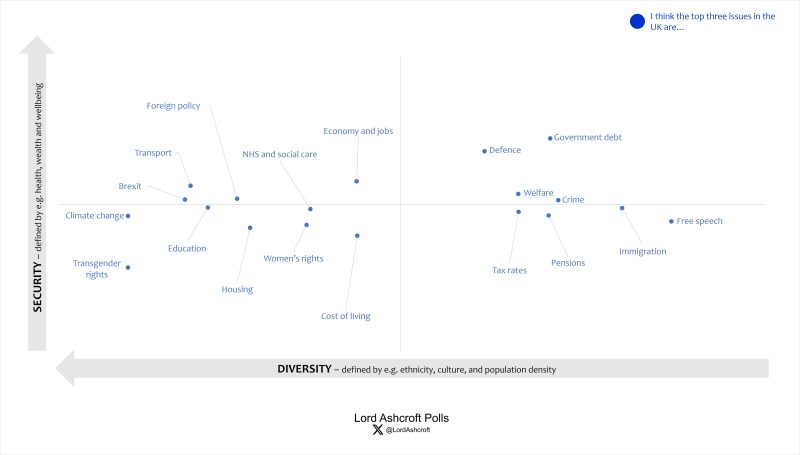
There are further clues in the chart below, which shows which kinds of voters are most likely to prioritise which issues. Along with the economy, whose position close to the centre of the map shows it to be important across the board, the Conservatives have already started gaining permission to talk about the things their target voters are most concerned about.
How the Conservatives talk about these issues also matters. Britain is too expensive, taxes are too high, living standards are stuck, we are unproductive and uncompetitive, the state spends and borrows too much, the welfare bill is ballooning, our borders are not properly controlled, public services are not good enough, our defence has been hollowed out, the authorities take a selective approach to crime and ambitious young people increasingly want to leave. People are frustrated, even angry, and that needs to be articulated. But anyone can list these problems, and they do every day. It is not enough for an aspiring party of government simply to describe them and rail against them.
The Conservatives need a proper analysis and understanding of how – over successive governments – Britain got into this state. Then they need a plan, including a willingness to take robust positions that some will find uncomfortable. And they need to show that they are prepared to do the necessary work and, crucially, to be honest that there will be winners and losers from the tough decisions that will follow. Here will be the contrast not just with Labour, who after more than a dozen policy U-turns have given up any attempt at welfare reform or spending control, but with Reform, who would not even defend the two-child benefit cap.
To begin with, the Tories must stabilise, unify and continue to focus their attention primarily on the economy.
Advertisement
Over time, voters’ patience with the Labour government will become increasingly strained, and Reform will also come under closer scrutiny. Uncommitted voters might contrast a rigorous Conservative offering with that of an untested party with more complaints than solutions – a properly conservative way to win trust and unite the right.
Michael Walker of Reform UK and Jonathan Dulston of the Conservatives claim they want to protect ALL women. Yet the pair spent Thursday 26 March 2026 pushing a transphobic motion that would have stripped away rights from some of Darlington’s most vulnerable residents. This moment, the mask slipped, exposing their “safety” rhetoric as nothing but a thin veil for their politics of hate.
Walker, a new Reform UK councillor in the area, chose a targeted attack on trans people as his first ever motion. Fucking shocking, I know. Alongside ex-leader of the council and Tory-boy Dulston, Walker tabled a proposal to enforce “biological sex-based” exclusions from single-sex spaces across the borough. They used their shitty platform to champion their bullshit vision, but they didn’t count on a tactical masterclass from the Green Party.
And it was fucking stunning to behold.
A masterclass in inclusion
Local Green party leader Matthew Snedker refused to let the right-wingers set the terms of the debate. His amendment to the motion absolutely gutted the transphobic language, whilst keeping the title: ‘Women’s Privacy, Dignity and Safety Across Darlington’.
Advertisement
Snedker, who himself has a trans daughter, delivered a powerful defence of human dignity. He told the chamber:
“Gender is a symphony, not a harmony. It is complex, it is lived, and it is diverse. To suggest that protecting the rights of women must come at the expense of the dignity of transgender people is a false choice.”
The amendment affirmed that protecting women and protecting trans people are ‘compatible obligations’ under the Equality Act 2010. It commits the council to rejecting ‘blanket exclusions’ and ensuring that any restrictions are justified on a case-by-case basis.
Michael Walker spewing his division
By the time the vote was called, the Green party, backed up by local Labour councillors, had verbally battered both of Reform’s Walker and conservative Dulston. Dulston’s hateful proposal of the motion claimed to champion the voices of women, spoke of protection and the usual divisive drivel. We all knew Walker’s first motion would never be about trying to solve Darlington’s child poverty rate which currently stands at a fucking third. We all knew it wouldn’t be about helping with bills. Of course it was about fucking toilets. Even before he was councillor, Walker was obsessed with trans people and toilets, but to a weird degree.
But by the time the vote was called, the Greens had successfully ripped out the hateful core of the motion, and replaced it with a shield for trans rights. They had effectively turned the right-wingers own motion against them. Their failure proved that, in Darlington, the politics of hate could fuck off entirely.
Reform — A mask off meltdown
The hypocrisy was not limited to the wording of the motion. Dulston, Conservative councillor and former head of the council, pitched the proposal on a ticket of elevating women’s voices. His actions during the debate, however, told a different story.
Advertisement
During the debate, there had been cheers and jeers from the gallery. And for some reason this appeared to get right up Dulston’s nose. Weird, when public input annoys someone, isn’t it? Like, come on my guy, these are the people you’re meant to represent. Yet this offended him to such a degree that the little Tory turned and addressed the gallery directly. I believe the line was:
“No one has done more for the LGBTQ community than me”
And then, choosing to address those filming directly, he went on an increasingly angry rant of changes he had made to the town. At one point he directly pointed at me and I couldn’t help but laugh. And it went on, and on until the mayor herself asked him to be quiet as his rant was getting boring. Dulston turned to her and snapped:
“No, I won’t, I’ve listened to the opposition talk and I’ll carry on, thank you.”
After being asked a second time by the FEMALE mayor to stop talking, the lad snapped:
“No, you’ve let everyone whine on, I’ll continue.”
Advertisement
Jonathan Dulston after he finally shut up
Yeah, Dulston, nothing screams elevating women’s voices and safety than shouting over one when you’re having a tantrum. He was waffling on about all the changes he had made for the LGBTQ+ community, but here’s the thing. If you’re doing all that but also trying to target the T in the LGBTQ+, you never were true ally. You cannot pick and choose who you get to protect in our community, a strike on one is a strike on all. He was more than happy to stand in front of a trans-inclusive flag for photoshoots though, when it suited him.
Reform — aggression in the gallery
The hostile environment extended to the supporters of Reform UK and the Tories in the public gallery. At one point, a supporter was caught taking photos of the opposition in attendance. This included a number of trans people. When a member of the public politely asked if he had taken a picture, this lad flew off the handle in a big way. Like, explosive rage.
He reported shouted ‘nonces’ and ‘smelly’ at those on the opposite side. His aggression grew to the point that the Mayor had to ask him twice for silence. He was repeatedly asked to calm down by those who had seen him take the images. It later emerged that the angry dickhead had in fact taken some, which he posted on Facebook with the transphobic caption “I bet it was one of these smelly blokes’. Grow up, my guy.
One of the original motion’s supporters didn’t look too happy with the amendment
This aggression highlights the real-world consequences of this culture war Walker and Dulston are trying to stoke. When these councillors use their first motion to signal that a vulnerable minority is ‘other’ or ‘dangerous’, their followers feel empowered to harass them in public. It’s the real human cost of this absurd politics of hate.
A rejection of hate
The failure of the Reform-Tory motion was absolutely a stunning political play from the Greens. By adopting their inclusive amendment, the council rejected the politics of hate in Darlington.
As Snedker noted in his closing remarks:
Advertisement
“When they came for the trans community, I spoke out because I have heard the poem before.”
Stunning stats by Labour allies who backed the amendment sealed the deal in a stunning humiliation for the right. The council will now move forward with clarity and compassion, upholding dignity over hate.
And just to end on a weird note, the BBC coverage of this seems pretty hostile. Yet the coverage in the local Northern Echoseems pretty tame and more inclusive, but both written by authors called Bill Edgar. Wonder if it could be the same one? Because why would one post be more inclusive on a local level, yet wholly hostile on a national one, all from the same guy?
Oh wait, it is the same one… seeing propaganda and narrative control like that is fucking buck wild.
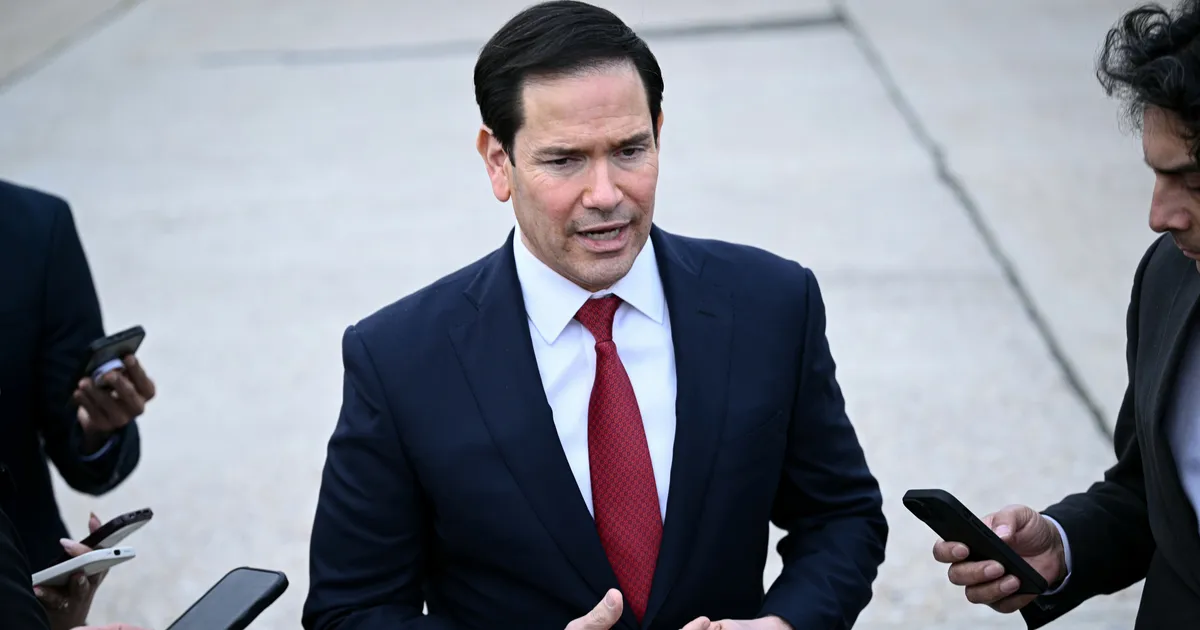
Marco Rubio perfectly demonstrated the US’s inconsistent messaging over Ukraine in a one-minute interview.
Donald Trump has vowed to end the Ukraine war as soon as possible and has frequently suggested Kyiv bow to Russia’s demands – even though Moscow started the conflict by invading its European neighbour.
Pressed over how the trilateral talks are going on Friday, the US’s top diplomat initially accused Volodymyr Zelenskyy of misrepresenting America’s stance in the ongoing negotiations.
In his next answer, he appeared to prove the Ukrainian president right.
Advertisement
Asked if American security guarantees for Ukraine after the war were dependent on the country giving up the eastern Donbas territory, Rubio immediately slapped it down.
He told reporters: “That’s a lie. I saw him [Zelenskyy] say that and it’s unfortunate that he would say that because he knows it’s not true and that’s not what he was told.”
“Security guarantees are not going to kick in until there’s an end to the war because otherwise you’re getting yourself involved in the war,” Rubio insisted.
“It’s a truce that you’re willing to step in and secure. If you’re putting that in place, that means you’re injecting yourself in the war.”
Advertisement
He said the guarantees were not attached to giving up the Donbas, adding: “I don’t know why he says these things, they’re just not true.”
Rubio said: “We’ve told the Ukrainian side what the Russians are insisting on.
“We’re not advocating for it, we explained it to them. It’s their choice to make. It’s not for us to make. We never told them to take it or leave it.
“The role we have played is to try and figure out what both sides want and to try and reach a middle ground.”
Advertisement
But, in the next breath, he suggests the war will only end – meaning, Ukraine will only get US security guarantees, if it concedes to Russian wishes.
Rubio said: “The decision ultimately is up to Ukraine, if they don’t want to make concessions, then the war keeps going.”
Zelenskyy told Reuters that questions remain around the security guarantees Ukraine could receive once the war ends, such as how allies would respond in the face of future Russian aggression and who would help to fund the country’s weapons purchase to sustain its military deterrent.
He added that the US will finalise questions “once Ukraine is ready to withdrawfrom Donbas”, which is one of Vladimir Putin’s maximalist demands – but that is a red line for Kyiv.
Advertisement
“I would very much like the American side to understand that the eastern part of our country is part of our security guarantees,” Zelenskyy said.
Over 100 church leaders have written an open letter to Paul Marshall, a self-professed Christian and owner of GB News. The missive criticised the far-right media baron for platforming climate-hostile pseudoscience, and called for Marshall to right his channel’s wrongs.
I am a committed Church of England Christian. I believe we are all made in God’s image, that we all have gifts and that education is the key to realising our potential.
Unfortunately, that commitment to education doesn’t seem to extend to his GB News channel. The far-right propaganda distributors frequently platforms fossil-fuel shills and demonstrably false climate-hostile views. In fact, it hosted 953 attacks on climate action in and around the 2024 general election.
GB News — ‘Significant responsibility’
As such, church leaders have now called out Marshall’s glaring hypocrisy. The open letter’s signatories include three assistant bishops, two bishops, and the former archbishop of Canterbury, Rowan Williams.
Advertisement
The open letter stressed the need to love and care for the world itself, going on to state that:
It is this love which has led climate scientists Katharine Hayhoe and the late Sir John Houghton, both evangelical Christians, to dedicate their lives to understanding why the planet is heating beyond what can be explained naturally, and then to suggest, with passion and conviction, what our response should be to this human-caused crisis.
They then get to the heart of the matter, and their reason for writing to Marshall:
We share all of this with you not only because you are a professing Christian and fellow brother in Christ, but because you have significant responsibility given your portfolio of media holdings (UnHerd, GB News, The Spectator): outlets which shape the thinking of millions of people and have a significant impact on our public discourse and politics.
‘Personal financial interests’
After listing numerous examples of GB News shilling for the climate-wrecking lobby, the letter moved on to hitting Marshall where it will hurt the most — his vast wealth. They called for the millionaire to make his fossil-fuel investments clear, and for his media empire to do likewise:
As of 2023, your hedge fund had £1.8 billion invested in fossil fuels. If you have personal financial interests in fossil fuels, we ask, in the spirit of transparency, that you declare these interests before making public statements about the climate crisis and what our collective response to it should be.
Likewise, we would ask that GB News presenters and guests, as well as contributors to The Spectator or UnHerd, might also, in the spirit of transparency and in the interest of honest debate, declare any personal interests in fossil fuels up front (on air or in print/online) prior to engaging in any discussion related to climate, energy, the natural world or decarbonisation.
Advertisement
Given a direct callout from the leaders of a faith Marshall claims to follow, you might hope that he’d show at least a mote of contrition. But of course, the far-right darling did no such thing.
I share the concerns for stewardship of the planet, which is currently in a gradual warming cycle. This has to be balanced with a commitment to human flourishing.
For that reason I do not support the current policy of unilateral net zero, which the UK is pursuing out of step with the rest of the world. It is undermining the country’s long-term prosperity, imposing excess costs on businesses, discouraging new growth industries and having an outsized negative impact on the elderly and the poor.
This bollocks about a “warming cycle” is pseudoscience. The vast majority of experts agree that global warming is caused by human actions — and that we need to reverse course, desperately and urgently.
Advertisement
Unfortunately, men like Marshall don’t have to listen to experts. They have something better than expertise — they have money and power. With those two things, they can buy — just as an example — their own news channel to repeat their lies. And, with enough repetition, those lies become accepted ‘truth’.
Marshall’s reaction to his own faith leaders is as predictable as it is depressing. After all, the Bible doesn’t mince words about the fate of the wealthy, but the GB News owner is still busy building his portfolio. It’s just a pity that he seems determined to bring fire down on us all before he meets his judgement.
On 28 March, Israel continued its bloody streak of murdering journalists. This time, the invading Israeli forces killed Ali Shuaib (Al-Manar), Fatima Ftouni (Al-Mayadeen), and camera operator Mohamad Ftouni. Now, their colleague Courtney Bonneau has mourned their passing:
Journalists Ali Shuaib (Al-Manar) and Fatima Ftouni (Al-Mayadeen), along with Fatima’s brother, camera operator Mohamad Ftouni, join a long list of Lebanese journalists killed by Israel. An Israeli warplane fired five missiles at their car, travelling in the countryside next to the city of Jezzine, around 30 Km north of the border with occupied Palestine. The last two missiles were fired at 2 civilians, one of them from the Lebanese Civil Defence, who were trying to save the targeted journalists.
Hi, I’m reporting to you from the city of Sur. As you may already know, my colleagues Fatima Ftouni and Haj Ali Shuaib were killed today in a targeted Israeli drone strike.
Ali Shuaib worked for Al Manar and Fatima worked for Al Mayadeen. I worked with them in the fields on the borders for the last 15 months documenting Israeli war crimes.
Haj Ali Shuaib was a veteran journalist and devoted his entire career to documenting Israeli war crimes in South Lebanon. Fatima was one of the bravest journalists that I’ve ever met. She never shied away from danger. She never shied away from a report, ever. And today, while documenting these war crimes and the Israeli invasion of Lebanon, they became victims of a war crime themselves.
They were shining examples of integrity and ethics. And we, as journalists in Lebanon, will honor their memory by continuing to work today and tomorrow and every day until the Israeli army is out of South Lebanon.
Dedication
Bonneau is a war correspondent working with Vocal Politics:
Advertisement
Five paramedics, three journalists and six Syrian farm workers were killed today in targeted Israeli strikes.
This is the report I was working on today when I received news of a massacre in Jezzine. It turned out to be Ali and Fatima. pic.twitter.com/J7WyRo6ixu
— courtneybonneauimages (@cbonneauimages) March 28, 2026
Speaking further on her fallen colleagues, Bonneau said:
What I admired about Hajj Ali and Fatima the most was their style of journalism. Their dedication to telling the story, not going for sensationalism or making the story about themselves. They led by example and I am a better journalist after spending this time with them.
— courtneybonneauimages (@cbonneauimages) March 28, 2026
The right-wing party has lost at least 67 candidates since May 2025, according to Lib Dem peer and polling expert Mark Pack.
In the last week, past social media posts from candidate Linda Holt referred to the former first minister of Scotland Hamza Yousaf as an “Islamist moron” – and the party has stood by her.
Corey Edwards was photographed appearing to perform the Nazi salute, and has since stood down from the upcoming Senedd elections in Wales.
Reform vowed last year that their vetting process would improve and they would not face the same problems they did during the general election.
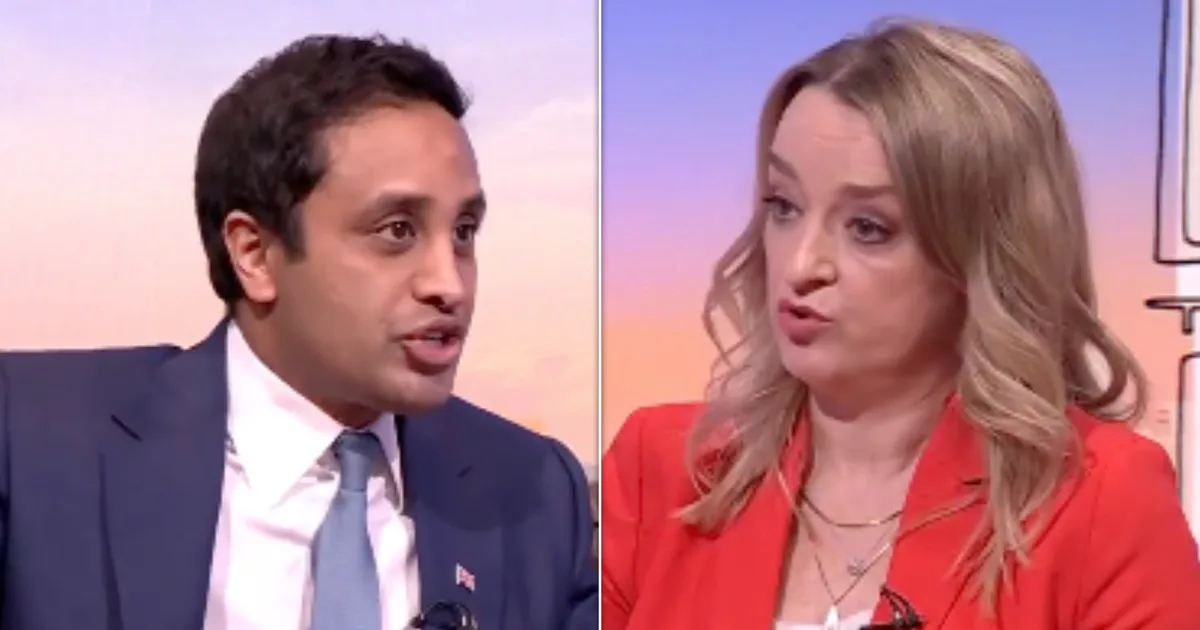
When questioned over these controversies on Sunday with Laura Kuenssberg, Yusuf said: “Firstly, all of that is abhorrent and the party has taken action on that.”
“Why does it keep happening?” The BBC presenter replied.
Advertisement
Reform’s home affairs spokesperson said: “Laura, Reform has vetted over a thousand candidates over the last couple of years.
“Even if our success rate is 99.9%, a handful will slip through.”
He then went on to attack the BBC, saying: “Yes, of course it’s reasonable to hold Reform to account.
“But what consistently happens is the BBC pounces on every single Reform mishap and gives it vastly disproportionate coverage in your news cycles – and completely ignores the far most voluminous misdemeanours and frankly egregious things from other parties do.”
Advertisement
But Kuenssberg cut in: “No, proportionally, Reform has lost more candidates over this kind of thing happening than other political parties.”
He claimed that was “actually incorrect” – before pointing to reports that Green activists had made a series of antisemitic remarks in a group chat.
He claimed a Green Party council candidate made that same claim but “the BBC hasn’t even reported on that and I think that’s unbecoming of the BBC.”
This is a reference to a story from The Telegraph about the Greens for Palestine group, one faction of the party.
Advertisement
A spokesperson told the newspaper: “We do not tolerate discrimination against anyone and also reject deliberate and disingenuous attempts to conflate Zionism and Judaism.”
The BBC has reported on antisemitism allegations within the Greens in the past, and how the party dropped candidates in the run-up to the 2024 general election over problematic or extreme social media posts.
The leader of Reform UK in Scotland, Malcolm Offord, was also asked this week if his party was “shambolic” after losing five Holyrood candidates in a matter of days.
He claimed: “I wouldn’t say it was shambolic, I’d say in fact he opposite. I would say we’ve done an extraordinary thing in a short space of time to interview over 300 candidates to get 73 wanting to stand.”
Advertisement
He claimed the party’s vetting process has been “terrific”, adding: “As I said, it’s gone from over 300 to 73 in six months.
“That’s an extraordinary achievements for a brand new party with a lot of very interesting people coming in, a really interesting mix of people of whom 80% have not been politicians before,” Offord said.
With the local elections fast approaching, Reform UK are working overtime to scale their operation. In aid of this, Farage descended on the capital to push his London-phobic message to the people of London. In response, hecklers made it clear what sort of welcome he should expect:
🚨 WATCH: Nigel Farage is repeatedly heckled at the launch of Reform UK’s London local election campaign pic.twitter.com/QCshvLKvU0
Try not to look at the above image for too long, by the way, and especially don’t look him in the eyes.
Back to the London launch, the clip begins with Farage slagging off London fashion before descending into chaos as a heckler shouts over him:
Advertisement
In the most fashionable parts of central London, men now don’t wear… Oh, we’ve got a screamer! We’ve got a screamer! Boring! Boring! Boring!
As he said this, the word ‘BORING’ was flashing on the screen behind him.
Tip for next time, Nigel; it’s never a good idea to repeatedly shout the word ‘boring’ in the middle of your own speech. Also, from a branding perspective, you should have been saying ‘Now then, now then‘ to hammer the Saville stuff home.
Farage continued:
Oh, it’s… Well, that was fun, wasn’t it? And do you know what I’d say to that young man? Do you know what I’d say? I’d say this. What other party leader in modern Britain would have a public event in the Fairfield Halls in Croydon and invite anyone to come along and listen to what I have to say. And you know what? You can agree, you can disagree, it doesn’t matter. Doesn’t matter. Who else would come along and do that?
This would be a good point if people’s concern was ‘party leaders won’t come to Croydon‘, and not that Reform is pursuing a far-right agenda of antagonising migrants and diminishing state capacity for the benefit of their tax exile donors.
Advertisement
The heckler resumed heckling, anyway, with Farage finishing:
Listen, mate, you’ll have a coronary. You’ll have a coronary. Do you know? Do you know I’d pay to watch this? And that is what… Well, as I always say, boring, boring.
It wasn’t that boring, to be fair, and it did at least draw attention away from the Saville stuff.
Perspectives
The following video shows things from the perspective of the hecklers:
As people noted, Farage might have suspected an easy ride given the massive anti-fascist protest going on elsewhere in the capital:
He tried to go under the radar in Croydon as everyone was at the march in central London. Some Croydon antifash stayed back though.
— Dr Iain Darcy 🍉 🇮🇪 💚 (@doctoriaindarcy) March 28, 2026
Advertisement
We covered that protest here:
We’ve joined the short march at the Together Alliance demo in central London today – oh and the rave on Trafalgar Square is already popping off 💚 pic.twitter.com/aRVWsfBulm
Two years after a high-profile primary defeat that sent shockwaves through the progressive Squad, Cori Bush wants to go back to Washington.
But as the activist-turned-politician seeks to reclaim her seat, she must also contend with the changed landscape of the Beltway — including a Democratic Party engaged in fierce infighting over the country’s support for Israel that has only intensified since her ousting from Congress, which she argues will fuel her comeback bid.
“I need to go back. I didn’t finish the work that I was doing,” Bush said in a recent interview. “It was interrupted by big money. It was interrupted by AIPAC and their allies who made the decision that they didn’t want this activist, this advocate, who had been speaking out against war and imperialism, that had been speaking out against a genocide in Gaza at the hands of the Israeli government.”
The fight over the American Israel Public Affairs Committee and its political arm’s support for candidates has reached a fever pitch among Democrats this election cycle. More and more Democrats have denounced the organization’s influence and, some 2028 presidential contenders have vowed to not accept funding from the organization.
Advertisement
The race in Missouri’s 1st District — a plurality Black district anchored in St. Louis — two years ago was one of the highest-profile fights between critics and supporters of Israel in the Democratic Party, occurring as activists pressured then-candidate Joe Biden over his stance in the raging Israel-Hamas war in Gaza.
Then-county prosecutor Wesley Bell — backed by more than $8.5 million in outside spending from the AIPAC-affiliated United Democracy Project — beat Bush by about 5 points in the primary before easily winning the seat in November. AIPAC’s political arm has yet to spend in the district this year, but they endorsed Bell once again in the 2026 cycle.
“Cori Bush was a disastrously ineffective Member of Congress who didn’t deliver for her constituents,” Patrick Dorton, a spokesperson for AIPAC’s United Democracy Project, said in a statement. “When voters are reminded of that record of non-accomplishment, they will be no more likely to elect Cori Bush to Congress than they were to re-elect her two years ago. She was a terrible Member of Congress that didn’t [do] anything for St. Louis.”
Usamah Andrabi of Justice Democrats, a progressive organization that endorsed Bush this cycle and last, argued Bell’s history of accepting AIPAC support may now be his downfall.
Advertisement
“Voters are waking up to [AIPAC’s] influence, and that is why you are now seeing AIPAC’s endorsement becoming, I think, a death for so many candidates and incumbents across the country,” said Andrabi.
Dorton highlighted Bush’s missed votes and her vote against Biden’s infrastructure bill as the reason she lost to Bell. For his part, Bell appeared unconcerned about the impact that AIPAC’s past support could have on his reelection bid, calling it nothing more than a “headline” for his opponent.
“Folks in my district, money in politics doesn’t impact whether they can get gas in their car and pay for food and the price of eggs and bringing jobs into our district,” Bell said in an interview. “And so that is a headline that my opponent likes to play into.”
Advertisement
Antjuan Seawright — a longtime Democratic strategist and adviser to top Democratic campaign committees — also argued that a focus on AIPAC won’t motivate most primary voters.
“I know there are some in and outside of our party who want to make the conversations about the type of money folks may or may not receive, but I tend to think it’s more important about the type of services we provide,” Seawright said. “As long as the people feel like you’re representing them, then why should the race be about the type of money instead of about the services you provide to the district?”
But the divide in the Democratic Party over support for Israel has only grown since Bush’s 2024 defeat, particularly amid the war in Iran launched by President Donald Trump and Israeli leaders.
Sixty-seven percent of registered Democrats said in an NBC News poll this month that they sympathized more with Palestinians rather than Israelis in “the Middle East situation.” And a recent Quinnipiac poll found that 53 percent of voters, including 89 percent of Democrats, oppose the U.S-Israel military action against Iran.
Advertisement
A similar division is playing out among Republicans. Most self-described MAGA voters firmly back the president’s actions, but prominent members of the conservative movement like Tucker Carlson have criticized the conflict, and Joe Kent, who was serving in a senior intelligence role, quit the administration.
“Without a doubt, the fact that Wesley Bell is historically one of the largest recipients of AIPAC money ever is a massive albatross around his neck that should be hit on consistently,” Andrabi said.
And he argued that primary voters are now rewarding Democrats willing to buck party leadership.
“Voters are looking for leaders who are willing to call out their own party when they are failing communities, call out their own party when they are too beholden to corporate lobbies like AIPAC,” he said. “Cori has done that her entire time [in Congress].”
Advertisement
AIPAC-backed groups two years ago broadly did not focus on Israel in contests across the country. They instead targeted Bush’s vote against Biden’s crowning infrastructure bill and missed House votes — a strategy the organization has continued in early primaries this year — and something that Bell amplified.
“I don’t want to hear about someone who claims to fight but won’t show up to do the job,” Bell said.
Bush was among six progressive Democrats who voted against Biden’s infrastructure bill. The group argued that the bill was incomplete without the separate economic package, known as the Build Back Better Act.
But Bush argues her activism — including pushing party leaders from the left — is where the base of the Democratic Party now is.
Advertisement
“The thing is, people are moving toward the things that I was speaking about,” Bush said. “I called it a genocide before many others did. I spoke up for Medicare For All before others did. I pushed for the Equal Rights Amendment in a way that hadn’t been done in a very long time, and I created a caucus to stand for the Equal Rights Amendment.”
The tensions between Bell and Bush are a stark difference from their relationship pre-2024. According to Bush, the two had been friends — until Bell launched his campaign against her without a heads up. Bush said the two haven’t talked since, and she didn’t let him know when she decided to run against him this year “the same way he didn’t reach out to me to tell me he was going to run against me.”
Still, Bell already has a few advantages in the race: Not only is he the incumbent, but he secured the endorsement of the Congressional Black Caucus PAC, one of the most influential Black political organizations. And Bell’s campaign war chest is much larger than hers: He has nearly $850,000 on hand as of the end of 2025, according to campaign finance records, compared to just over $200,000 for Bush.
Bell has pitched himself as a pragmatist, saying that voters in the district don’t actually think about many of the issues that Bush pushes for.
Advertisement
“She wasn’t present in St. Louis. She didn’t meet with stakeholders; she didn’t meet with constituents,” he said, highlighting the money he brought to district businesses over the last two years. “The MO in Missouri does not stand for Middle East. It stands for Missouri.”
Bush, meanwhile, has signaled she will lean into her progressive activism for her comeback bid. She said she still speaks regularly with members of the Squad: Democratic Reps. Ayanna Pressley, Alexandria Ocasio-Cortez, Rashida Tlaib and Ilhan Omar. None of the members responded to a request for comment.
Seawright, the Democratic strategist, said the back-and-forth between the two candidates exemplifies the party’s “growing pains.”
“The primaries, hopefully, will do what they’re supposed to do and settle whatever differences and disputes we may appear to have, but also change the direction of how we move forward,” he said. “No matter the differences we may appear to have amongst each other, they do not compare to the differences we have with the other side.”
Advertisement
A version of this article first appeared in POLITICO Pro’s Morning Score. Want to receive the newsletter every weekday? Subscribe to POLITICO Pro. You’ll also receive daily policy news and other intelligence you need to act on the day’s biggest stories.
In Nevada, a gallon of gas is approaching $5. In Pennsylvania, farmers are fretting about the prices of fertilizer. And in Michigan, supply chain woes are throwing a wrench into the manufacturing and auto industry operations.
One month into the war in Iran, a new political reality is sinking in for Republicans in these and other battlegrounds: The war may not end as quickly as they initially hoped, and the literal and figurative costs keep rising.
Each week the war drags on prolongs the pain Americans feel. Economists have warned gas prices could continue to remain high for months even if the U.S. immediately de-escalates in Iran. Extended conflict also raises the risk of increased casualties, especially if U.S. servicemembers are deployed to on-the-ground combat. And it could sour MAGA voters whose support of President Donald Trump hinged, in part, on their opposition to “forever wars” and foreign regime change.
Some Republicans worry the war will depress turnout among staunch “America First” proponents ahead of a crucial midterm election. It’s not yet a political crisis, GOP strategists and county chairs across the country said. They’re still willing to trust the president — for now.
Advertisement
But they’re also finding it harder to brush off the consequences.
“What’s the end game? I don’t think the president has been clear about that,” said Todd Gillman, chair of the Monroe County Republican Party in Michigan. “The gas prices are a problem. We’re concerned how this might affect the midterms.”
A POLITICO poll this month found the president’s most loyal voters continue to back his decision to attack Iran, even though some say it violates MAGA principles or even breaks his campaign promise not to start new wars. But it also revealed real political risk if more U.S. troops are killed or the conflict extends much longer than the promised four to six weeks.
“I don’t think it’s going to impact Republicans’ desire to vote Republican, but I do believe that that turnout will be an issue,” said Craig Berland, chair of the Maricopa County, Arizona, Republican Party. “If the war drags on, that is going to impact the turnout, unless we are very, very successful in communicating and educating. And that’s our plan, to do that.”
Advertisement
The situation in Iran remains in flux, and Trump could choose to withdraw U.S. support and end the country’s involvement at any moment.
Until then, the prolonged conflict is complicating the White House’s cost-of-living message, which voters consistently say is their top concern. In recent months, Trump and Vice President JD Vance embarked on an affordability messaging tour, dotting the country to deliver speeches about the administration’s wins in lowering costs and providing relief for working-class families.
But the affordability road show has screeched to a halt in the month since the U.S. launched its war in Iran.
“These types of major events can become all-consuming,” said Buzz Jacobs, a GOP strategist and White House official under George W. Bush. “They certainly suck up political capital, and they make it very difficult for the most senior officials, particularly the President, to focus on any other strategic objective.”
Advertisement
After Bush invaded Iraq, Jacobs recalled, a digital board outside the Situation Room listed the same meeting topics for weeks: “Iraq, Iraq, Iraq, Iraq, something else, Iraq, Iraq, Iraq,” Jacobs said.
The White House pointed to polling that shows a majority of Republican voters back the Iran war.
“The President has been clear that, while there may be some short-term disruptions as a result of Operation Epic Fury, ultimately oil prices will quickly drop once the operation’s clear objectives have been achieved and America will be back on its solid trajectory of cooling inflation and robust growth thanks to this Administration’s proven economic agenda of tax cuts, deregulation, and energy abundance,” spokesperson Kush Desai said in a statement.
In several battleground counties, GOP chairs are holding out hope that the impact will be temporary even as the reality of the war sets in and gas prices creep toward a national average of $4 per gallon.
Advertisement
“Yes, it’s painful now. We all realize that it’s painful, with the gas prices,” said Carson City, Nevada GOP chair Susan Ruch. “I know prices are going to go up — but I do know this is short term compared to World War III.”
That optimism is shared by Decatur County, Georgia, GOP Vice Chair Jesse Williard, who also believes gas prices will plummet quickly after the war ends, setting up Republicans to buck historic midterms trends and post a strong showing in November.
“The economy, I think between now and then, is going to be great,” he said. “If it goes the other direction, it may be horrible, but I anticipate it’s going to be a red wave.”
But other GOP county chairs see early fractures ahead of November’s election, driven by surging costs that are already causing pain for businesses and consumers. In the Phoenix metro area, Berland, the Maricopa County chair, said door-to-door canvassing has become more difficult since the onset of the war.
Advertisement
“We’re even going around canvassing neighborhoods and registered Republicans are yelling out the door, ‘go away, or I’m calling the police,’” Berland said. “I find that very discouraging.”
Voters’ frustrations, he said, stem from “the war or the economy. And the economy is defined largely by energy prices.”
Across Rural America, the pain is even more acute.
Farmers in Pennsylvania, North Dakota and other agriculture-heavy states are feeling the impact of disruptions in the Strait of Hormuz, which sent fertilizer prices skyrocketing just ahead of planting season. Some producers have had to shake up their plans last minute and plant new crops that are less reliant on fertilizer.
Advertisement
The scramble could lead to lower crop yields, which potentially means higher food prices this summer, North Dakota Farmers Union President Matt Perdue said.
Farmers have long been loyal to the GOP and Trump. But the war now poses another massive financial headache on top of the tariffs that have increased their production costs and evaporated markets abroad where they could sell their crops.
“We’ve had just a pile of uncertainty, a pile of volatility in the markets that we buy from and sell to and we’re just creating more volatility, more uncertainty as we move ahead,” Perdue said.
A chorus of farm groups — including the often Trump-aligned American Farm Bureau — petitioned the White House for a bailout last week. And the agriculture lobby is requesting an ad hoc aid package from Congress to cover the mounting fertilizer costs.
Advertisement
Monroe County, Pennsylvania, GOP chair Pete Begley acknowledged that supply chain woes and high prices are pinching some in his community. But he’s willing to offer Trump a long runway before he gets worried.
“If it turns into six months later, we’re still there, and the Ayatollah’s son is still supposedly in charge, that I think will cause concern,” Begley said. “But for now, I think people are standing by the president.”
As a young guy, wellness coach Jackson Hightower was always in a hurry – even when it came to sex.
Now 42, he’s learned that slowing down and really savoring the experience of getting to know your partner is more than worth it.
“Sex has gotten significantly better with age,” Hightower told HuffPost. “It lasts longer, there’s more time for connection, and more time to give her orgasms and pleasure.”
With 20 years of experience, you learn a lot about how to care for a woman, and that plays a major role in ensuring that you both get off.
Advertisement
“Young men rush to release. Older, more experienced men know how to set the stage for safety and real connection so she can unfurl,” he said.
Because knowledge is power, we recently asked men over 30 like Hightower to share some of their best sex tips gained from experience. Read what they had to say below.
Stop thinking your penis is the star of the show
“As a young man, I wish someone had told me that good sex wasn’t all about me and my penis. Just like most men, younger me assumed that sex was just intercourse, and to have good intercourse, your penis had to ‘perform.’ Not only did that put a lot of pressure on me to feel solely responsible for the entire experience, it also led to me singlehandedly dictating the pace of things in bed: the moment I’d start getting hard, I’d rush us on toward intercourse. And the moment I finished, we were done. As a result, I never spent very much time on foreplay (especially foreplay focusing on my partner) for fear of losing an erection.
Advertisement
“Once I realised that it wasn’t all about me – that real sex included any activity that felt good and great sex was something I co-created with my partner – it relieved so much pressure. It opened the door to putting activities back on the menu (like oral) that extend the experience and are far more pleasurable for most women. Now, I feel free to spend as much time as my partner wants on foreplay, and if I get and lose an erection while I focus on her, all I need to do is ask for her to use her hands or mouth on me to get me back in the game. Or, if I find myself getting a bit too excited mid-intercourse, I can slow things down by taking a break and focusing on her. Because ultimately, I find I always have a better time when she’s having a better time.”
“What you can do as a man is help guide the focus of her mind to the present moment you and her are sharing,” said Stirling Cooper, a 39 year-old sex coach.
Work on your dirty talk
“Oftentimes, the biggest obstacle to a woman achieving an orgasm during sex is her own conscious ‘thinking’ part of her brain, the part of her mind that races with anxiety and insecurity. So, to prevent that, what you can do as a man is help guide the focus of her mind to the present moment you and her are sharing.
Advertisement
“Things like describing the sensations she’s already feeling to amplify them more, praising her – telling her how sexy she looks and feels right now – leading her through the experience by guiding her with commands like ‘bend over,’ ‘come here,’ ‘grab it,’ ‘spread them.’ These comments pull her focus into the present and allow her to enjoy sex rather than be distracted by a million anxious thoughts instead.”
“I’d say, stop watching porn. It’s killing your ability to truly connect with a partner during the experience. It can also activate erectile dysfunction, performance anxiety and/or premature ejaculation. It teaches all the wrong moves and makes sex performative, which women can sense and dislike.”
Advertisement
Oleg Breslavtsev via Getty Images
“Give them hard and soft, rough and sweet, dominator and worshipper. Don’t just play one note; master the whole scale,” said Michael Chief.
Focus on getting the fundamentals right before you move on to kink
“How can you really satisfy a woman? Are you supposed to learn a bunch of cool tricks? I’ve done a lot of things that most people never tried: BDSM, tantric sex, threesomes, orgasm stacking. But as with all skills and disciplines, the most important thing is to master the fundamentals: anticipation and foreplay. Treat the entire process of seduction as foreplay, right from the beginning when you first lock eyes. Tease her. Elicit dopamine responses. Take her on an emotional roller coaster while providing the safety guardrails at the same time. Make her want more. Do this with both your words and your actions.
“You need to understand how important the psychological journey is for her physical pleasure. Embrace the dichotomy of women by applying dichotomous techniques in both foreplay and sex. Give them hard and soft, rough and sweet, dominator and worshipper. Don’t just play one note; master the whole scale. Do this with the fundamentals until you can craft your own art with it.”
“Touch for your own pleasure. Enjoy what you are doing. Communicate what you are feeling,” said Steve Bodansky, 71.
Talk about what you both want to do in bed
“Get to know her or them by being curious. Ask them questions about what their preferences are: how they like best to be touched, pressure, speed, lubricant and where they like to be touched. Most importantly, is to touch for your own pleasure. Enjoy what you are doing. Communicate what you are feeling. Ask questions that they can answer yes or no to, like would you like it lower, would you like it more to the left, would you like circles, would you like it lighter? Then respond in increments and ask again until you get it just right.”
Make it a goal to get her to orgasm, more than once, even
“In my early years of having sex, I focused most on my pleasure, specifically on doing what it took for me to come. Often it was short, and most times underwhelming for my partner. Now, when I make love, my favourite thing is turning it into a challenge to see how many times I can get her to orgasm, and how long those climaxes can last. Sex has turned into ‘worship sessions’ where I focus on bringing pleasure to as many parts of her body as possible.
Advertisement
“Most guys don’t realise her entire body is covered in erogenous zones just waiting to be explored with touch, kisses and your tongue. We have so many more tools at our disposal than just our cock. Sometimes I will spend over an hour in foreplay before I even enter her. The secret is to build her pleasure so much until she is begging for me to fuck her, and fuck her hard.”
“Foreplay starts way before you even touch her body, but sex isn’t over after you’ve orgasmed. Dialled-in aftercare creates a feeling of connection post-sex, which women crave as their hormones are in bonding mode post-orgasm.”
On 28 March, Zack Polanski said that the Daily Mail were harassing his family members for a story. According to Polanski himself, it was clear why the gutter press were doing this — because the Greens have leaped up in the polls. Since then, his war with the Mail has taken a turn for the ridiculous, with the journo involved accusing Polanski (a Jewish man) of antisemitism:
Daily Mail and journalist?
Those words don’t belong together with your parasitic behaviour.
You try your daily nonsense – with a paper that literally backed the fascists – and the Green Party continue to rise.
This hasn’t gone how Nicole Lampert thought it would; largely because the feud has drawn everyone’s attention to her history of weird and degenerate behaviour.
Zack Polanski vs scum media
Firstly, let’s look at this line from the above:
Daily Mail journalists aren’t going after your family (as you are aware, there is more we could write if we were).
This line implies that they’ve been digging into his family; how else would she know there was “more we could write”?
Advertisement
Given how quickly Lampert crumbled when Polanski pushed back, we imagine she’d be an absolute mess if someone asked her family what they thought of her politics.
Lampert continued:
I’m a freelance journalist who spoke to your family members who are frightened by the Jew hate in your party. They are frightened by what you have given the green light to.
While you once fought Jew hatred, now you indulge it because, as we both see, it is popular.
Other political groups have discovered this in the past.
Advertisement
Shame on you Zack Polanski
Shame on you.
The “Jew hate” in question is opposing the genocidal actions of Israel. We’re not going to spend too long on this, because we’ve heard it all before, and no one buys it anymore:
Honestly, half the country must just laugh at this shit these days. Are we all supposed to abandon progressive economic, environmental and foreign policies because the Daily Mail dug up some randoms who say they’ll leave the country? Again! Gimme a break https://t.co/R09anUoPZn
To be fair, they did stop backing Hitler when we went to war with him. Did their politics change accordingly? Not really; they just used different words to pursue the same goals.
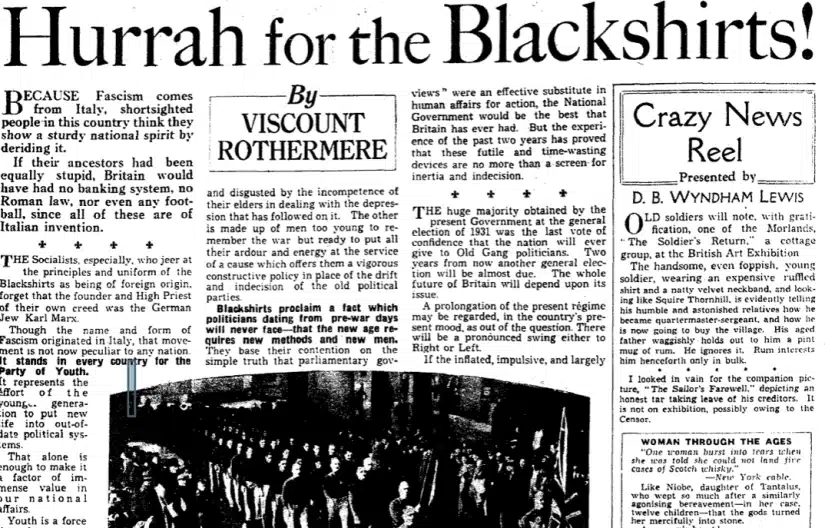
Oh, and talking of the Blackshirts, would you believe the shamelessness of this?
As people are saying, this simply doesn’t work anymore:
An ideology that will destroy the Middle East (including Israel, ironically) will happily do the same in Europe. A line has to be drawn in acceding to its nuttiness. Comparing a party led by a Jewish guy to Mosley is probably it.
The problem Lampert has is her long and well-documented history of being a degenerate freak online and at work. Novara’s Rivkah Brown highlighted this:
We’re not sure how to introduce the following, but Lampert also put this into the world:
Whoooo remembers when Daily Mail bin-rummager Nicole Lampert lauded ex-Sun hack John Kay, who drowned his wife in the bath, as “a very lovely man”? pic.twitter.com/88eY2uwcD8
The irony is that the ‘antizionists’ in your party are the parasites. They are turning a party that once cared about the environment into a vehicle for Jew hatred. And you are giving them cover.
There’s a problem here, and it’s that many of these Anti-Zionists are Jewish.
According to her, this is antisemitic.
And as a Jewish woman, Lampert should really know better.























 News Videos4 days ago
 Sports6 days ago
 Sports6 days ago
 Business7 days ago
 Tech7 days ago
 Tech7 days ago
 Business3 days ago
 News Videos6 days ago
 NewsBeat2 days ago

 Sports6 days ago
 Tech6 days ago



 Fashion5 days ago
 Business5 days ago
 Sports4 days ago
 Politics6 days ago
You must be logged in to post a comment Login