Whether it’s allowing its characters to break the fourth wall to give the audience a glimpse into their thoughts or getting rid of the infamous laugh tracks, some sitcoms do a lot more in their condensed, 30-minute time slot, as they also aim to completely change the entire sitcom landscape. For those who don’t know, the word sitcom is truncated for “situation comedy,” shows that deal with issues in a comedic fashion, and can, oftentimes, wrap up situations within their 30-minute time slot. However, sitcoms have come a long, long way from the days of the famous living room couch and the canned laughter that this genre was once known for.
Starting with the iconic I Love Lucy, sitcoms began to bend and change the structure of the genre, which, in turn, redefined how modern shows tell their stories. The following innovative shows didn’t just follow the same-old blueprint; they set that blueprint on fire, then went on to draw up another blueprint that has helped evolve a genre that could have easily become stale and predictable. These shows challenged the narrative structure, pushed the boundaries of dark comedy, changed the way sitcoms dealt with serious social issues, and rewrote the rules for how television showcased diverse families. So, without further ado, let’s take a look at the game-changing sitcoms that completely rewrote the rules of the genre.
Advertisement
6
‘I Love Lucy’ (1951–1957)
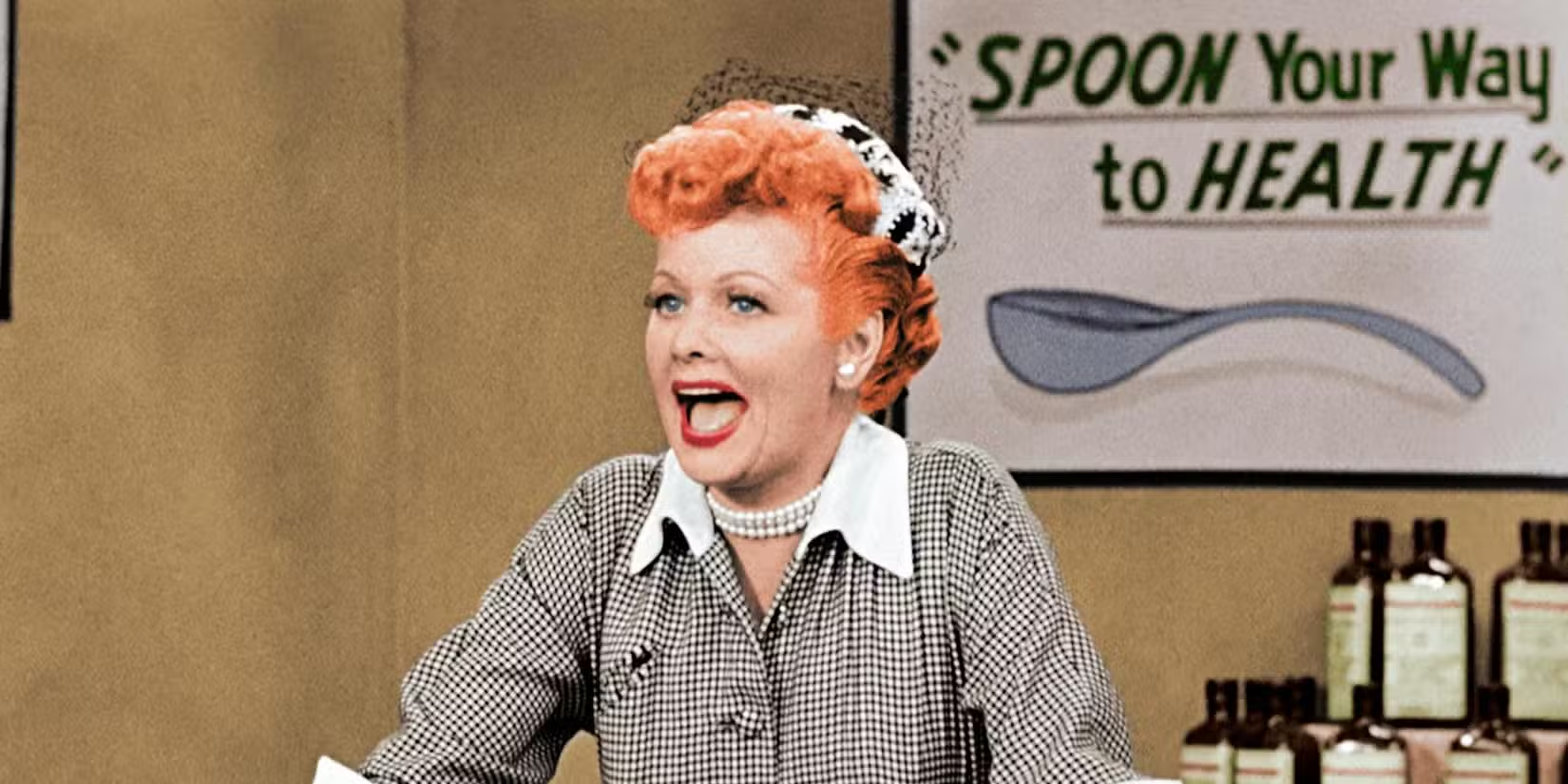
A still of Lucy Ricardo from I Love LucyImage via CBS
When I Love Lucy premiered on CBS in October 1951, it didn’t just become a huge hit overnight, but it rewrote the DNA for how a show is produced and filmed. Starring Lucille Ball and Desi Arnaz, I Love Lucy follows the daily life of Lucy Ricardo (Ball), an ambitious homemaker who often lands in trouble by trying to make it big in show business. Before I Love Lucy hit the airwaves, TV shows were treated as “radio with pictures,” as at the time, television was still a new medium on television. But this sitcom upped the game in production value, inventing the multi-camera setup that allowed the show to be filmed continuously and capture multiple angles, a setup that became the vanguard of sitcom shows in years to come.
Not only did I Love Lucy change how sitcoms were produced, but the show also did something different when it came to filming. In the early ’50s, TV shows were often filmed in New York City, with series airing on the West Coast via “Kinescope.” This resulted in terrible quality, which is something I Love Lucy corrected as the show was filmed on 35mm film. By using film, this allowed the sitcom to be shown at a higher quality, and, as a bonus, the show could be re-aired without losing its quality. This birthed the “rerun,” and it changed the television landscape forever, along with filming each episode in front of a live studio audience, which allowed the actors to react in real-time to the laughter of the audience.
Advertisement
5
‘Kevin Can F**k Himself’ (2021–2022)
Annie Murphy as Allison looking ahead, distraught, in Kevin Can F**K Himself.Image via AMC
Most people look at AMC’s Kevin Can F**k Himself as a brilliant parody of the sitcom genre, and that is a fair assessment for this series. However, this underrated sitcom not just parodied the genre, but it basically did an autopsy on the traditional sitcom. Kevin Can F**k Himself follows the life of Allison McRoberts (Annie Murphy), a woman who is struggling to redefine her life within an unhappy marriage. To frame the contrasting perspectives of the storyline, the series uses two distinct ways to describe Allison’s plight. When she’s with her narcissistic husband (Eric Petersen), the show is shot in a typical sitcom format, complete with a multi-camera setup and audience.
But when Kevin (Allison’s husband) isn’t on the screen, the show shifts into a single-camera setup that is mostly used in dramas. This is basically a “weaponization” of how television genres are filmed, with the muiti-camera format used to show how Kevin’s man-child “hijinks” serve as a punchline when they’re actually ruining his wife’s life, and the single-camera format is used to show the reality of Allison’s life when Kevin isn’t in the room, where his narcissism and man-child antics towards his wife borders on domestic abuse. By using this unique camera setup, Kevin Can F**k Himself forces the viewer to look at the “beloved sitcom wives” of previous sitcoms through a different lens, in which the wives are often seen as “killjoys” for trying to get their man-child husbands to deal with real-world consequences.
Advertisement
4
‘It’s Always Sunny in Philadelphia’ (2005–Present)
In the early 2000s, the sitcom landscape was changing, but they still opted to play it safe, with multi-camera shows still dominating the genre and being careful not to offend anyone. That all changed in 2005, when a pilot shot for only $200 managed to get picked by FX and go on to become the longest-running live-action sitcom in television history. That show is It’s Always Sunny in Philadelphia, created by Rob Mac and follows a group of self-centered, narcissistic misfits who run an Irish dive bar in South Philadelphia. When Always Sunny premiered, the sitcom genre was entering the “prestige” era, which was defined by mockumentary shows such as NBC’s The Office. But while the genre was just beginning to slightly nudge the limits of how far a sitcom can go, Always Sunny shoved it against the line.
The series took the “no learning, no growing” trope, which was popularized by Seinfeld, to the extreme. There isn’t a moment of human connection within the series, and by the end of each episode, a time when most sitcom characters would be better off or have learned their lesson, the gang in Sunny were always worse off morally or physically than they were when the episode started. This severe lack of self-awareness is the beauty of It’s Always Sunny in Philadelphia‘s relentless dark comedy. There is no moral center within “The Gang,” no saccharine moments where the characters learn their lesson or produce “teachable moments” for the audience. This is a high-octane sitcom in which every character is delightfully terrible, and the show has proven that fans would stay loyal to horrible characters if the chemistry and comedic timing are always on point, which they often are.
Advertisement
3
‘The Simpsons’ (1989–Present)
Kirk toasting to his family and the Simpson familyImage via FOX
At the end of the 1980s, the sitcom landscape was dominated by cozy, live-action sitcoms featuring families that were lovable and always taught the audience a lesson at the end of their 30-minute runtimes. Then, in 1989, The Simpsons premiered on the then-upstart Fox network, and the animated series not only invaded the cozy suburbs where family sitcoms lived, but it bulldozed them and built a metropolis built on satire. Before The Simpsons premiered, the typical TV sitcom was based on the “Moral of the Story” format. You’ll have conflict, then a mistake will be made, and then a heartfelt conversation over a saccharine piano track that wrapped everything up in a neat, tidy bow in just 30 minutes. The Simpsons looked at this format and said, “hell no,” and went in a much different direction, and the rest of the sitcom landscape followed.
The Simpsons ditched the “Moral of the Story” format for a “Status Quo” plotline, in that the main character didn’t learn their lesson after each episode. This made the sitcom more cynical, and, ironically, more tied to reality than the homey family sitcoms of the ‘80s. This was all possible thanks to The Simpsons‘ high-speed comedy, with each episode being “layered,” one on top being slapstick for the kids, the middle introducing a touch of sophistication for adults, and the last layer, a background pun for “obsessive” fans. With its quick joke delivery and dense storylines, The Simpsons set the standard for other adult animated sitcoms that would come after it, and it was a breakthrough for the animated sitcom, as it proved that you didn’t need a live studio audience, nor portray actual living humans, to have a hit, primetime sitcom.
Advertisement
2
‘All in the Family’ (1971–1979)
Archie and Edith dancing in ‘All in the Family’Image via CBS
In the first two decades of the sitcom’s golden age, shows within the genre carefully constructed the tropes that would become the pillars of the genre. Situations were often solved within an episode, and the show was so safe that kids could easily watch and enjoy these sitcoms with their parents. But by the 1970s, society was changing rapidly, stripping away the “plastic sheen” of American life. The rapid change in American society and the struggle of the older generation to adapt to it were perfectly captured in the iconic CBS sitcomAll in the Family. Created by Norman Lear, this socially-conscious sitcom followed the Bunker family of Queens, led by the family patriarch, Archie Bunker (Carroll O’Connor), the so-called “lovable bigot” who bemoaned America’s societal change.
All in the Family represented the death of escapism in the sitcom genre. Before the show premiered in 1971, sitcoms normally avoided the “Three Ts”: Taboos, Topicality, and Tension. This is how sitcoms kept their shows free from controversy and safe for the family. Then, All in the Family came in and broke all of those norms, using its characters to highlight social issues such as racism, feminism, and antisemitism. The success of the show rewrote the rules to show that sitcoms could tackle serious issues while still being funny. Granted, the sitcom was not your typical “family-friendly” show, but we wouldn’t have serious topics discussed in sitcoms if it weren’t for the success of All in the Family.
Advertisement
1
‘The Cosby Show’ (1984–1992)
The cast of The Cosby Show pose for a group promo photo against a plain backdrop. Image via NBC
In the 1970s, Black families on television were always depicted as struggling with poverty and dealing with social injustice. But in the 1980s, Bill Cosby set out to showcase that not all Black families were underprivileged, but were just as upwardly mobile as white families were. So, in 1984, NBC debuted The Cosby Show, which not only shone a different light on the African American family but also single-handedly revived the sitcom genre. While sitcoms were still on television, they were being drastically overshadowed by single-camera dramas like Dallas and Dynasty, to the point where the genre was basically on life support. The Cosby Show gave the sitcom a huge jolt and formally kick-started the family sitcom boom that the decade would be known for.
The Cosby Show was not only an overnight ratings success and savior of the sitcom genre, but it also completely rewrote the rules of how minority families were portrayed on television. The parents, Cliff (Cosby) and Clair (Phylicia Rashad), were professionals, with Cliff as an obstetrician and Clair a law firm partner, and the sitcom took a universal approach to themes such as parenting and education, showing that just because the family was Black, it didn’t mean that it had the same issues as white families. The Cosby Show re-wrote the rules for the family sitcom, showing that the “bumbling dad” could still be authoritative, and that the mother was just the “dotting wife” and was an equal to her husband. The sitcom paved the way for telling more diverse stories on television, and while the show was tarnished by Cosby’s fractured legacy, it should still be considered a sitcom that changed the game in television.
Advertisement
Advertisement
Release Date
1984 – 1992
Advertisement
Directors
Jay Sandrich, Chuck Vinson, Malcolm-Jamal Warner, Oz Scott, Alan Smithee
Writers
Advertisement
Bill Cosby, John Markus, Gary Kott, Janet Leahy, Mark St. Germain, Ehrich Van Lowe, Adriana Trigiani, Ed. Weinberger, Lisa Albert, Michael J. Leeson, Oliver Hailey, Thad Mumford
That makes tonight feel less like a surprise than a coronation — but it is still a huge deal. Buckley’s performance as Agnes has been the emotional centerpiece of Hamnet’s entire awards story, with critics and awards voters rallying around her work in a film that reimagines the grief and private life surrounding Shakespeare’s family. The film was directed by Zhao, who also co-wrote the screenplay with Maggie O’Farrell, adapting O’Farrell’s bestselling 2020 novel. The cast is led by Buckley as Agnes and Paul Mescal as William Shakespeare, with Emily Watson, Joe Alwyn, Jacobi Jupe, and Noah Jupe in supporting roles.
Advertisement
Advertisement
Collider Exclusive · Oscar Best Picture Quiz Which Oscar Best Picture Is Your Perfect Movie? Parasite · Everything Everywhere · Oppenheimer · Birdman · No Country
Five Oscar Best Picture winners. Five completely different visions of what cinema can be — and what it can do to you. One of them is the film that was made for the way your mind works. Ten questions will figure out which one.
🪜Parasite
🌀Everything Everywhere
☢️Oppenheimer
Advertisement
🐦Birdman
🪙No Country for Old Men
Advertisement
01
What kind of film experience do you actually want? The best movies don’t just entertain — they leave something behind.
Advertisement
02
Which idea grabs you most in a film? Great films are driven by a central obsession. What’s yours?
Advertisement
03
How do you like your story told? Form is content. The way a story is shaped changes what it means.
Advertisement
04
What makes a truly great antagonist? The opposition defines the protagonist. What kind of opposition fascinates you?
Advertisement
05
What do you want from a film’s ending? The final note is the one that lingers. What do you want it to sound like?
Advertisement
06
Which setting pulls you in most? Where a film takes place shapes everything — mood, stakes, what’s even possible.
Advertisement
07
What cinematic craft impresses you most? Every great film has a signature — a technical or artistic element that makes it unmistakable.
Advertisement
08
What kind of main character do you root for? The protagonist is the lens. Who you choose to follow says something about you.
Advertisement
09
How do you feel about a film that takes its time? Pace is a choice. Some films sprint; others let tension accumulate slowly, deliberately.
Advertisement
10
What do you want to feel walking out of the cinema? The best films leave a mark. What kind of mark do you want?
Advertisement
The Academy Has Decided Your Perfect Film Is…
Your answers have pointed to one Oscar Best Picture winner above all others. This is the film that was made for the way your mind works.
Advertisement
Parasite
You are drawn to films that operate on multiple levels simultaneously — that begin in one genre and quietly, brilliantly migrate into another. Bong Joon-ho’s Parasite is a film about class, desire, and the architecture of inequality that manages to be darkly funny, deeply suspenseful, and genuinely shocking across a single extraordinary running time. Your instinct is for cinema that hides its true intentions until the moment it’s ready to reveal them. Parasite is exactly that — a film that rewards close attention and punishes assumptions, right up to its devastating final image.
Advertisement
Everything Everywhere All at Once
You want it all — and this film gives you all of it. The Daniels’ Everything Everywhere All at Once is one of the most maximalist films ever made: action comedy, multiverse sci-fi, family drama, existential crisis, and a genuinely earned emotional core that sneaks up on you amid the chaos. You are someone who responds to ambition, who doesn’t want cinema to choose between being entertaining and being meaningful. This film refuses that choice entirely. It is overwhelming by design, and its overwhelming nature is precisely the point — because the feeling of being crushed by infinite possibility is exactly what it’s about.
Advertisement
Oppenheimer
You are drawn to cinema on a grand scale — films that understand history not as a backdrop but as a force, and that place their characters inside that force and watch what happens. Christopher Nolan’s Oppenheimer is a film about the terrifying gap between what we can do and what we should do, told with the full weight of one of the most consequential moments in human history behind it. You want your films to feel important without feeling self-important — to earn their ambition through sheer craft and the gravity of their subject. Oppenheimer does exactly that. It is enormous, complicated, and refuses easy comfort.
Advertisement
Birdman
You are drawn to films that foreground their own construction — that make the how of the filmmaking part of the what it’s about. Alejandro González Iñárritu’s Birdman, shot to appear as a single continuous take, is cinema examining itself through the cracked mirror of a fading actor’s ego. You respond to formal daring, to the feeling that a film is doing something that probably shouldn’t be possible. Michael Keaton’s performance and Emmanuel Lubezki’s restless camera create something genuinely unlike anything else — a film that is simultaneously about creativity, relevance, self-destruction, and the impossibility of ever truly knowing if your work means anything at all.
Advertisement
No Country for Old Men
You are drawn to cinema that trusts silence, that refuses to explain itself, and that treats dread as a form of meaning. The Coen Brothers’ No Country for Old Men is a film about the arrival of a new kind of evil — implacable, arbitrary, and utterly indifferent to the moral frameworks we use to make sense of the world. It is one of the most formally controlled films ever made, and its controlled restraint is what makes it so terrifying. You want your films to haunt you, not comfort you. You are not interested in resolution if resolution would be dishonest. No Country for Old Men is honest in a way that most cinema never dares to be.
Because today is Friday the 13th, let’s march our way through the iconic slasher franchise. Ch-ch-ch-ch. Ha-ha-ha-ha.
Advertisement
How Good Is ‘Hamnet’?
Collider’s review by Ross Bonaime stated that Buckley’s portrayal is remarkable not only in the film’s most emotional moments but in the quiet details. A hesitant touch. A hand reaching for someone who is no longer there. A confused glance at a world that suddenly feels unrecognizable. Buckley makes Agnes’ grief feel deeply physical, as if the loss has fundamentally altered the way she moves through life.
Advertisement
“Both Buckley and Mescal are incredible in Hamnet, showing an unflinching emotional rawness. The complete and utter destruction of one’s soul is exactly what Buckley is portraying, and it’s nothing short of magnificent what she’s able to pull off here. Not only is she heartbreaking in the major moments, but it’s in her smaller touches that her role of Agnes has a remarkable amount of power. Even just reaching out a hand at the right moment or the utter confusion of who she is now that her son is gone make for some of the most powerful scenes in Hamnet. It’s a gorgeous performance that will burrow itself into your heart.”
Stay tuned to Collider for more coverage of the Academy Awards.
For months, One Battle After Another looked like the movie to beat. It had the reviews, the momentum, the pedigree, and the kind of across-the-board support that usually signals a Best Picture winner before envelopes are even opened, and now it is official.
One Battle After Another has won Best Picture at the 2026 Academy Awards, giving Paul Thomas Anderson the night’s biggest prize and closing out one of the strongest awards runs of the season. Written and directed by Anderson, the film stars Leonardo DiCaprio as a former political radical and single father, with a cast that also includes Regina Hall, Sean Penn, Teyana Taylor, Benicio del Toro, and Chase Infiniti.
The film entered the ceremony with 13 Oscar nominations, making it the second-most-nominated movie of the year, behind only Sinners. It was widely seen as one of the top contenders all season long, with major outlets and prediction-market coverage all pointing to it as a major frontrunner heading into Oscar night. By the time the Oscars arrived, the movie had already solidified itself as a consensus prestige heavyweight, with outlets repeatedly describing the Best Picture race as essentially a showdown between Anderson’s film and Sinners.
Advertisement
Advertisement
Collider Exclusive · Oscar Best Picture Quiz Which Oscar Best Picture Is Your Perfect Movie? Parasite · Everything Everywhere · Oppenheimer · Birdman · No Country
Five Oscar Best Picture winners. Five completely different visions of what cinema can be — and what it can do to you. One of them is the film that was made for the way your mind works. Ten questions will figure out which one.
🪜Parasite
🌀Everything Everywhere
☢️Oppenheimer
Advertisement
🐦Birdman
🪙No Country for Old Men
Advertisement
01
What kind of film experience do you actually want? The best movies don’t just entertain — they leave something behind.
Advertisement
02
Which idea grabs you most in a film? Great films are driven by a central obsession. What’s yours?
Advertisement
03
How do you like your story told? Form is content. The way a story is shaped changes what it means.
Advertisement
04
What makes a truly great antagonist? The opposition defines the protagonist. What kind of opposition fascinates you?
Advertisement
05
What do you want from a film’s ending? The final note is the one that lingers. What do you want it to sound like?
Advertisement
06
Which setting pulls you in most? Where a film takes place shapes everything — mood, stakes, what’s even possible.
Advertisement
07
What cinematic craft impresses you most? Every great film has a signature — a technical or artistic element that makes it unmistakable.
Advertisement
08
What kind of main character do you root for? The protagonist is the lens. Who you choose to follow says something about you.
Advertisement
09
How do you feel about a film that takes its time? Pace is a choice. Some films sprint; others let tension accumulate slowly, deliberately.
Advertisement
10
What do you want to feel walking out of the cinema? The best films leave a mark. What kind of mark do you want?
Advertisement
The Academy Has Decided Your Perfect Film Is…
Your answers have pointed to one Oscar Best Picture winner above all others. This is the film that was made for the way your mind works.
Advertisement
Parasite
You are drawn to films that operate on multiple levels simultaneously — that begin in one genre and quietly, brilliantly migrate into another. Bong Joon-ho’s Parasite is a film about class, desire, and the architecture of inequality that manages to be darkly funny, deeply suspenseful, and genuinely shocking across a single extraordinary running time. Your instinct is for cinema that hides its true intentions until the moment it’s ready to reveal them. Parasite is exactly that — a film that rewards close attention and punishes assumptions, right up to its devastating final image.
Advertisement
Everything Everywhere All at Once
You want it all — and this film gives you all of it. The Daniels’ Everything Everywhere All at Once is one of the most maximalist films ever made: action comedy, multiverse sci-fi, family drama, existential crisis, and a genuinely earned emotional core that sneaks up on you amid the chaos. You are someone who responds to ambition, who doesn’t want cinema to choose between being entertaining and being meaningful. This film refuses that choice entirely. It is overwhelming by design, and its overwhelming nature is precisely the point — because the feeling of being crushed by infinite possibility is exactly what it’s about.
Advertisement
Oppenheimer
You are drawn to cinema on a grand scale — films that understand history not as a backdrop but as a force, and that place their characters inside that force and watch what happens. Christopher Nolan’s Oppenheimer is a film about the terrifying gap between what we can do and what we should do, told with the full weight of one of the most consequential moments in human history behind it. You want your films to feel important without feeling self-important — to earn their ambition through sheer craft and the gravity of their subject. Oppenheimer does exactly that. It is enormous, complicated, and refuses easy comfort.
Advertisement
Birdman
You are drawn to films that foreground their own construction — that make the how of the filmmaking part of the what it’s about. Alejandro González Iñárritu’s Birdman, shot to appear as a single continuous take, is cinema examining itself through the cracked mirror of a fading actor’s ego. You respond to formal daring, to the feeling that a film is doing something that probably shouldn’t be possible. Michael Keaton’s performance and Emmanuel Lubezki’s restless camera create something genuinely unlike anything else — a film that is simultaneously about creativity, relevance, self-destruction, and the impossibility of ever truly knowing if your work means anything at all.
Advertisement
No Country for Old Men
You are drawn to cinema that trusts silence, that refuses to explain itself, and that treats dread as a form of meaning. The Coen Brothers’ No Country for Old Men is a film about the arrival of a new kind of evil — implacable, arbitrary, and utterly indifferent to the moral frameworks we use to make sense of the world. It is one of the most formally controlled films ever made, and its controlled restraint is what makes it so terrifying. You want your films to haunt you, not comfort you. You are not interested in resolution if resolution would be dishonest. No Country for Old Men is honest in a way that most cinema never dares to be.
Because today is Friday the 13th, let’s march our way through the iconic slasher franchise. Ch-ch-ch-ch. Ha-ha-ha-ha.
Advertisement
How Good Is ‘One Battle After Another’?
Collider’s review stated thatOne Battle After Another finds Paul Thomas Anderson working on his largest canvas yet — and proving that even at blockbuster scale, his filmmaking instincts remain as sharp as ever. Known for ambitious, character-driven films like Boogie Nights, Magnolia, There Will Be Blood, and Licorice Pizza, Anderson has spent decades refining a style that blends humor, emotional depth, and sweeping storytelling. With this sprawling new project, loosely inspired by Thomas Pynchon’s novel Vineland, he delivers something unexpected: a politically charged action film that still feels unmistakably like a Paul Thomas Anderson movie, as Ross Bonaime opined.
Advertisement
“Anderson has executed an unbelievably rare feat: a big-budget studio action film that maintains his specific tone and style, with a film that feels essential to our troubled modern times. One Battle After Another is the type of film that only comes along a few times a generation, a masterfully crafted work that speaks to our present as a defining work of what it was like to live in our present era. Anderson does that with humor, tension, fear, and care, in a film that’s both one of the director’s and 2025’s best.”
One Battle After Another is streaming now on HBO Max. Stay tuned for more updates.
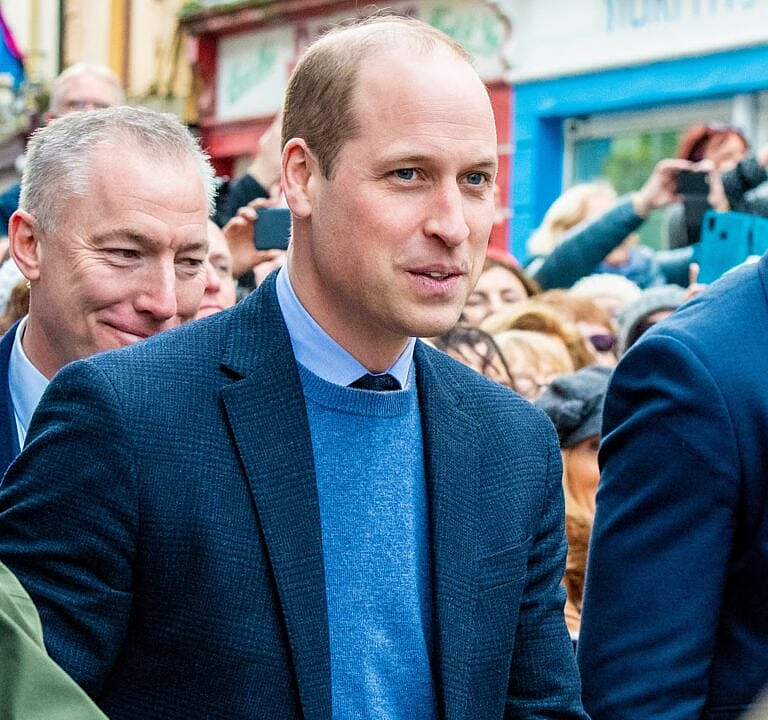
The Prince of Wales celebrated the late humanitarian on Mother’s Day, Sunday, March 15, 2026, on Instagram, 29 years after she lost her life in an auto crash at the Pont de l’Alma tunnel in Paris.
Prince William’s post comes amid reports that nothing positive has developed in his estranged relationship with his younger brother, Prince Harry, despite Princess Diana’s wish that they must always be there for each other.
Inside Prince William’s Emotional Mother’s Day Post
MEGA
The official handle of the Prince and Princess of Wales shared an adorable image of the young Prince William, then two years old, and his loving mother in a field of flowers at Highgrove in 1984. Diana was dressed in a bright pink sweater, a collared shirt, and denim pants, as she squatted behind William, who wore a white-and-blue shirt and pink pants.
The photograph, which was taken over four decades ago in the open field, was accompanied by the caption that read, “Remembering my mother, today and every day. Thinking of all those who are remembering someone they love today. Happy Mother’s Day. W.”
Advertisement
The post gathered nearly 500k likes and thousands of comments from people who fondly remembered the late princess alongside the future king. Commenters described Diana as a wonderful woman who left behind a legacy that her kids have carried on with honor.
The Mother’s Day Post Unlocked Years Of Pleasant Memories In The Comments
Prince William’s touching post drew heartfelt comments in the comment section, with most attesting to the bond between the mother and son. “Such a tender and beautiful memory. The love between mother and child shines through this moment in nature- truly touching and timeless,” this fan declared.
Other commenters assured William that his mother is very proud of him from up above while extending heartfelt wishes to the Princess of Wales, Kate Middleton, who shares three kids with the royal. “She would be so proud of you, PW. You are a credit to her legacy, your family, your country, and the commonwealth,” this fan acknowledged in the comments.
Prince William was born on June 21, 1982, at St. Mary’s Hospital in London, nearly one year after the late Princess Diana and King Charles tied the knot in their fairytale wedding on July 29, 1981.
Prince William Vowed To Do Things Differently As Regards His Family Exposure To The Media
MEGA
The Prince of Wales and his brother practically grew up in the eyes of the media, which made the aftermath of their mother’s death difficult, as they were just teenagers at the time of her death. As shared by The Blast, Prince William spoke about the importance of learning from his troubled history with the media and channelling that into creating a safe space for his children to grow up in.
He referenced how difficult it was to navigate life as a child while his parents dealt with such a public divorce and haunting headlines from tabloids. William emphasized that he is determined to ensure his kids do not carry the trauma of a controversial childhood into adulthood.
Advertisement
“If you let that creep in, the damage it can do to your family life is something that I vowed would never happen to my family. And so, I take a very strong line about where I think that line is, and those who overstep it, I’ll fight against,” the royal declared. He also spoke about the conscious decision he and Kate make to reduce their kids’ access to phones and find other ways to engage, such as playing their favorite outdoor sports.
Princess Diana’s Sons Have Strayed From Her Primary Wish For Them
MEGA
The royal, who died tragically at the age of 36, was reportedly very elated at the thought of birthing two boys because she believed the older would protect the younger in the turbulent waters of ruling the monarchy. Unfortunately, both boys were struck with the tragedy of losing her, and decades after that, the bond between them has dwindled.
According to Andrew Morton, Diana’s biographer, she might have been able to avert the ongoing feud between William and Harry if she were still alive. As shared by The Blast, the strained bond between the once inseparable brothers has reportedly also spilled over to the next generation due to the geographical distance. Harry and his family moved to America in 2020, while stepping down from their position as senior working royals.
They subsequently expanded their family when they welcomed Lilibet in 2021, and hopped right into building their empire on American soil. Morton stated that these dynamics now mean there is no relationship between William’s children and Harry’s kids. He added that things were said when their feud began shortly after Harry’s wedding in 2018, and they never healed, nearly a decade later.
Prince William Reportedly Carrying The Larger Load In Feud With Prince Harry
Mirrorpix / MEGA
Royal author Omid Scobie weighed in on the state of Harry and William’s relationship against the backdrop of alleged reconcilatory efforts by Harry behind the scenes. The author noted that in 2023, when Harry released his controversial memoir, he did all he could to get in touch with William both directly and through mutual friends, but he was iced out.
Scobie added that, even with a few instances of reunion between Charles and Harry, little could be said about any progress between the two brothers. The author continued that for a while, the ball has been in William’s court to reach out to Harry or give him an audience, but he has chosen to look the other way.
Advertisement
The royal author then declared that William’s way of handling this feud may haunt him in the long run, especially when he becomes king and heads an even more complex system. In Scobie’s words, “There’ll be a lot of things that he stands for, or will seemingly stand for. And if he’s unable to mend a fracture, for all the reasons that we know are behind it, with his brother, I think that also says something about him as a future monarch that may not work in his favor.”
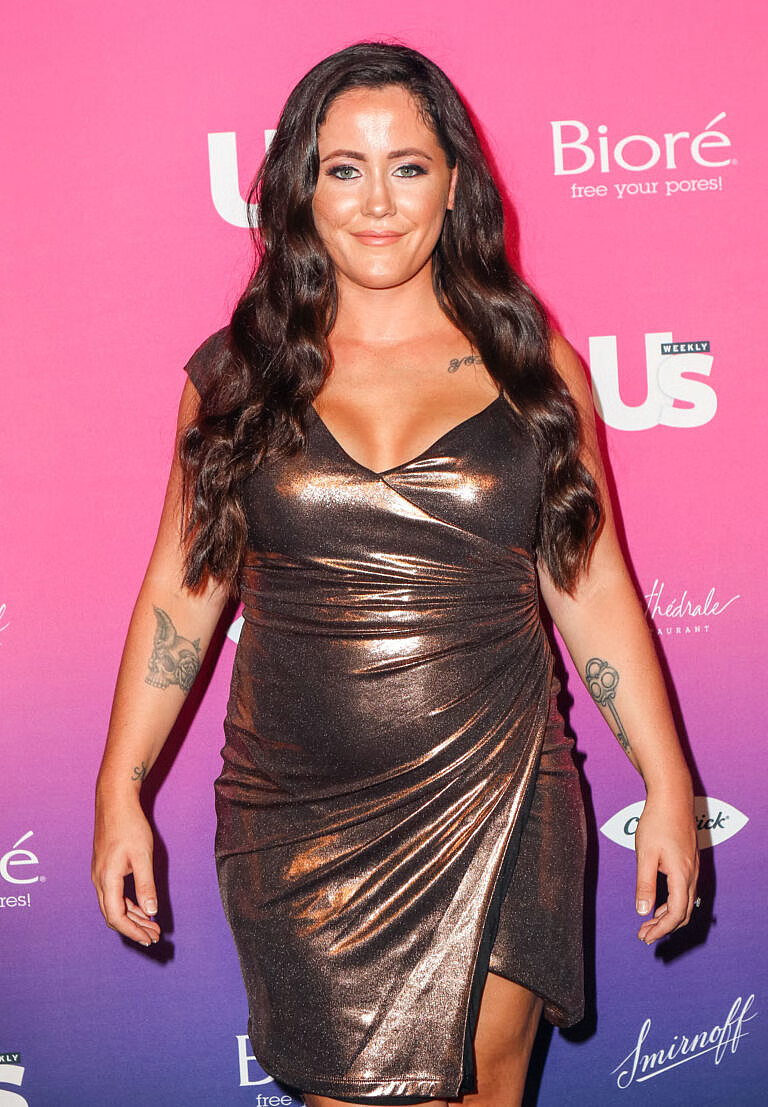
Jenelle Evans‘ family drama has moved to a whole new level involving her mother, Barbara Evans.
The MTV alum’s mother recently made an emergency attempt to gain custody of her grandson but was resisted by the court, at least until next month for a proper court hearing.
Jenelle Evans’ son, Jace, reportedly pulled a gun on Barbara Evans in February during a confrontation and was subsequently checked into a mental health facility days ago.
Jenelle Evans Reacts To Her Mother’s Custody Attempt
MEGA
The media personality reacted to the current situation in her family, stating that her mother’s recent request for custody was denied, and she still has physical and sole custody of Jace. Barbara had filed two motions on March 11, requesting for emergency custody and a separate filing to modify the existing child custody arrangement.
She was, however, given a date in April (13) for a temporary court hearing, and not one for emergency custody. As shared by US Weekly, Barbara appeared for the emergency custody hearing last Wednesday, March 11, in the absence of Jenelle’s lawyer and without notifying her team either, leading to an immediate dismissal of the motion.
Advertisement
The MTV Alum And Her Mother Had A Courthouse Spat In 2019
This is not the mother and daughter’s first rodeo over custody; as far back as 2019, PEOPLE had shared that they had a heated session outside a North Carolina courthouse. Jenelle and her husband, David Eason, had reportedly appeared in court to give judges an update on their couple’s counseling and parenting classes.
Jenelle and Barbara seemingly got into a tense exchange outside the courthouse after the day was done. “I’m right here outside of the courthouse, I’m giving my daughter a hug. If you have a problem with it, then get an officer. Because obviously she’s not scared,” the MTV alum had stated while holding her daughter, Ensley.
Barbara, at the time, had custody of Jenelle’s kids, Ensley and Jace, which explained the back and forth over the toddler. Jenelle told the lurking cameras as they walked towards the car that her mother blocked her number, while complaining about Child Protection Services ignoring her calls and office visits. A judge had temporarily ruled against Jenelle and Eason getting back custody of the kids after Eason allegedly shot and killed their dog, Nugget.
Jenelle Evans Slammed Her Family After The Alleged Gun Pulling Incident
MEGA
Following reports that her son pulled a gun on Barbara and threatened to take his life alongside, Jenelle hopped online with blazing hot words for her mother and sister. As shared by The Blast, Jenelle tagged Barbara her worst enemy, as she revealed that she had been holding back on her thoughts towards her mother due to her frail health.
She also attacked her sister, Ashleigh Evans, who had claimed she had a medical issue, but this did not stop her from being evil, as she also did not have custody of her son. Jenelle urged people to take whatever her sister says with a grain of salt, adding that despite cutting her family off to protect herself and her kids, she still has to face all hell getting loose.
Police had responded to a call from Barbara’s residence, where Jace lived in North Carolina, to report a troubled teen disturbance. Ashleigh responded to the allegations on social media, insisting that Jace did not pull out any firearm at his grandmother’s home, as there was no gun in the home, and it was probably Jenelle making up a false narrative in the media.
Advertisement
Jenelle’s Son Has Been Admitted Into A Mental Facility
Sources claimed that Jace was under the influence of alcohol and drugs when he pulled the gun on his grandmother. He has reportedly been placed in a mental health institution, as a representative from Jenelle revealed that she is still trying to find the best place for her son to receive premium treatment. Jenelle currently resides in Las Vegas with her other kids, Kaiser (from her previous relationship with Nathan Griffith) and Ensley.
The MTV alum was reportedly preparing to pay her son a visit at the facility amid requests that the public give them privacy to address such a sensitive and personal issue. Jenelle had previously blamed her mother for indulging her son’s bad habits while he lived with her. She described Barbara’s parenting style as a vicious cycle that she had to rewire her brain to grow out of.
Jenelle Evans Did Not See A Reconciliation In Her And Barbara Evans Future
MEGA
The former TV star and her mother’s rocky relationship began over a decade ago after Barbara gained custody of her daughter’s firstborn, Jace. E! Online stated that Jenelle finally got a formal visitation schedule in 2017 for Jace, but the resentment still abounds.
“You know we went to court about Jace, and I got a visitation schedule set, but she’s still kind of bent out of shape because I still have resentment towards her for still keeping my son, and we still butt heads,” Jenelle stated to E! News in 2017.
She gave a verdict on the state of her relationship with Barbara, declaring it as lost, adding that there might never be a comeback from their dynamics at any point in time. Jenelle and Barbara’s frequent arguments on camera during her appearance on the second season of “16 and Pregnant” in 2010 became the hallmark of the show.
Will Janelle Evans and Barbara Evans reach a truce before April?






:max_bytes(150000):strip_icc():format(jpeg)/conan-obrien-donald-trump-031526-8b920d4fec234ba1a928f96c584c9acd.jpg)


:max_bytes(150000):strip_icc():format(jpeg)/Gene-Hackman-The-French-Connection-031226-12af579c8b1049d6bfbc79aa27b7aacb.jpg)

:max_bytes(150000):strip_icc():format(jpeg)/Alexandre-Singh-conan-obrien-180-03142026-9a0b94014ac34db9a9951dce3438d453.jpg)
:max_bytes(150000):strip_icc():format(jpeg)/DARKWINDS_405_MM_0513_0667_RT-f49f88d8b4a04f6cb484a875a7ab234f.jpg)
:max_bytes(150000):strip_icc():format(jpeg)/bridesmaids-reunion-oscars-031526-12151c40d26c40e789a6688c5e6dc6bd.jpg)




:max_bytes(150000):strip_icc():format(jpeg)/james-van-der-beek-eric-dane-brigitte-bardot-031526-c28cc0fbdc454a58b3f59b605f7d5768.jpg)