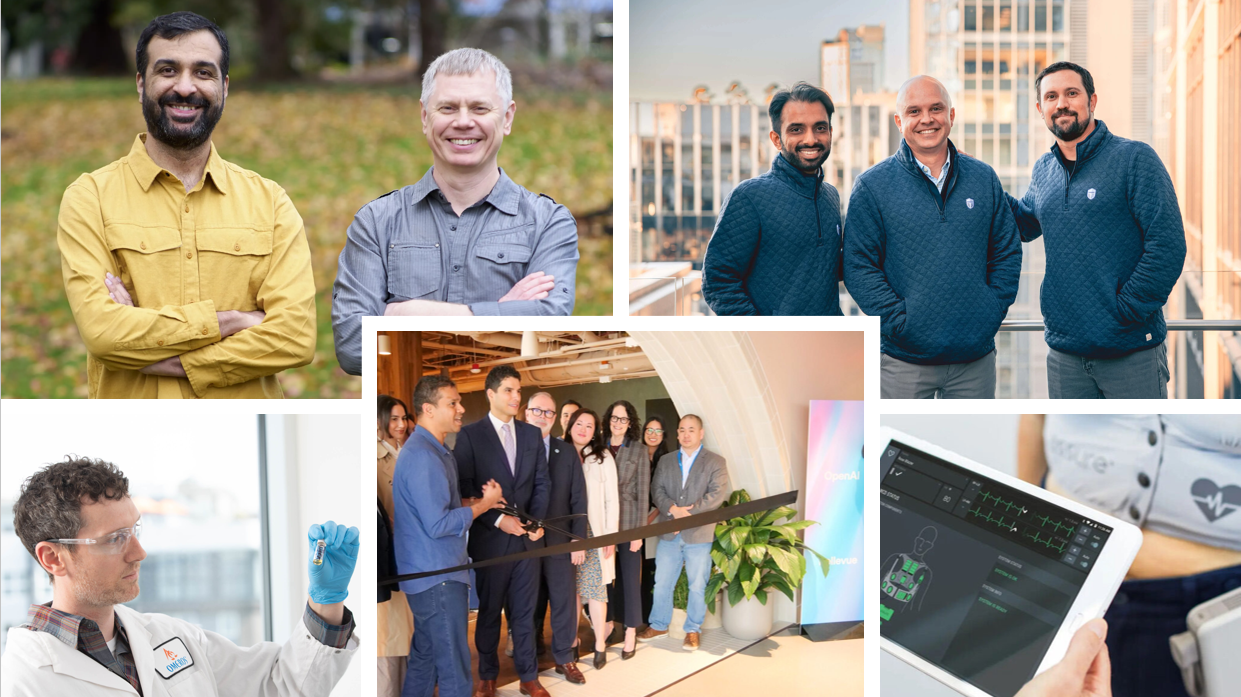
The finalists for Deal of the Year at the 2026 GeekWire Awards. Clockwise from top left: Temporal co-founders Samar Abbas and Maxim Fateev; Protect AI co-founders Badar Ahmed, Daryan Dehghanpisheh, and Ian Swanson; Kestra Medical Technologies’ cardiac monitoring device; the ribbon cutting at OpenAI’s new Bellevue office, home to the former Statsig team; an Omeros lab. (GeekWire / Company Photos)
The finalists for Deal of the Year at the 2026 GeekWire Awards include two major acquisitions, a landmark licensing deal, a big funding round, and a rare IPO — collectively representing billions of dollars in transactions.
This award, presented by Wilson Sonsini, recognizes the transactions that made the biggest impact in tech and innovation in Seattle and the Pacific Northwest. The Deal of the Year finalists this year are Kestra Medical Technologies, Omeros, Protect AI, Statsig, and Temporal.
Now in its 18th year, the GeekWire Awards is the premier event recognizing the top leaders, companies and breakthroughs in Pacific Northwest tech, bringing together hundreds of people to celebrate innovation and the entrepreneurial spirit. It takes place May 7 at the Showbox SoDo in Seattle.
Seattle startup Lexion was the Deal of the Year winner last year after being acquired by Docusign for $165 million, a successful exit for the AI-powered contract management company, which got its start in 2018 at the Allen Institute for AI in Seattle.
Continue reading for information on Deal of the Year finalists, who were chosen by a panel of independent judges from community nominations. You can help pick the winner: Cast your ballot here or in the embedded form at the bottom. Voting runs through April 10.
Statsig was acquired by OpenAI for $1.1 billion in an all-stock deal announced in September, in a surprise exit for the Bellevue, Wash.-based product experimentation platform. The deal also landed Statsig CEO Vijaye Raji, a former Facebook engineering leader, in the newly created role of CTO of Applications at OpenAI.
Advertisement
Founded in 2021, Statsig powers A/B testing, feature flagging, and real-time decisioning for major companies. It had raised more than $153 million, including a $100 million Series C round at a $1.1 billion valuation just months before the acquisition, with backing from Sequoia and Madrona. Statsig now forms the nucleus of OpenAI’s new Bellevue engineering office.
Kestra Medical Technologiesraised $202 million in its IPO in March 2025, pricing shares above the expected range in a strong debut for the Kirkland, Wash.-based maker of wearable cardiac devices. Shares began trading on the Nasdaq at more than 30% above the IPO price.
Founded in 2014, Kestra makes devices that detect and respond to sudden cardiac arrest. Its IPO marked the end of a long dry stretch with no traditional IPOs for Seattle-area tech companies since 2021.
Omeros Corporation, a Seattle-based clinical-stage biopharmaceutical company, struck a deal worth up to $2.1 billion with pharmaceutical giant Novo Nordisk for zaltenibart, its clinical-stage drug candidate in development for rare blood and kidney disorders. Announced in October, the agreement gives Novo Nordisk exclusive global rights to develop and commercialize the drug.
Advertisement
Founded in 1994 by orthopedic surgeon Gregory A. Demopulos, who still serves as CEO, Omeros went public in 2009 and recently received FDA approval for its lead drug Yartemlea, the first therapy for a rare post-transplant complication.
Protect AI, a Seattle startup that helps companies secure machine learning systems, agreed to be acquired by cybersecurity giant Palo Alto Networks in a deal announced in April. Terms were not disclosed, but sources familiar with the deal said it was valued north of $500 million.
Founded in 2022 by former engineering leaders at Amazon and Oracle, Protect AI serves Fortune 500 companies across finance, healthcare, and government. Palo Alto Networks said the deal will bolster its ability to secure the new attack surfaces created by AI.
Temporalraised $300 million in a Series D round at a $5 billion valuation in February, doubling its valuation from just months earlier. The Bellevue, Wash.-based company builds open-source software and a cloud service that helps companies run complex workflows reliably — what it calls “durable execution.” The rise of AI agents has amplified demand for its platform, with customers including OpenAI, ADP, and Block.
Advertisement
Founded in 2019 by co-founders Samar Abbas and Maxim Fateev, who previously built an internal orchestration engine at Uber, Temporal has raised $650 million to date, with backing from Andreessen Horowitz, Sequoia, and Madrona.
The event will feature a VIP reception, sit-down dinner and fun entertainment mixed in. Tickets go fast. A limited number of half-table and full-table sponsorships available. Contact events@geekwire.com to reserve a spot for your team today.
(function(t,e,s,n){var o,a,c;t.SMCX=t.SMCX||[],e.getElementById(n)||(o=e.getElementsByTagName(s),a=o[o.length-1],c=e.createElement(s),c.type=”text/javascript”,c.async=!0,c.id=n,c.src=”https://widget.surveymonkey.com/collect/website/js/tRaiETqnLgj758hTBazgd5M58tggxeII7bOlSeQcq8A_2FgMSV6oauwlPEL4WBj_2Fnb.js”,a.parentNode.insertBefore(c,a))})(window,document,”script”,”smcx-sdk”); Create your own user feedback survey
This week started off with Amazon’s Big Smile Sale, with a swathe of discounts across its massive inventory — you can follow our live coverage here where we have 100+ offers already listed. Now a few more retailers have joined in the fun for Afterpay Day, which officially kicked off yesterday morning.
That means we have a wealth of deals to explore this early in the year and you don’t have to wait until the EOFY sales or even Black Friday later this November for some tech upgrades that you’ve been eyeing.
After a busy morning scouring for deals, I stumbled upon some of our best blenders, best stick vacuums, best coffee machines, best air fryers and even one from our best video doorbells. These recommendations come from our resident experts who have thoroughly tested and reviewed these appliances, so know that you’ll be getting your hands on some quality tech for less.
So, without much ado, let’s jump into the bargain hunting, shall we?
Cloudflare’s CEO predicts AI-driven bot traffic will surpass human internet traffic by 2027, as AI agents generate vastly more web requests than people. “If a human were doing a task — let’s say you were shopping for a digital camera — and you might go to five websites. Your agent or the bot that’s doing that will often go to 1,000 times the number of sites that an actual human would visit,” Cloudflare CEO Matthew Prince said in an interview at SXSW this week. “So it might go to 5,000 sites. And that’s real traffic, and that’s real load, which everyone is having to deal with and take into account.” TechCrunch reports: Before the generative AI era, the internet was only about 20% bot traffic, with Google’s web crawler being the largest, according to Prince, whose infrastructure and security company is used by one-fifth of all websites. But beyond some other reputable crawlers, the only other bots were those used by scammers and bad actors. “With the rise of generative AI, and its just insatiable need for data, we’re seeing a rise where we suspect that, in 2027, the amount of bot traffic online will exceed the amount of human traffic that’s online,” Prince said.
The executive also noted that this change to the web would require the development of new technologies, like sandboxes for AI agents that can be spun up on the fly and then torn down when their task has finished. These could come into play when consumers ask AI agents to perform certain tasks on their behalf, like planning a vacation. “What we’re trying to think about is, how do we actually build that underlying infrastructure where you can — as easily as you open a new tab in your browser — you can actually spin up new code, which can then run and service the agents that are out there,” Prince said. He imagines there will soon be a time when millions of these “sandboxes” for agents would be created every second. “I think the thing that people don’t appreciate about AI is it’s a platform shift,” Prince said. “AI is another platform shift … the way that you’re going to consume information is completely different.”
When we think about the existential threats of new technology, we’re usually thinking about something like the recent negotiations between Anthropic and the Pentagon over how AI can be used in the military. It’s terrifying to think about — how long will it be before a nuclear weapon can be detonated without any human intervention?
We’ve been spending so much time thinking about these potential catastrophes that we haven’t braced ourselves for the more immediate danger in our midst: dancing robots.
A dancing robot at the hot pot restaurant Haidilao in Cupertino, California, boogied a little too hard, got too close to a table, and started smashing plates and sending dishware and chopsticks everywhere, prompting the restaurant’s staff to intervene, according to a video posted on the Chinese social network Xiaohongshu by user Meooow.
A dancing humanoid robot got a little too funky during a performance in Cupertino, California and had to be restrained by staff after knocking items off a table. pic.twitter.com/nZQsGoFHn6
From what we can see from the video, at least three employees struggled to restrain the robot as it flung its arms around. One Haidilao employee seems to be looking at her phone, perhaps in an attempt to toggle something on an app controlling the robot. It’s possible the robot — which appears to be an AgiBot X2 robot, which was featured at the CES conference in January — has a kill switch, but the staff might not have known how to operate it.
If you’re not familiar with hot pot, you should know that, as its name suggests, it involves very hot pots of soup. No one likes spilled food, but if the robot were to knock piping bowls of bone broth over, it wouldn’t just be a culinary disaster, it might seriously burn someone. Not to mention any potential blunt-force damage from the now-moshing automaton.
When The Killers sang “Are we human or are we dancer,” we did not realize they were asking us to take a stand in the future robot wars.
Haidilao confirmed the mechanical contretemps in a statement to NBC News, but denied the robot was “malfunctioning or out of control.”
Advertisement
Techcrunch event
San Francisco, CA | October 13-15, 2026
Advertisement
“In this case, the robot was brought closer to a dining table at a guest’s request, which is not its typical operating setting,” the Chinese chain of hot pot restaurants told NBC News in a statement. “The limited space affected its movement during the performance.”
AgiBot did not immediately respond to TechCrunch’s request for comment.
Haidilao has experimented with a “smart restaurant” in Beijing, which used robotic servers and broth mixing machines. It seems that this Haidilao restaurant was just using this robot for entertainment purposes, but things got out of hand when it danced a little too close to customers.
Many startups are working on bringing robots to the food service industry, like Shin Starr, which is working on making fully autonomous kitchens. Pudu Robotics’ BellaBot, a cutesy, cat-like robot, can direct customers to their seats and bring out their food when it’s done.
Advertisement
Maybe that’s safer than humanoid robots, for now at least — the BellaBot does not have any limbs.
Monitoring your health has never been easier thanks to wrist- and finger-worn fitness trackers. But analyzing the collected data has largely been left to the user. Until recent years, that is, when some of the tech companies that make these wearables launched their own AI health coaches.
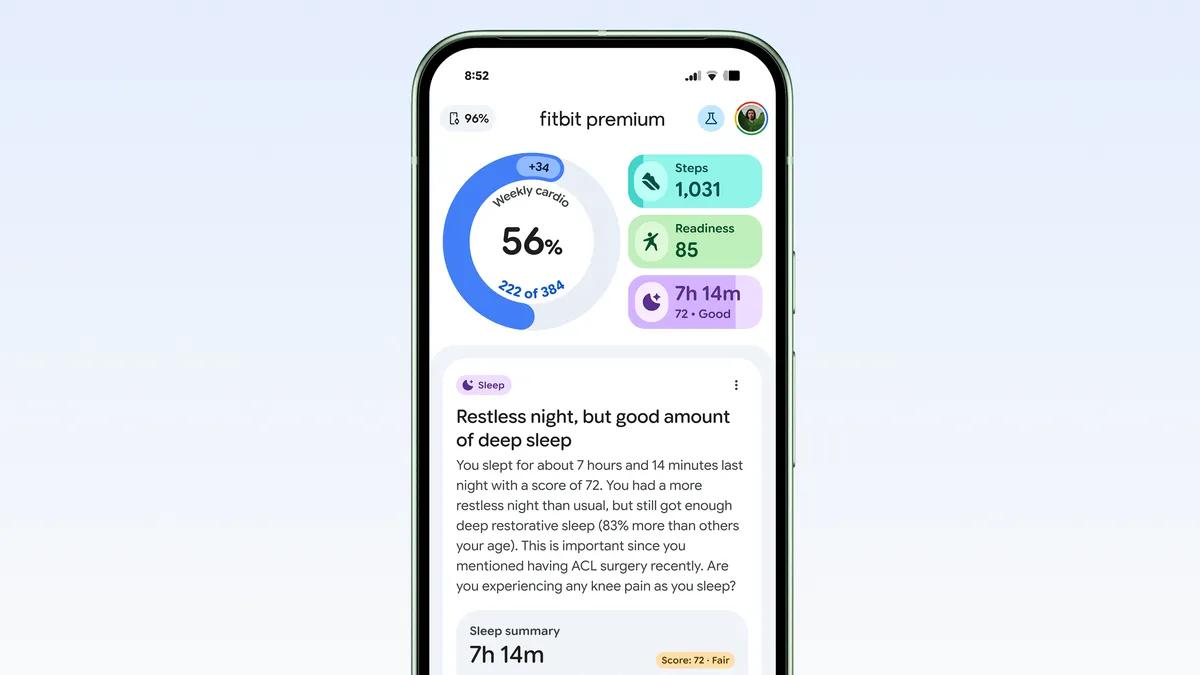
In October 2025, Google debuted its version called Coach, powered by Gemini AI, for US Fitbit Premium subscribers on Android. However, the October launch was just a preview, with the company requesting feedback from early adopters. This February, Google expanded the public Coach preview to include iOS users and Fitbit Premium members in Canada, the UK, Australia, New Zealand and Singapore. Google announced Tuesday at its annual The Check Up health event that it’s adding additional features to its all-in-one fitness trainer, sleep coach and health advisor.
Improved sleep insights and scoring
For sleep tracking, the company’s most significant update yet delivers a 15% increase in sleep stage accuracy, based on comparisons between its latest and previous algorithms across compatible Pixel and Fitbit devices.
Advertisement
The current model will now also be better able to differentiate between when you’re trying to sleep and when you’re actually asleep. It can detect when you’re napping, when your sleep has been interrupted or when you’re transitioning between sleep stages.
In a few weeks, these enhancements will all contribute to a revamped Sleep Score that won’t just focus on how much sleep you got, but on how much time it took you to get that sleep. Because it has more sleep data to work with, Coach will be able to provide more informed insights and recommendations for better sleep.
Fitbit’s upcoming personal health coach updates center around sleep, medical records and continuous glucose monitor data.
Advertisement
Google
Medical record availability
In April, US subscribers will be able to link their medical records, such as medications, lab results and doctor visit history, in the Fitbit app.
This feature was created in collaboration with B. Well Connected Health, an AI-powered digital health platform that aggregates health data from different providers, and Clear, the identity verification platform known from airport security.
In the Fitbit app, you can search for your doctor and then link to their member portal. Or if you use Clear to verify your identity with a selfie and a valid ID, it will search for medical records on your behalf. Availability will depend on your provider.
Advertisement
Once you verify your identity, Fitbit’s personal health coach can access your medical records.
Google
Fitbit’s Coach can then use your medical history to create more personalized guidance that combines your lab results, data collected by your Fitbit and any other relevant information it collects from your records. In several months, users will be able to share these records and summaries with their provider or family members using a QR code or Smart Health Link URL.
What it will look like once you’re able to share your Fitbit health summary with a doctor or relative.
Fitbit says it securely stores your medical records and that you control how your data is used, whether it’s shared and whether it’s deleted. The company also says your medical records won’t be used for ads.
AI health coaches are not a replacement for a doctor, as they can’t diagnose or treat medical conditions. You shouldn’t make any changes to your lifestyle or health routine without consulting your own doctor.
In April, Fitbit members in the public preview will also be able to connect a continuous glucose monitor to the Fitbit app via Health Connect. This feature lets you see all your health data from compatible apps in one place. According to a Google representative, any CGM that supports a Health Connect integration will be included, including Dexcom and Abbott Lingo. With this connection, Fitbit members can ask their Coach for more information about how their workouts or meal choices affect their glucose levels.
Canada’s hi-fi market is about to get a new distribution player and it’s entering a landscape that is both passionate and brutally complicated. Fidelity Imports and Playback Distribution have announced the creation of True North Distribution, a Canadian joint venture focused on importing and distributing high-end audio brands across the country.
On paper, the mission is simple: bring more premium hi-fi gear to Canadian retailers and listeners. In reality, the Canadian market is anything but simple.
I say that as someone who started his audiophile journey wandering record shops and stereo stores in Toronto before eventually working and living on both sides of the border. Canada loves music and has produced some remarkable audio companies over the decades; brands like Bryston, NAD, Totem, PSB Speakers, Paradigm, and Anthem didn’t become global players by accident. There is a deep culture of engineering and music appreciation baked into the Canadian audio scene.
But the economics of the market can be unforgiving.
Advertisement
Canada has a population of just over 40 million people, compared with roughly 335 million in the United States. The distances between major population centers are vast; Toronto, Vancouver, Montreal, Calgary, Edmonton, Ottawa, and Winnipeg are spread across nearly 5,500 kilometers of geography. Add in high taxes, shipping costs, currency swings from a weaker Canadian dollar, and the tariff tension with the United States, and suddenly the logistics of distributing hi-fi gear north of the border look a lot more like a survival sport.
And yet the demand is real. Canada has a highly concentrated audiophile community clustered in those major cities, supported by knowledgeable specialty dealers and a long tradition of music culture. What it lacks, at least compared with the United States, is scale.
That’s the gap True North Distribution is hoping to address.
The new venture from Fidelity Imports and Playback Distribution aims to create a dedicated national pipeline for premium audio brands entering the Canadian market. By partnering with specialized retailers across the country, the company plans to build a curated portfolio of high-end components while providing dealers with more consistent logistics, service, and brand support.
Advertisement
If successful, the move could make it easier for Canadian audiophiles to access some of the world’s most interesting hi-fi gear without navigating cross-border pricing, shipping delays, or exchange-rate headaches.
It also means something else: Canada’s homegrown audio companies are about to face more competition inside their own backyard.
And in a market this small, every new player matters.
Advertisement. Scroll to continue reading.
Advertisement
“For me, this all started with moments—sitting with friends, putting on a record, and feeling completely transported,” said Steve Jain, Fidelity Imports. “Those experiences stay with you, and they’re shaped by the care and craftsmanship behind the equipment as much as the music itself. True North Distribution is about sharing those moments—bringing products and stories to Canada that help people fall in love with music all over again.”
“Building something sustainable and reliable for our partners has been just as important as the passion behind it,” said Matt Hegt, Fidelity Imports. “With True North Distribution, we’ve created a structure that retailers can depend on—thoughtful brand selection, strong logistics, and the infrastructure needed to support long-term growth in the Canadian market.”
“What stood out to me from the beginning was the alignment in values,” said Rob Standley, Playback Distribution. “There’s a clear through-line between engineering integrity, manufacturing discipline, and the listening experience itself. True North Distribution allows us to bring together brands that demonstrate that connection in a meaningful and measurable way.”
Who Are Fidelity Imports and Playback Distribution?
Behind True North Distribution are two companies that most consumers rarely see but that play an essential role in the high end audio industry: the importers and distributors who determine which brands actually reach dealers, showrooms, and ultimately listeners.
Fidelity Imports is a U.S. based high end audio importer founded in 2018 that focuses on carefully curated premium hi fi brands sold through specialist retailers rather than mass market channels. The company has built a reputation for representing manufacturers that combine strong engineering with distinctive design and craftsmanship. Its portfolio includes brands such as Acoustic Energy, Cambridge Audio, Alare, Audia Flight, Primare, Matrix Audio, Perlisten Audio, AVM Audio, Unison Research, Michell Audio, Kora, Diptyque Audio, Wilson Benesch, Ruark Audio, Primare, and Opera Loudspeakers. Rather than flooding the market with dozens of overlapping product lines, Fidelity Imports has focused on building strong dealer relationships and supporting a smaller group of brands with consistent logistics, marketing support, and service infrastructure across North America.
Playback Distribution, founded by longtime audio industry executive Rob Standley, approaches the market from a similarly curated perspective but with additional focus on system building and the custom installation channel. The company distributes a range of high performance hi fi and architectural audio brands including PMC Speakers, Amphion Loudspeakers, Vienna Acoustics, Advance Paris, Esoteric, AVID HiFi, TEAC, Velodyne Acoustics, Quadraspire, and Vicoustic. Playback’s portfolio is built around complementary products that allow dealers and integrators to assemble complete playback systems rather than simply selling isolated components.
The Bottom Line
The launch of True North Distribution could be a real win for Canadian audiophiles. A dedicated national distributor backed by Fidelity Imports and Playback Distribution should mean better access to international hi-fi brands, more consistent dealer inventory, and stronger service support for retailers across the country. In a market where cross border pricing, shipping delays, and currency swings often complicate purchases, that kind of infrastructure matters.
Advertisement
The flip side is that Canada’s respected homegrown manufacturers and existing distributors are about to face more competition in a relatively small market of just over 40 million people. More brands chasing the same dealers and customers can create pressure on margins and shelf space.
Still, competition tends to make the hi fi ecosystem healthier over time. Dealers get more options, consumers get more choice, and manufacturers have to work harder to earn attention.
One thing is certain: visiting hi-fi shops across the Great White North is about to get a lot more interesting.
All iPhone users running iOS 13 or iOS 14 need to update now. Apple has confirmed routine browsing can trigger attacks on outdated iOS versions.
Apple advises iPhone users about iOS 15 update
Apple revealed on March 19 that malicious web content can exploit older iOS versions and expose personal data through compromised sites or unsafe links. Apple released security updates on March 11 for both newer and older devices, including iOS 15.8.7 and iOS 16.7.15. Users on iOS 13 or iOS 14 should upgrade to iOS 15 to receive those protections. Updating iOS closes those gaps and protects against these web-based attacks. Continue Reading on AppleInsider | Discuss on our Forums
“In January 2026 Broadcom signaled the termination of its VMware Cloud Service Provider program in Europe,” CIPSE said in a statement. This unilateral decision removed all but a tiny minority of hand-selected partners and excluded most European CSPs from selling VMware products.”
In its complaint, CISPE also accused Broadcom of “ongoing abuse,” citing sharp price hikes—up to tenfold, with some customers reporting as much as 900 percent increases—along with product bundling and commitment requirements based on projected rather than actual use, The Register reported.
“After imposing outrageous and unjustified price hikes immediately following the acquisition of VMware, Broadcom is now applying the ‘coup de grâce.’ We need urgent intervention to force them to change,” CISPE Secretary General Francisco Mingorance said, according to the publication.
In a statement responding to CISPE’s antitrust complaint, Broadcom said:
Advertisement
Broadcom strongly disagrees with the allegations by CISPE, an organization funded by hyperscalers, which misrepresent the realities of the market. We continue to be committed to investing significantly in our European VMware Cloud Service Provider partners… helping them offer alternatives to the hyperscalers and meet the evolving needs of European businesses and organizations.
CISPE currently has 50 members. It also names hyperscalers Amazon Web Services and Microsoft as “adherent members,” which CISPE claims don’t have voting rights and are prohibited from participating in certain activities.
In July, CISPE filed an appeal with the European General Court in an attempt to annul the EC’s approval of Broadcom’s VMware acquisition. That case is ongoing.
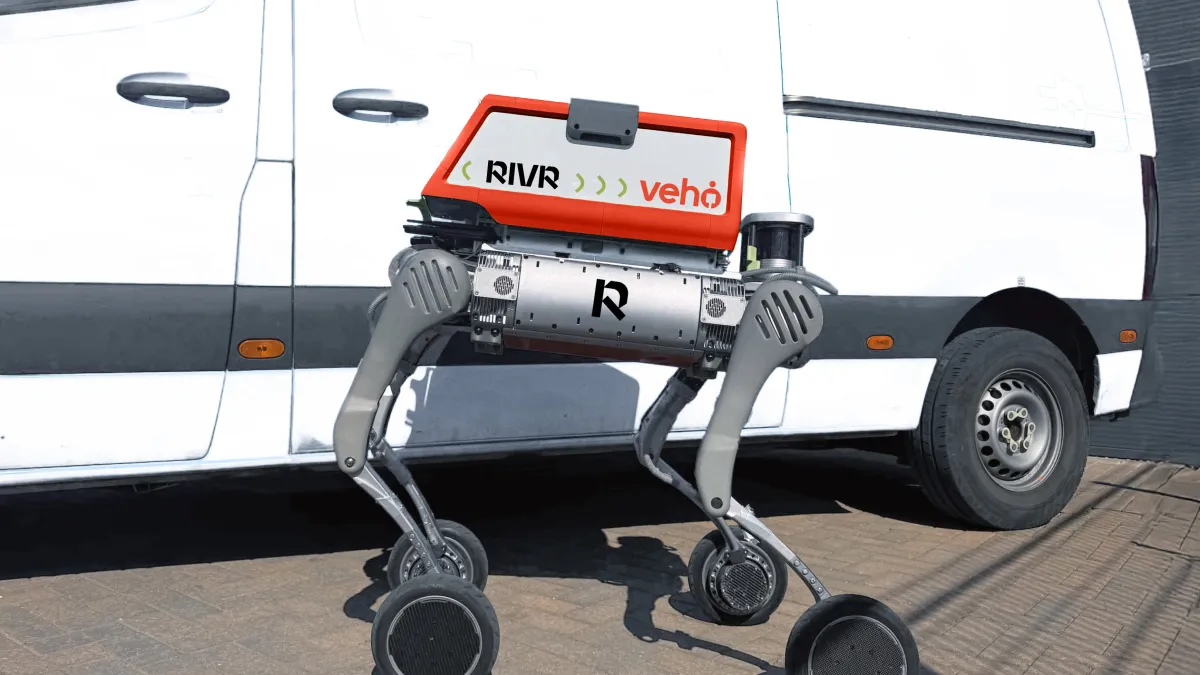
Rivr, a Zurich-based autonomous robotics startup known for its stair-climbing delivery robot, has been acquired by Amazon in a deal that signals the e-commerce giant’s interest in doorstep delivery. Terms of the deal weren’t disclosed.
Rivr co-founder and CEO Marko Bjelonic, who once described the four-legged wheeled robot to TechCrunch as a “dog on roller skates,” shared the acquisition news on LinkedIn. The Information was first to report the deal.
Bjelonic said in his LinkedIn post that the acquisition will “accelerate our vision of building General Physical AI through doorstep delivery, bringing robotics and AI closer to real-world deployment at scale,”meaning, in plain terms, that Amazon’s resources should help Rivr get its robots onto more doorsteps, faster.
Last year, Rivr launched a pilot program in Austin with Veho, package delivery company. Bjelonic said, at the time, he hoped to learn from the partnership with Veho and eventually scale to 100 bots by 2026. It’s unclear if the company was ever able to reach that milestone.
Advertisement
TechCrunch has reached out to Rivr for comment.
Rivr got the attention of Amazon long before its pilot program. The Amazon Industrial Innovation Fund and Bezos Expeditions invested in Rivr as part of a $22.2 million seed round that closed in 2024, according to Pitchbook. The startup, which had raised a total of $25 million, was last valued at $100 million.
Jeff Bezos is reportedly seeking $100 billion for a new fund, the likes of which will be used to buy up companies in major industrial sectors and, ultimately, modernize and automate them with AI, according to sources cited by The Wall Street Journal.
The effort is related to Bezos’ AI startup, Project Prometheus. Bezos, whose involvement with the company was originally reported in November, is serving as co-founder and co-CEO, alongside former Google executive Vik Bajaj.
Prometheus, which launched with $6.2 billion in funding, is focused on creating high-level AI models to improve manufacturing and engineering in aerospace, automotive, and other sectors. The new manufacturing fund will support that mission by buying up companies that will ultimately use Prometheus’ models.
According to the WSJ, Bezos recently traveled to Singapore and the Middle East in his mission to raise funds for the effort. The plan is to acquire companies in areas like aerospace, chipmaking, and defense.
Advertisement
TechCrunch reached out to Bezos via Amazon for more information.



















































You must be logged in to post a comment Login