
Tech
Today’s NYT Wordle Hints, Answer and Help for March 22 #1737

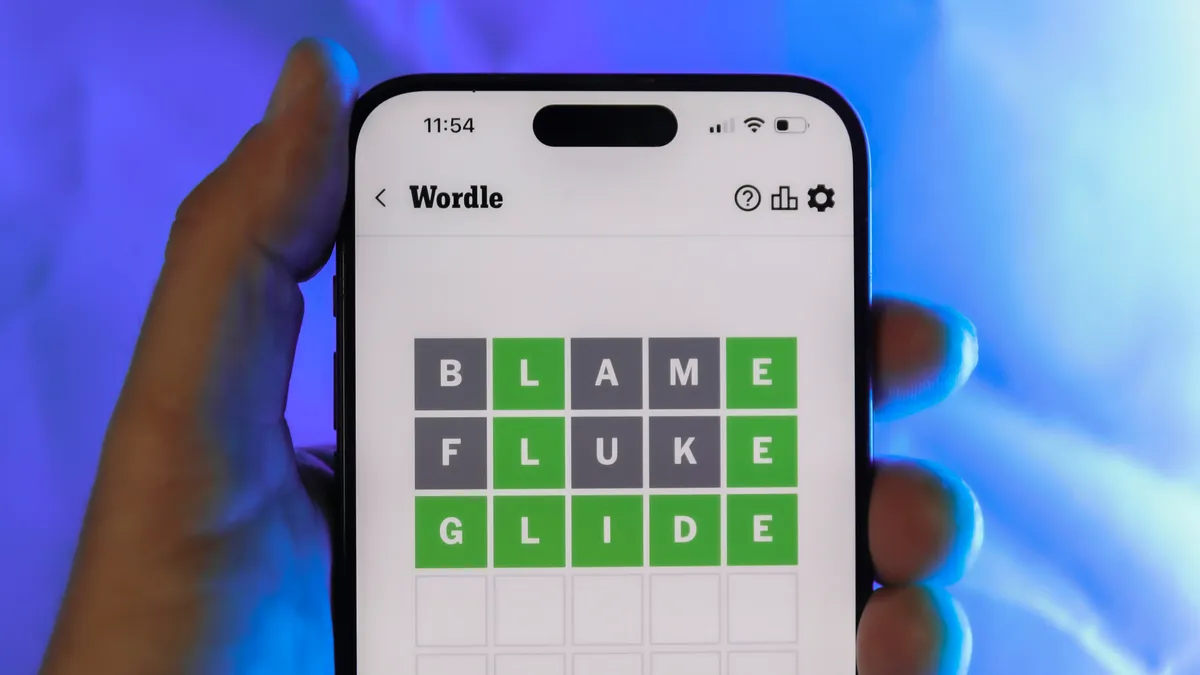
Looking for the most recent Wordle answer? Click here for today’s Wordle hints, as well as our daily answers and hints for The New York Times Mini Crossword, Connections, Connections: Sports Edition and Strands puzzles.
Today’s Wordle puzzle isn’t too tough, though the first letter is one I rarely ever guess. If you need a new starter word, check out our list of which letters show up the most in English words. If you need hints and the answer, read on.
Read more: New Study Reveals Wordle’s Top 10 Toughest Words of 2025
Today’s Wordle hints
Before we show you today’s Wordle answer, we’ll give you some hints. If you don’t want a spoiler, look away now.
Wordle hint No. 1: Repeats
Today’s Wordle answer has no repeated letters.
Wordle hint No. 2: Vowels
Today’s Wordle answer has two vowels.
Wordle hint No. 3: First letter
Today’s Wordle answer begins with B.
Wordle hint No. 4: Last letter
Today’s Wordle answer ends with L.
Wordle hint No. 5: Meaning
Today’s Wordle answer can refer to an aromatic herb in the mint family.
TODAY’S WORDLE ANSWER
Today’s Wordle answer is BASIL.
Yesterday’s Wordle answer
Yesterday’s Wordle answer, March 21, No. 1736, was SLICK.
Recent Wordle answers
March 17, No. 1732: CLASP
March 18, No. 1733: AMPLY
March 19, No. 1734: REHAB
March 20, No. 1735: OASIS



Dawn broke over Oakland, and a sleek Joby electric air taxi took off from the international airport runway as if it ruled the sky. Andrea Pingitore piloted N545JX, which lifted straight up and flew westward over the open water with a nice steady rise. Minutes later, she’d reached the far coast and swung north to take the Marin Headlands under her wing, with the entire San Francisco cityscape visible behind her.
The entire journey was silent as a mouse because no noisy engines were belching out there; the electric motors simply hummed along as the air taxi passed by the Golden Gate Bridge and completed its loop. That was the polar opposite of how things usually are, with all of those gridlocked bridges and freeways below that keep drivers stranded for hours on end, week after week. Joby created this baby to trim the annoying bits down to size, transforming a long drive into a brief breath of fresh air.

DJI Neo, Mini Drone with 4K UHD Camera for Adults, 135g Self Flying Drone that Follows You, Palm Takeoff…
- Due to platform compatibility issue, the DJI Fly app has been removed from Google Play. DJI Neo must be activated in the DJI Fly App, to ensure a…
- Lightweight and Regulation Friendly – At just 135g, this drone with camera for adults 4K may be even lighter than your phone and does not require FAA…
- Palm Takeoff & Landing, Go Controller-Free [1] – Neo takes off from your hand with just a push of a button. The safe and easy operation of this drone…

Years of hard work have led up to this point, with the company’s test fleet having already flown over 50,000 miles in thousands of flights, demonstrating that these aircraft can manage crowded city streets with ease. Every system on board is designed to achieve three goals: keeping passengers safe, reducing noise for those on the ground, and providing results. Boy, did that show during the bay crossing, as the craft moved like clockwork even as it passed right past one of the world’s most iconic sights.

The 2026 Electric Skies Tour began, and this identical aircraft will visit cities around the country around the time of the nation’s 250th birthday celebration. Joby wants to give more people the opportunity to see the device up close and get a feel of what it could accomplish for their daily lives without requiring extensive new infrastructure.

Regulatory progress is also backing them up. They’ve been selected to participate in a White House-backed program that allows them to get started early in ten states, ranging from Arizona to Utah. They could start flying sooner rather than later, after all of the agreements are in place and the remaining certifications are completed. Joby has already flown an airplane that meets all federal regulations, preparing for some proper test flights with authorities before the end of 2026.

Meanwhile, manufacturing is ramping up, with a new 700,000 square foot factory being built in Dayton, Ohio, which will eventually produce hundreds of vehicles each year, and they already have some extended locations in California lined up. Production targets state that they intend to reach four aircraft per month by 2027, as the entire network begins to come together.


The AI search company launches a suite of health data connectors, linking Apple Health, wearables, and electronic health records, making it the second major AI platform to integrate with Apple Health after OpenAI.
Consumer health AI has become the year’s fastest-moving product category, and on Thursday Perplexity entered the race properly. The company launched Perplexity Health, a suite of data connectors that pulls together a user’s electronic health records, wearable device data, and lab results into a single place, then uses that combined picture to personalise answers to health questions.
It is the second major AI platform to integrate with Apple Health, following OpenAI’s ChatGPT Health in January 2026. Microsoft launched Copilot Health just one week ago, on 12 March.
The architecture of Perplexity Health sits on top of Perplexity Computer, the company’s AI agent platform for autonomous tasks. At launch, the product connects to Apple Health on iOS, and to wearables and health apps including Fitbit, Ultrahuman, and Withings via Terra API, a unified health and fitness data platform.
Electronic health records are pulled through b.well Connected Health, a HIPAA-compliant platform Perplexity announced as a partner in a simultaneous press release. Integrations with Oura and Function are expected soon.
The b.well partnership is the more substantive piece of the infrastructure. According to b.well’s own announcement, the company’s network connects to more than 2.4 million providers and more than 350 health plans and labs across the United States.
Kristen Valdes, Founder and CEO of b.well, described the logic of the partnership simply: AI health questions are already happening at scale; the question is whether the answers are grounded in a person’s actual medical history or generic population data.
The product’s pitch is that health data is structurally fragmented, lab results in one portal, prescriptions in another, fitness data in a third, and that meaningful answers require all of it at once. A question about resting heart rate, for example, could draw on recent activity data, cardiac history, and the most recent bloodwork simultaneously.
The personalisable dashboard tracks trends in biomarkers and activity over time, and Perplexity Computer can use the connected data to generate outputs including pre-appointment visit summaries, personalised nutrition plans, and marathon training protocols. Responses draw from clinical guidelines and peer-reviewed journals, with citations linked to source material.
To manage the obvious clinical risk of this category, Perplexity is launching alongside a Health Advisory Board of physicians, researchers, and health technology leaders, whose stated role is to pressure-test product decisions, content quality, and clinical safeguards against evidence-based medicine standards.
The company is explicit that Perplexity Health is not a diagnostic tool: it is positioned as educational health information that helps users understand their data and prepare for conversations with clinicians, not as a substitute for professional medical advice.
On privacy, the company states that health data is encrypted in transit and at rest, subject to strict access controls, never used to train AI models, and never sold to third parties. Users can disconnect any data source or delete their information at any time.
The framing mirrors similar pledges from OpenAI and Microsoft for their respective health products, though independent scrutiny of any of these claims remains limited. A Washington Post investigation earlier this year found that ChatGPT was liable to report health information not supported by the data it was given, a baseline problem that no amount of data connectivity resolves if the underlying model is unreliable.
Perplexity Health is rolling out to Pro and Max subscribers in the United States over the coming weeks, initially on iOS and on the web at perplexity.ai/health. Broader availability across other subscriber tiers and geographies is expected in time. The product follows Perplexity Finance, which used Plaid to give users connected brokerage account access, as a second major vertical built around the same Perplexity Computer infrastructure.

Looking for the most recent Connections answers? Click here for today’s Connections hints, as well as our daily answers and hints for The New York Times Mini Crossword, Wordle, Connections: Sports Edition and Strands puzzles.
Today’s NYT Connections puzzle is a fun one, with a real mix of topics. Read on for clues and today’s Connections answers.
The Times has a Connections Bot, like the one for Wordle. Go there after you play to receive a numeric score and to have the program analyze your answers. Players who are registered with the Times Games section can now nerd out by following their progress, including the number of puzzles completed, win rate, number of times they nabbed a perfect score and their win streak.
Read more: Hints, Tips and Strategies to Help You Win at NYT Connections Every Time
Hints for today’s Connections groups
Here are four hints for the groupings in today’s Connections puzzle, ranked from the easiest yellow group to the tough (and sometimes bizarre) purple group.
Yellow group hint: In charge.
Green group hint: You might screenshot one.
Blue group hint: How many reps can you do?
Purple group hint: Hang ten!
Answers for today’s Connections groups
Yellow group: Oversee.
Green group: Picture taken from a film.
Blue group: Components of a weightlifting setup.
Purple group: ____ surf.
Read more: Wordle Cheat Sheet: Here Are the Most Popular Letters Used in English Words
What are today’s Connections answers?
The completed NYT Connections puzzle for March 22, 2026.
The yellow words in today’s Connections
The theme is oversee. The four answers are chair, head, lead and run.
The green words in today’s Connections
The theme is picture taken from a film. The four answers are frame, image, shot and still.
The blue words in today’s Connections
The theme is components of a weightlifting setup. The four answers are bar, bench, rack and weights.
The purple words in today’s Connections
The theme is ____ surf. The four answers are channel, couch, crowd and kite.
Tech
Cursor’s new coding model Composer 2 is here: It beats Claude Opus 4.6 but still trails GPT-5.4

Cursor, a San Francisco AI coding platform from startup Anysphere valued at $29.3 billion, has launched Composer 2, a new in-house coding model now available inside its agentic AI coding environment that’s a fine-tuned variant of Chinese open source model Kimi K2.5, and it offers drastically improved benchmarks from its prior in-house model.
It’s also launching and making Composer 2 Fast, a higher-priced but faster variant, the default experience for users.
Here’s the cost breakdown:
That’s a big drop from Cursor’s predecessor in-house model, Composer 1.5, from February, which cost $3.50 per million input tokens and $17.50 per million output tokens; Composer 2 is about 86% cheaper on both counts.
Composer 2 Fast is also roughly 57% cheaper than Composer 1.5.
There’s also discounts for “cache-read pricing,” that is, sending some of the same tokens in a prompt to the model again, of $0.20 per million tokens for Composer 2 and $0.35 per million for Composer 2 Fast, versus $0.35 per million for Composer 1.5.
It also matters that this appears to be a Cursor-native release, not a broadly distributed standalone model. In the company’s announcement and model documentation, Composer 2 is described as available in Cursor, tuned for Cursor’s agent workflow and integrated with the product’s tool stack.
The materials provided do not indicate separate availability through external model platforms or as a general-purpose API outside the Cursor environment.
Cursor is pitching long-horizon coding, not just better completions
The deeper technical claim in this release is not merely that Composer 2 scores higher than Composer 1.5. It is that Cursor says the model is better suited to long-horizon agentic coding.
In its blog, Cursor says the quality gains come from its first continued pretraining run, which gave it a stronger base for scaled reinforcement learning. From there, the company says it trained Composer 2 on long-horizon coding tasks and that the model can solve problems requiring hundreds of actions.
That framing is important because it addresses one of the biggest unresolved issues in coding AI. Many models are good at isolated code generation. Far fewer remain reliable across a longer workflow that includes reading a repository, deciding what to change, editing multiple files, running commands, interpreting failures and continuing toward a goal.
Cursor’s documentation reinforces that this is the use case it cares about. It describes Composer 2 as an agentic model with a 200,000-token context window, tuned for tool use, file edits and terminal operations inside Cursor.
It also notes training techniques such as self-summarization for long-running tasks. For developers already using Cursor as their main environment, that tighter tuning may matter more than a generic leaderboard claim.
The benchmark gains are substantial, even if GPT-5.4 still leads on one key chart

Cursor’s published results show a clear improvement over prior Composer models. The company lists Composer 2 at 61.3 on CursorBench, 61.7 on Terminal-Bench 2.0, and 73.7 on SWE-bench Multilingual.
That compares with Composer 1.5 at 44.2, 47.9 and 65.9, and Composer 1 at 38.0, 40.0 and 56.9.
The release is more measured than some model launches because Cursor is not claiming universal leadership.
On Terminal-Bench 2.0, which measures how well an AI agent performs tasks in command line terminal-style interfaces, GPT-5.4 still leads at 75.1, while Composer 2 scores 61.7, ahead of Opus 4.6 at 58.0, Opus 4.5 at 52.1 and Composer 1.5 at 47.9.

That makes Cursor’s pitch more pragmatic and arguably more useful for buyers. The company is not saying Composer 2 is the single best model at everything. It is saying the model has moved into a more competitive quality tier while offering more attractive economics and stronger integration with the product developers are already using.
Cursor also included a performance-versus-cost chart on its CursorBench benchmarking suite that appears designed to make a Pareto-style argument for Composer 2.

In that graphic, Composer 2 sits at a stronger cost-to-performance point than Composer 1.5 and compares favorably with higher-cost GPT-5.4 and Opus 4.6 settings shown by Cursor. The company’s message is not simply that Composer 2 scores higher than its predecessor, but that it may offer a more efficient cost-to-intelligence tradeoff for everyday coding work inside Cursor.
Why the “locked to Cursor” point matters for buyers
For readers deciding whether to use Composer 2, the most important question may not be benchmark performance alone. It may be whether they want a model optimized for Cursor’s own product experience.
That can be a strength. According to the documentation, Composer 2 can access Cursor’s agent tool stack, including semantic code search, file and folder search, file reads, file edits, shell commands, browser control and web access.
That kind of integration can be more valuable than raw model quality if the goal is to complete real software tasks rather than produce impressive one-shot answers.
But it also narrows the addressable audience. Teams looking for a model they can deploy broadly across multiple external tools and platforms should recognize that Cursor is presenting Composer 2 as a model for Cursor users, not as a generally available standalone foundation model.
The bigger picture: Cursor is making an operational argument
The significance of Composer 2 is not that Cursor has suddenly taken the top spot on every coding benchmark. It has not. The more important point is that Cursor is making an operational argument: its model is getting better, its pricing is low enough to encourage broader use, and its faster tier is responsive enough that the company is comfortable making it the default despite the higher cost.
That combination could resonate with engineering teams that increasingly care less about abstract model prestige and more about whether an assistant can stay useful across long coding sessions without becoming prohibitively expensive.
Cursor’s broader pricing structure helps frame the competitive pressure around this launch. On its current pricing page, Cursor offers a free Hobby tier, a Pro plan at $20 per month, Pro+ at $60 per month, and Ultra at $200 per month for individual users, with higher tiers offering more usage across models from OpenAI, Anthropic and Google.
On the business side, Teams costs $40 per user per month, while Enterprise is custom-priced and adds pooled usage, centralized billing, usage analytics, privacy controls, SSO, audit logs and granular admin controls. In other words, Cursor is not just charging for access to a coding model. It is charging for a managed application layer that sits on top of multiple model providers while adding team features, governance and workflow tooling.
That model is increasingly under pressure as first-party AI companies push deeper into coding itself. OpenAI and Anthropic are no longer just selling models through third-party products; they are also shipping their own coding interfaces, agents and evaluation frameworks — such as Codex and Claude Code — raising the question of how much room remains for an intermediary platform.
Commenters on X, while unverified and not necessarily representative of the broader market, have increasingly described moving from Cursor to Anthropic’s Claude Code, especially among power users drawn to terminal-first workflows, longer-running agent behavior and lower perceived overhead.
Some of those posts describe frustration with Cursor’s pricing, context loss or editor-centric experience, while praising Claude Code as a more direct and fully agentic way to work. Even treated cautiously, that kind of social chatter points to the strategic problem Cursor faces: it has to prove that its integrated platform, team controls and now its own in-house models add enough value to justify sitting between developers and the model makers’ increasingly capable coding products.
That makes Composer 2 strategically important for Cursor.
By offering a much cheaper in-house model than Composer 1.5, tuning it tightly to Cursor’s own tool stack and making a faster version the default, the company is trying to show that it provides more than a wrapper around outside systems.
The challenge is that as first-party coding products improve, developers and enterprise buyers may increasingly ask whether they want a separate AI coding platform at all, or whether the model makers’ own tools are becoming sufficient on their own.

13 million people live in Moscow, reports CNN.
But since early March the city “has experienced internet and mobile service outages on a level previously unseen.” (Though Wi-Fi access to the internet is still available…) Russian social media “is flooded with jokes and memes about sending letters by carrier pigeons or using smartphones as ping-pong paddles…”
[Moscow residents] complain they cannot navigate around the center or use their favorite mobile apps. The interruptions appear to have had a knock-on effect of making it more difficult to make voice calls or send an SMS. Some are panic-buying walkie-talkies, paper maps, and even pagers.
The latest shutdown builds on similar efforts around the country. For months, mobile internet service interruptions have hit Russia’s regions, particularly in provinces bordering Ukraine, which has staged incursions and launched strikes inside Russian territory to counter Russia’s full-scale invasion. Some regions have reported not having any mobile internet since summer. But the most recent outages have hit the country’s main centers of wealth and power: Moscow and Russia’s second city, St. Petersburg.
Public officials claim the blackout of mobile internet service in the capital and other regions is part of a security effort to counter “increasingly sophisticated methods” of Ukrainian attack… Speculation centers on whether the authorities are testing their ability to clamp down on public protest in the case there’s an effort to reintroduce unpopular mobilization measures to find fresh manpower for the war in Ukraine; whether mobile internet outages may precede a more sweeping digital blackout; or if the new restrictions reflect an atmosphere of heightened fear and paranoia inside the Kremlin as it watches US-led regime- change efforts unfold against Russian allies such as Venezuela and Iran… On Wednesday, Russian mobile providers sent notifications that there would be “temporary restrictions” on mobile internet in parts of Moscow for security reasons, Russian state news agency RIA-Novosti reported. The measures will last “for as long as additional measures are needed to ensure the safety of our citizens,” Kremlin spokesman Dmitry Peskov said on March 11…
As well as banning many social media platforms, Russia blocks calling features on messenger apps such as WhatsApp and Telegram. Roskomnadzor, the country’s communications regulator, has introduced a “white list” of approved apps… Russia has also tested what it calls the “sovereign internet,” a network that is effectively firewalled from the rest of the world. The disruptions are fueling broader concerns about tightening state control. In parallel with the internet shutdown, the Kremlin has also been pushing to impose a state-controlled messaging app called Max as the country’s main portal for state services, payments and everyday communication. There has been speculation the Kremlin may be planning to ban Telegram, Russia’s most widely used messaging app, entirely. Roskomnadzor said that it was restricting Telegram for allegedly failing to comply with Russian laws.
“Russia has opened a criminal case against me for ‘aiding terrorism,’” Telegram’s Russian-born founder Pavel Durov said on X last month. “Each day, the authorities fabricate new pretexts to restrict Russians’ access to Telegram as they seek to suppress the right to privacy and free speech….”
The article includes this quote from Mikhail Klimarev, head of the Internet Protection Society and an expert on Russian internet freedom. “In any situation when they (the authorities) perceive some kind of danger for themselves and accept the belief that the internet is dangerous for them, even if it may not be true, they will shut it down,” he said. “Just like in Iran.”


For people with Costco memberships, you’re spoiled for choice when it comes to discounted tech. These days, there are many electronics you can buy from Costco, like laptops and portable storage options. Not to mention, the retailer is popular for its bundles, wherein you slash the price for products that you would have typically have needed to buy separately. For gamers, Costco can also be a great place to stack up on gadgets that can be used to improve your set-up in meaningful ways.
To start with, Costco is known to sell discounted displays with strong return policies. Although there are some things you should know before buying a TV, Costco offers a ton of options that you can hook up to your console of choice. Afterward, you can proceed to improve elements to your gaming room, like Wi-Fi connectivity or quality cables, that everyone in your household can benefit from. Then, you can invest in ways to make it more immersive, wherein the best options depend on what kind of games you play. For example, you can explore improvements in terms of controllers, introducing more physical feedback, or even just improved audio. With so many gadgets on Costco that can help you take your gaming to the next level, it can be a little overwhelming. But, if you’re curious, here are some options that you can consider adding to cart.
TP-Link Deco X60 Wi-Fi 6 AX3000 Whole-Home Mesh Wi-Fi System
For online gamers, stable internet speed can make or break your next match. In many cases, this is why people tend to opt for LAN cables, which provide stable, wired connections to your router. However, if you’re a handheld console gamer or simply don’t want the hassle of attaching your device to cables, you may have no choice but to stick to Wi-Fi. Unfortunately, this does introduce some problems, especially when it comes to signal issues. And if you live in a home with multiple people or smart devices wherein many devices are connected to the same network, it can also impact the connection. But if you’re looking for a possible work around, you can get high and consistent speeds across multiple devices if you invest in mesh Wi-Fi systems, like the TP-Link Deco X60.
Priced at $139.99, the online exclusive mesh Wi-Fi system that you can get on Costco comes in a pack of three. Capable of hitting up to 3 Gbps with Wi-Fi 6, the three routers can collectively cover up to 7,000 square feet. Apart from letting you connect up to 150 devices, it has added features for parental control. On Costco, this 3-pack TP-Link set has been rated 4.4 stars on average by 3,300+ members. Apart from buying a fancy mesh Wi-Fi system, it’s also good to make sure your routers are located in the right places and the antennas are facing the right way.
SANUS 3 Meter 8K Ultra High-Speed HDMI 2.1 Cables
Designed for 8K viewing at 60 Hz or 4K at 120 Hz, the SANUS Ultra High Speed HDMI can be the perfect companion for all sorts of game nights. A pair of these 9.8 ft SANUS HDMI cables retail for just under $30 on Costco, which is roughly about $15 per unit. Apart from using them on your gaming consoles or computer, these HDMI cables can also be used to view all sorts of content from streaming platforms too. After all, it was made to be able to show Dynamic HDR, which gets you some great visual contrast.
For people who own fancy soundbars, SANUS claims that it can support high-bitrate Enhanced Audio Return Channel (eARC) audio formats and enhanced audio for DTS-HD Master Audio, Dolby Atmos, and so on. With Variable Refresh Rate (VRR), you can expect less display lag during your matches. For reduced interference, SANUS mentions a low EMI design, plus a maximum data transfer speed of up to 48 Gbps. For added durability, each cable is composed of protective features, such as the cotton braided jacket and sure grip connector. Apart from some added flexibility, you can expect less risks in terms of cuts and other damages. A Costco online exclusive, more than 620 customers have rated it about 4.7 stars on average.
Woojer High-Fidelity Haptic Vest 4
For a more immersive experience, the Woojer High-Fidelity Haptic Vest 4 lets you add another layer to your games. Capable of simulating frequencies up to 250 Hz, you can experience the same games differently with the added physical sensations. To help manage its functions and follow up with its software updates, you’ll need to download its integrated app. But if the sensations are starting to feel a little overstimulating, you also have the option to adjust the intensity. Apart from this, you can use it to view latency and battery life. On a full battery, you can expect up to 8 hours of playtime.
When you buy it at Costco, the Woojer Vest 4 retails for $299.99. But take note, it doesn’t include the chance to get free lining, like you would if you bought directly from Woojer website. Out of the box, it does include the vest unit, USB-C cable, 3.5mm audio cable, fast charger, and user manual. Depending on your preference, it can support both wired and Bluetooth headphones. Although it doesn’t have a ton of reviews yet, the early feedback from Costco customers have been promising. As of March 2026, 20 people have rated it an average of 4.7 stars, so you’re likely in good hands. But take note, Woojer did state that while it can fit sizes S to 3XL, it’s not recommended for children under 13.
Xbox Wireless Headset
Although some people can enjoy gaming with their elaborate home theater system, others may need to stay on the quieter side, especially if you live with small children or areas with strict noise compliance rules. For this reason, an Xbox Wireless Headset may be a must-have for you. Unlike other Bluetooth-enabled headsets, this headset has a slew of other features that make it more suitable for gaming.
Compatible with the Xbox One, Xbox Series S & X, and PC, it’s definitely designed to work seamlessly with your Xbox gaming consoles through wireless pairing, so you don’t have to worry about dongles or cables. Not to mention, you can use the Xbox Accessories app to help take it to the next level. For improved in-game chat experience, Microsoft shares useful features like auto-mute and voice isolation. With a 15-hour battery life, you can last a whole day of gaming without having to charge it.
For Costco members, you can snag the Xbox Wireless Headset for $94.99 on its website. As of March 2026, more than 190 people have rated it about 4.6 stars. But take note, some features may require additional Xbox subscription before you can enjoy them. It’s only available in black, so you can’t really expect a lot of cute color options. When you’re not gaming, you can also expect it to work like regular Bluetooth headphones, so you can listen to music and take calls.
Logitech G Driving Force Racing Simulator Bundle
Compatible with the Playstation 4, Playstation 5, and PC, the Logitech G Driving Force Racing Simulator Bundle is a great addition to your gaming arsenal if racing is your thing. In the set, it includes a steering wheel, pedals, and shifter, plus a power supply and user documentation. Logitech mentions that the steering wheel can turn up to 900 degrees lock-to-lock. It also has features like a hall-effect steering sensor, an overheat safeguard, and TRUEFORCE technology, which helps make your racing simulation games feel even more real. And if you want further customization, it has a 24-point selection dial too. Apart from this, it ships with a pedal that is both self-calibrating, has a carpet grip system, and a nonlinear brake pedal. Lastly, the shifter lets you choose between six speeds and works with multiple racing wheels (G923, G29 and G920). Depending on your preference, Logitech mentions that it can be mounted on your racing rig or a table with its built-in clamps.
An Costco online exclusive, this Logitech bundle doesn’t have that many reviews yet. However, early reviews have been largely positive with an average rating of 4.4 stars from 18 people. In tandem with VR headsets, users have praised how it takes realism to another level. Although there were some concerns regarding pedal stabilization, citing the tendency to slide. While the standard retail price is $399.99, Costco has listed it at $100 off or $299.99 for a select period.

While Samsung has added a ton of camera improvements to the Galaxy S26 series, there’s one that most of us missed out on first. As highlighted by Android Authority, the Galaxy S26 series also supports a native USB webcam mode, allowing users to connect their phone to a computer and use its camera as a webcam.

This isn’t entirely new to Android, though. Google first introduced this feature with Android 14 QPR1 on Pixel devices, and Samsung is now bringing it to its flagship lineup.
How does it actually work?
It’s refreshingly simple. All you need to do is plug your Galaxy S26 into a PC using a USB cable, and the phone will give you an option to switch to webcam mode. Once enabled, your computer recognizes the phone as a camera. No extra apps, drivers, or hacks required.

That’s a big upgrade over older methods, which relied on third-party apps that were often unreliable or required extra setup. What’s more, is that it also includes the optional High Quality Mode to ensure you’re squeezing the most out of your phone’s camera.
Your webcam just got… replaced?
Let’s be honest, your phone camera is already miles better than that sad, grainy webcam on your laptop. With the Galaxy S26 stepping in as a webcam, you’re essentially upgrading your video calls overnight, no extra gear needed. It also fits into a bigger trend where smartphones are quietly becoming all-in-one devices that replace webcams, scanners, and even compact cameras. At this point, your phone is basically doing everything except making coffee (for now).
That said, there are a couple of catches. The feature is currently limited to the Galaxy S26 series and still requires a wired connection. But honestly, if it means sharper video calls without spending extra, that’s a pretty solid trade-off.
The San Francisco B2B sales platform, which recently approached $200M in ARR and appointed a new CEO, absorbs the revenue intelligence startup’s signal-layer technology to deepen its enterprise push.
Apollo.io has acquired Pocus, a revenue intelligence startup that helps sales teams identify and prioritise the accounts most likely to buy based on behavioural and CRM signals. Financial terms were not disclosed.
The deal is Apollo’s clearest signal yet of its ambitions beyond the mid-market, combining its outreach and data infrastructure with Pocus’ intelligence layer to push deeper into enterprise sales workflows.
Apollo was founded in 2015 and has grown into one of the most widely used B2B sales platforms on the market, combining a database of more than 230 million contacts with outreach sequencing, a built-in dialer, conversational intelligence, and deal management tools.
The company is approaching $200 million in annual recurring revenue and serves more than 600,000 companies globally, according to its own figures. In February, the company appointed Matt Curl as CEO, replacing co-founder Tim Zheng, who moved to Chairman. Curl had been COO and had advised the company since 2019. The CEO transition was explicitly framed at the time as preparation for an acquisition phase, and the Pocus deal is the first visible result.
Pocus was founded in 2021 by Alexa Grabell, who serves as CEO, and co-founder and CTO Isaac Pohl-Zaretsky. The company emerged from a problem Grabell had experienced directly as a sales operations leader at Dataminr: revenue teams had data spread across CRM systems, product usage logs, and marketing platforms, but no good way to translate that fragmentation into actionable priorities for the sales team.
Pocus built a platform that aggregates those signals, CRM activity, customer behaviour, and intent data, surfaces the accounts with the strongest buying indicators, and pushes recommended actions to sales reps. Its customers include Asana, Canva, and Monday.com, with a particular foothold among product-led growth companies where understanding how users engage with a product is directly relevant to upselling and expansion.
The company raised a Series A of roughly $23 million in June 2022, led by Coatue, with participation from First Round Capital, Box Group, GTM Fund, and Mantis VC (the investment vehicle of the Chainsmokers). Total funding across seed and Series A rounds ran into the tens of millions of dollars, though reported figures vary across databases.
“We started Pocus to solve a simple but critical problem: revenue teams were drowning in data but starving for direction,” said Alexa Grabell in the announcement.
“Apollo has built the execution layer modern GTM teams trust. By joining Apollo, we can scale our mission in delivering signal-powered clarity and helping teams focus on the opportunities that matter most.”
For Apollo, the acquisition fills a gap in its platform that had become increasingly visible as the company moved upmarket. Apollo’s strength is in outbound execution: finding the right contacts, building sequences, making calls, and logging activity. What it has been weaker on is the intelligence layer upstream of that execution, determining which accounts deserve attention in the first place, and why now.
Pocus adds exactly that: a signal-processing layer that can prioritise accounts based on real-time behavioural evidence rather than static firmographic data. The company says enterprise accounts grew more than 400% over the past 12 months, with Anthropic and Glean among the notable new names.
Matt Curl framed the acquisition as an acceleration of Apollo’s broader platform thesis. “By combining Pocus’ talent and technology with Apollo’s scale, we strengthen our position today, and unlock new opportunities as we continue to expand upmarket,” he said.
The company is positioning the combined product as a step toward what it calls an “AI-native GTM operating system”, a single platform covering data, signal detection, prioritisation, and execution, as an alternative to the collection of point solutions that most enterprise sales teams currently stitch together.
Apollo says AI adoption among its customers has grown from 35% to 75% since the launch of its AI Assistant, and that weekly active users on that product have increased 94% since general availability.
The deal is also a product-market exit for a well-regarded startup. Being absorbed into a platform with Apollo’s distribution and data depth arguably makes the Pocus technology more valuable at scale than it could have become as a standalone business.
Tech
EFF Tells Publishers: Blocking the Internet Archive Won’t Stop AI, But It Will Erase The Historical Record

“Imagine a newspaper publisher announcing it will no longer allow libraries to keep copies of its paper,” writes EFF senior policy analyst Joe Mullin.
“That’s effectively what’s begun happening online in the last few months.”
The Internet Archive — the world’s largest digital library — has preserved newspapers since it went online in the mid-1990s… But in recent months The New York Times began blocking the Archive from crawling its website, using technical measures that go beyond the web’s traditional robots.txt rules. That risks cutting off a record that historians and journalists have relied on for decades. Other newspapers, including The Guardian, seem to be following suit…
The Times says the move is driven by concerns about AI companies scraping news content. Publishers seek control over how their work is used, and several — including the Times — are now suing AI companies over whether training models on copyrighted material violates the law. There’s a strong case that such training is fair use. Whatever the outcome of those lawsuits, blocking nonprofit archivists is the wrong response.
Organizations like the Internet Archive are not building commercial AI systems. They are preserving a record of our history. Turning off that preservation in an effort to control AI access could essentially torch decades of historical documentation over a fight that libraries like the Archive didn’t start, and didn’t ask for. If publishers shut the Archive out, they aren’t just limiting bots. They’re erasing the historical record…
Even if courts place limits on AI training, the law protecting search and web archiving is already well established… There are real disputes over AI training that must be resolved in courts. But sacrificing the public record to fight those battles would be a profound, and possibly irreversible, mistake.
Tech
From Blinding Sun to Dark Streets, the Pelsee P1 Pro 4K Dashcam Keeps Every Detail Sharp on a Budget
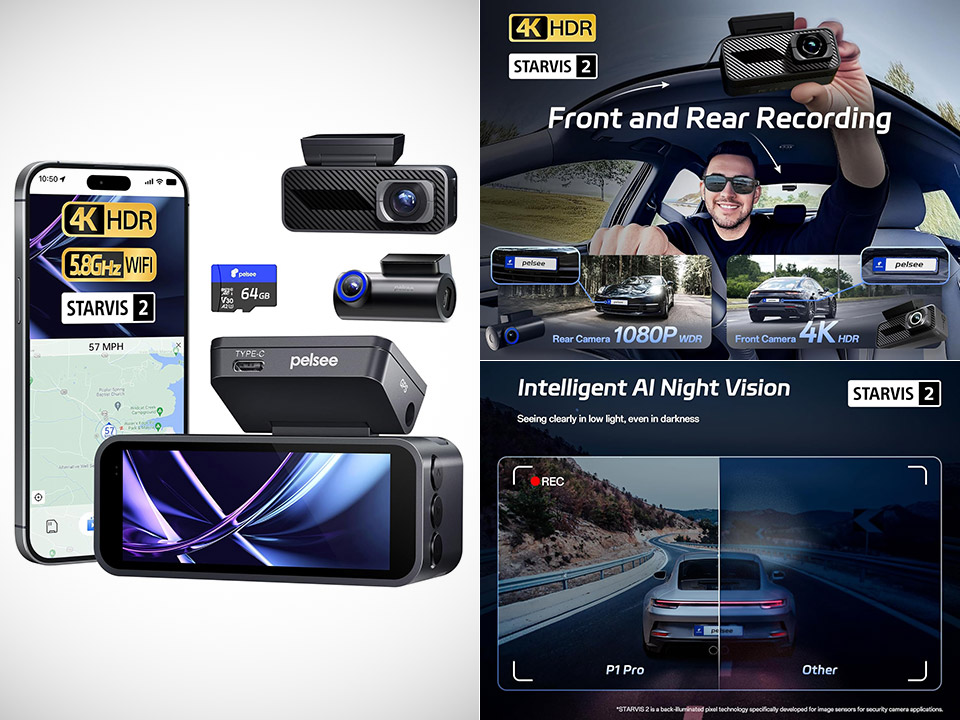
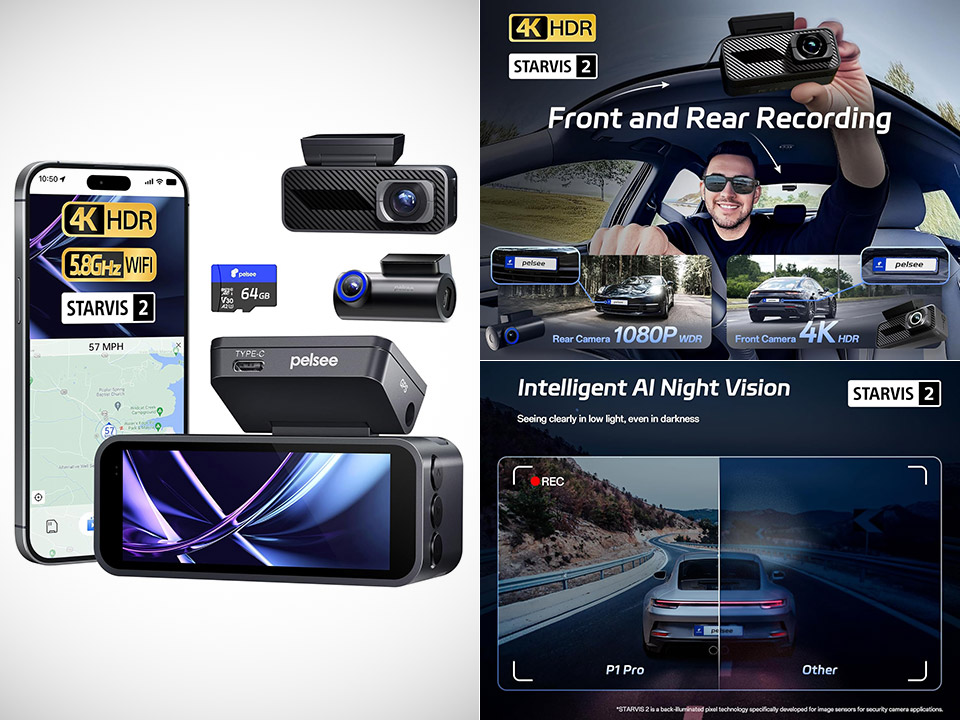
Every day, drivers face the occasional curveball on the road. The Pelsee P1 Pro 4K dashcam, priced at $49.99 with promotion code: 97KDCUO5 (was $110), does, however, bring clarity into focus, thanks to the footage it gets of license plates, which stay perfectly clear even when the sun is directly shining on it. Not to mention the front camera’s High Dynamic Range (HDR), which slices through glare like a hot knife through butter, leaving you with crisp, clear numerals and lettering that would otherwise be washed out.
Nighttime driving is no problem since the Sony STARVIS 2 sensor on the front camera gathers light four times more efficiently than normal sensors, allowing you to see full-color details even on the darkest city streets or country roads. Furthermore, scenes remain visible even when driving in complete darkness and exiting underground parking garages. The front camera films in 4K, while the rear shoots in 1080p, and they both run seamlessly at 30 frames per second, making the motion appear lifelike.

Pelsee P1 Pro 4K Dash Cam Front and Rear, STARVIS 2 Sensor, 64GB Card, Dual Dash Camera for Cars with…
- 【HDR Front & WDR Rear Recording】The front 4K HDR dash cam slices through blinding sunlight, capturing license plates clearly in overexposed…
- 【STARVIS 2 Sensor & AI Night Vision】Image sensor with technology of STARVIS developed by Sony delivers 4x greater low-light sensitivity…
- 【Smart Driving Assistant】Advanced Driver Assistance System (ADAS) included proactive alerts for forward collision, pedestrian collision, lane…
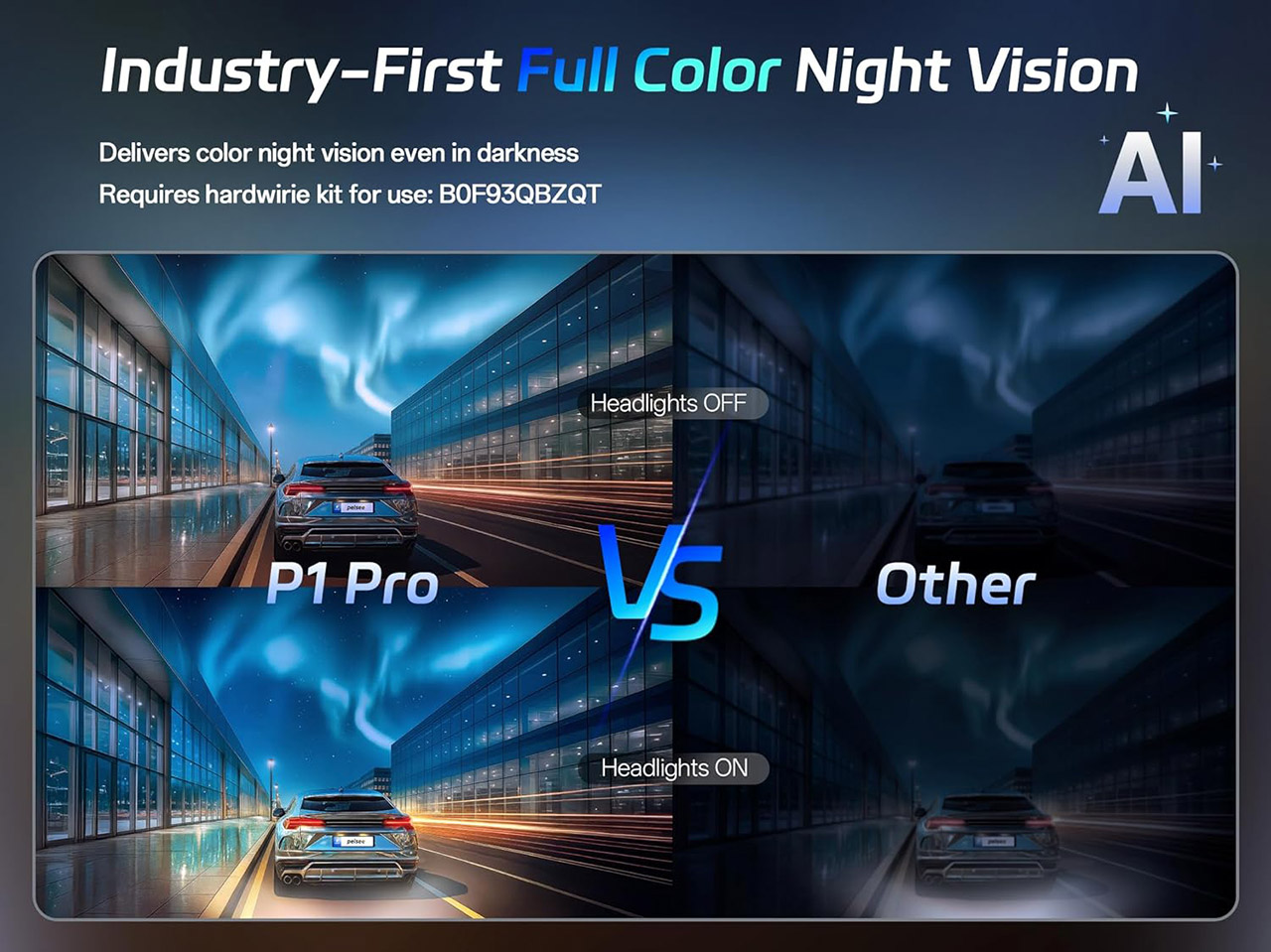
The rear coverage does an excellent job of balancing the shadows and tunnel lighting while retaining all of the most important details. Those huge 170-degree views of the front imply that two complete lanes, plus the shoulders, are visible, while drivers will also notice that license plates and traffic signs remain viewable until the very end. The 3.39-inch screen built into the main unit shows live views as soon as you turn it on, and you can navigate menu options and playback without having to use your phone. The ability to use voice commands provides another layer of control, which is useful because you can secure a clip or take a snapshot simply by saying a fast phrase like ‘lock it’ or’snap a photo’, all without taking your eyes off the road.

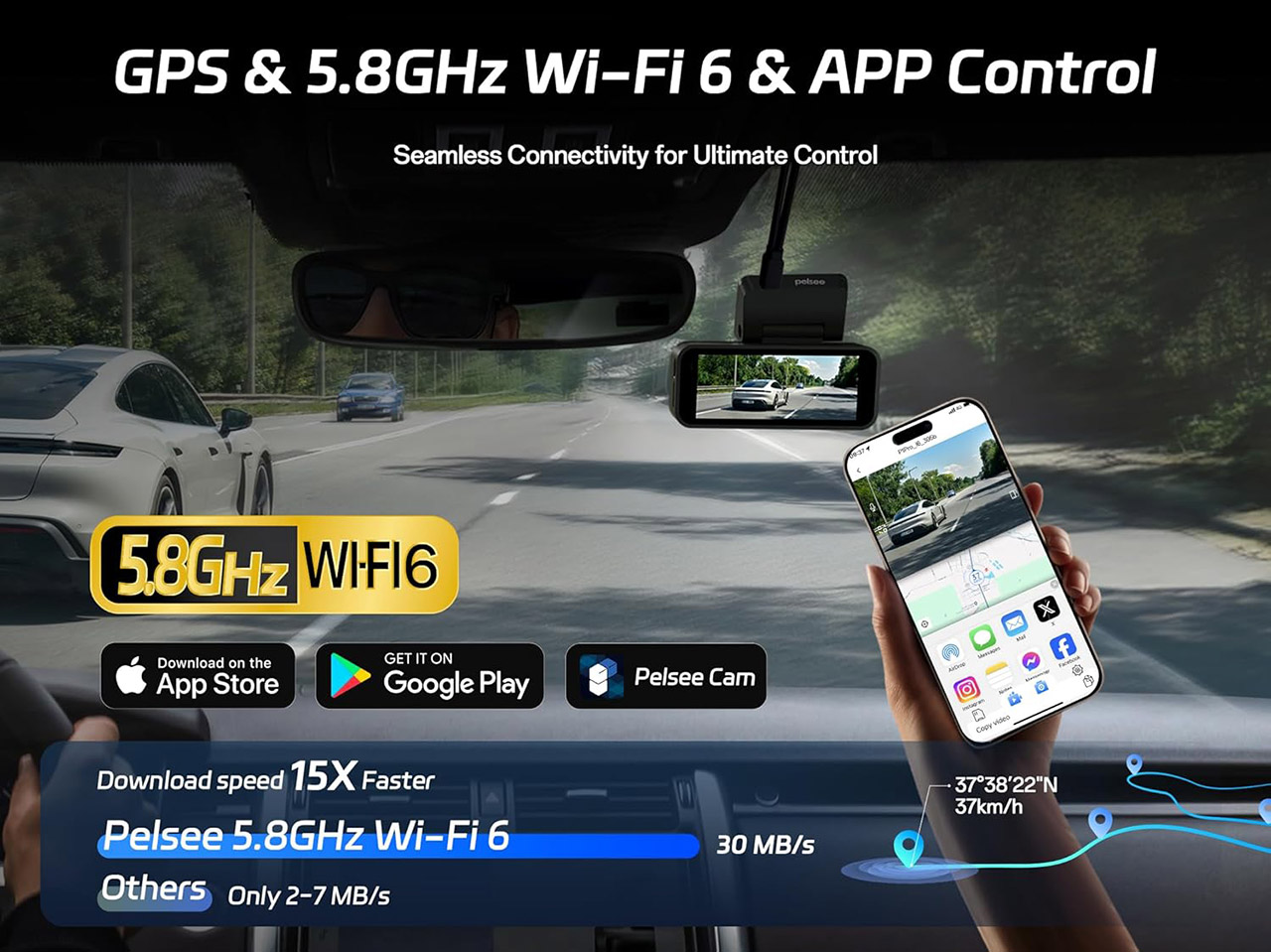
Wireless transfer transmits your clips directly to your phone over a fast 5.8 gigahertz connection. The accompanying app then handles all of the downloads and sharing for you, which takes about the same amount of time as fiddling with a memory card. Built-in GPS logs every second with speed, location, and time, which is extremely useful for insurance claims or police reports; it all adds up to solid undeniable proof in an instant.

Helpful alerts appear for frontal collisions, lane slips, and when the automobile in front of you begins to accelerate again. These notifications provide you extra time to react in slow-moving traffic or during highway merges. The cameras continue to record even when you park; owing to 24-hour monitoring, a sensor will wake them up on impact or motion, and there’s also a time-lapse option that compresses all those lengthy hours into shorter files. Furthermore, the loop recording simply overwrites previously recorded footage on the provided 64-gigabyte card, which may be expanded up to 512 gigabytes if necessary. Plus, the supercapacitor outperforms older battery designs in terms of high heat and cold tolerance.
Installing it is as simple as 1 2 3. Simply clamp the main unit onto the windshield, tuck the cables into the included guides, and connect it into the cigarette lighter. The rear camera simply snaps in at the back. Everything is ready to use in the package, including front and rear cameras, a memory card that has already been inserted, a charger, and basic equipment.

Big Volatility For Small But Buzzy IPO

Women’s NCAA Fort Worth 1 roundup: No. 3 Ohio State cruises past No. 14 Howard

Derry murder investigation: Woman named locally as community “utterly devastated”

Smart energy pays enters the US market, targeting scalable financial infrastructure

Why Israel is blocking foreign journalists from entering

Bitcoin: We’re Entering The Most Dangerous Phase

Rare Ferrari Model Worth Huge Money #pawnstars #antique #collection #collector

XRP 2026 PRICE PREDICTION: HOW MUCH WILL 1000 XRP BE WORTH?

#millionaire #millionairesworldwide #money #bankofallah #motivation #rich #ihavethisthingwithplants
-

 Tech6 days ago
Your Legally Registered ‘Motorcycle’ Might Not Count Under Proposed US Law
-

 Fashion1 day ago
Weekend Open Thread: Adidas – Corporette.com
-

 Politics1 day ago
Jenni Murray, Long-Serving Woman’s Hour Presenter, Dies Aged 75
-
 Tech4 days ago
Are Split Spacebars the Next Big Gaming Keyboard Trend?
-

 News Videos3 days ago
RBA board divided on rate cut, unusually buoyant share market | Finance Report | ABC NEWS
-

 Business6 days ago
Search for Savannah Guthrie’s Mother Enters Seventh Week with No Arrests
-
 Crypto World1 day ago
NIO (NIO) Stock Plunges 6.5% as Shelf Registration Sparks Dilution Worries
-

 Business6 days ago
Australian shares drop as Iran war enters third week
-

 Crypto World3 hours ago
Bitcoin Price News: Bhutan Sells $72 Million in BTC Under Fiscal Pressure, but the Smart Money Entering Pepeto Sees What the Market Does Not
-

 Crypto World6 days ago
Crypto Lender BlockFills Enters Chapter 11 with Up to $500M in Liabilities
-

 Politics4 days ago
The House | The new register to protect children from their abusers shows Parliament at its best
-

 Crypto World2 hours ago
Best Crypto to Buy Now: Strategy Just Spent $1.57 Billion on Bitcoin During Fear While Early Investors Quietly Enter Pepeto for 150x Potential
-

 Fashion6 days ago
25 Celebrities with Curly Hair That Are Naturally Beautiful
-

 Tech2 days ago
inKONBINI Lets You Spend Summer Days Behind the Register
-

 Crypto World3 days ago
Canada’s FINTRAC revokes registrations of 23 crypto MSBs in AML crackdown
-
 Politics4 days ago
Real-time pollution monitoring calls after boy nearly dies
-
 NewsBeat3 days ago
Residents in North Lanarkshire reminded to register to vote in Scottish Parliament Election
-

 News Videos3 days ago
PARLIAMENT OF MALAWI – PAC MEETING WITH REGISTRAR OF FINANCIAL ON AMARYLLIS HOTEL – INQUIRY LIVE
-

 Business5 days ago
Meta planning major layoffs as AI spending and automation reshape workforce
-

 Politics7 days ago
9 Stylish Leather Jackets Perfect For Spring 2026
You must be logged in to post a comment Login