
Crypto World
Bitcoin’s four-year cycle intact; Q4 rally forecast

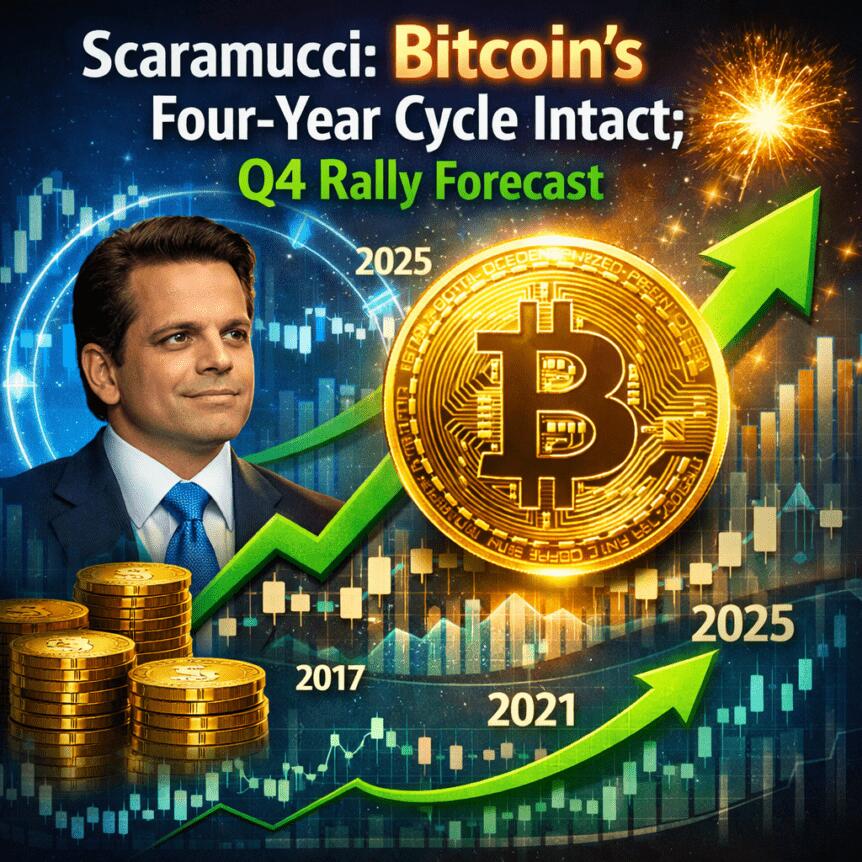
Bitcoin’s bear market has been framed by a familiar prism: the traditional four-year cycle. Yet proponents argue that institutional demand, particularly via BTC-focused exchange-traded funds, has muted volatility and may shape the path of prices through the next cycle. In a recent discussion, Anthony Scaramucci, managing partner of SkyBridge, suggested that while the cycle remains visible, its dynamics have been altered by new liquidity channels and changing market participation.
Speaking with Scott Melker on The Wolf of All Streets podcast, Scaramucci described the four-year pattern as “muted” by ETF inflows that have helped cushion sharp swings. “We’re in a four-year cycle, and there were some traditional whales, some OGs, that believe in the four-year cycle, and guess what happens in life when you believe in something? You create a self-fulfilling prophecy,” he said. The implication is that market psychology and the presence of ETFs have tempered the classic boom-bust rhythm that many investors associate with BTC.
Looking ahead, Scaramucci warned that BTC is likely to remain choppy for most of the year, with a renewed bull market emerging in the fourth quarter of 2026. He noted that the broader market narrative at the time had shifted away from a straightforward ascent toward a more nuanced trajectory, where macro and policy factors would matter just as much as on-chain signals.
The conversation also touched on the expectations that had circulated in late 2024 and early 2025. Market participants, including Scaramucci, had anticipated BTC could surge toward around $150,000 in 2025, driven by broad political momentum and regulatory openness in the United States. That consensus was upended by a sharp October downturn that pulled BTC from a prior peak to a much lower range, underscoring how quickly sentiment can swing in crypto markets.
History has repeatedly shown that price movements often defy prevailing sentiment. Scaramucci pointed to the early 2023 period, when BTC’s price action moved contrary to bright-eyed forecasts in the wake of the FTX collapse in November 2022. After a period of disinterest and malaise, the market reversed into a new upcycle, illustrating how catalysts can reset the mood even when the broader narrative appears unfavorable.
Key takeaways
- The four-year cycle remains a reference framework for BTC, but ETF inflows have muted its volatility and potentially altered how the cycle plays out.
- BTC is expected to experience choppy trading through much of this year, with the next major leg higher anticipated in the fourth quarter of 2026.
- Market expectations for a 2025 surge to around $150,000 were fueled by pro-crypto policy signals and regulatory warming, but an October crash shattered that consensus.
- Historical reactions show BTC can rebound after episodes of apathy or negative catalysts, reinforcing the idea that macro shocks and sentiment swings remain powerful drivers.
- Geopolitical developments and stock-market dynamics can influence BTC through correlations with risk assets, underscoring the need to monitor macro risk sentiment alongside on-chain activity.
The cycle, ETFs, and the evolving market backdrop
In the eyes of Scaramucci, the presence of BTC-focused exchange-traded funds has changed the game. ETFs offer a new, regulated channel through which institutional players can gain exposure, potentially dampening sharp drawdowns and tempering the kind of volatile spikes that once defined BTC cycles. This shift does not erase the cycle’s specter, but it reframes it—turning a potentially binary up- or down-market into a more nuanced, information-rich environment in which policy signals and fund flows matter as much as supply-demand fundamentals.
That framing sits alongside long-standing debates within the crypto industry about whether the four-year cycle remains intact. While some observers point to deviations in late 2025 or 2026, others, including Scaramucci, argue that the cycle still offers a useful heuristic for investors trying to gauge risk, duration, and potential turning points. The market’s sensitivity to events such as regulatory announcements, ETF inflows, or major macro shocks continues to complicate any simple forecast.
From peak to pause: how catalysts have shifted the narrative
The historical arc cited by Scaramucci stretches from BTC’s all-time run toward lofty levels to the subsequent retrenchment that has colored investor psychology for years. The narrative notes that BTC once traded near the upper stratosphere—around a $126,000 range in prior cycles—before the October pullback. From there, the price retraced to the $60,000 area, highlighting how quickly sentiment can reverse and the importance of liquidity and risk appetite in determining the price path.
Beyond these cycles, the market’s reaction to external shocks—such as the FTX collapse in late 2022—has underscored a pattern: even after periods of disillusionment, bitcoin has demonstrated resilience, often resuming an uptrend when investor interest returns and liquidity improves. The early months of 2023, in particular, showed that upside moves can unfold despite a broader backdrop of skepticism or unfavorable headlines.
Another facet of the discussion centers on whether 2025 and 2026 would deliver a fresh bull phase. While the consensus among several participants had anticipated a robust climb in 2025, the trajectory was interrupted by the October downturn and broader risk-off dynamics. The question remains whether the market will reassert its longer-term cycle or whether a new regime—shaped by macro policy, regulatory clarity, and global liquidity—will redefine BTC’s pace and scale.
Geopolitics, risk sentiment, and BTC’s market correlations
Macro shocks have always tested BTC’s claimed role as a hedge or diversifier. The recent wave of geopolitical tension and global risk-off periods have at times coincided with renewed pressure on risk assets, and BTC has not been immune. In the most recent turn, BTC dipped below a key psychological level in the wake of intensifying geopolitical events. At the same time, traditional stock indices have faced renewed selling pressure; the S&P 500 fell around 1.3% as the week closed, dipping below a widely watched moving average and highlighting a possible shift in the correlation between BTC and mainstream markets.
Analysts have warned that if BTC continues to exhibit a sustained positive correlation with equities, its downside could be more pronounced in risk-off environments—potentially amplifying losses in a scenario where macro catalysts favor traditional assets. Yet the crypto market has shown episodic decoupling at different points in history, illustrating that the relationship is not fixed and can diverge as new liquidity channels and market participants come into play.
The ongoing debate about Bitcoin’s cycle, and whether it remains a reliable compass for pricing, continues to draw attention from investors and researchers. Some industry voices argue that structural shifts—such as increasing institutional participation, evolving derivatives markets, and tighter regulation—could render the old four-year narrative less predictive than it once was. Others maintain that the cycle still captures a collective behavior pattern—cyclical expectations that influence trading and risk management, even if the visible price path changes in response to external shocks.
For readers seeking a synthesis, it’s not simply a question of whether the cycle endures, but how its cues interact with a broader market fabric that includes policy developments, ETF demand, and macro risk appetite. The interplay among these factors will likely determine how BTC navigates the remainder of this decade.
Longer-form reflections on the cycle’s fate have appeared in industry circles, including discussions in crypto-focused media that weigh the structural shifts against historical precedent. The tension between a legacy four-year rhythm and new market realities remains a core theme for traders and builders alike, as they assess timing, risk controls, and capitalization strategies in a landscape defined by rapid change and evolving incentives.
As the community weighs these signals, investors should stay alert to ETF flow data, central-bank signals, and regulatory developments that could reshape the calculus of risk and reward. The next few quarters will be telling in terms of whether BTC can establish a fresh breakout or whether the cycle will again be interrupted by macro or policy-driven shocks.
Looking ahead, observers will be watching how the market absorbs geopolitical risks, how the S&P 500 and other risk assets respond to policy news, and how BTC trades as liquidity conditions shift. The implications extend beyond price alone: they touch on institutional adoption, derivative markets, and the broader narrative around crypto’s role in diversified portfolios.
For now, the path remains uncertain but informed by a set of recognizable patterns and new inflows. The pace of ETF participation, the resilience of risk sentiment, and the cadence of regulatory clarity will help determine whether BTC’s next major leg higher lies in late 2026 or in a broader, more gradual re-acceleration beyond that horizon.
Readers should watch for how ETF allocations evolve and whether macro catalysts—such as policy shifts or geopolitical developments—alter the balance of risk and return in the coming months. The question of whether Bitcoin’s four-year rhythm endures or evolves is unlikely to be settled in the near term, but the signals from fund flows, price action, and policy readiness will continue to shape market expectations.


TLDR:
- Bitmine holds 4.6 million ETH, with 3 million actively staked and generating around $180 million annually.
- Ethereum’s 2.8% staking yield cuts the cost gap, meaning Lee needs only 8–9% more to match Saylor’s offer.
- Bitmine has been acquiring over 60,000 ETH weekly, building a low cost basis ahead of any product launch.
- Unlike Bitcoin, Ethereum’s native protocol yield subsidizes the dividend structure, making the flywheel self-reinforcing.
ETH Stretch may be the next big institutional product to emerge in the crypto market. Bitmine, led by strategist Tom Lee, currently holds 4.6 million ETH.
That figure represents nearly 4% of Ethereum’s total circulating supply. Of that holding, 3 million ETH is actively staked, generating around $180 million per year in protocol rewards.
Analyst Axel Bitblaze recently argued that Lee has the infrastructure to launch a Stretch-style fixed-yield product on this existing base.
Ethereum Staking Yield Creates a Structural Cost Advantage
Michael Saylor’s Stretch product offers a fixed 11.5% yield, with all proceeds going into Bitcoin. This buying pressure has pushed hundreds of millions into BTC each week.
Many credit this as a key reason Bitcoin held above $69,000. Without this demand, some analysts suggest prices would sit near $50,000.
Tom Lee, however, already runs a yield engine that Saylor does not have. Bitmine’s staked ETH generates about 2.8% annually from Ethereum’s protocol.
That income covers part of any fixed dividend Lee would need to pay out. Lee would only need to generate an additional 8–9% to match Saylor’s offer.
Bitblaze noted on X that this cost structure allows Lee to undercut Stretch on yield expenses. That margin could make the product more attractive to institutional capital.
Wall Street typically responds well to yield products with stronger cost profiles. Staking income is a meaningful competitive edge in this space.
Additionally, Bitmine has been buying over 60,000 ETH per week in current market conditions. The firm’s cost basis remains low, and Ethereum sentiment is broadly negative.
Those two factors create a favorable window for any product announcement. A low cost basis combined with native yield strengthens the overall case considerably.
The Ethereum Flywheel and Its Reflexivity Potential
The mechanics of an ETH Stretch product follow a clear and self-reinforcing loop. Every dollar raised would go toward buying more ETH on the open market.
More ETH purchased means more ETH available for staking. More staked ETH then generates additional protocol rewards to help fund the dividend.
This cycle differs from Saylor’s model in one key respect: Ethereum has native yield. Bitcoin has no protocol income, yet the BTC Stretch flywheel has still gained traction.
Ethereum’s staking rewards subsidize the structure from the start. That makes the feedback loop cheaper to run and easier to grow.
Bitblaze argued that Saylor’s flywheel works despite Bitcoin having no yield. Lee’s version, by contrast, would run on Ethereum’s own protocol income.
That distinction changes the product economics entirely. A yield-backed demand engine does not rely solely on price appreciation. It draws strength directly from the Ethereum protocol itself.
Should Lee announce such a product while sentiment is low, the price response could be rapid. Institutional capital targeting yield would flow in, driving ETH demand higher.
Higher ETH prices improve staking returns in dollar terms, attracting still more capital. That loop, once active, tends to accelerate.

Crypto World
Ethereum Price Prediction: ETH Price Could Reach $2,500 as BNB Weakens and Pepeto Shows the Utility Gains That Matter

BlackRock launched the iShares Staked Ethereum Trust on March 12, and the fund pulled in $254 million in its first week, making it the fastest growing crypto ETF this quarter.
While the ethereum price prediction shows a path toward $2,500, Pepeto is drawing attention with exchange infrastructure already live, more than $8 million raised, and a Binance listing approaching. The wallets entering now are targeting returns the ethereum price prediction needs the full cycle to deliver.
Ethereum Price Prediction Gains Support After BlackRock Staked ETF Pulls $254 Million in One Week
BlackRock launched ETHB on March 12 on Nasdaq, staking 70% to 95% of its Ethereum holdings and paying investors roughly 82% of staking rewards through monthly payouts, according to CoinDesk.
The fund reached $254 million in assets within seven days, according to Decrypt. Goldman Sachs reported over $1 billion in Ethereum ETF holdings, and Larry Fink called blockchain infrastructure necessary at Davos this year.
The ethereum price prediction has institutional money behind it, but from $2,083 the path to $2,500 is a 20% move that takes patience.
Ethereum Price Prediction and the Presale Offering Returns ETH Cannot Match
Pepeto
As rug pulls grow more common, the cost of entering a project without checking its contracts keeps rising. Every cycle, traders lose more capital to scams that grow harder to detect with each new method. Doing your own research takes hours most people do not have, and it still misses the risks buried in smart contract code.
Pepeto was designed to end that problem before your money is at risk. The exchange is already running while the presale fills. The risk scorer examines every contract for hidden traps and scam patterns, giving you a clear answer in seconds instead of hours of digging through code, so you act with confidence instead of guessing.
The cofounder who took the original Pepe coin to $11 billion with nothing is now building an exchange with zero fee trading, cross chain transfers at zero cost through the bridge, and a SolidProof audit completed before the presale opened. A former Binance expert is on the dev team, 195% APY staking compounds in wallets that positioned early, and the presale has crossed more than $8 million with the Binance listing approaching.
At $0.000000186 with the same 420 trillion supply that reached $11 billion under Pepe, matching that market cap is over 150x, and Pepeto has the exchange infrastructure Pepe never built. The wallets filling the presale are taking the entry that disappears the moment trading begins, and the holders who are not inside yet are the ones who will spend this cycle wishing they had moved.
Ethereum Price Prediction: Can ETH Reach $2,500 With BlackRock Leading Institutional Demand?
ETH trades near $2,083 as of March 22, holding above the $2,000 support that formed a floor since mid February, according to CoinMarketCap.
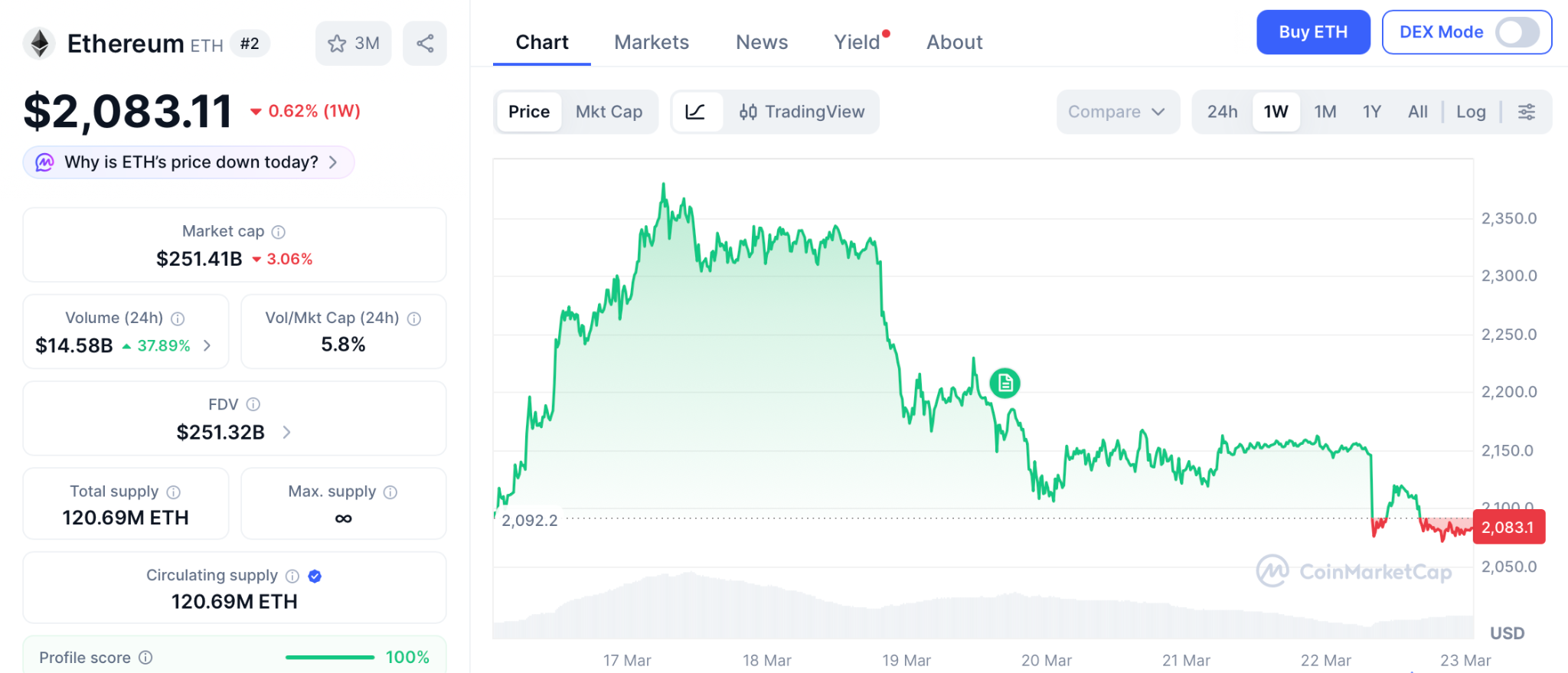
BlackRock’s ETHA holds $6.5 billion and the new staked ETHB already sits at $254 million after one week. Resistance levels form at $2,235 and $2,380, and if both break cleanly the next ethereum price prediction target is $2,500.
Losing $2,000 could trigger a pullback toward $1,800. Even the bullish $2,500 scenario is a 20% move from current prices, a return that requires months of positive conditions and institutional follow through.
BNB
BNB trades near $631 as of March 22, steady despite the broader correction, according to CoinMarketCap. The Binance ecosystem keeps BNB supported, but from $631 the token needs to reclaim $720 before any meaningful run begins.
A 2x requires BNB above $1,200, a level it has never held. Neither the ethereum price prediction nor BNB delivers the distance a presale to exchange listing compresses into the moment trading opens.
Ethereum Price Prediction Points to $2,500 but the Presale Entry Points to Where Wealth Was Built
The ethereum price prediction has BlackRock behind it, the staked ETF is pulling institutional money, and the $2,500 target is realistic. But the smart money wallets filling Pepeto at presale pricing are building positions that expect returns ETH from $2,090 takes years to match.
The crypto news will cover this moment after the Binance listing, and the only question is whether you lock in your position on the Pepeto official website today or pay a higher price later from wallets that moved while you were still reading about ETH.
BlackRock is staking ETH for 3% yield. The wallets inside Pepeto are targeting 150x, decide which return fits this cycle.
Click To Visit Pepeto Website To Enter The Presale

FAQs
What is the ethereum price prediction for today?
The ethereum price prediction targets $2,500 if ETH holds above $2,000 support. Investors seeking faster returns are looking at Pepeto, where matching Pepe’s market cap is over 150x from presale.
Why is Pepeto trending alongside the ethereum price prediction?
Pepeto has become the presale drawing the most capital because it combines a working exchange with the same supply that took Pepe to $11 billion, positioning it for returns ETH cannot match from $2,083.
How does the ethereum price prediction compare with early presales like Pepeto?
The Pepeto official website offers a presale where the Binance listing compresses the return window into days, while the ethereum price prediction from $2,083 to $2,500 is a 20% move requiring months.
Disclaimer: This is a Press Release provided by a third party who is responsible for the content. Please conduct your own research before taking any action based on the content.
TLDR:
- Trump issues 48-hour ultimatum demanding Iran reopen the Strait or face power plant strikes.
- Iran warns of full closure of the Strait and retaliation against regional energy infrastructure.
- Tanker traffic dropped 90%, increasing concerns over global oil supply and market stability.
- Iranian officials list potential targets, including Israel and US-linked energy assets.
Iran war live Trump Strait of Hormuz tensions intensified after a 48-hour ultimatum triggered threats of energy infrastructure attacks, raising risks of wider regional escalation and disruption to global oil transit routes.
Trump Issues 48-Hour Ultimatum
The United States has issued a direct warning to Tehran. In his statement, President Donald Trump demanded that Iran fully reopen the Strait within 48 hours.
He threatened attacks on major Iranian power plants if the demand is ignored. The ultimatum highlighted the strategic significance of the Strait of Hormuz, through which a significant portion of global oil shipments pass.
Tanker traffic has already fallen by nearly 90% in recent weeks, raising concerns about energy supply disruptions worldwide.
Trump’s statement did not clarify whether nuclear-linked power plants, such as Bushehr, would be included in the strike. This uncertainty added to regional tension, as the potential for collateral damage remains high.
“If Iran doesn’t FULLY OPEN the Strait, the US will hit major power plants first,” Trump’s statement read, reflecting the firm deadline.
Iran Warns of Retaliation and Regional Impact
Iranian officials outlined a detailed response as spokesperson Ebrahim Zolfaghari confirmed that the Strait remains partially open under controlled access. He however, warned that any strike on power plants would trigger immediate retaliation.
Iran indicated that a full closure of the Strait would follow any attack, with reopening dependent on reconstruction of damaged infrastructure.
Officials also listed potential regional targets, including power plants in Israel, companies with American shareholders, and energy infrastructure in countries hosting US bases.
Iran’s parliament speaker, Mohammad Bagher Ghalibaf, further emphasized the scale of potential consequences. He warned that attacks on Iranian infrastructure could lead to the irreversible destruction of energy networks across the Gulf, maintaining elevated oil prices for an extended period.
Previous demonstrations of Iran’s reach, such as the strike on Qatar’s Ras Laffan LNG terminal, showed the country’s capability to disrupt regional energy systems.
Regional and international actors are monitoring the situation closely, highlighting the strategic and economic stakes.
Iran war live Trump Strait of Hormuz tensions remain critical as the 48-hour deadline approaches, with both sides maintaining firm positions and regional stability at stake.
The divergence between gold and Bitcoin (BTC) in 2026 can be explained by two distinct segments of buyers, according to Stephen Coltman, head of macro at crypto exchange-traded product (ETP) provider 21Shares.
Gold’s rally over the last three years has been primarily fueled by central bank buying, while Bitcoin is more widely held by individuals than financial institutions, Coltman told Cointelegraph. He said:
“Physical gold has a greater geopolitical strategic role currently, as the asset of choice for state actors who want to store wealth in a way that is protected from rival powers. This has meant that it has traded with greater sensitivity to deteriorating international relations.”
However, BTC has more utility for individuals who may use it as an alternative “lifeline” when local banking infrastructure fails during times of crisis, and accessing the traditional financial system is not possible.

“Shortly after the conflict started, both the Dubai and Abu Dhabi exchanges were shut down following missile and drone strikes from Iran,” which, he said, is a “stark reminder” of how valuable 24/7 access is in wartime situations or other emergencies.
Coltman told Cointelegraph that the inverse correlation between BTC and gold means that investors should hold both to benefit from each asset’s unique properties.
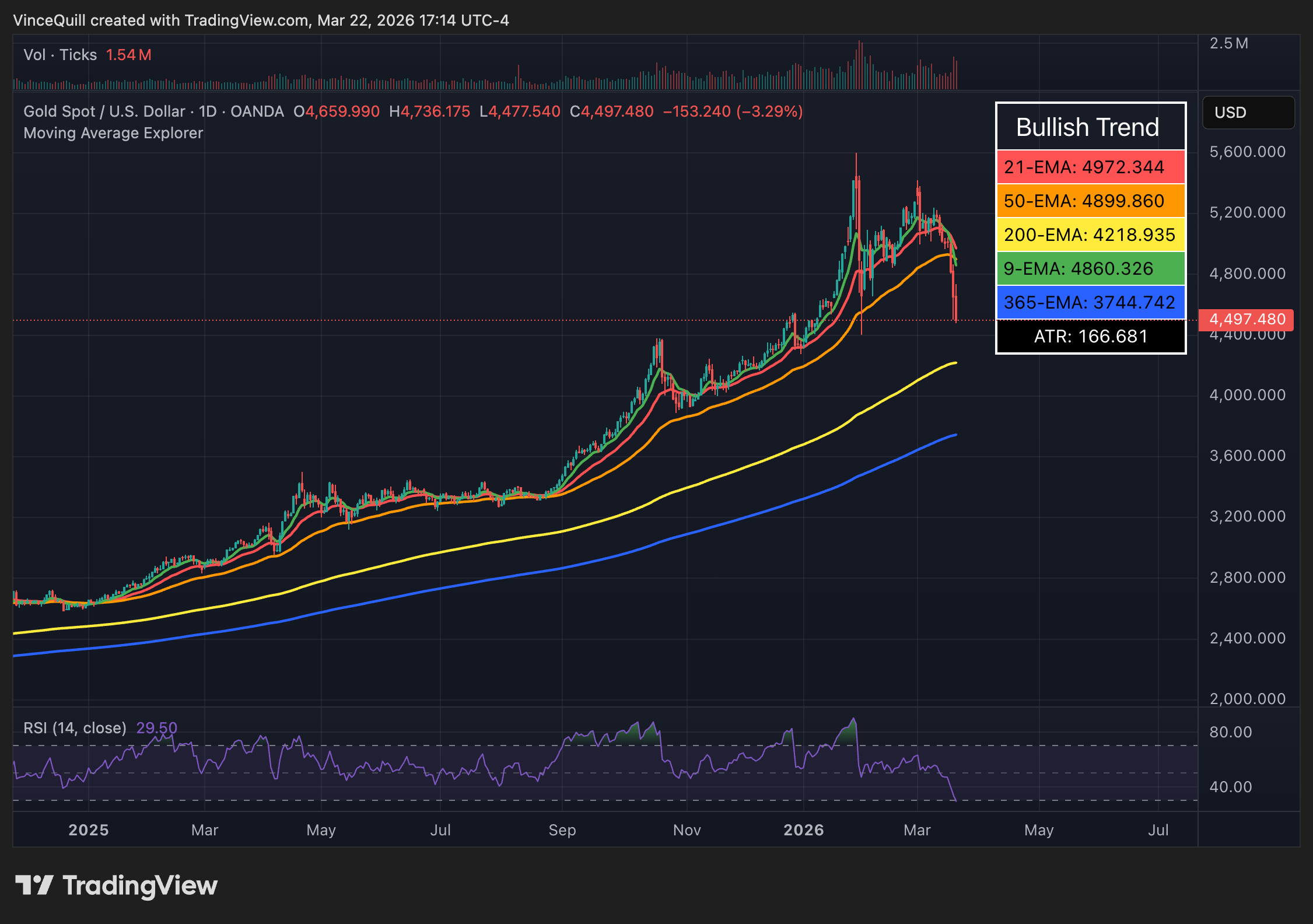
Ongoing macroeconomic and geopolitical shocks over the last several years drove gold to an all-time high of nearly $5,600 per ounce in January 2026.
However, heightened volatility dragged the precious metal back down to about $4,497 per ounce, leading to renewed debate among analysts about gold’s role as a store of value asset, and how it will perform against Bitcoin in the coming years.
Related: Bitcoin vs gold shows potential bottom signals as BTC bulls defend $70K
Financial analysts are split on gold versus BTC dominance
Bitcoin is likely to outperform gold over the next three years, according to macroeconomist Lyn Alden.
“It’s usually a pendulum between the two. If gold has gone up as much as it did, the entire diminishing return story per cycle is going to be erased in the coming one, too,” Alden said.
However, former hedge fund manager Ray Dalio expects that BTC will never replace gold as a store-of-value asset because it still trades like a risk-on asset with correlation to technology stocks, while gold is entrenched as a reserve asset in the banking system.
Magazine: Is China hoarding gold so yuan becomes global reserve instead of USD?
Crypto World
Hyperliquid Surpasses 218,000 Active Traders as Crude Oil Perpetuals Hit $300 Million Open Interest
TLDR:
- Hyperliquid’s active perpetual traders reached 218,340, marking a fresh local high with a 2.14% 24-hour gain.
- Crude oil perpetuals crossed $300M in open interest, overtaking every crypto and equity pair on Hyperliquid.
- Hyperliquid’s HIP-3 markets surpassed $1.43B in total open interest as platform activity hit an all-time high.
- Real-world assets including commodities, stocks, ETFs, and FX now account for roughly 30% of platform volume.
Hyperliquid is recording fresh activity highs across its perpetual trading platform in 2025. Active perpetual traders have reached 218,340, marking a new local high with a 24-hour gain of 2.14%.
Simultaneously, crude oil perpetuals on the platform have crossed $300 million in open interest. This figure places crude oil above every crypto and equity pair on the exchange.
Together, these numbers reflect a platform experiencing steady and measurable expansion this year.
Hyperliquid Trader Activity Recovers and Pushes Into New Territory
Hyperliquid’s active trader count has followed a notable recovery path over recent months. The platform peaked around November before pulling back sharply into January, dropping to roughly 150,000 active traders. That kind of reset typically stalls momentum on most trading platforms.
However, Hyperliquid began climbing again from late January onward. Since then, participation has moved steadily higher, reclaiming previous levels along the way. The platform has now pushed past its earlier highs into fresh territory.
According to data shared by Hyperliquid Hub on X, the platform went from around 127,000 traders in August to over 218,000 today.
That represents a broad expansion in user activity within less than a year. The growth has been gradual rather than driven by a single spike.
The post further noted a reinforcing dynamic: more traders bring more liquidity, which tightens spreads and improves execution.
Better execution, in turn, draws additional traders to the platform. This cycle has been building steadily through 2025 and continues to gain traction.
Crude Oil Perpetuals Lead Platform as Real-World Assets Drive Volume
Crude oil perpetuals have emerged as the largest market on Hyperliquid by open interest. The $300 million figure surpasses all crypto and equity pairs currently listed on the exchange. This development was reported by Delphi Digital and reflects a shift in what traders are engaging with.
Real-world assets, including commodities, stocks, ETFs, and foreign exchange pairs, now account for approximately 30% of overall platform volume.
That share represents a meaningful portion of activity. The growth of non-crypto markets on the platform has been a defining trend this year.
Hyperliquid’s HIP-3 markets have also crossed $1.43 billion in total open interest across all listed pairs. Active traders reached a new all-time high alongside this open interest figure. Both metrics moved higher together, suggesting broad participation rather than concentrated positioning.
The expansion into real-world assets marks a broader shift in how the platform is being used. Traders are no longer limited to crypto pairs when using Hyperliquid. The platform’s range of markets has grown, and so has the volume flowing through them.

Bitcoin (BTC) traded just below the $69,000 mark as traders braced for a pivotal weekly candle close, with prices hovering near the long-term line around $68,300. After a weekend slide, the setup underscores a tug-of-war between a fragile near-term outlook and the possibility of a contrarian move, even as analysts debate the significance of a fresh technical signal.
Historically, the 200-week exponential moving average has anchored multi-year cycles, but this year its reliability has been questioned. Cointelegraph has noted that the long-term EMA has failed to act as a clear support in 2026, complicating investor expectations for a durable bottom or renewed upside. As BTC approached the $68,300 region, traders watched to see whether the weekly close would restore any confidence in the metric or amplify the lingering bearish bias.
Key takeaways
-
Bitcoin remained under $69,000, testing the 200-week EMA near $68,300 as a critical reference point for the weekly close.
-
Market psychology tilted toward caution, with substantial liquidations signaling risk-off dynamics over the past 24 hours.
-
A fresh bullish tempo appeared with a golden cross developing between the 21-day and 50-day moving averages, but durability remains uncertain.
-
Analysts split on the path forward: some warn of continued macro downside even as near-term momentum offers a potential relief rally.
Weekend test of the long-term line
Trading data show BTC price action around the 200-week trend line, a level that has historically framed major cycles even as the asset wobbled through the weekend. The immediate vicinity of $68,300 serves as a focal point for whether bulls can sustain a bid above entrenched resistance or if sellers reassert control as the weekly close approaches.
Extended downside pressure in the days leading into the close produced notable liquidations across the market. CoinGlass reported that more than $300 million in long positions were liquidated, with roughly $100 million in shorts also liquidating in the same window. The liquidation profile underscores a risk-off environment in which traders are shrinking risk exposure into key technical junctures.
From a chart perspective, BTC’s motion around the 200-week EMA has reinvigorated debate about whether this line can again offer a meaningful foothold. In a broader 2026 context, some analysts have warned that the EMA’s traditional role as a durable support may be waning, complicating the interpretation of daily moves around this level.
Liquidity pressure and trader sentiment
The weekend action underscored a broader mood among market participants: risk appetite remains fragile as macro uncertainties persist. With a large portion of the futures market liquidated into the close, traders may adopt a cautious stance, awaiting a clearer directional cue from the weekly close and any subsequent macro catalysts.
In such a regime, the key question is whether the counter-move, if it occurs, can sustain momentum beyond a relief rally. The balance between safe-haven flows and renewed appetite for risk will likely define BTC’s trajectory over the coming sessions, particularly as market participants await more concrete signals from on-chain data, derivatives activity, and broader market liquidity conditions.
Momentum flicker: the Golden Cross and what it may imply
On the technical front, a visible positive signal emerged as the 21-day simple moving average crossed above the 50-day moving average, a formation often interpreted as a short-term momentum cue. Proponents of the setup cautioned that the cross could herald a temporary lift, though they emphasized that durability would hinge on subsequent price action.
Keith Alan, cofounder of trading resource Material Indicators, commented on the potential implications, saying the Golden Cross “will likely deliver some short term bullish momentum. Must watch to see if it develops into something durable.” He added a more cautious note, reflecting the prevailing sentiment: “For now…the range game continues.”
These near-term signals come after March saw two “death crosses” on BTC’s daily chart, a pattern historically associated with renewed downside pressure. The market’s interpretation of a Golden Cross in the current environment remains mixed: a possible spark for a bounce, but no guarantee of a sustained breakout without follow-through from higher timeframes.
Bearish undertones persist in higher timeframes
Several well-known traders have stressed that longer-horizon momentum remains skewed to the downside. A prominent analyst reiterated a bearish thesis for the macro cycle, highlighting ongoing fragility in higher timeframes despite any short-term bullish cues. The tension between near-term momentum signals and longer-term risk remains a defining feature of the BTC narrative as the market approaches another pivotal weekly close.
“There are still 0 signs of bear market exhaustion on HTF. No divs, no bear PA exhaustion, no momentum loss, etc.” He also noted a continued outlook for lower prices, saying, “I still have high confidence in seeing 50k and likely a bit lower.”
That sentiment sits alongside reminders from earlier periods that the market can swing on a few data points, even as long-run structural factors weigh on price discovery. The debate over whether BTC can muster a sustained recovery or slide toward new macro-driven lows remains unresolved, with bulls awaiting confirmation from price action and bears watching for any renewed downside momentum.
What readers should watch next
The immediate focus for BTC markets is the weekly candle close and how price behaves in the aftermath. If the price can hold above key support near the 200-week EMA and demonstrate follow-through above near-term moving averages, a cautious upside tilt could emerge. Conversely, failure to defend the region around $68,000–$68,300 may invite renewed selling pressure and retesting of lower support bands.
Investors should also monitor liquidity patterns and derivatives activity as they often foreshadow the next directional move. In addition, traders will be paying close attention to any shifts in macro sentiment or changes in the risk-on/risk-off appetite that can influence Bitcoin’s risk premium and its correlation with broader markets.
This ongoing narrative—between a fragile near-term bounce and the weight of higher-timeframe bears—will likely shape price action in the weeks ahead. As always, readers are advised to conduct their own research and consider how these developments fit their risk tolerance and investment horizon.
TLDR:
- BTC dominance has been ranging between 58% and 60% for months and is now approaching the critical 58% range low.
- Analyst CryptoCandy24x expects a rotation back to 60% or higher if BTC dominance holds firmly above the 58% boundary.
A CME gap at 70.1K remains unfilled, with analysts watching for a potential rejection that could push Bitcoin toward 66K. - Analyst maintains a short position, warning that Bitcoin’s structure stays bearish while price trades below the 71.4K level.
BTC dominance is nearing the 58% range low as Bitcoin’s price holds around $67,922, drawing attention from analysts across the market.
The metric has been cycling between 58% and 60% for months, and its latest move toward the lower boundary is happening alongside a key CME gap sitting at 70.1K.
Traders are now watching both developments closely, as the outcome of each could shape Bitcoin’s short-term price direction in the days ahead.
BTC Dominance Tests Critical Support at 58%
BTC dominance has been trapped in a defined range between 58% and 60% for several months. The metric has repeatedly rotated from the range high to the range low without breaking in either direction.
This prolonged consolidation has kept traders on alert for any sign of a decisive move. The current approach toward 58% is now putting that lower boundary under renewed pressure.
Analyst @cryptocandy24x noted that BTC dominance is once again approaching the range low near 58%. According to the analyst, if the current momentum holds, a rotation back toward the 60% range high is possible in the coming days.
However, this outlook only remains valid as long as BTC dominance holds above the 58% level. A confirmed breakdown below that mark would shift the bias in a different direction entirely.
A hold at 58% would suggest Bitcoin is maintaining its market share against altcoins. If dominance bounces from this level, it would align with the analyst’s expectation of a return toward 60% or higher.
On the other hand, a drop below 58% could signal growing altcoin strength across the broader market. The next few sessions will be telling as to which scenario plays out.
CME Gap at 70.1K Adds Pressure to Bitcoin’s Short-Term Outlook
While BTC dominance tests its range low, Bitcoin’s price is also facing a notable technical setup overhead. The CME closed at 70.1K, leaving a gap below the close that the market has yet to address.
Gaps of this nature have historically shown a strong tendency to get filled at some point. This makes the 70.1K level a significant reference point for traders planning their next moves.
Analyst @KillaXBT provided an update on how Bitcoin’s structure is developing around these key levels. The analyst noted that a push toward the CME gap, followed by a rejection, could lead to a retest of the 66K level next week.
KillaXBT also confirmed that the broader structure remains bearish while Bitcoin stays below 71.4K. The analyst noted they remain short and are tracking how price reacts at these zones.
A gap fill at 70.1K followed by a strong rejection would add more weight to the bearish case currently building. Traders are therefore watching for entry signals around that level ahead of any potential downside continuation.
The 66K area, meanwhile, stands as the next key support zone if selling pressure resumes. Until Bitcoin reclaims 71.4K, the market structure continues to favor the downside.
TLDR:
- Strategy has scaled its Bitcoin raises from hundreds of millions to over $1.8 billion per round in 2026.
- Five instruments, MSTR, STRK, STRF, STRD, and STRC, fund weekly Bitcoin purchases across investor profiles.
- Strategy recorded 12 consecutive weekly Bitcoin buys in 2026, regardless of short-term price movements.
- With 761,000 BTC held, Strategy still needs roughly 260,000 more coins to hit its one-million target by 2026.
Strategy has notably increased the pace of its Bitcoin accumulation through a series of larger and more frequent capital raises.
The company, led by Michael Saylor, has moved from occasional fundraising rounds to near-weekly capital deployments.
This shift has allowed Strategy to stack Bitcoin at a scale that few institutional players can match. The company currently holds over 761,000 Bitcoin and is targeting one million coins by the end of 2026.
Capital Raise Volume Grows From Millions to Billions
Between 2021 and 2023, Strategy raised capital through relatively modest and infrequent transactions. Convertible notes and occasional equity raises were the primary tools used during that stretch.
The amounts were in the hundreds of millions at most. The overall pace was slow compared to what the company would later execute.
That changed sharply heading into 2025 and 2026. Strategy began closing raises of $1 billion, $1.4 billion, and $1.8 billion in rapid succession.
The frequency moved from quarterly to weekly across that period. Crypto analyst Axel Bitblaze described the shift on X, calling Strategy “a bitcoin vacuum cleaner” that Saylor has carefully engineered.
The larger raises are now structured across five separate financial instruments. These are MSTR equity, STRK, STRF, STRD, and STRC.
Each instrument attracts a different type of investor within the capital stack. This design allows Strategy to pull in capital from a much wider pool of institutional and retail participants.
The broader result is a self-reinforcing system. As more investors seek yield or equity upside, more capital flows into Bitcoin purchases.
Bitblaze noted that Saylor has effectively built “a bitcoin-backed yield curve inside a single company.” Wall Street demand, therefore, converts directly and automatically into Bitcoin demand every single week.
Weekly Purchase Cadence Drives Steady Bitcoin Demand
Strategy recorded 12 consecutive weekly Bitcoin purchases throughout 2026 alone. Each purchase was funded through one or more of the five capital instruments currently in use.
The consistency of these buys has remained steady regardless of short-term price movements. No week was skipped even during periods of broader market uncertainty.
With 761,000 Bitcoin already on its balance sheet, Strategy still requires approximately 260,000 more coins to hit its one-million target.
That remaining demand translates into ongoing and predictable buying pressure across the market. The purchase timeline runs through the end of 2026. Price action along the way does not appear to alter the accumulation schedule.
Saylor recently posted the phrase “The Orange March Continues” across his social media channels. Analysts quickly read the statement as a signal of another imminent purchase.
Bitcoin was trading near $68,425 at the time. According to observers, the market had not yet priced in the anticipated move.
Strategy’s expanded capital raise program directly funds each new round of Bitcoin acquisitions. Larger raises mean larger and more frequent purchases moving forward.
The five-instrument structure ensures that investor demand across different risk profiles continues feeding the system.
For the broader Bitcoin market, this translates into a sustained and growing source of institutional buying pressure week after week.
Crypto World
Solana Head and Shoulders Breakdown Triggers Bearish Outlook Amid On-Chain Selling Pressure
TLDR:
- Solana confirms a head and shoulders breakdown, projecting downside toward the $70–$77 range.
- Market cap fell from $55B, signaling capital outflows and weakening investor confidence.
- On-chain data shows sustained realized losses, with daily selling pressure between $30M and $50M.
- Exchange outflows rose sharply, yet the price remains weak due to a lack of strong buyer demand.
Solana price analysis indicates a confirmed bearish reversal after a structured breakdown. Price action, declining market cap, and on-chain signals collectively point to sustained selling pressure in the near term.
Head and Shoulders Breakdown Signals Trend Reversal
Solana price has shown a clear head and shoulders formation after an extended uptrend. The pattern includes a defined left shoulder, a higher peak, and a lower right shoulder.
This structure typically signals exhaustion among buyers and a shift in trend direction. The neckline formed as a slightly ascending support level, reflecting earlier higher lows.
However, price action failed to hold this zone, leading to a decisive breakdown. This move confirmed a structural shift, with sellers gaining control of momentum.
Following the breakdown, Solana declined nearly 4% toward the $86 level. This move aligns with the expected reaction after a neckline breach.
The measured move projects a downside range between $70 and $77, based on the pattern’s height. $SOL has confirmed a head and shoulders breakdown.
If the price fails to reclaim this level, it may act as resistance. This scenario often accelerates selling pressure and reinforces the bearish outlook.
Market Cap and On-Chain Data Confirm Weakness
Solana’s network valuation peaked near $55 billion before entering a sharp decline phase. This drop reflects strong distribution activity and reduced participation. The initial decline around March 17 marked a turning point in sentiment.
Market cap fell rapidly, suggesting large holders exited positions. Afterward, the price entered a consolidation phase between $50 billion and $52 billion.
However, recovery attempts remained weak and formed lower highs. A further decline below $50 billion aligned with the neckline breakdown.
This confluence between price structure and capital flow strengthens the bearish case. Sustained weakness below this level may support the projected downside targets.
On-chain data adds another layer to the analysis. Net realized profit and loss shows continued selling at a loss since mid-February.
Daily losses range between $30 million and $50 million, indicating persistent pressure.Exchange flow data shows a shift, with outflows reaching 700,000 SOL after March 17.
This suggests reduced selling supply on exchanges. However, price has not responded positively, indicating weak demand.
Currently, Solana trades near $87.29, below key support at $88.02. A sustained move lower may expose the next support at $81.60. Resistance remains near $92.19, where buyers must regain strength.
Crypto World
The CLARITY Act Is Under Threat of Depayment Delay Although a Stablecoin Deal Is Being Made

Stablecoin Deal Is a Partial Victory
According to recent reports, the Senate leaders and the White House achieved a consensus on stablecoin yields. This move has resolved one of the major conflicts between crypto companies and banks. Thorn, however, said that the progress was good but still needs some work. Thorn pointed to the fact that a number of thorny issues may still delay the passage of the bill through Congress. These are the decentralization of finance monitoring, the security of the developers, and the regulatory framework. Furthermore, ethical considerations can also attract the attention in the process of further discussion.
The policy advisors of the US have noted that the negotiations are not over with the stablecoin issue. Participants of the discussions stated that the lawmakers should resolve the pending issues before the bill is completed. Besides, they characterized the new accord as a significant measure, as opposed to a solution.
Players in the industry have noted that there is a small legislative window in which the CLARITY Act should be passed. Kristin Smith of the Solana Institute told that the lawmakers should hope to pass it by August. In addition, she observed that the congressional timetable is even more restricted when there is greater activity in terms of election matters towards the end of the year. Senator Cynthia Lummis has proceeded to urge the bill to move forward quickly through the Congressional Banking Committee. She noted that the lawmakers would be able to pick the markup step during the Easter recess. Additionally, she has once again stated that timely passage is still relevant in developing the regulation of digital assets.
Danny Welbeck Double Helps Brighton Beat Liverpool Again

Today’s NYT Connections Hints, Answers for March 23 #1016

Credit Union vs. Bank


-

 Fashion2 days ago
Weekend Open Thread: Adidas – Corporette.com
-

 Politics2 days ago
Jenni Murray, Long-Serving Woman’s Hour Presenter, Dies Aged 75
-
 Tech5 days ago
Are Split Spacebars the Next Big Gaming Keyboard Trend?
-

 Crypto World24 hours ago
Best Crypto to Buy Now: Strategy Just Spent $1.57 Billion on Bitcoin During Fear While Early Investors Quietly Enter Pepeto for 150x Potential
-

 News Videos4 days ago
RBA board divided on rate cut, unusually buoyant share market | Finance Report | ABC NEWS
-

 Crypto World1 day ago
Bitcoin Price News: Bhutan Sells $72 Million in BTC Under Fiscal Pressure, but the Smart Money Entering Pepeto Sees What the Market Does Not
-
 Crypto World2 days ago
NIO (NIO) Stock Plunges 6.5% as Shelf Registration Sparks Dilution Worries
-

 Business7 days ago
Australian shares drop as Iran war enters third week
-

 Crypto World7 days ago
Crypto Lender BlockFills Enters Chapter 11 with Up to $500M in Liabilities
-

 Politics5 days ago
The House | The new register to protect children from their abusers shows Parliament at its best
-

 Fashion6 days ago
25 Celebrities with Curly Hair That Are Naturally Beautiful
-

 Tech3 days ago
inKONBINI Lets You Spend Summer Days Behind the Register
-
 Politics5 days ago
Real-time pollution monitoring calls after boy nearly dies
-

 Crypto World4 days ago
Canada’s FINTRAC revokes registrations of 23 crypto MSBs in AML crackdown
-
 NewsBeat4 days ago
Residents in North Lanarkshire reminded to register to vote in Scottish Parliament Election
-

 Business6 days ago
Meta planning major layoffs as AI spending and automation reshape workforce
-

 News Videos4 days ago
PARLIAMENT OF MALAWI – PAC MEETING WITH REGISTRAR OF FINANCIAL ON AMARYLLIS HOTEL – INQUIRY LIVE
-

 Business7 hours ago
No Winner in March 21 Drawing as Prize Rolls to $133 Million for Next
-

 Business4 days ago
Who Was Alex Pretti? 5 Key Facts About the ICU Nurse Killed by Federal Agents in Minneapolis
-

 Politics3 days ago
Gender equality discussions at UN face pushbacks and US resistance
You must be logged in to post a comment Login