
Crypto World
Stocks start catching up with bitcoin’s earlier meltdown to $60,000 as bond yields rise



Bitcoin began the year on a painful note, even as equity markets remained buoyant. But stock traders’ luck is now running out, as rising bond yields pressure valuations.
Prices for bitcoin plunged to nearly $60,000 from around $90,000 in the first five weeks of the year, according to CoinDesk data. The decline marked a sharp decoupling from the S&P 500 and Nasdaq, which were trading at or near record highs at the time.
Analysts wondered how long the divergence would last — whether bitcoin would quickly bounce back or stocks would eventually catch up with the weakness in bitcoin.
The latter appears to be happening. Since the Iran war began on Feb. 28, fears over inflation and fading Fed rate-cut expectations have pushed U.S. Treasury yields sharply higher, putting pressure on equities.
The stock market’s weakness, appearing weeks after BTC’s decline, underscores the cryptocurrency’s role as a leading indicator for traditional risk assets. Traders in conventional markets often watch BTC to gauge overall risk sentiment, particularly on weekends or during days when traditional exchanges are closed.
Yields rise, stocks drop
The yield on the 10-year U.S. Treasury note rose to 4.41% soon before press time, the highest since Aug. 1. The benchmark borrowing cost has risen by 48 basis points since the onset of the Iran war. The U.S. two-year yield has jumped 57 basis points to 3.94%.
Treasury yields are considered the benchmark for risk-free interest rates and borrowing costs in the economy, such as corporate bonds, mortgages, student loans, etc., are priced relative to Treasuries. So, when yields rise, lenders typically increase rates on loans to maintain their spreads, which pushes borrowing costs higher for businesses and consumers. This leads to risk aversion in equities, which we are beginning to see now.
Futures tied to Wall Street’s tech heavy index Nasdaq fell to 23,890 points early Monday, the lowest since Sept. 11. The S&P 500 e-mini futures fell to 6,505 points, also the lowest since September.
CoinDesk recently highlighted that the price patterns of major stock indices bear a striking resemblance to bitcoin’s price action leading up to its crash. This similarity has raised concerns among analysts, suggesting that stocks could be at risk of further declines if the pattern continues to play out.
“Bitcoin has been at the top of the risk-assets iceberg, and its collapsing price could be early days of a broader drawdown — particularly if surging commodity volatility trickles up to stocks,” Bloomberg’s Senior Commodity Strategist Mike McGlone said in a recent report.
Bitcoin steady
Having crashed early this year, BTC has held largely steady between $65,000 and $75,000 in recent weeks. As of writing, the cryptocurrency changed hands at $68,790.
Yet, pricing in options market shows peak fear, resulting in a record bias for put options, or derivative contracts offering protection from price slides in BTC.

Key Takeaways
- DOGE consolidates around $0.094 within a descending triangle pattern established since the 2021 all-time high
- Critical resistance level at $0.10 could unlock price objectives between $0.20 and $0.30
- Elliott Wave framework indicates DOGE may be finishing its final corrective phase around $0.093–$0.094
- Technical analyst Javon Marks spots hidden bullish divergence with potential upside to $0.44
- Blockchain metrics reveal 60,000–110,000 daily active addresses, indicating consistent network engagement
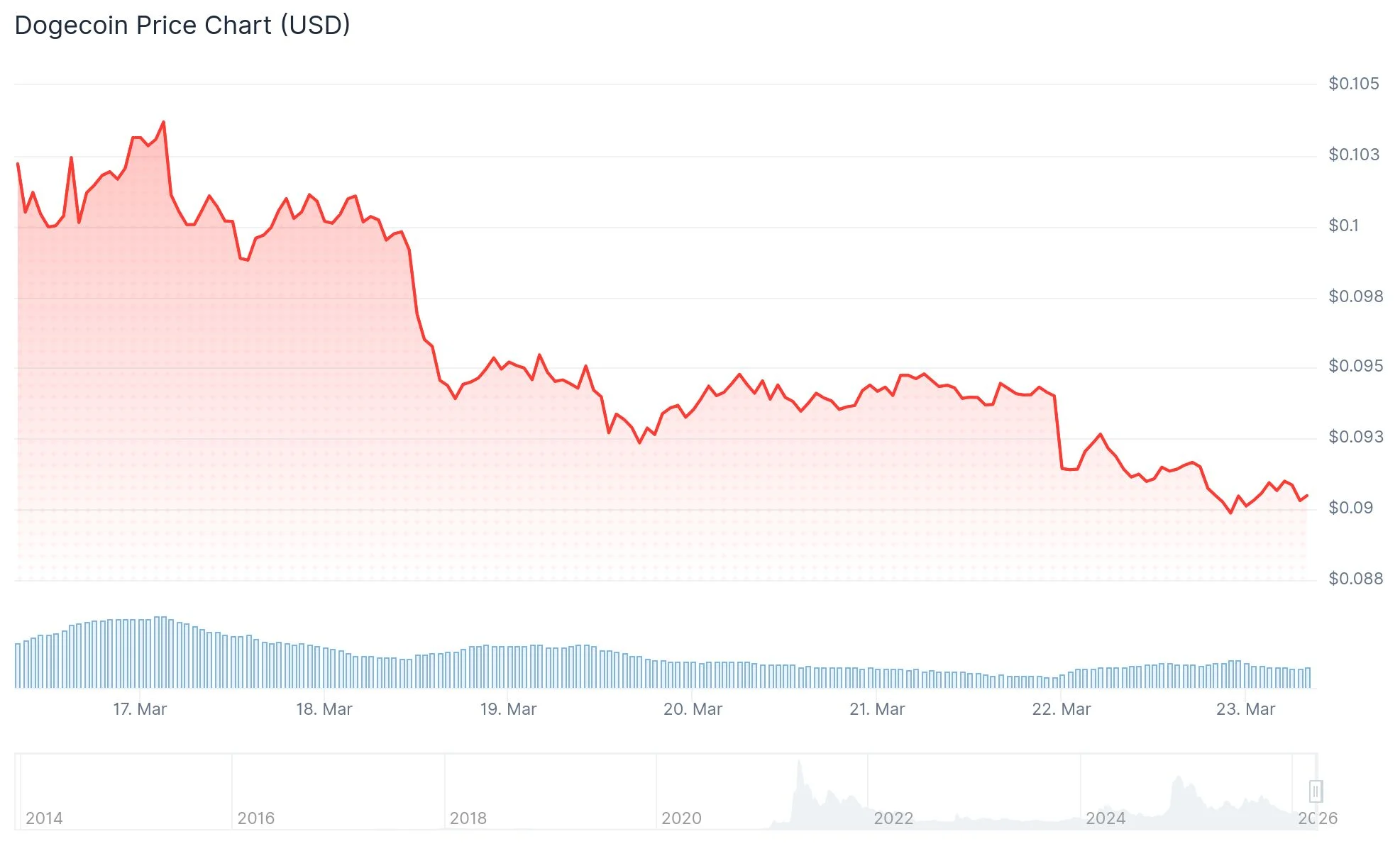
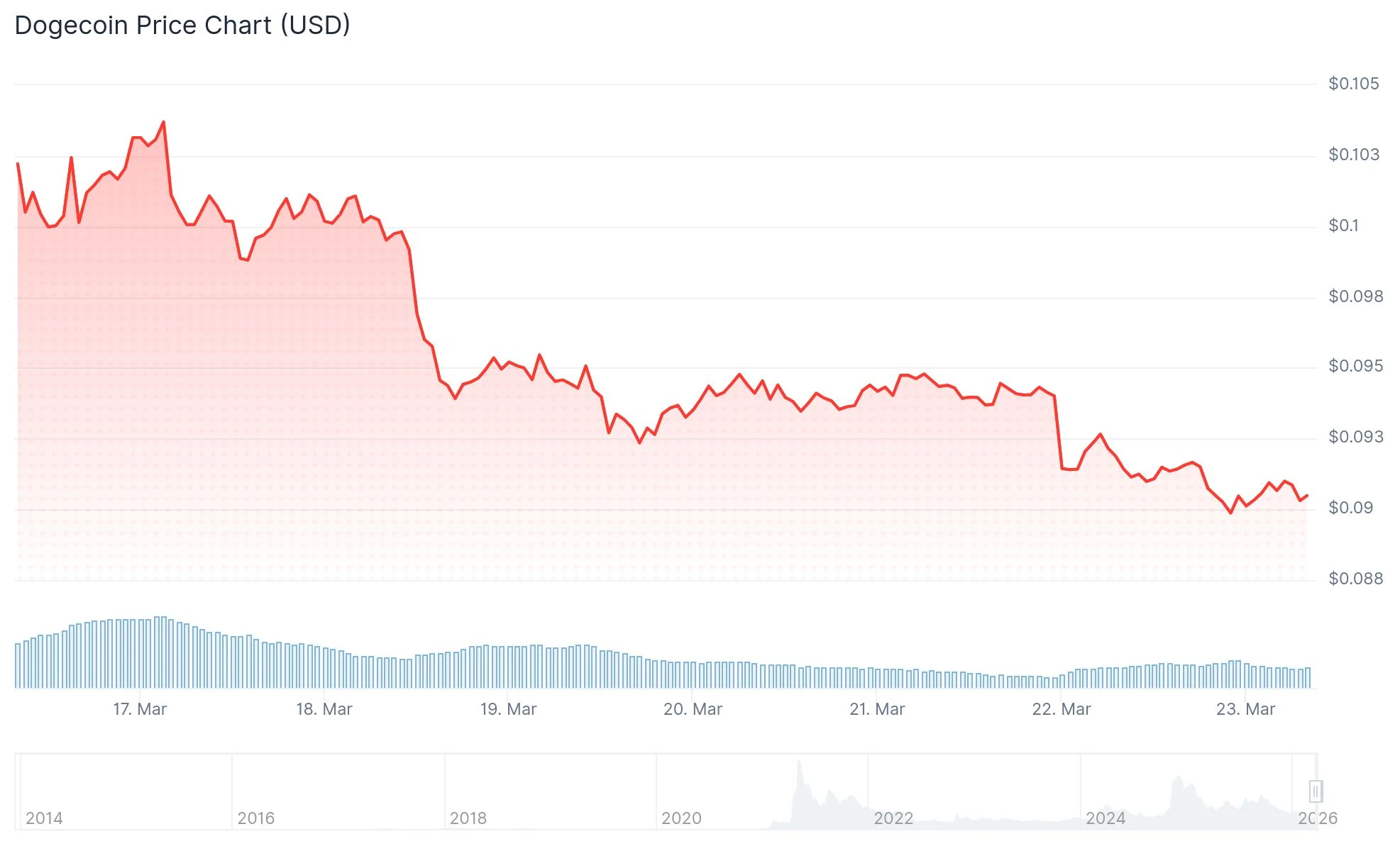
Dogecoin (DOGE) currently hovers around $0.094 as of March 21–22, 2026, confined within a prolonged technical consolidation structure that market participants are monitoring with keen interest.
Following its peak at $0.73 in May 2021, DOGE has experienced approximately 73% depreciation and transitioned into a lengthy consolidation period. The weekly timeframe reveals a formation of descending peaks creating a triangle configuration, with price support maintained within the $0.055 to $0.08 corridor.
Chart analyst CryptoPatel drew attention to this formation, observing that DOGE is positioned close to the upper limit of this extended compression area. This pattern indicates diminishing volatility as downward momentum weakens.
Analyst Crypto Lens identifies a 5-year demand region surrounding $0.07867. Historical breakouts from comparable formations delivered returns of +173%, +180%, and +421%, although historical performance doesn’t ensure future replication.
Elliott Wave Analysis and Momentum Divergence
Certain market observers interpret the current structure using Elliott Wave methodology. According to this framework, DOGE appears to be finalizing the fifth and concluding segment of a corrective downtrend, with Fibonacci projections clustering between $0.093 and $0.094.
Should this wave sequence conclude near present price levels, buying interest may emerge to challenge resistance around $0.098–$0.10.
Independently, analyst Javon Marks has detected a hidden bullish divergence developing within the $0.093–$0.095 territory. While price establishes higher lows above $0.09, momentum indicators are recording lower lows — a technical condition frequently linked to diminishing bearish momentum.
Marks proposes that if this divergence materializes as expected, DOGE might surge beyond 350%, reaching price levels exceeding $0.44 from approximately $0.093.
Critical Price Zones Under Observation
TradingView technical summaries continue displaying a “Sell” orientation across moving average metrics. Momentum oscillators such as RSI and Stochastic maintain predominantly neutral readings.
Market participants are focusing on these crucial levels:
- Resistance zones: $0.095 and $0.098
- Major psychological barrier: $0.10
- Support foundations: $0.092 and $0.088–$0.090
A weekly candle closing beyond the descending trendline, accompanied by volume surge, would constitute the most definitive bullish confirmation. Chart-based projection techniques indicate a breakthrough above $0.10 might establish objectives within the $0.20–$0.30 spectrum.
Blockchain analytics from Glassnode and IntoTheBlock document daily active addresses fluctuating between 60,000 and 110,000, with daily transaction counts spanning 80,000 to 200,000.
As of March 22, 2026, DOGE registered at $0.09191, reflecting a 2.81% decline across the preceding 24-hour period. The $0.09 support threshold remains the critical structural foundation under trader observation.

Quick Overview
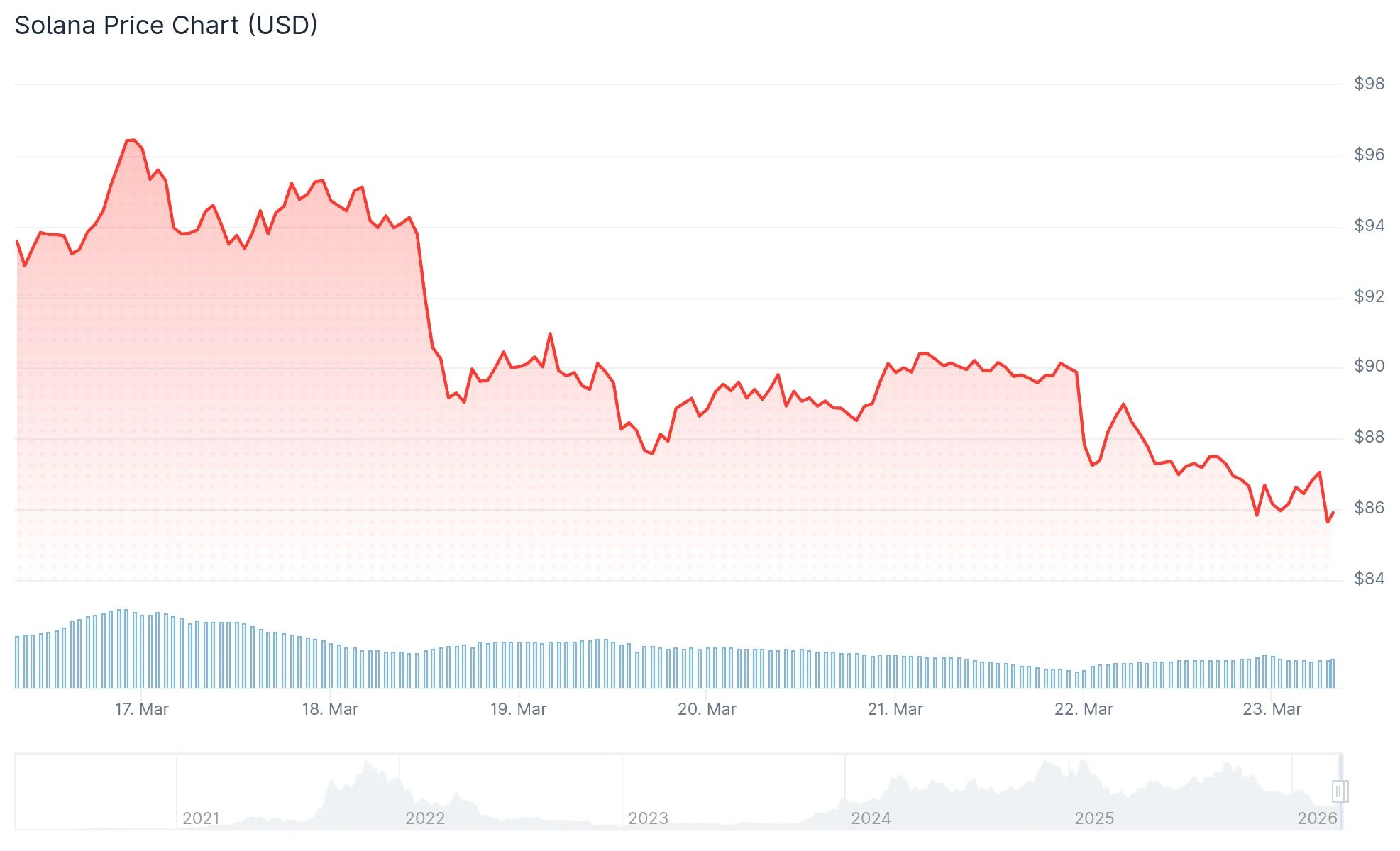
- Solana currently trades between $86 and $87, reflecting a roughly 7% decline across the last seven days
- On March 17, 2026, the SEC and CFTC jointly unveiled a comprehensive crypto token classification system
- Rising US-Iran geopolitical friction has dampened investor appetite for higher-risk digital assets
- Investment flows into Solana ETF products totaled between $21 million and $26 million last week, extending a six-week streak of positive inflows
- Critical support is positioned around $85; bulls need to reclaim $90 before challenging the $100 threshold
Solana (SOL) is currently changing hands near the $86–$87 range at press time, wrapping up a challenging trading week that saw the digital asset lose approximately 7% in value. This pullback aligns with broader cryptocurrency market weakness, as the aggregate market cap has retreated to roughly $2.36 trillion.
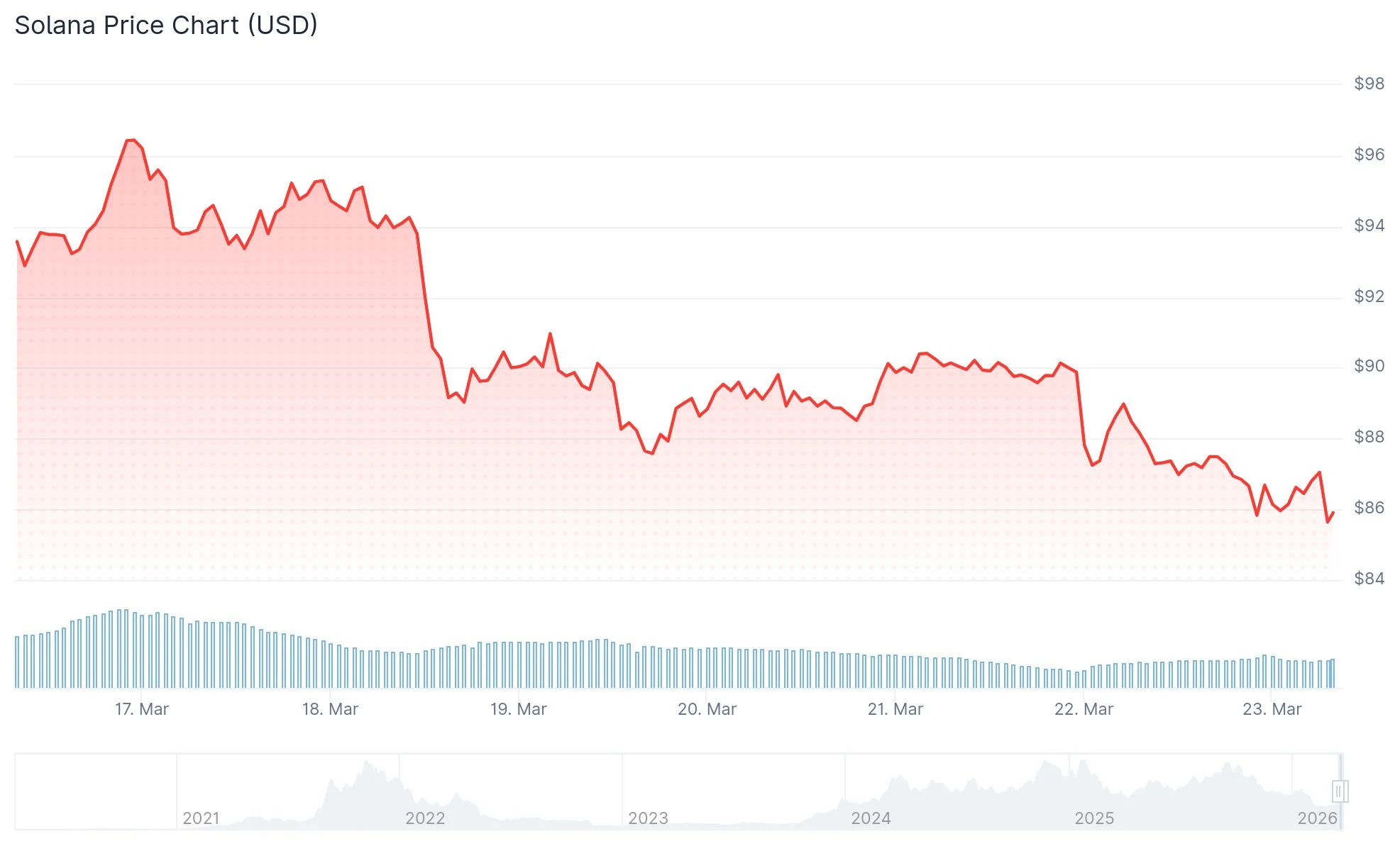
Bitcoin dropped beneath the $67,360 threshold over the weekend, sparking a cascade of liquidations throughout digital asset markets. Solana has experienced similar downward pressure during this period.
Growing geopolitical uncertainty continues to dampen market confidence. President Donald Trump posted on Truth Social: “PEACE THROUGH STRENGTH, TO PUT IT MILDLY!!!” — signaling heightened tensions with Iran.
Iranian officials warned they would target energy and water systems across Gulf states should Trump execute his stated plan to strike Iran’s electrical grid within a 48-hour window. These escalating threats have prompted investors to retreat from higher-risk asset classes.
Clearer Regulatory Framework Emerges
The SEC and CFTC released a collaborative interpretation document on March 17, 2026, establishing how existing securities regulations apply to cryptocurrency tokens. The framework introduces five distinct classifications: digital commodities, digital collectibles, digital tools, stablecoins, and digital securities.
Regulatory authorities emphasized that digital commodities, collectibles, and tools do not inherently qualify as securities under federal law. That said, they cautioned that specific promotional activities or organizational frameworks could alter this designation.
Solana received explicit mention in the guidance alongside Bitcoin, Ethereum, XRP, Dogecoin, and Cardano as reference examples. This interpretation represents a component of the broader SEC-CFTC coordination initiative designed to establish more transparent cryptocurrency regulation across the United States.
Market analyst Ali Charts shared data on X (previously known as Twitter) on March 22, stating: “11.80 million Solana $SOL have been withdrawn from crypto exchanges over the last 96 hours.” Withdrawals at this magnitude typically suggest investors are transferring holdings into cold storage wallets rather than positioning for immediate sales.
Strong Institutional Appetite Persists
Despite recent price weakness, professional investor interest in Solana remains robust. Exchange-traded products focused on SOL attracted approximately $21 million to $26 million in net capital last week, representing the sixth straight week of positive flows based on SoSoValue tracking data.

Aggregate net capital flowing into Solana-linked investment vehicles has now reached $989.78 million since product launches began. Additionally, the total value locked within real-world asset protocols built on Solana climbed to an all-time high of $465 million this quarter.
Nonetheless, futures open interest on Binance has experienced steady contraction since mid-January, falling to $871.40 million as of Monday. Funding rates shifted into negative territory during the weekend session, registering -0.0011% on Monday—indicating that short sellers currently outnumber long position holders.
From a technical standpoint, SOL continues trading beneath the $90 resistance threshold. The Relative Strength Index hovers between 38 and 46 across various timeframes, reflecting subdued buying momentum. The MACD indicator persists in bearish territory.
The primary support level sits at $85. Should this floor fail, the next downside objective emerges at $80. Conversely, a sustained breakout above $90 would establish the foundation for an advance toward the $100 psychological level.


Boyaa Interactive International, a Hong Kong-listed Web3 gaming firm, plans to expand its crypto treasury with up to $70 million in new purchases. The company will seek shareholder approval for the move, which comes as firms reassess crypto treasury strategies during a market downturn.
Summary
- Boyaa plans $70M crypto purchases, focusing on Bitcoin and Ether during market weakness periods.
- Firm holds $285M in crypto, ranking among top corporate Bitcoin treasury holders globally today.
- Strategy contrasts market trend as firms reduce exposure while Boyaa expands during crypto downturn.
Boyaa stated that it intends to deploy up to $70 million over the next year to grow its crypto holdings. The company said it aims to use “idle cash reserves during periods of weakness in the cryptocurrency market” to increase exposure. This approach focuses on buying during market dips rather than chasing rising prices.
The firm added that it will target assets with “good market liquidity, large market value, wide recognition on the market and relatively long-term holding value.” This suggests a preference for established cryptocurrencies such as Bitcoin and Ether rather than smaller tokens.
Boyaa already holds a large crypto treasury valued at nearly $285 million. This includes 4,091 Bitcoin worth around $280 million and 302 Ether valued at over $600,000. These holdings place the company among the top corporate Bitcoin holders globally.
The company began building its crypto position in 2024 as part of its transition into Web3 gaming. It invested $80.5 million in Bitcoin between August and November, showing a steady accumulation strategy tied to its long-term business plans.
In addition, Boyaa currently ranks as the 23rd-largest corporate Bitcoin treasury holder. It is also the third-largest in the Asia-Pacific region, behind Japan’s Metaplanet and China’s Next Technology Holding. This position reflects its growing role in the region’s digital asset space.
The expansion plan comes at a time when fewer companies are actively increasing crypto reserves. Some Bitcoin miners and firms have reduced holdings in recent months, reflecting caution across the market.
Market conditions and Web3 focus
The broader crypto market has declined by about 45% since October, creating a more cautious environment for treasury strategies. Boyaa’s plan to buy during weaker market conditions reflects a different approach compared to companies reducing exposure.
The firm continues to build its Web3 gaming ecosystem alongside its crypto investments. It has developed blockchain-based gaming products, including a Web3 version of its earlier Texas Hold’em platform that offers crypto rewards.

TLDR
- Fidelity Investments submitted formal correspondence to the SEC requesting comprehensive regulatory framework for digital asset operations by broker-dealers
- The correspondence emphasized alternative trading system (ATS) requirements for handling blockchain-based securities
- Fidelity advocates for regulatory standards enabling ATS platforms to facilitate trading of externally issued tokenized securities
- The asset manager proposed modernized reporting frameworks accommodating decentralized platform architecture
- Federal banking authorities clarified that tokenized securities maintain identical capital treatment as their traditional counterparts
Fidelity Investments has submitted a formal appeal to the United States Securities and Exchange Commission requesting enhanced regulatory clarity surrounding digital assets and blockchain-based securities. The correspondence reached the SEC’s Crypto Task Force on Friday.
The communication arrived as a direct response to SEC Commissioner Hester Peirce’s December inquiry. Peirce had solicited industry feedback regarding appropriate frameworks for national securities exchanges and alternative trading platforms managing cryptocurrency operations.
Fidelity expressed general approval of the SEC’s initiative to modernize regulatory frameworks for emerging technologies. However, the firm emphasized that significant gaps in guidance persist across multiple critical areas.
The asset management giant presented four primary policy recommendations. First among these was the continued development of regulatory standards governing broker-dealer engagement with digital assets.
Fidelity acknowledged recent SEC guidance affirming that broker-dealers possess authority to maintain custody of both crypto securities and non-security digital instruments. While recognizing this progress, the firm stressed that substantial ambiguity remains regarding trading operations and custodial protocols.
Regulatory Framework Needed for Tokenized Securities
A substantial section of Fidelity’s letter addressed tokenized securities specifically. These instruments represent traditional financial products—including equities, fixed income, real estate holdings, and private credit—that are either issued on or tracked through blockchain infrastructure.
Fidelity advocated for definitive regulatory parameters allowing ATS platforms to facilitate transactions in tokenized securities originated by third-party entities. The firm emphasized that broker-dealers require certainty in asset classification processes without assuming disproportionate legal exposure.
Additionally, the investment firm requested SEC confirmation that tokenized representations of conventional securities should maintain regulatory parity with their underlying assets. Such clarification could substantially minimize market friction between blockchain-based and traditional trading environments.
Roberto Braceras, serving as Fidelity’s general counsel, emphasized that the SEC should evaluate operational frameworks allowing centralized and decentralized trading infrastructure to coexist effectively.
Decentralized finance platforms inherently lack the centralized governance structures necessary to satisfy traditional exchange reporting obligations. Fidelity contended that existing regulatory requirements impose disproportionate compliance burdens on these alternative systems.
Blockchain Integration and Federal Banking Guidance
Fidelity additionally petitioned the SEC to authorize broker-dealers to implement blockchain infrastructure for regulatory recordkeeping purposes. The firm requested confirmation that utilizing on-chain settlement mechanisms would not subject broker-dealers to clearing agency regulatory obligations.
SEC Chairman Paul Atkins has demonstrated openness toward continuous capital market operations and has permitted financial institutions to pilot tokenized trading initiatives.
In a separate but related development, three federal banking regulators issued a coordinated statement in March. The Federal Reserve Board, the Federal Deposit Insurance Corporation, and the Office of the Comptroller of the Currency jointly declared that tokenized securities remain subject to capital requirements identical to the assets they represent.
The regulatory agencies clarified that the technological infrastructure employed for security issuance or trading does not modify capital treatment classifications.
Commissioner Peirce has actively encouraged organizations pursuing tokenization strategies to maintain direct dialogue with regulatory bodies, representing a notable departure from previous enforcement-focused regulatory approaches.
Crypto World
Cardano (ADA) Price Analysis: Bearish Momentum Meets Rare Bullish Signal Amid Market Turbulence
Key Takeaways
- Cardano is currently exchanging hands around $0.25 following a weekly decline exceeding 7%, testing critical support zones
- Geopolitical tensions between the United States and Iran have triggered risk-off sentiment throughout cryptocurrency markets, impacting Bitcoin and ADA
- Open interest in ADA futures contracts has declined consistently since the middle of March, while funding rates have shifted into negative territory, signaling bearish positioning
- A distinctive “Black 9” buy indication from the TD Sequential methodology emerged on Cardano’s weekly timeframe March 21, projecting potential targets of $0.32 and $0.37 upon validation
- Both the SEC and CFTC designated ADA as a “digital commodity” on March 17, providing enhanced regulatory framework
Cardano (ADA) faces mounting downward pressure. The digital asset experienced a decline exceeding 7% during the past week and currently trades in the vicinity of $0.25, positioned near critical support thresholds. The convergence of international geopolitical instability, deteriorating futures market indicators, and widespread cryptocurrency market weakness is fueling the pessimistic sentiment.
Rising hostilities between the United States and Iran have created uncertainty among market participants. During the weekend, US President Donald Trump issued threats to attack Iran’s electrical infrastructure within a 48-hour window. Tehran countered with warnings that it would retaliate by targeting energy infrastructure and water facilities across Gulf region allies if subjected to military action. This diplomatic escalation prompted investors to retreat from higher-risk asset classes.
Bitcoin settled underneath $67,360 during Sunday’s session, catalyzing liquidation cascades throughout digital asset markets. Cardano mirrored this movement, concluding the weekend session around $0.25 and maintaining defensive trading patterns into Monday.
Futures Market Indicators Signal Bearish Positioning
Open interest in Cardano futures contracts decreased to $388.23 million as of Monday. This metric has experienced consistent deterioration since the middle of March, indicating reduced trader participation and conviction.
Funding rates have similarly shifted into bearish territory. Data from CoinGlass reveals ADA’s funding rate reached -0.019% on Monday, indicating short position holders are compensating long position holders. This dynamic generally indicates market positioning skewed toward downside expectations.
From a technical perspective, Cardano is positioned significantly beneath both its 50-day and 100-day Exponential Moving Averages, currently located around $0.28 and $0.33 respectively. The Relative Strength Index registers at 41, positioned below neutral territory though not reaching oversold extremes. The MACD histogram has crossed beneath the signal line once more, indicating deteriorating upward momentum.
Near-term resistance is established at $0.27, with more substantial resistance concentrated around $0.30. A daily candle close surpassing $0.30 would begin alleviating bearish momentum. Conversely, support is positioned at $0.24, with a substantial foundation at $0.22. Penetration below $0.22 would likely accelerate the downtrend.
Constructive Developments Provide Counterbalance
Despite prevailing headwinds, several positive factors are developing. On March 21, cryptocurrency analyst Ali Martinez identified an uncommon “Black 9” buy indication on Cardano’s weekly chart utilizing the TD Sequential technical framework. This signal implies exhaustion of selling momentum may be approaching. Confirmation requires ADA to conclude the weekly period above $0.23. Projected upside objectives from this formation are located at $0.32 and $0.37.
Cardano $ADA has printed a buy signal!
The TD Sequential indicator has flashed a “black 9” on the weekly chart, suggesting the recent downtrend has exhausted. This setup typically anticipates 1–4 weeks of upward expansion.
The Blueprint:
• Validation: ADA must hold the $0.23… pic.twitter.com/FrhVV8N7Um
— Ali Charts (@alicharts) March 20, 2026
Cardano’s development organization also unveiled Node version 10.7.0, a significant upgrade that establishes infrastructure for upcoming protocol enhancements. The release incorporates advances to Plutus, Cardano’s smart contract framework, through multiple Cardano Improvement Proposals designed to optimize execution performance.
On March 17, the Securities and Exchange Commission and Commodity Futures Trading Commission collaboratively designated ADA as a “digital commodity,” furnishing developers and financial institutions with greater regulatory certainty for US-based operations.
The Midnight privacy-focused sidechain, constructed by Input Output Global, is anticipated to deploy on mainnet during the current week.

Bithumb, South Korea’s second-largest cryptocurrency exchange by trading volume, is pressing to reappoint CEO Lee Jae-won at its upcoming shareholders’ meeting on March 31, industry sources told the Korea Times. If shareholders approve, Lee would extend his tenure for another two years, with his current term set to expire at the end of March. Cointelegraph has sought comment from Bithumb but has not received a response at the time of writing.
The proposed renewal comes amid heightened regulatory scrutiny and a series of penalties that have tightened the exchange’s operating flexibility. In March, South Korea’s Financial Intelligence Unit levied a six-month partial suspension and a 36.8 billion won ($24.2 million) fine over alleged anti-money-laundering shortcomings. Under the sanctions, Bithumb is barred from processing external crypto transfers for new customers from March 27 to Sept. 26.
These pressures follow a February incident in which Bithumb mistakenly credited 2,000 BTC per user during a promotional payout instead of 2,000 won per user, distributing around 620,000 coins that the exchange subsequently could not back. The episode drew attention to governance and risk controls at the firm and added weight to ongoing regulatory scrutiny.
The Korea Times notes that Bithumb is also awaiting the outcome of investigations into its order-book sharing with an overseas platform, with further penalties possible and potentially complicating license renewals. Industry officials cited by the Times warned that Bithumb remains highly sensitive to the regulatory clock as it seeks renewal of its virtual asset service provider (VASP) license.
Key takeaways
- Bithumb aims to reappoint CEO Lee Jae-won at the March 31 shareholders’ meeting, potentially extending his tenure by two years if approved. Source: Korea Times.
- Regulatory actions penalized Bithumb with a six‑month partial suspension and a 36.8 billion won fine for AML shortcomings, plus a ban on external transfers for new customers (Mar 27–Sept 26).
- A February payout mishap credited 2,000 BTC per user instead of 2,000 won, distributing about 620,000 coins that could not be backed.
- Ongoing probes into order-book sharing with an overseas platform or other regulatory measures could threaten license renewal and operations.
- South Korea’s crypto market context remains supportive of growth, with Upbit leading in daily volume and a broader push toward clearer crypto regulation and the potential legalization of stablecoins.
Regulatory penalties and ongoing probes
The March penalties tallied to a substantial financial and operational impact on Bithumb. The six-month partial suspension and the 36.8 billion won fine came as regulators stepped up enforcement around AML controls, a theme that has reappeared in other exchanges’ compliance reviews. In addition to the funding penalty, Bithumb faces a prohibition on onboarding new customers’ external transfers for a six-month window, creating a temporary liquidity and onboarding bottleneck that could affect growth momentum.
The February mispayment incident amplified concerns about risk controls and operational resilience. By crediting 2,000 BTC per user rather than 2,000 won per user during a promo, Bithumb distributed a large, unbacked balance, underscoring governance challenges that authorities are likely to scrutinize closely as part of license-renewal proceedings.
Industry watchers cited by the Korea Times emphasized that the license renewal process remains a pivotal hinge for Bithumb’s near-term prospects. The regulator’s appetite for enforcement could influence not only Bithumb’s ability to operate but also the competitive dynamics among major Korean exchanges as the country’s crypto framework evolves.
Leadership renewal and market positioning
The proposed reappointment of Lee Jae-won signals a continuity plan at a time when regulatory risk is a material consideration for investors and operators. If endorsed by shareholders, Lee’s new two-year term would extend leadership through a period of heightened oversight, with the possibility of further policy adjustments by regulators that could shape Bithumb’s compliance posture and product strategy.
Market observers note that Bithumb remains a significant player in the domestic ecosystem even as it navigates penalties and investigations. Upbit continues to hold the top spot in 24-hour trading volume, followed by Bithumb and Korbit, according to CoinGecko figures. This ranking underscores Bithumb’s continued relevance in a crowded and competitive market and suggests that any regulatory disruptions could reverberate across major platforms.
As this unfolds, Cointelegraph contacted Bithumb for comment, but the exchange did not provide a statement at press time. The ongoing probes and the licensing process will be central to determining how quickly the firm can resume normal operations and whether the penalties portend broader changes to its business model or governance framework.
South Korea’s evolving crypto landscape
The regulatory and policy backdrop in South Korea has gradually shifted toward a more constructive stance for the crypto sector. The election of President Lee Jae-myung in mid-2022 catalyzed a push for crypto-friendly legislation, including a bill to legalize stablecoins and a broader regulatory roadmap intended to foster legitimate use and innovation while tightening compliance standards. In parallel, the user base for crypto services in Korea has continued to expand, with CoinGecko data showing exchanges like Upbit, Bithumb, and Korbit competing for liquidity and market share. By late last year, Korean crypto users surpassed 16 million, reflecting growing mainstream engagement.
Industry analysts also point to the domestic market’s potential to generate substantial revenue. Statista’s outlook for 2026 estimates the South Korean crypto sector could reach about $1.3 billion in revenue, highlighting the sector’s importance to the broader economy and the opportunity set for exchanges and infrastructure providers alike. The regulatory trajectory, combined with a rising user base and a public policy push toward clarity on stablecoins, sets the stage for continued evolution in Korea’s crypto scene.
For investors and builders, the key question remains: will Bithumb’s leadership renewal and the outcome of regulatory reviews stabilize the exchange’s path or signal a longer pause until a clearer compliance regime emerges? Markets will be watching not only the license decision but also how regulators and the exchange navigate AML improvements and governance reforms in the months ahead.
Readers should keep an eye on March 31, the date of the shareholder meeting, and on forthcoming regulatory updates regarding Bithumb’s VASP license and ongoing probes, as these developments will likely shape the competitive dynamics and regulatory expectations for Korea’s crypto sector in 2026.

If you’ve spent more than five minutes in DeFi, you’ve seen it:
“Earn 120% APY.”
“Stake now for 300% returns.”
Sounds amazing… until you realize your “yield” is denominated in a token that’s down 80% in a month.
Let’s be blunt:
Most DeFi yield isn’t yield. It’s marketing.
The Illusion: Token Emissions ≠ Yield
The majority of DeFi protocols bootstrap growth the same way:
>They print tokens.
>They hand them out as rewards.
>They call it “yield.”
This is known as token emissions.
Here’s the problem:
- No actual economic value is being created
- Rewards come from inflation, not profit
- Early users get paid with the dilution of later users
It’s like a startup paying dividends… by printing more shares out of thin air.
You’re not earning. You’re being subsidized
Ponzinomics (Yes, That Word)
Let’s not sugarcoat it.
When a protocol:
- Relies on constant new users
- Pays old users with newly minted tokens
- Has no real revenue stream
…it starts to resemble a Ponzi-like structure.
Now, not all emission-based systems are scams—but many are unsustainable by design.
Why?
Because eventually:
- Token supply inflates
- Sell pressure increases
- Price collapses
- “Yield” evaporates
And suddenly that 200% APY becomes -70% portfolio performance.
What Real Yield Actually Looks Like
Real yield doesn’t come from thin air.
It comes from cash flow.
In traditional finance, yield is generated by:
- Business profits
- Interest payments
- Dividends backed by earnings
DeFi has equivalents—but they’re often overlooked.
✅ Real Yield Sources in DeFi:
- Trading fees (DEXs like Uniswap-style platforms)
- Borrowing interest (lending protocols)
- Liquidation fees
- Protocol revenue sharing
If users are paying to use the protocol, and you’re earning a cut of that…
👉 That’s real yield.
Metrics That Actually Matter
If you want to separate signal from noise, ignore the APY headline.
Look at these instead:
1. Protocol Revenue
How much real income is being generated?
If it’s zero… your yield probably is too (eventually).
2. Fee-to-Emission Ratio
Compare:
- Fees earned
vs - Tokens emitted as rewards
If emissions dwarf fees, you’re in a subsidy phase—not a sustainable system.
3. Token Utility
Ask:
- Does the token capture value?
- Or is it just a reward farm dump token?
If the only reason to hold it is to farm more of it.
Net Cash Flow to Users
Are users being paid from:
- Real usage? ✅
- Or inflation? ❌
This is the single most important distinction.
The Trade-Off Nobody Talks About
Here’s the uncomfortable truth:
- Fake yield is high, fast, and temporary
- Real yield is lower, slower, and sustainable
DeFi users often chase the former… then complain when it collapses.
It’s the classic:
“I want 100% APY… but I also want it to be safe.”
Pick one.
A Smarter Way to Think About Yield
Instead of asking:
“What’s the APY?”
Start asking:
- Where does this yield come from?
- Who is paying for it?
- Would this still exist without token emissions?
If the answer is “no”…
You’re not investing.
You’re participating in a distribution schedule.
Final Take
DeFi isn’t broken.
But its incentives often are.
The space is maturing, and we’re slowly shifting from:
- Emissions-driven hype
➡️ to - Revenue-driven sustainability
The next wave of winners won’t be the protocols offering the highest APY…
They’ll be the ones generating real, durable cash flow.
And ironically?
They’ll probably look “boring” compared to the 300% farms.
Boring might finally be profitable.
REQUEST AN ARTICLE
Key Takeaways
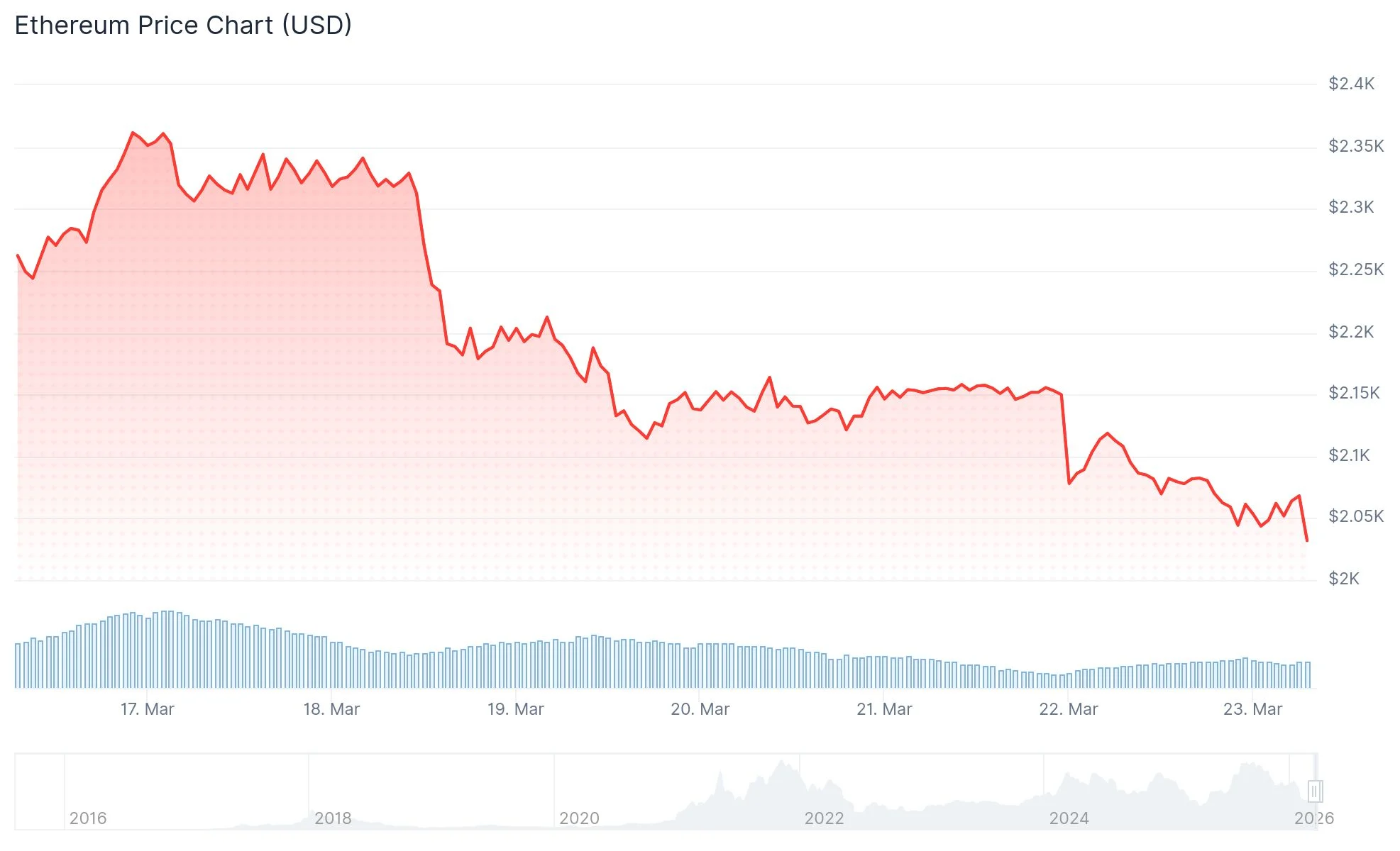
- Ethereum declined from $2,220 to a session low of $2,025, currently consolidating between $2,020 and $2,100
- Dual bearish trend lines present resistance levels at $2,120 and $2,165 on the hourly chart
- Upside breakout above $2,165 may target $2,200–$2,300; downside breach of $2,025 could accelerate decline toward $2,000
- Weekly net outflows from Ethereum spot ETFs totaled $59.94 million, with BlackRock’s ETHA recording $69.59 million in redemptions
- Cumulative net assets in Ethereum spot ETFs now total $12.33 billion, representing 4.79% of ETH’s market capitalization
Ethereum experienced a significant pullback during the last 24 hours, tumbling from approximately $2,385 down to touch $2,025. Currently, ETH is changing hands below the $2,100 mark and remains beneath its 100-hourly Simple Moving Average.
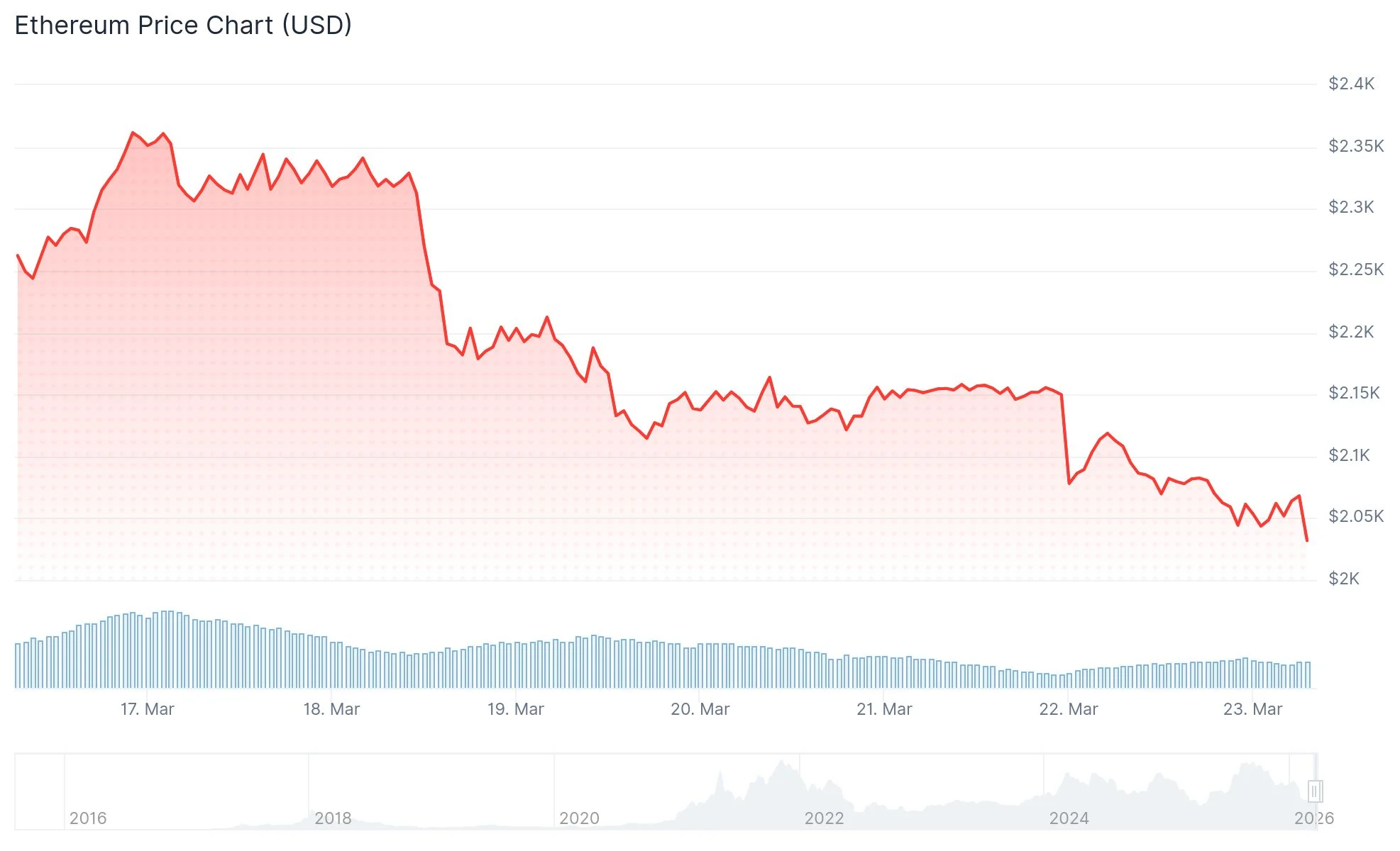
The downward momentum initiated when ETH couldn’t maintain levels above $2,220. Subsequently, the cryptocurrency breached support at $2,150 and $2,120, momentarily dipping beneath $2,050.
Currently, ETH is attempting to stabilize below the 23.6% Fibonacci retracement level, measured from the swing high of $2,385 down to the recent low of $2,025. Technical analysis reveals two descending trend lines on the hourly timeframe, establishing resistance zones at $2,120 and $2,165.
The immediate resistance barrier stands at $2,120, which coincides with the 100-hourly Simple Moving Average. Breaking through this level would bring $2,165 into focus as the subsequent obstacle.
Should Ethereum successfully clear $2,165, the 50% Fibonacci retracement level around $2,200 becomes the next target. Momentum beyond this area could potentially drive prices toward $2,250 or even $2,300.
Critical Support Zones Under Watch
Looking at downside scenarios, immediate support is established around $2,040. Beneath this level, $2,025 represents the primary support floor.
A decisive breakdown below $2,025 would shift attention to the psychological $2,000 threshold. Additional selling pressure could expose $1,965, with $1,880 serving as a more substantial support zone.
Market technician Ted Pillows shared his perspective on X, identifying a potential head and shoulders formation in ETH. His analysis stated: “$ETH seems to be forming head and shoulder pattern. If Ethereum loses the $2,040 level, expect a massive dump.”
Institutional Outflows Compound Bearish Sentiment
Ethereum spot ETF products experienced aggregate net outflows of $59.94 million during the trading week spanning March 16 through March 20, based on SoSoValue data shared by PANews on March 23.
BlackRock’s ETHA product dominated outflows, recording $69.59 million in net redemptions during the period. Despite this weekly exodus, ETHA maintains a cumulative historical net inflow of $11.91 billion.
Fidelity’s FETH product experienced $61.62 million in withdrawals throughout the same timeframe. The fund’s lifetime total net inflow remains at $2.32 billion.
The Grayscale Ethereum Mini Trust (ETH) stood as the sole product registering positive flows last week, attracting $6.87 million in new investments. This brings its cumulative historical net inflow to $1.85 billion.
As of March 23, aggregate net assets across all Ethereum spot ETF products total $12.33 billion, accounting for 4.79% of Ethereum’s overall market capitalization. The combined historical net inflow across the entire ETF ecosystem stands at $11.73 billion.
Crypto World
Bitcoin and Ethereum ETF Options Trading Unlocked as Final U.S. Exchanges Drop Contract Limits
Key Takeaways
- NYSE Arca and NYSE American eliminated the 25,000-contract restriction on options for 11 cryptocurrency ETFs
- SEC approval came with an expedited implementation timeline, bypassing the typical 30-day review window
- Impacted products include ETFs from BlackRock (IBIT), Fidelity (FBTC), ARK 21Shares, Grayscale, and Bitwise
- Cryptocurrency ETF options now qualify for FLEX trading with customizable contract specifications
- All primary U.S. options trading venues have now eliminated these restrictions
NYSE Arca and NYSE American submitted regulatory amendments to the Securities and Exchange Commission eliminating the 25,000-contract restriction on options contracts linked to 11 Bitcoin and Ether exchange-traded funds. The SEC granted an expedited approval, bypassing the typical 30-day implementation window and allowing immediate effectiveness.
The 25,000-contract restriction was originally implemented in November 2024 during the initial launch of cryptocurrency ETF options trading. Regulators established this threshold as a protective measure aimed at preventing excessive market manipulation and limiting volatility exposure.
The regulatory modifications apply to 11 distinct cryptocurrency ETF offerings. The roster includes BlackRock’s iShares Bitcoin Trust, Fidelity’s Wise Origin Bitcoin Fund, ARK 21Shares Bitcoin ETF, Grayscale’s Bitcoin and Ethereum trust products, and Bitwise’s Bitcoin and Ethereum exchange-traded funds.
Eliminating the restriction aligns cryptocurrency ETF options with existing regulatory treatment of commodity-based ETF derivatives at major trading venues. Options contracts on substantial, highly-liquid ETFs can now achieve position thresholds of 250,000 contracts or higher under conventional exchange protocols.
The amendments additionally authorize these investment vehicles to operate as FLEX options products. FLEX options provide market participants the ability to negotiate bespoke contract specifications, encompassing non-conventional strike prices, maturity dates, and exercise mechanisms.
During IBIT’s inaugural options trading session in November 2024, Bloomberg senior ETF analyst Eric Balchunas observed the product generated approximately $1.9 billion in notional value despite operating under the contract restriction.
In October 2024, Kbit CEO Ed Tolson commented that the restriction wasn’t excessively limiting considering the $40 billion in Bitcoin open interest spanning futures and perpetual swap markets during that period. However, market participants viewed the limitation as inconsistent with treatment of comparable commodity ETF products.
Coordinated Exchange Transition Reaches Completion
Several trading platforms had previously taken action to eliminate the restriction ahead of NYSE’s decision. Nasdaq ISE and Nasdaq PHLX submitted regulatory filings to remove limitations in January. MIAX pursued identical measures during the same timeframe. MEMX submitted its proposal in February. Cboe filed its corresponding version in March.
With NYSE Arca and NYSE American finalizing their regulatory submissions, every significant U.S. options trading platform has now removed the restriction.
The SEC acknowledged the proposals present no novel regulatory challenges, referencing the identical modifications already operational at competing exchanges.
Institutional Trading Implications
Eliminating the position restriction enables institutional market participants to implement more sophisticated hedging approaches, basis trading strategies, and portfolio overlay frameworks. Availability of FLEX options permits institutions to structure customized contract specifications for complex derivative products.
This operational flexibility existed previously for comparable commodity ETF products such as the SPDR Gold Trust and iShares Silver Trust, but remained unavailable for cryptocurrency ETF options until this development.
In a separate regulatory matter, Nasdaq ISE has submitted a pending proposal to elevate the position threshold exclusively for BlackRock’s IBIT to 1 million contracts. The SEC continues evaluating that submission, which has undergone five amendments to date. The public comment window for both NYSE regulatory filings concludes on April 13.
Bithumb, South Korea’s second-largest cryptocurrency exchange by trading volume, is reportedly seeking to reappoint CEO Lee Jae-won despite recent alleged anti-money laundering failures and other controversies, according to the Korea Times.
The exchange will convene its regular shareholders’ meeting on March 31, and a proposal to keep Lee in the top job will be put to shareholders, the Korea Times reported on Sunday, citing industry sources.
His current term expires at the end of the month, and a successful renewal would keep Lee as the exchange’s CEO for another two years. Cointelegraph has contacted Bithumb for comment.
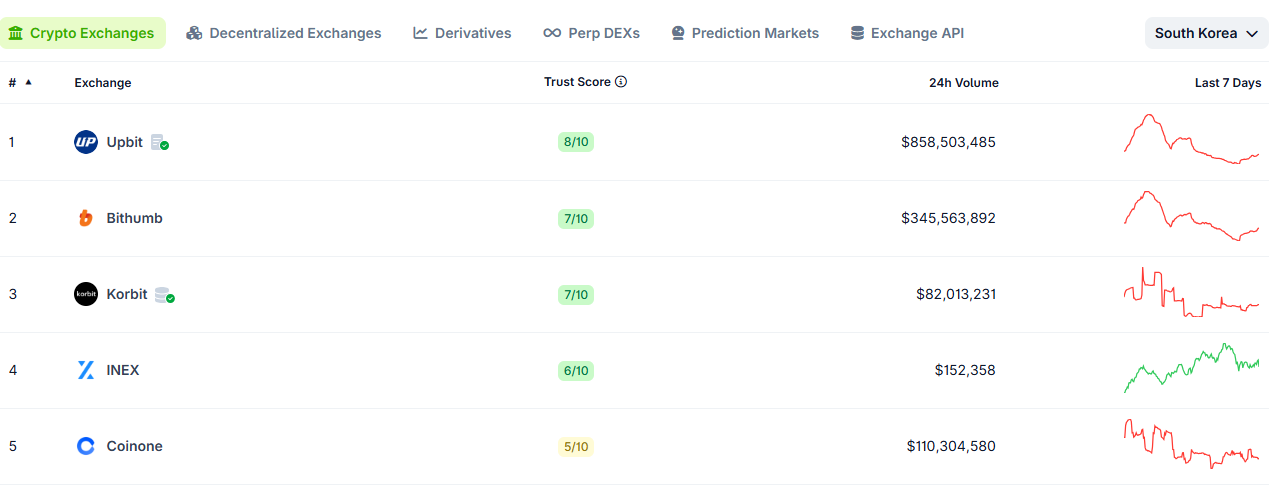
Upbit is the top South Korean crypto exchange by 24-hour trading volume, according to CoinGecko, followed by Bithumb and Korbit.

Regulators hit Bithumb with penalties
In March, South Korea’s Financial Intelligence Unit reportedly issued Bithumb a six-month partial suspension and a 36.8 billion won ($24.2 million) fine over alleged anti-money laundering failures.
Under the measures, the exchange will be banned from processing external crypto transfers for new customers from March 27 to Sept. 26.
The exchange also drew regulatory attention in February when it mistakenly credited 2,000 Bitcoin (BTC) per user instead of 2,000 Korean won ($1.40) during a promotional event, distributing a total of 620,000 coins that it couldn’t back up.
Bithumb is also awaiting the outcome of another probe into its order book sharing with an overseas platform and more penalties could pose a hurdle to license renewals, according to the Korea Times.
“Bithumb will be on edge awaiting the results of ongoing regulatory probes, as the company still needs to renew its virtual asset service provider license,” an industry official told the Korea Times.
Related: South Korea moves to cap crypto exchange shareholder stakes at 20%: Report
South Korean crypto industry is rising
The crypto industry in South Korea has benefited from a friendlier environment after the election of President Lee Jae-myung in June last year, who has pushed forward with various crypto-related laws, including a bill to legalize stablecoins.
Three months earlier, crypto exchange users in South Korea surpassed 16 million, representing more than 30% of the country’s population.
The cryptocurrency market in South Korea is projected to reach $1.3 billion in revenue in 2026, according to online data platform Statista.
Magazine: China’s ‘50x’ blockchain boost, Alibaba-linked AI mines Bitcoin: Asia Express
GSK lung cancer drug receives orphan status in Japan

Dogecoin (DOGE) Price Poised for 350% Breakout, Technical Patterns Suggest

Karen Hauer Quits Strictly Come Dancing After 14 Seasons


-

 Fashion3 days ago
Weekend Open Thread: Adidas – Corporette.com
-

 Politics3 days ago
Jenni Murray, Long-Serving Woman’s Hour Presenter, Dies Aged 75
-
 Crypto World2 days ago
NIO (NIO) Stock Plunges 6.5% as Shelf Registration Sparks Dilution Worries
-
 Tech6 days ago
Are Split Spacebars the Next Big Gaming Keyboard Trend?
-

 Crypto World1 day ago
Best Crypto to Buy Now: Strategy Just Spent $1.57 Billion on Bitcoin During Fear While Early Investors Quietly Enter Pepeto for 150x Potential
-

 News Videos5 days ago
RBA board divided on rate cut, unusually buoyant share market | Finance Report | ABC NEWS
-

 Crypto World1 day ago
Bitcoin Price News: Bhutan Sells $72 Million in BTC Under Fiscal Pressure, but the Smart Money Entering Pepeto Sees What the Market Does Not
-

 Business7 days ago
Australian shares drop as Iran war enters third week
-

 Crypto World7 days ago
Crypto Lender BlockFills Enters Chapter 11 with Up to $500M in Liabilities
-

 Politics5 days ago
The House | The new register to protect children from their abusers shows Parliament at its best
-

 Fashion7 days ago
25 Celebrities with Curly Hair That Are Naturally Beautiful
-

 Tech3 days ago
inKONBINI Lets You Spend Summer Days Behind the Register
-
 Politics6 days ago
Real-time pollution monitoring calls after boy nearly dies
-

 Crypto World5 days ago
Canada’s FINTRAC revokes registrations of 23 crypto MSBs in AML crackdown
-
 NewsBeat4 days ago
Residents in North Lanarkshire reminded to register to vote in Scottish Parliament Election
-

 Business7 days ago
Meta planning major layoffs as AI spending and automation reshape workforce
-

 News Videos5 days ago
PARLIAMENT OF MALAWI – PAC MEETING WITH REGISTRAR OF FINANCIAL ON AMARYLLIS HOTEL – INQUIRY LIVE
-

 Business16 hours ago
No Winner in March 21 Drawing as Prize Rolls to $133 Million for Next
-

 Politics4 days ago
Gender equality discussions at UN face pushbacks and US resistance
-
Entertainment7 days ago
Oscars reunite Rob Reiner supergroup of 17 stars for emotional tribute: Here's who appeared on stage
You must be logged in to post a comment Login