

Crypto World
Balancer Labs shuts down after hack and revenue strain



Balancer Labs is preparing to shut down as the team behind the DeFi protocol moves to cut costs after months of financial strain. The plan would leave the protocol running under a leaner structure led by the Balancer Foundation and the DAO while the corporate entity winds down.
Summary
- Balancer Labs will shut down as the protocol shifts toward DAO and foundation management.
- The November hack and falling TVL increased financial pressure across the Balancer ecosystem.
- Executives want lower costs, zero BAL emissions, and more revenue flowing to the DAO.
Balancer co-founder Fernando Martinelli said he had decided to wind down Balancer Labs after reviewing the project’s position. He said the company had become a “liability rather than an asset to the protocol” and linked that decision to legal exposure tied to the November 2025 exploit.
Balancer Labs chief executive Marcus Hardt also said the business was spending too much to attract liquidity compared with the revenue the protocol was generating. He said that approach came with dilution for BAL token holders and could not continue in its current form.
Balancer was one of the better-known DeFi protocols during the 2020 and 2021 market cycle. Its total value locked reached about $3.3 billion in November 2021 before falling sharply over the following years.
The pressure increased after the November 2025 exploit, which reports said totaled more than $100 million. Balancer’s TVL had already dropped to about $800 million by October 2025, then fell by another $500 million in thetwo weeks after the hack. Recent reporting placed the protocol’s TVL near $158 million.
Furthermore, Hardt and Martinelli said they want the Balancer Foundation and the DAO to guide the protocol from here. Their plan calls for a lean continuation model with lower operating costs and fewer people involved in day-to-day work.
Martinelli also backed changes to tokenomics and treasury flow. Those include cutting BAL emissions to zero and adjusting fees so the DAO can keep more of the revenue generated by the protocol. DAO members have been asked to vote on proposals tied to the restructuring and BAL token design.
Protocol revenue remains part of the case
Even with the current pressure, Martinelli said Balancer is still producing revenue. He said the protocol brought in more than $1 million over the past three months and described it as a working system weighed down by weak economics and a heavy cost base.
That position now forms the core of the restructuring push. The protocol is expected to continue operating, but under a smaller and less expensive setup built around the DAO and foundation rather than Balancer Labs.

Sui’s native cryptocurrency has outperformed all top 10 digital assets over the past week after its valuation surged by double digits.
While optimism is running high on crypto X that the uptrend is far from over, some technical indicators suggest that a downside move could also be approaching.
What Sparked the Rally?
Several hours ago, SUI briefly pushed above $1.40, marking its highest level since January. The bears, though, quickly stepped in and trimmed part of the gains, bringing the price back to around $1.27 – still an impressive 35% jump on the week. SUI’s market capitalization surged past the $5 billion milestone, making it the 23rd-biggest cryptocurrency.
The main catalyst behind the upswing seems to be Sui Group Holdings’ decision to stake 108.7 million SUI tokens (worth over $140 million), thus removing almost 3% of the coin’s circulating supply from the market.
The analytics platform Santiment Intelligence added two more factors that could have also positively impacted the valuation. The first is the upcoming launch of CME Group SUI futures (scheduled for May 29) and the partnership with Paga, which focuses on cross-border African payments.
Paga is a leading settlement platform that allows millions of people to send, receive, and manage money across Africa. The collaboration with Sui aims to bring the Sui Dollar (USDsui) to the continent, giving users access to faster, cheaper, and more reliable digital payments.
Numerous analysts believe the asset’s valuation may reach new peaks soon. X user OxNeena noted the “massive breakout attempt” on the daily chart, envisioning an explosion above $2.50 should the price make a “clean flip” of the $1.30 zone.
For their part, CoinForge said they dismiss 98% of altcoins, but SUI isn’t among those. They argued that the asset’s price trajectory repeats the pattern seen last cycle, suggesting it could be gearing up for a major bull run in the coming months.
The Pre-Correction Signs
Contrary to the prevailing optimism among market observers, SUI’s Relative Strength Index (RSI) suggests a pullback may be the next move in the short term. The technical analysis tool measures the speed and magnitude of recent price changes and is used by traders to spot potential price reversal points.
It ranges from 0 to 100, where anything above 70 signals that the valuation has risen too much in a short period, which could be a precursor to a cool-off. Conversely, ratios below 30 hint that the asset is oversold and could be on the verge of a pump. Currently, SUI’s RSI stands at nearly 75.

In the meantime, exchange inflows have outpaced outflows over the past few days, indicating that investors have abandoned self-custody in favor of centralized platforms. This, in turn, increases the immediate selling pressure.

The post Sui (SUI) Soars 35% Weekly: What Fueled the Pump and What’s Next? appeared first on CryptoPotato.
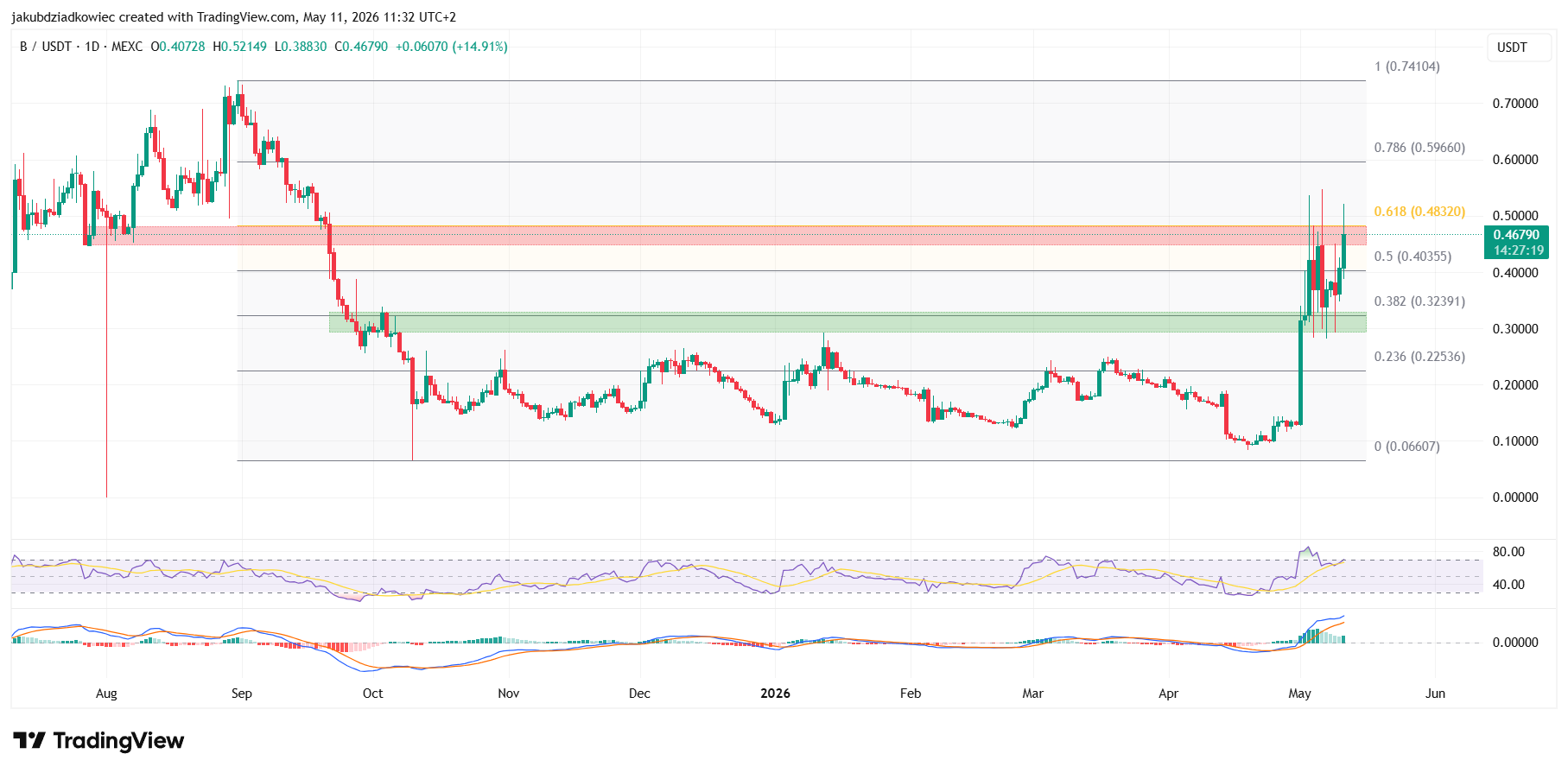
The top 3 meme coins on the weekly radar split into very different technical paths. BUILDon (B) extends a breakout, MemeCore (M) loses key support, and Siren (SIREN) coils below a descending trendline that has capped price since March.
Daily charts show BUILDon pressing the 0.618 Fibonacci level at $0.48, MemeCore correcting toward $3.27 after rejection near $4, and SIREN testing the 0.786 Fibonacci retracement at $1.07 with expanding volatility.
BUILDon (B) Bulls Press the $0.48 Resistance for a Third Time
BUILDon trades close to $0.4679 after a 14.91% daily gain, with intraday highs near $0.52 and lows at $0.38. The coin spent months inside a wide accumulation zone between $0.09 and $0.30 that reached back to September 2025.
Price broke out of that range on May 1 and confirmed the 0.382 Fibonacci retracement at $0.32 as fresh support. However, the 0.618 level at $0.48 has rejected B on three separate attempts so far in May.

The Relative Strength Index (RSI) sits close to 70, deep inside bullish territory. Meanwhile, the Moving Average Convergence Divergence (MACD) prints another taller green histogram bar after a short pause, which signals renewed upside momentum.
A confirmed daily close above $0.48 would open a path toward the 0.786 Fibonacci level near $0.60. Failure to clear that resistance could send the price back toward the $0.32 support shelf.
MemeCore (M) Slides Back After Losing Curved Support
In contrast to BUILDon, MemeCore trades at $3.27 after a 1.24% daily drop and shows clear technical weakness. The price action lost its exponential support curve at the end of April, which ended a steady advance that had held since February 1.
After that breakdown, M corrected to the 0.618 Fibonacci retracement at $2.59 before bouncing higher. The recovery retested the broken curve as resistance on May 7, then stalled around $4 at the 0.236 Fibonacci level.

The MACD now prints taller red histogram bars, which point to expanding bearish momentum. The RSI hovers in the neutral zone but trends lower, which warns that selling pressure has not yet been absorbed.
A second visit to $2.59 remains the base case if the current pullback continues. On the upside, bulls would need to reclaim $4 to invalidate the bearish setup, with the prior high near $4.85 the next major hurdle.
Siren (SIREN) Coils Under the Trendline as Volatility Returns
Siren offers a different setup again, with price compressing under a descending trendline that goes back to March 23. The line was confirmed as resistance on April 17 and tested once more on May 9.
SIREN currently trades at $1.17, close to the 0.786 Fibonacci retracement at $1.07, which has acted as a near-term magnet. Volatility, measured by the Bollinger Band Width Percentile (BBWP), recently sat at very low readings consistent with a contraction phase.

However, from May 6 through May 8, price activity began to expand again, with volatility ticking higher even though readings have not yet reached extreme zones. The RSI sits near 60 and slopes upward, which reinforces the building momentum.
A breakout above the trendline would extend gains toward the 0.618 Fibonacci retracement at $1.85 and then $2.40. The long-term support sits near $0.75, and a daily loss of $1.07 would put that floor back in play.
The post Top 3 Meme Coins to Watch This Week as BUILDon Targets $0.60 Breakout appeared first on BeInCrypto.
Crypto World
MoneySkills launches AI quantitative trading platform for 2026, enabling new users to easily earn daily returns

Disclosure: This article does not represent investment advice. The content and materials featured on this page are for educational purposes only.
MoneySkills unveils AI trading platform with automated execution and no-code crypto strategy tools.
Summary
- MoneySkills simplifies quantitative crypto trading with one-click automated strategy deployment.
- Built for beginners, MoneySkills removes coding and manual setup barriers through AI automation.
- With round-the-clock execution and AI optimization, MoneySkills aims to make automated trading more accessible in 2026.
One-click deployment, round-the-clock automated execution, and zero software costs redefine how ordinary investors access complex cryptocurrency strategies.
MoneySkills, a platform built specifically for AI-driven quantitative trading and automated strategy execution, announced today that its intelligent trading platform will go fully live in 2026.
MoneySkills aims to make complex algorithmic trading easy for mainstream users. It combines advanced AI-driven optimization models with a streamlined no-code interface, eliminating barriers such as traditional technical expertise, continuous market monitoring, and high software costs.

To celebrate the launch of its new platform and lower the barrier to entry for new users, MoneySkills is offering all newly registered users a sign-up bonus worth $15, along with $50 in free trial credits — enabling users to explore the platform’s full range of features without any upfront financial investment.
Breaking down the barriers to algorithmic trading
Historically, quantitative trading has been the exclusive domain of institutional investors and highly skilled individuals, requiring sophisticated programming skills, complex strategy design, and substantial infrastructure investment.
MoneySkills challenges this status quo with its unique “One-Click Activation” feature, allowing users to immediately deploy pre-configured AI trading strategies upon completing registration.
No programming knowledge, parameter configuration, or quantitative trading experience is required. Once activated, the platform automatically handles market monitoring, trade execution, and strategy optimization — freeing users from the tediousness of manual trading while ensuring uninterrupted, round-the-clock market participation.
The main advantages of one-click activation include:
- Zero Manual Setup: No programming, no parameter adjustment, and no prior experience required.
- Executes without manual intervention: The system automatically places orders and manages trades based on built-in strategic logic.
- Deploy immediately: A strategy can go live within minutes of registration.
- Save Time: Users no longer need to monitor screens or react to market fluctuations in real time.
AI optimization is the core
At the core of MoneySkills lies an advanced AI optimization engine that continuously analyzes market data and executes trades based on a clearly defined set of rules. Unlike manual trading, which is susceptible to emotional decision-making, fatigue, and time constraints, MoneySkills‘ automated approach ensures that its strategies operate stably within the 24/7 global cryptocurrency market.
This model is particularly well-suited for users seeking to enhance their trading discipline, alleviate operational stress, and save time, while still actively participating in the digital asset market. The platform’s AI layer continuously optimizes trade execution based on ever-changing market conditions, providing a smarter and more flexible trading experience — without user intervention.
How to get started
Getting started with MoneySkills takes just a few minutes:
1. Visit the official MoneySkills website and complete the registration process.
2. After registering, users can receive a registration bonus of $15 and $50 in free trial credits. The bonus will be automatically deposited into their account (click here to complete the registration).
3. Activate an AI trading strategy with a single click — no configuration or technical setup required.
4. Monitor strategy performance anytime via the web or mobile app. Users can get started without any fees, there are no complicated registration requirements, and no trading experience is needed.
Completely free: No hidden fees
MoneySkills is completely free of charge. There are no subscription fees, software licensing costs, or requirements to purchase any auxiliary trading tools. For new users, this zero-cost entry point minimizes the financial risk associated with exploration; for long-term participants, it ensures that the value generated by intelligent strategies remains undiminished by administrative overheads.
This reflects MoneySkills‘ broader mission: to make AI-driven quantitative trading truly accessible to a wider audience, regardless of their technical background or capital size.
Safety, transparency, and stability emphasized from the very beginning of the design
Security and operational transparency are MoneySkills’ top priorities. The platform employs robust security safeguards at every level, ranging from account protection and data integrity to the predictable, compliance-driven execution of automated strategies. Far from operating as a “black box,”
MoneySkills maintains clear and transparent processes, enabling users to stay fully informed at all times regarding the performance of their strategies and the allocation of their funds.
This commitment to stability is also reflected in operational performance. The platform is designed to ensure reliable and uninterrupted trade execution across diverse market environments, thereby guaranteeing that user-activated strategies continue to perform as expected — whether the market is trending, experiencing high volatility, or undergoing a consolidation phase. For users who entrust their trading activities to automated systems, the combination of security, transparency, and consistency serves as the cornerstone of their confidence.
Looking ahead: AI-powered trading will become the new standard
The cryptocurrency market is maturing rapidly, and users’ expectations for trading tools are changing accordingly. As manual trading is gradually supplanted by automated, AI-driven approaches, platforms like MoneySkills are spearheading a significant structural shift in how retail investors engage with the digital asset market.
MoneySkills boasts a rapidly growing user base, featuring a product architecture centered on ease of use and automation, alongside a clear commitment to eliminating the traditional cost and complexity barriers associated with quantitative trading. Entering 2026, MoneySkills will not only be a platform designed for experienced traders, but also for anyone ready to use their money more intelligently.
About MoneySkills
MoneySkills is an AI-driven quantitative trading platform dedicated to making automated cryptocurrency trading strategies easily accessible to everyone. Upholding core principles of security, efficiency, simplicity, and cost-free access, the platform enables users of all experience levels to deploy smart trading strategies and generate returns without any technical barriers or upfront investment.MoneySkills supports both web and mobile access, ensuring that users can manage their trading strategies anytime, anywhere.
For more information, visit the official MoneySkills website.
Disclosure: This content is provided by a third party. Neither crypto.news nor the author of this article endorses any product mentioned on this page. Users should conduct their own research before taking any action related to the company.
XRP (XRP) rallied 9% over the weekend to $1.50 as several technical and onchain indicators suggested it was due for a “full-scale” upward breakout.
Key takeaways:
- XRP’s funding rates and Bollinger Bands indicator warn of volatility in the coming days.
- XRP’s symmetrical triangle breakout targets $2.05.
XRP bullish reversal signals emerge
Data from TradingView showed XRP/USD remained 60% below its multiyear high of $3.66 reached in July 2025 and traded 21% below its yearly open of $1.83.
Despite this drawdown, several price indicators hinted at a potential upward breakout ahead.
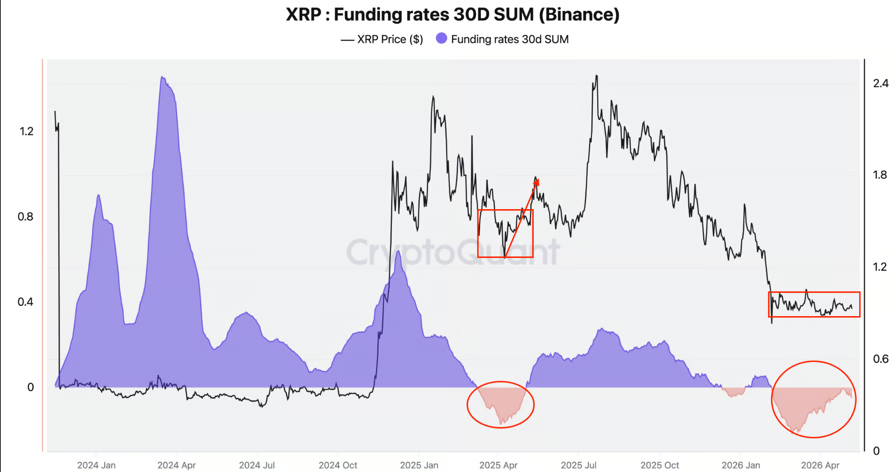
Analyzing XRP’s funding rates on Binance, analyst Darkfost flagged a key bullish signal, setting XRP/USD up for an upward run.
Related: XRP price copies 2025 chart fractal that last time sparked 66% gains
The funding rates 30-day sum on Binance have “maintained a bearish bias for nearly three months, even as XRP has posted a 27% gain over the same period,” the analyst said in a recent post on X, adding:
“When such a strong consensus forms, especially after a correction exceeding 60%, it is often a sign that a potential reversal may be developing.”

XRP/USD funding rates. Source: CryptoQuant
Previous instances show that XRP tends to rise sharply when funding rates recover after prolonged periods of being negative.
This notably happened in April 2025, when XRP reached $1.25, before a “bullish recovery eventually triggered a rally that led to a 126% advance,” the analyst added.
Meanwhile, the Bollinger Bands indicator, used by traders to assess price momentum and volatility within a certain range, reached its tightest point in 10 months, signaling that a significant price move could be underway.
The two-day XRP Bollinger Bands have slipped to their tightest level since July 2025, as shown in the chart below.
The XRP/USD pair surged about 90% in July 2025 to its multi-year high at $3.66, after breaking above the upper boundary of the Bollinger Bands. The gains were 72% in July 2024.

XRP/USD two-day chart. Source: Cointelegraph/TradingView
Analyst Seth said XRP has printed the “tightest Bollinger Band squeeze in years” on the daily time frame, adding:
“History says this kind of setup resolves with force.”

XRP/USD daily with tightening Bollinger Bands. Source: X/Seth
As Cointelegraph reported, multiple technical indicators suggested that XRP/USD is bottoming out, pointing to a possible rally to as high as $12.
XRP symmetrical triangle breakout is underway
The XRP/USD pair has broken above a symmetrical triangle on the daily chart, a setup typically associated with bullish reversals after prolonged consolidation.
The price has been compressing between two converging trend lines since February, with the upper boundary now acting as key support near the $1.40 psychological level.
A daily candlestick close above this level could open the way for a run toward the bullish target of the prevailing chart pattern at $2.05, roughly 41% above the current price.

XRP/USD daily chart. Source: Cointelegraph/TradingView
Meanwhile, the moving average convergence divergence (MACD) indicator is trading above the zero line and has produced a bullish cross, indicating rising buying momentum. Historically, similar MACD crossovers have preceded strong rebounds in XRP.
Analyst CW8900 said a “full-scale rise for $XRP is imminent,” after the price bounced off a multi-year support line on the three-day chart.

XRP/USD three-day chart. Source: X/CW8900
As Cointelegraph reported, buyers must break and sustain the XRP price above the $1.40- $1.61 seller congestion zone on the daily chart to signal a long-term trend shift.
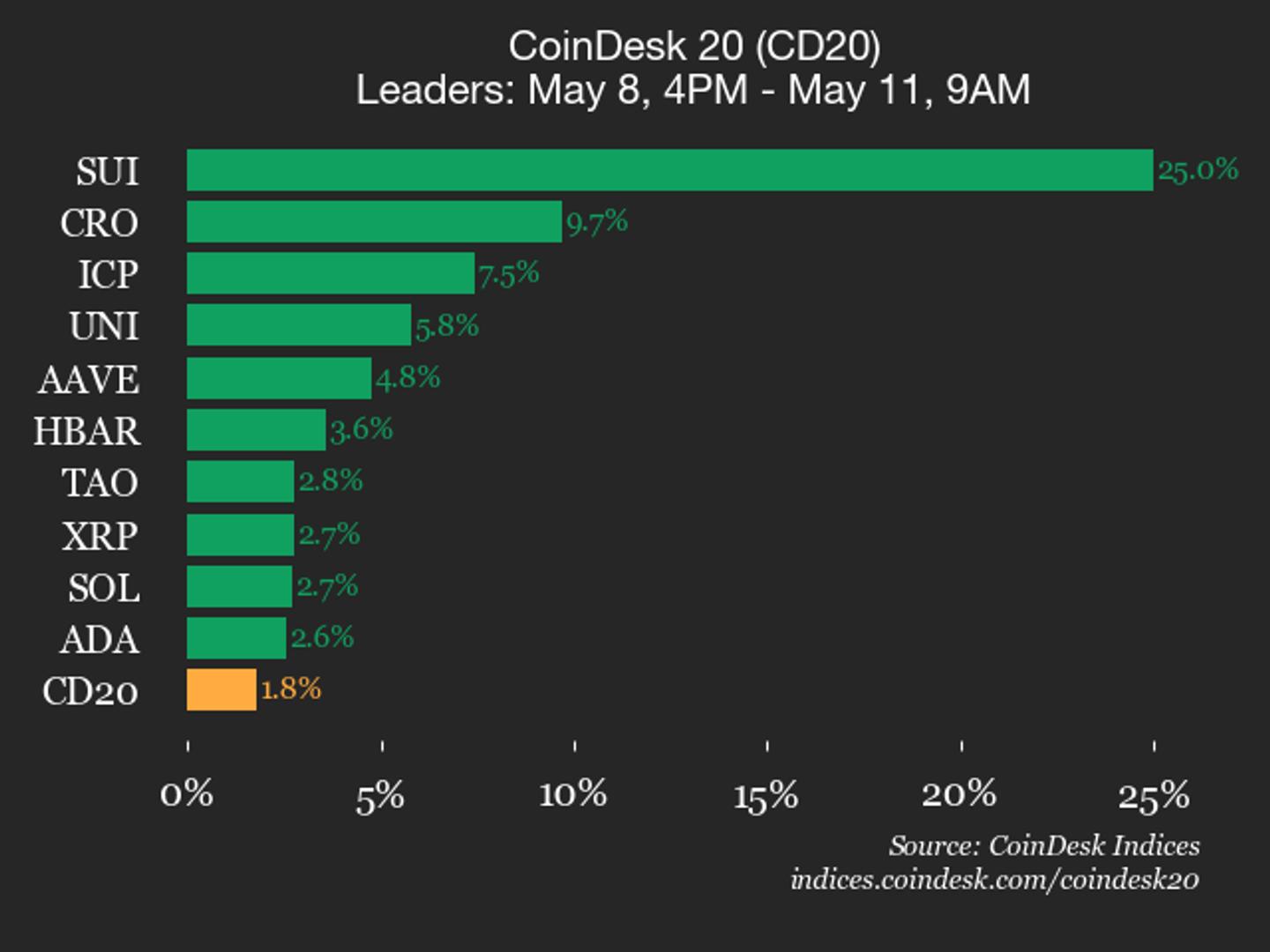

Cronos (CRO), up 9.7% from Friday, joined Sui (SUI) as a top performer.

xBubble allows users to complete specific tasks with simpler prompts by automatically building and dispatching task-specific AI agents.
Today, DAPPOS is launching xBubble, a low-prompt AI agent designed for users who want results, not prompt-tuning sessions.
With xBubble, users can turn short requests into deliverable work across creating image/video, websites, documents, and scheduled solutions, without testing models, assembling tools, building solutions, or vibe coding skills themselves.
xBubble is built around two core systems: Bubble Engine, which generates and tests task-specific SOPs that can be executed by AI agents, and Bubble Pilot, which reads a user’s request and dispatches it to the best available AI solution.
“Powerful AI no longer requires users to learn AI,” said the DAPPOS team. “xBubble inverts the relationship. We have AI learn AI, and we have AI use AI, so users don’t have to. The system evolves faster than any user can, and leverages AI more effectively than they can.”
Why low-prompt AI
AI capability is improving rapidly, and access is no longer the constraint. But as models grow more powerful, the gap between users who know how to operate AI and users who don’t is widening, not closing. The same model that produces professional results for power users often returns disappointing output for everyone else — and the gap compounds with every model release.
Closing that gap takes real work. Power users study how each model behaves across different task types, research which combinations of tools and skills chain together for a given workflow, and run repeated debugging cycles before outputs become reliable. They build internal playbooks of what works on which task, and re-learn the operating manual every time a new model launches — the know-how rarely transfers cleanly to the next release.
The bottleneck has shifted from model capability to model usability. The question is no longer only whether AI can complete a task. The question is whether ordinary users can reliably turn their goals into the right AI solution.
xBubble is designed to close that gap by inverting the relationship. Instead of users learning AI, xBubble has AI learn AI. Instead of users figuring out how to use AI, xBubble has AI use AI on their behalf. Bubble Engine does the learning. Bubble Pilot does the using. Users only state the goal.

The low-prompt approach
Dispatch task-specific AI solutions
Most AI products give users a blank box and a set of powerful tools. The user has to decide which model fits the task, which tools to chain, how to format the output, and how to recover when the result misses — and to re-learn that decision tree every time a new model arrives.
xBubble takes a different approach. It gives users a dispatch layer.
A short request is not sent to a general AI agent, but passed to a specified agent who can best understand and execute it. Bubble Pilot reads the user’s intent, identifies the task type, and routes the request to a solution that Bubble Engine has already built and tested.
This is what xBubble means by low-prompt AI. The goal is not to remove user intent. Users still describe what they want. The goal is to remove the burden of operating AI. Model choice, prompt structure, skills writing, tool selection and result testing move from users into the system.
Bubble Engine: A system that builds AI solutions for users
Bubble Engine is the part of xBubble that learns AI on the user’s behalf. It is the solution factory behind the system.
For a specified task, Bubble Engine uses AI coding agents to generate solution variants, build test harnesses, combine candidate models and tools, and evaluate outputs against task examples and quality criteria. The strongest route becomes an SOP (Standard Operating Procedure): a reusable solution that can be dispatched whenever a similar request appears.
Instead of relying on a fixed prompt template, Bubble Engine can generate task logic, test different execution paths and revise the solution for specified tasks. Bubble Engine will also test how versatile the SOP is before publishing it into xBubble’s dispatch layer.
This changes the unit of progress. A generic AI agent takes time and effort to deliver reliable results. xBubble starts from solutions that have already been designed for specific task types.
Bubble pilot: AI for using AI
Bubble Pilot is the part of xBubble that uses AI on the user’s behalf. It is the runtime dispatch layer that turns Bubble Engine’s solutions into delivered results.
It reads a short user trigger, identifies the task type, checks whether a matching SOP exists, and routes the request to the best available solution. If a specialized SOP fits, the user gets a task-optimized execution path. If no specialized SOP fits cleanly, Pilot falls back to a general-purpose agent so the user can still complete the task.
The user-facing change is simple. The work of choosing the right model, tool, and solution moves out of the user’s head and into the system.
The user states the goal. Bubble Pilot picks the path. Bubble Engine has already built the path.
Over time, recurring fallback requests can also inform what Bubble Engine builds next. When users repeatedly ask for a task that does not yet have a specialized SOP, that pattern becomes a candidate for solution generation and testing. Each new SOP expands what Bubble Pilot can dispatch. Each dispatch decision gives the system more signal about where low-prompt execution is most useful.
Available today
xBubble launches as a complete AI agent product, not a single-feature preview. It ships with 10+ core capabilities organized into two modes with multiple running environments that mirror how users actually work with AI.
Bubble computer
Bubble Computer is xBubble’s end-to-end project workspace. It unifies xBubble’s full capability stack into a single execution path, so a request that spans research, writing, design, and verification ships as one project rather than as a stitched-together chain of sessions. When Bubble Pilot detects multi-step work, it routes the request to Bubble Computer, where a sandbox spins up, specialized skills load on demand, and the project runs end-to-end without the user managing intermediate steps.
Within a single Computer run, xBubble can research a topic, draft documents, generate visual assets, verify claims, and deliver a final output. The user states the goal once. Bubble Computer handles model selection, tool routing, skill loading, and step coordination. The deliverable is the work product, not a conversation about one.
Bubble Personal
Bubble Personal is xBubble’s local-environment mode. It brings cloud AI home as a secure solution for work that requires access to a user’s own machine, operating across local files, browsers, apps, and schedules. Bubble Personal can automate website operations that need personal accounts, generate morning briefings from a user’s calendar and inbox, organize thousands of photos, or collect market data into a user’s drive overnight.
Bubble Personal runs on a sandboxed execution model. Installations, downloads, and system-level changes happen inside cloud containers and are destroyed once the task completes. On the user’s machine, only explicitly authorized actions execute, with no software installs or environment modifications. Heavy compute and risky operations stay in Bubble Cloud, and clean results flow back to the local workspace, giving users cloud-scale capability without local-environment risk.
Supported tasks
xBubble has two modes: fast and work. Fast mode is designed for simple daily tasks like research while work mode uses SOPs to deliver stable and professional results. Currently, we have supported the following task type:
- Voice Dictation: captures spoken input and turns it into clean text
- Text to Speech: reads xBubble’s responses aloud in natural voices
- Talking Avatar: generates visual content with style, format, and output structure handled by the system
- Deep Research
- Slides Creation
- Docs Creation
- Fact Check
- Scheduled Tasks
- Poster Creation
- Image Creation
- Video Creation
- Website Development
Built for results, save hours spent on learning AI
xBubble is built for users who know what they want but do not want to learn how AI is operated or spend time on multiple rounds of conversations with AI.
The core product thesis behind xBubble is simple: AI should learn AI. AI should use AI. Users just need to state goals.
Bubble Engine handles the learning. It studies how models behave, tests which tools and skills chain together, and builds reusable execution paths. Bubble Pilot handles the using. It reads each request and dispatches it to the right path. Users ask for outcomes and receive results.
Looking forward
DAPPOS will continue to improve Bubble Engine’s ability to build AI solutions for more complicated tasks. This leads to better performance for more tasks. As more SOPs are built by Bubble Engine, xBubble can also route more requests away from generic agents and toward task-optimized execution, making performance better with less response time.
The goal is simple: users should spend less time operating AI and more time using the results.
About DAPPOS
DAPPOS is an artificial intelligence company focused on building low-barrier AI products for general users and professionals. The company has secured over $20 million in funding from leading investors, including Polychain, Binance Labs, Sequoia China, IDG Capital, and OKX Ventures.
Learn more: https://medium.com/@dappos.com
The AI and crypto industries have made headlines over the past year thanks to the impressive war chests amassed by corporate political action committees (PACs).
Profligate spending during the last federal elections in the US has led to unprecedented policy changes favoring the crypto industry, with indications that a full legislative framework in the form of the CLARITY Act is on its way to becoming law.
But this hasn’t endeared the crypto industry to voters. Recent polls from Politico show distrust of the crypto industry, and the electorate isn’t sold on the benefits of AI.
“Voters across the ideological spectrum are raising concerns,” Michael Beckel, director of money in politics reform at Issue One, told Cointelegraph. “Some candidates on both sides of the aisle are trying to harness that frustration and outrage.”
Voters don’t trust crypto and don’t believe AI benefits them
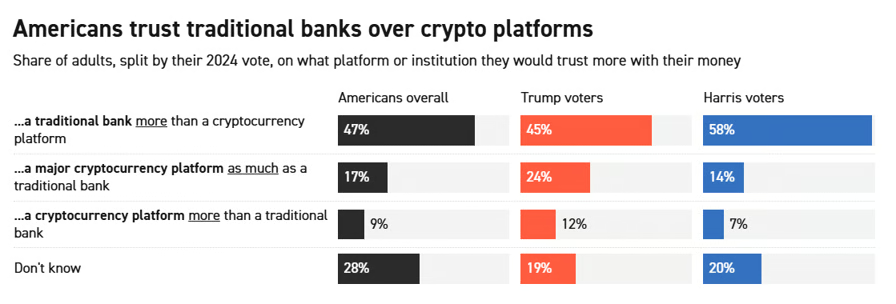
According to the recent poll by Public First for Politico, most Americans don’t trust crypto and don’t believe in the benefits of AI.

Source: Politico
While Republican voters are somewhat more likely to trust crypto, 47% of Americans overall trust a traditional bank over a crypto platform, while 17% trust a crypto platform as much as a traditional bank.
The numbers for AI aren’t great either. Some 43% of Americans overall believe that the risks outweigh the benefits, while 33% believe the inverse.

Source: Politico
Related: Crypto PACs secure massive war chests ahead of US midterms
Currently, most people haven’t heard about the major crypto and AI lobbies. According to Politico, only nine percent have heard of AI Super PAC Leading the Future. Only three percent have heard of pro-crypto PAC Fairshake.
That’s not much compared to public awareness of large lobbies like the National Rifle Association or the Planned Parenthood Action Fund, which are practically household names.
Still, association with crypto could be a problem. Ohio Republican Representative Jim Renacci told Politico, “I do think if they see somebody is backed by crypto, that’s always going to be a problem, because, let’s face it, the people that I talk to in Ohio, they don’t understand crypto, and most say they’re not comfortable with [it].”
Improving awareness around crypto lobbies may not help them much. Rick Claypool, research director at Public Citizen, told Cointelegraph:
“Generally speaking, voters are against corporate money influencing politics.”
“Even after Citizens United, the norm had been for big, brand-name corporations not to engage directly. Or when they did engage, they would often contribute through dark money groups that obscure their funding source.”
In this regard, the crypto industry’s spending spree in 2024 was somewhat unusual. Major contributors like Coinbase or a16z weren’t shy about the millions of dollars they put into campaigns.
But even then, “the voter-facing message from Fairshake was never about crypto, which voters never really cared about.” Mailers and ad buys reflected the supported candidates’ positions more broadly, or sometimes attacked those of the perceived anti-crypto candidate.
Overall, “candidates who are seen as not beholden to corporate interests have an electoral edge,” said Claypool. This was true for populist candidates like US Senator Bernie Sanders and even US President Donald Trump, who claimed during his 2016 campaign that “he was so rich he could not be bought, which is laughable in hindsight.”
If awareness about crypto — and crypto’s concerted efforts to influence policy — increases among the electorate, it may not shake out well.
Issue One’s Beckel said, “If voters view an industry as toxic, that can have serious implications for candidates who don’t want to be perceived as too close to a controversial company or industry.”
Grassroots organize against AI, crypto gets its day in Washington
Voter dissatisfaction with a certain industry has translated into real action.
Beckel noted a recent example when voter attitudes about the oil and fossil fuel lobby were enough to get some Democratic candidates to swear off any contributions. Beckel said that some organizations are already urging lawmakers to forswear any contributions from AI lobbies.
Indeed, there has been a grassroots movement growing against the AI industry more directly, namely the construction of the highly expensive and resource-intensive data centers. Local movements in seven states have blocked or delayed over $64 billion in data center investment. One state, Maine, is poised to introduce a state-wide ban.

Municipalities in California, Oregon, Arizona, Texas, Missouri, Indiana and Virginia have banned or delayed projects. Source: Data Center Watch
According to Claypool, this could prove a great opportunity for Congressional candidates “to seize the grassroots momentum against data centers and Big Tech for Democrats in particular, but not exclusively, since the tech sector has so fully enmeshed itself with the Trump administration.”
This increasing partisan alignment could also affect how voters perceive these industries.
Jason Thielman, former executive director of the National Republican Senatorial Committee, said that the crypto industry has attempted to “maintain a degree of bipartisanship and identify people whom they think will be champions on these issues.”
But even as the lobby claims to be bipartisan — Coinbase CEO Brian Armstrong called crypto “the most bipartisan issue” in DC — its priorities like deregulation and withdrawn enforcement lean mostly, but not exclusively, Republican, said Claypool.
Claypool said that “crypto billionaires have tried to present themselves as scrappy underdogs against Wall Street.”
“But that’s a less compelling argument now that crypto allies run, in addition to the White House, the DOJ, SEC, CFTC, the Treasury Dept., and the Commerce Dept.”
Furthermore, the sector has become deeply tied to Trump himself after the president’s full embrace of the industry in 2024, as well as pardons for convicted crypto execs and his use of crypto for his own personal enrichment.
With Trump’s popularity sliding due to geopolitical bungles, an unpredictable economic outlook and controversial policies at home, having ties to him and his party may carry political risk.
In a Democratic Illinois Senate primary, Illinois Lieutenant Governor Juliana Stratton accused her opponent Representative Raja Krishnamoorthi of being backed by big money from “MAGA-backed crypto bros.” She won by seven points.
It could also influence future policymaking. Said Beckel, “If an industry is viewed as a friend of one party and enemy of another, it may be more likely to be in the crosshairs or under the microscope when the other party is in power.”
For crypto and AI, that moment may come as soon as Nov. 4.
Magazine: XRP ‘probably going to $12,’ Bitcoin ETFs add $1B: Market Moves
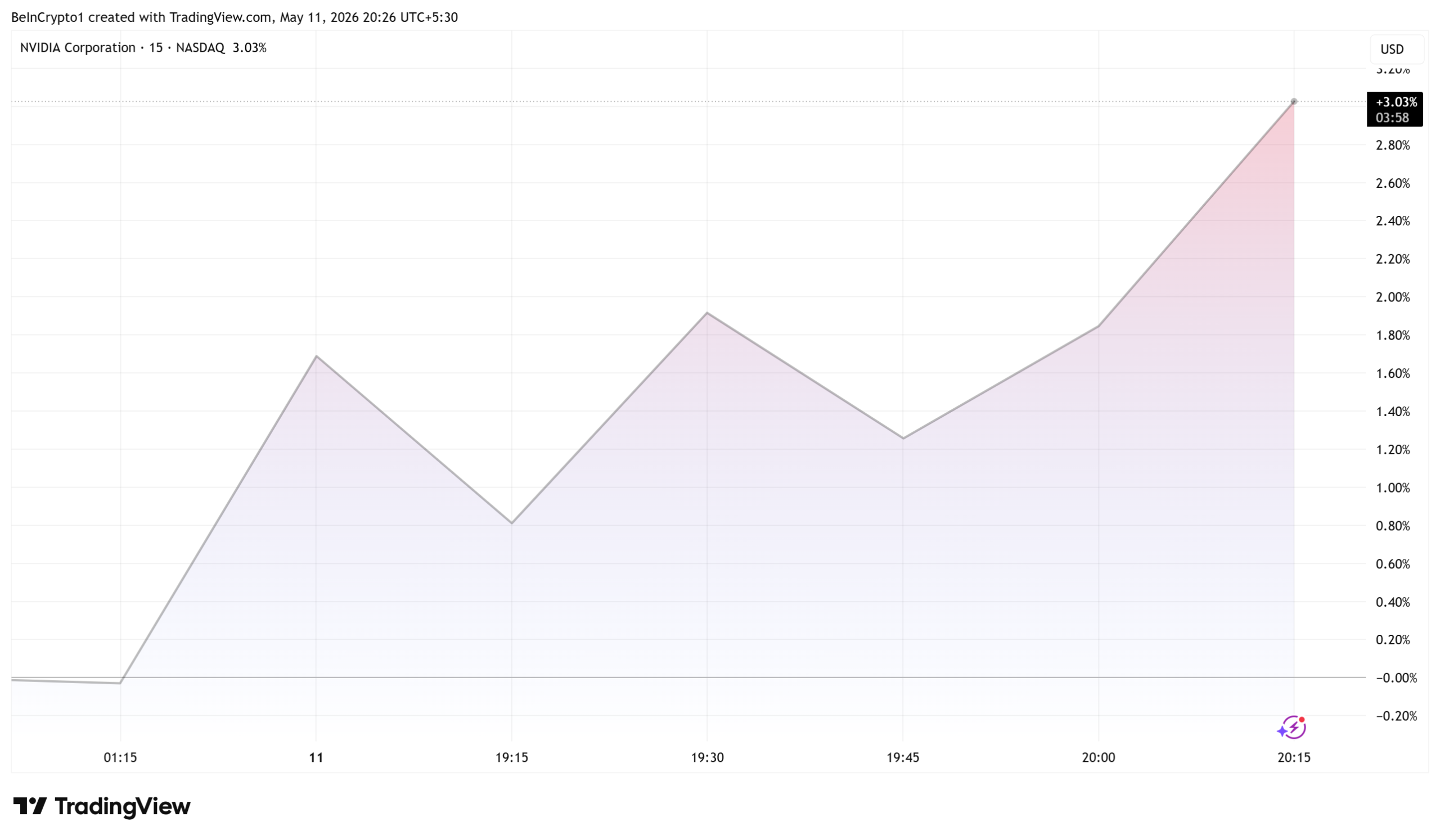
Nvidia (NVDA) shares advanced on Monday even after a “source familiar” report indicated chief executive Jensen Huang will not travel to Beijing with President Donald Trump for this week’s summit with Chinese leader Xi Jinping.
Earlier Reuters reporting named Nvidia among roughly a dozen companies invited to a trimmed CEO delegation. Trump arrives in Beijing on May 13, with formal state meetings scheduled for May 14 and May 15.
Why the Stock Shrugged Off the News
As of this writing, Nvidia’s NVDA stock was trading for $222.16, up nearly 5% on news that CEO Jensen Huang may not accompany Trump to China.

Wall Street has read the exclusion as background noise rather than a negative catalyst. Huang told investors that Nvidia’s market share for advanced AI accelerators inside China has collapsed to roughly zero under United States export restrictions.
Analyst models and current valuations already assume no meaningful revenue from restricted chips inside the country.
Nvidia stock has trailed the broader semiconductor index for weeks because of that overhang, with portfolio managers pointing to AI demand outside China as the dominant earnings lever.
A single state-visit appearance would not have changed the policy framework, which sits with the Commerce Department and Congress.
Investors likely viewed the speculation as the administration holding firm on chip controls rather than signaling concessions, a hawkish posture many funds prefer for long-term sector positioning.
“He is said to not have been invited, signaling Trump may not be willing to offer AI chip concessions in trade negotiations,” one user stated.
What Investors Are Watching Next
The CEO roster has been described as fluid in the days leading up to departure. Boeing chief Kelly Ortberg and Citigroup chief Jane Fraser are confirmed, while Qualcomm chief Cristiano Amon is expected. Others likely to go include Elon Musk and Apple’s Tim Cook.
The White House has not published a final attendee list.
Nvidia’s recent record revenue print and continued demand from hyperscale buyers remain the core bull case.
The question for holders is whether any post-summit communique touches chip export carve-outs.
Until then, AI infrastructure spending across U.S. and allied markets stays the only growth narrative investors are pricing.
The post Nvidia Stock Explodes Despite Rumors Jensen Huang Is Cut From Trump’s China Trip appeared first on BeInCrypto.


Payments firm Corpay (CPAY) add stablecoin wallets and settlement capabilities for its global corporate customers alongside BVNK to give companies another way to move money across borders outside traditional banking hours.
Teaming up with BVNK will allow Corpay clients to see stablecoin balances alongside fiat balances inside its platform, while allowing them to send, receive, store and convert stablecoins through embedded wallets.
Corpay said it will use the same stablecoin rails in its treasury operations. It expects to reduce reliance on pre-funded accounts, improve capital efficiency and make it easier to move funds across its global footprint doing so.
The firm has also added blockchain-based settlement to its cross-border payments platform through JPMorgan’s Kinexys private blockchain and BVNK’s stablecoin infrastructure. The company said the rails would be used across select corridors.
Those additions sit alongside SWIFT, Corpay’s proprietary iACH network and real-time local payment schemes. The new BVNK wallet integration brings that stablecoin functionality closer to customers.
BVNK has become one of the main firms helping payment companies add stablecoin rails. Mastercard agreed in March to buy BVNK for up to $1.8 billion, while Visa teamed up with BVNK earlier this year to support stablecoin funding and payouts through Visa Direct.
Other payment firms are taking a similar route. Stripe has been building stablecoin payments through Bridge, while Worldpay has used BVNK to offer stablecoin payouts to global businesses.
The use case is mostly operational. Stablecoins give payment firms another settlement option for liquidity movement, treasury management and cross-border transfers outside banking hours.
Stablecoin payments remain a small part of global money movement, but a growing one. Data from Visa shows that over the past 30 days, over $1.2 trillion in stablecoin transaction volume, up from $733 billion a year ago.

Bitmine Immersion Technologies has slowed the pace of accumulation of more ETH, as it’s well within its timeframe to reach the 5% supply target this year.
Nevertheless, its chairman remains highly bullish on crypto and Ethereum in particular, predicting the end of the bull market and the beginning of crypto spring.
The new press release from the firm shows that its total ETH holdings have risen to 5.21 million tokens from 5.18 million last week. This means that the firm has bought roughly 30,000 coins in the past week, which is a substantial decline from the over 100,000 in the previous few accumulation announcements.
The reason for this, according to chair Tom Lee, is that the previous pace of over 100,000 ETH per week “would have us reach 5% by mid-July.” He talks about the percentage of the asset’s total supply owned by the company he runs, which is now at around 4.3%. The company’s goal is to actually hit the coveted 5% in late 2026.
The declining buying efforts don’t mean that Lee and Bitmine are not as bullish on ETH as they were before; just the opposite.
“‘Crypto spring’ has commenced, and we wanted to highlight the importance of owning ETH as a source of diversification, and the likely drivers of this coming ‘crypto bull’ cycle. If ETH closes above $2,100 at the end of May 2026, this would be the third consecutive monthly gain – this has never been seen in a crypto bear market. Thus, a close above $2,100 would validate [that] ‘crypto spring’ has arrived.”
The company has accumulated over a million ETH since the start of 2026. In addition, its portfolio consists of 201 BTC, a $200 million stake in Beast Industries, an $88 million stake in Eightco Holdings, and total cash of $775 million.
It’s still the second-largest corporate holder of any cryptocurrency, trailing only Strategy, which increased its BTC holdings again today.
The post Tom Lee Doubles Down on ‘Crypto Spring’ Theory but Bitmine Slows ETH Accumulation appeared first on CryptoPotato.

Forget ‘Blade Runner’ — Ridley Scott’s 2-Part Sci-Fi Masterpiece Is the One That Needs a Revival

a financial governance systems that stop money leaks

Jet2 pilot explains ‘unusual’ mid-air sights as customer questions ‘UFO’ sightings

Manchester United reach agreement with Casemiro over contract clause amid transfer speculation

US brings back mandatory military draft registration

Steven Gerrard disagrees with Gary Neville over ‘shock’ Chelsea and Arsenal claim | Football


-
 Crypto World3 days ago
HarrisX Poll Found 52% of Registered Voters Support the CLARITY Act
-

 Fashion3 days ago
Weekend Open Thread: Marianne Dress
-

 Crypto World4 days ago
Upbit adds B3 Korean won pair as Base token gains Korea access
-

 Tech7 days ago
Image AI models now drive app growth, beating chatbot upgrades
-
 NewsBeat4 days ago
NCP car park operator enters administration putting 340 UK sites at risk of closure
-

 Tech1 day ago
Auto Enthusiast Carves Functional Two-Stroke Engine from Solid Metal
-

 Politics2 days ago
Politics Home Article | Starmer Enters The Danger Zone
-
 Business2 days ago
Ignore market noise, India’s long-term story intact, say D-Street bulls Ramesh Damani and Sunil Singhania
-

 Crypto World6 days ago
UAE Free Zone Deploys Blockchain IDs to Verify Registered Firms
-

 Tech10 hours ago
GM Agrees To Pay $12.75 Million To Settle California Lawsuit Over Misuse Of Customers’ Driving Data
-

 Crypto World5 days ago
BlackRock CEO Larry Fink Discusses a New Asset Class
-

 Crypto World5 days ago
Robinhood says Wall Street is building onchain
-
Entertainment7 days ago
Serena Williams hits Met Gala in metallic dress after GLP-1 reveal
-

 Tech6 days ago
Apple and Samsung are dominating smartphone sales so thoroughly that only one other company makes the top 10
-

 Tech6 days ago
I tested the Xiaomi 17 Ultra’s camera and I don’t think I’ll ever go back to an iPhone
-

 Fashion5 days ago
The Best Work Pants for Women in 2026
-
 Sports7 days ago
Everton v Man City LIVE: Haaland’s two-word response as visitors collapse to hand Arsenal advantage in Premier League title race
-

 Politics6 days ago
Met Gala 2026: Madonna’s Dramatic Red Carpet Look Steals The Show
-
 Tech4 days ago
AI agents are missing all the discussions your team is having. SageOX has an answer: agentic context infrastructure
-
Crypto World4 days ago
The FOMO Is Back: Why Bitcoin’s Latest Rally Has Analysts Flashing Warning Signs
You must be logged in to post a comment Login