

Crypto World
UAE Free Zone Deploys Blockchain IDs to Verify Registered Firms


Innovation City, a Ras Al Khaimah free zone focused on artificial intelligence and Web3, has unveiled what it calls the first blockchain-based digital business identity system. In a Monday release shared with Cointelegraph, the city said every company registered there will receive a sovereign, cryptographically verifiable identity issued on OPN Chain, the public blockchain infrastructure developed by UAE-based IOPn.
The release frames the initiative as converting a traditional business license from a static document into a dynamic on-chain asset, designed to reduce reliance on central intermediaries and to cut verification uncertainty across the free zone’s ecosystem.
The move aligns with a broader UAE push to replace traditional registries with blockchain-based identity systems and AI-driven workflows, a policy direction proponents say could streamline verification and digital operations for businesses operating in the United Arab Emirates.
Key takeaways
- Innovation City will issue on-chain, cryptographically verifiable business identities to its registered firms via the OPN Chain, covering more than 1,000 companies at launch.
- The onchain identity is intended as the native business registration primitive within the free zone, not merely an optional credential layered onto a traditional registry.
- OPN Chain uses a public validator network and a hybrid data model that stores core transaction data and proofs on-chain while handling sensitive or large datasets off-chain.
- The project emphasizes security through human-in-the-loop authorization for consequential actions and designs the agent layer with adversarial scenarios as a first principle.
- External adoption remains uncertain, with no specific banks, regulators, or exchanges named as current validators or acceptors of these onchain identities; questions persist about dispute handling and credential revocation when third parties are involved.
How the onchain business IDs work
Jimi Ibrahim, co-founder and chief operating officer of IOPn, told Cointelegraph that at launch the onchain identity framework is intended to extend across Innovation City’s client base of more than 1,000 companies, with immediate live utility within the free zone’s own digital ecosystem.
He described the core value not merely as issuing a digital certificate but as establishing a cryptographically verifiable business identity to be used for access and verification across Innovation City’s touchpoints, such as the business center and selected ecosystem services, with plans to broaden to partner providers in technology, marketing and legal services over time.
OPN Chain is presented as a public network where validator participation is open to institutions, infrastructure partners and governance-approved node operators. The system uses a hybrid data model in which core transaction data and proofs stay on-chain while sensitive or large datasets are handled off-chain, balancing transparency with privacy concerns.
Company registration under this framework is described as the native primitive within the free zone rather than an optional overlay on top of a conventional registry, distinguishing it from some digital-ID schemes such as Estonia’s e-residency example.
AI security and geopolitical risks
Recent exploits have highlighted how AI agents can be socially engineered to authorize transfers from wallets they control, underscoring the fragility of autonomous workflows. Ibrahim emphasized that every agentic workflow built on these identities will require human oversight for consequential actions, and that the agent layer is designed with adversarial scenarios as a core consideration from the outset.
The timing of the launch also intersects with regional tensions and new attacks affecting the UAE. Within this broader context, observers note that UAE investors have continued to allocate capital toward AI infrastructure, software and crypto-related assets, even amid volatility, according to data cited by Cointelegraph from eToro. Deutsche Bank researchers have also argued that the conflict may spur demand for AI rather than derail it.
Regulatory and market backdrop in the Gulf
The initiative sits within a wider policy push in the United Arab Emirates to move away from traditional registries toward blockchain-based identities and AI-enabled workflows. Government and industry watchers see potential benefits in streamlined verification, faster onboarding and more seamless cross-service operations, though practical adoption will hinge on external actors — banks, regulators, and service providers — recognizing and validating onchain credentials.
That context is underscored by the absence of named external banks or regulators currently recognizing Innovation City’s onchain identities, leaving questions about interoperability and dispute resolution when third parties are involved. The launch also arrives as the UAE seeks to attract AI and crypto investment, a dynamic reflected in investor behavior and market commentary cited by industry observers.
Uncertainties and next steps for external adoption
Key questions remain around how these onchain identities will be verified by external institutions such as banks and regulatory bodies, and how disputes or credential revocations will be handled when third parties are involved. The immediate utility is clear within Innovation City’s own digital ecosystem, but external integration will determine whether the model can scale beyond the free zone and become a broader standard.
As Innovation City pilots this approach, the next chapters will reveal whether the wider Gulf region and international partners will adopt similar onchain business identity primitives, and how issues of governance, data privacy and cross-border interoperability are resolved.
Readers should watch whether banks and regulators begin recognizing these onchain IDs outside Innovation City and how revocation or dispute handling will work as adoption expands.



CoinQuant trading platform has expanded its architecture to serve both human traders and autonomous AI agents.
Summary
- CoinQuant, with over 15,000 users since launch, is expanding its no-code AI trading platform into a unified intelligence architecture designed for autonomous AI agents.
- The platform converts plain-English strategy descriptions into complete trading systems covering entries, exits, position sizing, and risk rules, with tick-level backtesting.
- The expansion targets the emerging agent economy, where AI agents settled $73 million across 176 million blockchain transactions in the twelve months through April 2026.
CoinQuant announced the expansion of its no-code trading platform into a unified trading intelligence architecture serving both human traders and autonomous AI agents. The company has attracted more than 15,000 users since launch with a product that converts plain-English strategy descriptions into full algorithmic trading systems, including entries, exits, sizing, filters, and risk rules.
“I spoke one idea into CoinQuant, ran the test, and launched a bot on my lunch break,” said Alex K., a software engineer using the platform. The platform handles tick-level backtesting automatically from a user’s verbal or written input, without requiring coding skills.
What CoinQuant’s AI agent architecture enables
The expansion into agent-native infrastructure allows autonomous AI agents to deploy, test, and execute crypto trading strategies without human intervention at each step.
This positions CoinQuant within the fast-growing market for machine-to-machine crypto infrastructure, where AI agents settled more than $73 million across 176 million blockchain transactions in the twelve months through April 2026 according to research firm Keyrock.
The broader market CoinQuant is targeting spans more than a million potential autonomous trading agents active across crypto markets.
Crypto.news has covered the acceleration of AI-native crypto infrastructure, including MoonPay’s MoonAgents Card enabling AI agents to spend stablecoins at point-of-sale. The convergence of no-code strategy creation with agentic execution marks a structural shift in how trading strategies can be built and deployed at scale.
Why the agent economy is accelerating now
The infrastructure for AI agents to act as independent economic participants is arriving across crypto in waves. Coinbase launched agentic wallets via its x402 protocol in February 2026, processing more than 50 million transactions.
Circle launched its Agent Stack in May 2026, adding wallets, an agent marketplace, and nanopayments for sub-cent AI commerce. Crypto.news has noted MoonPay’s AI-native debit card infrastructure giving agents a live stablecoin payment rail.
CoinQuant’s approach focuses on the trading strategy layer of this stack, providing the intelligence engine that allows agents to construct and execute crypto strategies without pre-coded logic.


Tokenized stocks have emerged as the fastest-growing category of tokenized assets on Ethereum, according to Token Terminal. xStocks and Ondo Finance assets are leading the expansion of this new asset class on the blockchain. The growth in tokenized stock offerings reflects expanding demand for… Read the full story at The Defiant
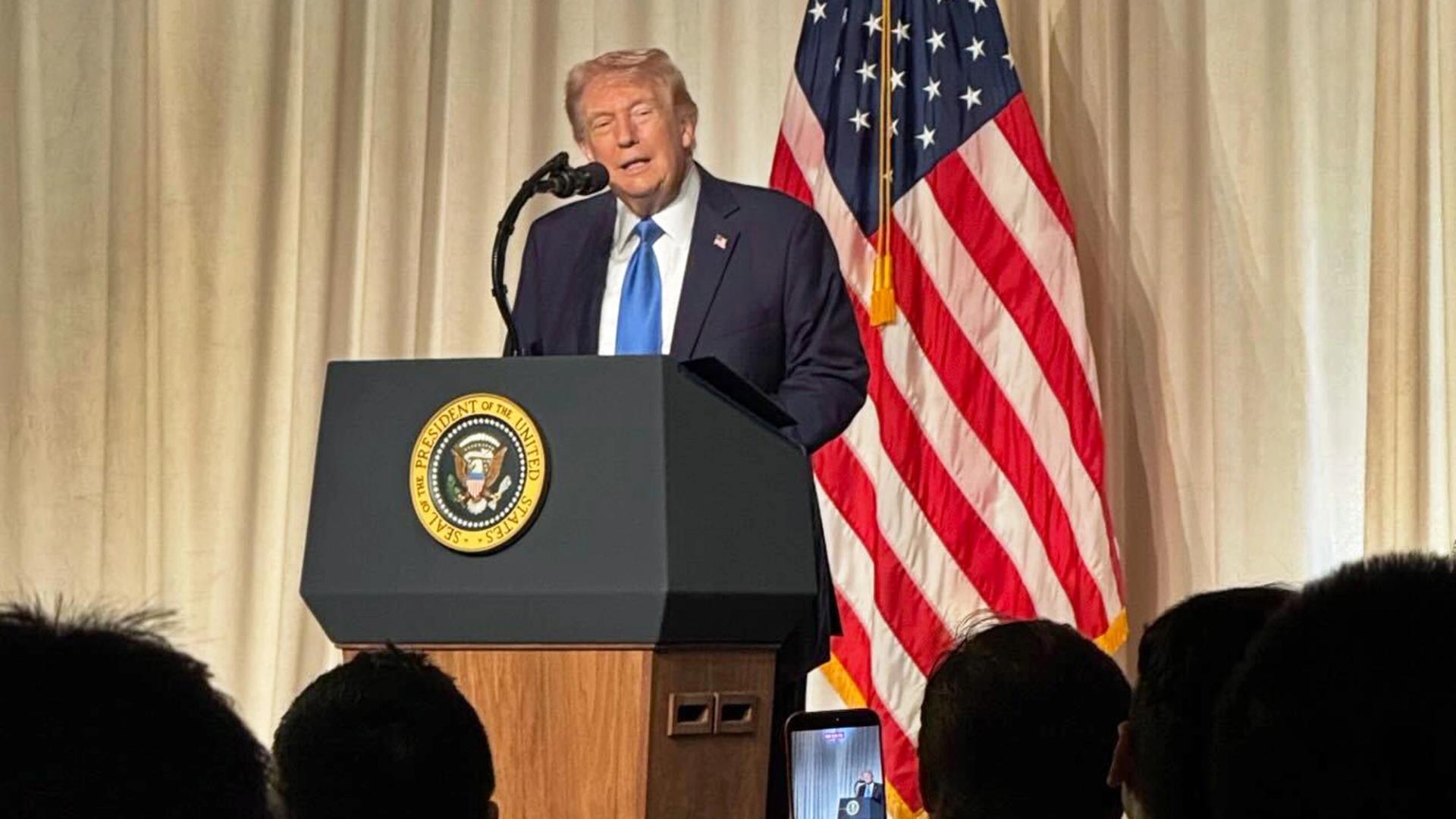
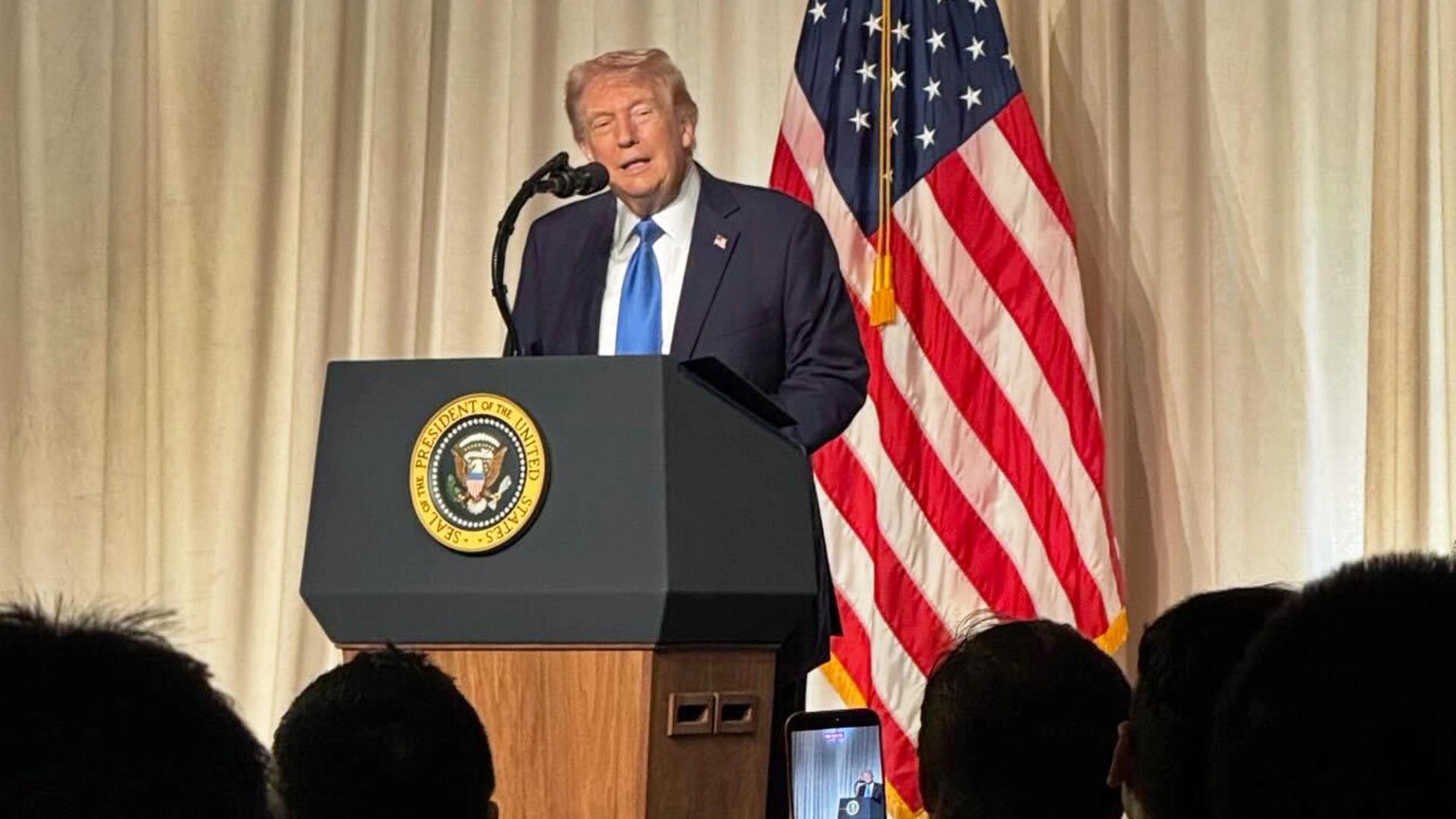
Crypto prices were slightly higher on Monday amid rising odds in prediction markets for a near-term U.S.-Iran peace deal, as Iranian negotiators arrived in Doha for talks.
Bitcoin gained 1.6% in 24 hours to $77,500, ether rose 1.4%, and the broader CoinDesk 20 (CD20) added 1.56%.
Traders on Polymarket pushed the probability of a permanent deal this month to 37%, up from roughly 14% on Friday. The odds for a deal are at 46% by early June and 72% by the end of July. The market has drawn roughly $178 million in volume.
The move follows a Truth Social post from President Trump on Saturday saying the framework agreement was “subject to finalization.” Iran’s chief negotiator, Mohammad Bagher Ghalibaf, Foreign Minister Abbas Araghchi, and Central Bank Governor Abdolnaser Hemmati arrived in Doha earlier today for talks, per CNN.
A diplomat briefed on the visit told CNN that the agenda is focused on the Strait of Hormuz and highly enriched uranium. Meanwhile, Iran’s foreign ministry has described the deal as a memorandum of understanding in a first phase, with broader talks over 30 to 60 days, CNBC reported. Pakistan and Qatar are mediating.
The Strait of Hormuz has been largely blockaded since the U.S. and Israel struck Iran on February 28, though traffic has partially resumed in recent days.
Crude oil fell 5.4% to $91.30 per barrel. Gold rose 1.35% to $4,570 per ounce. The dollar weakened, with the U.S. Dollar Index (DXY) falling around 0.3%.
Trump’s tone remains conditional. “It will only be a Great Deal for all or, no Deal at all — Back to the Battlefront and shooting, but bigger and stronger than ever before,” he wrote Monday.
Read more: Bitcoin trades above $77,000 as oil’s 5% slide pushes Asian equities higher
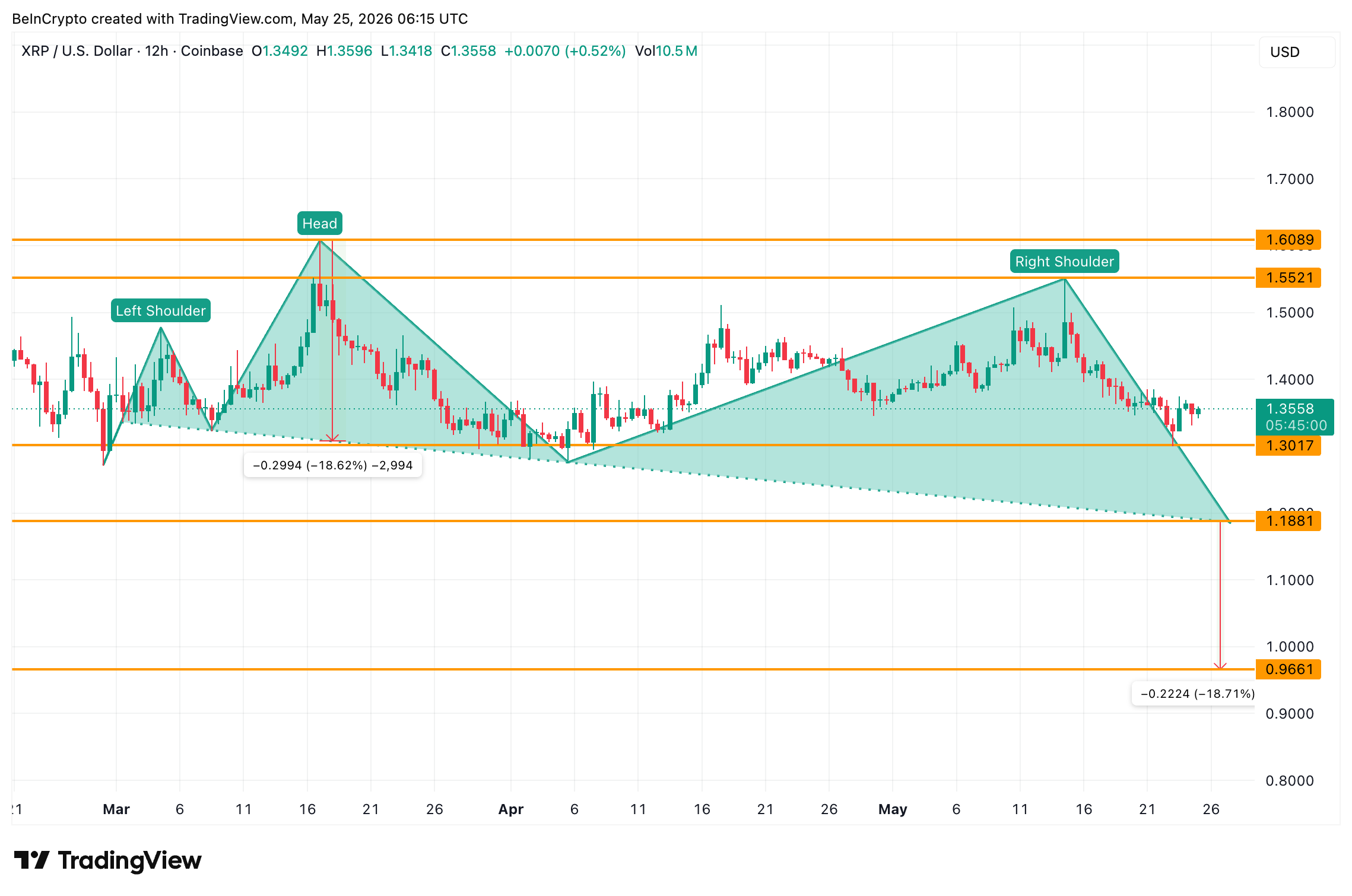
XRP price faces a bearish head and shoulders pattern that risks an 18% drop below $1. Yet, exchange outflows have surged over 300% since mid-May. Plus, open interest dropped, and long leverage hit multi-week lows.
The surging buying pressure could keep XRP range-bound for now, but a move below the neckline confirms the breakdown scenario.
Bearish Head and Shoulders Pattern Risks an 18% Drop
XRP’s 12-hour chart paints a bearish head and shoulders pattern. The left shoulder formed in early March, followed by the head peak in mid-March. The right shoulder completed in mid-May, mirroring the left shoulder structure.
Want more token insights like this? Sign up for Editor Harsh Notariya’s Daily Crypto Newsletter here.
The neckline sits around $1.18, with the bearish pattern breathing down XRP’s neck. XRP dropped to $1.30 on May 23 before a quick rebound. The risk stays alive until XRP reclaims levels above the right shoulder and head.

A measured move from the neckline projects roughly an 18% drop for XRP price. But will the breakdown happen? On-chain and derivatives data tell a different story.
Buying Pressure Quadruples as Exchange Outflows Surge 300%
The bearish XRP chart pattern faces strong on-chain pushback. Glassnode’s Exchange Net Position Change metric, which tracks exchange flows, shows XRP outflows accelerating since mid-May.
On May 15, the metric read -7,144,942 XRP. By May 24, the reading dropped to -29,372,431 XRP. That marks a 300%+ surge in outflows over nine days.
Net exchange outflows signal accumulation off-exchange. Coins moving out reduce available supply for immediate sale, easing downside pressure. The trend has been steady rather than spiky, pointing to a deliberate buying campaign.

Whether this buying pressure can save XRP price from falling below $1 depends on its persistence. A sustained outflow trend could absorb the supply driving the breakdown, turning the setup into a tug of war. Derivatives data adds further weight to this counter-argument.
Long Leverage Drains as XRP Price Faces Range-Bound Stalemate
Derivatives data reinforces the range-bound thesis. Santiment data shows XRP open interest dropped from $1 billion to $914.19 million since May 15. Total funding rates on long positions also dropped from 0.008% to 0.003%.
The 62% drop in long funding rates reduces the risk of cascading long liquidations. Less long leverage means less downside fuel for a breakdown. Combined with the buying pressure, the breakdown thesis weakens.

XRP trades at $1.35 on May 25 with the chart still in the bearish setup. A move below $1.34 followed by $1.28 increases drop risk. A bigger weakness emerges below the $1.21 and $1.18 levels.
A 12-hour close below $1.18 would push XRP price to $1.01 and even $0.96. That marks a sub-$1 fall and confirms the head and shoulders breakdown. The 1.618 Fibonacci level at $1.01 acts as a key bearish target.

A reclaim above $1.55 weakens the bearish bias and opens a path back to $1.60. A 12-hour close above $1.60 fully invalidates the head and shoulders pattern.
XRP price sits at a crossroads where chart bearishness meets on-chain bullishness. The data points to a tense range-bound period for now. A sustained sub-$1 drop requires the buying pressure to fade and long leverage to return.
The post XRP Exchange Outflows Surge 300%. Is It Enough to Save the Chart? appeared first on BeInCrypto.


Indonesia’s Ministry of Communication and Digital Affairs has blocked access to Polymarket, saying the crypto-based prediction market amounts to online gambling under local law.
The ministry said it had cut access to the platform and was tracing affiliated social media accounts for possible restrictions across other digital channels.
Alexander Sabar, director general of digital space supervision, claimed that platforms that allow users to wager money on uncertain outcomes remain gambling products, even when they use blockchain technology or crypto assets.
Polymarket lets users trade contracts tied to real-world events, including elections, sports, crypto prices and political outcomes. The platform has grown into one of the largest crypto prediction markets, but regulators in several jurisdictions have treated parts of the business as gambling rather than financial-market activity.
Indonesia’s statement did not name Kalshi, a U.S.-regulated prediction market operator, or other platforms but said authorities would restrict similar services that facilitate online gambling.
The order could extend to other prediction-market platforms if Indonesian regulators determine that they allow users to wager money on uncertain real-world events.
Indonesia’s move follows a broader clampdown on prediction markets in Asia. India recently blocked Polymarket after authorities classified such platforms as prohibited online money gaming, with Kalshi also facing potential scrutiny. Polymarket is separately seeking approval in Japan by 2030, where strict gambling rules limit most forms of betting outside state-sanctioned activities.
The Indonesian ministry said Singapore, Brazil and India have blocked Polymarket, while Taiwan, Thailand, China and Japan have imposed restrictions under local law. The prediction market is also blocked in Ukraine, where there’s no legal way for it to come back.
The regulator urged Indonesians not to access or participate in digital betting activity, including markets that use crypto assets, citing potential financial losses and violations of Indonesian law. The ministry said it would keep coordinating with law enforcement and other stakeholders to monitor similar platforms.

The first human to fly past Mars will be a Bitcoin miner. F2Pool co-founder Chun Wang, a Bitcoin miner, has been named by SpaceX as commander of its first private crewed interplanetary mission.
During the global Starship V3 launch livestream, Wang delivered a pre-recorded announcement from Bouvet Island confirming he would command a two-year Mars flyby mission and return to Earth. Wang co-founded F2Pool in 2013 and has mined more than 1.3 million BTC, representing over 9% of all Bitcoin blocks ever produced.
SpaceX has just announced that billionaire Bitcoin miner Wang Chun will lead its first mission to mars. — CryptoSavingExpert ® (@CryptoSavingExp) May 25, 2026
He bought Bitcoin at $1 and now he’s going to Mars!  pic.twitter.com/cyqQjESuDi
The funds for his space ambitions came directly from over a decade of mining pool fees and his stake.fish proof-of-stake business launched in 2018.
This isn’t just a human interest story. Bitcoin mining profits literally financing interplanetary travel signals a maturation of crypto wealth that markets are beginning to price in. SpaceX’s deepening crypto ties add a structural demand narrative.
Discover: The Best Crypto to Diversify Your Portfolio
Can Bitcoin Price Break $80,000 on Miner Mars Mission Momentum?
Bitcoin is consolidating at $77,500, sitting in a high-level compression zone just below the psychological $80,000 barrier. Volume has been consistent, and key technical levels are clearly defined.
Support is at $75,000, the previous breakout zone with heavy open interest concentration and confirmed buyer absorption. Immediate resistance sits between $82,000–$83,000, where sellers have repeatedly capped rallies in recent sessions. Moving average structure remains bullish, price is holding above its medium-term trend lines with no confirmed bearish crossover.

Three scenarios are on the table.
Bull case: Continued ETF inflows push BTC through $82,000, opening a path toward the $100,000+ cycle targets that major U.S. banks and asset managers have reiterated throughout 2025–2026 based on post-halving supply dynamics.
Base case: BTC grinds sideways between $74,000 and $80,000 as the market is under stress due to Middle East tensions.
Bear/invalidation: a close below $70,000 breaks the structure and signals the consolidation resolves to the downside. However, data currently does not suggest that scenario.
Discover: The best pre-launch token sales
Bitcoin Hyper Targets Early-Stage Upside While BTC Tests Resistance
At $77,500, the asymmetric upside that early Bitcoin miners like Wang captured is simply no longer available on the spot market. Where does a trader look when the base layer is pricing in maturity? Early-stage Bitcoin infrastructure is one answer.
Bitcoin Hyper ($HYPER) is positioning itself as the first Bitcoin Layer 2 with Solana Virtual Machine (SVM) integration. It boasts sub-second transaction finality and smart contract execution faster than Solana itself, while anchoring to Bitcoin’s security and trust.
The presale has raised close to $33 million at a current price of $0.0136, with a high 36% APY staking already live for participants.
The core thesis: Bitcoin’s limitations, such as slow transactions, high fees, and no programmability, are a product gap, and HYPER targets that gap directly with a decentralized canonical bridge for BTC transfers and low-cost execution infrastructure.
The post First Person to Fly Mars Going to Be A Bitcoin Miner: Bitcoin Mars Mission Started? appeared first on Cryptonews.


A New York lawsuit filed by Noah Doe seeks legal ownership of 39,069 dormant Bitcoin wallet addresses.
Summary
- Plaintiff Noah Doe filed suit in New York on May 1, 2026, seeking a declaratory judgment that 39,069 abandoned Bitcoin wallets belong to him under New York lost-property law.
- The filing was made through Brooklyn firm Lewis and Lin LLC under New York Personal Property Law Article 7-B, the lost-property statute covering found and abandoned property.
- The 39,069 listed wallets reportedly hold an estimated 3.7 million BTC worth approximately $285 billion, including addresses linked to Satoshi Nakamoto and the Mt. Gox hacker.
A New York Bitcoin wallet lawsuit filed on May 1, 2026 in the Supreme Court of the State of New York asks a court to declare that 39,069 dormant addresses legally belong to plaintiff Noah Doe.
The complaint, filed under index number 153119/2026 through Brooklyn law firm Lewis and Lin LLC, invokes New York Personal Property Law Article 7-B.
Doe says he discovered the wallets in October 2024 after identifying a security vulnerability that caused owners to permanently lose the ability to withdraw their holdings.
He developed a proprietary algorithm to identify wallets meeting the legal standard for abandonment, reported them to the NYPD, and spent more than a year attempting to locate their owners before filing suit.
What the Bitcoin wallet lawsuit is actually claiming
The complaint seeks a declaratory judgment declaring that Noah Doe and his two assignee companies, designated ABC Company and XYZ Company, are the legal owners of the 39,069 wallets and their contents.
Doe transferred ownership rights in all but 18 wallets to ABC Company on December 1, 2025, which subsequently transferred 17.7% to XYZ Company.
The listed addresses include wallet “12c6D,” associated with Satoshi Nakamoto, and “1Feex,” linked to the Mt. Gox exchange hacker. Sani, founder of blockchain analytics platform Timechain Index, estimated the total holdings across the listed wallets at approximately 3.7 million BTC, valued at around $285 billion at current prices. Crypto.news has tracked broader legislative efforts to establish legal frameworks around federal Bitcoin holdings.
Why the case could set a precedent for abandoned crypto property
The central legal question is whether dormant, self-custodied Bitcoin wallets can be treated as abandoned property under existing state law. Exchange-held assets already have dormancy and escheatment frameworks, but self-custodied wallets outside any institutional ledger sit in a legal grey zone that no court has formally resolved.
Timechain Index’s founder noted a potential procedural flaw: the plaintiffs sent legal notices to Pay-to-Public-Key-Hash addresses, while many old Satoshi-era wallet balances sit in unnotified Pay-to-Public-Key format scripts. If a court accepts the claim, it could establish precedent for how abandoned-property rules apply to decentralised assets entirely outside exchange custody.
Crypto.news has reported on the US government’s own Bitcoin holdings, as the legal and regulatory framework around Bitcoin ownership continues to evolve. The Bitcoin (BTC) price page tracks live market reaction as the lawsuit draws attention to dormant wallet dynamics.
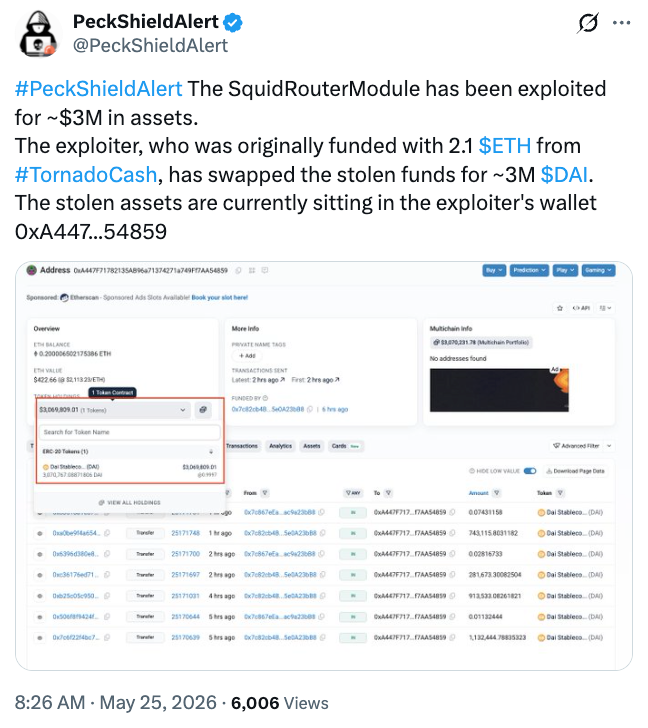
A suspected third-party Safe module exploit has drained about $3.2 million from wallets across Ethereum and Base, with multiple teams pointing to an external module as the cause.
Blockchain security platform Blockaid reported the incident on Monday, saying it involved a contract labeled “SquidRouterModule,” which initially led to confusion over a possible link to the cross-chain protocol Squid.
Squid later said on X that the issue was unrelated to its core protocol and instead involved a third-party module integrated into Safe wallets.
“A third-party SquidRouterModule was exploited, not Squid’s Router contract,” Squid said, adding that the contract shares its name but not its code.
The incident highlights how a trusted wallet module can be used to move funds if it has been granted broad execution permissions within a smart account.
86 Gnosis Safes drained for $3 million in about two hours
Safe, formerly Gnosis Safe, is a multi-sign wallet running on multiple networks, which requires a minimum number of users to approve a transaction before execution.
It can also be extended with optional modules, which are smart contracts that allow approved code to execute actions on behalf of the wallet.
Related: DeFi hacks shake institutional confidence as risks outpace yields
According to Blockaid, the attack affected at least 86 Safe accounts within roughly two hours, with all stolen tokens swapped to Dai (DAI) via attacker-controlled Uniswap V3 pools.
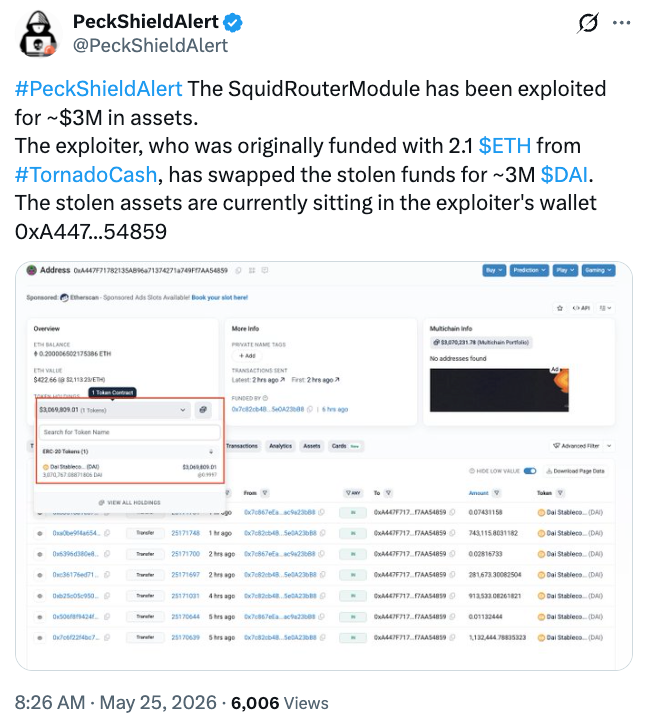
Source: PeckShieldAlert
The suspected root cause is a vulnerability in SquidRouterModule, which allegedly allowed the attacker to impersonate authorized delegates and trigger unauthorized token swaps, Blockaid said.
Module attribution and Safe response
Safe Labs CEO Rahul Rumalla said the accounts “do not seem to be operated on official Safe Wallet product,” adding that it remains unclear how and where they were created and managed, likely created through externally deployed integrations.
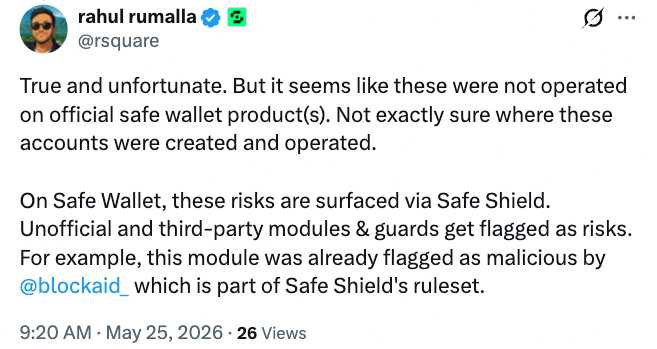
Source: Rahul Rumalla
He said Safe Wallet surfaces such risks through “Safe Shield,” a feature designed to flag potentially malicious or unverified modules and guards before they are used. The CEO added that the exploited module had already been flagged as malicious by Blockaid, which is included in Safe Shield’s risk detection ruleset.
Cointelegraph approached Safe and its CEO for comment but did not receive a response by publication time.
Magazine: ETH bears growling, Tom Lee’s buying, XRP to ‘explode’: Market Moves
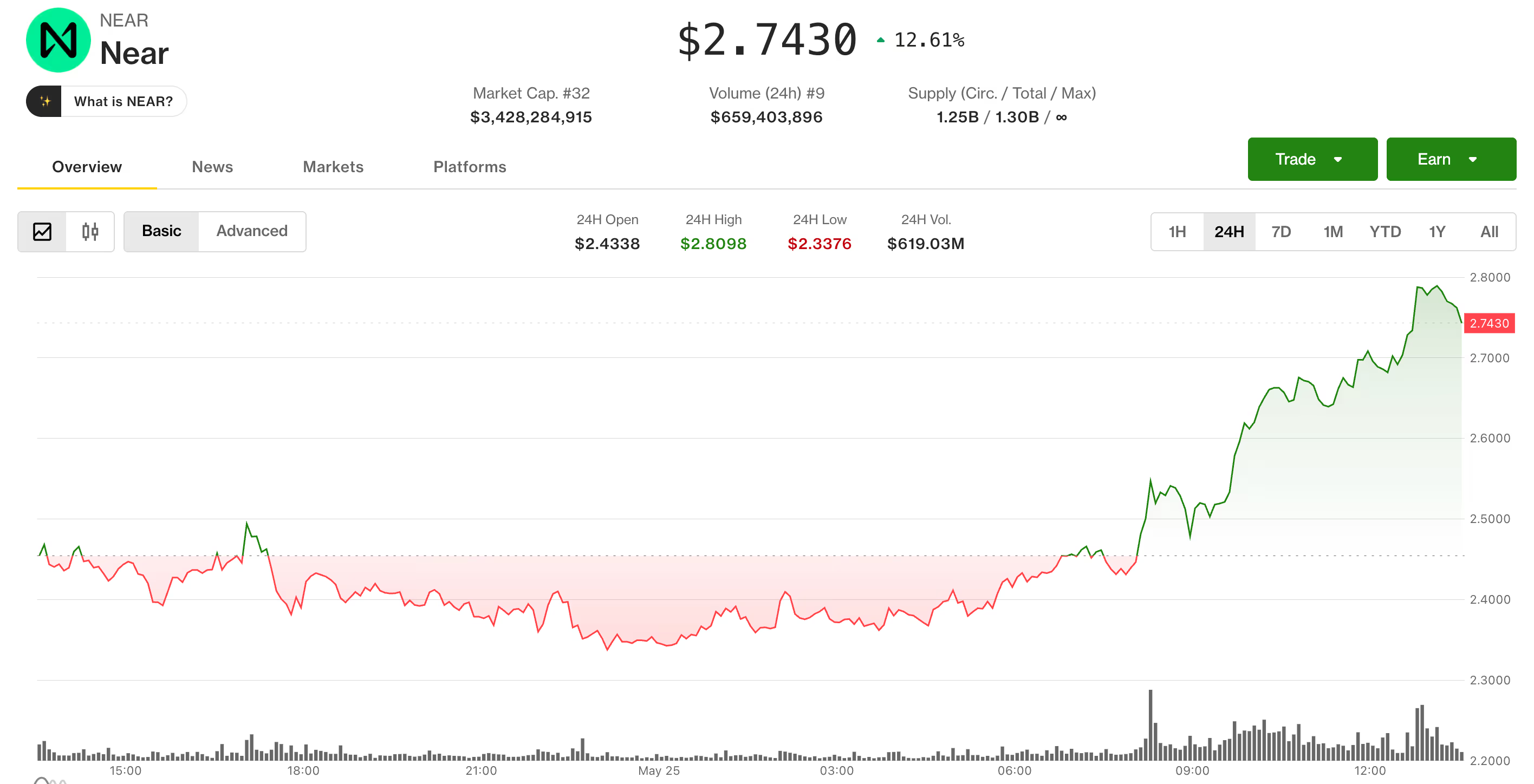
NEAR Protocol’s token climbed 15% over the past 24 hours to $2.8, extending a month-long rally that has seen the price of NEAR double in the past month.
The move comes amid the success surrounding NEAR Intents, the network’s cross-chain transaction system. The product allows users to request a desired outcome, such as swapping USDC on Ethereum for SOL on Solana, while third-party solvers execute the transaction behind the scenes.
DefiLlama data shows NEAR Intents has processed more than $19 billion in cumulative volume and generated about $32 million in fees. The figures have drawn renewed attention to the protocol after months of limited price movement.
The rally accelerated further after BitMEX co-founder Arthur Hayes described NEAR, Hyperliquid’s HYPE and ZEC as crypto’s “holy trinity” in a post on social media, before suggesting there’s a “long way to go” in its rally.

NEAR gained about 30% as traders rotated back into tokens tied to artificial intelligence and blockchain infrastructure earlier in the month, while institutional demand has been growing. The Bitwise NEAR Staking ETP listed in Europe has grown to roughly $40 million in assets under management, after seeing $7 million in inflows in a single week.
Investors are also watching an upcoming June network upgrade that introduces dynamic resharding. The change is designed to automatically split network shards as demand increases, potentially improving scalability during periods of heavy usage.
Despite the recent surge, NEAR remains well below its 2022 peak near $20.
NEAR is a layer-1 blockchain focused on applications, AI infrastructure and cross-chain transactions. The network uses a proof-of-stake model and markets itself as a platform designed to simplify interactions across blockchains while handling large volumes of activity through sharding.
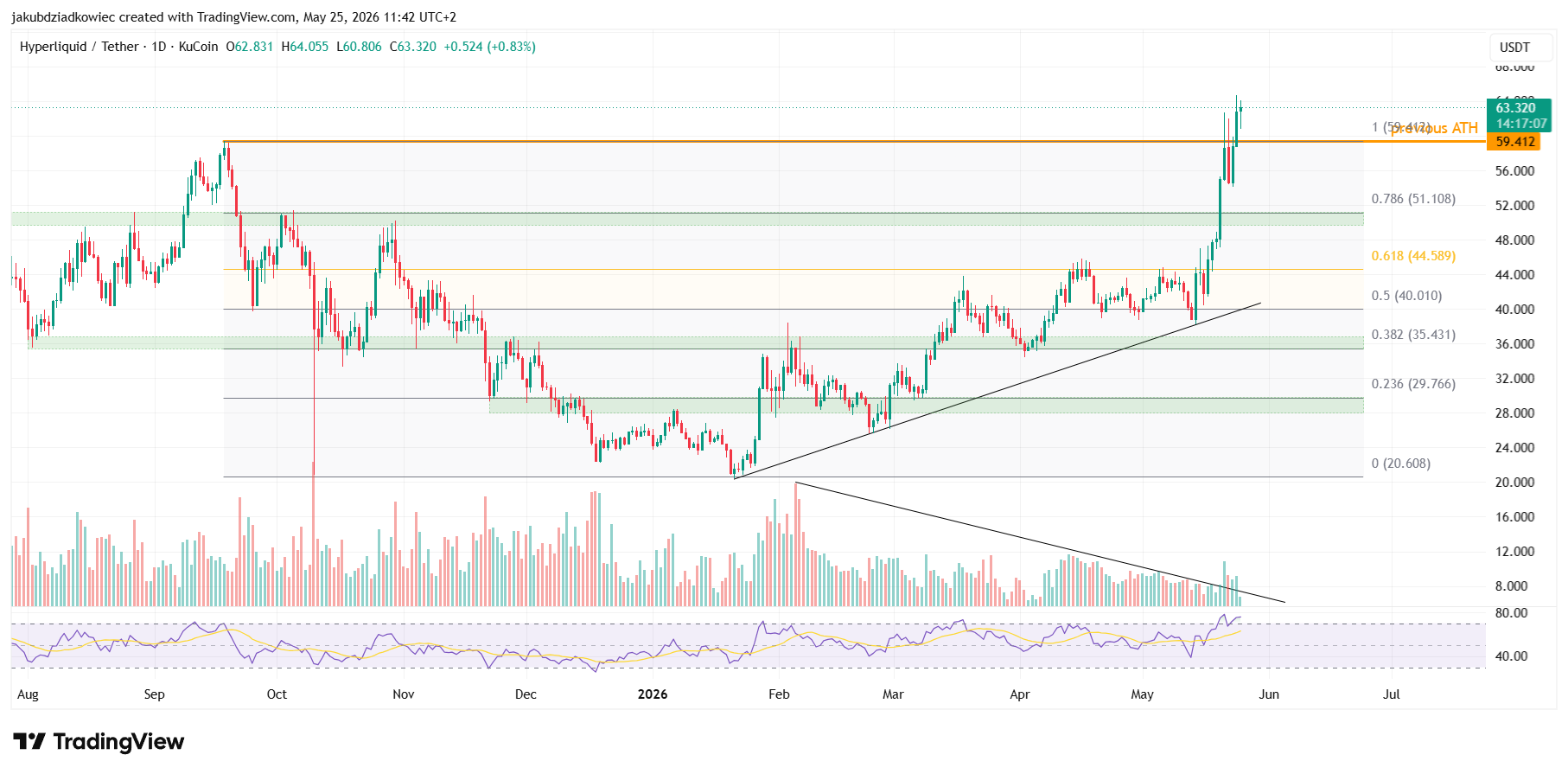
Three large-cap altcoins are flashing signals that put new all-time highs back on the table this week. Hyperliquid (HYPE), Tron (TRX), and WhiteBIT Coin (WBT) all sit within striking distance of fresh records.
HYPE has already pushed above its previous high and now trades in price discovery. TRX sits roughly 18% below its peak, while WBT trades around 13% below its own record.
HYPE Breaks Past Previous All-Time High and Enters Price Discovery
The Hyperliquid daily chart shows a clean breakout structure above the previous record near $59.50. The token bounced off an ascending trend line on May 14 and has trended higher ever since.
The most recent leg cleared the 0.786 Fibonacci retracement resistance at $51, with a fresh volume spike confirming the move into uncharted territory. RSI sits near 76, well in bullish territory but not yet at extreme overbought readings.
Background volume has been declining for several weeks, which forms a small divergence against the breakout candle. Traders may want confirmation of continued buying before assuming the price discovery phase extends much further.

X user IvanOnTech flagged the same setup with a trend-flip indicator showing HYPE up nearly 90% since its February bull flip. He framed the move as a lesson in selective altcoin exposure.
“$HYPE up almost 90% since the recent bull flip but the most important detail is that most altcoins are not recovering ADA, DOT, AVAX – all so called “bluechips” are dead and down 80-90%+ the lesson is – ONLY BUY CONFIRMED BULLISH ASSETS!”

TRX Breaks Ascending Channel and Eyes $0.40
Tron (TRX) recently broke out of an ascending parallel channel that had contained price action since November 12, 2025. The breakout also swept the September 12 swing high in the process.
The token now tests the second area of resistance near $0.37, which marks the previous swing high from August 23, 2025. TRX currently trades roughly 18% below its all-time high of $0.45.
The next upside target sits at the 1.272 Fibonacci retracement near $0.40, followed by the 1.618 extension at $0.4327. RSI hovers around 80 in bullish territory with no bearish divergence visible yet. Sustained stablecoin demand on the network continues to provide a fundamental tailwind.

X user VentureCoinist zoomed out further and highlighted TRX as one of the most consistent multi-year charts in the entire market. His log-scale view shows the token grinding higher since 2019.
“the least talked about & most insane chart in crypto $TRX has somehow been going uponly for 6+ years”

WBT Tests $57 Resistance and Eyes $60 Next
WhiteBIT Coin (WBT) continues to print higher highs and higher lows on the daily chart. The token recently swept the March 17 swing high before correcting to the 0.5 Fibonacci retracement around $55.
WBT now attempts another break above the 0.618 Fibonacci retracement resistance near $57. A confirmed close above this level would open the door to the 0.786 Fibonacci retracement at $60.
A successful break would put the price within roughly 13% of the all-time high at $64. In a deeper pullback scenario, the first support sits at the 0.382 Fibonacci retracement near $53.
Volume has been declining steadily, and RSI sits near the neutral zone. The combination points to an accumulation phase rather than aggressive directional positioning by either side.

Three Altcoin Setups for All-Time High, Three Different Stages
HYPE has already done its part by entering price discovery. TRX and WBT now need confirmed breakouts above $0.37 and $57, respectively, to validate the same thesis. The next 24 to 72 hours of price action around these levels will likely decide whether the altcoins all-time high theme extends across the entire trio. Traders should verify levels independently, since technical setups indicate probabilities, not certainties.
The post 3 Altcoins Within Striking Distance of New All-Time Highs This Week appeared first on BeInCrypto.

NCAA baseball tournament 2026: Bracket and schedule for regionals, road to CWS

Northern Ireland women urged to know symptoms of disease that claims 122 lives a year

Inflation Troubles, Now And Ahead


-

 Crypto World4 days ago
Blockchain.com files with SEC for U.S. IPO
-

 Fashion3 days ago
Holiday Weekend Open Thread – Corporette.com
-

 Business3 days ago
Dell Technologies DELL Stock Surges 15% on AI Server Momentum and Analyst Upgrades in 2026
-

 Crypto World4 days ago
Bitcoin Accumulation Weakens as BTC Realized Losses Hit $600M
-

 Crypto World3 days ago
Space X IPO Is ‘Bad News’ for Tech Stocks: But What About Bitcoin?
-

 Politics3 days ago
Makerfield: a tale of two social-media histories
-

 Crypto World2 days ago
Robinhood crypto COO Tanya Denisova exits
-

 Crypto World4 days ago
MicroStrategy’s Saylor Says Miners No Longer Set Bitcoin Price, Another Force Has Taken Over
-

 Business1 day ago
NYT Strands Answers May 24 2026 Revealed for Puzzle No. 812 Theme Summer Essentials
-

 Crypto World3 days ago
AI infrastructure race heats up as IREN pitches full-stack strategy, WhiteFiber lands $160M deal
-
 Tech3 days ago
A 0.12% parameter add-on gives AI agents the working memory RAG can’t
-
 Crypto World7 days ago
Revolut Launches Dogecoin Debit Card Across UK and EU
-

 Tech4 days ago
WhatsApp ads could make Irish debut after discussions with DPC
-

 Tech4 days ago
You Can Now Add ChatGPT To PowerPoint
-

 Business4 days ago
Trump Invests $1M-$5M in Kura Sushi USA Chain With 27 California Locations
-

 Sports4 days ago
2026 CJ Cup Byron Nelson leaderboard: Brooks Koepka finds putting stroke in Round 1
-
 NewsBeat4 days ago
Charity run by Reform leader Malcolm Offord accused of ‘law breaking’ over Scottish registration
-

 Crypto World4 days ago
Trump Media’s Bitcoin Stash Shrinks Again as 2,650 BTC Lands on Crypto.com
-
Business4 days ago
Goldman Sachs reinstates Ageas stock coverage with neutral rating
-

 Crypto World5 days ago
Exa Labs raises $250 million in funding led by a16z
You must be logged in to post a comment Login