April is around the corner, and with it a new financial year that promises to bring lots of change to households across the UK.
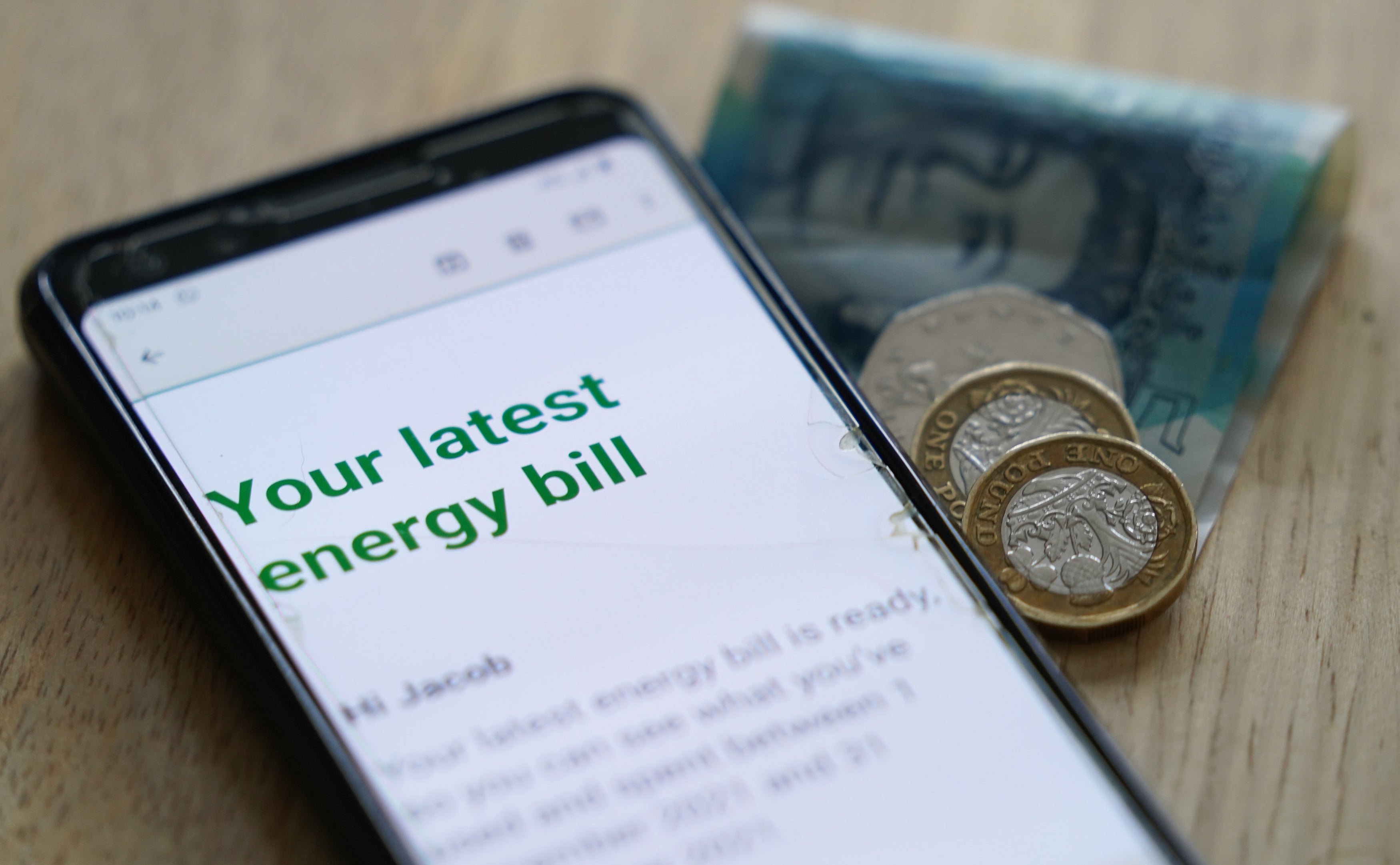
Cost of living concerns have grown as conflict in the Middle East suddenly threatens to hit Britain’s economy. The situation has severely disrupted the global oil trade, bringing knock-on effects to the price of essentials like energy and food.
Economists say that the worst impacts can be avoided should the conflict end soon, but uncertainty remains as the exchange of fire continues.
In positive news for household finances, inflation saw a steep drop in January to 3 per cent, marking a 10 month low. Some analysts now predict the rate could hit the Bank of England’s target of 2 per cent by April, which was last seen briefly in 2024.
Advertisement
The downward trend means prices are rising less quickly, but for many the cost of living still remains too high.
Meanwhile, 55 per cent of households living in poverty now contain at least one working person, according to the Resolution Foundation think tank, which revealed the scale of the issue.
The state pension is expected to rise by 4.8 per cent from next April in line with annual earnings growth (PA)
Against this difficult economic backdrop, households should claim all the support they are entitled to. There are now around 24 million people in the country claiming some combination of Department for Work and Pensions (DWP) administered benefits, which include those drawing a state pension, representing around one in three people.
Get a free fractional share worth up to £100. Capital at risk.
Yet research by Policy in Practice shows that £24bn worth of benefits goes unclaimed every year – you can use its helpful calculator to work out what you might be entitled to.
Are you struggling with the DWP or the cost of living? Share your story: albert.toth@independent.co.uk
Here is an overview of the financial support available to households this April and key dates for benefit and state pension recipients to look out for:
Advertisement
Benefit payment dates in April
Benefit payments will go out as usual in April, except on two key dates. Anyone due a benefit payment on Friday 3 April (Good Friday) or Monday 6 April (Easter Monday), should instead receive this on Thursday 2 April.
The DWP is aiming to complete the migration of all “legacy benefits” to universal credit by the end of March 2026. Those receiving tax credits, income support, jobseeker’s allowance, and housing benefit should have received a notice about moving to universal credit already.
Advertisement
Are you having issues with universal credit, PIP, or any other benefit? Get in touch via email: albert.toth@independent.co.uk
Pension payment dates in April
The basic state pension is paid straight into bank accounts, similar to how benefits are paid. It is usually paid every four weeks, with the exact day you receive it corresponding to the last two digits of your national insurance (NI) number.
Here’s when you should be paid based on those numbers:
Advertisement
00 to 19: Monday
20 to 39: Tuesday
40 to 59: Wednesday
60 to 79: Thursday
80 to 99: Friday
The same bank holiday payment date changes that apply to most benefits will also apply to state pension payments.
When will benefit rates go up?
In April 2026, all universal credit claimants will receive an above-inflation income boost of around 6.2 per cent to the standard allowance. For a single person over 25, this will be a £6 per week increase, rising from £92 to £98.
For couples with one or both partners over 25, it will be an increase of £9 per week, rising from £145 to £154.
Most other benefits should be uprated by September’s inflation rate alone, increasing by 3.8 per cent. This includes PIP, DLA, attendance allowance, carer’s allowance, ESA and more.
Advertisement
However, at the same time, the monthly payment rate for the health-related element of universal credit for new claimants will be cut from £105 to £50. The rate for existing claimants will also be frozen until 2029.
This is a reduction of more than £200 a month, cutting the additional rate by around half. This means it is advisable for anyone who thinks they might be eligible to apply as soon as they can.
The state pension will rise by 4.8 per cent from next April in line with annual earnings growth, the government has confirmed. This will bring the weekly amount to £241.05.
From April, councils will be able to administer Labour’s new ‘Crisis and Resilience Fund’, designed to support low-income households at times when affording the essentials becomes a struggle.
It will replace both the household support fund and discretionary housing payments.
Advertisement
Crisis payment
The first part of the new scheme will be a ‘crisis payment’ to to support low-income households that have experienced a financial shock, or are at risk of entering crisis.
Like the Household Support Fund, councils will continue to have discretion over the exact eligibility criteria. However, the government’s guidance says it should not be limited just to those in receipt of benefits.
The DWP has asked that councils take a ‘cash-first’ approach to the crisis payment, meaning cash payments should be awarded unless there is a fair reason not to do so.
Advertisement
Housing payment
A new ‘housing payment’ will also be introduced across the UK, aimed at providing financial support towards housing costs for those in need.
This will usually be related to rent, such as needing rent in advance, a rental deposit, or shortfall. It could also cover a lump sum associated with housing, like the cost of moving.
Unlike the crisis payment, the housing payment will be restricted to those in receipt of certain benefits. These are either housing benefit, or universal credit with the housing element for rental costs. However, DWP says those who do not qualify but are still in need could be considered for a crisis payment instead.
Advertisement
Budgeting advance loans
The government offers a “budgeting advance loan” for people on universal credit who face an emergency lack of money. The loan has a maximum repayment period of two years.
These loans are interest-free and are automatically deducted from universal credit payments. You can borrow an ‘advance’ of up to:
£348 if you’re single
£464 if you’re part of a couple
£812 if you or your partner claims child benefit
Following Labour’s 2024 Budget, a new cap was introduced on the amount the DWP can deduct from benefit payments to repay loans and debts, including budgeting advance loans.
Beginning in April 2025, deductions from universal credit have been capped at 15 per cent of the standard allowance, down from 25 per cent.
Advertisement
Charitable grants
If you are struggling financially, you may be eligible for certain charitable grants. There is a wide range of grants available depending on your circumstances.
However, these grants will typically require you to meet specific criteria and will only be able to offer limited funds.
Charitable grants are available for people who are disabled or ill, carers, bereaved, unemployed, students, and for many other reasons. The charity Turn2us has an online tool to search for grants which may be available to some.
Advertisement
Some energy suppliers offer assistance to those who aren’t able to afford their bills, including Octopus and British Gas (PA)
Energy provider help
A number of energy suppliers offer help for those struggling with their energy bills. These include British Gas, Scottish Power, EDF, E.ON, OVO and Octopus. It is worth contacting your energy provider to find out if you are eligible.
For those struggling with household costs, social tariffs are available for both broadband and water bills. This will mean a reduced rate for certain eligible households.
Advertisement
For water, every company operating in the UK has a social tariff by law. However, the amount on offer can vary between regions and, because water providers can’t be chosen like energy providers, the support has been criticised as a “postcode lottery”.
For instance, some offer as much as 90 per cent off bills, while others cap support at a 20 per cent reduction.
To find out what support your water company offers, it is worth checking on its website or contacting the helpline. In all cases, households will need to be deemed to be on a low income and/or in receipt of certain benefits.
Similarly, many broadband providers offer social tariffs to those on certain benefits like universal credit or pension credit.
Advertisement
Council tax reduction
If you meet certain criteria or are on certain benefits, you may be able to apply for a discount on your council tax of up to 100 per cent (this is sometimes called council tax support).
Your local council may still be able to offer you a discretionary reduction if you can demonstrate you are facing severe hardship and can’t afford to pay your council tax.
To apply for a council tax reduction, contact your local council via the government’s website.
Advertisement
Up to 30 hours of free childcare
From 1 September 2025, all working parents in the UK became entitled to 30 hours of free childcare for children up to the age of four. This concluded a gradual set of expansions that began in April 2024.
Parents must apply online and reconfirm their eligibility every three months, in time for each school term. Working parents can also apply for tax-free childcare, giving back 20p for every 80p you put towards childcare, up to a maximum of £500 a year.
Energy price cap: Is it going up?
Advertisement
Ofgem’s energy price cap will drop to £1,641 for 1 April to 31 June 2026 – decreasing by around seven per cent, or £117. It will remain at £1,758 until 31 March.
The energy price cap is the maximum amount energy suppliers can charge you for each unit of energy if you’re on a standard variable tariff. That includes most households. It is expressed as an annual bill for an average home.
Many experts – including Ofgem itself – are recommending households consider a fixed tariff energy deal, with many on the market offering lower than the price cap rate.
Ofgem will announce its cap for July to September by 27 May. This could be a steep increase of as much as 10 per cent, or £160, increase due to the situation in the Middle East, energy consultancy Cornwall Insight has warned.
Advertisement
Will there be another cost of living payment in 2026?
The DWP has not announced any continuation of the cost of living payment scheme that ran between 2022 and 2024. The final payment should have been made to eligible households between 6 February and 22 February 2024.
Mental health support
In the UK and Ireland, Samaritans can be contacted 24 hours a day, 365 days a year. You can call them for free on 116 123, email them at jo@samaritans.org, or visit samaritans.org to find your nearest branch
Mind runs a support line on 0300 102 1234 which provides a safe and confidential place to talk about how you’re feeling. There is also an information line on 0300 123 3393 for nearby support, and a welfare benefits line on 0300 222 5782 to support the mental health of those navigating the benefits system
Disability charity Scope has a forum where people can have supportive chats with others going through the same experiences
The NHS offers an online mental health triage service
Some people believe in UFOs while other people think it’s nothing more than reflections or a drone in the sky
A Jet2 pilot has shared his experience of a so-called “UFO” encounter mid-air, and said that he’s seen many “unusual” objects in the sky. But was it really a UFO?
Advertisement
On Jet2’s blog, Ask a Pilot, posted on May 8 of this year, Josh was asked by a customer: “Have you ever seen a UFO while flying?” In response, he suggested that some pilots or travellers may believe they’ve seen a UFO while looking out the window. But appearances can often be misleading, he said.
He explained: “No, I haven’t. I’ve seen things that seemed unusual at first glance; lights, reflections, even weather phenomena, but there’s always turned out to be a logical explanation.
“Quite often we also see satellites passing overhead – in particular, the chains of Starlink satellites, which are very cool to watch as they move across the sky.” Turning to other issues, he said that nervous flyers should bring two items with them in the cabin. This includes a book and a digital device.
Advertisement
The question asks: “I’m a nervous flyer! Can you give me some tips on how to relax and enjoy the flight?” In response, Josh suggested: “Try distractions like music, films, podcasts or a good book. This can make a big difference and help pass the time.”
With these tips in mind, the next time you are packing for a trip, remember to charge your iPad or mobile device so you can watch films, listen to music, or catch up on your favourite podcasts. You could also bring a Kindle – or a similar device – or even a physical book for the journey.
To help calm nerves, he reassures people that “turbulence is completely normal”. He added: “Aircraft are designed and tested to handle far more than you’ll ever experience on a typical flight.
“Let the crew know if you’re feeling nervous. The team at Jet2 are incredibly customer-focused, and if you mention it, they’ll do everything they can to reassure you and make the journey as comfortable as possible! This might even include a cockpit visit on the ground before departure, which can really help build confidence.”
Josh once again reassures travellers, regardless of which airline they fly: “Remember, flying is one of the safest forms of transport, with multiple layers of training, technology and procedures all working together to keep you safe. If you have any questions while on board, just ask a member of our friendly crew, who will gladly help you.”
History buffs and day-trippers alike are invited to step back in time at A Royal Hunt: History Re-enactment Weekend, a lively and immersive event perfect for all the family. Taking place on Saturday 11th and Sunday 12th July, the popular weekend returns following the success of its debut year. Visitors can experience the sights, sounds and stories of the English Civil War, brought vividly to life by the Marquess of Winchester’s Regiment through interactive displays and authentic re-enactments.
The teams come into the BetMcLean European Play-Off final at Windsor Park in very different shape
Rodney McAree admits Dungannon Swifts’ gruelling end-of-season schedule is taking its toll but he’s optimistic about finally getting the better of Linfield on Tuesday night (7.45pm).
Advertisement
The teams come into the BetMcLean European Play-Off final at Windsor Park in very different shape.
They had to dig deep to beat the Reds by that same scoreline at Solitude on Saturday, having beaten Carrick Rangers in the first round, which was hot on the heels of losing a thrilling Irish Cup final to Coleraine.
It’s been breathless stuff for the Tyrone club, but boss McAree was heartened by the resolve his players showed when up against it in the semi-final.
Advertisement
“I thought, to be honest, there was a stage in the second half where we looked a wee bit dead on our feet but we managed to find a little bit of a second wind,” he said.
“Maybe it was a third or fourth wind we found at that stage but we found another breath and we got going again.
“It’s one more game to go to get into Europe, and we couldn’t ask for a much tougher task.
“We just have to find a way and we have to go again.
Advertisement
“We knew it was going to be a tough schedule for us in terms of getting over the line.
“We’ve won two big games, Carrick at home and we’ve come to Cliftonville, which is a very, very tough place to come to.
“We have to challenge ourselves, I think we can go all in against a team that we haven’t beaten all year and try to turn them over in a one-off occasion.”
Among the aches and strains in the Dungannon squad, Gael Bigirimana is the biggest question mark for tonight’s game.
Advertisement
The midfield talisman was named to start against Carrick but pulled out after picking up an injury in the warm-up.
He then wasn’t in the squad for the Cliftonville semi-final, and remains doubtful to face Linfield.
Panicking Labour MPs are looking north for a route out of the electoral doldrums as Keir Starmer battles to retain his grip on power after the local elections bloodbath
‘When the herd moves, it moves.’
Advertisement
That was how Boris Johnson described his own MPs turning against him when he was forced out of power in 2022. And once again, we find ourselves watching MPs try to decide whether to commit regicide as Keir Starmer’s grip on power is tested to breaking point.
Things are moving quickly, and the outcome is not at all certain. But the mood appears to be shifting towards Andy Burnham, the mayor of Greater Manchester, as panicking MPs look north for a route out of the electoral doldrums.
Backbencher Catherine West’s kamikaze bid to trigger a leadership contest looked like it could derail his chances. But she appears have bowed to pressure, and is now calling on the PM to set out a timetable for his departure.
Plenty of MPs are talking about this timetable idea. Read between the lines and what they really mean is ‘give Burnham time to get back to Parliament’.
The Greater Manchester Mayor has rare popularity with voters at a time when almost every politician is viewed negatively by the electorate. But he faces significant hurdles before he could consider a leadership bid.
Labour’s rulebook says only MPs can stand in a contest – and Burnham doesn’t have a seat. His attempt to run in the Gorton and Denton by-election in February was blocked by Labour’s ruling National Executive Committee (NEC).
Advertisement
So he needs to find an MP willing to stand down and trigger a by-election in a seat where he can win. Then he needs the NEC to rubberstamp his nomination. Mr Starmer still holds sway over the NEC but he may not have the power to block his rival this time around.
Former Deputy PM Angela Rayner has said Burnham must be allowed to stand, which has been echoed by senior figures like Lisa Nandy and Sadiq Khan.
Burnham would still need to win the seat – no easy task with Reform and the Greens breathing down Labour’s neck. And then he would need to get 81 MP backers to even enter a leadership contest. He is not universally popular in Labour ranks, and has already made two unsuccessful bids to lead the party.
Starmer has made it clear he would fight any challenger, and he would automatically be on the ballot as leader of the Labour Party. There are also other potential successors to contend with, most notably Rayner and Wes Streeting.
Rayner has thrown her weight behind Burnham’s return to Parliament, and the pair have met privately in recent weeks. She is still waiting for the results of an HMRC probe into her tax affairs after she admitted to underpaying tax on her seaside flat.
But I have heard whispers from MPs who would have backed her who fear this may be too big an obstacle to overcome – even if HMRC clears her. She could decide to row in behind Burnham, but she is keeping her counsel for now.
And then there’s Wes Streeting. Speculation has been at fever pitch that the Health Secretary could move early to block Burnham from a contest. But his camp told me that he doesn’t intend to pull the trigger.
Advertisement
This could still fizzle out. Downing Street hopes the PM can cling on through this turbulence, and deliver a King’s Speech that brings MPs back together.
The longer his rivals hesitate, the better a position he will be in. But the threat from the King in the North won’t go away.
It comes amid growing US involvement in the South American country following the capture of former president Nicolas Maduro
Zahra Khaliq News Reporter and Kirstie McCrum Deputy Head of News, Live News Network
16:48, 11 May 2026
Donald Trump is reportedly “seriously considering” making Venezuela the 51st state of America.
The US president is believed to have raised the prospect during a conversation with Fox News correspondent John Roberts.
“Just got off the phone with @realDonaldTrump … he told me he is seriously considering a move to make Venezuela the 51st state…” Roberts wrote in a post on X.
Advertisement
Trump has repeatedly aired the notion of the South American nation becoming part of the US in a string of comments made throughout the 2026 World Baseball Classic, reports the Mirror.
He initially broached the subject after Venezuela defeated Italy 4-2 in the tournament semi-final in March, writing on Truth Social: “Good things are happening to Venezuela lately. I wonder what this magic is all about? STATEHOOD, #51, ANYONE?”
The following day, after Venezuela shocked the US in the tournament final, Trump seemed to reinforce his position by simply posting: “Statehood!!!”
The remarks emerged against a backdrop of escalating US engagement in Venezuela following the detention of former president Nicolas Maduro.
Advertisement
Trump ordered air strikes in Venezuela during the early hours of Saturday, 3 January, before American forces apprehended Maduro and his wife Cilia Flores at their Fort Tiuna military installation in Caracas, subsequently transporting them to the US.
Without providing proof, Trump alleged that Maduro had been “emptying his prisons and insane asylums” and “forcing” inmates to relocate to the US. He additionally held Maduro responsible for the surge of narcotics – particularly fentanyl and cocaine – entering the US. Maduro is currently detained at the Metropolitan Detention Centre in Brooklyn, where he is facing multiple charges, including Narco-Terrorism Conspiracy.
Throughout his second term in office, Trump has issued threats to seize control of several other nations and territories, including Greenland and Canada.
Want to see more of the stories you love from Belfast Live? Making us your preferred source on Google means you’ll get more of our exclusives… To add Belfast Live as a preferred source, simply click here.
Jarrod Bowen stood over the ball by the corner flag. There was so much going on in the penalty area as he delivered a cross.
A melee ensued before Callum Wilson blasted a shot over the line. Salvation for the Hammers? Enter the video assistant referee, Darren England.
You cannot blame the VAR for taking his time. This was such a huge moment with five potential fouls buried among the bodies.
Whatever decision England made was going to be the subject of intense scrutiny.
Advertisement
Let’s break it down step-by-step, consider the potential fouls and what the VAR would be looking for.
Soucek on Havertz
In the chronology of fouls, this was the first potential incident.
The two players were at the near post, with Kai Havertz in front facing the ball. Tomas Soucek was climbing over the back of the Germany international.
Advertisement
As the ball was in the air, the Arsenal forward ended up on the floor with Soucek on top of him.
The VAR will take into account that the players were not in the area where the ball was going to land – Havertz was not going to be prevented from playing it.
That Soucek was was facing the ball goes in his favour, too.
All in all, the VAR would have allowed this to go.
Advertisement
Odegaard on Tobido
A straight-forward situation to judge.
Both Martin Odegaard and Jean-Clair Todibo were engaged in mutual holding. When this is the case no one party is judged to be committing an offence – essentially, they are both as bad as each other.
Odegaard had an arm round the waist of the West Ham attacker, who had his arm around the Norway international’s shoulder.
Advertisement
Trossard on Pablo
The battle between Leandro Trossard and Pablo started just outside the six-yard box as the ball was kicked.
They were both holding on to each other at first before Pablo tried to make a run towards goal.
This was when Trossard, with his back to the play, grabbed Pablo around the waist.
Advertisement
Based on what we have seen this season, it was not enough for a penalty as Pablo was able to move to the flight of the ball and was not dragged down.
However, this was the incident which may have been of most interest to the VAR outside the foul on Raya.
Pablo on Raya
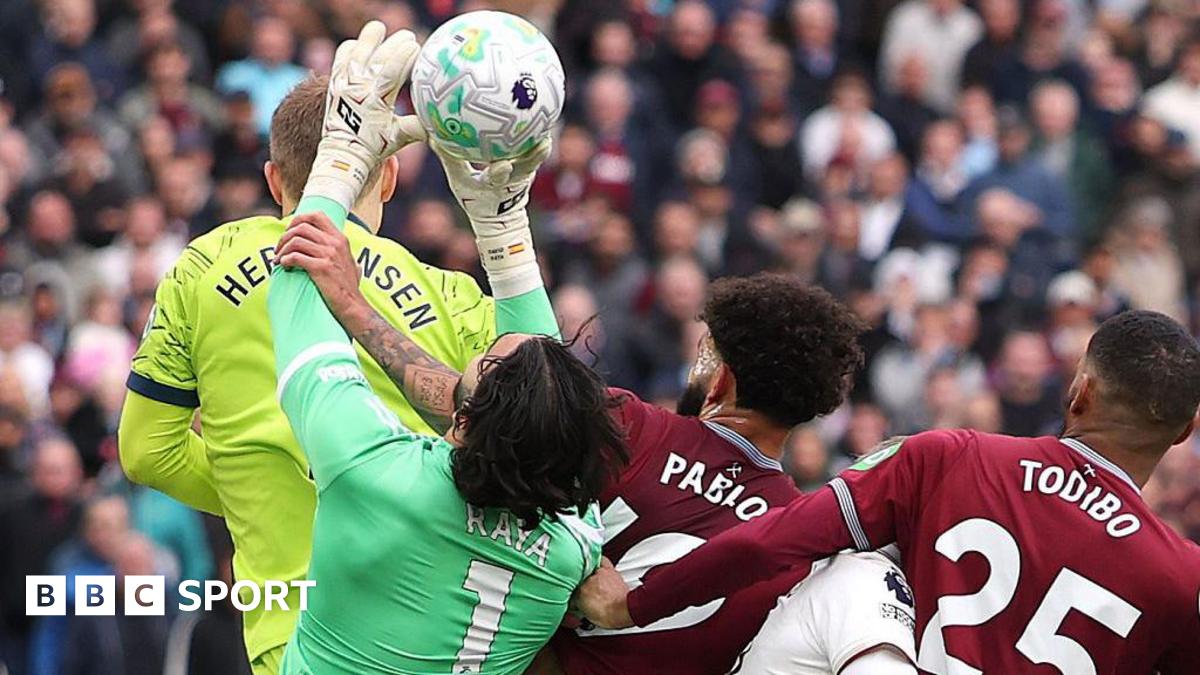
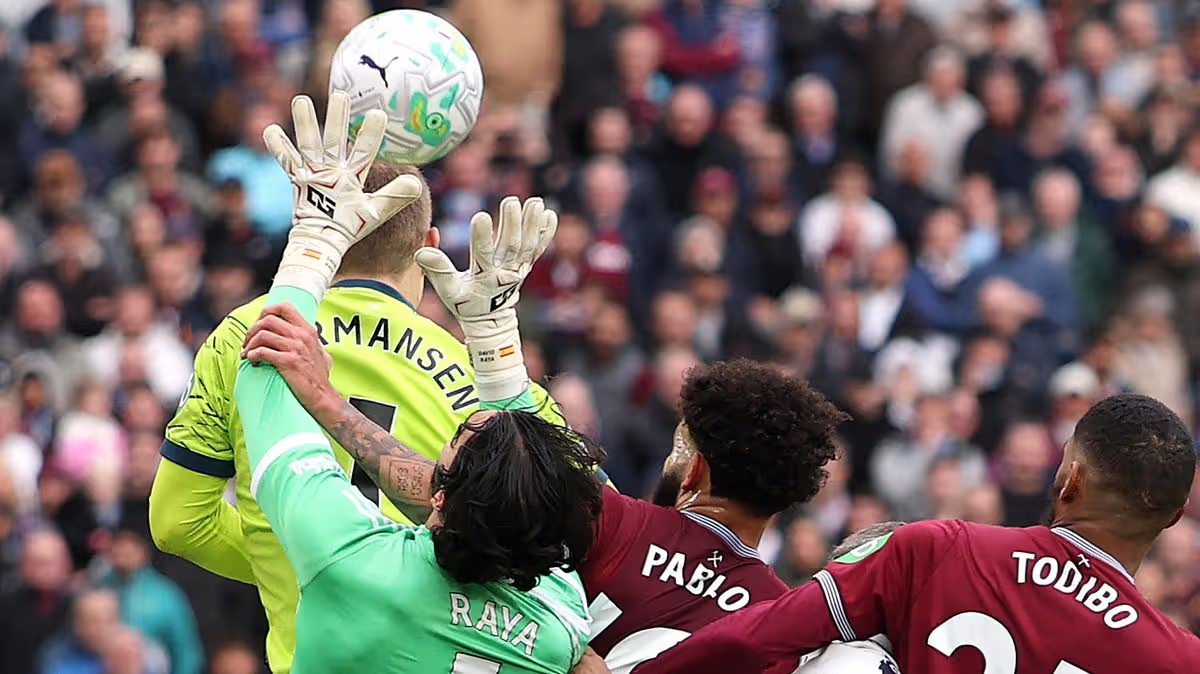
After moving into the six-yard area under pressure from Trossard, Pablo engaged with David Raya.
Advertisement
Crucially, he did so in a way which impeded the goalkeeper from being able to claim or play the ball.
Pablo had his arm directly across the Spain international, and was holding the goalkeeper’s left arm with his hand.
This restricted Raya in two ways. His right arm was pinned down by Pablo’s left biceps, and his left forearm was being held too.
For the VAR, this clearly impacted the goalkeeper’s ability to play the ball.
Advertisement
Tobido was pulling the back of Raya’s shirt, too, but it was Pablo committing the crucial foul.
Rice on Mavropanos
Declan Rice had his arms around the waist of West Ham‘s Konstantinos Mavropanos.
There was the potential for this to be a penalty, as it was a clear non-footballing action.
Advertisement
However, it happened almost simultaneously with Pablo’s challenge on Raya.
The foul which had the material impact on the passage of play was prioritised.
Richard’s family said he “spent his whole working life on the railway, where he was a mentor to many”
14:58, 11 May 2026Updated 15:09, 11 May 2026
The family of a man who died in a crash between a car and a lorry has paid tribute to him. Richard King, 45, died when a white Xpeng G6 he was driving was involved in a crash with an HGV at about 11.50am on Wednesday, May 6.
It happened on the eastbound carriageway of the A1139 Fletton Parkway in Peterborough, near the exit from the A1(M). Richard, who was from Fletton was pronounced dead at the scene. His family has described him as “loving father, son, brother, and friend to many” who was loved “so much”.
His family has released the following tribute to him: ” “Richard was a loving father, son, brother, and friend to many. He spent his whole working life on the railway, where he was a mentor to many.
Advertisement
“He was, however, at his happiest watching his beloved Arsenal with his two sons, Jack and Thomas. We will miss Richard more than words can do justice. His kindness, patience and strength left a lasting impression on everyone he encountered. We loved him so much and losing him will hurt forever.”
Police are appealing for information and dashcam footage from anyone who may have witnessed the crash or the vehicles in the moments leading up to it. Anyone with information should contact police online at www.cambs.police.uk/report quoting Operation Braddock. Those without internet access are asked to call 101.
ITV’s Dr Amir Khan has shared his shift work health advice
A GP has issued a stark warning about working patterns, claiming humans are “not designed” for a particular type of schedule. According to the medical professional, shift work can have serious consequences for both physical wellbeing.
Advertisement
During a recent episode of his podcast No Appointment Necessary, Doctor Amir Khan offered guidance for those working shifts. Dr Amir, who is widely recognised from his appearances on ITV, stated: “Our bodies are not evolved to do shift work.
“Shift work is a modern thing that’s been thrust upon us – part of capitalism that has been thrust upon us that sees us more as functional units, rather than actual human beings.” He outlined how the human body isn’t built to cope with the irregular nature of shift patterns.
Content cannot be displayed without consent
“So there is no easy answer to shift work, your body’s not designed to do shift work, your body’s not designed to stay up all night one week and then work days the next week,” he added. “You know I did a year and a half of A&E and I was doing shift work and I was trying to get sleep where I can but it is hard.”
Among his recommendations was getting rest “when you can”. He explained: “And I genuinely do not have the answer to that apart from sleeping when you can. It is always better to get into a rhythm and some people really like working nights and then sleeping through the day and having the day to do the stuff that they might want to do as well later on.” He ideally suggested maintaining consistent shift patterns.
Advertisement
Dr Amir explained: “If you can work consistently one shift for a period of time where your body can get into a rhythm that is better than switching and changing all the time but natural daylight, if you’re missing that that has its benefits as well.
“So it’s pros and cons, the long and short of it is, we’re not designed to do shift work.” The video’s caption on the podcast’s Instagram post stated: “Shift work might be normal… but it’s not natural.
“Dr Amir Khan explains why constantly switching between nights and days can seriously affect your body, sleep and health.”
Advertisement
The health dangers
His guidance is backed up by experts at UCLA Health in the United States. On its website, the organisation highlighted that shift work can have a “long-term” effect on health and wellbeing.
They stated: “The biggest health challenge facing shift workers is the interruption of circadian rhythm – your body’s physical, mental and behavioural processes that follow a 24-hour cycle. Circadian rhythms are influenced mainly by light and darkness.
“Shift work – especially at night – often disturbs the body’s systems regulated by circadian rhythm, including the sleep/wake cycle. The more years you work a shift schedule, the higher your risk of chronic health issues.”
These health problems include:
Cancer
Cardiovascular disease
Gastrointestinal disorders
Mental health disorders
Metabolic disorders such as obesity, metabolic syndrome and type 2 diabetes
UCLA stated: “According to research, night-shift workers are three times more likely to suffer from a shift-related sleep disorder than people who work a day shift. Recognising the signs and getting treatment for a sleep disorder may help you avoid associated physical and mental health issues.”
What action to take
The UCLA team suggested that shift workers should concentrate on the following:
Eating habits: consume high-quality, whole food wherever possible, and avoid eating between midnight and 6am to maintain typical eating patterns.
Sleeping better: implement sleep strategies tailored for shift workers that suit your personal needs, work schedule and home circumstances
Maintaining relationships: Share at least one meal with your family each day. Set aside time every week to connect with friends, either face-to-face or through video chat
“With filming just underway on season four of The White Lotus, it had become apparent that the character which [White Lotus showrunner] Mike White created for Helena Bonham Carter did not align once on set,” a spokesperson said at the time.
“The role has subsequently been rethought, is being rewritten and will be recast in the coming weeks.”
Asked if he had any insight about his co-star and fellow Brit’s exit on the TV Baftas red carpet, Steve told Deadline: “That was… I mean… that was… it sort of like… it just went in a different direction.”
“Sometimes you find that something isn’t working the way you want it to, in terms of, like, the character, and the sort of dynamic of the whole story,” he continued. “So that was just a mutual decision.”
Advertisement
He added that the “whole part was rewritten from scratch” when Oscar winner Laura Dern joined the cast.
Last week, Variety published a piece claiming that Mike White had originally intended for Helena to play a “washed-out star who is chasing a comeback”.
Citing undisclosed “sources”, Variety’s article alleged that the Harry Potter star left The White Lotus due to “creative differences”, notably Mike White wanting her to play the character in a more “boisterous” way.
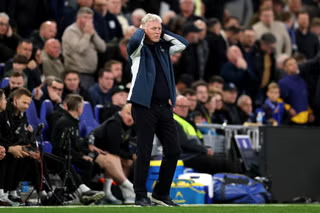
West Ham vs Arsenal VAR fallout as new referee verdict given and ‘so wrong’ claim made – Manchester Evening News
Need to know
West Ham were denied a late equaliser against Arsenal after David Raya was adjudged to have been fouled in the build-up
Arsenal goalkeeper David Raya is adjudged to have been fouled shortly before Callum Wilson equalises for West Ham(Image: Alex Pantling/Getty Images)
Everything you need to know about the Arsenal VAR drama
What happened: With Arsenal’s leading 1-0, Callum Wilson looked to have equalised when his fierce strike squeezed over the line. However, a VAR review ensued after the Gunners claimed David Raya had been fouled in the build-up by Pablo.
Referee decision: After going to his monitor, Chris Kavanagh confirmed the goal would be disallowed. He announced to the crowd: “After review, No.19 commits a foul on the goalkeeper. Final decision is a direct free kick.”
What the law says: According to the FA’s Law 12: Fouls and Misconduct, a direct free kick is awarded if a player commits any of the following offences against an opponent in a manner considered by the referee to be careless, reckless or using excessive force: Charges, jumps at, kicks or attempts to kick, pushes, strikes or attempts to strike (including head-butt), tackles or challenges, trips or attempts to trip, holds an opponent, impedes an opponent with contact, bites or spits at someone on the team lists or a match official, throws an object at the ball, opponent or match official, or makes contact with the ball with a held object.
What West Ham head coach Nuno Espirito Santo said: “They have to solve it. They have to come to the clubs and explain and show why sometimes it is, sometimes it’s not. Sometimes it’s a goal, sometimes not a goal. Everybody feels confused. Today we are upset, we are sad. It’s the lack of consistency with the decisions. These previous recent seasons have been having a lot of blocking, grappling, holding. Almost like a wrestling situation that all of us don’t even understand what is a foul, what is not a foul. I think even the referees confuse themselves. I have the same view of everybody. Sometimes I think it is, sometimes I think not because then you look at every corner in the Premier League. What’s happening? It’s something like this. Not only today but in all the pitches. Everybody, us included, are trying. But what is the barrier, what is the frontier of what is a foul and what is not a foul? It is tough.”
What Arsenal head coach Mikel Arteta said: “It’s very brave but very consistent with what they’ve been talking about all season. When I have to be critical I have been. Today I have to praise them at least for giving the option for the referee to decide away from the lights and the chaos, to give clarity for him to make the right call. When you look at the action in that way, it is an obvious error. The goal has to be disallowed.”
Ex-referee’s opinion: Speaking on Sky Sports’ Ref Watch, Dermot Gallagher said: “Between the officials, they came to the right decision. When you watch it, there is so much going on and to look at and what happens is you have to go in chronological order. If you look at it, Pablo puts his arm across Raya, he holds him, there is no doubt about that. Behind that, Declan Rice is engaged with [Konstantinos] Mavropanos, is that a penalty? Well, if you look at it in that order, definitely Pablo goes first, his arm is across Raya and at that point, Rice is reaching, he does get hold of him, there is no doubt about that. And if there is not a foul on the goalkeeper, that is definitely a penalty as Mavropanos is running towards the ball. But the first foul is definitely by Pablo.”
Pundit reaction: Former Man City and Manchester United goalkeeper Peter Schmeichel was adamant the goal should have stood. He told ViaPlay: “What really makes me angry is that Arsenal would never be top of the league if that’s a free kick. That’s how they have scored so many goals – by blocking people, holding people – doing all kinds of things. And then we get to this point, it takes VAR five minutes and he [Darren England] starts it over again. That in itself puts so much doubt into that decision. It cannot be a free kick. It cannot. It is so wrong. I just don’t understand why all of a sudden that’s a free kick because it’s not been for any teams all the way throughout the season. All this is just crazy. That decision today… It’s just so wrong on so many levels.”
What this means: Arsenal’s win means they remain five points clear of City in the Premier League. Pep Guardiola’s side face Crystal Palace on Wednesday night and, if they win, will move two points behind the Gunners.












































You must be logged in to post a comment Login