Connect with us
DAPA Banner

NewsBeat

Local election results show the hurdles along the path to power for French far right

Published

on

Local election results show the hurdles along the path to power for French far right

Despite achieving historic scores and taking control of over 60 municipalities in the French local elections, the far-right Rassemblement National (National Rally, RN) will be disappointed by its failure to make a breakthrough in the larger towns and cities. The headlines coming out of France after the second round of elections on March 22 tell of the resilience of the mainstream centre left and centre right, whose candidates held on to every major city hall in the country.

The two parties that dominate France’s political extremes – the far-right RN, led by Marine le Pen and Jordan Bardella, and Jean-Luc Mélenchon’s far-left La France Insoumise (France Unbowed, LFI) – made some gains in smaller towns. But they failed to capture a single one of the large cities.

This matters because France goes to the polls again in 2027 to elect its next president. The local elections were widely seen as a dress rehearsal – and the results expose the limits of both parties’ strategies. For the RN, the failure to break through in cities such as Marseille and Toulon — combined with the refusal of the centre-right Les Républicains (LR) to enter into alliances with RN candidates — shows that, for the far right, the path to the Élysée Palace remains highly complicated.

For LFI, a similar inability to translate national prominence into local power raises questions about Mélenchon’s capacity to unite the left ahead of next year’s presidential campaign.

Advertisement

For the RN, the dream result would have been a win in Marseille. Capturing France’s second city would have been a massive statement of intent. After the first round of the local elections on March 16, however, a victory in the port city seemed unlikely – especially after the refusal of the centre-right candidate, Martine Vassal, to enter into any alliance with the RN.

‘Le grande confusion’: all sides have claimed victory, but there are no real pointers ahead of next year’s presidential election.
France 24 screenshot.

Vassal’s decision is emblematic of one of the big lessons of these elections: the centre-right LR has resisted the temptation to ally itself with the far right, even where doing so might have delivered local power. The centre-left mayor of Marseille, Benoît Payan, drew his own red line, refusing to merge his electoral list with LFI. He still held on to his job comfortably, winning 54% in the second round, well ahead of the RN’s Franck Allisio on 40%. The double refusal in Marseille – the centre right rejecting the far right, the centre left rejecting the radical left – encapsulates the resilience of the political mainstream in France’s major cities.

Battle for credibility

While taking Marseille was always going to be a long shot, the RN had invested heavily in winning back another important port city on the south coast: Toulon. This is the city where in 1995 the party, then called the Front National (FN) and led by Marine Le Pen’s late father, Jean-Marie, made a historic breakthrough, taking control of the council. This was the first time the far right had captured a major French city since the second world war.

Advertisement

But the FN mayor, Jean-Marie Le Chevallier, endured a disastrous time in office. He fell out with his own city councillors and in 1999 ended up quitting the party after a spat with Le Pen (père). The failure to manage Toulon city council (Le Chevallier scored less than 8% when he was up for reelection in 2001) became an albatross around the party’s neck for many years to come.

As we have argued in our research on the RN in local government, overcoming this reputation for incompetence has been an important goal for all the party’s mayors elected since 2014. Recapturing Toulon would have been highly symbolic. But the RN candidate (and current MP) Laure Lavalette, despite leading after the first round, eventually fell short with 48% in the runoff against centre-right incumbent Josée Massi.

The result shows the enduring power of the front républicain: the tactical alliance of voters from across the political spectrum to keep out the far right.
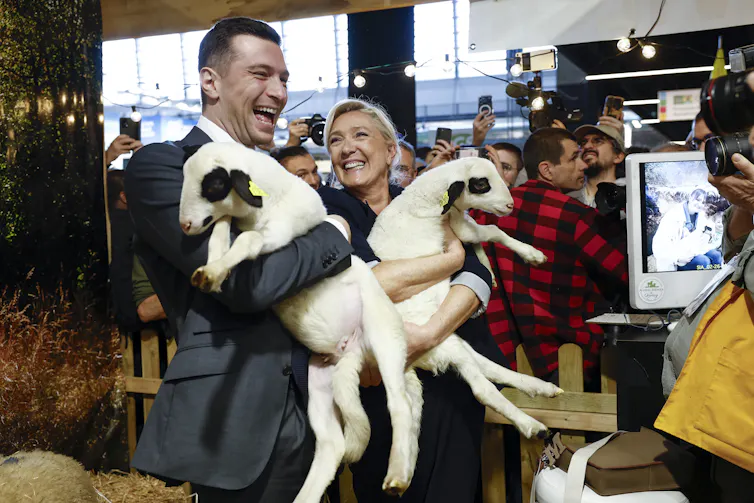
RN leader Marine le Pen and party president Jordan Bardella hold baby lambs and share a joke while campaigning in Paris, February 2026.
No clear path to victory: RN leader Marine le Pen and party president Jordan Bardella campaigning in Paris, February 2026.
EPA/Yoan Valat

Nevertheless, RN supporters could console themselves with some important victories in smaller towns across the south including Carcassonne, Menton and Orange – another municipality originally captured by the party in 1995. The RN also held on to the vast majority of the towns it was already governing, several of which it won outright in the first round. This includes Perpignan, still the largest town run by the party. In these established strongholds, RN mayors have worked to normalise the party’s reputation and professionalise its approach to local governance.

The success of this strategy is shown by the re-election of the longstanding mayor of Hénin-Beaumont, Steeve Briois, with a commanding 78% of the vote in the first round. His success seems to have had a kind of “coattail effect” across the former coal mining basin in France’s far north – with RN victories in a number of neighbouring towns. The consolidation of a solid block of RN-run municipalities in northern France, alongside those in its traditional heartland of the south-east, is one of the most striking outcomes of these elections.

Advertisement

Signs of things to come?

Yet arguably the most significant result for the far right came in a battle between former allies on the centre right. In Nice, France’s fifth-largest city, Éric Ciotti – who broke with the centre-right LR in 2024 to ally himself with the RN ahead of the legislative elections – defeated his former mentor, the outgoing mayor Christian Estrosi.

Ciotti’s victory raises an uncomfortable question for LR. Even as the party nationally held the line against allying with the far right, one of its most prominent former figures has demonstrated that crossing that line can be electorally rewarding. Whether Ciotti’s path remains an isolated case or becomes a template for other ambitious centre-right politicians will be one of the key dynamics to watch as the 2027 presidential campaign takes shape.

These local elections confirm that the RN’s road to the Élysée runs through a France that is not yet willing to hand over the keys. However, the cracks in the adherence of some significant political figures to the front républicain, cracks which became visible in Nice, even if not yet spreading to voters at large, suggest that “not yet” may not necessarily mean “never”.

Advertisement

Source link

Continue Reading
Click to comment

You must be logged in to post a comment Login

Leave a Reply

NewsBeat

Trump is pushing for leadership change in Cuba and the next president could be a Castro

Published

on

Trump is pushing for leadership change in Cuba and the next president could be a Castro

SAN JUAN, Puerto Rico (AP) — As U.S. President Donald Trump pushes for change in Cuba’s leadership, speculation is mounting about who, if anyone, might replace Cuban President Miguel Díaz-Canel.

As Raúl Castro’s handpicked largely figurehead successor in 2018, Díaz-Canel has been the only leader without the last name Castro to govern since the 1959 revolution. He still has two years left in his term —- but some experts and a growing number of Cubans doubt he’ll make it.

Two Castro cousins have come into focus as potential replacements, experts said.

Oscar Pérez-Oliva Fraga — Raúl Castro’s 55-year-old great nephew — has shot to power since emerging from obscurity several years ago. He became minister of Cuba’s influential Ministry of Foreign Trade and Investment in May 2024 and was appointed the island’s deputy prime minister in October.

Advertisement

By contrast, Raúl Guillermo Rodríguez Castro — Raúl Castro’s grandson — has never occupied a government post, having served as his grandfather’s bodyguard and later as head of Cuba’s equivalent of the U.S. Secret Service. He has long been known as “Raulito,” or “Little Raúl” and is new to the spotlight cast on high-ranking government officials.

But he made news last month when he secretly met on the sidelines of a Caribbean Community summit in St. Kitts with U.S. Secretary of State Marco Rubio. At the time, Rubio refused to say who he was speaking to in the Cuban government.

“The role Raulito is playing right now is the connection between Raúl Castro and whoever is on the U.S. side,” said Sebastián Arcos, interim director of the Cuban Research Institute at Florida International University. “He enjoys the absolute trust of Raúl Castro.”

But, Arcos and other experts argue, even should someone with the Castro pedigree take the presidency, little is likely to change.

Advertisement

“Party leadership doesn’t mean anything in Cuba,” Arcos said. “The party is just a hollow façade. The real power resides in the military, under Raúl Castro.”

The 94-year-old remains at the helm as general, appears at key events and is considered the most powerful person in Cuba, a country subject to more than six decades of absolute rule, first by revolutionary leader Fidel Castro, and then for the past decade, his younger brother Raúl.

And that is unlikely to change.

“The most significant thing that we have to consider for the last 30 years in Cuba is the absolute reluctance of this regime to implement serious structural economic reforms,” Arcos said. “Asking them for political reforms would be too much.”

Advertisement

One Castro cousin is described as a technocrat

Pérez-Oliva studied electrical engineering before becoming director general of an import company and then business director within Cuba’s Mariel Special Development Zone. That’s all the Cuban government has officially shared on Pérez-Oliva.

Online, there are barely traces of him; he doesn’t even have a Wikipedia page. His X account is private and inscribed with this sentiment: “Committed to the Revolution and to the ideas of FIDEL.”

Pérez-Oliva until only recently became a public figure, traveling with Cuban Foreign Minister Bruno Rodríguez to Russia and Vietnam earlier this year. He also made a public appearance in early February, when a massive blackout hit Cuba’s western region. While other high-ranking officials solely blamed the U.S. energy blockade, Pérez-Oliva acknowledged otherwise.

“We don’t want to justify ourselves with the blockade; there are a number of internal deficiencies,” he said in a TV interview with state media.

Advertisement

A key achievement came in December, when Pérez-Oliva was named a deputy within Cuba’s National Assembly Popular Power — a requirement for any Cuban president.

Carlos M. Rodríguez Arechavaleta, a Cuba expert and professor at the Iberoamerican University in Mexico City, said Pérez-Oliva has the profile of a technocrat with commercial negotiation skills. “This could be a more ideological figure … a more technocratic, potentially reformist-oriented official,” he said.

Arcos said he believes that Díaz-Canel could “very well be replaced” by Pérez-Oliva.

“This man looks more proper, more polished. He has been through more important positions,” Arcos said. “This is a family business.”

Advertisement

Known as Raulito, this cousin was a fixture on Cuba’s party scene

Rodríguez Castro is the son of Raúl Castro’s oldest daughter, and his father is Luis Alberto Rodríguez López-Calleja — one of Cuba’s most powerful figures who ran GAESA, the military’s long-standing business wing, before his unexpected death in July 2022.

In his youth, Rodríguez Castro became a fixture at Cuba’s music and party scenes. During his public appearances, people would poke each other with an elbow and whisper, ‘That’s El Cangrejo’ — a nickname that means “The Crab,” because he was born with an extra finger.

He went to military school and became Raúl Castro’s bodyguard, accompanying him on trips abroad. Rodríguez Castro was later promoted to head of the Cuban equivalent of the U.S. Secret Service, but with a mission to spy on the country’s leadership, Arcos said.

Then, on March 13, experts noted that Rodríguez Castro was present at a government meeting with Díaz-Canel, when he announced that Cuba had held talks with the U.S. government. He also was present at the news conference that followed.

Advertisement

It was a rare public appearance tied to government business — and drew some public scrutiny from ordinary Cubans.

“The Crab doesn’t have a position there, so I don’t know why he was there,” said 20-year-old Maday Beltrán Acosta. “People posted a lot of comments about it.”

Beltrán Acosta said she also is bothered by Rodríguez Castro’s social media posts because they feature “abundant food.”

“The people are suffering while he enjoys life,” she said.

Advertisement

But Arcos said he doesn’t believe Rodríguez Castro could be Cuba’s next president, at least in public, because his name would reflect a continuation of the island’s current leadership, not a change as demanded by Trump and Rubio.

“He cannot be the transitional figure,” Arcos said, “because his last name disqualifies him.”

“Not up for negotiation”

While speculation remains rampant over whether Cuba might have a new president before Díaz-Canel’s term expires, experts note he is an unpopular leader.

He ordered a crackdown following the July 2021 anti-government protests that stemmed from food shortages, the largest of their kind in decades.

Advertisement

Under Díaz-Canel, Cuba’s economic and energy crises have deepened.

“The living conditions of the population are on the verge of a humanitarian crisis,” said Rodríguez Arechavaleta. “The social situation is already unsustainable.”

Arcos added: “He’s a man with a pot belly in a country where everybody is trying to find (something) to eat.”

Last week, Deputy Foreign Minister Carlos Fernández de Cossío refuted comments about a possible change in the political system or the departure of Díaz-Canel as part of ongoing talks with the U.S.

Advertisement

“The Cuban political system is not up for negotiation, nor is the president, nor the position of any official in Cuba, subject to negotiation with the United States or with the government of any other country,” Fernández de Cossío told reporters.

Arcos, the Cuban expert, said he cannot imagine Raúl Castro relinquishing power but believes Díaz-Canel could be replaced, referring to him as “a gray apparatchik” within the party when he was appointed president.

He noted that Castro’s eventual death “would be the kind of shock that would crack the regime.”

“No one really knows who’s coming up to replace him,” Arcos said. “For the first time ever in Cuba, you have the possibility of several people struggling for power.”

Advertisement

___

Associated Press reporter Milexsy Durán in Havana contributed.

Advertisement

Source link

Continue Reading

NewsBeat

Police called to ‘sudden death’ in Cambridgeshire town

Published

on

Cambridgeshire Live

Emergency services were called to the incident

Emergency services were called to a “sudden death” in a Cambridgeshire town. Cambridgeshire Police were called to Nuffield Road, St Neots, at around 10.30am on Monday (March 23).

A police spokesperson confirmed it was for a “sudden death”. The spokesperson said: “We were at the scene of a sudden death. It is not being treated as suspicious.”


The East of England Ambulance Service has been contacted for further information.

Advertisement

Do you want more of the latest Cambridgeshire news as it comes in from across the county? Sign up to our dedicated newsletter to make sure you never miss a big story from Cambridge or anywhere else in the county. You can also sign up to our dedicated Traffic and Crime newsletters for the latest updates on the topics you are most interested in.

Source link

Continue Reading

NewsBeat

Major hotel group to build swimming pool at Scarborough site

Published

on

Major hotel group to build swimming pool at Scarborough site

​The Clarence Gardens Hotel at Blenheim Terrace in Scarborough is set to build an extension for a swimming pool and jacuzzi, and will convert part of its basement into a sauna and gym.

​Located in the town’s conservation area at Queens Parade, the “delightful boutique retreat combines timeless charm with modern comforts,” the hotel’s website boasts.

​The hotel is part of the “Signature Collection by Best Western” of the global BWH Hotels group.

Advertisement

​Yorkshire Hospitality Ltd’s plan for the 26-room hotel was given the green light by council planners after the scheme was amended.

​A single-storey extension with a roof lantern will be constructed at the rear of the hotel and will host the swimming pool and large jacuzzi facility, which aim to enhance the facilities offered to hotel guests, ensuring the building remains “competitive and attractive in the local hospitality market”.

​The conversion of the hotel’s basement flat will provide space for a gym, changing facilities, and a sauna for the hotel’s residents.

​While the layout of the hotel will be amended, the property will maintain all 26 bedrooms.

Advertisement

​Planning officers said they had no concerns about drainage from the site and noted that there would be no changes to the parking arrangements of the hotel.

​“There is not expected to be an increase in vehicle movements as a result of the development,” according to a planning report.

​The report notes: “Blenheim Terrace and North Marine Road form part of the area’s wide principal streets, lined with imposing Victorian and Georgian terraces orientated to take advantage of extensive views over the North Sea.

​“The locality is characterised by early to mid Victorian architecture, mainly of four storeys.”

Advertisement

​Officers said the development would not result in harm to the distinctive tourism character of the area and that by providing additional facilities, it “could be argued to contribute towards providing tourism facilities with less seasonal emphasis”.

​The planning application was approved by North Yorkshire Council, subject to conditions.

Source link

Advertisement
Continue Reading

NewsBeat

DWP to close two benefits for all new and existing claimants before April

Published

on

Cambridgeshire Live

The DWP is set to complete the final stage of moving claimants from two legacy benefits onto Universal Credit by March 31, 2026.

Two long-standing benefits administered by the Department for Work and Pensions (DWP) will cease on March 31 as the UK Government finalises the last phase of transitioning claimants from older ‘legacy’ benefits to Universal Credit.

Income Support and income-based Jobseeker’s Allowance (JSA) are being phased out as part of the ongoing ‘Managed Migration’ programme, which aims to transition individuals from older benefits to the newer Universal Credit system.

Advertisement

The DWP has already sent out over 1.8 million Migration Notices to claimants who need to switch benefits as the programme nears its conclusion. It is anticipated that most people affected by these changes will have completed their move to Universal Credit by the end of March 2026.

Under the managed migration process, claimants who receive a Migration Notice are required to apply for Universal Credit within a specified deadline. Those who fail to submit a claim in time could see their existing benefits terminated.

The transition of people receiving Income Support and income-based JSA is nearly complete, according to the DWP. These two benefits will officially terminate at the end of March as the government continues its broader reform of the welfare system, reports the Daily Record.

However, ministers have agreed to a brief extension for some cases involving Employment and Support Allowance (ESA). The Department states that many ESA claims are more complex and require additional support to ensure people transition safely to Universal Credit.

Advertisement

Universal Credit is progressively replacing six legacy benefits, including Income Support, income-based Jobseeker’s Allowance, income-related Employment and Support Allowance, Housing Benefit, Child Tax Credit and Working Tax Credit.

The UK Government says that the new system aims to simplify the benefits system by consolidating several payments into a single monthly payment.

The managed migration process has been ongoing for several years and involves directly contacting claimants when it is their turn to transition onto Universal Credit. The DWP sends letters outlining the necessary actions people need to take and offers support for those who require assistance with the application process.

Officials emphasise that ensuring claimants safely transition to the new system remains a priority as the programme approaches completion.

Advertisement

Claimants uncertain about whether they will need to switch to Universal Credit can verify their circumstances through official guidance or on GOV.UK or wait to receive a Migration Notice from the DWP.

The UK Government has stated its commitment to finalising the migration programme in the upcoming months as the last legacy benefits are phased out.

Claimants who receive a Migration Notice from the DWP must apply for Universal Credit by the deadline specified in the letter. If they fail to make a claim in time, their existing benefit payments could cease.

Source link

Advertisement
Continue Reading

NewsBeat

Neil Mendoza launches Tap and Tuk Tuk in Harrogate

Published

on

Neil Mendoza launches Tap and Tuk Tuk in Harrogate

Tap and Tuk Tuk, based at the former Inn at Cheltenham Parade, says it combines “the warmth and familiarity of a classic local pub with the vibrant, dynamic flavours of modern Asian cuisine.”

The venue, in the Timothy-Taylor owned pub, says Tap and Tuk Tuk is set to become a standout destination for food lovers and social drinkers alike.

Business owner Owner Neil Mendoza said: “Back in Asia people love to eat out regularly but without the formality of booking into a restaurant, our vision for Tap and Tuk Tuk is to mirror this informal approach to going out.”

Advertisement

RECOMMENDED READING:
Harrogate hit by claims of having too many restaurants

“We wanted to keep the soul and social element of a traditional pub, but elevate the food offering into something exciting, modern and reasonably priced. It’s about bringing people together over great drinks and unforgettable flavours.” 

At its heart, Tap and Tuk Tuk says it celebrates the best of both worlds.

Guests can expect the comforting atmosphere of a quintessential British pub—complete with expertly poured pints, the full range of Timothy Taylor’s cask ales, and a welcoming homely feel—paired with a bold menu inspired by contemporary Asian street food and culinary trends.

Advertisement

Diners can enjoy small sharing plates bursting with spice – think wasabi prawns, salt and chilli squid, Korean fried chicken followed by hearty mains that put an Asian twist on comfort food – Pad Thai, Lamb Massaman, Nasi Goreng and Seabass Choo Chee to name but a few.

The kitchen focuses on fresh ingredients and punchy flavours, offering an informal dining experience that complements the relaxed pub setting.

Tap and Tuk Tuk features a large outdoor covered seating area— which it says is perfect for al fresco dining, casual drinks, and social gatherings.

For more intimate occasions, a private dining room is also on offer, providing a dedicated space for celebrations, corporate events, and special gatherings. 

Advertisement

No reservations required.

As Neil added: “Wok-Ins Welcome.”

Source link

Advertisement
Continue Reading

NewsBeat

Jonny Bairstow criticises “care” shown by England regime under Brendon McCullum and Rob Key

Published

on

Jonny Bairstow

Bairstow, now 36, scored four hundreds across the first four matches under the current regime in 2022 before suffering a serious leg injury later that year.

He returned for the 2023 Ashes but was dropped the following summer, with his last Test – a match against India in March 2024 – his 100th.

The England and Wales Cricket Board’s review came after this winter’s 4-1 Ashes defeat, a tour blighted by poor planning, substandard performances and off-field issues.

Bowlers such as Mark Wood, who was picked despite missing the entire summer after knee surgery, only to manage just one Test, broke down with injuries while the batting line-up also struggled with only Joe Root and Jacob Bethell making centuries.

Advertisement

“If people get a finger injury, fine, but you have got to be on the park,” Bairstow said.

“It is OK playing four or five games a summer and missing the rest, but you are not backing things up and that is why you get injured.

“I feel for people like Woody. I feel massively for him.

“He bowls at 95mph and is expected to just come in having not come off the back of any overs.

Advertisement

“There is no wonder he has got injured. He has not been done right in my opinion.”

Speaking on Monday, Key admitted England “overvalued loyalty” throughout the Ashes series.

They stuck with under-performing batters such as Zak Crawley and Ollie Pope rather than looking to others who had performed well in county cricket.

Bairstow said: “As soon as you don’t have people chasing you up your back side you become comfortable.

Advertisement

“When you become comfortable you become complacent, and when someone questions you directly you are not used to it because you are in an environment that is potentially not questioning you in a different way.”

Lancashire all-rounder Liam Livingstone hit out at the England hierarchy last week, suggesting he did not want to be part of the recent T20 World Cup squad and was told by coaches he “cares too much”.

Asked about his own chances of a recall, Bairstow added: “Judging by the last few years, I am not sure it is on their agenda.

“It will be an interesting question for you to pose to them if I do go out and score a couple of hundreds early season.”

Advertisement

Source link

Continue Reading

NewsBeat

Harry and Meghan humiliated as 32,000 sign petition against taxpayer-funded trip

Published

on

Daily Mirror

Thousands have signed a petition demanding no taxpayer funding for Prince Harry and Meghan Markle’s upcoming visit to Australia – a huge blow for the A-list couple

Australians are voicing fierce opposition to the idea of taxpayer funds bankrolling Prince Harry and Meghan Markle’s forthcoming visit.

A petition calling on the couple to foot their own bill has already amassed tens of thousands of signatures – even as the upmarket wellness resort Meghan is set to promote grapples with an incomplete pool, a malfunctioning spa and a shoreline littered with sewage debris.

Beyond Australia, a grassroots advocacy organisation, has launched the campaign ahead of the couple’s planned arrival next month, urging ministers to establish a firm boundary – not a single penny of public funds for security provisions, travel logistics or any other expenses the visit might incur.

Advertisement

Ensure our latest headlines always appear at the top of your Google Search by making us a Preferred Source. Click here to activate or add us as your Preferred Source in your Google search settings.

By Tuesday evening, the Change.org petition – bluntly titled No Taxpayer-Funding or Official Support for Harry & Meghan’s Private Visit to Australia – had amassed 32,715 signatures, with numbers climbing steadily.

The group stated: “The activities are private and commercial and must be treated strictly as a private visit.

Advertisement

“At a time when Australians are facing significant cost-of-living pressures, including rising grocery bills, fuel prices, mortgage stress driven by interest rate hikes, and increasing energy costs, public resources must be used responsibly and applied fairly without special treatment for high-profile individuals.”

Trip privately funded The petition surfaced amid genuine confusion, reports the Daily Mail. For several weeks, both federal and state authorities in Australia refused to clarify who would bear responsibility for the couple’s security during their visit – sparking conjecture that Australian taxpayers could be left covering the costs. It has subsequently been confirmed that the trip is being privately funded.

The last occasion the couple set foot in Australia was seven years ago, when they arrived as fully accredited working members of the Royal Family. A security team accompanied them at every public appearance, and Kirribilli House – the Governor-General’s official Sydney residence boasting renowned harbour vistas – provided their accommodation throughout.

The petition is hardly the only complication plaguing the visit. Meghan is promoted as the headline attraction at what’s been billed as an Australian “ultimate girls’ weekend” – a three-day luxury getaway nicknamed “Meg-stock” – and the event has encountered a succession of awkward setbacks.

Advertisement

Her Best Life Retreat spans three days from April 17, attracting a sold-out audience of approximately 300 to a hotel overlooking Coogee Beach. Those who purchased VIP packages will secure front-row positions and receive a group photograph with Meghan at the InterContinental Hotel gala.

The property, which touts itself as heralding “a new era of beachside elegance”, is reportedly in a mad dash to meet its own high standards, according to the report. Its main draw – a brand-new infinity pool offering unobstructed vistas of the Tasman Sea – is still under construction, it’s believed. The spa, bar, and outdoor leisure deck are also anticipated to be completed just weeks before the event.

A recent visitor to the property expressed disappointment to the Daily Mail, describing the ongoing poolside work as “a work in progress” and a “a blot on the view.”

Advertisement

Adding to the woes, the beach directly beneath the hotel has been grappling with a persistent issue. Since 2024, the shoreline has been plagued by an unsavoury occurrence: compact balls of soap residue, cooking fat, hair, chemical waste, and human faeces washing ashore with the tide, a problem that has persisted for over two years.

Despite these mounting challenges, a Sussex spokesperson confirmed a fortnight ago that the Duchess had no plans to withdraw from the event.

Sussex spokesperson hits back

The Duke and Duchess’s representative dismissed the petition with palpable disdain, as understood by the Express.

“It’s a moot point. The trip is being funded privately, so I’m not sure what this petition hopes to achieve,” the spokesperson retorted.

Advertisement

“Of course, if you wanted to dive into the ridiculousness of this petition as an agenda for spreading misinformation, then one could equally hypothesise that there are approximately 26.5 million Australians (99.98% of the population) who haven’t signed it, who must therefore agree with the tax-payer picking up the tab for their visit.

“Of course, that is another equally stupid assertion to make but hey, why let common sense get in the way of a good story…”

Source link

Advertisement
Continue Reading

NewsBeat

Theo Walcott urges Arsenal star to reject England call-up for the World Cup | Football

Published

on

Theo Walcott urges Arsenal star to reject England call-up for the World Cup | Football
Max Dowman became the Premier League’s youngest-ever goalscorer earlier this month (AMA/Getty)

Theo Walcott ‘hopes’ Arsenal midfielder Max Dowman is not called up by Thomas Tuchel for England’s World Cup campaign this summer.

Dowman is widely regarded as one of the best young prospects in English football and earlier this month, the 16-year-old became the Premier League’s youngest-ever goalscorer with a brilliant solo effort to secure Arsenal’s 2-0 win over Everton.

Former Chelsea and England captain John Terry has likened Downman to Lionel Messi, while Tuchel has refused to rule out the prospect of including the uncapped midfielder in his World Cup squad.

‘I think he is at the moment competing and obviously a fantastic talent and an outstanding talent and at his age there cannot be a doubt about it,’ Tuchel said of Dowman last week.

Advertisement

‘Everyone who tells me about Max praises him and is full of compliments about him. The reality at the moment is also that he competes for minutes, he is not a regular starter for Arsenal.

‘He’s in a fantastic environment, the best possible environment. In a competitive and stable club. In a club where teamwork is the number one rule. He’s learning from the very best, in the very best environment.

Arsenal v Everton - Premier League
Thomas Tuchel has refused to rule out the prospect of calling up Max Dowman for England (Getty)

Your football fix

Metro‘s Head of Sport James Goldman delivers punchy analysis, transfer talk and his take on the week’s biggest stories direct to your inbox every week.

Sign up here, it’s an open goal.

Advertisement

‘With these young guys, of course we know all these players. We see them as you do as well. At the moment I think he is in a good place to fight for his minutes at Arsenal. We always have the chance to call him, maybe, up for the World Cup.’

Walcott was in a similar position in 2006 when he was called up by Sven-Goran Eriksson for England’s World Cup campaign at the age of 17 and with no playing time in the Premier League.

Former Arsenal forward Walcott insists he would advise Dowman not to rush his senior debut for England and believes Arsenal are doing the right thing by ‘protecting’ the 16-year-old.

Advertisement

‘I hope he doesn’t go,’ Walcott said in an interview with The Mirror.

Theo Walcott was a surprise inclusion in England’s 2006 World Cup squad (Getty)

‘I don’t mean it in a horrible way because if I could go back in time, I would change things. I would say to myself, ‘no, no, don’t do it’, but then try telling that to a 17-year-old.

‘I do still see him and me differently as he’s playing in the Premier League but he needs to grow at his own pace, especially on the emotional side because he’s a young adult.

‘I had to grow up very fast but this team is still young and not as experienced. He’s being protected, which is important, whereas I had to get thrown in to talk to you lot [the media].

‘In time he will go, yes, but I don’t think this is the time and I think there are better players who arguably deserve to be there ahead of him.

Advertisement

‘He will eventually get there but England have wide players doing really well, there’s Bukayo [Saka], [Noni] Madueke, Jarrod Bowen and Anthony Gordon and Harvey Barnes on the other side.’

For more stories like this, check our sport page.

Follow Metro Sport for the latest news on
FacebookTwitter and Instagram
.

Advertisement

Source link

Advertisement
Continue Reading

NewsBeat

Meet the Belfast teacher sparking a lifelong love of history among her students

Published

on

Belfast Live

“Teaching history has always been far more than a career choice for me – it is a lifelong passion that I feel incredibly fortunate to share with my students every day.”

A Belfast teacher has been named the Northern Ireland winner of the inaugural Inspiring History Teaching Awards.

Advertisement

Elaine McPeake of St Dominic’s Grammar School was selected as the Northern Ireland winner for her outstanding creativity in the classroom and her unwavering commitment to sparking a lifelong love of history among her students.

Judges praised Elaine’s “real love for her subject,” noting that “her passion was infectious,” and highlighting her creativity and dedication to her pupils.

READ MORE: St Paul’s High School Bessbrook leads tributes after death of teacher Denise HaganREAD MORE: Piano teacher blinded in Omagh bombing launches children’s logo contest for new charity

Created by Historic Royal Palaces (HRP), the awards, which recognise educators who bring history to life in innovative and inspiring ways, received thousands of nominations from pupils, parents and colleagues across the UK.

Advertisement

With more than 20 years at St Dominic’s Grammar School on the Falls Road in West Belfast, Elaine has inspired generations of young people through immersive and imaginative learning experiences. Her classroom regularly transforms into vivid scenes from the past – from Anne Frank’s bedroom and First World War trenches to Renaissance ‘Dragon’s Den’ challenges, where students pitch their new inventions in a bid to generate interest and investment.

Her impact extends far beyond the classroom. In 2025, Elaine worked with pupils to create a ‘museum of childhood’, where students researched toys from different eras and collected oral histories from staff. The exhibition gained widespread attention and was later showcased at the Ulster Museum, bringing students’ work to a public audience and highlighting the power of hands-on, creative history education.

Elaine also plays a leading role in extracurricular learning, running a History Club, after-school study sessions and creative workshops, as well as organising trips to significant historical sites locally and internationally. These include visits to Auschwitz as part of Holocaust studies and local landmarks such as Carrickfergus Castle, helping students connect deeply with both global and local histories.

Elaine said: “I am absolutely honoured to be named the Northern Ireland winner of the Inspiring History Teaching Awards. It is a great privilege to receive recognition for the role that history teaching plays in shaping young minds, and for a subject that I have loved since childhood.

Advertisement

Teaching history has always been far more than a career choice for me – it is a lifelong passion that I feel incredibly fortunate to share with my students every day.

Almost 30 years ago, I began teaching at St Dominic’s Grammar School, a Dominican school with a long and rich history in Belfast, and over that time I have had the privilege of working alongside many inspirational educators and young people.

As a school, we are committed to encouraging our students to develop a genuine love of learning, to think independently and to ask questions, rather than simply absorbing information. That ethos has continually shaped my own approach to teaching and strengthened my determination to foster a deep appreciation of history across the school community.

“I firmly believe that history is best brought to life through creativity and hands-on experiences, and it is incredibly rewarding to see students engaging with the past in ways that spark their curiosity and imagination. This recognition means a great deal to me, and I am sincerely grateful to my colleagues, pupils and to Hillsborough Castle and Gardens for their ongoing support.”

Advertisement

Hillsborough Castle and Gardens head Caroline Walker said Elaine is a truly deserving winner whose passion for history shines through in everything she does.

She added: “Her creativity and commitment to bringing the past to life – from immersive classroom experiences to inspiring projects like the museum of childhood – demonstrate the powerful impact great teaching can have on young people.

“The Inspiring History Teaching Awards are about recognising educators who go beyond the curriculum to make history engaging, inclusive and meaningful for their pupils. At Hillsborough Castle and Gardens, we are proud to celebrate educators like Elaine who are helping students across Northern Ireland connect with their heritage, think critically, and develop a lifelong curiosity about the world around them.”

As the Northern Ireland winner of the Inspiring History Teaching Awards, Elaine will receive £500 for herself and £500 for St Dominic’s Grammar School, along with annual memberships to Historic Royal Palaces and the Historical Association. She will also have the opportunity to become a Historic Royal Palaces Teacher Champion.

Advertisement

Elaine is one of ten regional winners from across the UK and will attend a prestigious awards ceremony at the Tower of London on Saturday, June 20, where one overall winner will be announced.

The overall winner will be determined by a judging panel led by much-loved historian and broadcaster Lucy Worsley, who launched the awards in October 2025, and includes some of the UK’s most respected historians, educators and writers: Greg Jenner, Sathnam Sanghera, Dan Jones, Shalina Patel, Katie Hunter and Michael Riley.

Want to see more of the stories you love from Belfast Live? Making us your preferred source on Google means you’ll get more of our exclusives, top stories and must-read content straight away. To add Belfast Live as a preferred source, simply click here.

Source link

Advertisement
Continue Reading

NewsBeat

AI physiotherapist saves Cambridgeshire woman from paralysis after rare diagnosis

Published

on

Cambridgeshire Live

A Cambridgeshire carer credits an NHS AI physiotherapist programme with saving her from paralysis after it flagged symptoms of cauda equina syndrome, a rare spinal condition affecting up to three in 100,000 people

A 47-year-old woman from Cambridgeshire has spoken of the “unbearable pain” she endured – to the point where she wished someone would amputate her “leg off” – before receiving a rare diagnosis that affects up to three in 100,000 people through an AI physiotherapist.

Advertisement

Amie Smith, a carer, said she first experienced lower back pain on Sunday April 20, 2025. Initially, she tried to manage it with painkillers, but within days, the pain had escalated to “excruciatingly painful” levels and had spread down her body into her legs.

The mother of three secured an urgent GP appointment on Tuesday April 22 and was referred to an AI physiotherapist programme named Flok Health, which was being trialled by the NHS trust in her area.

Following a consultation with the AI-powered physiotherapist, Amie received a call on Monday April 28 from Kirsty Henderson, senior physiotherapist at Flok Health. Henderson suggested that Amie might be suffering from cauda equina syndrome, a condition characterised by compression of the spinal nerves at the tail end of the spinal cord. If left untreated, this can lead to paralysis and incontinence, according to the NHS.

The following day, Amie was rushed to hospital where she underwent an MRI scan and was diagnosed with the condition. This led to a five-hour emergency lumbar decompression surgery on May 1.

Advertisement

Speaking to PA Real Life, Amie said: “Initially, I thought (an AI physiotherapist) is not very personal. I felt like I was probably talking to a robot that couldn’t really help me.

“But, actually, if it wasn’t for that process, I wouldn’t have gotten the help that I did, and ultimately I would have had a lot more damage.

“I think there’s a lot of people in my generation and upwards that are very negative (about AI), but I’m really quite thankful for it,” she added.

Advertisement

Following a fibromyalgia diagnosis in 2018 – a chronic condition that causes pain throughout the body – Amie said she has lived with discomfort ever since, but what she experienced in April 2025 felt “completely different”.

Amie said: “I’ve always suffered with back pain, but this was excruciatingly painful.

“I left it for a few days thinking that if I just take pain relief and I carry on, I should be fine. But it just gradually got worse.”

Amie arranged a telephone consultation at her GP surgery on Tuesday, April 22, but she said the doctor “automatically” wanted to “blame” her new pain on her fibromyalgia, despite Amie’s insistence that it was “different” and that she was really struggling to walk by that point.

Advertisement

Amie said she was directed to the Flok Health app, which was introduced in February 2025 by Cambridgeshire Community Services NHS Trust (CCS) as a means to help reduce NHS back pain waiting lists. She didn’t initially use Flok, because she didn’t think it was “very personal”, so when her pain worsened she opted instead to request an e-consult from her GP, which she didn’t hear back from. Amie said she submitted another one the next day and when she didn’t get a response from that one too, she decided to give Flok a go on Friday, April 25.

According to Flok Health, patients receive an invitation to complete an automated video call assessment and during this consultation an AI-powered physiotherapist will evaluate their symptoms to determine the right treatment.

It was during this consultation that Amie said the AI physiotherapist flagged her symptoms and lack of movement as serious, so encouraged her to go to A&E, where she was prescribed muscle relaxants and was sent home.

By Monday, April 28, Amie said she was “beside” herself in pain and she hadn’t heard anything back from her e-consult requests, but then her phone rang around 5pm. She said she was “pleasantly surprised” to receive an hour-long telehealth appointment with Kirsty Henderson from Flok, calling to see how she had got on at the hospital.

Advertisement

Amie said: “I described everything to her and I just felt like she was able to do what nobody else had: Give me time to tell exactly how this is affecting me and what’s happening.

“Straight away, she said that I definitely needed an MRI.

“She explained to me that it could be something called cauda equina, and that getting help urgently is essential because the longer it goes on, the more damage that can be done.

Advertisement

“That was the first time out of all the people I spoke to that anybody actually told me that I was at risk,” she added.

After gaining the confidence from Kirsty to advocate for herself, Amie said she contacted her GP the next morning, but didn’t make any progress. Consequently, a friend of Amie’s took her back to A&E, where she said doctors noticed she was “extremely upset” so they checked her blood pressure and found it was “really high”.

Amie stated she was taken “straight through” to being admitted and saw a doctor who conducted some initial tests and immediately sent her for an MRI scan. Within hours, Amie said an orthopaedic doctor described it as a “really bad situation” where her discs had slipped and they were trapping the nerves – something she later discovered in her GP’s notes as cauda equina syndrome.

Half an hour later, Amie said she was in the back of an ambulance being transferred to a nearby specialist hospital, where she spent a couple of days, until she informed a doctor that the back of her leg was numb so she was rushed into a five-hour lumbar decompression surgery on May 1.

Advertisement

Since the operation, Amie said her pain has eased but she has had to make some “adaptations” because she still doesn’t have full use of her left leg, such as driving her son’s automatic car instead of her manual one. She said she also struggles to walk for extended periods.

Mike Passfield, the deputy director from Cambridgeshire Community Services NHS trust, told PA Real Life: “The new AI-assisted approach is having a significant impact in our region, enabling thousands of patients to get faster access to expert physiotherapy support.

“Not only is the technology capable of treating and discharging patients at scale, but its red flag system means patients with more serious or extremely rare conditions are identified and directed to the right human-led service quickly to get the appropriate care.

“During a pilot of Flok Health in Cambridgeshire last year, we cut waiting lists by more than half. Thousands more people are getting immediate access to support thanks to the new approach, transforming the way we deliver physiotherapy,” he added.

Advertisement

After everything settled down, Amie said: “I went back to Kirsty to really thank her because I honestly felt like she was the only person that actually listened.

“She realised the red flags, talked me through it, explained the risks and what she was concerned about, and even gave me advice on how to try to get the doctors to help me.

“Now I can see that every 24 hours that was going by, more damage was being done to my body.

“That damage is still here today to a point, but had I not spoken to Kirsty and then gone on to follow what I’ve been told to do, I probably would have been unable to walk.

Advertisement

“I feel like I owe a lot to Kirsty. She made a huge difference,” Amie said, still surprised by how it all “started” with an AI physio.

Source link

Continue Reading

Trending

Copyright © 2025