
Entertainment
Three Dog Night Frontman Chuck Negron Dead at 83

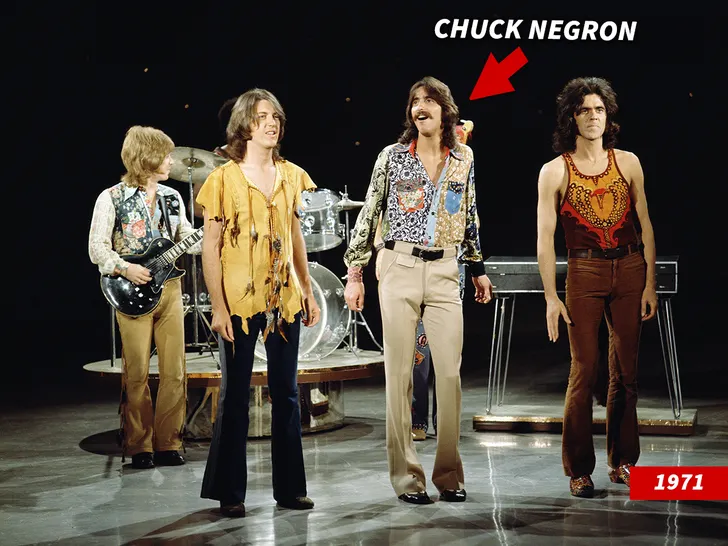
Chuck Negron
Three Dog Night Singer Dead at 83
Published
Chuck Negron — one of the founding members and frontman of rock band Three Dog Night — has died.
The singer died on Monday at his home in Studio City, CA surrounded by family, according to his obituary. A cause of death has not been immediately revealed, but the singer battled chronic obstructive pulmonary disease (COPD), for decades, and suffered from heart failure at the end of his life.
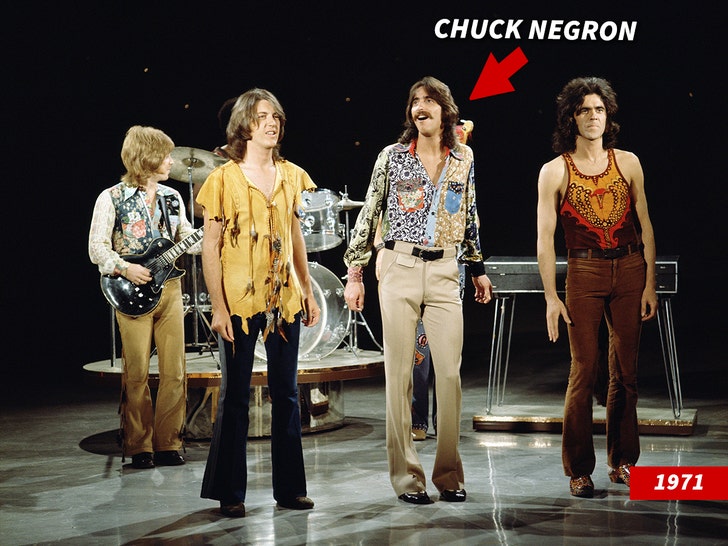
Negron was born in 1942 and raised in the Bronx, New York, and moved to Los Angeles to play basketball for California State University. During this time, he explored music as he had grown up singing in doo wop groups.
He formed Three Dog Night in 1967 with Danny Hutton and the late Cory Wells, and their genre-defying blend of R&B, rock ‘n’ roll and urban doo-wop music paired with modern, forward-looking production helped them become one of the biggest groups of the ‘60s and early ‘70s.
Some of their biggest songs include “Joy To The World (Jeremiah Was A Bullfrog),” “One (Is The Loneliest Number),” “Easy To Be Hard,” “Black and White” and “Mama Told Me (Not to Come).” The band’s final Billboard Hot 100 hit came with 1975’s “Til the World Ends.” The band broke up in 1976 due to internal conflicts.
Negron struggled with his skyrocketed fame and fell into deep drug use — he even spent his entire earnings on drugs and hit rock bottom when he called Skid Row his home. After cycling through rehab several times, he got clean in 1991 and pulled off a major comeback, launching a successful solo career that saw him release 7 albums between 1995 and 2017.

He recalled his ups and downs with addiction in his acclaimed 1999 book, “Three Dog Nightmare.”
He is survived by his wife Ami Albea Negron, his children Shaunti Negron Levick, Berry Oakley, Charles Negron III, Charlotte Negron, and Annabelle Negron, his brother Rene (Jody) Negron, sister Denise (Janey) Negron and his 9 grandchildren, 5 nieces and 2 nephews.
He was 83.
RIP.

Continue Reading
Entertainment
‘Stranger Things’ Creators’ New 8-Part Sci-Fi Mystery Series Checks Into Netflix in First Trailer

It’s only been a bit over three months since Stranger Things came to an end on Netflix, yet creators Matt and Ross Duffer haven’t slowed down. Back in March, the brothers served as executive producers on Haley Z. Boston‘s acclaimed new horror miniseries Something Very Bad Is Going to Happen at the streamer. They’re also bound to return to Hawkins, Indiana, on April 23 with the animated spin-off Stranger Things: Tales From ’85, taking viewers back to the time between Seasons 2 and 3 of their platform-defining megahit. Despite all of that, there’s still one more series they have planned for 2026, and it’s set to premiere next month.
On May 21, Netflix will debut The Boroughs, another project the Duffers executive-produced that was born out of their desire to support up-and-coming creators. In this case, those creators were Jeffrey Addiss and Will Matthews, the duo behind The Dark Crystal: Age of Resistance. Their project shares a lot of DNA with Stranger Things, only instead of following kids battling otherworldly threats in Indiana, it’ll center on misfit seniors in a seemingly idyllic retirement community in New Mexico. The titular Boroughs promises paradise for its residents, though a newcomer, Sam, played by Spider-Man 2 fan-favorite Alfred Molina, finds it to be more like a prison that becomes something far worse after a terrifying nighttime encounter. The first official trailer has now been released, teasing what horrors await him and the colorful group of fellow nursing home renegades who are ready to unravel what’s happening at the Boroughs before their time runs out.
The welcomes both viewers and Sam to The Boroughs, which acts as a fully-functioning little village in the desert packed with activities, gorgeous little houses, and a sense of autonomy for its residents. Sam can’t help but be a curmudgeon about the move, but it quickly becomes a new chapter of his life in the most unexpected way once he moves in. During one night, he sees an inhuman arm pushing through his oven, kicking off a journey both horrifying and fantastical where he joins forces with his fellow neighborhood outcasts in a fight to uncover the truth. There’s a Steven Spielberg-like sense of wonder as the group, also featuring a former journalist and a spiritual seeker, among others, forms a tight-knit companionship and sneaks into the heart of the Boroughs, where mystery abounds.
Who Makes Up ‘The Boroughs’ Ragtag Group of Seniors?
The two-time Emmy-nominated Molina is joined in his journey through the Boroughs by a diverse cast of veteran actors playing his fellow residents. Geena Davis, Alfre Woodard, Denis O’Hare,Clarke Peters, Bill Pullman, Carlos Miranda, Jena Malone, Seth Numrich, and Alice Kremelberg make up the main group, with additional Ed Begley Jr., Dee Wallace, Eric Edelstein, Rafael Casal, Mousa Hussein Kraish, Beth Bailey, Karan Soni, and Jane Kaczmarek. In an interview with Collider’s Taylor Gates last year for The Last Frontier, Woodard credited that star-studded roster for convincing her to come aboard, saying, “the coolest thing about it was that the first six or seven people on the call sheet were over 62.” Behind the camera, capturing the sort of “quirky and fun” yet still high-stakes horror, are directors Ben Taylor, Kyle Patrick Alvarez, and Augustine Frizzell.
The Boroughs premieres on Netflix on May 21. Check out the trailer in the player above.

- Release Date
-
May 21, 2026
- Network
-
Netflix
- Directors
-
Augustine Frizzell, Kyle Patrick Alvarez, Ben Taylor
Hayley Erbert reflected candidly on motherhood following the arrival of her first child with Derek Hough.
Taking to Instagram on Saturday, April 11, Erbert, 31, shared a carousel of four images that captured daughter Everley, born on December 29, 2025, being doted on by her professional dancer mom. The photos were accompanied by Erbert’s heartfelt musings.
“My love. My girl. My world. Motherhood is even more complex and contradicting than I could have ever imagined. It feels like living in two places at once. Where joy and heartache can both be true, all of the time. My heart is constantly bursting open, while also breaking into a million pieces,” Erbert wrote. “I find myself celebrating every little bit of your growth, while quietly grieving the version of you that existed just moments before.”
Hough, 40, shared news of his daughter’s arrival via Instagram on January 5. “Everley Capri Hough 🤍,” the Dancing With the Stars judge wrote alongside a black-and-white photo of his and Erbert’s hands cupping their baby’s feet. “Every step of our lives has led us to you. Our hearts have been cracked wide open and our world is forever changed.”

While Dancing With the Stars’ Hayley Erbert and Derek Hough are happily preparing for the arrival of their first baby, the pair are also marking Pregnancy and Infant Loss Awareness Month by opening up about Ebert’s first pregnancy, which ended in a miscarriage. “There are some things in life that change you forever,” they wrote […]
Hayley’s post also reflected on how her own world is adjusting to the “beautiful contradiction” that is motherhood. “This pull between holding on and letting go, between wanting time to slow down and knowing it never will,” she explained. “If this is the dichotomy of motherhood, then I’ll try my best to meet it with open arms. Soaking in every little detail, every version of you, every fleeting moment we have together.”
She concluded the post, “I love being your mom. I love you beyond, Everley. I have truly never felt a love like this.”
Hough was one of many who shared support on the post, writing, “😢❤️My girls,” in the comments section. Fellow DWTS personality Jenna Johnson Chmerkovskiy also wrote, “So beautifully said!!!” while Daniella Pashkova commented, “The best🥹💜.”
Erbert and Hough started dating in 2015 and announced their engagement in June 2022 before tying the knot the following year. After almost two years of marriage, Erbert announced her pregnancy via Instagram in July 2025.


“We can’t believe the biggest thing to happen to us could be so small,” she captioned a video that showed Erbert holding sonogram images.

Hayley Erbert has been counting down the days until she and husband Derek Hough meet their little one. The mom-to-be, 31, embraced her curves in new maternity photos shared via Instagram on Tuesday, December 30, showing off her transformation in the weeks leading up to their child’s arrival. “This pregnancy ♥️ Forever in awe of […]
The couple also shared their baby’s birth via social media, too, posting footage from Erbert’s home delivery via the social media platform on January 29. In the clip, Erbert was seen sitting in a birthing pool surrounded by candles inside the couple’s home as Hough stroked his wife’s hair.
The footage also showed their daughter earth-side, with Hough sharing a kiss with Erbert in the moments that followed.
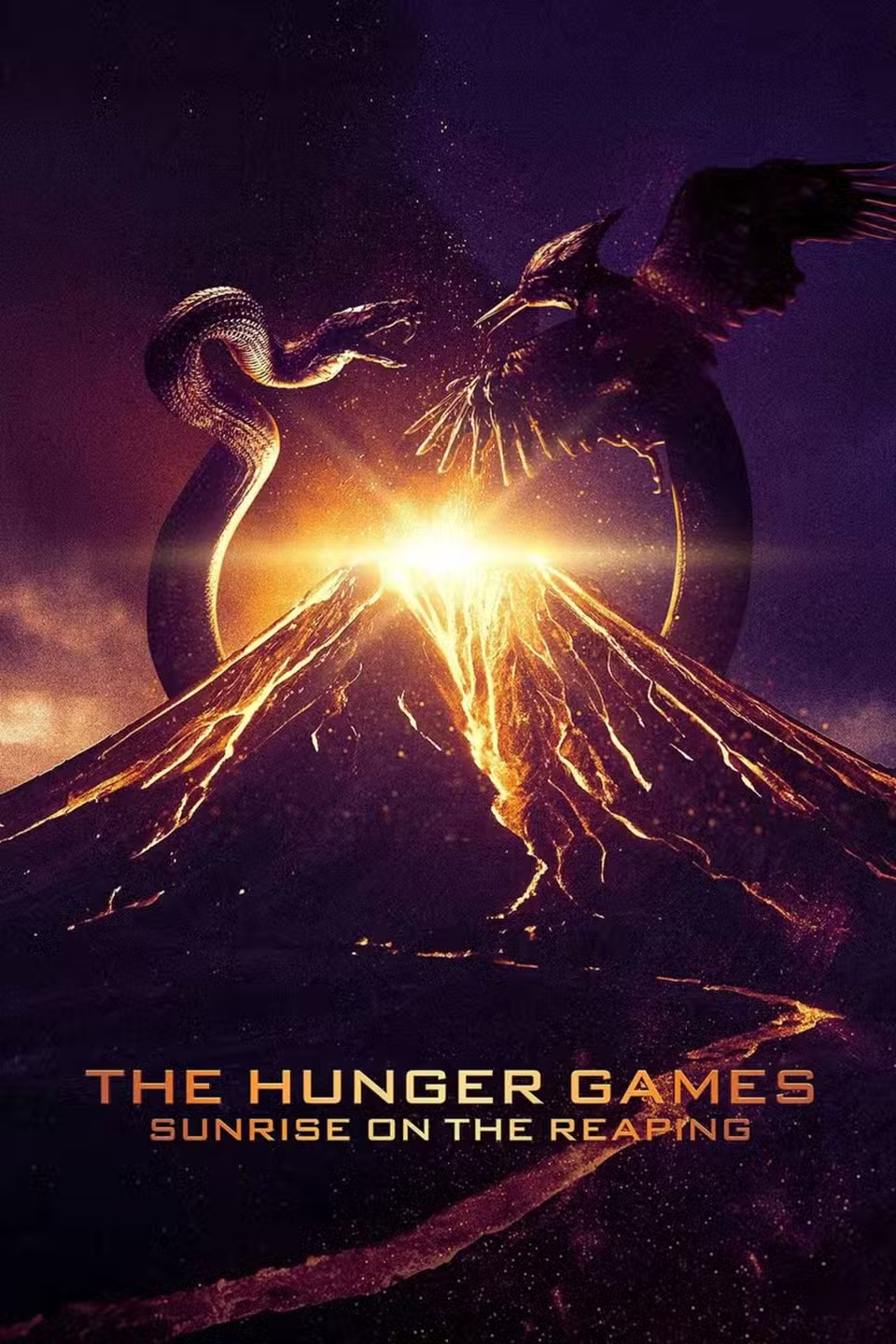
There are movie franchises that come and go, and then there’s The Hunger Games, which somehow always finds a way to pull everyone right back into Panem the second new footage drops. That world still has a grip on people, and not just because of the arena itself. It’s the cruelty, the politics, the heartbreak, and the way every new chapter comes pre-loaded with some fresh emotional damage. Sunrise on the Reaping was already one of the most anticipated franchise movies on the calendar. Now the new trailer has made the wait feel even longer.
Lionsgate has released a new trailer for The Hunger Games: Sunrise on the Reaping, giving fans their latest look at the prequel ahead of its November 20, 2026, theatrical release. The film is directed by Francis Lawrence and written by Billy Ray, adapting Suzanne Collins’ 2025 novel of the same name. The story is set 24 years before Jennifer Lawrence’s Katniss Everdeen entered the arena and follows the 50th Hunger Games, better known as the Second Quarter Quell.
The Hunger Games: Sunrise on the Reaping stars Joseph Zada as a young Haymitch Abernathy, with Ralph Fiennes playing President Coriolanus Snow, Jesse Plemons as Plutarch Heavensbee, Elle Fanning as Effie Trinket (in an utterly inspired fan casting come to life), Kieran Culkin as Caesar Flickerman, Mckenna Grace as Maysilee Donner, Ben Wang as Wyatt Callow, Maya Hawke as Wiress, Kelvin Harrison Jr. as Beetee Latier, Lili Taylor as Mags Flanagan, Whitney Peakas Lenore Dove Baird, Molly McCann as Louella McCoy, Iona Bell as Lou Lou, and Lili Taylor returning as Mags. Lawrence will reprise her role as Katniss Everdeen in the film too, having confirmed her part earlier this year. Alongside Lawrence, Josh Hutcherson is also set to reprise his role as Peeta in the epilogue.
What Can We Expect From ‘Sunrise on the Reaping’?
Mckenna Grace spoke to Collider’s Perri Nemiroff last year, singling out Zada’s performance as a standout, which is a big statement to make given how emotional the films have proven to be from the days of Jennifer Lawrence.
“Joseph Zada. Just his performance, everybody’s going to be, like, freaking sobbing in the theaters. It’s rough. Because I’m supposed to be the mean, most stuck-up girl in town, but I’m watching him do his thing and, like, oof, it’s very gut-punchy. And Glenn Close as Drusilla, all of us have been losing our minds. It’s been crazy. And also, Grace [Ackary], who’s playing the younger version of Asterid, Katniss’ mom, is really fantastic. But to me, it’s just crazy watching her on screen because she looks so much like her, so it’s so trippy. God, our entire cast is so good. Everybody’s so good.”
Sunrise on the Reaping hits theaters on November 20, 2026.

- Release Date
-
November 20, 2026
- Director
-
Francis Lawrence
- Writers
-
Billy Ray, Michael Lesslie, Suzanne Collins
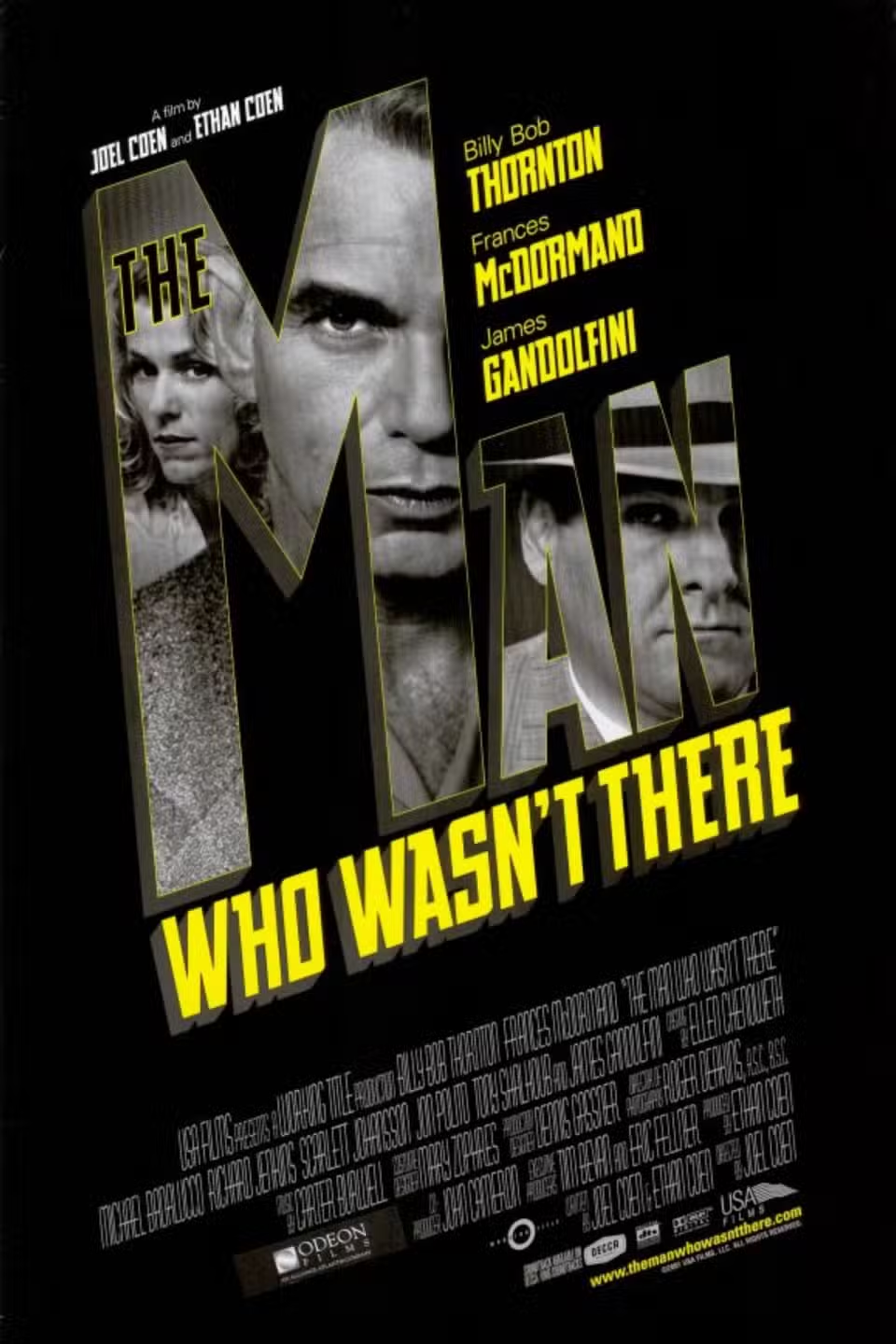
Joel and Ethan Coen are responsible for so many all-time great classics that it’s easy to take them for granted. While most cinephiles are familiar with the brutal neo-Western No Country For Old Men, the darkly comedic mystery Fargo, the cult classic The Big Lebowski, and the soulful music drama Inside Llewyn Davis, some of their best films have fallen under the radar, including The Man Who Wasn’t There.
While not a direct remake, The Man Who Wasn’t There is an homage to the film noir movement of the 1940s, and shares many tonal and stylistic similarities with classics like Double Indemnity, Mildred Pierce, and many thrillers directed by Alfred Hitchcock. Although the aesthetics alone make it worthy of a recommendation, The Man Who Wasn’t There ranks among the Coens’ best thanks to the amazing performance by Billy Bob Thornton.
What Is ‘The Man Who Wasn’t There’ About?
Set a few years after the conclusion of World War II, The Man Who Wasn’t There stars Thornton as the lowly barber Ed Crane, who works in a shop that is owned by his older brother, Frank (Michael Badalucco). After suspecting that his wife Doris (Frances McDormand) is secretly having an affair with his boss, Big Dave (James Gandolfini), Ed decides to stage a blackmail scheme. What he does not anticipate is that Big Dave will end up embezzling funds from a department store in order to pay off the blackmail, and ends up beating to death the businessman Creighton Tolliver (Joe Polito) after he reveals Ed’s involvement. Ed has no option but to kill Big Dave in self-defense, in what becomes the first in a series of crimes he commits to divert attention away from his insidious scheme.
There’s a clever double meaning to the title of The Man Who Wasn’t There as it relates to Ed; while it suggests that he is able to perform a nefarious scheme without anyone noticing, it also suggests that he was so anonymous in the way that he conducted his life that virtually no one paid attention to what he was actually doing. Extra-marital affairs are common plot devices within noir films, but The Man Who Wasn’t There subverts expectations of the genre by turning the “wronged” party into the protagonist of the story. While there isn’t much suggestion that there’s been any real affection between Ed and Dorris for quite some time, it’s implied that his anger towards Big Dave is one that involves ego. Ed has grown so irritated by how Big Dave acts callously without ever facing a consequence that he takes it upon himself to take advantage of the situation. What begins as a misguided attempt at justice ends up revealing a dark side of Ed that he becomes more acquainted with as the story continues to get more disturbing.
Billy Bob Thornton Is at His Most Ruthless in ‘The Man Who Wasn’t There’
Thornton is able to craft an intriguing anti-hero in The Man Who Wasn’t There, as Ed is undoubtedly a bad guy who is still compelling to watch. The Coens are keen to show that in this era of affluent business and a booming economy, many selfish people are trying to take advantage of their wealth and privilege. It’s easy to sympathize with Ed early on, as he is brilliant at using his enemies’ weaknesses against them to come up with a con. However, Thornton can make Ed into a steadily more terrifying character when it becomes clear that his desire for power cannot simply be cut off.
Thornton is a perfect fit for the Coens’ style of filmmaking, and it’s a shame that he never worked with them again. Thornton was able to embody the blend of social satire, dark humor, and thinly veiled morality that are essential components of the Coens’ filmmaking habits. Thornton likely has high standards of any script he attaches himself to, as he is an Academy Award-winning screenwriter in his own right; thankfully, the Coens were up to the challenge and ended up providing him with one of their greatest characters.

The Man Who Wasn’t There
- Release Date
-
November 16, 2001
- Runtime
-
116 minutes
- Director
-
Joel Coen
- Writers
-
Joel Coen, Ethan Coen
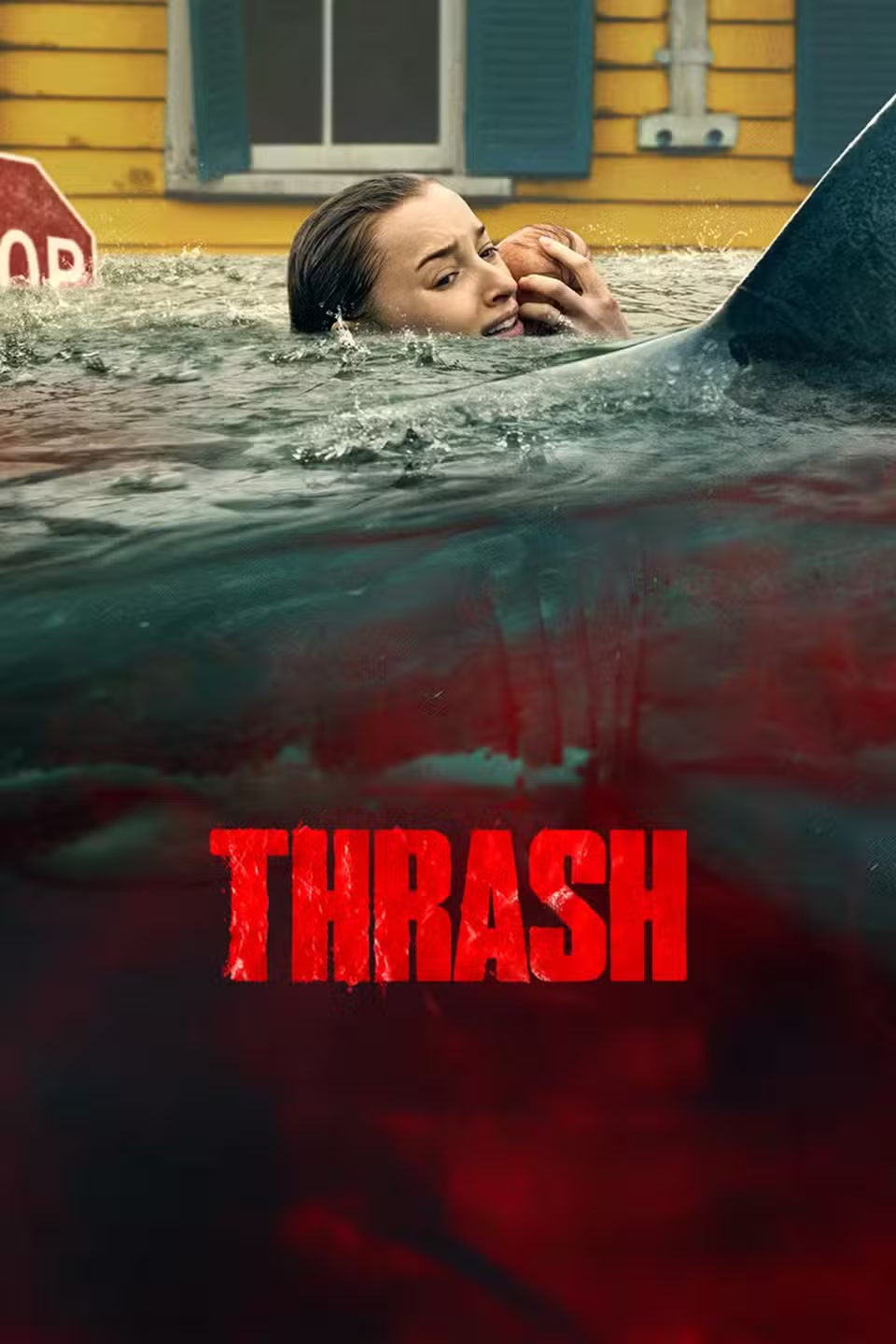
Netflix has dropped a lot of thrillers that get a quick burst of attention and then vanish into the algorithm void a few days later. Thrash doesn’t look like it’s heading that way. The new shark survival movie arrived with a pulpy, high-concept hook that basically sells itself, and viewers around the world seem to have gone for it immediately. A disaster movie with sharks was always going to be catnip for a certain kind of streaming audience. Now the numbers are backing that up in a big way.
Thrash is now the No. 1 movie on Netflix worldwide, according to FlixPatrol’s chart for April 11, 2026, where it sits well ahead of the rest of the film lineup. The title is currently leading Netflix’s global movie chart with 926 points, putting it comfortably ahead of second-place Striking Distance.
That momentum is also playing out country by country. FlixPatrol’s latest chart shows Thrash at No. 1 in multiple territories, which helps explain why the film already feels like one of Netflix’s first real global movie breakouts of the month. Directed by Tommy Wirkola, Thrash is set in a coastal town hit by a catastrophic Category 5 hurricane, where stranded residents suddenly find themselves dealing with rapidly rising floodwaters and hungry sharks. The film stars Phoebe Dynevor, Whitney Peak, and Djimon Hounsou.
Is ‘Thrash’ Any Good?
Critics, though, have been a lot less enthusiastic than viewers clicking play. On Rotten Tomatoes, Thrash currently holds a 37% Tomatometer score from 27 reviews, along with a 38% audience score. The Guardian gave the film a one-star review, which is a bit yikes, let’s be honest:
“Back in 2018, David Ellison found Alex Garland’s stylish and scary sci-fi thriller Annihilation “too intellectual” so passed it to Netflix for the majority of international territories. In early Covid, Disney sold the unusually excellent Fear Street trilogy to Netflix. Just last year, Netflix saw its biggest hit to date with KPop: Demon Hunters, a film that had originally been intended for a Sony release. But Thrash is not a fellow exception to the rule; if anything, it acts as the very definition of what the rule usually is: a messily made, choppily edited and entirely misfiring cavalcade of bad decisions and dodgy accents. I just hope Netflix got it on the cheap…”
Thrash is streaming on Netflix now.

- Release Date
-
April 10, 2026
- Runtime
-
83 Minutes
- Director
-
Tommy Wirkola
Cast
-

Phoebe Dynevor
Lisa Fields
-

-

-

Justin Bieber is not letting outside noise faze him after receiving mixed reviews for his 2026 Coachella set.
“This is Justin in 2026. He doesn’t have anyone pushing him to do these huge pop spectacles like a 3D concert movie anymore. It’s all about vibing and enjoying where he’s at now,” a source exclusively tells Us Weekly. “There’s a lot less pressure on him, which allows him to put on the show that he wants to.”
Bieber’s highly-anticipated Coachella performance on Saturday, April 11, primarily featured tracks from his Swag and Swag II album, but he also showed YouTube clips from his original music videos on his laptop to reminisce.
While the minimalist set received some criticism from fans, the insider tells Us that the now-viral clips from Bieber’s YouTube performances “were only a small part of a much larger set.”

Hailey Bieber remains her husband’s biggest fan. After Justin Bieber announced he will perform at the 2026 Coachella Valley Music & Arts Festival, multiple sources exclusively tell Us Weekly that his wife was the one to encourage him to book the gig. “Hailey was a big influence on Justin’s decision to headline Coachella,” one source […]
“He didn’t sit behind a computer the whole time,” the source explains. “Anyone who watched the full show saw that.”
The insider explains that Bieber’s YouTube segment was an “homage” to how the musician “got his start.”
“It was meant to show his journey from posting videos on YouTube to performing on one of the world’s biggest stages, also on YouTube,” the source shares. “Hailey [Bieber] thought it was adorable and very Justin. It was exactly what he planned and rehearsed.”
Us Weekly reached out to Bieber’s team for comment.

After Justin Bieber nearly bared it all on the 2026 Grammy Awards stage, he and wife Hailey Bieber opted for a wardrobe change. Justin, 31, topped the pink boxers he wore onstage Sunday, February 1, with a pair of low-slung, baggy denim jeans with an open, terrycloth hoodie. Hailey, 29, meanwhile, traded her strapless black […]
While performing, Justin, 32, made sure to give a shout-out to wife Hailey, 29, and the couple’s son, Jack. (The pair welcomed their first child in 2024.)
“Hailey, babe, hallelujah,” Justin sang while performing “Everything Hallelujah,” per social media footage. “Baby Jack, hallelujah.”
Hailey was seen blowing a kiss back to him and waving at Justin from the audience. Justin is scheduled to return to the main stage on Saturday, April 18, during the second weekend of Coachella.
Ahead of the singer’s duel performances, a separate source told Us that Bieber’s crew is “filming both weekends for a special project.” The news came after an unconfirmed Deuxmoi blind item reported that Justin was part of a documentary-style film with Netflix.
“Justin doesn’t feel he has something to prove, but at the same time, he wants to flex that he can put on a memorable show without a huge team like he once had,” the insider said of his Coachella set, referring to his 2023 split from longtime manager Scooter Braun. “It’s all his vision, brought to life by just a few people.”
Entertainment
When does “The Punisher: One Last Kill” come out? Inside Frank Castle's next blood-soaked rampage
:max_bytes(150000):strip_icc():format(jpeg)/Punisher-One-Last-Kill-Jon-Bernthal-041026-1da8d2516faa407d8399909b05221be3.jpg)
Jon Bernthal is back as the gun-touting vigilante in the gritty Disney+ special.
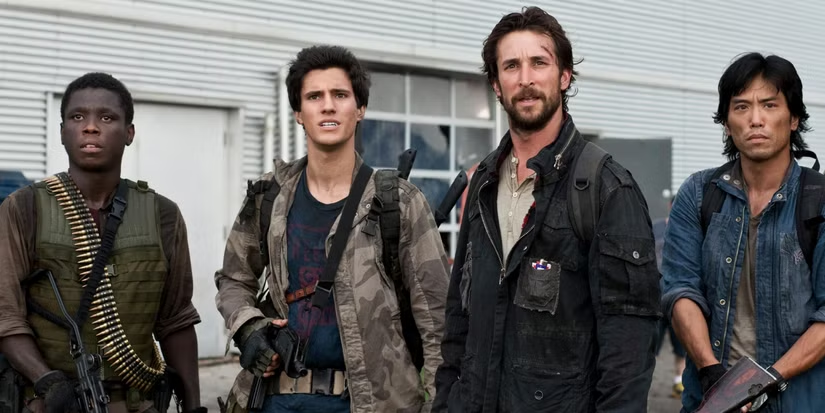
In 2011, for a short time, cable television produced a new science fiction show that attracted 5.9 million viewers on its first day. Falling Skies, which starts after the end of the world, was created by Robert Rodat and executive-produced by Steven Spielberg.
Those 5.9 million viewers didn’t happen by chance, but the show is rarely mentioned when the subject of defining sci-fi in the 2010s is concerned. The show faded from the spotlight, and it appears more than a little overdue for a second look.
What Happens in ‘Falling Skies’?

Falling Skies doesn’t provide us with the exciting invasion scenes that most other TV shows offer. The Earth has already been invaded, the worst has already happened, and most of the human race has perished or scattered apart from each other, struggling to survive. The format of that particular show sees us follow Tom Mason (Noah Wyle), who was once a history professor and now leads the civilian resistance group called 2nd Mass. He lacks the usual advantages of strength or firepower, but he wields the power of knowledge, which is limited by having to learn how to play the game of war again outside the old rules of warfare.
As this group continues to move around in their search for food and weapons, they always play cat and mouse with the aliens that are taking over the place. The show does a good job of showing the challenges of everyday survival during these bad days, including arguments over strategy, short supplies, and the quiet weight of people they’ve lost. It builds tension without overstating it. The alien threat adds another layer that hits harder than expected. Children are captured and fitted with biomechanical harnesses, turning them into extensions of the enemy.
Why ‘Falling Skies’ Deserved More Attention During Its Original Run

The first stretch leans on familiar ideas, and you can feel it searching for its voice; then it starts to settle. By the middle seasons, the writing tightens, and the characters begin to feel more defined. What helps is how the story opens up. When it comes to the invading aliens, a larger entity lies behind their presence on Earth — resource extraction, control, and a broader conflict that humans have been drawn into without understanding it. New factions appear, alliances shift, and the stakes grow without pulling attention away from the central group.
The genesis of the show depends on the continual balance between their being there and the ongoing success of maintaining their own being in a world that no longer functions as it once did. Wyle anchors that approach as his performance never tips into theatrics; he plays Tom as someone who’s exhausted but keeps moving forward anyway, which makes the leadership feel earned rather than assumed.
A lot of long-running genre series struggle to close things out. Falling Skies doesn’t stall when it reaches the end. The final season brings the larger conflict into focus, including the force behind the invasion itself. The story narrows in a way that works, pushing toward a direct confrontation rather than stretching the narrative beyond what it needs to. The resolution leans on sacrifice, and it doesn’t try to soften that. Characters pay for the choices they’ve made, and the outcome reflects the tone the show has carried from the start — hard-won, uneven, but still forward-moving. There’s a quieter moment at the end that lands just as well, when Tom is offered a leadership role in rebuilding what’s left of the world, and he turns it down. After everything, stepping away feels like the only honest choice.
Why ‘Falling Skies’ Is Worth Watching Now

That 5.9 million viewer premiere stands out more now than it did at the time. Back then, it made Falling Skies one of cable’s biggest launches of the year. The series benefited from weekly releases, which gave it time to grow and gave viewers space to stay engaged. Five seasons felt like a complete run, not an overextension like many shows these days.
These days, now that the show has been on Netflix, it is much easier to catch up with it if you haven’t seen it before. The pacing is consistent, you understand what happens, and once the show hits its stride, it moves with purpose so you don’t feel like you’re going around in circles. If you are watching for the sci-fi elements, those are all present — aliens, large-scale conflict, evolving mythos. Conversely, if you are watching because of the characters, they are all there, too. The show told a complete story from beginning to end and said goodbye when it reached its goal. Because of that, the show is far more impressive today than it was when it first aired on TV.

When the first movie is the great one, you can at least say the series began at its peak. When the last movie is the great one, you can argue the whole thing was building toward payoff. But when only the middle chapter becomes the masterpiece, it usually means the trilogy hit a level of confidence, emotional precision, and narrative intensity that the other two films never fully reached before or after. That middle film becomes the one time the machine is running at exact temperature.
And that does not always mean the other two are bad. Sometimes the first film is strong. Sometimes the finale is respectable, ambitious, or even moving in places. But the middle one is where character, stakes, conflict, and craft suddenly stop feeling like pieces of a franchise and start feeling inevitable. The middle-films I’ve listed below pass that test with excellent marks.
6
‘X2: X-Men United’ (2003)

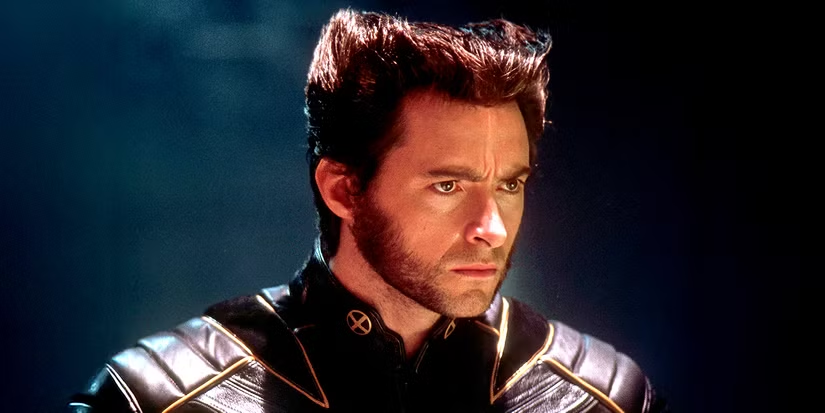
I have affection for the first X-Men, and I think The Last Stand has fragments of a much better movie trapped inside it, but X2: X-Men United is the one time that original trilogy truly feels complete. The reason is simple: it stops acting like the mutants are just a superhero team and starts treating them like a political, emotional, and biological crisis from every angle at once. The school attack alone tells you the movie has leveled up. Wolverine (Hugh Jackman) is not just the cool outsider anymore. He is suddenly in a position where the kids need him, and the mansion feels less like a comic-book base than a fragile refuge being violated.
The other reason why X2: X-Men United is extremely special is how well it spreads dramatic pressure across the whole cast. William Stryker (Brian Cox) being power-hungry, Magneto (Ian McKellen) gets to be dangerous, charismatic, and perversely right about how far humans will go, Mystique (Rebecca Romijn) becoming more than attitude and blue makeup, all of it is spot on. Then Jean Grey (Famke Janssen), Scott Summers (James Marsden), Storm (Halle Berry), Nightcrawler (Alan Cumming), Rogue (Anna Paquin), Pyro (Aaron Stanford), and Iceman (Shawn Ashmore) all feel like they belong to the same morally loaded story instead of separate subplots jostling for space. And then the film’s act with the uneasy alliance between Professor Xavier (Patrick Stewart)’s team and Magneto’s side is where X2: X-Men United really earns masterpiece status.
5
‘Dawn of the Planet of the Apes’ (2014)

I like Rise. I admire War. But Dawn of the Planet of the Apes is the masterpiece because it is the one that fully understands tragedy as a social process. It is not just a sequel about apes and humans clashing. It is a movie about trust being built slowly and then destroyed by fear, pride, grief, and opportunism. That is much richer material, and the movie handles it beautifully. What makes Dawn of the Planet of the Apes so devastating is Caesar (Andy Serkis). By this point, he is no longer simply the emotionally intelligent center of a franchise reboot but a leader carrying history in his body.
He remembers captivity. He remembers revolt. He has built a world for his people in the forest, a world with family, rules, and dignity. So when the humans arrive needing access to the dam, the whole movie immediately gains pressure because coexistence is possible, but only barely. That barely is where the film lives, and it is why every exchange matters. Malcolm (Jason Clarke) reaches for peace in good faith. Ellie (Keri Russell) sees the apes as beings, not obstacles. Dreyfus (Gary Oldman) wants survival badly enough that fear keeps turning into hardline logic. Koba (Toby Kebbell), most importantly, carries trauma like acid. And Koba is why Dawn of the Planet of the Apes becomes a masterpiece. He is the embodiment of what happens when memory of abuse never stops organizing your worldview.
4
‘Before Sunset’ (2004)

This one may be the quietest entry here, but emotionally it might be the most lethal. Before Sunrise is beautiful. Before Midnight is fearless and bruising. But Before Sunset is the masterpiece because it is the one that turns romantic possibility into emotional reckoning with almost unbearable precision. Nine years have passed, and Richard Linklater understands the most important thing about that gap: it is not just time. It is accumulated life. Failed relationships, compromises, self-invention, regret, the stories people tell themselves about why they didn’t choose differently, all of that is in the room before Jesse (Ethan Hawke) and Céline (Julie Delpy) even properly reconnect.
That is why Before Sunset is realistic. It runs on conversation, but the conversation is not casual. It is excavation. Every smile has history under it. Every joke is covering pain or testing intimacy. Jesse arrives with a novel that has obviously kept this one night alive inside him for almost a decade. Céline arrives with anger, intellect, charm, and that very particular kind of adult self-protection where someone can sound breezy while actually trying not to reopen a wound. Hawke and Delpy are so good here. The film lets attraction and disappointment coexist in every scene. It is not “do they still like each other?” Of course they do. The real question is whether recognition came too late to matter. At each stage they get less able to lie cleanly. The Paris sunlight almost makes the movie feel easy at first, which is cruel, because by the time Céline talks about the environmental work she throws herself into and Jesse starts revealing how dead his marriage feels, you understand what this movie is actually doing: measuring the damage of one missed chance.
3
‘The Empire Strikes Back’ (1980)

This is one of the clearest examples of the middle chapter outgrowing the trilogy around it. I love Star Wars. I think Return of the Jedi has real emotional payoff. But The Empire Strikes Back is the masterpiece because it takes everything the first film made mythic and then subjects it to difficulty, failure, and emotional complication without losing one ounce of adventure power. The brilliance starts immediately with Hoth. The rebellion is not triumphant and mobile anymore. It is freezing, cornered, improvising under pressure.
Luke Skywalker (Mark Hamill) gets pulled further into the Force, but the movie is careful not to make that growth clean or easy. Yoda (Frank Oz)’s training is not there to hand him cool powers. It is there to reveal impatience, fear, and incompleteness in him. Han Solo (Harrison Ford) and Leia Organa (Carrie Fisher), meanwhile, are getting one of the best romance-through-friction arcs ever put into a blockbuster. And then there is Darth Vader (David Prowse). This is the movie where he stops being a great villain design and becomes something much worse and better: a personal catastrophe. The film ends on pain, uncertainty, and separation. That is why The Empire Strikes Back remains untouchable.
2
‘The Dark Knight’ (2008)

The reason The Dark Knight towers over the trilogy is that it is the one chapter where the franchise stops being primarily about Batman and becomes about what Batman does to the moral chemistry of Gotham. Batman Begins is strong because it builds Bruce, fear, and the city. The Dark Knight Rises has ambition, but it buckles under the weight of its own ending. The Dark Knight is the one that feels like a total statement. Nothing in it is merely setup or cleanup. Everything is active pressure.
Batman (Christian Bale)’s existence has produced a new class of criminal response. Harvey Dent (Aaron Eckhart) is introduced not as a replacement hero in a simplistic sense, but as the legitimate public face Gotham desperately needs so Batman can imagine becoming unnecessary. Rachel Dawes (Maggie Gyllenhaal) sits in the middle of Bruce and Harvey not just as romance, but as a measure of which version of Gotham still feels possible. Then the Joker (Heath Ledger) comes in and does not simply threaten lives. He attacks the terms by which the city understands order, heroism, and moral choice. That is why the major sequences all matter beyond spectacle. The bank robbery, fundraiser, interrogation scene, and then Batman taking the blame at the end is the final proof that this chapter understood sacrifice at the level of myth and politics at once.
1
‘The Good, the Bad and the Ugly’ (1966)

This is #1 because it does something very few middle chapters ever do: it becomes so monumental that it practically rewrites the scale of the trilogy around it. A Fistful of Dollars is great. For a Few Dollars More is excellent. But The Good, the Bad and the Ugly is the masterpiece because Sergio Leone stops making just westerns and starts making a world. Bigger, dirtier, more ironic, more tragic, more expansive, more musically mythic. It feels like the trilogy suddenly realizing how enormous it can be. The thing people undersell is how well The Good, the Bad and the Ugly is written. Blondie (Clint Eastwood), Tuco (Eli Wallach), and Angel Eyes (Lee Van Cleef) are not just types.
Their motives are incredibly clean, and the movie keeps tightening the lines between them until the whole treasure hunt becomes a study in greed, dependency, humiliation, and tactical patience. Tuco is a huge part of why the film clears the others. Wallach gives him so much hunger, resentment, cunning, and wounded pride that the movie stops being a cool-guy western whenever he is on screen. He makes it human and ugly in the right way. Blondie is brilliant too — someone always slightly withholding moral clarity, which keeps the film from becoming simple hero mythology. And Angel Eyes is one of the great western villains. Then the Civil War material enters and The Good, the Bad and the Ugly becomes even richer. Not to mention that it had a perfect ending too.
The Real Housewives of Atlanta’s Drew Sidora has publicly addressed a court order that instructed her to vacate the home she shares with estranged husband Ralph Pittman.
According to court documents obtained by TMZ on Friday, April 10, Sidora, 40, was ordered to vacate the former couple’s marital residence in Georgia “by May 31.” The outlet also reported that Sidora and Pittman, 43, “will share joint legal custody” of their two children: son Machai, 10, and daughter Anija, 8. (Sidora is also mom to son Josiah, 15, from a previous relationship.)
Sidora addressed the legal situation via an X statement on Sunday, April 12. “Good morning. Some details regarding my divorce have recently become public, although the process is not yet finalized. During this time, Ralph and I are committed to co-parenting and doing what’s best for our children,” she wrote. “While certain things are beyond my control, my focus remains on showing up every day as the best mother I can be.”
Her statement continued, “Living in the public eye comes with challenges, but I’m choosing to move forward with grace, growth, and intention. My children are my priority, and I’m committed to leading with love, peace, and positivity. There is no ill intent toward anyone, just a continued focus on healing, evolving, and becoming the best version of myself.”

Drew Sidora is keeping it real when it comes to her divorce from her estranged husband Ralph Pittman. “It’s still not settled and yes, we’re still living together under the same roof,” Sidora, 39, told People in an interview published Friday, July 19. The Real Housewives of Atlanta star went on to share that her […]
Us Weekly has reached out to a representative for Sidora for comment.
TMZ also noted that a judge said “due to the current financial circumstance of the parties,” Sidora will “continue splitting the expenses” until she “leaves the home.”
Sidora, who joined RHOA in 2020’s season 13, told Us Weekly in November 2025 that despite Pittman filing for divorce from her after eight years of marriage in February 2023, he remained living in the basement. (Sidora filed her own divorce petition after Pittman’s was filed, and the pair have been going back and forth in court for months amid accusations spanning alleged infidelity and unpaid loans.)

Hours after their split news broke, Drew Sidora and Ralph Pittman’s divorce is already getting messy. The Real Housewives of Atlanta star accused her estranged husband of cheating and abuse in new court documents. TMZ obtained the Bravo star’s amended divorce complaint on Wednesday, March 1. In the paperwork, Sidora states that she cannot take […]
“Him downstairs, still there, and we’re still going through the process,” Sidora told Us at BravoCon 2025. “I was actually supposed to be in my final trial today, so this has been a very difficult, challenging day, but the judge allowed me to be here because it was so important for me to show up and be here. So I’m grateful.”
A representative for Sidora told TMZ on Friday, “This matter is still being actively litigated, and is in the middle of the final trial. The Second Temporary Order is, in fact, temporary, and does not reflect the final outcome of the case.”
Entertainment16 seconds ago
‘Stranger Things’ Creators’ New 8-Part Sci-Fi Mystery Series Checks Into Netflix in First Trailer

Fashion1 minute ago
Heist Studios Shorts Collection for Women

NewsBeat3 minutes ago
Manhunt launched after mysterious meat which made dogs unwell left in London park | News UK


-

 Politics3 days ago
US brings back mandatory military draft registration
-

 Fashion3 days ago
Weekend Open Thread: Veronica Beard
-
 Sports3 days ago
Man United discover Nico Schlotterbeck transfer fee as defender reaches Dortmund agreement
-

 Tech6 days ago
How Long Can You Drive With Expired Registration? What Florida Law Says
-

 Politics23 hours ago
World Cup exit makes Italy enter crisis mode
-

 Crypto World4 days ago
Canary Capital Files SEC Registration for PEPE ETF
-

 Business3 days ago
Tesla Model Y Tops China Auto Sales in March 2026 With 39,827 Registrations, Beating Cheaper EVs and Gas Cars
-

 Crypto World5 days ago
Bitcoin recovers as US and Iran Agree a Ceasefire Deal
-

 Politics3 days ago
Malcolm In The Middle OG Turned Down ‘Buckets Of Money’ To Appear In Reboot
-

 Fashion6 days ago
Let’s Discuss: DEI in 2026
-
 NewsBeat15 hours ago
Pep Guardiola and Gary Neville agree over Arsenal title problem that benefits Man City
-

 Business3 days ago
OpenAI Halts Stargate UK Data Centre Project Over Energy Costs and Copyright Row
-

 Business2 days ago
Ireland Fuel Protests Enter Day 5 as Blockades Spark Shortages and Government Prepares Support Package
-

 Politics3 days ago
LBC Presenter Mocks Trump Over Iran War Failures
-

 Crypto World3 days ago
Federal judge blocks Arizona from bringing criminal charges against Kalshi
-

 Tech4 days ago
A version of Windows 10 released a decade ago is now eligible for additional security patches
-
 NewsBeat1 day ago
JD Vance announces ‘no agreement’ with Iran over nuclear weapons fear
-

 Business3 days ago
IMF retains floor for precautionary balances at SDR 20 billion
-
Business2 days ago
Coreweave CSO Venturo sells $5.5m in class a common stock
-
Sports2 days ago
1st-Round WR Enters Vikings Mock Draft Orbit
You must be logged in to post a comment Login