In addition to screen time, the type of school to attend, the content children consume and the food they eat, a new concern cropped up for parents over the last few years: Whether to keep their children back a year from entering kindergarten.
“Redshirting,” a reference to collegiate sports in which the athlete sits out a year to boost their skills, has crept into the decision making process for parents with children on the cusp of the age cut-off in kindergarten, usually age 6 in most states. Parents can either have the student as one of the oldest in their grade or among the youngest, with some believing holding their child back can help academic achievement.
But according to a new report, the practice is not becoming more widespread. It has hovered steady at around 5 percent, since the the 1990s and 2010s, The number reached 6.4 percent during the pandemic.
“One of the reasons we wanted to look into it is because we felt like everyone talks about it, but only 1 in 20 students actually do it,” says Megan Kuhfeld, director of modeling and data analytics at NWEA, an education research firm. “So why does it feel like everyone was considering it for their children?”
Advertisement
Kuhfeld hypothesizes the smaller, more vocal group of parents considering redshirting was amplified on social media, but when it came time to make the decision, outside factors – like paying for an extra year of child care, which is becoming more costly than ever — played a large role.
“It might seem that this is a good idea but it’s, ‘We’re on the hook for an extra $15,000 in child-care costs,’ which may not be practical for a lot of families,” Kuhfeld says, adding she expects redshirting to stay steady. “The types to consider it will likely continue to, but a lot of people consider it then decide it’s not practical for a lot of reasons.”
The NWEA study did find more young boys were likely to be kept back than girls, with white students more often than nonwhite students. In the 2021 year, there were also upticks in rural areas, jumping from 6.2 percent to 9 percent, and high poverty areas, jumping from 2.2 to 4.7 percent. That could be because child care is more affordable in smaller towns, or easier to find with a friend, family or neighbor.
Proponents of redshirting say it gives the child an academic and social advantage being an older kindergartner. However, the benefits generally are short-lived, according to the NWEA report. While children initially saw higher reading and math scores, equating to about 20 percent to 30 percent of a year of learning, those results evened out by third grade, when the children who entered kindergarten early catch up to the redshirters.
Advertisement
While children who started kindergarten later initially saw a large academic advantage in math and reading scores, by third grades, those gaps were filled.
Source: NWEA
There is at least one strong reason not to redshirt, according to the American Economic Association: Children who started kindergarten after 5 years old are more likely to drop out later on.
“People often focus on the short-term gains, but it’s important to keep in mind the perspective of what it means to be the older kid in class, where you turn 18 your junior year of high school,” Kuhfeld says. “It’s just keeping in mind these longer term outcomes and making the best decision for your child.”
Some states have begun pushing toward a forced redshirting of sorts. North Carolina public schools shifted its age cut off in 2007, requiring students to be 5 years old or older on Aug. 31, upping the date from a previous mid-October cut off.
Advertisement
Jade Jenkins, an associate professor of education at University of California, Irvine, found in a report that forced redshirting brought pros and cons. It helped math and reading scores in third through fifth grades, and students with forced delays into kindergarten also had a 4 percent increase of being identified as academically gifted. However, the same report found students had a 6 percent drop in disability identification. According to Jenkins’ research, it benefitted lower-income, white students but brought no benefit to Hispanic students.
“Is the valuation of the academic benefits of delayed entry higher than the costs of the hold-out year and the public costs of increased racial-ethnic achievement gaps? Future research can provide a more precise estimate of this calculation, but we find this unlikely,” Jenkins says in the report.
The latest redshirt debate is one of several parents surrounding kindergarten. Some state legislators are pushing for it to become mandatory across the nation, with others concerned about the dipping levels for kindergarten readiness. It has also become more academic-focused than ever, which in part spurred the latest NWEA study.
“We wanted to get this information out in an accessible way to have both the advantages and disadvantages, and not get caught up in blanket guidance,” Kuhfeld says.
Advertisement
“Especially in high socio-economic status schools and districts, there’s already an arms race by preschool to get situated for college, which is where a lot of this comes from,” she adds. “There’s this attitude of, ‘We have to take every avenue to get ahead’ and I don’t think that is healthy.”
$30bn went to OpenAI; the rest is spread across CoreWeave, IREN, Corning, Nebius, and roughly two dozen private rounds. The pattern is closer to vertical integration than to venture investing, and is starting to draw the inevitable circular-deal questions.
NVIDIA has committed more than $40 billion to AI equity investments in the first four months of 2026, CNBC reported, citing public filings and corporate disclosures.
The single largest line in that total is the $30 billion the chipmaker put into OpenAI in late February. The remaining $10 billion-plus is spread across seven multi-billion-dollar deals in publicly traded companies, plus roughly two dozen private startup rounds.
On the public side, the disclosed cheques include up to $3.2 billion in Corning, the optical-fibre and ceramics maker that supplies AI-data-centre fabric, and up to $2.1 billion in IREN, the data-centre operator that is converting from Bitcoin mining toward GPU compute.
Advertisement
Both took the form of warrants or structured commitments rather than straight equity, with cash outflow timed at Nvidia’s discretion. The chipmaker also added to its CoreWeave and Nebius positions during the period.
The CoreWeave stake, $2 billion last January, is now valued at roughly $4.4 billion and represents about 28% of Nvidia’s listed equity portfolio.
The $2bn Nebius investment in March is smaller in dollar terms but carries an explicit five-gigawatt deployment commitment; the new $2.1bn warrant on IREN sits on a similar logic.
The pattern across these is consistent: capital flows to companies that buy Nvidia GPUs at scale and re-rent them to hyperscalers and frontier-model builders, a structure the industry now calls a neocloud.
NVIDIA’s own framing of the strategy is straightforward. CFO Colette Kress said on the most recent earnings call that the company invests where it sees a need to ensure that compute capacity is being built around its hardware.
Advertisement
Last fiscal year, the company put $17.5 billion into private companies and infrastructure funds, primarily early-stage startups, according to its 10-K. The 2026 pace already exceeds the previous full year.
The investments themselves are mostly small relative to Nvidia’s roughly $200 billion in cash and equivalents, which means they do not strain the balance sheet; what matters is what they signal about how the chipmaker views its place in the AI value chain.
That place is increasingly upstream and downstream of the chip itself. The OpenAI investment is not a standalone bet; it is paired with multi-year compute commitments and silicon roadmap alignment.
The CoreWeave and Nebius positions come with capacity reservations and joint-architecture agreements. The Corning investment supports the optical-interconnect supply chain Nvidia depends on for next-generation data-centre fabrics.
Advertisement
Looked at end-to-end, Nvidia is buying influence over how its silicon is paid for, deployed, and connected. Some analysts call this vertical integration; others call it circular financing.
The circular-deal critique has gained traction over the past two quarters. NVIDIA takes a position in a company; that company then signs a long-term GPU purchase commitment with NVIDIA; some of the GPU revenue flowing back to NVIDIA could be characterised as a return on the same equity it just invested.
The pattern with Nvidia’s smaller portfolio companies is the same shape, just with more counterparties.
Advertisement
There are reasons the comparison is partly unfair. Nvidia’s investments are usually minority positions in companies that have plenty of other customers; Meta’s $21bn add-on with CoreWeave demonstrates that CoreWeave’s customer base is broader than Nvidia.
Mistral AI, Wayve, Lambda Labs, Genesis Therapeutics, Recraft and JetBrains are all customers or investments that have independent commercial logic.
The criticism applies more sharply to deals where Nvidia is both a meaningful equity investor and a contractually committed customer of the same company; CoreWeave’s $6.3 billion capacity-purchase agreement with Nvidia is the most-cited case of that.
The bigger question is what happens to the portfolio when AI compute demand normalises. Most of Nvidia’s bets are financially small relative to the parent’s revenue and cash position, so a write-down event would not impair the core business.
Advertisement
The more important risk is reputational. Each new deal that looks structurally similar to a previous one adds to the perception that Nvidia is bankrolling its own demand curve.
Both Wall Street and the SEC are starting to ask whether the disclosure regime around these arrangements is keeping pace with their scale.
For now, the strategy is producing the outcome Nvidia wants. AI infrastructure capacity is being built where Nvidia silicon runs, model providers are securing compute they could not otherwise have built independently, and the chipmaker’s data-centre revenue is growing accordingly.
The 2026 pace of equity commitments suggests Nvidia intends to keep writing the same kind of cheque for as long as the demand-supply mismatch persists.
Advertisement
CNBC’s count of seven public-market multi-billion deals plus 24 or so private rounds is, on its own terms, a record-setting tempo. It also positions Nvidia as the largest single source of AI infrastructure financing in the market, alongside the major hyperscalers.
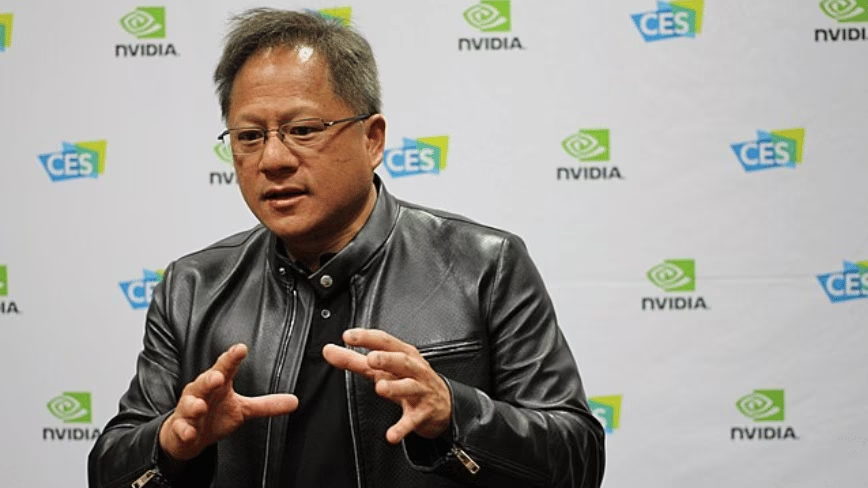
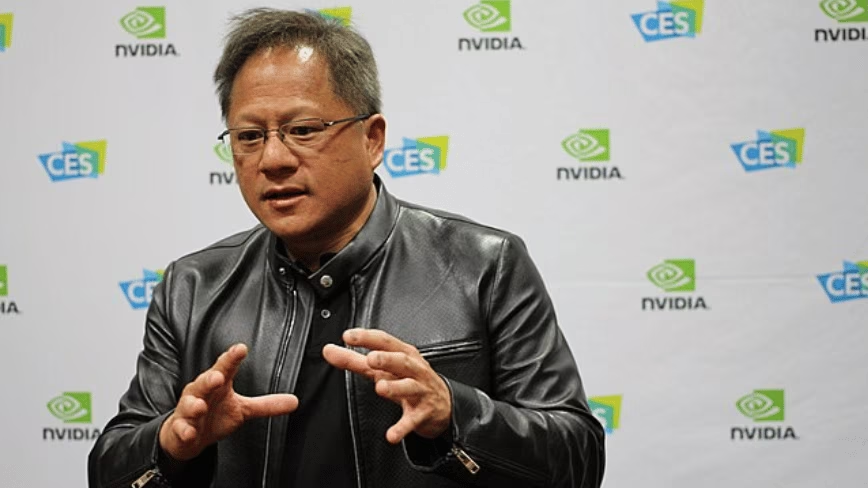
The role suits Jensen Huang’s narrative about being the platform of the AI era. Whether it suits the auditors and the regulators is the next question.
The Qwen app gets access to Taobao and Tmall’s catalogue of more than 4 billion items, plus Alipay-native checkout, in what is the largest agentic-commerce launch yet from a Chinese platform.
Alibaba is integrating its Qwen AI app with Taobao and Tmall, the company’s two largest consumer marketplaces, in what amounts to the most ambitious test yet of agentic shopping at scale, Reuters reported on Saturday, citing a source familiar with the plan.
Under the integration, the Qwen app gains access to the entire Taobao-Tmall catalogue, more than four billion items, and to a layer of Alibaba-built skills that handle logistics, customer service and after-sales workflows.
From inside Qwen, a shopper will be able to ask the agent to find a product, compare it across sellers, run virtual try-ons, monitor a 30-day price track and place an order.
Advertisement
The 💜 of EU tech
The latest rumblings from the EU tech scene, a story from our wise ol’ founder Boris, and some questionable AI art. It’s free, every week, in your inbox. Sign up now!
The transaction itself completes through Alipay, with the AI agent stepping back only for the final user confirmation. Inside Taobao, the same Qwen models will power a shopping assistant integrated with the existing app rather than as a standalone surface.
The architecture is a notable break from the way most Western e-commerce platforms have approached generative AI.
Advertisement
ChatGPT’s shopping integration with Shopify and Amazon’s Rufus assistant largely produce search-style answers; the buy-flow happens in the underlying retailer’s app or website, with payment, delivery and returns handled by separate systems.
Alibaba’s design treats the entire purchase, including payment and post-sale interactions, as something the AI agent can complete end-to-end. The four-billion-item catalogue is a meaningful difference too. Even an aggressive Western comparison falls short by an order of magnitude.
The company’s framing is explicit. Wu Jia, Alibaba Group VP, told a launch event that the strategy was about moving “from intelligence to agency.”
In a live demo, Qwen took a request for forty cups of bubble tea from a local chain, placed the order through Taobao Instant Commerce, applied loyalty discounts and completed the Alipay checkout, with delivery a short time later.
Advertisement
CEO Eddie Wu has positioned the spend behind this push as part of the more than $53 billion AI commitment Alibaba announced last year, framing AGI as a central group strategic goal.
The launch lands inside a fast-moving Chinese agentic-commerce market. Tencent’s ClawPro enterprise agent launch positioned ClawPro at enterprise customers; ByteDance’s Doubao has integrated similar capabilities into WeChat-adjacent surfaces.
Alibaba has been the most vocal of the three about consumer-side agentic flows, and the Qwen-Taobao integration is its largest move so far.
Earlier in 2026, Qwen reached 300 million monthly active users across Taobao, Tmall, Alipay and other consumer surfaces, with about 140 million first-time AI shopping experiences logged during the Chinese New Year campaign.
Advertisement
There are competitive and regulatory caveats. Alibaba’s e-commerce business has been losing share to PDD Holdings (parent of Pinduoduo and Temu) and to Douyin’s commerce surfaces, which is part of why the company is willing to gamble on a UI shift this large.
The 2021 fine has not been forgotten, and Alibaba has been more cautious than its peers about where it puts the AI agent, what data it stores, and how it handles user consent.
Strategically, the integration also fits Alibaba’s broader split-out strategy of recent years. Alibaba has been reorganising its consumer-internet, cloud, and logistics arms into separately governed units; the Qwen-Taobao tie reverses that direction, pulling cloud-side AI capability into a consumer surface to defend the marketplace business.
Advertisement
The implicit bet is that AI-native commerce is a sufficient step change that owning both halves matters more than the structural separation that has otherwise been progressing.
There are gaps that the launch does not address. Cross-border commerce, where Alibaba’s growth ambitions sit, is harder; Qwen’s integration with overseas Alibaba surfaces has been considerably more cautious.
Western retailers and platforms watching this launch will want to know whether the agentic checkout works for casual buyers as well as the enthusiast users who tend to test new commerce surfaces first.
Conversion data, average order value, and return rates are the metrics that will determine whether this becomes more than a flagship demo. The company has not committed to disclosing those metrics.
Advertisement
For now, the proposition is clear and the scale unmatched. China’s largest e-commerce platform is asking its users to talk to an AI rather than tap through a product grid.
Whether that becomes the default flow or shoppers prefer the muscle memory of the familiar app will be visible in the second-half retail-festival numbers.
Over cold drinks in the Florida heat, this TechCrunch reporter watched from the paddock as founders and investors — the rich and the richer — mingled in search of deals. Conversations barely paused, except for the occasional glance at the track where drivers, sealed inside multi-million-dollar machines, chased the chequered flag.
F1 weekend is a three-day affair, with the race as the finale. In between are kickoffs, soirées, cocktail parties, dinners, and nightclub takeovers — spaces where business and pleasure blur. Events like this, where wealth concentrates, have historically been places where business deals are struck. But the popularity of the F1 paddock has grown in recent years, especially among the startup and venture crowd.
“It’s a hot place for everyone with access trying to strike a deal,” one founder said, recalling being brought to the paddock by a venture firm two years ago.
This year, Chandler Malone, a founder, said he didn’t even attend the race; he only went to some of the side events. So many venture firms were hosting them and much more than usual, he said.
Advertisement
“You name the fund, it was someone there hosting clients,” Marell Evans, an investor, also told TechCrunch. “Lots of folks missed Milken for F1 Miami.”
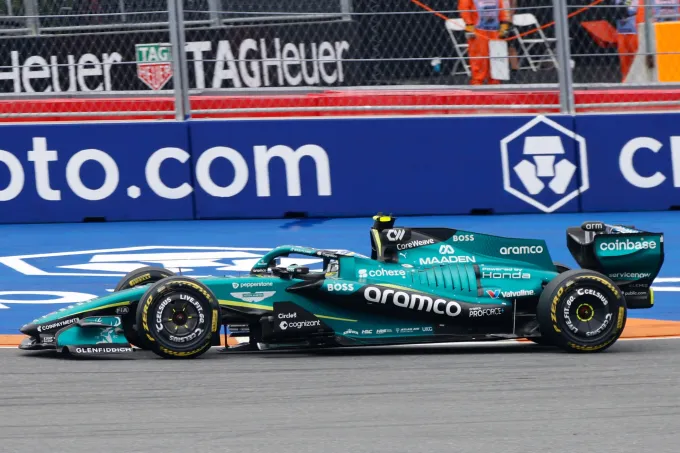
F1 teams, once sponsored by major oil, tobacco, banks, and alcohol companies, have embraced the new railroad giants. The F1 team liveries this season — plastered with AI, cloud computing, and enterprise company logos — is a literal sign pointing to where the money is.
The past five years reflects the shift. In that time, Oracle became the title sponsor of Red Bull Racing team, the Mercedes-AMG PETRONAS F1 team struck a multi-year partnership with Microsoft, CoreWeave became Aston Martin Aramco’s official AI cloud partner, Anthropic began working with Williams Racing, Palantir and IBM partnered with Ferrari, AWS began providing data analytics to F1, and the audio app ElevenLabs and fintech Revolut have teamed up with Audi.
Techcrunch event
Advertisement
San Francisco, CA | October 13-15, 2026
Some VC and PE firms also own stakes in F1 teams, including Dorilton Capital’s 2020 acquisition of Williams Racing and the 200 million euro investment into Alpine by backers Otro Capital, RedBird Capital Partners, and Maximum Effort Investments.
Advertisement
Hannan Happi, founder of the climate startup Exowatt, credits the 2020 Netflix F1 show “Drive to Survive” as a catalyst for increasing audience interest. But the tech industry showing up in force is more recent, Happi said, “really the last three or four years.” He cited all the big tech companies that have moved into the sport, including crypto and AI brands. “Where the sponsors go, the executives will follow,” he said.
It’s no wonder, then, that TechCrunch ran into Lightspeed Ventures CMO Josh Machiz, who explained that founders and execs from many startups in its portfolio were also roaming the paddock. The goal for them, he said, was to strike some enterprise deals with other startups and tech giants.
Though TechCrunch ran into Machiz in the IBM Paddock, he said the firm actually has a structured program in place with Aston Martin to help introduce Lightspeed founders to Aston Martin and its enterprise clients. In the paddock, CIOs and CISOs stand next to CEOs, and rooms are small enough for people to actually chat with each other, Machiz said. Aston Martin, like all the F1 teams, is actively looking for ways to leverage the latest tech, as well as meet the founders behind it.
Technology has always been central to F1, helping drive advancements in consumer tech and car safety. Looking ahead is how teams stay ahead and these days, if a startup like Anthropic gets big enough, the team can nab a future sponsor, too.
Machiz calls Lightspeed the first firm to formalize this kind of partnership and said the Miami race brought in 10 portfolio companies. And it produced results, he said. One of the firm’s blockchain companies struck a handshake deal dover the weekend, and one of its AI infrastructure startups closed two more. Two came from Aston introductions, while the third came by chance, he said.
Advertisement
“The Aston Martin tech team also opened doors to our founders and talked about what they need from builders,” Machiz continued.
Machiz, who used to work at Redpoint, joined Lightspeed just a few months ago. One of the first things he wanted to do was to challenge the idea of the “traditional founder retreat,” where startups and their investors spend time in a remote location, talking, catching up, and, well, sometimes being bored out of their minds.
“The consistent ask from founders was always the same, ‘help me meet more buyers,’” Machiz said, recalling when he used to help plan founder retreats. “Another weekend in Sonoma was never going to do that, and the reviews were always that while [it was] nice to spend time together and to meet tech luminaries or VIP speakers, they’d have rather been building or meeting customers.”
Instead of another retreat, he took the Lightspeed Venture portfolio to F1. It is, after all, he said, “one of the densest concentrations of enterprise buyers anywhere.”
Advertisement
“The opportunity was obvious,” Machiz continued. “We wanted to build a structure around it, not just show up.”
Farooq Malik, founder of the Lightspeed company Rain, said he managed to close a deal, connect with another prospective client, and meet another founder whose product he’s interested in using as part of Rain’s ERP (enterprise resource planning). “This model was a lot more interactive with more organic interactions,” Malik said.
It’s not just startup founders, either. Evans, the investor, said backers are tired of going to dinner and attending conferences. “They want to see real-world experiences, and why not do it at the fastest-growing company in the world right now, F1?,” he mused.
Evans said top money makers like seeing how their business world intertwines with the tech these car teams are using.
Advertisement
“We’ve seen different brands showcase how they’re using AI for the drivers and some of the technology they’re using inside the cars,” he said.
‘Everyone there has capital’
Investor Immpana Srri said she went to Miami this year to look for deals and noted that over the past five years it has become a place for tech people to meet up.
“Sponsors followed, investors followed, and founders followed. Now it’s just where people are,” Srri said.
The race is actually quite fast, she said, and it’s the pre-race and post-race events that matter most over the three-day weekend. Srri flew in by herself, ran into some friends, then got an invite to the McLaren paddock and other brand activations — a micro-conference, she called it — where she met other operators, allocators, and founders.
Advertisement
“It’s all priced as a filter,” she said of how expensive tickets can be. “By the time you’re inside, the room has done the sorting for you. Everyone there has capital, the deal flow, or the kind of track record that justifies dropping six figures on a weekend.”
Like Machiz, she also noted how tiny the spaces are — a pressure cooker of people quietly trying to one-up each other in conversations.
“Deals get showcased; names get dropped. Stuff gets teased. Over the weekend, I heard pitches across defense, CPG, and more,” she said.
Happi, the founder of Exowatt, said F1 champion-turned-investor Nico Rosberg stopped by the startup’s headquarters over the Miami Grand Prix weekend to see what the team was building.
Advertisement
Happi said F1 represents something tech also identifies with: “engineering excellence, rapid iteration, a willingness to spend big to win.”
The aesthetic of the whole sport, he continued, matches the startup world. It’s international by nature, he added, and the fact that the event usually lasts a few days gives people time to close a deal, should they wish.
“F1 is a luxury sport by nature, and that brings a certain type of person,” Happi said, adding that he’s heard of deals getting closed “in the helicopter to the hotel to the track.”
“And it doesn’t hurt that Miami and Las Vegas, suddenly two of the marquee races, are in really fun, entertainment-led cities,” he continued.
Advertisement
Miami kicked off the Lightspeed Aston Martin program, and Machiz hopes to continue throughout the season, at least at the U.S. races, the last of which is Las Vegas in November. Then, he wants to expand his program internationally and is planning to bring a small group of their European founders to England’s Silverstone later this year.
“In AI, distribution is speed,” he said. “The firms that win are the ones that can get founders in front of buyers and into deals faster than anyone else.”
When you purchase through links in our articles, we may earn a small commission. This doesn’t affect our editorial independence.
German authorities have shut down a relaunch version of the criminal marketplace ‘Crimenetwork’ that generated more than 3.6 million euros, and arrested its operator.
Crimenetwork was the largest online cybercrime marketplace in Germany, operating since 2012 and with 100,000 registered users. The platform enabled the sale of illegal services, substances, and stolen data.
In late 2024, the Public Prosecutor’s Office in Frankfurt am Main, the Central Office for Combating Cybercrime (ZIT), and the Federal Criminal Police Office (BKA) dismantled the operation by seizing the platform and arresting one of its administrators.
Just a few days later, a new version of the Crimenetwork emerged on a new infrastructure administered by a new operator.
Advertisement
Earlier this week, a 35-year-old German man suspected of administering the new Crimenetwork was arrested at his residence in Mallorca, Spain, by a special unit of the Spanish National Police under a European arrest warrant.
“The suspect is accused of having built and administered a completely new technical infrastructure only a few days after the shutdown of the previous version of Crimenetwork and the arrest of its former administrator in December 2024, also naming it Crimenetwork,” the BKA said in a press release.
The rebooted version of the cybercrime platform offered a similar range of illicit goods and services, and quickly amassed 22,000 users and over 100 vendors.
In terms of revenue, evidence gathered during the police action suggests that the new version of Crimenetwork had generated at least €3.6 million ($4.2 milion) in revenue.
Advertisement
The police also seized approximately €194,000 ($228,000) in allegedly illicit assets and obtained substantial amounts of user and transaction data to facilitate further investigation.
“The reboot of Crimenetwork has failed, and another administrator will have to answer before a German court,” stated Carsten Meywirth, Director at the Federal Criminal Police in Germany.
“Together with our national and international partners, we consistently enforce the law even in the darknet. Cybercrime does not pay.”
The following banner was placed on the seized online portal, informing visitors of the action.
Advertisement
Seizure banner Source: BKA
The arrested administrator now faces charges under Section 127 of the German Criminal Code and Sections 29a and 30a of the German Narcotics Act, both potentially punishable by prison time.
In March, the operator of the original Crimenetwork marketplace was sentenced to seven years and 10 months in prison and ordered to forfeit more than €10 million in criminal proceeds. However, the ruling is not yet final.
AI chained four zero-days into one exploit that bypassed both renderer and OS sandboxes. A wave of new exploits is coming.
At the Autonomous Validation Summit (May 12 & 14), see how autonomous, context-rich validation finds what’s exploitable, proves controls hold, and closes the remediation loop.
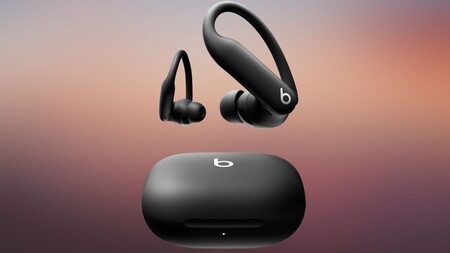
The secure-fit earhooks are reinforced with a nickel-titanium alloy, making them 20% lighter than the previous generation whilst keeping them locked in place through runs, gym sessions, and anything else you can throw at them.
Advertisement
Sound is handled by the Apple H2 chip, which powers Adaptive EQ that measures what you are hearing and adjusts frequencies accordingly, alongside Personalised Spatial Audio with dynamic head tracking for a more immersive listening experience when you step away from the weights.
Active Noise Cancellation and Transparency mode sit side by side so you can shut out the gym entirely or stay aware of your surroundings, depending on what the session demands, and the built-in heart rate monitor pulses over 100 times per second to keep your training data accurate in real time.
Advertisement
Battery life reaches 45 hours combined with the charging case, which is 33% smaller than its predecessor and supports Qi wireless charging, so topping up between sessions does not require hunting for a cable.
Advertisement
Thoughtfully engineered for the demands of real training, the Powerbeats Pro 2 carry an IPX4 sweat and water resistance rating that accounts for rain, humidity, and sweat-soaked sessions alike, with on-ear buttons and tactile volume rockers ensuring full control stays at your fingertips without breaking stride.
Note that a USB-C charging cable and power adaptor are sold separately, so factor that in if you are buying as a first-time Beats owner.
If you want a distraction-free fitness tracker then the newly announced screenless Fitbit Air and Oura Ring 4 are two brilliant options.
While you’ll need to be happy to forgo smartwatch features, both promise to quietly track your health, fitness and workout metrics without getting in the way of your everyday life.
While we’re yet to review the Fitbit Air, we have reviewed the Oura Ring 4 and not only gave the wearable a 4.5-star rating but also hailed it as being one of the best smart rings too. With this in mind, how do the Fitbit Air’s specs look set to compare?
We’ve highlighted the key differences, alongside noteworthy similarities, between the Fitbit Air and Oura Ring 4 below. Keep reading to see how the two differ and decide which one will likely suit you best.
Advertisement
Otherwise, our list of the best fitness trackers rounds up our current favourites on the market. If, however, you think you’d prefer a device that acts as an extension of your smartphone, then you should visit our best smartwatches list instead.
Advertisement
Specs comparison table
Fitbit Air
Oura Ring 4
Dimensions
34.9 x 17 x 8.3mm
7.9 x 2.88mm
Water Rating
5ATM
10ATM
Battery Life
Up to seven days
Up to eight days
Sensors
Optical heart rate monitor, 3-axis accelerometer and gyroscope, SpO2, Skin Temperature and Vibration Motor
Optical heart rate monitor, 3-axis accelerometer, SpO2 and Skin Temperature
UK RRP
£84.99
£349
US RRP
$99.99
$349
Subscription
$9.99 a month
£/$5.99 a month
Price and Availability
At the time of writing, the Fitbit Air is available to pre-order and will launch in the UK and US from May 26. With a starting RRP of £84.99/$99.99, the Fitbit Air is one of the cheaper fitness trackers.
In comparison, the Oura Ring 4 has a considerably more expensive starting price of £349/$349 – though this can significantly alter depending on the finish you opt for. For example, the Silver or Black iterations are £349/$349 while the Gold or Rose Gold iterations will set you back £499/$499 instead.
Advertisement
Alternatively you can opt for the Oura Ring 4 Ceramic which comes in a choice of four colours but starts at £499/$499.
Fitbit Air has changeable bands
Let’s get the most obvious difference out of the way: the Oura Ring 4 is a smart ring while the Fitbit Air is a screenless band worn around the wrist. Naturally, this means the Oura Ring 4’s colour or shape can’t be changed after purchase, whereas the Fitbit Air’s band is entirely changeable.
Google explains that the Fitbit Air moves from “bracelet to workout band to sleep tracker” as you can purchase different bands separately.
Advertisement
Advertisement
Fitbit Air. Image Credit (Google)
However, that’s not to say the Oura Ring 4 stands out as an unsightly wearable. In fact, at 7.9mm wide and 2.88mm thick, the Oura Ring 4 is designed to look just like an ordinary ring and not stand out as a fitness tracker.
Oura Ring 4. Image Credit (Trusted Reviews)
Oura Ring 4 promises up to eight days of battery and slightly faster charging
Compared to even the best Apple Watches, both the Fitbit Air and Oura Ring 4 boast much higher battery lives. In fact, while Google promises the Fitbit Air will see up to seven days of power, the Oura Ring 4 is promised up to eight.
Oura Ring 4 on charger. Image Credit (Trusted Reviews)
However, it’s worth noting that in our review we actually found the Ring 4 struggled to see the full eight days and achieved around five days instead. That was with daily use, passive tracking and occasional workouts, so you’d likely need to be a particularly light user to see the full eight days.
Advertisement
Otherwise, the Fitbit Air is said to take around 90 minutes to go from 0 to 100% battery, while a five minute charge should result in an extra day’s worth of juice. In comparison, the Oura Ring 4 is said to take up to 80 minutes to charge, though it doesn’t benefit from any fast charging tricks like the Fitbit Air.
Oura Ring 4 has Natural Cycles integration
Women are said to make up 60% of Oura Ring 4 users, as the wearable offers in-depth cycle insights which include pregnancy metrics and even fertility insights too. Plus, the Ring 4 sports integration with Natural Cycles, a natural birth control or family planning tool that determines your most fertile times of the month according to your skin temperature.
This is especially appealing for those who don’t want to rely on hormonal birth control methods that usually come with a long list of side effects. Garmin also recently introduced an integration with Natural Cycles.
Advertisement
While the Fitbit Air does include menstrual cycle insights, with predicted periods and fertile windows shown on the new Google Health app, this is based on your recorded data and trends. Although the Fitbit Air can track skin temperature, if you forget to log a period then this can affect the accuracy of your insights.
Google Health app. Image Credit (Google)
Both operate with subscriptions, though Fitbit Air’s isn’t compulsory
The Fitbit Air is compatible with the new Google Health smartphone app, which has replaced the old Fitbit app. Google Health will act like the hub for your Fitbit’s data, bringing together your health and fitness tracking metrics and insights to your iPhone or Android.
Advertisement
While Google Health offers an overall insight, there is a paid subscription to opt for which unlocks many more features. Coined Google Health Premium, the $9.99-a-month subscription will provide access to Google Health Coach, the Gemini-powered AI tool that offers personalised workout plans and guidance according to you and your personal goals. In addition, Google Health Premium includes in-depth sleep tracking which is said to be 15% more accurate on the Fitbit Air compared to previous models.
Fitbit Air on wrist. Image Credit (Trusted Reviews)
Even so, we should note that the Fitbit Air doesn’t need this subscription to work, whereas the Ring 4 does require Oura’s subscription.
Slightly cheaper at £5.99/$5.99 a month, the Oura Membership is compulsory and required to unlock all the daily insights you’d expect to see from your Ring 4.
Advertisement
Both promise auto workout detection but Oura’s isn’t always reliable
As neither the Fitbit Air or Ring 4 are equipped with a display, checking metrics and tracking workouts is done via their respective smartphone apps. While you can manually start tracking a workout through the app, both the Fitbit Air and Ring 4 promise to sport automatic workout detection. This means that you can simply start exercising and both the wearables will track and log the workout, without you needing to dive into the app.
Advertisement
In theory, this is a welcome time-saver and means you won’t miss out on key data like your HRV. However, we actually found the Ring 4’s automatic workout tracking to be somewhat hit and miss. While running was tracked well, other activities were sometimes missed entirely.
With this in mind, we’d always recommend manually inputting workouts.
Advertisement
Early Verdict
As the concept is the same, with both offering screenless and therefore distraction-free health tracking, perhaps one of the biggest deciding factors between the Fitbit Air and Oura Ring 4 is whether you prefer wearing a band or a ring.
Having said that, it’s worth remembering that the Fitbit Air does benefit from the AI-powered Health Coach (albeit with the optional subscription) which could be useful for beginners who’d like help getting started on their fitness journey. Plus, the Oura Ring 4 is not only more expensive, but it requires the subscription to even track basic metrics, making it much more of a long-term investment.
On the other hand, the Oura Ring 4 is fitted with many women’s health insights which could be useful for those either looking to move away from hormonal birth control, start family planning or tracking pregnancies too.
We’ll be sure to update this versus once we review the Fitbit Air.
Though the Poco X8 Pro faces stiffer competition than ever, it’s still an easy recommendation for anyone after strong performance and fast charging at a less-than-premium price. It’s not the most powerful or polished phone around, but for the money, there’s enough here to keep it competitive – even if the Iron Man finish does it no favours.
Solid performance in virtually every situation
Gorgeous 120Hz AMOLED display for HDR gaming
Good enough camera in good conditions
Noticable background battery drain
Iron Man stylings are lackluster
Fair bit of pre-installed bloat
Key Features
Advertisement
Review Price:
£349
Dimensity 8500-Ultra SoC
Advertisement
Matched with the Mali-G720, GPU, this 3.4Ghz chipset can handle the most demanding games and everyday tasks with ease.
6500mAh battery with 100W charging
Advertisement
Ultra-fast 100W charging from compatible power plugs lets you max out the massive battery in just over an hour.
3D dual-layer IceLoop cooling system
Advertisement
The 5300mm² surface area cooling solution promises to chill the chipset by up to three degrees Celsius for to avoid throttling when gaming in humid areas.
Introduction
As top-tier specs continue to trickle down into budget blowers, some of the long-standing bargain brands of the last ten years are still finding ways to stay firmly in the middle. For Xiaomi’s Poco brand, that’s the Poco X8 Pro line. It’s easy to see where the inspiration lies with this one.
With the Poco X8 Pro, we’re specifically looking at the Iron Man variant. It isn’t the first time a Poco handset has been adorned with Marvel graphics. But don’t let Tony Stark’s billion-dollar projects fool you: this isn’t a cutting-edge device.
Advertisement
Instead, it’s a solid performer for the cost, just with a frankly hideous interface that’s closer in appeal to the sort you’ll find in an after-market theme shop app than anything you’ll have seen in a Marvel movie. The best-looking part of this phone is its themed packaging. So it’s a good thing everything else functions well enough.
Advertisement
Design
Easy to handle
Quality feel
Mint Green, White, Black, and Iron Man variants
The Poco X8 Pro Iron Man sits well in the hand. It’s a comfortable device with just enough material-lending heft to feel premium without being uncomfortable. Generously rounded along each corner and with a stainless steel frame, it reminded me a lot of the first phone I decided to pony up a pretty penny for – a Nokia Lumia I lost on a press trip in Stockholm too long ago.
Image Credit (Trusted Reviews)
Along the suitably smooth outer edges are a single-piece volume rocker, a separate power button, a down-firing speaker, a super-speedy USB-C port, and plenty of microphones to make calls feel as clear as they reasonably need to be. Given the choice of materials here, the Poco X8 Pro is a solid device, with IP68 dust and water resistance, and a cool, smooth feel.
Image Credit (Trusted Reviews)
Advertisement
Unless you opt for the Iron Man look, you’ll be getting a flagship-style appearance in some appealing colours. Whether that’s what you want in a £349 device is up to you. I’m partial to how Motorola helps its budget blowers stand out with unique vegan leather looks, but the Iron Man version of the Poco X8 Pro sadly looks like a cheap sticker on a printed plastic back.
Screen
6.59in 1.5K 120Hz AMOLED display
480Hz touch sampling rate
HDR10+ and Dolby Vision support with 2000 nits HBM brightness
A tight screen-to-body ratio means the Poco X8 Pro’s curves create a display that’s pleasing to the eye – a full-screen look that would have cost a premium a few years back. The 120Hz AMOLED display clocks in at a sharp-enough 1.5k resolution, getting more than bright enough to stand against piercing outdoor glare and helping the AMOLED display show off its glossy colours.
Image Credit (Trusted Reviews)
Poco’s standing with streaming giants means you’ll struggle to put that high brightness to use with HDR content outside of your own photos and some games. Still, if you can find supported content, there’s HDR10+ capabilities and Dolby Vision certification to make use of.
Auto-HDR wizardry can offer a sample of bright, bold colours and tight contrast in games, too, but you’ll be banking on the nature of AMOLED to work its own magic on streamed content for the most part.
Advertisement
Advertisement
For gamers – of which Poco tends to attract many – there are some solid features here, too. The 480Hz touch sampling should already ensure your slides and taps register at rocket speed, but you can crank this all the way to 2560Hz through Game Turbo Mode just to be sure.
Image Credit (Trusted Reviews)
Similarly, the Wet Touch display 2.0 claim works well to stop a little splash or a drop of rain from making general use difficult, so it should work to offset any misplays in tense, sweaty conditions, too.
What is a shame, though, is its lack of adaptive refresh rates. Though you can set 120Hz to kick in only on specific apps, it can’t slow to 24Hz for an optimal movie-viewing experience, and it certainly can’t drop to 1Hz for comfortable, battery-efficient reading. It’s all go all the time.
Performance
Dimensity 8500 Ultra SoC
12GB RAM
Smooth everyday performance
With the Poco line initially gaining traction as one good for gaming at half the price of competing products, it isn’t surprising to see the Poco spec sheet rife with chatter about ‘revolutionary performance,’ various ‘boost’ features, and cooling tech with embellished titles.
Advertisement
Advertisement
In practice, the Poco X8 Pro is a powerful device for just £349, sporting a high-end (if not proper flagship) MediaTek Dimensity 8500 Ultra chipset and ample 12GB of RAM that leaves most phones at the price point in the dust.
Image Credit (Trusted Reviews)
Given its dominance in regions like India, where the go-to games are far from bleeding-edge gacha titles and console ports, the Poco X8 Pro maintains rock-solid frame rates, imperceivable input lag, and crams just enough passive cooling tech in there to keep gamers snagging chicken dinners in low-fidelity esports titles in the heat.
In fast-paced, graphically intense combat titles that push the boundaries of mobile chipsets, a solid 60fps is easily attainable at the highest settings. Zenless Zone Zero, we’re looking at you. In general use, the situation is much the same – solid, stable, and snappy. Flicking between apps and drawers is like butter. Your Chrome tab hoarding won’t phase this one.
Image Credit (Trusted Reviews)
To put things into numbers, our typical Geekbench 6 benchmark came back with a single-core result of 1724, with multicore clocking in at 6614. The Mali-G720 GPU returned an impressive score of 12,549 there, too, translating to a 24fps average in 3DMark Wildlife Extreme and around 26fps in the lighting-heavy Solar Bay test, all of which align with the premium, but not quite top-end, chipset on offer.
Advertisement
The stress test showed barely any change in performance as the temperature slowly rose before plateauing at 38°C in 20°C ambient room temperatures. Now, that’s obviously not a good enough test for a cooler designed to keep you gaming in arid conditions, but proof enough that it can hold its own.
Advertisement
Overall, it’s a decent improvement over last year’s Poco X7 Pro, but probably not enough to justify an upgrade.
Software and AI
HyperOS/Android 16
Google suite
Security support up to early 2032
Running Xiaomi HyperOS fork of Android 16, what you’re getting here is a fairly up-to-date handset. It’s worth noting that if you get the Iron Man Edition, you’ll also get a custom theme to enjoy.
Image Credit (Trusted Reviews)
You’ll find a few iconic bits of app bloat here, but they’re largely the big names: TikTok, Spotify, Facebook, Amazon Music, and the rest, which is honestly fascinating. But that doesn’t mean it’s bereft of the usual slew of basic waiting room games. Oh, and Mi/Poco-branded apps with infuriating full-screen startup ads.
Advertisement
You’ll have to dig through the search bar to uninstall them, but removing them from the dashboard sends things off in a nice little pop of a bubble – at least on our Iron Man-inspired review device. Is it an annoyance? Always. But at least Poco made cleaning things up a relatively satisfying experience.
You also get the admittedly handy Gemini AI assistant. Camera and Circle to Search features are all intact, and getting Google to voice what it sees through the camera is always a fun little party trick – a way for an older person to quickly read their mail without their glasses, or a great way to identify pretty foliage on a morning walk.
Advertisement
Image Credit (Trusted Reviews)
Dig through the settings, and you’ll find Poco’s own AI App Boost options. Beyond smart uses of sometimes scary technological buzzwords like auto-translate/transcribe and image sharpening, you’ll find options to turn photos into dynamic wallpapers and expand them with additional details.
Camera
50MP rear Sony sensor
8MP Ultrawide
20MP selfie snapper
Packing a 50MP Sony lens on the rear, the Poco X8 isn’t out of its depth when it comes to photography, either. As long as you keep your expectations in check.
Advertisement
Image Credit (Trusted Reviews)
Today’s chips and AI enhancements mean there’s enough computational gubbins here to grab some great shots with little effort. In the bright Spring sunshine around the Greek Isles, I had a great time capturing the rare snow-covered caps of Crete from Chania and photographing traffic jams.
The lack of a telephoto means you won’t be zooming in to shoot distant details in a hurry, but there’s enough detail here to pinch in to reframe shots. Again, within reason. The depth sensor pairs well with today’s processors to make portrait shots look particularly pleasing, too, with frankly fantastic edge detection in perfect conditions. The 8MP ultrawide helps to cram more detail into cramped scenes, too.
Where once a budget gaming blower meant sacrificing a half-decent snapper in your pocket, the sensor of the Poco X8 Pro could genuinely be a solid upgrade for some. Paired with speedy UFS 4.1 storage, another previously premium option, there’s enough general performance here to please most amateur shutterbugs, but low-light isn’t a strong suit. Unsurprising, given the price point.
Battery
6500mAh battery
100W wired charging
27W reverse wired charging
Advertisement
A massive 6500mAh cell keeps the Poco X8 Pro going for days at a time. Paired with increasingly scary 100W charging with a compatible plug, it doesn’t take long at all to get back in the game.
Advertisement
With such a focus on playing hours of matches before needing to recharge, it would have been nice to see Poco lean on the teachings of the now-absent Asus ROG Phone with a side-mounted USB-C plug for comfortable charging while gaming. That would really put the cooling tech to the test.
Image Credit (Trusted Reviews)
Interestingly, the reverse wired charging came in clutch while away from home, enabling it to be used akin to a power bank for other devices, saving me from needing to buy yet another travel adapter to litter a drawer back home.
Bewildering background battery drain was a concern, though. It’s difficult to chalk up the reason why, but it often lost far more power overnight than my ageing iPhone 13 Pro Max. Hopefully it’s something an update will fix, but it’s worth keeping in mind if you’re often away from a charger.
Advertisement
Should you buy it?
Advertisement
You want solid general performance at a low cost
At £349 (or cheaper with the launch discount), the Poco X8 Pro is considerably cheaper than its fancy-sounding name would suggest. And in raw performance, it’s a value king.
Advertisement
Poco handsets often focus on raw power, and the X8 Pro is no different – it can take good shots in bright conditions, but its certainly not a strong suit.
Final Thoughts
Though the Poco line has stiffer competition today than ever before, the X8 Pro is still an easy recommendation for those looking for a powerful handset at a less-than-premium price.
Advertisement
Sturdy construction means it sits just fine alongside today’s more fashion-forward phones. And if you’re the type to savour every minute, its lightning-fast charging is part of what makes this one not a big deal, but a great deal.
It’s far from the most powerful device on the market today, but at this price, there’s enough going on to keep it (and you) competitive, making it one of the best budget phones around (even in its Iron Man finish).
How We Test
We test every mobile phone we review thoroughly. We use industry-standard tests to compare features properly and we use the phone as our main device over the review period. We’ll always tell you what we find and we never, ever, accept money to review a product.
Used as a main phone for two weeks
Thorough camera testing in a variety of conditions
Benchmarked using a mix of respected industry tests and real-world data
FAQs
Does the Poco X8 Pro include a charger in the box?
No, there’s no included charger with the Poco X8 Pro despite its 100W HyperCharge capabilities. The Iron Man version doesn’t include one, either.
Advertisement
Is the Poco X8 Pro waterproof?
The Poco X8 Pro is rated for IP68, suggesting long-term water submersion shouldn’t be a problem if proper precautions are followed.
As families across the U.S. prepare to celebrate Mother’s Day this Sunday, Allison Stern is looking beyond the single day of appreciation.
Stern just closed $10 million in commitments for her debut early-stage fund, Mother Ventures, which focuses exclusively on the mother as a consumer.
“In the U.S., moms are responsible for 85% of household purchases and have $2.4 trillion in spending power,” Stern (pictured below) told TechCrunch. “The numbers say that moms are the buyers, and they really are a very unique economic engine.”
Stern, a mother of two, is tapping into that spending clout by backing startups that reflect the needs of modern mothers. Since launching Mother Ventures two years ago, she has already deployed $4 million into 13 startups. Her portfolio includes Coral Care, which allows instant booking of pediatric specialists for children with developmental delays, and Tin Can, a popular Wi-Fi-enabled “landline” designed as a retro-style phone for kids.
Advertisement
Before launching her own fund, she co-founded Tubular Labs, a social video analytics startup she helped grow to $25 million in annual recurring revenue prior to its 2023 acquisition by private equity, and served as an operating partner at The Chernin Group (TCG), a consumer-focused growth equity firm.
Part of TCG’s investment thesis included backing companies serving “overlooked unique audiences with spending power,” such as Barstool Sports, which originally targeted Boston sports fans, she said.
Image Credits:Mother Ventures
When Stern set out to launch her own fund, she identified mothers as a similarly underserved market with the potential to deliver superior returns. “I felt like motherhood is the ultimate niche that’s not really a niche,” she said,
Techcrunch event
San Francisco, CA | October 13-15, 2026
Advertisement
Stern convinced Tony James, the former president and COO of Blackstone and current board chair of Costco, to back Mother Ventures as an anchor LP. Other backers of the fund include Jessica Rolph, founder of the child development startup Lovevery, as well as female executives from Netflix, Rent the Runway, and Sesame Street, she said.
She argues that millennial and Gen Z mothers expect a different set of products, from on-demand transportation services such as Zum, to ready-meal delivery from DoorDash, and fintech tools like Greenlight that allow parents to instantly fund a child’s debit card.
Advertisement
“We want healthy things. We want subscription things. We want digital communities,” she said.
However, Stern doesn’t want her fund to be perceived as one that invests only in parenting tech. “It’s a consumer fund, and focus on the mom as the consumer allows us to be wider in our bets,” she said.
When you purchase through links in our articles, we may earn a small commission. This doesn’t affect our editorial independence.
Linux and UNIX operating systems have become increasingly popular in commercial computing environments. Due to their rapid growth in today’s businesses, Linux/UNIX administrators have also become very much in demand. This hands-on Linux/UNIX Certification Training Bundle will help you prepare for the CompTIA Linux+ and the Novell Certified Linux Professional certification exams. It’s on sale for $50.
Note: The Techdirt Deals Store is powered and curated by StackCommerce. A portion of all sales from Techdirt Deals helps support Techdirt. The products featured do not reflect endorsements by our editorial team.
We spend hours testing every product or service we review, so you can be sure you’re buying the best. Find out more about how we test.
Now that two of us from the TechRadar Gaming team have spent hours in free-to-play third-person action looter-shooter Tom Clancy’s The Division: Resurgence – and I, as the big Division fan, am still committing hours to it – we are happy to report that it’s a terrific mobile game and proof that big AAA series from console and PC can successfully make the jump over to the small screen to produce something excellent.
Review info
Platform reviewed: Android Available on: Android, iOS, PC Release date: March 31, 2026
Advertisement
Every element of the core Division experience is here. The systems work and are easily navigable on a different scale, the combat is still fun and engaging, and the loot-and-improve loop is just as moreish.
Combine that with a story that’s relatively plain but one that perfectly complements the events of the first game and will be best enjoyed by existing fans, and a well-realized version of that post-apocalyptic New York City setting (complete with weather effects and a robust standard of graphical quality) as well as an intuitive and excellent control scheme on mobile, and the experience is complete.
Advertisement
Latest Videos From
It’s winter in NYC again
(Image credit: Ubisoft)
As an agent of the Strategic Homeland Division (SHD) activated after the deadly Green Poison rips through the populace after spreading on money during Black Friday, your job is to save what’s left of the civilized world, help out its inhabitants, defeat factions looking to take control, and build up the SHD’s presence.
You might not have a military background, but you do have access to weapons, gear, and specialist skills and abilities. You’ll choose the latter by picking a specialization based on some pretty typical video game archetypes: there’s a tanky one, a healer, an assault expert, and an engineer type. Familiar skills such as the shield and gun combo, turrets and drones, and an excellent pulse ability work beautifully once again as you tear up Resurgence’s streets.
(Image credit: Ubisoft)
It’s worth noting that the protagonist actually offers something more than those found in the main games, too: they’re fully voiced and, as such, feel like more of a character. It’s a welcome move as spending hundreds of hours in the likes of The Division 2 and its many expansions, and even the Ghost Recon games, without saying a single word felt odd. Still, it is a shame that there aren’t more character customization options for the lead in Resurgence, which may irk some used to more expansion character creation systems.
Your chatty agent can combine your preferred specialization with a host of different weapons, which provide a huge range of ways to play. From assault rifles to sub-machine guns and high-powered shotguns to marksman rifles, there are loads of combos to try out, and you’ll also have lots of opportunity to level up and improve gear, and make it your own with a variety of attachments.
Advertisement
Sign up for breaking news, reviews, opinion, top tech deals, and more.
Best bit
(Image credit: Ubisoft)
The loot-improve-loot loop is incredibly satisfying in The Division: Resurgence and will constantly have you chasing better weapons and gear to optimize builds and improve your power score, and take down baddies with greater ease.
Most of your time will be spent in the expansive PvE part of the New York map, which features a host of recognizable foes for returning players. There’s the Rikers and fire-crazy Cleaners, as well as a newer faction in the form of the Freemen.
Advertisement
As you cross the map, unlocking safe houses and new areas, you’ll carry out a lot of story missions and side missions that take place up and down the streets. Th overall story are nothing to really write home about, but one specific gripe I do have is that at multiple points in the main story (and thus overall progress) are level gated, requiring you to grind.
At least the selection of enemy nests, alcoves, and urban squares all make for fun and action-packed arenas. The world is very nicely executed on the whole, and does a great job of nailing the aesthetic and vibes of the original game.
Encounters can feel straightforward in design, but still manage to be suitably high-octane and high-tension. It’s a great mix to have, as you can settle into the rhythm of looting, but still have to sometimes get creative and tactical to get yourself out of sticky situations.
(Image credit: Ubisoft)
For committed looter shooter players, the extraction shooter style Dark Zone is back to provide a sterner PvPvE test, while Conflict offers a dedicated PvP mode for those who fancy testing their skills against other players directly. As someone who prefers cooperation over competition, I’ve really enjoyed the fact that the open world is shared with other players, and there are ample informal opportunities to help others or be helped by them with no matchmaking necessary.
Advertisement
While pouring time into the game to level up my character, I soon found that Resurgence really scratched that looter-shooter itch of needing to find more gear to improve, take down enemies more efficiently, and get even more gear in the process. The steady stream of upgrades keeps pulling you along, as does the desire for the XP gained from main and side missions.
The handful of ongoing elements in the game, such as weekly and daily tasks and plenty of fresh bounties, should also be enough to keep fans engaged over the long term, too. Adjacent to this, the series’ monetization and microtransactions are, naturally, present too, and while they can largely be ignored and not engaged with, it is a looming factor.
Running the streets
(Image credit: Ubisoft)
While the game successfully translates the core experience established in The Division series, it’s another thing to have it perform on smaller, less powerful hardware.
Advertisement
With the visual settings cranked up to max, environments in Resurgence certainly look the part. It feels very faithful to the original 2016 game, thanks to its highly atmospheric snowy New York streets and a great level of environmental detail. It can achieve a mostly solid 30fps on a beefy Qualcomm Snapdragon 8 Gen 3-powered gaming tablet, though cracks do start to show if you want to hit a higher framerate.
Dash mostly plays on the medium pre-set in order to reach a smooth 45 fps, and the difference in quality is stark. The models of prominent objects, like abandoned cars, look slightly lower fidelity, and the textures become quite muddy. Render distance takes a bit of a hit, too, resulting in quite obvious pop-in on the horizon as you explore. The game is still perfectly playable and holds up decently well on a smaller phone screen, but it’s not as good-looking as similar AAA mobile releases like Delta Force and Once Human.
Even when it looks a bit grim, the game still feels fantastic to play as touch controls are brilliantly implemented. The layout (which includes a wealth of movement options like vaulting, diving, and jumping into cover in addition to your standard virtual thumbstick and aiming stroke firing buttons) does a commendable job of translating a The Division 2-like control scheme to a touch screen format.
The control scheme will be instantly familiar to existing fans and intuitive to those new to the franchise, but we think it really excels when played with a controller
Although it’s no trouble for experienced touch control players, there are still loads of options to simplify the controls if you’re finding it a little too much. This includes the ability to automate entering cover, aiming down sights, climbing, or vaulting. You even have the option to aim weapons from a first-person perspective, something found in the recent Ghost Recon games but a new and welcome addition for The Division.
Advertisement
Mobile controller support is top-notch, too, as we tested multiple mobile pads from the likes of GameSir, Nacon, SteelSeries, and 8BitDo that all enabled the game to be played exactly like one can play The Division 2 on console.
The control scheme will be instantly familiar to existing fans and intuitive to those new to the franchise, but we think it really excels when played with a controller.
Should I play Tom Clancy’s: The Division Resurgence?
Advertisement
Play it if…
Don’t play it if…
Accessibility features
Tested as it was initially released as a mobile game, The Division Resurgence sadly doesn’t have a huge number of accessibility features. While there are a host of settings around controls that allow you to change sensitivity across touch, controller, or even mouse and keyboard inputs and gyro sensitivity, there is no way to change subtitle size or color (though you can change languages), no colorblind modes, or extra audio settings.
There are also some assists you can alter with to find the right balance of play, such as aim assists, aiming down sights settings, and things like vaulting and climbing can be toggled to become automatic.
Advertisement
How we reviewed The Division Resurgence
We tested The Division Resurgence in both single-player and multiplayer modes for many hours. Dash tested the game on an Honor Magic 8 Pro, while Rob used a Samsung S20 Ultra (which was only capable of running it on the lowest settings), and then an Asus ROG Phone 8 Pro combined with a Nacon MGX-Pro mobile gaming controller.
Rob also tested the game using other mobile controllers such as the 8BitDo Ultimate Bluetooth Controller, the GameSir G8+ Bluetooth controller, and a Stratus+ from SteelSeries. Often using the ROG Phone 8 Pro’s own speakers for audio, he also tried the game through the new SteelSeries Arcits Nova Pro Omni headset.
While Dash is TechRadar Gaming’s mobile gaming expert, Rob is a longtime fan of the Division series, having committed hundreds and hundreds of hours to both main games on PlayStation 4 and PlayStation 5 since 2018. He still plays The Division 2 regularly with friends, and is perfectly placed to know what works and what doesn’t in this mobile version.


































































You must be logged in to post a comment Login