





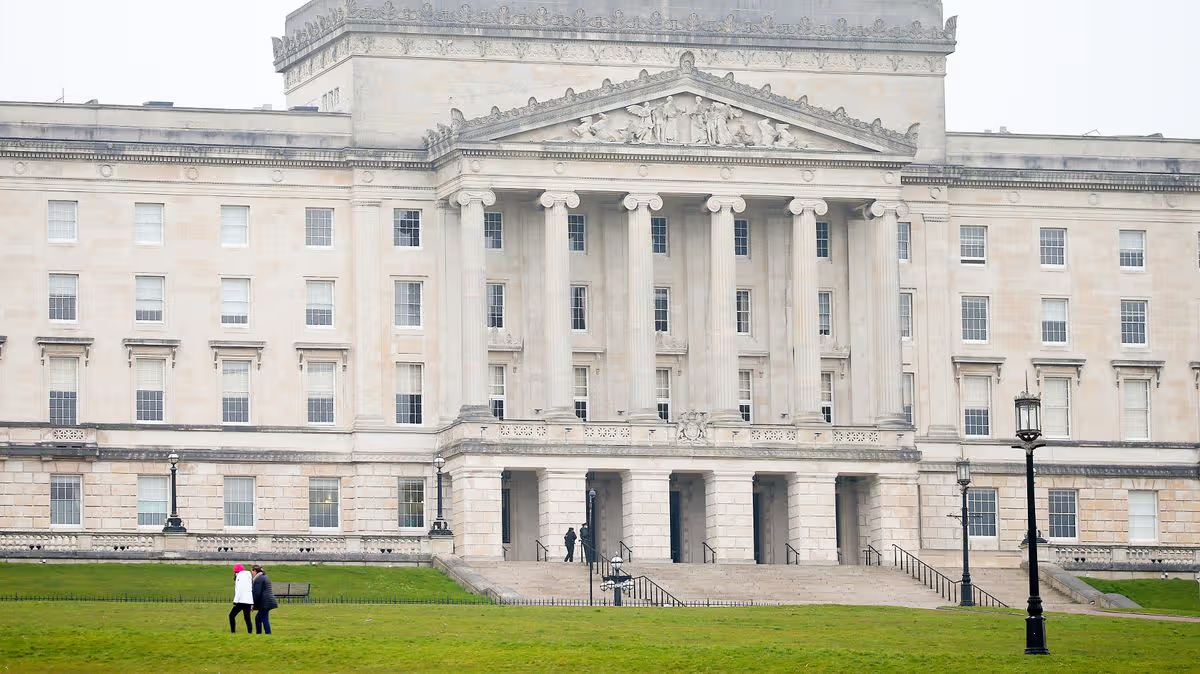
We want to hear your thoughts on whether Stormont should be reformed so that no single party can collapse the Executive
Earlier this week, the Alliance Party published their 18 point plan for political reform in Northern Ireland.
Among the proposals was a suggestion to reform the Northern Ireland Act so that the next-largest party can nominate a First or deputy First Minister if the first eligible party refuses to do so.
They also propose that the titles of First and deputy First Minister be equalised to reflect the joint nature of the office.
Defending the party’s proposals to change how First Ministers are nominated and to expand the use of weighted majority voting, the party’s deputy leader, Eóin Tennyson, rejected suggestions that such reforms would undermine the Good Friday Agreement.
“In 1998, people were promised a stable power-sharing government that would deliver for them and improve people’s lives, and instead, what we’ve had over the past nearly three decades is Stormont being suspended for almost half of that time,” he said.
“Then, when it is up and running, it is beset by deadlock, by delay, by veto, and is vulnerable to vested interests and dark money. So this document is actually about renewing and re-energising Stormont to restore public confidence.
“We have been very clear with the UK and Irish governments that to argue for reform is not to undermine the Good Friday Agreement at all. It’s actually to recognise that if we fail to reform, then we are condemning its institutions either to death by 1000 collapses or death by a slow bleed of public confidence in their ability to deliver.”
Alliance’s 18 proposals for political reform
- Reform the Northern Ireland Act so the next largest party can nominate a First or deputy First Minister if the first eligible party refuses to do so.
- Implement a weighted majority system (approximately two-thirds) to determine cross-community support for the election of the Speaker and other key decisions, rather than using parallel consent.
- Restrict Executive cross-community votes and the Petition of Concern strictly to matters relating to national identity, the legacy of the Troubles, or the constitutional structures established under the Good Friday Agreement.
- Put the ‘three meeting rule’ on a statutory footing so items cannot be blocked from the Executive agenda, and publish all Executive meeting agendas.
- Scrap the ‘anti-democratic’ system of Assembly designations.
- Change the First and deputy First Minister titles to ‘Joint First Ministers’ to reflect their equal status, and include these posts in the D’Hondt calculation along with every other Ministry.
- Establish a statutory Commission in the long term, sponsored by the Executive and the UK and Irish governments, to design a plan for implementing a voluntary coalition in Stormont.
- Conduct all cross-community votes on Ministerial sanctions on a weighted majority basis.
- Empower the Standards Commissioner to recommend the level of sanction that should apply for breaches of the Ministerial Code, which would then be reviewed and verified by an independent lay panel.
- Introduce an annual cap on donations from single private sources, applying to both individuals and companies, as well as foreign and domestic donors.
- Lower the reporting threshold for political donations from £11,180 to £500.
- Publish all donations to local political parties retroactively from 2014.
- Support more rigorous donor checks as outlined in the UK Government’s Representation of the People Bill.
- Provide better funding to the Electoral Commission, so it is equipped to investigate and sanction breaches of third-party campaigning rules.
- Establish a Lobbying Register in the Assembly to ensure greater transparency around who is seeking to influence politics and how much money they are spending.
- Implement a fairer electoral system for Westminster elections, preferably the multi-member Single Transferable Vote (STV) system already used for Assembly and Council elections in Northern Ireland.
- Transition to a directly elected House of Lords using a Proportional Representation (PR) system to represent the 12 regions of the UK, and implement maximum term limits to avoid politicisation.
- Convene a UK-wide constitutional convention to develop a fully codified UK constitution
For all the latest news, visit the Belfast Live homepage here and sign up to our daily newsletter here.













































You must be logged in to post a comment Login