

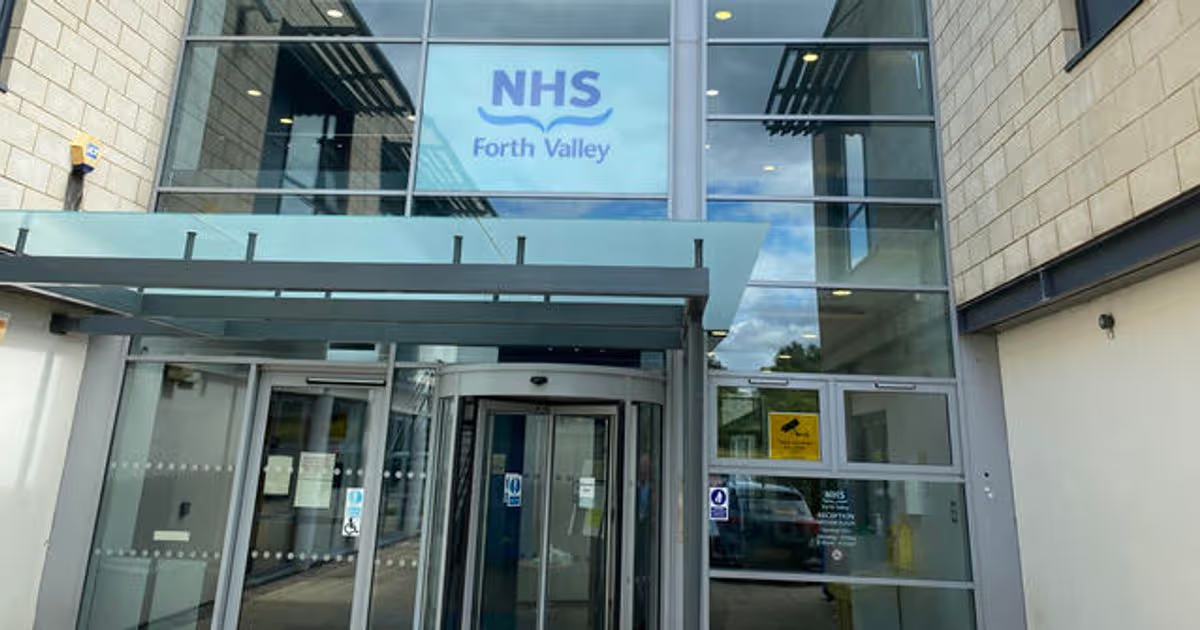
The health board’s performance is improving but much more work remains, according to figures heard at a board meeting last week.
Performance figures in NHS Forth Valley are improving in a number of areas, the board meeting heard on Tuesday.
But almost 3000 patients are still waiting beyond four hours.
For Urgent & Unscheduled Care performance in December in the Emergency Department (ED) the four-hour standard Compliance improved from 55.5 per cent to 65.9 per cent.
The average Length of Stay reduced to 6.9 days (target: seven days by March 2026, with further improvement to 5.4 days in late December).
Hospital Occupancy Acute occupancy dropped from a mean of 107.3 per cent to a low of 93.5 per cent. Continued focus is needed to reach the 95 per cent target by March.
Delayed Discharges achieved a 22.6 per cent reduction (average now 113 and the target: is a 25 per cent reduction by January.
Hospital at Home Utilisation ranged from 83.8 per cent to 89.5 per cent.
Funding has been secured to expand capacity to 114 beds by December.
Emergency Department attendances fell by 3.5 per cent in December (5,455 as opposed to 5,654 in November).
Minor Injury Unit 86.5 per cent compliance with the four hour standard; ongoing work to increase pathway utilisation.
Time to First Assessment Median reduced to 111 minutes; afternoon ED occupancy remains a challenge. • Pre-noon discharges averaged 15.6 per cent (target: 20 per cent)
Length of Stay: four days reduced by 23 per cent. Contingency beds usage declined, indicating improved patient flow.
Acute Frailty Unit Direct – discharge rates remain below target (21.3 per cent v 50 per cent); further investigation required.
Priority Areas of Performance Unscheduled Care Overall compliance with the four-hour emergency access standard (EAS) in November 2025 was 58.3 per cent; Minor Injuries Unit 99.7 per cent;, Emergency Department 46.7per cent.
A total of 2,891 patients waited longer than the four-hour target across both the ED and Minor Injuries Unit (MIU); with 1,436 waits longer than eight hours, 701 waits longer than 12 hours and 69 waits longer than 23 hours.
The main reason for patients waiting beyond four hours continues to be waiting for first assessment with a cohort of 1,772 patients, noting this was 1,713 in November 2024.
Wait for a bed accounted for 617 patients waiting beyond four hours with clinical reasons accounting for 197 breaches.
In November there were 522 new attendances to Rapid Assessment and Care Unit (RACU), 115 of which were via ED. It is worth noting 999 patients that attended ED did not wait in November, compared with 781 in November 2024.
The November 2025 census position in relation to standard delays (excluding Code 9 and guardianship) is 57 delays; this is compared to 82 in November 2024. There were a total of 60 code 9 and guardianship delays, with the total number of delayed discharges noted as 117.
The number of bed days occupied by delayed discharges (excluding code 9 and 100) at the September 2025 census was 2,886, this is a reduction from 3,276 in November 2024. Scheduled Care
At the end of November, the number of patients on the waiting list for a first outpatient appointment was 17,046 (16,738 excluding mutual aid) compared with 12,639 in November 2024 with the number waiting beyond 12 weeks 5,517 (5,289 excluding mutual aid) compared to 3,396 in November 2024.
In November, the number of inpatients/day cases waiting was 7,588 (7,329 excluding mutual aid and NTC) compared with 6,223 in November 2024.
An increase from the previous year in those waiting beyond 12 weeks from 3,521 to 4,475 was also noted. At the end of October 2025, 2,166 patients were waiting beyond the 6-week standard for imaging with 79 patients were waiting beyond 6 weeks for endoscopy.
Cancer target compliance in September 2025: 62-day target – 85.3 per cent of patients waited less than 62 days from urgent suspicion of cancer referral to first cancer treatment. This is compared with the September 2024 position of 84.1 per cent.
The position for the July to September 2025 quarter is that 86.3 per cent of patients were treated within 62 days of referral with a suspicion of cancer. This is an increase from 72.4 per cent in the previous quarter.
During the same period, 100 per cent of patients were treated within 31 days of the decision to treat. Psychological Therapies In October, data shows that 77 per cent of patients started treatment within 18 weeks of referral.
















































You must be logged in to post a comment Login