

This is the text from The Conversation UK’s World Affairs Briefing email. Sign up here to receive weekly analysis of the latest developments in international relations, direct to your inbox.
The five-day deadline to open the Strait of Hormuz handed to Iran by Donald Trump on Monday expires some time tomorrow and the Islamic Republic needs to “get serious before it is too late” – or so the US president has announced on his TruthSocial platform.
You’ll recall that this deadline replaced another deadline which was due to expire on Monday night, after which the US and Israel would obliterate Iran’s power plants and plunge the country into darkness. Happily Trump pulled back from this plan, reporting that talks were progressing very well, so he would extend the deadline until March 27.
For their part, Iranian officials denied that negotiations were even underway, while US officials said contacts were at a very early stage. This has prompted speculation that the US president was seizing even the most informal of contacts as an “off ramp” to save face over not following through with his threat.
Certainly Trump’s oft-repeated assurance that the war in Iran has been won and that Iran’s senior officials (whoever remains after Israel’s highly successful campaign of assassinations) are “begging” the US to make a deal looks a rather optimistic assessment from the US president.
Far from collapsing in a heap after the death of the former supreme leader, Ali Khamenei, the regime is showing its resilience. Its targeting of US installations in the region are hurting the Gulf states and there are signs that Israel’s Iron Dome is fracturing in parts under the volume of Iranian missile attacks (this reportedly also happened during the 12-day war last year). Conservative estimates are that the war is costing the US and Israel more than US$1 billion £740 million) a day.
TruthSocial
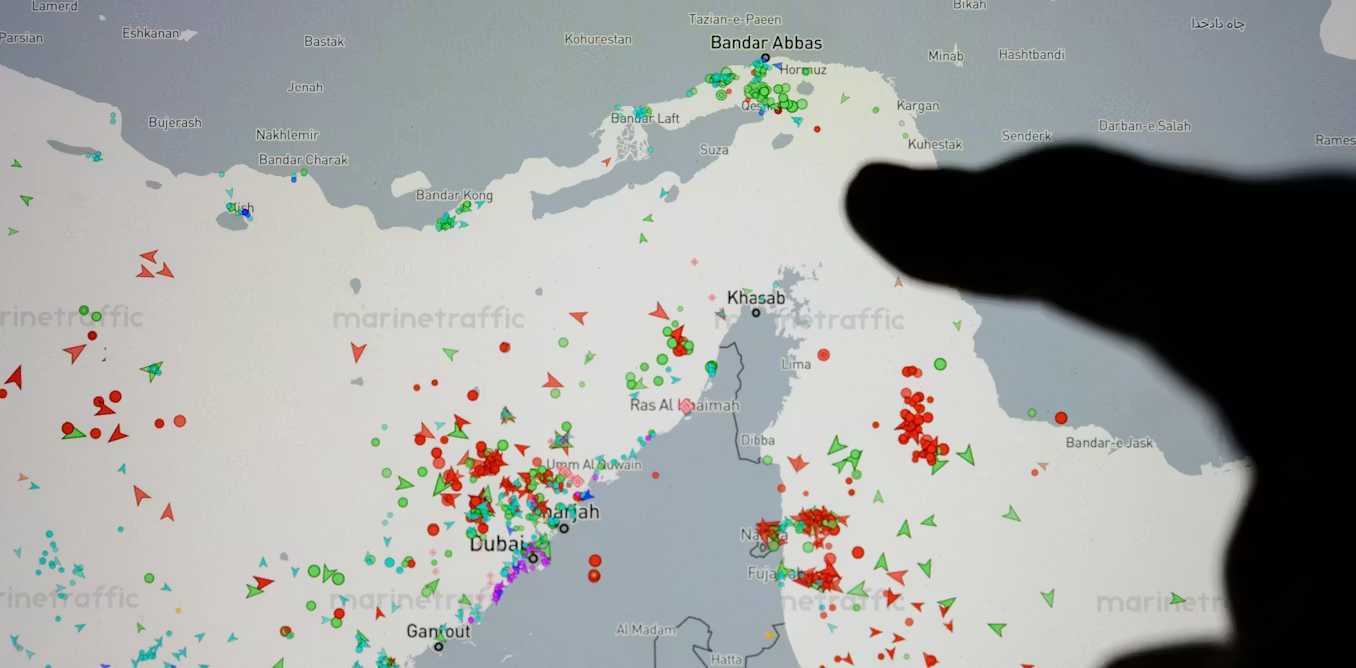
But it has been Iran’s ability to shut down traffic through the Strait of Hormuz that has arguably turned this into a world war, despite the unwillingness of many of America’s allies, particularly in Europe, to get involved. An estimated 20% of the world’s gas and oil transit the strait each day along with other vital supplies. Or at least it did before the end of February. Now very little is getting through and the consequences are being felt globally.
It’s not as if the US and Israel couldn’t anticipate that Iran would react to their attacks by closing down the strait. Arshin Adib-Moghaddam, an expert in Iranian history at the SOAS, University of London, walks us through nearly five decades in which Iran responded to every crisis by threatening to close the strait. Is is, he argues, a key plan in Iran’s security policy.
À lire aussi :
Iran has been threatening to close the Strait of Hormuz for years – it’s a key part of Tehran’s defence strategy
Meanwhile, it appears that the US is dusting off a 15-point peace plan it developed in May last year and which has already been rejected by Iran.
Critics say the chances of Iran acquiescing to the plan were negligible then and remain so now. It calls for Iran to give up all its uranium and agree to hand control of its civil nuclear programme to an outside panel. And, controversially, it seeks to control what Iran spends the money it gains if sanctions are relaxed.
This has prompted analysts to ask whether this plan was simply produced to give the US an explanation as to why it changed its mind over hitting Iran’s power plants. Bamo Nouri and Inderjeet Parmar, experts in international politics at City St George’s, University of London, think it the resurfacing of this plan is the strongest indication yet that Washington is beginning to fear that it has become embroiled in an unwinnable war.
À lire aussi :
‘Girl math’ may not be smart financial advice, but it could help women feel more empowered with money
Certainly this conflict has not gone the way Trump and his Israeli counterpart Benjamin Netanyahu might have wanted. But – as with the closure of the Strait of Hormuz, this should have been predictable. Jason Reifler, a political scientist at the University of Southampton, asserts that the US in particular, has embarked on this conflict with no clear goals or thought-through strategy.

Wikimedia Commons
Failing to ask for authorisation via the United Nations (and for America, the the US congress) was a bad start, meaning the war had a legitimacy deficit from the word go. The reason for launching the conflict has veered from halting Iran’s nuclear programme to regime change and back again. And the strategy of assassinating Iran’s leadership has produced a rally-round-the-flag effect that few had anticipated.
Add to that the devastatingly effective use of drones by Iran (which the war planners in the US and Israel must surely have picked up on from the experience in Ukraine), means that the two countries are often forced to counter munitions worth US$20,000 with missiles worth millions of dollars. Meanwhile, the pain from Iran’s closure of the closing the strait will only get worse.
À lire aussi :
Iran war lacks strategy, goals, legitimacy and support – in the US and around the world
Holy war?
The US defense secretary, Pete Hegseth, held a religious service at the Pentagon yesterday, at which he called on god to “grant this task force clear and righteous targets for violence”. Hegseth appears to see this as a holy war in which he has clearly cast himself as a crusader, even sporting a tattoo reading, “Daus vult” (god wills it) – reportedly the rallying cry for the attempt to “liberate the Holy Land” in the 11th century.
Toby Matthiesen, senior lecturer in global religious studies at the University of Bristol observes here the way in which all parties to this conflict have used religion to garner support. Of course, claiming the approval of one’s chosen deity is a time-honoured tactic that even Nazi Germany tried. But it feels a little incongruous in the 21st century.
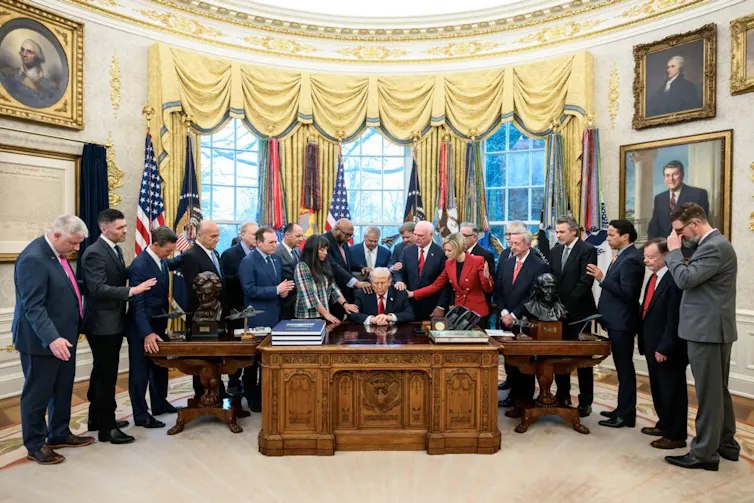
Image courtesy of the White House.
You could be forgiven for thinking that the sight of Donald Trump in the middle of a prayer huddle in the Oval Office was an amusing oddity. But Benjamin Netanyahu’s reference to the Old Testament story of the Amalekites, whom god told the children of Israel to annihilate, “men and women, children and infants, cattle and sheep, camels and donkeys” is frankly chilling. Parts of the Islamic world has flocked to Iran’s defence (although not with particular enthusiasm in the Sunni countries of the Gulf, which Iran is bombarding with ballistic missiles).
À lire aussi :
God on their side: how the US, Israel and Iran are all using religion to garner support
Trang Chu and Tim Morris, meanwhile, believe that this conflict has been nearly five decades in the making. Just as Iran has always denied the right of Israel to exist as a Jewish state, many people in the US and Israel have long been committed to the destruction of Iran as a theocracy. Accordingly the way the two sides talk about each other has hardened over the years. Language on each side no longer reflects a criticism of their adversary’s behaviours, it has become a verdict on their moral character.
So to Iranians, the US is the “Great Satan”, while Iran is described in America as part of an “axis of evil”. Our experts believe that, this language “not only describes the enemy, but actively participates in creating it”. The observe that once you start to think these sorts of things about your adversaries, the idea of engaging in negotiation tends to become secondary to the desire to simply defeat or destroy them. Which is terribly dangerous, as we’re seeing.
À lire aussi :
How the words that Iran and America use about each other paved the way for conflict

Sign up to receive our weekly World Affairs Briefing newsletter from The Conversation UK. Every Thursday we’ll bring you expert analysis of the big stories in international relations.














































You must be logged in to post a comment Login