
Politics
How a grooming-gang victim was framed as a criminal

The post How a grooming-gang victim was framed as a criminal appeared first on spiked.


The Department for Work and Pensions (DWP) are still pretending to care about the mental health of people going through the benefits system – despite their actions showing otherwise.
DWP bullshit again
Labour MP Sarah Hall asked the DWP a written question about mental health:
To ask the Secretary of State for Work and Pensions, what recent assessment he has made of the potential impact of social security assessment and application processes on the mental health of claimants.
The department’s response was the typical non-answer.
Minister for Disabled People, Stephen Timms, answered:
The Pathways to Work Green Paper set out our commitment to get the basics right and improve the experience for people who use the system of health and disability. This includes exploring ways to improve trust and transparency in PIP and WCA through reviewing our approach to safeguarding, recording assessments to increase trust in the process, and moving back to having more face-to-face assessments while continuing to meet the needs of people who may require different methods of assessment.
Timms continued:
We have also launched the Timms Review, the first ever full review of PIP, to ensure we have a system that supports disabled people to achieve better health, higher living standards and greater independence, including through employment. The Review is being co-produced with disabled people, the organisations that represent them, carers, clinicians, experts, MPs and other stakeholders, so a wide range of views and voices are heard.
The Review will consider how PIP can enable disabled people to live independently; whether the assessment effectively captures the impact of long-term health conditions and disability in the modern world; and whether it should consider any other evidence. It will also look at how the assessment could ensure people access the right support at the right level.
Oh, the Timms review? The one that already looks like a stitch-up?
No meaningful research
What’s clear from this copy-and-paste answer is that they still haven’t done any real assessments of the impact the process has on people’s mental health. They also don’t intend to do any meaningful research into this.
This is despite them being given proof for a very long time that the system does negatively impact mental health. This includes a whole bloody book by John Pring. Just this February, it was uncovered that 1 in 5 privately contracted benefit assessors aren’t safeguard trained.
They’re also very light on what “reviewing our approach to safeguarding” actually means. The department has been pulled up by multiple committees on the way they treat claimants. The Public Accounts Committee hauled them up for demonising claimants instead of fixing their own system. The department was also forced to admit that the ESA helpline was so bad it was driving claimants to self-harm.
Then there’s the absolute bullshit that face-to face assessments will help people’s mental health, when the assessments are found to be stressful and inhumane.
By citing all of their previous work, they’re attempting to boost their own credibility. But the Pathways to Work Green consultation was completely ignored. The Timms Review is currently underway, but it’s also being rushed and ignoring the needs of disabled people in favour of saving money. Timms mentioning this essentially confirms that the review will strip back support.
At the end of the day, the DWP don’t give a fuck about claimants’ mental health, if they did they would’ve done more to protect them years ago. All they care about it saving money, no matter how many disabled people die.
Featured image via the Canary

Saying goodbye to Mohamed Salah is not simply about football; when Salah walks away from Liverpool, the club loses more than a prolific scorer; it loses a cultural touchstone. He arrived as a hopeful youngster and leaves as one of the defining figures of this generation. A player whose impact extended far beyond goals and trophies.
A sweet Salah strike to start your Friday 💫😮💨
— Liverpool FC USA (@LFCUSA) March 20, 2026
Salah: from Nagrig to the world stage
Before the goals, the trophies and the deafening chants, there was a boy from Nagrig armed with nothing but belief and determination. Salah’s journey is the kind of story sport loves; belief, sacrifice and relentless work. Overcoming setbacks and doubts which would derail many, only sharpened his resolve. Arriving at Liverpool, he did not join the club as a complete player. Instead, he arrived determined to prove himself, to learn and to not only lift a club but also a city.
Watching Salah at Liverpool felt like witnessing something truly rare. From his very first season, there was an unmistakable feeling that something great was brewing. His pace was electric, his finishing was ruthless. Yet it was his relentless desire that truly set him apart. Every run, every touch, every celebration revealed how deeply the club and the fans mattered to him.
Records fell, defenders faltered and stadiums erupted, yet Salah remained unchanged. Even as the goals mounted and high praise surrounded him, he stayed focused, grounded and driven. Champions league nights at Anfield became unforgettable nights charged with belief, noise and pure emotion. When Salah delivered on the biggest of stages, it felt as though he carried the hopes of all the supporters with him.
More than a footballer
For many Salah has always been more than just a player. As a Muslim football superstar, his expressions of faith on the pitch have been quiet, but powerful. Many a time, fans have seen him fall to the floor in sujood, a poignant reminder that devotion and elite performance can coexist without apology. His conduct challenged assumptions, opened conversations, and offered representation to millions who had not seen themselves reflected at football’s highest levels.
According to a Stanford University study, since Mo Salah joined Liverpool, hate crimes in the area decreased by 19% and anti-Muslim comments online have dropped by 50%. Impact on and off the pitch. pic.twitter.com/pTKOmCshdc
— Football on TNT Sports (@footballontnt) March 25, 2026
Away from the pitch, his willingness to speak and act on broader issues, notably his dignified support for Palestine, showed a conscience that matched his talent. He used his platform to stand in solidarity rather than seek attention, demonstrating how athletes can carry both influence and responsibility.
And, Salah made global headlines when he remained one of a very small number of professional footballers to challenge UEFA’s complicity in Israel’s murder of Palestinian footballer, Suleiman al-Obeid:
Can you tell us how he died, where, and why? https://t.co/W7HCyVVtBE
— Mohamed Salah (@MoSalah) August 9, 2025
Salah never chased the spotlight; his conduct with teammates, supporters and charitable causes did the talking. His generosity, humility and having humanity in his heart turned admiration into something special.
What Salah means to me
Legacies are measured largely in silverware when it comes to football. However, Salah gave belief, to a village, to a nation, and to an entire generation by expanding what was possible in the minds of young players who now see his path as proof that origins will not limit destiny. The terraces will keep singing his name, teaching it to fans who never got the chance to watch him live, but ensuring the legend that is Mohamed Salah and his presence will remain at Anfield.
Thank you, Mohamed Salah, for the goals, the grace and the moments that made football feel larger than sport. You leave Liverpool not only as a record breaker but as a bridge between cultures and a symbol of possibility. The Egyptian King will remain part of Liverpool FC for as long as fans in the stands will be singing his name.
It is truly remarkable to witness an African Muslim footballer achieve the highest accolades as Mohamed Salah has done in the most watched league in the world. His journey is a testament not only to his immense talent and perseverance, but also to the rarity of such accomplishments given the current climate in the UK, where the far-right have undertaken a worrying resurgence. Even in the face of increasing censorship and pressure against voices supporting Palestine, Salah has steadfastly maintained his public support for the cause. His rise serves as a beacon of hope and inspiration, breaking barriers and challenging prejudices, while paving the way for greater inclusivity within football.
Featured image via the Canary

Probiotic and fibre-rich foods are great for our guts (which, it turns out, influence a lot of our overall health).
But the British Heart Foundation (BHF) have warned that not all of these are as kind to our hearts, even though happier guts usually mean better cardiovascular health.
BHF nutrition lead Tracy Parker said that though, “We encourage everyone to choose foods that can keep their gut microbiome healthy… A lot of these products can contain high levels of salt or sugar.”
Here are five foods they warn to “watch out for”:
1) Kimchi
The fermented cabbage dish is great for our gut microbiomes. It’s packed with probiotics, and it may make your digestive tract an unwelcome space for “bad” gut bacteria.
But, the BHF said, “traditional kimchi is often made with a lot of salt, so it can raise blood pressure if eaten frequently or in large quantities. High blood pressure is known to increase your risk of having a heart attack or stroke”.
They advise trying smaller portions or lower-salt versions.
2) Kombucha
The jury’s still out on whether kombucha, a fermented tea, definitely benefits your gut health, though the BHF says it “can be a healthier alternative to sugary or fizzy drinks and has become a popular choice for people looking to introduce fermented products into their daily routine”.
But, they add, “many commercial kombucha products contain added sugars. Eating too much sugar can lead to weight gain, which in turn can increase the risk of a heart attack or stroke or other cardiovascular disease.”
Stick to kinds with “no added sugar” written on the label if you can.
3) Fruit yoghurt
Plain yoghurt contains live bacteria that could benefit the gut, and it’s also high in calcium, which is linked to a lower risk of bowel cancer.
But flavoured, sweetened, and “fruit” yoghurts often “contain added sugars and may have fewer live cultures than plain versions,” the BHF cautioned.
They reccomend choosing plain yoghurt with “live and active cultures” on the label to “ensure you are buying a low sugar option that is good for your gut”.
If you like, you can add fresh fruit at home.
4) Smoothies
“Smoothies made with whole fruits provide prebiotic fibre that feeds the beneficial gut bacteria and supports digestive health,” the BHF said.
But a mere 150ml counts as one of your five a day, and many of us are drinking more than that.
Additionally, “blending breaks down the structure of fruit, releasing ‘free sugars’ that behave like added sugars in the body and cause faster rises in blood sugar levels,” they shared.
“Regularly consuming too much sugar can lead to weight gain, which can increase the risk of developing type 2 diabetes, heart and kidney disease.”
Stick to recommended portion sizes and consider adding nuts, which provide protein and fibre that may help to control the impact of the sugars.
5) Sauerkraut
Like kimchi, this fermented cabbage dish can also be high in probiotics.
But it also often runs a little salty, the BHF said, “which may be a concern for anyone watching their blood pressure. Some shop-bought versions are also pasteurised, which removes most of the live bacteria”.
Try “checking the label and eating small portions,” as well as looking for “raw” sauerkraut or those described as containing “live cutlures”.

Iran has bombed a chemical compound linked to Israel’s white phosphorus production, finally delivering a scrap of consequences to Israel – unlike the entire international community.
White phosphorus is a chemical substance which ignites instantly upon contact with oxygen. It’s incredibly hard to extinguish and sticks to surfaces like clothes and skin. White phosphorus is extremely harmful to people, no matter the route of exposure. It causes deep and severe burns – often down to the bone, breathing problems, and burning of the eyes and respiratory tract.
Israel struck
An Iranian ballistic missile made direct contact with the ICL (Israeli Chemicals Ltd) Rotem chemical complex in the Negev on 25 March. It caused a large blast and a fire near the site.
DIRECT HIT! 🚨🇮🇷🇮🇱 Footage shows the moment an Iranian missile struck the state-owned “Rotem” military research facility in the Negev. Israel has imposed a STRICT media blackout on the extent of the damage! pic.twitter.com/NubMZVPu8f
— 𝐓𝐌𝐓 (@TMT_arabic) March 25, 2026
The facility is located in the Rotem Industrial Zone near Dimona. It houses infrastructure belonging to several industrial and technology companies.
Social media users geolocated the missile impact site to the facility, and the missile damaged the structure.
Damage to structure in the Rotem Amfert facility, east of DIMONA, Israel
The company produces fertilizer and related chemicals and is located ~8km north-east of the Negev Nuclear Research Center.
31.062424, 35.193562@GeoConfirmed @EpicFuryMap @FaytuksNetwork
geolocated by… pic.twitter.com/bSOl1xtUp9
— acceladealer (@acceladealer) March 25, 2026
Importantly, ICL has factories all over the world, including another chemical plant in St Louis, Missouri, which also produces white phosphorus for both the US and Israeli armies.
Karma
The Canary has previously reported on the shady business of ICL – which the company was not happy with, by the way.
So it seems like a healthy dose of karma that one of its war-crime producing factories has now been bombed.
White phosphorus ignites on contact with oxygen. It sticks to skin and burns down to the bone. It is very hard to extinguish. Israel is bombing Gaza and Lebanon with white phosphorus. Iran’s strikes on Israel’s white phosphorus factories are a service to humanity. https://t.co/oCA1i15Jv0
— Shailja #FreePalestine Patel (@shailjapatel) March 25, 2026
The human body absorbs white phosphorus, causing dysfunction in multiple organs, including the liver, kidneys, and heart.
It burns at more than 800 degrees Celsius (nearly 1,500 degrees Fahrenheit). That is high enough to melt metal.
Importantly though:
The incendiary effects of white phosphorous can cause death or cruel injuries that result in lifelong suffering.
The use of chemical weapons, such as white phosphorus, in civilian areas is a war crime for exactly this reason.
According to the World Health Organisation:
The use of white phosphorus may violate Protocol III (on the use of incendiary weapons) of the Convention on Certain Conventional Weapons (CCCW) in one specific instance: if it is used, on purpose, as an incendiary weapon directly against humans in a civilian setting.
So far, Israel has used white phosphorus in both Gaza and Lebanon as far back as 2023.
I saw an interview with the mother of a Palestinian girl who had had her hair and eyelids burned off by Israeli white phosphorous. She couldn’t even close her eyes to shut out the horror of her own reflection.
Israel will be a pariah state for generations, if it even survives.
— Ruby Redshoes (@Ruby__Redshoes) March 26, 2026
Of course, the majority of the international community didn’t give a shit when little children were burnt alive.
White phosphorus has eaten the flesh of Palestinians in Gaza without the world lifting a finger. May every inch of that complex burn to the ground https://t.co/caPklJOGvN
— Remi Kanazi (@Remroum) March 25, 2026
But when Israel is using weapons that literally melt off children’s faces – we have to ask why it’s only Iran, and only now, that anyone has bothered to take a stand.
Iran taking out the apartheid regime’s chemical weapons. 🙃 https://t.co/FdIye3IZIK
— Basti 🍥 (@SHartmann82) March 25, 2026
Strategic military targets
For 30 years, Netanyahu has been banging on about Iran being two weeks away from having nuclear weapons. Of course, he has zero proof for these claims.
Yet Israel has had nuclear weapons since 1969, and has refused both inspections and safeguards from the International Atomic Energy Agency (IAEA).
We also have years’ worth of evidence of Israel (not Iran) indiscriminately attacking civilians with all kinds of weapons. Yet somehow, the Epstein class want us to believe Iran is the bad guy?
So Iran appears to be the one enforcing the law against terror weapons used in ethnic cleansing https://t.co/HdhPEuiPGa
— The Fulcrum Point (@Fu1crumPoint) March 26, 2026
Now it turns out that Iran is destroying the real weapons of mass destruction – Israel’s.
Average Israeli airstrike: we blew up a hospital
Average Iranian missile strike: we precision targeted a facility known as The Death Factory https://t.co/HwtQHeO06S
— j (@thickyrubio) March 25, 2026
Where international law, morals, conscience, and even the United Nations have failed, Iran has stepped in.
Notice how Iran keeps hitting actual military and strategic targets while Israel just keeps targeting and bombing civilian targets.
— Yi-Long (@YikeYuke) March 25, 2026
Every western country should have been doing the same if they had a spine.
— RAY RAY (@sweet_baby_ray5) March 25, 2026
There is only one thing Israel does well – and that is playing the victim. So I won’t be surprised when we see an official Israeli broadcast telling us that bombing an illegal chemical weapons factory is antisemitic.
But the truth is that while the majority of the international community has collectively sat on its arse and let Israel murder innocent people, Iran has taken out the chemical weapons production of an illegal, apartheid regime. It deserves a Nobel Peace Prize.
More than Trump does, at least.
Featured image via Mahmood OD | محمود عودة/YouTube

Yesterday, 25 March, the British Medical Association (BMA) announced six new days of strike action. The news followed the union members’ vote to reject the government’s latest offer on pay and jobs. Following the announcement, supposedly-socialist health secretary Wes Streeting took to the Commons to continue his streak of bashing the doctors’ union.
His excuse for paltry pay offers this time? Well, the economic fallout of the war in Iran, of course. As if he was just brimming with constructive pay offers before Netanyahu and Trump started their latest bombing campaign, the little fucking weasel.
Strike action
On 24 March, the BMA officially rejected the government’s latest pay offer. This had included pay uplifts for doctors after the successful completion of their ARCP (annual review of competence progression). Likewise, it also committed to a reform of the nodal points of the pay scale structure.
However, the union called the government out for moving the goalposts during the negotiations. Resident Doctors Committee (RDC) negotiators said that, at the last moment, the Government reduced the original investment on the pay element of the offer. Worse still, they said they’d stretch this over a three-year period.
Given this appalling behaviour from the government, the RDC announced that residents will stage a six-day walkout. This will last from 7 April until 13 April.
Streeting — moving the goalposts
RDC chair Jack Fletcher explained that the government had failed to deliver on pay offers, in spite of weeks of negotiations. He said:
We have been negotiating in good faith for weeks to try and end the simultaneous pay and jobs crises for resident doctors. Frustratingly we had been making good progress right up until the point, in the last two weeks, when the Government began to shift the goalposts.
As talks progressed it became clear that the money proposed for pay increases was now going to be spread over three years. This is combined with today’s pay review body (DDRB) recommendation pointing to yet more years in which our pay, at best, barely treads water.
We have made abundantly clear throughout this dispute that our aim is pay restoration, and any deal that did not move us substantially in that direction was not going to fly.
We also cannot ignore that, thanks to global events, economic indicators now point to years of greatly increased inflation. We are simply not going to put an offer to doctors that risks locking in further erosion of pay at a time when doctors continue to leave the UK for other countries.
The strike would be the first industrial action from the RDC since last December. However, the union emphasised that doctors want to get on with their jobs, rather than standing on picket lines – and the RDC is hoping that the threat of action will make the government take the matter seriously.
Likewise, Fletcher re-stated his willingness to negotiate:
We are not closing the door on talks. We remain willing to negotiate and are eager to get a deal done if we can simply recapture the early positive spirit of negotiations. No strikes need to happen, but Government will need to act fast to prevent them.
Streeting’s newest excuse
However, Labour’s health secretary is clearly hellbent on doing anything but negotiating in good faith. Instead, he’s once again resorted to threats and excuses.
This time, Streeting bleated that the war in Iran meant there was no chance of a better pay offer. But, as a reminder, Streeting was making no-pay-rise offers long before Iran.
Speaking in the Commons today, 26 March, Streeting said:
The BMA has pointed to the war in Iran as reason to reject the deal, so let me spell out the consequences of what this country is facing.
This country wants to see de-escalation, a swift resolution to the conflict with a negotiated agreement that puts tough conditions on Iran and specifically its nuclear ambitions.
However, we are planning on the basis of a prolonged conflict because that is the prudent thing to do.
In that eventuality, there would be an impact on the economy and on the public finances. Were that to happen, a future offer to resident doctors will not look better than what is on offer today.
Doubling down
Worse still, he chose to double down with his threats against the union. Before now, his tactic consisted of blaming resident doctors for handing the next election to Reform —s and thus destroying the NHS. That, and an utterly farcical attempt to blame the BMA for ruining Christmas (genuinely).
However, Streeting is now threatening to renege on handing over the money that was already ringfenced to fund the government’s paltry pay offer to resident doctors.
He stated that the government’s patience for NHS disruption is running out, and issued an ultimatum: the BMA has until 2 April to call of the strike, or the government will spend the money on ‘minimising disruption’.
Let’s not mince words here. This is a health secretary speaking for a Labour government — supposedly the pro-union option — threatening to destroy months of negotiations in order to strong-arm workers out of a strike.
If Wes Streeting had any fucking shame, he wouldn’t be able to show his face above a red tie ever again. But at this point, the anti-union health secretary probably feels right at home in Starmer’s Labour, doesn’t he?
Featured image via the Canary
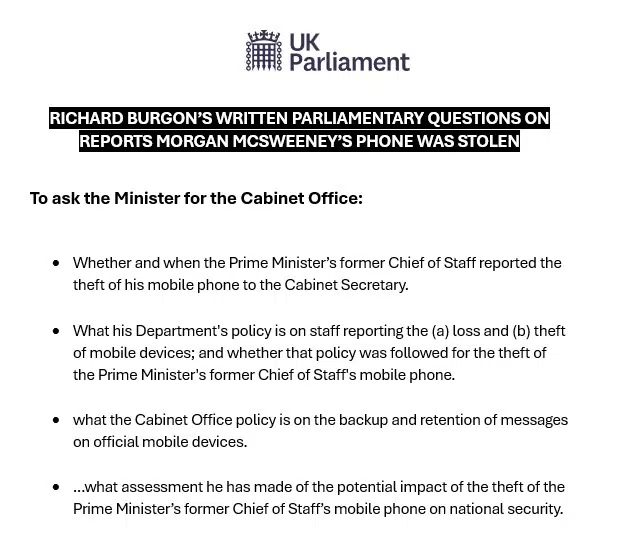
Two Labour MPs have separately issued strong responses to the government’s handling of the Morgan McSweeney phone scandal. Richard Burgon provided his in the form of a Parliamentary Written Question; Karl Turner, meanwhile, called McSweeney a “lying bastard”:
BREAKING: Labour MP says “lying bastard” Morgan McSweeney is “still running the job”.
Following my investigation yesterday into McSweeney’s unlikely account of a “phone theft”, the MP for East Hull, @KarlTurnerMP, has granted me an exclusive interview.
Here’s what he told me:🧵 pic.twitter.com/oegLcdSisg
— Jody McIntyre (@jodymcintyre_) March 26, 2026
McSwindle
As we reported, Morgan McSweeney is Keir Starmer’s former chief of staff. He resigned in resigned in disgrace in February this year to take the fall for hiring Peter Mandelson — a close associate of the international paedophile Jeffrey Epstein.
Now, it’s emerged that McSweeney conveniently had his phone stolen not long after Mandelson got the boot. This has led to the accusation that McSweeney faked this event as cover to permanently delete messages:
Q: Critics say the theft and botched investigation of Morgan McSweeney’s phone stinks of a cover-up. Can you understand why people are suspicious about this phone being stolen just as the Mandelson scandal was unfolding? https://t.co/nDvTL34qZj
— Beth Rigby (@BethRigby) March 26, 2026
Speaking to Canary contributor Jody McIntyre, Labour MP Karl Turner said the following:
This morning on Sky News, Keir Starmer said that it is “a little bit far-fetched” to think that McSweeney could have known that “sometime in the future there would be a request for the phone”.
Labour MP Karl Turner told me this morning that the statement is “absolute bollocks”. pic.twitter.com/ANxfikYWai
— Jody McIntyre (@jodymcintyre_) March 26, 2026
Labour’s Karl Turner told me that he’s not the only MP wary of McSweeney’s version of events.
“We all think it’s f***ing nonsense. The only one’s who will stick by McSweeney are the 2024 intake. The McSweeney, Mandelson, Doyle, and Faulding selections.”
The inner circle. pic.twitter.com/MRNPSr3Brj
— Jody McIntyre (@jodymcintyre_) March 26, 2026
Explosively, Turner has alleged that McSweeney is still the puppet master behind our muppet prime minister:
The MP for East Hull admitted to having an “association” with Peter Mandelson himself, but said:
“With McSwindle, [Peter] Kyle, [Steve] Reed, and [Wes] Streeting, it’s more than an association…they’re very close friends!”
Streeting + Reed have both lied in defending McSweeney. pic.twitter.com/OCGXQ1DFOX
— Jody McIntyre (@jodymcintyre_) March 26, 2026
Turner is one of many to note that McSweeney’s story doesn’t make sense. According to the disgraced McSweeney, he called the police, gave them the wrong details, and then called it a day. Like the rest of us, Turner simply can’t believe that:
Labour MP Karl Turner told me this morning: “I would say to Starmer: ‘Don’t protect McSwindle! You can’t confirm what he’s saying!’
Let’s get to the real issue: the whole world is at war because we’ve got a mad bastard in the White House indiscriminately bombing countries.” pic.twitter.com/gyJRP0kAu9
— Jody McIntyre (@jodymcintyre_) March 26, 2026
Labour — National Security
Turner isn’t the only Labour MP taking the government to task. Richard Burgon announced the following:
I’ve submitted these formal Parliamentary Written Questions following reports that Morgan McSweeney’s phone was stolen.
Given the serious impact this could have on getting the truth about the Mandelson scandal (and even on the Labour Together scandal), we need answers.
Burgon is demanding to know:

Given the track record of Starmer’s government, we can’t imagine we’ll get plausible answers to these questions. The more the pressure builds, though, the sooner Labour will have to force the PM out, and the sooner the better.
Featured image via PickPik

After four ambulances owned by Jewish charity Hatzola were set on fire, Israel lobbyists – including Nigel Farage – were quick to claim an ‘Iranian terror cell’ was responsible. The lobby said this was clear proof of Iranian hostile acts on UK soil and demanded a terror ban on the Islamic Revolutionary Guard Corps (IRGC). The lobby’s media allies, naturally, amplified the claim.
None of the ‘mainstream’ media, of course, bothered to wonder why a crack ‘Iranian terror cell’ would choose four nearly-defunct ambulances as their first target. But others did:
Suspect
The supposed ‘terror cell’ behind the 23 March 2026 attack had never been heard of before March 2026. Its emblem spells ‘Islamic’ wrong in Arabic. Its statement claiming credit for the attack mentioned the “Land of Israel”, a phrase no Islamic group would use.
The language of the group’s statements is also, according to Amsterdam’s VU university’s political anthropologist Younes Saramifar, a weird mix completely inconsistent with people as familiar with Arabic as religious Muslim Iranians would be. Saramifar concluded that:
The language of announcements shows a clear lack of fluency in Arabic. The language is generated by an AI tool. Furthermore, the electronic device on which the new video was edited does not have Arabic or English as its native language in its operating system. This is clear from where the colon and the exclamation mark are placed in the sentence. This shows that the group is neither native Arabic nor English speakers. Native speakers are habituated to managing these technical glitches. Based on their language use, I don’t think they are a direct proxy or a sleeper cell associated with the Axis of Resistance.
It seems the courts and Crown Prosecution Service agree, as the suspects have been released on bail this morning, 26 March 2026. As Irish comedian and political activist Tadgh Hickey pointed out, this “weirdly lenient” decision doesn’t really fit with the idea of a ‘terror cell’:
That’s a weirdly lenient way to deal with members of a new bloodthirsty Iran sponsored Shia terrorist cell 🤔 pic.twitter.com/8nwTWhqPNO
— Tehran Tadhg (@TadhgHickey) March 26, 2026
Israel has a long and well-documented history of ‘false-flag’ attacks to achieve political ends, including in London.
Featured image via the Canary

New screen time limits have been revealed for children in the UK under five.
The guidance, from the UK government, comes as almost one-quarter (24%) of parents of three‑ to five‑year‑olds say they find it hard to control their child’s screen time, and 98% of two‑year‑olds watch screens every day.
In response to parents calling for support on how much screen time is too much, as well as how to build healthy habits, the government shared new evidence-informed guidance for babies, toddlers and pre-schoolers.
What are the new screen time rules?
Under twos should avoid screen time other than for shared activities that encourage bonding, interaction and conversation (ie. FaceTiming family), per the new guidance.
Meanwhile two- to five-year-olds should stick to no more than one hour of screen time a day.
The government also advises avoiding screen time at mealtimes and in the hour before bed, so as not to disrupt sleep.
What else does the guidance say?
- Opt for slow-paced, age-appropriate content.
- Fast-paced, social media-style videos and AI toys or tools should be avoided for young children.
- Parents are encouraged to watch or use screens together to make the experience more interactive, as talking, asking questions, and engaging with the content is better for children’s development.
- Make safe screen swaps like reading bedtime stories together or playing simple games at mealtimes.
The guidance stems from the findings of an expert panel led by the Children’s Commissioner Dame Rachel de Souza and Professor Russell Viner, a paediatrician and expert in children’s health.
The panel reviewed the latest evidence on screen use in under-5s, and found long periods of time spent on screens alone can get in the way of activities critical for development.
Think: sleep, physical activity, creative play, and interaction with parents.
But not all screen use is equal.
Watching screens with an engaged adult where parents talk and ask questions is linked to better cognitive development than solo use.
Slow-paced content is also far better for development than fast-paced social media-style videos.
Evidence also suggests time limits shouldn’t apply in the same way for screen-based assistive technologies to support children with special educational needs and disabilities.
Prime minister Keir Starmer said: “Parenting in a digital world can feel relentless. Screens are everywhere, and the advice is often conflicting.”
The new guidance “cuts through the noise”, he added, “to keep children safe and make sure healthy habits are baked in from the start”.
Admitting that some will oppose the guidance, he added, “I will always stand on the side of parents doing their best for their children”.
Children’s Commissioner Dame Rachel de Souza said: “Young children need their parents to be confident in managing their screen use, but often this can be overwhelming for parents learning to navigate this.
“My hope is that this guidance helps to cut through the conflicting advice available and prioritise children’s development and wellbeing, as well as their safety.”
Neil Leitch, CEO of the Early Years Alliance, welcomed the new guidance and its emphasis on providing practical tips and advice for parents and carers.
He added he hopes it’s “the first step towards equipping children – and those supporting them – with the skills they need to thrive in an increasingly digital world and ensuring that technology enhances rather than undermines early learning and wellbeing”.
A resolution adopted by the UN General Assembly declared the transatlantic slave trade and the associated system of racialised chattel enslavement to be the gravest crime against humanity, a text that saw the UK and Ukraine abstain alongside 51 other nations, mostly European countries, as the measure passed with 123 votes in favour and only three countries, Argentina, Israel, and the United States, voting against.
The resolution emphasised that “claims for reparations represent a concrete step toward remedy.”
Funny how the UK, which got rich off the whole operation, suddenly found itself unable to pick a side, except to side with silence.
Of course, the US, Israel, and Argentina voted no — they are shameless. The shameless Americans also said the UN “was not founded to advance narrow specific interests and agendas” while arguing that reparations for historical wrongs are not legally owed because such crimes “were not illegal under international law at the time they occurred.”
Diane Abbott, Member of Parliament and the Mother of the House, shared the news of Britain’s abstention
Britain abstained. https://t.co/gHqzMyAmTV
— Diane Abbott (@HackneyAbbott) March 26, 2026
MP Bell Ribeiro-Addy said the UK’s abstention put it at odds with the global majority.
UN Delegates just voted to recognise the Transatlantic slave trade as a crime against humanity. Britain abstained.
This refusal to support this motion only places our government more at odds with the global majority.
The call for reparatory justice is only getting louder.
— Bell Ribeiro-Addy MP (@BellRibeiroAddy) March 25, 2026
Ben Norton criticised the West’s refusal to condemn slavery.
The West refused to condemn slavery in a UN General Assembly vote denouncing the transatlantic slave trade as “the gravest crime against humanity”.
Europe abstained.
Just 3 countries voted against it: the US, Israel, and Argentina.
More info here: https://t.co/ySFuXcylBr pic.twitter.com/gLOKBaCRLw
— Ben Norton (@BenjaminNorton) March 26, 2026
Meanwhile, GB News ran with a sensationalist headline.
UN votes for Britain to give up trillions of pounds in ‘slavery reparations’ handoutshttps://t.co/GPBtPRAXuI
— GB News (@GBNEWS) March 26, 2026
The new story quoted a Foreign Office spokesperson saying:
The UK’s position on reparations is clear – we will not pay them.
GB News was also cross that the UN “did not note Britain’s role in ending the slave trade, freeing 800,000 slaves, abolishing the trade entirely in 1807, and throughout most of the British Empire under the Slavery Abolition Act 1833.”
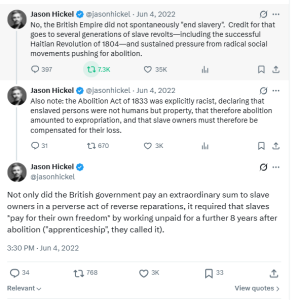
Maybe we should ask GB News to read Scholar Jason Hickel, who has written extensively on reparations, on the UK’s role in ending slavery.

He has also recently contributed to five case studies covering damages from slavery, conflict-related sexual violence, climate change, racial injustice, and structural adjustment.
I’m excited to announce this new dossier on reparations, published in the BMJ Global Health. Five case studies covering damages related to slavery, conflict-related sexual violence, climate change, racial injustice and structural adjustment. https://t.co/MaTBKffHG2 pic.twitter.com/uI3pPKGCwI
— Jason Hickel (@jasonhickel) March 24, 2026
Featured image via Twitter

As we reported, Starmer’s former chief of staff Morgan McSweeney claimed his phone was stolen in October last year. This caused controversy, with many accusing McSweeney of faking the theft to destroy WhatsApp messages between himself and Peter Mandelson. Lending further credence to these suspicions, the Times has now revealed that the government hasn’t asked Mandelson to hand over his personal devices:
Exclusive:
Lord Mandelson has not been asked to hand over WhatsApp messages or texts from his personal phone amid mounting concern about the limited nature of the government’s disclosures
The peer handed over his work mobile when he was sacked as ambassador to the US because of…
— Steven Swinford (@Steven_Swinford) March 26, 2026
Shocking
The Mandelson scandal exposed that many people in Starmer’s government like to play fast and loose with the truth, including Mandelson himself. Given this, it should be a given that all of Mandelson’s devices need to be searched — not just the ones he was supposed to be using. If the man was willing to lie about his connections to Jeffrey Epstein, we can assume he was equally comfortable sending official messages from an unofficial device.
Times political editor Swinford said that Mandelson:
handed over his work mobile when he was sacked as ambassador to the US because of his friendship with the late paedophile Jeffrey Epstein
But he has not been asked by the Cabinet Office for any of the messages on his personal device
It has been left to a group of a dozen officials to attempt to “reconstruct” the contents of Mandelson’s phone by asking ministers and officials for their correspondence with the peer
This sounds like a truly nightmarish way of conducting an investigation. It’s like they’re trying to put pieces of shredded paper together despite knowing where the original document is.
Swinford continued:
The Times has been told that the Cabinet Office was so concerned about the limited nature of the disclosures that it has asked people for messages from their personal devices
It is also now asking people for group WhatsApp messages that involved Mandelson, having initially refrained from doing so
Why refrain from asking people for messages? And why not just ask Mandelson? To be fair, they should definitely do both, because there’s every reason to suspect Mandelson would delete any evidence. After all, this is the guy the authorities suspected of being a legitimate flight risk following his arrest.
Swinford further said:
Mandelson used his personal mobile in the run-up to his appointment as ambassador before switching over to a work mobile just under a month into the role. He resumed using his personal mobile on his return to the UK after he was sacked in September
Oh, okay, so it’s confirmed; he did use his personal phone for work business.
What on Earth is going on?
It’s so bad that even the Tories are looking less sleazy than Labour, as Swinford noted:
The Tories said that under the terms of the “humble address”, a parliamentary mechanism that forces the government to disclose information, the Cabinet Office should have requested the messages from Mandelson.
They said that the failure to do so “risks putting the government in contempt of parliament”
Mandelson exceptionalism
This is how Swinford ends his post:
Mandelson could not be compelled to hand it over, but others who used to work for government have been asked for messages from their personal devices
In other words, they’re allowed to ask, but those being investigated are under no obligation to comply.
It’s funny, isn’t it, because they almost certainly would have to comply if they were normal people who’d stolen a loaf of bread. That’s a proper crime, though, isn’t it — not like sharing state secrets with the 20th century’s most notorious paedophile.
Featured image via UKinUSA

Experts reveal worrying increase in violence and abuse against NHS staff
Two humanitarian aid boats en route to Cuba missing, Mexico says

White House crypto czar David Sacks transfers to presidential advisory committee role

Smart energy pays enters the US market, targeting scalable financial infrastructure

Why Israel is blocking foreign journalists from entering

Bitcoin: We’re Entering The Most Dangerous Phase

NEW YORK’S Governor ERUPTS After $7 Trillion Vanguard Builds Its Next Financial Center in Texas!

Divine Financial Breakthrough #Prayer #FinancialBlessing #ChristianMotivation #Faith #Breakthrough

Crypto Setup Looks TERRIFYING! – But It’s Not What You Think!!
-
 Crypto World6 days ago
NIO (NIO) Stock Plunges 6.5% as Shelf Registration Sparks Dilution Worries
-
 NewsBeat2 days ago
Manchester United reach agreement with Casemiro over contract clause amid transfer speculation
-

 Fashion6 days ago
Weekend Open Thread: Adidas – Corporette.com
-

 Politics6 days ago
Jenni Murray, Long-Serving Woman’s Hour Presenter, Dies Aged 75
-

 Crypto World5 days ago
Best Crypto to Buy Now: Strategy Just Spent $1.57 Billion on Bitcoin During Fear While Early Investors Quietly Enter Pepeto for 150x Potential
-

 Crypto World5 days ago
Bitcoin Price News: Bhutan Sells $72 Million in BTC Under Fiscal Pressure, but the Smart Money Entering Pepeto Sees What the Market Does Not
-

 Tech7 days ago
inKONBINI Lets You Spend Summer Days Behind the Register
-

 News Videos22 hours ago
Parliament publishes latest register of MPs’ financial interests
-

 Sports4 days ago
Remo Stars and Kano Pillars Strengthen Survival Hopes in NPFL
-

 Sports3 days ago
Gary Kirsten Accuses Pakistan Cricket Board Of ‘Interference’, Mohsin Naqvi Responds
-

 Business4 days ago
No Winner in March 21 Drawing as Prize Rolls to $133 Million for Next
-

 Tech4 days ago
Give Your Phone a Huge (and Free) Upgrade by Switching to Another Keyboard
-

 Sports6 days ago
2026 Kentucky Derby horses, odds, futures, preview, date: Expert who nailed 12 Derby-Oaks Doubles enters picks
-

 Tech4 days ago
AI enters the chat: New Seattle dating app relies on tech to facilitate meaningful human connections
-
Business6 days ago
Columbia Sportswear enters $500 million credit agreement with JPMorgan Chase
-

 Tech5 days ago
Today’s NYT Connections Hints, Answers for March 22 #1015
-

 News Videos3 days ago
Ch 9 Financial Management Part 1 | Detailed One Shot | Class 12 Business Studies Boards 2026
-

 Business5 days ago
Will Duke Basketball Win It All? Duke Basketball Enters Second Round as Third Favorite to Claim NCAA Title
-
 Crypto World6 days ago
Small-cap Russell 2000 enters correction territory
-

 Sports4 days ago
2026 Kentucky Derby horses, odds, futures, preview, date: Expert who hit 12 Derby-Oaks Doubles enters picks
You must be logged in to post a comment Login