
Crypto World
Coca-Cola (KO) Stock: Jefferies Projects 15% Gains Fueled by Fairlife Momentum


Key Takeaways
- Jefferies identifies Coca-Cola’s fairlife protein line as a major catalyst for future growth
- Production capacity for fairlife is projected to jump 25% throughout 2026, unlocking new distribution opportunities
- The fairlife brand may boost North American organic revenue by more than 2% in 2026 alone
- Four out of five Wall Street analysts maintain positive ratings on KO with an $86 average target
- Warren Buffett’s Berkshire Hathaway generates approximately $848 million yearly from KO dividends
Coca-Cola (KO) shares are currently hovering in the mid-$70 range, registering approximately 12% growth year-over-year, despite experiencing a modest 6% decline during the last 30 days.
Jefferies has positioned Coca-Cola among its premier selections within the protein sector, emphasizing fairlife as the primary catalyst. According to the firm, consumers are increasingly gravitating toward accessible, economically viable, protein-dense products — a trend that fairlife capitalizes on effectively.
The investment bank projects that Coca-Cola’s extensive distribution infrastructure will accommodate a 25% surge in fairlife production capacity during the current year. This expanded manufacturing capability should enable deeper penetration into convenience retail locations and food service establishments, channels that represent significant growth opportunities for the brand.
From a financial perspective, Jefferies anticipates fairlife will add upward of 2 percentage points to Coca-Cola‘s North American organic revenue expansion in 2026. This impact is projected to strengthen by an additional percentage point when 2027 arrives.
Collectively, the analyst firm maintains that fairlife positions Coca-Cola to achieve its published organic sales growth target range of 4% to 6% annually.
Broad Analyst Support for KO Stock
Jefferies represents just one voice in a broader chorus of support. According to data compiled through March 24, 2026, approximately 80% of equity analysts tracking Coca-Cola maintain optimistic ratings. The collective price target stands at $86, suggesting potential appreciation exceeding 15% from present trading levels.
Morgan Stanley analyst Dara Mohsenian recently reaffirmed his bullish stance on Coca-Cola with an $87 valuation target. His confidence stems from robust 2026 earnings projections, resilient demand throughout North America, and fairlife’s continued market penetration.
Bank of America Securities similarly maintains a Buy recommendation alongside an $88 price objective.
The stock has retreated approximately 3% to 4% during the most recent trading week. Nevertheless, the prevailing Wall Street sentiment remains largely unchanged.
Berkshire’s Coca-Cola Position Generates Massive Dividend Flow
Warren Buffett’s Berkshire Hathaway has maintained ownership of 400 million Coca-Cola shares since the early 1990s. In 1994, Berkshire received approximately $75 million annually in dividend payments from this holding. Currently, that annual distribution has expanded to roughly $848 million.
Coca-Cola boasts an impressive 64-year streak of consecutive dividend increases, securing its designation as a Dividend King. The stock currently offers a yield approaching 3%, though Berkshire’s yield calculated against its original investment basis now exceeds 60%.
This exceptional dividend history explains why KO continues attracting income-oriented investors, particularly during periods of market turbulence.
Based on assessments from 15 analysts, the consensus rating classifies the stock as a Strong Buy, with a mean price target of $85.07.




Bitcoin margin long positions on Bitfinex have climbed to levels not seen since November 2023, drawing fresh market attention during a period of weak price action.
Summary
- Bitfinex margin long positions climbed to 79,193 BTC, the platform’s highest level since November 2023.
- Adam Back said buyers may use TWAP strategies to accumulate Bitcoin below $69,000 during pullbacks.
- Back estimated leveraged accumulation now exceeds 300 BTC daily, or about $20 million each day.
The move has added a new data point to the wider debate over whether large buyers are building exposure during the current correction.
Recent market data shows Bitfinex margin long positions rising to about 79,193 BTC. That marks the highest level recorded on the platform since November 2023.
The increase came as many traders kept their attention on macro risks, including oil prices and geopolitical tension. Even so, activity on Bitfinex pointed to a different trend, with leveraged Bitcoin accumulation continuing in the background.
Adam Back, chief executive of Blockstream, described the pattern as “unprecedented.” He linked the move to a market structure where larger buyers appear to be adding exposure in a steady and deliberate way.
Back said a group of institutional participants may be using a time-weighted average price strategy, also known as TWAP. Under that approach, buyers spread purchases over time instead of placing one large order.
He said this buying appears to focus on Bitcoin below the $69,000 level. According to his reading of the market, those orders have absorbed available supply during the recent pullback.
Back also said Bitfinex margin accumulation has been building since late 2020. He estimated that the pace now stands at 300 BTC or more per day through organic trades.
Using that rate, the daily flow would equal about $20 million at recent prices. That works out to around $14,000 per minute, with an average purchase rate between 450 and 600 BTC over a full day.
Accumulation builds during a correction phase
The timing of the buildup has drawn attention because it is taking place during a correction. While price action has remained under pressure, long positioning on Bitfinex has continued to expand.
Back said this does not look like “artificial speculation.” Instead, he described it as longer-term positioning by buyers whose identities remain unclear.
That view reflects a wider idea now circulating in the market. Some traders believe the current phase is shifting Bitcoin from weaker holders to entities with a longer holding period.
Several analysts have also pointed to signs of bearish exhaustion on the weekly chart. In that setting, a large leveraged buildup can become a closely watched market signal.
Back said the size of the Bitfinex long book could tighten available supply if the current pace continues. He added that reduced market depth could make Bitcoin react faster if a positive catalyst appears.
Quick Overview
- Major U.S. equity benchmarks declined last week, leaving the Nasdaq with a 10% year-to-date loss
- Closure of the Strait of Hormuz has driven oil prices over 45% higher in just one month
- Friday’s March employment report projected to reveal 50,000–56,000 new jobs added
- Consumer confidence plunged to December lows as geopolitical conflict weighs on sentiment
- Market pricing now reflects a 22% probability of Fed rate increase by late 2026
Investors face a critical but abbreviated trading week marked by equity weakness, energy market turbulence, and employment data that could reshape market expectations.
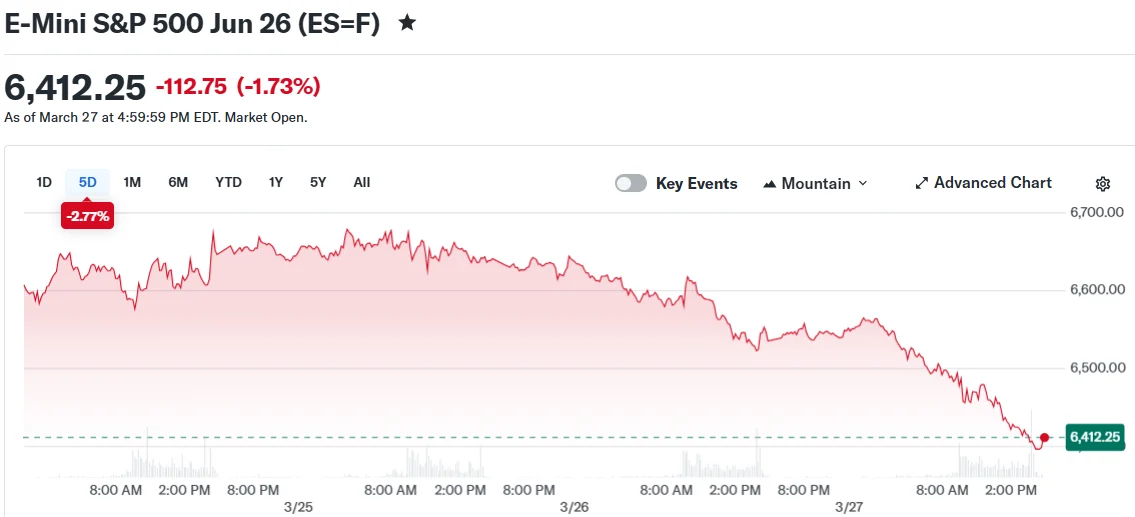
The S&P 500 retreated 2.12% over the prior week, settling at 6,368.85. The Dow Jones Industrial Average declined 1.73%, suffering an approximately 800-point loss on Friday’s session alone. The Nasdaq Composite shed 2.2% Friday and has accumulated roughly a 10% decline year-to-date. Significantly, all three major benchmarks have now breached their 52-week moving averages, suggesting deteriorating technical support.
The primary catalyst remains the U.S.-Israeli confrontation with Iran, now entering its fifth week. The effective blockade of the Strait of Hormuz has eliminated 15 to 16 million barrels daily from worldwide supply. Brent crude has climbed more than 45% while WTI crude has surged over 50% during the past month.
BP’s chief economist Gareth Ramsay characterized the Strait of Hormuz shutdown as “every analyst’s study piece, or worst nightmare that we thought could never happen.” Iranian parliamentary speaker Mohammad Baqer Qalibaf declared the strait “cannot be the same as before.”
Employment Report Takes Center Stage
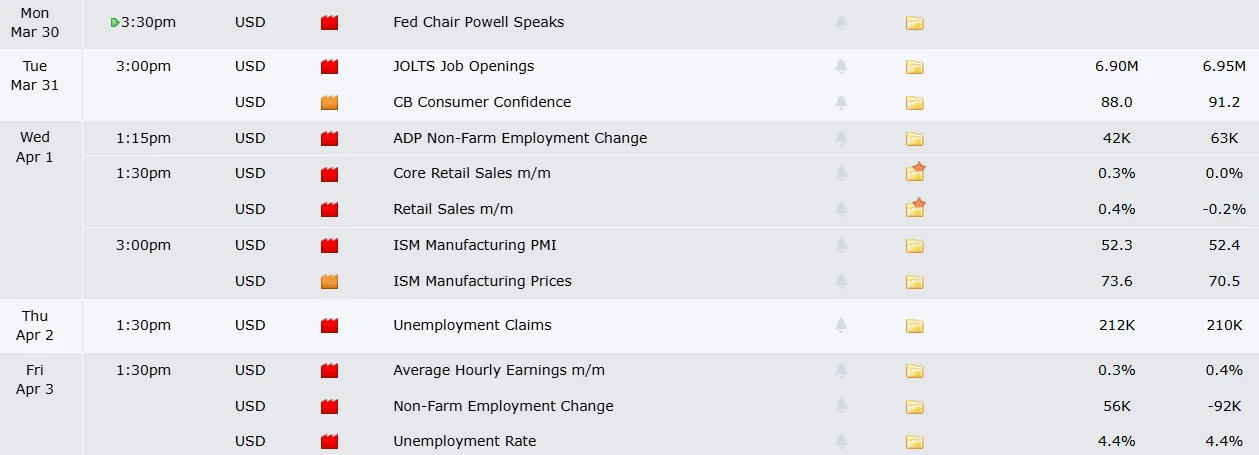
Friday’s nonfarm payrolls release represents the week’s most significant market event. Analyst consensus anticipates approximately 50,000 to 56,000 positions created during March, following February’s unexpected decline of 92,000 jobs. The unemployment rate is projected to remain unchanged at 4.4%.
Goldman Sachs economist Pierfrancesco Mei projects elevated energy costs will subtract roughly 10,000 monthly jobs from payroll expansion through year-end. BNP Paribas economist Andrew Husby suggested a more pronounced energy disruption would be required to disrupt the current pattern of modest hiring and limited layoffs characterizing the labor market.
Prior to Friday’s payrolls announcement, market participants will monitor Tuesday’s consumer confidence reading, Wednesday’s JOLTS job openings and ADP private payrolls data, and Thursday’s weekly jobless claims.
Central Bank Stance Shifting
Fixed-income markets are beginning to reflect expectations of a less accommodative Federal Reserve posture. The 10-year Treasury yield advanced to 4.48%, marking its peak since July. Two-year yields climbed to 4%, accumulating over 30 basis points since the Federal Reserve’s most recent policy meeting.
BofA Global Research economist Aditya Bhave noted markets seem to be “anticipating a more hawkish Fed reaction function.” Current market pricing assigns a 22% likelihood to a quarter-point rate increase materializing by 2026’s conclusion.
Headline consumer price inflation is projected to approach 3.5% annually in upcoming months as national gasoline prices near $4 per gallon.
Regarding corporate earnings, Nike delivers quarterly results Tuesday, with particular attention on Chinese market demand trends. ConAgra, Lamb Weston, and Cal-Maine Foods announce Wednesday. Tesla is scheduled to publish monthly delivery figures this week.
Federal Reserve Chair Jerome Powell addresses markets Monday, with investors scrutinizing his commentary for indications regarding the monetary policy trajectory.
Crypto World
USA Rare Earth (USAR) Stock Slides 3.6% Despite Major Production Milestone and Strong Insider Buying

Key Highlights
- USAR shares dropped 3.6% on Friday, reaching an intraday low of $15.05 before settling near $15.42, with trading volume significantly lighter than typical sessions.
- The firm launched its commercial-scale magnet manufacturing facility in Stillwater, Oklahoma, positioning itself to accept customer orders for sintered NdFeB permanent magnets beginning in Q2 2026.
- Initial production (Phase 1a) is projected to achieve an annual run rate of 600 metric tons by Q4 2026, with total facility capacity expanding to 1,200 mtpa by Q1 2027.
- Wall Street analysts collectively rate the stock a “Moderate Buy” with an average price target of $34.33 — representing potential upside exceeding 120% from current levels.
- Company insiders control approximately 46.6% of outstanding shares, with two board members acquiring a combined $2.17 million worth of stock in January.
USA Rare Earth (USAR) finished Friday’s session at $15.42, marking a 3.6% decline from Thursday’s closing price of $16.00, after touching a session low of $15.05.
The rare earth company achieved a significant operational milestone this week, declaring successful commissioning of its commercial magnet manufacturing line at the Stillwater, Oklahoma location. This development positions the firm to begin processing customer orders for sintered neodymium-iron-boron (NdFeB) permanent magnets from the second quarter of 2026 onward.
Friday’s price retreat occurred alongside subdued trading activity, with approximately 8.74 million shares changing hands — representing roughly 55% below the stock’s typical daily volume of 19.5 million shares.
According to company statements, the commissioning represents a sophisticated, multi-phase manufacturing process. Raw rare earth and metallic components are transformed into ultra-fine powder, then jet-milled to particle sizes between 3 and 5 microns within oxygen-controlled environments. The material subsequently undergoes pressing, precision machining, protective coating application, and magnetization to produce finished magnets.
Over 100 workers at the Stillwater location oversee the complete production cycle.
USAR’s initial Phase 1a manufacturing line is projected to scale up to an annual production run rate of 600 metric tons (mtpa) by the conclusion of Q4 2026.
Expansion of Manufacturing Capacity
With the addition of a subsequent production line, the company forecasts total operational capacity at the Stillwater site reaching 1,200 mtpa by the first quarter of 2027.
Technical indicators show the stock trading significantly below its 50-day moving average of $20.15 and its 200-day moving average of $18.76 as of Friday’s close.
USAR maintains a market valuation near $2.05 billion, posts a PE ratio of -29.65, and displays a beta coefficient of 1.05.
Wall Street Outlook and Insider Transactions
Notwithstanding the recent price weakness, analyst sentiment remains constructive on the stock. Six research firms maintain Buy recommendations while one holds a Sell rating, resulting in a consensus “Moderate Buy” assessment. The mean price objective stands at $34.33 — more than doubling Friday’s trading level.
Canaccord Genuity elevated its price target from $23 to $33 during January, while Cantor Fitzgerald increased its forecast from $28 to $35, maintaining an “overweight” stance.
Benchmark initiated coverage with a Buy recommendation in January, and UBS reaffirmed its Buy rating in December.
Insider purchasing activity has intensified recently. In late January, Board Member Michael Blitzer acquired 100,000 shares at $21.44 per share, representing an investment of roughly $2.14 million. This transaction expanded his holdings by 13.4%.
Board Member Carolyn Trabuco similarly purchased 1,300 shares at $22.60 during the same timeframe.
Collectively, company insiders now control approximately 46.6% of USAR’s total outstanding equity.
Institutional investors have also been accumulating positions. Larson Financial Group expanded its stake by 217.5% during Q4, while NewEdge Advisors increased its holdings by 158.2%.
The company’s flagship Round Top deposit located in West Texas — a polymetallic rare earth resource — continues to serve as its primary asset base, while the Stillwater manufacturing facility represents its strategic move into downstream production capabilities.
The Phase 1a commissioning milestone establishes USAR’s entry into commercial-scale magnet manufacturing, with the subsequent production line anticipated to elevate total output capacity to 1,200 mtpa by early 2027.

Onchain commodity trading is attracting sustained attention as a viable channel for macro risk exposure, yet the market still wrestles with liquidity gaps that keep it from fully rivaling traditional venues. A new milestone for Hyperliquid’s HIP-3 market shows the trend toward broader onchain adoption, while observers flag key bottlenecks that could determine whether this momentum endures.
Key takeaways
- HIP-3 posted an all-time volume high on March 23, with about $5.4 billion in perpetual futures across commodities and macro assets, according to Artemis Analytics. Silver led the pack with roughly $1.3 billion in activity, followed by WTI crude ($1.2B), Brent ($940 million) and gold ($558 million).
- Traders are increasingly seeking macro-style exposure onchain. The shift isn’t limited to crypto-native participants; traditional finance actors are entering via personal accounts, expanding weekend and off-hours participation.
- Price discovery onchain is gaining traction during weekend and after-hours periods, but liquidity depth and price reliability on onchain venues remain weaker than centralized traditional exchanges.
- Liquidity depth, tighter spreads and clearer regulatory frameworks remain the main hurdles for broader institutional participation, according to market observers.
- The onchain macro narrative is expanding beyond commodities, with market participants anticipating broader asset classes to follow the same weekend-discovery dynamic as volatility shifts.
Onchain activity hits new highs as macro exposure gains traction
Data from Artemis Analytics shows a clear spike in onchain macro trading, centered on Hyperliquid’s HIP-3 market. On March 23, HIP-3 recorded a fresh all-time high, tallying roughly $5.4 billion in perpetual futures volume that spanned commodities and macro assets. The standout drivers were silver, oil and gold, with silver accounting for about $1.3 billion, West Texas Intermediate (WTI) crude around $1.2 billion, Brent crude at $940 million, and gold near $558 million. Equity indices, including the Nasdaq and S&P 500, also reflected notable flow on the platform.
Industry participants describe the surge as a signal not merely of higher trading activity, but of shifting intent: more market participants are seeking real-time, onchain access to macro trends. “Previously, onchain commodity futures were mostly a venue for crypto-native investors; that is no longer the whole story,” said Iggy Ioppe, chief investment officer at Theo. “The real tell isn’t just the volume; it’s who is trading and when they show up.”
“The real tell is not just the volume, it’s when the volume shows up and who is showing up to trade.”
— Iggy Ioppe, chief investment officer at Theo
Ioppe emphasized that onchain oil futures markets are now processing more than $1 billion in daily volume over weekends, a period when traditional exchanges are closed. He attributed part of the shift to individual traders from traditional finance who are accessing these markets via personal accounts. “Geopolitics does not stop on Friday afternoon, and markets are starting to adapt to that fact,” he observed.
In a broader sense, the data underscore a larger trend: traders are becoming more comfortable accessing macro-style exposure onchain, with gold and oil leading the development. While the current wave is anchored by commodities, observers anticipate similar patterns proliferating into other asset classes as volatility evolves.
Weekend price discovery creates a notable edge for onchain venues
A defining characteristic of onchain trading, according to industry voices, is the ability to operate around the clock. With an approximately 49-hour gap between the close of traditional markets on Friday and their Sunday reopening, decentralized platforms have become among the few places where traders can respond to macro developments in real time. This dynamic is already influencing how prices are formed beyond regular trading hours, even though traditional venues still provide the lion’s share of liquidity.
“Onchain is the price discovery layer when the rest of the market is asleep. TradFi remains the depth layer when size matters most,” said Sergej Kunz, co-founder of 1inch. The contrast highlights a structural gap: while onchain venues can react instantly to headlines, the ability to execute large trades without slippage still hinges on deeper liquidity and tighter spreads available in traditional venues.
Comparisons to established markets illustrate the scale difference. On the CME, crude oil futures regularly trade between 1 million and 4.5 million contracts daily, translating to roughly $100 billion to $300 billion in notional volume. These figures reflect the vast depth and execution quality that onchain platforms have yet to match on a practical, institutional scale.
Liquidity depth and market structure: the remaining hurdles
Even as weekend and off-hours activity gains traction, liquidity depth remains a central constraint for broader adoption. Experts point to two intertwined challenges: pricing reliability and market structure maturity. “Traditional venues still dominate when it comes to liquidity, execution quality, and institutional-scale pricing depth,” noted Sergej Kunz. He argued that unless onchain venues offer materially deeper liquidity and tighter spreads, sizable trades risk moving prices unfavorably and deterring large players.
Shawn Young, chief analyst at MEXC Research, added that while there are signs of behavioral shifts—more traders seeking macro exposure onchain—gaps in liquidity and price aggregation persist. He cautioned that commodity tokenization represents a real, but early-stage, development that will require maturation in pricing, data quality and regulatory clarity before it becomes a steady alternative to legacy markets.
Beyond commodities: a broader onchain macro narrative
Despite early-stage constraints, the trajectory appears to point toward broader macro participation onchain. Kunz framed it as a larger trend: “The broader direction is clear: traders are becoming more comfortable accessing macro-style exposure onchain.” While gold and oil currently dominate the flow, industry observers expect analogous patterns to emerge across other asset classes as market volatility continues to evolve.
As weekend pricing gains legitimacy and trust in onchain price formation grows, more market participants—especially those who already trade in traditional markets—may begin to rely on onchain venues for off-hours exposure. This could gradually contribute to higher open interest and more robust price discovery over time, reinforcing a feedback loop that strengthens the credibility of onchain valuations.
For now, the line between onchain and traditional markets remains clearly drawn: the former offers around-the-clock access and rapid reaction to macro events, while the latter provides depth, reliable execution, and institutional pricing power. Observers say continued progress will depend on improving liquidity, refining price aggregation, and navigating evolving regulatory expectations.
Related coverage from industry reporting highlights emerging milestones like S&P Dow Jones’ licensing of S&P 500 perpetuals for Hyperliquid, signaling growing mainstream engagement with onchain derivatives. As the landscape evolves, market participants will be watching whether expanded weekend activity and broader macro exposure onchain translate into lasting open interest gains and deeper liquidity across asset classes.
For readers tracking the trajectory of onchain futures, Artemis Analytics remains a key data touchstone for measuring volume and asset mix. The latest data point—an all-time HIP-3 high—suggests growing demand for onchain macro exposure even as questions about liquidity depth, price reliability and regulatory clarity continue to shape the conversation about how soon onchain venues can mature into viable, full-scale competitors to traditional exchanges.
What comes next will hinge on whether onchain platforms can translate weekend and after-hours momentum into sustained liquidity and tighter pricing, and whether institutional participants increasingly trust onchain pricing during times when TradFi is open and active. In the near term, observers will closely watch how other asset classes respond to the ongoing push for macro exposure onchain and whether the weekend price formation dynamic broadens beyond metals and energy.

Key Takeaways
- Both BRK.A and BRK.B shares have declined for eight consecutive trading days — the most extended losing period since late 2018
- Class A shares are down 4.7% while Class B has fallen 4.9% from their March 17 closing highs
- Fourth quarter 2025 operating profits declined approximately 30% compared to the previous year, totaling $10.2 billion; insurance underwriting profits plunged 54%
- CEO Greg Abel reinitiated share repurchases on March 4 and acquired $15.3 million of company stock personally
- The conglomerate acquired approximately 2.5% of Tokio Marine Holdings for $1.8 billion, with shares jumping 24% following the announcement
Berkshire Hathaway is experiencing an eight-session consecutive decline — marking the most prolonged downward streak since December 2018. Since closing positively on March 17, Class A shares have retreated 4.7% while Class B shares have dropped 4.9%.
Berkshire Hathaway Inc., BRK-B
Broader market turbulence has compounded the pressure. The S&P 500 has declined 5.2% during the identical timeframe and sits approximately 7% lower year-to-date, amid its own five-week consecutive downturn. Escalating energy costs and geopolitical tensions stemming from the Iran situation continue to dampen investor confidence.
The timing presents challenges for Berkshire. Greg Abel formally assumed the CEO position at the beginning of 2026, while Warren Buffett transitioned to the chairman role. Shares have tumbled more than 13% since Buffett’s announcement last year regarding his planned departure from the chief executive position.
The company’s financial performance added to investor concerns. Fourth quarter 2025 operating profits totaled $10.2 billion, representing approximately a 30% year-over-year decline. Full-year operating earnings reached $44.5 billion, down 6% compared to 2024.
Insurance underwriting operations proved particularly challenging, plummeting 54% year-over-year during Q4 to $1.56 billion. While this comparison faced a particularly robust prior-year baseline, the results nonetheless rattled market participants when disclosed on February 28.
BNSF, Berkshire’s railroad subsidiary, continues grappling with margin compression due to elevated diesel expenses. The conglomerate’s consumer-focused and manufacturing operations also face headwinds from increased energy costs that are squeezing consumer spending power.
Abel Takes Action
Notwithstanding the negative price momentum, Abel has acted decisively to communicate his capital deployment philosophy. Berkshire restarted its share repurchase program on March 4 — marking the first buyback activity since May 2024. Abel informed CNBC that the company repurchases shares when they trade beneath intrinsic value, signaling his belief that current prices represent value.
He additionally revealed a personal investment of $15.3 million in Berkshire shares and pledged to invest his complete after-tax compensation in company stock annually throughout his tenure as chief executive.
Berkshire concluded 2025 holding $373.3 billion in cash, cash equivalents, and Treasury bills, slightly down from the third quarter record of $381.6 billion but still representing among the largest corporate cash reserves worldwide.
Tokio Marine Investment
In a notable transaction announced this week, Berkshire’s National Indemnity insurance subsidiary invested $1.8 billion to acquire just under 2.5% of Tokio Marine Holdings — Japan’s most established insurance enterprise.
Tokio Marine shares rocketed more than 24% after Monday’s disclosure. The position now carries a market value approaching $2.3 billion.
Berkshire retains the flexibility to expand its ownership to just below 10% via open-market transactions. Any holdings exceeding that threshold necessitate board authorization.
The transaction was directed by Ajit Jain and reportedly included Buffett in a consultative role. Tokio Marine issued fresh shares to facilitate the acquisition and intends to execute equivalent buybacks to maintain share count neutrality.
Both organizations will work together on reinsurance opportunities and jointly evaluate strategic investment prospects. Tokio Marine characterized the arrangement as a “long-term strategic relationship.”
Berkshire’s current portfolio of five Japanese trading companies — Itochu, Marubeni, Mitsubishi, Mitsui, and Sumitomo — have appreciated between 42% and 124% during the past 52 weeks, with aggregate market capitalization exceeding $44 billion.
Mitsubishi reached a record closing price on Friday.

GameStop didn’t sell its Bitcoin stash; it pledged it to Coinbase for a covered-call strategy. By capping its upside at a $105,000 strike price, GameStop evolved its treasury from passive holding into active yield generation.
But while corporate giants squeeze fixed-income premiums from established assets, retail investors are hunting for explosive price discovery. DeepSnitch AI (DSNT) delivers exactly that.
With $2.6 million raised and five live AI agents already giving traders an institutional-grade intelligence edge, DSNT captures the asymmetric upside that legacy treasuries trade away.
GameStop pledged its Bitcoin as collateral
GameStop’s recent 10-K filing reveals it didn’t sell its massive Bitcoin stash; instead, it pledged 4,709 BTC to Coinbase for a covered-call strategy.
By capping its upside at the $105,000 to $110,000 strike range, GameStop evolved its treasury from passive holding into active yield generation, even while recording a $59.7 million unrealized loss.
Because Coinbase can now rehypothecate the collateral, GameStop replaced the BTC on its balance sheet with a digital asset receivable. This move signals a broader market shift: corporate treasuries and institutional giants like BlackRock are increasingly using structured options to squeeze fixed-income yield from Bitcoin.
However, this institutional yield playbook is designed for entities holding hundreds of millions in capital. Everyday retail investors do not need capped options premiums; they need asymmetric price discovery and a fundamentally better entry point.
Top 3 best crypto presales in 2026
DeepSnitch AI
GameStop recently revealed it is generating yield on its massive Bitcoin holdings through covered-call premiums with a $105,000 strike. While this marks a major evolution in corporate treasury strategy, it requires holding thousands of Bitcoin and utilizing complex institutional infrastructure.
Retail investors don’t need fixed-income options on established assets; they need asymmetric early-stage opportunities. That is exactly what DeepSnitch AI (DSNT) offers.
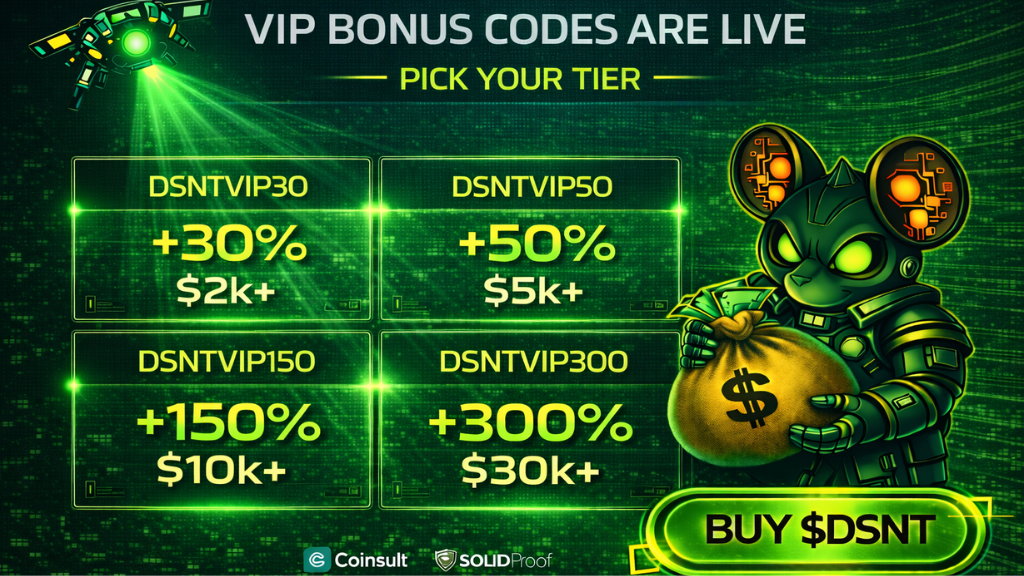
With its March 31st launch rapidly approaching, DSNT has raised over $2.6 million by doing what most presales fail to do: launching a fully operational product first. Its five live AI agents empower retail traders with institutional-grade intelligence, handling real-time sentiment tracking, scam detection, and hidden gem discovery.
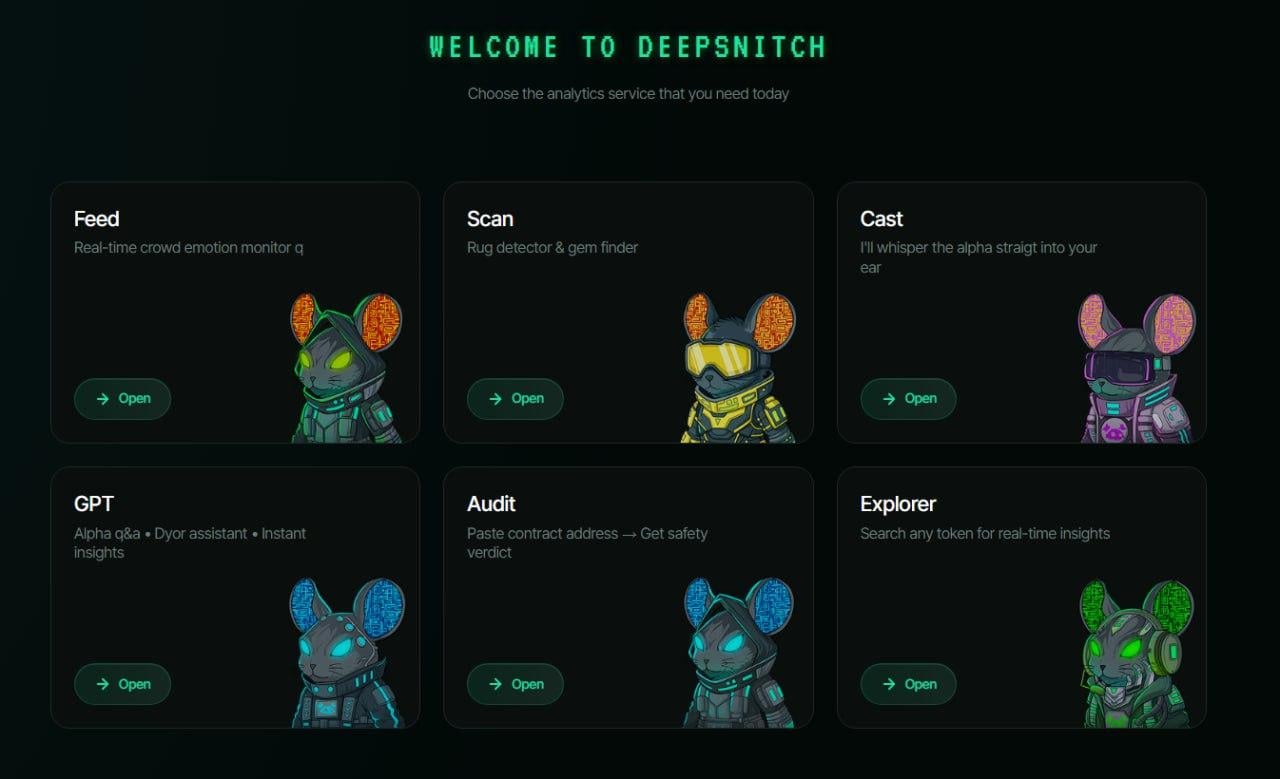
Community projections are pointing toward 100x to 300x returns, the explosive upside that covered-call strategies simply cannot offer. This growth story is built on genuine daily utility, driving organic adoption and long-term token value rather than a temporary launch spike.
At $0.04669, the DeepSnitch AI ground-floor entry point is definitively closing in just three days. Once the Uniswap listing goes live, open-market price discovery takes over entirely.
Ionix Chain
Ionix Chain embeds AI directly into its Layer 1 protocol, offering a decentralized GPU marketplace and $0.0005 transaction fees. Having raised $6.65 million in Stage 18, its ambition is undeniable.
However, the risks match the scale. Building production-ready AI infrastructure takes significantly longer than roadmaps suggest, and Ionix’s undisclosed team severely hinders the enterprise adoption it targets. As GameStop’s transparent Bitcoin strategy proves, institutional credibility requires verifiable accountability.
DeepSnitch AI (DSNT) operates from a structurally different position. By shipping a live, working intelligence product with a fully disclosed team before opening its presale, DSNT delivers immediate utility.
Gassed Token
Gassed Token relies on a Solana-based, click-to-earn mechanic to drive community engagement.
While Solana’s low fees suit this gamified loop, the ceiling remains strictly capped. Beneath the meme, there is no underlying product, recurring revenue, or utility to absorb selling pressure once the novelty fades.
Furthermore, unconfirmed audits and an undisclosed team strip away crucial accountability. As GameStop’s transparent Bitcoin yield strategy proves, serious capital demands verifiable structure.
DeepSnitch AI (DSNT) operates in an entirely different category. Offering a live intelligence platform, active daily users, dual audits, and a confirmed March 31st listing, DSNT delivers genuine utility over fleeting attention.
Closing thoughts
GameStop recently pledged its Bitcoin to Coinbase to run covered calls, squeezing options yield from a $105,000 strike. While corporate crypto strategy grows increasingly sophisticated, retail investors need asymmetric entry points.
The market is actively filtering out weak setups. Ionix Chain’s undisclosed team creates a massive credibility gap for enterprise adoption, and Gassed Token’s click-to-earn model lacks both an underlying utility floor and published audits. DeepSnitch AI (DSNT) answers these exact concerns.
Having shipped five live AI agents before raising a single dollar, DSNT has secured $2.6 million from active users. At $0.04669, early backers are already seeing 210% gains, fueling 100x to 300x community projections that are grounded in genuine daily utility.
While GameStop caps its upside for yield, DSNT is heading for pure price discovery. The March 31st presale deadline is exactly three days away, and the Uniswap listing follows immediately. The entry point that exists today will not exist next week.
Visit the official DeepSnitch AI website, join Telegram, and follow on X for more updates.
FAQs
Which best crypto presales are still open as GameStop’s Bitcoin strategy evolves from holding to yield generation?
DeepSnitch AI leads: $2.6M raised, 210% gains, five live AI agents, and a confirmed March 31st Uniswap launch with 100x to 300x projections. GameStop’s covered-call strategy peaks at structured options premiums on a $105,000 strike.
What upcoming crypto presales offer retail investors bigger returns than corporate covered-call Bitcoin strategies?
DeepSnitch AI: daily utility across sentiment tracking, rug detection, hidden gem discovery, and instant DYOR tools that any retail investor can access with a wallet, no Bitcoin collateral required. DSNT’s 100x to 300x case requires getting in before March 31st.
How does DeepSnitch AI stand apart from Ionix Chain and Gassed Token right now?
DeepSnitch AI has a shipped product, a disclosed team, $2.6M raised from real users, and a confirmed listing time. Ionix Chain has team transparency gaps that enterprise adoption will eventually require answers to. Gassed Token has no utility floor and no published audits.
Disclaimer: This is a Press Release provided by a third party who is responsible for the content. Please conduct your own research before taking any action based on the content.
Funding spikes and liquidations point to positioning build-up, with direction hinging on whether buyers can defend support.
On Monday, March 23, President Trump announced a 5-Day pause on strikes against Iranian energy infrastructure. The decision added $1.7 trillion to US stocks, crashed oil prices by 15%, and sent Bitcoin above $70,000. That pause is now extended until April 6.
But Tehran called these claims ‘fake news’, and Israel already violated Trump’s pause. Almost all of these financial gains vanished within a week.
So, did Donald Trump actually have productive talks with Iran, or was it just a ploy to benefit financial markets and have big players cash out?
How Trump’s Pause Lines Up With Market Hours
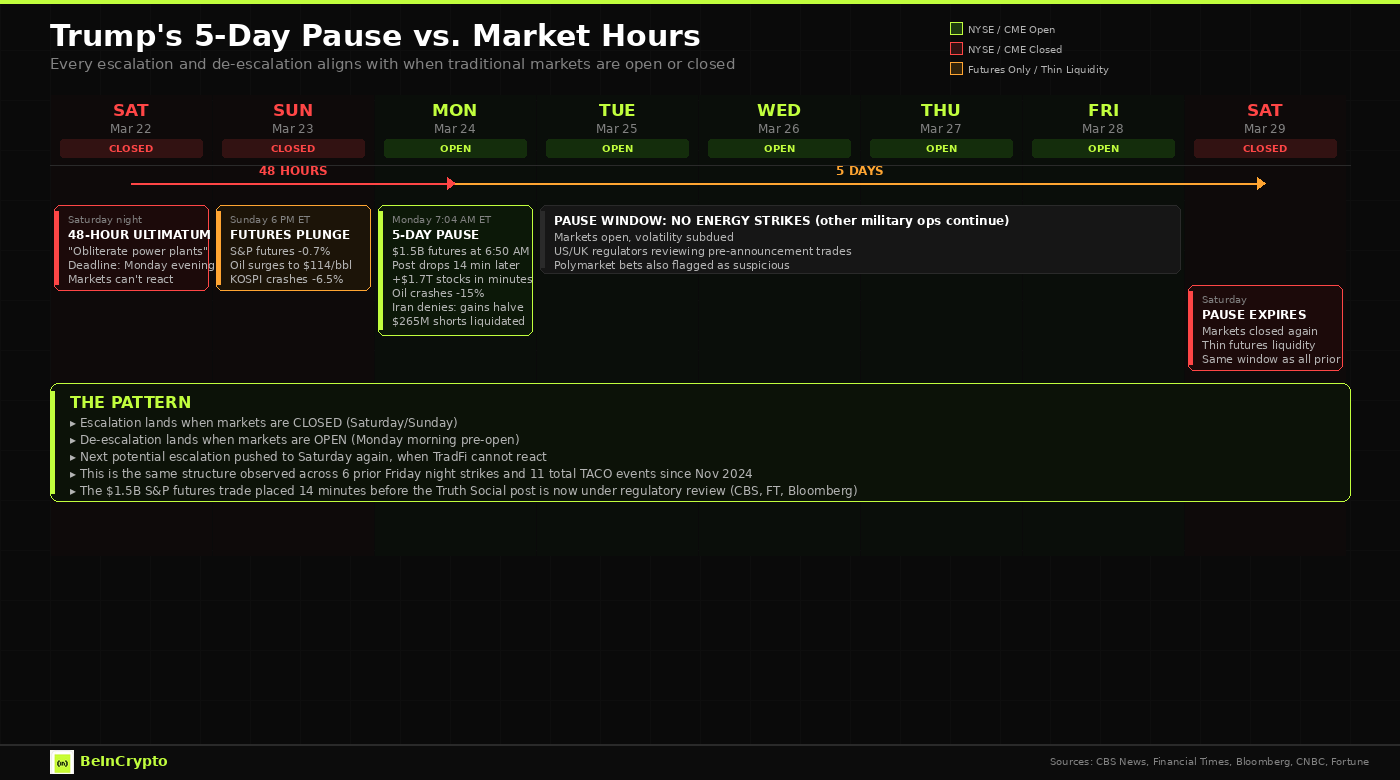
The sequence starts Saturday, March 22. Trump posted a 48-hour ultimatum on Truth Social demanding Iran reopen the Strait of Hormuz or face strikes on its power plants.
That deadline was set to expire Monday evening, with traditional markets fully open and exposed.
Instead of following through, Trump posted at 7 a.m. ET Monday, claiming “very good and productive conversations” with Tehran. He announced a 5-day postponement of all energy infrastructure strikes.
The 5-day window expired Saturday, March 28. Not a random day.
- Equity markets are closed
- Futures liquidity is thin
- Institutional desks are offline.
If escalation resumes, it lands in the same low-liquidity window that has preceded every major Trump-era market shock since mid-2025.
Someone Traded Before the Post
Markets moved before the announcement went live. Between 6:49 and 6:50 a.m. ET, roughly 6,200 Brent and WTI futures contracts changed hands with a notional value of $580 million.
The average for that same minute over the prior five trading days was approximately 700 contracts, according to Bloomberg data reported by the Financial Times.
At the same time, $1.5 billion in S&P 500 futures were purchased. That single order pushed the index 0.3% higher instantly. Fourteen minutes later, Trump’s post dropped. By 7:10 a.m. ET, the S&P 500 had gained roughly $2 trillion in value.
U.S. and UK regulators are reportedly reviewing the data. No charges have been filed.
“The massive spike in volume of trades right before that post is certainly enough to raise eyebrows, and I think to launch an investigation into what was behind that,” wrote CBS News, citing Stephen Piepgrass, a partner who specializes in futures trading at the law firm Troutman Pepper Locke.
Iran Says It Never Happened
Tehran’s response left no ambiguity. Parliament Speaker Mohammad Bagher Ghalibaf called it “fake news” intended to manipulate financial and oil markets.
The Foreign Ministry described it as psychological warfare aimed at lowering energy prices and buying time for more strikes. Officials acknowledged receiving messages through intermediaries but insisted no direct negotiations occurred.
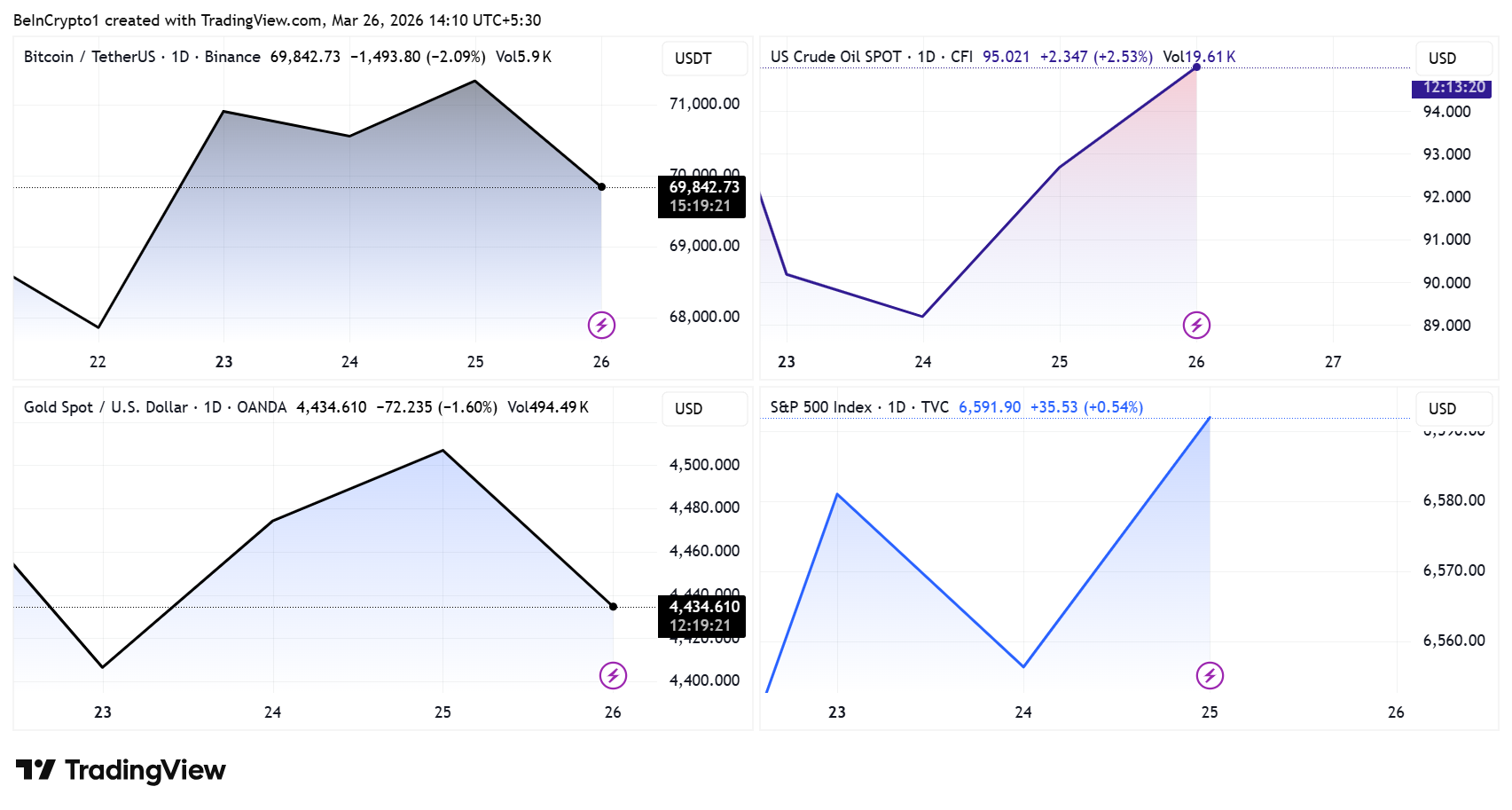
The denial triggered an immediate reversal. Oil rebounded. Stocks gave back roughly half their gains. BTC pulled back after briefly reclaiming $70,000, leaving $265 million in crypto shorts liquidated within 15 minutes.
This Has Happened 11 Times Since November 2024
Monday was not the first time. BeInCrypto has tracked 11 market-moving Trump announcements since November 2024, each following what traders now call the TACO pattern, a cycle of action, crash, reversal, and recovery.
- Liberation Day tariffs were announced on April 2, 2025, at 4:30 p.m. ET, after markets closed. Trump posted “BE COOL! THIS IS A GREAT TIME TO BUY!!” the next morning, minutes after opening. A 90-day pause followed, producing a 9.5% rally in the S&P 500.
- On October 10, 2025, a 100% tariff threat on China dropped on a Friday, 20 minutes after close. BTC fell 18.4%. Crypto liquidations hit $19.1 billion in 24 hours.
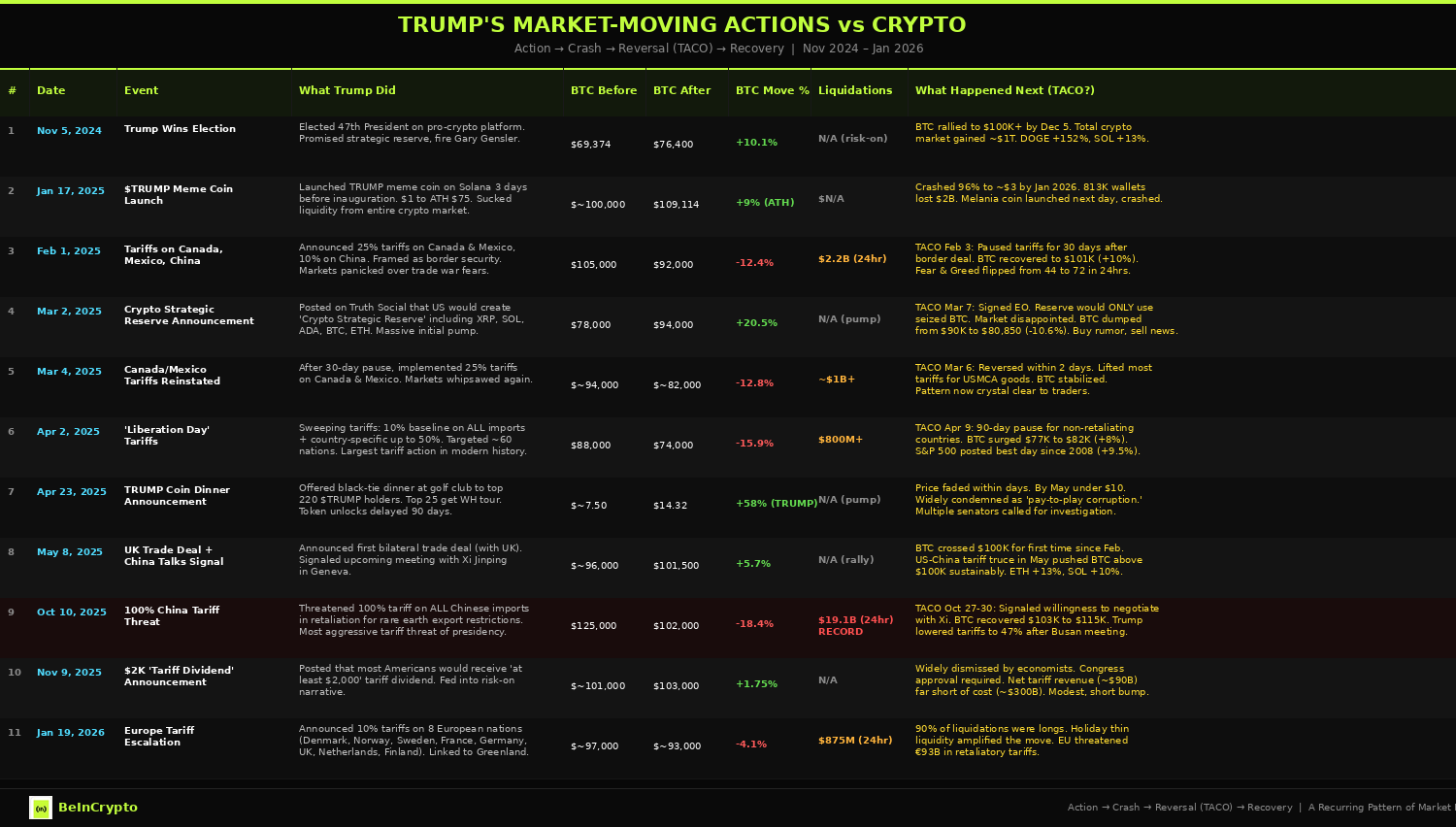
Six confirmed Friday night strikes between June 2025 and February 2026 followed the same logic. BeInCrypto identified this as a repeatable 60-hour sequence across those events.
The Iran pause is the evolution. Instead of a Friday shock and a Monday walk-back, Monday itself became the vehicle. Ultimatum on Saturday. Relief on Monday. Next escalation window on Saturday again.
What the Experts See
Oxford-based political scientist Richard Heydarian warned on the BeInCrypto podcast that the economic damage from the conflict could run into trillions while Trump’s tactical moves remain impossible to anticipate.
“Trump is strategically predictable, but tactically impossible to predict. We know what his endgame is. American hegemony, beyond question. But how to achieve that in such a complex world? No one knows,” Richard Heydarian told BeInCrypto.
Stanford economist Mordecai Kurz, also speaking on the BeInCrypto podcast, placed the dynamics within a structural problem of concentrated private power that leaves ordinary people exposed.
“There are so many concentrations of private power in America that this cannot continue… young people have a chance only if technology is made to serve people and policy serves people,” Kurz explained.
The 5-day clock expires Saturday. If the pattern holds, the next headline lands when markets are closed, and liquidity is at its weakest.
Across 11 documented events and 16 months, the pattern has not broken once.
The post How Trump’s Iran Pause Fits Into His Market-Timed Playbook appeared first on BeInCrypto.
Sam Altman’s World Foundation has raised $65 million through an over-the-counter (OTC) sale of its WLD token, which has hit new record lows.
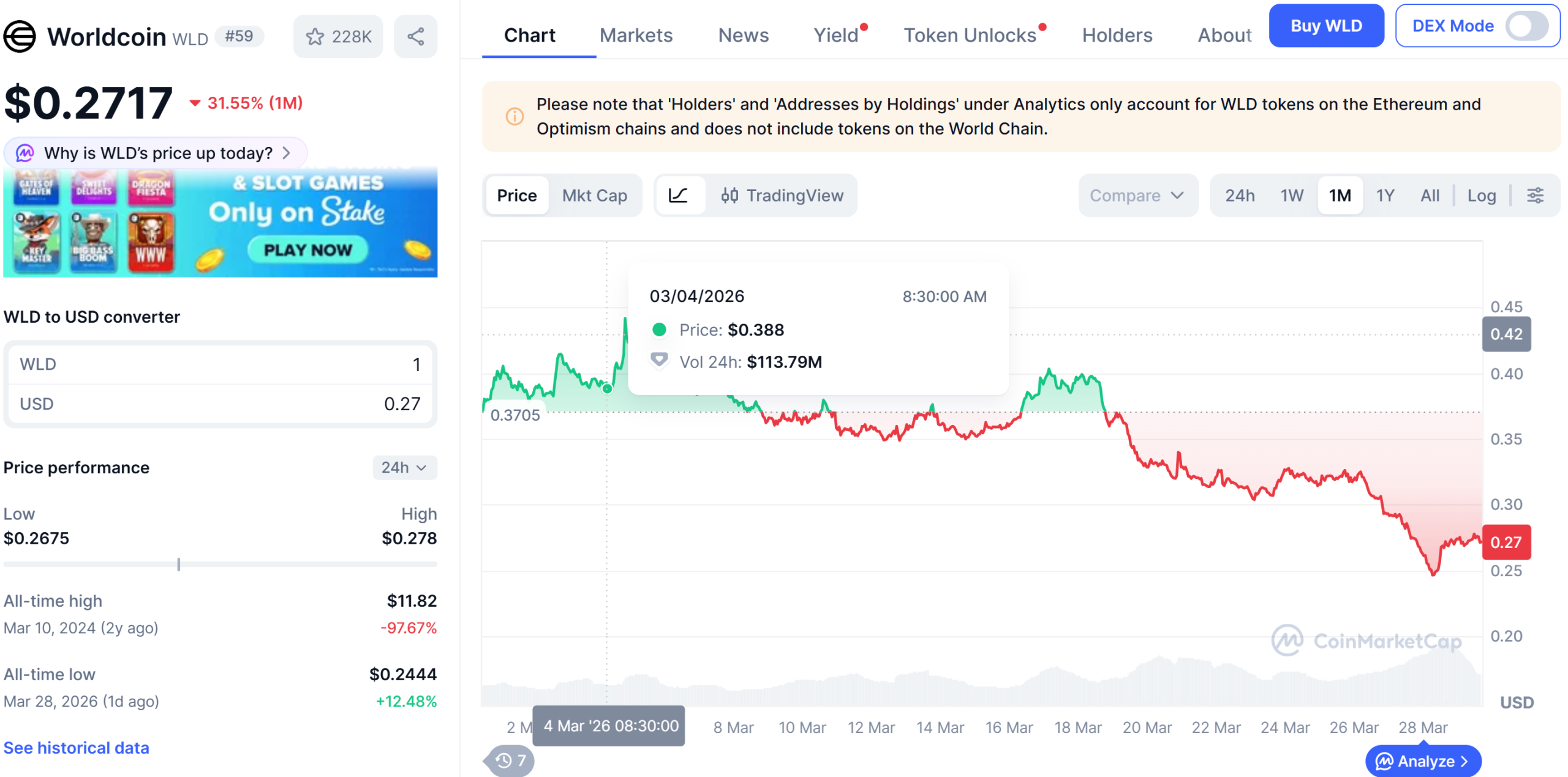
In a Saturday post on X, the foundation said its token issuance arm, World Assets, completed the sale to four counterparties over the past week, with the first tranche settling on March 20. The transactions were priced at an average of roughly $0.27 per token, suggesting that around 239 million Worldcoin (WLD) changed hands.
“This sale funds the project’s core operations and activities, R&D, orb manufacturing, ecosystem development, and more,” World Foundation wrote on X.
Of the total, $25 million worth of tokens are subject to a six-month lockup, while the remainder were immediately liquid.
Related: World launches AgentKit with Coinbase integration to enable human-verified AI agents
WLD hits new low
Following the announcement, WLD briefly fell to an all-time low of around $0.24 before recovering to $0.27, leaving it down about 97% from its March 2024 peak near $11.82. The token is currently trading at $0.2725, up by 0.28% over the past day, according to data by CoinMarketCap.

Additional supply pressure may be on the horizon. A major community token unlock is scheduled for July 23, covering roughly 52.5% of the token’s 10 billion total supply, according to DefiLlama.
Meanwhile, the new sale also comes at a steep discount to prior rounds. In May last year, World raised $135 million at approximately $1.13 per token from backers including Andreessen Horowitz and Bain Capital Crypto.
Related: Tools for Humanity expands World app toward super-app model
Thailand raids World-linked iris scanning site
In October last year, authorities in Thailand raided an iris-scanning site linked to World. The country’s Securities and Exchange Commission, working with the Cyber Crime Investigation Bureau, said the service may have violated digital asset laws by operating without a license, leading to arrests and an ongoing investigation.
The move added to a growing list of regulatory challenges for World. Since launching in 2023, the project has faced probes and pushback in several countries, including Indonesia, Germany, Kenya and Brazil, with concerns ranging from licensing issues to the handling of sensitive biometric data.
Magazine: Bitcoin may take 7 years to upgrade to post-quantum — BIP-360 co-author
Crypto World
Solana Price Prediction: Grok AI Targets $290 as Pepeto Targets 100x While BNB and LINK Hold
When Goldman Sachs speaks, markets pay attention. The $3.6 trillion asset manager published research indicating the downturn may be running out of steam, and the solana price prediction from Grok AI at $210 to $290 confirms the recovery.
Pepeto is in that window right now with more than $8 million raised, a live exchange already running, and analysts projecting 100x as the Binance listing approaches. Pepeto at presale is positioned to capture the kind of return SOL at $39 billion will not deliver.
Grok AI forecasts Solana trading between $210 and $290 by December 2026, supported by Goldman Sachs’ $108 million SOL ETF stake and Mastercard and Western Union partnerships according to MEXC.
Combined with the Alpenglow upgrade bringing 150ms finality, the forecast carries the highest raw percentage growth potential among large caps. According to Yahoo Finance, AI models project SOL up to $800 in a bull scenario, a 500% ceiling, but that level still requires $39 billion in market cap growth.
The presale entries with verified utility capture the returns that large cap forecasts structurally will not produce.
Where Goldman Research Points and Where the Real Entry Lives
Pepeto: The Exchange That Could Multiply Wealth as the Solana Price Prediction Confirms the Cycle
Most presale projects ask investors to bet on a promise. Pepeto is asking investors to back an exchange that is already running. The trading tools are live right now, accessible to any trader in the world, with no setup process or learning curve required. That simplicity is the product’s most powerful quality, and this is why Pepeto leads the presale market.
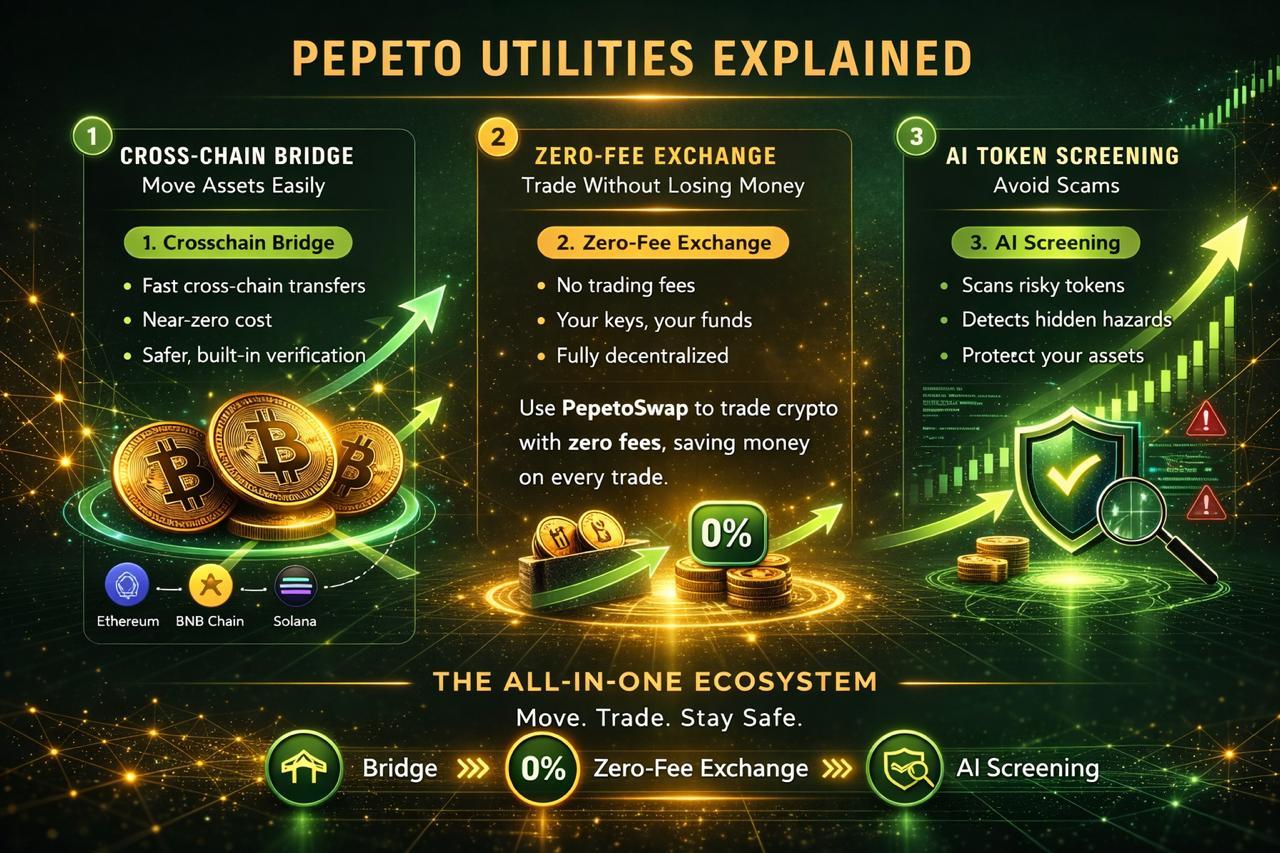
Zero cost execution on PepetoSwap means your full investment stays working, the multi chain delivery system moves tokens without deducting a cent, and the project auditor rejects anything that fails its safety scan, all verified by SolidProof. The mind behind the original Pepe coin, which climbed to $11 billion on meme power with zero products backing it, engineered this exchange alongside a Binance infrastructure veteran.
A tool that solves a real, recurring problem creates durable demand long after the initial excitement fades, At the current entry of $0.000000186, analysts project 100x as the Binance listing opens, and 191% APY staking compounds your position while the listing approaches.
The solana price prediction at $290 is a 3.5x over 9 months, and each new exchange listing introduces a fresh pool of buyers who pay market price instead of presale price, and this is the kind of entry that will not come back.
Binance Coin (BNB)
BNB trades at $612 per CoinMarketCap, holding steady as the broader market corrects.
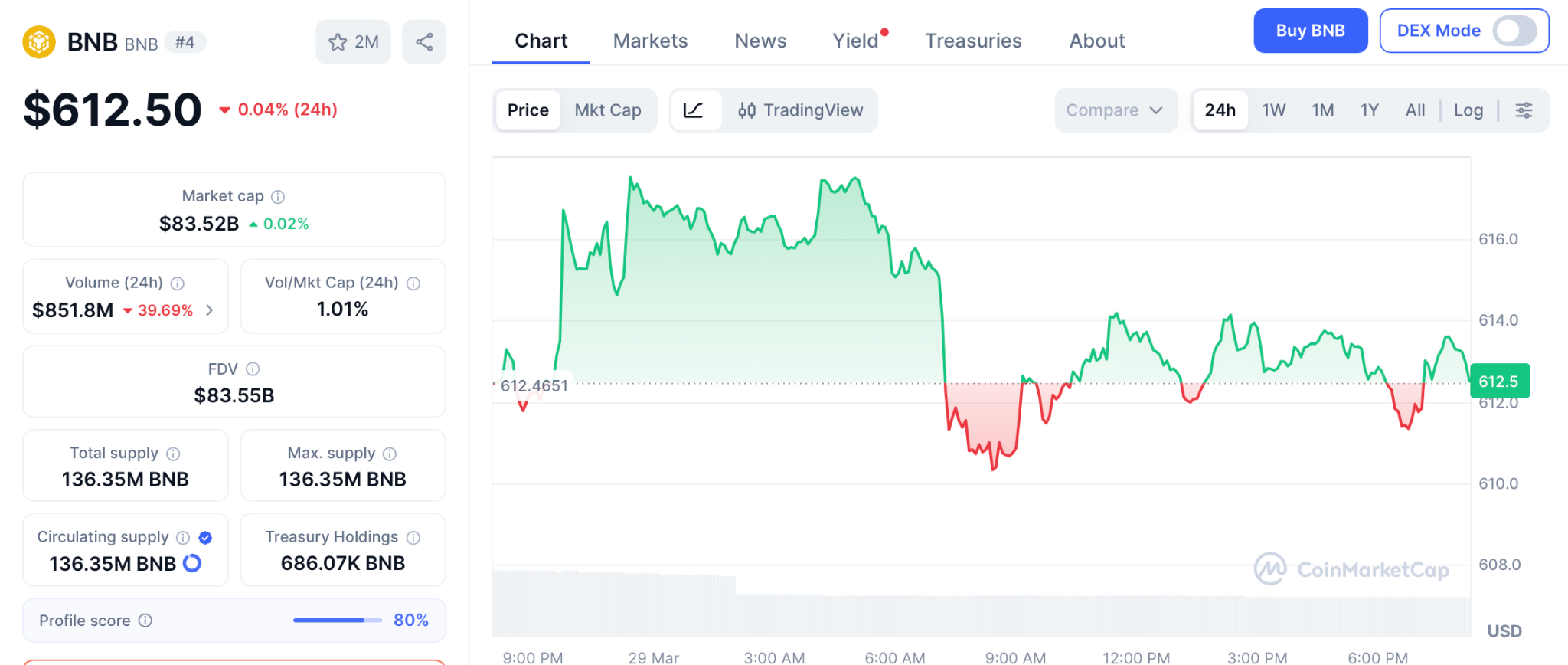
At $83 billion market cap, a recovery to $700 delivers 14% over months, a strong ecosystem anchor, while Pepeto at presale targets the 100x that BNB at this cap is past delivering.
Chainlink (LINK)
LINK trades at $8.49 per CoinDesk, pressured below major moving averages as the oracle sector corrects as the broader market corrects.
The CCIP protocol positions LINK for tokenized asset growth as NYSE explores blockchain integration.
A recovery to $12 delivers 38% over months, while presale entries are where the life changing returns are built and Pepeto offers the math that LINK at $5 billion will not replicate.
The Solana Price Prediction Confirms the Cycle and the Presale Window Is the Entire Opportunity
The picture is clear, because when Goldman Sachs signals a bottom and large wallets move into a presale at this pace it is a signal that the smartest capital already knows where the next repricing is coming from.
Six months from now you are living one of two versions of this moment. In one version you entered while $8 million in presale proved conviction was real and 191% APY compounded daily until the listing changed everything. In the other you saw this and let it pass.
SOL targets $290 while Pepeto targets 100x. Visit the Pepeto official website and enter the presale now, because six months from now this entry is either your proudest decision or someone else’s best investment of the year.
Click To Visit Pepeto Website To Enter The Presale

FAQs
What did Goldman Sachs say about the solana price prediction and crypto in March 2026?
Goldman Sachs signaled the crypto bottom is forming, and the solana price prediction from Grok at $210 to $290 confirms the bull case that Pepeto’s Binance listing is positioned to capture with 100x projected.
What is the solana price prediction for 2026?
Grok AI forecasts SOL between $210 and $290 by December, a 3.5x from current levels, but Pepeto at presale targets 100x that the solana price prediction at $39 billion cap will not deliver, and the Pepeto official website is where the entry is still open.
Why is Pepeto the strongest entry alongside the solana price prediction?
Pepeto has a live exchange with SolidProof audit and Binance listing approaching that targets 100x, while SOL at $290 represents patience returns and Pepeto represents the life changing math.
Disclaimer: This is a Press Release provided by a third party who is responsible for the content. Please conduct your own research before taking any action based on the content.

The faces and crimes of Cambridgeshire criminals jailed this week

Houthi Threat to Red Sea Shipping Raises Risk of Oil-Supply Shock

MI vs KKR LIVE Score, IPL 2026: Ajinkya Rahane Solid But KKR’s Rs 25.20 Crore Star Falls For 18 vs MI


-
 NewsBeat4 days ago
Manchester United reach agreement with Casemiro over contract clause amid transfer speculation
-

 News Videos4 days ago
Parliament publishes latest register of MPs’ financial interests
-

 Sports6 days ago
Remo Stars and Kano Pillars Strengthen Survival Hopes in NPFL
-

 Sports6 days ago
Gary Kirsten Accuses Pakistan Cricket Board Of ‘Interference’, Mohsin Naqvi Responds
-

 Business7 days ago
No Winner in March 21 Drawing as Prize Rolls to $133 Million for Next
-

 Tech7 days ago
Give Your Phone a Huge (and Free) Upgrade by Switching to Another Keyboard
-

 Tech7 days ago
AI enters the chat: New Seattle dating app relies on tech to facilitate meaningful human connections
-

 Business3 days ago
Instagram, YouTube Found Responsible for Teen’s Mental Health Struggle in Historic Ruling
-

 News Videos6 days ago
Ch 9 Financial Management Part 1 | Detailed One Shot | Class 12 Business Studies Boards 2026
-

 NewsBeat2 days ago
The Story hosts event on Durham’s historic registers
-
 NewsBeat4 days ago
Tesco is selling new Cadbury Dairy Milk bar and people can’t wait to try it
-

 Sports6 days ago
2026 Kentucky Derby horses, odds, futures, preview, date: Expert who hit 12 Derby-Oaks Doubles enters picks
-

 Tech6 days ago
Samsung will soon let you control smart home devices from your car’s dashboard
-
 Entertainment17 hours ago
Lana Del Rey Celebrates Her Husband’s 51st Birthday In New Post
-
 Entertainment6 days ago
Cynthia Bailey Dishes on ‘RHOA’ Season 17, Discusses Kandi
-
 NewsBeat6 days ago
Colombian military plane with 110 soldiers onboard crashes following takeoff
-

 Fashion5 days ago
Does It Matter What You Wear When You’re Laid Off and Looking?
-

 Business5 days ago
More women enter wealth management, but few in advisory roles: study
-

 Sports4 days ago
Fantasy Baseball Week 1 Preview: Top sleeper hitters for both five- and 12-day period led by Munetaka Murakami
-

 Politics6 days ago
How Media Platforms Balance Performance and Accessibility in Image Delivery
You must be logged in to post a comment Login