
Crypto World
How to Launch a White Label Crypto Neo-Bank App in Indonesia In Just 7 Days?


Indonesia is one of the fastest growing and most attractive markets for a crypto-enabled digital bank. Retail crypto activity, expanding youth adoption, and clearer regulatory direction are creating a window for disciplined, well-capitalized investors to capture market share quickly. For investors who demand precision, regulatory certainty, and defensible economics, a white label approach compresses time to market and reduces execution risk, while allowing you to control product, liquidity and customer economics.
Let us scroll to unpack the right white label digital banking model, the compliance guardrails, the minimum viable technical architecture, an ironclad day-by-day 7 day launch plan, and realistic cost bands.
Market Opportunity in Indonesia
Indonesia is now a top regional crypto market, with rapid user growth and sizable transaction volumes that justify a dedicated neo-banking product with embedded crypto rails. The number of crypto asset holders in Indonesia surpassed 19 million in late 2025, and annual transaction values have been measured in the hundreds of trillions of rupiah, demonstrating both depth and recurring transaction velocity. Consumer demand is concentrated in retail trading, payments on-ramps, and young demographics under 30 who prefer mobile-first financial products.
On the infrastructure side, local banks and payment rails are open to partnerships for virtual accounts and card programs, which reduces clearing friction. For investors, this means a realistic path to scale user acquisition through seamless fiat on-ramps, card spend conversions, and margin capture via FX and trading spreads. The macro picture supports a focused investment in a compliant, white label neo-bank app that combines fiat wallets, crypto custody, and payment rails under one product umbrella.
Regulatory Landscape and What Changed Recently?
The most important development for investors is regulatory clarity. Indonesia has transitioned crypto assets from a pure commodity classification toward financial sector oversight. Supervision responsibilities now align more closely with financial regulators, particularly the Financial Services Authority and Bank Indonesia. This shift increases compliance expectations, but it significantly reduces ambiguity.
For builders and investors, this means that crypto-friendly neo banking solutions must be designed with financial-grade controls from day one. Custody models, AML workflows, transaction monitoring, reporting mechanisms, and auditability are no longer optional or loosely interpreted. However, the benefit is predictability. Regulatory expectations are clearer, enforcement pathways are defined, and compliant operators gain long-term defensibility.
Importantly, this environment favors structured, institutionally designed platforms over informal or lightly governed products. Investors who prioritize compliance-first architecture are better positioned to scale without disruption, regulatory pauses, or forced redesigns.
Which crypto neo-bank model fits Indonesia best?
Indonesia is a retail-driven market with large mobile adoption and growing regulatory clarity. That combination favors a pragmatic operating model that lets investors own customer economics while relying on licensed financial partners for settlement and prudential controls. The white label neo bank platform must be designed to give you speed to market, auditability, and the levers to capture revenue in a defensible way.
- Operate as a sponsored neo bank that uses a licensed bank or licensed e-money institution for IDR settlement and reconciliation.
- Host customer-facing apps and the ledger on a white-label core that exposes modular APIs for accounts, cards, KYC, and reporting.
- Start Day-1 with a custodial custody model provided by a certified custodian using MPC or HSM key protection and an attestation package.
- Separate hot operational wallets from cold reserve storage and enforce automated reconciliations between ledger balances and custody positions every day.
- Implement tiered KYC that matches sponsor bank risk appetite and regulatory thresholds, and block transactional privileges until required KYC is complete.
- Offer a deliberately small initial asset set chosen for regulatory clarity and commercial demand, with a controlled governance process for adding tokens.
- Provide IDR rails via virtual accounts or API-driven payment rails supplied by the sponsor bank, so treasury and settlement are auditable.
- Monetize through card interchange and card product journeys, trading spreads on buy and sell flows, wallet float and interest mechanics, and premium subscription services.
- Embed a real-time AML rules engine and case management console that creates investigator-ready artifacts for each flagged event.
- Require vendor SLAs that include audit support, regular penetration testing evidence, and clear liability allocation for custody and settlement failures.
- Design for horizontal scale from the outset with a microservice ledger, API gateway, and full observability for tracing and alerting.
- Gate higher risk features, such as large peer-to-peer transfers and open withdrawals, until reconciliation metrics and fraud KPIs settle at low thresholds in the invite cohort.
Why Invest In White-Label BaaS Software Fit For Indonesia?
When speed, regulatory proof points, and investor discipline matter, customized BaaS platform is not an engineering compromise. It is a strategic choice that shifts build risk to proven modules and lets capital focus on liquidity, compliance, and go-to-market. The bullets below summarize the investor benefits you should demand from any white-label partner.
- Launch speed that converts concept to revenue faster than a custom build.
- Contractual auditability so that sponsor banks and regulators can review vendor controls and reconciliation artifacts.
- Lower upfront engineering cost so investor capital is available for liquidity, customer acquisition, and regulatory operations.
- Proven operational reliability with APAC references that reduce partner integration risk.
- Embedded security controls, including HSM, secrets management, and published pentest reports that accelerate approvals.
- Prebuilt compliance hooks for KYC, AML, suspicious activity reporting, and regulator reporting templates.
- Modular APIs that allow swapping custody, KYC, or card vendors without rebuilding the ledger.
- Standardized reconciliation and settlement reporting that aligns with sponsor bank procedures.
- Predictable pricing and clearer OPEX forecasting for investor financial models.
- Faster path to pilot and scaled rollouts using invite cohorts and phased feature gating.
- Focus on monetization by shifting product engineering to the vendor and concentrating internal teams on revenue channels.
- Easier due diligence because white-label providers can present evidence packages, customer references, and operational SLAs.
However, it is always recommended that you connect with an experienced and renowned crypto neo banking development company that boasts a vast team of certfied and talented experts, who will help you to launch a successful solution.
Crypto Banking Licensing & Compliance Checklist
- Confirm the sponsor bank or licensed e-money issuer and obtain sandbox credentials.
- Ensure the KYC provider supports Bahasa and local ID types, with liveness and document verification.
- Implement AML transaction monitoring and case management with threshold rules aligned to OJK guidance.
- Validate custody architecture: MPC or HSM, segregation of hot and cold wallets, and third-party audits.
- Prepare tax and reporting flows for domestic transaction taxes and withholding rules.
- Maintain production-grade audit trails, incident response playbooks, and regular compliance reporting cadence.
Explore How Quickly Your Customized Neo-Bank Can Go Live
How to Launch in Just 7 Days: A Realistic Execution Framework?
Launching a white label neo-banking solution in Indonesia does not require months of engineering or regulatory uncertainty when the right white-label and sponsor-bank structure is in place. For investors, the objective of a seven-day launch is not scale, but proof. Proof of regulatory alignment, operational readiness, secure custody, and real transaction flows. This approach enables a controlled, invite-only rollout that validates core economics and risk controls before capital is committed at scale. The timeline below reflects an execution-ready scenario where infrastructure, partners, and compliance frameworks are pre-aligned, allowing teams to move decisively without compromising governance or auditability.
Day 1: Model lock-in and compliance alignment
The first day is about removing ambiguity. The business model, sponsor bank responsibilities, custody approach, and compliance thresholds are finalized. Product scope is frozen to a minimal but monetizable set, typically onboarding, IDR wallets, limited crypto access, and virtual cards. KYC tiers, AML thresholds, and transaction limits are defined and approved, ensuring that every feature released is compliant by design.
Day 2: Core platform deployment
On day two, the white-label neo-banking core is deployed in a staging environment. IDR wallet logic, ledger configuration, and API access are activated. Administrative dashboards and reconciliation views are enabled so treasury and compliance teams can already see transaction traces. By the end of the day, the platform is functionally alive, even if not yet consumer-visible.
Day 3: Identity and custody integration
This day focuses on trust and security. KYC flows are integrated and tested, ensuring users cannot transact without appropriate verification. Custody connections are established using MPC or certified custodial infrastructure, with wallet creation and key management validated in sandbox conditions. This step proves that assets can be securely held and accounted for under regulatory expectations.
Day 4: Payments and card readiness
Day four connects the platform to the real economy. IDR top-ups via sponsor-bank rails are tested, and virtual card issuance is enabled. Settlement flows and posting logic are validated so that every movement of funds is traceable from user action to ledger entry. At this stage, the platform can simulate real customer journeys end to end.
Day 5: Product readiness and localization
With the core plumbing complete, attention shifts to user experience and operational polish. Branding, Bahasa localization, and interface refinements are completed. Core flows such as onboarding, wallet views, and transactions are tested together to ensure consistency. Support workflows and escalation paths are also prepared so early users receive controlled, high-quality service.
Day 6: Security validation and sign-off
Before anything goes live, the platform undergoes focused security validation. Key flows are tested for vulnerabilities, secrets handling is verified, and custody controls are reviewed. Compliance teams perform a final review of audit logs and reporting readiness. This day ends with formal approval to move into production under a controlled launch.
Day 7: Controlled go-live
The final day marks a quiet but critical milestone. The platform is deployed to production and opened to a limited invite-only cohort. Transactions are monitored in real time, reconciliation is verified, and operational KPIs are captured. Investors receive the first performance snapshot, demonstrating that the system is live, compliant, and stable.
What this 7-day launch actually proves to investors?
This timeline does not claim full market rollout. It proves execution discipline. Investors see a working neo-bank, compliant IDR flows, secure custody, and live user activity within a week. More importantly, they see a foundation that can be scaled deliberately, backed by auditability, regulatory readiness, and measurable economics.
How Much Does Indonesia’s White-Label Neo-Bank Platform Cost?
Estimating the cost to develop an Indonesia fit white label crypto neo bank hinges on several controllable and contextual factors. Key drivers include the level of customization versus out of the box configuration, the chosen custody model and its associated security attestations, and the depth of sponsor bank and card integration required for local IDR rails.
Ongoing compliance needs, such as AML tooling, KYC volume fees, and regulatory reporting workflows, influence operational spend and governance overhead. Integration complexity with liquidity providers, market makers and fiat on ramps affects engineering effort and run rate. Localization for Bahasa, user experience refinement, and customer support readiness shape product development and operations. Finally, desired service levels, monitoring, audit readiness and fraud prevention determine testing scope and staffing. Together, these elements define capital allocation and recurring costs for a compliant, scalable neo bank tailored to Indonesia.
Why Investors Choose to Build With Us?
Launching a crypto-friendly neo bank platform in Indonesia is not about speed alone. It is about controlled execution within a complex regulatory and technical environment. Our team designs compliant, ready for launch white label neo banks tailored for Indonesia. We combine fintech engineering, custody architecture, card and sponsor bank integrations, and regulatory counsel to deliver platforms that are production ready. Our legal experts guide you through OJK and Bank Indonesia expectations, prepare documentation ready for audit, and manage compliance workflows from sandbox to live operations.
Apart from this we believe that transparency is central: we provide weekly investor updates, access to operational dashboards, and an evidence package for due diligence. We prioritize measurable outcomes, not just technology, so investors see KYC conversion, settlement reliability, and revenue levers. If you seek a partner who reduces execution risk, accelerates time to market and keeps governance central, Antier can lead the journey to a defensible, scalable neo banking platform.
Frequently Asked Questions
01. What factors make Indonesia an attractive market for crypto-enabled digital banks?
Indonesia’s rapid retail crypto activity, expanding youth adoption, and clearer regulatory direction create a favorable environment for crypto-enabled digital banks, allowing disciplined investors to capture market share quickly.
02. How does a white label approach benefit investors in the crypto banking sector?
A white label approach compresses time to market and reduces execution risk, enabling investors to maintain control over product offerings, liquidity, and customer economics while ensuring regulatory compliance.
03. What recent regulatory changes have impacted the crypto landscape in Indonesia?
Indonesia has shifted crypto assets from a commodity classification to financial sector oversight, aligning supervision with financial regulators, which increases compliance expectations but reduces regulatory ambiguity for crypto-friendly neo banking solutions.



The RAVE token recorded a rapid increase in value, rising from about $0.25 to nearly $28 within a short period.
Summary
- RAVE token surged rapidly before crashing over 80%, raising concerns about trading activity and liquidity patterns.
- Binance and Bitget launched investigations following claims of insider control and unusual token movement patterns.
- RaveDAO denied involvement and plans token sales to fund operations while promising transparent growth strategies ahead.
The surge attracted attention across the crypto market due to its speed and scale. Soon after, the token lost more than 80% of its value, leaving traders with large losses.
Market data shows that the token later dropped further, trading near $1.39 within a day of the crash. This sharp movement raised questions about trading patterns and liquidity. Observers noted unusual activity during both the rise and fall.
RaveDAO Responds to Allegations
RaveDAO issued a public statement denying any role in the price movement. The team stated that it was “not engaged in, nor responsible for, recent price action.” The response came as discussions grew across social media and trading platforms.
The project also addressed claims about token control. It did not confirm the figures but maintained that operations follow internal plans. The team added that it aims to act “sustainably and transparently” as it develops its platform.
In addition, major crypto exchanges have started reviewing the situation. Binance CEO Richard Teng stated, “We’re looking into it,” confirming that internal checks are underway. Bitget CEO Gracy Chen also said the platform had “started investigating” the trading activity.
These actions followed claims by onchain analyst ZachXBT, who pointed to concentrated holdings and unusual exchange flows. He suggested that more than 90% of the supply could be linked to insiders. Exchanges have not released detailed findings at this stage.
Project Plans and Market Context
RaveDAO shared plans to sell part of its unlocked tokens to fund growth. The funds are expected to support hiring, marketing, and operations. The team also mentioned possible “price-triggered or performance-triggered locks” to manage supply.
The project operates in the Web3 entertainment space, linking music events with blockchain use.
At the same time, the broader crypto sector has seen increased security issues. Several DeFi platforms have reported recent exploits, adding pressure on market confidence.

Key Highlights
- Intel shares have soared 220% over twelve months, reaching $70.32—the highest price in twenty-five years
- New CEO Lip-Bu Tan slashed over 20,000 positions and restored positive free cash flow during the latter half of 2025
- Nvidia committed $5 billion to Intel’s operations; partnerships include Alphabet and Elon Musk’s Terafab initiative
- First quarter 2026 financial results arrive April 23—elevated expectations may trigger price swings
- A single analyst projects shares could reach $150 by 2029 if margin expansion and profit growth materialize
Intel’s recent performance represents one of the semiconductor industry’s most striking comebacks. After touching a multi-year bottom near $18 in June 2025, shares rocketed to $70.32—a twenty-five-year peak—with a remarkable 58% spike compressed into just nine trading sessions. Many investors are now questioning whether the opportunity has passed or if upside remains.
The transformation narrative revolves primarily around Lip-Bu Tan, who assumed the CEO role in March 2025. A veteran venture capitalist with expertise in corporate turnarounds, Tan previously guided Cadence Design Systems to a staggering 3,200% appreciation during his twelve-year tenure. Upon joining Intel, he acted decisively. Workforce reductions exceeded 20,000 employees while capital expenditures were trimmed. Free cash flow, which had posted a combined negative $44 billion drain from 2022 through 2025, finally turned positive in the second half of the previous year.
Intel’s product portfolio has gained fresh momentum as well. The chipmaker unveiled its Core Series 3 mobile processors utilizing the advanced 18A manufacturing process, designed to handle routine AI workloads while extending battery performance for consumer laptops.
Strategic AI Collaborations Mark New Direction
Intel’s strategy extends beyond expense reduction—it’s mounting a serious challenge in the artificial intelligence sector. The firm has forged partnerships with Alphabet focusing on AI capabilities and cloud computing infrastructure. Additionally, Intel is collaborating with Elon Musk on “Terafab,” a semiconductor manufacturing joint venture connecting SpaceX and Tesla.
Then comes Nvidia. Last September, Nvidia poured $5 billion into Intel to manufacture specialized x86 server processors designed to work seamlessly with Nvidia’s graphics processing units. Ben Reitzes, analyst at Melius Research, stated bluntly: “The demand for the x86 server CPU has gone through the roof at hyperscalers. The x86 became an AI chip.”
This represents a fundamental transformation in market perception regarding Intel’s position within AI infrastructure.
Yet the dramatic rally has pushed valuation metrics into stretched territory. Intel currently commands approximately 95 times projected earnings—surpassing valuations for Nvidia, Taiwan Semiconductor, Broadcom, and AMD. Gross profit margins hover below 40%, contrasting sharply with Taiwan Semi’s 55% and Nvidia’s 75%.
Production Efficiency Presents Ongoing Challenge
A significant portion of the margin disadvantage stems from manufacturing capabilities. Intel currently farms out roughly 30% of its wafer production to Taiwan Semiconductor while expanding internal fabrication capacity. Yield rates on its cutting-edge manufacturing process are estimated around 70%, compared to Taiwan Semi’s 90%.
Should these yields climb as the technology matures, profitability margins would likely follow suit. Analyst Reitzes forecasts Intel could generate $7 in earnings per share by 2029. Applying a standard semiconductor industry multiple of 22 times forward earnings produces a theoretical price target of $150.
Wall Street sentiment remains measured. Roughly one in five analysts tracking Intel maintains a Buy recommendation, significantly trailing the S&P 500 average of 55%. The consensus target price stands at $51.25—markedly below current trading levels.
Institutional money managers are quietly building positions. ZEGA Investments established a fresh stake during Q4. Executive Vice President David Zinsner purchased approximately $250,000 in shares this past January.
Intel will announce Q1 2026 results on April 23.


Key Takeaways
- Amazon shares reached $250.56, sitting just 1.4% beneath the record closing high of $254.
- The e-commerce giant’s stock has climbed 20% during April, finishing higher in nine out of the past 10 trading days.
- Truist Securities lifted its target to $285, forecasting 25% AWS revenue expansion in Q1.
- TD Cowen analyst John Blackledge maintained his Buy stance with a $300 target price.
- Amazon announced plans to purchase Globalstar for approximately $12 billion and partnered with Apple on satellite services.
Amazon has been building impressive momentum over recent weeks. Shares concluded Friday’s session at $250.56 — the highest closing price since November 3, 2025 — leaving the stock within striking distance of its all-time record close of $254, just 1.4% away.
The upward trajectory has been consistent and methodical. AMZN shares have finished in positive territory for nine of the last ten trading sessions, accumulating a remarkable 20% gain throughout April. For the year, the stock has advanced approximately 8.6%.
As Amazon prepares to report Q1 results on April 29, investor focus has intensified. Wall Street analysts are projecting earnings per share of $1.63 — a slight uptick from the $1.59 posted in the same period last year — alongside total revenue of approximately $177 billion, marking roughly 14% year-over-year expansion.
Truist Securities analyst Youssef Squali upgraded his price objective Friday to $285 from $280, reaffirming his Buy recommendation. His forecast anticipates AWS revenue climbing 25% in Q1, representing an acceleration from the 23% growth achieved in Q4 2024, fueled by expanding AI collaborations with companies including OpenAI and Anthropic.
Squali further projects North America marketplace revenue will expand approximately 10% compared to last year, characterizing economic pressures such as elevated fuel prices as “manageable” assuming they remain temporary.
Financial commentator Jim Cramer offered his perspective over the weekend, labeling Amazon “ascendant” while drawing a sharp contrast with Microsoft, which he characterized as becoming viewed as a “chronic underperformer.” Cramer positioned Amazon as the superior investment choice currently, citing its growth momentum against Microsoft’s decelerating revenue trends.
Wall Street Eyes $300 Price Level
John Blackledge from TD Cowen, recognized as a 5-star analyst, reaffirmed his Buy recommendation alongside a $300 price objective — representing approximately 20% potential upside from Friday’s closing price. His projections suggest Q1 revenue will marginally exceed consensus estimates, with operating income tracking roughly 4% ahead of expectations.
Blackledge highlights high-margin advertising revenue and AWS as primary profit catalysts, supplemented by ongoing improvements in fulfillment operations.
Looking toward Q2 2026, his revenue forecast sits 1.5% above Street consensus while his operating income estimate runs 5% higher — indicating expectations for continued AWS growth acceleration.
Across Wall Street, Amazon commands a Strong Buy consensus rating derived from 42 Buy recommendations and only 3 Hold ratings. The average analyst price target registers at $284.77, suggesting approximately 14% upside potential from present levels.
During Q4 2025, AWS delivered 24% year-over-year revenue growth. CEO Andy Jassy characterized this performance as the division’s “fastest growth in 13 quarters” — a metric that analysts are incorporating heavily into their Q1 projections.
Amazon Enters Satellite Communications Market
Beyond the upcoming earnings report, Amazon executed a significant strategic transaction this week. Tuesday brought the announcement of an agreement to purchase Globalstar at an equivalent price of $90 per share — establishing a valuation approaching $12 billion for the satellite communications company.
This acquisition positions Amazon to develop its own space-based internet infrastructure, challenging the market dominance currently held by Elon Musk’s Starlink operation.
Additionally, Amazon finalized an arrangement with Apple to deliver satellite connectivity capabilities for existing and upcoming iPhone and Apple Watch products. This partnership leveraged a pre-existing Globalstar relationship that Apple had previously established.
The consensus Wall Street price target of $284.77 implies approximately 14% potential appreciation from AMZN’s latest closing price of $250.56.

Key Takeaways
- Oklo (OKLO) shares climbed 30% this week alongside NuScale Power (SMR), which also gained over 30%
- White House issued new directives to accelerate nuclear power development for space exploration
- Goals include an orbital reactor demonstration by December 2028 and a lunar-based system by 2030
- Oklo announced a significant board restructuring, bringing in four new directors with nuclear sector expertise
- The company recently missed earnings expectations while insiders sold more than $50M in shares over three months
Oklo experienced a breakout week as shares of the small modular reactor developer surged 30% across five consecutive trading sessions. The rally was fueled by favorable policy developments, industry-wide momentum, and internal governance changes.
The primary driver? New White House directives released this week focused on accelerating nuclear power technology for space applications. The roadmap establishes an orbital reactor demonstration target of December 2028, with a lunar surface reactor planned for 2030.
NuScale Power (SMR) experienced a parallel surge, climbing more than 30% during the same timeframe. Nano Nuclear Energy (NNE) advanced approximately 20%, while uranium miner Uranium Energy (UEC) posted gains of roughly 10%.
The nuclear energy sector has experienced sustained upward momentum, with consecutive positive sessions attracting significant investor interest.
Space Nuclear Initiative Sparks Market Enthusiasm
The White House directive provides investors with concrete milestones. The establishment of a 2028 orbital demonstration and 2030 lunar reactor creates specific timeframes for potential contract awards and supply chain development.
Andrew Chanin, co-founder and CEO of ProcureAM, explained to Yahoo Finance that dependable power sources are essential for space infrastructure. “Lunar bases, orbiting space stations, orbiting data centers — all these require energy,” he noted.
The sector’s momentum also benefited from NASA’s successful Artemis II lunar flyby mission, which concluded earlier this month and maintained space exploration in the investment spotlight.
Oklo simultaneously announced a board overhaul this week, appointing four new directors with nuclear engineering and industrial expertise. The company designated a Lead Independent Director and transitioned its CTO to a senior technical advisory position. Market participants interpreted these moves as signals of increased operational focus.
Underlying Financials Present Challenges
Despite the stock’s impressive run, the company’s financial performance reveals ongoing challenges.
Oklo fell short of its latest quarterly expectations, reporting a per-share loss of $0.27 versus analyst projections of -$0.17. Wall Street currently anticipates a full-year EPS of -$8.20.
Recent insider transactions have drawn attention. CEO Jacob DeWitte disposed of 140,000 shares in February at $75.18 per share, totaling approximately $10.5 million. CFO Richard Bealmear sold 72,090 shares in March at $60 per share. Collectively, insiders have sold over $50.8 million in stock during the past 90 days.
Among institutional investors, Sumitomo Mitsui Trust Group established a new stake in Q4, acquiring 222,510 shares valued at roughly $15.97 million. Institutional ownership now represents approximately 85% of outstanding shares.
Wall Street analysts remain divided. Citigroup reduced its price objective from $95 to $73.50 while maintaining a neutral stance. Canaccord Genuity lowered its target from $175 to $125 but retained a buy rating. The consensus rating stands at “Moderate Buy” with an average price target of $84.30.
OKLO began trading Friday at $66.92, within its 52-week range of $19.89 to $193.84.
Crypto World
Solana (SOL) Surges Past Ethereum in Transaction Volume as Network Adds 1.5M Monthly Users

Key Highlights
- SOL rallied 10% over a five-day period, reaching its highest level in three weeks on Friday
- Open interest in futures contracts increased from $3.5B to $4.2B within seven days
- The token has lagged behind the wider cryptocurrency market by 13% year-to-date in 2026
- The Solana network has attracted 1.5 million additional daily active users each month during Q1
- Several Solana-based memecoins surged over 40% from Wednesday through Friday
The price of Solana’s SOL token experienced a 10% increase across a five-day trading window, touching a three-week peak on Friday. This upward momentum followed announcements from the United States and Iran regarding an extended ceasefire agreement, which triggered an 8% decline in Brent crude oil valuations and boosted risk appetite throughout cryptocurrency markets.
Currently, SOL is changing hands in the $84–$85 range, with market participants monitoring whether the psychological $100 threshold represents the next significant price objective.
The aggregate open interest across SOL futures contracts expanded from $3.5 billion last Sunday to $4.2 billion by Friday—representing a 20% increase within a single week. This expansion signals heightened engagement from leveraged market participants spanning both institutional investors and retail traders.
However, despite this upward price action, the annualized funding rate for SOL perpetual futures contracts remains at approximately 3%. This figure falls short of the 5–10% neutral bandwidth, suggesting that bullish traders have yet to demonstrate overwhelming confidence. Nevertheless, it represents a substantial improvement from the extreme pessimism witnessed on April 7, when SOL traded beneath the $80 level.
Throughout 2026, SOL has delivered returns 13% below those of the broader cryptocurrency market. Reduced activity across decentralized applications (DApps) built on the network has contributed to this underperformance.
Weekly revenue generated by DApps on the Solana blockchain currently hovers around $16 million, representing a decline from previous peaks. To provide perspective, Ethereum-based DApps generated $10 million in revenue last week, while BNB Chain DApps produced $4 million—indicating that diminished DApp revenue represents an industry-wide phenomenon rather than a Solana-specific challenge.
Memecoin Trading Volume Accelerates
Numerous memecoins operating on the Solana blockchain recorded gains exceeding 40% during the Wednesday-to-Friday trading window. Historically, increased memecoin trading activity has correlated positively with SOL price appreciation, especially following the early 2025 memecoin boom that positioned Solana as the dominant platform for user engagement after the Official Trump memecoin deployment.
Solana maintains its leadership position in decentralized exchange (DEX) trading volume and currently ranks as the second-largest blockchain by Total Value Locked across all networks.
The Solana blockchain processed approximately 9 billion transactions during the previous month, significantly outpacing Ethereum’s 69 million transactions. Cumulatively, Solana has now settled over 500 billion transactions compared to Ethereum’s 3 billion. Its architectural design prioritizing speed, minimal fees, and high throughput positions it favorably for applications in gaming, trading platforms, and financial service offerings.
Additionally, Solana has established a stablecoin settlement collaboration with Visa, securing its presence within the developing blockchain-based payments sector.
Network User Base Expands Steadily
Throughout the previous quarter, the Solana ecosystem successfully onboarded 1.5 million new daily active users each month. This growth trajectory persisted even as SOL’s market price declined from $293 to approximately $83 during the period of heightened Middle East geopolitical tensions.
Data from prediction markets showed the April 16 price target of $110 trading at 100% YES probability, while the April 30 target of $150 remains active with approximately 15% implied probability. Trading volume within these prediction markets remains limited, meaning the probability estimates could experience rapid shifts following any substantial order flow.
As of Friday’s trading session, SOL was valued around $85, with total open interest standing at $4.2 billion as memecoin trading activity continues to generate upward momentum in futures market demand.
Key Takeaways
- California federal court dismissed securities fraud lawsuit targeting Caitlyn Jenner’s JENNER memecoin
- Token failed to satisfy Howey Test criteria required for security classification
- British investor Lee Greenfield reported losses exceeding $40,000 from token purchases
- Court determined absence of “common enterprise” among token purchasers
- Non-federal claims under California law transferred to state court jurisdiction
A federal court has delivered a legal victory to Caitlyn Jenner by dismissing a class-action lawsuit alleging her JENNER memecoin constituted an unregistered security.
A federal judge ruled Caitlyn Jenner’s $JENNER memecoin is not a security, dismissing a class action lawsuit from a buyer who lost $40K.
The court found the token failed the Howey Test’s “common enterprise” requirement. pic.twitter.com/UGQUs2YYzo
— Token Metrics (@tokenmetricsinc) April 17, 2026
The decision came Thursday from California federal judge Stanley Blumenfeld Jr., who determined the plaintiffs failed to demonstrate that the JENNER token satisfied the legal criteria for a security.
At the heart of the case was the Howey Test, a legal framework established by a 1946 Supreme Court decision. This test requires an investment contract to include capital invested in a collective venture with profit expectations derived from the efforts of others.
Judge Blumenfeld concluded that the token failed to satisfy two of the three Howey Test components. Specifically, he found insufficient evidence establishing a “common enterprise” linking JENNER token purchasers.
The primary plaintiff, Lee Greenfield from the United Kingdom, claimed losses surpassing $40,000 from purchasing the token across both Solana and Ethereum networks during May 2024.
Greenfield’s legal team contended that Jenner exploited her fame to promote the token. The filing cited an X platform post featuring an AI-created image depicting Jenner wearing a “JENNER ETH” shirt, used to market the cryptocurrency to potential buyers.
The initial legal action was brought in November 2024 against both Jenner and her manager Sophia Hutchins. Hutchins passed away in July 2025.
The revised complaint claimed investors had collectively pooled their resources based on Jenner’s promise that a 3% transaction fee would finance token repurchases, promotional activities, political donations to Donald Trump’s campaign, and fractional ownership shares in her Olympic gold medal.
Court Rejects Common Enterprise Claim
Judge Blumenfeld dismissed the pooling theory presented by plaintiffs. His ruling stated the allegations failed to establish that investors had agreed to share profits and losses or combine resources beyond the simple act of purchasing the cryptocurrency.
The Olympic medal ownership initiative was revealed in August 2024, occurring after Greenfield had already completed his token purchases, and ultimately never materialized.
The court further determined that Jenner’s promotional efforts alone were insufficient to constitute a common enterprise under securities law.
JENNER Token History
The JENNER token debuted on the Solana blockchain in May 2024 via the Pump.fun platform. Controversy erupted immediately when Jenner and other celebrity endorsers alleged they had been defrauded by a partner identified as Sahil Arora.
Jenner subsequently relaunched the token on the Ethereum network. Investors asserted this migration negatively impacted the original Solana version’s market value.
The cryptocurrency reached its peak market capitalization of approximately $7.5 million in June 2024. Since then, its value has collapsed, losing virtually all market worth.
Case Outcome and Future Proceedings
The court rejected the plaintiff’s motion to file a third amended version of their complaint. Claims based on California state law regarding contract violations and fraud were transferred to state court for potential further proceedings.

Key Highlights
- Shares of Boeing advanced more than 2% Friday following announcements that CH-47 Chinook helicopters will receive drone swarm deployment capabilities.
- A contract worth approximately $324M from the U.S. Army for Chinook helicopters strengthened Boeing’s defense order book.
- Millennium Space Systems and Boeing introduced a mid-class satellite platform with plans for approximately 26 units in 2026.
- Oak Harvest Investment Services expanded its Boeing position by 44.5% during Q4, bringing holdings to 28,933 shares valued at approximately $6.28M.
- Analysts maintain a “Moderate Buy” rating on BA stock with a consensus price target of $252.48.
Friday proved eventful for Boeing as shares gained more than 2% following several significant announcements across its defense and aerospace divisions.
The primary catalyst came from revelations that the CH-47 Chinook helicopter platform will receive substantial capability enhancements. Boeing is integrating what it describes as “launched effects” technology into the Chinook fleet — an umbrella term encompassing drones, electronic decoys, and loitering munitions. These capabilities can be deployed from both piloted and autonomous aircraft platforms.
The Chinook platform has maintained operational relevance for over 60 years and continues generating new orders. This technological enhancement aims to extend its strategic value. Reports indicate the U.S. Army has expressed substantial interest in these enhanced vertical-launch capabilities.
That interest translates into tangible financial commitments. The Army recently granted Boeing a contract valued at approximately $324 million for Chinook helicopters, bolstering the company’s defense sector pipeline. However, the program faces some uncertainty — congressional members have questioned the CH-47F Block II program’s trajectory, prompting Boeing to advocate for firmer Army commitments.
New Satellite Platform Unveiled
In aerospace developments, Boeing partnered with its Millennium Space Systems division to reveal a mid-class satellite platform designed for the “micro GEO” segment. The platform serves both defense and commercial markets, combining Boeing’s payload technology with Millennium’s accelerated manufacturing capabilities.
The initiative targets delivery of approximately 26 satellites throughout 2026. Boeing has been aggressively pursuing this market segment, and Millennium’s rapid production methodology provides competitive advantages as communications satellite demand accelerates.
Boeing’s most recent quarterly results exceeded market expectations considerably. The aerospace giant reported Q4 earnings per share of $9.92, substantially surpassing the consensus forecast of -$0.40. Quarterly revenue reached $23.95 billion — representing 57.1% year-over-year growth and exceeding the $22.41 billion analyst projection.
Despite the exceptional quarterly performance, Wall Street forecasts remain cautious with a projected -$2.58 EPS for the full fiscal year, creating a complex earnings outlook as the company approaches its April 22 Q1 earnings release.
On the manufacturing front, Boeing continues ramping workforce additions, hiring between 100 and 140 factory employees weekly to accelerate 737 MAX production and populate a newly established assembly line.
Institutional Activity Intensifies
Institutional stakeholders control 64.82% of Boeing’s outstanding shares. Oak Harvest Investment Services increased its position by 44.5% in the fourth quarter, elevating holdings to 28,933 shares with an approximate value of $6.28 million. Multiple additional institutional investors similarly expanded their Boeing allocations during Q3.
This institutional accumulation coincides with some insider divestment. Executive Vice President Howard McKenzie divested 10,497 shares in February at $233.99 each, while Senior Vice President Ann Schmidt sold 6,281 shares at $243.37. Collectively, company insiders have sold 21,012 shares totaling approximately $4.98 million over the past 90 days.
Boeing commenced Friday trading at $223.17. The stock’s 52-week trading range extends from $156.47 to $254.35. The 50-day moving average currently stands at $219.27.
Wall Street price targets span from the $252.48 consensus to $290.00 from Tigress Financial, which maintains a Buy rating. Susquehanna established a $280 target with a “positive” outlook, while Royal Bank of Canada elevated its target to $275 with an “outperform” designation.
Additionally, El Al expanded its 787 Dreamliner order by six aircraft this week, contributing incremental demand to Boeing’s widebody production backlog.
Key Highlights
- Russia’s dominant financial institution, Sberbank, has completed technical preparations to launch digital asset custody and trading platforms for its massive customer base of 110 million users, awaiting only regulatory clearance.
- Retail investors without qualified status will face annual purchase restrictions of approximately $4,000 in cryptocurrency transactions under proposed legislation.
- Privacy-oriented digital currencies including Monero, Zcash, and Dash face complete prohibition within the upcoming regulatory structure.
- The financial institution has already ventured into crypto-collateralized lending, providing a loan to mining operation Intelion last December with plans for program expansion.
- Russian authorities target June for finalizing comprehensive cryptocurrency regulations, with enforcement scheduled to begin July 1, 2027.
The dominant player in Russia’s banking sector is positioning itself to make a significant entrance into the digital asset industry, awaiting only regulatory authorization to begin providing cryptocurrency trading and custody solutions to its client base.
Russia’s Largest Bank Sberbank Prepares for Crypto Trading Rollout
According to TASS, Sberbank is ready to offer cryptocurrency trading services once regulation and organized exchange trading are introduced, Senior Vice President Ruslan Vesterovsky said at a Moscow Exchange… pic.twitter.com/CJxKym0lBx
— Wu Blockchain (@WuBlockchain) April 19, 2026
With a customer base exceeding 110 million retail clients, Sberbank operates under majority state ownership. According to bank officials, the necessary technological framework has been established and is operational. The institution stands ready to deploy margin trading capabilities, artificial intelligence-driven investment tools, and robust custody solutions immediately upon regulatory confirmation.
The announcement came from Senior Vice President Ruslan Vesterovsky during the Moscow Exchange forum. Vesterovsky stated that the bank anticipates organized exchange trading will deliver enhanced liquidity and competitive pricing to the marketplace. He emphasized the institution’s readiness to act swiftly once structured trading regulations receive approval.
While Russia’s Central Bank continues to designate cryptocurrencies as elevated-risk instruments, it has authorized restricted deployment of digital assets within certain financial operations. Sberbank’s current cryptocurrency initiatives demonstrate the institution is already functioning within the boundaries of existing permissions.
Last December, Sberbank extended one of Russia’s inaugural crypto-collateralized loans to Intelion, a cryptocurrency mining enterprise. Intelion operates over 300 megawatts of electrical capacity and maintains approximately 1,500 client relationships. Subsequently, Sberbank revealed intentions to extend comparable financing arrangements to additional corporations.
Framework Details for Cryptocurrency Trading
Russian legislative bodies are advancing toward completing a comprehensive digital asset regulatory structure by June. Should the timeline proceed as planned, implementation would commence on July 1, 2027.
The proposed framework would permit both certified and non-certified investors to participate in cryptocurrency purchases and sales. Non-certified investors would encounter annual acquisition caps of approximately 300,000 rubles, equivalent to roughly $3,934. Additionally, these investors must successfully complete a competency evaluation before gaining trading authorization.
Certified investors would operate without volume constraints, though mandatory risk evaluation procedures would remain required.
The approved asset roster is anticipated to encompass Bitcoin and Ethereum. However, the central banking authority strictly prohibits digital currency usage for domestic commercial transactions within Russian borders.
Prohibited Digital Assets
Anonymity-enhanced cryptocurrencies face total exclusion from both investor classifications. The proposed regulatory framework bans Monero, Zcash, and Dash completely, citing anti-money laundering protocols as justification.
The legislation additionally establishes sanctions for unauthorized intermediary operations within the cryptocurrency sector. These sanctions mirror existing penalties applied to unlicensed banking activities, providing licensed institutions such as Sberbank with enhanced legal clarity.
The regulatory approach establishes a two-tier classification system separating retail and certified investors. This framework design minimizes exposure for general investors while permitting greater latitude for sophisticated market participants.
Sberbank’s cryptocurrency market participation depends directly on the completion of regulatory guidelines drafted in December. The financial institution has already broadened its crypto-backed lending operations and continues developing its platform infrastructure to accommodate additional corporate clients.
Russian cryptocurrency regulation is projected to reach finalization by June, with comprehensive implementation targeted for mid-2027.
Crypto World
Why Marvell (MRVL) Stock Surged 55% YTD: Nvidia Partnership and AI Chip Demand Fuel Rally

Key Takeaways
- Shares of MRVL have climbed 55% since the start of the year and 168% over the trailing twelve months, fueled by AI data center infrastructure demand.
- On March 31, Nvidia made a $2 billion private placement investment in Marvell, establishing a strategic collaboration centered on NVLink Fusion technology.
- The semiconductor company closed two major acquisitions: $540 million for XConn Technologies and $1 billion for Celestial AI to strengthen AI interconnect capabilities.
- Marvell generated $1.5 billion from custom silicon sales in Fiscal 2026, with leadership targeting this segment to comprise at least 25% of total data center revenues.
- Management projects data center networking revenue will exceed $600 million in Fiscal 2027, representing a doubling from the prior fiscal year.
Marvell Technology has delivered exceptional performance throughout 2025 and into 2026. Shares have rallied over 55% year-to-date and posted gains of 168% across the past year. April proved particularly explosive, with MRVL climbing more than 50% during the month alone.
Marvell Technology, Inc., MRVL
Such extraordinary price action stems from a series of tangible business catalysts rather than speculation.
The March 31 announcement that Nvidia would invest $2 billion in Marvell via private placement marked a watershed moment. Alongside the capital infusion, the companies forged a strategic alliance to expand Nvidia’s NVLink Fusion infrastructure and collaborate on semi-customized AI solutions. The partnership solidifies Marvell’s position as a critical design collaborator within Nvidia’s expanding ecosystem.
Wall Street responded enthusiastically. Oppenheimer lifted its price objective for MRVL to $170 post-announcement. Barclays took an even more bullish stance, elevating the stock from Equal Weight to Overweight while raising its target from $105 to $150, highlighting momentum in Marvell’s optical components and port technologies.
Jim Cramer offered his perspective on the stock’s trajectory, describing Marvell as among the data center plays that “was good and then became unbelievable.” He highlighted CEO Matt Murphy’s prescient stock acquisitions around the $70 level and the company’s strategic purchase of optical assets at attractive valuations as catalysts behind the surge.
Custom Silicon Segment Generates Substantial Revenue Growth
Hyperscale cloud providers are pivoting from off-the-shelf GPUs toward application-specific custom silicon optimized for AI inference tasks. Marvell has emerged as a leading beneficiary of this architectural shift.
During Fiscal 2026, which concluded in January 2026, custom silicon operations delivered $1.5 billion in revenue. Company executives have established a target for this division to account for no less than 25% of aggregate data center sales moving forward. Marvell asserts that custom accelerators provide total cost of ownership advantages exceeding 40% compared to traditional GPU solutions, driving rapid customer adoption.
The firm has secured custom accelerator design partnerships with every major cloud infrastructure provider. Internal projections indicate that shipment volumes of custom accelerators will surpass GPU units by 2028.
To accelerate innovation in this domain, Marvell finalized a $1 billion all-cash acquisition of Celestial AI, which specializes in AI interconnect technology development.
Data Center Networking on Track to Double
Marvell’s data center networking operations are experiencing robust expansion. This segment generated over $300 million during Fiscal 2026. Leadership has provided guidance calling for networking revenue to surpass $600 million in Fiscal 2027.
The recently completed $540 million acquisition of XConn Technologies plays a central role in this growth trajectory. Marvell’s Structera S 60260 switching platforms now deliver double the lane density relative to rival offerings.
Demand for the company’s retimer products remains particularly strong. Alaska PCIe retimers from Marvell have become standard components in hyperscale server deployments. Management forecasts that combined revenue from retimers and active electrical cables will double during Fiscal 2027.
Consensus price targets from 27 Wall Street analysts currently average $126.12, suggesting approximately 9.7% downside from present trading levels.
The capital from Nvidia’s investment will support research and development initiatives at the 3nm and 5nm process nodes, where Marvell plans to manufacture its next-generation custom silicon portfolio.
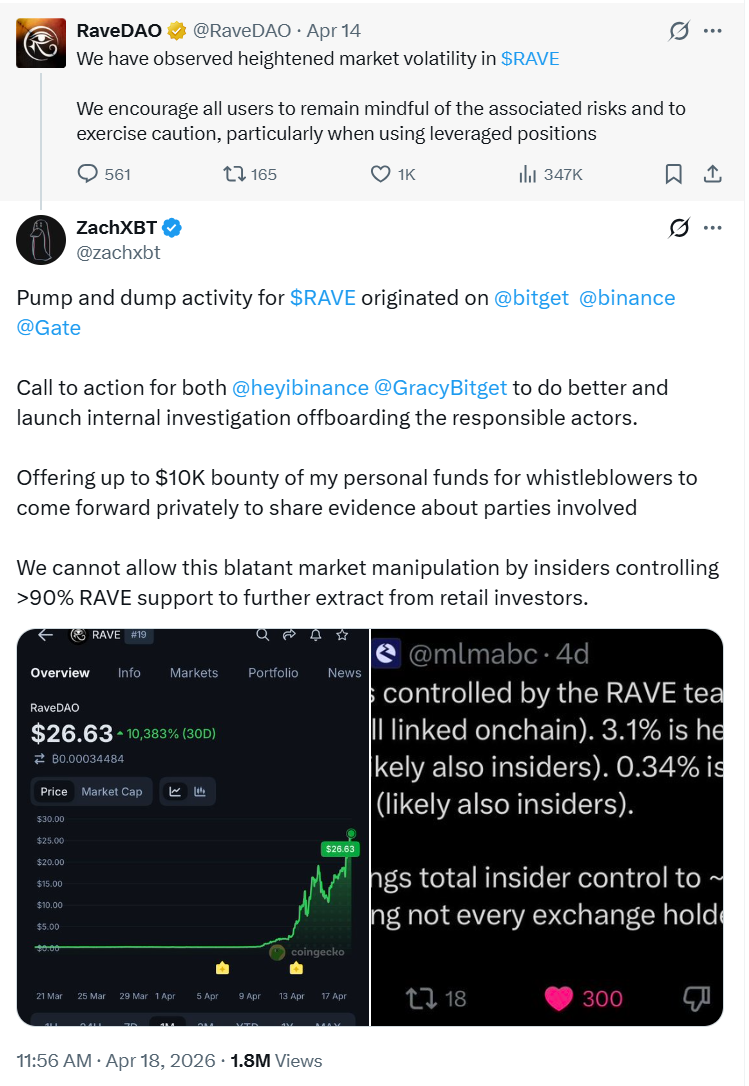
RaveDAO has denied any role in the recent surge and sharp collapse of its RAVE token, as major crypto exchanges open probes into trading activity following allegations of market manipulation.
In a thread posted on X, the project said it was “not engaged in, nor responsible for, recent price action,” responding to mounting scrutiny after RAVE soared from roughly $0.25 to nearly $28 within days before plunging more than 80%.
The denial comes as onchain investigator ZachXBT accused the project of orchestrating a pump-and-dump scheme, pointing to concentrated token holdings and suspicious exchange flows. He claimed that more than 90% of the token supply may be controlled by insiders, calling on exchanges to take action.

Both Binance and Bitget confirmed they are reviewing the situation. “We’re looking into it,” Binance CEO Richard Teng wrote, while Bitget CEO Gracy Chen said the exchange had “started investigating” RAVE trading activity.
Related: Study finds almost no crypto protocols disclose market-maker terms
RaveDAO plans token sales to fund growth
RaveDAO also outlined plans to sell portions of unlocked tokens to fund operations, marketing and hiring. The team said it is exploring “price-triggered or performance-triggered locks” to better align incentives.
“Building a movement requires resources,” the project wrote, adding it aims to do so “sustainably and transparently.”
RaveDAO is a Web3-based entertainment project that combines electronic music events with blockchain technology, aiming to onboard users into crypto through real-world experiences like festivals and parties. It operates as a decentralized community where attendees receive NFTs for participation, while its RAVE token is used for governance, ticketing and access to events.
At the time of writing, RAVE is trading at $1.36, down by 94.95% over the past day, according to data from CoinMarketCap.
Related: Stablecoins behave like FX markets as liquidity splits: Eco CEO
DeFi hacks surge in April
As Cointelegraph reported, more than a dozen DeFi protocols and crypto firms have been hit by exploits in just over two weeks, starting with the massive $280 million Drift Protocol attack on April 1.
Other affected projects include CoW Swap, Hyperbridge, Bybit, Silo Finance, Aethir and Rhea Finance, along with exchanges and liquidity pools across multiple chains. The attacks range from smart contract bugs and oracle manipulation to access control failures and liquidity pool exploits.
Magazine: Bitcoin may take 7 years to upgrade to post-quantum — BIP-360 co-author

Bruno Fernandes fury explained as potential red card missed in Man United win vs Chelsea

MEGA XRP FLARE BOMBSHELL! THIS LITERALLY CHANGES IT ALL!

Friend in search of Alan Wong of York – can you help?


-
 NewsBeat6 days ago
Pep Guardiola and Gary Neville agree over Arsenal title problem that benefits Man City
-

 Crypto World6 days ago
The SEC Conditionalises DeFi Platforms to Be Avoided for Broker Registration
-

 Fashion2 days ago
Weekend Open Thread: Theodora Dress
-

 Politics7 days ago
World Cup exit makes Italy enter crisis mode
-

 Crypto World5 days ago
SEC Signals Exemption for Crypto Interfaces From Broker Registration
-

 News Videos4 days ago
Secure crypto trading starts with an FIU-registered
-

 Sports2 days ago
NWFL Suspends Two Players Over Post-Match Clash in Ado-Ekiti
-

 Crypto World5 days ago
SEC Proposes Certain Crypto Interfaces Don’t Need to Register as Brokers
-

 NewsBeat5 days ago
Trump and Pope Leo: Behind their disagreement over Iran war
-

 Politics2 days ago
Palestine barred from entering Canada for FIFA Congress
-

 Crypto World1 day ago
Russia Pushes Bill to Criminalize Unregistered Crypto Services
-

 Sports6 days ago
NWFL opens Pathway for new Clubs ahead of 2026 Season
-

 Crypto World6 days ago
Trump whales load up ahead of Mar-a-Lago luncheon.
-
 Business2 days ago
Creo Medical agree sale of its manufacturing operation
-
Business6 days ago
Kering slides after Morgan Stanley downgrade, Gucci woes loom
-
Crypto World6 days ago
Sei Network Enters Quiet Reset Phase as On-Chain Metrics Signal a Slowdown in 2026
-

 Tech6 days ago
Google adds E2E encryption to Gmail for iOS and Android enterprise users
-
 Entertainment5 days ago
Brand New Day’ Footage Reveals the Devastating Impact of ‘Now Way Home’
-

 Tech6 days ago
Apple glasses won’t go brand shopping like Meta did with Ray-Ban and Oakley
-
 Entertainment5 days ago
Karol G’s ‘Ultra Raunchy’ Coachella Set Gave ‘Satanic Vibes’
You must be logged in to post a comment Login