

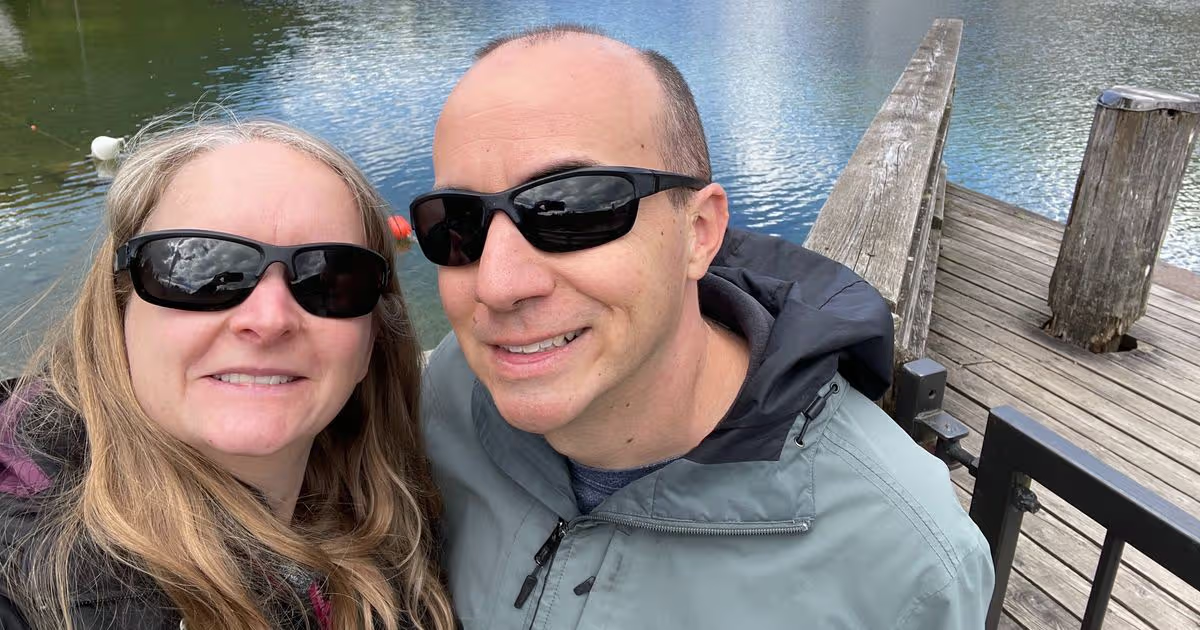
Forget dating apps and blind dates, one couple found love halfway across the world
In today’s society, dating apps have become the go-to for meeting new people and starting romantic connections. But for one couple, their love story started halfway across the world, after a chance encounter, when they least expected it.
Looking for an adventure, Nicki Challinger packed her suitcase and headed to the airport to embark on a 10-day trip around Southeast Asia, stopping in Thailand and Laos. At 31, working as a freelance translator, Nicki was seeking thrills. She booked the trip through Flash Pack, a tour company offering adventures for solo travellers in a small group of a similar age.
This meant that rather than a trip dedicated to 18-30s or one catering to the over 50s, Nicki could enjoy a group tour that suited her age perfectly – avoiding the late-night club outings but ditching early nights! But little did she know she’d meet her husband, Tony Kern, almost the moment after she touched down in Thailand, during their first group meal.
READ MORE: I’ve visited 400 islands – this near impossible to reach British one is the best


“There was a group dinner the first night, and I was just coincidentally seated next to him. We had a lot in common, he asked a lot of questions about me, and we shared the same sense of humour,” Nicki exclusively told the Mirror.
“He was really sweet, and he was just so genuine – a really open and kind guy.” Over the course of their trip in November 2018, they went whitewater rafting, cycling and treks, including one through a jungle.
Nicki sweetly recalled one day when they floated down the Mekong River on a boat as they crossed the border into Laos. “We had been getting on, and we were just chatting for hours while sitting at this little table, and just watching the beautiful scenery. It was without the pressure, as we were just hanging out, as everyone else in the group was.”
As sparks began to fly, they got closer, but as Tony, who was 32 at the time, was from the US and Nicki from the UK, they didn’t think it would go anywhere outside of the trip. It wasn’t until day eight of their tour that they knew it was something special.
“We went for a walk around this little town that we’d stopped in on the Mekong, and it was late at night, so all the stars were out, and it was sort of really romantic. That’s when I thought, ‘I can see this going somewhere’, and I did think we might kiss at the end of that night,” Nicki recalled.
“But then there was a pack of wild street dogs and I’m terrified of them. I don’t like dogs when they’re on a lead, so street dogs in Laos, I was not feeling it. He didn’t kiss me that night, so I was like, ‘Oh, maybe he doesn’t feel it.’ And then the next day, when we talked about it, he said, ‘Yeah, it just didn’t seem like the right moment.’”
They later had a conversation while at a resort overlooking the Mekong River and said it wasn’t just a holiday romance but something serious. That’s when they shared their first kiss.
As their relationship began, the tour inevitably came to an end. Yet that wasn’t going to stop the newly formed couple, despite being thousands of miles apart. Nicki had stayed in Thailand for a month to work on an island, while Tony travelled back home to the US.
They kept in contact and spoke on the phone a lot, while battling a 13-hour time difference for a month. But after spotting affordable flights to the US just two weeks after meeting, Nicki later jetted off to meet Tony at his home in Kansas City.
She said they had a “great time” together in the US, and after that, went back and forth to see each other. Then, as the COVID-19 pandemic hit, Nicki made the quick decision to go back over to the US, just days before they shut the border, and stayed there for three months.
“In hindsight, it was quite a good practice for real married life, and we went for nice walks in the evening,” she shared. Then, in April 2021, the couple got engaged in the US, the evening before Nicki’s birthday, “It was relaxed but romantic”.
Just a few months later, in November 2021, they joyfully tied the knot during an intimate ceremony in the US before returning to the UK for a bigger wedding party in July 2022. Here, they had eight of their friends from the tour attend, two of whom also sparked up a relationship on the trip, and now have a baby together.
Talking of their love story, Nicki said: “It was unexpected, none of us were looking for a relationship, we just went on the tour for an adventure. It was life-changing. Everything had lined up like the dates of the trip and the discount – it just worked really well logistically, and then I met my husband. People are always so surprised.”
They had both used Flash Pack to book trips in the past, but never thought their 2018 adventure would lead to love. “I was not bothered at all. I just wanted to see some of Thailand, and I didn’t want to do it by myself,” Nicki said. It was also the first time this specific tour had ever run, which Nicki said meant “everybody on the trip had the same, relatively relaxed mindset.”
After maintaining a visa, Tony, now 40, moved to the UK in November 2022, and today, they happily live in Nottingham. While they’ve known each other for around eight years, Nicki, now 38, confessed: “Theoretically, the language is the same, but I would say it’s still probably about once a week where one of us says something, and the other is like, ‘I literally have no idea what you’re saying’.”
Do you have a travel story to share? Email webtravel@reachplc.com










































You must be logged in to post a comment Login