Connect with us
DAPA Banner

NewsBeat

My dad died after two days of agony in a hospital corridor. He had so much life to live

Published

on

Wales Online

‘Kind‑hearted’ Barry Rhys James could only watch as his feet turned black while waiting days for a hospital bed

A much-loved grandfather died after his health deteriorated while spending well over two days in a chaotic hospital corridor. Barry Rhys James, 64, was in agony as his feet turned black at Caerphilly county’s Ysbyty Ystrad Fawr but his needs were neglected for days, his family have claimed in a formal complaint.

Advertisement

Barry, a taxi driver who lived in Bedwas, was described by his daughter Holly James-Dryland as a “kind‑hearted and gentle” family man who “consistently put others before himself”. He was admitted to the community hospital in Ystrad Mynach on the morning of January 6 with severely discoloured feet but was not given a bed until the night of January 8.

With blood no longer circulating to his feet, Barry suffered a cardiac arrest and died on January 10. The initial cause of his illness has not yet been confirmed.

Holly and her partner Shaun are speaking out to raise awareness of various alleged failings in Barry’s treatment. They told WalesOnline there were missed opportunities where the hospital did not follow the instructions of its own doctors while Barry sat helplessly in a corridor watching his feet blacken.

Barry was in “absolute agony” and rolling around in his chair in the corridor of the medical assessment ward, said Holly, who was told by staff that the ward had a capacity of 29 patients – and that at the time of her dad’s treatment some 63 patients were crammed into the ward.

Advertisement

“The first medical professional we encountered, a triage nurse, said this was the worst period she had experienced in 23 years and that she wanted to quit,” Holly added. “Staff frequently complained about conditions and a nurse encouraged us to formally complain.”

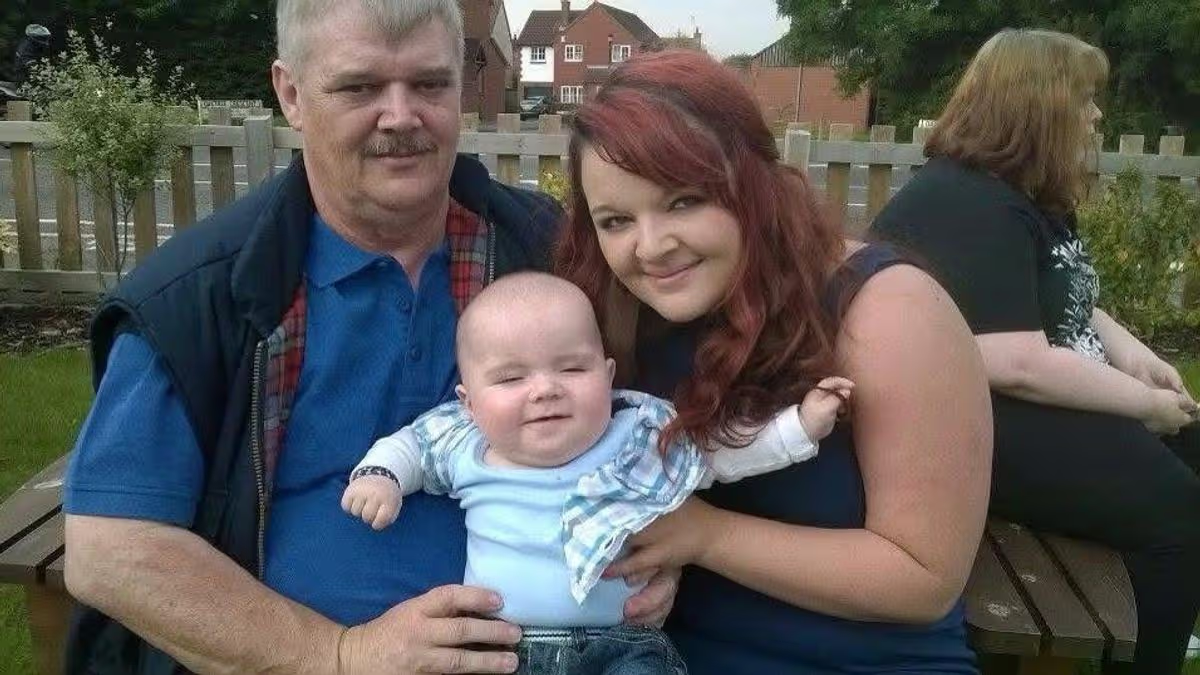
Barry, who was a winger for Newport rugby club in his youth, had three children and two grandchildren. Holly said: “Our dad wasn’t just our father. He played the role of our mother as well, stepping up and taking on the role of both parents. He did an outstanding job.

“He went out of his way to make sure his family were cared for and happy. Often it would be through small but meaningful gestures that showed how much he cared.”

Following a 20-hour wait for an ambulance, Barry’s family had taken him to the hospital themselves. He had been concerned that his feet were cold and painful, with a bluish tinge.

Advertisement

Barry arrived at Ysbyty Ystrad Fawr at around 11.30am on Tuesday, January 6. His family questioned why he was taken to a minor injury unit rather than the Grange A&E – which they suspect was explained by a Facebook post issued that week by Aneurin Bevan university health board, stating the A&E was under “severe pressure” amid high levels of illness.

Medics suspected the loss of blood supply to Barry’s feet may have been linked to his type-two diabetes. Shortly after his admission he was assessed by a consultant who “clearly stated that his feet needed to be warmed urgently”, said Holly.

“This instruction was not acted upon. My father remained in a chair in a corridor. There was no meaningful or sustained attempt to warm his feet throughout the week.”

Advertisement

Staff told the family that Barry could not use a Bair Hugger blanket – a device for maintaining a patient’s core body temperature – as there were not enough plug sockets in the corridor and it would be a “trip hazard”.

Holly said: “Staff refused to use plug sockets due to trip hazard concerns, yet the following day an extension cable was used across the corridor for another patient sitting in the exact same location.

“My dad could see his feet turning blacker by the minute. He was frequently vomiting with no privacy or dignity, in full view of other patients and visitors.

“The nurses themselves said they wanted change. One of them gave us a QR code and encouraged us to make a complaint, but that was for future change, not to help my dad there and then.

Advertisement

“On one occasion, a doctor said he would return in five minutes but left the ward for over an hour.”

Barry was eventually placed in one of the ward’s beds at around 9.25pm on Thursday (January 8). He was then finally able to use a Bair Hugger blanket but by this point his condition had deteriorated severely and his feet would not warm.

Holly said: “On Thursday evening I noticed his feet were being kept covered by medical staff. This was a change from the early and middle part of the week when his feet were frequently uncovered and clearly visible.

“On Thursday and Friday, I was explicitly told by doctors that my father still had a pulse in both feet. However, on Saturday at around 3pm I received a phone call from a doctor who informed me my father had not had any pulse in his feet for the previous 48 hours.

Advertisement

“During this call, the doctor apologised that I had previously been told otherwise and stated that his feet now required amputation.”

Holly was told her dad would be moved to the Grange. Soon afterwards she received another call saying Barry was in cardiac arrest. She had nearly reached the Grange by the time the final call came, telling her that Barry was still at Ysbyty Ystrad Fawr and had died.

“We later learned the hospital didn’t contact a kidney specialist until three hours before my dad died,” said Holly. “They had known his kidney was failing since the blood test on Tuesday.”

The family has been waiting nearly three months for the health board’s response to their formal complaint, which calls for the release of Barry’s medical records.

Advertisement

“My dad was 64 and had a lot of life left to live,” said Holly. “I want the hospital to learn and I want answers for why certain things happened that week.”

Paying tribute to Barry, she said he “took great pride” in his 37-year career as a taxi driver. “He was reliable, active, and routinely up early each day to work.

“When I was younger, he took me horse-riding twice a week in all weathers, even after waking up at 2am to go to work and working a 12-hour shift. He never complained or let me down. He did everything in his power to make sure I was happy, always encouraging and cheering me on.

“He adored his two grandchildren, Toby and Arielle, and put a great deal of effort into being an active part of their lives. With my son Toby, he would sit for hours debating football statistics, both stubborn and passionate but enjoying every minute of the discussion.

Advertisement

“With my daughter Arielle, he always looked forward to seeing her come down the stairs on a Sunday morning, ready with a joke as soon as she entered the living room.”

Barry gave daily care to Holly’s 27-year-old sister, who has learning difficulties. He would attend appointments with her, help her communicate with healthcare professionals, and manage her weekly medication.

“Sunday mornings were reserved for his visits,” Holly added. “Every week, without fail, he arrived at my door at 9am, often waking me up just so he could spend a few hours with us. He never missed a single Sunday. His absence has left a profound void in our family, and our home is no longer the same without him.”

Second only to his family, Barry’s other great love was for rugby, as a loyal follower of Wales and the Dragons. Following his death his ashes were placed in a Welsh Rugby Union ball and one of his rugby jerseys was made into a cuddly elephant toy bearing a message for his family: “These are the clothes that I used to wear. Whenever you hold me know that I am there.”

A spokesperson for the health board said: “Our thoughts are with Mr James’ family at this very difficult time and we’re sorry that they are unhappy with the care he received. Whilst we aim to conclude investigations within 30 working days, there are some instances where more complex cases may take longer than this.

“Investigations can take anywhere up to six months to conclude, which is outlined within the ‘putting things right’ regulations. We recognise that awaiting a response can be frustrating and we are working to conclude our investigation and respond to the family as quickly as possible.”

Last month we revealed Aneurin Bevan health board had put 21 Royal Gwent hospital patients at risk of serious infections by treating them with unsterilised medical instruments and had then failed to tell them until around three weeks later – which only happened after a whistleblower had come forward to WalesOnline.

Advertisement

Shortly after we reported on the sterilisation error, an anonymous petition was launched on Change.org calling for “an independent review of leadership and governance” at the health board. It pointed to various failings from recent years, including the mixing-up of bodies in a mortuary and the death of nine-year-old Dylan Cope after he was sent home from hospital despite having a perforated appendix. The petition is backed by Barry’s family.

They are also concerned by the wait for an ambulance before Barry’s admission to hospital. One finally arrived after repeated calls across a 20-hour period, though the family ended up taking him to hospital themselves. Shaun explained: “Because Barry was already sat in our car during the examination, the paramedic asked if we could take him to the hospital. [The ambulance service] was also definitely under pressure.”

Sonia Thompson, the Welsh ambulance service’s assistant director for emergency operations, said: “We would like to extend our sincere condolences to the family of Mr James at what must be a very difficult and upsetting time. We were facing sustained pressure on our service on January 5, with a high number of patients waiting for a face-to-face response within the community.

“At 5am on January 6 we were contending with 11-hour handover delays outside the Grange Hospital in Cwmbran. Pressures on the ambulance service are well recognised, with delays reflecting wider, system-wide challenges. When ambulances are held at hospital, they are unable to respond to other 999 calls in the community.”

Advertisement

Ms Thompson added: “If it is safe to do so, some patients may be asked to use alternative transport to get to hospital, helping us keep ambulances available for those who need them most.”

Holly’s partner Shaun said he was “angry and deeply disappointed” by Barry’s care at the hospital, adding: “I am very sad at seeing what Holly is going through. Losing her dad has been unbearable for us all.”

If you have information about a story we should be investigating, you can contact us at conor.gogarty@walesonline.co.uk

Get daily breaking news updates on your phone by joining our WhatsApp community here. We occasionally treat members to special offers, promotions and ads from us and our partners. See our Privacy Notice.


Advertisement

Source link

Continue Reading
Click to comment

You must be logged in to post a comment Login

Leave a Reply

NewsBeat

Jacqueline Jossa shares Easter break with daughters after Dan Osborne split

Published

on

Daily Mirror

EastEnders star Jacqueline Jossa headed to the coast for a relaxing break after it emerged that she had split from her reality star husband, Dan Osborne.

Jacqueline Jossa has shared a glimpse into a wholesome Easter getaway with her daughters, marking her first trip away since news of her split from husband Dan Osborne emerged.

The EastEnders star looked happy and healthy as she documented the family break on social media, giving fans a peek at their time by the coast of Cornwall.

Advertisement

Jacqueline revealed she had headed off to enjoy the school Easter holidays with daughters Ella, 11, and seven-year-old Mia, sharing lots of clips from their stay at a beachfront holiday park in Newquay.

Making it clear the trip wasn’t sponsored or a gift, she told followers she simply wanted to show “what an amazing time” they’d had together. One sweet video showed the trio enjoying a jam-packed break, soaking up the sunshine and making the most of the seaside location.

News of the trip comes just days after The Sun detailed how they’d “decided to make the split permanent” after trialling a period of living apart.

The couple, who married in 2017 after first meeting in 2013, share two daughters together, while Dan is also dad to son Teddy from a previous relationship.

A source close to the situation said the pair had ultimately decided to part ways after spending time apart earlier this year.

“Everyone knows they’ve had their troubles, but after spending some time apart this year, they’ve decided to make the split permanent,” the source said.

Advertisement

Jacqueline and Dan’s relationship has long been under the spotlight, with a number of allegations and rumours surrounding Dan over the years putting strain on their marriage.

Throughout their 13 years together, the couple have been plagued with multiple cheating claims. Less than a year after they married at Delamere Manor in Cheshire in 2017, the pair split, citing that they couldn’t “make each other happy”. Then in 2018 rumours surfaced that Dan had been unfaithful with Love Island alumni Gabby Allen and Alexandra Cane, who both denied the claims.

Advertisement

Recent reports claimed that it was Dan, who ended their nine-year marriage after he could no longer ‘cope’ with EastEnders star Jacqueline’s behaviour, as she struggled to move beyond his past indiscretions.

Our source adds: “They’ve been so on and off, for Dan, it never really feels over. He’ll try to come back, because in the past he always has, and it’s worked. He’s desperate for them to stay as a family and win back Jac.”

Despite previously working through their issues and attempting to move forward, it’s understood that the pair had been living increasingly separate lives in recent months.

Advertisement

While neither Jacqueline nor Dan has publicly addressed the split, those close to the actress say she is now focusing on her children and moving forward.

Single and thriving – and at the centre of some of the soap’s juiciest storylines – our source says the star is in a much better place. “Jac is going from strength to strength,” they said. “She’s getting some great leads in EastEnders now, and there’s other work coming in as well.”

And we’re told that Jac hasn’t looked back since cutting ties with Dan. “She’s going to enjoy being on her own,” our source said. “She doesn’t need to be with a man to feel validated.”

Like this story? For more of the latest showbiz news and gossip, follow Mirror Celebs on TikTok , Snapchat , Instagram , Twitter , Facebook , YouTube and Threads .

Advertisement

Source link

Continue Reading

NewsBeat

Storm Dave batters UK as homes left without power

Published

on

Manchester Evening News

While weather warnings have now been lifted, authorities are advising the public to ‘remain vigilant’

While the worst of Storm Dave has passed, the aftermath continues to disrupt life across the UK this Easter Sunday.

Advertisement

Utility crews and transport officials remain in a race against time to restore services after the storm lashed the country with hurricane-force winds and unexpected snowfall. Although the Met Office was able to lift several yellow weather warnings earlier than expected as conditions stabilised, the trail of destruction left in the storm’s wake remains a significant hurdle for households and people on the move.

The sheer power of the storm was most evident in North Wales, where a peak gust of 93mph was recorded at Capel Curig.

Get MEN Premium now for just £1 HERE – or get involved in our WhatsApp group by clicking HERE. And don’t miss out on our brilliant selection of newsletters HERE.

Other regions felt the brunt of the gales as well, with Yorkshire, Cumbria, and Aberdeenshire all clocking wind speeds well above 70mph.

Advertisement

These fierce conditions resulted in localized blackouts, particularly in Scotland. Engineering teams from Scottish and Southern Electricity Networks are currently deployed across Skye, Caithness, and coastal Aberdeenshire to reconnect a small number of homes that remain without power following a turbulent night.

Infrastructure and transport networks are still reeling from the impact. On the west coast of Scotland, Caledonian MacBrayne ferry services faced significant cancellations, while motorists across the north struggled with blocked roads caused by fallen trees.

Rail travel was also hit hard. Network Rail Scotland managed to lift most speed restrictions by mid-morning, but passengers in the north west of England were forced onto replacement buses between Manchester Piccadilly and Chester.

In East Yorkshire, the Humber Bridge was temporarily closed to high-sided vehicles before eventually reopening as the winds subsided.

Advertisement

Adding to the seasonal confusion, the storm brought a wintry chill that turned rain into snow across much of Scotland. Residents in Glasgow, Skye, and Inverclyde woke to snow flurries on Easter morning, creating treacherous driving conditions even as the wind warnings were deactivated.

Met Office spokesperson Marco Petagna noted that while the storm pulled away faster than originally predicted, the cold air left in its wake will keep temperatures below the April average for the northern half of the country.

“Storm Dave will clear north east on Sunday morning, leaving sunshine and widespread showers across the UK,” he said. “Northern areas will see the heaviest blustery showers and feel cold, while temperatures elsewhere stay closer to average for early April.”

Advertisement

As the afternoon progresses, the focus has shifted from wind damage to the risk of rising water.

Despite the return of some sunshine, one flood warning remains in place for Scotland, while England faces a combined 18 flood warnings and alerts.

Authorities are advising the public to remain vigilant near coastal areas and riverbanks, as the combination of heavy overnight rain and lingering blustery showers continues to threaten localized flooding.

Source link

Advertisement
Continue Reading

NewsBeat

Fears coastal erosion could threaten Saltburn freight railway

Published

on

Fears coastal erosion could threaten Saltburn freight railway

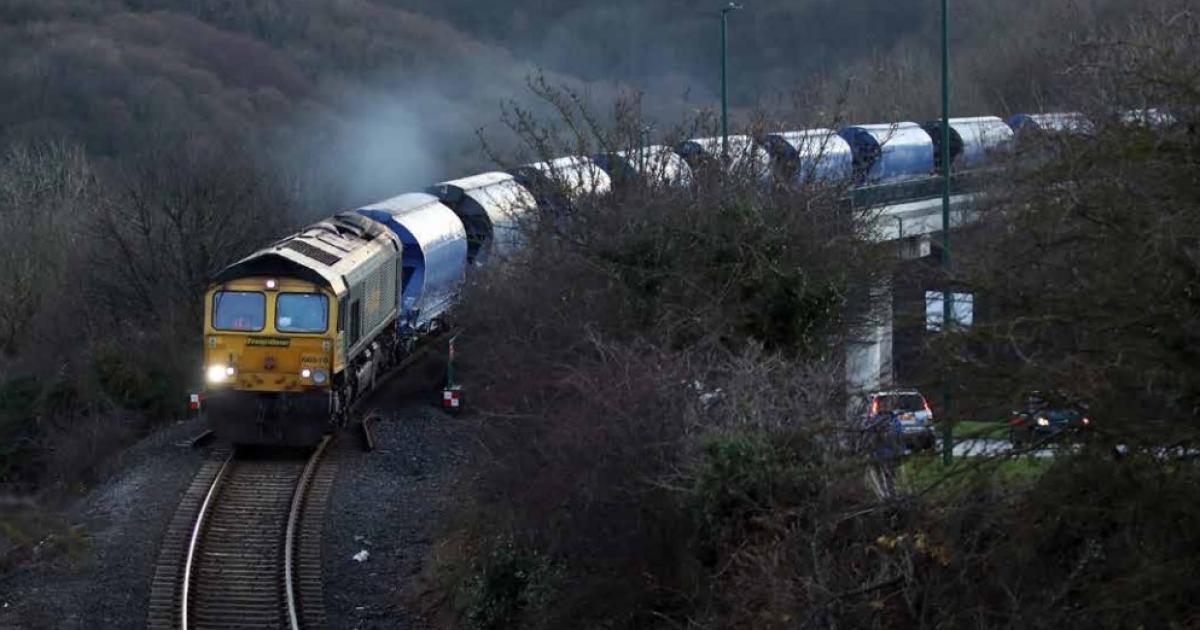
The Saltburn to Boulby line serves the potash mine at Boulby and the British Steel site at Skinningrove, both major employers in the area.

While the majority of the route is some way inland, it hugs the coast at Huntcliff, Saltburn with only a coastal path, forming part of the Cleveland Way, separating it from the sea.

At a recent Redcar and Cleveland Council climate and environment scrutiny committee, members warned of “cliff instability near rail assets” and questioned officers over the approach being taken.

They also called for better communication with the likes of Network Rail, which maintains rail infrastructure assets, suggesting a “structured forum” should be established with the body and other interested parties to develop current and future strategy.

Advertisement

Saltburn councillor Philip Thomson, a member of the committee, said the line was “very close to the sea”.

Saltburn ward councillor Philip Thomson. Picture/credit: Ian Cooper/Teesside Live. Free for use for all LDRS partners.Saltburn ward councillor Philip Thomson. Picture/credit: Ian Cooper/Teesside Live. Free for use for all LDRS partners.

He said: “The challenge is monitoring these things.

“The clear lay evidence is that this part of the coast, particularly coming around Huntcliff, has a large question about its longevity.

“The service to the potash line and British steelworks at Skinningrove requires a forward plan, not waiting for further slippage to be planned on the assumption it is going to happen at some time.

Advertisement

“I asked the question [about a forward plan] and the answer came back saying we will just move the path to the other side of the railway line.

“That is all very well if the railway is not to be jeopardised as well.”

Cllr Thomson said Network Rail’s (NR)position was unclear and he had asked the council’s highways department to make a formal approach to NR with a view to a report being brought back to the committee.

Philip Chisholm, from Redcar, a former councillor with Langbaurgh Borough Council – Redcar and Cleveland’s predecessor – contacted the Local Democracy Reporting Service  with his concerns earlier this year.

Advertisement

Philip Chisholm. Picture/credit: Supplied. Free for use for all LDRS partners. Philip Chisholm. Picture/credit: Supplied. Free for use for all LDRS partners.

He described how the freight line “clings to the cliff edge” with the Cleveland Way being “squeezed into a narrowing space” between the railway and the sea.

Mr Chisholm also described how last year sections of the walking route had been closed after rock falls.

He said: “The underlying geology has been unstable for decades, but climate change, heavier rainfall, and accelerating coastal erosion have turned a long-term issue into an immediate risk. 

“The question is no longer whether the railway is vulnerable, but whether we are prepared to act before it is lost.”

Advertisement

Mr Chisholm said the rail link was a “working artery” supporting East Cleveland’s industrial economy and freight access was “vital” to both the steelworks at Skinningrove and the Boulby potash mine.

He said: “The loss of the line would ripple through supply chains, employment, and regional competitiveness.

“Despite the scale of the risk, there remains no clearly articulated, publicly visible strategy that convincingly secures the railway’s future.”

Mr Chisholm said essential infrastructure investment could secure a solution in the form of engineered coastal protection and “cliff stabilisation”.

Advertisement

He said: “These are not optional extras. If this line were lost to the sea, the cost of rebuilding – if rebuilding were even possible – would dwarf the cost of acting now.”

Network Rail did not respond to a request for a comment.

A Redcar and Cleveland Council spokeswoman said the coastline in question was subject to a shoreline management plan (SMP) – as with other areas of the UK – with councils and the Environment Agency working together to make assessments as part of regional coastline groups.

She said: “The main purpose of SMPs is to identify long-term policy options to manage the shoreline in a sustainable way.

Advertisement

“The [current] policy is no active intervention…and not to encourage new defences.”

The Tees Valley Combined Authority, which previously set money aside for a feasibility study looking at the potential of passenger services being reinstated to the line, also did not respond to a request for comment.

Last year Redcar and Cleveland Council said planned engineering works to divert a cliff top road at Cowbar, near Boulby, were being brought forward after coastal erosion forecasts were updated and identified a much greater risk of collapse than previously thought.

It has continued to list the issue among several ‘red risks’ included in its corporate risk register, which is reviewed twice a year.

Advertisement

Source link

Continue Reading

NewsBeat

Smith-Watkins brand bought by John Packer Musical Instruments

Published

on

Smith-Watkins brand bought by John Packer Musical Instruments

John Packer Musical Instruments, one of the UK’s largest specialist brass and woodwind retailers and manufacturers, has confirmed the acquisition of Richard Smith Musical Instruments, based in Sheriff Hutton, North Yorkshire, and the company behind the Smith-Watkins brand.

Smith-Watkins is internationally recognised for its handcrafted cornets and trumpets.

Rob Hanson, managing director of John Packer Musical Instruments, said: “It’s a huge honour to welcome the Smith-Watkins brand to the John Packer Musical Instruments family.

Advertisement

“With his groundbreaking acoustic research, Dr Richard Smith was a pioneer and the result has been outstanding musical instruments which light up concert halls, recording sessions and military parades all over the world.”

The company is now part of a family that includes other respected names such as JP Musical Instruments, Rath Trombones, Taylor Trumpets, Sterling Musical Instruments and Rudall Carte Woodwinds.

Smith-Watkins instruments will continue to be manufactured at their facility near York.

Mr Hanson said: “These beautiful instruments will continue to be handcrafted in the UK, helping strengthen the future of UK brass manufacturing, and ensuring musicians all over the world can enjoy playing Smith-Watkins for generations to come.”

Advertisement

The acquisition marks the latest chapter in a long-standing relationship between JP Musical Instruments and Richard Smith Musical Instruments, who began collaborating in 2008 on the popular JP Smith-Watkins range of trumpets and cornets.

Smith-Watkins brass instruments are used worldwide in jazz, chamber music, big bands, orchestras, and studio recordings.

The brand has a particularly strong reputation within military music.

Smith-Watkins instruments are played by bands in the British Army, Royal Marines, and Royal Air Force.

Advertisement

Their fanfare trumpets have been used at high-profile events including the Grand National, the 2011 wedding of the Prince and Princess of Wales, the Queen’s Diamond Jubilee in 2012, the London 2012 Olympics opening ceremony, and the 2018 wedding of Prince Harry and Meghan Markle.

Dr Richard Smith, who founded Richard Smith Musical Instruments, is a prominent figure in the world of brass instrument design.

He completed a doctoral thesis on trumpet acoustics before spending 12 years at Boosey and Hawkes as chief designer and technical manager.

During his time there, he was responsible for the Besson brass range.

Advertisement

His designs include the original trumpets played by Derek Watkins (906) and John Wallace (907), trombones used by Roy Williams and Don Lusher (937), and the Sovereign/Besson 928 cornets, which remain popular in brass and military bands worldwide.

Dr Smith said: “Seeing Smith-Watkins instruments performed on the world stage has been an honour, and it gives me great pleasure knowing they are the choice of many of the world’s leading trumpet players.

“I have known Rob Hanson for many years, and with his drive, passion and inimitable business acumen, I know he will help ensure the company can thrive and continue to reach new audiences all over the world.”

His research has been published widely in scientific journals, and he has presented papers at international conferences.

Advertisement

He has also worked with leading symphonic and session musicians across Europe, the US, and Japan.

In 2000, Dr Smith’s ‘The Soloist’ cornet was awarded Millennium Product Status by the UK Design Council.

The instrument, which features interchangeable leadpipes for varied playing conditions and genres, was recognised as a prime example of British design and innovation.

John Packer Musical Instruments has twice received the King’s Award for Enterprise in International Trade, most recently in May 2025.

Advertisement

Source link

Continue Reading

NewsBeat

Three youths charged after major fire erupts at abandoned Aberdeen mill

Published

on

Daily Record

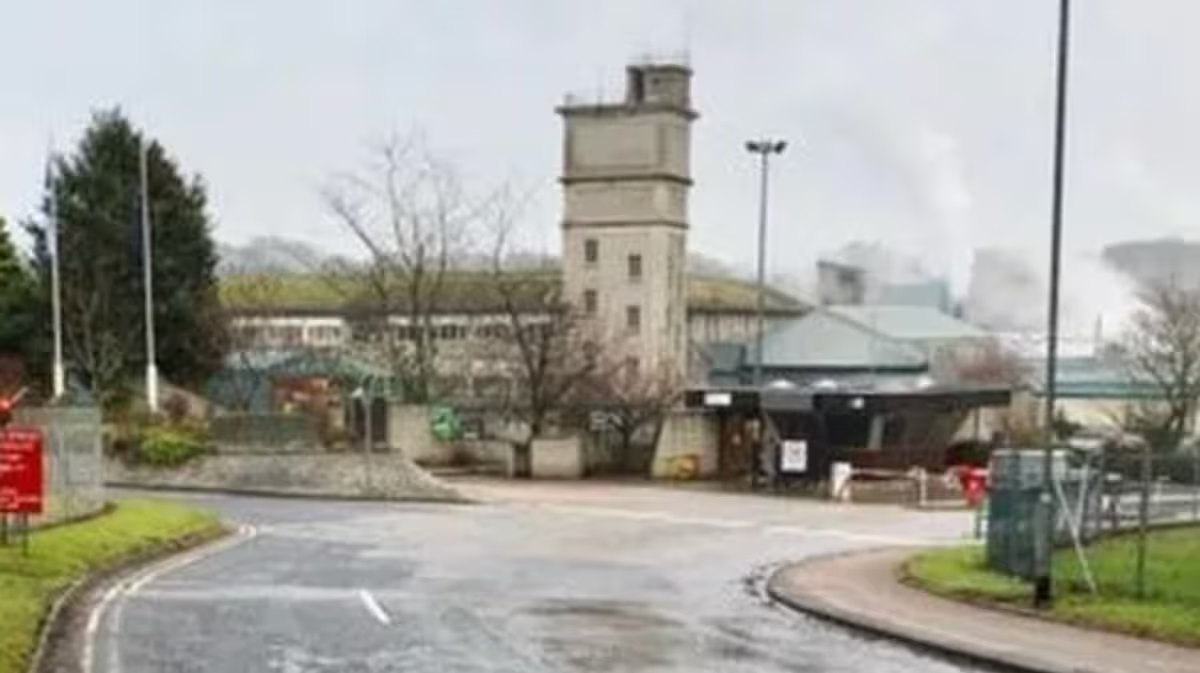
Emergency services were called to the abandoned Stoneywood Mill building after the alarm was raised at around 5.20pm on Sunday, March 29.

Three youths have been charged after a major fire erupted in a derelict building in Aberdeen.

Advertisement

Emergency services were called to the abandoned Stoneywood Mill building after the alarm was raised at around 5.20pm on Sunday, March 29. The Scottish Fire and Rescue Service (SFRS) mobilised four appliances, as well as a high reach vehicle and a number of other vehicles to Stoneywood Terrace.

Crews battled the blaze for a number of hours before it was finally extinguished, with the SFRS leaving the scene at 8.30pm. Police launched an investigation and officers have now confirmed that three male youths have been charged in connection with wilful fire-raising.

The trio have been reported to Youth Justice Management. No one was injured in the fire but cops urged the public to avoid the area and residents to remain indoors and keep doors and windows closed.

Pictures showed smoke billowing from the building as fire crews battled the inferno. Paper production factory Stoneywood Mill permanently closed its doors in 2022 and has lain empty ever since, falling into a derelict state.

Advertisement

A Police Scotland spokesperson said: “Three male youths have been charged in connection with wilful fire-raising in Aberdeen. Around the 5.55pm on Sunday, March 29, police received a report of a fire at a disused building on Stoneywood Terrace. The youths have been reported to Youth Justice Management.”

An SFRS spokesperson: “We were alerted at 5.21pm on Sunday March 29 following reports of a fire affecting a derelict building in the Stoneywood Terrace area of Aberdeen.

“We mobilised four appliances, a high reach vehicle, and other vehicles with crews working to extinguish a significant fire. There are no reported injuries.”

Get more Daily Record exclusives by signing up for free to Google’s preferred sources. Click HERE.

Advertisement

Source link

Continue Reading

NewsBeat

Train passengers hit with major disruption on Easter Sunday

Published

on

Manchester Airport train disruption after emergency incident

At around 10.30am, damage to the overhead electric wires between Bolton and Preston was reported, with trains instantly cancelled throughout the morning and afternoon.

The route, via Chorley, was shut in both directions, leaving many passengers facing major disruption to their Easter Sunday travel plans.

Replacement bus services between Bolton and Preston were organised for affected passengers, with the cancellations affecting trains moving between Blackpool North station and Manchester Airport.

Advertisement

The train line faced further disruption in the afternoon when an object was caught in the overhead wires between Blackpool North and Preston, leading to more cancellations.

The incidents were part of many across the UK’s railway network which took place in the wake of Storm Dave making landfall overnight.

Source link

Advertisement
Continue Reading

NewsBeat

Why has it taken so long to return to the Moon?

Published

on

Why has it taken so long to return to the Moon?

At 13:24:59 Central Standard Time on December 19 1972, the Apollo 17 command module splashed down in the Pacific Ocean, about 350 nautical miles south-east of Samoa, concluding the last mission to the Moon.

During his career, Apollo 17’s commander, Eugene A. Cernan, logged 566 hours and 15 minutes in space, of which more than 73 hours were spent on the surface of the Moon. Cernan was the second American to have walked in space, and the last person to leave his footprints on the surface of the Moon.

The conclusion of the Apollo 17 journey marked not only the end of a mission, but the close of an era. Between 1969 and 1972, 12 astronauts walked on the Moon over the course of six separate landings.

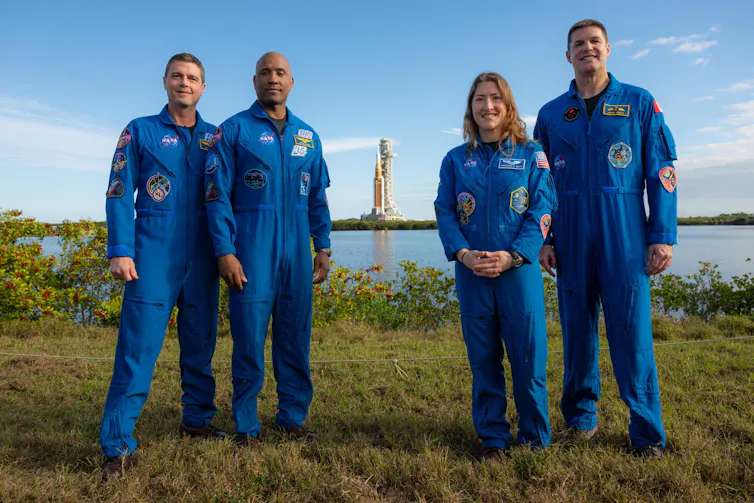
Half a century later, Nasa is preparing to return under its Artemis programme. For the Artemis II mission, set to launch on April 1 2026, four astronauts will travel in a loop around the Moon in Nasa’s next-generation Orion crew capsule.

Advertisement

More than 50 years is a long gap, and it is only natural to ask if Americans could reach the Moon routinely in the early 1970s, why did it take so long for them to try to go back?

The Apollo 17 mission in 1972 marks the last time humans set foot on the Moon.
Nasa

The answer is not simple. It has little to do with technology and much more with how politics, money and global support work. The place to start is with Apollo itself: its model of exploration was not built to last, and was clearly not sustainable.

On May 25 1961, before a joint session of Congress, President John F. Kennedy committed the US to the goal, before the decade was out, of landing a man on the Moon and returning him safely to the Earth.

After Kennedy’s assassination in 1963, President Lyndon B. Johnson ensured that this Moon landing goal was met. But rising costs from the Vietnam war and domestic reforms reduced his appetite for further space investment.

Advertisement
John F Kennedy’s speech at Rice University in 1962 reaffirmed America’s commitment to landing on the Moon.
JFK Library

In fact, Nasa’s budget peaked in 1966 and began falling even before Apollo’s success, undermining prospects for sustained exploration. Further funding was declined, planned missions were cancelled, and Apollo ended in 1972 – not because it failed, but because it had accomplished its task.

Sustainable exploration (in space as on Earth) requires stable political commitment, predictable funding, and a clear long-term purpose. After Apollo, the US struggled to maintain all three at once.

Policymakers began to ask what direction Nasa should take next. In 1972, President Richard Nixon directed the space agency to begin building the space shuttle. It would lead Nasa to shift its focus away from deep space exploration towards operations in low-Earth orbit.

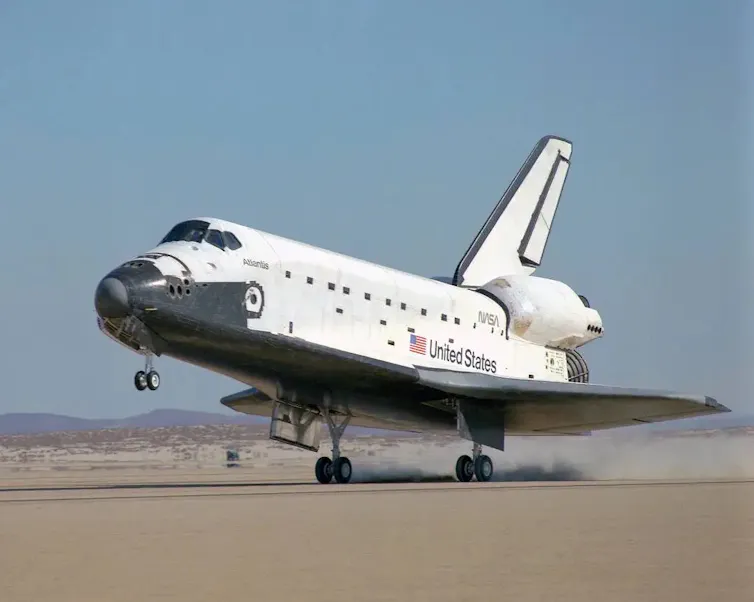
‘Space truck’: the shuttle was marketed as providing affordable access to low-Earth orbit. The reality was somewhat different.
Nasa

Marketed as a reusable “space truck”, the space shuttle was intended to make orbital access routine and affordable. However, it would turn out to be a vehicle of incredible complexity, marred by technical failures and human tragedies – the Challenger and Columbia accidents in which 14 astronauts’ lives were lost.

Eight years into the shuttle programme, some in the space community believed it was time for the US to once again set its sights on the Moon – and the tantalising prospect of a landing on Mars. On July 20 1989, the 20th anniversary of Apollo 11’s first Moon landing, President George H.W. Bush announced the Space Exploration Initiative (SEI).


À lire aussi :
Why is the US going back round the Moon with Artemis II? A space policy expert explains

Advertisement

The plan aimed for a long-term commitment to construct Space Station Freedom, return astronauts to the Moon “to stay”, and finally send humans to the red planet.

However, the high estimated costs of SEI, reaching hundreds of billions of dollars, led to its downfall. Weak support in Congress along with other factors led to its cancellation under Bill Clinton’s presidential administration.

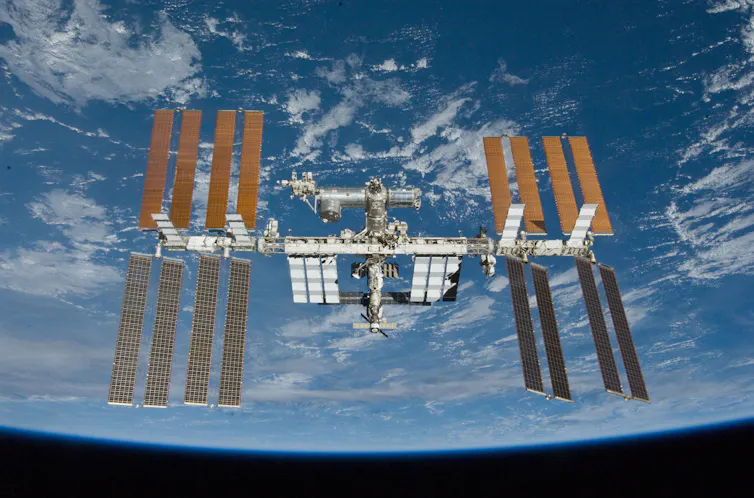
The ISS became a symbol of scientific cooperation, but consumed resources that might have been used for deep space exploration.
Nasa

During the 1990s, the International Space Station (ISS) project cemented low-Earth orbit as the priority for human exploration. The space shuttle was the US’s means of building the station and transporting crews to and from the orbiting outpost.

The ISS became a symbol of scientific cooperation and technical prowess. Experiments carried out on the station generated valuable insights into everything from medical research to materials science. However, it also soaked up resources that might otherwise have supported deep-space exploration.

The Columbia disaster in 2003 – in which a space shuttle broke up over Texas with the loss of its crew – led to another rethink of America’s direction in space. As a result, President George W. Bush announced the Vision for Space Exploration.

Advertisement

The aim of this proposal, which would give rise to what was known as the Constellation programme, was to rebuild Nasa’s capability for reaching the Moon, with Mars as its longer-term goal. But independent reviews warned that costs and schedules were unrealistic. Congress never really gave full financial support to Constellation, leading to its cancellation in 2010 during Barack Obama’s presidency.

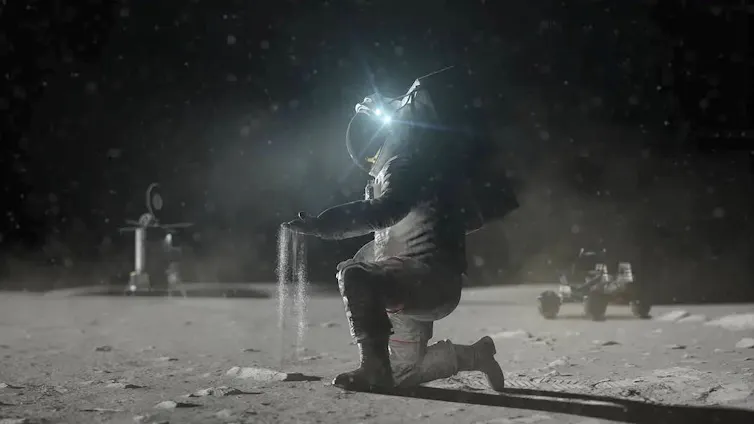
Constellation would have sent astronauts to the lunar surface on a lander called Altair.
Nasa

This repeated cycle of cancelled space projects exposes some inherent limitations to the system for funding lunar exploration. A sustainable Moon programme needs strong multi-sector commitment, and mechanisms in place for guaranteed multi-decade funding.

But such large programmes must compete each year with defence, healthcare and social spending. Electoral turnover and shifting committee leadership in the US further weaken the prospect of continuity.


À lire aussi :
Heat shield safety concerns raise stakes for Nasa’s Artemis II Moon mission


Lunar exploration has also suffered from an unresolved strategic question: why go back at all? Apollo’s purpose was largely geopolitical, and after the cold war no equally compelling justification really emerged.

Advertisement

Scientific returns from human space missions are limited compared with robotic exploration. Commercial prospects remain uncertain, and prestige alone rarely sustains or secures large budgets.

The Artemis II astronauts will travel to space on the giant Space Launch System (SLS) rocket (centre).
Nasa / John Kraus

Maybe a more fitting question is: why does Artemis appear to have escaped the pattern? Well, Nasa argues that sending astronauts back to the lunar surface – and in particular, establishing a sustained presence there – will help researchers learn “how to live and work on another world as we prepare for human missions to Mars”. That is true, up to a point.

Nasa also emphasises that Artemis will be built through commercial partnerships and international cooperation, creating the first long-term human foothold on the Moon.

The programme seems to sit at a carefully crafted intersection of US government leadership, commercial launch capabilities, and a broad coalition of international partners brought together under the Artemis Accords. The accords are a set of common principles regarding the use of the Moon and other targets in outer space, agreed between the US and other countries.

With Artemis, has Nasa finally found a rationale to maintain a more enduring presence on the Moon?
Nasa

The main difference from previous promises to return to the Moon is that this, at least in theory, spreads risk and widens the base of political support. In practice, though, Artemis remains costly and exposed to shifting budgets and priorities.

There is also a cultural dimension to this question. Apollo created a powerful – albeit fragile – myth of swift, heroic technological advance. Artemis is building its large technological base in societies and democratic contexts where investments and commitments tend to evolve slowly, shaped by negotiation, compromise and
competing interests.

Advertisement

If Artemis succeeds, it will be because all the political, economic, societal and scientific incentives have finally aligned in a durable way. But until that alignment is proven, the 50-year gap between Apollo and Artemis is less an engineering puzzle than a reminder of how difficult sustained exploration is for modern democracies.

Source link

Advertisement
Continue Reading

NewsBeat

What Is ‘Sudoku Packing’? The Best Packing Hack For Overpackers.

Published

on

What Is 'Sudoku Packing'? The Best Packing Hack For Overpackers.

As a last-minute packer who always stuffs my carry-on bag the night before a trip, I am curious about any way I can lessen my organising woes. According to a new viral travel hack, “sudoku packing” might be my answer for easy repeatable outfit combinations I can create with just nine anchor pieces.

Like the grid puzzle it is named after, this organising system uses three-by-three grids of a top, bottom and layering piece to create a total of 27 outfits from nine pieces of clothing. If you lay it out in your bed, the combinations should look like:

  • Top row has top, bottom, layer
  • Middle row has bottom, layer, top
  • Bottom row has layer, top, bottom

The “sudoku packing” term has been around since 2016, but “packing sudoku” recently went viral after multiple travellers shared their own effortless combinations for trips.

Massachusetts-based travel content creator Natalie Shaquer has popularised the packing sudoku framework.

“It takes away all of that decision fatigue,” she said. Shaquer’s video on her “sudoku packing” has been seen more than 4 million times since she first shared her outfit combinations on Instagram in February.

Advertisement

Recently, Shaquer put sudoku packing to the test on a three-week trip across the globe from Australia to Dallas, Texas, and Portland, Oregon ― and she still found it to be a successful hack, defying critics who say you can’t pack for long journeys with only a carry-on luggage.

Shaquer told HuffPost that sudoku packing “actually forces you to be a little bit more intentional and a little bit more real about what you’re going to do.”

“It forces you to think about what you actually like wearing, what looks good on you, and what you’re going to need for the trip,” she said.

How To Execute Sudoku Packing

Advertisement

eclipse_images via Getty Images

Stressed about what to pack? Try this viral travel hack.

In the last month, Shaquer has already used this sudoku packing system for four different trips. “I think so often we like to pack for a fantasy version and not the real version,” Shaquer said. But this system pushes you to be honest about what will work for your whole trip.

“If you’ve got ten tops in your closet and you’re like, ‘This is my favorite top,’ and you lay it on the bed and it’s like, well, that top does only goes with two pairs of the pants…it doesn’t make it into the grid,” she explained.

To try this out for yourself, Shaquer suggested picking your three pairs of shoes before deciding on your outfits. For Shaquer, she likes to pick a walking shoe like white sneakers, a weather-dependent shoe like sandals or boots, and the “you shoe” that brings out her individual flair like ballet flats or stilettos.

Advertisement

After she picks her shoes, Shaquer will apply this same mentality to choosing her tops, bottoms and layers for a trip. For layers, you could do “a weather-dependent layer, a more structured layer and a cozy cardigan-type layer,” Shaquer suggested as an example. You can make your chosen clothing pieces as colorful or neutral as you need it to be, but you need to make sure they match every combination. “You’re not going to have every colour in your grid, you need to have some constraint around what you’re taking,” Shaquer suggested.

This constraint is what personal stylist Bridgette Raes recommends if you do this sudoku system. “Avoid anything overly specific or novelty-driven, because those pieces tend to limit your outfit combinations,” she said. “You can include one ‘hero’ piece, like a printed blouse or a standout colour, to anchor the palette, but everything else should support it.”

Overall, Shaquer likes playing sudoku with her closet more than the popular “5-4-3-2-1” travel hack of five tops, four bottoms, three pairs of shoes, two dresses and one set of accessories because this method has “intentional compatibility.”

“Every piece goes with every other piece,” Shaquer said. Ideally, you should give yourself an hour to sift through your clothes and pack using this method, she suggested.

Advertisement

Sudoku Packing Might Not Be For Every Trip

Lisa Zaslow, a professional organiser with Gotham Organisers, said this packing hack can be helpful because it “gives people a structure to get started.”

“Anything that prevents people from stuffing a suitcase willy nilly is a good thing,” she said.

But it might not be for everyone. “While the math might work on the sudoku method, I know I wouldn’t want only three tops for a trip that required 27 outfits,” Zaslow said. “I often wear two tops in one day while traveling. After a day roaming about or doing an activity, I need a clean top at night. And I’m not a fan of doing laundry while on vacation.”

Advertisement

More than playing sudoku with your closet, Zaslow thinks the best way to prevent overpacking is to create a packing list at least a few days before your trip. This way, you can see clearly what works and what doesn’t. “You’ll think more clearly when you’re not rushed,” she said. This cuts down on packing stress and gives you time to plan what you do ― and don’t ― need to bring.”

Shaquer said you can modify the grid system to suit your needs, and you can add additional tops if needed.

“I’m certainly not espousing that everybody needs to use this,” Shaquer said. “But if this is the kind of packing that you want to do, this is something that we have not seen before.”

Advertisement

Source link

Continue Reading

NewsBeat

Trump threatens to bomb Iran’s power plants and bridges in bizarre foul-mouthed Easter morning rant: ‘Praise be to Allah’

Published

on

Trump threatens to bomb Iran’s power plants and bridges in bizarre foul-mouthed Easter morning rant: ‘Praise be to Allah’

President Donald Trump began his Easter Sunday with another blustery warning to Iran and claimed that U.S. forces would begin a series of strikes against Iranian civilian infrastructure targets in two days.

The U.S. president wrote early Sunday morning on Truth Social that Tuesday would be “Power Plant Day” and “Bridge Day” for American forces selecting targets in the region, adding: “Open the F***in’ Strait, you crazy b*****ds, or you’ll be living in Hell.”

“Praise be to Allah,” Trump concluded his Easter Morning statement to Americans.

U.S. forces continue to conduct strikes within Iranian airspace as the president has vowed to unleash a more devastating salvo of attacks if the key waterway which serves as a crucial passage for a large fraction of the world’s oil traffic is not opened up by Iranian forces. The closure of the Strait of Hormuz has caused global oil prices to spike past $100 per barrel.

Advertisement

There’s little sign that Trump’s threats have been effective, however, and Iranian officials maintain that peace talks are not happening in any meaningful sense. The issue has angered the president, who has spent the past week making sequentially angrier and more severe threats to Iran’s military and civilian population. Like other messages Trump has sent recently, Sunday’s indication that Trump is considering targeting Iranian civilian infrastructure is a suggestion that the U.S. military could violate international law by expanding to include non-military targets.

Donald Trump made a new threat against Iran’s infrastructure on Sunday
Donald Trump made a new threat against Iran’s infrastructure on Sunday (AP)

On Saturday, he wrote that he’d “reign down hell” on Iran if the Strait wasn’t opened, his latest messaging flub as the White House and broader administration hope to sell the president’s expanding war to a skeptical American public and Congress, where the Pentagon is asking for billions to fund the war effort.

Trump and his allies continue to insist through all of this bluster that the war is actually won already, and that Iran’s military might has been devastated.

“Never in the history of warfare has an enemy suffered such clear and devastating, large-scale losses in a matter of weeks,” Trump told Americans during a primetime address last week, before claiming that the U.S. was “winning and now winning bigger than ever before”. That address ripped largely from his Truth Social posts.

Even so, the downing of a second American fighter jet and the continued inability of the U.S. to say it has reached its military objectives — either pertaining to the Strait of Hormuz, Iran’s ballistic missiles, or other factors — cheapens that view.

Advertisement

A U.S. airman was rescued from Iranian territory late on Saturday after being shot down in an F-15 days earlier, with Trump making that announcement shortly after midnight Sunday morning. The crew member had been missing since Friday.

A US F-15, similar to the one shot down, is seen supporting Operation Epic Fury
A US F-15, similar to the one shot down, is seen supporting Operation Epic Fury (via REUTERS)

The Strait’s closure has become a central point of the war as the president’s critics question why the administration did not plan for Iranian forces mining the area and shutting down sea traffic indefinitely. With the war now in its second month, U.S. predictions of a timeline for ending the conflict seem inaccurate and Trump’s own angry messages suggest that the White House is largely out of ideas to that effect.

The president separately claimed on Saturday that another U.S. strike had killed a number of senior Iranian military commanders. And in an interview Sunday with Fox’s Trey Yingst, he simultaneously claimed that Iran was on the verge of surrender and would accept a deal with his administration “by tomorrow.”

On NBC’s Meet the Press on Sunday, Sen. Tim Kaine reacted to the president’s threat and called it “juvenile.”

“I hope the White House – I doubt the president will – but please dial back the rhetoric, because you don’t need to put people like these pilots more at risk,” said the Democratic senator from Virginia. He added that he didn’t believe the threat, or others to bomb Iran “back to the Stone Age” were effective, labeling them embarrassing.

Advertisement

“It’s people trying to act like they are puffed up and tough when what we really see from this administration is the absence of a plan, the absence of a clear rationale, no effort to get our allies onboard, and thus deep unpopularity of this war with the American public,” Kaine added.

Source link

Continue Reading

NewsBeat

Why measuring pain could reveal more about wellbeing than GDP

Published

on

Why measuring pain could reveal more about wellbeing than GDP

Anna spends most of her workday typing on her laptop. After a few hours, she starts rubbing her wrists as her pain sets in. A glance at her desk reveals the painkillers that she uses to ease her discomfort. And for John, his neck pain sets in every time he listens to the news about a potential economic crisis and his stress levels start to rise.

These experiences of pain are not unique. Nearly 35% of people worldwide experience pain every day, and in the UK alone, almost 20 million people live with it.

Pain used to be thought of purely as a symptom of a physical problem: you break a leg, experience pain, see a doctor and the injury is treated. However, research has shown that pain can arise not only from physical injuries but also from emotional or psychological circumstances. This suggests that people can experience pain even in the absence of a physical injury.

In light of this understanding, other research conceptualised pain as something that can be related to a person’s socioeconomic situation, their thoughts and their behaviour. This perspective suggests that pain does not simply originate and stay in the body but influences and is influenced by other aspects of people’s lives.

Advertisement

For example, one study I was involved in found that people living in countries with higher unemployment rates reported greater levels of pain than those in countries where there was less joblessness. This was true regardless of an individual’s own employment status. It indicates that pain can be shaped not only by someone’s circumstances but also by broader social and economic environments.

One possible explanation is that being surrounded by higher levels of unemployment triggers feelings of financial and job insecurity, which in turn can exacerbate pain. This is consistent with evidence suggesting that stress can contribute to inflammation, and increase physical pain.

Around 30 million work days are lost to musculoskeletal conditions in the UK each year.
FOTO Eak/Shutterstock

And of course, pain has significant consequences in the workplace. For instance, in the UK, musculoskeletal conditions such as arthritis and back pain account for around 30 million lost working days each year.

Advertisement

This not only undermines the productivity of organisations, but it also affects key aspects of workers’ wellbeing. On the one hand, time lost from work can erode the sense of dignity and purpose that having a job provides, for example by limiting time spent on meaningful activities or building social relationships.

On the other, people’s capacity to earn a living may be reduced, especially in jobs where income is directly tied to the time they spend working – freelance workers, for example.

A different way of thinking about pain

More broadly, this all contributes to research into the measures used to assess how citizens in a country are feeling.

For a long time, governments have been using pure economic indicators, such as national income represented by GDP per capita to assess how well their citizens were doing. But these indicators fail to capture aspects that are key for wellbeing, including things like income inequality or air pollution.

Advertisement

As a result, researchers have suggested alternative metrics that can provide a more accurate picture of wellbeing. These include happiness and life satisfaction, which are typically assessed by asking people to report on these aspects of their experience.

But another strong metric that could be used to enhance this picture is pain. After all, pain can capture dimensions of the human experience that are not fully addressed by traditional economic indicators or by proposed wellbeing measures.

For instance, although measuring life satisfaction or emotions like sadness and anger can provide insights into how citizens are feeling, assessing them often requires complex evaluation and reflection.

In contrast, pain can be seen as a more direct and reliable indicator, as it is experienced in the body and does not require the same level of cognitive processing. One way to measure pain is to ask people to rate their pain from zero (meaning no pain) to ten (meaning the worst pain they can imagine).

Advertisement

Since everyone has felt pain at some point in their lives, this technique makes measuring it straightforward and the results relatively trustworthy.

What’s more, pain may be less susceptible to the stigma that can make people reluctant to report supposedly negative emotions like sadness or anger in certain settings or cultures.

This shows that pain may be much more than just a personal problem; it affects several domains including work and relationships. Unlike abstract numbers such as GDP or survey data, pain is something felt in the body. This can make it a powerful signal of wellbeing.

Paying attention to pain can help governments and workplaces understand what really matters for people’s quality of life – and why supporting those in pain isn’t just a health issue, but a matter of social and economic importance.

Advertisement

Source link

Continue Reading

Trending

Copyright © 2025