
Business
Safety Controls IPO opens today. Check GMP, price band, subscription and other details


At the upper end of the price band, the IPO values the company at a pre-issue market cap of around Rs 159 crore. The issue size and SME platform positioning, coupled with a flat GMP, suggest cautious investor sentiment despite a reasonable anchor participation.
The company raised nearly Rs 13 crore from anchor investors ahead of the issue, with institutional allocation forming a significant portion. Of the net offer, nearly 49% is reserved for qualified institutional buyers, about 15% for non-institutional investors, and around 36% for retail investors. Retail participation requires a minimum investment of Rs 2.56 lakh for 3,200 shares.
About the company
Safety Controls and Devices operates as an EPC (engineering, procurement and construction) player, focusing on substations, solar projects, firefighting systems, and healthcare infrastructure projects under the Ministry of Ayush. The company primarily caters to government entities and utilities, with operations spanning power infrastructure and renewable energy segments.

The company has reported steady profitability, with profit after tax at Rs 8.5 crore for the period ended January 2026, compared with Rs 9 crore in FY25. Revenue, however, saw some moderation to Rs 68 crore from Rs 103 crore in the previous financial year, suggesting some volatility in execution cycles typical of EPC businesses.
Proceeds from the IPO will largely be used to fund working capital requirements at Rs 31.5 crore, along with Rs 6 crore earmarked for debt repayment and the rest towards general corporate purposes.
While the company’s government-linked order book and diversification into solar and EV infrastructure provide long-term visibility, the flat GMP suggests that investors are likely weighing execution risks, working capital intensity, and SME liquidity factors before committing aggressively.
The subscription trend over the next two days will be key in determining listing performance, especially in a market where investor appetite for smaller IPOs remains selective.
(Disclaimer: Recommendations, suggestions, views and opinions given by the experts are their own. These do not represent the views of Economic Times)


S&P 500 Earnings And A StyleBox Update For March 31, 2026

He highlighted that this is the third consecutive April—2024, 2025, and now 2026—when markets are hovering around similar levels despite earnings growth of nearly 10–12% over the past two years. According to him, this divergence suggests that markets have already undergone a significant correction in terms of valuations, and much of the downside risk appears to be priced in. As a result, he sees every decline from here as a potential buying opportunity.
Maheshwari, however, cautioned that volatility is far from over. With geopolitical tensions capable of triggering sudden market swings, investors should not expect a smooth upward trajectory. Instead, he recommends a disciplined approach to investing—allocating capital in parts rather than all at once. For instance, deploying 10–15% of funds at current levels and adding more on further declines allows investors to navigate uncertainty without trying to perfectly time the market bottom. He also pointed out that valuations, currently at around 17–18 times FY27 earnings, appear reasonable, especially under his assumption that earnings growth could remain flat between FY26 and FY27 due to risks such as rising oil prices. Even with conservative estimates, he sees a fair value zone emerging that supports gradual accumulation.
On the sectoral front, Maheshwari expressed strong confidence in banking stocks, particularly private sector lenders. He noted that these stocks have underperformed over the past two years and are now trading at valuations not seen in four to five years, despite maintaining healthy earnings growth of 12–15%, strong capital positions, and stable asset quality. He attributed the weakness largely to selling pressure from foreign institutional investors (FIIs), who have been reducing exposure to Indian equities. This, he believes, has created an attractive entry point for domestic investors. Alongside banking, he also sees a short-term trading opportunity in the IT sector, where he expects a potential upside of 10–15% over the next three months, though he clearly emphasized that this is a tactical play rather than a long-term investment.
Discussing specific pockets of the market, Maheshwari maintained a positive stance on InterGlobe Aviation, calling current levels favourable for buying. In contrast, he advised caution on retail stocks, suggesting that while existing investors can continue to hold positions, fresh investments may be better directed toward sectors offering more attractive valuations. For those looking to play the consumption theme, he prefers the automobile sector, naming Mahindra & Mahindra as his top pick. At the same time, he urged investors to stay away from high-valuation stocks across the board, stressing that with several sectors now available at reasonable prices, there is little justification for chasing expensive names.
He also flagged certain areas where caution is warranted. In the pharma sector, he recommended a wait-and-watch approach due to potential disruptions from global developments, particularly the possibility of tariffs being discussed by former U.S. President Donald Trump. As for PSU banks, while he acknowledged that recent corrections have made them more attractive, he views them primarily as short-term trading opportunities rather than long-term investment bets, given that their valuations are now comparable to private sector peers.
Overall, Maheshwari’s strategy reflects a balanced and pragmatic outlook. While he acknowledges that markets may continue to swing sharply in the near term, he believes the broader correction has already played out. His core message to investors is simple yet effective: avoid trying to predict the exact bottom, focus on fundamentally strong yet undervalued sectors like banking, participate selectively in tactical opportunities such as IT, and most importantly, build positions gradually. In a market defined by uncertainty, he suggests that consistency and discipline, rather than aggressive timing, will ultimately drive better outcomes.

Thailand will increase retail diesel prices starting April 5, reducing subsidies for B7 and B20 grades, resulting in prices exceeding 50 baht per litre to align with market conditions.
Key Points
- Starting April 5, Thailand will raise retail diesel prices due to the Oil Fuel Fund Management Committee’s decision to reduce subsidies on diesel grades. The B7 price will exceed 50 baht per litre, increasing transport and living costs.
- The subsidy for diesel B7 will decrease by 2.61 baht per litre, from 20.71 baht to 18.10 baht. Similarly, the subsidy for diesel B20 will drop from 22.22 baht to 19.61 baht per litre.
- As a result, the retail prices will rise by 2.80 baht per litre: B7 from 47.74 to 50.54 baht, and B20 from 42.75 to 45.54 baht. This adjustment aims to align prices with market conditions and alleviate pressure on the Oil Fuel Fund.
Price Increase Announcement
Thailand is set to increase retail diesel prices starting April 5 due to a decision by the Oil Fuel Fund Management Committee to reduce subsidies on essential diesel grades. The retail price of diesel B7 is expected to rise above 50 baht per litre, thereby exerting new pressure on both transport and living costs in the country. This decision comes amid ongoing economic challenges, with the aim of aligning fuel prices more closely with current market conditions while also managing the finances of the Oil Fuel Fund.
Subsidy Reductions for Diesel Grades
The committee has announced a 2.61 baht per litre reduction in subsidies for both diesel B7 and diesel B20. Specifically, the subsidy for diesel B7 is being reduced from 20.71 baht to 18.10 baht per litre, while the subsidy for diesel B20 will decrease from 22.22 baht to 19.61 baht per litre. Consequently, the retail price of diesel B7 will increase by 2.80 baht per litre, resulting in a new price of 50.54 baht per litre. Similarly, diesel B20 will see an increase leading to a new price of 45.54 baht per litre. These new pricing adjustments will take effect on April 5, highlighting the government’s efforts to stabilize the Oil Fuel Fund.
Financial Implications of the Decision
The rationale behind this decision is to ensure the liquidity of the Oil Fuel Fund, which has been severely tested due to ongoing subsidies amidst fluctuating market conditions. The anticipated subsidy reductions are projected to decrease the fund’s daily outflow from 1.70875 billion baht to 1.49672 billion baht, yielding a savings of approximately 212.03 million baht daily. The adjustments in diesel pricing and subsidy levels reflect a broader strategy to navigate the economic landscape while maintaining service levels and safeguarding the fund against significant financial strain.
Other People are Reading

Baidu: Pivoting To AI Infrastructure, Robotaxis, And Embodied Robotics At A Discount


North Korea working on carbon-fibre ICBM for multi-warhead delivery, Seoul says
Business
Samsung to Discontinue Messages App in July 2026, Urges Galaxy Users to Switch to Google Messages

Samsung Electronics will discontinue its long-running Samsung Messages app in July 2026, officially ending support for the native messaging application on Galaxy devices and directing millions of users to adopt Google Messages as the default SMS and RCS platform.

The South Korean tech giant posted an “End of Service Announcement” on its U.S. website, confirming that the Samsung Messages application will cease operations in July 2026. Users still relying on the app are encouraged to switch to Google Messages immediately to ensure uninterrupted texting, with Samsung providing guided transition instructions within the app.
The move marks the culmination of a years-long shift by Samsung toward Google’s messaging ecosystem. Starting with the Galaxy S21 series in 2021, the company began promoting Google Messages as the default on many devices. Newer models, including the Galaxy S25 and S26 series, ship with Google Messages pre-installed as the primary app, and the S26 lineup skipped Samsung Messages entirely. The July 2026 cutoff will remove the app from the Galaxy Store and Google Play Store, preventing new downloads.
Devices running Android 11 or older remain unaffected, but users on Android 12 and newer will lose the ability to send or receive standard SMS and MMS messages through Samsung Messages after the discontinuation date, except for emergency service numbers or predefined emergency contacts. Samsung has not yet specified the exact day in July, advising users to check the app for precise timing.
The decision aligns Samsung more closely with Google’s broader Android strategy, particularly around Rich Communication Services, or RCS. Google Messages offers enhanced RCS features, including high-quality media sharing, typing indicators, read receipts, reactions and improved end-to-end encryption in supported chats. The app also integrates Gemini AI tools for smarter replies and scam detection, features that Samsung Messages lagged in updating.
Industry analysts view the change as practical for both companies. By ceding messaging responsibilities to Google, Samsung can focus engineering resources on hardware innovation, One UI customization and other core Galaxy experiences. For Google, the shift standardizes RCS across more Android devices, especially important after Apple enabled RCS support in iMessage, improving cross-platform texting between Android and iPhone users.
Samsung has assured users that data migration will be seamless during the switch. Conversations, contacts and message history should transfer without loss when setting Google Messages as the default. To make the change, users can open Google Messages, tap the prompt to set it as the default SMS app, or navigate through Settings > Apps > Choose default apps > SMS app on their Galaxy device.
Some users have expressed nostalgia for Samsung Messages, praising its cleaner integration with One UI themes, quick reply options and occasional exclusive features. Online forums buzzed with mixed reactions, with some lamenting the loss of a Samsung-branded experience while others welcomed the consistency and faster feature rollout from Google. A common complaint in recent years was that Samsung Messages stopped receiving major RCS updates on certain carriers, pushing users toward Google’s app anyway.
The transition comes at a pivotal time for mobile messaging. With RCS now bridging the gap between Android and iOS, Google Messages serves as a more universal platform. Features like satellite-based texting, already hinted at in Google’s roadmap, could further enhance reliability in areas with poor cellular coverage. Samsung’s move ensures its vast Galaxy user base — hundreds of millions worldwide — benefits from these advancements without fragmentation.
For existing Samsung Messages users, the company recommends acting soon to avoid any disruption. After July 2026, the app will no longer function for regular messaging on supported devices. Samsung has begun displaying in-app notifications and on-screen prompts guiding users through the switch, including step-by-step instructions and links to download Google Messages if needed.
The change primarily affects the U.S. market in the initial announcement, though similar shifts are expected in other regions as Samsung harmonizes its global software strategy. Carriers have largely embraced Google Messages for RCS certification, simplifying backend support and reducing compatibility issues that sometimes arose with dual messaging apps.
Privacy and security considerations also factor into the decision. Google Messages benefits from Google’s extensive infrastructure for spam filtering, phishing protection and regular security updates. The app’s integration with Google’s ecosystem allows features like message syncing across Android phones, tablets and even web access via messages.google.com.
Samsung emphasized that the discontinuation does not impact other core Galaxy apps or services. Users can continue enjoying One UI features, Bixby routines and device-specific customizations. The company will maintain support for emergency messaging capabilities during the wind-down period.
Tech observers note this fits a broader industry pattern of OEMs streamlining software to reduce maintenance overhead. Similar moves have occurred with other pre-installed apps as manufacturers partner more deeply with Google for core Android experiences. For Samsung, the focus remains on hardware leadership, foldables, AI enhancements like Galaxy AI and ecosystem integration with wearables and smart home devices.
As the July deadline approaches, Samsung is expected to ramp up awareness campaigns, possibly through Galaxy Store notifications, email alerts to registered users and support articles. Community forums and social media will likely see increased guides on backing up messages and troubleshooting any temporary RCS hiccups during the switch.
For most users, the change should feel incremental rather than disruptive. Many Galaxy owners already use Google Messages as default, especially on recent flagships. Those who preferred Samsung Messages can prepare by exporting any unique settings or themes before the cutoff.
The announcement underscores the maturing Android ecosystem, where collaboration with Google on foundational services allows manufacturers like Samsung to deliver polished, feature-rich devices without reinventing every wheel. Google Messages, with its cross-device continuity and rapid iteration, now becomes the unified messaging hub for Galaxy smartphones.
Users with questions can visit Samsung’s support pages or the official Samsung Messages announcement site for detailed migration steps. Google also offers comprehensive help resources for setting up RCS chats and optimizing the app experience.
In an era of rapid technological change, Samsung’s decision to retire its Messages app reflects a pragmatic choice: prioritize user experience through standardization while freeing internal teams to innovate elsewhere. As July 2026 nears, Galaxy users have ample time to make the switch and enjoy an upgraded, future-proof messaging platform.
The move is expected to affect a significant portion of Samsung’s user base still on older devices or those who manually installed Samsung Messages. With roughly 12 weeks remaining from early April announcements, the company urges proactive migration to prevent any last-minute issues.
Overall, the transition promises a more consistent Android messaging experience across devices and carriers, benefiting everyday users with richer features and better interoperability in a multi-platform world.
How to Switch to Google Messages on Galaxy Devices:
- Download or open Google Messages from the Google Play Store.
- Tap “Set as default” when prompted.
- Alternatively, go to Settings > Apps > Default apps > SMS app and select Google Messages.
- Enable RCS chat features in Google Messages settings for enhanced functionality.
For the latest updates, check Samsung’s official announcement page or Google’s Messages support resources. The change does not affect users on very old Android versions.


India’s services growth slows to 14-month low as Middle East war hits demand, PMI shows

Merlin: Evolutionary Flight Autonomy, Not AI Hype

Iran executes man over attack on military site during January protests, Mizan reports
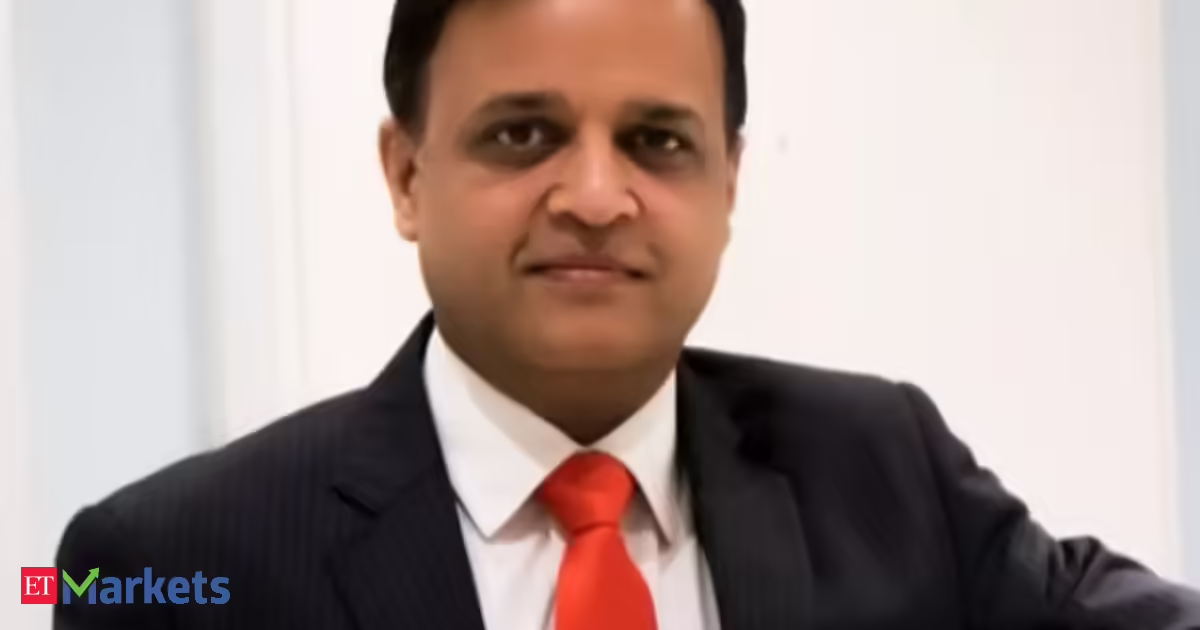
Responding to whether valuations could correct further, Abhay Agarwal from Piper Serica highlighted the outsized role of foreign portfolio investor (FPI) selling in shaping market direction.
“Our biggest problem has been consistent FPI selling, which has not halted and keeps worsening every month. If DIIs had not supported the market, the Nifty could have fallen below 20,000.”
Despite these pressures, he noted that investor confidence in India remains intact, even as the country underperforms other emerging markets.
“Despite incessant FPI selling and multiple challenges like geopolitics and tariffs, investors continue to have faith in the market.”
Liquidity Could Trigger Sharp Rebound
Agarwal pointed out that India’s relatively shallow market structure means even small inflows can drive sharp upside moves, making it difficult to maintain a bearish stance.
“In a shallow market like India, even small inflows can push indices higher quickly. Any liquidity return can reverse the trend.”
Earnings Recovery Still Key
Looking ahead, he identified earnings growth and liquidity revival as the two key triggers for the next market leg, while remaining constructive on domestic fundamentals.
“We are not very bearish because domestic consumption remains strong, and there are no major inventory or cash flow challenges.”
He also noted that export-oriented companies continue to benefit from currency movements.
Opportunities Beyond the Index
Agarwal cautioned against relying solely on Nifty valuations as a benchmark for investment decisions, arguing that broader market opportunities are far more compelling.
“Nifty is not the right benchmark for Indian earnings. The real opportunity lies outside Nifty stocks.”
He emphasized that many midcap and smallcap companies are now attractively priced after recent corrections.
“Several midcaps and smallcaps are now available at reasonable valuations after investing in growth over the last five years.”
West Asia Conflict: Sectoral Impact
On the impact of the West Asia conflict, Agarwal indicated that rising crude and input costs are likely to hurt margins in the near term.
“The current quarter will bear the full brunt of high crude prices unless the situation improves.” He warned that sectors dependent on crude derivatives and metals could face pressure, especially if companies are unable to pass on costs. “Margins will be impacted for companies using crude or metals, as passing on costs typically takes time.”
Crisis Also Brings Opportunity
At the same time, Agarwal highlighted that disruptions often create new opportunities, particularly for domestic manufacturers.
“When there is a crisis, there is also an opportunity, especially for companies replacing imports.”He pointed to sectors such as electronics manufacturing, auto components, and specialised pharma outsourcing as key beneficiaries.
“Advanced electronics, auto components, and CDMO/CMO pharma companies are key opportunity areas.”
A More Selective Market Ahead
The broader message for investors is that while macro headwinds persist, the market is becoming increasingly selective. Index-level valuations may not fully capture the opportunities emerging across sectors.
As liquidity conditions evolve and earnings visibility improves, stock-specific strategies—particularly in emerging sectors—are likely to define returns in the coming quarters.

Stars Celebrate Easter 2026: Mariah Carey and More

Former North Yorkshire foster child praises Harrogate family

S&P 500 Earnings And A StyleBox Update For March 31, 2026


-

 NewsBeat3 days ago
Steven Gerrard disagrees with Gary Neville over ‘shock’ Chelsea and Arsenal claim | Football
-

 Business3 days ago
No Jackpot Winner and $194 Million Prize Rolls Over
-

 Fashion2 days ago
Weekend Open Thread: Spanx – Corporette.com
-
Entertainment7 days ago
Fans slam 'heartbreaking' Barbie Dream Fest convention debacle with 'cardboard cutout' experience
-

 Crypto World4 days ago
Gold Price Prediction: Worst Month in 17 Years fo Save Haven Rock
-

 Business6 hours ago
Three Gulf funds agree to back Paramount’s $81 billion takeover of Warner, WSJ reports
-
Crypto World6 days ago
Dems press CFTC, ethics board on prediction-market insider trades
-

 Sports1 day ago
India men’s 4x400m and mixed 4x100m relay teams register big progress | Other Sports News
-

 Business4 days ago
Login and Checkout Issues Spark Merchant Frustration
-

 Tech7 days ago
Apple will hide your email address from apps and websites, but not cops
-

 Tech6 days ago
EE TV is using AI to help you find something to watch
-

 Sports6 days ago
Tallest college basketball player ever, standing at 7-foot-9, entering transfer portal
-

 Politics6 days ago
Should Trump Be Scared Strait?
-

 Tech6 days ago
Flipsnack and the shift toward motion-first business content with living visuals
-
Tech6 days ago
Daily Deal: StackSkills Premium Annual Pass
-

 Fashion7 days ago
The Best Spring Trends of 2026
-

 Crypto World6 days ago
U.S. rule change may open trillions in 401(k) funds to crypto
-

 Sports6 days ago
Women’s hockey camp eyes fitness boost, tactics ahead of WC 2026 campaign | Other Sports News
-

 Tech6 days ago
How to back up your iPhone & iPad to your Mac before something goes wrong
-

 Politics7 days ago
BBC slammed for ignoring author of The Fraud
You must be logged in to post a comment Login