Fast Facts About The JPMorgan International Value ETF
The JPMorgan International Value ETF (JIVE) is an actively managed ETF launched on September 13, 2023, with an objective of long-term capital appreciation. JIVE has a portfolio of 337 companies, a trailing 12-month yield of 2.67%, a 30-day SEC yield of 3.12%, and an expense ratio of 0.55%. Distributions are paid annually. It is quite a large and liquid ETF, with about $2 billion in assets under management (“AUM”) and an average daily dollar trading volume of $30 million. The fund’s sponsor, JP Morgan (JPM), is a leading global financial services firm with about $3.9 trillion of assets.
Strategy
As described in the prospectus by JP Morgan, the fund may invest in both developed (ex-U.S.) and emerging markets and intends to maintain geographic and sector exposures similar to those of the MSCI ACWI ex USA Value Index. Value companies are primarily identified based on price/sales, price/earnings, and price/net assets ratios. The investing process blends quantitative screens and in-depth fundamental analysis. The fund may also invest in ETFs and use derivatives for investing and hedging purposes. Exposure in certain currencies may be hedged with currency forwards from time to time, even though the fund is generally not currency-hedged.
The portfolio’s turnover rate was 46% in the most recent fiscal year. This article will use the iShares Core MSCI Total International Stock ETF (IXUS) as a benchmark. IXUS tracks the MSCI ACWI ex USA IMI Index.
The JIVE Portfolio
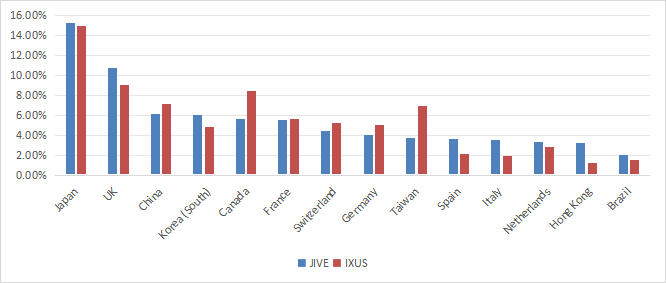
The portfolio is mostly invested in large- and mega-cap companies (about 75% of asset value), with notable exposure in Japan (15.3%) and the U.K. (10.7%). The geographical allocation is close to that of IXUS, although JIVE significantly downplays Canada and Taiwan.
Advertisement
JIVE top countries, % of asset value (Chart: author; data: iShares)
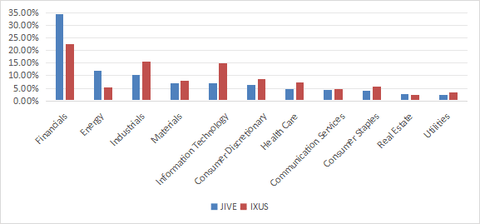
The fund has a focus on financials (34.5% of asset value), in particular banks (22.5%). The second heaviest sector (energy) weighs only 12%. Compared to the benchmark, JIVE overweights financials and energy, while it mostly downplays technology and industrials.
JIVE sector breakdown, % of asset value (Chart: author; data: iShares)
The portfolio is well-diversified, with low company-specific risk. The top 10 issuers, listed in the next table, represent 15.4% of asset value, and the largest position weighs 2.65%.
Name
Advertisement
Country
Ticker
Sector
Weight
Advertisement
Samsung Electronics Co
South Korea
A005930
Technology
Advertisement
2.65%
HSBC Holdings plc
United Kingdom
HSBA
Advertisement
Financials
1.71%
Roche Holding AG
Switzerland
Advertisement
ROP
Health Care
1.66%
Shell plc
Advertisement
United Kingdom
SHEL
Energy
1.56%
Advertisement
Nestlé SA
Switzerland
NESN
Consumer Staples
Advertisement
1.55%
Taiwan Semiconductor
Taiwan
2330
Advertisement
Technology
1.41%
Royal Bank of Canada
Canada
Advertisement
RY
Financials
1.37%
Mitsubishi UFJ Financial
Advertisement
Japan
8306
Financials
1.20%
Advertisement
TotalEnergies SE
France
FP
Energy
Advertisement
1.15%
BHP Group Limited
Australia
BHP
Advertisement
Materials
1.10%
Fundamentals
In accordance with the strategy description, JIVE has strong value characteristics. It is much cheaper than IXUS based on valuation ratios and has lower growth rates, as reported in the table below.
Advertisement
JIVE
IXUS
P/E TTM
11.94
Advertisement
17.05
Price/Book
1.35
1.99
Advertisement
Price/Sales
1.04
1.66
Price/Cash Flow
Advertisement
6.22
10.66
Earnings growth
7.95%
Advertisement
10.92%
Sales growth %
1.91%
2.73%
Advertisement
Cash flow growth %
2.66%
4.71%
Data source: Fidelity
Advertisement
Portfolio composition and fundamental metrics are given as an example from April 7, 2026. They may have changed by the time you read this.
Performance
JIVE has greatly outperformed IXUS, by 9.7% annualized from its inception to the present, with similar risk measured by maximum drawdown and volatility.
From 9/20/23
Advertisement
Total Return
Annual. Return
Drawdown
Sharpe ratio
Advertisement
Volatility
JIVE
88.40%
28.24%
Advertisement
-13.79%
1.89
11.62%
IXUS
Advertisement
54.24%
18.55%
-13.75%
1.18
Advertisement
11.97%
Data: Portfolio123
JIVE is 18% ahead of IXUS just over the 12 months prior to April 7, 2026, again with similar risk metrics.
Advertisement
12 months
Total Return
Annual. Return
Drawdown
Advertisement
Sharpe ratio
Volatility
JIVE
44.08%
Advertisement
44.11%
-11.36%
1.57
13.45%
Advertisement
IXUS
62.08%
62.14%
-10.57%
Advertisement
2.52
13.40%
JIVE Vs. Competitors
The next table compares characteristics of JIVE and five international value ETFs without currency hedges:
Schwab Fundamental International Equity ETF (FNDF).
VictoryShares International Value Momentum ETF (UIVM).
This list is not intended to be exhaustive.
Advertisement
JIVE
FNDF
DFIV
IVLU
Advertisement
AVIV
UIVM
Inception
09/13/2023
Advertisement
08/14/2013
04/16/1999
06/16/2015
09/28/2021
Advertisement
10/24/2017
Expense Ratio
0.55%
0.25%
Advertisement
0.27%
0.31%
0.25%
0.35%
Advertisement
AUM
$2.01B
$21.83B
$18.38B
Advertisement
$3.84B
$1.20B
$309.18M
Avg. Daily Volume
Advertisement
$30.14M
$93.47M
$88.43M
$71.40M
Advertisement
$6.78M
$537.88K
Holdings
336
Advertisement
886
557
344
612
Advertisement
197
Top 10
15.40%
15.53%
Advertisement
16.90%
17.10%
15.48%
10.17%
Advertisement
Turnover
46.00%
12.00%
6.00%
Advertisement
16.00%
11.00%
99.00%
Yield TTM
Advertisement
2.67%
3.13%
2.65%
3.50%
Advertisement
2.95%
3.32%
Total. Return*
88.40%
Advertisement
66.96%
73.11%
71.09%
67.84%
Advertisement
75.15%
Annual. Return*
28.24%
22.30%
Advertisement
24.05%
23.48%
22.55%
24.62%
Advertisement
Drawdown*
-13.79%
-13.89%
-14.72%
Advertisement
-15.48%
-14.13%
-11.69%
Sharpe ratio*
Advertisement
1.89
1.38
1.57
1.5
Advertisement
1.4
1.51
Volatility*
11.62%
Advertisement
12.80%
11.95%
12.29%
12.34%
Advertisement
12.90%
* Calculated with Portfolio123 from 9/20/2023.
JIVE has the highest expense ratio and is the best performer based on total return and Sharpe ratio (a measure of risk-adjusted return) since its inception.
Advertisement
Takeaway
JIVE holds over 300 international value stocks with a focus on large companies. The fund has low company-specific risk, moderate country risk, but high sector risk in financials. JIVE has greatly outperformed the ex-U.S. benchmark IXUS and its closest competitors since its inception, with similar volatility. JIVE is best suited for investors seeking exposure in international value as a long-term holding or for tactical allocation.
Pros: low company and country risks, superior risk-adjusted return.
Cons: financial sector risk, high expense ratio.
This article answers these three main questions about JIVE:
How is the JIVE portfolio structured?
How does JIVE compare to a benchmark and competitors?
What kind of strategy is JIVE best suited for?
Editor’s note: This article is intended to provide a general overview of the ETF for educational purposes only and, unlike other articles on Seeking Alpha, does not offer an investment opinion about the ETF.
The estate agency division of property services group LSL has acquired a franchise operation based on England’s South Coast.
LSL Estate Agency Franchising has acquired Meyers Franchising Limited, based in Dorchester, which operates across Dorset. The undisclosed deal will see 10 franchise partners and six branches added to the LSL network, with the acquisition set to be earnings accretive this year.
Meyers was founded in 2011 by Mark Meyer out of his garage, and has gone on to become a franchise operation giving mainly home-based agents systems and branding to work with. LSL says that over the past 15 years, Meyers has become a trusted name in the region’s property market and pointed to the company as one of the leading sales agents across a large part of Dorset and the South Coast, with coverage extending from Christchurch and Bournemouth across to Weymouth and Poundbury, then up to Sherborne and Shaftesbury.
In becoming part of LSL, Meyers will benefit from investment support and access to the London Stock Exchange-listed group’s resources, infrastructure and strategic expertise. LSL says its strong lettings capability will come into play as an area of opportunity for the Meyers network.
Advertisement
Mark Meyer, founder of Meyers Estate Agents, said: “I am incredibly proud of what we have built at Meyers over the years. Our success is down to the dedication of our franchise partners and their commitment to delivering outstanding service. As we look to the future, partnering with LSL Estate Agency Franchising provides the perfect opportunity to take all the Meyers partners to the next level, while staying true to our core values.”
Paul Hardy, managing director of LSL Estate Agency Franchising, said: “Meyers Estate Agents is a fantastic business with a strong reputation, a proven franchise model, and a highly engaged network of partners. We are delighted to welcome Mark and the Meyers team into the LSL family. With our investment and particular strength in lettings, we see significant opportunities to support Meyers in accelerating its growth and further strengthening its position across the South Coast.”
The latest acquisition for LSL follows full year results for the Newcastle-registered group which saw underlying operating profit rise to to £32.6m in 2025, from £27.8m the year before. Group revenue was up 8% in the same year to nearly £183m as a £12m share buyback scheme was launched in January.
Chief executive Adam Castleton said it had been a strong year for the property services business with improved profitability across each of its divisions, record margins and strong cash generation. It follows a significant reorganisation of LSL in recent years which saw its estate agency network of more than 180 branches switch to a franchise model.
Two WA projects have been chosen by the government for a pilot program to build economic resilience and sovereign capability amid the crippling fuel crisis and critical minerals spotlight.
Lindsey Vonn is recovering from a crash that nearly cost the decorated alpine skier her leg, but Vonn said this week she’s not ruling out a return to the Olympics in 2030, when she’d be 45 years old.
In an interview with CNBC Sport, the Olympic gold medalist said she would consider making one final run at the 2030 Winter Olympics — if she can be competitive.
“It’s been done,” Vonn said. “If I were to do it, I would only do it if I could be fast. But, I don’t know, that’s a long ways off. I would be 45 [during] the next Olympics. That might be a little bit too much, but we’ll see.”
Vonn said she’s still using crutches following the crash during her first downhill run at the Milano Cortina Olympics in February. She said she expects to be walking unassisted by the end of April.
Advertisement
But she still needs one more surgery later this year, she said, to take metal out of her leg from previous surgeries during the last two months — she’s now had five — and to repair her ACL, which she tore in January, nine days before her Olympic run.
USA’s Lindsey Vonn takes part in the second official training for the women’s downhill event ahead of the Milano Cortina 2026 Winter Olympic Games at the Tofane Alpine Skiing Centre in Cortina d’Ampezzo on Feb. 6, 2026.
Francois-Xavier Marit | AFP | Getty Images
If Vonn were to compete again in 2030, she would be one of the oldest Olympic skiers in history.Forty-six-year-old alpine skier Sarah Schleper finished 26th in the women’s Olympic Super-G in February, competing for Mexico.
A winning effort at Cortina d’Ampezzo would have made Vonn the oldest female downhill gold medalist, at the age of 41. Instead, she crashed just 13 seconds into her run.
“I don’t want that to be the last run of my career,” Vonn said. “I just have to wait and see what my body does and how it responds.”
Get the CNBC Sport newsletter directly to your inbox
The CNBC Sport newsletter with Alex Sherman brings you the biggest news and exclusive interviews from the worlds of sports business and media, delivered weekly to your inbox.
The gaming market isn’t just growing it’s evolving, diversifying, and embedding itself deeper into global culture than ever before. What was once a niche hobby has become one of the world’s most influential entertainment industries, outpacing film and music combined.
As we move further into the decade, the momentum behind gaming shows no signs of slowing. Instead, new technologies, shifting demographics, and innovative business models are pushing the industry into fresh territory. Here’s a closer look at the forces driving the gaming market’s continued expansion.
Gaming Has Become Truly Mainstream
One of the biggest reasons for gaming’s growth is simple: everyone plays now. The stereotype of the “typical gamer” has dissolved. Mobile gaming, in particular, has opened the door to millions of people who might never have picked up a console or gaming PC.
Casual puzzle games, social simulation titles, and mobile RPGs have created a massive, diverse player base. Meanwhile, blockbuster franchises continue to attract dedicated fans who treat game releases like major cultural events. This broad appeal ensures that the market isn’t dependent on a single demographic it’s a global, multi‑generational phenomenon.
Mobile Gaming Continues to Dominate
Mobile gaming remains the largest segment of the industry, and its growth is relentless. Smartphones have become powerful gaming devices, capable of running visually rich, complex titles that rival console experiences. The convenience of mobile play anywhere has made it the go to platform for millions.
Advertisement
Several trends fuel this dominance:
Free to play models that lower the barrier to entry like free spins
Live service updates that keep games fresh
Cross platform integration that lets players switch between devices
Social features that encourage community and competition
As mobile hardware continues to improve, the line between mobile and traditional gaming will blur even further.
Console and PC Gaming Are Entering a New Golden Age
While mobile leads in scale, console and PC gaming are thriving in depth and innovation. The latest hardware generations have unlocked new possibilities in graphics, physics, and world‑building. Players now expect cinematic storytelling, expansive open worlds, and seamless online connectivity.
Key drivers include:
Ray‑tracing and advanced rendering that elevate visual realism
High‑speed SSDs that eliminate loading screens
Cloud saves and cross play that unify gaming ecosystems
Modding communities that extend a game’s lifespan
The result is a market where premium titles can generate massive global excitement, often becoming cultural touchstones.
Cloud Gaming Is Expanding Access
Cloud gaming is where games run on remote servers and stream to any device has quietly become one of the industry’s most transformative technologies. It removes the need for expensive hardware, allowing players to enjoy high-end games on laptops, tablets, or even smart TVs.
Advertisement
This shift has enormous implications:
Lower cost of entry for new players
Instant access without downloads or updates
A unified library across multiple devices
Greater global reach, especially in regions where consoles are less common
While still developing, cloud gaming is poised to become a major pillar of the industry as internet speeds and infrastructure improve worldwide.
Live Service Games Are Redefining Longevity
The rise of live service games titles that evolve continuously through updates, seasons, and events has reshaped how players engage with games. Instead of one and done experiences, many games now function as ongoing worlds.
This model offers:
Constant new content
Community driven events
Cosmetic customization
Long‑term player investment
Live service games have become social hubs, blending entertainment with digital identity and community interaction.
Esports and Streaming Are Expanding Gaming Culture
Esports has grown into a global spectator sport, with professional leagues, sponsorships, and arenas filled with fans. Streaming platforms have turned gamers into entertainers, influencers, and cultural figures.
Advertisement
This ecosystem fuels market growth by:
Increasing visibility and mainstream acceptance
Creating new revenue streams
Encouraging competitive and social play
Building global communities around specific games
Gaming is no longer just something people play it’s something they watch, discuss, and celebrate.
New Technologies Are Opening New Frontiers
Innovation continues to push gaming into new dimensions:
Augmented reality (AR) blends digital play with the real world
AI driven design enables smarter NPCs and dynamic storytelling
Haptic feedback and adaptive controllers enhance sensory engagement
These technologies expand what games can be, attracting new audiences and inspiring new genres.
Gaming Is Becoming a Lifestyle Industry
Gaming’s influence now extends far beyond the screen. Fashion brands collaborate with game studios, musicians debut songs inside virtual worlds, and major franchises expand into TV, film, and merchandise. Gaming has become a cultural anchor one that shapes trends, communities, and even social spaces.
This crossover appeal strengthens the market by connecting gaming to broader entertainment ecosystems.
Advertisement
A Market That Shows No Signs of Slowing
The gaming market continues to expand because it adapts, innovates, and welcomes new players with open arms. It’s an industry driven by creativity, technology, and community it is one that evolves alongside the world around it.
As new platforms emerge, new genres take shape, and new audiences discover the joy of play, gaming’s growth feels not just inevitable but limitless. The future of gaming isn’t just bright it’s expansive, interconnected, and full of possibility.
A private school is one step closer to building the next stage of its college in Perth’s north east, after an assessment panel approved the $49.2 million plan.
Mumbai: A fragile calm following the US-Iran ceasefire has lifted sentiment, but investors are grappling with a trickier question: is the worst over for markets, or is this merely a relief rally?
Momentum could carry equities higher in the near term, but its endurance will hinge on fourth-quarter earnings, the trajectory of crude prices and whether foreign institutional investors reverse their bearish bets, according to research heads and strategists.
While the immediate overhang from the conflict is fading and energy flows should normalise over the coming weeks, the stock market recovery is unlikely to be linear, said Sanjay Mookim, head of India Equity Research, JP Morgan.
“The key variable is how oil prices settle, as India had been benefiting from imports at $60-65 per barrel, and now, every $10 move higher translates into roughly $15 billion of incremental outflows.”
Advertisement
Agencies
navigating peace: Equities could rise for now, but linear recovery ‘unlikely’ Street to take direction from Q4 earnings, oil prices Also, watch out for any reversal of FII bearish bets
Brent crude June futures have dropped more than 13% to $95.1 /barrel on Wednesday evening from a recent high of $119.5 at the start of the conflict. Notwithstanding the initial cheer around the oil price decline, uncertainty over the temporary truce is keeping the investors on the edge.
Live Events
“Recent volatility in oil, gas, and related macro variables may be somewhat manageable for now, but optimism remains tempered with caution among investors,” said Gautam Chhaochharia, head of Global Markets, at UBS India. After the 4% gains on Wednesday, the Sensex and Nifty are down 4.7% from February 27 – the start of the war. If talks between the US and Iran progress well over the next two weeks, the indices could recoup these losses but some pre-existing concerns could resurface. “Even prior to the conflict, concerns around domestic valuations, growth recovery, and AI were weighing on Indian markets,” said Chhaochharia, who remains underweight on India among emerging markets. “Assuming no further escalation, these factors are likely to re-emerge as market drivers.”
Investors will watch companies’ fourth quarter earnings to gauge the impact of rising raw material costs on profitability. “Higher energy costs, combined with a weaker rupee, are likely to keep pressure on corporate profitability in the near term,” said Mookim. “While the sharp day-to-day volatility should ease, the macro effects, particularly on consumption, are another key concern.”


















 Agencies



 NewsBeat7 days ago
 Business6 days ago
 Fashion6 days ago
 Business5 days ago
 Business3 days ago
 Sports5 days ago
 Tech2 days ago
 Fashion3 days ago
 Tech7 days ago
 Fashion2 days ago
 Business4 days ago
 Fashion7 days ago
 Crypto World21 hours ago
 Politics6 days ago
 Fashion7 days ago
 Sports7 days ago
 Fashion7 days ago
 Politics6 days ago
You must be logged in to post a comment Login