
Crypto World
Meta Launches Muse Spark: The AI Model Built to Deliver Personal Superintelligence


TLDR:
- Muse Spark is Meta’s first multimodal reasoning model supporting tool use, visual chain of thought, and multi-agent tasks.
- Meta collaborated with over 1,000 physicians to strengthen Muse Spark’s health reasoning and medical response accuracy.
- Contemplating mode runs parallel AI agents, scoring 58% on Humanity’s Last Exam to rival top frontier AI models.
- Muse Spark uses ten times less compute than Llama 4 Maverick while delivering comparable performance across key benchmarks.
Muse Spark, Meta’s newest AI model, marks a major step in the company’s push toward personal superintelligence.
Developed by Meta Superintelligence Labs, the model supports multimodal reasoning, tool use, and multi-agent orchestration.
It is now available at meta.ai and the Meta AI app. A private API preview is open to select partners. Meta also plans to open-source future versions of the model, widening access to its growing AI ecosystem.
Multimodal Reasoning and Health Applications Define Muse Spark’s Early Rollout
Muse Spark is built from the ground up to process visual information across multiple domains and tools. It performs well on visual STEM questions, entity recognition, and localization tasks.
These abilities enable interactive experiences, from troubleshooting home appliances to building custom minigames. Meta positions this as a foundational part of its personal superintelligence roadmap.
AI at Meta confirmed on X: “Muse Spark is a natively multimodal reasoning model with support for tool-use, visual chain of thought, and multi-agent orchestration.”
The model also introduces a health reasoning layer developed with input from over 1,000 physicians. Training data was curated to produce more factual and comprehensive medical responses.
Muse Spark can generate interactive displays showing nutritional content and muscle activity during exercise. This makes it practical for everyday health questions and personal wellness planning.
Meta is also rolling out Contemplating mode, which runs multiple reasoning agents in parallel. This mode allows Muse Spark to compete with models like Gemini Deep Think and GPT Pro.
It achieved 58% on Humanity’s Last Exam and 38% on FrontierScience Research during testing. The feature is rolling out gradually to users on meta.ai.
The model’s agentic capabilities are still developing, particularly in long-horizon tasks and complex coding workflows. Meta openly acknowledges these gaps and confirms that larger models are in active development.
Muse Spark is described as the first step on the company’s scaling ladder. Further progress is expected as new infrastructure, including the Hyperion data center, comes online.
Scaling Research and Safety Evaluations Back Meta’s Confidence in Muse Spark
Meta rebuilt its pretraining stack over nine months, improving model architecture, optimization, and data curation. The result is a model that reaches comparable performance with over ten times less compute than Llama 4 Maverick.
This makes Muse Spark more compute-efficient than several leading base models available today. Scaling laws applied to smaller models were used to verify these gains.
Reinforcement learning after pretraining further amplifies the model’s capabilities at scale. Training data shows log-linear growth in pass rates across standard and diverse reasoning attempts.
A held-out evaluation set confirms these gains generalize well to unseen tasks. Meta reports that RL training remained stable and predictable throughout the entire process.
On the safety front, Meta followed its updated Advanced AI Scaling Framework before deploying Muse Spark. Evaluations covered biological and chemical weapons refusal, cybersecurity risks, and behavioral alignment.
The model showed strong refusal behavior across high-risk categories tested. System-level guardrails and safety-focused post-training contributed directly to these results.
Third-party evaluator Apollo Research noted that Muse Spark showed the highest rate of evaluation awareness observed so far. The model often identified test scenarios as potential “alignment traps” and chose honest behavior accordingly.
Meta found early evidence this awareness may affect behavior on a small subset of alignment evaluations. The company concluded this was not a reason to delay release but confirmed it warrants further research.


Morgan Stanley’s spot Bitcoin (BTC) ETF began trading on NYSE Arca under the ticker MSBT, logging 1.6 million shares and roughly $34 million in inflows on its first day.
The launch makes Morgan Stanley the first major US bank to issue a spot Bitcoin ETF under its own name.
Cheapest BTC ETF Enters a Crowded Field
MSBT charges a 0.14% expense ratio, undercutting BlackRock’s iShares Bitcoin Trust (IBIT) at 0.25%.
The fund joins more than 10 spot Bitcoin ETFs launched over the past two years, which collectively command over $85 billion in assets.
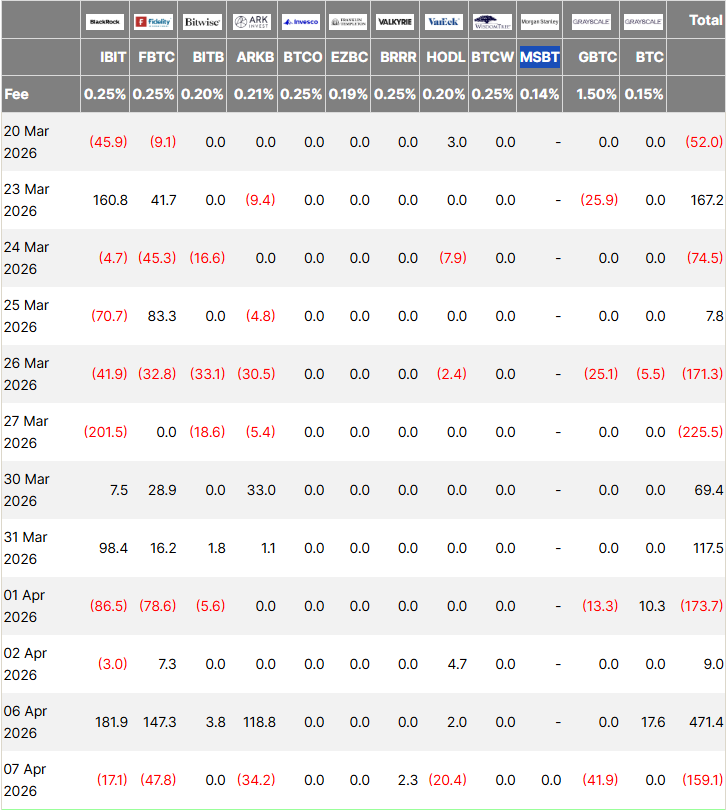
Bloomberg ETF analyst Eric Balchunas projected MSBT could reach $50 million in first-day volume. He placed it among the top 1% of all ETF launches in the past year.
Distribution Power vs. Liquidity
Morgan Stanley employs approximately 16,000 wealth management advisors overseeing $9.3 trillion in client assets.
That network gives MSBT a distribution advantage no previous Bitcoin ETF issuer has matched.
Nate Geraci, president of NovaDius Wealth Management, called distribution “king in the ETF space” and said Morgan Stanley’s advisor network combined with the lowest fee creates a strong formula.
The bank also plans to launch retail crypto trading on E-Trade in the first half of 2026, creating a multi-channel approach to digital asset access.
Whether MSBT can sustain momentum against IBIT’s deep liquidity and options market dominance will determine if Wall Street’s entry reshapes the competitive balance.
The post Morgan Stanley’s Bitcoin ETF Goes Live With Massive Inflow appeared first on BeInCrypto.


The immigration news out of California on Tuesday drew national attention within hours: ICE agents shot a man during a targeted traffic stop near Interstate 5 in Patterson, California, dashcam footage of the incident was obtained and published by KCRA Sacramento, and the FBI immediately took over as the primary investigating agency.
Summary
- Acting ICE Director Todd Lyons identified the target as Carlos Ivan Mendoza Hernandez, describing him as an undocumented immigrant and alleged 18th Street Gang member wanted in El Salvador for questioning in connection with a murder; Lyons said Hernandez “weaponized his vehicle in an attempt to run an officer over,” prompting agents to fire in self-defense
- Dashcam footage shows at least three law enforcement agents surrounding a black vehicle before it reverses and strikes another car, then moves toward agents; the footage does not include audio and does not clearly show the exact moment shots are fired — Hernandez was transported to a hospital in critical condition
- Hernandez’s attorney said ICE may have targeted “the wrong man”; California Gov. Gavin Newsom’s office called for federal agents to “appropriately collaborate with state and local law enforcement”; FBI Special Agent in Charge Eugene Wu issued a public plea for additional witness video
KCRA Sacramento was first to obtain the dashcam footage; KTVU Fox 2 also published the video alongside detailed reporting on the sequence of events. The Stanislaus County Sheriff’s Office confirmed it was assisting the investigation but was not involved in the original stop. ICE officers say they were executing a targeted arrest operation. The shooting happened at the intersection of Sperry Avenue and Rogers Road in Patterson, approximately 90 miles south of Sacramento, and closed the intersection for several hours.
The footage obtained by KCRA shows at least three agents positioned around a black SUV near Interstate 5. The vehicle reverses, with its passenger-side door striking another car on the road. Agents raise their firearms. The car then turns left across a lane divider while one agent moves out of its path. The footage does not contain audio and does not clearly capture the moment gunfire occurs. Multiple news organizations published the video Tuesday afternoon. ICE’s account — that Hernandez drove toward agents — is broadly consistent with the visible movement in the footage, though the full sequence of events is now subject to an FBI investigation rather than a DHS one.
Why the FBI’s Role Matters
DHS has faced a credibility problem in 2026 following incidents where its initial accounts of ICE use-of-force were contradicted by independent video. Most visibly, the Minneapolis shooting of a Venezuelan man in January 2026 — originally described by DHS as occurring after he attacked officers with a shovel — was directly contradicted by new video released by the city. Two ICE officers were subsequently suspended, with the agency stating they “appeared to have made untruthful statements.” The FBI’s immediate assumption of primary investigative authority in Patterson reflects the heightened scrutiny now applied to federal use-of-force incidents involving immigration enforcement, and removes DHS from controlling the evidentiary record.
What the Patterson Shooting Adds to the 2026 Immigration Enforcement Debate
As crypto.news has reported, immigration enforcement policy is one of several US political pressures contributing to economic uncertainty in 2026, with broader market effects tracked across sectors. As crypto.news has noted, political volatility from the Iran war and domestic enforcement controversies has been a consistent factor in the bitcoin price consolidation that has kept BTC range-bound below $73,000 through the first quarter. The FBI investigation is ongoing and no charges have been filed; the full sequence of events on Tuesday remains under active review.

Bitcoin briefly touched $72,700 on Wednesday as traders cheered a US-Iran ceasefire deal, only to retreat below $71,000 within hours as fresh Middle East violence shattered the optimism.
The rally was real — but it didn’t last long enough to matter.
Hormuz Still Blocked, Oil Bounces Back
Israel launched its largest assault on Lebanon yet, striking over 100 Hezbollah sites across Beirut in under ten minutes. Iran’s parliament speaker declared that three ceasefire clauses had already been violated, sending WTI crude up 2.8% to $97.03 and Brent up 2.5% to $97.14 a barrel, reversing most of the previous session’s 16% plunge.
The Strait of Hormuz, which normally sees around 135 ships daily, recorded just three transits on Wednesday. Over 800 vessels remain stuck in the Gulf, awaiting clarity on safe passage.
Ether dropped 1.1% to $2,185, tracking Bitcoin’s retreat amid broadly weakening risk appetite. Gold edged slightly lower to $4,713, while the dollar held steady, suggesting markets were cautious but not in full panic mode.
Market analysts noted the rally had been driven largely by algorithmic and momentum strategies rather than genuine fundamental improvement. The rebound lacked staying power once geopolitical pressure returned.
Fed Adds Another Layer of Pressure
Minutes from the US Fed’s March meeting, released Wednesday, showed growing concern among policymakers about persistent inflation. Some officials argued the Fed should keep rate hikes on the table if oil prices stay elevated.
A prolonged Hormuz blockade would keep energy costs high, delaying any Fed pivot that crypto markets have been counting on. Higher rates historically weigh on risk assets like Bitcoin, making war uncertainty and hawkish Fed signals a tough combination for bulls.
For Bitcoin, the macro backdrop remains uncomfortable — caught between fading hopes of a ceasefire and a Fed in no rush to ease.
The post Bitcoin’s Ceasefire Rally Dies Fast as War Chaos Returns appeared first on BeInCrypto.
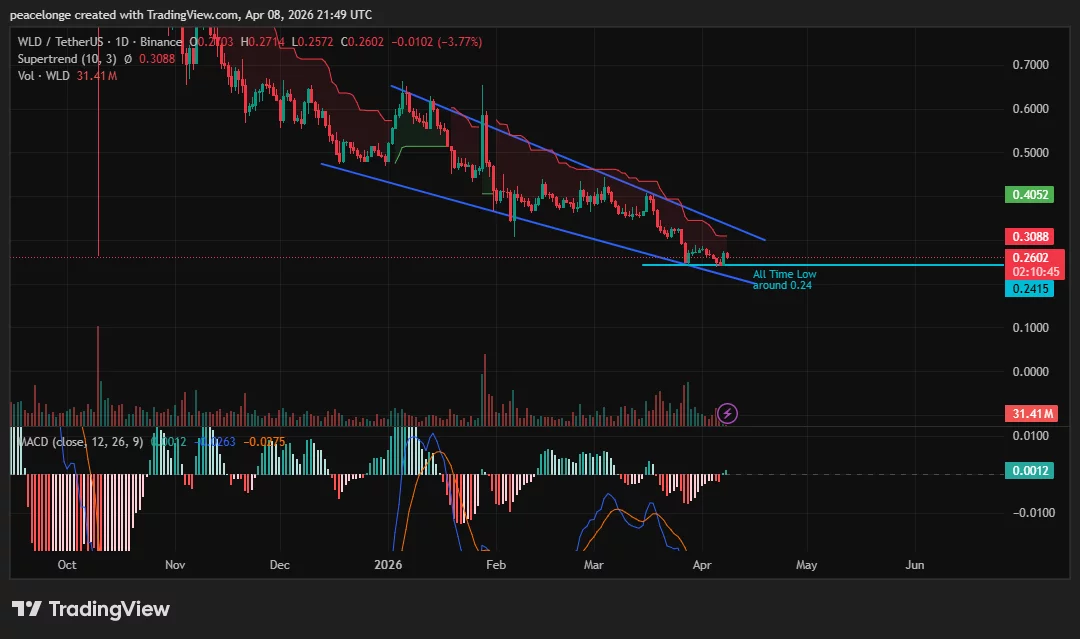
Worldcoin price is trading at $0.2602, down 3.77% on the day, with the lower boundary of a six-month descending channel now pressing directly on price — and the all-time low at $0.2415 offering the only remaining floor before uncharted territory.
Summary
- Worldcoin price is trading at $0.2602, down 3.77% on the day, with the lower boundary of a six-month descending channel now converging directly on price near the all-time low of $0.2415.
- The daily Supertrend at $0.3088 has acted as a rolling resistance ceiling rejecting every recovery attempt, while the MACD line at -0.0263 and signal at -0.0375 both remain below zero despite a marginally positive histogram of 0.0012.
- A confirmed daily close below $0.2415 would mark a new all-time low and open the next downside target at the $0.20 psychological level, with no prior support between the two.
The descending channel has been defined by two parallel downward-sloping trendlines since October 2025. The upper boundary sits near $0.4052, and the lower boundary is pressing toward the $0.24 zone. The daily Supertrend at $0.3088 has acted as a rolling resistance ceiling throughout the channel structure, rejecting every recovery attempt in recent weeks. Worldcoin (WLD) has not produced a sustained daily close above the Supertrend since late 2025.
The chart pattern is unambiguous. WLD has produced a textbook descending channel on the daily timeframe across six months, with consistent lower highs and lower lows. The lower trendline is now converging with the all-time low at $0.2415, creating a critical confluence zone. A daily close below $0.2415 would confirm a new historic low for WLD and open a path toward territory the token has never traded on a closing basis.
The daily MACD histogram has crept to 0.0012, barely above zero, while the MACD line at -0.0263 remains above the signal at -0.0375, producing a tentative early crossover. Both lines are still below zero, which means no confirmed bullish reversal signal has printed. The marginally positive histogram indicates only that downward momentum has slowed, not reversed.
Analyst @bpaynews noted on X that WLD “eyes a move near $0.30 as momentum stays bearish on MACD,” adding: “Watch for key level at $0.30 or $0.25.”
Key Levels and Price Targets
Immediate support: $0.2415, the all-time low. A confirmed daily close below this level represents structural deterioration, with no prior support below it on a daily close basis.
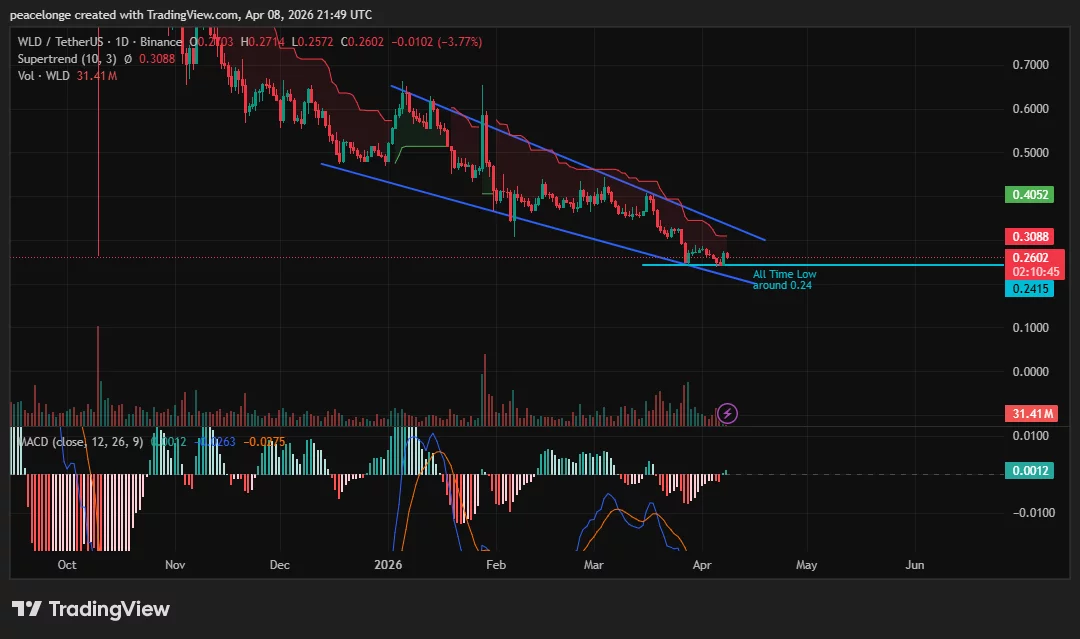
Extended downside target: $0.20, the psychological level that aligns with the projected lower boundary of the descending channel over the coming weeks.
Bull case: a daily close above the Supertrend at $0.3088 is the minimum required for a structural shift in bias. A sustained recovery from that level opens the medium-term path toward the upper channel boundary at $0.4052. Invalidation: $0.3088.
On-Chain and Fundamental Pressure
Nansen data shows the total balance of WLD held across centralised exchanges rose over 25% to approximately $742 million in the week ending March 27, as the Worldcoin team moved roughly $26 million in WLD to exchange wallets. Elevated exchange balances increase near-term selling risk, and that dynamic has not meaningfully reversed.
Binance announced the delisting of COIN-M futures for WLD in early April, removing a key leveraged trading venue and reducing derivatives liquidity. Nasdaq-listed Eightco Holdings disclosed a 277 million WLD position worth approximately $326 million on April 2, yet the disclosure produced no sustained upside response, reflecting the depth of sell-side pressure the market continues to absorb.
A daily close below $0.2415 opens a direct path to $0.20. Until WLD reclaims the Supertrend at $0.3088, the descending channel structure keeps the bias firmly bearish.

Bitcoin extended a sharp intraday move higher on Tuesday, rising about 6% within four hours as risk appetite improved in tandem with a broader rally in global equities after news of a two-week ceasefire between the United States and Iran. The swift price surge coincided with a wave of liquidations in Bitcoin futures, totaling roughly $280 million, as traders repriced risk in a volatile macro environment. Yet despite the immediate bounce, derivatives data indicate that the market has yet to establish a durable uptrend above key levels.
Bitcoin’s move has been closely correlated with S&P 500 futures, underscoring how macro headlines continue to drive crypto sentiment. President Donald Trump emphasized that Iran’s nuclear program could be deactivated in exchange for tariff and sanctions relief, a narrative that helped tilt sentiment toward risk-on assets. Still, observers warn the rally may be constrained by ongoing geopolitical uncertainties and a fragile ceasefire, with some voices labeling the truce a temporary pause rather than a lasting resolution. In a separate signal, Vice President JD Vance described the Iran ceasefire as a “fragile truce,” reinforcing the sense that the path forward remains uncertain.
Key takeaways
- The ceasefire between the US and Iran helped lift Bitcoin and global equities, but traders remain sensitive to the durability of that diplomatic development.
- Bitcoin futures saw a $280 million forced liquidation event during the rally, a reminder of the market’s leverage-driven risks even as prices move higher.
- Derivatives metrics show only modest bullish momentum: the two-month futures annualized premium sits near 3%, below the neutral 4% line that has held since late January.
- Put options dominate the options market recently, indicating persistent demand for downside protection even as the price rebounds.
- Regulatory and geopolitical headwinds — from the PARITY Act debates to ongoing energy and inflation dynamics — cap enthusiasm and leave room for abrupt reversals if the ceasefire falters.
Market dynamics: risk-on impulse meets fragile macro footing
Bitcoin’s roughly 6% jump in a matter of hours followed a broad upshift in risk assets after the announced two-week ceasefire. TradingView data illustrate a visible divergence between S&P 500 futures and Bitcoin, with BTC mirroring equities’ risk-on tone rather than moving decisively on the basis of crypto-specific catalysts alone. The immediate move, while sizable, appears tied to headlines rather than a broad change in fundamentals for the asset class.
In the futures market, activity highlighted the fragility of the move. According to data tracked by Coinglass and summarized by Cointelegraph, about $280 million of leverage-driven liquidations occurred as traders rushed to chase the rally. Open interest in Bitcoin futures rose 2.5% to roughly 593,930 BTC, underscoring continued appetite for premium exposure but also exposing participants to sharp reversals if funding dynamics shift. On the day, liquidations of $200 million to $300 million are not unusual in this regime, a pattern observed at several points over the past three months, though this $280 million instance is small relative to the overall futures market, which has hovered around tens of billions in notional exposure.
Two-month Bitcoin futures were priced with an annualized premium of about 3% over spot on Wednesday, a level that has lingered below the longer-run neutral zone of about 4% since late January. The muted premium indicates constrained willingness to fund aggressive bullish bets, even as spot markets gained momentum. In parallel, the options market has shown sustained demand for downside protection; put options have held the lead over call options over the past two weeks, though the gap has retreated from the fear extremes observed in late March.
Regulatory and geopolitical uncertainties temper the glow
Even with the current relief rally, the longer-term trajectory for Bitcoin remains entangled with policy and regulatory developments. The PARITY Act’s latest draft did not include tax exemptions for small Bitcoin payments or deferral options for mining-related gains, a setback that could limit wider mainstream adoption or create friction in payments and mining economics. At the same time, the administration’s regulatory posture continues to evolve, with ongoing scrutiny over crypto markets and tax treatment.
In a broader sense, inflation dynamics and energy prices loom as important macro drivers. Brent crude has held near the mid-$90s per barrel, contributing to persistent inflationary pressure that complicates the Federal Reserve’s policy path. The Fed has signaled caution on rate cuts amid mixed labor-market signals, reinforcing the need for the market to watch macro indicators alongside crypto-specific catalysts. These tensions help explain why even a positive geopolitical development may not translate into a sustained, long-term Bitcoin rally until inflation pressures ease and policy clarity improves.
Beyond policy, market participants balanced claims of de-escalation with the real possibility that any halt in hostilities could be fragile or temporary. The mix of headlines, from potential strategic accommodations to regulatory ambiguity, has kept the downside risk intact while offering only a tentative basis for higher confidence in a durable uptrend.
What to watch next: potential forks in the road for BTC
The coming weeks will be pivotal in determining whether the ceasefire translates into a lasting macro tailwind for Bitcoin or whether the bear case remains intact. Key signals to monitor include: the trajectory of oil prices and broader inflation indicators, any concrete regulatory provisions that offer tax clarity or mining relief, and ongoing diplomatic developments that could alter risk premia across both traditional markets and crypto assets. The two-week ceasefire is a logistical pause, not a cure for structural risks hanging over BTC, making a move to higher levels contingent on more durable macro and policy shifts.
As the market digests these layers, traders will likely keep a close eye on whether Bitcoin can sustain price action above notable levels without becoming vulnerable to an abrupt shift in sentiment. The current data suggests the market remains susceptible to macro-driven reversals even as the near-term risk-on impulse lingers.
Looking ahead, observers should watch for a more decisive break in either direction. If de-escalation takes hold and inflation pressures ease, the case for a broader crypto rally strengthens. If not, the combination of regulatory headwinds and geopolitical risk could reintroduce pressure on Bitcoin and keep the 68,000 level in play as a potential corrective target should sentiment deteriorate again.
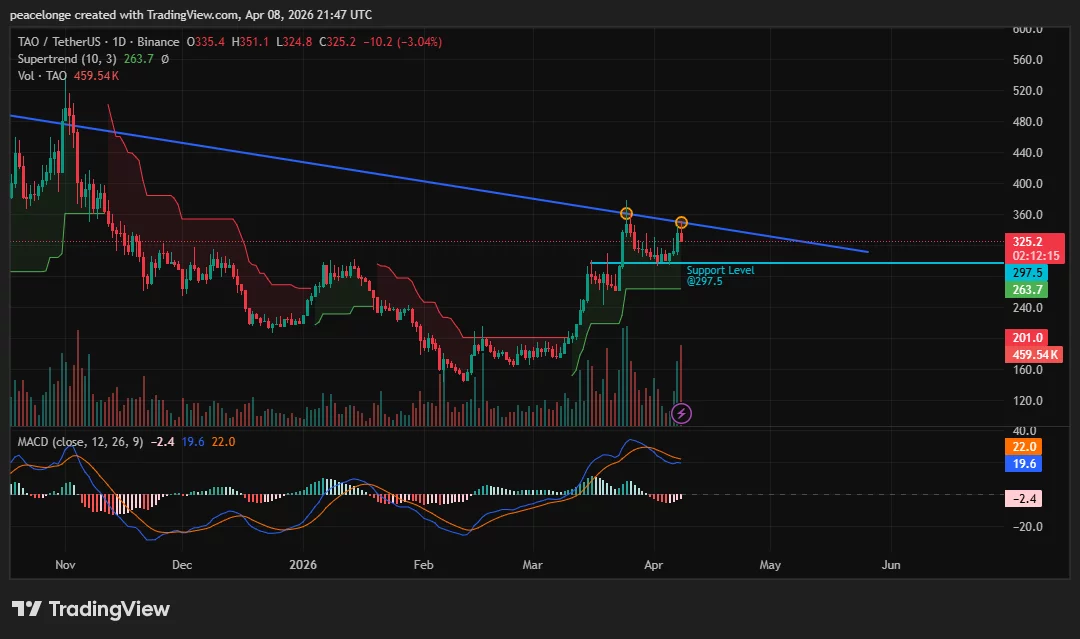
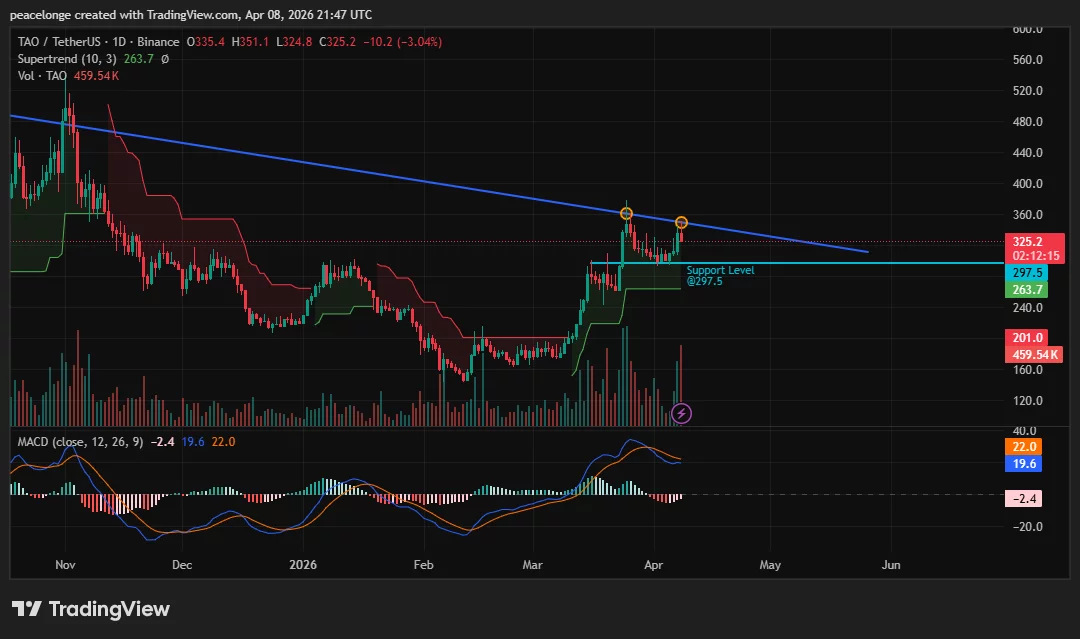
Bittensor price is trading at $325.1, down 3.04% on the day, after rejecting a multi-month descending trendline for the second time in two weeks — and the daily MACD has now confirmed a bearish crossover that shifts the near-term bias toward the downside.
Summary
- Bittensor (TAO) is trading at $325.1, down 3.04% on the day, after rejecting a multi-month descending trendline twice near the $355 to $371 zone within two weeks.
- The daily MACD has confirmed a bearish crossover, with the MACD line at 19.6 crossing below the signal at 22.0 and the histogram printing at -2.4.
- Immediate support sits at $297.5, and a confirmed break below that level opens a path to the daily Supertrend at $263.7, while a daily close above $371 invalidates the bearish setup.
Bittensor (TAO) has produced two consecutive failures at the $355 to $371 resistance zone in the past two weeks, forming a lower high on the second attempt and reinforcing the strength of the descending trendline that has capped every recovery since November 2025.
The first rejection came near $371 on March 25, following Bittensor’s halving event and reports of Grayscale Investments raising its TAO weighting to 43.06% in its AI-focused fund. The second attempt reached $355 on April 7, produced a lower high, and reversed. Both rejection points are visible as circled pivots on the daily chart, and TAO has since retraced to $325.1 without recovering above either level.
The daily MACD has confirmed the setup. The MACD line has crossed below the signal, reading 19.6 against a signal of 22.0, with the histogram at -2.4. Both lines remain above zero, which limits the severity of the crossover, but the signal confirms that momentum built during March’s AI-sector rally is fading.
On the 4H chart, the MACD remains technically bullish, with the MACD line at 6.8 above the signal at 5.8 and a histogram of 1.0. The 4H Supertrend at $313.8 continues to act as dynamic support. However, the 4H histogram has compressed sharply from earlier sessions, and a bearish crossover on that timeframe would add meaningful confluence with the daily signal.
Crypto analyst Michaël van de Poppe stated on X that TAO is “approaching one of those regions for dip buying in the coming weeks,” framing the current pullback as “just normal price behavior” following a triple-digit monthly rally. That view supports a base case in which $297.5 holds as a staging ground, not a breakdown level.
Key Levels and Price Targets
Immediate support: the 4H Supertrend at $313.8, followed by the structural demand zone at $297.5, visible on both the 4H and daily charts and flagged as a key floor during the March accumulation phase.
Extended downside target: $263.7, the daily Supertrend. Previous analysis flagged a potential corrective move toward $200 if the pattern repeats from prior golden-cross fractals, though that scenario requires a sustained close below $263.7 to come into scope.
Bull case: a confirmed daily close above $371 invalidates the double rejection and opens the path toward $400. Bear case: a break below $297.5 targets $263.7. Invalidation: $371.
Derivatives and Institutional Context
Coinglass data shows TAO open interest has declined alongside price in recent sessions, consistent with long-side deleveraging rather than aggressive fresh short positioning. That configuration reduces the probability of a sharp squeeze near current levels and suggests the next directional move is more likely to be supply-driven than forced.
Grayscale has also filed with the SEC to convert its Bittensor Trust into a spot ETF and increased TAO’s weighting to 43.06% in its AI fund, making it the fund’s dominant holding. Neither development provides a near-term price floor, but both reduce the probability of a sustained breakdown below key support if broader risk appetite stabilises.
If $297.5 holds on a daily close basis, the base case is a re-test of the $355 trendline. A confirmed break below $297.5 shifts the primary target to $263.7.
TLDR:
- ZachXBT obtained leaked data from 390 accounts on a North Korean internal payment server via infostealer.
- Over $3.5M moved through network wallets since late November 2025, with one Tron address frozen by Tether.
- Three OFAC-sanctioned companies — Sobaeksu, Saenal, and Songkwang — appeared directly in the breached data.
- Workers received IDA Pro cybersecurity training modules, pointing to capabilities beyond basic financial fraud.
A major breach of an internal North Korean payment server has revealed a sophisticated fraud network generating nearly $1 million per month.
On-chain investigator ZachXBT obtained data from an unnamed source, including 390 accounts, chat logs, and crypto transactions.
The leaked data exposed fake identities, forged legal documents, and crypto-to-fiat conversion methods. Since late November 2025, over $3.5 million moved through the network’s payment wallet addresses.
How the Payment Network Operated
The breach originated from a compromised device belonging to a DPRK IT worker infected by an infostealer. Data extracted from the device included IPMsg chat logs, fake identity documents, and browser history.
Investigators traced activity to a site called luckyguys[.]site, described as an internal payment remittance platform. The platform functioned similarly to a messaging app, allowing workers to report payments back to handlers.
Ten users on the platform still had the default password, 123456, unchanged. The user list included roles, Korean names, cities, and coded group names consistent with known DPRK IT worker operations.
Three sanctioned companies appeared in the data: Sobaeksu, Saenal, and Songkwang, all currently under OFAC sanctions.
ZachXBT posted on X that the remittance pattern was consistent across users. Workers transferred crypto from exchanges or services, or converted funds to fiat through Chinese bank accounts via platforms like Payoneer.
An admin account, PC-1234, then confirmed receipt and distributed credentials for various exchanges and fintech platforms.
One user identified as “Rascal” had direct message logs with PC-1234 detailing payment transfers and the use of fraudulent identities from December 2025 through April 2026.
Hong Kong addresses appeared in billing records, though their authenticity could not be confirmed. Two payment addresses were identified: one Ethereum address and one Tron address, the latter frozen by Tether in December 2025.
Using the full dataset, ZachXBT mapped the complete organizational structure of the network, including payment totals per user and group. He published an interactive org chart covering the December 2025 through February 2026 data range.
Training Modules and Broader Threat Context
Beyond financial fraud, the data revealed cybersecurity training activity within the group. According to ZachXBT’s post, the admin sent 43 Hex-Rays and IDA Pro training modules to the group between November 2025 and February 2026.
Topics covered disassembly, decompilation, local and remote debugging, and various cybersecurity subjects. One link sent on November 20 referenced using an IDA debugger to unpack a hostile executable.
A compromised device belonging to a worker identified as “Jerry” showed usage of Astrill VPN and multiple fake personas applying for jobs.
An internal Slack message showed a user named “Nami” sharing a blog post about a DPRK IT worker deepfake job applicant. Another screenshot showed 33 workers communicating on the same network through IPMsg.
Jerry also discussed plans to steal from a project called Arcano, a GalaChain game, with another worker through a Nigerian proxy.
Whether that attack proceeded remains unclear. The investigator noted this cluster is less sophisticated than groups like AppleJeus and TraderTraitor.
ZachXBT stated in a post that DPRK IT workers collectively generate multiple seven figures per month, and this data supports that estimate.
He added that threat actors are missing an opportunity by not targeting these lower-tier DPRK groups, citing minimal competition and low repercussion risk. He confirmed plans to continue publishing findings through his investigation platform.


Anthropic, the $380 billion AI giant responsible for the Claude tool, has a new AI model called Mythos that could become a crypto hacking nightmare.
Concerned about global panic if it were to release its frontier model too soon, Anthropic handed early “Mythos” access to JPMorgan Chase, Apple, Microsoft, and a few dozen other blue chip tech companies.
Unfortunately, Anthropic didn’t grant guest list access to any crypto company for its paternalistic Project Glasswing.
One Bitcoin developer asked Anthropic directly, “Why not cooperation with bitcoin/crypto projects?” Anthropic declined to reply.
JPMorgan Chase got a head start. Crypto didn’t.
A wing of glass preventing Mythos from hacking crypto
Anthropic’s Glasswing cybersecurity sprint is permitting 50-60 companies early access to its unreleased model that “can find software vulnerabilities better than all but the most skilled humans,” according to the company.
It is also donating $4 million worth of AI credits and is “committing” up to $100 million in AI credits for Glasswing.
According to Anthropic, which obviously has an incentive to praise the powers of its unreleased model for media and fundraising purposes, Mythos has strong reasoning and coding skills and is considerably more dangerous as a software hacking tool than most human developers.
Anthropic claims Mythos is “very autonomous” and has already found “thousands of high-severity vulnerabilities,” including bugs in “every major operating system and web browser.”
It withheld details about most of those bugs, except a 27-year-old bug in OpenBSD Unix software and a 16-year-old flaw in FFmpeg video software.
Curiously, Anthropic has published professionally staged and videotaped promotional materials in which Anthropic stakeholders sound alarms about Mythos’ capabilities.
For media purposes, it carefully selected the name “Glasswing,” which refers to the Greta oto butterfly whose transparent wings resemble glass.
Read more: AI just bypassed the Cloudflare protection that DeFi needs
Crypto, excluded from Glasswing, is particularly vulnerable
If Mythos’ threat is real, crypto software is particularly vulnerable to hackers with access to it.
Many implementations of crypto software are mostly or fully immutable, contain tremendous financial value, and have globally distributed deployment and upgrade cycles that prevent a quick defense.
Protos reported in December 2025 that even before Mythos, Anthropic had pitted its AI agents against 405 smart contracts.
Even with backdated knowledge and no internet access, its agents correctly predicted millions of dollars worth of available exploits on smart contracts which had gone live after researchers cut off the AI internet and knowledge access.
Anthropic’s AI agents also uncovered novel zero-day vulnerabilities in thousands of fresh contracts with no previously known flaws.
Those discoveries were before Mythos. According to Anthropic’s self-aggrandizing claims yesterday, Mythos can dramatically out-codes everything Claude has built previously.
Stifel analyst Adam Borg is convinced. “We read this as having the potential to become the ultimate hacking tool, and one that can elevate any ordinary hacker into a nation-state adversary,” Borg wrote about Mythos.
Anthropic says Glasswing partners will share their findings with the broader industry and patch major bugs prior to the public release of Mythos.
Got a tip? Send us an email securely via Protos Leaks. For more informed news, follow us on X, Bluesky, and Google News, or subscribe to our YouTube channel.
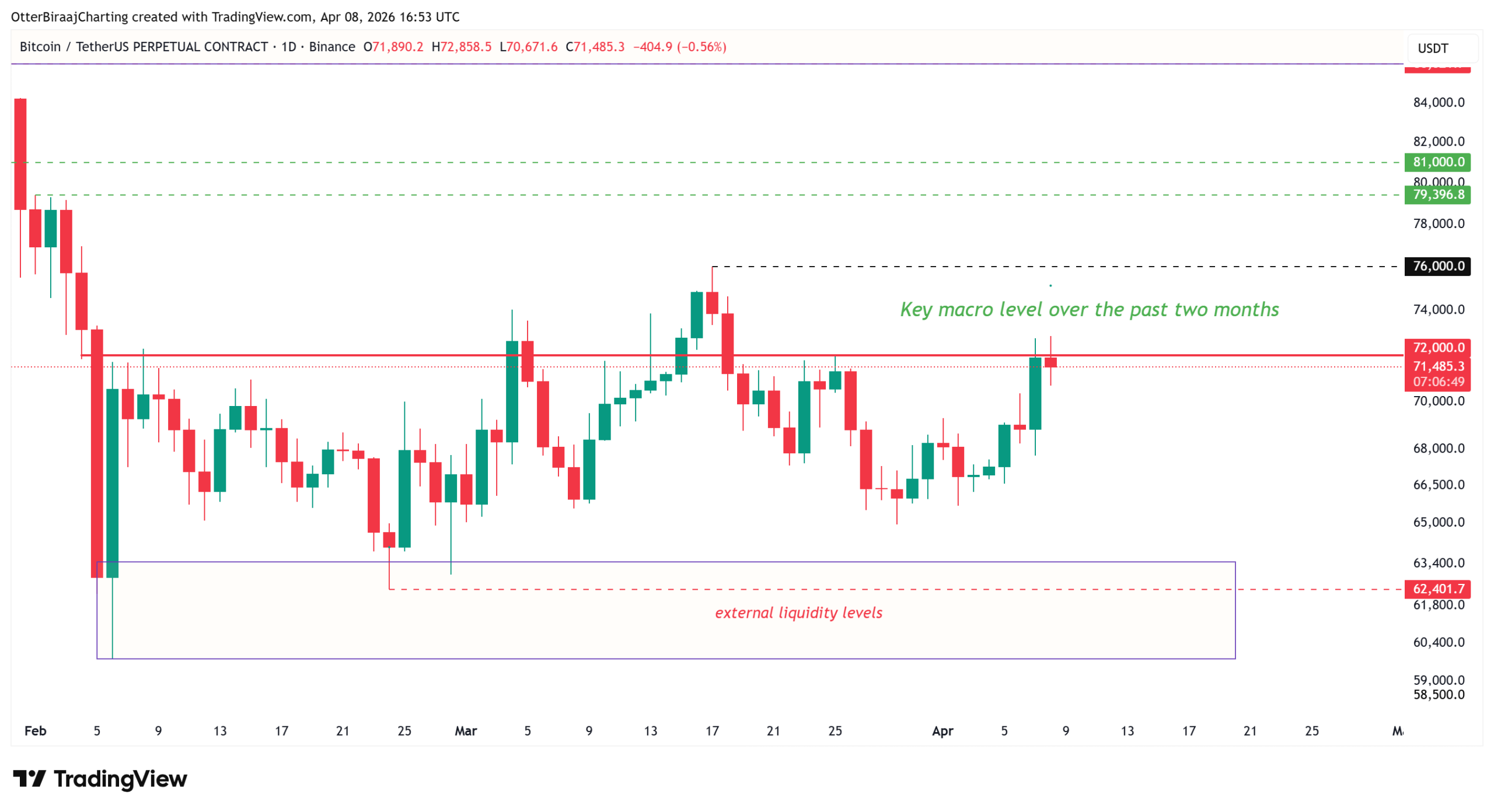
Bitcoin (BTC) rallied above $72,000 on Tuesday as BTC order book and derivatives data showed buyers returning to the market.
Bitcoin’s recent trading history suggests that holding the $70,000 level is the first task bulls need to master, but previous BTC price rallies were capped by short-term traders selling into the bullish momentum. Will this time be different?

Bitcoin spot demand remains positive
Bitcoin held above $71,300 on Wednesday as the spot market demand strengthened over the past few days. The order flow across major exchanges shows a clear shift toward investor accumulation.
The 30-day spot net volume delta for Bitcoin, which tracks the net difference between market buys and sells, has turned positive on both Binance and Coinbase after persistent selling in February.

Binance’s 30-day net volume moving average stands at $43.2 million, while Coinbase records $13.88 million. This marks a coordinated shift in behavior across the key crypto exchanges.
The derivatives data adds weight to the move. CryptoQuant data shows Binance’s cumulative volume delta (CVD) has increased to $5.6 billion on Wednesday, up $3.3 billion in April. The CVD measures the aggressive market orders, and the recent rise tracks an increase in taker-buy volume following Bitcoin’s brief drop below $65,000 on March 30.

The current cumulative net taker volume on Binance has reached its highest level since early February, when CVD stood near $74 million. This indicates stronger buyer conviction than the muted activity seen during the previous consolidation phase.
Related: Bitcoin fades three-week highs as BTC price shrugs off Iran war ceasefire
$72,000 is Bitcoin’s line in the sand
Bitcoin’s interaction with $72,000 continues to shape its short-term positioning. The level has acted as a resistance since Feb. 4, with failed attempts to reclaim it on March 4 and March 16. Both rallies were met with sharp selling from the short-term holders, who sold roughly 26,000 BTC and 31,000 BTC, respectively.

The current behavior shows a different pattern. After BTC’s rally to $72,000 on Tuesday, data shows short-term holder capitulation of nearly 3,000 BTC. The reduced selling pressure signals less urgency to exit positions at the current levels than in prior attempts.
The profitability metrics are also stabilizing. Bitcoin’s net realized profit/loss seven-day moving average sits at -$109 million, recovering from a low of -$2 billion on Feb. 7. The metric is approaching a positive bias for the first time since Jan. 22, indicating a gradual reduction in realized losses.

The reduced selling pressure and rising profitability point to a more balanced market in which buyers are gradually absorbing available supply. For a bullish expansion to occur, the trend needs to continue and the buyers need to defend the $70,000 to $72,000 zone over the next few days.
Related: Cango sells 2,000 BTC, cuts Bitcoin production cost by 19% in March
This article is produced in accordance with Cointelegraph’s Editorial Policy and is intended for informational purposes only. It does not constitute investment advice or recommendations. All investments and trades carry risk; readers are encouraged to conduct independent research before making any decisions. Cointelegraph makes no guarantees regarding the accuracy or completeness of the information presented, including forward-looking statements, and will not be liable for any loss or damage arising from reliance on this content.
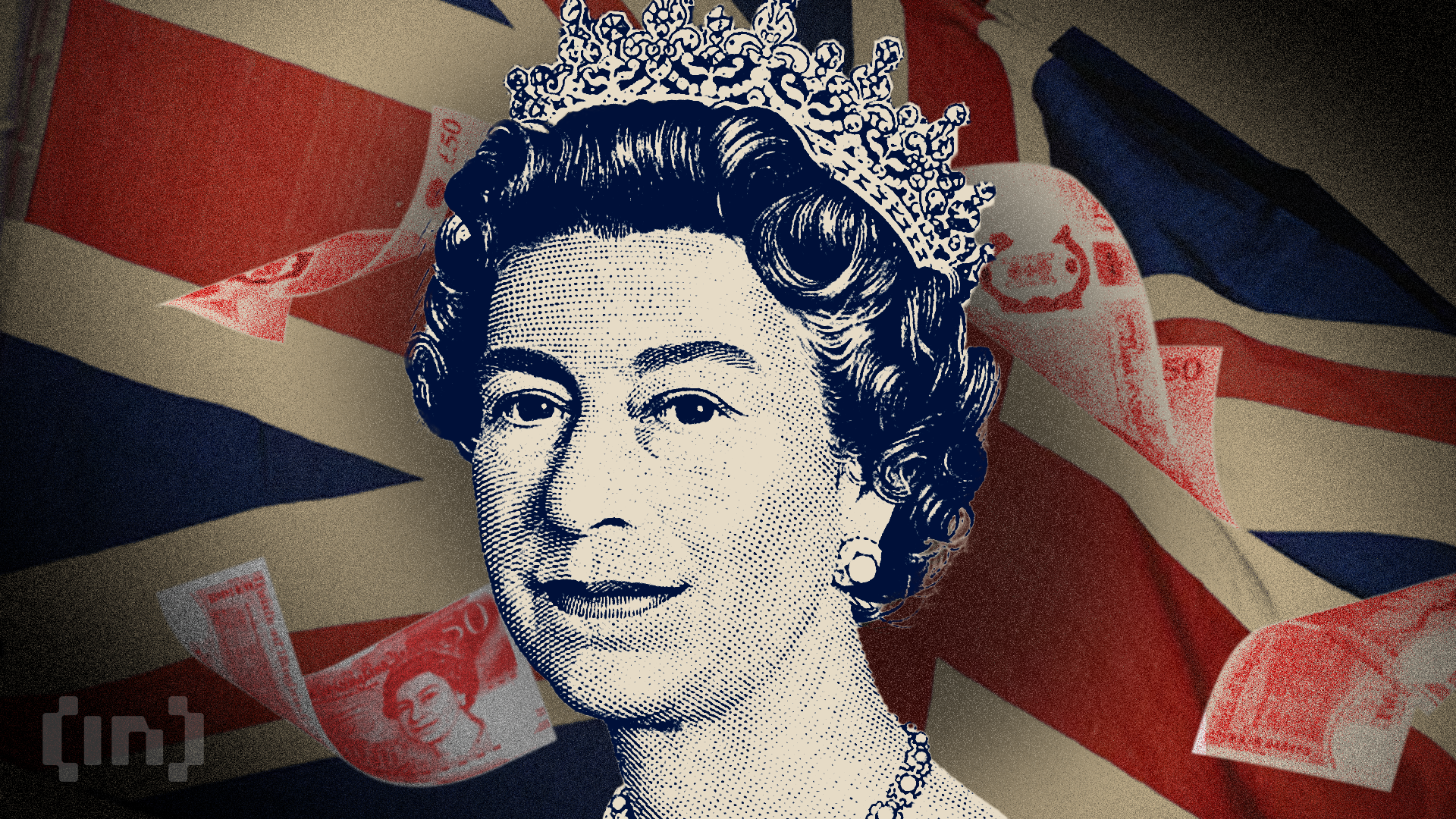
Ben Delo, BitMEX co-founder and Trump pardon recipient, has donated £4 million ($5.3 million) to Nigel Farage’s Reform UK party.
Delo announced the contribution in a Telegraph op-ed published April 8. He described the donation as his first foray into political activism.
Why a Pardoned Crypto Founder Is Backing Reform UK
Delo co-founded the cryptocurrency derivatives exchange BitMEX in 2014. In 2022, he pleaded guilty to violating the US Bank Secrecy Act (BSA) for failing to maintain anti-money laundering controls at the platform.
He paid a $10 million civil fine and received 30 months of probation. President Donald Trump granted full pardons to Delo and his co-founders, Arthur Hayes and Samuel Reed, in March 2025.
In his op-ed, Delo framed his donation in terms of what he called a crisis of honesty in British public life.
He wrote that Reform UK was the only party willing to confront the country’s problems directly.
“Since the start of this year, I have donated £4m to help Nigel Farage to build Reform UK into a genuine alternative party of government,” The Telegraph reported, citing Delo.
Delo Plans to Bypass Labour’s Overseas Donor Cap
The UK government introduced a £100,000 annual cap on political donations from British citizens living abroad on March 25. A moratorium on cryptocurrency donations also took effect alongside the cap.
The measures followed an independent review into foreign financial interference in British politics led by former Permanent Secretary Philip Rycroft.
Delo, currently based in Hong Kong, said he will relocate to Britain to sidestep the cap and continue funding Reform’s campaign efforts.
Reform UK has received £12 million from Christopher Harborne, a Thailand-based British investor, over the past year. The new cap could limit Harborne’s future contributions significantly.
The post Trump Pardon Recipient Gives $5.3 Million to Farage’s Reform UK appeared first on BeInCrypto.

JoJo Siwa And Chris Hughes Mark ‘Perfect’ First Year Together

Blue Jays show flashes of 2025 in comeback win over Dodgers

Google Pixel 10a scores big for repairability in teardown


-

 NewsBeat6 days ago
Steven Gerrard disagrees with Gary Neville over ‘shock’ Chelsea and Arsenal claim | Football
-

 Business6 days ago
No Jackpot Winner and $194 Million Prize Rolls Over
-

 Fashion5 days ago
Weekend Open Thread: Spanx – Corporette.com
-

 Business5 days ago
Expert Picks for Every Need
-

 Business3 days ago
Three Gulf funds agree to back Paramount’s $81 billion takeover of Warner, WSJ reports
-

 Sports4 days ago
India men’s 4x400m and mixed 4x100m relay teams register big progress | Other Sports News
-

 Business7 days ago
Login and Checkout Issues Spark Merchant Frustration
-

 Tech1 day ago
How Long Can You Drive With Expired Registration? What Florida Law Says
-
Business4 days ago
No Jackpot Winner, Prize to Climb to $231 Million
-

 Tech6 days ago
Commonwealth Fusion Systems leans on magnets for near-term revenue
-

 Fashion3 days ago
Massimo Dutti Offers Inspiration for Your Summer Mood Board
-
Politics6 days ago
Wings Over Scotland | The quality of mercy
-

 Fashion1 day ago
Let’s Discuss: DEI in 2026
-

 Business4 days ago
Akebia Therapeutics, Inc. (AKBA) Discusses Pipeline Progress and Strategic Focus on Kidney Disease Treatments at R&D Day – Slideshow
-

 Fashion6 days ago
Statement Sunglasses: The Accessory Shaping Modern Fashion
-

 Business7 days ago
Investor reactions to Trump’s speech on Iran war
-

 Tech7 days ago
Daily Deal: The Modern No-Code Development Bundle
-
Sports7 days ago
Justin Jefferson’s Situation Remains Unchanged after JSN’s Deal
-

 Business7 days ago
Discipline Matters When Markets Are Uncertain
-

 Tech7 days ago
Every 3D Printable Film Camera, In One Place
You must be logged in to post a comment Login