
Crypto World
Bitcoin recovery rally fades as liquidations and macro risks return



Bitcoin’s push toward $73,000 has lost traction, leaving the market exposed to renewed downside risks as macro uncertainty returned.
Summary
- Bitcoin rally to $72,698 stalled at resistance, triggering over $150M in long liquidations.
- Ceasefire tensions resurfaced after officials called the deal a “fragile truce” and reports pointed to violations.
The flagship cryptocurrency climbed to a weekly high of $72,698 on Tuesday, gaining nearly 6% in under four hours as global markets responded to news of a two-week ceasefire agreement between the United States and Iran.
Bitcoin rose as risk sentiment improved, as expectations that the Strait of Hormuz could reopen helped ease supply concerns.
However, the short period of euphoria faded quickly near the $72,000 level. A wave of liquidations hit derivatives markets at that point. More than $150 million in long positions were wiped out, confirming that bullish conviction remains weak at higher levels.
Price action also continued to track movements in traditional markets, with Bitcoin showing a tight correlation to S&P 500 futures during the rally. The link points to a market still heavily influenced by macro headlines rather than internal crypto-specific drivers.
Now, tensions surrounding the ceasefire have since raised fresh concerns. US Vice President JD Vance described the agreement as a “fragile truce,” while developments on the ground painted a less stable picture.
Reports from the Levant indicated repeated violations, with Israel launching “Operation Eternal Darkness” targeting underground infrastructure tied to Hezbollah in Lebanon.
Israeli officials maintained that their operations fall outside the scope of the Iran ceasefire, citing strategic independence.
Further strain came after Iran’s parliamentary speaker accused Washington of violating “the spirit of the roadmap,” warning that Tehran could resume strikes if attacks on its allies continue.
Any breakdown in the agreement risks reigniting conflict, a scenario that could weigh heavily on risk assets, including cryptocurrencies.
Market positioning remains sensitive to these developments. Bitcoin has struggled to secure a firm hold above $70,000 over the past week, and a sustained move below that level could open the door for a retest of the $64,000 support zone.
At last check, Bitcoin was trading just above $71,000, down less than 1% over the past 24 hours, as traders weighed the combined impact of geopolitical instability and shifting policy expectations.
Attention has also turned to monetary policy signals. Minutes from the Federal Reserve’s March 17–18 meeting showed that officials voted 11–1 to keep rates unchanged at 3.5% to 3.75%, while leaving the door open for potential cuts later this year.
The details of the discussion, however, pointed to caution. Policymakers signaled that any move toward easing would depend on inflation staying contained, particularly as energy prices remain a concern. Some members indicated that a tighter policy could still be required if price pressures persist.
Interest rate expectations continue to play a key role in crypto market sentiment. While lower rates tend to support risk assets, uncertainty around the timing of cuts can dampen demand and increase volatility.
Despite all the negative geopolitical headwinds, Bitcoin price could find some support and potentially decouple from traditional risk-off sentiment if reports of Iran circumventing traditional financial sanctions by using Bitcoin to facilitate trade at the Strait of Hormuz are confirmed.
On April 8, several regional maritime intelligence outlets reported that the Iranian Revolutionary Guard Corps (IRGC) was charging transit fees for commercial vessels with the option for direct payment in Bitcoin. If this is confirmed, it could help keep momentum afloat by providing a fundamental floor of demand in the short-term.


South Korean crypto exchange Bithumb has filed for a provisional attachment to freeze assets tied to users who have yet to return 7 BTC that remain missing after a February payout error, a move aimed at supporting a civil lawsuit to recover the funds. The court-backed measure was reported by Chosun Biz on Thursday and marks the latest chapter in a highly visible post-mortem of the incident.
On February 6, the exchange intended to distribute a total of 620,000 won ($420) to 249 event winners. Instead, a system input error sent out 620,000 BTC, briefly valuing the mistaken transfers at roughly 62 trillion won ($42 billion). Bithumb reversed the transactions within minutes, but a portion of the funds had already moved, prompting the recovery effort that continues to this day.
Following the incident, Bithumb announced it had recovered 99.7% of the funds on the same day. The remaining 0.3%, or 1,788 BTC, had already been sold, with the company covering that shortfall from its reserves. As of the latest reporting, the exchange has been contacting affected users individually and recouping most of the proceeds from those sales, though a small number of recipients have refused to return the balance, arguing they are not responsible for the erroneous transfers, according to Chosun Biz’s account.
Cointelegraph reached out to Bithumb for comment but did not receive an immediate response at the time of publication.
Key takeaways
- The provisional attachment targets users who have not returned 7 BTC missing from a February payout error that briefly distributed 620,000 BTC.
- The incident involved a mistaken transfer valued at about 62 trillion won ($42 billion) after an input error in the payout process.
- Bithumb says it recovered 99.7% of the funds on the same day; 1,788 BTC were sold, with reserves used to cover the remaining shortfall.
- Some recipients have refused to return the remaining funds, but South Korean law generally treats mistaken transfers as unjust enrichment and expects return of the assets.
- Regulators have moved quickly to tighten controls, with the Financial Services Commission ordering exchanges to reconcile ledgers with actual holdings every five minutes after the incident.
Provisional measures and the legal path forward
The filing for provisional attachment underscores Bithumb’s intent to press claims ahead of a civil case. By freezing assets tied to non-compliant recipients, the exchange aims to secure a path to full recovery while the broader dispute unfolds in court. The approach reflects a cautious, rule-driven stance common in asset recovery efforts involving mistaken transfers, where the balance between user rights and corporate accountability is tested in real time.
From rapid reversal to regulatory tightening
The February payout debacle prompted broader scrutiny beyond the immediate recovery efforts. In response, South Korea’s Financial Services Commission ordered exchanges to reconcile their internal ledgers with actual holdings at five-minute intervals to accelerate detection of discrepancies and prevent delays in addressing errors. Earlier assessments had found that three of the five major domestic exchanges performed reconciliations on a daily cadence, creating a potential lag between misentries and corrective action.
The rapid regulatory nudge comes as the industry continues to digitize, complicate, and democratize access to crypto markets in a densely regulated environment. While the Bithumb incident centered on a single promotional payout, the reforms are framed as systemic safeguards to minimize spillover risk across exchanges and users alike.
What readers should watch next
Market participants and retail users will want to monitor the court’s handling of the provisional attachment and any subsequent rulings on the remaining unreturned funds. The case could shape how exchanges structure payout processes, how aggressively they pursue mistaken transfers, and how the legal framework delineates responsibility when automated systems misfire. In the near term, observers should also track how the five-minute reconciliation rule influences incident responses and the speed at which authorities and firms close gaps in asset verification and recovery.

TLDR:
- Oceanus and HashKey signed an MOU to deploy stablecoin settlement across Asian trade finance corridors.
- The partnership integrates AI-driven ODIN platform with regulated infrastructure to improve settlement efficiency.
- Stablecoin settlement enables faster, secure transactions for commodity trades including seafood, meats, and wines.
- The initiative targets the $2.5 trillion trade finance gap affecting SMEs in global markets.
Stablecoin settlement is advancing into global trade finance as Oceanus Group Limited and HashKey Group formalize a strategic partnership.
The two firms signed a Memorandum of Understanding to deploy regulated infrastructure across Asian trade corridors.
The collaboration aims to reduce inefficiencies in cross-border transactions while addressing the persistent funding shortfall affecting small and medium enterprises engaged in commodity trade.
Building Infrastructure for Trade Finance Efficiency
The agreement is executed through Oceanus Digital Intelligence Network Pte. Ltd and HashKey Technology Services Pte Ltd.
Both entities will integrate their platforms to enable stablecoin settlement across commodity transactions. This structure is designed to support faster settlement cycles and reduce counterparty risks in international trade flows.
Oceanus is transitioning from its origins in aquaculture into a technology-focused enterprise. Its ODIN platform uses artificial intelligence to manage trade finance workflows.
By enabling stablecoin-based payments, ODIN connects buyers and sellers through a unified digital system that supports compliance requirements.
Adrian Teo, CEO of ODIN, stated that the partnership marks a shift in Oceanus’s strategic direction. He said it moves beyond a conventional vendor relationship into a peer-level collaboration. He added that Oceanus is strengthening how food trade operates through digital asset integration.
HashKey will serve as the institutional settlement layer within the partnership. Its regulated infrastructure is expected to provide the necessary safeguards for digital asset transactions.
This setup allows stablecoin settlement to function within established financial frameworks while maintaining operational reliability.
Expanding Stablecoin Use in Real-World Asset Markets
The initiative focuses on deploying digital assets into real-world asset transactions. Commodity trades involving seafood, meats, and wines are included in early use cases. These trades demonstrate how stablecoin settlement can handle high-value transactions in traditional industries.
Oceanus is adopting compliant processes to accept and issue payments in stablecoins globally. This transition supports faster settlements compared to conventional banking channels. As a result, trading partners can operate with improved efficiency and reduced transaction delays.
Jason Tay, Managing Director at HashKey Technology Services Pte Ltd, described the partnership as part of a broader strategy.
He stated that HashKey is working to connect traditional finance systems with digital asset infrastructure. He also noted that regulated settlement rails are necessary for institutional adoption.
He added that the collaboration enables stablecoin capital to move into real-world trade environments. This approach supports broader financial access while maintaining security standards.
Through this structure, stablecoin settlement is positioned as a functional tool for modern trade finance systems.

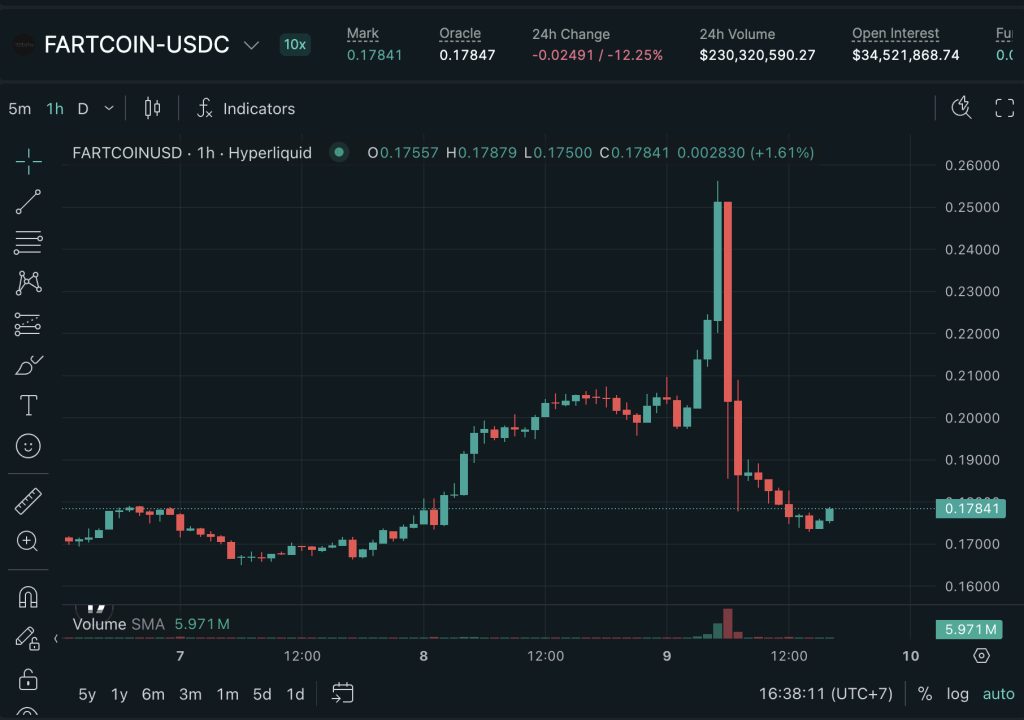
Hyperliquid is bleeding again. Allegedly, a cluster of coordinated crypto wallets drove FARTCOIN up by 20% on Hyperliquid in under four hours, then weaponized the platform’s own liquidation mechanics against it. How much did Hyperliquid’s liquidity vault actually lose, and is the platform structurally vulnerable to this playbook?
On-chain data flagged two linked wallets that accumulated an eight-figure notional long position in FARTCOIN over several hours, pushing the price sharply higher as liquidity thinned, forcing Hyperliquid liquidity provider vault (HLP), which acts as a counterparty of last resort, to absorb the opposing side.
The coordinated traders then triggered or allowed liquidations on their own long positions, activating the Hyperliquid auto-deleveraging (ADL) mechanism. Combined PnL from the maneuver: +$1.3 million. The same wallets were previously linked to a similar squeeze on XPL, suggesting a repeating pattern.
The incident lands while questions about Hyperliquid’s structural design remain unresolved, and as the broader memecoin market continues showing signs of coordinated manipulation activity across multiple platforms.
Discover: The best crypto to diversify your portfolio with
Can FARTCOIN Crypto Recover After Hyperliquid Incident?
FARTCOIN’s engineered pump notwithstanding, the token’s longer-term chart tells a grimmer story. The coin peaked at $2.48 in January 2025 and has shed approximately 93% of its value since, trading near $0.17 as of today. The 20% Hyperliquid spike represents a blip against that decline.
Volume context matters here. FARTCOIN trades in a thin market, exactly why the coordinated Hyperliquid long allegation was effective in the first place. Thin order books mean outsized price reactions to relatively modest capital flows, making the token a recurring target for manipulation that has defined the 2025 memecoin landscape.
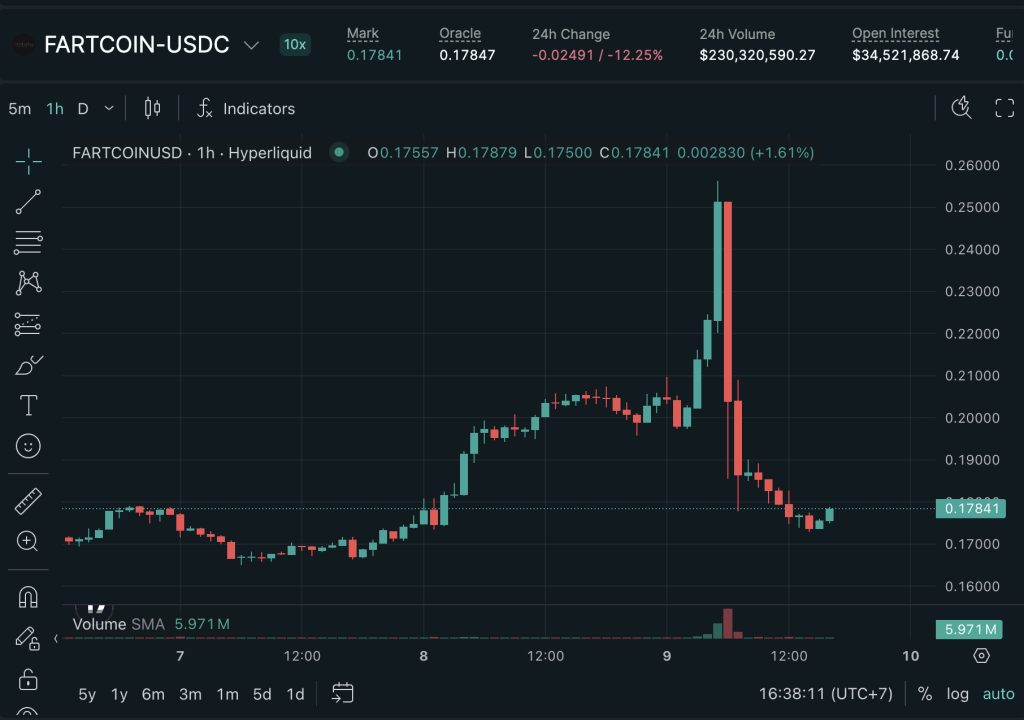
For Fartcoin itself, immediate resistance sits near the $0.20–$0.22 range, which previously acted as support through Q4 2025 before the breakdown. Below the current price, $0.12 represents the next identifiable demand zone. Moving averages are stacked bearishly and are sloping downward, with price trading well beneath both.
Discover: The best pre-launch token sales
Maxi Doge Targets Early Mover Upside as Memecoins Flash Manipulation Risk
FARTCOIN’s chart raises an uncomfortable reality for late participants: by the time a memecoin is being used as a vehicle for eight-figure coordinated squeezes, the asymmetric upside has long since transferred to early holders.
Chasing the spike is the trade that funds other people’s PnL. The rotation play and finding the next leveraged memecoin narrative before it prints are where the real edge lies. Maxi Doge ($MAXI) is positioning directly inside that thesis. The ERC-20 token frames itself around a 1000x leverage trading culture, embodying the bull market grind.
Current presale price sits at $0.00028, with just under $5 million raised to date. Staking also offers a huge 60% APY for early participants. Features include holder-only trading competitions with leaderboard rewards, a Maxi Fund treasury for liquidity and partnership deployment, and meme-first marketing built around gym-bro humor that travels well on social.
Research Maxi Doge before the presale price moves.
The post Fartcoin Crypto Pump and Dump Hurts Hyperliquid: Coordinated $1.3 Million Drain? appeared first on Cryptonews.

The Morgan Stanley Bitcoin Trust (MSBT), the first spot Bitcoin exchange-traded fund (ETF) offered by a US bank, recorded $30.6 million in inflows on its trading debut, giving the Wall Street bank a respectable, but not blockbuster, entry into the spot Bitcoin ETF market.
MSBT started trading on the NYSE Arca on Wednesday, generating $34 million in trading volume, slightly above the expectations of Bloomberg ETF analyst Eric Balchunas, who predicted first-day volume would reach $30 million.
As of April 8, MSBT held 444.4 Bitcoin (BTC), worth around $31.7 million, accounting for roughly 0.03% of the estimated 1.29 million BTC collectively held by US spot BTC ETFs.
Offering the lowest fee among its peers, Morgan Stanley’s ETF trailed only BlackRock’s iShares Bitcoin Trust (IBIT) on the day, which saw $40 million in inflows, highlighting competition in a market dominated by a few large issuers.
The debut matters less as a challenge to BlackRock than as a sign that traditional finance still sees room in Bitcoin ETFs, but Morgan Stanley is arriving two years late to a market where the 2024 launch class set a far higher bar for first-day demand.
Total Bitcoin ETF flows negative amid outflows from FBTC and ARKB
IBIT and MSBT’s inflows were not enough to offset selling from other funds, as the Fidelity Wise Origin Bitcoin Fund (FBTC) and the ARK 21Shares Bitcoin ETF (ARKB) saw outflows of $79 million and about $75 million, respectively, according to Farside data.
The Grayscale Bitcoin Trust ETF (GBTC) added another $11 million in redemptions, bringing total daily outflows from US spot Bitcoin ETFs to $124.5 million.

The outflows marked two consecutive days of selling, following Tuesday’s $159 million in outflows, after the funds recorded $471 million in inflows on Monday, the largest daily inflows since late February.
Related: Canary Capital submits application for US-based spot PEPE ETF
MSBT trails the 2024 launch wave
MSBT’s debut was modest compared with the January 2024 launch wave that followed the Securities and Exchange Commission’s approval of the first US spot Bitcoin ETFs.
GBTC and IBIT handled $2.3 billion and $1 billion in opening day volume, respectively. IBIT saw about $112 million in inflows on its first day, while GBTC recorded $95 million in outflows.
Although trailing, Morgan Stanley’s Bitcoin ETF is still on track to be among the top ETF launches in the past year, according to Bloomberg’s Balchunas.

The ETF analyst referred to funds such as the Bitwise Solana Staking ETF (BSOL), the Canary XRP ETF (XRPC) and the Roundhill Memory ETF (DRAM), highlighting a $60 million volume threshold.
Crypto World
Fundstrat’s Tom Lee says ‘the bottom is in’ for stocks, paving a bull case for bitcoin, ether


Fundstrat co-founder Tom Lee is calling the bottom on the stock market, a prediction that, if correct, would flow directly into bitcoin , ether (ETH) and the broader crypto market given how the asset classes tend to correlate.
The macro strategist said that the Iran ceasefire meant “the bottom is in” for the stock market, and that a break above the S&P 500’s 200-day moving average at 6,617 would trigger “a decisive move higher,” in a CNBC appearance on Wednesday.
E-mini futures were already trading at 6,820 by Thursday morning, well past his trigger.
Lee’s framework rests on two points. First, stocks rose from mid-March through early April even as oil climbed from $87 to $116 and the war escalated. The S&P 500 moved from 6,300 to 6,600 while conditions were getting worse, meaning equities were absorbing war risk without breaking.
Second, the ceasefire is what he calls a “positive rate of change inflection.” Even if the truce is not definitive, the shift from escalation to de-escalation produced a 2.5% equity rally, a 15% oil crash, and VIX below 20 in one session.
An observation,
Point 1: stocks higher on bad news 📰
– from mid-March, $oil rose from $87 to $116
– S&P 500 $SPY rise from 6,300 to 6,600
– stocks rose even as Iran war progress worsePoint 2: positive inflection ‘rate of change’ 📈
– yesterday proposed ceasefire
– is a… https://t.co/D4NG4JWCJP— Thomas (Tom) Lee (not drummer) FundstratDirect.com (@fundstrat) April 8, 2026
Bitcoin and the broader crypto market are direct beneficiaries of a bottom in equities.
BTC’s surge past $72,000 late on Wednesday came alongside S&P 500 futures jumping 1.9%. Every major risk-on move since the war began has been a cross-asset trade where stocks, metals and crypto move in concert on the same geopolitical catalyst.
A sustained equity recovery doesn’t just help crypto sentiment, but removes the macro headwind that has kept bitcoin pinned in a $65,000 to $73,000 range for six weeks.
The onchain setup supports the timing. Bitcoin’s realized price sits at $54,286, 21% below its spot price, the closest approach to the metric that historically defines cycle bottoms outside of outright crashes.
The Fear and Greed Index spent the past month in single digits, the most bearish sustained reading since the 2022 bottom. ETF inflows held at roughly 50,000 BTC per month through March despite the extreme sentiment, as CoinDesk reported.
The bull case has additional legs for ether (ETH) specifically. The Ethereum Foundation completed its 70,000 ETH staking target last week, putting $143 million to work generating yield rather than selling into the market, a shift the community had demanded for years.
Spot ether ETF flows flipped positive on Monday with $120 million in inflows, the highest since mid-March. And network fundamentals around tokenization and agentic AI infrastructure continue to build regardless of price action.
Tom Lee is also chairman of Bitmine Immersion Technologies (BMNR), the largest corporate ether holder on earth with 4.8 million ETH worth roughly $10 billion. Bitmine bought 71,252 ETH last week, its biggest single-week purchase since December 2025, and is actively targeting 5% of total ether supply. Every percentage point of ether appreciation adds roughly $100 million to the company’s treasury.
Lee may well be right about the bottom, but he also has one of the largest financial incentives in the industry for the market to agree with him.
That test comes quickly, however. Iran’s parliament said late Wednesday that three clauses of the ceasefire have already been breached. The Strait of Hormuz remains effectively closed, and oil rebounded 2% to $97 on Thursday after Wednesday’s 15% plunge.
If the truce unravels, the bottom call unravels with it and both equities and crypto retest the lows.


South Korean cryptocurrency exchange Bithumb has asked a local court to freeze seven bitcoin , worth roughly $8 million, that remain unreturned after a February payout error. The move escalates a dispute with a small group of users who refused to return the funds.
The exchange said it began a provisional seizure, a pre-lawsuit step that blocks a debtor from moving assets, according to local media. A civil case is expected to follow.
It all began on Feb. 6, when the exchange ran a promotion intended to pay 620,000 won (~$460) to 249 winners. Staff mistakenly entered “BTC” instead of “KRW,” which led to the system crediting each winner with 620,000 bitcoin on Bithumb’s internal ledgers. This was human error that briefly made it look like the exchange had created over $40 billion worth of BTC.
Within minutes, some users sold roughly 1,788 BTC before Bithumb froze accounts, pushing its BTC/KRW price down to the low 80 million won ($54,000) range.
The exchange reversed most entries and recovered the bulk of sold coins, but about 12.3 billion won ($8.3 million) remained outstanding. That figure has since fallen to seven bitcoin after months of outreach.
Legal experts in Korea, per the local reports, say such cases fall under unjust enrichment, meaning recipients must return the assets. If coins were sold, users may need to buy them back at higher prices to repay.
This episode highlights how a human error, combined with the speed and irreversibility of crypto transactions, can turn minor mistakes into multi-million–dollar crises.
Bithumb is the second-largest cryptocurrency exchange in South Korea, according to Coingecko, with a 24-hour trading volume of $388 million, trailing only Upbit, which recorded $788 million over the same period.


The latest U.S. inflation report for March, due Friday, is seen as a vital indicator by several observers, given the backdrop of the Iran war and its inflationary impact.
Yet, the latest activity in the bitcoin market shows that traders do not see it as a major market mover.
“The bitcoin market is currently pricing in just a 2.5% swing in either direction on the back of the inflation data,” Markus Thielen, founder of 10x Research, told CoinDesk in an email. These probabilities are derived from options and derivatives pricing, which reflect traders’ expectations of how much Bitcoin could move over a given time frame.
A 2.5% swing is well within bitcoin’s recent average volatility, indicating that the market isn’t expecting any major directional moves from the inflation data.
The market calm is also evident in the widely tracked 30-day implied volatility, represented by the BVIV index, which has dropped to 46.5%, the lowest since Jan. 31, according to data source TradingView.
This translates to an expected daily move of about 2.9%, which is well below the 30-day average of 3.4%. Implied volatility is determined by demand for options, or hedging bets, and represents traders’ expectations for price swings over a specific period.
The data clearly shows that traders are largely treating Friday’s consumer price index (CPI) release as a non-event. That’s somewhat uncanny, given that the data is likely to offer a glimpse of the inflationary impact of the Iran war, which began in late February.
“Even if the U.S. price figures for March are unlikely to reflect the full extent of the situation, they do provide an initial indication of how strongly the Middle East conflict could be felt in US prices,” Commerzbank said.
It’s worth noting that interest rate markets have largely dialed back expectations for Fed rate cuts this year as the Iran war and the resulting energy price shock have increased inflation risks.
CPI due Friday
The CPI data, scheduled for release on Friday at 8:30 ET, is expected to show that the cost of living rose 3.4% year-on-year in March, a sharp increase from February’s 2.4% reading, according to data source MarketWatch. The core figure, which excludes the volatile food and energy component, is forecast to have increased by 2.7% following March’s 2.5% rise.
The expected sharp upswing is largely due to fuel and energy price spike triggered by the Iran war and the oil price surge. U.S. gasoline prices surged in March 2026, exceeding $4 per gallon nationally for the first time since August 2022.
Several experts believe that macro conditions, particularly inflation data, are the dominant market drivers.
“With the energy shock still feeding through to prices, every inflation print carries asymmetric weight for crypto — a softer read reopens the rate-cut conversation; a hotter one hardens the higher-for-longer narrative further,” Iliya Kalchev, analyst at Nexo, said in an email. Nexo is a digital asset wealth manager with $8 billion in assets under management.
Timothy Misir, head of research, BRN, said that the next leg in bitcoin hinges on Friday’s inflation data and the Fed meeting to be held on April 28-29.
“Those two events will tell the market whether policymakers still think inflation is containable after the oil shock, or whether the war is extending the no-cuts regime,” Misir said in an email.
Long story short: There’s a wide gap between expert expectations and how traders are pricing Friday’s inflation data. Whether markets are right to shrug or the data proves pivotal, Friday will finally show which side has it right.

Key Takeaways
- PLTR shares declined approximately 6% following Michael Burry’s bubble warning
- The ‘Big Short’ investor argues Anthropic is capturing market share with ARR surging from $9B to $30B
- Palantir’s forward P/E ratio stands at roughly 115x versus a sector median of 21x
- Analyst opinions vary: Rosenblatt maintains $200 Buy; Benchmark expresses valuation worries
- Street consensus remains Moderate Buy with average target of $194.61
The legendary investor from “The Big Short,” Michael Burry, publicly challenged Palantir’s market position on Wednesday through a post on X, declaring the stock potentially overvalued while highlighting Anthropic’s growing dominance in enterprise artificial intelligence.
PLTR shares tumbled approximately 6% during regular trading hours following his remarks. After-hours activity showed some recovery as the stock climbed back toward $141.18 with renewed buying interest.
Palantir Technologies Inc., PLTR
Burry previously revealed a short bet against Palantir in early 2025. His Wednesday commentary escalated his critique, focusing on fundamental shifts in the competitive environment.
“Anthropic is eating Palantir’s lunch,” Burry stated. “That massive boost from $9B to $30B ARR at Anthropic is because Anthropic offers the easier, cheaper, intuitive solution for businesses.”
His argument drew support from Ramp data, referencing a March 2026 study by economist Ara Kharazian. The analysis revealed that nearly 25% of Ramp’s business customers now subscribe to Anthropic services — a dramatic increase from just 4% twelve months earlier.
Burry further emphasized that Anthropic is capturing 73% of incremental enterprise AI expenditures, while the broader AI sector displays zero-sum characteristics, with OpenAI recording its steepest monthly user decline ever.
Premium Pricing Under Scrutiny
With a forward price-to-earnings multiple hovering around 115x, Palantir commands a significant premium over its sector median of 21x and towers above comparable large-cap AI competitors. This valuation disparity has consistently fueled bearish arguments.
Benchmark’s Yi Fu Lee maintains a neutral stance with a Hold rating. His position reflects concerns that current pricing assumes flawless operational performance, leaving limited room for growth deceleration.
Rosenblatt analyst John McPeake takes the opposing view. He stands by his Buy recommendation and $200 valuation target, highlighting forthcoming developments such as the “Golden Dome” missile defense initiative. McPeake projects Palantir’s involvement in this contract could drive billions in revenue through 2028.
Bank of America’s Mariana Perez also retains her Buy stance, characterizing the selloff as a temporary response to news flow. She emphasizes Palantir’s entrenched position within critical government data infrastructure as a sustainable competitive moat.
Wall Street Perspective
The current analyst consensus registers as Moderate Buy, comprising 14 Buy ratings, 5 Hold ratings, and 2 Sell ratings.
The mean price objective stands at $194.61 post-volatility, suggesting potential upside of approximately 38% from Wednesday’s closing price.
Palantir delivered 70% year-over-year revenue expansion in its latest quarterly results, a metric that bullish investors cite as validation of the company’s underlying business strength despite valuation controversies.
Burry isn’t the sole prominent skeptic. Short-seller Andrew Left revealed his own short position in Palantir last September, additionally highlighting Databricks as a superior alternative investment.
Since Anthropic remains privately held, investors lack direct mechanisms to capitalize on Burry’s competitive thesis — though the downward pressure on PLTR has proven tangible.
The official designation of the Maven Smart System represents one of the more concrete near-term positive catalysts currently on the horizon for shareholders.
Binance announced it will delist six tokens on April 23, triggering immediate losses across the affected assets.
The exchange will remove Beefy.Finance (BIFI), FIO Protocol (FIO), FunToken (FUN), Measurable Data Token (MDT), Orchid (OXT), and Wanchain (WAN) from all spot trading pairs.
Binance Purges Six Tokens in Latest Delisting Wave
The exchange attributed its decision to its periodic review process. It evaluates development activity, trading volume, network security, and team commitment, among other factors.
“At Binance, we periodically review each digital asset we list to ensure that it continues to meet a high level of standard and industry requirements. When a coin or token no longer meets these standards or the industry landscape changes, we conduct a more in-depth review and potentially delist it. Our priority is to ensure the best services and protections for our users while continuing to adapt to evolving market dynamics,” the blog read.
Follow us on X to get the latest news as it happens
The sell-off was swift. FUN dropped 27.93% within minutes of the April 9 notice, the steepest fall among the six.
MDT followed with a 22.79% decline, while FIO lost 20.51%. BIFI fell 8.93%, and OXT slid 13.42%. WAN saw the mildest reaction, with a dip of just 1.24%.
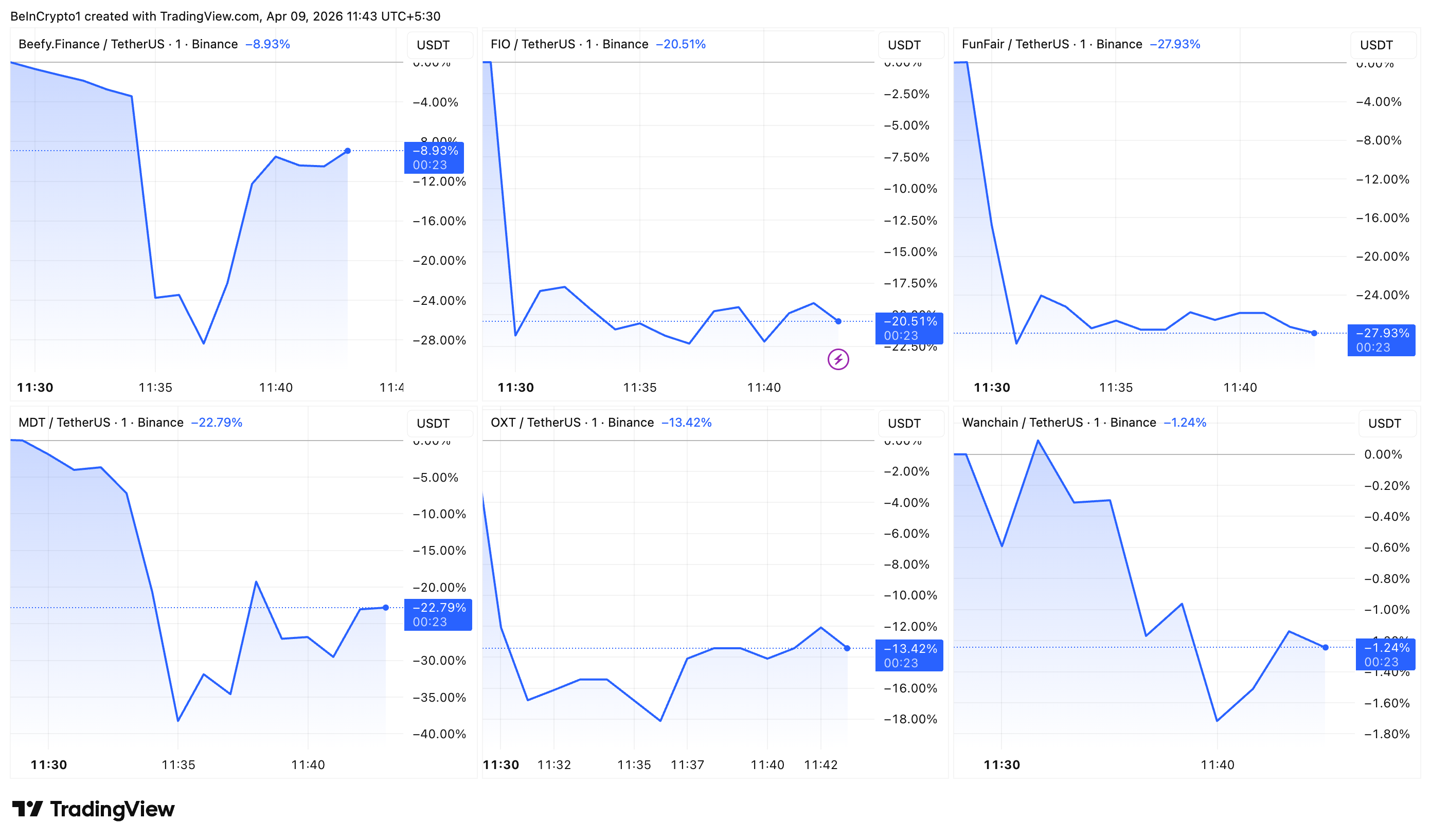
This is another wave of removals this month. On April 1, Binance delisted eight tokens, including Loopring (LRC) and Radiant Capital (RDNT), which also saw double-digit drops following the announcement.
Several of these tokens had been flagged well before removal. Binance placed BIFI and MDT under its Monitoring Tag in June 2025. FUN and OXT received the same warning label in March 2026.
The label flags tokens that show elevated risk and sharper price swings than their peers. Binance reviews tagged assets on an ongoing basis and may delist those that fail to meet its standards.
Subscribe to our YouTube channel to watch leaders and journalists provide expert insights
The post Binance Delisting Wipeout: 6 Altcoins Crash After Exchange Pulls the Plug appeared first on BeInCrypto.
Ethereum (ETH) price trades at $2,181 on April 9, sitting just 0.5% above a critical technical level while facing coordinated selling pressure from three directions.
The Ethereum Foundation, spot ETF holders, and whales are all reducing exposure simultaneously. Meanwhile, two key moving averages on the daily chart are converging toward a bullish crossover. The combination puts the Ethereum price in its most conflicting position yet, in April.
Symmetrical Triangle Tightens as Two EMAs Close In
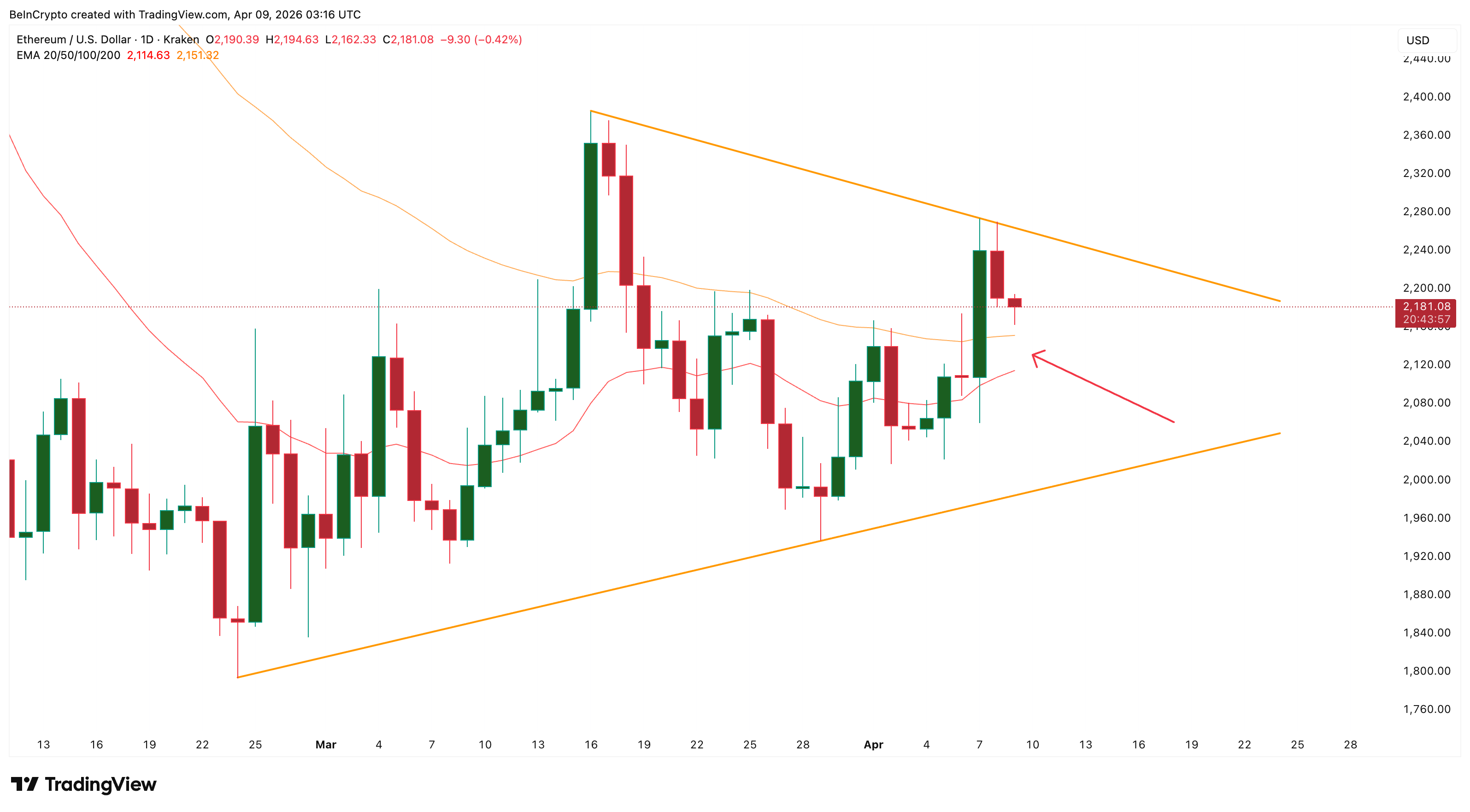
Ethereum price has been trading inside a symmetrical triangle on the daily chart since late February. The pattern has compressed price between a series of lower highs and higher lows, squeezing the range tighter with each session.
The most recent test of the upper trendline was rejected. Sellers defended that level aggressively, pushing ETH back toward the middle of the triangle. The rejection matters because it confirms the pattern is still intact and no breakout has occurred.
The 20-day Exponential Moving Average (EMA), a trend indicator that gives greater weight to recent price movements, sits at $2,114, still below the 50-day EMA at $2,151. The gap between them is narrowing. If the 20-day manages to cross above the 50-day, it would flash a golden cross and shift short-term momentum bullish.
However, with selling pressure mounting from three fronts, the risk is that the 20-day stalls and diverges back downward, a failed crossover attempt that would reinforce the bearish structure.
Want more token insights like this? Sign up for Editor Harsh Notariya’s Daily Crypto Newsletter here.
A failed crossover attempt inside a tightening triangle would tilt the odds toward a downside breakdown. But the chart setup alone does not explain why ETH is under this much pressure. The selling is not just technical. It is structural.
Foundation, ETFs, and Whales All Reduce Exposure at Once
The sell pressure is arriving from three separate fronts simultaneously.
The Ethereum Foundation announced it would convert 5,000 ETH into stablecoins via CoWSwap’s TWAP feature to fund R&D, grants, and donations.
According to on-chain tracker Lookonchain, 3,750 ETH worth $8.3 million has already been sold at an average price of $2,214. Another 1,250 ETH, worth approximately $2.77 million, remains earmarked for conversion. The Foundation’s own announcement framed the sale as routine treasury management, but the market reads any large sell from the project’s creator as a bearish signal regardless of intent.
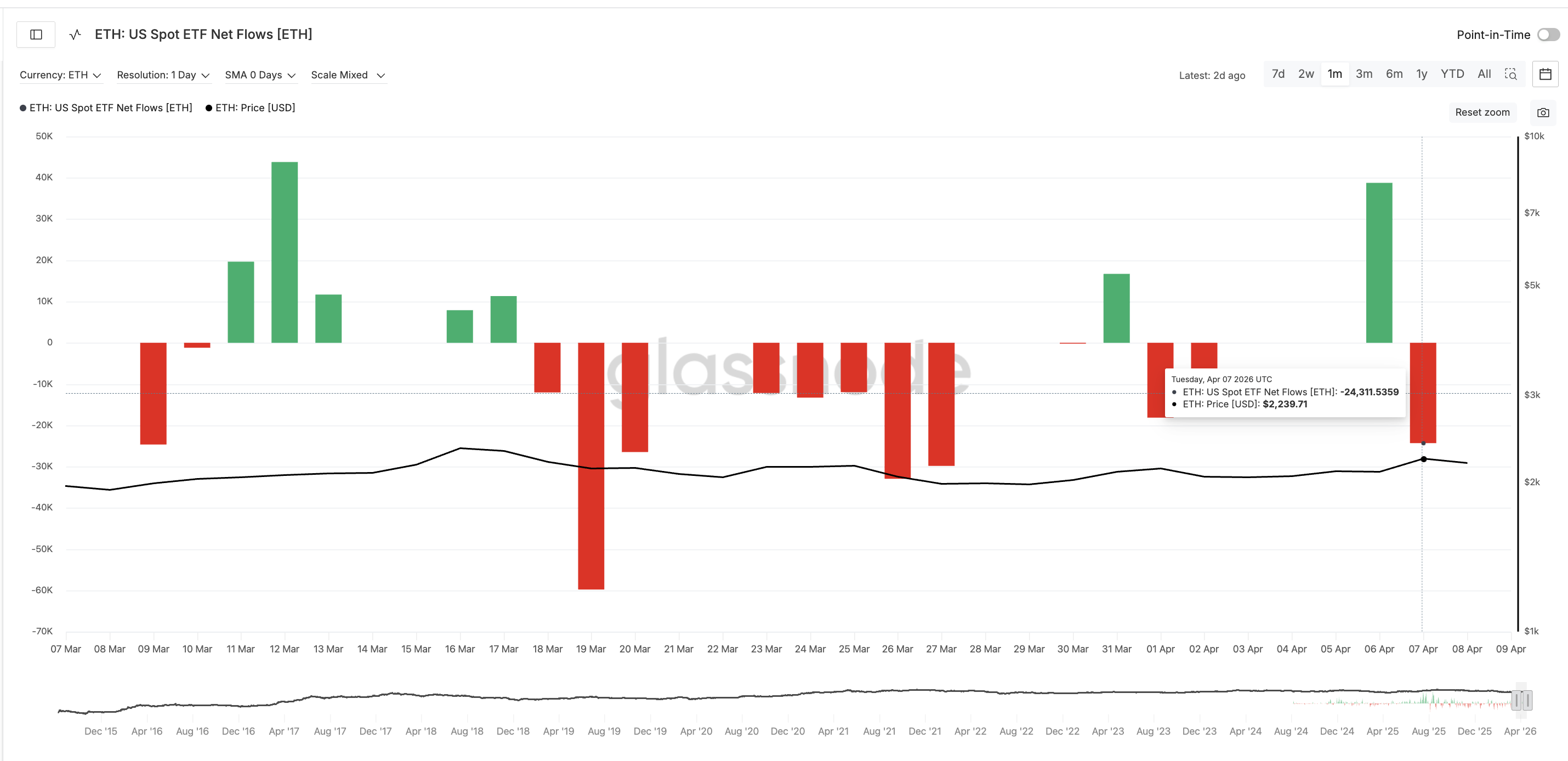
The ETF picture flipped just as fast. US spot ETH ETF flows recorded a strong inflow of 38,769 ETH on April 6. One day later, April 7 saw an outflow of 24,311 ETH. The reversal erased most of the previous session’s institutional demand in a single day.
Whale behavior adds the third layer.
According to Santiment data, the supply held by whales outside of exchanges peaked at approximately 123 million ETH around April 8 and has since dropped to 122.93 million, roughly $153 million. The decline appears modest in absolute terms, but the timing matters. Whales began reducing holdings around the same time the Foundation started selling and ETF flows reversed.
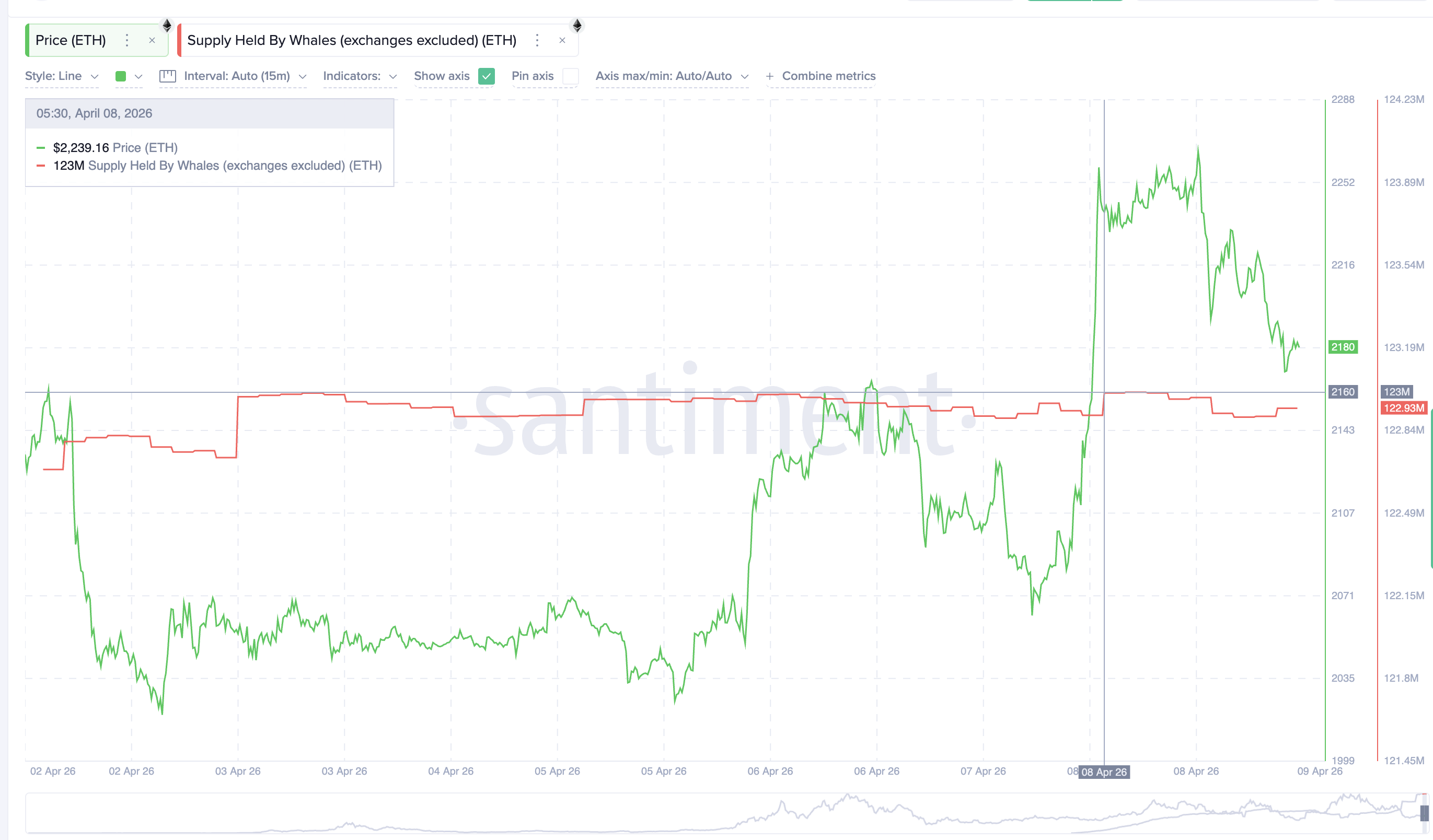
When three independent groups, the Foundation, ETF holders, and whales, all reduce exposure within the same 48-hour window, it creates a supply overhang that technical patterns alone cannot absorb. The ETH price chart now decides how much of this pressure the market can handle.
Ethereum Price Sits 0.5% Above the Level That Changes Everything
ETH trades at $2,181, just 0.5% above the 0.236 Fibonacci level of $2,168. This is the line that matters most right now. A daily close below $2,168 would confirm that the selling pressure from all three fronts is overwhelming dip buyers and would place ETH firmly in the lower half of the triangle.
Below $2,168, the next supports are $2,102 at the 0.382 level and $2,049 at the 0.5 level. A drop below $1,995 at the 0.618 level would bring the lower trendline of the symmetrical triangle into direct focus, raising the risk of a breakdown toward $1,823.
Ethereum price did briefly dip below $2,168 during the session before buying pressure helped it reclaim the level. That reclaim shows buyers are aware of the line. However, a second test with the EMA golden cross still unconfirmed and the Foundation still holding 1,250 ETH to sell may not hold as well. The broader market weakness adds another headwind.
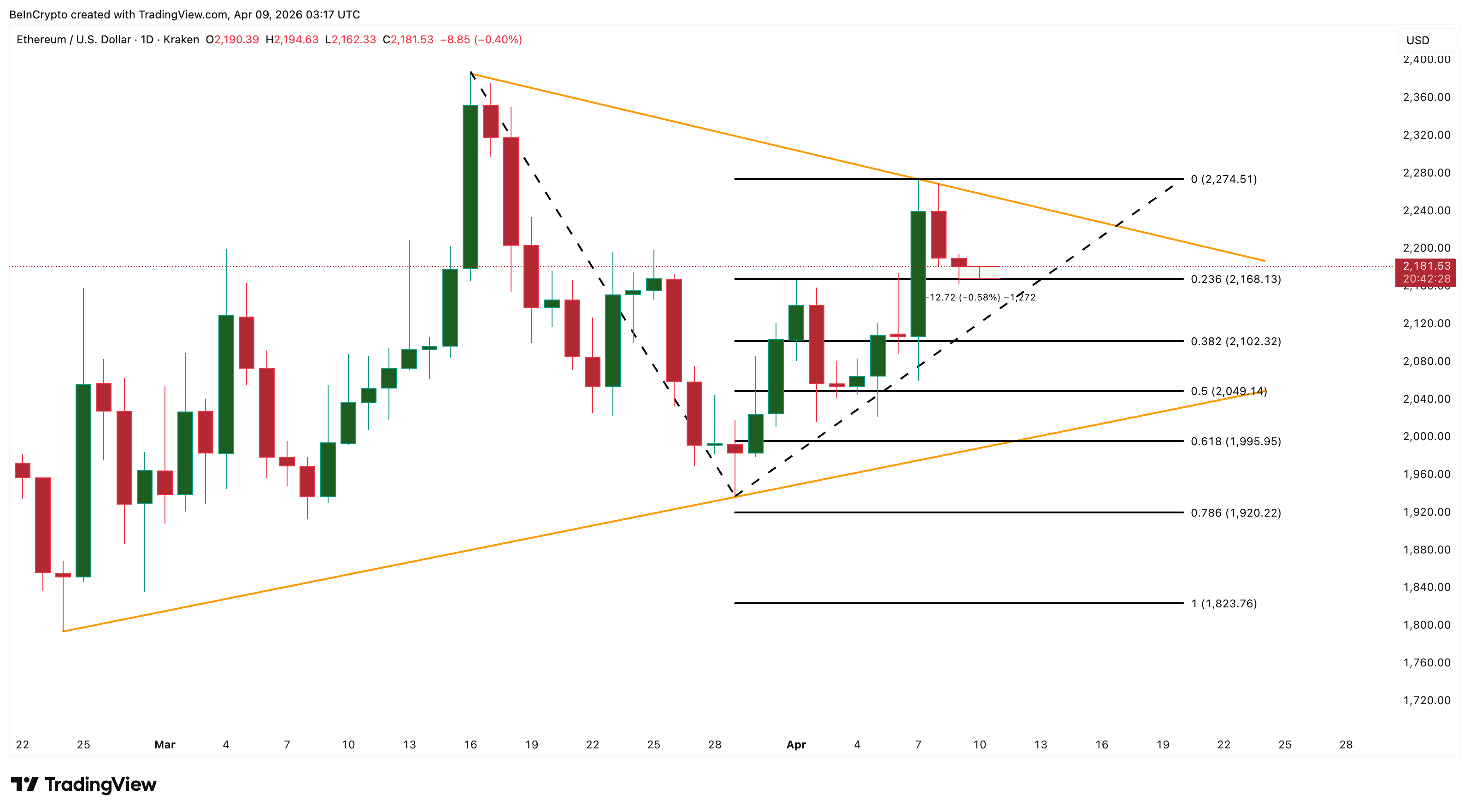
For strength to return, ETH needs to stay above $2,168 and attempt a move back toward $2,274. That would push price back toward the upper trendline and could help confirm the crossover. However, with three selling cohorts active and no fresh demand catalyst visible, the upside path remains the harder one.
Currently, $2,168 separates a defended floor with a path back toward $2,274 from a three-front-driven slide toward $2,102 and lower.
The post Ethereum Price Clings to $2,168 as Foundation Leads a 3-Front Selloff appeared first on BeInCrypto.
BofA reiterates Constellation Brands stock Underperform rating

Bithumb Files Suit to Recover 7 BTC After Payout Error

Blue Jackets head to Buffalo with focus on making late playoff push


-

 NewsBeat7 days ago
Steven Gerrard disagrees with Gary Neville over ‘shock’ Chelsea and Arsenal claim | Football
-

 Business6 days ago
No Jackpot Winner and $194 Million Prize Rolls Over
-

 Fashion6 days ago
Weekend Open Thread: Spanx – Corporette.com
-

 Business5 days ago
Expert Picks for Every Need
-

 Business3 days ago
Three Gulf funds agree to back Paramount’s $81 billion takeover of Warner, WSJ reports
-

 Sports5 days ago
India men’s 4x400m and mixed 4x100m relay teams register big progress | Other Sports News
-

 Tech2 days ago
How Long Can You Drive With Expired Registration? What Florida Law Says
-
Business4 days ago
No Jackpot Winner, Prize to Climb to $231 Million
-

 Fashion3 days ago
Massimo Dutti Offers Inspiration for Your Summer Mood Board
-

 Tech7 days ago
Commonwealth Fusion Systems leans on magnets for near-term revenue
-

 Fashion2 days ago
Let’s Discuss: DEI in 2026
-
Politics6 days ago
Wings Over Scotland | The quality of mercy
-

 Business4 days ago
Akebia Therapeutics, Inc. (AKBA) Discusses Pipeline Progress and Strategic Focus on Kidney Disease Treatments at R&D Day – Slideshow
-

 Fashion6 days ago
Statement Sunglasses: The Accessory Shaping Modern Fashion
-
Sports7 days ago
Justin Jefferson’s Situation Remains Unchanged after JSN’s Deal
-

 Crypto World20 hours ago
Bitcoin recovers as US and Iran Agree a Ceasefire Deal
-

 Politics6 days ago
East Jerusalem Palestinian families eviction orders
-

 Fashion7 days ago
Thursday’s Workwear Report: Merino Wool Blend Short-Sleeved Sweater
-

 Sports7 days ago
Which German players will make final cut?
-

 Fashion6 days ago
For Love & Lemons’ Spring 2026 Line is for the Romantics
You must be logged in to post a comment Login