

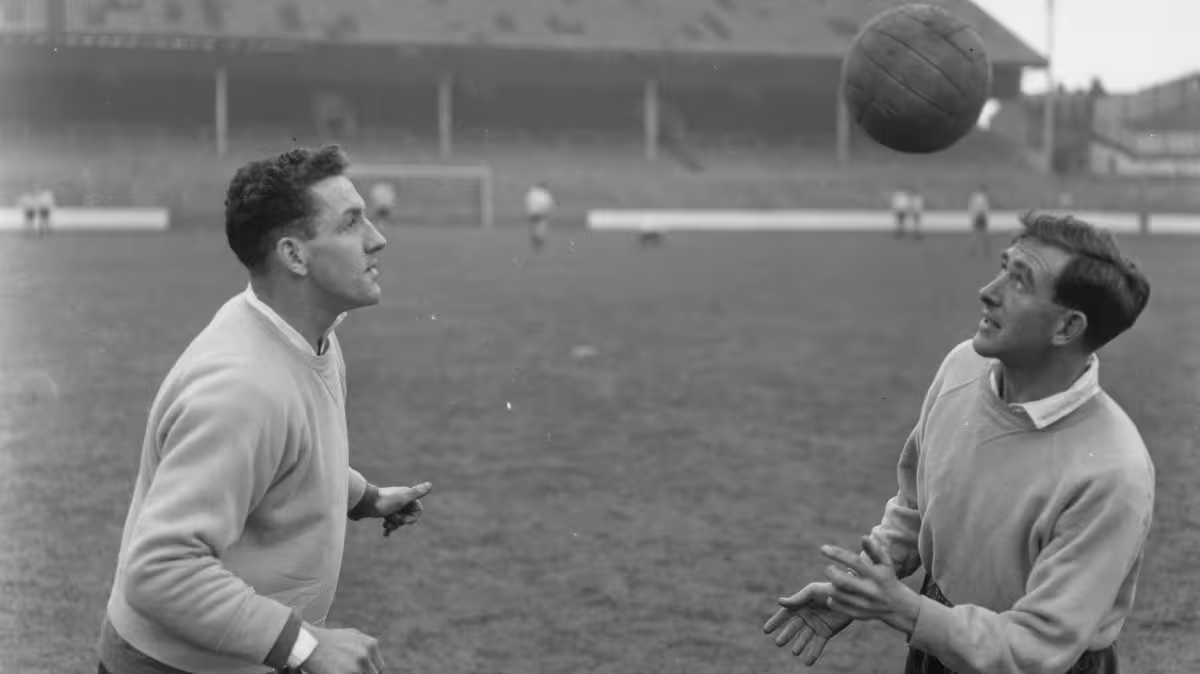
A new book has been published to mark 100 years since the birth of east Belfast man Danny Blanchflower
He was born in Belfast, in a place where the streets were narrow and the arguments were not. It was a city that demanded something of you early — a willingness to stand your ground. Danny Blanchflower learned those lessons long before he became a footballer. Identity came first. Football followed.
There is a new book out now — Danny Blanchflower: A Glorious Life by Mike Donovan — published to mark 100 years since his birth. It arrives not as a nostalgic exercise but as a timely reminder. Because Blanchflower does not sit easily in the modern game. He belongs to a different tradition — one where football was never just about the transaction.
He once explained his relationship with the sport in a way that felt disarmingly simple.
Danny Blanchflower never fell out of love with football. “Because I never had illusions to start with.”
There is honesty and a kind of defiance in that. He saw the game clearly — its beauty, its flaws, its limits — and chose to believe in it anyway. Not blindly but deliberately.
For all that clarity, he still spent a career striving for something close to perfection. Not perfection in the modern, statistical sense, but in the way a team should play, the way players should think, the way a dressing room should function.
Donovan’s book sets out to ensure that legacy endures.
“I want to make sure these players are not forgotten,” the author says. “Particularly Danny Blanchflower, because he was the guy who orchestrated everything. The ’61 side was the greatest in Spurs’ history. And he was the leader of that team.”
Leader, though, feels insufficient.
Blanchflower was the axis around which everything turned. He dictated tempo, shaped matches and set standards that went beyond the pitch. He had presence. When he spoke, people listened.
“Football was never about money,” he said.
There is a story, often told, that captures that ethos. At the height of his career, Blanchflower was offered a pay rise. He refused it. Asked for it to be distributed among his team-mates instead. It was a gesture that summed up the collective purpose he believed in.
In 1961, they achieved something that had been considered beyond reach. The League and FA Cup double — the first of the 20th century. It has been repeated since, often enough that it risks feeling routine. But at the time, it was anything but.
Blanchflower believed it could be done before anyone else did.
“He was the first to say it was possible,” Donovan says. “He was adamant.”
What followed was not just success, but a style of success that has endured in memory. Spurs did not simply win. They entertained. They dominated with a kind of elegance that made the game look expansive and generous.
“They crucified teams,” Donovan says, “but did it with style and grace.”
For a brief period, they may have been the finest side in the world. Real Madrid were ageing. Spurs were at their peak. Their European campaign came a year too late to confirm it, but the sense remains.
It was the greatest team in Tottenham’s history.
And at its centre was Blanchflower – one of only four Irishmen to captain an English club to their top division title – Roy Keane, Johnny Carey and Noel Cantwell being the others.
Donovan says: “We’ve had great players — Gascoigne, Klinsmann, Greaves, Bale, Kane,” Donovan says. “But that was our best team. And Blanchflower was the leader. I would say he is the most important player in Spurs’ history.”
He influenced the game in other ways too. He is credited with pioneering the defensive wall at free-kicks, a detail that now feels so embedded it is almost invisible. He thought about the game differently. He looked for solutions others had not yet considered.
And when leadership required words, he found those as well.
Before the 1963 Cup Winners’ Cup final, he felt manager Bill Nicholson had given too much respect to Atletico Madrid. Too much caution. Blanchflower addressed the players himself. He reminded them of their own quality, their own identity.
It was a moment that mattered. Spurs won. The players credited his intervention.
“He could command a room,” Donovan says.
That authority extended beyond club football.
In 1958, Northern Ireland embarked on a World Cup journey that defied expectation. Drawn against stronger, more established nations, they progressed through qualification and then beyond the group stage itself.
Blanchflower, alongside Peter Doherty, helped shape that achievement. It was more than a football story. Catholic and Protestant, different backgrounds and experiences, united by a shared purpose.
They saw off Italy, West Germany, Argentina and Czechoslovakia to reach the quarter-finals. Fatigue ended the run, but not the significance of it.
Blanchflower later returned as manager, motivated by a sense of obligation.
“I owed the game a debt,” he said. “I owed Northern Ireland a debt.”
There was always humour too, often dry, occasionally cutting. When a player asked about a win bonus, he replied: “We have no money and we don’t win matches. Therefore there is no bonus and no problem.”
He died in 1992, his final years affected by Parkinson’s and dementia. There is a sadness in that, an unavoidable one. A man whose life was built on clarity and memory gradually losing both.
But what remains is substantial.
Players are often remembered for moments — goals, trophies, flashes of brilliance. Blanchflower is remembered for what he valued.
That is why Donovan’s book feels important now.
If we don’t write about these heroes, if we don’t remember them, then what have we got?
History matters. Men like Blanchflower created legacies. May that always be remembered. And may he never be forgotten.
- DANNY BLANCHFLOWER, A GLORIOUS LIFE The Authorised 100th Anniversary Biography of a Global Football Icon By Mike Donovan Publisher: Pitch Publishing Ltd


















































You must be logged in to post a comment Login