
Crypto World
Bitget launches SpaceX-linked pre-IPO proxy on Republic platform

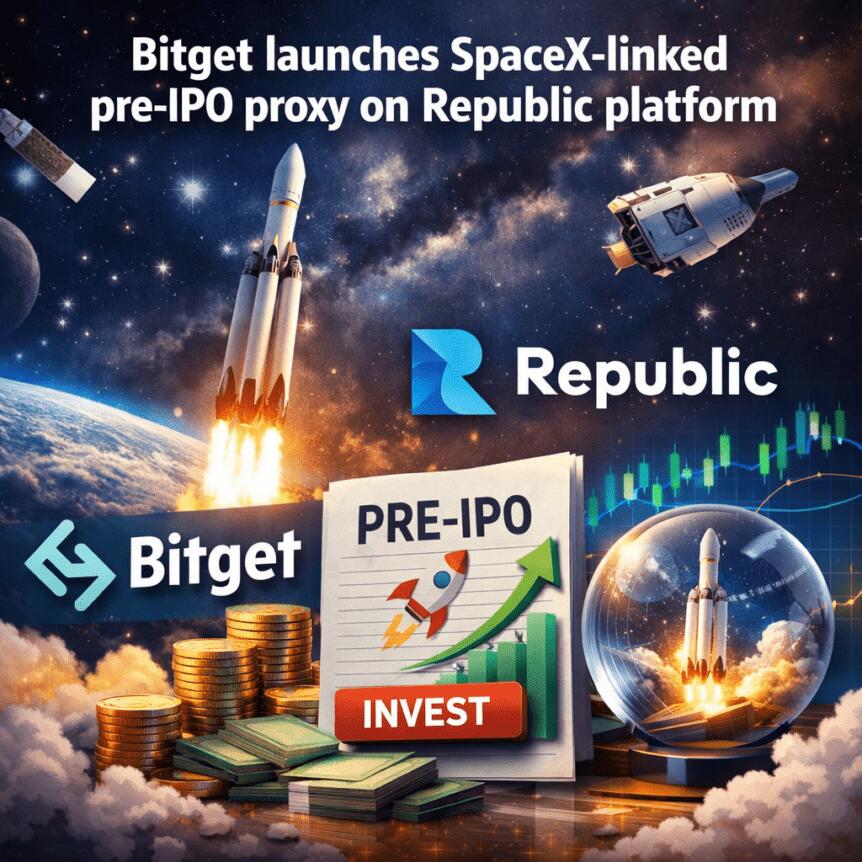
Bitget is expanding its product suite with IPO Prime, a proxy offering tied to the pre-initial public offering (pre-IPO) phase of SpaceX. The exchange said the initial token, preSPAX, will give retail users economic exposure to SpaceX’s post-IPO performance without granting direct ownership of SpaceX shares. SpaceX has not endorsed, approved, or authorized the offering, and Bitget emphasized that the instrument is a tokenized exposure rather than a security stake.
Key takeaways
- Bitget launches IPO Prime, offering pre-SPAX as a Republic-issued token designed to track SpaceX’s post-IPO performance without giving holders equity in SpaceX.
- The preSPAX subscription window runs April 18–21, with distribution on April 21 and subsequent OTC trading slated for later that day. VIP users reportedly receive early access via exclusive airdrop rounds.
- SpaceX’s IPO status remains unconfirmed publicly, but Bloomberg’s report highlights investor interest and potential valuation in the trillions of dollars range.
- IPO Prime fits a broader trend of crypto exchanges angling for TradFi access, placing tokenized versions of traditional assets—stocks, ETFs, and pre-IPO exposures—on crypto trading platforms.
- Industry peers and traditional market players are already experimenting with tokenized or expanded access to mainstream assets, signaling a potential shift in how retail investors participate in early-stage or pre-IPO opportunities.
Bitget’s bet on tokenized pre-IPO exposure
Bitget frames IPO Prime as a “new route” to traditional finance opportunities, part of the company’s broader aim to build a “universal exchange” that brings more TradFi assets under tokenized wrappers. The platform’s rollout centers on a subscription-based model, allowing users to apply for allocations through a tiered structure and then receive a proportional stake in the instrument.
Cointelegraph, she said: “Pre-IPO exposure used to be limited to small circles, but tokenization has changed that, providing access to traditional assets that were typically out of reach. preSPAX is our first offering and we will be bringing more such opportunities to our users this year.”
“Pre-IPO exposure used to be limited to small circles, but tokenization has changed that, providing access to traditional assets that were typically out of reach. preSPAX is our first offering and we will be bringing more such opportunities to our users this year.”
TradFi on chain: a wider push for tokenized access
Bitget’s IPO Prime sits within a broader pattern of crypto exchanges courting traditional financial products through tokenized wrappers. The concept is not unique to Bitget; several other crypto platforms have previously or currently pursued similar paths to broaden their investor base and offer a one-stop venue for traditional and digital assets.
Earlier this year, Bitpanda, a Vienna-based exchange, announced an expansion of its product suite to include around 10,000 stocks and exchange-traded funds (ETFs), signaling a push into regulated equity access via a crypto-enabled interface. Other industry actors have pursued comparable moves: Kraken unveiled a program in 2025 to offer 11,000 U.S.-listed stocks and ETFs with commission-free trading as part of a broader “phased national rollout,” while Coinbase has integrated stock trading into its ecosystem and reoriented its wallet toward a broader “everything app” concept aimed at 24/7 access to stocks, ETFs, and crypto assets. The industry framing sees these efforts as part of a broader “universal exchange” agenda to unify traditional and digital asset markets under a single platform.
Delphi Digital, a crypto research firm, has described the trend as the onset of a “super app” era in which users gravitate toward platforms that aggregate assets and trading products. The implication is that value could tilt from standalone protocols to the platforms that capture the most user attention and trading activity, as tokenized TradFi products become increasingly routinized for retail participants.
Industry peers emphasize that tokenized pre-IPO products are part of a broader expansion into professional-grade finance on crypto rails, raising both opportunities and questions. On the upside, greater accessibility could unlock early-stage and high-growth exposure for a wider audience. On the downside, investors must evaluate the liquidity, valuation methodologies, and regulatory underpinnings of tokenized pre-IPO instruments, which operate at the intersection of securities, derivatives, and digital assets.
Bitget’s strategy is not happening in a vacuum. The same week Bloomberg highlighted SpaceX’s rumored confidential IPO filing, reigniting interest in a potential post-IPO trajectory for the aerospace company. If SpaceX proceeds to public markets, tokenized pre-IPO instruments could become a more visible ladder for retail investors to engage with a stock-market-ready asset—albeit one that remains subject to the evolving regulatory and listing framework governing tokenized assets.
What to monitor next
Investors should track how pre-IPO tokenization evolves in practice: the accuracy of post-IPO performance tracking, liquidity dynamics in the OTC window, and the degree of regulatory clarity surrounding tokenized exposure to privately held companies. The SpaceX narrative—whether the company confirms an IPO timeline or refrains from public disclosure—will be a crucial backdrop for assessing the real-world demand for such products. Additionally, the reception of IPO Prime among users, and how Bitget and similar platforms refine their tiered allocations and airdrop strategies, will indicate how quickly tokenized pre-IPO access could scale across the market.
For readers seeking historical context, the broader trend toward TradFi assets on crypto platforms has already drawn attention from both crypto media and traditional financial circles. If the momentum continues, the next 12 to 18 months could define how retail investors navigate a blended landscape where tokenized stocks, ETFs, and pre-IPO exposures sit alongside digital assets in a single, cross-asset trading environment.
As markets watch SpaceX’s publicly announced or speculative IPO trajectory, IPO Prime stands as a concrete signal that crypto exchanges are actively testing the perimeter of traditional finance within blockchain-enabled product rails. Whether this approach will endure or face regulatory pushback remains to be seen, but the track record of Bitget’s latest launch indicates a continuing push to normalize access to otherwise exclusive financial opportunities.
Further reading and related coverage from the crypto press illustrate how the space is evolving. For example, reports on Bitpanda’s expansion into stocks and ETFs and Kraken’s broadened U.S. listings highlight a shared industry direction. Readers can also review Cointelegraph coverage on how exchanges are pricing, listing, and managing risk around traditional assets in a crypto context, as well as parallel analyses of the broader regulatory and market implications of these developments.
What remains uncertain is the precise regulatory treatment of tokenized pre-IPO products and how safeguards for retail investors will be enforced as these platforms scale. Yet the momentum is clear: tokenization is reshaping access to mainstream assets, and SpaceX’s rumored IPO is now part of a wider experiment in how the crypto industry can bridge private markets and public markets for a global audience.



Worldcoin will cut WLD’s daily unlock rate by about 43% from July 24, halving community emissions and trimming team and investor unlocks as selling pressure concerns mount.
Summary
- Worldcoin says 4.9b WLD (49% of supply) is unlocked, with around 3.3b in circulation; the daily unlock will fall from ~5.1m WLD to ~2.9m in July.
- Community unlocks drop 50% from 3.2m to 1.6m WLD per day, while team and investor unlocks fall 32% from 1.9m to 1.3m WLD.
- The project stresses WLD’s continuous linear unlocks “with no cliffs,” arguing the on‑chain adjustment is meant to “gradually reduce selling pressure” rather than shock markets.
Worldcoin’s development team has outlined a major change to the WLD token’s emission schedule, saying it will cut the daily unlocking rate by about 43% from late July in a move aimed at gradually easing structural selling pressure. In a blog post on its official site, the project said that from July 24, 2026, the aggregate unlock rate will fall from roughly 5.1 million WLD per day to about 2.9 million, as on‑chain contracts automatically adjust the flow of new tokens to the community, team and early investors.
According to Worldcoin, a total of 4.9 billion WLD — 49% of the token’s 10 billion maximum supply — has been unlocked so far, with approximately 3.3 billion WLD in actual circulation. The project emphasized that WLD uses a continuous linear unlocking mechanism with “no one‑time large unlocks (cliffs),” arguing that the scheduled rate change is “due to established on‑chain contract arrangements” rather than a discretionary decision by the foundation or contributors.
The adjustment will hit different stakeholder buckets in distinct ways. The unlock rate for the “World community” allocation, which covers tokens distributed to users and operators, will be cut from 3.2 million WLD per day to 1.6 million, a 50% reduction. At the same time, the unlock rate for “team and investors” will fall from 1.9 million WLD per day to 1.3 million, a smaller but still significant 32% reduction. In aggregate, daily unlocks drop from about 5.1 million WLD to roughly 2.9 million WLD, a change the team says is intended “to gradually reduce selling pressure” as more of the supply becomes liquid.
The blog frames this as a “tokenomics milestone,” suggesting that the most aggressive phase of emissions is now behind the project. Worldcoin officials argue that a predictable, linearly slowing unlock schedule is better for long‑term holders than either perpetual high emissions or lumpy cliff events that can shock markets.
For traders and existing holders, the immediate takeaway is nuanced. On one hand, a 43% cut in the daily unlock rate mechanically reduces the amount of new WLD that can hit secondary markets each day, all else equal. On the other, nearly half of the total supply is already unlocked, and about 3.3 billion WLD is circulating, meaning that any relief from slower future emissions has to be weighed against the large base of tokens that can already be sold.
Market reaction will ultimately depend on whether demand for WLD — from governance, staking, ecosystem incentives or speculative flows — grows faster than the slowed unlock curve. If activity around the Worldcoin protocol and its associated World ID infrastructure accelerates, the new schedule could help absorb selling and support price. If adoption stalls, slower unlocks alone may not be enough to prevent further dilution for existing holders.


A long-running dispute between OKX founder Star Xu and Binance founder Changpeng “CZ” Zhao resurfaced Thursday, with Xu calling CZ a “habitual liar” in a series of posts on X that revisit allegations dating back more than a decade.
The clash traces back to Zhao’s brief tenure at OKCoin, founded by Xu, when he was accused in 2015 of “harmful acts of conduct” and misleading statements tied to a contract dispute involving Roger Ver, claims Zhao has previously disputed.
This latest flare-up also follows an earlier public disagreement in January, when Xu blamed Binance-linked market dynamics for amplifying the Oct. 10 crypto crash, a claim Binance and other market participants disputed. The latest flare-up was triggered by CZ’s memoir, published earlier this week, Xu said.
He revived the decade-old issues, saying he had no “intention of revisiting these old issues involving CZ [..] but since I’ve been dragged into this again because of the book, let’s restate the facts,” he wrote.
“Out of the blue, Star [Xu] said that I had somehow forged a contract when working there [at OKCoin],” CZ said in his book. “… In May 2015, I got annoyed and made a public post on Reddit, obviously denying forging any contracts … while I was at it, I detailed a few problems I saw at OKCoin.”
Xu, in his recent posts, pointed to a video he said shows evidence of conflicting contract versions and reiterating that Zhao had misled the public about the matter.
“After spending four months in prison, he continues to make false statements to the world,” Xu wrote, adding that “a habitual liar never changes their nature.”
The dispute escalated when Xu questioned whether Zhao had misrepresented his marital status, referencing earlier CoinDesk reporting in which Zhao’s spouse was described as his “wife” in a letter submitted to a judge. Xu said he would apologize if Zhao could produce a divorce agreement signed by both parties.
Zhao responded that he is “officially divorced” and challenged Xu to a $1 billion bet or any amount Xu chose, that the divorce had been finalized, saying lawyers could verify the agreement while declining to publish documents.
Xu rejected the wager, citing compliance considerations tied to running a regulated exchange, and instead pressed Zhao on whether his Binance stake had been legally separated as part of any divorce.
Zhao dismissed the line of questioning, saying his Binance stake was “none of your business” and accused Xu of deflecting.
Crypto World
CrowdStrike (CRWD) Stock Rebounds After Anthropic Partnership Erases AI Disruption Fears

Key Takeaways
- CRWD shares tumbled more than 5% amid investor anxiety that AI-powered solutions might threaten conventional cybersecurity subscription revenues.
- Macroeconomic headwinds, including weakening GDP figures and conservative guidance from Zscaler, intensified selling pressure across the sector.
- Executive stock sales raised eyebrows despite management’s announcement of an enlarged buyback program.
- CNBC’s Jim Cramer countered bearish sentiment, claiming Anthropic’s AI capabilities would actually strengthen demand for cybersecurity services.
- The unveiling of “Project Glass Wing,” a collaborative security initiative between Anthropic, CrowdStrike, and Palo Alto Networks, sparked a major stock recovery.
CrowdStrike (CRWD) experienced significant turbulence recently as shares plunged more than 5% during a period of heightened anxiety across the cybersecurity industry. Investor apprehension centered on whether emerging agentic artificial intelligence platforms might eventually displace traditional subscription-based security solutions that form the revenue backbone for firms like CrowdStrike.
CrowdStrike Holdings, Inc., CRWD
The downturn extended beyond a single company. Cybersecurity stocks broadly faced renewed scrutiny as market participants reassessed the sector’s long-term revenue potential and profitability assumptions in an AI-driven landscape.
This unease had been percolating for several weeks. Central to the narrative was Anthropic, the organization responsible for developing the Claude AI model. Growing market chatter suggested that Anthropic’s advanced autonomous agent technology might possess sufficient sophistication to render conventional cybersecurity platforms redundant.
CrowdStrike and Palo Alto will no longer be manipulated when it comes to Anthropic after this announcement today ,,,CRWD and PANW can go much higher now
— Jim Cramer (@jimcramer) April 7, 2026
CRWD’s year-to-date trajectory already mirrored these mounting concerns, with shares retreating approximately 15.8% prior to the latest selloff. Daily trading volume typically hovers around 4 million shares, while technical indicators had flipped to bearish territory.
Broader economic conditions compounded the pressure. Recent data releases revealed decelerating U.S. economic expansion, while rival firm Zscaler (ZS) delivered a measured demand forecast that dampened sentiment. When industry leaders express reservation about future business conditions, markets typically extrapolate those concerns across comparable companies.
Executive Stock Disposals Undermine Repurchase Program
CrowdStrike attempted to bolster investor confidence through action. Management unveiled an enhanced share repurchase authorization, a signal ordinarily interpreted as faith in the company’s intrinsic worth.
Unfortunately, the announcement failed to gain traction. Disclosure of stock sales by senior leadership emerged simultaneously, creating doubt about whether executives truly share the optimistic outlook implied by the buyback expansion. The market registered this contradiction.
Cramer Challenges Bears as Anthropic Collaboration Emerges
The pessimistic narrative didn’t go unchallenged. Television personality Jim Cramer from CNBC mounted a defense, and his commentary proved remarkably prescient.
During a recent broadcast, Cramer confronted the Anthropic anxiety head-on. His position was that cybercriminals leveraging AI agents would amplify rather than diminish the necessity for established cybersecurity defenses. “Without the help of traditional cybersecurity, you’re more vulnerable than ever,” he stated emphatically.
CrowdStrike’s CEO George Kurtz reinforced this perspective during his appearance on Cramer’s program, characterizing the AI revolution as favorable for cybersecurity demand.
Shortly thereafter came the development that appeared to vindicate Cramer’s analysis. Anthropic introduced “Project Glass Wing,” a cooperative security framework incorporating both CrowdStrike and Palo Alto Networks (PANW), aimed at safeguarding Anthropic’s user base. The revelation triggered a 24-point surge in CRWD shares within a single trading day.
Palo Alto Networks experienced its own significant decline in recent trading, dropping approximately 7.3%, indicating that broader industry uncertainty persists despite positive partnership news.
CrowdStrike maintains a market capitalization of roughly $100.1 billion, though shares continue trading approximately 15.8% below their year-to-date starting point as markets prepare for the upcoming session.

Crypto World
Canary Capital’s Spot PEPE ETF Filing Puts Meme Coins Back in Focus as Maxi Doge Presale Nears $6M

Friday 10 April 2026 – Canary Capital has filed an S-1 with the US Securities and Exchange Commission for a spot PEPE ETF, a move that would bring direct PEPE exposure into traditional brokerage accounts if approved. The proposed trust would hold spot PEPE tokens and allocate a small amount of Ethereum to cover fees.
The filing lands as parts of the meme coin market show signs of selective strength rather than broad-based risk appetite. PEPE has flashed a bullish RSI divergence and saw whale accumulation of 1.23 trillion tokens on April 5, while Shiba Inu wallets have added 2.02 trillion SHIB since the start of the month, worth about $12.16 million at current prices.
Alongside that backdrop, the Maxi Doge presale is approaching $6 million, drawing interest from traders still willing to back newer meme-coin bets despite a cautious wider market.
The PEPE ETF proposal is notable less for any immediate approval odds than for what it signals: a mainstream asset manager is formally testing whether a meme coin can be packaged for conventional investors. That shifts the discussion from pure speculative trading toward market structure, access, and product eligibility.
The trust outlined in the filing would hold actual PEPE, with shares created in standard baskets. For meme coins, that is a meaningful step toward institutional-style infrastructure, even as the broader Crypto Fear & Greed Index remains in extreme fear.
Price action has been mixed, but on-chain positioning has stayed constructive. PEPE traded roughly 6% lower in the 24 hours after the filing news, yet daily-chart momentum showed a completed bullish RSI divergence, with price making a lower low while RSI posted a higher low. That setup has already been followed by an 11% spot rebound in recent sessions, though the token remains well below recent highs.
$PEPE ETF Approval sets it up for a very solid long-term bullish catalysts

Long-term this is very bullish for #PEPE

Latest #PEPE price and news action right here
pic.twitter.com/GSZjWH7emY
— Crypto Zeus
(@CryptoZeusYT) April 10, 2026
Whale Flows in PEPE and SHIB Point to Selective Accumulation
On-chain data suggests larger holders are still positioning in the largest meme names. PEPE whales accumulated 1.23 trillion tokens on April 5, reinforcing the idea that experienced market participants are buying into weakness rather than exiting the sector altogether.
Shiba Inu is showing a similar pattern. Large wallets have increased holdings to 773.79 trillion SHIB since April 1, while the token changes hands near $0.00000602 and remains up 11% over the past 30 days. Exchange reserves have also dropped to multi-year lows, a sign that fewer tokens are sitting on venues where they can be sold immediately.
Those flows are developing as Bitcoin consolidates near $72,000 and easing geopolitical pressure offers modest support to risk assets. In that context, meme-coin demand appears concentrated in liquid, well-established names rather than spread evenly across the category.
The broader implication is straightforward: if sentiment improves, assets such as PEPE and SHIB may be first to respond because they already have scale, liquidity, and active holder bases. The PEPE filing also raises the prospect that other meme assets could eventually be considered for similar regulated products.
Maxi Doge Draws Fresh Capital as Presale Closes In on $6 Million
While PEPE and SHIB dominate the high-liquidity end of the sector, newer projects are still attracting capital. Maxi Doge, an Ethereum-based meme token built around degen branding, is nearing the $6 million mark in its presale.
That pace stands out in a market where early-stage meme launches have often struggled to maintain attention. Maxi Doge has centered its pitch on community momentum and simple meme-driven positioning rather than an extensive early utility narrative, a strategy that has historically helped projects build recognition quickly across crypto social channels.
WHERE ALL THE BULLS AT? WE DON'T QUIT. pic.twitter.com/J30E70EV5f
— MaxiDoge (@MaxiDoge_) March 31, 2026
Maxi Doge is not competing with PEPE or SHIB on scale. Instead, it is being framed as a higher-risk entry for traders looking for earlier-stage exposure if capital rotates further down the meme-coin curve. Its Ethereum base gives it immediate compatibility with major wallets and decentralized exchanges, while the presale’s progress suggests there is still demand for new meme narratives when branding resonates.
If the PEPE ETF filing gains traction or prompts copycat applications, the strongest spillover would likely start with large-cap meme coins before reaching smaller names. But that kind of sector-wide attention can also benefit projects like Maxi Doge, particularly if they already have active communities and funded presales heading into listing.
Maxi Doge Presale Terms, Staking and Access
Anyone can join the Maxi Doge Token presale through WalletConnect or directly via Best Wallet. Buyers can use ETH, BNB, USDT, or USDC, or pay with a bank card. Best Wallet is available on Google Play and the Apple App Store.
MAXI tokens purchased in presale can also be staked immediately in Maxi Doge’s native protocol, earning a dynamic 66% APY.
The current presale price is $0.00028120, and the project states the price will rise within the next 48 hours.
The team also says the code has been audited by Coinsult and SOLIDProof.
Community channels are available on X and Telegram.
The post Canary Capital’s Spot PEPE ETF Filing Puts Meme Coins Back in Focus as Maxi Doge Presale Nears $6M appeared first on Cryptonews.
Circle said trust in digital assets depends on security, accountability, and the rule of law. The company made the case after the April 1 exploit at Drift Protocol. Public reports placed losses at more than $270 million. Circle said the event renewed debate over controls and open access in crypto.
The company said stablecoin issuers should not act as private police. It said legal process must guide any freeze action.
Circle also said open financial systems need better protection across the crypto stack. The statement placed the issue within current U.S. stablecoin policy work.
Circle Says Asset Freezes Follow Legal Orders
Circle said it freezes USDC only when the law requires action. It said sanctions, court orders, and law enforcement requests drive those decisions. The company said this is a compliance duty, not a discretionary move. It also said the process protects user rights and privacy.
Circle described USDC as a regulated financial instrument under U.S. and EU laws. It said that framework prevents arbitrary interference with user funds. The company argued that legal limits matter as much as technical controls. It said privacy and property rights remain core design goals.
Drift Exploit Renews Debate on Shared Security Duties
Circle linked its comments to the Drift Protocol exploit on April 1. It said bad actors do more than steal funds during such attacks. They also test weak points between wallets, protocols, exchanges, issuers, and regulators. Circle said those gaps let attackers move quickly.
The company argued that no single part of crypto can carry the full burden. It said security and accountability must be shared across the ecosystem. That includes protocols, wallet providers, infrastructure firms, exchanges, and stablecoin issuers. Circle said each layer needs defenses that match its role.
It also warned against rushed policy responses that could harm open systems. Circle referenced debates over self-hosted wallets and permissionless DeFi. It said poorly designed restrictions could weaken innovation and open blockchain access. At the same time, it said openness without accountability creates risk.
Circle suggested added technical safeguards at the protocol level. It pointed to circuit breakers that could pause activity under set conditions. The company said such tools may help during fast-moving cyber threats. It added that threats can include social engineering and physical security risks.
Circle Backs New Legal Frameworks for Faster Action
Circle said the tools for faster intervention already exist in many cases. Yet it said the legal framework for coordinated action remains incomplete. The company argued that regulation has not kept pace with internet-based finance. It said this gap is a policy issue that needs a policy answer.
The firm said it is working with policymakers in the United States and abroad. It wants safe harbor rules and updated laws for digital asset markets.
Circle said those rules should let firms act faster against illicit activity. It also said any new framework must protect privacy and property rights.
Circle stated, “The goal is not a system where private companies unilaterally decide who loses access to their assets.” It added that the aim is lawful intervention that can move at the speed of threats. The company said that balance matters for both safety and openness. It framed the issue as central to trust in digital assets.
Circle tied that work to stablecoin legislation now under discussion in the United States. It referenced the GENIUS Act and broader market structure rules under the CLARITY Act. The company said these efforts offer an opportunity to establish standards before another major incident. It said those standards should protect due process, privacy, and legal accountability.


Bitget, the world’s largest Universal Exchange (UEX), has launched IPO Prime, introducing a new market structure that enables users to access and trade pre-IPO exposure to global unicorn companies such as SpaceX.
Powered by Republic, the launch marks an expansion beyond traditional secondary market trading, enabling participation in value creation before companies enter public markets, a phase historically limited to institutional investors and private capital networks. Through IPO Prime, Bitget extends its Universal Exchange framework into primary market access, bridging a long-standing gap between private and public market participation.
IPO Prime operates through a subscription-based model, where eligible users can apply for allocations in tokenized offerings tied to specific companies. Allocation limits are determined based on user tier, with higher participation thresholds available to elevated VIP levels. Following the subscription phase, these digital assets transition into an over-the-counter market on Bitget, enabling continuous pricing, trading and circulation within a structured environment.
The first offering under IPO Prime is preSPAX, a digital asset designed to mirror the economic performance of SpaceX following its potential public listing. As one of the most closely watched private companies globally, SpaceX represents the type of high-growth opportunity that has traditionally remained inaccessible to retail investors.
“Since the beginning of financial markets, access to pre-IPO opportunities has been defined by exclusivity,” said Gracy Chen, CEO of Bitget. “IPO Prime allows users to participate earlier in a company’s growth cycle, with the flexibility of continuous trading. This shifts how and when investors can engage with emerging companies, which gives retailers and new investors a chance to buy-in early. This is part of our greater shift towards building an UEX, democratizing access to financial equality.”
To mark the launch, Bitget will introduce two rounds of preSPAX token airdrops for eligible VIP users, on April 13, 2026 at 10:00 (UTC), providing early participants with additional exposure as the platform begins onboarding its first offering. The official preSPAX token launches on April 21, 2026 at 12:00 (UTC), with the commitment period starting April 18, 2026, 18:00 and ending April 21, 2026, 18:00 (UTC). Distribution period runs from April 21, 2026 18:00 till April 21, 2026, 22:00 (UTC).
The introduction of IPO Prime is a new route to traditional financial opportunities being structured and accessed. As boundaries between asset classes continue to blur, platforms are expanding beyond traditional and crypto trading to include early-stage market participation. Within Bitget’s Universal Exchange model, IPO Prime moves towards integrating diverse financial opportunities into a single, unified environment.
To find out more about IPO Prime and further details on preSPAX, visit here.
Disclaimer: This content is for reference only and does not constitute investment advice or an offer or solicitation to buy or sell any assets. This product may not be suitable for your jurisdiction. This product represents only a mirrored economic interest in the potential upside of SpaceX upon a qualifying event, and does not constitute a direct investment in SpaceX. SpaceX has not endorsed, approved, or authorized this Product in any capacity. Digital asset trading involves significant risks and price fluctuations, and you may lose all investment principal without any guarantee of return. Please ensure compliance with local laws and regulations and seek independent professional advice before investing.
About Bitget
Bitget is the world’s largest Universal Exchange (UEX), serving over 125 million users and offering access to over 2M crypto tokens, 100+ tokenized stocks, ETFs, commodities, FX, and precious metals such as gold. The ecosystem is committed to helping users trade smarter with its AI agent, which co-pilots trade execution. Bitget is driving crypto adoption through strategic partnerships with LALIGA and MotoGP™. Aligned with its global impact strategy, Bitget has joined hands with UNICEF to support blockchain education for 1.1 million people by 2027. Bitget currently leads in the tokenized TradFi market, providing the industry’s lowest fees and highest liquidity across 150 regions worldwide.
For more information, visit: Website | Twitter | Telegram | LinkedIn | Discord
Risk Warning: Digital asset prices are subject to fluctuation and may experience significant volatility. Investors are advised to only allocate funds they can afford to lose. The value of any investment may be impacted, and there is a possibility that financial objectives may not be met, nor the principal investment recovered. Independent financial advice should always be sought, and personal financial experience and standing carefully considered. Past performance is not a reliable indicator of future results. Bitget accepts no liability for any potential losses incurred. Nothing contained herein should be construed as financial advice. For further information, please refer to our Terms of Use.
The post Bitget Launches New Pre-IPO Product With SpaceX as First Listing appeared first on BeInCrypto.
Pavel Durov announced that the TON blockchain is now 10x faster. The Telegram founder shared the news on April 9, explaining that transactions now confirm in under one second. Before the upgrade, users waited over five seconds for finality.
“The TON blockchain just got upgraded and is now 10× faster,” Durov wrote. “Transactions are now instant, subsecond.”
How the Upgrade Works
The speed improvement comes from Catchain 2.0, a new consensus mechanism running under the hood. Blocks now generate every 400 milliseconds, which is 6x faster than before. A new streaming layer pushes updates to apps almost instantly rather than making them wait for the next block.
For everyday users, this means payments go through in about one second. Trades execute in real time. Apps respond immediately. The delays that made blockchain interactions feel slow compared to regular apps are largely gone.
Follow us on X to get the latest news as it happens
Step One of Make TON Great Again
Durov framed the upgrade as the first step in a seven-part plan he calls “Make TON Great Again,” or MTONGA. The name echoes a certain political slogan, but the goals are technical: making TON fast enough and cheap enough to compete with centralized platforms.
The next step on the roadmap: cutting transaction fees by 6x. TON fees are already low compared to Ethereum or Solana, but further reductions would make micropayments and high-frequency applications more practical.
Durov designed TON to work inside Telegram, which has over one billion users. His vision includes payments that feel like sending a message, Mini Apps that respond instantly, and DeFi tools that rival the speed of centralized exchanges.
At five-second confirmation times, delivering that experience was difficult. At sub-second finality, it becomes possible. The infrastructure now matches what users expect from any other app on their phone.
What Comes Next for TON
The upgrade went live on mainnet on April 10, 2026. Durov confirmed the fee reduction as step two but has not yet shared the timeline for the remaining six steps in the MTONGA roadmap.
For developers building on TON, the recommendation is to update their apps to use streaming APIs rather than polling. In other words, the blockchain is faster. Apps need to catch up.
The post TON Blockchain is Now 10x Faster: Pavel Durov Explains the Upgrade appeared first on BeInCrypto.


Digital assets have moved well beyond the hype cycle. What began as an experiment in decentralized value transfer has evolved into a serious conversation about how capital markets, custody, settlement and asset ownership could be re-imagined for the digital age. Tokenization, programmable money and distributed ledgers may deliver faster settlement, greater transparency and new efficiencies across the financial system.
The opportunity is both real and transformative, but accelerated adoption of digital assets is not guaranteed.
The ecosystem’s success will not be determined by any single technology, protocol, innovator or platform. Instead, it will hinge on whether the industry embraces a principle that traditional markets have relied on and come to expect for more than a century: choice.
If investors, issuers and intermediaries are forced into narrow paths and left without options, the promise of digital assets risks being constrained by the very silos they were meant to dismantle. For Web3 to flourish, market participants must be able to choose how, where and when they engage.
Choice in blockchain networks: avoiding silos
One of the most pressing challenges facing digital assets adoption today is fragmentation. New blockchains and networks continue to emerge, each optimized for different use cases, governance models or performance requirements. While innovation is healthy, disconnected ecosystems can quickly become a barrier to scale.
Without interoperability, assets risk being locked into isolated environments, limiting liquidity, mobility and investor access. The result is a digital version of the same inefficiencies that have historically plagued financial markets, with the added benefits of being faster and more complex.
Interoperability has the potential to change that result. A “network of networks” approach enables assets to move securely across platforms, enabling market participant firms and investors to take full advantage of tokenization’s potential while preserving market integrity and scale. It simplifies use cases, unlocks new business models and supports regulatory consistency, without forcing the industry to converge on a single chain.
Indeed, some investors may prefer open, public blockchains, while others may gravitate toward private blockchains. It’s not a matter of ‘or’ – both can and should be available.
Achieving this vision will require collaboration. Market infrastructure providers, technology firms and regulators must work together to establish frameworks that prioritize compatibility and interoperability over control. In a recent white paper authored by The Depository Trust & Clearing Corporation (DTCC) in collaboration with Clearstream, Euroclear and BCG, we explored how shared standards and coordinated governance could help advance interoperability while maintaining trust and resilience. The message was and remains clear: interoperability is foundational to scale and the future growth of digital markets.
Choice in what assets to tokenize (and when!)
Tokenization is often discussed as an inevitability, but inevitability should not be confused with immediacy. Not every asset will tokenize, and those that do will not do so at the same pace.
For example, while The Depository Trust Corporation (DTC), as a securities depository, facilitates the post‑trade settlement of securities representing over $100 trillion in value, we are not advocating for broad, indiscriminate, or immediate tokenization. Particularly in the early stages of this ecosystem, disciplined sequencing, intentionality, and caution are essential.
Certain asset classes, especially those with clear operational inefficiencies, high reconciliation costs or settlement frictions, are natural early candidates for tokenization. Others may follow as technology matures, regulatory clarity increases, and market demand evolves. Giving issuers and investors the ability to decide what makes sense for their needs, and on their timeline, reduces risk and builds confidence.
Choice, in this context, is about sequencing and needs. It allows the market to learn, adapt and scale responsibly rather than forcing adoption before the infrastructure is ready.
Choice in how investors want to hold real-world assets
Digital transformation does not mean abandoning established investing principles and processes.
For many institutional investors, tokenized assets will coexist with traditional holdings for many years to come. Some will prefer onchain representations for their operational efficiency or programmability. Others will continue to rely on established custody models, particularly as compliance and risk frameworks evolve.
A successful digital asset ecosystem can support both. Investors should be able to hold assets in tokenized form alongside traditional securities – and even switch back and forth between them – without sacrificing legal certainty, operational continuity or even the feeling of being in control. Flexibility ensures participation is driven by value, not obligation, and that trust is earned, not assumed.
Choice in wallets: empowering the client
Perhaps the most tangible expression of choice is the wallet.
As digital assets enter mainstream financial markets, participants will bring different preferences, risk tolerances and operational requirements. Some will prioritize self-custody. Others will rely on institutional-grade solutions. Many will want the freedom to change over time.
Wallet selection should belong to clients (market participant firms). No prescribed wallet. No mandated standard. This model empowers market participants to choose based on their own security needs, regulatory considerations, geographic requirements or internal controls.
This flexibility is essential for adoption at scale. Markets will thrive when financial institutions have the opportunity to engage on their own terms and can make decisions based on their clients’ and investors’ strategies, needs and preferences.
The path forward
The success of the digital assets ecosystem will not be built on constraints and limitations. Instead, it will be built on options: choice in blockchain, in assets, in custody and in wallets. These are practical requirements for facilitating growth.
If the industry gets this right, digital assets can deliver on their promise: more inclusive, efficient and resilient markets. If it gets it wrong, it risks recreating the limitations of the past on faster rails.
Choice is the key to making digital assets work for everyone.
The White House warned staff against improperly using confidential information to place bets in futures markets after suspicious oil trades ahead of President Donald Trump’s March 23 Iran announcement drew scrutiny, according to Reuters.
Reuters reported on Thursday that the White House sent the internal email on March 24, a day after Trump ordered a five-day delay in attacks on Iran’s energy infrastructure.
The warning followed a roughly $500 million bet on Brent and West Texas Intermediate crude futures placed in a one-minute burst shortly before Trump’s March 23 announcement, according to Reuters calculations based on exchange data. Oil prices fell about 15% after the policy shift.
The episode has intensified scrutiny of whether officials or politically connected traders could profit from nonpublic information tied to military or policy decisions. It has also added momentum to a broader push in Washington to tighten rules around prediction-market trading.
The STOCK Act amendment in the Commodity Exchange Act (CEA) prohibits federal officials, congress members, executive staff and judicial officers from using non-public information derived from their positions to trade commodity, futures or options markets. The amendment was signed into law on April 4, 2012.
Cointelegraph has approached the White House for a copy of the internal email.
Related: US Senate bill targets prediction markets on war and assassinations
Lawmakers respond to prediction market insider trading concerns
Lawmakers have also stepped up scrutiny of prediction markets, where well-timed bets tied to military and political events have raised similar concerns about the misuse of privileged information. Polymarket traders netted around $1 million by accurately betting when the US would strike Iran.
In response to the concerns, Congressman Adrian Smith and Congresswoman Nikki Budzinski introduced the Preventing Real-time Exploitation and Deceptive Insider Congressional Trading Act (PREDICT Act) on March 25, a bipartisan bill seeking to ban members of Congress and federal officials from prediction market trading.
On March 26, US lawmakers Todd Young, Elissa Slotkin, John Curtis and Adam Schiff unveiled the bipartisan Public Integrity in Financial Prediction Markets Act of 2026, a bill aimed at curbing prediction market insider trading by government officials.

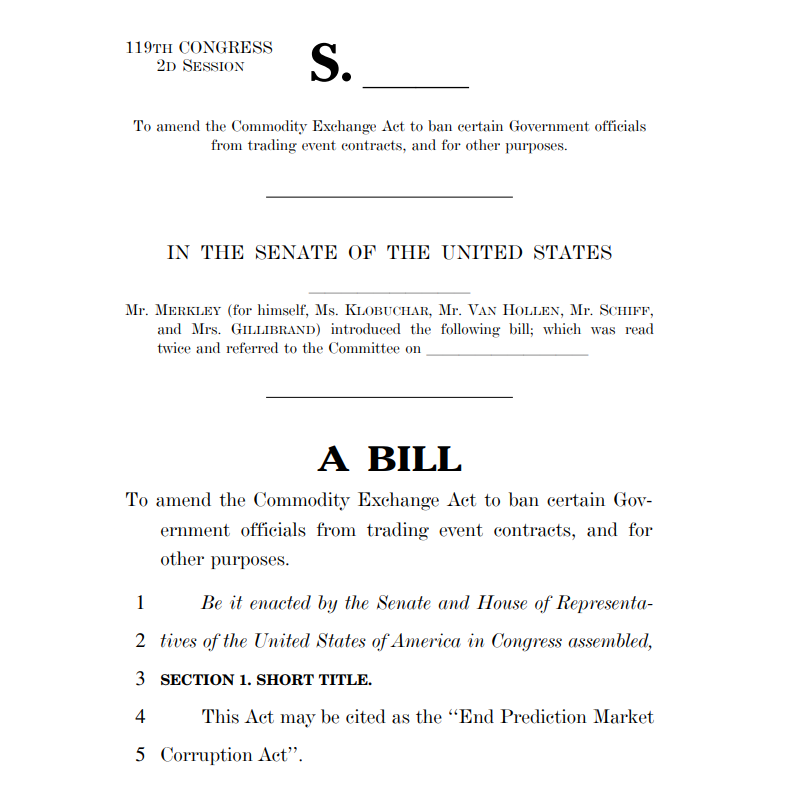
The same day, Senator Jeff Merkley introduced the End Prediction Market Corruption Act, seeking to ban event contract trading by government officials with “material non-public information,” including the president, vice president and members of Congress.
Magazine: Crypto traders ‘fool themselves’ with price predictions — Peter Brandt

Bitcoin traded near the $73,000 zone after the March CPI print came in cooler than some forecasts, easing some inflation fears and setting the stage for a cautious push higher. The Bureau of Labor Statistics showed the consumer price index rose modestly, with energy costs driving the month’s big moves.
Gasoline, in particular, surged by a hefty margin, helping push gasoline prices higher within the energy component. The CPI release also highlighted that energy costs remained elevated, even as the overall inflation picture topped by the energy spike did not portend an immediate shift in policy expectations. Traders recalibrated their bets as futures markets signaled that a near-term rate cut by the Federal Reserve remained unlikely for now.
The day’s momentum reflected a broader market narrative: traders parsed the data for hints on the Federal Reserve’s trajectory while monitoring Bitcoin’s own resistance and support levels in a chart that has shown both resilience and volatility in recent weeks.
Key takeaways
- Bitcoin hovered around $73,000 as the March CPI print came in below market expectations, suggesting a softer near-term inflation path than anticipated.
- The CPI energy component rose notably, with the gasoline index up 21.2% month over month, contributing to a 10.9% year-over-year rise in energy costs for March.
- Despite the energy spike, the overall CPI surprised to the downside relative to expectations, reinforcing a caution stance on aggressive monetary tightening or imminent rate cuts.
- Traders highlighted technical setups near critical zones, with liquidity pockets identified below $71,000 and resistance in the $73,000–$74,000 area, shaping short-term risk and reward for BTC.
- Analysts continued to weigh the broader macro context, including Fed expectations and potential chart-driven catalysts, amid a mixed inflation backdrop.
CPI dynamics and Bitcoin’s path to local highs
Markets absorbed a CPI reading that showed a tepid move versus forecasts. The data pointed to a pause in hotter inflation pressures, even as energy costs remained a focal point for investors. The gas price spike, in particular, was a reminder that energy components can dominate monthly price shifts and influence policy discourse. The official release underscored that “The index for energy rose 10.9 percent in March, led by a 21.2-percent increase in the index for gasoline,” a figure that fed into traders’ cautious posture about near-term inflation trajectories.
In the context of Bitcoin, the price action around $73,000 signals a test of nearby supply zones rather than a breakout run. Market commentary from traders noted a narrowing wedge pattern forming in the BTC/USD space, a setup that could precipitate a decisive move if support or resistance gives way. The sense of pending direction was reinforced by observations of order-book liquidity, with attention focused on levels just below $74,000 and pockets around $71,000 on the downside.
Analysts have previously linked RSI-like signals to potential trend reversals in Bitcoin, citing a pattern that some observers say echoes the late-2022 bear-market bottom. While such indicators are not guarantees, they contribute to the ongoing discourse around whether BTC can extend a move toward fresh local highs or face renewed resistance in the near term.
Near-term technical context and the broader market backdrop
From a technical standpoint, traders have kept a close eye on how BTC responds to key price levels in the coming sessions. A recent analysis from a market analyst known as JDK Analysis described BTC/USD as operating within a narrowing wedge, suggesting that the next substantial move could hinge on a breakout above a prior high or a rejection that tests support. In practical terms, that means watching how BTC behaves near the $73,000–$74,000 zone and whether selling interest tightens below $71,000.
On the liquidity front, observers have pointed to local order-book dynamics as a guiding factor for the short-term path. One trader highlighted that liquidity around critical levels—roughly below $71,000 and above $73,000–$74,000—would likely influence the pattern of any impending breakout or pullback. Such micro-structure considerations matter in a market where macro headlines intermittently drive risk appetite and liquidity conditions.
Intraday commentary also echoed the role of macro policy expectations in shaping BTC moves. Market participants have largely priced in a cautious stance from the Federal Reserve, with rate-cut prospects pushed further into the future by recent data. The CME FedWatch Tool and related market-implied probabilities have reinforced the view that policy normalization remains gradual, supporting a context in which Bitcoin could act as a risk-on or risk-off asset depending on the liquidity environment and broader risk sentiment.
Earlier coverage from Cointelegraph noted that a copycat RSI signal had appeared to mirror the conditions seen at the end of the 2022 bear market, a reminder that momentum indicators can align with longer-term price cycles in unexpectedly telling ways. This backdrop continues to color how traders interpret periodic pullbacks and rallies in BTC as they weigh the odds of a renewed leg higher versus a renewed test of the lower boundary.
This article follows the inflation release in a week that has underscored the complexity of the macro picture: energy costs are pushing CPI moves, policy expectations remain cautious, and bitcoin’s price action continues to respond to a combination of macro data and micro-structure signals. As investors weigh the next steps, attention remains on how BTC negotiates the $74,000 resistance and whether the $71,000 level will provide a firmer foothold for a sustained recovery or a further dip.
This article is intended for informational purposes and reflects data from official sources and market commentary available at the time of publication. Readers should perform their own due diligence before making any investment decisions.
What remains uncertain is how sustained energy-driven volatility will influence both inflation trajectories and the timeline for policy normalization, as well as how Bitcoin’s price will respond to any changes in risk appetite as new data comes in.

Unite Group PLC (UTGPF) Q1 2026 Sales/Trading Call Transcript
When does “Beef” season 2 come out? Inside the all-new story (and A-list cast)

Weekly News Update, 4.10.26 – Corporette.com


-

 Fashion7 days ago
Weekend Open Thread: Spanx – Corporette.com
-

 Business5 days ago
Three Gulf funds agree to back Paramount’s $81 billion takeover of Warner, WSJ reports
-

 Sports6 days ago
India men’s 4x400m and mixed 4x100m relay teams register big progress | Other Sports News
-

 Business6 days ago
Expert Picks for Every Need
-

 Tech3 days ago
How Long Can You Drive With Expired Registration? What Florida Law Says
-

 Business5 days ago
No Jackpot Winner, Prize to Climb to $231 Million
-

 Fashion4 days ago
Massimo Dutti Offers Inspiration for Your Summer Mood Board
-

 Fashion3 days ago
Let’s Discuss: DEI in 2026
-

 Crypto World2 days ago
Bitcoin recovers as US and Iran Agree a Ceasefire Deal
-
 Business6 days ago
Akebia Therapeutics, Inc. (AKBA) Discusses Pipeline Progress and Strategic Focus on Kidney Disease Treatments at R&D Day – Slideshow
-

 Crypto World1 day ago
Canary Capital Files SEC Registration for PEPE ETF
-

 Politics6 days ago
The UK should not pay a penny in slavery reparations
-

 Tech4 days ago
Samsung just gave up on its own Messages app
-

 Tech4 days ago
Haier is betting big that your next TV purchase will be one of these
-
Sports7 days ago
A Kevin O’Connell Theory Can Now Be Retired
-

 NewsBeat7 days ago
Kemi Badenoch talks ‘spring cleaning’ Reform defections
-

 Tech4 days ago
Gamer Restores the Original PlayStation Portal From Two Decades Ago
-

 Business4 hours ago
OpenAI Halts Stargate UK Data Centre Project Over Energy Costs and Copyright Row
-

 Tech4 days ago
The Xiaomi 17 Ultra has some impressive add-ons that make snapping photos really fun
-

 Tech4 days ago
Italian court says Netflix must refund customers up to $576 over price hikes
You must be logged in to post a comment Login