Connect with us
DAPA Banner

Tech

Mems Photonics Chip Shrinks Quantum Computer Control Limits

Published

on

By many estimates, quantum computers will need millions of qubits to realize their potential applications in cybersecurity, drug development, and other industries. The problem is, anyone who has wanted to simultaneously control millions of a certain kind of qubits has run into the problem of trying to control millions of laser beams.

That’s exactly the challenge that was faced by scientists working on the MITRE Quantum Moonshot project, which brought together scientists from MITRE, MIT, the University of Colorado at Boulder, and Sandia National Laboratories. The solution they developed came in the form of an image projection technology that they realized could also be the fix for a host of other challenges in augmented reality, biomedical imaging, and elsewhere. The device is a one-square-millimeter photonic chip capable of projecting the Mona Lisa onto an area smaller than the size of two human egg cells.

“When we started, we certainly never would have anticipated that we would be making a technology that might revolutionize imaging,” says Matt Eichenfield, one of the leaders of the Quantum Moonshot project, a collaborative research effort focused on developing a scalable diamond-based quantum computer, and a professor of quantum engineering at the University of Colorado at Boulder. Each second, their chip is capable of projecting 68.6 million individual spots of light—called scannable pixels to differentiate them from physical pixels. That’s more than fifty times the capability of previous technology, such as micro-electromechanical systems (MEMS) micromirror arrays.

“We have now made a scannable pixel that is at the absolute limit of what diffraction allows,” says Henry Wen, a visiting researcher at MIT and a photonics engineer at QuEra Computing.

Advertisement

The chip’s distinguishing feature is an array of tiny micro-scale cantilevers, which curve away from the plane of the chip in response to voltage and act as miniature “ski-jumps” for light. Light is channeled along the length of each cantilever via a waveguide, and exits at its tip. The cantilevers contain a thin layer of aluminum nitride, a piezoelectric which expands or contracts under voltage, thus moving the micromachine up and down and enabling the array to scan beams of light over a two-dimensional area.

Despite the magnitude of the team’s achievement, Eichenfield says that the process of engineering the cantilevers was “pretty smooth.” Each cantilever is composed of a stack of several submicrometer layers of material and curls approximately 90 degrees out of the plane at rest. To achieve such a high curvature, the team took advantage of differences in the contraction and expansion of individual layers caused by physical stresses in the material resulting from the fabrication process. The materials are first deposited flat onto the chip. Then, a layer in the chip below the cantilever is removed, allowing the material stresses to take effect, releasing the cantilever from the chip and allowing it to curl out. The top layer of each cantilever also features a series of silicon dioxide bars running perpendicular to the waveguide, which keep the cantilever from curling along its width while also improving its length-wise curvature.

A micro-cantilever wiggles and waggles to project light in the right place.Matt Saha, Y. Henry Wen, et al.

What was more of a challenge than engineering the chip itself was figuring out the details of actually making the chip project images and videos. Working out the process of synchronizing and timing the cantilevers’ motion and light beams to generate the right colors at the right time was a substantial effort, according to Andy Greenspon, a researcher at MITRE who also worked on the project. Now, the team has successfully projected a variety of videos from a single cantilever, including clips from the movie A Charlie Brown Christmas.

Advertisement

A warped projection of the Mona Lisa. The chip projected a roughly 125-micrometer image of the Mona Lisa.Matt Saha, Y. Henry Wen, et al.

Because the chip can project so many more spots in any given time interval than any previous beam scanners, it could also be used to control many more qubits in quantum computers. The Quantum Moonshot program’s mission is to build a quantum computer that can be scaled to millions of qubits. So clearly, it needs a scalable way of controlling each one, explains Wen. Instead of using one laser per qubit, the team realized that not every qubit needed to be controlled at every given moment. The chip’s ability to move light beams over a two-dimensional area, would allow them to control all of the qubits with many fewer lasers.

Another process that Wen thinks the chip could improve is scanning objects for 3D printing. Today, that typically involves using a single laser to scan over the entire surface of an object. The new chip, however, could potentially employ thousands of laser beams. “I think now you can take a process that would have taken hours and maybe bring it down to minutes,” says Wen.

Wen is also excited to explore the potential of different cantilever shapes. By changing the orientations of the bars perpendicular to the waveguide, the team has been able to make the cantilevers curl into helixes. Wen says that such unusual shapes could be useful in making a lab-on-a-chip for cell biology or drug development. “A lot of this stuff is imaging, scanning a laser across something, either to image it or to stimulate some response. And so we could have one of these ski jumps curl not just up, but actually curl back around, and then move around and scan over a sample,” Wen explains. “If you can imagine a structure that will be useful for you, we should try it.”

From Your Site Articles

Advertisement

Related Articles Around the Web

Source link

Continue Reading
Click to comment

You must be logged in to post a comment Login

Leave a Reply

Tech

Geshelli’s Torc DAC at AXPONA 2026 Lets You Have It Your Way Because Different Strokes for Different Folks

Published

on

Geshelli doesn’t do “launch hype.” Maybe a little. They build something, tear it apart, rebuild it again, and only then let it out into the world. The $699.99 TORC DAC that showed up at AXPONA 2026 isn’t some carryover from last fall; it’s the version that survived that process. And it shows. After spending time with their gear at CanJam NYC 2026, we were already paying attention. The TORC gave us a reason to stop and then stay while it took control of the room with some Metallica and a rather large pair of SVS floorstanders. Add one of the most colorful setups at the show and it felt less like a demo and more like a full-blown music party under the sea.

Which is impressive, considering we’re in Schaumburg. Closest thing to an ocean here is Lake Wazzapamani and even that’s a rather heavy ask.

Because this isn’t just another DAC with a new chip and a slightly shinier faceplate. The TORC is Geshelli doubling down on what they do best: practical engineering, modular thinking, and pricing that doesn’t assume you just sold a kidney to be here.

And here’s the part that makes some of the room a little uncomfortable; it’s a family operation, it’s built in the U.S., you can actually afford it, and it’s not cutting corners to get there. That combination isn’t supposed to exist. But here we are.

Advertisement

Finally a DAC That Doesn’t Expire the Second a New Chip Drops

The TORC is built around a genuinely modular architecture and not the usual marketing version where “upgradeable” really means “buy the next model.” At its core is a swappable DAC module (the GDAC card), which lets you choose between different conversion paths; AKM, ESS, Burr-Brown, even R2R, and change them later without replacing the entire unit. Each module has its own onboard power regulation, so you’re not just swapping chips, you’re changing how the DAC behaves at a fundamental level.

Geshelli didn’t stop there. The TORC uses four socketed mono op-amps instead of the typical dual configuration, which improves channel separation and gives you direct control over the output stage. If you want to tweak the sound, you physically swap op-amps. No menus. No DSP tricks. Just hardware doing the work.

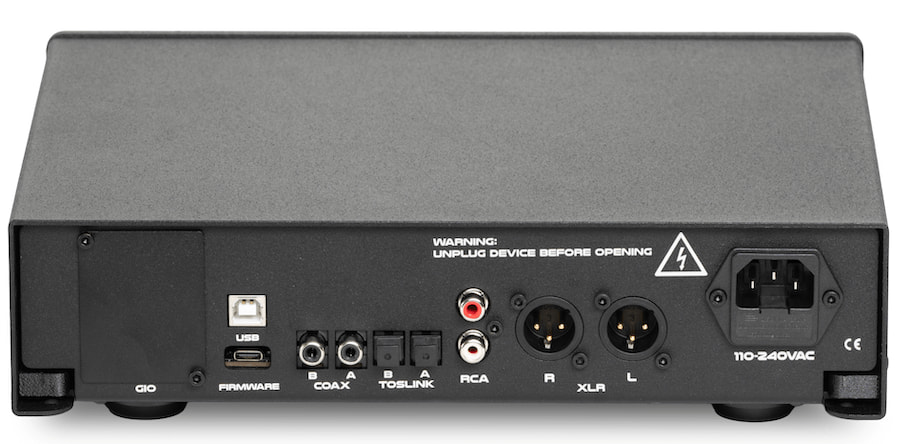
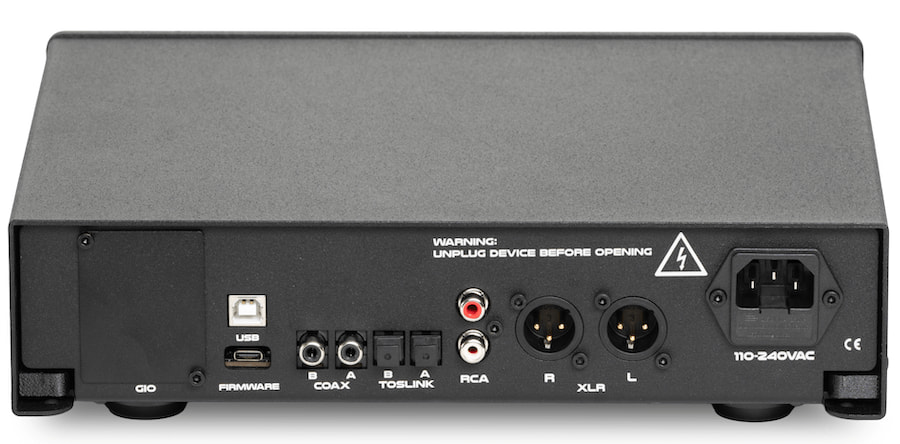
geshelli-torc-dac-rear

On the digital side, inputs are relay-switched—an old-school approach that physically disconnects unused inputs to reduce noise. It’s more complex to implement, but it works better than the shortcuts most DACs take. You get a solid baseline of connectivity with dual coaxial and dual Toslink inputs supporting up to 24-bit/192kHz PCM, and there’s an optional Amanero USB interface that pushes things much further; up to 32-bit/768kHz PCM and DSD512, depending on the DAC module installed.

Power is handled internally with a 20W AC/DC supply using a standard IEC connection, and it’s not just a single rail feeding everything. The TORC separates digital (7V, 5V, 3.3V) and analog (±11V) power rails, each with its own filtering, plus an isolated supply for the optional expansion card. That kind of separation keeps noise where it belongs—away from the signal path.

Advertisement

Output options are equally flexible, with both RCA (unbalanced) and XLR (balanced) connections standard. And if that’s not enough, the optional GIO (Geshelli Input/Output) expansion adds AES input, additional SPDIF connections, extra RCA output, and even a 4.4mm balanced output.

Which brings us to the part most companies conveniently ignore longevity. The TORC is designed to evolve. You can swap DAC modules, change op-amps, upgrade inputs and outputs, and update firmware as needed. At $699.99, it’s not trying to be disposable and it doesn’t behave like it either.

Most DACs are a dead end. New chip drops, new box shows up, and your “investment” becomes a paperweight.

Advertisement. Scroll to continue reading.
Advertisement

What Is This Going to Cost Me?

The Geshelli Labs TORC starts at $699.99, and that gets you a fully functional DAC with your choice of standard DAC modules; AKM4493, Burr-Brown PCM1794, or ESS ES9039Q2M along with OPA1655 or OPA1641 op-amps. At that price, you’re not getting a stripped-down entry point; you’re getting the core experience with balanced (XLR) and unbalanced (RCA) outputs, multiple SPDIF inputs, and the modular platform already in place.

Where things get interesting—and more expensive—is when you start customizing. Upgraded DAC modules range from about $128.99 to $259.99 if installed at purchase, including options like the ESS ES9026PRO, ES9039PRO, AKM4499 (single or dual mono), and even the AD1862R R2R module at $249.99. If you want to own multiple DAC boards to swap later, those run separately between $178.99 and $309, depending on the configuration. That’s the whole point of the TORC—you’re not replacing the DAC, you’re swapping its personality.

Op-amp rolling is another rabbit hole. Since the TORC uses four mono op-amps and all four must match, your upgrade cost lands between roughly $159.60 and $240 depending on whether you go with Sparkos, Sonic Imagery, Staccato, or Burson options. It’s not mandatory, but if you’re chasing a specific sound signature, it’s part of the appeal.

Add-ons are relatively painless by comparison. The optional Amanero USB input is $50, and the GIO expansion board, adding AES, additional SPDIF, RCA, and even 4.4mm balanced output—is another $50. Cosmetic choices like case color, LED ring, and feet don’t appear to impact pricing, but they do let you personalize the unit far more than most gear in this category.

Advertisement

So where do you land? Stick with the base unit and you’re in at $699.99. Add a better DAC module and USB, and you’re realistically in the $850 to $1,000 range. Go all-in with multiple DAC boards, premium op-amps, and expansion options, and you can push past $1,200 without trying too hard. The difference here is that you’re building one DAC that evolves with you and not replacing it every time something new drops.

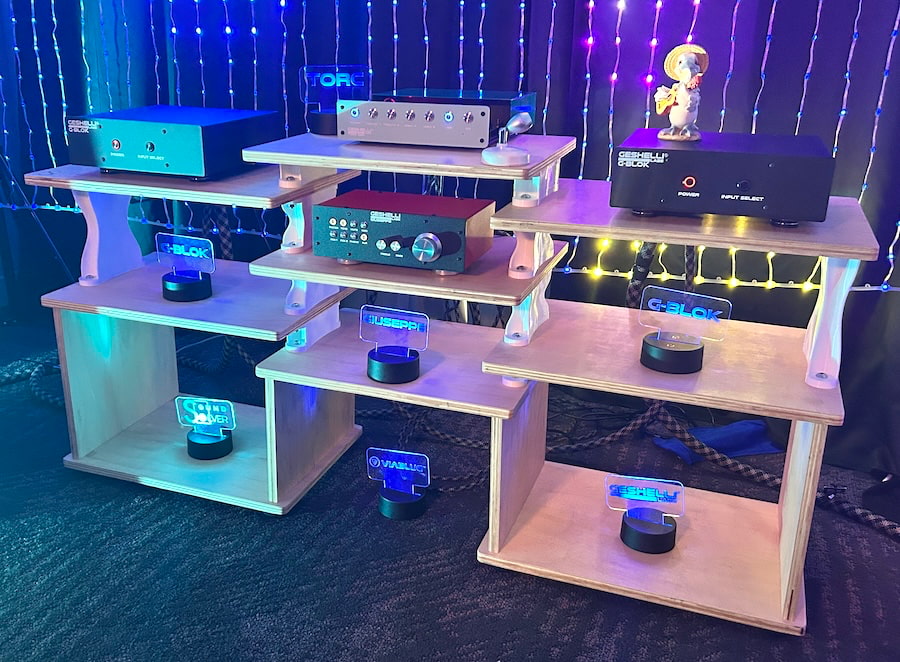
geshelli-rack-axpona-2026

For Whom the DAC Tolls and It Hits Hard

Nothing like some older Metallica requested by a couple of listeners in their 20s to get things moving. The TORC was feeding a pair of G-BLOK monoblocks, each a fully balanced Class A/B differential design rated at 200 watts into 8 ohms, and they didn’t exactly ease into For Whom the Bell Tolls. The presentation was robust, clean, and tight right out of the gate, with real grip in the low end and no sense of strain as the volume climbed. If there was a slight dryness to the overall balance, it was hard to pin on one culprit; the amps were clearly in control, but the TORC wasn’t adding any extra warmth to soften the edges either.

What makes the TORC unique is simple; it doesn’t expire. Modular DAC boards, swappable op-amps, and expandable I/O mean it evolves instead of getting replaced.This is a platform, not a dead end. And after hearing it here, we’re absolutely down to get one into the home system and see what it can really do.

For more information: geshelli.com

Advertisement

Source link

Continue Reading

Tech

Trump Threatens CNN For Very Basic Reporting On His Shitty, Unpopular War

Published

on

from the this-is-all-extremely-stupid dept

In case you’ve been asleep, what appears to be an increasingly mentally unstable Donald Trump has further destabilized the middle east with a war nobody asked for or wanted. Most U.S. media coverage of Trump’s disastrous Iran war hasn’t been great, but they’ve still occasionally managed to communicate the pointlessness of the endeavor to the electorate (which speaks more of the unpopularity of the war than their reporting chops).

Trump recently announced a “cease fire” with Iran (which apparently isn’t even a cease fire), but refused to state what the conditions of the cease fire or long term peace actually are. The Iranian Security Council issued a list of ten demands that, if agreed to, would leave Iran in a stronger position than when this whole idiocy started:

Some news outlets, like CNN, simply reported directly on what Iran had claimed. This, as you might expect, upset Donald Trump and his top FCC censor Brendan Carr, who are now threatening an “investigation” of CNN for simply repeating what was publicly stated:

Not mentioned (of course) is the fact that Fox News also reported the Iran statement, yet avoided being called out by the president:

Trump later would issue another statement over at his right wing propaganda website, calling for criminal action against CNN (and CNN only), while making up a whole bunch of nonsense (he may or may not believe is actually true):

Advertisement

Trump’s sensitivity here suggests they’re well aware that a massive, superior military has been getting dog-walked by Iranians because Trump and his advisors were too stupid to understand modern, cheap drone warfare and how shipping in the Straight of Hormuz actually worked. The shipping logjam is driving up gas prices and making life difficult for Republicans ahead of the midterms.

There is, of course, absolutely zero basis for any meaningful criminal action against CNN here of any kind that wouldn’t be laughed out of court on free speech grounds. As we’ve seen with corporate media that doesn’t mean they won’t still capitulate embarrassingly, but so far CNN is standing its ground. As it should, since again, all it did was report on an Iranian statement in a very basic way alongside dozens of other news outlets.

The bigger threat, as I keep noting, is CNN’s looming acquisition by Larry Ellison as part of the Paramount Warner Brothers merger. CNN under current management is already very friendly to right wing ideology (see its enthusiastic platforming of MAGA bullshitter Scott Jennings). Under Ellison’s ownership (see: Bari Weiss at CBS) there’s little doubt CNN will be converted into yet another Trump agitprop network.

At which point, Trump will move on to threatening any remaining U.S. corporate media outlets that haven’t either embarrassingly capitulated or been purchased by a right wing billionaire. This is, as I keep repeating, an exact copy of Victor Orban’s autocratic media policy in Hungary, which involves having party-loyal oligarchs buy up all corporate media outlets and pummel the public with propaganda while the government strangles what’s left of real, independent reporting just out of frame.

Advertisement

Filed Under: brendan carr, donald trump, first amendment, free speech, iran, iran war, journalism, reporting, straight of hormuz, trump

Companies: cnn

Source link

Advertisement
Continue Reading

Tech

Digging Into The Twilight Hack That Brought Us Wii Homebrew

Published

on

With each new game console, there’s an effort to get around whatever restrictions exist to run your own software on it. In the case of the Nintendo Wii, the system was cracked through one of its most popular games — The Legend of Zelda: Twilight Princess. How this hack works was recently covered in detail by [Skawo].

The key for this ‘Twilight Hack‘ is to use a modified game save that allows you to run arbitrary code from an SD card, something which was first patched out of the Wii firmware with version 3.3. As shown in the video using the source code, the basic concept is that the name of Link’s horse in the game is changed in the save file to be longer than the allocated buffer, which leads to a buffer overflow that can be used to reach the application loader code.

Interestingly, while the horse’s name can only be 8 characters long, and the buffer is 16 bytes (due to ShiftJS two-byte encoding), the save file loading code allocates no less than 100 bytes, for some reason. Since the code uses strcpy() instead of strncpy() (or C11’s strncpy_s()), it will happily keep copying until it finds that magic 0x00 string terminator. Basically the horse can have any name that fits within the save file’s buffer, just with no null-byte until our specially crafted payload has been copied over.

Although it took Nintendo a few months to respond to this hack, eventually it was patched out in a rather brutal fashion by simply searching for and wiping any modified save files. Naturally this didn’t stop hackers from finding ways to circumvent this save file check, which led to more counter-fixes by Nintendo, which led to more exploits, ad nauseam.

Advertisement

Even with firmware update 4.0 finally sunsetting the Twilight Hack, hackers would keep finding more ways to get their previous Homebrew Channel installed, not to mention so that they could keep watching DVDs on a Wii.

Source link

Advertisement
Continue Reading

Tech

ATC EL50 Anniversary Active Speaker Launches at AXPONA 2026 for $100,000 and Has a Lot to Prove

Published

on

$99,999 is a lot of money for almost anything. Let alone a pair of loudspeakers. It’s a king’s ransom. The ATC EL50 Anniversary Active loudspeakers roll into AXPONA 2026 carrying that number like it’s no big deal, but let’s not pretend otherwise.

I have a weird allergy to most speakers over $20,000. I’ve heard plenty, and once you get anywhere near six figures, I stop being impressed by specs and start looking for something that actually justifies the insanity. So far at this show, only two systems in that range have managed to do that. Everything else? Expensive, competent, and ultimately forgettable.

ATC doesn’t usually play the hype game. Their reputation is built on studio-grade accuracy and engineering that actually shows up in the listening. But at $99,999, none of that gets a free pass. The ATC Statement EL50 Anniversary loudspeakers needed to be mindblowing. Did they succeed? Let’s take a look.

Press breakfasts are part of the routine at trade shows like AXPONA 2026, but let’s not confuse hospitality with influence. I’m always up for a proper English breakfast minus the bacon or bangers because kosher rules still apply. Coffee, eggs, maybe some toast. That’s not a payoff. That’s survival.

Advertisement

What it actually is: “Morning, boys. You spent a few grand to get here. Here’s something so you don’t pass out before noon.” Fair enough. We appreciated it and moved on.

Let’s get one thing out of the way before anyone starts sharpening knives on social media. Breakfast doesn’t buy coverage. It doesn’t buy opinions. And it definitely doesn’t buy a pass on a $99,999 loudspeaker that better deliver something more than a polished sales pitch.

There was some noise last week from a certain Editor and Publisher on Facebook suggesting otherwise. That we’re all somehow in the pocket. That access equals allegiance. That’s a convenient narrative if you’re not actually in the room doing the work. And was he including himself in that rant? I have stories.

But here’s the reality. If a plate of eggs is enough to sway your editorial integrity, that says a lot more about you than it does about anyone sitting at that table.

Advertisement

Now that the air is clear, back to the part that actually matters. The gear.

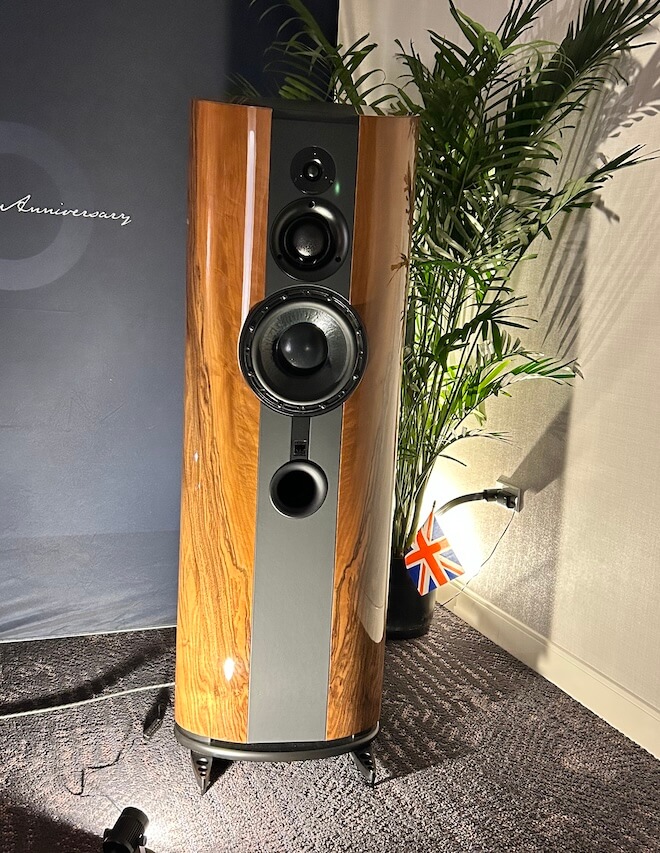
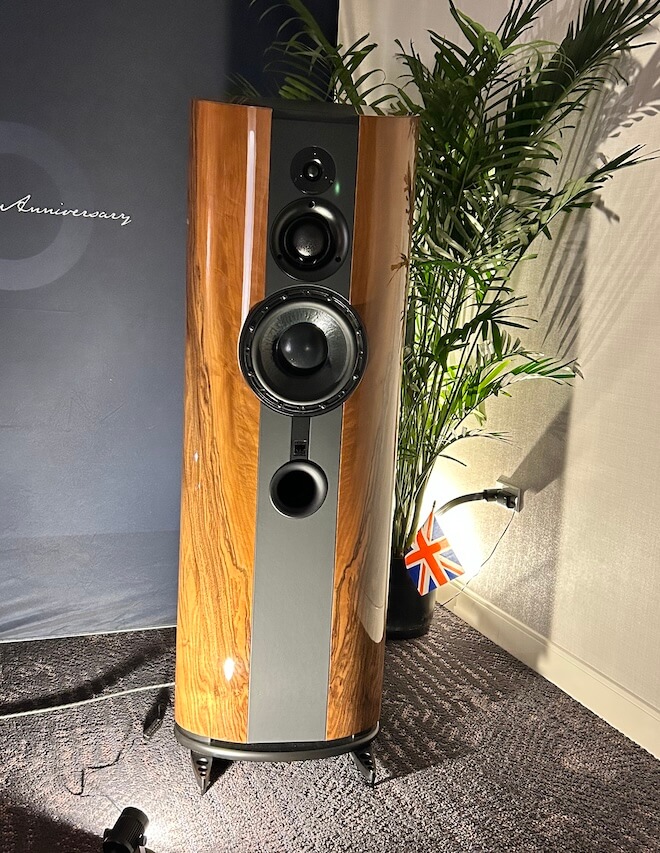
atc-el50-axpona-speaker-2026

Why the ATC EL50 Anniversary Costs $99,999

The ATC EL50 Anniversary is expensive for a very specific reason. It is not a passive loudspeaker that needs to be matched with external amplification. It is a fully active 3 way system with amplification, crossover, and drivers all engineered to work together as a single platform. The crossover is handled at line level using a fourth order Linkwitz-Riley active design with crossover points at 380Hz and 3.5kHz, which allows each driver to be controlled more precisely than in a traditional passive speaker. Each driver has its own dedicated amplifier channel with 200 watts for the bass, 100 watts for the midrange, and 50 watts for the tweeter, all using ATC’s discrete grounded source MOSFET Class A/B amplification running fanless with convection cooling.

ATC also builds its own drivers in house, and that has been central to its design philosophy for decades. The system is designed to cover a frequency range from 32Hz to 25kHz within a -6dB window, which is sufficient for full range reproduction in most rooms without relying on a subwoofer. Distortion is kept extremely low, with THD around 0.0015 percent just below rated power, and matched pair tolerance is held to ±0.5dB, which ensures consistency between channels. Maximum output is rated at 112dB per pair at one meter in anechoic conditions, which gives it enough headroom for larger spaces without strain.

Advertisement. Scroll to continue reading.

The cabinet design follows the same thinking. The curved enclosure and softened edges are intended to reduce diffraction and improve off axis behavior, while the multi layer construction increases rigidity and reduces unwanted resonance. Each speaker stands just under 56 inches tall, over 18 inches wide, and nearly 14 inches deep, and weighs 139 pounds. This is a physically large and heavy loudspeaker, and that mass contributes to overall stability and reduced cabinet interaction.

Advertisement

Connectivity is straightforward but purposeful. The EL50 uses a balanced XLR input with switchable input sensitivity, along with a bass shelf adjustment from -2dB to +3dB to help with room integration. There is also a 12V trigger input and link for system control, and built in protection circuits for DC offset and thermal management with active limiting to maintain reliability under load.

In practice, you are paying for a system where the major variables have already been addressed at the design stage rather than left to system matching. That approach has long been part of ATC’s presence in professional studios, and it carries over directly into a product like the EL50.

The room at AXPONA 2026 was not especially large, which likely worked in its favor. The rest of the system included a balanced ATC preamplifier, along with an Innuos ZENith NG network player and a Playback Designs MPD-8 DAC. That digital front end alone totals close to $50,000, with cabling handled by WireWorld.

atc-el50-speaker-drivers-axpona-2026

No Place to Hide at $99,999

Where do you even begin with something like this? Fine. Here goes.

I was the first one in the room. Of course I was. I’ll show up early for my own execution. Expectations were high, borderline unreasonable, but that comes with the territory at this level. I’ve been burned before by speakers in this price range. Big promises. Impressive specs. And then…nothing. Polite. Safe. Forgettable. I wasn’t in the mood for that again. I was still hungry.

Advertisement

There’s a moment most speakers completely fumble. That split second before the music actually starts. The air shifts, the room tightens, and you’re waiting for something to happen. Your brain knows what’s coming, but your body hasn’t caught up yet. When it’s done right, your heart skips. When it’s not, you’re already checking out before the first note lands.

ATC didn’t miss.

That first transient hit and something locked in. Not exaggerated. Not hyped. Just there—with a sense of presence and control that felt immediate and real. It didn’t creep up on you. It arrived. And it hit with the kind of conviction that makes you sit up without thinking about it.

It’s hard to explain without sounding ridiculous, but it felt like the first time you finally kiss someone you’ve been thinking about for way too long. There’s anticipation, sure, but then there’s that moment where it actually happens and it’s better than you built it up to be. More intensity. More weight. More passion. And suddenly you’re not analyzing anything anymore. You’re just in it.

Advertisement

And that was the first 20 seconds.

At that point, I wasn’t thinking about price, specs, or whether this was “worth it.” I was just trying to keep up.

Advertisement. Scroll to continue reading.

Another huge positive? The bass is actually under control.

Advertisement

Not polite. Not neutered. Controlled. And that’s a big deal because this is where a lot of speakers in this category fall apart. They either overdo it to impress in five minutes or they hold back and sound like they’re afraid of their own capabilities.

The EL50 doesn’t do either.

If the bass is in the recording, it shows up with authority. If it’s not, the speaker doesn’t invent it. The midbass in particular is doing a lot of heavy lifting here—resolute, tight, well defined, and absolutely critical to how this speaker holds everything together. There’s no bloom, no excess weight hanging around where it shouldn’t be, and no sense that the room is being pushed past its limits.

And let’s be clear, this is not a small speaker. It looks imposing. The bass driver looks like it has a job to do and zero interest in compromise. But the presentation never tipped into something disproportionate or overblown. It sounded big, yes—but in a way that felt grounded. Real, for lack of a better word.

Advertisement

That’s the part that stuck with me.

atc-el50-right-speaker-axpona-2026

It never overloaded the room. It never tried to dominate the space just because it could. It just scaled naturally with the music, which is harder to pull off than most designers would care to admit.

At some point, I realized I was mentally rearranging my entire review schedule for May and June just to figure out how to spend more time with these. That’s not normal behavior.

I will never be able to afford these. And that’s fine.

No, it isn’t. But it’s what I’ll be telling myself for a very long time. Bugger.

Advertisement

For more information: atc.audio

Source link

Advertisement
Continue Reading

Tech

The Beats Studio Buds+ drop to $99, and they’re the wireless earbuds I’d recommend for iPhone and Android users alike

Published

on

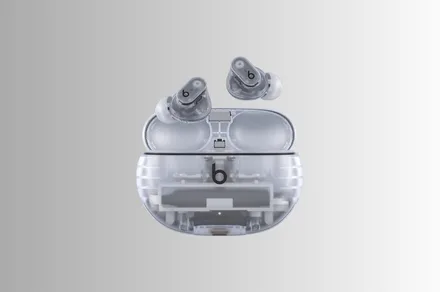
The Beats Studio Buds+ are down to $99.95, a $70 saving off their $169.95 list price, and that gets you true wireless noise canceling, spatial audio, and sweat resistance at a price that most competing earbuds with this feature set can’t touch. For anyone using an iPhone or an Android device, these cover the bases better than most things at this price.

What you’re getting

The Studio Buds+ improved on the original Studio Buds in two meaningful ways: better ANC performance and the addition of spatial audio, which delivers a more immersive, three-dimensional listening experience on compatible content. The noise-canceling handles commuting and office environments well, and transparency mode is responsive enough to actually use when you need to stay aware of your surroundings.

What sets the Studio Buds+ apart from most earbuds at this price is the cross-platform compatibility. They pair seamlessly with iPhone through the Apple ecosystem while offering full Android integration through the Beats app, one-touch Google Assistant access, and Find My Device support. Most earbuds at this price favor one platform at the expense of the other; the Studio Buds+ don’t make that compromise.

The built-in microphone handles calls clearly, the IPX4 sweat resistance makes them a practical gym companion, and the compact charging case keeps the overall package travel-friendly.

Advertisement

Why it’s worth it

Spatial audio and ANC together in a wireless earbud typically push the price well above $100. The Beats Studio Buds+ at $99.95 bring both to a price point where the decision becomes considerably easier, particularly for anyone who switches regularly between Apple and Android devices and doesn’t want to sacrifice features to do so.

The bottom line

The Beats Studio Buds+ at $99.95 are a well-rounded wireless earbud at a price that makes the feature set look considerably more expensive than it is. The ANC, spatial audio, and genuine dual-platform compatibility add up to an earbud that’s difficult to beat at this price, and the $70 saving makes it the right time to pick them up.

Source link

Advertisement
Continue Reading

Tech

South Korea moves to curb the meteoritic rise of DRAM and PC hardware prices

Published

on


Conditions in the hardware market remain strained, with prices for nearly all components rising sharply as AI companies place unprecedented pressure on supply chains for future demand. In this environment, stricter market regulation may be warranted, but there appears to be little appetite in Washington for increased government intervention.
Read Entire Article
Source link

Continue Reading

Tech

Garmin may be working on a Whoop competitor

Published

on

Whoop, the makers of a screen-free fitness tracker of the same name, could soon have some competition. Fitbit teased its take on a Whoop-style band with the help of Steph Curry at the end of March, and based on a trademark filing spotted by Gadgets & Wearables, Garmin appears to be working on its own band that tracks similar health metrics.

This new Garmin wearable, called “CIRQA” in the trademark filing submitted in February, is designed to measure “the body’s physical parameters and other physiological data, bio-signals, and bodily behavior.” That could broadly describe the smartwatches and fitness trackers Garmin already sells. But the CIRQA apparently goes further, by also measuring “recovery from physical and emotional stress, human alertness level, and performance,” a set of more granular, wellness-focused features that could bring the unreleased wearable into the same ballpark as a Whoop.

Garmin accidentally leaked that it was working on a new wearable via a hastily removed store page in January, Android Authority reports. While some phantom web pages and a trademark do not guarantee Garmin is working on a new device, or that the band will be screen-free in the same way the Whoop is. If the company is preparing a competitor, though, the timing makes sense. Where other devices try to split the difference between tracking biometrics and offering real-time information or other smartwatch features, Whoop is decidedly data-first. Its wearables monitor as much information as possible through a nondescript band, and then analyze and display what it learned via a smartphone app. The approach is attractive to anyone tired of dealing with screens, and the growing number of people obsessed with optimizing their health. In fact, Whoop just raised $575 million on the back of its current success. It would make sense that Garmin and Google (via its Fitbit brand) would want a piece of the company’s audience, too.

Whoop-style bands are also a perfect fit for future uses of AI in health and fitness tracking. Google is interested in having users turn to Fitbit’s AI-powered health coach for everything from workout tracking to nutrition advice. If health data processing is going to happen in the cloud, and you’re going to have to pull out your smartphone to view that data anyway, it makes sense to sell a tracker without a screen.

Advertisement

Source link

Continue Reading

Tech

The FAA is encouraging gamers to get jobs in air traffic control

Published

on

Sick! The Federal Aviation Administration is targeting gamers in its most recent job advertisement for air traffic controllers. The administration’s annual hiring window opens at 12AM ET on April 17, and considering the ongoing shortage of air traffic controllers, it’s calling this a period of “supercharged hiring.” Rad! The FAA’s YouTube video draws parallels between gaming and directing air traffic, and notes that the average salary for the role after three years is $155,000. Hella!

The FAA is clearly seeking players who are at least old enough to remember the Xbox One and Bjergsen in the LCS, which puts would-be candidates around their early 20s at least. It’s either that, or the ad editors really just picked videos at random from the pile of stock footage marked gamerz. But I won’t lie, it made me smile to see that Xbox One logo appear out of nowhere. Nostalgia is a hell of a thing.

“To reach the next generation of air traffic controllers, we need to adapt,” US Transportation Secretary Sean P. Duffy said. “This campaign’s innovative communication style and focus on gaming taps into a growing demographic of young adults who have many of the hard skills it takes to be a successful controller.”

The FAA has been losing more air traffic controllers than it can hire and retain since the 2010s, and this trend only worsened during the pandemic in the 2020s, according to a report released in December by the US Government Accountability Office. The administration increased hiring every year since 2021, but at the end of 2025 it employed 13,164 air traffic controllers, 6 percent fewer than in 2015, the report said. At the same time, the number of flights in the air traffic control system increased by about 10 percent, to 30.8 million.

Advertisement

Or, as the FAA put it on the ATC hiring page: “Join the BEST AND BRIGHTEST, the elite squad of 14,000 controllers protecting 2.9 million daily passengers.” Applicants must be a US citizen, under 31 (maybe those video editors do know what they’re doing), and be able to speak fluent English. An aptitude test, medical screening and academy training follows, among other steps.

Source link

Continue Reading

Tech

CPUID Site Hijacked To Serve Malware Instead of HWMonitor Downloads

Published

on

Attackers briefly hijacked part of CPUID’s backend and swapped legitimate download links on its site with malware-laced ones. “The issue hit tools like HWMonitor and CPU-Z, with users on Reddit and elsewhere starting to notice something wasn’t right when installers tripped antivirus alerts or showed up under odd names,” reports The Register. From the report: CPUID has since confirmed the breach, pinning it on a compromised backend component rather than tampering with its software builds. “Investigations are still ongoing, but it appears that a secondary feature (basically a side API) was compromised for approximately six hours between April 9 and April 10, causing the main website to randomly display malicious links (our signed original files were not compromised),” one of the site’s owners said in a post on X. “The breach was found and has since been fixed.”

The files themselves appear to have been left alone and remain properly signed, so it doesn’t seem like anyone got into the build process. Instead, the problem sat in front of that, in how downloads were being served. For anyone who hit the site during that stretch, though, that distinction offers little comfort. If the link you clicked had been swapped out, you were pulling whatever it pointed to, whether you realized it or not.

Source link

Continue Reading

Tech

CPUID hacked to deliver malware via CPU-Z, HWMonitor downloads

Published

on

CPUID hacked to deliver malware via CPU-Z, HWMonitor downloads

Hackers gained access to an API for the CPUID project and changed the download links on the official website to serve malicious executables for the popular CPU-Z and HWMonitor tools.

The two utilities have millions of users who rely on them for tracking the physical health of internal computer hardware and for comprehensive specifications of a system.

Users who downloaded either tool reported on Reddit recently that the official download portal points to the Cloudflare R2 storage service and fetches a trojanized version of HWiNFO, another diagnostic and monitoring tool from a different developer.

Wiz

The name of the malicious file is HWiNFO_Monitor_Setup, and running it launches a Russian installer with an Inno Setup wrapper, which is atypical and highly suspicious.

Users reported that downloading the clean hwmonitor_1.63.exe from the direct URL was still possible, indicating that the original binaries were intact, but the distribution links appear to have been poisoned.

Advertisement

The externalized download chain was also confirmed by Igor’s Labs and @vxunderground, who reported that a fairly advanced loader using known techniques, tactics, and procedures (TTPs) is involved.

“As I began poking this with a stick, I discovered this is not your typical run-of-the-mill malware,” stated vxunderground.

“This malware is deeply trojanized, distributes from a compromised domain (cpuid-dot-com), performs file masquerading, is multi-staged, operates (almost) entirely in-memory, and uses some interesting methods to evade EDRs and/or AVs such as proxying NTDLL functionality from a .NET assembly.”

Tweet

The researcher claims that the same threat group targeted users of the FileZilla FTP solution last month, suggesting that the attacker is focusing on widely used utilities.

Advertisement

The downloaded ZIP is flagged by 20 antivirus engines on VirusTotal, although not clearly identified. Some classify it as Tedy Trojan, and others as Artemis Trojan.

Some researchers on Virustotal say that the fake HWiNFO variant is an infostealer malware.

BleepingComputer has contacted CPUID to learn more about what happened, the date of the compromise, the affected versions, and what impacted users should do. A spokesperson has provided the following statement.

“Investigations are still ongoing, but it appears that a secondary feature (basically a side API) was compromised for approximately six hours between April 9 and April 10, causing the main website to randomly display malicious links (our signed original files were not compromised). The breach was found and has since been fixed.” – CPUID

Advertisement

The same person told us that the hackers hit them at a time when the main developer was away on holiday.

Currently, it appears that CPUID has fixed the problem and now serves clean versions for both CPU-Z and HWMonitor.

Automated pentesting proves the path exists. BAS proves whether your controls stop it. Most teams run one without the other.

This whitepaper maps six validation surfaces, shows where coverage ends, and provides practitioners with three diagnostic questions for any tool evaluation.

Source link

Advertisement
Continue Reading

Trending

Copyright © 2025