
Crypto World
Arizona barred from acting against Kalshi event contracts



A federal judge in Arizona has temporarily stopped state officials from enforcing gambling laws against Kalshi, a prediction market platform regulated by the Commodity Futures Trading Commission.
Summary
- A federal judge paused Arizona action against Kalshi and backed the CFTC’s jurisdiction argument.
- The restraining order blocks Arizona enforcement until April 24 as the case moves forward.
- State and federal officials remain split on whether event contracts are swaps or gambling.
The ruling adds to the legal fight over whether event-based contracts should be treated as financial products under federal law or as gambling under state rules.
The order came from Judge Michael Liburdi of the US District Court for the District of Arizona. The court granted a request from the CFTC and the federal government to pause Arizona’s action while the case moves ahead. The restraining order will stay in place until April 24 as the court considers the next step.
The case centers on Kalshi’s event contracts, which let users trade on the outcome of real-world events. The CFTC argued that these products qualify as swaps under the Commodity Exchange Act and therefore fall under federal oversight rather than state gambling law.
The court said the federal government is likely to succeed on that argument. That finding led the judge to block Arizona from starting or continuing civil or criminal action tied to contracts listed on CFTC-regulated markets. The ruling also paused Arizona’s criminal case against Kalshi.
Additionally, Arizona had moved against Kalshi under state gambling rules and filed criminal charges tied to event-based trading. State prosecutors argued that Kalshi was offering unlawful betting products, including contracts tied to political events and sports outcomes.
After the CFTC stepped in, the federal court halted that effort. The order means Arizona officials cannot continue enforcement tied to Kalshi’s contracts during the current restraining period. Reports also said a scheduled arraignment was called off after the ruling.
Wider fight over prediction markets
The Arizona case is part of a wider dispute over prediction markets in the United States. On April 6, a federal appeals court ruled that New Jersey could not restrict Kalshi’s sports-related event contracts, finding that the CFTC has exclusive jurisdiction over those products.
Other states have taken a different view. In Nevada, a judge last week extended a ban on Kalshi’s event contracts, saying the products were close enough to sports betting to fall under state gaming law.
Utah lawmakers have also moved against proposition-style event markets. Those split outcomes show that the legal fight over Kalshi and similar platforms is still active.
Furthermore, the latest order gives Kalshi temporary relief, but it does not settle the full dispute. The larger question is whether platforms offering these contracts operate as regulated exchanges or as betting businesses under state law.



The crypto market recap for May 3 centered on U.S. regulation, tokenized securities, venture funding and Bitcoin-focused corporate activity.
Summary
- Coinbase said Senate negotiators reached a stablecoin rewards deal, easing delays around the CLARITY Act.
- NYSE filed to trade tokenized securities under DTC’s pilot while preserving traditional share rights rules.
- Founders Fund raised $6 billion as Tether backed a Bitcoin merger involving Strike and Elektron.
Coinbase reported progress on a key crypto bill, while the NYSE moved closer to tokenized stock trading under a DTC pilot.
Coinbase says CLARITY Act deal clears key hurdle
Coinbase said Senate negotiators reached a compromise on a disputed stablecoin rewards provision tied to the CLARITY Act. The agreement could help the bill move toward a Senate markup after months of delay.
The dispute focused on whether crypto firms and stablecoin issuers can offer rewards to users. Banks argued that yield-like rewards could pull deposits away from lenders, while crypto firms said they need room to reward real platform use.
Coinbase Chief Policy Officer Faryar Shirzad said, “In the end, the banks were able to get more restrictions on rewards, but we protected what matters.” He said crypto platforms kept the ability to offer rewards based on real network and platform activity.
Meanwhile, the reported compromise was negotiated by Senators Thom Tillis and Angela Alsobrooks. The language would ban rewards that work like interest or yield on a bank deposit.
That gives banks part of what they wanted while leaving a path for crypto rewards tied to user activity. The bill’s next step depends on committee support, final rule details and wider political backing.
The SEC has also scheduled a May roundtable tied to the CLARITY Act and digital asset market structure. That meeting adds another policy event for crypto firms watching U.S. rules.
Founders Fund raises record $6B vehicle
Peter Thiel’s Founders Fund closed a new $6 billion fund, marking the largest raise in the firm’s history. The vehicle will focus mainly on late-stage startup investments.
About $4.5 billion came from limited partners, including sovereign wealth funds. Thiel, management and employees contributed the remaining $1.5 billion.
The fund places Founders Fund in a stronger position to compete for large private technology deals. It also shows that major venture firms can still attract capital for mature startups, even as many companies delay public listings.
NYSE files for tokenized securities trading
The New York Stock Exchange filed a proposed rule change with the SEC to allow tokenized versions of eligible securities to trade on its market. The plan would run under DTC’s three-year tokenization pilot.
Eligible tokenized securities must keep the same CUSIP, ticker, rights and privileges as their traditional versions. They would trade on the same order book and follow the same execution priority.
Clearing and settlement would remain through DTC on a T+1 basis. The NYSE also said it is “assessing various methods of tokenization” and may file more proposals if it chooses another structure.
Tether backs Bitcoin merger plan
Twenty One Capital shares rose after hours after Tether backed a merger plan involving Strike and Elektron Energy. The proposal would combine Bitcoin treasury exposure, payments and mining infrastructure.
Strike would add payments and financial services, while Elektron would add mining operations. Tether said the deal could bring together “Mallers’ product, brand, and consumer Bitcoin leadership” with Raphael Zagury’s operating and capital markets experience.
Crypto World
Microsoft (MSFT) or Alphabet (GOOGL): Which Tech Giant Deserves Your Investment in 2025?

Key Takeaways
- Microsoft’s 2025 revenue climbed to $281.7B with 15% growth, while Azure surpassed $75B in annual revenue
- Google Services delivered a 41.9% operating margin in Q4 2025 under Alphabet
- Wall Street analysts rate Microsoft with 38 Buy recommendations and a consensus price target of $556.15
- Alphabet’s GOOGL attracts 53 analyst ratings with a mean price objective of $397.48
- Analysts generally view Microsoft as offering a more straightforward investment narrative
When evaluating leading technology stocks, Microsoft and Alphabet stand out as dominant forces shaping the cloud computing and artificial intelligence landscapes. However, their investment profiles present distinct characteristics for shareholders to consider.
Microsoft delivered impressive fiscal year 2025 performance, recording $281.7 billion in total revenue—a 15% year-over-year increase. The company’s operating income expanded 17% to reach $128.5 billion. Azure’s cloud platform achieved a significant milestone, generating over $75 billion in revenue with 34% growth.
During its fiscal Q3 2026, Microsoft reported $82.9 billion in revenue, marking an 18% increase. The quarter yielded $38.4 billion in operating income and $31.8 billion in net income.
Microsoft’s competitive advantage lies in its tightly integrated ecosystem. Azure’s expansion drives complementary demand across Office 365, Teams, GitHub, and cybersecurity solutions. The company has successfully woven AI capabilities into existing revenue-generating enterprise products.
This integration creates clearer visibility for financial analysts projecting future performance. Unlike speculative AI investments, Microsoft’s artificial intelligence monetization is demonstrable and current.
Alphabet’s Competitive Position
Alphabet posted solid financial results as well. In Q4 2025, Google Services operating income jumped 22% to $40.1 billion, achieving an impressive 41.9% margin. The company’s search and advertising segments generated $63.1 billion during the quarter, reflecting 17% growth.
By mid-2025, Google Cloud had established an annual revenue trajectory exceeding $50 billion. Company executives highlighted ongoing margin improvements alongside expanding customer adoption.
Alphabet’s diversified assets include YouTube, subscription services, and a robust cash-generation machine. The organization has integrated AI functionality throughout its Search ecosystem, deploying AI Overviews, AI Mode, and enhanced Lens capabilities.
The lingering question for investors centers on whether artificial intelligence will enhance Google’s core Search business long-term or potentially disrupt its traditional revenue model. Market participants are still awaiting definitive evidence.
Wall Street’s Perspective
Microsoft receives a Moderate Buy consensus rating from MarketBeat, supported by 38 Buy ratings, 1 Strong Buy, and 5 Hold recommendations. Analysts project a mean 12-month price target of $556.15.
Alphabet’s GOOGL shares attract coverage from 53 analysts with a consensus target of $397.48. The GOOG share class commands 29 buy ratings, 7 strong buy ratings, and 3 holds, with an average price objective of $362.73.
Both companies enjoy favorable Wall Street sentiment. Microsoft’s investment case appears more transparent, featuring extensive enterprise penetration and clearly accelerating cloud revenue.
Alphabet may attract investors seeking exposure to a more attractively priced tech giant with formidable Search and Cloud franchises, particularly those who believe AI-related concerns are exaggerated.
The fundamental difference: Microsoft has already embedded AI monetization throughout its commercial operations. Alphabet’s complete AI value proposition remains contingent on how its Search business adapts and evolves.

Crypto World
Aster Chain Hits 100 Million Blocks in Two Months, Aster DEX Surpasses 16 Million Users

TLDR:
- Aster Chain reached 100 million blocks in under two months, driven by a 50-millisecond block production time.
- Aster DEX has recorded over $4.49 trillion in total trading volume with 16 million registered users.
- The network processes all transactions in a fast, private, and completely gas-free on-chain environment.
- Staking is now live on Aster Chain, with on-chain governance and RWA perp expansion coming very soon.
Aster Chain has reached 100 million blocks just two months after its Mainnet launch. The Layer 1 network, built exclusively for derivatives trading, operates at a block time of about 50 milliseconds.
That speed allows it to generate tens of thousands of blocks every hour. The milestone reflects strong real-world activity and growing overall adoption since the network first went live.
Speed and Infrastructure Behind the 100 Million Block Milestone
Aster Chain’s block production pace is among the fastest recorded on any Layer 1 network in operation today. At 50 milliseconds per block, the chain processes transactions at a rate that very few blockchain networks can match.
This level of throughput is validated by the 100 million blocks confirmed in under 60 days. Reaching that mark in such a short window shows that the network is handling genuine and consistent transaction load.
All transactions are processed on the network in a fast, private, and gas-free environment. This structure removes the friction typically found in high-frequency trading on most Layer 1 platforms.
Derivatives traders benefit directly from this model, as speed and cost matter most in their daily activity. The chain was built with those specific requirements in mind from the ground up.
A post by @davidbnb68 on X described the milestone and credited the chain’s architecture for enabling it. The post noted that the 100 million block count reflects extremely high block production speed and real-world activity.
It further identified Aster Chain as the core platform behind fast, private, and gas-free transaction processing. The post also pointed out that traders and ASTER holders are paying close attention to developments.
Aster DEX Growth and the Road Ahead for Token Holders
Aster DEX has surpassed 16 million users since launching on the Aster Chain network. Total trading volume on the platform has exceeded 4.49 trillion USD.
Open interest currently sits at approximately 2.1 billion USD. These metrics reflect a steady and active level of participation from traders across the market.
The platform’s gas-free and privacy-focused model has helped position it alongside top perpetual DEXs globally. Aster DEX routes all trades through Aster Chain, giving it a speed and cost advantage over platforms on slower networks. This setup has contributed to consistent volume growth in a relatively short period of time.
Staking is now live on the network, and on-chain governance features are expected to follow soon. The roadmap also covers smart-money tools and expansion into RWA and stock perpetual markets.
ASTER token holders now have an early chance to stake ahead of governance going live. These features are set to add more utility to the ecosystem for both active traders and long-term holders.
Crypto World
Crypto is at the bottom of U.S. voters’ priorities heading into the midterm, CoinDesk survey shows
U.S. voters placed cryptocurrencies toward the bottom of a list of their highest priorities for the upcoming midterm election.
Just 1% of respondents said they ranked crypto as their top concern, according to a survey of 1,000 randomly selected registered U.S. voters, though other responses revealed a wider view of the technology as an important political issue.
The survey was conducted near the end of April by Public Opinion Strategies on CoinDesk’s behalf, as part of CoinDesk’s coverage of the 2026 U.S. midterm election. The survey was evenly split between Republican and Democrat respondents (41% of respondents identified with each party to some degree), with a credibility interval of plus or minus 3.53%.
Crypto won’t be on the ballot this year, but the industry still has a vested interest in who wins. The market structure bill, one of the most important pieces of legislation, is seen as the top priority for crypto. Though the bill known as the Clarity Act still has a path to becoming a law before the end of the year, it’s taken far more time than expected and still needs to clear a number of hurdles. Other bills, including expected tax reform legislation, will likely end up before Congress in the coming months. Ahead of the election, the crypto industry has dedicated hundreds of millions of dollars intended to support friendly candidates, after being the single largest donor industry in the 2024 election.
This article is part of a CoinDesk series on voters’ views for the 2026 midterm election.
As of press time, the most likely outcome of the 2026 election is that Democrats will become the majority party in the House of Representatives, while the Senate is more likely to remain dominated by Republicans. A generic question in POS’s poll for CoinDesk about whether voters would choose the Republican or Democrat candidate gave a slight edge to Democrats (44% to 41%); this +3 margin is roughly in line with a number of other polls, according to a tracker hosted by The New York Times.
Prediction market provider Kalshi has the Senate at an even split. But Democrats have a much tougher road to picking up a majority there, Cook Political Report said in April.
This poll also showed U.S. President Donald Trump with a net negative approval rating, with 40% of respondents saying they somewhat or strongly approved of his performance, while 60% disapproved.
And unsurprisingly, respondents said the cost of living (36%), jobs and the economy (13%), and Social Security and Medicare (11%) were their single most important issues. Other issues, such as immigration and border security, healthcare, national security, government spending and more, all saw single-digit percentage responses. Crypto ranked at the bottom, largely among voters leaning toward the Republican Party. Artificial intelligence came in just a smidge higher, with 2% of respondents calling it their single most important issue.
Views on crypto
Crypto itself does not enjoy a favorable image among the survey respondents. While participants who leaned toward the GOP had a slightly more favorable view of cryptocurrency than unfavorable (41% to 39%), base GOP (33% to 39%), independents (27% to 48%), Dem-leaning voters (26% to 54%) and base Dems (25% to 58%) all had a more unfavorable view.

Just over a quarter of participants (27%) said they had invested, traded or used a cryptocurrency, while another 27% said they haven’t but might one day. Of those who had invested, 2% currently have over $10,000 worth of digital assets, 9% said they owned between $1,001 and $10,000 and 12% said they had $1,000 or less in crypto.

In terms of the November election, 49% of participants who said they were “much more interested” in this year’s election than in the 2022 election said they owned $1,000 or more worth of crypto.
According to the data, 47% of respondents said Republicans were more supportive of cryptocurrencies, compared to just 14% who said the same about Democrats. These figures don’t necessarily indicate whether respondents saw that as a good thing, however. Interestingly, Democrats maintained a slight edge in voter trust in crypto, with 27% of respondents saying they trusted the party, compared with 25% who said they trusted Republicans more. A greater proportion of respondents — 40% — said they didn’t trust either party.
Roughly 40% of respondents also said they would be more likely to vote for a candidate who shared their views on crypto, though the survey did not ask whether this was tied to positive or negative views of crypto.
Crypto also had lower favorability (30%) than Republicans (39%) or Democrats (43%). Meanwhile, DeFi — also known as finance on the blockchain — had 17% of respondents saying they had a favorable view, though only 60% of respondents overall said they’d even heard of it.
Artificial intelligence had rosier numbers — 46% of respondents had a favorable view, while 45% had an unfavorable view.
Despite all that — and in somewhat of a contradiction to not flagging crypto as their top issue — when asked directly how important crypto was for the 2026 election, 3% of respondents said it was the “single most” important issue, and a further 22% said it was an important issue. That represents a much higher awareness of digital assets than voters had several years ago.
CoinDesk will release data from this survey on Tuesday at Consensus Miami.
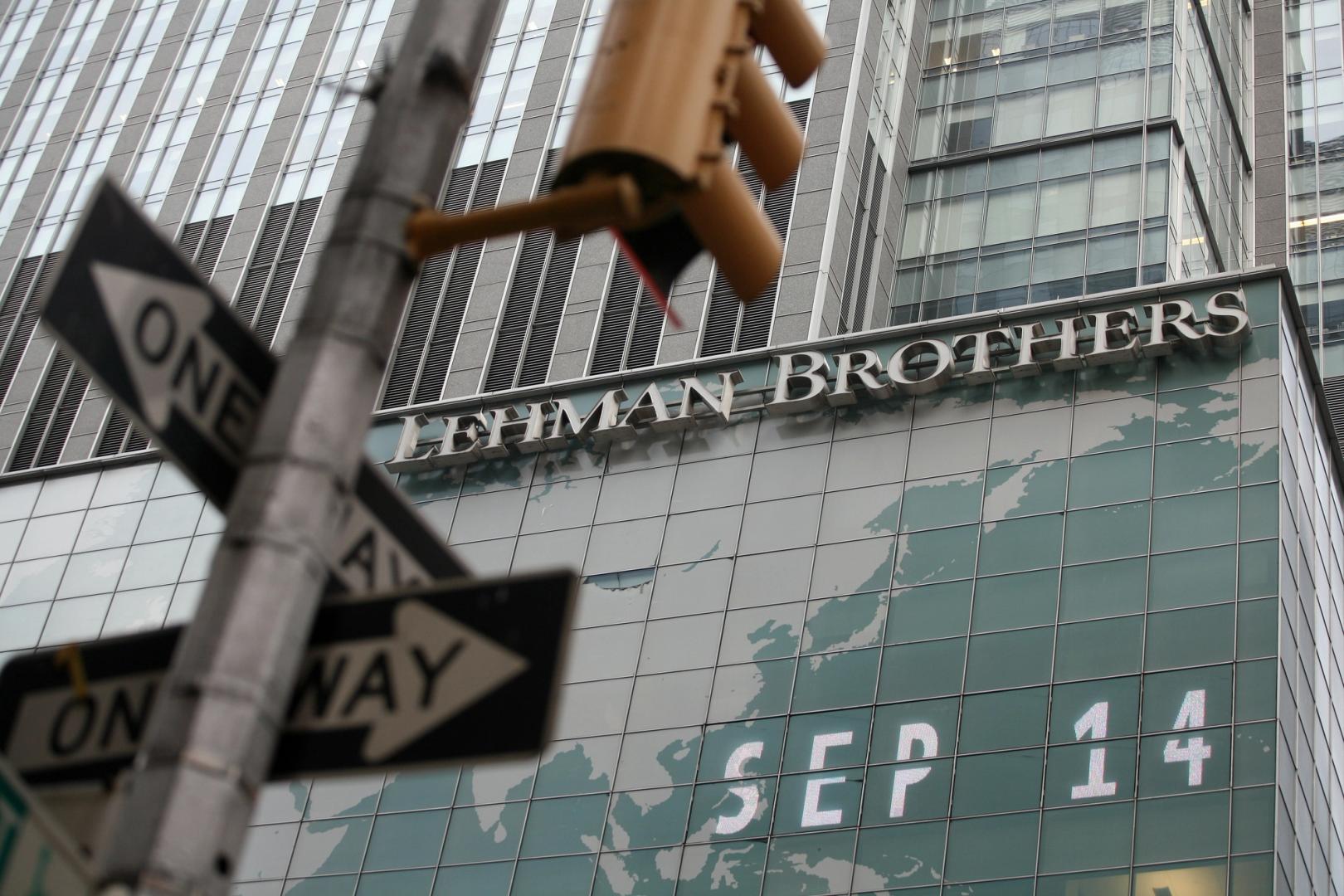
Cryptocurrency began in part as an answer to the missteps and abuses of banks during the 2008 financial crisis, but despite existing almost two decades and capturing wide attention, the public hasn’t been sold on that point and still favors the traditional financial system for their financial access, according to new polling commissioned by CoinDesk.
When asked which they trusted more between banks and crypto when it came to financial inclusion, 65% of respondents to an online survey said banks and only 5% favored crypto. Though slightly more than half (52%) agree that the movement is more than a passing fad, 60% think crypto will be a mostly negative force in the economy.
That’s according to 1,000 randomly selected U.S. voters surveyed last week by research firm Public Opinion Strategies. The survey is meant to get a snapshot of public sentiment as crypto and artificial intelligence issues wind their way through Congress, federal regulators and the political campaigns that are steaming toward this year’s congressional midterm elections.
This article is part of a CoinDesk series on voters’ views for the 2026 midterm election.
The sense that banks are safer than crypto comes at a delicate time for the industry, when its lobbyists have been fighting with the bank industry over the crypto sector’s most important policy hope: the Senate’s Digital Asset Market Clarity Act. Banks have argued that stablecoin rewards could compete directly with their own interest-bearing deposit accounts and threaten a migration that could strangle U.S. lending. So far, their argument stalled the Clarity Act for months, though the latest signs suggest the bill may start moving again in the coming days.
Despite some public distrust, crypto has come a long way in a short time to insert itself into the financial life and culture of the U.S. About one in four people say they’ve invested in crypto (27%), though most of them got in at least a few years ago and only 2% say they have more than $10,000 in digital assets.
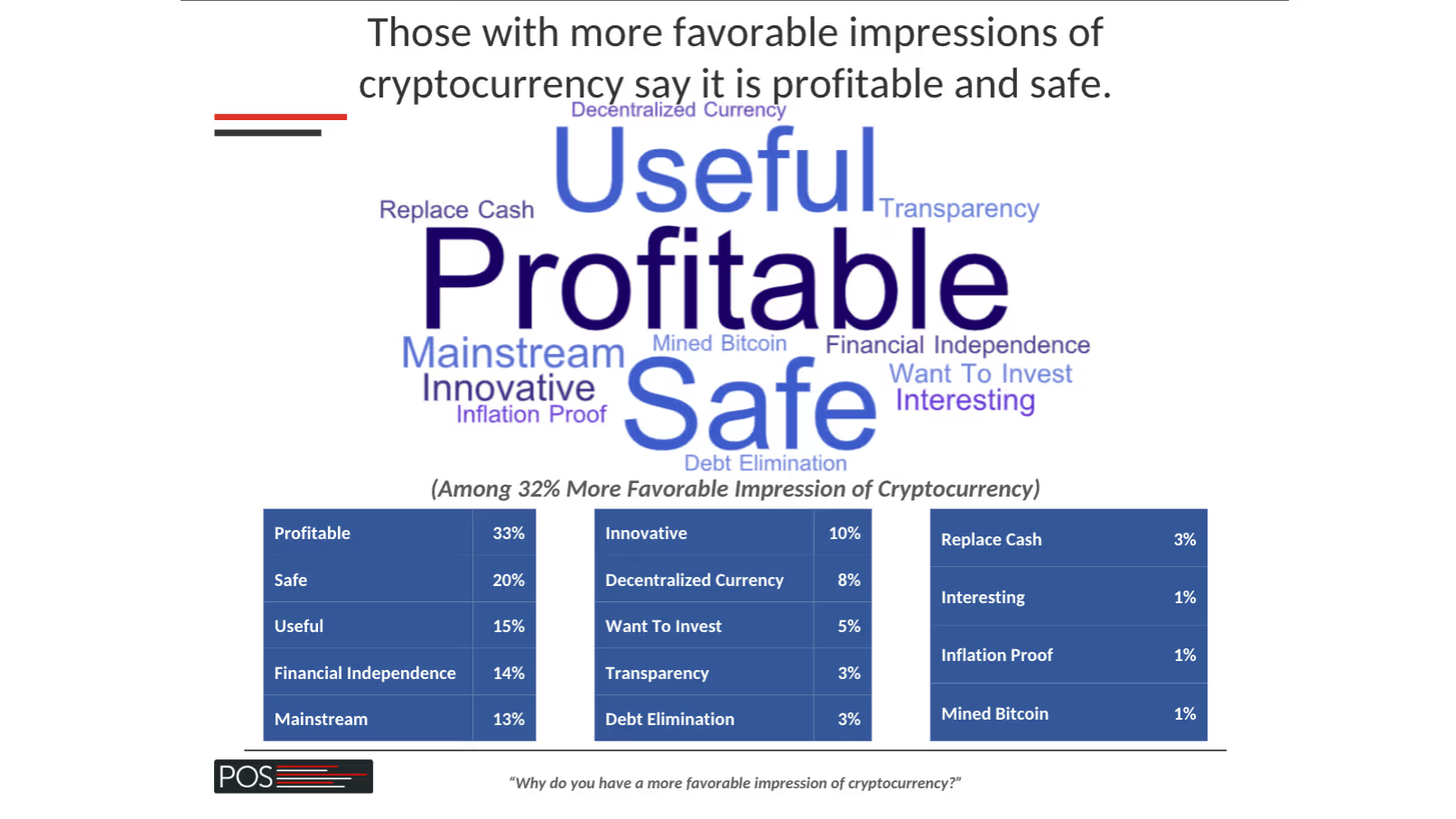
Whatever information the public is consuming about the industry doesn’t seem to be helping lift their view, with more than half (53%) getting a less favorable impression of the industry in recent news coverage. When they think about crypto, those who like it gravitate most toward the concept of its profitability while those who distrust it focus on the scams associated with the sector.
About 46% of people don’t have anything to do with crypto and say they don’t want to, though that leaves 27% who haven’t yet invested and say they might be open to it. The negative views are most likely to be held by people older than 45, with a sharp rise in distrust the older they get. Males, Republicans and minority groups share the most consistent affinity for crypto, according to the data.
The AI question
Like crypto, AI also gets a heap of distrust from older respondents, though younger people’s views are pretty mixed.
Overall, 55% think the risks of AI technology outweigh its benefits. But the younger demographics, males and Republicans are all a bit more likely to support the advances, as they do in digital assets. And owners of crypto are also much more likely to support the benefits of AI, with 64% saying its pursuit is worth the risks.
While the corporate U.S. has embraced the use of AI in almost all aspects of their business, the new data on public perceptions reveals the negative perception gap that emerging technologies may need to overcome for mass acceptance. The crypto industry has pinned hopes on its eventual inclusion in the U.S. system of financial regulation to lend it wider acceptance and give more comfort to holdouts who worry about its oversight. But that process depends on a sharply divided Congress and the sedate timeline of federal regulators like the Securities and Exchange Commission.
Still, key regulators appointed by crypto-cheering President Donald Trump have pledged to move as quickly as possible to bring digital assets into the mainstream. And key senators have suggested the Clarity Act will finally get the hearing it needs in May, keeping it potentially viable for 2026 passage.
CoinDesk will release data from this survey on Tuesday at Consensus Miami.


The New York Stock Exchange has filed a rule change with the U.S. Securities and Exchange Commission to allow tokenized versions of eligible securities to trade on its market.
Summary
- NYSE wants tokenized securities to trade beside traditional shares on the same exchange order book.
- Eligible tokenized assets must keep the same ticker, CUSIP, rights, and privileges as originals.
- Clearing and settlement would remain through DTC, keeping tokenized trading inside existing market rails now.
The filing adds to a wider push by major exchanges to bring blockchain-based settlement into regulated market systems.
The SEC notice shows that NYSE filed the proposed rule change on April 9. The filing would adopt Rule 7.50 and amend several exchange rules to allow securities to trade in tokenized form during a Depository Trust Company pilot program.
The DTC pilot would run for three years under a December 2025 SEC staff no-action letter. The SEC issued the NYSE notice on April 17, and public comments are due by May 13.
Tokenized shares would keep the same rights
Under the proposal, tokenized securities must remain equal to their traditional versions. They must share the same CUSIP number, ticker, rights, and privileges as the regular security.
The exchange said tokenized securities would trade on the same order book and follow the same execution priority rules. The filing states that a tokenized security must give holders the same rights to dividends, voting, and residual assets as the traditional share.
Moreover, the NYSE proposal does not create a separate crypto-style venue for stock trading. Instead, eligible members would enter orders through the exchange and choose instructions for DTC to clear and settle the trade in tokenized form.
The filing says tokenized securities can trade within the current national market system. NYSE also said it is “assessing various methods of tokenization” and would file new proposals if it chooses another method outside the DTC approach.
Broader tokenization push reaches SEC
NYSE’s filing follows similar movement from Nasdaq, which recently amended its rules to allow tokenized securities trading during the DTC pilot. The NYSE filing says its proposal is based on Nasdaq’s approved rule structure.
A separate NYSE Arca filing also drew attention in crypto markets after naming XRP, Bitcoin, Ethereum, and Solana as assets that could qualify under proposed commodity trust listing standards. Crypto.news reported that the XRP filing does not formally classify XRP as a commodity under federal law.
The two filings point to growing interest in tokenization across both traditional securities and crypto-linked products. However, the NYSE tokenized securities rule focuses on regulated equities and exchange-traded products, not new digital tokens.
Crypto World
U.S. voters don’t trust Trump administration to oversee crypto sector, CoinDesk poll finds
Most voters in the U.S. aren’t comfortable with President Donald Trump’s hand on the wheel of crypto industry oversight, with 62% saying they don’t trust his administration on that point, according to a survey commissioned by CoinDesk.
After the previous administration’s heavy hand on crypto, Trump’s promise to make the U.S. the “crypto capital of the world” reignited hopes in the sector. The president has deployed his White House to pave a wide road toward friendly crypto regulation. His administration named a high-profile crypto czar, issued executive orders to map out an industry agenda, named regulators who vowed to support friendly new rules and shepherded legislation to create the first major U.S. crypto law.
However, the polling trend seems to show that Trump’s broader political popularity beyond crypto has steadily waned, and his approval rating among U.S. voters is sinking, with this latest polling putting it at 40%.
This article is part of a CoinDesk series on voters’ views for the 2026 midterm election.
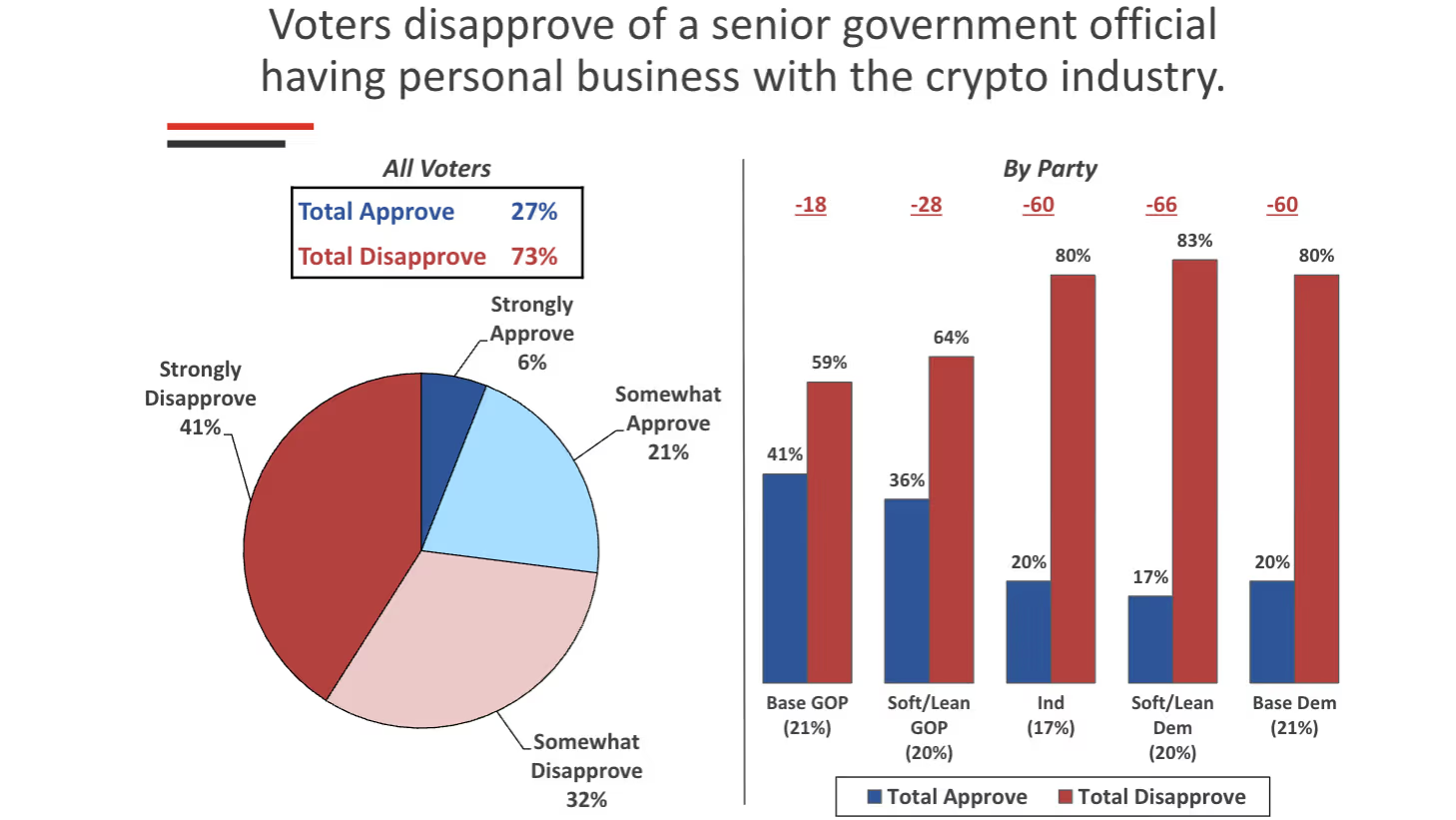
Almost half of the respondents (45%) are also aware that the president and his family have built a profitable personal stake in the crypto industry, which includes partial ownership and control of World Liberty Financial and other digital assets interests. The poll revealed that 73% of the public opposes its senior government officials — without identifying any in particular — having personal business dealings in the industry.

While Republicans are the most flexible on that point, a strong majority of 59% of GOP voters also can’t stomach those kinds of ties.
However, most people don’t know the extent of Trump’s financial involvement, with only 17% of those polled being aware that he and his sons backed the launch of World Liberty. Though the Trumps have many irons in crypto fires, World Liberty has drawn special attention for a number of potential conflicts and controversies.

The online survey conducted last week was split evenly between voters who supported Trump and Democrat Kamala Harris in the last presidential election, so a large majority of respondents doubting his administration’s crypto capabilities would seem to demonstrate a shift since 2024 in the sentiment of some of Trump’s voters.
The White House didn’t respond to requests for comment, but a spokesman for World Liberty responded to the polling data with a statement that Trump “pledged to make the United States the crypto capital of the world, and World Liberty wholeheartedly supports this vision.”
“The president has continually delivered on his promise to ensure that one of the most important technological breakthroughs of the century develops and thrives in America,” the company spokesman said.
Apart from people’s thoughts on Trump and government officials’ involvement in crypto, the survey of 1,000 registered voters performed by research firm Public Opinion Strategies delved into perceptions of crypto and the voters’ intentions in this year’s elections, revealing that most retain a distrust — or at best an uncertainty — about cryptocurrencies and their place in the economy and politics. The snapshot of public opinion carries a “credibility interval” of about 3.5%, representing the statistical uncertainty of the survey’s results.

The crypto industry has had a delicate relationship with the president, rejoicing at his regulatory appointments and policy choices, but having to quietly weather his own business involvement in the sector, which brought a host of challenges in lobbying for crypto legislation. The crypto world’s biggest aim in Washington is to get a new law that formalizes U.S. regulation of the industry, but Trump’s political opponents argue it benefits his own interests. The current effort is known as the Digital Asset Market Clarity Act, and while Trump’s White House has been one of its major boosters, his own crypto ties may get in the way.
The Clarity Act has already passed the U.S. House of Representatives and remains a few steps away in the Senate, but one of the last sticking points is a Democratic request that it should include a ban on the kind of personal crypto ties that CoinDesk’s poll revealed most people oppose. The provision to halt senior officials from crypto interests clearly had Trump in mind when the lawmakers called for it, and the bipartisan talks over its potential form have stretched across months and have included back-and-forth exchanges of language ideas in recent days.
In previous attempts, White House officials have said they won’t stand for a bill that targets the president or his family members. It’s unclear how the final version will avoid affecting Trump while also living up to Democrats’ expectations that it prevents government conflicts of interest.
The bill will need plenty of Democrats if it’s expected to eventually win the 60 votes typically required for legislation to get Senate approval.
Last weekend, President Trump spoke at an event for a few hundred of the top investors in his self-branded memecoin $TRUMP. There, he assured the crowd that the U.S. is the “leader in crypto.” He also told them the assets have “become mainstream.”
According to the CoinDesk survey, the industry has only become a regular part of the lives of a small segment of the population — not quite mainstream. And most haven’t embraced the industry’s most important political booster, Trump, as an industry watchdog they’re ready to trust.
CoinDesk will release data from this survey on Tuesday at Consensus Miami.
Crypto World
5 Critical Stocks to Monitor This Week: AMD (AMD) Earnings, Disney (DIS) Results, and Roblox (RBLX) Rebound

Quick Summary
- AMD releases quarterly results Tuesday with emphasis on AI accelerator sales and data-center performance
- Apple exceeded Q2 projections and authorized $100 billion in stock repurchases, testing ability to maintain momentum
- Broadcom continues as leading AI infrastructure investment linked to specialized chips and data-center expansion
- Disney announces results Wednesday with attention on streaming profitability and theme park revenue
- Roblox reduced full-year bookings guidance following safety implementations that impacted user engagement and daily active user counts
The coming days feature an intensive lineup of corporate earnings and market-moving events. Five companies emerge as particularly significant for investor focus: AMD, Apple, Broadcom, Disney, and Roblox.
Advanced Micro Devices
AMD releases quarterly financial results following Tuesday’s closing bell on May 5. Management projected approximately $9.8 billion in first-quarter revenue, representing substantial annual growth.
Advanced Micro Devices, Inc., AMD
Market participants seek evidence of momentum in artificial intelligence processors and data-center sales. Scrutiny will also focus on profit margins and competitive positioning against Nvidia in the GPU accelerator space.
The share price faces potential volatility depending on outcomes. Robust AI chip projections would bolster optimistic scenarios. Disappointing commentary regarding demand trends or margin pressure would likely trigger selling.
Apple
Apple has already disclosed second fiscal quarter performance. The technology leader delivered $111.18 billion in revenue alongside $2.01 per share in earnings, surpassing Wall Street expectations.
Management greenlit $100 billion for stock repurchases. iPhone and Mac sales exceeded forecasts, alleviating worries about growth deceleration.
This week’s question centers on whether the stock can preserve its post-announcement rally as the market weighs future trajectory.
Broadcom
Broadcom has established itself among the market’s favored AI infrastructure investments. The company maintains significant exposure to application-specific integrated circuits, networking equipment, and data-center infrastructure.
Investors monitor the stock as an indicator for overall AI capital expenditure patterns, alongside Nvidia and AMD. The firm occupies a strategic position in demonstrating that AI investment translates into tangible revenue growth.
Consumer-Focused Companies Under Scrutiny
Disney
Disney unveils second fiscal quarter performance on Wednesday, May 6. Critical metrics include streaming segment profitability, theme park attendance trends, and advertising income.
Parks data will reveal whether discretionary spending on entertainment experiences remains healthy. Streaming margins will indicate success of operational efficiency initiatives and pricing adjustments.
Share price reaction could swing significantly based on reported figures.
Roblox
Roblox lowered its annual bookings projection after implementing enhanced safety protocols and age-verification systems that constrained user expansion. Daily active user metrics also fell short of analyst estimates.
Stock value plummeted following the announcement, as reported by Reuters. The gaming platform prioritizes protecting younger audiences, but these protective measures create obstacles that diminish user engagement.
Market observers await signals of stabilization following this week’s sharp decline.
Concluding Analysis
These five equities encapsulate dominant market narratives presently shaping investor decisions. AMD and Broadcom represent the AI hardware revolution. Apple exemplifies large-capitalization reliability and shareholder capital allocation.
Disney reflects consumer discretionary strength and entertainment industry economics. Roblox illustrates the tension when platforms emphasize user protection over immediate revenue optimization.
Roblox equity experienced substantial decline after management reduced annual bookings expectations, with Reuters documenting the selloff triggered by disappointing daily active user performance.
Crypto World
Ethereum Price Falls Below $3,000 as Validators Cash Out While Pepeto Presale Crosses $9.7 million
The ethereum price fell 4% this week as validators pulled staking rewards amid market pressure, and the same rotation pushing capital out of ETH is flowing into presales with confirmed listings. Large wallets are repositioning in a pattern that matches every cycle before a breakout.
That pressure is creating a window for projects with real products underneath, and Pepeto stands at the front. With a Binance listing approaching, Pepeto crossed $9.7 million in presale funding, a former Binance expert leading the build, and analysts calling for 100x after launch.
Ethereum validators pulled more than 200,000 ETH in withdrawals over the past five days, according to CoinDesk. The move followed the Pectra upgrade going live, which opened new withdrawal options and triggered selling on the ethereum price.
CoinGlass data shows ETH liquidations hit $180 million in 48 hours as long positions got wiped below $2,900. The weakness is pushing capital into early stage projects where upside is not capped by a $300 billion market cap, and presale tokens with confirmed listings carry the most momentum.
Ethereum, Pepeto, and Where Capital Flows After the Dip
Pepeto: The Presale Gaining From Large Cap Pressure
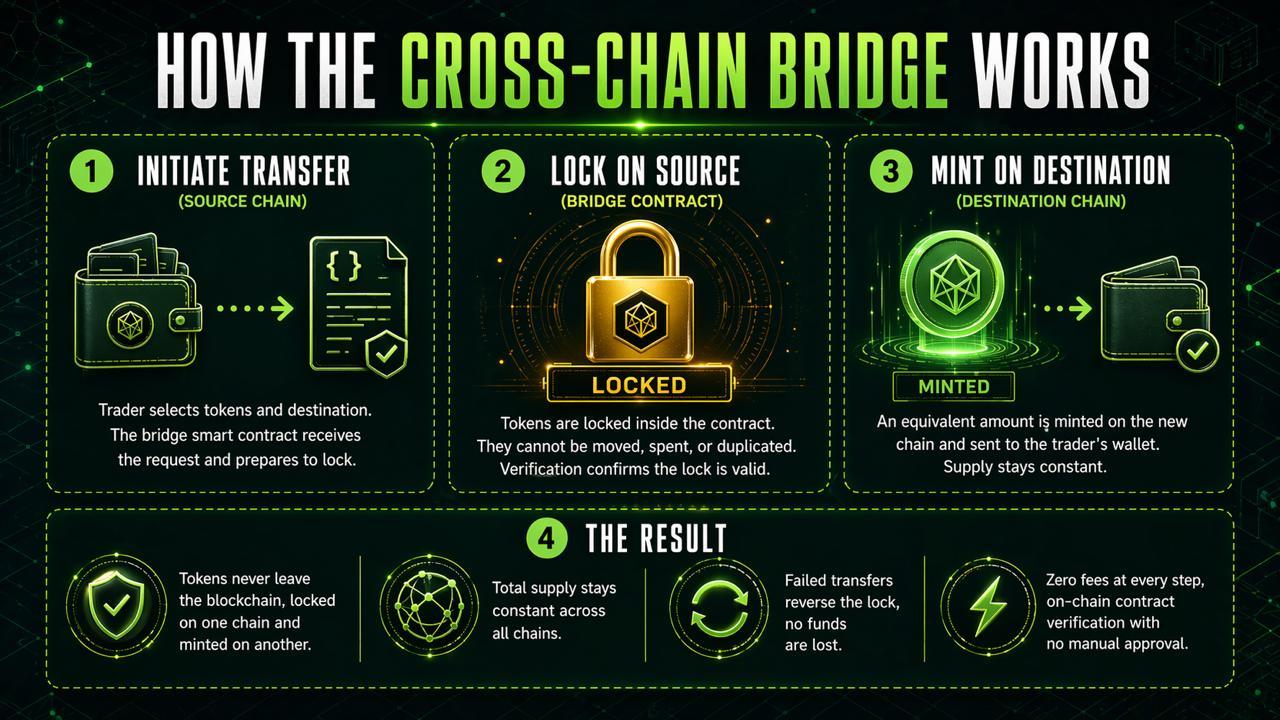
That pressure on large caps is exactly where presale entries gain their edge, and one project already cleared $9.7 million before trading begins. Pepeto sits at the center of that rotation, with a former Binance expert building an exchange that runs on zero fee trading and cross chain transfers.
The same 420 trillion token supply that carried Pepe to $11 billion sits behind Pepeto, but this time a working exchange backs every token from the start.
Analysts see 100x or higher once the Binance listing goes live, and the difference between Pepeto and every other presale token is that the exchange tools already work. The entire platform was built by a team that includes someone who worked inside Binance, and every product protects the holder’s capital before a single trade happens. PepetoSwap removes fees from every trade so nothing gets skimmed from profits, and the cross chain bridge moves tokens between networks at zero cost so holders never pay to reposition.
While ETH whales pull rewards and move capital sideways, the wallets entering Pepeto grow daily because the presale is the one place where retail enters at the same price as the biggest buyers. Pepeto crossed $9.7 million at $0.0000001864, and staking rewards at 176% APY keep tokens locked, the kind of commitment that only appears before a major listing. Add the SolidProof audit that cleared every contract, the cofounder who built the original Pepe coin, and a Binance listing on the calendar, and the ethereum price correction is handing this presale the attention it earned.
ETH Forecast: Where Does the Price Go From $2,313
ETH is trading near $2,313 according to CoinMarketCap, down over the past week after the Pectra upgrade triggered validator withdrawals. The ethereum price has struggled to reclaim $3,000 since late April, and selling from unlocked staking rewards adds weight to each recovery attempt.
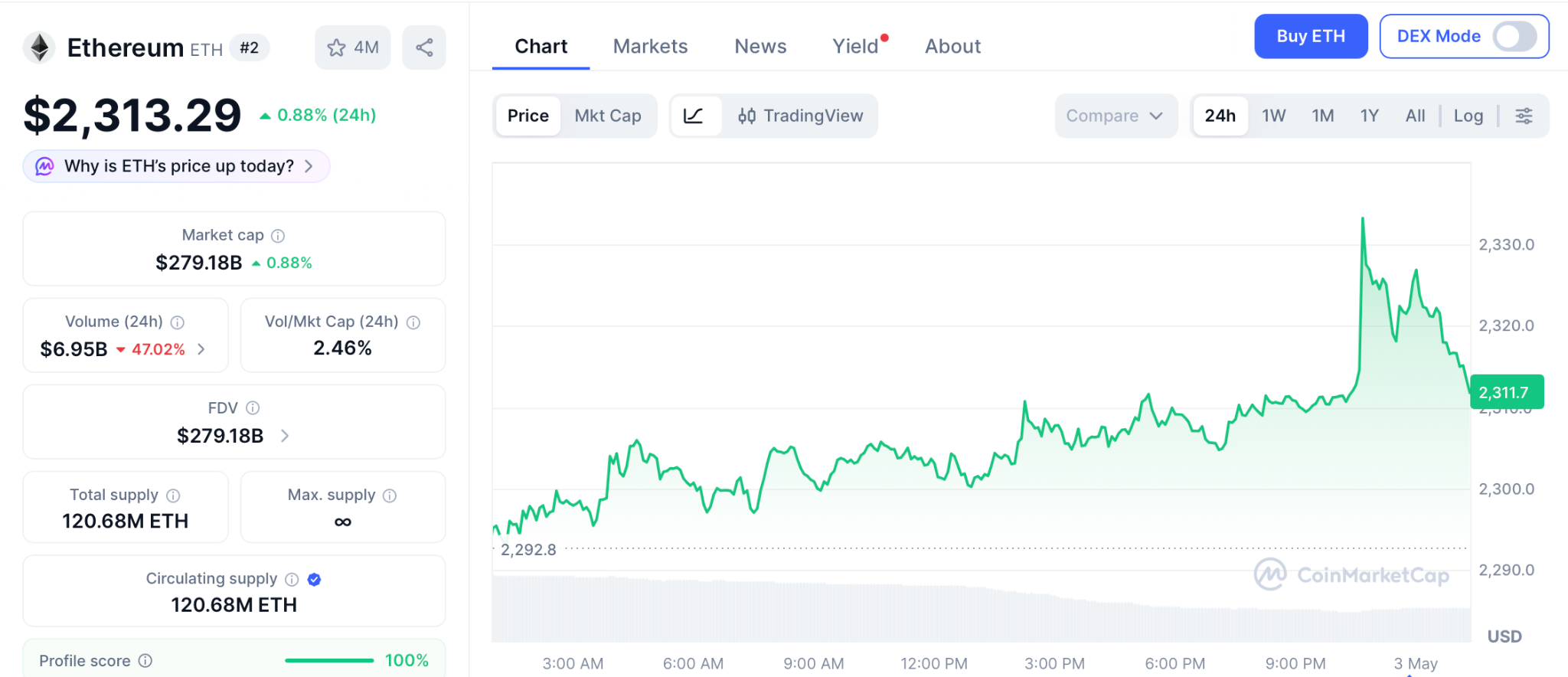
Analysts at The Block see $3,200 as the next target if ETH holds $2,700 support through May. Below that, $2,400 becomes the next major floor. Whale wallets holding more than 10,000 ETH have not cut their positions despite the dip, which matches the accumulation pattern that preceded the run from $1,800 to $4,000 in late 2023.
The ethereum price forecast depends on whether institutional buyers step in once the withdrawal wave settles, and a close above $3,000 would confirm the reversal.
Final Takeaway
Watching the ethereum price correct while Pepeto crosses $9.7 million mirrors the setup that turned early ETH holders into millionaires. Those holders turned a few thousand dollars into generational wealth, and every one of them wishes they had bought more at the start.
The same setup is forming around Pepeto, and the Pepeto official website shows capital flowing in before the listing delivers returns that transform presale entries into the biggest positions of the cycle. Securing the entry now captures the upside, and waiting means becoming the person wishing they had acted while the window was open.
Click To Visit Pepeto Website To Enter The Presale

FAQs
How does the Pectra upgrade affect the ethereum price?
The upgrade unlocked validator withdrawals that pushed over 200,000 ETH into the market, creating short term selling pressure on the ethereum price below $3,000.
What are the ETH price targets for 2026?
ETH targets $3,200 if $2,700 support holds, with a breakout above $3,000 confirming the reversal. Below $2,700 the next floor sits near $2,400.
Why are analysts watching Pepeto right now?
Pepeto raised over $9.7 million with a Binance listing approaching and a working exchange already live. The Pepeto official website shows the presale still open at pre listing price.
Disclaimer: This is a Press Release provided by a third party who is responsible for the content. Please conduct your own research before taking any action based on the content.
Crypto World
Crypto, AI Super PACs Flood Midterms As Poll Finds Most Americans Distrust Both Industries
Crypto and AI industry groups are pumping tens of millions of dollars into the 2026 midterm elections, but a new poll shows most Americans don’t trust either industry.
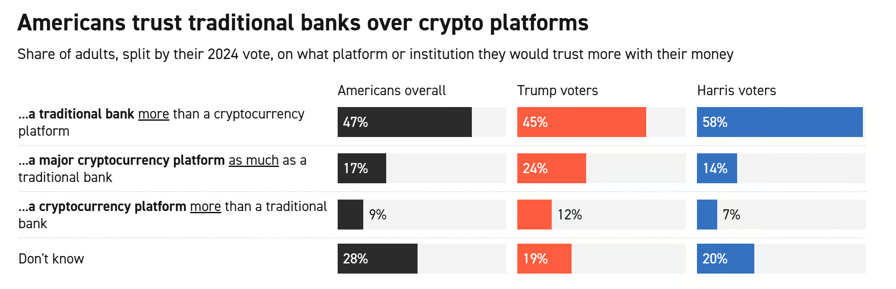
45% of Americans say investing in cryptocurrency is not worth the risk and 44% say AI is developing too fast, according to an April survey by Public First for Politico. The survey also found that narly half trust a traditional bank over a crypto platform, and two-thirds want Congress to impose strict regulations or broad oversight principles on AI.
The numbers spell trouble for candidates taking money from industry-aligned super PACs. In hypothetical matchups, poll respondents were far less likely to back candidates supported by groups pushing looser AI regulations than those backed by groups calling for tighter tech rules.
“Skepticism of the industries, those results suggest, could turn into voter backlash if Americans grow fed up with the heavy spending,” the report said.
The poll was conducted between April 11 and 14, surveying 2,035 US adults online. Results were weighted by age, race, gender, geography and educational attainment, with an overall margin of sampling error of ±2.2 percentage points.
Related: White House confirms Trump to address memecoin gala on Saturday
AI, crypto PACs spend big
Pro-AI super PAC Leading the Future, which launched in August 2025, has raised more than $75 million and deployed funds in primaries across North Carolina, Texas, Illinois and New York. Fairshake, the pro-crypto PAC backed by Coinbase, Andreessen Horowitz and Ripple Labs, has already spent $28 million across competitive primaries.

Source: Politico
Both industries are also spending heavily on lobbyists. OpenAI and Anthropic posted record lobbying expenditures in the first quarter of 2026. The crypto industry, meanwhile, is pushing the CLARITY Act through the Senate, a market structure bill it hopes will bring regulatory certainty to digital assets.
In 2024, a Fairshake-affiliated PAC spent over $40 million helping defeat Ohio Senator Sherrod Brown, a longtime crypto critic who is now running again.
Related: Crypto PAC Fellowship Halts Support of Texas AG for Senate: Report
Crypto, AI PACs are flying under the radar
For now, most voters don’t know these groups exist. Just 9% have heard of Leading the Future and only 3% recognize Fairshake. However, political observers told Politico that once voters connect the money to the industries behind it, the backlash could be swift.
“I do think if they see somebody is backed by crypto, that’s always going to be a problem,” former Ohio Rep. Jim Renacci reportedly said.
Magazine: Bitcoin will not hit $1M by 2030, says veteran trader Peter Brandt

King cracks Star Wars joke on trip to Bermuda ahead of May the Fourth | News UK

Stress in private credit could spark ’psychological contagion,’ Fed’s Barr tells Bloomberg News

Crypto market recap: What happened today?

Manchester United reach agreement with Casemiro over contract clause amid transfer speculation

US brings back mandatory military draft registration

Steven Gerrard disagrees with Gary Neville over ‘shock’ Chelsea and Arsenal claim | Football


-

 Tech6 days ago
Register Renaming | Hackaday
-

 Politics6 days ago
Drax board avoid their own AGM, accused of greenwashing & environmental racism
-

 Tech6 days ago
Why Blue Badges Disappeared From Toyota Hybrids
-

 Tech6 days ago
Images of Samsung’s rumored smart glasses have leaked
-
 Tech2 days ago
Trump’s 25% EU auto tariff breaches Turnberry Agreement that also covers semiconductors and digital trade
-

 Fashion5 days ago
Kylie Jenner’s KHY Enters a New Era with ‘Born in LA’
-

 Business5 days ago
Most Commercial Energy Audits Miss the Real Losses
-

 Crypto World5 days ago
CFTC’s AI will review U.S. crypto registration applications, chairman tells CoinDesk
-

 Business6 days ago
(VIDEO) Charlize Theron Climbs Times Square Billboard to Promote New Netflix Thriller ‘Apex’
-

 Business4 days ago
Barclay Brothers Avoid Bankruptcy: HSBC Drops High Court Petitions After IVA Deal
-
 Sports2 days ago
Paul Scholes issues Marcus Rashford reality check as agreement emerges over Man United star
-
 Business4 days ago
Tesla Officially Registers Elon Musk’s Stock: What Investors Need to Know
-
 Entertainment6 days ago
Alicia Keys Calls Out Music Industry ‘Boys Club’
-

 Tech5 days ago
Get Ready for More Brain-Scanning Consumer Gadgets
-

 Tech7 days ago
Dyson Vacuums And The Curse Of Cooked Capacitors
-
Crypto World5 days ago
Robinhood Phishing Scam Exploits Gmail Dot Feature to Bypass Security
-

 Entertainment6 days ago
Sister Wives: Janelle Posts New Scary Warning
-

 Crypto World5 days ago
Gmail Dot Trick Underpins Robinhood Phishing, Sending Real-Looking Emails
-

 Business7 days ago
AI-Driven App Creation at Your Fingertips
-

 Business3 days ago
Two Powerball Tickets Split $143 Million Jackpot in Indiana and Kansas
You must be logged in to post a comment Login