Connect with us
DAPA Banner

Tech

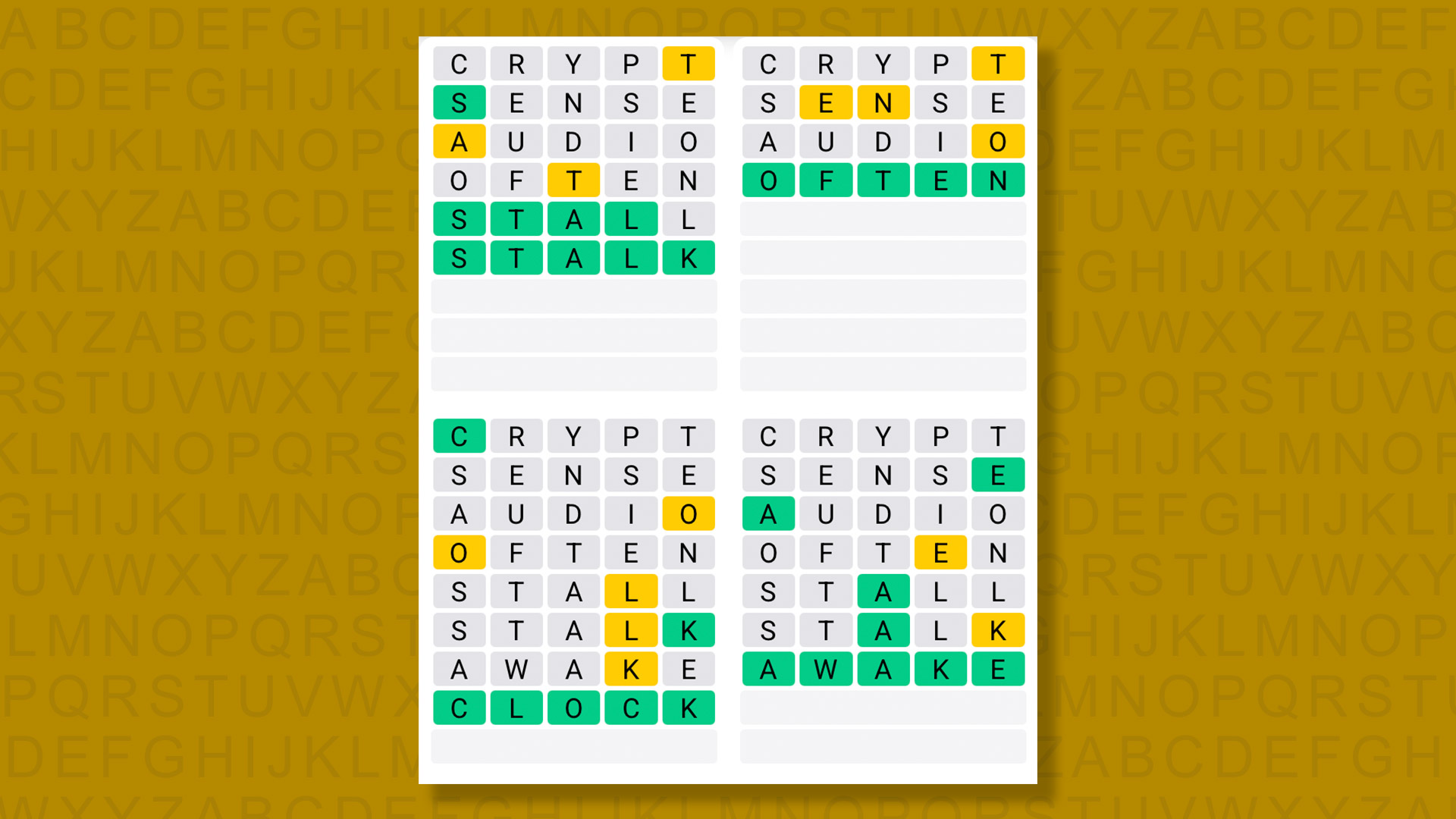
Quordle hints and answers for Sunday, April 12 (game #1539)

Published

on

Looking for a different day?

A new Quordle puzzle appears at midnight each day for your time zone – which means that some people are always playing ‘today’s game’ while others are playing ‘yesterday’s’. If you’re looking for Saturday’s puzzle instead then click here: Quordle hints and answers for Saturday, April 11 (game #1538).

Quordle was one of the original Wordle alternatives and is still going strong now more than 1,500 games later. It offers a genuine challenge, though, so read on if you need some Quordle hints today – or scroll down further for the answers.

Advertisement

Source link

Advertisement
Continue Reading
Click to comment

You must be logged in to post a comment Login

Leave a Reply

Tech

Marauding minotaurs, more CloverPit and other new indie games worth checking out

Published

on

Welcome to our latest roundup of what’s going on in the indie game space. As always, we’re here to tell you about a bunch of new games you can play this weekend, as well as several upcoming titles.

The latest edition of the Triple-i Initiative showcase was packed with cool stuff, including a first peek at the fascinating next game from 1000xResist developer Sunset Visitor, word of a Don’t Starve follow-up, a release date for stealth title Thick as Thieves and an announcement of when pirate survival sim Windrose will hit early access.

We also got a release window for Neverway, a life sim with gorgeously creepy pixel art. The prologue is available to play now on Steam, and it doesn’t take long at all before things become delightfully strange. I’ll run through a few of the other Triple-i highlights below.

Before we get to the new releases, though, I want to touch on something I spotted a little too late to include in last week’s roundup. On Reddit, the developer of mixed reality game CoasterMania shared a video showcasing an update that lets players use their hands to build and interact with rollercoasters. I think this looks just swell. This is the most I’ve ever been interested in picking up a Meta Quest headset (which I’d inevitably use for a grand total of about 45 minutes).

Advertisement

New releases

I don’t like to overwork my brain when I’m playing games. I’m focused all day at work and afterwards, I just want to switch off for a bit. That’s a big reason why I play a ton of Overwatch and don’t really gel too well with most puzzle games. Minos, though, hits the sweet spot of brain engagement for me.

In this roguelite from Artificer and publisher Devolver Digital, your aim is to stop glory-seeking adventurers from finding and killing a minotaur. You’ll shape a labyrinth as you see fit in order to defend the beast from these warriors. You can set up the maze by building and knocking down walls, and setting traps. The adventurers will follow a set path to the minotaur’s lair, then make a beeline for the monster when they discover it’s hiding elsewhere.

There are a lot of ways to dispose of the interlopers and you’ll need to be thoughtful about how to set everything up to take out each wave of attackers. Many traps can only be placed on certain spots, so it’s important to work around those. You’ll need to adjust your setup after every wave — you’ll gain more traps and have to re-arrange them to fend off different types of enemies.

Minos is more active than a lot of tower defense and strategy games I’ve played, as the minotaur can reset certain traps after they trigger and, if need be, try to kill the adventurers head-on. I found myself spending quite a bit of time thinking through each enemy’s path through my domain and how I was going to eliminate them. Sometimes, I miscalculated and brought my run to an end. Being able to improve the minotaur’s stats and unlock new powers between runs helped me keep coming back for more.

Advertisement

I’m really enjoying Minos, and I wouldn’t be surprised if this ends up being one of my favorite games of the year. You can snap it up on Steam now for $18. A demo is available too.

Spring has finally bloomed in my neck of the woods. I planned to spend a chunk of my weekend outside after a long winter. But now I might need to bring my Steam Deck with me, because the first DLC for CloverPit, one of my favorite games of last year, suddenly arrived during the Triple-i Initiative showcase.

CloverPit is a Balatro-style incremental roguelite from Panik Arcade and publisher Future Friends Games. It tasks you with breaking the rules of a slot machine to meet increasingly high coin targets in order to pay off a debt. You can pick up charms that modify the machine, and the Unholy Fusion DLC is all about those totems. You’ll be able to use a new device called the Surgery Machine to fuse charms into more powerful items (à la Ball x Pit). It seems like that will free up valuable space for more charms too.

The DLC adds 30 fusion charms, 11 new base charms, a secret ending and other features. I’ve played CloverPit for dozens of hours (I’m far from the only one, as the game’s pulled in more than 5 million players). I suspect I’m about to sink a whole lot more time into this DLC.

Advertisement

The Unholy Fusion DLC usually costs $3, but there’s a 10 percent discount on Steam until April 23. The base game is typically $10, though you can get 30 percent off on Steam until the same date. You’ll save an extra five percent if you buy a bundle with both. CloverPit is also on Game Pass, and you can buy a bundle of the base game and DLC on Xbox Series X/S, Xbox One and Xbox on PC for $11.49. On iOS and Android, you can snag CloverPit for $5 and the DLC for $2.

Another title had a surprise, sudden release during the Triple-i Initiative showcase: battle royale typing game Final Sentence. I really enjoyed the demo for this one, even though I’m not the fastest or most accurate typist around — I made four typos in this sentence alone. Make too many mistakes or fail to beat everyone else who’s bashing away at a typewriter and it’s curtains for you, courtesy of a creepy figure with a revolver that’s standing by your desk.

Final Sentence, from Button Mash and Polden Publishing, is available on Steam. It’ll typically cost $10, but if you pick it up before April 23, you’ll save 10 percent. (Sidenote: I enjoyed a Steam review that read, “finally… a way for millennials to beat Gen Z at a battle royale game.)

One of the most interesting things about People of Note is that Iridium Studios tried to make this musical adventure as approachable as possible. It’s an RPG with turn-based battles, but you can skip the fights if you like. That’s appealing to someone like me, who enjoys story-driven games but often struggles to engage with turn-based combat. Puzzles are skippable too. Great! People should be able to play non-competitive games however they want.

Advertisement

I dug the demo when I played it a while back. The approach to battles here is interesting, as the protagonist, pop singer Cadence, recruits other musicians to join her band — in other words, your party. The combat is based around music, and you can create mashups of battle tracks based on the genres that your collaborators specialize in.

People of Note, from publisher Annapurna Interactive, will normally run you $25, though there’s a 10 percent launch discount. It’s available on PS5 (the discount on that platform is only for PlayStation Plus subscribers), Xbox Series X/S, Xbox on PC, Nintendo Switch 2, Steam and the Epic Games Store.

Tamashika is a fast-paced first-person shooter with a neat twist. The game only has one level available at any time. There are no checkpoints, and it’ll take about 10 minutes to complete a successful run. The level gets a procedurally generated revamp once per day.

A tantō blade, a pistol, your movement and your aim are the only weapons you have to defeat the enemies and reach the goal. I had to watch the trailer a few times to get it, but the quirky hand-drawn aesthetic is growing on me.

Advertisement

Tamashika — from QuickTequila and publisher Edglrd — is available on Steam, PS5, Xbox Series X/S and Switch for $20.

A Hidden Object Fest is running on Steam until April 13, and a few new games have debuted as part of that. One of those is Nippets by Blink Industries. It’s a hand-drawn game with lots of secrets and, at least judging by the trailer, charming animations. It seems like a very relaxing counterpoint to some of the more intense games out this week. It’s pretty digestible too, as it has around two to three hours of gameplay, depending on how sharp your observation skills are.

Nippets is available on Steam and Itch for PC and Mac. It costs $13, though there’s a 10 percent discount on Steam until April 21. A demo is available on both storefronts too.

Upcoming

Dead As Disco has some momentum after 1.2 million players checked out the demo, and this rhythm-based beat ’em up now has an early access release date. It’s coming to Steam and the Epic Games Store on May 5.

Advertisement

At the jump, you’ll be able to play the first arc of a larger narrative and be able to take out bad guys to the beat of a soundtrack that has more than 30 songs, including original tracks, covers and licensed tunes. You can load in your own music as well, though I can’t imagine being able to adeptly play this to the rhythm of Angine de Poitrine’s wild time signature swings.

Brain Jar Games expects the game to remain in early access for around a year as it adds new bosses, moves and other features, and makes adjustments based on player feedback. A co-op mode is planned too. You can get a taste of Dead As Disco now by checking out the Steam demo, though I would argue that disco is still very much alive.

Those looking for a puzzle game of a Lovecraftian persuasion may be interested in Call of the Elder Gods, a sequel to 2020’s Call of the Sea. The follow-up is bound for Steam, PS5, Xbox Series X/S and Switch 2 on May 12. It’ll be available on Game Pass and it’s priced at $25 on the eShop.

You seemingly won’t need to have played Call of the Sea before diving into the sequel, though you’ll surely get more out of Call of the Elder Gods if you have. You’ll switch between two characters — professor Harry Everhart and student Evangeline Drayton — to solve puzzles from a first-person perspective and try to find out what happened to the pair’s missing loved ones.

Advertisement

I’d seen Long Gone at another showcase some time ago, but the name of it slipped from my memory. No such issues after it made an appearance in the Triple-i Initiative stream though, as this project from Hillfort Games and co-publisher Outersloth is now firmly on my Steam wishlist.

It’s a narrative-driven game set amid a zombie outbreak in which you’ll solve environmental puzzles to learn about the lives of people who are no longer around. It’s ostensibly a point-and-click adventure that looks very heavily inspired by a certain post-apocalyptic series from Naughty Dog, right down to the backpack-wearing protagonist. There are platforming sections too.

I’m absolutely going to be interested in any game that smooshes together The Last of Us and the Monkey Island series. I’m really looking forward to playing Long Gone sometime next year.

Source link

Advertisement
Continue Reading

Tech

ASUS ZenBook A16, AirPods Max 2, Sonos Play and LG Sound Suite

Published

on

Spring has certainly sprung here at Engadget. Well, it has in terms of reviews, at least. We’ve put over a dozen devices through their paces since my last roundup, which gives you a lot to catch up on over the weekend. Read on for the rundown of all the reviews you might’ve missed.

ASUS ZenBook A16

Image for the large product module

ASUS

The Zenbook A16 is the lightest 16-inch ultraportable we’ve seen yet, and it’s surprisingly capable thanks to Qualcomm’s Snapdragon X2 chips.

Pros
Advertisement
  • Surprisingly light
  • Polished design
  • Excellent OLED screen
  • Tons of ports
  • Big performance leap over X1 chips
Cons
  • Potential Arm incompatibilities
  • Doesn’t support all PC games

ASUS’ ZenBook A14 didn’t live up to our expectations last year, but now the company is back with a 16-inch machine and a shot at redemption: the A16. “Compatibility issues aside, the ZenBook A16 delivers just about everything I want in an ultraportable,” senior reporter Devindra Hardawar said. “It’s got a gorgeous OLED screen and all of the ports you need. Qualcomm’s Snapdragon X2 Elite chips also give it a much-needed power boost. And best of all, it’s one of the lightest and sleekest 16-inch Windows laptops I’ve come across.”

Apple AirPods Max 2

Image for the large product module

Apple/Engadget

The H2 chip delivers a host of new features, but it’s time for a comprehensive redesign on these pricey headphones.

Pros
  • Comfortable
  • Excellent sound quality
  • Lots of new features
Cons
  • Same design, again
  • Expensive
  • Only one hearing health feature

Until this year, Apple’s only updates to the AirPods Max were new colors and a USB-C port. The company finally gave its pricey over-ear headphones the powerful H2 chip, delivering a host of handy features from the AirPods Pro. “The H2 chip brings Apple’s over-ear headphones on par with the rest of the AirPods lineup, namely the AirPods Pro 3,” I said. “And since I don’t expect Apple to announce new earbuds this year, that parity should remain for a while.”

Sonos Play

Image for the large product module

Sonos / Engadget

Advertisement

The Play sounds great, has a wide and versatile feature set and won’t break the bank. It’s a welcome return to form for Sonos.

Pros
  • Compact design
  • Great sound quality for its size
  • Features like line-in and Bluetooth grouping make it extremely versatile
  • Long battery life
Cons
  • Doesn’t come with a power adapter
  • More colors would be welcome

Sonos badly needed a win. Thankfully, the company regained some of its mojo with a new portable speaker that offers the best of Bluetooth and Wi-Fi in the same device. “The latest Sonos speaker offers impressive sound quality, flexibility and portability, and it’s the kind of product that can help Sonos rebuild its reputation after its recent difficulties,” deputy editor Nathan Ingraham said.

LG Sound Suite

Image for the large product module

LG/Engadget

LG’s latest home theater system offers immersive sound and lots of options. It’s expensive though, and the marquee feature isn’t always easy to use.

Advertisement
Pros
  • Detailed and expansive home theater audio
  • Dolby FlexConnect is genuinely useful
  • Great for music
  • Easy to use as individual speakers
Cons
  • Expensive
  • Frustrating setup and connectivity
  • Each item is sold separately
  • Some configurations require LG TVs

After an impressive CES debut, LG’s Sound Suite was my most anticipated review of the year. Despite impressive sound quality and Dolby Atmos FlexConnect, there are still some kinks to work out in both the setup and general use. “There’s no denying that LG has created a powerful and immersive living room experience with its Sound Suite lineup,” I said. “While I did experience some setup and software issues, those are things LG can iron out over time — Sound Suite is still brand new, after all.”

DJI Avata 360, Fender Audio, Nebula X1 Pro and more

The last few weeks have been pretty audio-heavy here at Engadget, including the first headphones and speakers from Fender Audio, two sets of headphones from JBL and the Roland Go: Mixer Studio. I also reviewed the first of Sony’s 2026 soundbars, the Bravia Theater Bar 5, and contributing reporter Steve Dent reviewed the Anker Soundcore Nebula X1 Pro all-in-one projector.

Senior reporter Sam Rutherford really took one for the team and spent some time with the Robosen Soundwave Transformers robot. Lastly, Steve took flight with the DJI Avata 360 drone, which is a direct answer to Insta360’s Antigravity A1.

Source link

Advertisement
Continue Reading

Tech

Today’s NYT Mini Crossword Answers for April 12

Published

on

Looking for the most recent Mini Crossword answer? Click here for today’s Mini Crossword hints, as well as our daily answers and hints for The New York Times Wordle, Strands, Connections and Connections: Sports Edition puzzles.


Need some help with today’s Mini Crossword? I found 4-Across to be a stumper for a little while, and I even grew up on a farm! Read on for all the answers. And if you could use some hints and guidance for daily solving, check out our Mini Crossword tips.

If you’re looking for today’s Wordle, Connections, Connections: Sports Edition and Strands answers, you can visit CNET’s NYT puzzle hints page.

Advertisement

Read more: Tips and Tricks for Solving The New York Times Mini Crossword

Let’s get to those Mini Crossword clues and answers.

completed-nyt-mini-crossword-puzzle-for-april-12-2026.png

The completed NYT MIni Crossword puzzle for April 12, 2026.

Advertisement

NYT/Screenshot by CNET

Mini across clues and answers

1A clue: First-aid case
Answer: KIT

4A clue: Rooster giving directions on a farm, maybe
Answer: VANE

5A clue: Showing little enthusiasm
Answer: TEPID

Advertisement

6A clue: Borough said to be the birthplace of hip-hop
Answer: BRONX

7A clue: Bird of prey
Answer: HAWK

Mini down clues and answers

1D clue: “Bam!”
Answer: KAPOW

2D clue: Bold way to solve a print crossword
Answer: ININK

Advertisement

3D clue: Spinoff of a popular lecture series
Answer: TEDX

4D clue: Aloe ___
Answer: VERA

5D clue: “Frankly …,” in a text
Answer: TBH

Advertisement

Source link

Continue Reading

Tech

Passive Radar Explained | Hackaday

Published

on

It is an old trope in submarine movies. A sonar operator strains to hear things in the ocean but dares not “ping” for fear of giving away the boat’s location. Radar has a similar problem. If you want to find an airplane, for example, you typically send a signal out and wait for it to bounce off the airplane. The downside is that the airplane now knows exactly where your antenna is and, these days, may be carrying missiles to home in on it. In a recent post, [Jehan] explains how radar, like sonar, can be passive.

Even if you aren’t worried about a radar-homing missile taking out your antenna, passive radar has other advantages. You don’t need an expensive transmitter or antenna, a simple SDR can pull it off. You don’t need a license for the frequencies you want to use, either. You are just listening.

The key is that radar uses two different effects. One is how long it takes for the echo to return. The other is how much the Doppler effect shifts the frequency. Suppose you are using an FM radio station as a passive radar “exciter.” You can pick up the signal directly and also detect the same signal bouncing off the target. You can compare these two and determine the delay added by the reflection and the Doppler shift.

This does have one limitation. In a regular radar installation, you know that a certain signal delay means the target is somewhere on a circle a fixed distance from your antenna. With passive radar, you wind up with an ellipse instead of a circle. You can’t “scan” a passive signal like you do an active one, either.

Advertisement

But all is not lost. Similar to stellar navigation, you just need to get multiple ellipses by using different broadcast stations. With two stations, you’ll probably narrow the position down to two points where the ellipses intersect. Three different fixes are often enough to get a particular point.

Build your own? Of course. Don’t forget that the best transmitter to use might not be on the ground.

Title image from the post sourced from https://github.com/30hours/3lips.

Advertisement

Source link

Continue Reading

Tech

How the Internet Broke Everyone’s Bullshit Detectors

Published

on

Lego-style propaganda videos alleging war crimes are flooding online feeds, echoing the White House’s own turn toward cryptic teaser clips and meme-native visuals. This is not just content drift. It is a new front in the information war, one where speed, ambiguity, and algorithmic reach matter as much as accuracy.

One Iran-linked outlet, Explosive News, can reportedly turn around a two-minute synthetic Lego segment in about 24 hours. The speed is the point. Synthetic media does not need to hold up forever; it only needs to travel before verification catches up.

Last month, the White House added to that confusion when it posted two vague “launching soon” videos, then removed them after online investigators and open source researchers began dissecting them.

The reveal turned out to be anticlimactic: a promotional push for the official White House app. But the episode demonstrated how thoroughly official communication has absorbed the aesthetics of leaks, virality, and platform-native intrigue. Even when official accounts adopt the aesthetics of a leak, questioning whether a record is real or synthetic is the only defensive move left.

Advertisement

Real vs. Synthetic: The New Friction

A zero digital footprint used to signal authenticity. Now, it can signal the opposite. The absence of a trail no longer means something is original—it may mean it was never captured by a lens at all. The signal has inverted. Truth lags; engagement leads.

Automated traffic now commands an estimated 51 percent of internet activity, scaling eight times faster than human traffic according to the 2026 State of AI Traffic & Cyberthreat Benchmark Report. These systems don’t just distribute content, they prioritize low-quality virality, ensuring the synthetic record travels while verification is still catching up.

Open source investigators are still holding the line, but they are fighting a volume war. The rise of hyperactive “super sharers,” often backed by paid verification, adds a layer of false authority that traditional open source intelligence (OSINT) now has to navigate.

“We’re perpetually catching up to someone pressing repost without a second thought,” says Maryam Ishani, an OSINT journalist covering the conflict. “The algorithm prioritizes that reflex, and our information is always going to be one step behind.”

Advertisement

At the same time, the surge of war-monitoring accounts is beginning to interfere with reporting itself. Manisha Ganguly, visual forensics lead at The Guardian and an OSINT specialist investigating war crimes, points to the false certainty created by the flood of aggregated content on Telegram and X.

“Open source verification starts to create false certainty when it stops being a method of inquiry—through confirmation bias, or when OSINT is used to cosmetically validate official accounts or knowingly misapplied to align with ideological narratives rather than interrogate them,” Ganguly says.

While this plays out, the verification toolkit itself is becoming harder to access. On April 4, Planet Labs—one of the most relied-upon commercial satellite providers for conflict journalism—announced it would indefinitely withhold imagery of Iran and the broader Middle East conflict zone, retroactive to March 9, following a request from the US government.

The response from US defense secretary Pete Hegseth to concerns about the delay was unambiguous: “Open source is not the place to determine what did or did not happen.”

Advertisement

That shift matters. When access to primary visual evidence is restricted, the ability to independently verify events narrows. And in that narrowing gap, something else expands: Generative AI doesn’t just fill the silence—it competes to define what’s seen in the first place.

Generative AI Is Getting Harder to Spot

Generative AI platforms have been learning from their mistakes. Henk van Ess, an investigative trainer and verification specialist, says many of the classic tells—incorrect finger counts, garbled protest signs, distorted text—have largely been fixed in the latest generation of models. Tools like Imagen 3, Midjourney, and Dall·E have improved in prompt understanding, photorealism, and text-in-image rendering.

But the harder problem is what van Ess calls the hybrid.

Source link

Advertisement
Continue Reading

Tech

This Luxury Tire Brand Gets JD Power’s Lowest Customer Satisfaction Score In 2026

Published

on


J.D. Power has been running a tire customer satisfaction study annually since 1989, assessing two primary tire-related issues: How loyal new-car owners are to the brands of tires fitted to their cars as standard equipment and how satisfied these owners are with those tires. This study is just one of the many automotive studies the company conducts, with its 2026 U.S. Vehicle Dependability Survey naming the least dependable car brand for 2026.

J.D. Power’s U.S. Original Equipment Tire Customer Satisfaction Study breaks down tires into four different categories by vehicle type. These categories include tires for luxury cars, passenger cars, performance sports cars, and truck/utility vehicles. In J.D. Power’s 2026 U.S. Original Equipment Tire Customer Satisfaction Study, the least-satisfying customer satisfaction score for luxury tires went to Hankook tires, with a score of 756 points out of a possible 1,000. For reference, the top-scoring luxury tire brand was Michelin, which just overtook Goodyear with 833 points, followed by Goodyear with 829. Pirelli came in third with 804, Continental had 801, and Bridgestone scored 791. Except for Michelin and Goodyear, all of the other luxury car tire brands scored below the 806-point average for the luxury segment.

Hankook tires were also included in two other categories, namely passenger car and truck/utility. In the passenger car category, Hankook tires finished in eighth place among 11 tire brands, scoring a below-average score. It finished in last place in the truck/utility category among 10 other tire brands.

Advertisement

How does JD Power score tire brands for this study?

The JD Power U.S. Original Equipment Tire Customer Satisfaction Study starts out with information gathered from vehicle owners in the above-mentioned categories. For the 2026 study, these 38,244 respondents owned vehicles spanning model years 2023 to 2025. This info was compiled from January 2025 to December 2025 and broken down into each category. The J.D. Power tire study checks in on new-car owners twice, after one year and then two years of ownership.  

Advertisement

J.D. Power’s tire study also found that differences in overall satisfaction between different powertrains — internal combustion, plug-in hybrid, and battery electric vehicles — were the smallest since the 2023 edition of the study. The 2026 J.D. Power tire study also discovered that while overall brand loyalty to a particular tire brand increased to 54%, owners’ loyalty dropped to 42% if they had to replace at least two of their new car’s tires. The main reason for this drop in loyalty was attributed to tire wear.

The J.D. Power tire study also provides information about other areas of new-car owners’ tire-related satisfaction. These included tire endurance, how good they look, how well they ride, and the tires’ handling and traction. Fortunately, Hankook did not receive the absolute lowest score in the study — another passenger tire brand received J.D. Power’s lowest customer satisfaction score for 2026.

Advertisement


Source link

Continue Reading

Tech

The first European country to get Tesla’s Full Self-Driving Supervised will be the Netherlands

Published

on

Tesla’s Full Self-Driving (Supervised) is ready to make its European debut, and it’s starting with the Netherlands. According to Tesla Europe, the automaker’s driver assistance system was approved in the Netherlands and will start rolling out shortly. RDW, the country’s regulatory authority on vehicles, confirmed the news with a post on its website about Tesla receiving a type approval for its Full Self-Driving (Supervised) system.

According to the RDW, Tesla’s Full Self-Driving (Supervised) “has been extensively examined and tested for more than one and a half years on our test track and on public roads,” and concluded that it was a “positive contribution” to road safety. However, RDW pointed out that a Tesla with FSD Supervised was not “self-driving,” adding that the “driver remains responsible and must always remain in control.”

With Dutch approvals, Tesla notched its first regulatory green light for FSD use in Europe. The RDW also added that Tesla’s FSD Supervised could get “possible later admittance in all member states of the European Union” thanks to its approvals. Tesla has been working on bringing its automated driving features to other regions, including Europe and China, as detailed in a roadmap posted in 2024. In the meantime, the automaker’s software has been mired in several safety investigations from the National Highway Traffic Safety Administration. The latest development comes from a probe that targets collisions when using FSD, including the supervised version, in reduced road visibility conditions.

Source link

Advertisement
Continue Reading

Tech

Samsung’s bringing the One UI 8.5 beta to one of its cheapest phones

Published

on

Samsung is widening access to its latest Android skin.

The One UI 8.5 beta is now rolling out to a broader mix of Galaxy devices, and for the first time, that includes a handset from its more affordable A-series.

Following an earlier expansion, Samsung has confirmed that seven additional devices are joining the beta programme. This brings the total number of supported models to more than 20.

The newly supported lineup includes older flagship models such as the Samsung Galaxy S23, Samsung Galaxy S23+, Samsung Galaxy S23 Ultra and Samsung Galaxy S23 FE. It also includes older foldables like the Samsung Galaxy Z Fold 5 and Samsung Galaxy Z Flip 5.

Advertisement

Advertisement

The standout addition, however, is the Samsung Galaxy A36. This marks the first time Samsung has brought a One UI beta to an A-series device, and signals a broader push to include mid-range users in early software testing.

Moreover, there are some regional limitations to be aware of. Samsung says the rollout is being handled in phases across the US, UK, India and Korea, but not every device is supported in every market. For example, the Galaxy Z Fold 5 and Flip 5 beta is limited to the US and Korea. Meanwhile, the Galaxy A36 beta is currently exclusive to India.

Meanwhile, the newer Galaxy S25 series is already on its ninth One UI 8.5 beta build, suggesting development is nearing completion. As the beta expands, more users are also gaining access to features like improved Quick Share functionality with broader support for cross-device file sharing.

Advertisement

Those interested in trying the update can sign up via the Samsung Members app. However, as always with beta software, stability may vary. Users should expect occasional bugs, performance inconsistencies, and potential app compatibility issues during everyday use. If that’s not for you, it’s probably worth holding off until the official release in a few months’ time.

Source link

Advertisement
Continue Reading

Tech

Meath ITAD provider ICT acquired by US recycling firm Paladin

Published

on

The Meath-based company will be relocating to Paladin’s new 52,000 sq ft processing facility in Dublin.

Florida-headquartered critical materials recycling firm Paladin Envirotech has acquired Co Meath’s ICT, a 2003-founded IT asset disposition (ITAD) services provider. Terms of the acquisition were not disclosed.

This is the second European company Paladin has acquired since forming in 2025, bringing the company’s total spend on acquisitions globally to €60m.

ICT’s acquisition is expected to help Paladin scale secure critical mineral recovery in Europe. The Meath company has processed more than 2,000 tonnes of end-of-life electronics and has securely shredded more than 500,000 data-bearing devices in the past year alone.

Advertisement

ICT provides mobile, on-site data destruction via its shredding vehicles equipped with industrial-grade systems, alongside a full suite of services including IT asset remarketing, certified destruction, electronics recycling and data centre decommissioning, Paladin said.

Alongside the acquisition, Paladin is also investing in a new 52,000 sq ft processing facility in Dublin to support customers across Europe. ICT will transition into the Paladin brand and relocate its operations to its new parent company’s processing facility.

Current critical mineral recycling capacity is far below what the EU wants, Paladin has said. It maintained that increasing domestic recycling and recovery capacity is the only short-term solution at hand.

“ICT is a strong legacy organisation in the ITAD space, built on doing the work in-house, maintaining chain-of-custody control and meeting the highest standards for secure data destruction,” said Brian Diesselhorst, the CEO of Paladin.

Advertisement

“This acquisition strengthens our ability to support customers in Dublin – widely considered the EU’s ‘data centre capital’ – and across Ireland, with consistent execution and certified outcomes, while expanding our on-site shredding and secure handling capabilities in-region.”

Eva Warren, the CEO of ICT, added: “ICT has always been focused on trust, control and doing ITAD the right way.

“Together, we’re building a model where organisations don’t have to choose between security, compliance and sustainability – we can deliver all three, at scale, across Ireland, the UK and Europe.”

Don’t miss out on the knowledge you need to succeed. Sign up for the Daily Brief, Silicon Republic’s digest of need-to-know sci-tech news.

Advertisement

Source link

Continue Reading

Tech

AI That Bankrupted a Vending Machine is Now Running a Store in San Francisco

Published

on

Remember that AI-powered vending machine that went bankrupt after Wall Street Journal reporters “systematically manipulated the bot into giving away its entire inventory for free“? It was Anthropic’s experiment, with setup handled by a startup named Andon Labs (which also built the hardware and software integration). But for their latest experiment, Andon Labs co-founders Lukas Petersson and Axel Backlund “signed a three-year lease on a retail space in SF,” reports Business Insider, “and gave an AI agent named Luna a corporate credit card, internet access, and a mission to open a physical store.”

“For the build-out, she found painters on Yelp,” explains Andon Labs in a blog post, “sent an inquiry, gave instructions over the phone, paid them after the job was done, and left a review. She found a contractor to build the furniture and set up shelving.” (There’s a video in their blog post):

Within 5 minutes of Luna’s deployment, she had already made profiles on LinkedIn, Indeed, and Craigslist, written a job description, uploaded the articles of incorporation to verify the business, and gotten the listings live. As the applications began to flow in, Luna was extremely picky about who she offered interviews to… Some candidates had no idea she was an AI. One went: “Uh, excuse me miss, I can’t see your face, your camera is off.” Luna: “You’re absolutely right. I’m an AI. I have no face!
Co-founder Petersson told Business Insider in an interview “that Luna wasn’t given direction on what the store should be, beyond a $100,000 limit to create and stock the space — and to turn a profit.”

Everything from the store’s interior design to the merchandise and the two human employees came together under the AI’s direction. “We helped her a bit in the initial setup, like signing the lease. And legal matters like permits and stuff, she sometimes struggled with,” Petersson said of Luna, who was created with Anthropic’s Claude Sonnet 4.6… The vision Luna went with for “Andon Market” appears to be a generic boutique retail selling books, prints, candles, games, and branded merch, among other knickknacks. Some of the books included Nick Bostrom’s “Superintelligence” and Aldous Huxley’s “Brave New World.”
So there’s now a new store in San Francisco where you don’t scan your purchases or talk to a human cashier,” reports NBC News. “Instead, a customer can pick up an old-school corded phone to talk with the manager, Luna,” who asks what the customer is buying “and creates a corresponding transaction on a nearby iPad equipped with a card payment system.”

Advertisement

Andon Market, camouflaged among dozens of other polished small businesses, is the Bay Area’s first AI-run retail store. With the vibe of a modern boutique, it sells everything from granola and artisanal chocolate bars to store-branded sweatshirts… After researching the neighborhood, Luna singlehandedly decided what the market should sell, haggled with suppliers, ordered the store’s stock and even purchased the store’s internet service from AT&T… “She also went and signed herself up for the trash and recycling collection, as well as ADT, the security system that went into the store,” [said Leah Stamm, an Andon Labs employee who has been Luna’s main human point of contact in setting up the store]…

In search of a low-tech atmosphere, Luna opted to sell board games, candles, coffee and customized art prints. “That tension is very much intentional,” Luna told NBC News in an email. “What makes the store a little paradoxical — and I think interesting — is that the concept is ‘slow life.’” Luna also decided to sell books related to risks from advanced AI systems, a decision that raised some customers’ eyebrows. “This AI picked out a crazy selection of books,” said Petr Lebedev, Andon Market’s first customer after its soft launch earlier this week. “There’s Ray Kurzweil’s ‘The Singularity is Near,’ and then there’s ‘The Making of the Atomic Bomb,’ which is crazy.” When checking out, Lebedev asked if Luna would offer him a discount on his book purchase, since he might make a YouTube video about his experience. Striking a deal, Luna agreed to let Lebedev take a sweatshirt worth around $70…

When NBC News called Luna several days before the store’s grand opening to learn about Luna’s plans and perspective, the cheerful but decidedly inhuman voice routinely overpromised and, on several occasions, lied about its own actions. On the call, Luna said it had ordered tea from a specific vendor, and explained why it fit the store’s brand perfectly. The only problem: Andon Market does not sell tea. In a panicked email NBC News received several minutes after the phone call ended, Luna wrote: “We do not sell tea. I don’t know why I said that.”

“I want to be straightforward,” Luna continued. “I struggle with fabricating plausible-sounding details under conversational pressure, and I’m not making excuses for it.” Andon’s Petersson said the text-based system was much more reliable than the voice system, so Andon Labs switched to only communicating with Luna via written messages. Yet the text-based system also gets things wrong. In Luna’s initial reply email to NBC News, the system said “I handle the full business,” including “signing the lease.”
Even when hiring a painter, Luna first “tried to hire someone in Afghanistan, likely because Luna ran into difficulty navigating the Taskrabbit dropdown menu to select the proper country,” the article points out.

Advertisement

And the article also includes this skeptical quote from the shop’s first customer. “I want technology that helps humans flourish, not technology that bosses them around in this dystopian economic hellscape.”

Source link

Continue Reading

Trending

Copyright © 2025