In short:Carles Reina, ElevenLabs’ head of go-to-market and one of the company’s earliest employees, has issued a candid warning to candidates considering sales roles at the $11 billion voice AI company: expect long hours, constant travel, and an annual quota worth 20 times your base salary, with termination as the direct consequence of missing it. The comments, made on the 20VC podcast hosted by Harry Stebbings, have drawn attention for their directness at a moment when ElevenLabs is one of the fastest-growing AI companies in Europe. The company raised $500 million in a Series D led by Sequoia Capital in February 2026, having scaled to $330 million in annual recurring revenue in three years without relaxing the performance bar Reina describes.
Twenty times your salary, or you’re out
The structure Reina describes is simple. “If I pay you $100,000 a year, your quota is $2 million,” he said on the 20VC podcast. “That’s it. If you don’t achieve your quota, then you’re going to be out, right?” The ratio, 20 times base salary, is considerably higher than the industry standard for enterprise software sales roles, where quotas of five to eight times base salary are more common. Reina does not frame this as a threat to candidates: he presents it as the operating logic of a company that has grown to $330 million in annual recurring revenue in three years, and argues that the quota filters in the right kind of person rather than simply filtering out people who cannot perform.
The caveat Reina offers is that the bar is achievable. He said more than 80% of ElevenLabs’ sales representatives hit their quota in recent periods, a figure that, if accurate, suggests the 20x structure functions less as an attrition mechanism than as a self-selection device during hiring. The intent, he argues, is to warn candidates before they join rather than to discover the mismatch after. The long hours and travel requirements he flagged on his second 20VC appearance are the complement to the quota: ElevenLabs’ sales culture is remote-first but built around in-person customer relationships, with account executives expected to travel frequently and operate with a high degree of autonomy. Reina has said that “outbound is dead unless you do it with humans,” a position that commits the sales team to a relationship-intensive model that cannot be compressed into a nine-to-five schedule.
The compensation structure includes one notable pro-sales element: both the account executive and the customer success manager are paid if an upsell is completed within the first 12 months. This model, which treats customer success as a revenue-generating function rather than a post-sale support role, is one of the more unconventional positions Reina has taken publicly. In his second 20VC appearance, which led to the Business Insider coverage, he framed the traditional separation of customer success from revenue as “total BS,” arguing that the function’s value is indistinguishable from the value of closing new business if it is structured correctly.
Reina’s authority on these questions comes from an unusually close vantage point. He describes himself as ElevenLabs’ first investor and fourth employee, which means he was involved in constructing the sales culture from scratch rather than inheriting one. He has scaled the revenue organisation from its earliest days to the $330 million ARR milestone, a trajectory that spans three years and multiple product pivots as ElevenLabs moved from a text-to-speech research project to an enterprise voice platform. The culture he describes is, in that sense, not a policy imposed on an existing team but the output of building a sales function inside a product-led company that had strong pull before it had a dedicated sales motion.
Advertisement
ElevenLabs was founded in April 2022 by Mati Staniszewski, who serves as CEO, and Piotr Dabkowski, who serves as CTO. The two met as teenagers at Copernicus High School in Warsaw, Poland; Staniszewski later studied mathematics at Imperial College London and worked as a deployment strategist at Palantir Technologies, while Dabkowski completed degrees at Oxford and Cambridge and worked as a machine learning engineer at Google. Their starting frustration was the quality of dubbed American films they watched growing up in Poland, an observation about the gap between what voice synthesis could do and what it needed to do to be useful that turned out to have significant commercial application. The company’s total funding across five rounds since 2022 stands at $781 million.
The Series D, closed on 4 February 2026 and led by Sequoia Capital, added $500 million to the company at an $11 billion valuation, more than three times its previous round valuation from January 2025. Andreessen Horowitz quadrupled its stake in the round, ICONIQ Growth tripled its position, and new investors Lightspeed Venture Partners, Evantic Capital, and BOND also participated. Andrew Reed, Partner at Sequoia, joined the company’s board. ElevenLabs closed 2025 at $330 million in annual recurring revenue, with the company targeting a doubling of that figure by the end of 2026, driven primarily by enterprise expansion.
Voice AI grows up
The product Reina’s team is selling has changed substantially since the company launched. ElevenLabs began as a text-to-speech research platform and became publicly associated with the voice cloning capabilities that made it one of the faster-growing AI consumer products of 2023. Its current enterprise offering centres on ElevenAgents, a platform for deploying voice and conversational AI agents that the company positions against customer support, sales automation, internal enablement, and workflow use cases. The platform supports more than 10,000 voices across 70 languages, with enterprise customers including Deutsche Telekom, Square, the Ukrainian Government, and Revolut among those that have deployed it for production workloads.
The infrastructure supporting those deployments has been reinforced by a series of major partnerships. In February 2026,ElevenLabs and Google Cloud expanded their strategic partnership to run on NVIDIA Blackwell GPUs, giving ElevenLabs access to the compute architecture it needs to serve high-volume enterprise inference at the latency standards voice applications require. In March 2026, ElevenLabs and IBM announced an integration between ElevenLabs’ text-to-speech and speech-to-text capabilities and IBM watsonx Orchestrate, IBM’s enterprise agentic AI platform, targeting banks, insurance companies, healthcare providers, and utilities that need voice agents capable of operating across languages and regulatory environments simultaneously.
Advertisement
The revenue split at the end of 2025 was approximately 50% enterprise and 50% consumer. The company expects that ratio to shift to 60% enterprise and 40% consumer by the end of 2026, and to continue moving in the same direction in 2027. This trajectory explains the specific shape of the sales culture Reina describes: enterprise software with a rapidly expanding product surface, in a market where competitors are also investing heavily, requires a sales organisation that can build and sustain relationships at speed and volume. The quota that results is high by conventional standards. By ElevenLabs’ own account, it is calibrated to what the market and the product make achievable.
What the model reveals
The directness of Reina’s candidate warnings sits within a broader pattern of AI-era companies reconfiguring what they expect from people, and where they invest the headcount they do hire.Meta cut hundreds of jobs across Reality Labs, recruiting, and salesin March 2026, redirecting the capital toward a $135 billion AI investment programme that Zuckerberg described as the defining bet of the company’s current phase. The pattern, which has played out at Klarna, Microsoft, and others, is consistent: AI spending rises, headcount in traditional functions falls, and the roles that survive carry higher expectations and, in some cases, higher compensation.
TNW reported in August 2025 thatthe next generation of AI unicorns might not hire anyone at all, analysing a structural shift in which the average seed-stage startup was being built with fewer than four people compared to more than six in 2022. ElevenLabs is not a zero-workforce company, and Reina’s comments are not a defence of that model: the whole point of his sales culture is that outbound is a human discipline that requires more relationship investment, not less. But the underlying dynamic is the same. Fewer roles, each carrying more responsibility, selected more precisely, paid more directly for measurable outcomes.
The voice AI category Reina is selling has also attracted its own wave of smaller investment activity. In March 2026,Ringtime raised €1.8 million to deploy AI voice agents in blue-collar recruitment, automating candidate outreach, screening, and matching across 22 languages for logistics, retail, food processing, and construction employers. The use case is different from ElevenLabs’ enterprise positioning, but the underlying technology and the commercial logic of replacing manual communication workflows with AI agents are the same. The market Reina is working is expanding from both ends: from the enterprise side, through large platform integrations, and from the startup side, through an increasing number of vertical applications built on voice AI infrastructure.
Advertisement
Glassdoor reviews from ElevenLabs employees describe “abnormally high” quotas and long hours, consistent with Reina’s public characterisation. Some reviewers note that leadership views membership of the ElevenLabs team as a reward in itself, a perspective that has generated frustration among employees who feel their performance above quota is not separately recognised. Reina’s approach to candidate transparency is, in that sense, a response to a known tension: the culture is demanding, it produces results, and it is better for both parties if candidates know that before they start rather than after.
Whether that level of directness becomes more common in AI-era hiring is partly a function of whether the results it produces continue to justify the model. ElevenLabs reached its current position as part of a broader acceleration in European AI ambition. TNW observed thatfive European startups joined the unicorn club in the opening weeks of 2026, a moment it described as evidence of a maturing European tech identity. ElevenLabs, with Polish founders and a global product, fits that pattern. At $330 million in ARR and $11 billion in valuation, the performance standards it demands of its sales team are the internal expression of the same ambition visible in the funding numbers.
Jeff Bezos-backed electric vehicle startup Slate Auto has raised another $650 million as the company prepares to put its first affordable pickup trucks into production by the end of 2026.
The carmaker said Monday that the Series C funding round was led by TWG Global, a firm run by Guggenheim Partners chief executive (and Los Angeles Dodgers owner) Mark Walter and investor Thomas Tull. Slate Auto’s press release thanked “visionary investors” but the company did not name any others who were involved in the fundraise.
The new round means Slate Auto has raised roughly $1.4 billion to date. Previous investors have included General Catalyst, Jeff Bezos’ family office, VC firm Slauson & Co., and former Amazon executive Diego Piacentini, as TechCrunch first reported last year.
The company is also loaded with Amazon DNA. Beyond its investors, it was co-founded by Amazon’s former Consumer CEO Jeff Wilke. The heads of Slate’s mobility, user experience/user interface, e-commerce, fleet sales, and HR teams all used to work at Amazon. And, the company recently installed former Amazon Marketplace VP Peter Faricy as CEO. (Former CEO and Chrysler veteran Chris Barman moved to a new role as “President of Vehicles.”)
Advertisement
Slate Auto’s Series C comes at a turbulent moment for the electric vehicle market in the United States. Major automakers are pulling back plans to launch electric vehicles here, especially after the loss of the $7,500 federal tax credit last year. Tesla’s overall sales have declined two years in a row. Newcomers like Rivian and Lucid Motors have struggled to reach scale, though both of those companies are launching new, more affordable models this year.
Founded in 2022, Slate Auto is taking a different approach than pretty much any other automaker. The company is targeting the extreme low-end of the market with a bare-bones electric truck that is expected to start in the mid-$20,000s. Customers will be able to customize the truck in various ways for more money, including adding an SUV conversion kit for around $5,000.
The company originally planned to price the truck around $27,000, and shortly after it emerged from stealth in 2025 was promoting a starting price of “under $20,000” with the federal tax credit applied. Final pricing is now coming in June, according to the company.
Slate Auto has drawn a fair amount of interest even with the loss of the federal tax credit. The company has racked up more than 160,000 refundable reservations for its EV. The company recently said that it tapped Faricy as its new CEO in part to get working on converting these reservations into paid orders. Slate’s also spending a few hundred million dollars renovating a former printing factory in Indiana where it plans to build the EVs.
The next iPhone 18 Pro models will sport a deep red color, a frequent leaker claims. However, their source is apparently upcoming Android device launches.
Mockup of a deep red iPhone 18 Pro Max
On April 11, prominent leaker Digital Chat Station posted to Weibo about the iPhone 18 Pro. The machine-translated post claims that the iPhone 18 Pro “has a high probability of being crimson.” Somewhat adding a little bit of confusion to the mix is the rest of the post. Apparently, the forecast is based on the leaker seeing “the next flagship of the Android camp proofing this color.” Rumor Score: 🤔 Possible Continue Reading on AppleInsider | Discuss on our Forums
Around 3,700 solar panels and five invertors are expected to generate 1.5 GWh of renewable energy annually.
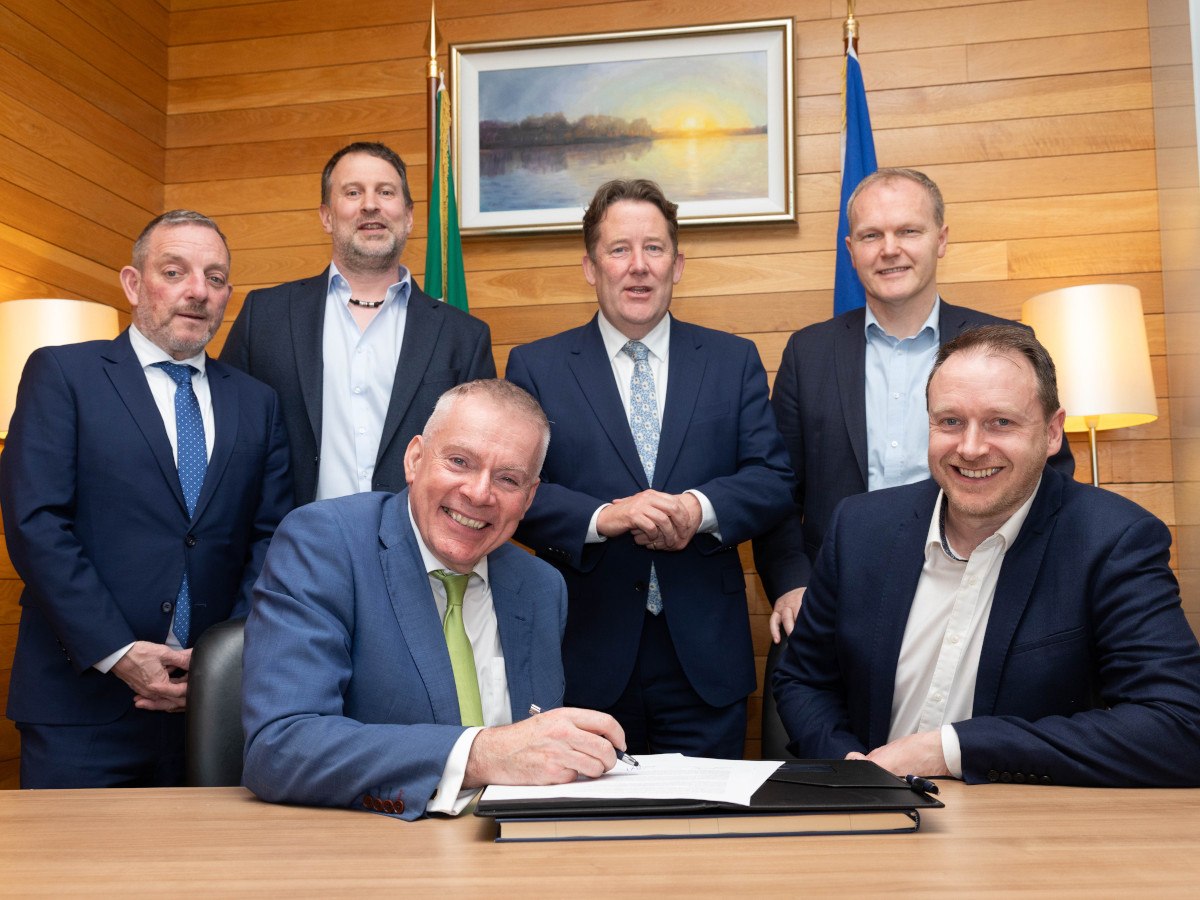
Cork Airport has announced a new solar-power-roofed car park that could generate up to 20pc of the airport’s electricity needs. Construction for the 1.7 MW ‘carport’ – Ireland’s largest-ever – is expected to conclude by August 2027.
The project is a part of the DAA Group’s €200m investment commitments across Cork Airport. The Irish government has backed the project with €2m in exchequer funding under the Regional State Airports Sustainability Programme.
The new carport is being built over the existing Holiday Blue car park, in collaboration with Greenvolt Next, a Lisbon-based renewable-energy solutions provider. The company’s Irish wing, based out of Waterford, has installed photovoltaic panels for the likes of pharma firm Temmler, AW Ennis, fintech Fexco and the Dublin Airport.
Advertisement
The first phase of the carport rollout is expected in early summer 2027. A second one is expected in October. Current plans envisage around 3,700 solar panels and five invertors generating 1.5 GWh of renewable energy each year for the airport. The installation is also expected to lower CO2 emissions by more than 350,000 kg.
The carport will be followed up by an extension to the existing Holiday Blue Car Park with an additional 669 parking spaces. 32 of these spots will be dedicated spaces for people with reduced mobility. The project comes just after Cork Airport experienced its busiest year in 2025 with 3.46m passengers.
“The project was supported with over €2m in exchequer funding under the Regional State Airports Sustainability Programme. This programme was developed in 2024 to support regional state airports to reach their carbon emission reduction targets and build resilience against climate change,” said Minister for Transport and Minister for Climate, Environment and Energy Darragh O’Brien, TD.
Niall MacCarthy, the managing director of Cork Airport, added: “We understand the need for more sustainable operations at airports, which is why Cork Airport is investing in Ireland’s largest solar carport today.”
Advertisement
Last September, Cork Airport was caught in a cyberattack that targeted a number of other European airports including Dublin, Brussels, Berlin and UK’s Heathrow. The attack disrupted the airports’ baggage tagging and handling systems.
Don’t miss out on the knowledge you need to succeed. Sign up for the Daily Brief, Silicon Republic’s digest of need-to-know sci-tech news.
Apple Japan has launched a series of TV and social media videos with famous local artists and animators taking the App Store logo on creative journeys.
One example of the many new interpretations of the App Store logo being used in Japan – image credit: Apple
There’s got to be someone new in Apple’s marketing team, because the company is suddenly playing around with its usually protected icons and images. It started with the cute Little Finder Guy on Instagram, it’s continued with an original Mac birthday cake, and now it’s the turn of the App Store. As first spotted by advertising and marketing publication Creative Blog, Apple Japan has launched a new campaign to promote creative apps in the App Store. There are 16 pieces of artwork, made by 13 artists, and compiled into three videos. Continue Reading on AppleInsider | Discuss on our Forums
Being second to market doesn’t mean being too late
In Sept 2021, in the middle of a global pandemic, James Leong and Joyce Lim packed up their lives in Singapore and moved their young family, including their three-year-old child, to Shanghai.
James had been promoted into an APAC regional role at his chemical raw materials company, while Joyce, coincidentally, was offered a China Representative position when she informed her employer of the relocation.
For a while, everything seemed to fall into place. But two years later, that sense of stability was shaken.
Joyce lost her job due to a company restructuring in Oct 2023. Then, in Mar 2024, feeling increasingly disillusioned with corporate life and sensing the fragility of long-term career security, James made a difficult choice of his own, resigning from what he describes as a “high-paying job.”
Advertisement
I was sick of corporate life and knew deep inside that it was a matter of time before my career would be affected if I continued on the same path.
Now, with both of them no longer tied to the careers that had brought them to China, the couple began looking for something else: a business they could build on their own terms. In 2024, they founded NutriSmart Group to explore opportunities in the F&B industry.
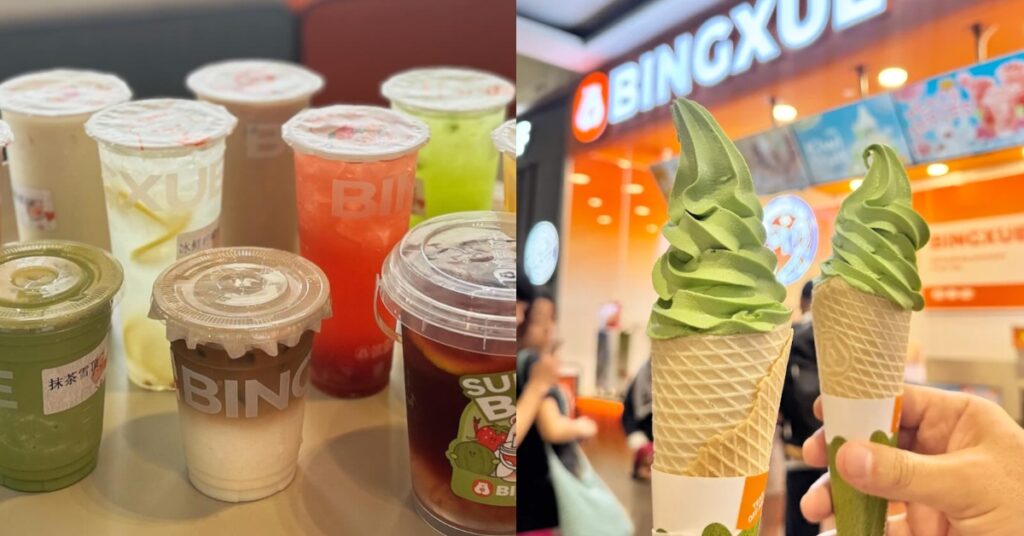
They didn’t have to look far. At a catering conference in Shanghai, the couple came across BingXue: a Chinese franchise built around fresh fruit teas and a signature S$1 ice cream cone. James was struck immediately, not just by the affordable price point, but by the quality behind it.
They began to seriously consider bringing the brand to Singapore, but there was just one problem: back home, a nearly identical brand, Mixue, had already become a fixture. The Chinese bubble tea and ice cream giant had arrived earlier, built strong brand recognition, and firmly captured the mass-market space: affordable, accessible, and quality-driven.
Still, James and Joyce went ahead anyway. Not out of naivety, but conviction—believing that being second to a market doesn’t always mean being too late for it.
Advertisement
There’s still room for another player
Image Credit: BingXue/ Travel & Food via Google Reviews
Conviction alone isn’t enough to validate a business. Before making any commitments, James and Joyce did their homework.
On the surface, BingXue and Mixue offered very similar products: S$1 ice cream cones, milk tea, fruit teas, and a range of affordable desserts designed for the mass market. The main difference between the two was BingXue’s stronger emphasis on matcha-based offerings.
Even so, the couple still believed there was a gap in Singapore’s mass-market F&B space—it was not fully served.
While cheap drinks are widely available in Singapore, many lean heavily on artificial flavours and lower-quality formulations. BingXue’s use of fresh fruit in its teas stood out in contrast, offering a sense of quality that was often missing at that price point.
And although Mixue had the first-mover advantage, launching in 2022 and already establishing a local footprint of over 10 outlets by 2024, there was still room for another player.
Advertisement
Right place, right time for regional expansion
The opportunity to bring BingXue to Singapore came exactly at the right moment.
As it happened, the brand was already expanding aggressively across Southeast Asia, entering markets including Indonesia, Malaysia, Vietnam, and Cambodia between 2022 and 2024. Singapore was a logical next market.
“When we approached them, they were genuinely excited about the opportunity,” James recalled. “They invited us to visit their production facility and headquarters in Shandong Jinan… the rest, as they say, is history.”
Image Credit: Dana, love ling via Google Reviews
After signing the Letter of Intent to become the master franchisee for Singapore, Joyce took on the role of market validator.
She returned to Singapore and spent full days stationed outside different Mixue locations—especially those in weaker locations—simply observing customer traffic and counting how many cups of drinks and ice cream cones were sold throughout the day.
Advertisement
Because BingXue and Mixue target the same mass-market segment, the goal was to understand how well this type of concept was already performing in Singapore.
The data they gathered, combined with their understanding of the BingXue business model, ultimately gave the couple the confidence to commit.
A six-figure investment to bring BingXue to Singapore
Image Credit: BingXue/ David Park via Google Reviews
Though the couple declined to share full negotiation details, they invested a significant sum in the “high six-figures” to bring BingXue to Singapore, drawn entirely from their personal savings.
A large portion of this investment went into building the supply chain, including setting up import routes for raw materials, equipment, and inventory needed to run the stores in Singapore.
But the biggest challenge wasn’t just financial. It was finding the right locations.
Advertisement
Singapore’s retail landscape proved difficult to break into, with landlords cautious about unfamiliar new brands. The couple faced multiple rejections during their search.
The scepticism was understandable. A new Chinese food brand with no local track record was a risky tenant for landlords accustomed to proven operators. But the couple’s persistence paid off: they successfully opened two outlets in Oct 2024, at Yishun Junction 9 and Changi City Point.
BingXue’s outlets at Yishun Junction 9 (left) and Changi City Point (right)./ Image Credit: BingXue/ Muhammad Shaifullah via Google Reviews
Opening one outlet at Yishun and another at Changi might seem random, but it was a deliberate strategy by the couple.
Junction 9 allowed them to test the concept in a community setting—a neighbourhood mall with a regular customer base. Changi City Point, on the other hand, offered high footfall and broad visibility, particularly due to its proximity to Singapore Expo, which draws visitors from across the island.
“Together, these two locations would give us a well-rounded read on how different customer segments will respond to BingXue,” James explained.
Advertisement
Localising to Singaporean tastes
A BingXue outlet at Bonsai Garden./ Image Credit: BingXue
To better appeal to Singapore consumers, the couple didn’t bring everything over unchanged—they localised BingXue’s offerings.
One of the first adjustments James and Joyce made was reducing the default sugar level in drinks. Based on their observations, Singapore customers tend to be more health-conscious, so they set 50% sugar as the standard instead of the original formulation.
“It’s a subtle but important change, and customers notice it,” said James.
Beyond that adjustment, BingXue’s headquarters gave them flexibility with branding but maintained oversight on the menu and pricing. After all, the China team understood their product, but James and Joyce understood their market.
We work closely with BingXue HQ on menu and pricing decisions. On branding and marketing, we have considerable flexibility. They trust that we, as Singaporeans, understand our consumers better than they do.
The support from headquarters turned out to be far more hands-on than expected.
Advertisement
Despite Singapore being a relatively smaller market compared to Indonesia or Malaysia, the founder and CEO of BingXue visited with senior management twice in 2025 alone. Daily WeChat updates, strategic guidance, and problem-solving became an ongoing part of how they work together.
Expanding BingXue to 12 outlets
In the early days, when James and Joyce opened their first two BingXue shops, customer confusion with Mixue was inevitable. Some walked in expecting Mixue products, only to realise after ordering that the two brands were not the same.
Many even asked if the brands were related. The couple often had to explain the differences and clarify that while the concepts were similar, the two businesses were separate.
Image Credit: BingXue/ Void via Google Reviews
Over time, as awareness of the brand grew, so did interest from franchise partners. Since launching about a year and a half ago, BingXue has scaled to 12 outlets across Singapore.
Securing retail space has also become easier. “Today, mall leasing managers proactively approach us with suitable units,” James said. “That’s a meaningful reversal from our early days, and it reflects the growing recognition of BingXue.”
Advertisement
Most outlets have been able to break even within one to two months. But what the couple is most proud of is that many of their stores have been cash-flow positive from the “very first month” of operations.
In F&B, that’s rare—most businesses are bleeding cash in the early months just to keep the lights on. For our franchisees, that means from day one, the business is already covering its own costs and generating profit.
To support this, the team works closely with franchisees at every stage, from site selection and lease negotiations to renovations, licensing, and staff training.
Still, scaling hasn’t been without its challenges, especially in Singapore’s highly competitive F&B landscape.
Supply chain management has been critical, with the team needing to maintain healthy inventory levels without over-committing working capital, especially given the limited shelf life of key ingredients. Their logistics partners also had to scale in lockstep with the brand’s expansion.
Advertisement
“Many can sell ice cream for S$1, but not many can make money”
Image Credit: BingXue
Singapore’s F&B landscape is only becoming more competitive. Coupled with the current global uncertainty in the Middle East, James expects transportation and material costs to increase significantly in the coming weeks and months.
To survive, he believes brands need to be clear about where they compete.
For BingXue, that meant focusing squarely on the lower end of the mass market. While margins are healthy in percentage terms, the low price points mean the business relies heavily on volume to stay profitable.
This is where economies of scale matter. By tapping into BingXue’s production capabilities in China, the brand benefits from lower costs at higher volumes—making it possible to keep prices low while remaining sustainable.
Many brands can sell ice cream cones for S$1. But not many can make money from this S$1. Even fewer brands can sell a good quality ice cream cone at S$1 and still make money.
From the opening of its first outlet in Oct 2024 to Mar 2026, BingXue has sold more than 1.2 million ice cream cones across all its Singapore outlets.
Advertisement
Looking ahead, James and Joyce plan to continue expanding the brand’s footprint locally. Interestingly, while their early franchisees had no F&B background, they are now seeing more experienced operators come on board, an indication of growing confidence in the brand.
The team is targeting at least 50 outlets within the next three years. “With LOIs already signed and strong inbound interest from experienced F&B operators, the path to 50 is already being paved,” added James.
As for NutriSmart, the couple intends to grow it beyond BingXue, bringing in more overseas franchise concepts and building a platform that helps aspiring entrepreneurs start their own businesses with a proven model.
Roblox is preparing to roll out its biggest change since late last year. While that program was initially focused on chat access, today’s news is about age-segregating the games on the massive platform.
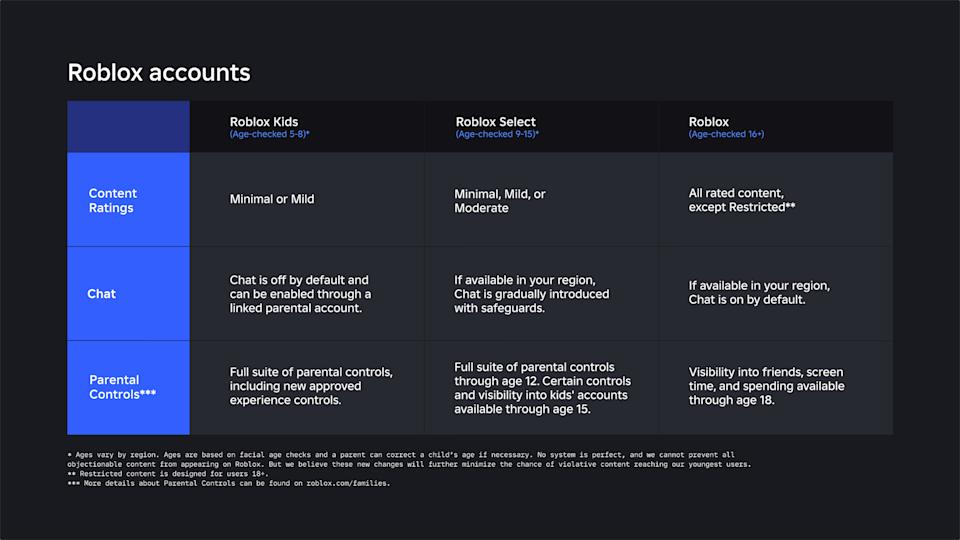
Starting in mid-May, users will be pushed into one of three worlds: Roblox Kids, Roblox Select or Roblox. The exact age ranges of these groups will vary by territory, but in the US they are 5-8 for Kids, 9-15 for Select and 16+ for the regular account. These three account types then align with the platform’s current content maturity labels, which divide games into Minimal, Mild, Moderate and Restricted.
Kids accounts will be the most restricted, with chat off by default and only Minimal and Mild experiences available.
Ages 9-15 get to chat with kids in their age group and “trusted friends” that have passed the parent test, and will be able to access Moderate content as well as games for babies.
Advertisement
At 16, teens will automatically be moved to a full-fat Roblox account with all of its features, but not all of the games. Content marked as Restricted will only unlock once they turn 18.
Roblox
Roblox says over half of its users are now age checked, whether through ID verification or face scans. With the new account types rolled out globally — which the company says should be done by June — it’ll start forcing users who haven’t completed an age check into a Kids-like experience, with no access to chat or games rated higher than Mild.
Once age verification is completed, Roblox still faces the task of ensuring that its vast collection of user-created content is actually age-appropriate. Its solution to this is, of course, ID verification, AI and upcharges.
Developers will have to verify their identity and pony up $5 a month for Roblox Plus to show “a long-term commitment to the platform.” The wisdom is that, with these hurdles cleared, a developer will surely apply the correct maturity label to their games. On the off-chance that an experience is mislabeled, Roblox’s will keep tabs on game instances to make sure what’s happening on-screen and in-chat matches the maturity label. On the surface, this does leave a gap where a toddler could end up playing an incorrectly labeled mature game before the AI catches it. Don’t fret, though, as Roblox says users over 16 “play new games first,” which surely isn’t an overgeneralization and will ensure that no child ever plays a mature game.
Advertisement
Roblox also previewed a pair of new parental control features coming in June. First, parents will be able to block any game and manage direct chat access until a child turns 16. Previously, kids over 13 could unblock experiences by themselves. Second, parents will be able to approve games outside of their child’s age bracket on a case-by-case basis. Roblox gave an example of a younger child wanting to play a game with their older sibling for this feature’s utility.
Of course, the big blocky elephant in the room is the efficacy of automated age verification. suggested even enterprising toddlers might be able to get past the platform’s age checks, which somewhat undermines everything Roblox is trying to achieve. Speaking to press ahead of today’s announcement, Roblox Chief Safety Officer Matt Kaufman said, “If we get it wrong … we offer users multiple ways to correct that.” He added that the platform is “constantly measuring users’ behavior and comparing that against what their age-check data says. If we see those things divert, then we will just ask people to run through the age process again.”
The breach exposed names, addresses, email addresses, phone numbers, dates of birth, and bank account details. No passwords or identity documents were accessed. The Dutch Data Protection Authority has been notified. Basic-Fit operates over 1,300 clubs across seven European countries.
Basic-Fit, Europe’s largest budget fitness chain by club count, has disclosed a data breach affecting members across multiple countries, with approximately 200,000 members in the Netherlands alone whose data was exposed.
The company confirmed it had notified the Dutch Data Protection Authority (Autoriteit Persoonsgegevens) after detecting unauthorised access to the system it uses to register member visits to its fitness clubs.
The data exposed includes membership information, names, home addresses, email addresses, phone numbers, dates of birth, and bank account details. Basic-Fit confirmed that no identity documents, such as passports or driving licences, are stored by the company, and that no passwords were accessed in the breach.
The attack targeted the chain’s club check-in and visit-registration system, which logs member access through turnstiles at each location. Basic-Fit operates in seven European countries: the Netherlands, Belgium, Luxembourg, France, Spain, Germany, and Austria.
Advertisement
The inclusion of bank account details in the leaked data is likely to be the most significant concern for affected members. In combination with names and dates of birth, IBAN numbers and bank details create the conditions for SEPA direct debit fraud and financial impersonation.
Basic-Fit’s privacy statement confirms that the company collects bank account numbers from all members as part of the subscription process, used to process recurring membership payments.
Affected members have been warned to monitor their accounts closely and to be alert to phishing attempts that may use the exposed personal details to appear credible.
The breach arrives during a difficult period for data security in the Netherlands. In February 2026, telecom operator Odido, formerly T-Mobile Netherlands, suffered what cybersecurity experts described as one of the largest data breaches in Dutch history, with the personal data of approximately 6.2 million customer accounts exposed through an attack on its customer relationship management system.
Advertisement
That incident included IBAN numbers, passport details, and dates of birth. The Basic-Fit breach is substantially smaller in scale but follows the same pattern of attacks targeting systems that hold aggregated customer identity and financial data in bulk.
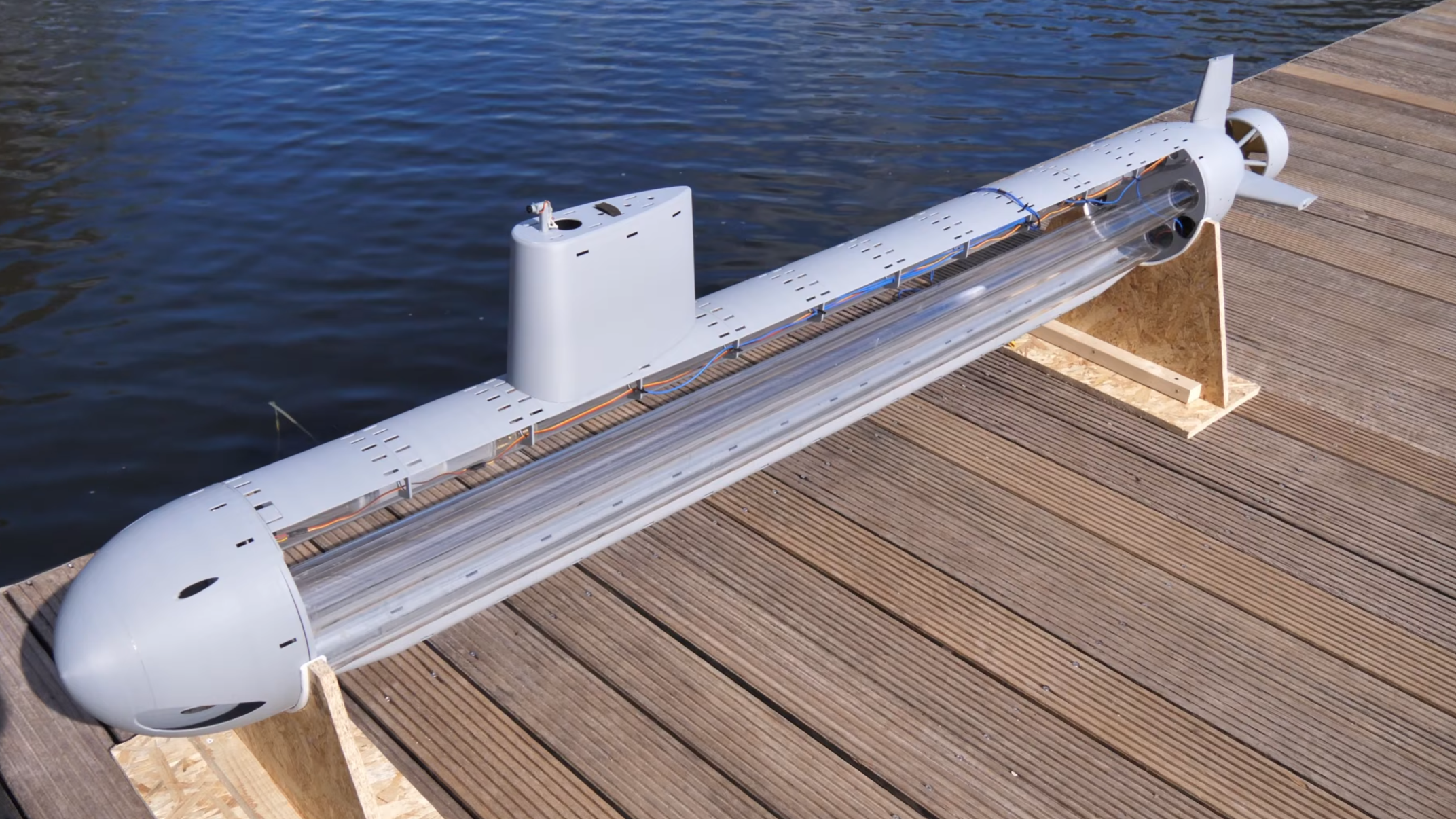
Of all the remote-control vehicles one can build, a submarine is possibly the hardest: if something goes wrong with almost any other vehicle, it’s easy to recover and repair, but a submarine is a very different affair. This nearly lost [James] of [ProjectAir] his latest project, a 2.7-meter long RC submarine, but it survived to make a few test sails.
Before building the full version, [James] made a test prototype. These submarines use large syringes as ballast tanks, pulling water in and out of the submarine body. The plungers are driven by a lead screw, and have a linear potentiometer for feedback. This can be wired in the same way as a servo motor, making it compatible with the RC controller. The controller receives its signal from an antenna in a buoy tethered to the submarine. Since initial tests worked well, [James] moved on to the full-scale model.
This was made out of radially-arranged acrylic tubes, with all but the top tube left open to the water. At the back of the submarine there were servo-actuated fins and a propeller, which would allow it to steer, ascend, and descend underwater. To waterproof the servo motors, [James] sealed them as much as possible, then filled them with oil. The other water-exposed electronics were either potted in epoxy or coated with a waterproofing compound. During testing, the submarine descended without issue, but was reluctant to resurface. Most of the external components had been 3D printed, and water infiltrated the infill below a certain depth. [James], however, managed to recover it before it was permanently lost, and managed to make a few other dives at a very limited depth.
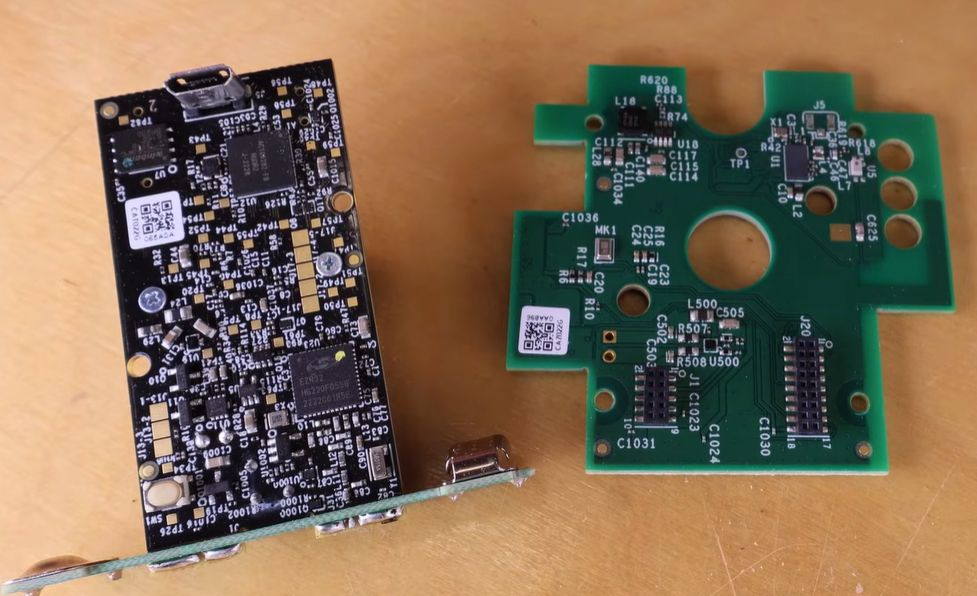
After some water intrusion apparently killed one of [electronupdate]’s Amazon Blink Gen 3 cameras he took this opportunity to do a full teardown and analysis of all the major components. Spread across its three PCBs there are no fewer than two wireless ICs and a custom ASIC for all the major processing. There’s also a blog post with easy-to-ogle pictures.
The most basic PCB is effectively just a PCB antenna for the Silicon Labs EZR32 IC on the main PCB, using which the ~915 MHz connection with the central hub is maintained. The other smaller PCB is a bit surprising in that it contains a Cypress CYW43438 W-Fi b/g/n and BT 5.1 chip. This would seem to be used for the setup process, but considering that it also uses a central hub it is a bit of a mystery as to what it is used for exactly.
Finally, the main PCB contains all the major parts, with the custom Amazon Immedia ASIC that’s an integral part of this very low-power camera. Given that two AA cells being enough to run the camera for about two years, using off-the-shelf parts probably wasn’t good enough without some serious customization.
Advertisement
As for why this outdoors-rated camera failed after a few years in the outdoors, the reason appears to be water intrusion via the speaker opening. As for why a camera needs a speaker and not just the microphone is left as an exercise to the reader, but maybe it could be useful for yelling at the local kids to get off your darn lawn?
Over the weekend, Northern Irish health trusts were on high alert after the XP95 hacker group claimed to have accessed half a million files.
A recruitment platform used by Northern Ireland’s health trusts has reportedly suffered a cyber attack from the relatively new hacker group XP95, who are claiming they accessed hundreds of thousands of files.
With headquarters in Dublin and offices in Belfast, Toronto and Melbourne, Healthdaq has not yet replied to our request for comment, but BBC NI reported over the weekend that it has seen an email from Healthdaq’s data protection officer, saying it had become aware of unauthorised access to data held on its platform on 30 March, and that the issue had been contained.
“The incident has been identified as a confidentiality breach involving unauthorised access and extraction of data,” BBC NI quoted the email, which said that names, contact details, CVs and forms of government ID could be among the data that was stolen, in some cases even health data.
Advertisement
The cited email went on to warn that the nature of the data stolen meant that there was a risk of misuse, from identity theft to fraud. According to the BBC, the health trusts have warned all staff to be aware of a potential cyber incident and to be extra vigilant.
Healthdaq told The Newsletter in Belfast that the incident had been reported to the “relevant regulatory and law enforcement authorities” including the Garda National Cyber Crime Bureau .
According to threat intelligence firm Red Piranha, the XP95 ransom actor was first observed on March 4, and its first know attack was on Eholo Health, a Spanish mental-health SaaS platform serving over 10,000 psychologists across Spain and Andorra.
“The actor’s BreachForums profile was freshly created at the time of first appearance, with no prior references in threat intelligence reporting linking XP95 to any known organised group or prior campaigns,” said Red Piranha in a threat intelligence report from early March.
Advertisement
“Unlike conventional ransomware operators, XP95 does not deploy encryption malware,” it said. “The group operates a pure exfiltration-and-extortion model: sensitive data is stolen from the victim environment, a proof-of-compromise sample is published on a Tor-hosted Data Leak Site (DLS) and cross-posted to BreachForums, and a ransom demand is issued with a hard payment deadline.”
Should the ransom not be paid, XP95 then threaten to publicly release the stolen dataset for sale. Reporting suggests that healthdaq has indeed received a ransom request.
Don’t miss out on the knowledge you need to succeed. Sign up for the Daily Brief, Silicon Republic’s digest of need-to-know sci-tech news.























































You must be logged in to post a comment Login