Business
(VIDEO) 10 Things You Must Know About Nike’s Neuroscience-Powered Shoes Nike Mind
Nike’s Mind platform is one of the brand’s most ambitious innovations yet, blending neuroscience, design and sport psychology into a new category of “sensory footwear.” Here are 10 things you need to know about Nike Mind — and why it matters for the future of performance.

1. Nike Mind is Nike’s first neuroscience-based footwear platform
Nike Mind is not just another cushioning or performance foam; it is Nike’s first footwear platform explicitly built around neuroscience and how the brain responds to sensory input from the feet. Developed inside the Nike Mind Science Department, a branch of the Nike Sport Research Lab, the project spent about a decade in research and prototyping before its public debut.
Unlike traditional performance shoes that focus on speed, propulsion or impact protection, Nike Mind is designed to change how athletes feel mentally by stimulating specific neural pathways through underfoot contact. Nike describes it as a “new sensory footwear concept that helps reawaken the foot, the body and the mind,” signaling a shift from pure physical performance to mind–body integration.
2. It’s built around 22 anatomically mapped foam nodes
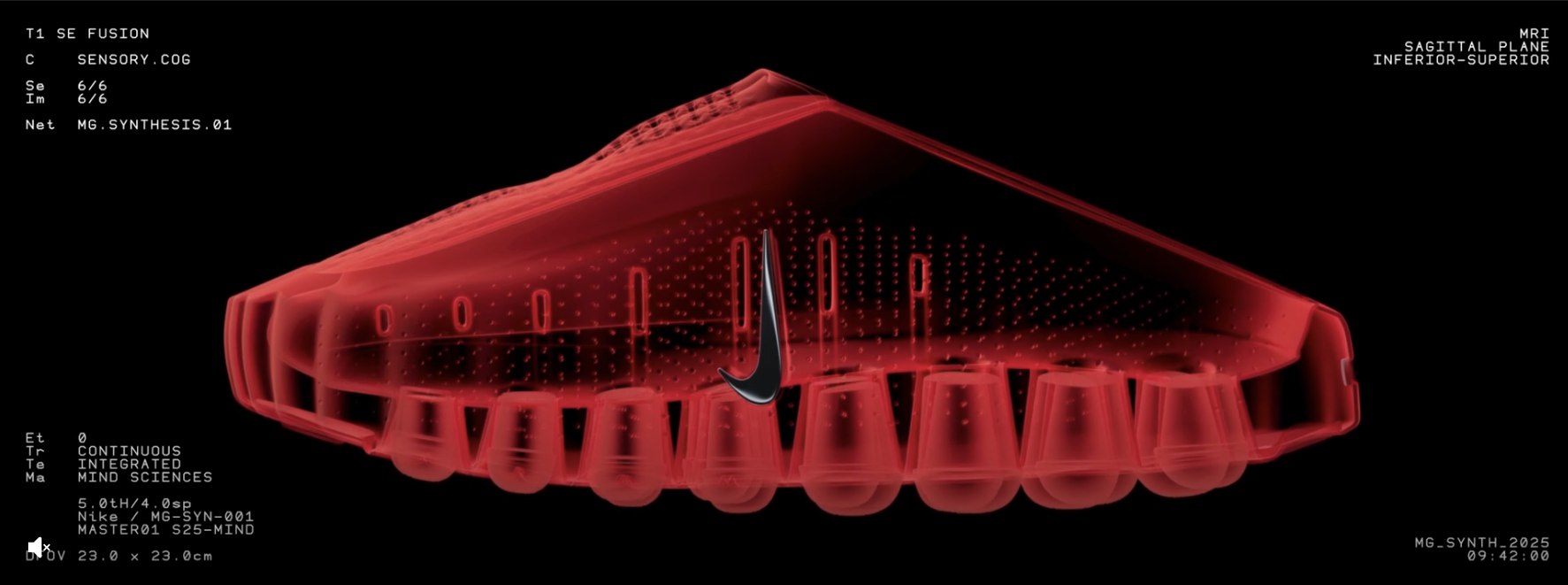
At the heart of Nike Mind technology is a system of 22 foam “nodes” mapped to key regions under the foot. These nodes are attached to a flexible base and function like tiny pistons or gimbals that move independently as you walk, stand or shift your weight.
The idea is to target pressure points and mechanoreceptors on the sole, which are directly linked to sensory regions of the brain. By constantly changing the pattern of underfoot stimulation, the nodes amplify sensation and mimic a more natural, varied interaction with the ground than flat cushioning normally provides.
3. It’s designed for pre-game priming and post-game recovery
Nike Mind shoes are explicitly framed as “pre-game and post-game” tools rather than race-day or in-game performance footwear. Nike says the platform is meant to help athletes prime their nervous systems before competition and then reset or decompress afterward.
During pre-game routines, the sensory stimulation is intended to sharpen focus, heighten awareness and mentally prepare athletes to compete. Post-game, the same technology aims to support recovery by helping the brain and body shift out of high-alert competition mode and into a calmer, more grounded state.
4. Nike Mind 001 and Mind 002 launch the line
The first products to feature the technology are Nike Mind 001 and Nike Mind 002. Mind 001 is described as a slip-on mule with a minimalist, “directionless” design that’s easy to slide into before or after training. Mind 002 takes the same sensory system and wraps it into a more structured sneaker silhouette for everyday movement and more active use.
Both styles share the 22-node underfoot system, but they target slightly different use cases: the mule emphasizes simplicity and transition, while the sneaker emphasizes stability and versatility for walking, light training and daily wear.
5. The goal is to quiet the brain’s “default mode network”
One of the most striking claims behind Nike Mind is neurological: the shoes are designed to help disengage the brain’s default mode network (DMN) and activate the sensorimotor network. The DMN is associated with mind-wandering, ruminating and self-referential thoughts, while the sensorimotor network is linked to movement, touch and present-moment engagement.
Nike’s researchers report that in trials, the underfoot sensory pattern from the foam nodes increased activity in brain regions responsible for processing touch and boosted alpha-wave activity associated with meditative or calm-but-alert states. In practical terms, that translates to feeling more grounded, less distracted and more “in the moment” before or after competition.
6. Nike built a dedicated Mind Science Department
To create Nike Mind, the company formed a specialized Mind Science Department inside its existing Nike Sport Research Lab. This team combines neuroscientists, biomechanists, engineers and designers who study how mechanical inputs at the foot translate into electrical signals in muscles and brain rhythms.
During development, athletes and test subjects were wired to EEGs and other sensors while using Mind prototypes, logging tens of thousands of hours of wear and generating large datasets on how underfoot stimuli shape perception, attention and emotional state. Nike’s Chief Science Officer, Dr. Matthew Nurse, describes the project as an expansion from “studying the body in motion” to studying perception and attention as core elements of performance itself.

7. Top athletes like Erling Haaland tested the shoes
Elite athletes were heavily involved in Nike Mind’s validation. Manchester City striker Erling Haaland is cited as a key tester; he reportedly praised the shoes for helping him “bring balance to my game,” referencing a feeling of improved mental stability and focus.
Across hundreds of trials with professional athletes, healthcare workers and therapists, wearers consistently reported heightened awareness, sharper focus and a sense of being more grounded and in control. Those subjective reports line up with the neuroscientific data showing shifts in sensory networks and meditation-like brain activity when Mind shoes are used properly.
8. Mind is about mental engagement, not max speed
Nike is clear that Mind 001 and Mind 002 are not racing shoes or performance trainers in the traditional sense. Instead, the design brief focuses on mental engagement, flow state and recovery—what Nike calls “holistic performance.”
The footwear is “directionless by design,” which means it’s not optimized for a specific gait pattern or sprinting efficiency but for free movement, shifting weight, micro-adjustments and sensory exploration. The goal is to give athletes and everyday wearers a tool they can use before, between or after high-intensity sessions to re-center mentally, rather than something to shave seconds off a race.
9. The design language is minimal, tactile and “mindful”
Aesthetically, Nike Mind 001 and 002 lean into a clean, futuristic minimalism that underscores their role as sensory tools rather than flashy performance sneakers. The uppers favor simple lines, soft materials and easy entries, while the visible underfoot node structure and flexible base signal the technology underneath.
Materials were chosen for comfort and “consciousness”—soft yet supportive foams, flexible platforms and water-resistant bonding that allow the nodes to move freely in all directions. Every design choice is meant to keep your attention on how the shoe feels, not just how it looks, reinforcing Nike’s pitch that Mind is about reconnecting the wearer with their own body and environment.
10. Nike sees Mind as “chapter one” of brain-focused gear
Nike executives repeatedly describe Mind as just the beginning of a much larger move into brain-centered performance products. Dr. Matthew Nurse has called Mind 001 and 002 “chapter one of the feet,” suggesting that future chapters may target other parts of the body and broader emotional or cognitive states.
The company frames Mind as a “sensory intervention” and hints at expanding neuro-informed design into apparel and accessories that influence how we feel—calm, energized, focused—through touch, pressure, temperature and other stimuli. That vision positions Nike not just as a maker of shoes and clothing, but as an early player in consumer neurotechnology, where what you wear is deliberately engineered to shape your mind as much as your muscles.
In short, Nike Mind is less about running faster and more about feeling more present, focused and resilient—using your feet as a direct doorway into your brain.
Business
New Zealand celebrates national day with call to support Maori and preserve unity

New Zealand celebrates national day with call to support Maori and preserve unity
Business
Eurozone Inflation Sinks Below ECB Target Ahead of Rate Decision
Eurozone inflation fell below the European Central Bank’s target in January and is expected to remain under that 2% mark over the next two years.
However, a weaker dollar and increased imports of lower-priced Chinese goods could push inflation even lower than policymakers expect, and persuade them to restart a series of interest-rate cuts the ECB halted in June.
Copyright ©2026 Dow Jones & Company, Inc. All Rights Reserved. 87990cbe856818d5eddac44c7b1cdeb8
Business
NKGen Biotech increases loan principal by $251,000 under amended agreement

NKGen Biotech increases loan principal by $251,000 under amended agreement
Business
PureField Ingredients: Protein-Focused from America’s Heartland

U.S.-grown wheat protein delivering performance, transparency, and industry-leading low-carbon operations.
Business
Qualys Q4 2025 presentation: Enterprise TruRisk Platform drives 10% revenue growth

Qualys Q4 2025 presentation: Enterprise TruRisk Platform drives 10% revenue growth
Business
TAT Technologies: Strong Buy As Tiny Company Powers Huge APU, Gear Expansion (NASDAQ:TATT)
Dhierin-Perkash Bechai is an aerospace, defense and airline analyst.
Dhierin runs the investing group The Aerospace Forum, whose goal is to discover investment opportunities in the aerospace, defense and airline industry. With a background in aerospace engineering, he provides analysis of a complex industry with significant growth prospects, and offers context to developments as they occur, describing how they might affect investment theses. His investing ideas are driven by data informed analysis. The investing group also provides direct access to data analytics monitors.
Learn more.
Analyst’s Disclosure: I/we have no stock, option or similar derivative position in any of the companies mentioned, and no plans to initiate any such positions within the next 72 hours. I wrote this article myself, and it expresses my own opinions. I am not receiving compensation for it (other than from Seeking Alpha). I have no business relationship with any company whose stock is mentioned in this article.
Seeking Alpha’s Disclosure: Past performance is no guarantee of future results. No recommendation or advice is being given as to whether any investment is suitable for a particular investor. Any views or opinions expressed above may not reflect those of Seeking Alpha as a whole. Seeking Alpha is not a licensed securities dealer, broker or US investment adviser or investment bank. Our analysts are third party authors that include both professional investors and individual investors who may not be licensed or certified by any institute or regulatory body.
Business
ADM earnings decline amid lower crush margins

Company awaits clarity from US biofuels policy.
Business
MF Tracker: Can this 3 and 5 year top performer PSU fund extend its winning streak?
Launched in July 2010, the fund is not given any rating by Morningstar and Value Research. For this fund, according to Value Research, each category must have a minimum of 10 funds for it to be rated, which is not the case for the PSU category as there are five funds. As per Morningstar, this category is a non rateable category fund.
Also Read | Will secondary market SGB maturity returns now be taxed? Budget 2026 has changed the rules
Based on the trailing returns, the fund has outperformed its category average in the last three and five years whereas in the last 10 years, it failed to outperform its benchmark. As in the last three years and five years, the fund gave 32.14% and 28.74% respectively, the category average was 30.60% and 27.94% respectively. Since its inception, the fund has delivered a CAGR of 8.35%. Note, the data for the benchmark BSE PSU TRI was not available to compare the performance of the fund.
On the basis of daily rolling returns, the fund has delivered a CAGR of 15.23% in the last five years, 8.27% in the last seven years, and 7.79% in the last 10 years.
A monthly SIP made in the fund since its inception would have been Rs 59.25 lakh with an XIRR of 13.67%. A lump sum investment of Rs 1 lakh made in the fund since its inception would have been Rs 3.48 lakh with a CAGR of 8.34%.
How does the fund house decode the performance?
PSU stocks have been strong performers, both on an absolute basis and relative to the broader market post 2020, due to an earnings revival and valuation re rating and this tailwind clearly aided our fund’s performance, Rohit Shimpi, Fund Manager, SBI PSU Fund shared with ETMutualFunds.Top contributors for the fund over the last five years have been our holdings in PSU banks and financial institutions, industrials including defence, utilities including electric utilities, energy and metals. These stocks were aided by improvement in asset quality of PSU banks, growth in defence and power, and a positive commodity cycle impacting metals.
Our fund’s strategy has not changed significantly over time, however in mid 2024, we did feel that certain pockets within PSUs were seeing exuberance, and we realigned the portfolio towards large cap stocks within the PSU space. Overall, while being highly stock specific, we remain more positive on large cap stocks within the PSU space at this point in time, Shimpi further said.
What experts say on SBI PSU Fund
According to an expert, with the fund comfortably outperforming its category average, this strong performance marks a sharp improvement over its long term historical returns and reflects the powerful rally seen in public sector stocks in recent years.
Abhishek Bhilwaria, BhilwariaMF (AMFI registered MFD), shared with ETMutualFunds that the primary drivers of this performance have been favourable macroeconomic conditions for PSUs and focused portfolio positioning. The government led reforms, balance sheet clean ups in public sector banks, higher capital expenditure and policy support for infrastructure, defence and energy companies have significantly improved earnings visibility across the sector.
“In addition, the fund has maintained high exposure to core PSU segments such as financial services, energy and power, which have been among the biggest beneficiaries of the economic cycle.”
He further said that the fund has also benefited from a concentrated portfolio approach, with its top holdings accounting for over half of its assets and stocks such as State Bank of India, Bharat Electronics and NTPC have delivered strong returns and played a major role in boosting overall fund performance, and a measured allocation to mid cap PSUs further enhanced returns during periods of market momentum.
Also Read | Silver & gold ETFs rally up to 9% as bullion boom continues. Should you invest now?
As per the last available portfolio data, the top 10 stock holding of the fund is SBI with an allocation of 17.80%, followed by NTPC of around 7.70%, and Bank of Maharashtra with an allocation of 3.65%.
Based on the sectoral allocation, the fund holds 30.05% in banks, 13.49% in power, and 13.33% in crude oil. Around 12.32% is allocated to capital goods, 8.53% to gas transmission, and 6.30% to mining.
So has the fund benefited more from stock selection or sector trends? Bhilwaria said that the SBI PSU Fund has benefited more from broad sector trends, with stock selection acting as a differentiating factor rather than the primary driver and the re rating of the PSU sector as a whole has been the foundation of the fund’s strong returns.
“Improved asset quality in PSU banks, sustained government spending on infrastructure and defence, and renewed investor confidence in public sector enterprises lifted the entire category. This is evident from the fact that average PSU funds have also delivered strong multi year returns, indicating that the rally was sector wide.”
However, SBI PSU Fund’s ability to consistently rank at the top of the category stems from its concentrated exposure to high conviction names and its willingness to take calculated bets across market capitalisations. By overweighting leaders such as SBI and Bharat Electronics and maintaining exposure to select mid cap PSUs, the fund was able to capture incremental gains over peers.
The fund holds 97.12% in equity, 0.08% in debt, and 2.80% in others. Based on market capitalisation, the fund holds 68.95% in large caps, 21.21% in mid caps, 2.89% in others, and 6.96% in small caps.
Should one focus on this sector now post Budget 2026?
Bhilwaria said that following the Union Budget 2026, the outlook for PSU funds has turned more cautious in the near term. PSU bank stocks corrected sharply after the budget due to the absence of fresh capital infusion announcements and profit booking after a strong pre budget rally and this highlights the sensitivity of PSU stocks to policy signals and market expectations.
“That said, the longer term structural story remains intact. The government’s continued emphasis on capital expenditure, particularly in power, defence, railways and infrastructure, supports earnings growth for several PSU companies. As a result, PSU funds may still offer opportunities, but a selective and disciplined approach is essential rather than aggressive lump sum allocations.”
And lastly, given their very high risk profile, sectoral and thematic funds such as PSU funds should form only a small part of an investor’s portfolio. Most experts recommend limiting exposure to a single sector fund to around 10% of the overall portfolio.
He further said that these funds should be treated as satellite investments, while the core portfolio remains anchored in diversified equity funds and investors whose PSU allocation has increased significantly due to past rallies may also consider rebalancing to manage risk.
Also Read | NFO Insight: Does Kotak Services Fund offer access to India’s core growth engine?
Key risk ratios and investment style
The PE and PBV ratio of this fund were recorded at 19.66 times and 3.12 times respectively whereas the dividend yield ratio was recorded at 2.39% as of December 2025.
ETMutualFunds analysed the other key ratios of the fund over a three year period. Based on the last three years, the scheme has offered a Treynor ratio of 2.15 and an alpha of 0.18. The Sortino ratio of the scheme was recorded at 0.82. The return due to net selectivity was recorded at 0.12 and return due to improper diversification was recorded at 0.05 in the last three years.
The investment style of the fund is to invest in growth oriented stocks across large cap market capitalisations.
Others in PSU basket
Apart from SBI PSU Fund, there are three other actively managed funds in the category which have completed three years of existence in the industry. Invesco India PSU Equity Fund gave 31.74%, Aditya Birla SL PSU Equity Fund gave 29.49%, and ICICI Prudential PSU Equity Fund gave 29.03% in the last three years.
Post seeing strong performance by these funds, what is the outlook of these funds? The expert said that the outlook for the PSU sector in early 2026 is one of selective long term opportunity combined with near term volatility. Fundamentally, many PSUs are in a stronger position than in previous cycles, with healthier balance sheets, improved governance and steady cash flows and several companies continue to offer attractive dividend yields and benefit from government backed order visibility.
“However, market sentiment has become more discerning. Much of the valuation re rating seen over the past few years is already priced in, particularly in PSU banks. Budget related uncertainty, evolving governance reforms and ambitious disinvestment targets have added to short term fluctuations. As a result, broad based sector rallies may be limited going forward.”
He further said that for PSU funds, this suggests a phase of consolidation rather than runaway gains. Performance is likely to be driven by stock specific fundamentals rather than pure sector momentum. Investors should approach PSU funds with a medium to long term horizon, an ability to tolerate volatility and a clear understanding that returns may be uneven, and a selective and measured exposure remains the most prudent strategy in the current environment.
One should always consider risk appetite, investment horizon, and goals before making any investment decisions.
(Disclaimer: Recommendations, suggestions, views and opinions given by the experts are their own. These do not represent the views of The Economic Times)
If you have any mutual fund queries, message ET Mutual Funds on Facebook or Twitter. We will get it answered by our panel of experts. Do share your questions at ETMFqueries@timesinternet.in along with your age, risk profile, and Twitter handle.
Business
Minute Maid to discontinue frozen juice concentrate products
Check out what’s clicking on FoxBusiness.com.
Minute Maid, owned by The Coca-Cola Company, is preparing to discontinue its frozen juice concentrate products, a move that has sparked a wave of nostalgia among longtime fans online.
The change is expected to take effect in the first quarter of 2026 as the company responds to shifting consumer demand. Remaining cans will stay on shelves until supplies are exhausted, a Coca-Cola spokesperson confirmed to FOX Business on Thursday.
“We are discontinuing our frozen products and exiting the frozen can category in response to shifting consumer preferences,” the spokesperson said. “With the juice category growing strongly, we’re focusing on products that better match what our consumers want.”
COCA-COLA OFFICIALLY ROLLS OUT CANE SUGAR SODA ACROSS US MARKETS FOLLOWING TRUMP’S URGING: REPORT

Minute Maid frozen orange juice is displayed in a freezer at a grocery store on August 30, 2016, in San Rafael, California. (Justin Sullivan/Getty Images / Getty Images)
Minute Maid’s current frozen concentrate lineup includes orange juice, lemonade, pink lemonade, raspberry lemonade and limeade, according to The Coca-Cola Company’s website.
Following the announcement, users took to social media to share their nostalgia after food blogger Markie Devo posted about the change, People Magazine first reported.
Many expressed sadness over the loss of the product.
COCA-COLA INTRODUCES CONTENDER IN PREBIOTIC DRINK TREND AS ‘GUT-HEALTHY’ SODAS GAIN POPULARITY

Cans of Minute Maid frozen lemonade are displayed on a store shelf on Feb. 5, 2026, in San Anselmo, California. (Justin Sullivan/Getty Images / Getty Images)
“NOOOOOO! This is my literal childhood,” one user wrote.
“An end of an era is right! My favorites growing up. Sad to hear this,” another commented.
“My Mom made pies using the lemonade,” another wrote, adding a crying emoji. “They are getting rid of so many childhood memories! Thank you for posting.”
“I hated these but I am somehow still sad to see them go,” another user added.
Minute Maid’s frozen concentrate products have long held a place in U.S. food history, with the brand’s frozen orange juice dating back 80 years, according to The Coca-Cola Company’s website.
COCA-COLA RECALLS TOPO CHICO MINERAL WATER OVER BACTERIA CONCERNS

Signage outside the Coca-Cola bottling plant in Albany, New York, on Jan. 30, 2024. (Angus Mordant/Bloomberg via Getty Images / Getty Images)
The move comes as Coca-Cola shifts its broader strategy, placing greater emphasis on zero-sugar beverages and brands such as Fairlife milk amid evolving consumer preferences, Reuters reported.
Coca-Cola also recently began rolling out soda made with U.S. cane sugar across the country.
GET FOX BUSINESS ON THE GO BY CLICKING HERE
A 12-ounce, single-serve glass bottle of the cane sugar version of its signature soda launched in select markets nationwide last fall, a company spokesperson previously told The New York Post.
Business
The Bancorp, Inc. 2025 Q4 – Results – Earnings Call Presentation (NASDAQ:TBBK) 2026-02-05
Q4: 2026-01-29 Earnings Summary
EPS of $1.28 misses by $0.18
| Revenue of $92.08M (-2.35% Y/Y) misses by $51.07M
Seeking Alpha’s transcripts team is responsible for the development of all of our transcript-related projects. We currently publish thousands of quarterly earnings calls per quarter on our site and are continuing to grow and expand our coverage. The purpose of this profile is to allow us to share with our readers new transcript-related developments. Thanks, SA Transcripts Team
-
Crypto World6 days agoSmart energy pays enters the US market, targeting scalable financial infrastructure
-
Politics6 days agoWhy is the NHS registering babies as ‘theybies’?
-
Crypto World7 days agoAdam Back says Liquid BTC is collateralized after dashboard problem
-
Video3 days agoWhen Money Enters #motivation #mindset #selfimprovement
-
Fashion6 days agoWeekend Open Thread – Corporette.com
-
Tech2 days agoWikipedia volunteers spent years cataloging AI tells. Now there’s a plugin to avoid them.
-
NewsBeat7 days agoDonald Trump Criticises Keir Starmer Over China Discussions
-
Politics4 days agoSky News Presenter Criticises Lord Mandelson As Greedy And Duplicitous
-
Crypto World6 days agoU.S. government enters partial shutdown, here’s how it impacts bitcoin and ether
-
Sports5 days agoSinner battles Australian Open heat to enter last 16, injured Osaka pulls out
-
Crypto World5 days agoBitcoin Drops Below $80K, But New Buyers are Entering the Market
-
Crypto World4 days agoMarket Analysis: GBP/USD Retreats From Highs As EUR/GBP Enters Holding Pattern
-
Business6 hours agoQuiz enters administration for third time
-
Crypto World6 days agoKuCoin CEO on MiCA, Europe entering new era of compliance
-
Business6 days ago
Entergy declares quarterly dividend of $0.64 per share
-
Sports4 days agoShannon Birchard enters Canadian curling history with sixth Scotties title
-
NewsBeat13 hours agoStill time to enter Bolton News’ Best Hairdresser 2026 competition
-
NewsBeat3 days agoGAME to close all standalone stores in the UK after it enters administration
-
NewsBeat3 days agoUS-brokered Russia-Ukraine talks are resuming this week
-
Crypto World2 days agoRussia’s Largest Bitcoin Miner BitRiver Enters Bankruptcy Proceedings: Report