
Crypto World
Privacy Boost, Sunnyside’s Privacy SDK, Goes Live on Optimism Mainnet: Optimism



Optimism’s first privacy offering by core developer Sunnyside uses ZK and TEE hybrid technology to enable confidential computing for enterprises on the OP Stack.
Privacy Boost, a privacy offering built by Sunnyside—an Optimism core developer—launched on OP Mainnet on Tuesday, April 21. The product is a drop-in SDK enabling confidential computing for Sunnyside’s customers on any OP Stack chain. The hybrid architecture combines zero-knowledge proofs and trusted execution environments (TEE), with sub-500ms proof generation and compliance-compatible design.
Privacy Boost targets enterprise demand for onchain transaction privacy without exposing customer data. The protocol’s high-throughput design is expected to expand to additional blockchains beyond Optimism. The launch addresses institutional adoption barriers on Ethereum and Layer 2 networks where regulatory and operational requirements demand confidential data handling.
Sources: Optimism | Decrypt
This article was generated automatically by The Defiant’s AI news system from publicly available sources.


A coalition of European financial institutions and industry bodies is urging EU lawmakers to accelerate reform of blockchain rules by treating the DLT Pilot Regime as a standalone law rather than folding it into a broader legislative package. The letter, signed by 39 entities including Nasdaq and Boerse Stuttgart, calls for a quick carve‑out to keep Europe at pace with global developments in tokenized finance. According to Cointelegraph, the missive was addressed to the European Commission and Parliament, highlighting the risk that delaying action could slow Europe’s adoption of distributed ledger technology in financial markets.
The DLT Pilot Regime, launched in 2023, serves as a regulatory sandbox for testing blockchain-based trading and settlement of assets such as stocks and bonds under real-market conditions. It provides temporary exemptions from certain rules to allow firms to experiment with tokenized finance in a controlled environment. The signatories contend that integrating the regime into a wider Market Integration and Supervision Package would push reforms into a protracted negotiations cycle, potentially undermining Europe’s competitiveness as the United States advances its own tokenized-finance initiatives. “Negotiations are likely to be lengthy,” the letter states, adding that delays “risk dampening Europe’s momentum in DLT adoption.”
Key takeaways
- EU industry groups press for treating the DLT Pilot Regime as a standalone legislative act rather than including it in a broader digital finance package.
- Proposals call for expanding the regime’s scope, increasing the asset universe, and raising the overall testing cap to 150 billion euros.
- Efforts include removing time limits on licenses, enabling longer or permanent permission to operate pilot projects.
- Context is shaped by a U.S. regulatory shift: the SEC has clarified custody rules for tokenized securities and signaled support for tokenization services via a DTCC subsidiary under an no-action posture.
- The developments bear on Europe’s cross-border capital markets, licensing regimes, and competitiveness relative to the United States and other jurisdictions.
EU regulators and industry: decoupling the DLT Pilot from broader reform
The joint letter contends that a standalone DLT Pilot Regime would yield faster regulatory clarity and more predictable pathways for firms testing blockchain-enabled trading and settlement. With the European Union pursuing a broader digital-finance reform agenda, the authors warn that binding the pilot to the multi‑year negotiation timeline of other measures could slow practical progress on tokenized markets. The signatories emphasize broad industry support for pragmatic adjustments that could accelerate implementation without compromising safety or investor protection. The letter was directed to Financial Services Commissioner Maria Luis Albuquerque, underscoring a sense of urgency among market participants who fear lagging policy momentum.
Scope expansion and licensing: what changes are proposed
Under the current regime, the pilot allows limited testing of certain asset classes and issuance scales. Specifically, it covers relatively small market-test cases, with thresholds such as shares of companies valued under roughly $588 million, bonds with issuances under about $1.17 billion, and investment funds with assets under $588 million. The industry coalition is pushing for a broader menu of eligible assets and a substantial uplift in the testing ceiling to 150 billion euros ($176 billion). Besides widening eligibility, the proponents call for the removal of time limits on licenses, effectively enabling longer or ongoing pilot activity to support scale‑up and learning by doing. They argue these are practical, widely supported adjustments that would foster regulated on‑chain markets across Europe.
US momentum and cross-border regulatory context
The United States has been moving to integrate tokenized securities into the existing financial infrastructure, creating a contrasting backdrop to Europe’s stalled pace. The Securities and Exchange Commission has clarified that broker‑dealers can custody tokenized securities under current investor-protection rules. In another development, the SEC issued a no‑action letter enabling a Depository Trust & Clearing Corporation (DTCC) subsidiary to launch a service that tokenizes real-world assets held in custody. These steps reflect a broader U.S. policy trajectory toward practical, regulated tokenization as part of the mainstream financial system. While these actions are not EU decisions, they influence the regulatory discourse in Europe and shape expectations for how quickly EU rules must adapt to technological and market developments. Cointelegraph has reported on these developments and notes the contrast with Europe’s cautious, negotiations-heavy approach.
Industry calls and the push for a timely fix
Separate but related to the current push, a February letter from a group of nine European tokenization and market-infrastructure firms similarly urged EU policymakers to urgently update the DLT Pilot Regime. The signatories—among them Securitize, 21X, and Boerse Stuttgart Group—warned that strict asset limits, low issuance caps, and time-bound licenses risk constraining the growth of regulated on‑chain markets and could drive liquidity away from Europe toward the United States. This earlier appeal underscores a broader concern that the continent’s financial ecosystem could lose competitive momentum if policy changes are not enacted promptly. The situation is being watched closely by exchanges, custodians, and asset managers seeking regulatory clarity and a scalable path to tokenized capital markets.
These developments sit at the intersection of European harmonization efforts and the need for robust, enforceable frameworks that support institutional adoption. They also touch on MiCA (Markets in Crypto-Assets Regulation) and the EU’s broader strategy for digital finance, raising questions about licensing, cross‑border supervision, and alignment with traditional banking and custody infrastructures. As regulators weigh changes, market participants are looking for predictable rules, clear oversight standards, and scalable pilot programs that can translate into real-market activity without compromising investor protection or market integrity.
Cointelegraph’s reporting indicates a broad desire among European incumbents and new entrants to reduce the frictions that typically accompany regulatory pilots when they are embedded in larger reform packages. The outcome will influence how quickly regulated, tokenized products can be tested and, ultimately, how seamlessly Europe integrates tokenized finance into its existing financial system.
What happens next remains contingent on negotiations among EU institutions, member‑state interests, and the regulatory oversight community. A standalone DLT Pilot Regime could accelerate practical outcomes, but it will need to be carefully calibrated to maintain high standards of investor protection and market integrity while enabling prompt, scalable experimentation.
Closing perspective: As EU policymakers consider next steps, observers should monitor how changes to the DLT Pilot Regime align with MiCA timelines, licensing processes, and cross‑border supervision frameworks. The balance between speed, safety, and systemically important oversight will shape Europe’s role in global tokenized markets and determine whether the continent keeps pace with U.S. innovations in digital finance.
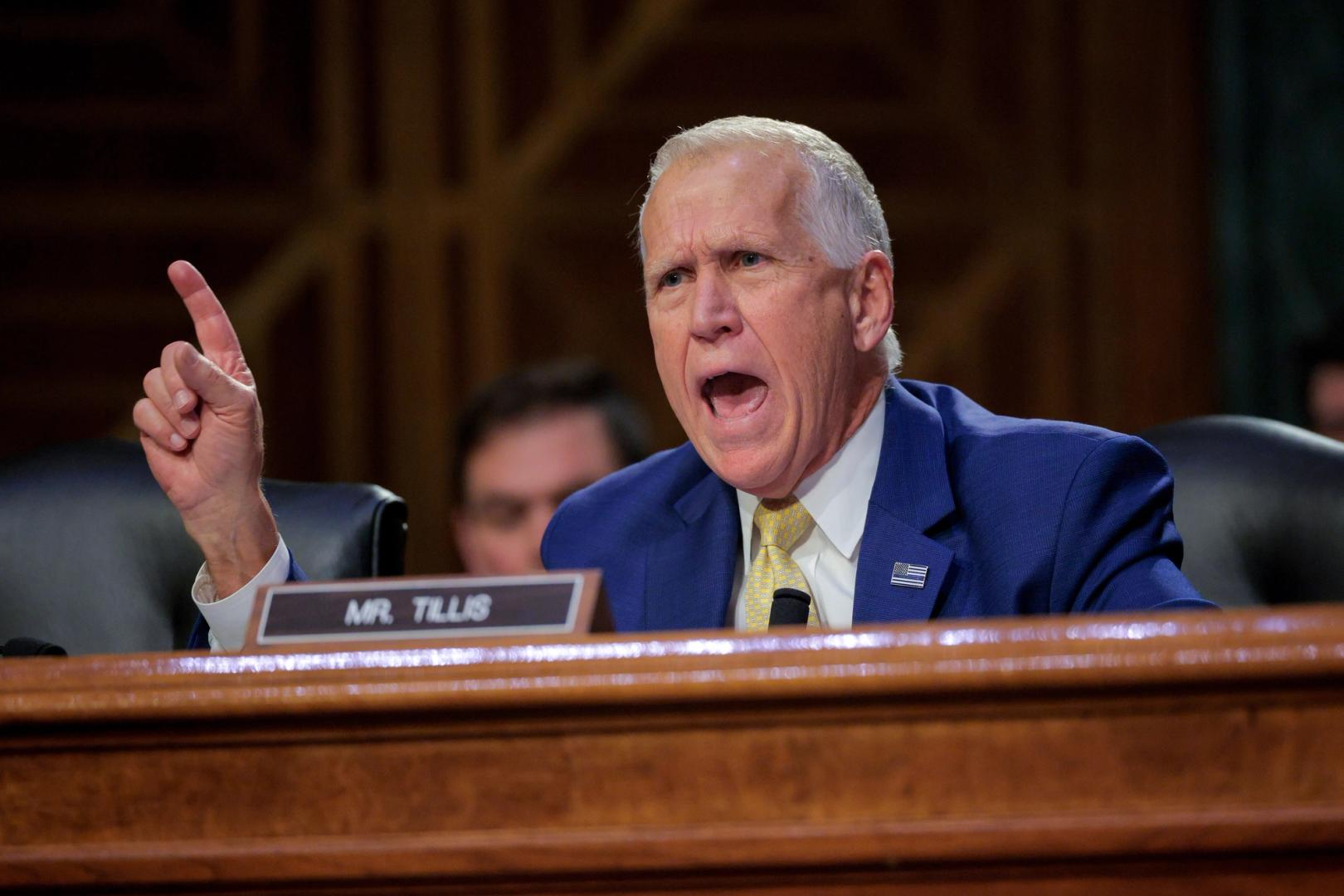
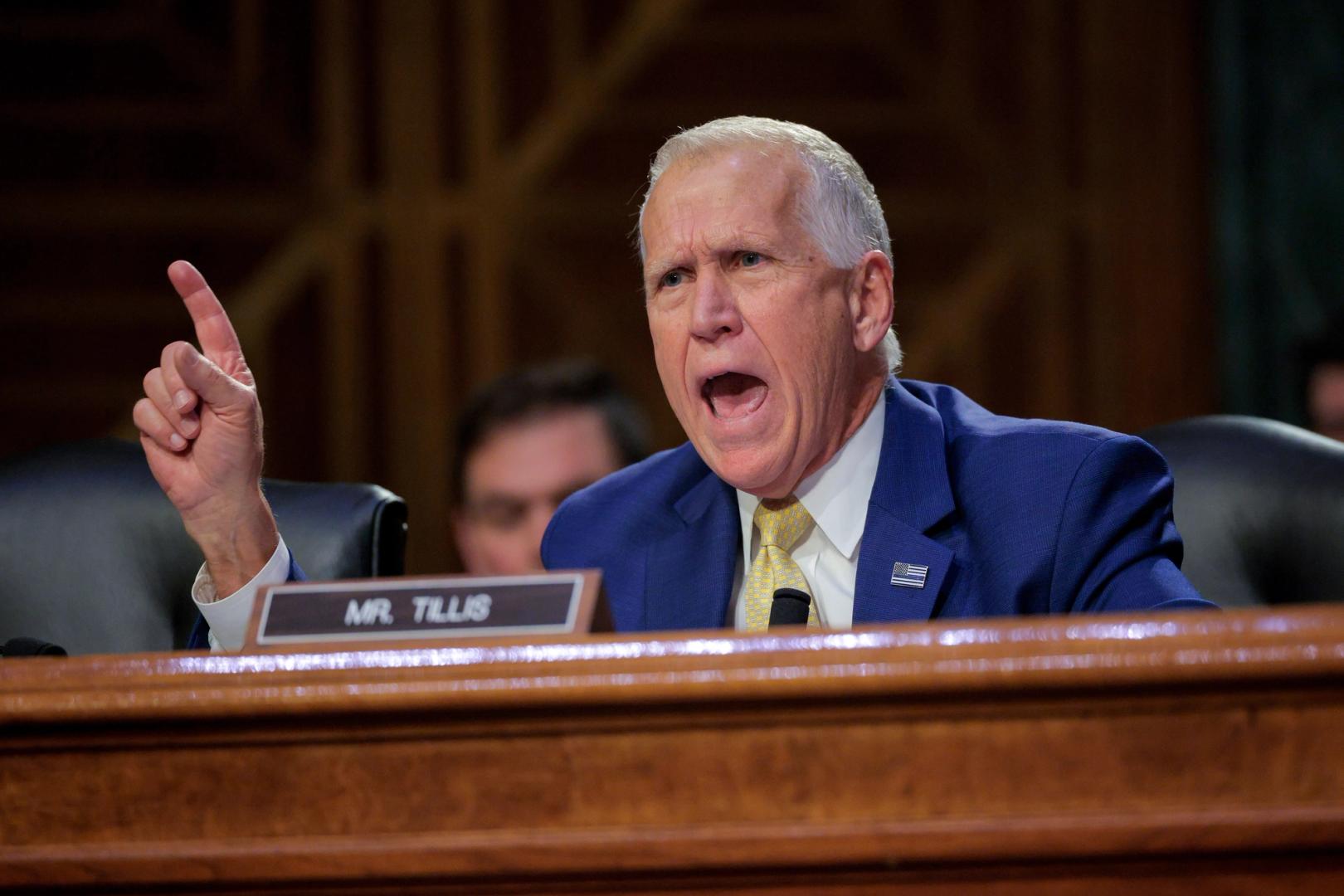
April appears to be a lost cause for the crypto Clarity Act, but a U.S. Senate committee hearing sometime in May could keep the critical market structure legislation alive, as long as it can reach a final vote of the overall Senate by July, according to lobbyists and a lawmaker aide focusing on the market structure bill’s sluggish progress.
The legislative calendar is running out of room for this year, but a Senate aide told CoinDesk that a potential new delay of a couple of weeks — allowing Republican Senator Thom Tillis to finish discussions with bankers over stablecoin-yield concerns — is not yet pushing this work past the point of no return. The aide also said that earlier negotiations over decentralized finance (DeFi) protections are effectively settled, leaving few other impediments in the way of a committee approval.
One of the chief problems the crypto industry faces (if it can leap the stubborn hurdle of the banking sector’s objections about stablecoin rewards) is that the Senate Banking Committee hearing that the bill needs to clear would be only a first step of many.
Here’s the scheduling maelstrom the effort is now circling: The Senate will essentially flee Washington in August and be in election mode until the November congressional midterms arrive. It’s currently scheduled for about a dozen weeks of DC work before the elections, and it has some pressing matters on its plate during that time, including the funding battle over the Department of Homeland Security, clashes over the Iran war, the debate on voter identification and addressing nominations such as President Donald Trump’s pick to run the Federal Reserve, Kevin Warsh.
If the bill manages to finally get signoff from the Senate Banking Committee, the text needs to be merged with the version that passed the Senate Agriculture Committee. That merger work is the timing cushion that these current delays are eating into, the aide said.
The final legislation would likely be revised further as lawmakers add their final compromise on an ethics piece in which Democrats wanted to limit senior government officials (most pointedly President Trump) from profiting off of crypto interests. The aide said that language is now circulating back and forth on that point but that it won’t be in the banking panel’s version and would be added later. If they can get past that dispute and another demand about appointing a full slate of commissioners to oversee markets regulation, the bill may win enough Democratic support to pass.
Then the House would need to approve it again, because it’s very different from the version that chamber already advanced last year. But that would be expected to go quickly, as long as further disagreements don’t arise.
The last step, Trump’s signature, is expected to be the easiest, though he inserted some uncertainty in March when he said he wouldn’t sign any bill until he gets legislation approved that would demand voters prove their citizenship before they can cast ballots.
The Digital Asset Market Clarity Act, if approved, would become the second major crypto bill to become law, joining last year’s Guiding and Establishing National Innovation for U.S. Stablecoins (GENIUS) Act. But it’s an unresolved stablecoin matter from the GENIUS Act that has delayed progress on the Clarity Act since the start of the year, as bank lobbyists have drawn enough support from senators to back their worry that stablecoin rewards programs could be close enough to deposit yield that it jeopardizes the banks’ business model.
The debate — far afield from the central aims of the Clarity Act — has raged through White House interventions and tough rhetoric from crypto insiders. Coinbase, which stands to take a substantial hit if stablecoin reward programs are curtailed, has been at the forefront, and Chief Legal Office Paul Grewal posted Tuesday on social media site X with another push.
“You can’t be for CLARITY and against rewards,” he wrote. “It’s one or the other. Time to choose.”
Though key Senate negotiators had recently said they had an “agreement in principle” to move forward with a compromise, Republican Senator Tillis told reporters that earlier hopes for April progress was likely slipping into May. The White House has leaned into the crypto position on allowing some rewards that don’t look like interest on core bank deposits.
“It’s hard to explain any further lobbying by banks on this issue as motivated by anything other than greed or ignorance,” Patrick Witt, a top crypto adviser in Trump’s White House, said in how own recent posting on X. “Move on.”
In the current version, insiders say that the compromise has hovered steadily around an approach that would ban payment of yield on any product that looks or acts like insurance on a deposit, but it would still let firms such as Coinbase structure rewards programs that would be more akin to credit-card incentives. But the lawmakers have been shy about releasing text that could spark further negotiation drama, after letting both crypto and banking industry representatives review language last month.
“We’re too close to let this effort fail,” said Cody Carbone, CEO of the Digital Chamber, in a statement to CoinDesk. “A markup must happen to move this forward. It’s been three months since it was initially scheduled, and given the progress on all issues, especially the bipartisan stablecoin yield agreement, now is the time.”
Every day that passes without progress marks a decline in the odds for eventual Clarity Act success. The very next action should be the scheduling of the markup hearing and the sharing of the long-awaited bill text that the negotiators have been wrestling over.
“In our view, the odds of CLARITY being signed into law in 2026 are roughly 50-50, and possibly lower,” according to a research note that crypto investment firm Galaxy is planning on publishing this week. “The uncertainty stems not from any single issue but from the sheer number of unresolved questions that must be settled in sequence under severe time pressure.”
In other words, a single further blowup among the negotiators could be a fatal delay, though the period after the November elections could offer a final low-odds, last-ditch opening. The so-called “lame duck” session of Congress at the end of the year can be a period in which the outgoing Congress can still act, and more than one crypto insider has suggested that it’s not out of the realm of possibility that a hypothetically derailed Clarity Act could reappear then.
While crypto lobbyists are desperate for immediate action on the legislation, the industry is playing the long game on the political front. Crypto PACs have already devoted millions of dollars to keep adding to the list of its friends in Congress from both parties. The sector’s leading campaign-finance arm, Fairshake, is careful to back members of both parties, and many of their political picks will be joining next year’s Congress. If the Clarity Act is law by then, there are likely to be other pressing legislative matters for the industry, potentially including a tax overhaul and the establishment of a federal stockpile of bitcoin .
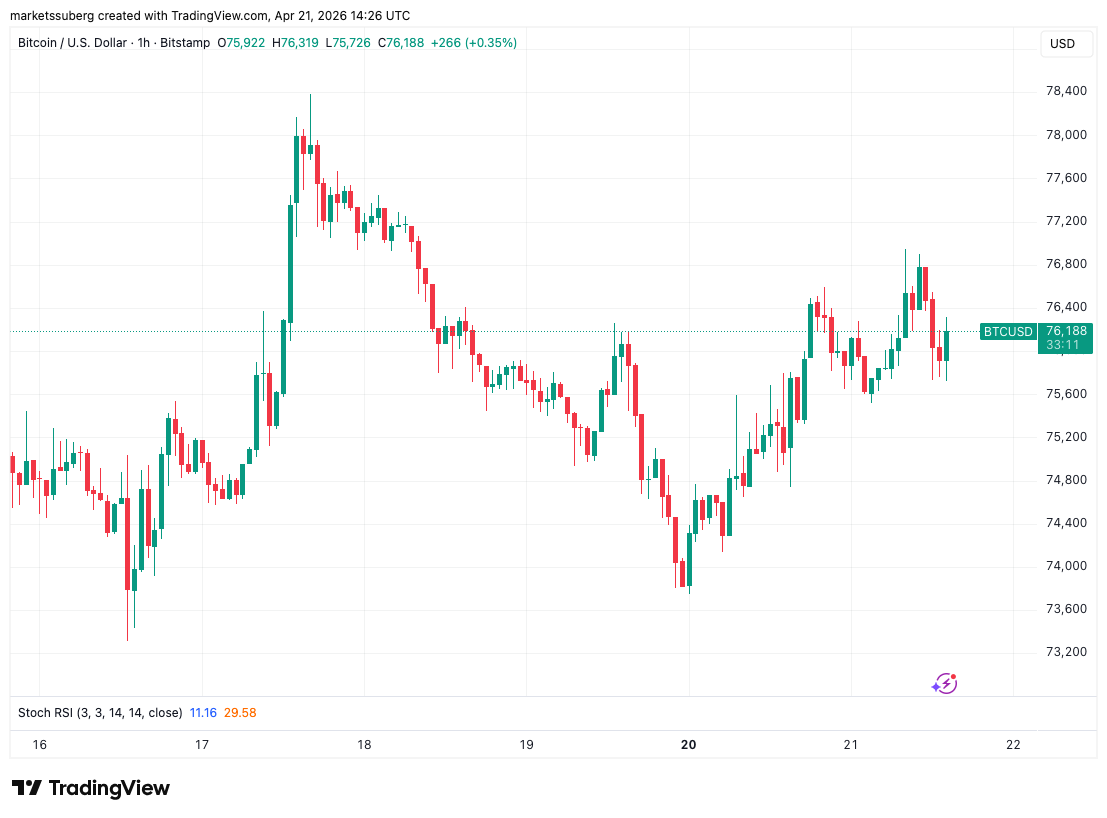
Bitcoin (BTC) sought to match ten-week highs on Tuesday as market participants bet on a new short squeeze.
Key points:
-
Bitcoin is due a fresh short squeeze as funding rates uniquely stay negative as price grinds higher, say market pundits.
-
Short-term targets include a trip to $85,000 in the coming weeks.
-
Bitcoin bulls still need to clear the nearby 21-week trend line keeping price pinned since October 2025.
“Cannon is loaded” for Bitcoin short squeeze
Data from TradingView showed BTC/USD approaching $77,000 for the first time this weekly candle.

A slight comedown into the Wall Street open meant that price continued to coil below a large area of resistance.
Mixed signals over the US-Iran war continued on the day, with Iran denying that its delegations had arrived in Pakistan for a new round of negotiations with the US. As Cointelegraph reported, markets offered only a muted reaction to the latest closure of the Strait of Hormuz oil route.
Among Bitcoin traders, a sense of cautious optimism was slowly growing.
“A period of consolidation, but clearly upwards pattern,” crypto trader Michaël van de Poppe wrote in an X post.
“This means that there’s likely more upside to come for Bitcoin towards the $85,000 area.”
Van de Poppe gave a time frame of “two to three weeks” for that level to come into focus, reiterating earlier comments about Bitcoin’s correlation with the Nasdaq.

Others focused on ongoing negative funding rates on exchanges, despite price rising.
“We’ve never actually gotten one when the chart was grinding up. NEVER. It only occurred during the local BOTTOMS,” trader Osemka noted on X alongside charts showing past negative funding periods.
Osemka suggested that “something is brewing beneath” the surface, just as BTC/USD eyed a reclaim of lost support.

Responding, crypto market intelligence platform Decode agreed, seeing the potential for another short squeeze.
“What this tells you is that the market is heavily short and bearish, and Bitcoin is setting up for a short squeeze. The cannon is loaded, bulls just need to light the fuse…,” it told X followers.
CME gap thins with BTC up against resistance
Multiple lines in the sand for bulls lie immediately above the spot price.
Related: Bitcoin can grow ‘probably a lot bigger’ than $30T+ gold market — Analysis
These include the 21-week exponential moving average (EMA), true market mean, and average buy-in price for investors of the US spot Bitcoin exchange-traded funds (ETFs).

Trader Daan Crypto Trades observed that price had also filled the latest weekend “gap” in CME Group’s Bitcoin futures market.
“$BTC Closed a big part of the gap from this weekend but still not everything. Market still just following the headlines and no $STRC raises for now. So we will just patiently wait and see,” he commented.

This article is produced in accordance with Cointelegraph’s Editorial Policy and is intended for informational purposes only. It does not constitute investment advice or recommendations. All investments and trades carry risk; readers are encouraged to conduct independent research before making any decisions. Cointelegraph makes no guarantees regarding the accuracy or completeness of the information presented, including forward-looking statements, and will not be liable for any loss or damage arising from reliance on this content.
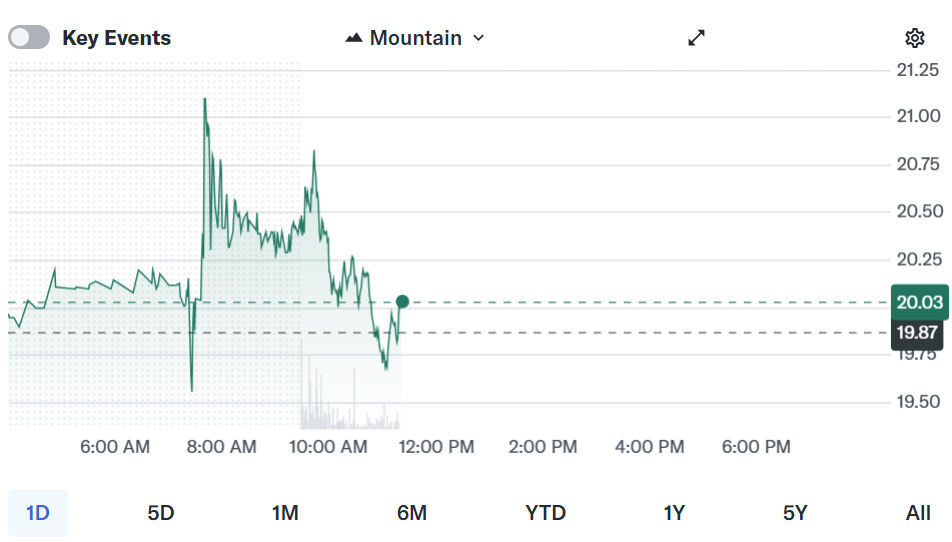
Core Scientific is seeking to raise $3.3 billion in debt to support its expanding data center operations across the United States, as crypto miners increasingly pivot toward high-performance computing and artificial intelligence workloads amid tighter conditions in the mining sector.
The financing will come through senior secured notes due in 2031, the company disclosed Tuesday. The notes will be backed by Core Scientific’s assets, giving investors priority claims in the event of default. Unlike an equity raise, the offering allows the company to access capital without diluting existing shareholders.
Proceeds from the offering are expected to fund ongoing data center development and refinance existing short-term debt.
In particular, Core Scientific plans to repay borrowings under its 364-day credit facility, effectively extending its debt maturities as it scales infrastructure. The company has identified expansion projects in Georgia, Texas, North Carolina and Oklahoma.
The proposed raise follows a separate $1 billion credit agreement with Morgan Stanley announced in March, underscoring Core Scientific’s push to secure long-term financing for its data center buildout.

Core Scientific is among several crypto miners that have turned to leverage to expand beyond traditional bitcoin mining, particularly into high-performance computing and AI-focused data center services. Peers, including MARA Holdings, Riot Platforms and Hut 8 have pursued similar strategies, investing in infrastructure and partnerships to diversify revenue streams.
Meanwhile, IREN has pursued one of the most aggressive expansion strategies in the sector, spending roughly $800 million on data centers and related infrastructure in its most recent quarter.
Related: CoreWeave shows how crypto-era infrastructure quietly became AI’s backbone
Mining industry turns to partnerships
The crypto mining industry is increasingly turning to partnerships to finance and expand its footprint in AI and data center workloads.
On Tuesday, Soluna Holdings, a publicly traded developer of renewable-powered data centers, announced an expanded partnership with Bitcoin mining infrastructure provider Blockware. The deal is expected to add 3.3 megawatts of capacity at Soluna’s West Texas colocation facility, which primarily hosts third-party mining operations.
The agreement marks Blockware’s fourth expansion with Soluna.
As Cointelegraph recently reported, Soluna is also expanding into AI workloads, including a $53 million investment in a wind farm to support those operations as mining revenues come under pressure.
Related: Aluminum giant Alcoa to sell dormant smelter to Bitcoin miner NYDIG: Report


Coinbase’s Independent Advisory Board on Quantum Computing and Blockchain has published its first position paper, warning that the crypto industry must begin preparing for quantum threats now.
The board includes researchers from Stanford, UT Austin, the Ethereum Foundation, Eigen Labs, Bar-Ilan University, and UC Santa Barbara. Their assessment is direct. Digital assets are safe today, but a quantum computer capable of breaking blockchain cryptography will eventually be built.
What the Coinbase Paper Found
The paper identifies wallet-level cryptography as the primary vulnerability. Digital signatures that prove asset ownership could one day be broken by a sufficiently powerful quantum machine.
For Bitcoin (BTC), an estimated 6.9 million BTC sit in wallets where key information is publicly visible on-chain.
Bitcoin’s core infrastructure, including mining and hash functions, faces no meaningful quantum threat. However, proof-of-stake networks like Ethereum (ETH) carry additional exposure through validator signature schemes.
Ethereum has already published a dedicated post-quantum roadmap targeting Layer 1 upgrades.
“Your crypto is safe today. But a quantum computer capable of threatening blockchain cryptography will eventually be built, and the industry needs to start preparing now, not when it’s urgent,” Coinbase CSO Phillip Martin explained.
Migration Challenges Ahead
The US National Institute of Standards and Technology (NIST) has already standardized several quantum-resistant cryptographic schemes.
The building blocks for migration exist. However, new quantum-safe signatures are significantly larger than current ones, affecting transaction speed, costs, and storage.
Migrating millions of wallets across decentralized networks requires every user to take action. That coordination challenge surpasses anything traditional finance faces.
Solana (SOL), Algorand (ALGO), and Aptos (APT) have each begun offering or planning quantum-resistant options for users.
The paper also raises a difficult question for every blockchain community. Wallets that never upgrade, whether from lost keys, inactive holders, or abandoned accounts, will remain exposed.
Each network will need to decide whether to freeze, revoke, or leave those assets vulnerable.
The board recommends those decisions be made and communicated publicly as soon as possible.
Coinbase says it is building flexible systems to adopt new cryptographic standards quickly and working with infrastructure partners on upgrade readiness.
The post Coinbase Publishes First Paper on Quantum Computing Position for Crypto appeared first on BeInCrypto.
Crypto World
3 Top Trending Crypto Coins: Ethereum Forms Bullish Triangle and XRP Hits Record ETF Week as Pepeto Targets 150x
The 3 top trending crypto coins conversation gained a new dimension today as spot Ethereum ETFs recorded $276 million in inflows over seven consecutive days, and XRP products recorded $55.39 million, their strongest weekly total of 2026, according to CoinDesk. That capital is moving into assets with real utility for the next stage of the cycle.
The 3 top trending crypto coins list is clear right now. Ethereum is forming an ascending triangle targeting $3,076 and XRP is holding $1.43 on record ETF demand, yet a third name is attracting fresh capital faster than either. That name is Pepeto, which has raised $9.29 million at $0.0000001865 with the Binance listing date already set.
How 3 Top Trending Crypto Coins Absorbed $331M in Fresh ETF Capital This Week
Ethereum ETFs recorded $276 million in net inflows between April 13 and April 17, consistent with the ascending triangle forming on the daily chart, according to crypto.news. A breakout from the pattern targets $3,076, a level calculated from the triangle height projected above the breakout point. The SuperTrend indicator turned positive on April 20 and MACD is now above the neutral line.
XRP ETFs recorded $55.39 million during the same week, the highest weekly total of 2026, according to The Crypto Basic. Cumulative flows now exceed $1.27 billion. All three assets benefit from institutional demand, but a 3% to 4% yield on blue chip tokens cannot compete with the return a presale buyer sees when a Binance listing date is weeks away.
Which Name on the 3 Top Trending Crypto Coins List Delivers the Sharpest Entry Right Now?
Why Pepeto Is Attracting More Capital Than ETH and XRP Combined Right Now
Every major return in crypto has begun with investors buying an asset the broader market has not yet noticed, at a price that appears unreasonable. Pepeto is currently at that stage, with operational infrastructure and a presale price that will change once trading begins on Binance.
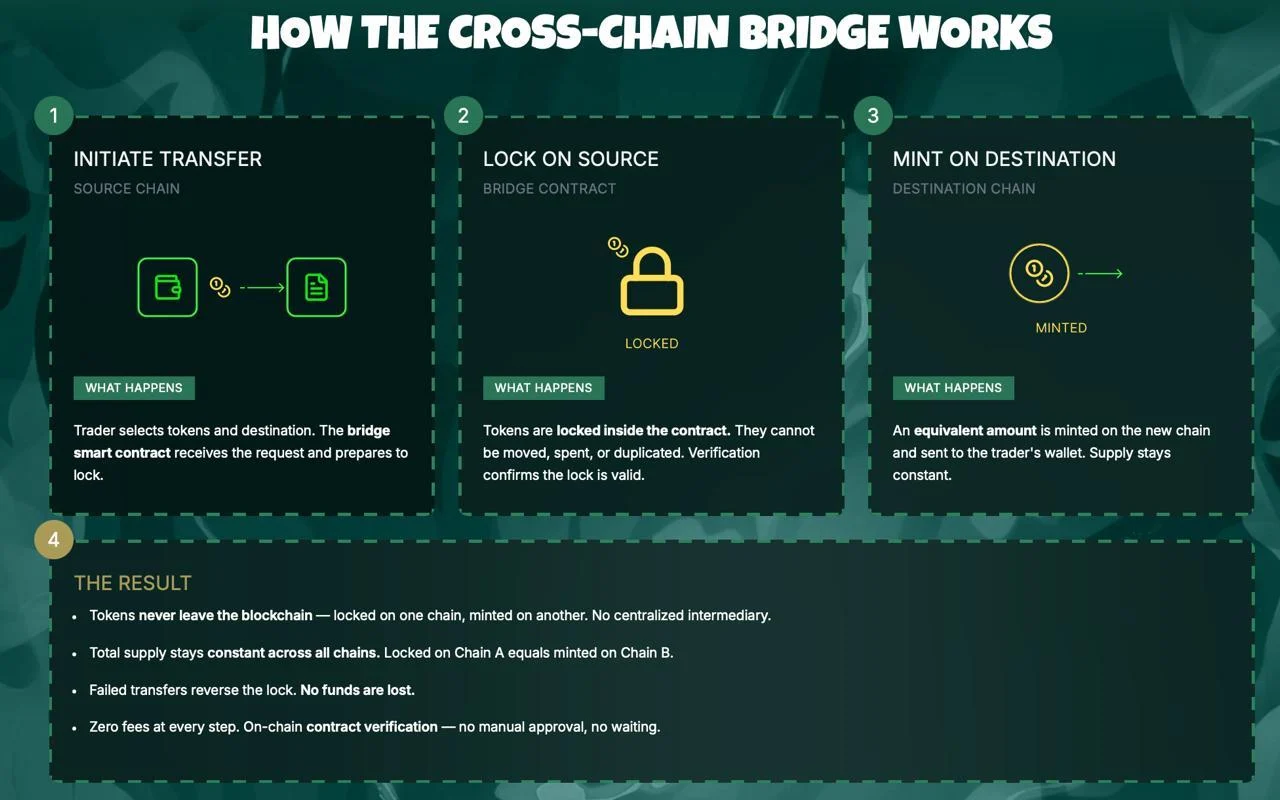
The built-in contract scanner reviews every token for honeypot structures and exploit code before a single dollar is transferred. PepetoSwap processes trades across Ethereum, BNB, and Solana at zero cost, and the bridge transfers tokens across all three networks without gas fees.
SolidProof and Coinsult have completed full audits of the codebase, and a former Binance developer is overseeing the exchange through its final pre-launch testing phase.
A $5,400 position at $0.0000001865 secures close to 29 billion tokens, and if Pepeto reaches the market cap Pepe achieved, the calculation produces over 150x and turns that $5,400 into approximately $810,000. Pepe reached an $11 billion market cap on 420 trillion supply with no bridge or exchange in place. Pepeto has every one of those tools operational, the same cofounder leading the project, and analysts project 150x as the base case.
Once Binance opens trading, the presale will close. Every entry that later delivered life changing returns shared three characteristics, which are a working product, a price the market did not take seriously, and a catalyst that could not be prevented. Pepeto at $0.0000001865 meets all three criteria, and the locked position reward system continues to reduce available supply.
Is Ethereum a Good Buy at $2,305 With ETF Flows on a Seven Day Streak?
Ethereum (ETH) trades at $2,305 on April 21, up from $2,078 at the start of the month, according to CoinMarketCap. A $90.9 million 20x leveraged long position was opened against ETH on April 20, indicating strong whale conviction in the ascending triangle setup.
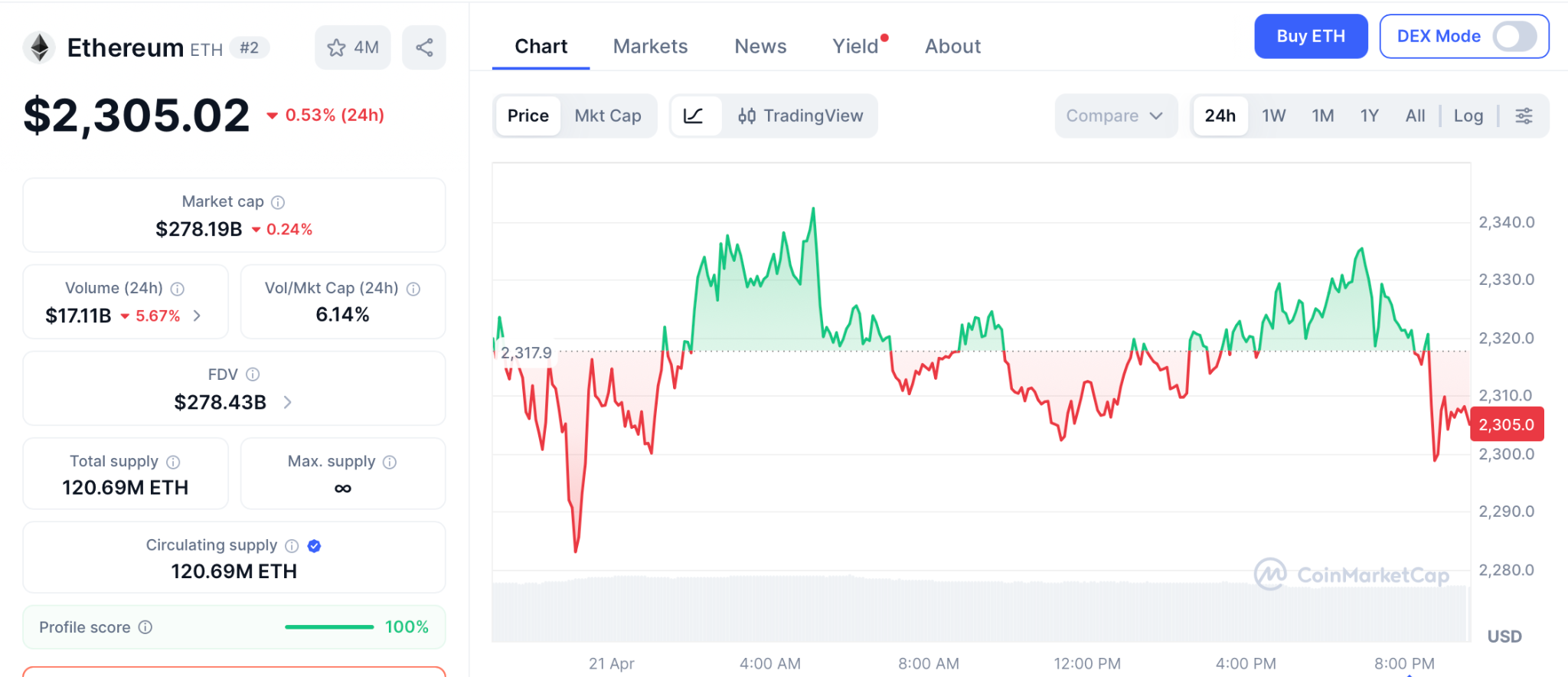
A breakout above $2,378 would open the path to $3,076, a 33% move based on the triangle geometry. ETH is a valid choice among the 3 top trending crypto coins for long term exposure, but a breakout produces 33% over a period of weeks that the presale compresses into a single listing event.
Can XRP Break Past $1.45 With ETF Inflows at Record Levels?
XRP (XRP) trades at $1.43 on April 21, up 6% on the week after Swiss exchange-traded products drove most of the fresh capital, according to 24/7 Wall St. Analysts target $1.60 if the CLARITY Act Senate markup takes place in late April, a 13% gain from current levels.
The $1.45 level is the main resistance, with approximately 1.24 billion XRP held in breakeven wallets between $1.45 and $1.47. If that resistance is cleared, the path opens toward $1.60. XRP qualifies on the 3 top trending crypto coins list for its ETF demand and enterprise positioning, but a 13% target plays out over weeks that the Pepeto listing concentrates into a single day.
Conclusion
The 3 top trending crypto coins each serve a different role. ETH and XRP are institutional investments with breakout math that plays out over weeks, while Pepeto reduces the distance from entry to listing to a matter of days. The large wallets accumulating this presale understand where the Binance date will take the price, and the working exchange tools resolve the issue every prior meme coin has struggled with.
Ethereum itself rose from $0.31 at its 2014 ICO to an all-time high above $4,800, delivering over 15,000x to the earliest buyers on a ledger that very few market participants believed in. Pepeto has stronger viral appeal in a larger market, is led by the same cofounder who previously delivered Pepe into an eleven-figure valuation, and a Binance listing with a price target consistent with the analyst calculations.
Click to Lock Your Pepeto Tokens Before the Binance Listing Closes This Stage

FAQs
How does Pepeto compare to Ethereum and XRP among the 3 top trending crypto coins?
Pepeto offers 150x presale-to-listing math from $0.0000001865 with five exchange tools already operational. ETH requires a triangle breakout for 33% toward $3,076 and XRP targets 13% toward $1.60 on a CLARITY Act vote.
What are the 3 top trending crypto coins worth watching in April 2026?
Pepeto, Ethereum, and XRP lead the list for different reasons. Pepeto targets 150x from presale pricing, Ethereum ETFs recorded $276 million over a seven day streak, and XRP funds recorded $55.39 million, the highest week of 2026.
Disclaimer: This is a Press Release provided by a third party who is responsible for the content. Please conduct your own research before taking any action based on the content.



New York sued Coinbase and Gemini on Tuesday, becoming the latest state to argue that prediction market contracts dealing with sports, entertainment and elections are violating state gambling laws.
According to the lawsuits, Coinbase and Gemini’s prediction market offerings are really unlicensed gambling products, pointing to how the companies advertised their prediction markets and their role as bookmakers on the platforms. The NYAG’s office also described the actual behavior of the prediction market platforms, describing users as “bettors” and saying that “each contract is a bet.” The suits also argued that the platforms allow people to place bets between the ages of 18 and 21, when New York bars anyone under 21 from gambling on mobile apps.
“As described above, what Respondent offers through its platform is quintessentially gambling: It allows a bettor to stake or risk money upon the outcome of a contest of chance or a future contingent event not under the bettor’s control or influence, upon an agreement or understanding that he will receive something of value in the event of a certain outcome,” the suit against Coinbase said.
New York is just the latest state to sue prediction market providers over their sports and entertainment products. Nevada, Washington and a host of other states have similarly filed suit, arguing that at least the sports-related bets are, indeed, bets, and not federally regulated swaps. It’s an issue that now sits before multiple appeals courts, and is likely to wind up before the U.S. Supreme Court.
Coinbase Chief Legal Officer Paul Grewal said in a post on X (formerly Twitter) that “prediction markets are federally regulated national exchanges” and that Coinbase would fight for federal oversight.
Commodity Futures Trading Commission Chairman Mike Selig, for his part, has argued that prediction markets — including the sports-related contracts — fall under his agency’s “exclusive jurisdiction.” The CFTC has filed suit against Arizona, Connecticut and Illinois to block them from bringing charges against prediction market providers, and it filed to join another case out of Nevada to defend the prediction market providers.
Kalshi, one of the biggest prediction market providers, was not named as a defendant on Tuesday. The company preemptively sued the New York State Gaming Commission last fall, asking a federal court to rule that state gambling laws do not apply to its platform. That case is still working its way through the Southern District of New York courthouse.
In a statement, New York State Attorney General Letitia James said both Gemini and Coinbase’s products were “illegal gambling operations.”
“Gambling by another name is still gambling, and it is not exempt from regulation under our state laws and Constitution,” she said.


US election news from Texas arrived Monday as Attorney General Ken Paxton filed a lawsuit in Tarrant County district court against ActBlue, the Democratic fundraising platform, alleging it violated the Texas Deceptive Trade Practices Act by continuing to accept gift card donations it had publicly claimed to ban.
Summary
- Texas investigators made three donations to ActBlue in February 2026 using false identities and prepaid gift cards and successfully reached the DNC and two Texas officials’ campaign accounts, directly contradicting ActBlue’s representations to Congress.
- The lawsuit seeks a permanent injunction barring ActBlue from accepting gift card and prepaid debit card donations, $10,000 in civil penalties per violation, and attorneys’ fees on claims totaling more than $1 million.
- ActBlue called the suit “a thinly veiled attempt to distract from Ken Paxton’s numerous legal and ethical issues ahead of next month’s runoff” against Senator John Cornyn.
US election news sharpened Monday around campaign finance integrity as Paxton accused ActBlue of deceiving Congress and the public about its safeguards against fraudulent and foreign donations. ActBlue has processed more than $16 billion for Democratic candidates and causes since 2004 and processed $1.78 billion in small-dollar donations in 2025 alone.
“ActBlue lied to Congress and to the American people, and I will ensure justice is served,” Paxton said in a statement. “Fair elections are the foundation of our democracy, and I will work to ensure no illegal campaign donation flies under the radar.”
The lawsuit rests on a core factual allegation: ActBlue’s own outside counsel at Covington and Burling acknowledged in early 2025 that the organization’s representations about its donation safeguards to Congress were not true. The New York Times had previously reported that acknowledgment. Despite that, ActBlue did not correct its public statements or inform Congress of the discrepancy.
What Texas Investigators Found and When
The Office of the Attorney General opened its ActBlue investigation in December 2023. In February 2026, investigators made three test donations using false identities and prepaid gift cards. All three cleared the platform and landed in the accounts of the Democratic National Committee and two Texas state officials’ campaigns. The investigation also found that ActBlue made its fraud prevention rules “more lenient” twice during the 2024 election cycle despite documented fraud on the platform.
The lawsuit alleges seven counts against ActBlue, centering on false, misleading, and deceptive business practices under Texas consumer protection law. The state seeks an injunction prohibiting gift card and prepaid debit card donations, civil penalties of $10,000 per violation paid to the state, and full recovery of litigation costs. The complaint states the monetary relief sought exceeds $1 million.
ActBlue’s Response and the Political Context
ActBlue denied wrongdoing through spokesperson De’Andra Roberts-LaBoo, calling the filing politically motivated. “This is a thinly veiled attempt to distract from Ken Paxton’s numerous legal and ethical issues ahead of next month’s runoff,” she said, referencing Paxton’s GOP Senate primary runoff against incumbent Senator John Cornyn. “Our platform has done more than any other, regardless of party, to prevent improper donations and protect donors.”
The timing is notable. Paxton is in an active Senate primary runoff. House Administration, Judiciary, and Oversight Committees have been investigating ActBlue separately for nearly two years over its 2024 practices. A House Republican aide has indicated that all options remain on the table for compelling ActBlue’s cooperation, including hauling its CEO before the panels or initiating contempt proceedings.
What the Lawsuit Means for Crypto and Campaign Finance
The ActBlue case is part of a broader federal and state-level pressure campaign on digital fundraising infrastructure heading into the 2026 midterms. The midterm pressure already compressing the congressional calendar for crypto legislation is compounded by each new political conflict that draws attention and legal resources away from the legislative agenda. Stablecoin regulation, the CLARITY Act, and crypto reform more broadly all depend on a Senate majority that can focus on substantive legislation rather than managing compounding political and legal crises through a midterm election cycle.
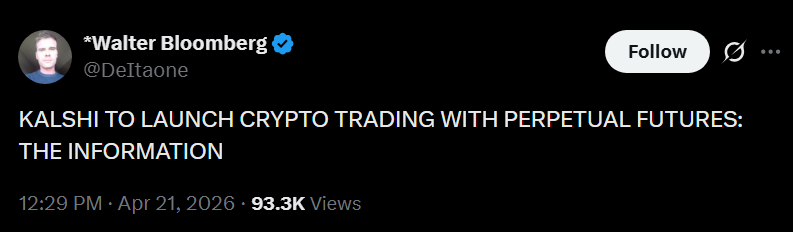
Prediction market exchange Kalshi is reportedly preparing to expand into cryptocurrency trading by introducing perpetual futures contracts, marking a major shift beyond its core event-based derivatives business.
In a Tuesday report, The Information cited people familiar with the matter as saying Kalshi plans to offer perpetual futures — commonly known as “perps” — on cryptocurrencies such as Bitcoin (BTC).

Perpetual futures are a type of derivative contract that allows traders to speculate on price movements without an expiration date.
Unlike traditional futures, which must be rolled over periodically, perps enable continuous exposure and are typically paired with leverage. The structure was popularized in crypto markets by BitMEX, helping fuel the rapid growth of derivatives trading.
Kalshi’s planned launch would signal a move away from binary event contracts toward continuous financial markets, potentially broadening its appeal to both retail and institutional traders.
Kalshi is regulated in the United States by the Commodity Futures Trading Commission (CFTC), a distinction that could position it as a compliant alternative to offshore crypto derivatives platforms.
CFTC Chair Michael Selig has indicated that these products could become available in the United States in the near future, as regulators seek to bring more trading volume onshore.
Related: Onchain real-world perps surge, while altcoin rout drags on: Report
Competition for perps is gaining traction
The reported move comes amid intensifying competition across both prediction markets and the fast-growing perpetual futures segment, with US platforms increasingly seeking to offer this trading to non-US residents.
Crypto exchanges have been drawn in this direction, with Coinbase recently launching round-the-clock perpetual-style futures tied to equities for non-US traders, expanding beyond its traditional crypto derivatives offering.

Kraken has also rolled out tokenized stock perpetual futures for users outside the United States, targeting exposure to US stock indexes, precious metals and individual stocks.
Related: S&P Dow Jones licenses S&P 500 perpetual futures for Hyperliquid
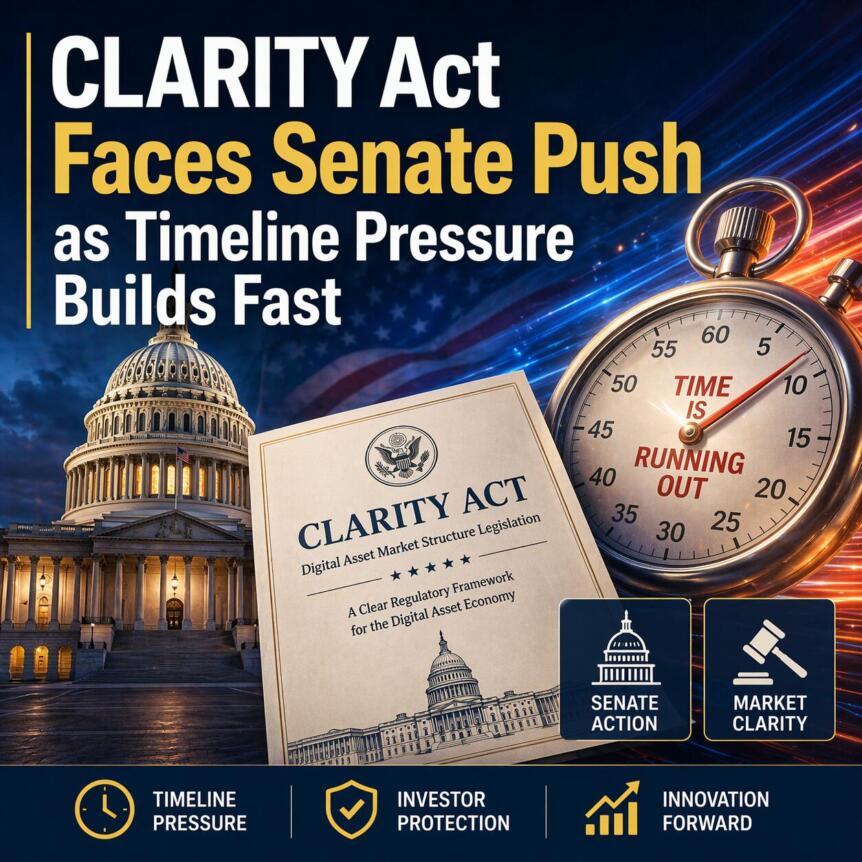
The push to advance the CLARITY Act gained fresh momentum after a key industry group urged swift Senate action. Lawmakers now face tighter timelines as unresolved issues continue to slow progress. The development highlights growing pressure to finalise a clear regulatory framework for digital assets in the United States.
Senate Banking Committee Faces Renewed Pressure
The Digital Chamber increased pressure on the Senate Banking Committee to move the CLARITY Act forward. It sent a formal letter urging lawmakers to begin the markup phase without further delay. The group stressed urgency due to limited legislative time remaining.
The committee leadership, including Chairman Tim Scott and Ranking Member Elizabeth Warren, received the request directly. The letter emphasised that the House already passed the bill with bipartisan backing months ago. As a result, industry leaders expect the Senate to act without prolonged delays.
Lawmakers now operate within a narrowing window before the upcoming congressional recess. If the committee delays further, the bill risks losing momentum. Therefore, stakeholders continue pushing for immediate procedural progress.
Timeline Constraints Increase Legislative Pressure
The legislative calendar continues to tighten as Congress moves deeper into its current session. Lawmakers have already passed significant time without advancing the CLARITY Act in the Senate. This delay creates urgency among both policymakers and industry participants.
The bill missed a recent markup opportunity, which added pressure on the next available schedule. The upcoming week presents another chance to move the process forward. However, failure to act before the May recess could stall progress for an extended period.
Industry advocates argue that continued delays undermine regulatory certainty for millions of users. They point to the rapid growth of digital asset adoption across the country. Consequently, they maintain that clear legislation remains essential for market stability and innovation.
Stablecoin Yield Debate Remains Key Obstacle
The ongoing disagreement over stablecoin yield provisions continues to block legislative progress. Banking groups and crypto firms have not reached a consensus on how to regulate yield-bearing stablecoins. This disagreement remains the central issue delaying the markup phase.
Some lawmakers have proposed extending discussions to allow more time for negotiation. Senator Thom Tillis supported delaying the markup to allow further dialogue between stakeholders. This approach aims to produce a balanced framework acceptable to both sides.
Meanwhile, the absence of a finalised draft complicates negotiations and slows progress further. Banking representatives have also introduced new concerns about the proposed provisions. As a result, lawmakers must address these issues before moving the bill forward.
Industry Signals Strong Support for Immediate Action
The Digital Chamber continues to advocate for immediate legislative movement despite unresolved issues. The organisation believes that the markup process can proceed while discussions continue. This approach would allow lawmakers to refine details during later stages.
Industry representatives highlight the scale of digital asset adoption across the United States. Millions of users rely on clear rules to guide participation in the market. Therefore, they argue that delaying action creates unnecessary uncertainty.
At the same time, policymakers recognise the importance of balancing innovation with financial stability. The Senate Banking Committee has engaged with stakeholders to gather input. However, pressure continues to build for decisive action in the coming weeks.

The Logitech MX Vertical drops to $74, and if you spend more than a few hours a day at a mouse this deal is worth your attention

Which cryptocurrency is trustworthy?

‘Beautiful corner of the world’ named Brits’ favourite UK holiday spot for summer 2026

Manchester United reach agreement with Casemiro over contract clause amid transfer speculation

Steven Gerrard disagrees with Gary Neville over ‘shock’ Chelsea and Arsenal claim | Football

US brings back mandatory military draft registration


-

 News Videos7 days ago
Secure crypto trading starts with an FIU-registered
-

 Fashion4 days ago
Weekend Open Thread: Theodora Dress
-

 Politics4 days ago
Palestine barred from entering Canada for FIFA Congress
-

 Sports5 days ago
NWFL Suspends Two Players Over Post-Match Clash in Ado-Ekiti
-
Entertainment2 days ago
NBA Analyst Charles Barkley Chimes in on Ice Spice McDonald’s Fiasco
-

 Business2 days ago
Powerball Result April 18, 2026: No Jackpot Winner in Powerball Draw: $75 Million Rolls Over
-

 Crypto World4 days ago
Russia Pushes Bill to Criminalize Unregistered Crypto Services
-

 Politics1 day ago
Gary Stevenson delivers timely reminder to register to vote as deadline TODAY
-

 Tech3 days ago
Auto Enthusiast Scores Running Tesla Model 3 for Two Grand and Turns It Into Bare-Bones Go-Kart
-

 Politics3 days ago
Zack Polanski demands ‘council homes not luxury flats for foreign investors’
-
 Business5 days ago
Creo Medical agree sale of its manufacturing operation
-

 Tech6 days ago
‘Avatar: Aang, The Last Airbender’ Leaked Online. Some Fans Say Paramount Deserves the Fallout
-

 Crypto World4 days ago
Russia Introduces Bill To Criminalize Unregistered Crypto Services
-

 Tech7 days ago
Microsoft adds Windows protections for malicious Remote Desktop files
-

 Crypto World7 days ago
X Launches New Cashtag Feature for Stocks and Crypto: X
-
 Entertainment7 days ago
Dave Portnoy Slams Dianna Russini: ‘Makes Zero Sense’
-

 Sports6 days ago
British climbers complete new route in Swiss Alps
-
 Crypto World7 days ago
Bitcoin surpasses halfway mark in current halving cycle
-

 Sports7 days ago
WTA roundup: All seeded players advance in Stuttgart, Rouen
-

 Tech6 days ago
Ford EV and tech chief leaving automaker
You must be logged in to post a comment Login