
Crypto World
American Bitcoin Stock Jumps 12% on Miner Expansion



Shares of American Bitcoin, the Trump family-linked mining company, surged approximately 12% on April 22 after the firm announced it had completed the deployment of 11,298 new ASIC miners at its Drumheller, Alberta site, expanding its active fleet to roughly 89,242 machines.
Summary
- American Bitcoin deployed 11,298 new ASIC miners at its Drumheller facility, adding 3.05 exahash per second of capacity and pushing total hashrate to 28.1 EH/s.
- The stock jumped approximately 12% to $1.38 on the news, extending a broader recovery as Bitcoin prices climbed.
- The expansion reinforces American Bitcoin’s decision to double down on Bitcoin mining while many rivals pivot capital toward AI data centers.
American Bitcoin Corp., the Bitcoin mining and treasury firm co-founded by Eric Trump and backed by the Trump family, sent its stock up roughly 12% to $1.38 on April 22 after announcing the completion of a major fleet expansion. The company deployed 11,298 ASIC miners at its Drumheller, Alberta facility, adding approximately 3.05 exahash per second of mining capacity and pushing its total owned fleet to around 89,242 machines representing 28.1 EH/s.
American Bitcoin Mining Expansion Defies the AI Pivot Trend
The newly deployed machines operate at an efficiency of approximately 13.5 joules per terahash, which the company says lowers its electricity cost per coin and improves the profitability of its mining operations even as Bitcoin network difficulty continues to rise. The expansion completes a fleet buildout that was first announced in March, making American Bitcoin one of the more aggressive scale-up stories among publicly traded miners in 2026. “Scaling hashrate is one of the ways we strengthen our position in Bitcoin,” Eric Trump, the company’s co-founder and chief strategy officer, said in a statement. “Bringing these miners online at Drumheller reflects exactly how we intend to lead: moving quickly, allocating capital with discipline, and growing our Bitcoin exposure efficiently at institutional scale.”
A Deliberate Bet on Mining as Rivals Shift to AI
The deployment represents a strategic statement as much as an operational update. Several major publicly traded Bitcoin miners have been redirecting capital and infrastructure toward artificial intelligence and high-performance computing data centers, where margins and demand have attracted significant institutional interest. American Bitcoin has chosen the opposite path, committing to large-scale mining as its core value driver. The company’s Bitcoin treasury now sits at approximately 7,000 BTC, and its business model is built around accumulating Bitcoin below spot price through scaled mining operations. As crypto.news reported at the company’s September Nasdaq debut, American Bitcoin positions itself as an institutional-grade vehicle for Bitcoin exposure, leveraging Hut 8’s infrastructure for mining and at-market purchases to maximize Bitcoin per share. The stock has faced significant volatility since listing, falling from a peak near $13 to around $1 before Tuesday’s rally.
What the Expansion Means for American Bitcoin’s Market Position
With its fleet now at 89,242 machines and an operational capacity of 25 EH/s across nearly 59,000 active units, American Bitcoin is deepening its structural advantage over competitors that have diluted their mining focus. The new hardware operates at above-average efficiency relative to the company’s existing fleet, which the firm says will lower its overall cost basis per Bitcoin mined. As crypto.news tracked, the stock has faced multiple pressure points since going public, including a sharp lockup expiry-driven selloff in December 2025, making the current recovery meaningful context for investors watching whether the operational expansion can translate into sustained price support.
American Bitcoin has scheduled its first quarter 2026 earnings call for May 6, where investors will be watching for updated Bitcoin production figures, treasury size, and the company’s cost-per-coin metrics following the completed Drumheller expansion.

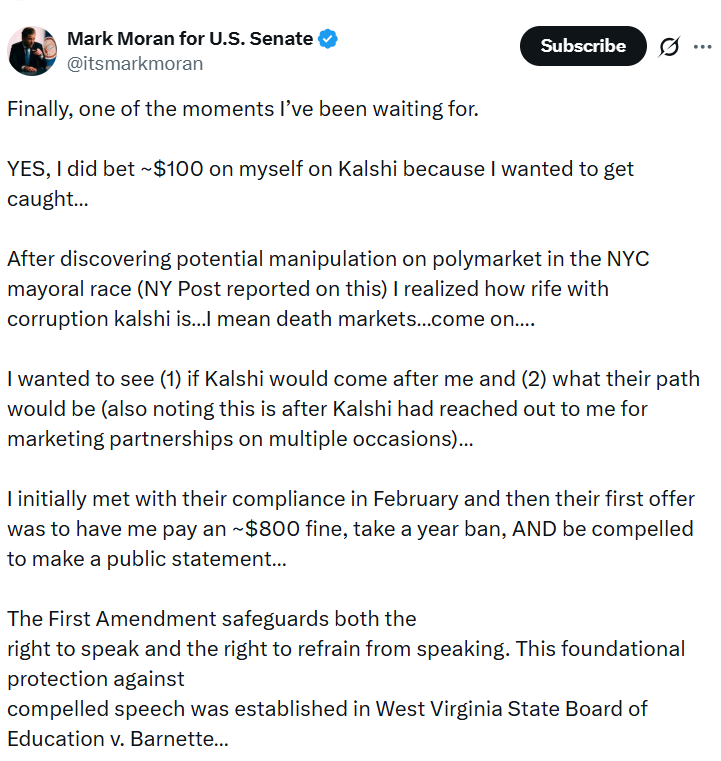
Two US congressional candidates and one sitting lawmaker have received fines and bans from Kalshi after they were found betting on the outcomes of their election races, as prediction market platforms crack down on insider trading.
Matt Klein, a sitting member of the Minnesota State Senate, was fined $539 for betting on his primary race in his bid for the US House of Representatives, which is set to take place in August. Ezekiel Enriquez, who ran for a US House seat in March, received a $784 penalty, according to Kalshi’s notice of settlement.
Another case involved Mark Moran, a candidate in Virginia’s US Senate race, who received a $6,229 penalty and was ordered to return any profits from his trades after allegedly refusing to cooperate with Kalshi to resolve the issue. All three were banned from the platform for five years.
Prediction markets, which let users trade contracts on the outcomes of future events, have faced growing scrutiny over insider trading and possible violations of gambling laws. Kalshi and Polymarket, the two largest platforms, have pledged to introduce stricter controls and crack down on unlawful activity.
Lawmakers offer reasons for insider trades
Moran said in a statement on X that he placed his wager to test Kalshi’s procedures and see how the platform would respond to insider trading.
“YES, I did bet ~$100 on myself on Kalshi because I wanted to get caught,” he said, adding that he “wanted to see (1) if Kalshi would come after me and (2) what their path would be.”

Klein said in a statement that he placed the wager out of curiosity about how prediction markets worked, but later learned it violated platform rules.
“In compliance with their request, I paid a penalty and agreed to be suspended from the platform. That was the only wager I have ever made on a predictions market,” he added.
Klein is a co-sponsor of a bill in the Minnesota Legislature that aims to ban wagers on the outcomes of real-world events such as elections or policy decisions.
Cointelegraph was unable to reach Ezekiel Enriquez for comment.
Kalshi’s ongoing insider trading crack down
Bobby DeNault, Kalshi’s head of enforcement, said Tuesday these cases violated Kalshi’s exchange rules but didn’t warrant referral to the US Commodity Futures Trading Commission or the Department of Justice for further investigation and prosecution.
Related: Charles Schwab, Citadel Securities are eying prediction markets
“Regardless of the size of a trade, political candidates who can influence a market based on whether they stay in or out of a race violate our rules. No matter how small the size of the trade, any trade that is found to have violated our exchange rules will be punished,” he added.
The platform issued a $2,000 fine and a five-year ban in February to a former California gubernatorial contender for betting on his own candidacy last year.
Magazine: How to fix suspected insider trading on Polymarket and Kalshi
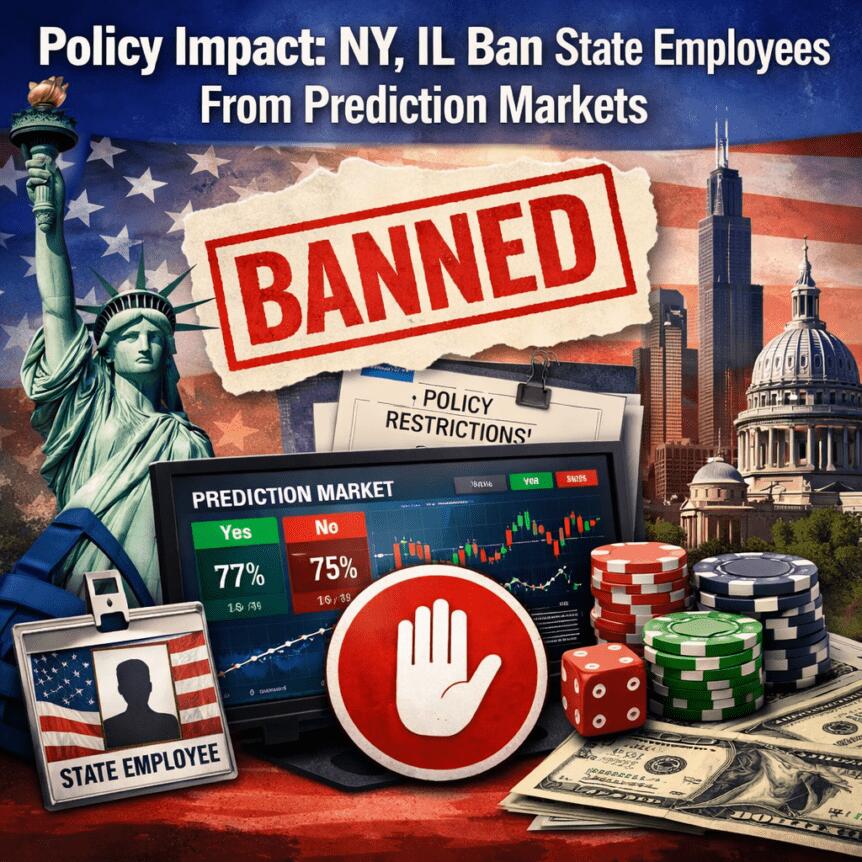
New York Governor Kathy Hochul signed an executive order barring state employees from participating in prediction-market betting, adding a formal layer of ethics rules to a sector that has seen rapid growth and rising scrutiny. The move follows a similar order issued by Illinois earlier in the week and underscores a broader policy shift as authorities weigh the implications of insider information and market manipulation in event-based markets.
Hochul framed the policy as a defense of public integrity, stating that “getting rich by betting on inside information is corruption, plain and simple.” The executive order also criticizes the federal policy environment for permitting an “ethical Wild West” around prediction markets without meaningful standards to curb insider trading. The directive makes clear that violations may lead to dismissal and could invite law enforcement action, while explicitly prohibiting state employees and officers from assisting others in profiting on confidential information through prediction markets.
Illinois moved in a parallel direction, with Governor JB Pritzker issuing an executive order that expands state ethics oversight in response to the rapid expansion of online prediction markets and event-based betting contracts. A formal statement from Illinois framed the action as a reinforcement of transparent governance and a preventative measure against insider trading as these platforms gain scale and reach across public life. The two states’ actions reflect a growing concern among policymakers that prediction markets, while useful for information aggregation, can become vectors for illicit trading if not properly restricted.
The movement comes amid mounting attention on how prediction markets operate when sensitive information may influence outcomes such as geopolitical events, military actions, or major policy decisions. Hochul cited specific cases that have drawn scrutiny over potential insider trades involving U.S. military action, pointing to instances where confidential information appeared to intersect with trading activity. These references illustrate why state-level ethics rules are becoming a focal point for both compliance programs in public administration and the private platforms that host these markets.
Key takeaways
- State-level ban on official participation: New York’s executive order prohibits state employees from engaging in prediction-market betting and signals a broader intent to curb conflicts of interest within public service.
- Parallel action in Illinois: Illinois issued a similar executive order, reinforcing ongoing regulatory attention to insider trading risks in prediction markets and setting a precedent for other states.
- Rapid market growth with regulatory risk: Prediction markets have seen sustained growth in volume, with March activity reaching a record level, highlighting the tension between information efficiency and insider-trading risk. According to Cointelegraph, monthly volumes climbed to $23.6 billion in March as markets expanded across sports, elections, and business outcomes.
- Notable enforcement activity: High-profile cases and platform actions illustrate tightening enforcement around insider trading, including actions involving traders and platform operators as scrutiny intensifies.
- Platform regulatory battles: Kalshi faces ongoing regulatory friction in multiple states, including cease-and-desist actions and court proceedings, with potential implications for how event-based contracts are treated under state gaming and wagering laws.
Insider trading concerns and enforcement dynamics in prediction markets
The discourse around prediction markets has increasingly moved from theoretical debates about market efficiency to concrete enforcement concerns. Hochul’s executive order anchors that shift in law, linking ethics violations with tangible consequences for public service employees. The references to suspected insider trading tied to U.S. military actions highlight the practical stakes when confidential information intersects with trading activity online. While platforms argue that they operate within a framework designed to protect against misuse, regulators have repeatedly signaled that gaps in oversight could undermine public trust and market integrity.
Market participants have noted that prediction markets often cover high-stakes events—ranging from geopolitical developments to corporate earnings—creating incentives for non-public information to leak into trading activity. In response, platform operators have pursued their own oversight measures. For example, reports on enforcement actions against participants who wager on personal candidacies or other sensitive events illustrate that private platforms are increasingly expected to police and sanction behavior that may hamper fair markets. The broader takeaway for analysts and compliance teams is that estimation of risk now must include a robust review of how information flows are managed and how enforcement mechanisms align with public ethics obligations.
Beyond individual cases, the regulatory zeitgeist is pressing for stronger framework alignment across jurisdictions. The mounting attention from state governments to predict-market governance dovetails with ongoing debates about how event-based derivatives should be regulated, including where they fit within general securities, gaming, or consumer-protection laws. While the federal approach to prediction markets remains unsettled, state-level actions are effectively shaping the practical operating environment for platforms and participants alike. For institutions, this translates into tighter internal controls, enhanced KYC/AML considerations, and a heightened focus on conflicts-of-interest policies when dealing with internal or confidential information that could influence trading decisions.
Kalshi, Nevada, and New York: regulatory friction products a broader compliance map
The regulatory landscape for prediction-market platforms has become a focal point in several states. The Kalshi platform, which operates on event-based contracts, has faced a series of regulatory challenges as states seek to determine whether such contracts constitute illegal gambling or require separate licensing regimes. In New York, the State Gaming Commission issued a cease-and-desist order related to Kalshi’s unlicensed mobile wagering activities within the state, highlighting the complexities of regulating digital prediction markets within traditional gaming frameworks. Separately, a lower court in Nevada temporarily blocked Kalshi from operating in the state, with regulators arguing that the contracts facilitated unlicensed gambling. The outcomes of these actions could have far-reaching implications for how prediction markets are treated under state licensing regimes and gaming laws.
Industry observers note that the regulatory tension surrounding Kalshi underscores a broader question about the status of prediction-market platforms in the U.S. If these platforms are deemed to operate as unlicensed gambling venues, they may face a cascade of licensing and enforcement actions across multiple states. Conversely, if authorities reconcile these products under a securities or commodity framework—or carve out a clear regulatory pathway—the sector could experience clearer compliance roadmaps. In public commentary, some industry participants have indicated that the regulatory question could eventually reach the Supreme Court, depending on how lower court rulings align with existing interpretations of gambling, securities, and commodities law. Such a development would carry implications for the permissible boundaries of event-based derivatives and the proper boundaries of government interference in private market activity.
For market participants and compliance teams, these regulatory dynamics call for heightened vigilance around platform governance, trade monitoring, and the handling of non-public information. As enforcement actions proliferate at the state level, firms must reassess internal controls, including the segregation of confidential information, conflict-of-interest disclosures, and the scope of permissible trading for employees and affiliated entities. The evolving precedent could also influence cross-border considerations, as global regulators evaluate whether similar governance models require standardized minimum standards or a more harmonized approach to event-based contracts and their financial or social risks.
Regulatory policy in a broader policy and market-structure context
While the U.S. state-level actions form a syndicate of ethics and compliance measures, observers are increasingly aligning these moves with broader policy debates. The rapid growth of prediction markets—driven by platforms that cover sports outcomes, elections, and business events—has intensified scrutiny of how these markets integrate with traditional financial and gaming regulatory regimes. In parallel, global policy evolution, including frameworks like the European Union’s MiCA, continues to shape how mainstream crypto-asset markets and related derivatives are governed. Although MiCA focuses primarily on crypto assets and their regulatory treatment, its approach to licensing, transparency, and cross-border activity offers a useful reference point for institutions navigating multi-jurisdictional compliance in rapidly evolving financial technologies. The comparative lens underscores the importance of robust, auditable governance structures, clear definitions of permissible activities, and consistent enforcement signals to support institutional adoption and compliance resilience.
For corporate counsel, risk managers, and financial investigators, the current trajectory suggests a dual emphasis: strengthening internal ethics regimes within public bodies and ensuring external platforms implement clear, enforceable standards that deter insider trading and manipulation. The thread tying these developments together is a clear move toward explicit governance of information flows, robust monitoring for suspicious activity, and a defined path for regulatory action when rules are bent or broken. This alignment is essential not only for market integrity but also for preserving trust among participants, investors, and the public sector that depends on orderly, predictable oversight of these innovative markets.
In sum, the surge in prediction-market activity is meeting a corresponding escalation in regulatory attention. State governments are taking concrete steps to limit conflicts of interest within public service, while enforcement against platform operators and traders intensifies the legal and regulatory risk landscape. As legal challenges unfold and potential Supreme Court consideration looms, market participants should expect continued clarity and continuity in compliance expectations, alongside ongoing innovations in platform governance and risk controls.
Closing perspective: the evolving regulatory framework for prediction markets will shape best practices across governance, monitoring, and cross-border operations. Institutions should monitor not just state actions but the legal ripples that may reach federal policy, court rulings, and potentially international standards as these markets mature.

TLDR
- Kalshi has selected Pyth Network as the official data provider for its new Commodities Hub.
- The Commodities Hub offers binary markets tied to gold, oil, lithium, and soybeans.
- Pyth will act as the resolution source by supplying real-time institutional price feeds.
- Kalshi’s most liquid oil contract uses ICE data to verify market outcomes.
- Polymarket has also integrated Pyth for its own commodities prediction markets.
Kalshi has selected Pyth Network as the data provider for its newly launched Commodities Hub. The platform now offers event markets tied to gold, oil, lithium, and other commodities prices. The exchange confirmed that Pyth will serve as the official resolution source for these contracts.
Kalshi Expands Commodities Markets With Pyth Integration
Kalshi introduced its Commodities Hub with dozens of live contracts linked to major raw materials. Traders can choose binary options based on whether prices move above or below set targets. The markets include Brent crude oil, gold, lithium, and soybeans.
Pyth will supply real-time pricing data and act as the resolution authority for these contracts. Kalshi Head of Crypto John Wang said, “It’s important that Kalshi’s markets are backed by fast, institutional-grade data.” He added that Pyth’s feeds are granular and easy to consume for retail and institutional participants.
Pyth aggregates price data from over 125 institutions, including exchanges and market makers. The network distributes real-time feeds designed for 24/7 availability across asset classes. The firm also operates a live interface known as Pyth Terminal.
Douro Labs CEO Mike Cahill addressed the integration in a statement. He said, “Market participants need price discovery that doesn’t stop when traditional exchanges close.” He linked that demand to constant geopolitical developments affecting commodity pricing.
Kalshi confirmed that ICE data will verify outcomes for its most liquid oil market. That contract has generated about $4 million in trading volume so far. The exchange continues to expand listings within the Commodities Hub.
Prediction Market Competition and Regulatory Scrutiny
Kalshi and Polymarket continue to compete for market share and valuation growth. Polymarket recently integrated Pyth for its own commodities markets. The onchain platform also uses Chainlink as an oracle provider.
Kalshi reached a $22 billion valuation in March, according to recent disclosures. Polymarket is currently raising capital at a $15 billion valuation. Both firms seek broader user adoption and new data partnerships.
The Commodity Futures Trading Commission has reiterated that prediction markets fall under federal oversight. However, several state regulators argue that certain contracts violate local gambling laws. Lawmakers Adam Schiff and John Curtis introduced the “Prediction Markets Are Gambling Act” to address sports-related contracts.
Some countries have taken action against prediction platforms. Argentina has moved to restrict access to certain services. Regulators continue to review the classification of these markets.
The Pyth Network’s native PYTH token rose over 6% to $0.048 on Wednesday. Bitcoin gained more than 4% and returned to $79,000 during the same session. Crypto markets showed broader gains alongside these moves.



The $3 trillion crypto industry’s compliance infrastructure runs on a small group of RegTech firms. From blockchain analytics and travel rule networks to KYC, sanctions screening, and government intelligence, these companies allow institutions to operate in digital assets under regulatory scrutiny.
Here are the 15 companies holding digital asset compliance together in 2026.
Entry
Company
Founded · HQ
Key People
Scale & Funding
Core Capability
Signature Matter
1
Chainalysis
2014 · New York
Michael Gronager (CEO)
Jonathan Levin (Co-founder, CSO)$8.6B valuation; 763 employees
$537M+ raised (Accel, GIC, Blackstone, BNY)Blockchain analytics, investigations, KYT
Standard for global agencies including FBI, IRS, Europol.
Tracing linked to Colonial Pipeline and Bitfinex recoveries
2
TRM Labs
2018 · San Francisco
Esteban Castaño (CEO)
Ari Redbord (Policy Head)$1B valuation (Series C, 2026)
$220M raised; 383 employeesAI-driven blockchain intelligence
Clients include Coinbase, Visa, PayPal.
$300M+ illicit assets frozen via T3 Unit
3
Elliptic
2013 · London
Simone Maini (CEO)
Richard May (ex-HSBC)Backed by HSBC, JPMorgan, Santander
99.99% uptime (company claim)Blockchain analytics, stablecoin risk
Issuer due diligence for stablecoins (2025)
Data used in Garantex takedown
4
ComplyAdvantage
2014 · London
Charles Delingpole (Founder)
$158M raised; 474 employees
ISO 27001 + SOC 2 certifiedAML, sanctions screening, monitoring
AI resolves 85% of alerts (company claim).
1,000+ clients across 80+ countries
5
Sumsub
2015 · Limassol
Andrew Sever (CEO)
Ilya Brovin (CGO)500–1,000 employees
14,000+ document types globallyKYC, KYB, travel rule, monitoring
1,800+ VASPs in network
23,000+ fraud checks daily
6
Notabene
2020 · New York
Pelle Braendgaard (CEO)
Catarina Veloso (Regulatory)$26.6M raised
2,000+ VASPs in networkTravel rule compliance
Leading global VASP network
Brazil regulatory playbook (2026)
7
Merkle Science
2018 · Singapore / NY
Mriganka Pattnaik (CEO)
Nirmal Ak (Co-founder)$25.6M raised
41 investors incl. DCGPredictive crypto risk analytics
Behavioral ML engine for pre-risk detection
10,000+ assets tracked
8
Crystal Intelligence
2018 · Amsterdam
Navin Gupta (CEO)
Marina Khaustova (COO)1,900+ clients
Backed by Bitfury, TetherBlockchain investigations, analytics
330+ blockchains covered
Used in ransomware and terror finance tracking
9
Scorechain
2015 · Luxembourg
Founding leadership team
350+ compliance teams
250+ institutions across 40+ countriesAML, wallet screening, MiCA compliance
Core EU MiCA compliance coverage
UNICEF Luxembourg deployment
10
Solidus Labs
2017 · NY / Tel Aviv
Asaf Meir (CEO)
Backed by Evolution Equity, Hanaco
Category-defining positioningMarket surveillance, threat intelligence
Staking Guard (2024) with Figment
Pre-chain validator compliance
11
Lukka
2014 · New York
Robert Materazzi (CEO)
Used by Big Four firms
Institutional data infrastructureCrypto tax, accounting, compliance
Acquired Coinfirm (2023)
AICPA standards partnership
12
Jumio
2010 · Palo Alto
Robert Prigge (CEO)
700+ employees
Backed by Centerbridge PartnersIdentity verification, KYX
Dedicated crypto vertical
Supports exchanges and on-ramps
13
CipherTrace
2015 · Menlo Park
Mastercard Crypto division
Acquired by Mastercard (2021)
Integrated into Crypto SecureBlockchain analytics, travel rule
TRISA co-founder
Embedded in Mastercard network stack
14
Onfido
2012 · London
Entrust (parent company)
300M+ identity checks
Acquired by Entrust (2024)Identity verification, CDD workflows
FATF-aligned compliance flows
Integrated with IAM systems
15
Inca Digital
2018 · Washington DC
Adam Zarazinski (CEO)
US government contracts (DARPA, SEC)
National security focusGovernment analytics, threat intelligence
Supports federal agencies
Regulatory and congressional engagement
About This List
This list is compiled by the BeInCrypto Research Division as part of the BeInCrypto Institutional 100 Awards 2026.
These companies provide the infrastructure behind AML enforcement, travel rule compliance, sanctions screening, identity verification, and blockchain intelligence across global jurisdictions.
Methodology
This category evaluates compliance technology providers under Track B of the BeInCrypto 100 methodology: 30% quantitative metrics, 50% Advisory Council input, and 20% disclosed data analysis.
Assessment spans seven criteria: technology capability, client adoption, regulatory recognition, innovation, funding maturity, effectiveness, and reputation.
Data points were verified using company disclosures, press releases, regulatory filings, and private market platforms including PitchBook and Tracxn. Figures reflect the most recent available information at the time of publication and may change.
The post BeInCrypto Institutional Research: 15 Companies Behind Digital Asset Compliance appeared first on BeInCrypto.
TLDR
- Bitwise launched a new Avalanche-focused fund on April 15 to expand its crypto product lineup.
- CIO Matt Hougan said Avalanche offers differentiated exposure within the Layer 1 blockchain market.
- Hougan explained that Avalanche allows institutions to launch customizable blockchains with their own rules and validators.
- He linked the AVAX ETF thesis to long-term growth in tokenized assets, stablecoins, and onchain finance.
- Hougan cited partners including BlackRock, Apollo, Toyota, the State of Wyoming, and FIFA as part of Avalanche’s ecosystem.
Bitwise Asset Management has launched an Avalanche-focused fund and outlined its investment rationale. Chief Investment Officer Matt Hougan presented the case in a recent memo. He argued that Avalanche offers differentiated exposure within the Layer 1 market.
Hougan said the firm launched its Avalanche fund on April 15 to expand its crypto lineup. He explained that Avalanche approaches blockchain design differently from Ethereum and Solana. He stated that this structural difference supports the case for broader portfolio inclusion.
AVAX ETF Thesis Centers on Differentiated Blockchain Structure
Hougan wrote that Avalanche does not operate as a single shared chain like many rivals. Instead, it allows institutions to launch customizable blockchains with tailored rules and validators. He said this structure supports regulated entities seeking controlled blockchain environments.
He stated, “Avalanche is attractive not because it dominates Layer 1, but because it approaches blockchain design differently.” He added that banks and governments may prefer infrastructure without adopting a fully public chain model. He linked this flexibility to long-term growth in tokenized assets and onchain finance.
Hougan connected the AVAX ETF thesis to expanding tokenization trends across financial markets. He said tokenized real-world assets on Avalanche have climbed sharply in recent months. He cited activity from partners including BlackRock, Apollo, Toyota, the State of Wyoming, and FIFA.
He wrote that Avalanche could capture part of the market if hundreds of trillions of dollars move onchain. He framed this opportunity as tied to institutional blockchain adoption. He maintained that the fund provides targeted exposure to that theme.
Ethereum, Solana, XRP, and Avalanche Form Core Layer 1 Group
Hougan used the memo to outline Bitwise’s broader Layer 1 allocation strategy. He said the market remains early and fast-moving across competing networks. He argued that predicting a single long-term winner remains difficult.
He wrote that the most sensible approach focuses on networks with clear structural differences. He identified Ethereum, Solana, and XRP as core platforms within that group. He added that Avalanche extends that list due to its customizable model.
Hougan said Ethereum leads in smart contracts and decentralized applications. He described Solana as optimized for high-speed and low-cost transactions. He included XRP for its focus on payments infrastructure.
He explained that Avalanche offers exposure to a different segment of blockchain demand. He said its design supports private and public use cases within one ecosystem. He positioned the Avalanche fund as aligned with that framework.
TLDR
- U.S. banking groups asked the Treasury Department to extend comment periods on GENIUS Act stablecoin rule proposals.
- The associations requested at least 60 additional days after the OCC finalizes its supervisory framework.
- Bankers said the related rule proposals depend directly on the OCC’s final approach.
- The letter addressed rulemaking efforts at OFAC, FinCEN, and the FDIC.
- The GENIUS Act aims to establish a national stablecoin oversight framework before 2027.
U.S. banking groups have urged federal regulators to extend comment periods tied to stablecoin rules under the GENIUS Act. They argue that overlapping proposals require more review time before agencies finalize frameworks. The request centers on aligning rulemaking schedules across multiple banking regulators.
Banking Groups Call for More Time on GENIUS Act Rules
Several major bank trade associations submitted a letter to the U.S. Department of the Treasury and the Federal Deposit Insurance Corp. They asked regulators to extend three proposed rule comment periods linked to the GENIUS Act. They requested at least 60 additional days after the Office of the Comptroller of the Currency completes its framework.
The American Bankers Association and the Bank Policy Institute signed the letter with other organizations. They stated that all related proposals remain “directly contingent on the OCC’s final framework.” They argued that agencies should allow coordinated review before moving forward.
The Office of the Comptroller of the Currency is drafting standards for supervising stablecoin issuers. Bankers said the OCC’s final approach will shape related rules under development at other agencies. They stressed that agencies should not finalize separate rules without considering the OCC’s decisions.
The letter addressed rulemaking efforts at the Treasury’s Office of Foreign Assets Control and the Financial Crimes Enforcement Network. It also referenced a related proposal at the FDIC. The groups said these efforts together represent a “body of regulatory work of extraordinary scope and complexity.”
Bankers explained that they plan to provide detailed feedback on each proposal. However, they said agencies must first finalize the OCC’s supervisory structure. They wrote that their comments “will necessarily be more comprehensive” with more time.
Coordinated Oversight and Ongoing Stablecoin Debate
The GENIUS Act aims to establish a national framework for stablecoin oversight before 2027. Lawmakers designed the measure to coordinate federal supervision across banking and financial regulators. Agencies have begun drafting rules to meet the law’s timeline.
Federal agencies often extend comment windows for complex rule proposals. Banking groups cited that precedent in their request. They said regulators should synchronize review periods to avoid inconsistent standards.
At the same time, the same banking organizations remain engaged in discussions over the Digital Asset Market Clarity Act. That proposal seeks to define oversight roles for digital asset markets. Disagreements between banks and crypto industry participants have slowed its progress in Congress.


PUSD, a Shariah-compliant stablecoin backed by Gulf currencies, is set to deploy on ADI Chain, a Layer 2 network focused on institutional settlement in the Middle East.
According to an announcement shared with Cointelegraph, the stablecoin has about $2.3 billion in circulation and is backed 1:1 by reserves held in Saudi riyals and UAE dirhams, which are pegged to the US dollar.
It is already available on multiple blockchains, including Ethereum, BNB Chain, Solana and Tron, with ADI Chain marking its latest integration. The stablecoin is positioned to provide access to Islamic finance markets, which represent more than $3 trillion in assets globally, according to the announcement from the ADI Foundation.
ADI Chain is the settlement layer for a dirham-backed stablecoin initiated by International Holding Company and First Abu Dhabi Bank and licensed by the Central Bank of the UAE, according to the announcement.
The addition of PUSD introduces a second stablecoin to the network, allowing institutions to settle transactions using either a dollar-linked asset or a dirham-denominated token on the same infrastructure.
Transactions on the network require its native token for fees and are expected to support settlement across corridors linking the Gulf, the Middle East and parts of Africa.
PUSD is issued by Palm Azgar Finance and is designed for institutional use, including corporate treasuries, exchanges and payment processors.
Related: Here’s why crypto is moving to Dubai and Abu Dhabi
UAE builds out stablecoin framework
The United Arab Emirates has developed a multi-layered regulatory framework for digital assets, with authorities including the Central Bank of the UAE and Abu Dhabi Global Market (ADGM) establishing rules for stablecoins and virtual asset providers. Within that framework, dirham-pegged payment tokens are being explored as a way to modernize domestic payments and improve cross-border settlement.
In December, UAE telecom giant e& signed an agreement with Al Maryah Community Bank to test a dirham-pegged stablecoin licensed by the UAE central bank for consumer payments across its digital platforms in an early-stage pilot.
The following month, RAKBank received in-principle approval from the central bank to issue a dirham-backed stablecoin, with the planned token expected to be fully backed 1:1 by reserves held in regulated accounts. The approval is subject to final regulatory and operational conditions before any live issuance.
The push has also expanded to dollar-denominated tokens operating under local rules. In January, Universal Digital launched USDU, a US dollar-backed stablecoin registered by the UAE central bank under its Payment Token Services Regulation, making it the first dollar-denominated token approved for payment use within the framework.
Separately, the Financial Services Regulatory Authority has granted approvals to several crypto firms, including Tether (USDT), Ripple USD and Circle, to operate inside the ADGM’s financial zone.
TLDR
- Thailand SEC has proposed new rules to allow digital asset firms to apply for derivatives licenses within existing entities.
- The proposal removes the requirement for crypto firms to establish separate companies for derivatives operations.
- The regulator aims to expand access to crypto futures while strengthening oversight and compliance standards.
- The consultation period will remain open until May 20 for industry feedback.
- Blockchain.com launched perpetual futures trading with up to 40% leverage using Bitcoin as collateral.
Thailand’s securities regulator has opened consultation on new licensing rules for digital asset firms. The proposal allows firms to seek derivatives licenses within existing entities. The move targets broader access to crypto futures while tightening oversight standards.
Thailand Crypto Futures Framework Shifts Under Proposed SEC Rule Changes
Thailand’s Securities and Exchange Commission has proposed rule updates for digital asset operators. The agency aims to streamline licensing and expand derivatives offerings. Officials said the plan supports market growth and regulatory clarity.
The proposal removes the need for separate entities when applying for derivatives licenses. Licensed crypto firms could apply directly within current structures. This approach could lower operational barriers for market participants.
The regulator confirmed that earlier changes recognized digital assets as valid underlying assets. Futures contracts can now reference these assets under approved frameworks. The new proposal builds on that regulatory base.
Officials also introduced safeguards to address conflicts of interest within firms. They outlined stronger compliance and reporting standards for licensed entities. These measures aim to align with international derivatives practices.
The SEC said the consultation period will run until May 20. Industry participants can submit feedback during this period. Authorities will use responses to finalize the regulatory framework.
Global Crypto Derivatives Expansion Accelerates Alongside Regulatory Moves
Crypto derivatives activity has increased across major markets in recent months. Exchanges continue to expand offerings tied to digital assets and traditional markets. This trend reflects growing demand for leveraged trading tools.
Blockchain.com recently launched perpetual futures trading within its self-custody wallet. Users can open leveraged positions using Bitcoin as collateral. The system supports over 190 markets with leverage up to 40%.
The platform relies on infrastructure provided by Hyperliquid for execution. It allows traders to maintain custody of assets during trading. This structure reduces reliance on centralized exchanges.
Other platforms have introduced similar products targeting global users. Kraken and Coinbase launched perpetual futures linked to equities earlier this year. These products target non-US clients seeking continuous trading access.
Both exchanges continue to expand multi-asset trading environments. Their offerings support round-the-clock trading across different asset classes. This approach aligns with growing global trading demand.
Regulatory discussions in the United States may influence future availability. In March, official statements suggested progress on crypto perpetual futures approvals. Authorities indicated movement could occur within a short timeframe.
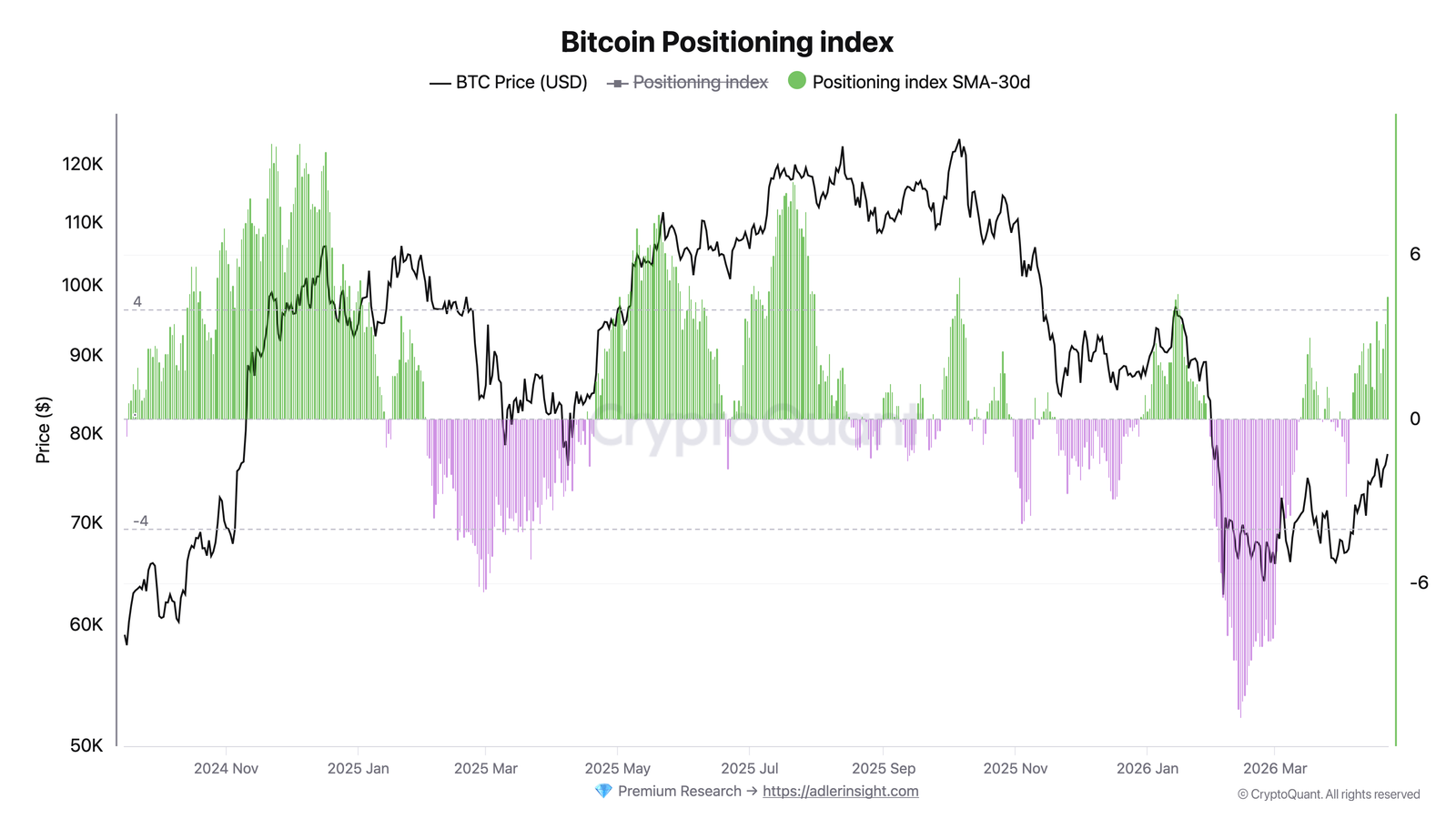
Bitcoin (BTC) reached a monthly high of $79,472 on Wednesday, marking its strongest 28-day return since April 2025. The rally aligns with a shift in a market positioning metric and a surge in leverage use.
A combined view of the market positioning metric and open interest shows new positions are being added, potentially influencing BTC’s push toward new highs.
BTC positioning builds with rising leverage
Bitcoin researcher Axel Adler Jr. said that the Bitcoin positioning index has turned higher, with its 30-day average rising to 4.5 from -10.9 in February. The indicator blends net taker flow direction, open interest trends, funding and the exchange balance into a single metric.

Its steady climb since late March, from 0.4 to current levels, shows a consistent improvement without breaking the price trend.
The growth in open interest confirms the same trend. The 30-day change stands at +14.5%, with 23 of the past 30 sessions closing positive. The rising positioning alongside expanding open interest signals new capital entering derivatives markets.

Over the past 24 hours, the aggregated open interest also rose 6.7% to 260,000 BTC, while the price experienced a 10.7% drop in leverage over the weekend.
Related: Bitcoin Bull Score hits six-month high as 2022 bear-market fears linger
Key BTC levels to watch
Bitcoin has moved above a descending trendline dating back to the October 2025 peak near $126,000 and has reclaimed the 100-day exponential moving average (EMA). This indicates a strong shift in trend from bearish to neutral-to-bullish on the higher time frame.
The $81,000 level now serves as the first test area, with a small fair-value gap indicating a liquidity imbalance, where a price hold would signal that buyers are accepting higher prices.

Above that, $88,000 stands as the supply zone tied to prior distribution. The $88,000–$91,000 range stands out as a key supply zone, shaped by a prior distribution phase when large volumes of Bitcoin last changed hands.
Many of those holders are now sitting near break-even or in slight profit, which typically increases activity when the price revisits that area.
Adding to this, the realized price of the three–to-six–month holder cohort sits at $91,600, further reinforcing this zone as a major decision point.
A sustained move through this range would signal strong demand, showing that buyers are absorbing overhead supply and setting the stage for Bitcoin price to move higher.
Crypto analyst Crazzyblockk highlighted a tight range, with the $72,000–$75,000 zone acting as a floor, supported by clusters of realized prices from mid-term holders. A break below this band would push more supply into loss, increasing the risk of reactive selling.

On the upside, the $83,000–$85,000 marks a profit-taking zone for recent short-term holders. Price strength through this range would signal that buyers are absorbing the supply, allowing momentum to build.
Related: ‘Powerful move’ looms for Bitcoin price, says Bollinger Bands indicator
This article is produced in accordance with Cointelegraph’s Editorial Policy and is intended for informational purposes only. It does not constitute investment advice or recommendations. All investments and trades carry risk; readers are encouraged to conduct independent research before making any decisions. Cointelegraph makes no guarantees regarding the accuracy or completeness of the information presented, including forward-looking statements, and will not be liable for any loss or damage arising from reliance on this content.

At the LONGITUDE crypto conference in Paris, industry leaders gathered to map the path from regulatory clarity to practical adoption of digital assets. In a fireside chat, Blockstream CEO Adam Back—an enduring figure in Bitcoin lore—addressed renewed speculation that he might be Satoshi Nakamoto, offering a measured denial while reflecting on why the mystery still captures the imagination of the space.
Back told Cointelegraph that the Satoshi rumor is flattering in some sense, but not accurate. He pointed to his long-running presence on early cypherpunk forums as a likely fuel for the assumption that he could have penned Bitcoin. “It is flattering in some sense that they think you could have done it,” he said, noting that he was “the reply guy” when electronic cash was a hot topic on the Cryptography Mailing List in the 1990s. When the Bitcoin white paper appeared in October 2008, he said, the public’s curiosity about Satoshi’s identity became a persistent talking point in the industry.
Beyond the personal intrigue, Back described the Satoshi mystery as an “interesting question” that the community has lingered on for years, without any conclusive answer. The exchange of ideas at LONGITUDE underscored a broader shift in crypto discourse—from secrecy and novelty to questions of regulation, market structure, and the practical growth of stablecoins.
Key takeaways
- Adam Back acknowledges the Satoshi speculation but firmly denies being the Bitcoin creator, attributing much of the conjecture to his historic participation in early cypherpunk discussions.
- MiCA is widely seen as a watershed for regulatory clarity, but industry leaders warn that heavy oversight could slow innovation if not balanced with global coherence.
- Proponents of a U.S. framework, including the CLARITY Act, expect a more stable environment for crypto firms, though terms remain unsettled, and some voices urge caution about implementation details.
- Major players in payments view stablecoins as well-suited for settlement, provided regulatory clarity, while last-mile integration into local economies remains the key hurdle for widespread adoption.
- Stablecoin circulation sits around $317 billion and has surged roughly 50% year over year, signaling continued growth but also a need to solve local adoption challenges beyond cross-border use cases.
Regulatory clarity and the competition for global coherence
Onstage conversations at LONGITUDE highlighted a regulatory landscape that many in the industry view as progressively clearer, yet uneven in its global reach. Erald Ghoos, CEO of OKX Europe, participated in a discussion asserting that the Markets in Crypto-Assets (MiCA) framework has been “extremely beneficial for the industry.” He argued that MiCA’s framework helps build trust by treating crypto as a regulated asset class and ensuring participants “will be vetted and held up to the highest standards.”
Yet Ghoos also cautioned that the heavy regulatory overhead could dampen entrepreneurial momentum in Europe. He warned that the burden might drive startups to seek more permissive jurisdictions, potentially slowing local innovation. That sentiment echoed broader industry concerns about fragmentation in global regulatory regimes—an issue voiced by CertiK CEO Ronghui Gu, who noted that developers and crypto firms still operate under divergent compliance standards depending on their region.
Industry observers also weighed the U.S. policy horizon. The CLARITY Act—posed as a framework to bring structure to the crypto sector—was discussed as a potential catalyst for adoption beyond traditional financial channels. Cardano Foundation CEO Frederik Gregaard argued that the act is “extremely important,” adding that policymakers appear eager to advance it. He predicted that once the CLARITY Act passes, non-TradFi adoption could accelerate dramatically, claiming a “100X” acceleration as classical industries begin to embrace the technology once regulatory clarity is in place.
However, not everyone shares the same level of optimism about timeline and interpretation. U.S. Senator Thom Tillis indicated that he does not expect the Senate Banking Committee to mark up the CLARITY Act in April and suggested scheduling for the following month. The evolving political process underscores a broader tension: the sector seeks rapid clarity, while lawmakers balance consumer protections, stablecoin risk, and financial-system resilience.
Ronghui Gu of CertiK framed the broader challenge as a call for a unified, global framework. Without one, developers and crypto companies must navigate a mosaic of national standards, creating friction for cross-border projects and complicating risk management and compliance in multinational deployments. The dialog at LONGITUDE thus underscored a central truth: regulatory clarity matters to players across the ecosystem, but it must be congruent across borders to unlock scalable growth.
Payments rails and the march of stablecoins: benefits, burdens, and the last mile
Another thread at the event explored how stablecoins fit into real-world payments—and the friction that remains before they reach everyday users. Mastercard’s Christian Rau, speaking on a panel with Stella Development Foundation’s Raja Chakravorti and Ethereum Foundation enterprise lead Matthew Dawson, framed stablecoins as particularly well-suited for payments when backed by regulatory clarity. He described stablecoins as having more predictable behavior than other digital assets, which helps them function effectively in settlement and commerce, while acknowledging that most real-time payment experiences still rely on traditional rails.
Rau characterized the current payments landscape as one where real-time-like experiences are possible in practice but not yet achieved end-to-end in a fully digital sense. He noted that the existing card- and bank-based systems still require steps of authorization, clearing, and settlement, which introduces latency and costs—albeit with a degree of immediacy that resembles real-time payments in many cases. The implication is that stablecoins, if properly integrated with clear regulatory guardrails, could streamline settlement in certain use cases, particularly cross-border and cross-ecosystem transactions.
On the adoption front, Chakravorti pointed to the roughly $317 billion in stablecoin circulation as of the event, up about 50% from a year prior. He observed early signs of cooling, a healthy signal that infrastructure is maturing. The larger takeaway, he said, is that the next frontier for stablecoins lies in “local stablecoins”—efforts to embed digital assets into domestic economies and legal tender ecosystems. The last mile, he emphasized, remains the principal barrier: turning digital assets into something that works smoothly within local financial systems and everyday commerce.
That last-mile bottleneck aligns with a broader assessment that widespread adoption hinges on bridging on-chain activity with off-chain financial systems. In this view, robust on- and off-ramp infrastructure, clear regulatory expectations, and interoperable standards will determine whether stablecoins transition from a mainly cross-border instrument to a pervasive domestic payments layer.
For readers watching regulatory developments, the LONGITUDE conversations offered a clear signal: clarity is not enough. The rules must be practical, globally coherent, and paired with the kind of interoperable infrastructure that makes digital assets usable in day-to-day life. The path forward will likely hinge on coordinating policy globally while continuing to build the technical and regulatory guardrails that give institutions, developers, and users confidence to participate at scale.
Overall, the event illustrated a crypto ecosystem at a crossroads: maintain the momentum of innovation while embracing a framework that both protects consumers and accelerates real-world adoption. As policymakers weigh fresh measures and industry players push for cross-border harmonization, readers should monitor how quick regulatory signals translate into tangible, usable solutions—especially in the crucial last mile that connects digital assets to everyday commerce.
Readers should watch for updates on MiCA’s rollout across Europe, the CLARITY Act’s path through U.S. channels, and how large-scale stablecoin deployments evolve in local economies. The next phase will reveal whether regulatory clarity translates into faster, broader adoption or if the pace of policy development outstrips practical deployment.

Kalshi Bans 3 US Candidates Over Insider Bets on Elections

Meghan Markle Gets In Trouble With Palace Again Over Kids’ Titles

Unga mama ipadi thana ? #shorts #shortvideo #shortsfeed #trending #funny #comedy #money #like

Manchester United reach agreement with Casemiro over contract clause amid transfer speculation

Steven Gerrard disagrees with Gary Neville over ‘shock’ Chelsea and Arsenal claim | Football

US brings back mandatory military draft registration


-

 Sports6 days ago
NWFL Suspends Two Players Over Post-Match Clash in Ado-Ekiti
-

 Fashion5 days ago
Weekend Open Thread: Theodora Dress
-

 Politics5 days ago
Palestine barred from entering Canada for FIFA Congress
-
Entertainment3 days ago
NBA Analyst Charles Barkley Chimes in on Ice Spice McDonald’s Fiasco
-

 Business4 days ago
Powerball Result April 18, 2026: No Jackpot Winner in Powerball Draw: $75 Million Rolls Over
-

 Tech4 days ago
Auto Enthusiast Scores Running Tesla Model 3 for Two Grand and Turns It Into Bare-Bones Go-Kart
-

 Politics4 days ago
Zack Polanski demands ‘council homes not luxury flats for foreign investors’
-

 Crypto World5 days ago
Russia Pushes Bill to Criminalize Unregistered Crypto Services
-

 Politics2 days ago
Gary Stevenson delivers timely reminder to register to vote as deadline TODAY
-

 Politics9 hours ago
Disabled people challenge government SEND proposals over segregation concerns
-

 Business17 hours ago
Rolls-Royce Voted UK’s Most Iconic Trade Mark as IPO Register Hits 150
-

 Politics8 hours ago
Making troops accountable for war crimes threatens US alliance, ex-SAS colonel warns
-
 Business6 days ago
Creo Medical agree sale of its manufacturing operation
-

 Crypto World5 days ago
Russia Introduces Bill To Criminalize Unregistered Crypto Services
-

 Politics10 hours ago
Starmer handler McSweeney to be dragged from shadows by Foreign Affairs Committee
-

 Politics9 hours ago
Zack Polanski responds to home secretary’s taser threat
-
Politics10 hours ago
Wings Over Scotland | How To Get Away With Crimes
-
Crypto World4 days ago
Kelp DAO rsETH Bridge Hack Drains $292M as DeFi Losses Top $600M in Two Weeks
-

 Politics7 hours ago
‘Iran is still a nuclear threat’
-

 Tech7 days ago
Ford EV and tech chief leaving automaker
You must be logged in to post a comment Login