
Crypto World
Tether Freezes $344 Million USDT on Tron in OFAC Coordination



Tether froze $344 million in USDT (USDT) across two Tron wallets in coordination with the Office of Foreign Assets Control and U.S. law enforcement, the company confirmed on April 23.
The action targets addresses flagged for activity tied to sanctions evasion and criminal networks. It represents Tether’s largest single enforcement action to date.
Freeze Tied to Active U.S. Investigations
The two blacklisted wallets held approximately $212.9 million and $131.3 million respectively. Tether said U.S. authorities shared intelligence linking the addresses to unlawful conduct before the freeze was executed, preventing further movement of funds
“USD₮ is not a safe haven for illicit activity. When credible links to sanctioned entities or criminal networks are identified, we act immediately and decisively,” read an excerpt in the announcement, citing Tether CEO Paolo Ardoino who framed the response as part of a broader compliance posture.
Tether now works with more than 340 law enforcement agencies across 65 countries. That cooperation has supported over 2,300 cases globally, with more than 1,200 tied to U.S. authorities.
Surpasses Previous Record
The $344 million freeze dwarfs the previous high of $182 million blacklisted across five Tron wallets in January 2026.
Tether has now frozen more than $4.4 billion in total assets linked to illicit activity, with over $2.1 billion connected to U.S. law enforcement.
The U.S. Department of Justice has previously acknowledged Tether’s role in enforcement actions that led to seizures of nearly $61 million and approximately $225 million tied to pig butchering fraud.
The latest freeze reinforces the argument that public blockchains offer investigators a traceable record that traditional cash transfers cannot.
The post Tether Freezes $344 Million USDT on Tron in OFAC Coordination appeared first on BeInCrypto.


Bitcoin (BTC) eased from a brief run of near three-month highs on Thursday as traders shifted focus to the weekly close and the broader macro backdrop. After punching higher earlier in the week, the flagship crypto retraced toward the mid-to-upper $70,000s, with the market eyeing whether the next weekly candle can sustain the ascent or mark a pause before the next leg.
Trading data pointed to BTC/USD hovering around $77,200 ahead of the U.S. session, following a surge to around $79,500 the day prior. The $80,000 level remained a stubborn hurdle, keeping a decisive breakout out of reach for now. In this context, the weekly close looms large, serving as a potential referendum on whether the rally has enough momentum to break into a new phase or whether liquidity needs another catalyst before meaningful upside ensues.
Key takeaways
- BTC/USD retraced after trading near multi-month highs, slipping to about $77,200 before the New York open, with intraday peaks around $79,500 and a stubborn barrier near $80,000.
- The weekly candle close takes on heightened importance as traders gauge whether upside momentum can be sustained beyond a short-term liquidity pullback.
- The bull market support band—defined by the 21-week EMA and the 20-week SMA—has re-emerged as a focal point after a six-month absence from strong support, with traders watching for a sustained move back above this zone.
- Macro drivers remain in focus, with the Federal Reserve’s next policy decision and oil prices cited as key catalysts. CME’s FedWatch Tool points to a very low probability of an imminent policy change, while oil’s trajectory could influence inflation expectations and risk appetite.
Reasserting the bull market band: a technical crosshair reappears
Market technicians highlighted the return of Bitcoin’s bull market support band, a price corridor formed by the 21-week exponential moving average and the 20-week simple moving average. This band previously provided a cushion for Bitcoin during prior upswings but fell away as the market challenged new highs earlier this year. In the latest cycle, observers noted that BTC has again flirted with reclaiming the band, signaling a potential shift in the longer-term technical landscape.
“Bitcoin is attempting to break back above the bull market support band,” commented a trader tracking the charts. The focus now shifts to the weekly close, with several analysts noting that Bitcoin has not traded above this band since October 2025. A sustained move above the band could be interpreted as renewed demand and a possible confirmation of a broader uptrend, while a failure to hold could invite renewed caution among risk markets.
In this context, sentiment hinges on how the weekly candle closes, rather than a single daily print. The pattern underscores the ongoing tension between near-term price action and longer-term structural levels that have historically helped define the market’s trajectory.
Macro catalysts in view: policy, oil, and the path ahead
The immediate calendar offers limited volatility from macro headlines, but the coming week is expected to bring a fresh wave of U.S. inflation data and the Federal Reserve’s policy decision. Market participants have largely priced in a steady stance from the Fed, with tools tracking percentage chances of a rate move pointing to a negligible probability of policy change at the next meeting.
As noted by market observers, the “oil and policy” dynamic remains a principal driver. Oil’s trajectory—whether it remains below a critical threshold or breaches higher—can influence both inflation expectations and the risk appetite across asset classes, including crypto. A vendor note from QCP Capital summed up the sentiment: “The cleanest tells from here are still oil and policy. Oil below $100 would support the relief case, while clearer Fed signalling would help compress the policy premium.”
Meanwhile, traders and analysts continue to weigh the persistence of macro headwinds against the potential for a softer inflation backdrop to unlock policy accommodation later in the cycle. The balance between geopolitical risk, energy prices, and macro cooling will likely shape BTC’s trajectory in the weeks ahead.
What this means for traders and investors
For market participants, the key takeaway is the careful watch on the weekly close as a potential inflection point. If Bitcoin can sustain above the bull market band and close the week with strength, it could lay the groundwork for renewed upside momentum. Conversely, a rejection at these levels or a downside break could signal renewed consolidation risk or a retest of nearby support zones.
From a risk-management perspective, the coming data prints and the Fed’s stance will be critical. A clear shift in policy expectations or a decisive signal on inflation could recalibrate risk premia across markets, including crypto, potentially amplifying volatility around price levels that have historically been pivotal for trend direction.
Investors should also monitor liquidity dynamics around major milestones. As traders have observed in prior cycles, price moves that “take out highs” without immediate follow-through may indicate liquidity is being reallocated toward larger positions, which could translate into sharper moves once buyers decide to step in. In this context, the next weekly close and the alignment (or misalignment) with the bull market band will be important barometers of where Bitcoin’s trend stands as the market navigates a still-uncertain macro environment.
This article is provided in accordance with editorial guidelines and is intended for informational purposes only. It does not constitute investment advice. Readers are encouraged to conduct their own research and consider their risk tolerance before engaging in crypto markets.
Looking ahead, market watchers will be keen to see whether the weekly close confirms the reestablishment of the bull market band as a structural support zone and how the macro backdrop evolves with Fed expectations and energy prices. The coming days should offer clearer signals on Bitcoin’s longer-term direction as traders weigh technical signals against the evolving macro narrative.

Traders work on the floor of the New York Stock Exchange (NYSE) at the opening bell in New York, on April 20, 2026.
Timothy A. Clary | AFP | Getty Images
Retail traders are diving back into some of the market’s most speculative corners, with a regulatory shift removing barriers to rapid-fire trading and helping revive the kind of meme-stock frenzy that has historically delivered sharp gains, and even sharper reversals.
April’s rally in risk assets, fueled in part by an Iran ceasefire, has emboldened individual investors to pile back into volatile trades. In one of the more striking examples, retail traders stampeded into Allbirds after the troubled shoemaker slapped an artificial intelligence label on its business.
Shares surged to as high as $24 from roughly $2.50 after the company outlined plans to rebrand as NewBird AI and pivot toward compute infrastructure. Much of that advance has already unraveled, with the stock recently changing hands near $8 — a sharp reversal that underscores the volatility of such trades.

Allbirds year to date
A similarly dramatic move led by smaller traders played out in Avis Budget Group. Shares of the company, ticker “CAR,” soared from under $100 last month to a record high near $850 in early trading Wednesday, before staging a sharp intraday U-turn lower, serving as another reminder of how quickly momentum-driven rallies can unwind.
Avis year to date
Analysts at JPMorgan said crowding in so-called meme stocks has surged, approaching levels just shy of the extremes seen during the post-Liberation Day risk chase.
The Wall Street firm noted that a key catalyst may be a recent rule change by the U.S. Securities and Exchange Commission. Earlier this month, the regulator approved a proposal by FINRA to eliminate the so-called pattern day trader rule. Under the rule, traders who executed four or more day trades within five business days had to maintain a minimum equity of $25,000 in a margin account.
The new rule does away with the $25,000 requirement, replacing it with a more flexible “intraday margin” rule. FINRA called the old rule, hatched in the wake of the Dotcom crash “outdated.”
“This change opens the door for more investors with smaller accounts to trade more actively, while still keeping protections in place through modern margin and risk controls,” Adam Cohn, head of trading operations at TradeStation, told CNBC. “Removing that barrier means more people can participate in short-term trading strategies … We’ll see a more open market with broader participation and more liquidity.”
JPMorgan analysts said the shift could drive a further pick-up in retail volumes in the coming months, reinforcing momentum in already crowded trades.


Until last Friday, April 17, lending stablecoins into Aave, widely considered the gold standard of DeFi, paid 2.32% APY. The Federal Reserve’s overnight rate was 3.64%. Taken at face value, the market was pricing an unregulated, open-source smart contract as a lower credit risk than the United States Treasury.
In 48 hours, that ended. The market did in real time what no regulator, auditor, or commentator had managed to do: it repriced DeFi credit risk.
The mispricing
Rank the dollar-credit options by yield before last weekend, and the hierarchy made no sense. Treasury overnight: 3.64%. Ledn’s investment-grade Bitcoin-backed ABS senior tranche, priced in February at BBB-: 6.84%. Strategy’s STRC perpetual preferred: 11.50%. U.S. credit cards: 21% against a 4% default rate. And Aave, sitting well below it all: 2.32%.
Something had to give. Luca Prosperi argued earlier this year that DeFi stablecoin rates should carry a 250–400 basis-point premium over the risk-free rate, implying 6.15–7.76%. The Bank of Canada’s April 2nd report took the opposite view, citing Aave’s 0.00% non-performing loan rate as proof that DeFi’s architecture delivers defaultless lending through strict collateral requirements and price-based enforcement.So what does this all mean? Either DeFi had solved credit risk, or the market had stopped pricing it.
Only one side could be right. Last weekend, we found out which.
The 1/1 problem
On April 18th, an attacker exploited Kelp DAO’s LayerZero-powered cross-chain bridge to mint roughly 116,500 unbacked rsETH tokens — about 18% of the circulating supply, worth around $292 million. The synthetic tokens were moved into Aave as collateral. The attacker borrowed an estimated $190–230 million of real assets against collateral that, when it mattered, didn’t exist. Aave’s incident report acknowledged the protocol functioned as designed; the shortfall is structural, not technical. Kelp and LayerZero have since publicly blamed one another for the 1/1 validator configuration that made the exploit trivial.
The contagion was instant. DeFi protocols are interoperable by design, and “looping” — borrowing on one platform and redepositing the proceeds as collateral on another — means a hit to Aave is a hit to everything built on top of Aave. Roughly 20% of Aave’s historical borrow volume has come from recursive leverage. Within 48 hours, $6–10 billion in net outflows left Aave. Utilization on WETH, USDT, and USDC pools hit 100%. Depositors couldn’t withdraw. Borrowers couldn’t source stablecoin liquidity. Stranded users borrowed another $300 million against their own locked stablecoin deposits at 75% LTV, often at a loss, just to access cash.
Rates responded accordingly. Aave stablecoin deposit APYs went from 3–6% pre-exploit to 13.4% within two days. Morpho’s USDC vault, which powers Coinbase’s consumer loan product, jumped from 4.4% APR on April 18th to 10.81% the next day as the liquidity scramble rippled outward. Total DeFi TVL across the top 20 chains fell by more than $13 billion.
No bankruptcy, no court, no recourse
Here is the part that won’t make headlines, and that allocators need to understand.
There is no bankruptcy law inside a DeFi protocol. If you withdraw first, you keep everything. If you are among the last, you don’t — and you may absorb a disproportionate share of the losses. Regulated lenders have a legal duty to halt operations the moment they realize they cannot cover liabilities, and bankruptcy courts can claw back from parties who benefited unfairly. The Celsius, BlockFi and FTX wind-downs were grueling, but creditors recovered assets, and the people responsible faced a judge.
In DeFi, there is no process. There is no court. There is no recovery. There is no one to hold accountable.
That has direct consequences for risk sizing. If you can estimate the total loss but cannot predict how it will be distributed, you cannot estimate your own exposure. It may be zero. It may be everything. It depends on how fast you moved, and on how fast the people next to you moved.
What happens next
DeFi is not going away. The architecture has real utility, and permissionless markets have always existed — across every asset class and in every era. But they have never been risk-free, and they have always carried a premium over their regulated equivalents. The 48 hours following the April 17 incident reminded the market that the same rule applies onchain.
Institutional allocators sizing DeFi exposure for the coming year should take the signal seriously. The 2.32% Aave APR before last weekend did not reflect the underlying risk, and the market has now adjusted. Where DeFi rates settle from here is for the market to decide. But the mispricing is over. Last weekend proved it.


Reppo landed a $20m strategic commitment from Bolts Capital to scale its prediction market protocol and “Datanets,” aiming to turn staked human judgment into high‑quality AI training data.
Summary
- Reppo Foundation has secured a $20,000,000 strategic investment commitment from Bolts Capital to scale its decentralized prediction market protocol.
- The deal aims to expand Reppo’s ecosystem and use markets to generate high-quality training data for artificial intelligence models.
- Reppo supports multimodal data — from text and images to audio and video — via decentralized “Datanets” designed for model training, evaluation, and fine-tuning.
Decentralized prediction market network Reppo has secured a $20,000,000 strategic investment commitment from Bolts Capital to back the next phase of its protocol development and ecosystem growth, the Reppo Foundation said on April 23.
The foundation said the funding will also be used “to promote the use of prediction markets to solve the training data bottleneck issue,” positioning Reppo at the intersection of crypto-native market design and AI infrastructure.
Bolts Capital’s commitment is structured as a strategic investment, underscoring that this is not just balance-sheet capital but a longer-term wager on Reppo’s core thesis and the wider prediction-market-as-data narrative.
Turning human judgment into AI training data
Reppo’s central idea is to convert human judgment into verifiable, incentivized data streams using prediction market mechanisms, rather than relying solely on traditional data-labeling pipelines.
According to the project, this design directly targets “the current challenges in acquiring high-quality data for AI training,” where noisy, biased, or low-signal datasets can cap model performance even as compute scales.
By forcing participants to stake capital on their beliefs and be financially accountable for being wrong, prediction markets can, in theory, produce sharper probability estimates and richer behavioral signals than conventional surveys or annotation tasks.
Building decentralized Datanets for models
Reppo says its protocol supports multimodal data processing, spanning text, images, audio, and video, all organized through decentralized data networks it calls “Datanets.”
These Datanets are pitched as infrastructure for model training, evaluation, and fine-tuning, effectively turning a prediction market layer into a continuous source of scored, time-stamped, and incentive-aligned data.
The $20,000,000 commitment is meant to accelerate both protocol development and ecosystem expansion around these Datanets, from new prediction-market primitives to tooling for AI teams that want to plug Reppo-derived data into their pipelines.
If Reppo can prove that markets can reliably generate better training and evaluation data than conventional labeling shops, Bolts Capital’s bet could mark an early, high-conviction signal that crypto prediction markets are maturing from speculative casinos into critical plumbing for AI development.
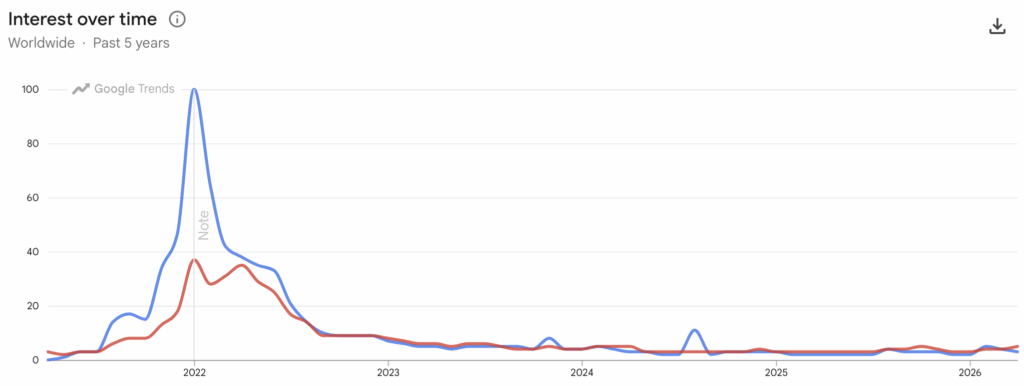
Bored Ape Yacht Club (BAYC) celebrates its fifth birthday today. Unfortunately, celebrations have been a little muted.
The project’s once massive pool of high-profile celebrity supporters that included the likes of Paris Hilton,, Mark Cuban, and Jimmy Fallon, has dwindled, and online interest has cratered.
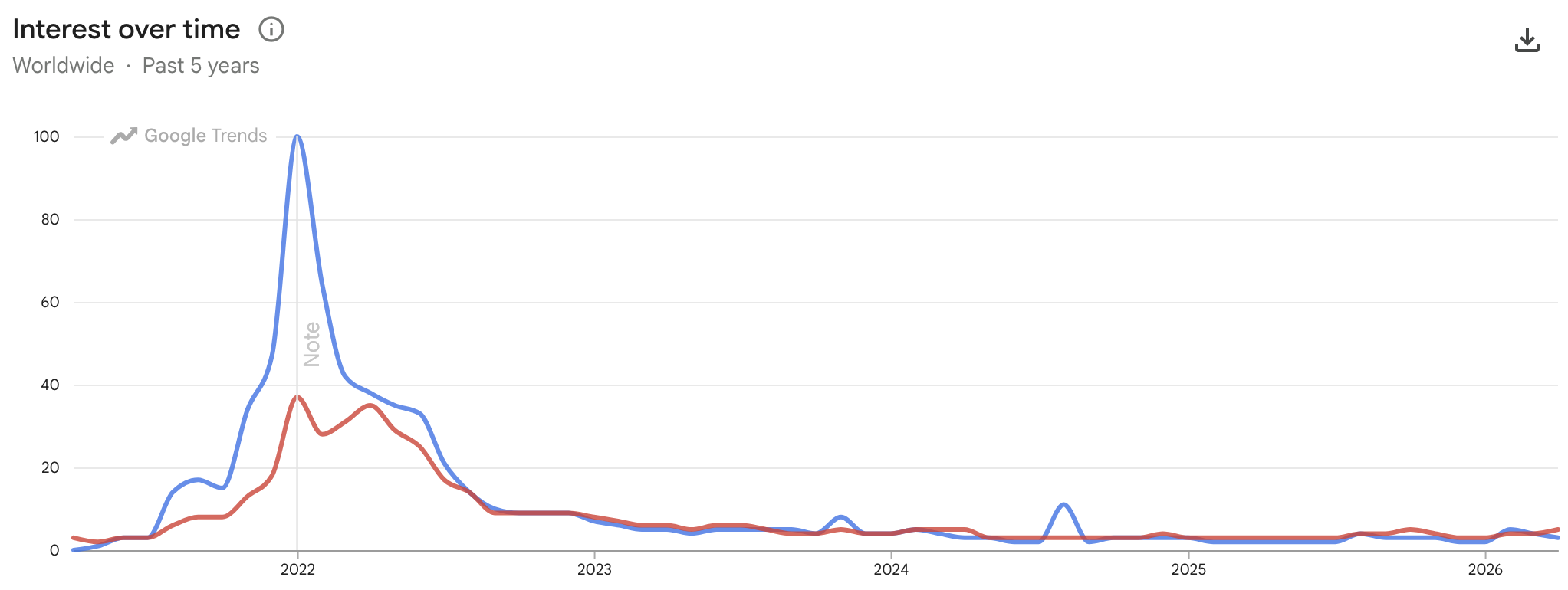
Indeed, searching Google Trends for the term “Bored Ape Yacht Club” reveals that interest in the company is 97 times lower than it was during the NFT frenzy of 2022.
During the height of NFT and Bored Ape Mania, the likes of Snoop Dogg and Eminem promoted the project and the short-lived metaverse fad onstage at various times.
Eminem at least put his money where his mouth is, reportedly buying an Ape for roughly $462,000. Unfortunately, top offers for the same NFT are now sitting at around 8.83 ether (ETH), or $20,000.
Eminem hasn’t posted anything about NFTs or BAYC on his X account since 2022.
Snoop, also spent big, paying $366,000 for four Apes back in 2021. However, the top offers for these four NFTs are worth just shy of $28,000.
And while he’s maintained some support for the floundering project, his enthusiasm seems to have waned. Despite calling it a “cultural juggernaut” at the time, he’s posted very little about the project on X since 2022.
Read more: Yuga Labs directs royalties to bankrupt FTX US
Celebrities aren’t talking about Bored Ape Yacht Club anymore
While Snoop Dogg has continued to mention BAYC from time to time, he now appears to be using it as more of an attention getter for other projects than anything else.
For example, a trip arranged by BAYC for holders to visit Snoop’s compound to celebrate 4/20 ended up being just a promotional stunt for his family’s ice cream brand, Dr Bombay — named after his Ape — which hasn’t posted on X in years.
While Snoop was briefly present at the event, and there was little to no BAYC-themed promotion from him on social media, save for a shoddy AI-generated video of his Ape and a single repost of an old image.
Other celebrities such as, Justin Bieber, Serena Williams, Neymar Jr, Post Malone, DJ Khaled, Paris Hilton, Mark Cuban, and Jimmy Fallon have all supported the BAYC brand.
Canadian pop elf Bieber paid roughly $1.3 million for his very own Ape in 2021. Its current top offer is roughly $19,000 and he’s seemingly not happy, having posted nothing at all about BAYC or NFTs.
Brazilian footballer Neymar Jr. spent over $1.1 million on two APES in 2022, however these are now worth somewhere in the region of $57,000.
Surprise surprise, Neymar hasn’t posted about NFTs or BAYC since 2022.
Talk show host Fallon spent $224,000 buying an Ape in 2021 but its value has since slid to just $19,000.
He hasn’t talked about it on X since.
DJ Khaled, Paris Hilton, Mark Cuban, and Serena Williams have all neglected to mention BAYC since 2022 on X while Post Malone brings up no results for either NFTs or BAYC.
Perhaps worst of all, none of these celebrities wished BAYC a happy birthday today.
Read more: Yuga Labs wants Pauly0x’s $400K worth of crypto seized
As interest in BAYC itself dries up, so too are the funds entering its wider NFT ecosystem.
The floor price of the BAYC collection is down 94.3% from its all-time high in May 2022, while BAYC’s token ApeCoin is also down 99.6% from it’s similarly timed peak.
Last year, one BAYC buyer sold two of his NFTs at a 92% loss despite holding them during the 2022 craze. During the May highs, they were worth $4.3 million, however, they eventually sold them for $420,000.
Five years of legal wrangling and blinding fans
2021/2022 was a wild couple of years for BAYC and its followers.
It appeared to have hit the mainstream in earnest when Jimmy Fallon and Paris Hilton awkwardly promoted the project on his primetime talk show. Meanwhile, Snoop Dogg and Eminem sang the brand’s praises at the MTV VMAs.
However, these celebrity endorsements ultimately led to a 2022 lawsuit which accused the project’s creator Yuga Labs of promoting the NFTs without clarifying their compensation. It also claimed that the NFTs should be classified as securities.
Three years later, a judge dismissed the lawsuit and ruled that NFTs are not, in fact, securities.
Read more: BAYC goes full ‘laser eyes’ and allegedly blinds ApeFest attendees
Further damaging to BAYC’s image was its 2023 ApeFest. The event was a three-day get together in Hong Kong that, far from catapulting Bored Apes to even greater heights, was thrown into chaos when UV lighting used on stage temporarily blinded a number of attendees.
The previous year, Yuga Labs bought the rights to NFT collection CryptoPunks. However, by 2025, it sold that stake to the non-profit Node Foundation for $20 million.
In 2024, Yuga Labs sunk $450 million into web3 game Otherside. Its launch was a virtually unplayable buggy mess.
Today, the firm continues to promote meetups with holders, and recently replaced its former CEO Greg Solano with Michael Figge.
Got a tip? Send us an email securely via Protos Leaks. For more informed news and investigations, follow us on X, Bluesky, and Google News, or subscribe to our YouTube channel.
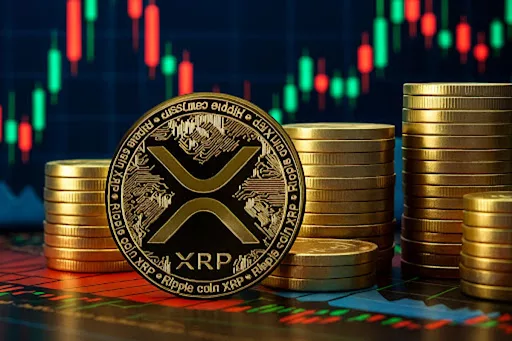
XRP is grinding in the mid‑$1.40s, trapped between stubborn resistance and strong support as fresh “digital commodity” clarity, ETF rails and April seasonality fight flat flows.
Summary
- XRP trades around 1.42–1.45, still roughly 60% below its 2018 all‑time high near $3.65, with a key 1.30–1.35 support band and 1.50–1.52 acting as near‑term resistance.
- April is historically XRP’s strongest month with average returns above 20%, and 2026 is already shaping up as one of its better Aprils thanks to renewed regulatory clarity, ETF access and altcoin rotation.
- A joint SEC–CFTC statement now treats XRP as a digital commodity, Ripple is leaning into its “institutional rails” pitch, and derivatives open interest is well below 2025 peaks, leaving room for a squeeze if 1.50 breaks on volume.
XRP (XRP) is still down roughly 60% from its 2018 all‑time high near $3.65, even after a strong bounce off the low‑$1 area earlier this year. April is historically XRP’s best month, with average returns above 20%, and 2026 is already one of its strongest April performances since 2025, driven by renewed regulatory clarity and an altcoin rotation bid. The SEC’s decision to fully drop its lawsuit against Ripple resets the narrative: the token moves from “regulatory orphan” back to credible settlement rail, which institutions actually model in their payment stacks.
XRP market structure and history
Spot XRP is currently trading around 1.42–1.45, with most short‑term models clustering April fair value between 1.40 and 1.63. Price is compressing in a range where 1.30–1.35 acts as major support and 1.50–1.52 caps upside; above that, 1.70–1.80 opens quickly, with thin historical resistance until the high‑$1.70s. On daily charts, XRP is trading above short‑term SMAs (3–50 day) but still below the 100–200 day averages, which remain a drag; this is classic mid‑cycle repair, not euphoric blow‑off.
Volume tells the real story. Open interest in XRP derivatives is currently far below 2025 peaks and ETF flows have cooled from hundreds of millions a week to low single‑digit millions, even registering net outflows in March. Yet social sentiment is perversely strong: XRP carries one of the best positive‑to‑negative mention ratios among majors, even as price underperforms. That is exactly the kind of positioning that produces violent squeezes when a catalyst finally hits.
Recent headlines matter:
- Ripple is currently leaning into the “institutional rails” pitch, with at least a quarter of surveyed big allocators planning to add XRP exposure in 2026.
- A joint SEC–CFTC release is now classifying XRP as a digital commodity, with the CLARITY Act markup sitting in the near‑term pipeline.
- ETFs tied to XRP, including leveraged products, are already live and giving traditional funds cleaner access.
Smug trader’s price view (next 4–8 weeks)
Base case: XRP is currently trading in an accumulation band; I expect a grind higher into the 1.65–1.80 zone as regulatory headlines crystallize and ETF outflows stabilize. That implies roughly 15–25% upside from here, with volatility compressing first, then expanding on a clean break of 1.50–1.52 on rising volume.
Bear case: a failed breakout above 1.50 that rejects back into the range and loses 1.30 support sends XRP toward 1.15–1.20, where there is stronger historical holder density. In that scenario, leveraged longs get rinsed, and April’s “seasonality edge” dies right there.
Moon‑boy case: structurally possible, not yet probable. The 3–5 region some analysts tout would require a synchronized risk‑on regime, BTC making new highs, and a second wave of ETF inflows as banks roll out real XRP‑based payment products. I am currently treating that as an option, not a forecast.


- Chainlink price retested $9.50 as bears keep sentiment in check.
- Bridgetower has adopted Chainlink’s solutions to tokenize $11 billion in securities.
- LINK price faces short-term resistance around $9.50-$10.50.
Chainlink’s LINK token trades at $9.31 after shedding gains from intraday highs of $9.50 earlier in the day.
The altcoin continues to hover below the $10 mark amid broader market dynamics.
Macro and geopolitical headwinds remain notable factors keeping bears in control, but could Bridgetower’s adoption of Chainlink to tokenize over $11 billion in securities provide fresh momentum for LINK?
Here’s a brief outlook for Chainlink’s price following this latest milestone in institutional asset tokenization.
Bridgetower’s Chainlink integration
According to an announcement, Bridgetower is set to leverage Chainlink’s institutional platform to tokenize assets across natural resources, energy, and metals.
The move will initially bring the DOM X Arizona Copper-Gold Project, a US-based natural resource initiative valued at $11 billion, on-chain.
NOW: Bridgetower adopts Chainlink to tokenize $11B+ in securities from the DOM X Arizona Copper-Gold Project.
By integrating the full Chainlink stack into its tokenization platform, BridgeTower is unlocking the issuance and distribution of tokenized securities at scale. pic.twitter.com/wnucctQ3IP
— Chainlink (@chainlink) April 23, 2026
Bridgetower will enable the issuance and management of the tokenized asset via Chainlink’s Cross-Chain Interoperability Protocol (CCIP), Proof of Reserve, and NAVLink solutions.
The integration embeds KYC, KYB, and AML controls at the protocol level within Bridgetower’s Tokenization Platform, supported by fiat and stablecoin rails from Iron, a MoonPay company.
“We’re excited to see Bridgetower move from a CRE early adopter to live institutional tokenized asset deployment around an $11 billion asset in just a few months. All the world’s largest financial institutions are watching tokenization right now, and they are looking for production evidence for powering assets at an institutional scale,” said Johann Eid, chief business officer of Chainlink Labs.
This development strengthens Chainlink’s momentum in the tokenization sector.
Recent months have seen major financial institutions and governments tap into the oracle network for real-world asset tokenization. Chainlink has helped secure over $100 billion in total assets, and analysts say this traction could reflect in LINK’s long-term price.
Chainlink price – short-term technical outlook
With LINK hovering around $9.30, key support lies in the $8.70–$9.00 range, while immediate resistance is between $9.50 and $10.50.
If buyers push higher, a potential rebound toward $14–$15 could follow. However, a breakdown on high volume could send prices lower toward support at $7.80.
Technical indicators support this mixed outlook. The RSI on the daily chart is around 48, placing it in neutral territory and suggesting room for gains.
However, the MACD shows waning momentum with a flat histogram, hinting at a possible inflection point.

A broader bullish breakout in cryptocurrencies—particularly if Bitcoin moves above $80,000—would be supportive for LINK. Conversely, geopolitical uncertainty or escalation that dampens risk appetite could trigger selling pressure across major altcoins, including Chainlink.

Key Takeaways
- Circle Internet Group (CRCL) soared 9.7% Wednesday following a rating upgrade from Freedom Capital to hold.
- Shares reached an intraday peak of $104.39, closing up from the previous $96.02, though volume remained significantly below normal levels.
- Rising USDC stablecoin adoption is fueling investor enthusiasm as the company approaches its May 11 Q1 earnings announcement.
- The company exceeded Q4 projections with earnings per share of $0.43 versus consensus of $0.25 and year-over-year revenue growth of 76.9% to $770.23M.
- Wall Street remains divided on CRCL, with an aggregate “Hold” rating and a mean price target of $127.24.
Circle Internet Group (CRCL) posted a robust 9.7% gain Wednesday, advancing from $96.02 to an intraday high of $104.39 before stabilizing near $105.33 during midday trading.
The surge followed Freedom Capital’s decision to elevate CRCL to a hold rating. Though a hold designation typically signals neutrality, the move was sufficient to spark renewed buying momentum.
Share turnover registered approximately 2.99 million — roughly 80% beneath the typical daily average of 15.08 million. The advance occurred on subdued volume, a detail that warrants attention from active traders.
The upgrade wasn’t the sole driver. Market participants are increasingly zeroing in on accelerating demand for Circle’s USDC stablecoin and heightening institutional engagement as the May 11 Q1 earnings release approaches.
Expanding USDC reserves are being interpreted as evidence that Circle’s primary revenue engine is gaining traction. This developing story has amplified bullish sentiment.
Wall Street’s Mixed Signals
The analyst community presents a fragmented outlook. Based on MarketBeat intelligence, CRCL maintains an average “Hold” rating with a collective price target of $127.24.
The distribution: 1 Strong Buy, 9 Buy recommendations, 11 Hold ratings, and 3 Sell calls. The consensus lacks uniformity, though optimistic voices have grown more prominent recently.
Robert W. Baird increased its price objective from $110 to $138 in March while maintaining an “outperform” designation. Clear Street elevated CRCL to a strong buy recommendation during the same period.
Conversely, JPMorgan reduced its target from $100 to $90 in February while preserving an “overweight” rating — an approach that struck some observers as inconsistent.
Mizuho boosted its target from $100 to $120 in March but maintained a “neutral” stance. William Blair reaffirmed its “outperform” view in February.
Q4 Results Exceeded Expectations
Circle’s most recent quarterly disclosure, published February 25, delivered solid results. The firm reported earnings per share of $0.43 for the period, surpassing the Wall Street consensus of $0.25 by $0.18.
Revenue reached $770.23 million, representing a 76.9% year-over-year increase. These figures commanded attention across the investment community.
The analyst community collectively projects full-year earnings per share of $0.84 for the ongoing fiscal period.
The stock’s 50-day moving average currently stands at $94.86, while the 200-day moving average rests at $92.82. Wednesday’s advance positioned CRCL decisively above both technical benchmarks.
Regarding insider activity, CFO Jeremy Fox-Geen divested 4,238 shares at $90.00 on April 2, generating proceeds of $381,420. Director M. Michele Burns sold 1,666 shares at $92.38 on April 6 for $153,905. Both dispositions occurred under predetermined Rule 10b5-1 trading arrangements.
Cumulatively, company insiders have sold 545,874 shares valued at $52.99 million across the past quarter. Insiders retain ownership of 10.85% of outstanding shares.
Market capitalization approximates $25.91 billion, accompanied by a price-to-earnings multiple of -56.38.


Spanish police seized crypto cold wallets tied to an alleged illegal manga site, as questions remain over whether officers can access the funds.

Key Takeaways
- First-quarter earnings per share reached $9.71, surpassing the Wall Street estimate of $8.95
- Revenue for the quarter totaled $3.99 billion, representing an 8.7% year-over-year increase and exceeding the $3.87B forecast
- Annual revenue projection elevated to $16.9B–$17.4B range, improved from previous $16.8B–$17.3B outlook
- Expansion fueled by nonresidential construction, infrastructure projects, power sector, and mining operations
- Bernstein maintained its Outperform rating as URI has delivered 37% gains over the trailing twelve months
The equipment rental leader delivered an impressive first quarter that exceeded analyst projections on both the top and bottom lines, triggering a swift market response.
Shares of URI skyrocketed approximately 20% during Thursday’s trading session, reaching levels near $960, positioning it as the S&P 500’s strongest performer for the day. The stock has now gained 32% in April alone and posted 19% gains year-to-date.
Adjusted earnings per share for the first quarter registered at $9.71, exceeding analyst expectations of $8.95 by $0.76. This represents growth from the $8.86 per share recorded in the comparable period last year. Total revenue reached $3.99 billion, marking an 8.7% increase from the prior-year figure of $3.72 billion and surpassing the consensus estimate of $3.87 billion.
Rental revenue—representing the company’s primary business segment—advanced to $3.42 billion, improving from $3.15 billion in the first quarter of 2025 and establishing a new quarterly record for the period. The average original equipment cost increased 5.7%, while overall fleet productivity showed improvement of 2.3%.
CEO Matthew Flannery highlighted that expansion came from multiple business segments. On the construction front, nonresidential construction and infrastructure projects drove performance, while the industrial segment benefited from strength in power, mining, and minerals.
New construction activity in healthcare facilities, data centers, manufacturing plants, and infrastructure projects all played a role in the quarter’s strong showing.
Company Elevates Full-Year Projections
United Rentals increased its annual revenue forecast to a range of $16.9 billion to $17.4 billion, representing an upgrade from the previous guidance of $16.8B to $17.3B. The revised midpoint of $17.15 billion slightly exceeds the Street consensus of $17.07 billion.
The company tightened its adjusted EBITDA guidance to $7.625B–$7.875B, compared to the earlier range of $7.575B–$7.825B. Free cash flow projections remained steady at $2.15B–$2.45B.
During the analyst call, Flannery noted the year is “playing out better than we expected just a few months ago,” emphasizing that field-level feedback continues to be positive, particularly regarding large-scale projects.
World Cup Tournament Provides Additional Tailwind
Flannery specifically highlighted one notable opportunity: the 2026 FIFA World Cup. The company anticipates serving as “a key partner” for the international tournament beginning in the second quarter.
Construction activity is currently progressing throughout host cities in the United States, Mexico, and Canada, encompassing stadium modifications to meet FIFA specifications along with extensive infrastructure enhancements.
First-quarter adjusted EBITDA totaled $1.76 billion, exceeding consensus projections by 5%. The General Rentals segment posted gross margins of 33.8%, approximately 180 basis points higher than analyst forecasts. Specialty segment gross margins reached 41.4%, falling roughly 200 basis points short of expectations, although Specialty rental revenues still surpassed estimates by 5%.
Bernstein SocGen Group maintained its Outperform rating on the stock following the quarterly report, keeping its price target at $903. The current trading price near $960 places shares significantly above that target following Thursday’s rally.
URI’s market capitalization now stands at roughly $50.5 billion, with the stock generating approximately 37% returns over the past year.

Bitcoin Eyes Key Weekly Close After Failing to Revisit $80K

Starmer won’t answer when asked if Cabinet backs him

Sidney Crosby gets first embellishment penalty of his career in Penguins Game 3 loss

Manchester United reach agreement with Casemiro over contract clause amid transfer speculation

Steven Gerrard disagrees with Gary Neville over ‘shock’ Chelsea and Arsenal claim | Football

US brings back mandatory military draft registration


-

 Sports6 days ago
NWFL Suspends Two Players Over Post-Match Clash in Ado-Ekiti
-

 Fashion6 days ago
Weekend Open Thread: Theodora Dress
-

 Politics6 days ago
Palestine barred from entering Canada for FIFA Congress
-
Entertainment4 days ago
NBA Analyst Charles Barkley Chimes in on Ice Spice McDonald’s Fiasco
-

 Tech5 days ago
Auto Enthusiast Scores Running Tesla Model 3 for Two Grand and Turns It Into Bare-Bones Go-Kart
-

 Business4 days ago
Powerball Result April 18, 2026: No Jackpot Winner in Powerball Draw: $75 Million Rolls Over
-

 Politics4 days ago
Zack Polanski demands ‘council homes not luxury flats for foreign investors’
-

 Crypto World6 days ago
Russia Pushes Bill to Criminalize Unregistered Crypto Services
-

 Politics3 days ago
Gary Stevenson delivers timely reminder to register to vote as deadline TODAY
-

 Business1 day ago
Rolls-Royce Voted UK’s Most Iconic Trade Mark as IPO Register Hits 150
-

 Politics23 hours ago
Disabled people challenge government SEND proposals over segregation concerns
-

 Politics23 hours ago
Making troops accountable for war crimes threatens US alliance, ex-SAS colonel warns
-
 Business7 days ago
Creo Medical agree sale of its manufacturing operation
-

 Crypto World6 days ago
Russia Introduces Bill To Criminalize Unregistered Crypto Services
-

 Politics1 day ago
Starmer handler McSweeney to be dragged from shadows by Foreign Affairs Committee
-

 Politics1 day ago
Zack Polanski responds to home secretary’s taser threat
-
Politics1 day ago
Wings Over Scotland | How To Get Away With Crimes
-
 Crypto World5 days ago
Kelp DAO rsETH Bridge Hack Drains $292M as DeFi Losses Top $600M in Two Weeks
-

 Politics22 hours ago
‘Iran is still a nuclear threat’
-

 Crypto World2 days ago
New York sues Coinbase, Gemini over prediction market offerings
You must be logged in to post a comment Login